EP0410930B1 - Colorants formazane réactifs avec des fibres, leurs procédés de préparation et leur utilisation - Google Patents
Colorants formazane réactifs avec des fibres, leurs procédés de préparation et leur utilisation Download PDFInfo
- Publication number
- EP0410930B1 EP0410930B1 EP90810546A EP90810546A EP0410930B1 EP 0410930 B1 EP0410930 B1 EP 0410930B1 EP 90810546 A EP90810546 A EP 90810546A EP 90810546 A EP90810546 A EP 90810546A EP 0410930 B1 EP0410930 B1 EP 0410930B1
- Authority
- EP
- European Patent Office
- Prior art keywords
- formula
- dye
- fibre
- compound
- parts
- Prior art date
- Legal status (The legal status is an assumption and is not a legal conclusion. Google has not performed a legal analysis and makes no representation as to the accuracy of the status listed.)
- Expired - Lifetime
Links
- 0 C*1C(*)=NC(C)=NC1C=C Chemical compound C*1C(*)=NC(C)=NC1C=C 0.000 description 4
Classifications
-
- C—CHEMISTRY; METALLURGY
- C09—DYES; PAINTS; POLISHES; NATURAL RESINS; ADHESIVES; COMPOSITIONS NOT OTHERWISE PROVIDED FOR; APPLICATIONS OF MATERIALS NOT OTHERWISE PROVIDED FOR
- C09B—ORGANIC DYES OR CLOSELY-RELATED COMPOUNDS FOR PRODUCING DYES, e.g. PIGMENTS; MORDANTS; LAKES
- C09B50/00—Formazane dyes; Tetrazolium dyes
-
- C—CHEMISTRY; METALLURGY
- C09—DYES; PAINTS; POLISHES; NATURAL RESINS; ADHESIVES; COMPOSITIONS NOT OTHERWISE PROVIDED FOR; APPLICATIONS OF MATERIALS NOT OTHERWISE PROVIDED FOR
- C09B—ORGANIC DYES OR CLOSELY-RELATED COMPOUNDS FOR PRODUCING DYES, e.g. PIGMENTS; MORDANTS; LAKES
- C09B62/00—Reactive dyes, i.e. dyes which form covalent bonds with the substrates or which polymerise with themselves
- C09B62/44—Reactive dyes, i.e. dyes which form covalent bonds with the substrates or which polymerise with themselves with the reactive group not directly attached to a heterocyclic ring
- C09B62/4401—Reactive dyes, i.e. dyes which form covalent bonds with the substrates or which polymerise with themselves with the reactive group not directly attached to a heterocyclic ring with two or more reactive groups at least one of them being directly attached to a heterocyclic system and at least one of them being directly attached to a non-heterocyclic system
- C09B62/4403—Reactive dyes, i.e. dyes which form covalent bonds with the substrates or which polymerise with themselves with the reactive group not directly attached to a heterocyclic ring with two or more reactive groups at least one of them being directly attached to a heterocyclic system and at least one of them being directly attached to a non-heterocyclic system the heterocyclic system being a triazine ring
- C09B62/4407—Formazane dyes
-
- Y—GENERAL TAGGING OF NEW TECHNOLOGICAL DEVELOPMENTS; GENERAL TAGGING OF CROSS-SECTIONAL TECHNOLOGIES SPANNING OVER SEVERAL SECTIONS OF THE IPC; TECHNICAL SUBJECTS COVERED BY FORMER USPC CROSS-REFERENCE ART COLLECTIONS [XRACs] AND DIGESTS
- Y10—TECHNICAL SUBJECTS COVERED BY FORMER USPC
- Y10S—TECHNICAL SUBJECTS COVERED BY FORMER USPC CROSS-REFERENCE ART COLLECTIONS [XRACs] AND DIGESTS
- Y10S534/00—Organic compounds -- part of the class 532-570 series
- Y10S534/01—Mixtures of azo compounds
Definitions
- the present invention relates to new fiber-reactive formazan dyes, processes for their preparation and the use of these dyes for dyeing and printing fiber materials.
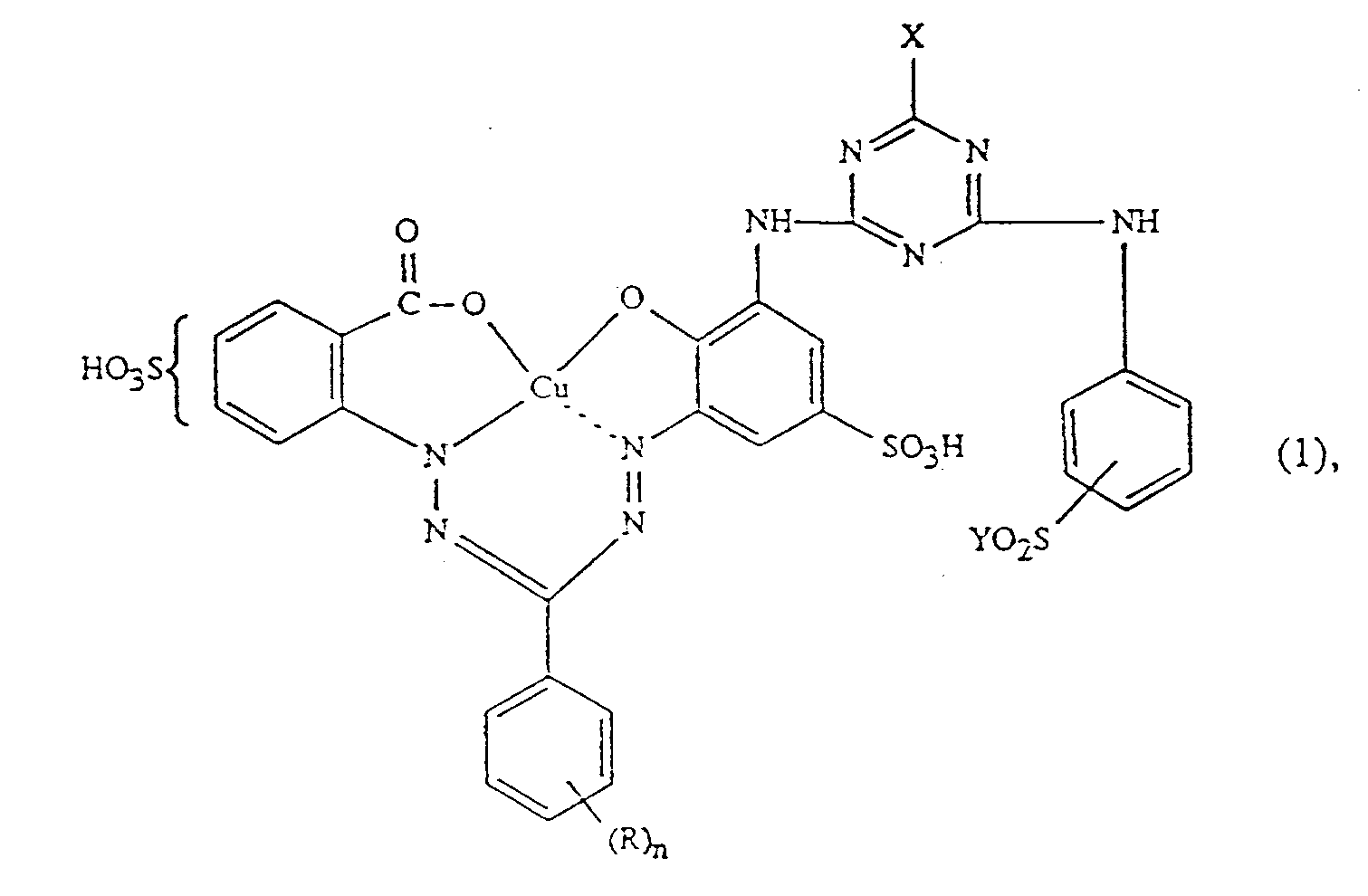
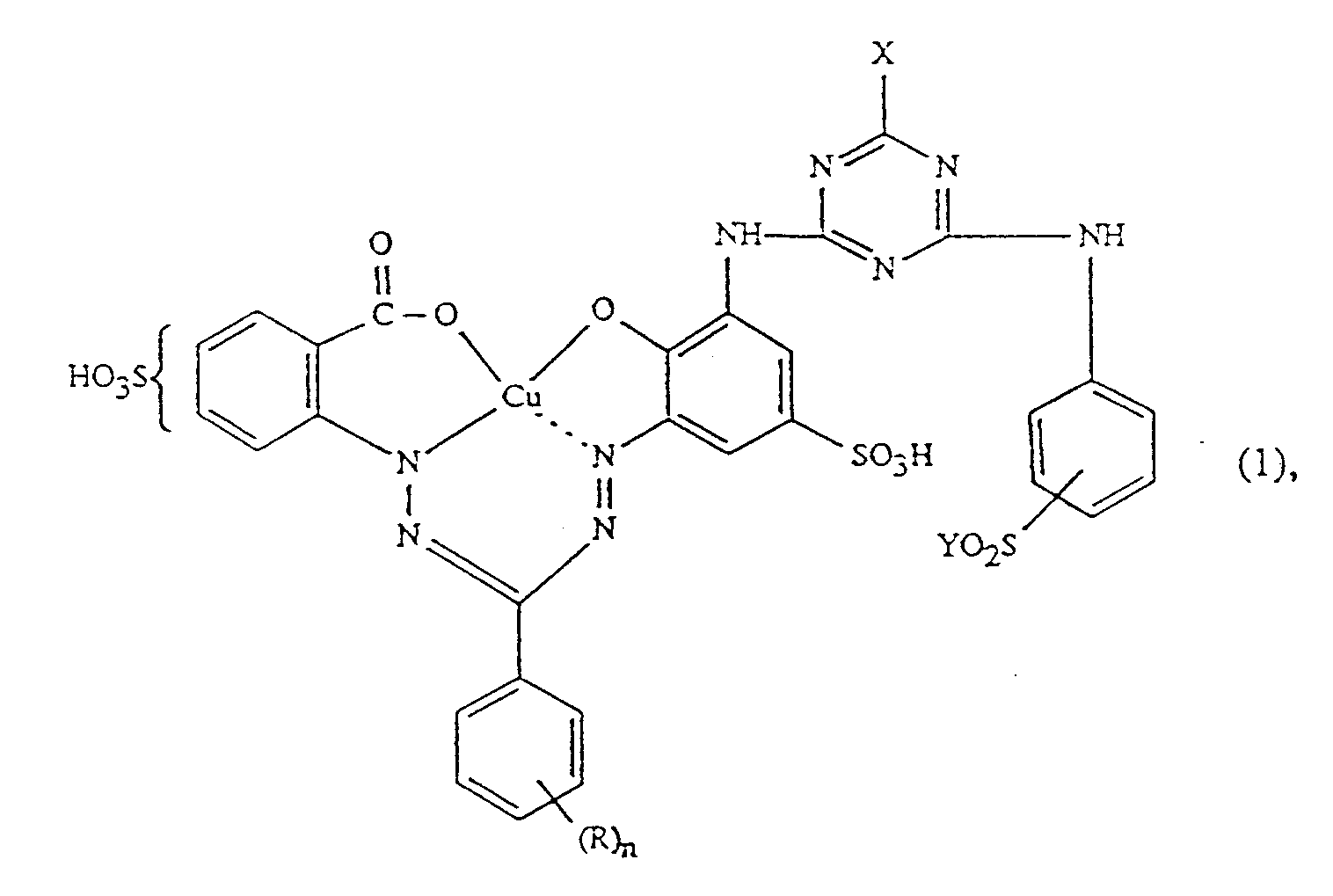
- the present invention relates to fiber-reactive formazan dyes of the formula wherein R is C1-C4-alkyl, C1-C4-alkoxy, halogen, cyan or nitro, X is fluorine or chlorine and n is the number 0, 1 or 2.
- the curly brackets have the meaning that the respective group can be bound to one of the two positions of the benzine ring encompassed by the curly bracket.
- C1-C4-alkyl for R in formula (1a) or in the following formula (1) e.g. Methyl, ethyl, propyl, isopropyl, butyl, tert-butyl, sec-butyl or isobutyl, especially methyl, into consideration.
- halogen for R in formula (1a) or in the following formula (1) is, for example: Fluorine, bromine or preferably chlorine.
- dyes of the formula (1a) or (1b) are preferred, in which X is chlorine.
- Dyes of the formula are particularly preferred where X is fluorine or especially chlorine.
- the invention further relates to a process for the preparation of the dyes of the formula (1), which is characterized in that a compound of the formula with one the rest of the formula introducing compound, or a compound of formula with one the rest of the formula introducing compound, wherein R, X and n have the meanings given under formula (1a).
- halides in particular chlorides or fluorides, are preferably suitable as compounds introducing the rest of the formula (5a) or (5b). Examples include:
- One embodiment of the process according to the invention is characterized in that a compound of the formula (4b) is used to form the rest of the formula introducing compound, where X is fluorine or especially chlorine and B is a radical which can be split off under alkaline conditions, such as, for example, -OSO3H, -SSO3H, -OPO3H2, -S-CS-N (C2H5) 2, -N (CH3) 2, - N (C2H5) 2, -OCOCH3.
- X is fluorine or especially chlorine
- B is a radical which can be split off under alkaline conditions, such as, for example, -OSO3H, -SSO3H, -OPO3H2, -S-CS-N (C2H5) 2, -N (CH3) 2, - N (C2H5) 2, -OCOCH3.
- Corresponding halides in particular chlorides or fluorides, are preferably suitable as compounds introducing the rest of the formula (6). As an example called.
- a preferred embodiment of the process according to the invention is characterized in that a compound of the formula (4a) or (4b) is firstly reacted with a compound of the formula wherein X is fluorine or chlorine and Hal each halogen, especially fluorine or chlorine, condenses, and the condensation product of the compound of formula (4a) and the compound of formula (7) then with the rest of the formula implementing introductory connection, or the condensation product of the compound of formula (4b) and the compound of formula (7) then with the rest of the formula introducing connection.
- Examples of compounds of the formula (7) are cyanuric fluoride and cyanuric chloride.
- Examples of compounds introducing the rest of formula (8a) are 3- or 4- ( ⁇ -chloroethylsulfonyl) aniline and examples of compounds introducing the rest of formula (8b) are 4-vinylsulfonylaniline.
- 4- ( ⁇ -Sulfatoethylsulfonyl) aniline may be mentioned as an example of the compounds introducing the rest of the formula (9).
- the reaction of the compound of formula (4a) with the compound introducing the rest of formula (5a), the reaction of the compound of formula (4b) with the compound introducing the rest of formula (5b) or the compound introducing the rest of formula (6) or the condensation of the compound of formula (4a) or (4b) with the compound of formula (7) and the subsequent reaction of the condensation product with the rest of the formula (8a), (8b) or the rest of the formula (9) introductory compound is preferably carried out in aqueous solution, emulsion or suspension, at low temperature, for example 0 to 40 ° C, and with a weakly acidic, neutral to weakly alkaline pH.
- the hydrogen halide liberated during the condensation is advantageously continuously neutralized by adding aqueous alkali metal hydroxides, carbonates or bicarbonates.
- a preferred embodiment of the process according to the invention is characterized in that a compound of the formula (5a) is used as the compound of the formula or as a compound of formula (8a) a compound of formula used, where X has the meanings given under the formulas (1a) and (1b).
- a further preferred embodiment of the process according to the invention is characterized in that a compound introducing the rest of the formula (5a), (5b) or (6) is used, in which X is chlorine.
- Cyanuric chloride is preferably used as the compound of formula (7).
- a particularly preferred embodiment of the process according to the invention for the preparation of the dyes of the formula (3) is characterized in that a compound of the formula condensed with cyanuric chloride or cyanuric fluoride and then reacting the condensation product with a compound introducing the rest of the formula (11).
- a process for the preparation of the dyes of the formula (3) is characterized in that a compound of the formula (12) is reacted with a compound introducing the rest of the formula (10), in which X has the meanings given under formula (3).
- the compounds of the formulas (4a) and (4b) are known per se or can be prepared analogously to known compounds.
- the dyes of the formula (1a) or (1b) are suitable for dyeing and printing a wide variety of fiber materials, in particular textile fiber materials, preferably textile materials containing hydroxyl groups or nitrogen, such as silk, fiber materials made of cellulose and in particular wool, synthetic polyamide fiber materials, such as polyamide 6 and polyamide-6,6 and leather and paper.
- textile fiber materials preferably textile materials containing hydroxyl groups or nitrogen, such as silk, fiber materials made of cellulose and in particular wool, synthetic polyamide fiber materials, such as polyamide 6 and polyamide-6,6 and leather and paper.
- level dyeings in blue shades with good general fastness properties, in particular good wet fastness properties, such as, for example, wet rub resistance and good light fastness are obtained.
- the dyes of the formulas (1a) or (1b) can be combined very well with other reactive dyes.
- the above-mentioned textile material can be in a wide variety of processing forms, such as yarn, woven or knitted fabric.
- the dyes of the formulas (1a) or (1b) according to the invention have a high reduction stability, a good pull-up behavior and a good fixing speed as well as a high fiber levelness and show no dichroism.
- the dyes of the formulas (1a) or (1b) according to the invention which contain two sulfonic acid groups are present either in the form of their free acid or preferably as their salts.
- Suitable salts are, for example, alkali, alkaline earth or ammonium salts or the salts of an organic amine. Examples include the sodium, lithium, potassium or ammonium salts or the salt of triethanolamine.
- the dyes according to the invention is their suitability for trichromatic dyeing and printing of natural or synthetic polyamide fiber materials together with a fiber-reactive yellow or orange dye and a fiber-reactive red dye.
- Trichromatic is to be understood as the additive color mixture of suitably selected yellow or orange, red and blue coloring dyes, with which practically every desired shade of the visible color spectrum can be adjusted by suitable choice of the proportions.
- the dyes to be used in the trichromatic process are said to show a uniform color build-up with constant shade in different concentrations and good combinability.
- the invention also relates to a process for trichromatic dyeing or printing of natural and synthetic polyamide fiber materials with dye mixtures of fiber-reactive dyes, which is characterized in that a blue-coloring dye is used formula wherein R is C1-C4-alkyl, C1-C4-alkoxy, halogen, cyan or nitro, X is fluorine or chlorine, Y ⁇ -chloroethyl or vinyl and n is the number 0, 1 or 2, together with a fiber-reactive, sulfo-containing yellow or orange dye and a fiber-reactive, sulfo-containing red dye.
- a blue-coloring dye is used formula wherein R is C1-C4-alkyl, C1-C4-alkoxy, halogen, cyan or nitro, X is fluorine or chlorine, Y ⁇ -chloroethyl or vinyl and n is the number 0, 1 or 2, together with a fiber-reactive, sulfo-containing yellow
- fiber-reactive, sulfo-containing yellow or orange and red-dyeing azo dyes which preferably contain a halogenotriazine or halopyrimidine group or a group from the aliphatic series as the fiber-reactive group.
- difluorochloropyrimidinyl in particular 2,4-difluoro-5-chloropyrimidinyl
- ⁇ , ⁇ -dihalopropionyl in particular ⁇ , ⁇ -dibromopropionyl
- ⁇ -haloacryloyl in particular ⁇ -bromoacryloyl
- Suitable yellow or orange-colored, fiber-reactive, fiber-reactive dyes are:
- suitable red-coloring, sulfo-containing, fiber-reactive dyes are the following: wherein acyl is, for example, acetyl or optionally substituted benzoyl.
- R ' represents a fiber-reactive radical, in particular a fiber-reactive radical of the halotriazine or halogen pyrimidine series or the aliphatic series, preferably R' means difluorochloropyrimidinyl or ⁇ , ⁇ -dihalopropionyl or ⁇ -bromoacryloyl.
- R '2,4-difluoro-5-chloropyrimidin-6-yl or ⁇ , ⁇ -dibromopropionyl or ⁇ -bromoacryloyl is particularly preferred.
- Another object of the invention are trichromatic dye mixtures, which are characterized in that they contain a blue-coloring dye of the formula (1) together with a yellow or orange-colored sulfo group-containing reactive dye and a red-colored sulfo group-containing reactive dye, the blue-coloring dye of the formula (1 ), the yellow or orange-colored sulfo-containing reactive dye and the red-dyeing sulfo-containing reactive dye, the meanings and preferences given above apply.
- the yellow, orange and red coloring dyes used in the process according to the invention for trichromatic dyeing or printing and in the trichromatic dye mixtures according to the invention are known or can be prepared in analogy to known dyes.
- the dyes are either in the form of their free sulfonic acid or, preferably, as their salt, it being possible to use the same salts as those given for the dyes of the formula (1).
- the amounts in which the dyes of the formula (1) and the yellow or orange and red-dyeing fiber-reactive dyes are used in the dyebaths or printing pastes can vary within wide limits depending on the desired depth of color, in general amounts of 0 , 01 to 10 percent by weight, in particular 2 to 10 percent by weight, based on the material to be dyed or the printing paste, proven to be advantageous.
- Fiber material made from natural polyamides, in particular wool, is preferably used in the process according to the invention.
- the usual dyeing and printing apparatus and machines can be used, for example for flake, sliver, strand yarn, bobbins, piece goods and carpets.
- the aqueous dye baths can also contain auxiliaries, in particular leveling assistants.
- the leveling aids are used in an amount of 0.3 to 3 percent by weight, based on the fiber material.
- the dyebaths can contain mineral acids, such as sulfuric acid, sulfamic acid or phosphoric acid, organic acids, expediently lower, aliphatic carboxylic acids, such as formic acid, acetic acid or maleic acid.
- the acids are used primarily to adjust the pH of the liquors used according to the invention.
- the pH is preferably adjusted from 3 to 6 with an organic acid, in particular formic acid or acetic acid.
- the dye liquor can also contain various salts, in particular ammonium salts or alkali salts, such as ammonium sulfate or sodium sulfate, as auxiliaries.
- various salts in particular ammonium salts or alkali salts, such as ammonium sulfate or sodium sulfate, as auxiliaries.
- the liquor ratio can be selected within a wide range, from 1: 6 to 1:80, preferably 1:10 to 1:50.
- Dyeing is carried out from an aqueous liquor using the exhaust process, e.g. at a temperature between 80 and 105 ° C or 110 ° C when using a formaldehyde-releasing wool protection agent, preferably between 98 ° and 103 ° C.
- the dyeing time is usually 30 to 90 minutes.
- a particularly preferred embodiment of the process according to the invention is characterized in that after dyeing at preferably 98 to 103 ° C., the dye liquor is allowed to cool to approx. 75 ° to 90 ° C. and the pH to 8 to 9, preferably to approx. 8.5.
- the pH can be adjusted using conventional means, e.g. Alkali hydroxide solutions and in particular with an aqueous ammonia solution of the usual concentration, e.g. Containing 25 weight percent ammonia.
- parts represent parts by weight.
- the temperatures are degrees Celsius.
- the relationship between parts by weight and parts by volume is the same as that between grams and cubic centimeters.
- Example 1 13.24 parts of the chromophore of the formula are taken up in 200 parts of water, mixed with 0.6 parts of disodium hydrogen phosphate and heated to 40 °, a clear solution being formed after the addition of sodium hydroxide solution up to pH 6.5. After cooling to 0 to 2 °, a solution of 3.9 parts of cyanuric chloride in 25 parts of acetone is added dropwise over the course of 2 to 3 minutes, the pH being kept at 6.25 with sodium hydroxide solution.
- EXAMPLE 3 If the procedure is as described in Example 1, but instead of 13.24 parts of the chromophore of the formula (101), an equimolar amount of the chromophore of the formula used, 21.4 parts of a dye are obtained, which corresponds to the formula (105).
- the dye of formula (105) dyes wool in real blue shades.
- EXAMPLE 4 If the procedure is as described in Example 1, but instead of 13.24 parts of the chromophore of the formula (101), 16.6 parts of the chromophore of the formula (104) from Example 3 and instead of 5.27 parts of 4- (2 '-Chloräthylsulfonyl) aniline 6.6 parts of 3- (2'-chloroethylsulfonyl) aniline used, 27.8 parts of a dye which corresponds to the formula (106). The dye of formula (106) dyes wool in real blue shades.
- Example 5 2.2 parts of 4- (2'-chloroethylsulfonyl) aniline are dissolved in a mixture of 25 parts of acetone and 25 parts of water. After cooling to 0 to 2 °, 1.49 parts of cyanuric fluoride are added dropwise in the course of 1 to 2 minutes, the pH being kept at 6 to 6.5 by adding sodium hydroxide solution. After the condensation has ended, a solution of 5.96 parts of the chromophore of the formula (104) in 50 parts of water is added dropwise at 5 ° in the course of 10 minutes, the pH being kept at 6.25 with sodium hydroxide solution.
- the dye of formula (107) dyes wool in real blue shades.
- Example 7 2.81 parts of 4- (2'Sulfatoethylsulfonyl) aniline are taken up in 42 parts of water and dissolved at room temperature with sodium hydroxide solution at a pH of 6.5. After cooling to 0 to 2 °, 1.49 parts of cyanuric fluoride are added dropwise in the course of 1 to 2 minutes, the pH being kept at 6 to 6.5 by adding sodium hydroxide solution. After the condensation has ended, a solution of 5.96 parts of the chromophore of the formula (104) in 50 parts of water is added dropwise at 5 ° in the course of 10 minutes, the pH being kept at 6.25 with sodium hydroxide solution.
- the compound obtained After stirring at room temperature and addition of sodium chloride, the compound obtained is filtered off with suction, washed with sodium chloride solution and dried at 60 to 70 °. 5 parts of the compound thus obtained are dissolved in 50 parts of water, adjusted to pH 10 with sodium hydroxide solution and stirred for 20 hours at room temperature. The pH is then adjusted to 7 using hydrochloric acid and the dye obtained is filtered off with suction. After washing with sodium chloride solution and drying at 60 to 70 °, 3.3 parts of a dye are obtained, that corresponds to the formula (109).
- the dye of formula (109) dyes wool in real blue shades.
- Example 4 parts of the dye obtained in Example 1 are dissolved in 100 parts of hot water and added to the above dyebath. Then 100 parts of pre-wetted wool knitting yarn are used and the temperature of the bath is increased from 50 to 80 ° in the course of 30 minutes. After 20 minutes of dyeing at 80 °, the mixture is heated to boiling and then dyeing at the boil for 90 minutes. The dye is almost completely absorbed on the substrate. After the bath has cooled to 80 °, the pH is raised from about 4.5 to 8.5 by adding ammonia solution increased and the material to be dyed for 20 minutes at this temperature. After thorough rinsing with hot and cold water, acidification with 1 part of 80% formic acid, centrifugation and drying, a dark blue colored wool yarn with very good fastness to wet and rubbing as well as excellent lightfastness is obtained.
- a felt-resistant wool fabric is soaked with the preparation described below and squeezed to a moisture absorption of 250% on the foulard.
- the impregnated material is then pressed in a heatable press for 3 minutes at 100 to 105 ° under a pressure of about 0.5 kg / cm 2 with a transfer paper which bears a printing pattern applied in the usual way with the dye according to Example 2. After rinsing and drying the wool fabric, it has a corresponding blue print pattern with very good fastness properties.
- a flannel fabric made of chlorinated wool is soaked on a foulard with the dye preparation described below and squeezed to a liquid absorption of 100%: 50 parts of the dye according to Example 3 300 parts of Solvitose OFA® at 40% (thickener) 20 parts of a mixture of anionic fatty alcohol ether sulfate with non-ionic wetting agents 10 parts of the leveling agent used in dyeing example 1 20 parts acetic acid 80% 600 parts of water 1000 pieces Padding fleet.
- the impregnated fabric is then placed in a steamer and treated with saturated steam for 20 to 40 minutes. After rinsing with cold water, the material is treated on a fresh bath with sufficient 24% ammonia solution to reach a pH of 8.5 and to keep it at 80 ° for 15 minutes. After rinsing in warm water, it is finally acidified with 80% acetic acid and dried.
- the wool fabric is dyed in a full shade of blue with excellent fastness properties.
- Example 3 parts of the dye obtained in Example 1 are dissolved in 100 parts of hot water and added to the above dyebath.
- a circulation dyeing machine is loaded with 100 parts of pre-wetted comb in a winding form and the temperature of the bath is increased from 50 to 97-99 ° in the course of 30 minutes, and then stained boiling for 90 minutes. The dye is almost completely absorbed on the substrate.
- the pH is increased from about 4.5 to 8.5 by adding ammonia solution and the material to be dyed is treated at this temperature. After thorough rinsing with hot and cold water, acidification with 1 part of 80% formic acid, centrifugation and drying, a dark blue colored material with very good wet fastness and excellent lightfastness is obtained.
- Example 5 3 parts of the dye obtained in Example 5 are dissolved in 100 parts of hot water and added to the above dyebath.
- a circulation dyeing machine is charged with 150 parts of pre-wetted loose wool and the temperature of the liquor is increased from 50 ° to 97-99 ° in the course of 30 minutes and then dyed boiling for 90 minutes. The dye is almost completely absorbed on the substrate.
- the pH is increased from about 4.5 to 8.5 by adding ammonia solution and the material to be dyed is aftertreated for 20 minutes at this temperature.
- acidification with 1 part of 80% formic acid, centrifugation and drying, a fiber-shelved blue-colored substrate with good wet and rub fastness and excellent lightfastness is obtained.
- Example 2 0.6 part of the dye obtained in Example 2 and 0.09 part of the yellow dye of the formula and 0.2 part of the red dye of the formula are dissolved in 100 parts of hot water and added to the above dyebath.
- a circulation dyeing machine is charged with 100 parts of pre-wetted comb in a winding form and the temperature of the bath is increased from 50 to 97-99 ° in the course of 30 minutes and then stained boiling for 90 minutes. The dye is almost completely absorbed on the substrate.
- the pH is raised from about 4.5 to 8.5 by adding ammonia solution and the material to be dyed is aftertreated for 20 minutes at this temperature.
- acidification 1 part of 80% formic acid, centrifugation and drying, a gray colored dye is obtained with very good fastness to wet and rubbing as well as excellent lightfastness.
Landscapes
- Chemical & Material Sciences (AREA)
- Organic Chemistry (AREA)
- Coloring (AREA)
- Heterocyclic Carbon Compounds Containing A Hetero Ring Having Oxygen Or Sulfur (AREA)
Claims (13)
- Procédé de préparation de colorants de type formazan réactifs vis-à-vis des fibres de formule


- Procédé conforme à la revendication 1, caractérisé en ce que l'on utilise, comme composé de formule (5a), un composé de formule

- Procédé conforme à une des revendications 1 et 2, caractérisé en ce que l'on utilise un composé de formule (4a) dans lequel n est égal à 0.
- Procédé conforme à une des revendications 1 et 3, caractérisé en ce que l'on utilise un composé de formule (5a) ou un composé de formule (5b) dans lesquels X représente un atome de chlore.
- Utilisation des colorants de type formazan réactifs vis-à-vis des fibres obtenus conformément à une des revendications 1 à 4 pour la teinture et l'impression.
- Utilisation conforme à la revendication 5 pour la teinture et l'impression de papier, de cuir ou de matériaux fibreux textiles contenant des groupes hydroxyle ou des atomes d'azote.
- Procédé pour la teinture ou l'impression en trichromie de matériaux fibreux en polyamide naturel ou synthétique à l'aide de mélanges de colorants, caractérisé en ce que l'on utilise un colorant de type formazan réactif vis-à-vis des fibres de formule
- Procédé conforme à la revendication 7, caractérisé en ce que l'on utilise, comme colorants jaunes ou oranges et rouges réactifs vis-à-vis des fibres et contenant des groupes sulfo, des colorants azoïques.
- Procédé conforme à une des revendications 7 et 8, caractérisé en ce que les colorants jaunes ou oranges et rouges contiennent, comme groupe réactif vis-à-vis des fibres, un groupe de type halogénotriazine, halogénopyrimidine ou un groupe de la série aliphatique.
- Procédé conforme à une des revendications 7 à 9, caractérisé en ce que les colorants jaunes ou oranges et rouges contiennent, comme groupe réactis vis-à-vis des fibres, des groupes difluorochloropyrimidinyle, en particulier le groupe 2,4-difluoro-5-chloropyrimidinyle, ou α,β-dihalogénopropionyle en particulier le groupe α,β-dibromopropionyle, ou α-halogénoacryloyle en particulier α-bromoacryloyle.
- Procédé conforme à une des revendications 7 à 10, caractérisé en ce que l'on utilise pour la teinture ou l'impression en trichromie, du matériau en polyamide naturel, en particulier de la laine.
- Procédé de préparation de mélanges de colorants trichromiques, caractérisé en ce que l'on mélange un colorant de type formazan réactif vis-à-vis des fibres de formule
Applications Claiming Priority (2)
| Application Number | Priority Date | Filing Date | Title |
|---|---|---|---|
| CH276189 | 1989-07-24 | ||
| CH2761/89 | 1989-07-24 |
Publications (3)
| Publication Number | Publication Date |
|---|---|
| EP0410930A2 EP0410930A2 (fr) | 1991-01-30 |
| EP0410930A3 EP0410930A3 (fr) | 1991-02-06 |
| EP0410930B1 true EP0410930B1 (fr) | 1995-04-19 |
Family
ID=4241017
Family Applications (1)
| Application Number | Title | Priority Date | Filing Date |
|---|---|---|---|
| EP90810546A Expired - Lifetime EP0410930B1 (fr) | 1989-07-24 | 1990-07-17 | Colorants formazane réactifs avec des fibres, leurs procédés de préparation et leur utilisation |
Country Status (6)
| Country | Link |
|---|---|
| US (1) | US5112958A (fr) |
| EP (1) | EP0410930B1 (fr) |
| JP (1) | JPH0359079A (fr) |
| KR (1) | KR910003029A (fr) |
| DE (1) | DE59008919D1 (fr) |
| ES (1) | ES2071076T3 (fr) |
Families Citing this family (3)
| Publication number | Priority date | Publication date | Assignee | Title |
|---|---|---|---|---|
| CA2055425A1 (fr) * | 1990-11-13 | 1992-05-14 | Hideaki Morishita | Polypeptide, fragment d'adn l'encodant, methode pour le fabriquer, procede d'inhibition enzymatique, composition medicamenteuse et methodes de traitement faisant appel a ce |
| AU2666800A (en) | 1999-02-05 | 2000-08-25 | Ciba Specialty Chemicals Holding Inc. | Black-dyeing inks and their use |
| KR101746995B1 (ko) | 2015-12-24 | 2017-06-28 | 주식회사 포스코 | 가공성이 우수한 열연도금강판 및 그 제조방법 |
Family Cites Families (11)
| Publication number | Priority date | Publication date | Assignee | Title |
|---|---|---|---|---|
| GB1398601A (en) * | 1972-08-31 | 1975-06-25 | Ici Ltd | Reactive formazan dyestuffs |
| CH606349A5 (fr) * | 1976-08-03 | 1978-10-31 | Hoechst Ag | |
| CH627206A5 (fr) * | 1978-07-06 | 1981-12-31 | Ciba Geigy Ag | |
| JPS6018357B2 (ja) * | 1979-06-20 | 1985-05-09 | 住友化学工業株式会社 | セルロ−ズ系繊維の染色法 |
| JPS56100861A (en) * | 1980-01-16 | 1981-08-13 | Sumitomo Chem Co Ltd | Dying of cellulosic fiber by bifunctional reactive dye |
| JPS5792054A (en) * | 1980-11-28 | 1982-06-08 | Nippon Kayaku Co Ltd | Copper-containing reactive dye |
| JPS5915451A (ja) * | 1982-07-19 | 1984-01-26 | Sumitomo Chem Co Ltd | 金属ホルマザン化合物、その製造法およびそれを用いる繊維材料の染色方法 |
| DE3666700D1 (en) * | 1985-12-24 | 1989-12-07 | Ciba Geigy Ag | Process for the preparation of reactive dyes |
| JPS6381167A (ja) * | 1986-09-25 | 1988-04-12 | Mitsubishi Kasei Corp | セルロ−ス含有繊維の染色法 |
| KR960004541B1 (ko) * | 1987-01-05 | 1996-04-09 | 미쯔비시 가가꾸 가부시끼가이샤 | 수용성 포르마잔 착색제 및 그를 사용한 염색방법 |
| DE3705789A1 (de) * | 1987-02-24 | 1988-09-01 | Hoechst Ag | Kupferkomplex-formazan-verbindungen, verfahren zu ihrer herstellung und ihre verwendung als farbstoffe |
-
1990
- 1990-07-17 DE DE59008919T patent/DE59008919D1/de not_active Expired - Fee Related
- 1990-07-17 ES ES90810546T patent/ES2071076T3/es not_active Expired - Lifetime
- 1990-07-17 EP EP90810546A patent/EP0410930B1/fr not_active Expired - Lifetime
- 1990-07-19 US US07/555,335 patent/US5112958A/en not_active Expired - Fee Related
- 1990-07-23 KR KR1019900011146A patent/KR910003029A/ko not_active Withdrawn
- 1990-07-24 JP JP2194107A patent/JPH0359079A/ja active Pending
Also Published As
| Publication number | Publication date |
|---|---|
| DE59008919D1 (de) | 1995-05-24 |
| EP0410930A2 (fr) | 1991-01-30 |
| US5112958A (en) | 1992-05-12 |
| ES2071076T3 (es) | 1995-06-16 |
| JPH0359079A (ja) | 1991-03-14 |
| KR910003029A (ko) | 1991-02-26 |
| EP0410930A3 (fr) | 1991-02-06 |
Similar Documents
| Publication | Publication Date | Title |
|---|---|---|
| EP1247842B1 (fr) | Colorants anthraquinoniques réactifs sur la fibre, leur préparation et leur utilisation | |
| EP0870807B1 (fr) | Mélanges de colorants réactifs et leur utilisation | |
| EP0040790B2 (fr) | Procédé de teinture et d'impression de matière textile contenant des groupements hydroxyle et/ou carbonamide | |
| EP0202436A2 (fr) | Procédé de teinture ou d'impression de fibres de cellulose ou de fibres mixtes de cellulose | |
| DE4031650C2 (de) | Farbstoffgemische und ihre Verwendung in Trichromie-Färbeprozessen | |
| EP0070807A2 (fr) | Colorants réactifs, leur préparation et leur utilisation | |
| EP0352222B1 (fr) | Colorants formazanes réactifs avec les fibres procédé pour leur préparation et leur utilisation | |
| EP0199950A1 (fr) | Procédé de teinture ou d'impression de matières fibreuses contenant des groupes hydroxyles avec de nouveaux colorants réactifs | |
| EP0410931B1 (fr) | Colorants formazane réactifs avec des fibres, leurs procédés de préparation et leur utilisation | |
| EP0548014B1 (fr) | Mélanges de colorants et leur utilisation | |
| EP0718374B1 (fr) | Mélanges de colorants contenant des colorants complexes de chrome 1:2 et colorants complexes de chrome 1:2 | |
| EP0629666B1 (fr) | Composés azoiques solubles dans l'eau, procédé pour leur preparation et leur utilisation comme colorants | |
| DE2658268C2 (de) | Reaktive Disazofarbstoffe mit Monochlortriazin-Reaktivgruppen, deren Herstellung und Verwendung zum Färben oder Bedrucken von Textilgut | |
| EP0341206A1 (fr) | Colorants formazane réactifs avec les fibres | |
| EP0356394A2 (fr) | Colorants réactifs, leur préparation et leur utilisation | |
| DE3405204A1 (de) | Phthalocyanin-faserreaktivfarbstoffe | |
| EP0808940B1 (fr) | Procédé pour la teinture ou l'impression par trichromie | |
| EP0410930A2 (fr) | Colorants formazane réactifs avec des fibres, leurs procédés de préparation et leur utilisation | |
| DE69702963T2 (de) | Faserreaktive farbstoffe | |
| EP0651028B1 (fr) | Procédé de teinture ou d'impression en trichromie | |
| EP0775731A1 (fr) | Colorants réactifs, procédé pour leur préparation et leur utilisation | |
| EP0360735A1 (fr) | Procédé pour la teinture ou l'impression par trichromie | |
| EP0524147B1 (fr) | Colorants azoiques, procédé pour leur préparation et leur utilisation | |
| EP0866100B1 (fr) | Colorants réactifs, leur préparation et leur utilisation | |
| EP0857762B1 (fr) | Formulations aqueuses de colorants réactifs et procédés de teinture et d'impression de materiaux fibreux textiles |
Legal Events
| Date | Code | Title | Description |
|---|---|---|---|
| PUAI | Public reference made under article 153(3) epc to a published international application that has entered the european phase |
Free format text: ORIGINAL CODE: 0009012 |
|
| PUAL | Search report despatched |
Free format text: ORIGINAL CODE: 0009013 |
|
| 17P | Request for examination filed |
Effective date: 19900720 |
|
| AK | Designated contracting states |
Kind code of ref document: A2 Designated state(s): BE CH DE ES FR GB IT LI |
|
| AK | Designated contracting states |
Kind code of ref document: A3 Designated state(s): BE CH DE ES FR GB IT LI |
|
| 17Q | First examination report despatched |
Effective date: 19930422 |
|
| GRAA | (expected) grant |
Free format text: ORIGINAL CODE: 0009210 |
|
| AK | Designated contracting states |
Kind code of ref document: B1 Designated state(s): BE CH DE ES FR GB IT LI |
|
| ET | Fr: translation filed | ||
| REF | Corresponds to: |
Ref document number: 59008919 Country of ref document: DE Date of ref document: 19950524 |
|
| REG | Reference to a national code |
Ref country code: ES Ref legal event code: FG2A Ref document number: 2071076 Country of ref document: ES Kind code of ref document: T3 |
|
| ITF | It: translation for a ep patent filed | ||
| GBT | Gb: translation of ep patent filed (gb section 77(6)(a)/1977) |
Effective date: 19950615 |
|
| PLBE | No opposition filed within time limit |
Free format text: ORIGINAL CODE: 0009261 |
|
| STAA | Information on the status of an ep patent application or granted ep patent |
Free format text: STATUS: NO OPPOSITION FILED WITHIN TIME LIMIT |
|
| 26N | No opposition filed | ||
| REG | Reference to a national code |
Ref country code: CH Ref legal event code: PUE Owner name: CIBA-GEIGY AG TRANSFER- CIBA SC HOLDING AG |
|
| BECN | Be: change of holder's name |
Effective date: 19961129 |
|
| REG | Reference to a national code |
Ref country code: FR Ref legal event code: TP |
|
| PGFP | Annual fee paid to national office [announced via postgrant information from national office to epo] |
Ref country code: FR Payment date: 19970409 Year of fee payment: 8 |
|
| PGFP | Annual fee paid to national office [announced via postgrant information from national office to epo] |
Ref country code: DE Payment date: 19970416 Year of fee payment: 8 |
|
| REG | Reference to a national code |
Ref country code: CH Ref legal event code: PFA Free format text: CIBA SC HOLDING AG TRANSFER- CIBA SPECIALTY CHEMICALS HOLDING INC. |
|
| REG | Reference to a national code |
Ref country code: GB Ref legal event code: 732E |
|
| PGFP | Annual fee paid to national office [announced via postgrant information from national office to epo] |
Ref country code: GB Payment date: 19970606 Year of fee payment: 8 |
|
| PGFP | Annual fee paid to national office [announced via postgrant information from national office to epo] |
Ref country code: CH Payment date: 19970617 Year of fee payment: 8 |
|
| PGFP | Annual fee paid to national office [announced via postgrant information from national office to epo] |
Ref country code: ES Payment date: 19970710 Year of fee payment: 8 |
|
| PGFP | Annual fee paid to national office [announced via postgrant information from national office to epo] |
Ref country code: BE Payment date: 19970905 Year of fee payment: 8 |
|
| REG | Reference to a national code |
Ref country code: FR Ref legal event code: CD |
|
| REG | Reference to a national code |
Ref country code: ES Ref legal event code: PC2A |
|
| PG25 | Lapsed in a contracting state [announced via postgrant information from national office to epo] |
Ref country code: GB Free format text: LAPSE BECAUSE OF NON-PAYMENT OF DUE FEES Effective date: 19980717 |
|
| PG25 | Lapsed in a contracting state [announced via postgrant information from national office to epo] |
Ref country code: ES Free format text: LAPSE BECAUSE OF EXPIRATION OF PROTECTION Effective date: 19980718 |
|
| PG25 | Lapsed in a contracting state [announced via postgrant information from national office to epo] |
Ref country code: LI Free format text: LAPSE BECAUSE OF NON-PAYMENT OF DUE FEES Effective date: 19980731 Ref country code: CH Free format text: LAPSE BECAUSE OF NON-PAYMENT OF DUE FEES Effective date: 19980731 Ref country code: BE Free format text: LAPSE BECAUSE OF NON-PAYMENT OF DUE FEES Effective date: 19980731 |
|
| BERE | Be: lapsed |
Owner name: CIBA SPECIALTY CHEMICALS HOLDING INC. Effective date: 19980731 |
|
| GBPC | Gb: european patent ceased through non-payment of renewal fee |
Effective date: 19980717 |
|
| REG | Reference to a national code |
Ref country code: CH Ref legal event code: PL |
|
| PG25 | Lapsed in a contracting state [announced via postgrant information from national office to epo] |
Ref country code: FR Free format text: LAPSE BECAUSE OF NON-PAYMENT OF DUE FEES Effective date: 19990331 |
|
| PG25 | Lapsed in a contracting state [announced via postgrant information from national office to epo] |
Ref country code: DE Free format text: LAPSE BECAUSE OF NON-PAYMENT OF DUE FEES Effective date: 19990501 |
|
| REG | Reference to a national code |
Ref country code: FR Ref legal event code: ST |
|
| REG | Reference to a national code |
Ref country code: ES Ref legal event code: FD2A Effective date: 20010201 |
|
| PG25 | Lapsed in a contracting state [announced via postgrant information from national office to epo] |
Ref country code: IT Free format text: LAPSE BECAUSE OF NON-PAYMENT OF DUE FEES;WARNING: LAPSES OF ITALIAN PATENTS WITH EFFECTIVE DATE BEFORE 2007 MAY HAVE OCCURRED AT ANY TIME BEFORE 2007. THE CORRECT EFFECTIVE DATE MAY BE DIFFERENT FROM THE ONE RECORDED. Effective date: 20050717 |