EP0411202A1 - Cosmetic composition - Google Patents
Cosmetic composition Download PDFInfo
- Publication number
- EP0411202A1 EP0411202A1 EP89116660A EP89116660A EP0411202A1 EP 0411202 A1 EP0411202 A1 EP 0411202A1 EP 89116660 A EP89116660 A EP 89116660A EP 89116660 A EP89116660 A EP 89116660A EP 0411202 A1 EP0411202 A1 EP 0411202A1
- Authority
- EP
- European Patent Office
- Prior art keywords
- chain
- composition
- alkyltrimethylol
- long
- cosmetic
- Prior art date
- Legal status (The legal status is an assumption and is not a legal conclusion. Google has not performed a legal analysis and makes no representation as to the accuracy of the status listed.)
- Granted
Links
- 239000000203 mixture Substances 0.000 title claims abstract description 70
- 239000002537 cosmetic Substances 0.000 title claims abstract description 39
- 125000004432 carbon atom Chemical group C* 0.000 claims abstract description 4
- 229920006395 saturated elastomer Polymers 0.000 claims abstract description 3
- 125000004417 unsaturated alkyl group Chemical group 0.000 claims abstract description 3
- 150000001875 compounds Chemical class 0.000 claims description 20
- 125000000217 alkyl group Chemical group 0.000 claims description 10
- 230000000694 effects Effects 0.000 abstract description 19
- 210000004209 hair Anatomy 0.000 description 36
- XLYOFNOQVPJJNP-UHFFFAOYSA-N water Substances O XLYOFNOQVPJJNP-UHFFFAOYSA-N 0.000 description 31
- QKUSTVKSBZYKTG-UHFFFAOYSA-N 2-(hydroxymethyl)-2-(14-methylpentadecyl)propane-1,3-diol Chemical compound CC(C)CCCCCCCCCCCCCC(CO)(CO)CO QKUSTVKSBZYKTG-UHFFFAOYSA-N 0.000 description 27
- -1 etc. Chemical class 0.000 description 22
- WSFSSNUMVMOOMR-UHFFFAOYSA-N Formaldehyde Chemical compound O=C WSFSSNUMVMOOMR-UHFFFAOYSA-N 0.000 description 20
- PEDCQBHIVMGVHV-UHFFFAOYSA-N Glycerine Chemical compound OCC(O)CO PEDCQBHIVMGVHV-UHFFFAOYSA-N 0.000 description 20
- 230000035807 sensation Effects 0.000 description 18
- 238000006243 chemical reaction Methods 0.000 description 16
- LFQSCWFLJHTTHZ-UHFFFAOYSA-N Ethanol Chemical compound CCO LFQSCWFLJHTTHZ-UHFFFAOYSA-N 0.000 description 15
- 239000000839 emulsion Substances 0.000 description 14
- 239000002304 perfume Substances 0.000 description 14
- 239000004973 liquid crystal related substance Substances 0.000 description 13
- LXCFILQKKLGQFO-UHFFFAOYSA-N methylparaben Chemical compound COC(=O)C1=CC=C(O)C=C1 LXCFILQKKLGQFO-UHFFFAOYSA-N 0.000 description 12
- 230000003020 moisturizing effect Effects 0.000 description 12
- RTZKZFJDLAIYFH-UHFFFAOYSA-N Diethyl ether Chemical compound CCOCC RTZKZFJDLAIYFH-UHFFFAOYSA-N 0.000 description 11
- 239000002585 base Substances 0.000 description 11
- 239000003921 oil Substances 0.000 description 11
- 235000019198 oils Nutrition 0.000 description 11
- KFZMGEQAYNKOFK-UHFFFAOYSA-N Isopropanol Chemical compound CC(C)O KFZMGEQAYNKOFK-UHFFFAOYSA-N 0.000 description 10
- 235000011187 glycerol Nutrition 0.000 description 10
- HEMHJVSKTPXQMS-UHFFFAOYSA-M Sodium hydroxide Chemical compound [OH-].[Na+] HEMHJVSKTPXQMS-UHFFFAOYSA-M 0.000 description 9
- YXFVVABEGXRONW-UHFFFAOYSA-N Toluene Chemical compound CC1=CC=CC=C1 YXFVVABEGXRONW-UHFFFAOYSA-N 0.000 description 9
- 239000007864 aqueous solution Substances 0.000 description 9
- 125000002485 formyl group Chemical class [H]C(*)=O 0.000 description 9
- XDOFQFKRPWOURC-UHFFFAOYSA-N 16-methylheptadecanoic acid Chemical compound CC(C)CCCCCCCCCCCCCCC(O)=O XDOFQFKRPWOURC-UHFFFAOYSA-N 0.000 description 8
- WYURNTSHIVDZCO-UHFFFAOYSA-N Tetrahydrofuran Chemical compound C1CCOC1 WYURNTSHIVDZCO-UHFFFAOYSA-N 0.000 description 8
- 238000011156 evaluation Methods 0.000 description 8
- 150000002632 lipids Chemical class 0.000 description 8
- 239000000047 product Substances 0.000 description 8
- 239000004094 surface-active agent Substances 0.000 description 8
- 239000003795 chemical substances by application Substances 0.000 description 7
- 235000014113 dietary fatty acids Nutrition 0.000 description 7
- 239000000194 fatty acid Substances 0.000 description 7
- 229930195729 fatty acid Natural products 0.000 description 7
- 239000002453 shampoo Substances 0.000 description 7
- 239000002904 solvent Substances 0.000 description 7
- 238000003756 stirring Methods 0.000 description 7
- HEDRZPFGACZZDS-UHFFFAOYSA-N Chloroform Chemical compound ClC(Cl)Cl HEDRZPFGACZZDS-UHFFFAOYSA-N 0.000 description 6
- KWYUFKZDYYNOTN-UHFFFAOYSA-M Potassium hydroxide Chemical compound [OH-].[K+] KWYUFKZDYYNOTN-UHFFFAOYSA-M 0.000 description 6
- DNIAPMSPPWPWGF-UHFFFAOYSA-N Propylene glycol Chemical compound CC(O)CO DNIAPMSPPWPWGF-UHFFFAOYSA-N 0.000 description 6
- 239000002671 adjuvant Substances 0.000 description 6
- 239000006071 cream Substances 0.000 description 6
- 239000006185 dispersion Substances 0.000 description 6
- 230000001804 emulsifying effect Effects 0.000 description 6
- 239000007788 liquid Substances 0.000 description 6
- 238000000034 method Methods 0.000 description 6
- 235000010270 methyl p-hydroxybenzoate Nutrition 0.000 description 6
- 239000004292 methyl p-hydroxybenzoate Substances 0.000 description 6
- 229960002216 methylparaben Drugs 0.000 description 6
- VLKZOEOYAKHREP-UHFFFAOYSA-N n-Hexane Chemical compound CCCCCC VLKZOEOYAKHREP-UHFFFAOYSA-N 0.000 description 6
- 229920001296 polysiloxane Polymers 0.000 description 6
- 239000007787 solid Substances 0.000 description 6
- 230000000052 comparative effect Effects 0.000 description 5
- 239000013078 crystal Substances 0.000 description 5
- BXWNKGSJHAJOGX-UHFFFAOYSA-N hexadecan-1-ol Chemical compound CCCCCCCCCCCCCCCCO BXWNKGSJHAJOGX-UHFFFAOYSA-N 0.000 description 5
- 239000003960 organic solvent Substances 0.000 description 5
- 230000001953 sensory effect Effects 0.000 description 5
- PUPZLCDOIYMWBV-UHFFFAOYSA-N (+/-)-1,3-Butanediol Chemical compound CC(O)CCO PUPZLCDOIYMWBV-UHFFFAOYSA-N 0.000 description 4
- UFHFLCQGNIYNRP-UHFFFAOYSA-N Hydrogen Chemical compound [H][H] UFHFLCQGNIYNRP-UHFFFAOYSA-N 0.000 description 4
- 239000002253 acid Substances 0.000 description 4
- 150000001298 alcohols Chemical class 0.000 description 4
- 125000002091 cationic group Chemical group 0.000 description 4
- 229960000541 cetyl alcohol Drugs 0.000 description 4
- 150000002148 esters Chemical class 0.000 description 4
- 229940057995 liquid paraffin Drugs 0.000 description 4
- 235000014593 oils and fats Nutrition 0.000 description 4
- 239000000049 pigment Substances 0.000 description 4
- YLQBMQCUIZJEEH-UHFFFAOYSA-N tetrahydrofuran Natural products C=1C=COC=1 YLQBMQCUIZJEEH-UHFFFAOYSA-N 0.000 description 4
- OISVCGZHLKNMSJ-UHFFFAOYSA-N 2,6-dimethylpyridine Chemical compound CC1=CC=CC(C)=N1 OISVCGZHLKNMSJ-UHFFFAOYSA-N 0.000 description 3
- ZYRWFEVQVPPGPO-UHFFFAOYSA-N 2-dodecyl-2-(hydroxymethyl)propane-1,3-diol Chemical compound CCCCCCCCCCCCC(CO)(CO)CO ZYRWFEVQVPPGPO-UHFFFAOYSA-N 0.000 description 3
- 241000446313 Lamella Species 0.000 description 3
- OKKJLVBELUTLKV-UHFFFAOYSA-N Methanol Chemical compound OC OKKJLVBELUTLKV-UHFFFAOYSA-N 0.000 description 3
- 229920003171 Poly (ethylene oxide) Polymers 0.000 description 3
- 235000021355 Stearic acid Nutrition 0.000 description 3
- GSEJCLTVZPLZKY-UHFFFAOYSA-N Triethanolamine Chemical compound OCCN(CCO)CCO GSEJCLTVZPLZKY-UHFFFAOYSA-N 0.000 description 3
- 125000000129 anionic group Chemical group 0.000 description 3
- 150000001732 carboxylic acid derivatives Chemical class 0.000 description 3
- 229940082500 cetostearyl alcohol Drugs 0.000 description 3
- 230000003750 conditioning effect Effects 0.000 description 3
- SZXQTJUDPRGNJN-UHFFFAOYSA-N dipropylene glycol Chemical compound OCCCOCCCO SZXQTJUDPRGNJN-UHFFFAOYSA-N 0.000 description 3
- 229960001617 ethyl hydroxybenzoate Drugs 0.000 description 3
- 235000010228 ethyl p-hydroxybenzoate Nutrition 0.000 description 3
- 239000004403 ethyl p-hydroxybenzoate Substances 0.000 description 3
- NUVBSKCKDOMJSU-UHFFFAOYSA-N ethylparaben Chemical compound CCOC(=O)C1=CC=C(O)C=C1 NUVBSKCKDOMJSU-UHFFFAOYSA-N 0.000 description 3
- 230000001747 exhibiting effect Effects 0.000 description 3
- 150000004665 fatty acids Chemical class 0.000 description 3
- 239000003676 hair preparation Substances 0.000 description 3
- UBHWBODXJBSFLH-UHFFFAOYSA-N hexadecan-1-ol;octadecan-1-ol Chemical compound CCCCCCCCCCCCCCCCO.CCCCCCCCCCCCCCCCCCO UBHWBODXJBSFLH-UHFFFAOYSA-N 0.000 description 3
- 239000004615 ingredient Substances 0.000 description 3
- 239000002353 niosome Substances 0.000 description 3
- QIQXTHQIDYTFRH-UHFFFAOYSA-N octadecanoic acid Chemical compound CCCCCCCCCCCCCCCCCC(O)=O QIQXTHQIDYTFRH-UHFFFAOYSA-N 0.000 description 3
- OQCDKBAXFALNLD-UHFFFAOYSA-N octadecanoic acid Natural products CCCCCCCC(C)CCCCCCCCC(O)=O OQCDKBAXFALNLD-UHFFFAOYSA-N 0.000 description 3
- 238000002360 preparation method Methods 0.000 description 3
- 150000003242 quaternary ammonium salts Chemical class 0.000 description 3
- 239000011541 reaction mixture Substances 0.000 description 3
- 238000000926 separation method Methods 0.000 description 3
- 239000000344 soap Substances 0.000 description 3
- 239000000243 solution Substances 0.000 description 3
- 239000008117 stearic acid Substances 0.000 description 3
- OULAJFUGPPVRBK-UHFFFAOYSA-N tetratriacontyl alcohol Natural products CCCCCCCCCCCCCCCCCCCCCCCCCCCCCCCCCCO OULAJFUGPPVRBK-UHFFFAOYSA-N 0.000 description 3
- 229940058015 1,3-butylene glycol Drugs 0.000 description 2
- RYHBNJHYFVUHQT-UHFFFAOYSA-N 1,4-Dioxane Chemical compound C1COCCO1 RYHBNJHYFVUHQT-UHFFFAOYSA-N 0.000 description 2
- SPSPIUSUWPLVKD-UHFFFAOYSA-N 2,3-dibutyl-6-methylphenol Chemical compound CCCCC1=CC=C(C)C(O)=C1CCCC SPSPIUSUWPLVKD-UHFFFAOYSA-N 0.000 description 2
- YURQLUXJGMVKDT-UHFFFAOYSA-N 2-(hydroxymethyl)-2-octylpropane-1,3-diol Chemical compound CCCCCCCCC(CO)(CO)CO YURQLUXJGMVKDT-UHFFFAOYSA-N 0.000 description 2
- CYZIPMMNONORGD-UHFFFAOYSA-M 2-dodecylhexadecyl(trimethyl)azanium;chloride Chemical compound [Cl-].CCCCCCCCCCCCCCC(C[N+](C)(C)C)CCCCCCCCCCCC CYZIPMMNONORGD-UHFFFAOYSA-M 0.000 description 2
- IWGLLXNWZOYECV-UHFFFAOYSA-N 2-dodecylpropane-1,2,3-triol Chemical compound CCCCCCCCCCCCC(O)(CO)CO IWGLLXNWZOYECV-UHFFFAOYSA-N 0.000 description 2
- LJPZFLMYVDXBLO-UHFFFAOYSA-N 2-hexadecyl-2-(hydroxymethyl)propane-1,3-diol Chemical compound CCCCCCCCCCCCCCCCC(CO)(CO)CO LJPZFLMYVDXBLO-UHFFFAOYSA-N 0.000 description 2
- IJGRMHOSHXDMSA-UHFFFAOYSA-N Atomic nitrogen Chemical compound N#N IJGRMHOSHXDMSA-UHFFFAOYSA-N 0.000 description 2
- 241000195940 Bryophyta Species 0.000 description 2
- VTYYLEPIZMXCLO-UHFFFAOYSA-L Calcium carbonate Chemical compound [Ca+2].[O-]C([O-])=O VTYYLEPIZMXCLO-UHFFFAOYSA-L 0.000 description 2
- VEXZGXHMUGYJMC-UHFFFAOYSA-M Chloride anion Chemical compound [Cl-] VEXZGXHMUGYJMC-UHFFFAOYSA-M 0.000 description 2
- 239000004354 Hydroxyethyl cellulose Substances 0.000 description 2
- 229920000663 Hydroxyethyl cellulose Polymers 0.000 description 2
- UQSXHKLRYXJYBZ-UHFFFAOYSA-N Iron oxide Chemical compound [Fe]=O UQSXHKLRYXJYBZ-UHFFFAOYSA-N 0.000 description 2
- AOMUHOFOVNGZAN-UHFFFAOYSA-N N,N-bis(2-hydroxyethyl)dodecanamide Chemical compound CCCCCCCCCCCC(=O)N(CCO)CCO AOMUHOFOVNGZAN-UHFFFAOYSA-N 0.000 description 2
- KDLHZDBZIXYQEI-UHFFFAOYSA-N Palladium Chemical compound [Pd] KDLHZDBZIXYQEI-UHFFFAOYSA-N 0.000 description 2
- 239000004264 Petrolatum Substances 0.000 description 2
- XBDQKXXYIPTUBI-UHFFFAOYSA-M Propionate Chemical compound CCC([O-])=O XBDQKXXYIPTUBI-UHFFFAOYSA-M 0.000 description 2
- VYPSYNLAJGMNEJ-UHFFFAOYSA-N Silicium dioxide Chemical compound O=[Si]=O VYPSYNLAJGMNEJ-UHFFFAOYSA-N 0.000 description 2
- CDBYLPFSWZWCQE-UHFFFAOYSA-L Sodium Carbonate Chemical compound [Na+].[Na+].[O-]C([O-])=O CDBYLPFSWZWCQE-UHFFFAOYSA-L 0.000 description 2
- HEDRZPFGACZZDS-MICDWDOJSA-N Trichloro(2H)methane Chemical compound [2H]C(Cl)(Cl)Cl HEDRZPFGACZZDS-MICDWDOJSA-N 0.000 description 2
- XSTXAVWGXDQKEL-UHFFFAOYSA-N Trichloroethylene Chemical compound ClC=C(Cl)Cl XSTXAVWGXDQKEL-UHFFFAOYSA-N 0.000 description 2
- KXKVLQRXCPHEJC-UHFFFAOYSA-N acetic acid trimethyl ester Natural products COC(C)=O KXKVLQRXCPHEJC-UHFFFAOYSA-N 0.000 description 2
- 125000003342 alkenyl group Chemical group 0.000 description 2
- 238000004458 analytical method Methods 0.000 description 2
- 239000007900 aqueous suspension Substances 0.000 description 2
- 230000003796 beauty Effects 0.000 description 2
- 230000015572 biosynthetic process Effects 0.000 description 2
- 238000009835 boiling Methods 0.000 description 2
- 235000019437 butane-1,3-diol Nutrition 0.000 description 2
- 235000010354 butylated hydroxytoluene Nutrition 0.000 description 2
- 238000005345 coagulation Methods 0.000 description 2
- 230000015271 coagulation Effects 0.000 description 2
- 239000003086 colorant Substances 0.000 description 2
- 238000004440 column chromatography Methods 0.000 description 2
- 238000007796 conventional method Methods 0.000 description 2
- 239000012043 crude product Substances 0.000 description 2
- 230000007547 defect Effects 0.000 description 2
- 235000013870 dimethyl polysiloxane Nutrition 0.000 description 2
- 229910001873 dinitrogen Inorganic materials 0.000 description 2
- 238000004090 dissolution Methods 0.000 description 2
- POULHZVOKOAJMA-UHFFFAOYSA-N dodecanoic acid Chemical compound CCCCCCCCCCCC(O)=O POULHZVOKOAJMA-UHFFFAOYSA-N 0.000 description 2
- 230000002349 favourable effect Effects 0.000 description 2
- 229930195733 hydrocarbon Natural products 0.000 description 2
- 150000002430 hydrocarbons Chemical class 0.000 description 2
- 235000019447 hydroxyethyl cellulose Nutrition 0.000 description 2
- 229940031957 lauric acid diethanolamide Drugs 0.000 description 2
- 239000000463 material Substances 0.000 description 2
- 238000002844 melting Methods 0.000 description 2
- 230000008018 melting Effects 0.000 description 2
- 235000011929 mousse Nutrition 0.000 description 2
- 239000004006 olive oil Substances 0.000 description 2
- 235000008390 olive oil Nutrition 0.000 description 2
- 229940066842 petrolatum Drugs 0.000 description 2
- 235000019271 petrolatum Nutrition 0.000 description 2
- 229920000435 poly(dimethylsiloxane) Polymers 0.000 description 2
- 239000003755 preservative agent Substances 0.000 description 2
- 230000008569 process Effects 0.000 description 2
- 239000000741 silica gel Substances 0.000 description 2
- 229910002027 silica gel Inorganic materials 0.000 description 2
- PRAKJMSDJKAYCZ-UHFFFAOYSA-N squalane Chemical compound CC(C)CCCC(C)CCCC(C)CCCCC(C)CCCC(C)CCCC(C)C PRAKJMSDJKAYCZ-UHFFFAOYSA-N 0.000 description 2
- 238000004809 thin layer chromatography Methods 0.000 description 2
- 238000005303 weighing Methods 0.000 description 2
- JSPNNZKWADNWHI-PNANGNLXSA-N (2r)-2-hydroxy-n-[(2s,3r,4e,8e)-3-hydroxy-9-methyl-1-[(2r,3r,4s,5s,6r)-3,4,5-trihydroxy-6-(hydroxymethyl)oxan-2-yl]oxyoctadeca-4,8-dien-2-yl]heptadecanamide Chemical compound CCCCCCCCCCCCCCC[C@@H](O)C(=O)N[C@H]([C@H](O)\C=C\CC\C=C(/C)CCCCCCCCC)CO[C@@H]1O[C@H](CO)[C@@H](O)[C@H](O)[C@H]1O JSPNNZKWADNWHI-PNANGNLXSA-N 0.000 description 1
- LDVVTQMJQSCDMK-UHFFFAOYSA-N 1,3-dihydroxypropan-2-yl formate Chemical compound OCC(CO)OC=O LDVVTQMJQSCDMK-UHFFFAOYSA-N 0.000 description 1
- 125000004066 1-hydroxyethyl group Chemical group [H]OC([H])([*])C([H])([H])[H] 0.000 description 1
- UQSPGXUPIYEKRI-UHFFFAOYSA-N 10-methylundecyl tetradecanoate Chemical compound CCCCCCCCCCCCCC(=O)OCCCCCCCCCC(C)C UQSPGXUPIYEKRI-UHFFFAOYSA-N 0.000 description 1
- LFDKQJVNMJFNGG-UHFFFAOYSA-N 16-methylheptadecanoyl chloride Chemical compound CC(C)CCCCCCCCCCCCCCC(Cl)=O LFDKQJVNMJFNGG-UHFFFAOYSA-N 0.000 description 1
- BKOLOWBAIUBQKK-UHFFFAOYSA-N 2-(hydroxymethyl)-2-icosylpropane-1,3-diol Chemical compound CCCCCCCCCCCCCCCCCCCCC(CO)(CO)CO BKOLOWBAIUBQKK-UHFFFAOYSA-N 0.000 description 1
- MQJCRQHMSWUYOK-UHFFFAOYSA-N 2-(hydroxymethyl)-2-octadecylpropane-1,3-diol Chemical compound CCCCCCCCCCCCCCCCCCC(CO)(CO)CO MQJCRQHMSWUYOK-UHFFFAOYSA-N 0.000 description 1
- BDIHTLOLBRTRID-UHFFFAOYSA-N 2-(hydroxymethyl)-2-tetradecylpropane-1,3-diol Chemical compound CCCCCCCCCCCCCCC(CO)(CO)CO BDIHTLOLBRTRID-UHFFFAOYSA-N 0.000 description 1
- NGNBDVOYPDDBFK-UHFFFAOYSA-N 2-[2,4-di(pentan-2-yl)phenoxy]acetyl chloride Chemical compound CCCC(C)C1=CC=C(OCC(Cl)=O)C(C(C)CCC)=C1 NGNBDVOYPDDBFK-UHFFFAOYSA-N 0.000 description 1
- FJGTUOZNRTVJGO-UHFFFAOYSA-N 2-[bis(2-hydroxyethyl)amino]ethanol;2-[2-(dodecanoylamino)ethyl-(2-hydroxyethyl)amino]acetic acid Chemical compound OCCN(CCO)CCO.CCCCCCCCCCCC(=O)NCCN(CCO)CC(O)=O FJGTUOZNRTVJGO-UHFFFAOYSA-N 0.000 description 1
- FINONPXDFUNRLT-UHFFFAOYSA-N 2-decyl-2-(hydroxymethyl)propane-1,3-diol Chemical compound CCCCCCCCCCC(CO)(CO)CO FINONPXDFUNRLT-UHFFFAOYSA-N 0.000 description 1
- XWKFPIODWVPXLX-UHFFFAOYSA-N 2-methyl-5-methylpyridine Natural products CC1=CC=C(C)N=C1 XWKFPIODWVPXLX-UHFFFAOYSA-N 0.000 description 1
- XPFCZYUVICHKDS-UHFFFAOYSA-N 3-methylbutane-1,3-diol Chemical compound CC(C)(O)CCO XPFCZYUVICHKDS-UHFFFAOYSA-N 0.000 description 1
- FJKROLUGYXJWQN-UHFFFAOYSA-N 4-hydroxybenzoic acid Chemical compound OC(=O)C1=CC=C(O)C=C1 FJKROLUGYXJWQN-UHFFFAOYSA-N 0.000 description 1
- LIFHMKCDDVTICL-UHFFFAOYSA-N 6-(chloromethyl)phenanthridine Chemical compound C1=CC=C2C(CCl)=NC3=CC=CC=C3C2=C1 LIFHMKCDDVTICL-UHFFFAOYSA-N 0.000 description 1
- 238000005705 Cannizzaro reaction Methods 0.000 description 1
- 102000008186 Collagen Human genes 0.000 description 1
- 108010035532 Collagen Proteins 0.000 description 1
- FBPFZTCFMRRESA-FSIIMWSLSA-N D-Glucitol Natural products OC[C@H](O)[C@H](O)[C@@H](O)[C@H](O)CO FBPFZTCFMRRESA-FSIIMWSLSA-N 0.000 description 1
- QXNVGIXVLWOKEQ-UHFFFAOYSA-N Disodium Chemical compound [Na][Na] QXNVGIXVLWOKEQ-UHFFFAOYSA-N 0.000 description 1
- 239000004166 Lanolin Substances 0.000 description 1
- 239000005639 Lauric acid Substances 0.000 description 1
- 241001465754 Metazoa Species 0.000 description 1
- CERQOIWHTDAKMF-UHFFFAOYSA-M Methacrylate Chemical compound CC(=C)C([O-])=O CERQOIWHTDAKMF-UHFFFAOYSA-M 0.000 description 1
- 241000772415 Neovison vison Species 0.000 description 1
- 229930040373 Paraformaldehyde Natural products 0.000 description 1
- 239000002202 Polyethylene glycol Substances 0.000 description 1
- 229920001214 Polysorbate 60 Polymers 0.000 description 1
- VBIIFPGSPJYLRR-UHFFFAOYSA-M Stearyltrimethylammonium chloride Chemical compound [Cl-].CCCCCCCCCCCCCCCCCC[N+](C)(C)C VBIIFPGSPJYLRR-UHFFFAOYSA-M 0.000 description 1
- 239000004974 Thermotropic liquid crystal Substances 0.000 description 1
- GWEVSGVZZGPLCZ-UHFFFAOYSA-N Titan oxide Chemical compound O=[Ti]=O GWEVSGVZZGPLCZ-UHFFFAOYSA-N 0.000 description 1
- ZJCCRDAZUWHFQH-UHFFFAOYSA-N Trimethylolpropane Chemical compound CCC(CO)(CO)CO ZJCCRDAZUWHFQH-UHFFFAOYSA-N 0.000 description 1
- 230000005856 abnormality Effects 0.000 description 1
- 239000006096 absorbing agent Substances 0.000 description 1
- 238000010521 absorption reaction Methods 0.000 description 1
- 229910052783 alkali metal Inorganic materials 0.000 description 1
- 150000001340 alkali metals Chemical class 0.000 description 1
- 229910052784 alkaline earth metal Inorganic materials 0.000 description 1
- 230000002421 anti-septic effect Effects 0.000 description 1
- 229940064004 antiseptic throat preparations Drugs 0.000 description 1
- 239000003212 astringent agent Substances 0.000 description 1
- 235000015278 beef Nutrition 0.000 description 1
- 239000006227 byproduct Substances 0.000 description 1
- 229910000019 calcium carbonate Inorganic materials 0.000 description 1
- AXCZMVOFGPJBDE-UHFFFAOYSA-L calcium dihydroxide Chemical compound [OH-].[OH-].[Ca+2] AXCZMVOFGPJBDE-UHFFFAOYSA-L 0.000 description 1
- 239000000920 calcium hydroxide Substances 0.000 description 1
- 229910001861 calcium hydroxide Inorganic materials 0.000 description 1
- 239000004204 candelilla wax Substances 0.000 description 1
- 235000013868 candelilla wax Nutrition 0.000 description 1
- 229940073532 candelilla wax Drugs 0.000 description 1
- 229910052799 carbon Inorganic materials 0.000 description 1
- 150000001735 carboxylic acids Chemical class 0.000 description 1
- 239000003054 catalyst Substances 0.000 description 1
- 238000010531 catalytic reduction reaction Methods 0.000 description 1
- 229920006317 cationic polymer Polymers 0.000 description 1
- 229930183167 cerebroside Natural products 0.000 description 1
- RIZIAUKTHDLMQX-UHFFFAOYSA-N cerebroside D Natural products CCCCCCCCCCCCCCCCC(O)C(=O)NC(C(O)C=CCCC=C(C)CCCCCCCCC)COC1OC(CO)C(O)C(O)C1O RIZIAUKTHDLMQX-UHFFFAOYSA-N 0.000 description 1
- WOWHHFRSBJGXCM-UHFFFAOYSA-M cetyltrimethylammonium chloride Chemical compound [Cl-].CCCCCCCCCCCCCCCC[N+](C)(C)C WOWHHFRSBJGXCM-UHFFFAOYSA-M 0.000 description 1
- 230000008859 change Effects 0.000 description 1
- 238000004140 cleaning Methods 0.000 description 1
- 239000003240 coconut oil Substances 0.000 description 1
- 235000019864 coconut oil Nutrition 0.000 description 1
- 229920001436 collagen Polymers 0.000 description 1
- 229940125904 compound 1 Drugs 0.000 description 1
- 229940125782 compound 2 Drugs 0.000 description 1
- 229940126214 compound 3 Drugs 0.000 description 1
- 238000006482 condensation reaction Methods 0.000 description 1
- 238000001816 cooling Methods 0.000 description 1
- 239000008271 cosmetic emulsion Substances 0.000 description 1
- 239000013058 crude material Substances 0.000 description 1
- 239000003599 detergent Substances 0.000 description 1
- 238000011161 development Methods 0.000 description 1
- 239000004205 dimethyl polysiloxane Substances 0.000 description 1
- LLRANSBEYQZKFY-UHFFFAOYSA-N dodecanoic acid;propane-1,2-diol Chemical compound CC(O)CO.CCCCCCCCCCCC(O)=O LLRANSBEYQZKFY-UHFFFAOYSA-N 0.000 description 1
- TVACALAUIQMRDF-UHFFFAOYSA-N dodecyl dihydrogen phosphate Chemical compound CCCCCCCCCCCCOP(O)(O)=O TVACALAUIQMRDF-UHFFFAOYSA-N 0.000 description 1
- 229940079593 drug Drugs 0.000 description 1
- 239000003814 drug Substances 0.000 description 1
- 239000000975 dye Substances 0.000 description 1
- 229910001651 emery Inorganic materials 0.000 description 1
- 239000003995 emulsifying agent Substances 0.000 description 1
- 150000002170 ethers Chemical class 0.000 description 1
- 238000001914 filtration Methods 0.000 description 1
- 235000013305 food Nutrition 0.000 description 1
- 239000008098 formaldehyde solution Substances 0.000 description 1
- 238000004817 gas chromatography Methods 0.000 description 1
- 239000011521 glass Substances 0.000 description 1
- 150000008282 halocarbons Chemical class 0.000 description 1
- 238000010438 heat treatment Methods 0.000 description 1
- IUJAMGNYPWYUPM-UHFFFAOYSA-N hentriacontane Chemical compound CCCCCCCCCCCCCCCCCCCCCCCCCCCCCCC IUJAMGNYPWYUPM-UHFFFAOYSA-N 0.000 description 1
- 150000004679 hydroxides Chemical class 0.000 description 1
- 125000002887 hydroxy group Chemical group [H]O* 0.000 description 1
- 230000001771 impaired effect Effects 0.000 description 1
- 238000009776 industrial production Methods 0.000 description 1
- WNWHHMBRJJOGFJ-UHFFFAOYSA-N isooctadecyl alcohol Natural products CC(C)CCCCCCCCCCCCCCCO WNWHHMBRJJOGFJ-UHFFFAOYSA-N 0.000 description 1
- 235000019388 lanolin Nutrition 0.000 description 1
- 229940039717 lanolin Drugs 0.000 description 1
- 239000006210 lotion Substances 0.000 description 1
- 239000000314 lubricant Substances 0.000 description 1
- 238000004519 manufacturing process Methods 0.000 description 1
- UKVIEHSSVKSQBA-UHFFFAOYSA-N methane;palladium Chemical compound C.[Pd] UKVIEHSSVKSQBA-UHFFFAOYSA-N 0.000 description 1
- WSFSSNUMVMOOMR-NJFSPNSNSA-N methanone Chemical compound O=[14CH2] WSFSSNUMVMOOMR-NJFSPNSNSA-N 0.000 description 1
- 239000004200 microcrystalline wax Substances 0.000 description 1
- 235000019808 microcrystalline wax Nutrition 0.000 description 1
- 238000002156 mixing Methods 0.000 description 1
- 238000012986 modification Methods 0.000 description 1
- 230000004048 modification Effects 0.000 description 1
- JXTPJDDICSTXJX-UHFFFAOYSA-N n-Triacontane Natural products CCCCCCCCCCCCCCCCCCCCCCCCCCCCCC JXTPJDDICSTXJX-UHFFFAOYSA-N 0.000 description 1
- 150000002888 oleic acid derivatives Chemical class 0.000 description 1
- 239000012188 paraffin wax Substances 0.000 description 1
- 229920002866 paraformaldehyde Polymers 0.000 description 1
- 229920001223 polyethylene glycol Polymers 0.000 description 1
- 229920000642 polymer Polymers 0.000 description 1
- 229920001184 polypeptide Polymers 0.000 description 1
- 230000002335 preservative effect Effects 0.000 description 1
- 238000011112 process operation Methods 0.000 description 1
- 102000004196 processed proteins & peptides Human genes 0.000 description 1
- 108090000765 processed proteins & peptides Proteins 0.000 description 1
- 239000003380 propellant Substances 0.000 description 1
- 239000003223 protective agent Substances 0.000 description 1
- 238000000746 purification Methods 0.000 description 1
- 239000008213 purified water Substances 0.000 description 1
- 238000010992 reflux Methods 0.000 description 1
- 238000011160 research Methods 0.000 description 1
- 229920005573 silicon-containing polymer Polymers 0.000 description 1
- 229910000029 sodium carbonate Inorganic materials 0.000 description 1
- 239000000600 sorbitol Substances 0.000 description 1
- 238000001228 spectrum Methods 0.000 description 1
- 229940032094 squalane Drugs 0.000 description 1
- 230000006641 stabilisation Effects 0.000 description 1
- 238000011105 stabilization Methods 0.000 description 1
- 230000000087 stabilizing effect Effects 0.000 description 1
- 230000000638 stimulation Effects 0.000 description 1
- 238000003860 storage Methods 0.000 description 1
- 239000000126 substance Substances 0.000 description 1
- 235000000346 sugar Nutrition 0.000 description 1
- 150000008163 sugars Chemical class 0.000 description 1
- 238000003786 synthesis reaction Methods 0.000 description 1
- 239000000454 talc Substances 0.000 description 1
- 229910052623 talc Inorganic materials 0.000 description 1
- 239000003760 tallow Substances 0.000 description 1
- 238000012360 testing method Methods 0.000 description 1
- OGIDPMRJRNCKJF-UHFFFAOYSA-N titanium oxide Inorganic materials [Ti]=O OGIDPMRJRNCKJF-UHFFFAOYSA-N 0.000 description 1
- 230000009466 transformation Effects 0.000 description 1
- 238000009834 vaporization Methods 0.000 description 1
- 230000008016 vaporization Effects 0.000 description 1
- 235000013311 vegetables Nutrition 0.000 description 1
- 239000011782 vitamin Substances 0.000 description 1
- 229940088594 vitamin Drugs 0.000 description 1
- 229930003231 vitamin Natural products 0.000 description 1
- 235000013343 vitamin Nutrition 0.000 description 1
- 238000005406 washing Methods 0.000 description 1
- 229920003169 water-soluble polymer Polymers 0.000 description 1
Images

Classifications
-
- A—HUMAN NECESSITIES
- A61—MEDICAL OR VETERINARY SCIENCE; HYGIENE
- A61K—PREPARATIONS FOR MEDICAL, DENTAL OR TOILETRY PURPOSES
- A61K8/00—Cosmetics or similar toiletry preparations
- A61K8/18—Cosmetics or similar toiletry preparations characterised by the composition
- A61K8/30—Cosmetics or similar toiletry preparations characterised by the composition containing organic compounds
- A61K8/33—Cosmetics or similar toiletry preparations characterised by the composition containing organic compounds containing oxygen
- A61K8/34—Alcohols
- A61K8/345—Alcohols containing more than one hydroxy group
-
- A—HUMAN NECESSITIES
- A61—MEDICAL OR VETERINARY SCIENCE; HYGIENE
- A61Q—SPECIFIC USE OF COSMETICS OR SIMILAR TOILETRY PREPARATIONS
- A61Q19/00—Preparations for care of the skin
-
- C—CHEMISTRY; METALLURGY
- C07—ORGANIC CHEMISTRY
- C07C—ACYCLIC OR CARBOCYCLIC COMPOUNDS
- C07C31/00—Saturated compounds having hydroxy or O-metal groups bound to acyclic carbon atoms
- C07C31/18—Polyhydroxylic acyclic alcohols
- C07C31/22—Trihydroxylic alcohols, e.g. glycerol
-
- A—HUMAN NECESSITIES
- A61—MEDICAL OR VETERINARY SCIENCE; HYGIENE
- A61Q—SPECIFIC USE OF COSMETICS OR SIMILAR TOILETRY PREPARATIONS
- A61Q1/00—Make-up preparations; Body powders; Preparations for removing make-up
- A61Q1/02—Preparations containing skin colorants, e.g. pigments
-
- A—HUMAN NECESSITIES
- A61—MEDICAL OR VETERINARY SCIENCE; HYGIENE
- A61Q—SPECIFIC USE OF COSMETICS OR SIMILAR TOILETRY PREPARATIONS
- A61Q1/00—Make-up preparations; Body powders; Preparations for removing make-up
- A61Q1/02—Preparations containing skin colorants, e.g. pigments
- A61Q1/04—Preparations containing skin colorants, e.g. pigments for lips
- A61Q1/06—Lipsticks
-
- A—HUMAN NECESSITIES
- A61—MEDICAL OR VETERINARY SCIENCE; HYGIENE
- A61Q—SPECIFIC USE OF COSMETICS OR SIMILAR TOILETRY PREPARATIONS
- A61Q19/00—Preparations for care of the skin
- A61Q19/10—Washing or bathing preparations
-
- A—HUMAN NECESSITIES
- A61—MEDICAL OR VETERINARY SCIENCE; HYGIENE
- A61Q—SPECIFIC USE OF COSMETICS OR SIMILAR TOILETRY PREPARATIONS
- A61Q5/00—Preparations for care of the hair
-
- A—HUMAN NECESSITIES
- A61—MEDICAL OR VETERINARY SCIENCE; HYGIENE
- A61Q—SPECIFIC USE OF COSMETICS OR SIMILAR TOILETRY PREPARATIONS
- A61Q5/00—Preparations for care of the hair
- A61Q5/06—Preparations for styling the hair, e.g. by temporary shaping or colouring
-
- A—HUMAN NECESSITIES
- A61—MEDICAL OR VETERINARY SCIENCE; HYGIENE
- A61Q—SPECIFIC USE OF COSMETICS OR SIMILAR TOILETRY PREPARATIONS
- A61Q5/00—Preparations for care of the hair
- A61Q5/12—Preparations containing hair conditioners
Definitions
- the present invention relates to a novel cosmetic composition, and, more particularly, to a cosmetic composition comprising a long-chain alkyltrimethylol which exhibits superior extendibility when applied, imparts a non-sticky, fresh feeling upon use, and provides an excellent moisture-retaining effect.
- the cosmetic composition possesses a good emulsion stability.
- moisturizing agents Conventionally, various types of moisturizing agents have been used for cosmetic compositions. Such moisturizing agents do not exhibit sufficient effects if the amount formulated is small. If, on the other hand, a large amount is formulated, cosmetics tend to impart an unfavorable feeling to the skin or their stability tends to be impaired.
- Emulsion type cosmetics are widely used owing to their capability of imparting both oil and water to skins and hairs.
- Various types of emulsion type cosmetics with varied characteristics and sensation upon use can be prepared by changing the types and amounts of oil components.
- emulsion is a thermodynamically unstable system.
- Various attempts and studies have been undertaken to stabilize emulsion systems.
- One of the measures of the emulsion system stabilization is the use of emulsifying adjuvants.
- emulsifying adjuvants include cationic-, anionic-, amphoteric-, and nonionic type. Of these, nonionic type is preferable because of its broader spectrum of oil components which can be used together.
- Higher alcohols such as cetanol and cetostearyl alcohol are known as examples of nonionic type emulsifying adjuvant. Addition of such a higher alcohol to a cosmetic emulsion produces a liquid crystal structure and this structure helps the emulsion to stabilize.
- the addition of a higher alcohol is effective from the aspect of preventing oils and fats having a high melting point from crystallizing. However, if a higher alcohol is added in an amount sufficient to maintain such oils and fats in a stable condition, viscosity of the cosmetic becomes so high that it cannot adequately extend on the skin when applied and imparts an excessive oily, sticky sensation.
- the liquid crystal structure produced by the use of a higher alcohol when destroyed, deposits crystals having pearl-like gloss and lowers the viscosity of the composition.
- compositions to which a nonionic type emulsifying adjuvant capable of producing a lamella type liquid crystal structure have been developed.
- Japanese Patent Publication No. 5050/1963 discloses a skin and hair protecting agent comprising a triol represented by the formula (II): wherein n is an integer of 1-3.
- the triol however, has a defect of forming liquid crystals with a reversed middle structure in an aqueous solution which imparts an oily sensation and does not exhibit a sufficient moisture-retaining effect.
- Japanese Patent Laid-open No. 23737/1988 discloses an aqueous niosome dispersion comprising lipid lamella formed using polyglycerolether as a nonionic amphiphilic compound in an attempt to promote the stability by encapsulating water-soluble active components in an aqueous compartment which is encircled by lipid layers.
- Such an aqueous niosome dispersion requires treatment at a high temperature of above 80°C to produce a niosome encapsulating active components.
- Japanese Patent Publication No. 8287/1983, Japanese Patent Publication No. 56016/1986, Japanese Patent Laid-open No. 77613/1982, and Japanese Patent Laid-open No. 94326/1982 disclose aqueous dispersions of lipid spheres by the use of polyglycerolether.
- Industrial production of aqueous dispersions of lipid sheres involves difficulties such as requirement of a homogenizing procedure, use of organic solvents such as chloroform and methanol for dissolving lipids, complicated vaporization processes for removing the solvents, etc.
- Nonionic emulsifying adjuvants conventionally used thus have drawbacks in that they have narrow concentration ranges for liquid crystal formation, require a high temperature for forming liquid crystals, and are difficult to produce liquid crystals industrially.
- compositions in which high melting point active components are not uniformly dispersed or adequately emulsified do not exhibit a sufficient moisture-retaining effect. Although some nonionic emulsifying adjuvants can exhibit moisturizing effects, such effects are not sufficient.
- the present inventors have conducted extensive studies to resolve the above-mentioned problems in conventional cosmetic compositions, and found that cosmetic compositions having an excellent moisturizing effect could be produced by the use of a certain type of long-chain alkyltrimethylol and that if such a long-chain alkyltrimethylol is formulated in an emulsion type cosmetic compositions, in addition to the excellent moisturizing effect, further effects could be obtained such as stabilizing emulsions and broadening the range in which high boiling point active components are maintained homogeneous.
- the inventors have further found that the emulsion cosmetic compositions exhibited superior extendibility when applied and imparted a non-sticky, fresh feeling upon use. Such findings have led to the completion of the present invention.
- an object of this invention is to provide a cosmetic composition
- a cosmetic composition comprising one or more long-chain alkyltrimethylols represented by the following formula (I) wherein R represents a linear or branched, saturated or unsaturated alkyl group having 8-22 carbon atoms.
- said long-chain alkyltrimethylol is a branched alkyl type long-chain alkyltrimethylol represented by the following formula (III): wherein m and n are independently an integer of 0-19, provided that the sum m + n is 7-19.
- Long-chained alkyltrimethylols which can be used in this invention are represented by the formula (I) and include trimethylolundecane, trimethyloltridecane, trimethylolpentadecane, trimethylolheptadecane, trimethylolnonadecane, trimethylolheneicosane, and the like.
- branched alkyl type long-chain alkyltrimethylols represented by the following formula (III) are preferable: wherein m and n are independently an integer of 0-19, provided that the sum m + n is 7-19, with especially preferable range of the sum m + n being 11-15.
- the most preferable compound is trimethylolisoheptadecane having the value m + n of 13.
- These branched alkyl type long-chain alkyltrimethylols of the formula (III) are novel compounds. They are lamella-type liquid crystals at room temperature, possess superior dissolving ability with almost all solvents, and disperse uniformly in water.
- a long-chain alkyltrimethylol can be prepared, for example, by reacting the corresponding aldehyde with formaldehyde in a suitable solvent in the presence of a base according to the following reaction scheme: wherein R has the same meaning as defined above.
- the reaction comprises a first, condensation reaction step in which 1 mole of aldehyde reacts with 2 moles of formaldehyde and a second, Cannizzaro reaction in which additional one mole of formaldehyde and a base react to produce a trimethylol.
- Aldehyde (IV) used in the above reaction can be prepared by the catalytic reduction, using, for example, palladium carbon, of an acid chloride of the corresponding carboxylic acid [ Synthesis , 767 (1976)].
- a typical carboxylic acid is methyl-branched carboxylic acids with carbon atom contents of about 18 and containing isostearic acid as a major carboxylic acid component, which is produced as a by-product in a process for the manufacture of oleic acid dimer [ J. Amer. Oil Chem. Soc ., Vol. 51, 522 (1974)].
- Organic solvents used in the above reaction are given as examples of organic solvents used in the above reaction.
- isopropanol, tetrahydrofuran, and dioxane are preferable.
- the amount of an organic solvent which is used is 20-1,000% by weight, and preferably 100-300% by weight, of the amount of aldehyde used.
- the solvent is usually charged into the reaction vessel in advance. Alternatively, it can be added to the reaction mixture during the reaction. A part of the organic solvent can be used mixed with water. The reaction may be carried out even without using an organic solvent.
- Preferable bases are sodium hydroxide and potassium hydroxide.
- the amount of the base to be used is in a range of 1.1-3.5 mole equivalents, and preferably 1.5-2.0 mole equivalents, per one mole of aldehyde.
- the use of a base as an aqueous solution of a 50% or smaller concentration is desirable from the aspect of the process operation.
- Formaldehyde can be used as is or as an aqueous solution. Use of paraformaldehyde is also acceptable. There are no specific limitations as to the concentration of fromaldehyde when it is used as an aqueous solution. The use of a formaldehyde aqueous solution with 5-50% concentration which is readily available is advantageous. The amount of formaldehyde is 3-30 mole, and preferably 4-8 mole per mole of aldehyde.
- reaction temperature is usually 20-100°C, and preferably 30-60°C.
- a long-chain alkyltrimethylol thus prepared can be used individually or two or more of long-chain alkyltrimethylols can be used together.
- Nonionic surface active agents are preferable for skin cosmetic compositions, while cationic surface active agents are preferable for hair cosmetic compositions.
- nonionic surface active agents include polyoxyethylenealkyl ether, polyoxyethylenealkylphenyl ether, polyoxyethylene fatty acid ester, sorbitan fatty acid ester, polyoxyethylene sorbitan fatty acid ester, polyoxyethylene fatty acid monoglyceride, glycerine ether, and the like.
- cationic surface active agents are quaternary ammonium salts.
- quaternary ammonium salts which are commonly used for cosmetic compositions can be used for the purpose of the present invention.
- Preferable quaternary ammonium salts are a branched alkyl type which is described in Japanese Patent Laid-open No. 267505/1986.
- a surface active agent is formulated in an amount of 0.01-30% by weight, and preferably 0.1-10% by weight, in the cosmetic composition.
- ingredients which are commonly used for cosmetics, drugs, and foods can be optionally added to the cosmetic composition of the present invention.
- optional ingredients include higher alcohols having a linear or branched alkyl or alkenyl group, hydrocarbons such as liquid paraffin, petrolatum, solid paraffin, etc., lanoline derivatives such as liquid lanoline, lanoline fatty acid, etc., silicone derivatives such as dimethylpolysiloxanes, polyether-modified polysiloxanes, amino-modified polysiloxanes, etc., oils and fats such as higher fatty acid esters of higher alcohols, higher fatty acids, long-chain amidoamines having an alkyl or alkenyl group, etc., natural oils and fats of animal or vegetable origin such as mink oil, olive oil, etc., medicinal ingredients such as antidandruffs, antiseptics, vitamins, etc., preservatives such as paraben, etc., viscosity increasing agents
- the cosmetic composition of the present invention can be prepared according to conventional methods. It can be applied to various types of cosmetics, for example, to basic cosmetics of oil-in-water-, water-in-oil-, or oil type, make-up cosmetics such as lip sticks, foundations, and the like, skin cleansers, hair cosmetics such as hair rinse, hair treatment agents, and the like.
- a long-chain alkyltrimethylol provides a superior moisture-retaining effect. Since a long-chain alkyltrimethylol is capable of producing lamella type liquid crystals, the cosmetic composition exhibits superior extendibility when applied and imparts a non-sticky, fresh feeling upon use. In addition, since high boiling point substances are encompassed into liquid crystals, the stability of the composition is improved, making all active components to fully exhibit their effects.
- Branched alkyl type long-chain alkyltrimethylols of the formula (III) which are novel compounds take a form of thermotropic liquid crystals at room temperature. They have outstanding lubricity, can abundantly dissolve with almost all solvents, and disperse uniformly in water. Owing to these characteristics they are very useful compounds as a basic material, an emulsifier, and a lubricant for cosmetic composition.
- the reaction mixture was cooled to room temperature and the solvent was evaporated under reduced pressure to obtain 125 g of a crude product.
- To the crude product was added 300 g of toluene and the mixture was heated to dissolve. After washing the toluene solution twice with 100 g of hot water (60°C), toluene was evaporated to obtain 63.1 g of crude trimethylolisoheptadecane.
- This crude material was purified by column chromatography on silica gel (eluant: hexane/methyl acetate) until thin-layer chromatography analysis gives a single spot to obtain 22.7 g of trimethylolisoheptadecane (yield: 34%).
- the product was a colorless transparent thermotropic crystals at room temperature.
- Trimethylolisoheptadecane was prepared from isostearyl aldehyde prepared in Reference Example in the same manner as in Synthetic Example 1 except that 400 g of tetrahydrofuran was used instead of isopropanol. Through purification by column chromatography on silica gel (eluant: hexane/methyl acetate) 24.2 g (yield: 36%) of trimethylolisoheptadecane was produced which was colorless transparent thermotropic crystals at room temperature.
- Hair rinse compositions shown in Table 2 were prepared using the compound prepared in Synthetic Example 1. The rinsing performance of the compositions was evaluated.
- Hair bundles 15 cm long, weighing 20 g, were prepared.
- the hairs were those from Japanese women who had not received any beauty treatment such as cold perming and breaching in the past. Hair bundles were washed with a commercially available shampoo containing an anionic surface active agent as a major detergent component.
- the hair bundles were rinsed in a water stream for 30 seconds and dried with towel. Flexibility, smoothness, non-oiliness of these moistened hair bundles were evaluated.
- those exhibiting excellent performance were rated AAA, those exhibiting good performance were rated BBB, those giving no effects were rated CCC, and those exhibiting bad performance were rated DDD.
- aqueous solutions of sample moisturizing agents Eighty percent (80%) were prepared. Each solution was placed in a Petri dish with a 30 mm diameter and allowed to stand in a P2O5 desiccator to measure the change in water content over time.
- Hair bundles 15 cm long, weighing 20 g, were prepared. Hairs used were those taken from Japanese women who had not received any beauty treatment such as cold perming and breaching in the past.
- For rinse-type hair cosmetics 2 g of the cosmetic was uniformly applied to the hair bundles and the hairs were washed with running water for 30 seconds, and dried with towel, then with a dryer.
- For non-rinse-type hair cosmetics a prescribed amount of the cosmetic was uniformly applied to the hair bundles and the hairs were air-dried. Hair bundles were subjected to sensory evaluations.
- the treted hair bundles were subjected to sensory evaluation by expert panelists.
- the evaluation was performed according to the following standard.
- AAA Exhibits a good moisturizing effect
- BBB Exhibits a moisturizing effect
- CCC Cannot decide
- DDD Exhibits no moisturizing effect
- a hair treatment composition had superior smoothness, flexibility, and non-oiliness, and yet gave a soft, moistened, and comfortable sensation.
- Example 6 Hair cream composition (Invention Composition No. 8) (1) di-2-hexyldecyldimethylammonium chloride 2.0 wt% (2) Cetyltrimethylammonium chloride 1.0 (3) Modified silicone aqueous suspension *** 2.0 (4) Trimethylolisoheptadecane 1.0 (5) Cetyl alcohol 5.0 (6) Dipropylene glycol 6.0 (7) Glycerine 10.0 (8) Liquid paraffin 3.0 (9) Perfume 0.4 (12) Water Balance Total 100.0 *** SM 8702C (trade name, product of Toray Silicone Co., Ltd. containing 40% a modified-silicone polymer
- a hair cream has superior smoothness, flexibility, and non-oiliness, and yet gave a soft, moistened, and comfortable sensation.
- Example 7 Styling lotion composition (Invention Composition No. 9) (1) 2-Dodecylhexadecyltrimethylammonium chloride 0.5 wt% (2) Trimethylolisoheptadecane 0.2 (3) Modified silicone aqueous suspension *** 1.0 (4) Methacrylate polymer **** 1.0 (5) Polyethylene glycol 1.0 (6) Ethanol 20.0 (7) Perfume 0.3 (12) Water Balance Total 100.0 *** The same as in Example 5. **** Yukaformer, product of Mitsubishi Petrochemical Co., Ltd.
- Example 8 Conditioning mousse composition (Invention Composition No. 10) (1) Dialkyldimethylammonium chloride ** 0.5 wt% (2) Methylphenylpolysiloxane (300 cs) 1.0 (3) Isododecyl myristate 1.0 (4) 3-methyl-1,3-butanediol 1.0 (5) Glycerine 2.5 (6) Liquid paraffin 2.5 (7) Trimethylolisoheptadecane 0.2 (8) 95% Ethanol 5.0 (9) Methyl paraben 0.1 (10) Perfume 0.1 (11) Propellant (LPG) 10.0 (12) Water Balance Total 100.0 ** The foot note of Table 4 applies.
- Oil phase components Stearic acid 5.0 (%) Cetostearyl alcohol 1.0 Trimethyloltridecane 0.5 Trimethylolisoheptadecane 6.0 Lipid (isostearic acid choresteryl ester) 6.0 Monolauryl glycerine 2.0 Propylene glycol monolauric acid 3.0 Water phase components: Glycerine 10.0 Triethanolamine 1.2 Ethyl paraben 0.1 Methyl paraben 0.1 Perfume 0.1 Purified water Balance Powdery components: Titanium oxide 8.0 Talc 4.0 Iron oxide 0.5 Total 100.0
- Example 13 Lipstick (Invention Composition No. 15) Microcrystalline wax 6.0 (%) Candelilla wax 3.0 Diisostearic acid glycerine ester 5.0 Trimethylolisoheptadecane 10.0 Lipid (Cerebroside; product of Sedary Research Laboratories Inc.) 2.0 Jojova oil 6.0 Olive oil Balance Lanolin 10.0 Pigment 7.0 Perfume 0.1 Total 100.0
- Example 14 Shampoo (Invention Composition No. 16) Triethanolamine lauryl sulfate 20 (%) Lauric acid diethanolamide 3 Trimethylolisoheptadecane 2 Perfume 0.3 Pigment Small amount Water Balance Total 100.0
- Example 15 Shampoo (Invention Composition No. 17) N-lauroyl-N′-carboxymethyl-N′-(2-hydroxyethyl)ethylenediamine triethanolamine 12 (%) Disodium polyoxyethylenelaurylsulfosuccinate 5 Lauric acid diethanolamide 3 Cationic polymer (Marcoat 100, product of Merck Co.) 0.2 Trimethylolisoheptadecane 0.2 Preservative 0.1 Perfume/pigment Suitable amount Water Balance Total 100.0
- the cleaning cream of the present invention exhibited excellent stability and gave superior dirt removing performance.
- Example 17 Soap (Invention Composition No. 19) Beef tallow/coconut oil soap 97.3 (%) Trimethylolnonane 0.5 Trimethylolisoheptadecane 0.5 Perfume 1.5 Coloring agent 0.2 Total 100.0
- the soap of the present invention gave favorable feeling upon use and provided an effect of suppressing roughened sensation.
- Example 18 Body shampoo (Invention Composition No. 20) Lauryl phosphate 8.0 (%) Lauric acid 3.2 Triethanolamine 10.0 Glycerine 3.0 Trimethylolisoheptadecane 2.0 Dibutylhydroxytoluene 0.1 Hydroxyethyl cellulose (1% aqueous solution, 8.000 cp) 0.5 Ethanol 3.0 Perfume 0.5 Water Balance Total 100.0
- the body shampoo of the present invention gave favorable feeling upon use and provided an effect of suppressing roughened sensation.
Landscapes
- Health & Medical Sciences (AREA)
- Organic Chemistry (AREA)
- Chemical & Material Sciences (AREA)
- Life Sciences & Earth Sciences (AREA)
- General Health & Medical Sciences (AREA)
- Veterinary Medicine (AREA)
- Public Health (AREA)
- Animal Behavior & Ethology (AREA)
- Emergency Medicine (AREA)
- Epidemiology (AREA)
- Birds (AREA)
- Dermatology (AREA)
- Cosmetics (AREA)
- Organic Low-Molecular-Weight Compounds And Preparation Thereof (AREA)
Abstract
Description
- The present invention relates to a novel cosmetic composition, and, more particularly, to a cosmetic composition comprising a long-chain alkyltrimethylol which exhibits superior extendibility when applied, imparts a non-sticky, fresh feeling upon use, and provides an excellent moisture-retaining effect. The cosmetic composition possesses a good emulsion stability.
- Conventionally, various types of moisturizing agents have been used for cosmetic compositions. Such moisturizing agents do not exhibit sufficient effects if the amount formulated is small. If, on the other hand, a large amount is formulated, cosmetics tend to impart an unfavorable feeling to the skin or their stability tends to be impaired.
- Emulsion type cosmetics are widely used owing to their capability of imparting both oil and water to skins and hairs. Various types of emulsion type cosmetics with varied characteristics and sensation upon use can be prepared by changing the types and amounts of oil components.
- An emulsion, however, is a thermodynamically unstable system. Various attempts and studies have been undertaken to stabilize emulsion systems. One of the measures of the emulsion system stabilization is the use of emulsifying adjuvants. Such emulsifying adjuvants include cationic-, anionic-, amphoteric-, and nonionic type. Of these, nonionic type is preferable because of its broader spectrum of oil components which can be used together.
- Higher alcohols such as cetanol and cetostearyl alcohol are known as examples of nonionic type emulsifying adjuvant. Addition of such a higher alcohol to a cosmetic emulsion produces a liquid crystal structure and this structure helps the emulsion to stabilize. The addition of a higher alcohol is effective from the aspect of preventing oils and fats having a high melting point from crystallizing. However, if a higher alcohol is added in an amount sufficient to maintain such oils and fats in a stable condition, viscosity of the cosmetic becomes so high that it cannot adequately extend on the skin when applied and imparts an excessive oily, sticky sensation. In addition, the liquid crystal structure produced by the use of a higher alcohol, when destroyed, deposits crystals having pearl-like gloss and lowers the viscosity of the composition.
- In order to overcome such defects in liquid crystal structures, compositions to which a nonionic type emulsifying adjuvant capable of producing a lamella type liquid crystal structure have been developed. For example, Japanese Patent Publication No. 5050/1963 discloses a skin and hair protecting agent comprising a triol represented by the formula (II):
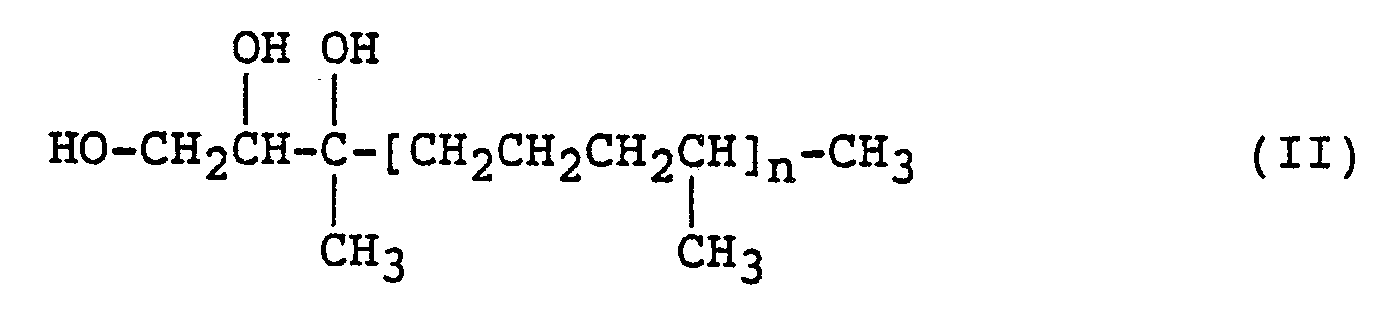
- The triol, however, has a defect of forming liquid crystals with a reversed middle structure in an aqueous solution which imparts an oily sensation and does not exhibit a sufficient moisture-retaining effect. Japanese Patent Laid-open No. 23737/1988 discloses an aqueous niosome dispersion comprising lipid lamella formed using polyglycerolether as a nonionic amphiphilic compound in an attempt to promote the stability by encapsulating water-soluble active components in an aqueous compartment which is encircled by lipid layers. Such an aqueous niosome dispersion, however, requires treatment at a high temperature of above 80°C to produce a niosome encapsulating active components. This makes it difficult to apply the method to active components which are not stable at a high temperature. Japanese Patent Publication No. 8287/1983, Japanese Patent Publication No. 56016/1986, Japanese Patent Laid-open No. 77613/1982, and Japanese Patent Laid-open No. 94326/1982 disclose aqueous dispersions of lipid spheres by the use of polyglycerolether. Industrial production of aqueous dispersions of lipid sheres, however, involves difficulties such as requirement of a homogenizing procedure, use of organic solvents such as chloroform and methanol for dissolving lipids, complicated vaporization processes for removing the solvents, etc.
- Nonionic emulsifying adjuvants conventionally used thus have drawbacks in that they have narrow concentration ranges for liquid crystal formation, require a high temperature for forming liquid crystals, and are difficult to produce liquid crystals industrially.
- Cosmetic compositions in which high melting point active components are not uniformly dispersed or adequately emulsified do not exhibit a sufficient moisture-retaining effect. Although some nonionic emulsifying adjuvants can exhibit moisturizing effects, such effects are not sufficient.
- Accordingly, development of cosmetic compositions which do not cause crystal transformation and remain homogeneous with superior stability over a wide range of temperature at which they are used, and which do not impart oily sensation and exhibit an excellent moisturizing effect has been desired.
- In view of this situation, the present inventors have conducted extensive studies to resolve the above-mentioned problems in conventional cosmetic compositions, and found that cosmetic compositions having an excellent moisturizing effect could be produced by the use of a certain type of long-chain alkyltrimethylol and that if such a long-chain alkyltrimethylol is formulated in an emulsion type cosmetic compositions, in addition to the excellent moisturizing effect, further effects could be obtained such as stabilizing emulsions and broadening the range in which high boiling point active components are maintained homogeneous. The inventors have further found that the emulsion cosmetic compositions exhibited superior extendibility when applied and imparted a non-sticky, fresh feeling upon use. Such findings have led to the completion of the present invention.
- Accordingly, an object of this invention is to provide a cosmetic composition comprising one or more long-chain alkyltrimethylols represented by the following formula (I)

- In a preferable embodiments said long-chain alkyltrimethylol is a branched alkyl type long-chain alkyltrimethylol represented by the following formula (III):

- Since a branched alkyl type long-chain alkyltrimethylol of the formula (III) is a novel compound, it is another object of the present invention to provide such a novel compound.
- Other objects, features and advantages of the invention will hereinafter become more readily apparent from the following description.
-
- Fig. 1 is a drawing showing changes in water content over time of a compound of of the present invention and comparative compounds.
- Long-chained alkyltrimethylols which can be used in this invention are represented by the formula (I) and include trimethylolundecane, trimethyloltridecane, trimethylolpentadecane, trimethylolheptadecane, trimethylolnonadecane, trimethylolheneicosane, and the like. Among these, branched alkyl type long-chain alkyltrimethylols represented by the following formula (III) are preferable:

- A long-chain alkyltrimethylol can be prepared, for example, by reacting the corresponding aldehyde with formaldehyde in a suitable solvent in the presence of a base according to the following reaction scheme:

- More specifically, as is well known, the reaction comprises a first, condensation reaction step in which 1 mole of aldehyde reacts with 2 moles of formaldehyde and a second, Cannizzaro reaction in which additional one mole of formaldehyde and a base react to produce a trimethylol.
- Aldehyde (IV) used in the above reaction can be prepared by the catalytic reduction, using, for example, palladium carbon, of an acid chloride of the corresponding carboxylic acid [Synthesis, 767 (1976)]. Given as a typical carboxylic acid is methyl-branched carboxylic acids with carbon atom contents of about 18 and containing isostearic acid as a major carboxylic acid component, which is produced as a by-product in a process for the manufacture of oleic acid dimer [J. Amer. Oil Chem. Soc., Vol. 51, 522 (1974)].
- Lower alcohols such as ethanol, isopropanol, etc., ethers such as tetrahydrofuran, dioxane, etc., hydrocarbons, and halogenated hydrocarbons are given as examples of organic solvents used in the above reaction. Among these, isopropanol, tetrahydrofuran, and dioxane are preferable. The amount of an organic solvent which is used is 20-1,000% by weight, and preferably 100-300% by weight, of the amount of aldehyde used. The solvent is usually charged into the reaction vessel in advance. Alternatively, it can be added to the reaction mixture during the reaction. A part of the organic solvent can be used mixed with water. The reaction may be carried out even without using an organic solvent.
- Given as examples of bases which can be used in the reaction are hydroxides of alkali metal and alkali earth metal such as sodium hydroxide, potassium hydroxide, calcium hydroxide, etc., and sodium carbonate, calcium carbonate, and the like. Preferable bases are sodium hydroxide and potassium hydroxide. The amount of the base to be used is in a range of 1.1-3.5 mole equivalents, and preferably 1.5-2.0 mole equivalents, per one mole of aldehyde. The use of a base as an aqueous solution of a 50% or smaller concentration is desirable from the aspect of the process operation.
- Formaldehyde can be used as is or as an aqueous solution. Use of paraformaldehyde is also acceptable. There are no specific limitations as to the concentration of fromaldehyde when it is used as an aqueous solution. The use of a formaldehyde aqueous solution with 5-50% concentration which is readily available is advantageous. The amount of formaldehyde is 3-30 mole, and preferably 4-8 mole per mole of aldehyde.
- There are no specific limitations as to the order of the addition of aldehyde, formaldehyde, and base to the reaction system. A desirable result can be obtained when aldehyde and base are added dropwise simultaneously to a formaldehyde solution. The reaction temperature is usually 20-100°C, and preferably 30-60°C.
- A long-chain alkyltrimethylol thus prepared can be used individually or two or more of long-chain alkyltrimethylols can be used together. There are no specific limitations as to the amount of a long-chain alkyltrimethylol to be formulated to the cosmetic composition of the present invention. Usually, an amount of 0.01-80% by weight is preferable, with an especially preferable amount being in the range of 0.1-50% by weight.
- Surface active agents can be used to increase the effect of the present invention. Any surface active agents, including cationic-, anionic-, amphoteric-, and nonionic type, can be used. Nonionic surface active agents are preferable for skin cosmetic compositions, while cationic surface active agents are preferable for hair cosmetic compositions. Examples of nonionic surface active agents include polyoxyethylenealkyl ether, polyoxyethylenealkylphenyl ether, polyoxyethylene fatty acid ester, sorbitan fatty acid ester, polyoxyethylene sorbitan fatty acid ester, polyoxyethylene fatty acid monoglyceride, glycerine ether, and the like. Given as typical examples of cationic surface active agents are quaternary ammonium salts. Any quaternary ammonium salts which are commonly used for cosmetic compositions can be used for the purpose of the present invention. Preferable quaternary ammonium salts are a branched alkyl type which is described in Japanese Patent Laid-open No. 267505/1986. A surface active agent is formulated in an amount of 0.01-30% by weight, and preferably 0.1-10% by weight, in the cosmetic composition.
- In addition to the above essential components, various types of ingredients which are commonly used for cosmetics, drugs, and foods can be optionally added to the cosmetic composition of the present invention. Such optional ingredients include higher alcohols having a linear or branched alkyl or alkenyl group, hydrocarbons such as liquid paraffin, petrolatum, solid paraffin, etc., lanoline derivatives such as liquid lanoline, lanoline fatty acid, etc., silicone derivatives such as dimethylpolysiloxanes, polyether-modified polysiloxanes, amino-modified polysiloxanes, etc., oils and fats such as higher fatty acid esters of higher alcohols, higher fatty acids, long-chain amidoamines having an alkyl or alkenyl group, etc., natural oils and fats of animal or vegetable origin such as mink oil, olive oil, etc., medicinal ingredients such as antidandruffs, antiseptics, vitamins, etc., preservatives such as paraben, etc., viscosity increasing agents such as water soluble polymeric compounds, etc., coloring agents such as dyes and pigments, UV absorbers, astringents, other types of moisture-retaining agents, including propylene glycol, glycerol, carbitol, 3-methyl-1,3-buatnediol, sugars, etc., water, perfumes, and the like.
- The cosmetic composition of the present invention can be prepared according to conventional methods. It can be applied to various types of cosmetics, for example, to basic cosmetics of oil-in-water-, water-in-oil-, or oil type, make-up cosmetics such as lip sticks, foundations, and the like, skin cleansers, hair cosmetics such as hair rinse, hair treatment agents, and the like.
- In the cosmetic composition of the present invention a long-chain alkyltrimethylol provides a superior moisture-retaining effect. Since a long-chain alkyltrimethylol is capable of producing lamella type liquid crystals, the cosmetic composition exhibits superior extendibility when applied and imparts a non-sticky, fresh feeling upon use. In addition, since high boiling point substances are encompassed into liquid crystals, the stability of the composition is improved, making all active components to fully exhibit their effects.
- Branched alkyl type long-chain alkyltrimethylols of the formula (III) which are novel compounds take a form of thermotropic liquid crystals at room temperature. They have outstanding lubricity, can abundantly dissolve with almost all solvents, and disperse uniformly in water. Owing to these characteristics they are very useful compounds as a basic material, an emulsifier, and a lubricant for cosmetic composition.
- Other features of the invention will become apparent in the course of the following description of the exemplary embodiments which are given for illustration of the invention and are not intended to be limiting thereof.
- Into a 3 1 reaction vessel equipped with a thermometer, a dropping funnel, a hydrogen gas feed tube, and a stirrer were charged 1,000 ml of tetrahydrofuran, 27.2 g (0.25 mole) of 2,6-lutidine, and 5.0 g of 5% palladium-on-carbon (dry basis; product of Engerhard Industries Corp.). To the reaction vessel was dropwise added from a dropping funnel 76.2 g (0.25 mole) of isostearic acid chloride [prepared from isostearic acid (product of Emery Corp.] by a conventional method) over 1 hour at room temperature while stirring and passing hydrogen gas through the vessel. After the addition, the stirring was continued for a further 4 hours at room temperature while passing hydrogen gas through the vessel. The amount of hydrogen gas consumed in the reaction was about 2.7 mole.
- Catalyst was removed from the reaction mixture by filtration and the solvent was evaporated under reduced pressure to obtain 68.1 g of isostearyl aldehyde (purity: 93%, yield: 94%).
- Into a 3 1 reaction vessel equipped with a thermometer, a reflux condenser, two dropping funnels, an nitrogen gas feed tube, and a stirrer were charged 100 g of (1.2 mole) of 35% aqueous formaline, 400 g of isopropanol, and 175 g of water. To the reaction vessel were dropwise added simultaneously from dropping funnels 190 g of 30% isopropanol solution of isostearyl aldehyde (isostearyl aldehyde: 0.2 mole) and 76.7 g (0.4 mole) of 20% aqueous solution of sodium hydroxide over a period of 6 hours at 40°C while stirring and passing nitrogen gas through the vessel. After the addition, the stirring was continued for a further 2 hours at 40°C to complete the reaction.
- The reaction mixture was cooled to room temperature and the solvent was evaporated under reduced pressure to obtain 125 g of a crude product. To the crude product was added 300 g of toluene and the mixture was heated to dissolve. After washing the toluene solution twice with 100 g of hot water (60°C), toluene was evaporated to obtain 63.1 g of crude trimethylolisoheptadecane. This crude material was purified by column chromatography on silica gel (eluant: hexane/methyl acetate) until thin-layer chromatography analysis gives a single spot to obtain 22.7 g of trimethylolisoheptadecane (yield: 34%). The product was a colorless transparent thermotropic crystals at room temperature.
- IR (thin layer):νO-H(-CH₂OH) 3400 cm⁻¹,νC-H (stretching)
(-H, -CH₂, -CH₃)
2860-2950 cm⁻¹, νC-H (deformation)
(-H, -CH₂, -CH₃) 1380 cm⁻¹, 1470 cm⁻¹.
NMR (CDCl₃): δ (ppm)
3.64-3.85 (6H, broad, -CH₂OH)
3.22-3.48 (3H, broad, -CH₂OH)
1.12-1.43 (27H, broad, -CH₂, -H)
0.78-1.04 (6H, broad, -CH₃)
Acid value: 0.06
Hydroxyl value: 499.1 - Trimethylolisoheptadecane was prepared from isostearyl aldehyde prepared in Reference Example in the same manner as in Synthetic Example 1 except that 400 g of tetrahydrofuran was used instead of isopropanol. Through purification by column chromatography on silica gel (eluant: hexane/methyl acetate) 24.2 g (yield: 36%) of trimethylolisoheptadecane was produced which was colorless transparent thermotropic crystals at room temperature.
- The results of analyses by thin layer chromatography, IR, and NMR were identical with the results obtained with trimethylolisoheptadecane prepared in Synthetic Example 1.
- Characteristics at room temperature and solubility with water of trimethylolisoheptadecane prepared in Synthetic Example 1 and conventionally known trimethylols were tested and compared. The results are shown in Table 1.
TABLE 1 Tested Compounds Characteristic (at room temperature) Mutual solubility with water Compound of this invention trimethylolisoheptadecane Thermotropic crystals Homogeneously disperse Comparative compounds trimethylolpropane Solid Homogeneously disperse trimethylolnonane Solid Solid/liquid separation trimethylolheptadecane Solid Solid/liquid separation trimethylolisohepatane Viscous liquid Liquid/liquid separation - Hair rinse compositions shown in Table 2 were prepared using the compound prepared in Synthetic Example 1. The rinsing performance of the compositions was evaluated.
- To hot water at a temperature of 70°C the composition listed in Table 2 which was heated at 70°C to melt was added and stirred. The mixture was cooled to room temperature with stirring to produce hair rinse compositions.
- Hair bundles, 15 cm long, weighing 20 g, were prepared. The hairs were those from Japanese women who had not received any beauty treatment such as cold perming and breaching in the past. Hair bundles were washed with a commercially available shampoo containing an anionic surface active agent as a major detergent component. After uniformly applying 2 g of hair rinse compositions shown in Table 2, the hair bundles were rinsed in a water stream for 30 seconds and dried with towel. Flexibility, smoothness, non-oiliness of these moistened hair bundles were evaluated. In the results shown in Table 2, those exhibiting excellent performance were rated AAA, those exhibiting good performance were rated BBB, those giving no effects were rated CCC, and those exhibiting bad performance were rated DDD.
- Hair rinse compositions to which trimethylolisoheptadecane of the present invention was formulated had superior flexibility and smoothness and gave very slight oily sensation.
TABLE 2 Invention Composition Comparative Compositions Components (wt%) No. 1 No. 1 No. 2 No. 3 Trimethylolisoheptadecane (Example 1) 3.0 - - - Isostearyl alcohol - 3.0 - - Isostearyl monoglyceride - - 3.0 - Stearyltrimethylammonium chloride 2.0 2.0 2.0 2.0 Water 95.0 95.0 95.0 98 Sensory Evaluation (1) Flexibility BBB DDD CCC BBB (2) Smoothness AAA DDD DDD CCC (3) Non-oiliness AAA CCC BBB BBB - Eighty percent (80%) of aqueous solutions of sample moisturizing agents were prepared. Each solution was placed in a Petri dish with a 30 mm diameter and allowed to stand in a P₂O₅ desiccator to measure the change in water content over time.
-
- Compound 1 (the compound of of the present invention)
Trimethylolisoheptadecane - Compound 2 (comparative compound)
Propylene glycol - Compound 3 (comparative compounds)
Glycerine - The results are given in Fig. 1, which shows that the compound of the present invention exhibited a better moisture-retaining effect than conventional moisturizing agents.
- Hair rinse compositions shown in Table 3 were prepared and their rinsing performance were evaluated. The results are shown in Table 3.
- Hair bundles, 15 cm long, weighing 20 g, were prepared. Hairs used were those taken from Japanese women who had not received any beauty treatment such as cold perming and breaching in the past. For rinse-type hair cosmetics, 2 g of the cosmetic was uniformly applied to the hair bundles and the hairs were washed with running water for 30 seconds, and dried with towel, then with a dryer. For non-rinse-type hair cosmetics, a prescribed amount of the cosmetic was uniformly applied to the hair bundles and the hairs were air-dried. Hair bundles were subjected to sensory evaluations.
- 0.5 g of hairs treated as above was subjected to higher alcohol extreaction with chloroform. The extract was concentrated, dissolved in a specified amount of chloroform containing an internal standard compound, and subjected to gas chromatography to detremine the amount of absorbed higher alcohol from the peak area.
- The treted hair bundles were subjected to sensory evaluation by expert panelists. The evaluation was performed according to the following standard.
- AAA Excellent
BBB Good
CCC Cannot decide
DDD Bad - AAA Imparts no oily sensation
BBB Hardly imparts oily sensation
CCC Imparts oily sensation (sticky)
DDD Imparts strong oily sensation - AAA Exhibits a good moisturizing effect
BBB Exhibits a moisturizing effect
CCC Cannot decide
DDD Exhibits no moisturizing effect - Hair rinse compositions were observed by a reflactive microscope having a hot stage.
O Forms a uniform liquid crystals
X Does not form a uniform liquid crystals
- Hair rinse compositions shown in Table 4 were prepared and their rinsing performances were evaluated. The results are shown in Table 4.
- To the mixture of components (8)-(10) and (12) heated to 70°C, the mixture of components (1)-(7) heated to the same temperature to dissolution was added and stirred to emulsify. The emulsion was allowed to cool to 45°C while stirring and component (11) was added with stirring thus obtaining hair rinse compositions.
- All hair rinse compositions exhibited good hair rinse performance and possessed superior stability. Sensory evaluation was peformed in the same manner as in Example 3.
- Samples were placed in a 100 ml transparent glass container. After having been stored, the samples were observed by the naked eye. The evaluation was rated according to the following criterion.
O: The whole composition was uniform without any abnormality such as dispersion or coagulation.
X: The composition was not uniform with dispersion or coagulation.

Example 5 Hair treatment composition (Invention Composition No. 7) (1) 2-dodecylhexadecyltrimethylammonium chloride 1.5 wt% (2) Stearyltrimethylammonium chloride 1.0 (3) Dimethylpolysiloxane (500 cs) 1.0 (4) Cetostearyl alcohol 3.0 (5) Trimethylolisoheptadecane 3.0 (6) Liquid paraffin 3.0 (7) Polypeptide (collagen hydrolyzate) 5.0 (8) Hydroxyethyl cellulose (1% aqueous solution; viscosity: 8,000 cp) 0.5 (9) Polyoxyethyleneoleyl ether (EO=5) 0.5 (10) Methyl paraben 0.2 (11) Perfume 0.4 (12) Water Balance Total 100.0 - A hair treatment composition had superior smoothness, flexibility, and non-oiliness, and yet gave a soft, moistened, and comfortable sensation.
Example 6 Hair cream composition (Invention Composition No. 8) (1) di-2-hexyldecyldimethylammonium chloride 2.0 wt% (2) Cetyltrimethylammonium chloride 1.0 (3) Modified silicone aqueous suspension *** 2.0 (4) Trimethylolisoheptadecane 1.0 (5) Cetyl alcohol 5.0 (6) Dipropylene glycol 6.0 (7) Glycerine 10.0 (8) Liquid paraffin 3.0 (9) Perfume 0.4 (12) Water Balance Total 100.0 *** SM 8702C (trade name, product of Toray Silicone Co., Ltd. containing 40% a modified-silicone polymer - A hair cream has superior smoothness, flexibility, and non-oiliness, and yet gave a soft, moistened, and comfortable sensation.
Example 7 Styling lotion composition (Invention Composition No. 9) (1) 2-Dodecylhexadecyltrimethylammonium chloride 0.5 wt% (2) Trimethylolisoheptadecane 0.2 (3) Modified silicone aqueous suspension *** 1.0 (4) Methacrylate polymer **** 1.0 (5) Polyethylene glycol 1.0 (6) Ethanol 20.0 (7) Perfume 0.3 (12) Water Balance Total 100.0 *** The same as in Example 5. **** Yukaformer, product of Mitsubishi Petrochemical Co., Ltd. - A hair set composition was prepared, which gave a good feeling upon use and a superior hair style retaining characteristic.
Example 8 Conditioning mousse composition (Invention Composition No. 10) (1) Dialkyldimethylammonium chloride ** 0.5 wt% (2) Methylphenylpolysiloxane (300 cs) 1.0 (3) Isododecyl myristate 1.0 (4) 3-methyl-1,3-butanediol 1.0 (5) Glycerine 2.5 (6) Liquid paraffin 2.5 (7) Trimethylolisoheptadecane 0.2 (8) 95% Ethanol 5.0 (9) Methyl paraben 0.1 (10) Perfume 0.1 (11) Propellant (LPG) 10.0 (12) Water Balance Total 100.0 ** The foot note of Table 4 applies. - A conditioning mousse composition which imparted good sensation upon use was prepared.
Example 9 Cream (Invention Composition No. 11) Oil phase components: Cetanol 2.0 (%) Stearic acid 3.0 Trimethylolisoheptadecane 3.0 Trimethyloltridecane 2.0 Lipid (isostearic acid choresteryl ester) 8.0 Monolaurylglycerine 2.0 Polyoxyethylene sorbitanemonolauric acid ester (EO = 20) 2.0 Water phase components: Dipropylene glycol 10.0 1,3-butylene glycol 5.0 Ethyl paraben 0.1 Methyl paraben 0.2 Perfume 0.1 Water Balance of both oil and water components - The cream gave good sensation upon use and an excellent moisture-retaining effect.
Example 10 Emulsion (Invention Composition No. 12) Oil phase components: Cetanol 0.5 (%) Petrolatum 1.0 Trimethylolisoheptadecane 10.0 Polyoxyethylenemonooleic acid ester (EO = 10) 2.0 Stearic acid 2.0 Water phase components: 1,3-butylene glycol 3.0 Dipropylene glycol 6.0 Triethanolamine 1.0 Ethyl paraben 0.1 Methyl paraben 0.2 Perfume 0.1 Water 74.1 Total 100.0 - The emulsion exhibited an excellent moisture-retaining effect.
Example 11 Cosmetic base (Invention Composition No. 13) Glycerine 15 (%) Polyoxyethylenoctyldodecyl ether (EO = 20) 10 Trimethylolisoheptadecane 10 Squalane 50 Water Balance Total 100 - All above components were subjected to procedures comprising dissolution with heating, blending, and cooling to prepare a single phase cosmetic base. Various oil-soluble compounds can be blended with this base material to produce cosmetic products.
Example 12 Emulsion-type foundation (Invention Composition No. 14) Oil phase components: Stearic acid 5.0 (%) Cetostearyl alcohol 1.0 Trimethyloltridecane 0.5 Trimethylolisoheptadecane 6.0 Lipid (isostearic acid choresteryl ester) 6.0 Monolauryl glycerine 2.0 Propylene glycol monolauric acid 3.0 Water phase components: Glycerine 10.0 Triethanolamine 1.2 Ethyl paraben 0.1 Methyl paraben 0.1 Perfume 0.1 Purified water Balance Powdery components: Titanium oxide 8.0 Talc 4.0 Iron oxide 0.5 Total 100.0 - The emulsion gave good sensation upon use and exhibited an excellent moisture-retaining effect.
Example 13 Lipstick (Invention Composition No. 15) Microcrystalline wax 6.0 (%) Candelilla wax 3.0 Diisostearic acid glycerine ester 5.0 Trimethylolisoheptadecane 10.0 Lipid (Cerebroside; product of Sedary Research Laboratories Inc.) 2.0 Jojova oil 6.0 Olive oil Balance Lanolin 10.0 Pigment 7.0 Perfume 0.1 Total 100.0 - The lipstick gave good sensation upon use and exhibited an excellent moisture-retaining effect.
Example 14 Shampoo (Invention Composition No. 16) Triethanolamine lauryl sulfate 20 (%) Lauric acid diethanolamide 3 Trimethylolisoheptadecane 2 Perfume 0.3 Pigment Small amount Water Balance Total 100.0 - The shampoo gave good sensation upon use and exhibited an excellent moisture-retaining effect.
Example 15 Shampoo (Invention Composition No. 17) N-lauroyl-N′-carboxymethyl-N′-(2-hydroxyethyl)ethylenediamine triethanolamine 12 (%) Disodium polyoxyethylenelaurylsulfosuccinate 5 Lauric acid diethanolamide 3 Cationic polymer ( Marcoat 100, product of Merck Co.)0.2 Trimethylolisoheptadecane 0.2 Preservative 0.1 Perfume/pigment Suitable amount Water Balance Total 100.0 - The shampoo gave very weak stimulation to the skin and exhibited an excellent conditioning effect.
Example 16 Cleansing cream (Invention Composition No. 18) Sorbitol 10 (%) Polyoxyethylenoctyldodecyl ether (EO = 25) 15 Trimethylolisoheptadecane 60 Glycerine 5 Dibutylhydroxytoluene 0.1 Methyl paraben 0.1 Perfume 0.1 Water Balance Total 100.0 - The cleaning cream of the present invention exhibited excellent stability and gave superior dirt removing performance.
Example 17 Soap (Invention Composition No. 19) Beef tallow/coconut oil soap 97.3 (%) Trimethylolnonane 0.5 Trimethylolisoheptadecane 0.5 Perfume 1.5 Coloring agent 0.2 Total 100.0 - The soap of the present invention gave favorable feeling upon use and provided an effect of suppressing roughened sensation.
Example 18 Body shampoo (Invention Composition No. 20) Lauryl phosphate 8.0 (%) Lauric acid 3.2 Triethanolamine 10.0 Glycerine 3.0 Trimethylolisoheptadecane 2.0 Dibutylhydroxytoluene 0.1 Hydroxyethyl cellulose (1% aqueous solution, 8.000 cp) 0.5 Ethanol 3.0 Perfume 0.5 Water Balance Total 100.0 - The body shampoo of the present invention gave favorable feeling upon use and provided an effect of suppressing roughened sensation.
- Obviously, numerous modifications and variations of the present invention are possible in light of the above teachings. It is therefore to be understood that within the scope of the appended claims, the invention may be practiced otherwise than as specifically described herein.
Claims (5)

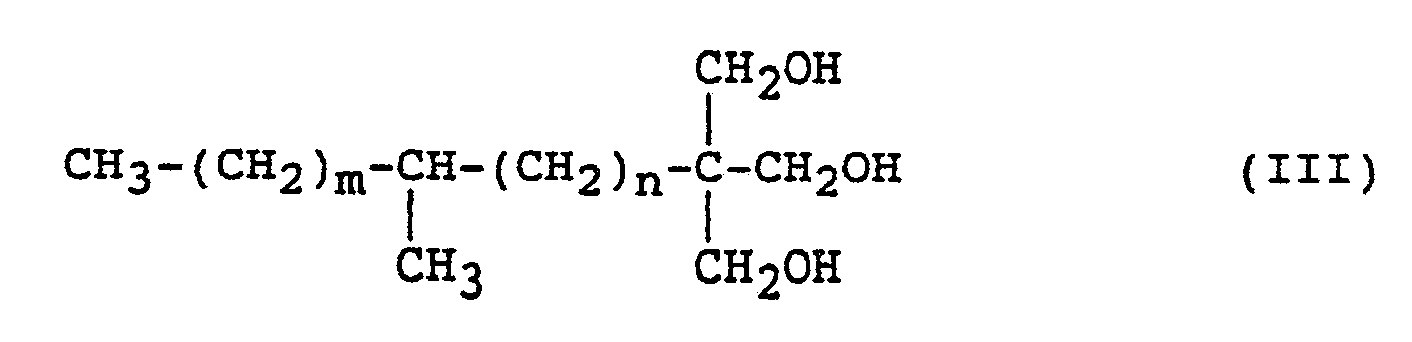
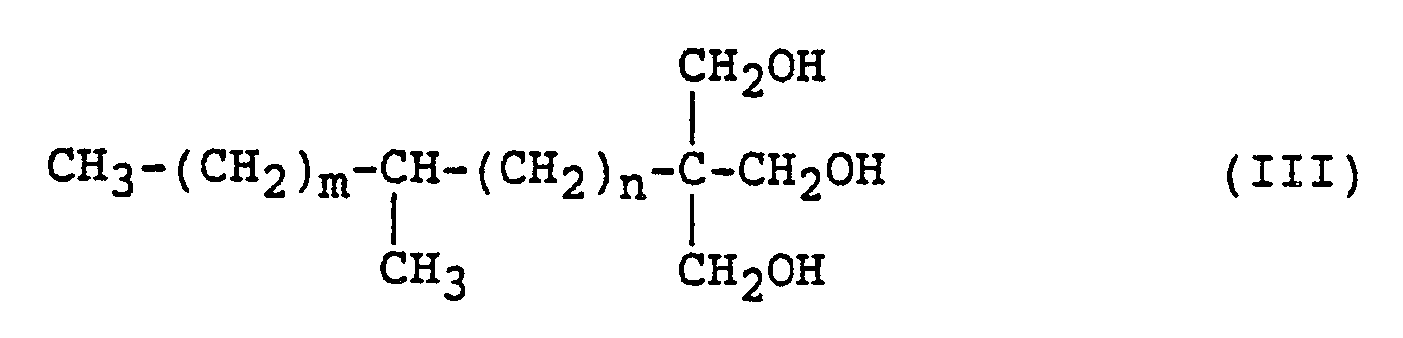

Applications Claiming Priority (2)
| Application Number | Priority Date | Filing Date | Title |
|---|---|---|---|
| JP63113312A JPH082812B2 (en) | 1988-05-10 | 1988-05-10 | Trimethylolmethyl branched alkane |
| SG112594A SG112594G (en) | 1988-05-10 | 1994-08-12 | Cosmetic composition |
Publications (2)
| Publication Number | Publication Date |
|---|---|
| EP0411202A1 true EP0411202A1 (en) | 1991-02-06 |
| EP0411202B1 EP0411202B1 (en) | 1993-12-15 |
Family
ID=26452304
Family Applications (1)
| Application Number | Title | Priority Date | Filing Date |
|---|---|---|---|
| EP89116660A Expired - Lifetime EP0411202B1 (en) | 1988-05-10 | 1989-09-08 | Cosmetic composition |
Country Status (8)
| Country | Link |
|---|---|
| US (1) | US5041283A (en) |
| EP (1) | EP0411202B1 (en) |
| JP (1) | JPH082812B2 (en) |
| AT (1) | ATE98476T1 (en) |
| DE (1) | DE68911522T2 (en) |
| ES (1) | ES2061849T3 (en) |
| HK (1) | HK103594A (en) |
| SG (1) | SG112594G (en) |
Cited By (5)
| Publication number | Priority date | Publication date | Assignee | Title |
|---|---|---|---|---|
| EP0512270A3 (en) * | 1991-04-08 | 1994-04-27 | Kao Corp | |
| WO1994008553A1 (en) * | 1992-10-15 | 1994-04-28 | Wella Aktiengesellschaft | Hair-care agent |
| US5399274A (en) * | 1992-01-10 | 1995-03-21 | Marcus; R. Steven | Metal working lubricant |
| EP0662314A1 (en) * | 1993-12-16 | 1995-07-12 | Kao Corporation | Method of hair treatment |
| WO2000006106A1 (en) * | 1998-07-30 | 2000-02-10 | The Procter & Gamble Company | Hair care compositions |
Families Citing this family (18)
| Publication number | Priority date | Publication date | Assignee | Title |
|---|---|---|---|---|
| JPH082812B2 (en) * | 1988-05-10 | 1996-01-17 | 花王株式会社 | Trimethylolmethyl branched alkane |
| EP0466237B1 (en) * | 1990-07-11 | 1994-03-23 | Quest International B.V. | Stabilized emulsion systems |
| US5246918A (en) * | 1990-07-11 | 1993-09-21 | Unilever Patent Holdings B.V. | Process for preparing perfumed personal products |
| DE69103487T2 (en) * | 1990-07-11 | 1995-02-16 | Quest Int | Perfumed structured emulsions in personal care products. |
| FR2687314A1 (en) * | 1992-02-18 | 1993-08-20 | Oreal | LIPID VESICLE DISPERSION, COSMETIC AND / OR PHARMACEUTICAL COMPOSITION CONTAINING THE SAME, AND PROCESS FOR THE PREPARATION OF SAID DISPERSION. |
| JPH06157255A (en) * | 1992-11-30 | 1994-06-03 | Kao Corp | Hair treating agent composition |
| RU2133120C1 (en) * | 1995-12-14 | 1999-07-20 | Сантр Энтернасьональ де Решерш Дерматоложик Галдерма | Cosmetic or dermatological composition of emulsion-like water-in-oil |
| US5776443A (en) * | 1996-03-18 | 1998-07-07 | Chesebrough-Pond's Usa Co., Division Of Conopco, Inc. | Hair care compositions |
| RU2133603C1 (en) * | 1996-06-10 | 1999-07-27 | Московское акционерное общество "Биокон" | Hand cream "maria" |
| RU2136264C1 (en) * | 1996-07-10 | 1999-09-10 | Товарищество с ограниченной ответственностью "Биокосметическая фабрика" | Child oil balsam "sun storehouse" |
| RU2129858C1 (en) * | 1996-10-24 | 1999-05-10 | Товарищество с ограниченной ответственностью "Биокосметическая фабрика" | Biologically active additive for cosmetic agents of regenerating action and regenerating cream on its base |
| RU2144815C1 (en) * | 1996-12-24 | 2000-01-27 | Общество с ограниченной ответственностью Научно-производственный центр "Сибирская природная косметика" | Method of production of regenerating cosmetic cream for skin care |
| DE10116497B4 (en) * | 2001-04-03 | 2004-08-12 | Faber-Castell Ag | Liquid for lip care or lip coloring |
| US20030224024A1 (en) * | 2002-02-04 | 2003-12-04 | Jean-Luc Leveque | Compositions comprising cyclopentane derivatives and their use |
| US8603502B2 (en) * | 2002-02-04 | 2013-12-10 | L'oreal S.A. | Compositions comprising jasmonic acid derivatives and use of these derivatives |
| DE10205190B4 (en) | 2002-02-08 | 2017-06-08 | Beiersdorf Ag | 2-methyl-1,3-propanediol-containing preparations |
| US7238652B2 (en) * | 2005-08-18 | 2007-07-03 | Conopco, Inc. | Personal care compositions comprising alkyl phosphate surfactants and selected weak acid auxiliary agents |
| US7241724B2 (en) * | 2005-08-18 | 2007-07-10 | Conopco, Inc. | Personal care compositions comprising alkyl phosphate surfactants and selected auxiliary surfactants |
Family Cites Families (10)
| Publication number | Priority date | Publication date | Assignee | Title |
|---|---|---|---|---|
| US2752399A (en) * | 1956-06-26 | hydroxy i | ||
| US2292926A (en) * | 1938-05-10 | 1942-08-11 | Du Pont | Preparation of methyltrimethylolmethane |
| US2400724A (en) * | 1942-10-28 | 1946-05-21 | Du Pont | Preparation of polyhydroxy compounds |
| US2991297A (en) * | 1958-07-02 | 1961-07-04 | Celanese Corp | Process for preparing synthetic lubricants |
| FR2254633B1 (en) * | 1973-12-12 | 1976-10-08 | Inst Francais Du Petrole | |
| DE2702582C3 (en) * | 1977-01-22 | 1980-12-04 | Bayer Ag, 5090 Leverkusen | Process for the preparation of trimethylolalkanes |
| JPS59193837A (en) * | 1983-04-18 | 1984-11-02 | Nissan Chem Ind Ltd | Novel liquid primary trihydroxy alcohol composition and its production |
| US4655947A (en) * | 1986-07-23 | 1987-04-07 | Aluminum Company Of America | Metalworking with a trimethylolalkane ester lubricant |
| DE68917352D1 (en) * | 1988-04-20 | 1994-09-15 | Kuraray Co | Trimethylolheptanes and their application. |
| JPH082812B2 (en) * | 1988-05-10 | 1996-01-17 | 花王株式会社 | Trimethylolmethyl branched alkane |
-
1988
- 1988-05-10 JP JP63113312A patent/JPH082812B2/en not_active Expired - Fee Related
-
1989
- 1989-09-08 US US07/404,409 patent/US5041283A/en not_active Expired - Lifetime
- 1989-09-08 DE DE68911522T patent/DE68911522T2/en not_active Expired - Fee Related
- 1989-09-08 ES ES89116660T patent/ES2061849T3/en not_active Expired - Lifetime
- 1989-09-08 EP EP89116660A patent/EP0411202B1/en not_active Expired - Lifetime
- 1989-09-08 AT AT89116660T patent/ATE98476T1/en not_active IP Right Cessation
-
1994
- 1994-08-12 SG SG112594A patent/SG112594G/en unknown
- 1994-09-29 HK HK103594A patent/HK103594A/en unknown
Non-Patent Citations (1)
| Title |
|---|
| PATENT ABSTRACTS OF JAPAN, vol. 14, no. 57 (C-684)[4000], 2nd February 1990; & JP-A-1 283 235 (KAO CORP.) 14-11-1989 * |
Cited By (7)
| Publication number | Priority date | Publication date | Assignee | Title |
|---|---|---|---|---|
| EP0512270A3 (en) * | 1991-04-08 | 1994-04-27 | Kao Corp | |
| US5429820A (en) * | 1991-04-08 | 1995-07-04 | Kao Corporation | Cosmetic composition |
| US5399274A (en) * | 1992-01-10 | 1995-03-21 | Marcus; R. Steven | Metal working lubricant |
| WO1994008553A1 (en) * | 1992-10-15 | 1994-04-28 | Wella Aktiengesellschaft | Hair-care agent |
| EP0662314A1 (en) * | 1993-12-16 | 1995-07-12 | Kao Corporation | Method of hair treatment |
| WO2000006106A1 (en) * | 1998-07-30 | 2000-02-10 | The Procter & Gamble Company | Hair care compositions |
| WO2000006101A1 (en) * | 1998-07-30 | 2000-02-10 | The Procter & Gamble Company | Hair care compositions |
Also Published As
| Publication number | Publication date |
|---|---|
| EP0411202B1 (en) | 1993-12-15 |
| JPH01283235A (en) | 1989-11-14 |
| DE68911522D1 (en) | 1994-01-27 |
| US5041283A (en) | 1991-08-20 |
| SG112594G (en) | 1995-01-13 |
| ATE98476T1 (en) | 1994-01-15 |
| JPH082812B2 (en) | 1996-01-17 |
| DE68911522T2 (en) | 1994-06-23 |
| HK103594A (en) | 1994-10-07 |
| ES2061849T3 (en) | 1994-12-16 |
Similar Documents
| Publication | Publication Date | Title |
|---|---|---|
| EP0411202B1 (en) | Cosmetic composition | |
| US6117915A (en) | Fatty alcohol phosphate ester emulsifier compositions | |
| EP0512270B1 (en) | Cosmetic composition | |
| KR0166372B1 (en) | Oil-soluble n-long chained acyl acidic amino acid ester, mixture thereof and perfuming cosmetics containing the same | |
| EP0217105A2 (en) | Lamella type single phase liquid crystal composition and oil-base cosmetic compositions using the same | |
| EP0028457B1 (en) | Cosmetic and emulsifier composition | |
| EP0538764B1 (en) | N-long chain acyl neutral amino acid esters; and cosmetics and pharmaceutical preparation containing the same | |
| JPH11240828A (en) | Oily raw material for cosmetic material | |
| JP2946145B2 (en) | Cosmetics | |
| JPH06293614A (en) | Lanoline fatty acid esters, cosmetic and external medicine | |
| EP0450527A2 (en) | N-Tris(hydroxymethyl)methylfatty acid amides and cosmetic compositions containing same | |
| JPH0686373B2 (en) | Cosmetics | |
| GB2091102A (en) | Hair cosmetics containing a glyceryl ether | |
| JP2893128B2 (en) | Cosmetic additive and cosmetic containing the same | |
| JP3073813B2 (en) | Cosmetics | |
| JP2961559B2 (en) | Methyl-branched alkyl glycoside and cosmetic containing the same | |
| JP3483984B2 (en) | Cosmetics | |
| JP2577997B2 (en) | Cosmetics | |
| JP3397956B2 (en) | Skin cosmetics | |
| PH25962A (en) | Cosmetic composition | |
| JP2004026781A (en) | Utilization of hydroxy fatty acid dialkylaminoalkylamide as hair treatment agent | |
| JPH0763613B2 (en) | Water-in-oil emulsion composition | |
| JPH05117295A (en) | Cosmetic raw material and base for external-use medical drug | |
| JPH0469321A (en) | Cosmetic | |
| JPS63222106A (en) | Saccharide ether-containing cosmetic |
Legal Events
| Date | Code | Title | Description |
|---|---|---|---|
| PUAI | Public reference made under article 153(3) epc to a published international application that has entered the european phase |
Free format text: ORIGINAL CODE: 0009012 |
|
| AK | Designated contracting states |
Kind code of ref document: A1 Designated state(s): AT CH DE ES FR GB LI NL |
|
| 17P | Request for examination filed |
Effective date: 19910426 |
|
| 17Q | First examination report despatched |
Effective date: 19920323 |
|
| GRAA | (expected) grant |
Free format text: ORIGINAL CODE: 0009210 |
|
| AK | Designated contracting states |
Kind code of ref document: B1 Designated state(s): AT CH DE ES FR GB LI NL |
|
| REF | Corresponds to: |
Ref document number: 98476 Country of ref document: AT Date of ref document: 19940115 Kind code of ref document: T |
|
| REF | Corresponds to: |
Ref document number: 68911522 Country of ref document: DE Date of ref document: 19940127 |
|
| ET | Fr: translation filed | ||
| PLBE | No opposition filed within time limit |
Free format text: ORIGINAL CODE: 0009261 |
|
| STAA | Information on the status of an ep patent application or granted ep patent |
Free format text: STATUS: NO OPPOSITION FILED WITHIN TIME LIMIT |
|
| 26N | No opposition filed | ||
| REG | Reference to a national code |
Ref country code: ES Ref legal event code: FG2A Ref document number: 2061849 Country of ref document: ES Kind code of ref document: T3 |
|
| REG | Reference to a national code |
Ref country code: GB Ref legal event code: IF02 |
|
| PGFP | Annual fee paid to national office [announced via postgrant information from national office to epo] |
Ref country code: DE Payment date: 20070906 Year of fee payment: 19 |
|
| PGFP | Annual fee paid to national office [announced via postgrant information from national office to epo] |
Ref country code: CH Payment date: 20070913 Year of fee payment: 19 Ref country code: AT Payment date: 20070912 Year of fee payment: 19 |
|
| PGFP | Annual fee paid to national office [announced via postgrant information from national office to epo] |
Ref country code: GB Payment date: 20070905 Year of fee payment: 19 |
|
| PGFP | Annual fee paid to national office [announced via postgrant information from national office to epo] |
Ref country code: NL Payment date: 20070916 Year of fee payment: 19 Ref country code: ES Payment date: 20071005 Year of fee payment: 19 |
|
| PGFP | Annual fee paid to national office [announced via postgrant information from national office to epo] |
Ref country code: FR Payment date: 20070914 Year of fee payment: 19 |
|
| REG | Reference to a national code |
Ref country code: CH Ref legal event code: PL |
|
| GBPC | Gb: european patent ceased through non-payment of renewal fee |
Effective date: 20080908 |
|
| PG25 | Lapsed in a contracting state [announced via postgrant information from national office to epo] |
Ref country code: NL Free format text: LAPSE BECAUSE OF NON-PAYMENT OF DUE FEES Effective date: 20090401 |
|
| NLV4 | Nl: lapsed or anulled due to non-payment of the annual fee |
Effective date: 20090401 |
|
| REG | Reference to a national code |
Ref country code: FR Ref legal event code: ST Effective date: 20090529 |
|
| PG25 | Lapsed in a contracting state [announced via postgrant information from national office to epo] |
Ref country code: AT Free format text: LAPSE BECAUSE OF NON-PAYMENT OF DUE FEES Effective date: 20080908 Ref country code: DE Free format text: LAPSE BECAUSE OF NON-PAYMENT OF DUE FEES Effective date: 20090401 |
|
| PG25 | Lapsed in a contracting state [announced via postgrant information from national office to epo] |
Ref country code: FR Free format text: LAPSE BECAUSE OF NON-PAYMENT OF DUE FEES Effective date: 20080930 Ref country code: LI Free format text: LAPSE BECAUSE OF NON-PAYMENT OF DUE FEES Effective date: 20080930 Ref country code: CH Free format text: LAPSE BECAUSE OF NON-PAYMENT OF DUE FEES Effective date: 20080930 |
|
| REG | Reference to a national code |
Ref country code: ES Ref legal event code: FD2A Effective date: 20080909 |
|
| PG25 | Lapsed in a contracting state [announced via postgrant information from national office to epo] |
Ref country code: GB Free format text: LAPSE BECAUSE OF NON-PAYMENT OF DUE FEES Effective date: 20080908 |
|
| PG25 | Lapsed in a contracting state [announced via postgrant information from national office to epo] |
Ref country code: ES Free format text: LAPSE BECAUSE OF NON-PAYMENT OF DUE FEES Effective date: 20080909 |