EP0411204A1 - Verfahren zur Feststellung des Alkoholgehaltes und/oder des Heizwertes von Kraftstoffen - Google Patents
Verfahren zur Feststellung des Alkoholgehaltes und/oder des Heizwertes von Kraftstoffen Download PDFInfo
- Publication number
- EP0411204A1 EP0411204A1 EP89117831A EP89117831A EP0411204A1 EP 0411204 A1 EP0411204 A1 EP 0411204A1 EP 89117831 A EP89117831 A EP 89117831A EP 89117831 A EP89117831 A EP 89117831A EP 0411204 A1 EP0411204 A1 EP 0411204A1
- Authority
- EP
- European Patent Office
- Prior art keywords
- measuring cell
- fuel
- measuring
- capacitance
- measurement
- Prior art date
- Legal status (The legal status is an assumption and is not a legal conclusion. Google has not performed a legal analysis and makes no representation as to the accuracy of the status listed.)
- Granted
Links
Images


Classifications
-
- G—PHYSICS
- G01—MEASURING; TESTING
- G01N—INVESTIGATING OR ANALYSING MATERIALS BY DETERMINING THEIR CHEMICAL OR PHYSICAL PROPERTIES
- G01N33/00—Investigating or analysing materials by specific methods not covered by groups G01N1/00 - G01N31/00
- G01N33/26—Oils; Viscous liquids; Paints; Inks
- G01N33/28—Oils, i.e. hydrocarbon liquids
- G01N33/2835—Specific substances contained in the oils or fuels
- G01N33/2852—Alcohol in fuels
-
- G—PHYSICS
- G01—MEASURING; TESTING
- G01N—INVESTIGATING OR ANALYSING MATERIALS BY DETERMINING THEIR CHEMICAL OR PHYSICAL PROPERTIES
- G01N27/00—Investigating or analysing materials by the use of electric, electrochemical, or magnetic means
- G01N27/02—Investigating or analysing materials by the use of electric, electrochemical, or magnetic means by investigating impedance
- G01N27/22—Investigating or analysing materials by the use of electric, electrochemical, or magnetic means by investigating impedance by investigating capacitance
- G01N27/221—Investigating or analysing materials by the use of electric, electrochemical, or magnetic means by investigating impedance by investigating capacitance by investigating the dielectric properties
Definitions
- the invention relates to a method for determining the alcohol content and / or the calorific value of fuels by measuring electrically measurable quantities in a measuring cell containing the fuel for determining the dielectric constant of the mixture contained in the cell as a parameter of the alcohol content or the calorific value.
- methyl or ethyl alcohol is increasingly added to these fuels. Any refueling of both pure and mixed fuels should be possible.
- knowledge of the mixing ratio is necessary in order to achieve optimal operation of the internal combustion engine and, in particular, to enable a precise fuel metering that is adapted to the operating conditions.
- the ongoing determination of the alcohol content of the fuel continuously supplied to the internal combustion engine during operation in vehicle engines causes particular problems in which any possible mixture can be achieved by refueling the fuel types as desired.
- the known optical methods are hardly suitable for this purpose, since they mostly use interface effects to determine the refractive index, from which the alcohol content can then be deduced.
- a disadvantage of this method is that the mixture to be measured must have a high degree of homogeneity, especially at the interface must be present. The required accuracy was not achieved with this method.
- the invention is therefore based on the object of providing a method of the type described at the outset which, in particular when used on vehicle engines, enables the alcohol content and / or the calorific value of fuels to be determined precisely and reliably.
- the dielectric constant is determined by measuring the capacitance of a capacitor formed in the measuring cell
- the dielectric Trikum is formed by the fuel contained in the measuring cell
- the determination of the capacitance takes place in terms of circuitry and / or computation regardless of the influence of the conductivity of the fuel.
- an AC voltage or a DC voltage superimposed by AC voltage is applied to two capacitor electrodes in the measuring cell and the dielectric constant is determined as a function of the real and / or imaginary part from parameters of the flowing current.
- the capacitance can advantageously be measured by applying a sinusoidal voltage to the measuring cell and evaluating the current flowing through the measuring cell with regard to the imaginary part. This can be done by a simple synchronous rectification or by multiplication with a cos-shaped voltage of the same frequency. The resulting output signal is then proportional to the capacitance.
- Measuring circuits which enable the influence of the conductance values to be suppressed by means of specific circuitry or arithmetic evaluation of mathematical correlations, enable a precise determination of the alcohol content via a capacity determination - provided with a temperature-dependent correction.
- FIG. 2 shows a preferred embodiment of a measuring cell for carrying out the method according to the invention.
- the fuel enters the measuring cell via inflow 14, and it leaves the measuring cell via outflow 15.
- the fuel flow is divided into flow paths 16 and 17, which are formed by a central cylinder 18. If the central cylinder 18 and outer jacket 19 are completely or partially electrically conductive, these walls or wall parts of the measuring cell can represent the electrodes of the capacitor of a measuring or evaluation circuit.
- the at least partially conductive central cylinder 18 as the flow body is the second electrode.
- the central cylinder 18 together with the outer jacket 19 forms the actual measuring capacitor, which encloses the measuring volume.
- the corresponding values can be tapped at connections 21 and 22.
- fuel mixed with alcohol from fuel tank 30 passes via line 31 to measuring cell 13 and from there via line 32 to metering device 33, which is generally an injection pump with corresponding injection nozzles.
- the fuel is fed into engine 34 in direct or indirect injection.
- the values of the capacitance and the conductance tapped in the measuring cell 13 are fed via a measuring line 35 to a common evaluation circuit or evaluation unit 36.
- a common evaluation circuit or evaluation unit 36 it can be advantageous that an AC voltage or a DC voltage superimposed by AC voltage is applied to two capacitor electrodes in the measuring cell and the dielectric constant is determined as a function of the real and / or imaginary part of parameters of the flowing current.
- the signals emitted by the evaluation circuit 36 pass via a line 37 to an injection computer 38, which controls the metering device 33 via a line 39.
- the mixture proportion measured in each case in the measuring cell and evaluated in the evaluation unit 36 is therefore not changed operationally, but rather the type of injection is changed depending on the measured and evaluated values.
- the measurement of the alcohol content of the fuel supplied can be used to pre-control the injection quantity, while the fine control of the air ratio takes place via a known type of lambda control.
- the common circuit as an evaluation unit is integrated into the injection system in terms of circuitry and programming.
- further advantages can be achieved by additionally determining the temperature of the fuel in the measuring cell 13 and entering it in the evaluation unit to compensate for the influence of temperature.
- An AC voltage source 41 applies a sinusoidal voltage to a measuring cell 43 via a low-resistance resistor 42, which works as a current sensor.
- the resulting current flow which is tapped off at the resistor 42 as a voltage drop, contains a real part which only depends on the conductance 44 of the measuring cell and an imaginary part which only depends on the capacitance 45 of the measuring cell.
- the tapped current is multiplied by a cosine voltage in a multiplier 46, which e.g. is obtained from the sinusoidal voltage via a phase shifter 47.
- the direct-voltage component of the multiplier output voltage which represents a measure of the capacitance, is extracted by a low-pass filter 48.
- a further particularly advantageous embodiment according to FIG. 5 results when two different frequencies of two voltage generators 51 and 52 are used to measure the voltage drop at measuring cell 53 with conductance 54 and capacitance 55. Then only the amount of the output voltage formed via a rectifier 56 and a low-pass filter 57 is evaluated.
- the capacitance of the measuring cell can be used as the frequency-determining element of an oscillating circuit, the conductance causing a cross influence.
- the measurement is carried out in two phases, with a defined capacitance C of a capacitor 61 being connected in parallel with the measuring cell capacitance Cx of the measuring cell 62 in the second measurement.
- a defined capacitance C of a capacitor 61 being connected in parallel with the measuring cell capacitance Cx of the measuring cell 62 in the second measurement.
- Another advantageous embodiment consists in carrying out the measurement with the aid of a measuring bridge.
- the bridge must be adjusted automatically, with the value set for the capacity being evaluated as a measure of the capacity of the measuring cell.
- the measured quantities are linked and the linearization is already carried out in the sensor, and without a processor through a circuit that is as simple and inexpensive as possible.
- the values for the temperature and the capacity are fed as digital quantities to the address lines of a programmable module (eg a ROM, EPROM, PAL).
- a programmable module eg a ROM, EPROM, PAL.
- the information about the alcohol content can then be taken in digital form and, if necessary, fed to a D / A converter for conversion into an analog value.
- One of the output lines can also be used to output an error signal, which can detect that the range in the input data has been exceeded and thus malfunctions of the sensors.
- a further preferred embodiment is achieved by using a frequency or a frequency range in which, due to the failure of certain polarization mechanisms, increases in the dielectric constant are used for measurement purposes shortly before the failure frequency.
Landscapes
- Chemical & Material Sciences (AREA)
- Health & Medical Sciences (AREA)
- Life Sciences & Earth Sciences (AREA)
- General Health & Medical Sciences (AREA)
- Engineering & Computer Science (AREA)
- Chemical Kinetics & Catalysis (AREA)
- Pathology (AREA)
- Immunology (AREA)
- General Physics & Mathematics (AREA)
- Physics & Mathematics (AREA)
- Analytical Chemistry (AREA)
- Biochemistry (AREA)
- Oil, Petroleum & Natural Gas (AREA)
- Medicinal Chemistry (AREA)
- Food Science & Technology (AREA)
- General Chemical & Material Sciences (AREA)
- Electrochemistry (AREA)
- Investigating Or Analyzing Materials By The Use Of Electric Means (AREA)
- Electrical Control Of Air Or Fuel Supplied To Internal-Combustion Engine (AREA)
Abstract
Description
- Die Erfindung bezieht sich auf ein Verfahren zur Feststellung des Alkoholgehaltes und/oder des Heizwertes von Kraftstoffen durch Messung elektrisch meßbarer Größen in einer den Kraftstoff enthaltenden Meßzelle zur Bestimmung der Dielektrizitätszahl des in der Zelle enthaltenen Gemisches als Kenngröße des Alkoholgehaltes bzw. des Heizwertes.
- In Anbetracht der langfristig nur in begrenztem Umfang verfügbaren Reserven an fossiler Energie, insbesondere der aus Rohöl gewonnenen Kraftstoffe, und in Anbetracht der steigenden Anforderungen an den Umweltschutz, wird diesen Kraftstoffen in zunehmendem Maße Methyl- oder Äthylalkohol zugemischt. Dabei soll ein beliebiges Tanken sowohl von Reinkraftstoffen als auch von Mischkraftstoffen möglich sein. Bei höheren Alkoholanteilen ist dabei die Kenntnis des Mischungsverhältnisses erforderlich, um eine optimale Arbeitsweise der Brennkraftmaschine zu erreichen und dabei insbesondere eine genaue, den Betriebsverhältnissen angepaßte Kraftstoffzumessung zu ermöglichen. Besondere Probleme bereitet dabei die laufende Feststellung des Alkoholgehaltes des der Brennkraftmaschine im Betrieb laufend zugeführten Kraftstoffs bei Fahrzeugmotoren, bei denen durch das beliebige Tanken der Kraftstoffarten jede mögliche Mischung erreicht werden kann.
- Die bekannten optischen Verfahren sind zu diesem Zweck kaum geeignet, da sie meist Grenzflächeneffekte zur Bestimmung des Brechungsindexes ausnutzen, aus dem dann auf den Alkoholanteil geschlossen werden kann. Abgesehen von der Schwierigkeit der Auswertung bei Fahrzeugmotoren ist ein Nachteil dieses Verfahrens auch, daß die messend zu beobachtende Mischung eine hohe Homogenität aufweisen muß, die insbesondere auch an der Grenzfläche vorhanden sein muß. Mit diesem Verfahren wurden nicht die erforderlichen Genauigkeiten erreicht. Außerdem besteht im optischen Bereich eine große Abhängigkeit von dem Aromatengehalt der verwendeten Benzinkraftstoffe, so daß sich je nach Kraftstoffirma und Charge zusätzlich erhebliche Fehler einstellen.
- Es wurde daher vorgeschlagen, den Alkoholanteil in Kraftstoffen durch eine Dielektrizitätsbestimmung festzustellen, und ein solches Verfahren hätte den Vorteil, daß die Problematik der Messung von Grenzflächeneffekten behoben ist, da die Messung volumetrisch erfolgt. Andererseits geht in die volumetrische Dielektrizitätsbestimmung in starkem Maße der Leitwert der Mischung ein (Querempfindlichkeit). Da aber der Leitwert sehr stark von Verunreinigungen oder Wasseranteilen abhängt, führt auch ein solches Meßverfahren zu unbrauchbaren Ergebnissen.
- In der Schrift "Proceedings of the Fourth International Symposium on Alcohol Fuels Technology", Sao Paulo, Brasilien, vom 05.10.1980, wird die Möglichkeit der Feststellung des Alkoholgehaltes von Kraftstoffen durch Dielektrizitätsmessungen beschrieben. Aufgrund der Einflüsse von Temperatur und Leitwert (hervorgerufen durch Wasseranteile oder andere Verschmutzungen im Kraftstoff) wurde das Verfahren jedoch verworfen, da eine für Verbrennungsmotoren geeignete, zuverlässige Messung nicht durchgeführt werden konnte.
- Der Erfindung liegt daher die Aufgabe zugrunde, ein Verfahren der eingangs bezeichneten Art zu schaffen, das insbesondere in der Anwendung auf Fahrzeugmotoren eine genaue und zuverlässige Feststellung des Alkoholanteils und/oder des Heizwertes von Kraftstoffen ermöglicht.
- Gemäß der Erfindung ist zu diesem Zweck vorgesehen, daß die Dielektrizitätszahl durch Messung der Kapazität eines in der Meßzelle gebildeten Kondensators bestimmt wird, dessen Dielek trikum durch in der Meßzelle enthaltenen Kraftstoff gebildet wird, und die Feststellung der Kapazität schaltungstechnisch und/oder rechnerisch unabhängig von dem Einfluß der Leitfähigkeit des Kraftstoffs erfolgt.
- Gemäß einer bevorzugten Ausführungsform ist vorgesehen, daß eine Wechselspannung oder eine von Wechselspannung überlagerte Gleichspannung an zwei Kondensatorelektroden in der Meßzelle angelegt und die Dielektrizitätszahl in Abhängigkeit von dem Real- und/oder Imaginärteil von Kenngrößen des fließenden Stromes bestimmt wird.
- In vorteilhafter Weise kann dabei die Messung der Kapazität durch Beaufschlagung der Meßzelle mit einer sinusförmigen Spannung und der Auswertung des durch die Meßzelle fließenden Stromes hinsichtlich des Imaginärteils erfolgen. Dies kann durch eine einfache Synchrongleichrichtung oder aber auch durch Multiplikation mit einer cos-förmigen Spannung gleicher Frequenz geschehen. Das sich ergebende Ausgangssignal ist dann proportional zur Kapazität.
- Hinsichtlich weiterer vorteilhafter Merkmale der Erfindung wird auf die Ansprüche, die Zeichnungen und die nachfolgende Beschreibung Bezug genommen.
- Ausführungsbeispiele der Erfindung werden anhand der Zeichnungen beschrieben.
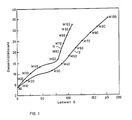
- Fig. 1 zeigt im Diagramm die Dielektrizitätszahl als Funktion des Leitwertes G in Abhängigkeit von dem Wassergehalt und dem Methanolgehalt des Kraftstoffes.
- Fig. 2 zeigt ein bevorzugtes Beispiel einer Meßzelle zur Ausführung des Verfahrens gemäß der Erfindung.
- Fig. 3 zeigt schematisch eine Anordnung zur Anwendung des Verfahrens gemäß der Erfindung zur Steuerung bzw. Regelung einer Einspritzbrennkraftmaschine.
- Fig. 4 zeigt eine bevorzugte Ausführungsform einer Schaltung zur Bestimmung der Dielektrizitätszahl durch Kapazitätsmessung.
- Fig. 5 zeigt eine bevorzugte Ausführungsform einer Schaltung, in der der Meßvorgang mit Hilfe unterschiedlicher Frequenzen erfolgt.
- Fig. 6 zeigt eine weitere bevorzugte Ausführungsform, bei der die Messung in zwei Phasen erfolgt.
- In der Darstellung gemäß Fig. 1 sind die Werte der Dielektrizitätsmessung in der Ordinate und die Leitwerte G in der Abszisse aufgetragen. Linienzug 11 zeigt die Abhängigkeit der Werte der Dielektrizitätsmessung von dem Anteil der Methanolbeimischung bei einem Wasseranteil von 0% im Kraftstoff, während Linienzug 12 die entsprechenden Werte bei einem Anteil von 2,5% Wasser darstellt. Auf den Linienzügen sind die jeweiligen Meßpunkte für variable Methanolanteile von 0% bis 100% (MO bis M100) aufgetragen.
- Bei einer Kapazitätsmessung zur Bestimmung der Dielektrizitätszahl treten Schwierigkeiten bedingt durch den Einfluß verschiedener Leitfähigkeiten auf. In Fig. 1 ist erkennbar, welchen Einfluß ein bestimmter Wasseranteil auf den Leitwert hat. Stärkere Einflüsse auf den Leitwert werden auch bei Säuren und Salzen beobachtet, die schon in geringen Konzentrationen den Leitwert drastisch erhöhen können, ohne eine nennenswerte Kapazitätsänderung zu bewirken. In Schwingschaltungen zur Bestimmung der Kapazität wirken sich unterschiedliche Leitwerte jedoch sehr negativ aus; in RC-Schaltungen ergibt sich eine Fehlmessung der Kapazität, die nachträglich durch separate Messung des Leitwertes kompensiert werden muß, und in LC-Schaltungen ergeben sich ebenfalls Probleme hinsichtlich des Meßfehlers bis hin zu Problemen mit der grundsätzlichen Schwingfähigkeit der Schaltung.
- Durch Meßschaltungen, die durch gezielte schaltungstechnische oder rechnerische Auswertung von mathematischen Zusammenhängen eine Unterdrückung des Leitwerteinflusses ermöglichen, ist über eine Kapazitätsbestimmung - versehen mit einer temperaturabhängigen Korrektur - eine genaue Bestimmung des Alkoholanteils möglich.
- Fig. 2 zeigt eine bevorzugte Ausführungsform einer Meßzelle zur Ausführung des Verfahrens gemäß der Erfindung. In die Meßzelle gelangt der Kraftstoff über Zufluß 14, und er verläßt die Meßzelle über Abfluß 15. Der Kraftstoffstrom teilt sich in der flächenhaften Darstellung der Fig. 2 auf in Strömungswege 16 und 17, die durch einen Mittelzylinder 18 gebildet werden. Wenn der Mittelzylinder 18 und Außenmantel 19 ganz oder teilweise elektrisch leitend sind, können diese Wandungen bzw. Wandungsteile der Meßzelle die Elektroden des Kondensators einer Meß- bzw. Auswerteschaltung darstellen. Innerhalb der wenigstens teilweise leitfähigen Wandung der Meßzelle, die die erste Elektrode darstellt, ist dann der wenigstens teilweise leitfähige Mittelzylinder 18 als Strömungskörper die zweite Elektrode.
- Der Mittelzylinder 18 bildet zusammen mit dem Außenmantel 19 den eigentlichen Meßkondensator, der das Meßvolumen umschließt. An Anschlüssen 21 und 22 können die entsprechenden Werte abgegriffen werden.
- Wie aus der schematischen Darstellung der Fig. 3 hervorgeht, gelangt mit Alkoholanteilen gemischter Kraftstoff aus Kraftstofftank 30 über eine Leitung 31 zur Meßzelle 13 und von dort über eine Leitung 32 zu einer Zumeßeinrichtung 33, die im Regelfall eine Einspritzpumpe mit entsprechenden Einspritzdüsen ist. Der Kraftstoff wird in direkter oder indirekter Einspritzung in Motor 34 zugeführt.
- Die in der Meßzelle 13 abgegriffenen Werte der Kapazität und des Leitwertes werden über Meßleitung 35 einer gemeinsamen Auswerteschaltung oder Auswerteeinheit 36 zugeführt. Insbesondere kann es dabei vorteilhaft sein, daß eine Wechselspannung oder eine von Wechselspannung überlagerte Gleichspannung an zwei Kondensatorelektroden in der Meßzelle angelegt und die Dielektrizitätszahl in Abhängigkeit von dem Real- und/oder Imaginärteil von Kenngrössen des fließenden Stromes bestimmt wird.
- Die von der Auswerteschaltung 36 abgegebenen Signale gelangen über eine Leitung 37 zu einem Einspritzrechner 38, und dieser steuert über eine Leitung 39 die Zumeßeinrichtung 33.
- Der jeweils in der Meßzelle gemessene und in der Auswerteeinheit 36 ausgewertete Mischungsanteil wird also betrieblich nicht verändert, sondern es wird vielmehr die Art der Einspritzung je nach den gemessenen und ausgewerteten Werten geändert. Gemäß einer bevorzugten Ausführungsform kann bei der Steuerung bzw. Regelung von Einspritzbrennkraftmaschinen die Messung des Alkoholanteils des zugeführten Kraftstoffs zur Vorsteuerung der Einspritzmenge dienen, während die Feinregelung des Luftverhältnisses über eine Lambdaregelung bekannter Art erfolgt. Insbesondere bei Kraftfahrzeugmotoren kann es dabei zweckmäßig sein, daß bei der Anwendung des Verfahrens gemäß der Erfindung auf Einspritzbrennkraftmaschinen die gemeinsame Schaltung als Auswerteeinheit in das Einspritzsystem schaltungs- und programmtechnisch integriert ist. Weitere Vorteile können verfahrenstechnisch dadurch erreicht werden, daß zusätzlich die Temperatur des in der Meßzelle 13 befindlichen Kraftstoffs festgestellt und in die Auswerteeinheit zur Kompensation des Temperatureinflusses eingegeben wird.
- Fig. 4 zeigt eine bevorzugte Ausführungsform einer Schaltung zur Kapazitätsbestimmung. Eine Wechselspannungsquelle 41 beaufschlagt über einen niederohmigen Widerstand 42, der als Stromsensor arbeitet, eine Meßzelle 43 mit einer sinusförmigen Spannung.
- Der sich ergebende Stromfluß, der am Widerstand 42 als Spannungsabfall abgegriffen wird, enthält einen Realteil, der nur vom Leitwert 44 der Meßzelle abhängt und einen Imaginärteil, der nur von der Kapazität 45 der Meßzelle abhängt. Zur ausschließlichen Auswertung des Imaginärteils wird der abgegriffene Strom mit einer cosinusförmigen Spannung in einem Multiplizierer 46 multipliziert, die z.B. aus der sinusförmigen Spannung über einen Phasenschieber 47 gewonnen wird. Durch einen Tiefpaßfilter 48 wird der Gleichspannungsanteil der Multiplikatorausgangsspannung extrahiert, der ein Maß für die Kapazität darstellt.
- Anstelle einer Multiplikation kann auch eine einfache Synchrongleichrichtung erfolgen.
- Eine weitere besonders vorteilhafte Ausführungsform gemäß Fig. 5 ergibt sich, wenn zwei unterschiedliche Frequenzen zweier Spannungserzeuger 51 und 52 zur Messung des Spannungsgabfalls an Meßzelle 53 mit Leitwert 54 und Kapazität 55 verwendet werden. Es wird dann nur der Betrag der über einen Gleichrichter 56 und einen Tiefpaß 57 gebildeten Ausgangsspannung ausgewertet.
- Bei einer weiteren Gruppe von bevorzugten Ausführungsformen kann die Kapazität der Meßzelle als das frequenzbestimmende Glied einer Schwingschaltung verwendet werden, wobei der Leitwert einen Quereinfluß bewirkt.
- Gemäß Fig. 6 wird in einer bevorzugten Ausführungsform die Messung in zwei Phasen durchgeführt, wobei bei der zweiten Messung eine definierte Kapazität C eines Kondensators 61 zur Meßzellenkapazität Cx der Meßzelle 62 parallel geschaltet wird. Man erhält so zwei unterschiedliche Frequenzen, deren Auswertung eine Aussage über die Kapazität liefert. Im einfachsten Fall ergibt sich die Formel:

- Besondere Vorteile hinsichtlich der Serienfertigung ergeben sich, wenn anstelle der geschalteten Kapazität eine schaltbare Verzögerung beispielsweise in einen Rückkopplungszweig 63 eingefügt wird. Diese wirkt wie eine Parallelschaltung der Kapazität frequenzerniedrigend, so daß eine gleichartige Auswertung der Frequenzen erfolgen kann.
- Eine weitere vorteilhafte Ausführungsform besteht darin, die Messung mit Hilfe einer Meßbrücke durchzuführen. Dabei muß der Brükkenabgleich automatisch erfolgen, wobei der für die Kapazität eingestellte Wert als Maß für die Kapazität der Meßzelle ausgewertet wird.
- Da der Zusammenhang zwischen Dielektrizitätszahl und Alkoholgehalt stark von der Temperatur abhängt, ist eine Verknüpfung des Kapazitätsmeßwertes mit dem Wert der Kraftstofftemperatur vorteilhaft, um eine von der Temperatur unabhängige Ausgangsgröße als Maß für den Alkoholgehalt zu erzielen. Diese Verknüpfung kann zusammen mit einer Linearisierung der Ausgangsspannung mit Hilfe eines Prozessors erfolgen. Besonders vorteilhaft ist dabei die Verwendung des normalerweise für die Einspritzung oder Zündung verwendeten Prozessors.
- Für eine weite Anwendung auf dem Gebiet der Verbrennungskraftmaschinen ist es auch vorteilhaft, wenn die Verknüpfung der gemessenen Größen und die Linearisierung schon im Sensor erfolgt, und zwar ohne Prozessor durch eine möglichst einfache und kostengünstige Schaltung. Hierzu werden die Werte für die Temperatur und die Kapazität als Digitalgrößen auf die Adressleitungen eines programmierbaren Bausteines (z.B. eines ROM, EPROM, PAL) geführt. An den Datenleitungen des entsprechend programmierten EPROMS o.ä. kann dann die Information über den Alkoholgehalt in digitaler Form abgenommen werden und ggf. noch einem D/A-Wandler zur Umsetzung in einen Analogwert zugeführt werden.
- Eine der Ausgangsleitungen kann auch zur Ausgabe eines Fehlersignals verwendet werden, das Bereichsüberschreitungen in den Eingangsdaten und somit Fehlfunktionen der Sensoren feststellen kann.
- Eine weitere bevorzugte Ausführungsform wird durch Verwendung einer Frequenz oder eines Frequenzbereiches erzielt, in der bzw. dem durch den Ausfall bestimmter Polarisationsmechanismen Überhöhungen der Dielektrizitätszahl kurz vor der Ausfallfrequenz meßtechnisch ausgenutzt werden.
Claims (20)
Applications Claiming Priority (2)
| Application Number | Priority Date | Filing Date | Title |
|---|---|---|---|
| DE3921707A DE3921707A1 (de) | 1989-07-01 | 1989-07-01 | Verfahren zur feststellung des alkoholgehaltes und/oder des heizwertes von kraftstoffen |
| DE3921707 | 1989-07-01 |
Publications (2)
| Publication Number | Publication Date |
|---|---|
| EP0411204A1 true EP0411204A1 (de) | 1991-02-06 |
| EP0411204B1 EP0411204B1 (de) | 1994-11-30 |
Family
ID=6384119
Family Applications (1)
| Application Number | Title | Priority Date | Filing Date |
|---|---|---|---|
| EP89117831A Expired - Lifetime EP0411204B1 (de) | 1989-07-01 | 1989-09-27 | Verfahren zur Feststellung des Alkoholgehaltes und/oder des Heizwertes von Kraftstoffen |
Country Status (5)
| Country | Link |
|---|---|
| US (1) | US5134381A (de) |
| EP (1) | EP0411204B1 (de) |
| JP (1) | JP3112279B2 (de) |
| BR (1) | BR9001383A (de) |
| DE (2) | DE3921707A1 (de) |
Cited By (3)
| Publication number | Priority date | Publication date | Assignee | Title |
|---|---|---|---|---|
| EP0558972A3 (de) * | 1992-03-04 | 1994-03-23 | Perkin Elmer Corp | |
| WO2001023876A3 (de) * | 1999-09-24 | 2001-05-17 | Siemens Ag | Bestimmung der alkoholkonzentration im elektrolyt von brennstoffzellen |
| WO2012007718A2 (en) | 2010-07-13 | 2012-01-19 | Oxford Rf Sensors Ltd | Permittivity sensor |
Families Citing this family (30)
| Publication number | Priority date | Publication date | Assignee | Title |
|---|---|---|---|---|
| BR9107079A (pt) * | 1990-11-16 | 1993-09-21 | Siemens Ag | Instrumento de medicao para a determinacao do teor alcoolico de uma mistura |
| DE4131626A1 (de) * | 1991-09-23 | 1993-03-25 | Kloeckner Humboldt Deutz Ag | Verfahren zur steuerung der kraftstoffeinspritzung von einem kraftstoff und einer fluessigkeit |
| US5361035A (en) * | 1992-02-11 | 1994-11-01 | Ford Motor Company | Resonant cavity flexible fuel sensor and system |
| US5179926A (en) * | 1992-02-18 | 1993-01-19 | General Motors Corporation | Alcohol discriminator and fuel control for an internal combustion engine fueled with alcohol-gasoline fuel mixtures |
| JP2925423B2 (ja) | 1993-03-15 | 1999-07-28 | 三菱電機株式会社 | 燃料のアルコール濃度検知装置 |
| JPH0675379U (ja) * | 1993-04-13 | 1994-10-25 | ジューキ株式会社 | ミシンの生地端制御装置 |
| US6129895A (en) * | 1993-08-12 | 2000-10-10 | Emcee Electronics, Inc. | Fuel additive analyzer system and process |
| JP3126872B2 (ja) * | 1994-05-12 | 2001-01-22 | 三菱電機株式会社 | 燃料の混合比率検知装置 |
| DE19533628A1 (de) * | 1995-09-12 | 1997-03-13 | Teves Gmbh Alfred | Schaltungsanordnung zur Messung der Alkohol-Konzentration in Wasser und Verfahren hierzu |
| DE19533927A1 (de) * | 1995-09-13 | 1997-03-27 | Michael Prof Dr Dr Gitis | Online-Messung der Waschmittelkonzentration in verschmutzten Industrie-Waschlaugen |
| US6057693A (en) * | 1996-08-27 | 2000-05-02 | Raytheon Company | Dielectric mixture composition sensor with compensation for mixture electrical conductivity |
| DE19736528A1 (de) * | 1997-08-22 | 1999-02-25 | Ruhrgas Ag | Verfahren zur verbrennungslosen Messung des Brennwertes von Brenngas |
| SE9901512D0 (sv) | 1999-04-27 | 1999-04-27 | Siemens Elema Ab | Förfarande för analys av ämnen samt en analysator |
| US6566892B2 (en) * | 2000-06-19 | 2003-05-20 | Siemens Vdo Automotive Corporation | Portable fuel analyzer for analyzing the alcohol content of a mixed fuel |
| US6927583B2 (en) * | 2001-05-17 | 2005-08-09 | Siemens Vdo Automotive Inc. | Fuel sensor |
| US6885199B2 (en) * | 2001-05-17 | 2005-04-26 | Siemens Vdo Automotive Corp. | Fuel sensor |
| US6842017B2 (en) * | 2001-05-17 | 2005-01-11 | Siemens Vdo Automotive Corporation | Fuel cell mixture sensor |
| DE10155371A1 (de) * | 2001-11-10 | 2003-05-28 | Bosch Gmbh Robert | Sensor zur Bestimmung der Dielektrizitätskonstanten eines Kraftstoffs |
| US7902838B2 (en) * | 2004-11-17 | 2011-03-08 | Continental Automotive Systems Us, Inc. | Sensor device for determining a fluid property |
| US7030629B1 (en) | 2004-11-18 | 2006-04-18 | Siemens Vdo Automotive Corporation | In line fluid quality sensor |
| US20060196264A1 (en) * | 2005-03-03 | 2006-09-07 | Siemens Vdo Automotive Corporation | Level sensor |
| US7222528B2 (en) | 2005-03-03 | 2007-05-29 | Siemens Vdo Automotive Corporation | Fluid level sensor |
| US7466147B2 (en) * | 2005-08-08 | 2008-12-16 | Continental Automotive Systems Us, Inc. | Fluid quality sensor |
| EP2238440A4 (de) * | 2008-01-09 | 2013-11-20 | Diraction Llc | Automatische phasentrennung und brennstoffqualitätssensor |
| US7775092B2 (en) * | 2008-02-07 | 2010-08-17 | Ssi Technologies, Inc. | Fuel delivery system and method |
| JP5158513B2 (ja) * | 2008-12-19 | 2013-03-06 | 株式会社デンソー | 燃料性状センサ |
| JP2010210241A (ja) * | 2009-03-06 | 2010-09-24 | Denso Corp | 液体用濃度測定装置 |
| JP5683376B2 (ja) * | 2011-05-10 | 2015-03-11 | パナソニックIpマネジメント株式会社 | 混合濃度測定用センサー装置 |
| JP5691942B2 (ja) * | 2011-08-30 | 2015-04-01 | トヨタ自動車株式会社 | 液体性状検出装置及び液体性状検出プログラム |
| US9658204B2 (en) * | 2014-05-08 | 2017-05-23 | Continental Automotive Systems, Inc. | Stoichiometric air to fuel ratio sensor system |
Citations (4)
| Publication number | Priority date | Publication date | Assignee | Title |
|---|---|---|---|---|
| US4174498A (en) * | 1978-03-30 | 1979-11-13 | Preikschat F K | Apparatus and method for providing separate conductivity, dielectric coefficient, and moisture measurements of particulate material |
| GB2055472A (en) * | 1979-06-12 | 1981-03-04 | El Menshawy M F Woodrow P A | Methods and apparatus for monitoring the condition of dielectric liquid in electric discharge machining |
| US4288741A (en) * | 1979-05-18 | 1981-09-08 | Auburn International, Inc. | Electrical measurement of fluid void fraction for fluid having capacitive and resistive conductive components |
| US4426616A (en) * | 1981-10-06 | 1984-01-17 | Simmonds Precision Products, Inc. | Capacitive measurement system |
Family Cites Families (10)
| Publication number | Priority date | Publication date | Assignee | Title |
|---|---|---|---|---|
| US3324049A (en) * | 1966-02-18 | 1967-06-06 | Cts Corp | Precision resistance element and method of making the same |
| GB1578527A (en) * | 1976-03-13 | 1980-11-05 | Lucas Industries Ltd | Apparatus for detecting water in oil |
| JPS57168169A (en) * | 1981-04-10 | 1982-10-16 | Nissan Motor Co Ltd | Electrostatic capacitance detector |
| DE3517065C2 (de) * | 1985-05-11 | 1996-08-01 | Schloemann Siemag Ag | Anordnung zur Überwachung des Mischungsverhältnisses zweier Flüssigkeiten |
| JPH0199056U (de) * | 1987-12-23 | 1989-07-03 | ||
| JP2511092B2 (ja) * | 1988-01-30 | 1996-06-26 | 日産自動車株式会社 | 流体用センサ |
| US4885529A (en) * | 1988-03-10 | 1989-12-05 | Lee David O | Identification of fluids and an interface between fluids by measuring complex impedance |
| US4945863A (en) * | 1988-03-30 | 1990-08-07 | Fev Motorentechnik Gmbh & Co. Kg | Process for operating a fuel-burning engine |
| EP0377782B1 (de) * | 1988-12-08 | 1995-09-20 | FEV Motorentechnik GmbH & Co. KG | Verfahren zur Feststellung des Alkoholgehaltes und/oder des Heizwertes von Kraftstoffen |
| US4907442A (en) * | 1989-03-20 | 1990-03-13 | Mobil Oil Corporation | Method and system for determining fluid saturations within natural or simulated fractures |
-
1989
- 1989-07-01 DE DE3921707A patent/DE3921707A1/de not_active Withdrawn
- 1989-09-27 EP EP89117831A patent/EP0411204B1/de not_active Expired - Lifetime
- 1989-09-27 DE DE58908701T patent/DE58908701D1/de not_active Expired - Lifetime
-
1990
- 1990-03-27 BR BR909001383A patent/BR9001383A/pt not_active IP Right Cessation
- 1990-06-11 US US07/535,536 patent/US5134381A/en not_active Expired - Lifetime
- 1990-06-29 JP JP02170358A patent/JP3112279B2/ja not_active Expired - Fee Related
Patent Citations (4)
| Publication number | Priority date | Publication date | Assignee | Title |
|---|---|---|---|---|
| US4174498A (en) * | 1978-03-30 | 1979-11-13 | Preikschat F K | Apparatus and method for providing separate conductivity, dielectric coefficient, and moisture measurements of particulate material |
| US4288741A (en) * | 1979-05-18 | 1981-09-08 | Auburn International, Inc. | Electrical measurement of fluid void fraction for fluid having capacitive and resistive conductive components |
| GB2055472A (en) * | 1979-06-12 | 1981-03-04 | El Menshawy M F Woodrow P A | Methods and apparatus for monitoring the condition of dielectric liquid in electric discharge machining |
| US4426616A (en) * | 1981-10-06 | 1984-01-17 | Simmonds Precision Products, Inc. | Capacitive measurement system |
Non-Patent Citations (2)
| Title |
|---|
| IEEE TRANS. VEHICULAR TECHN., Band VT-27, Nr. 3, August 1978, Seiten 142-144, IEEE, New York, US; J.W. HILE et al.: "An on-board sensor for percent alcohol" * |
| PATENT ABSTRACTS OF JAPAN, Band 6, Nr. 133 (P-129)[1011], 20. Juli 1982; & JP-A-57 57 253 (NISSAN JIDOSHA K.K.) 06-04-1982 * |
Cited By (5)
| Publication number | Priority date | Publication date | Assignee | Title |
|---|---|---|---|---|
| EP0558972A3 (de) * | 1992-03-04 | 1994-03-23 | Perkin Elmer Corp | |
| WO2001023876A3 (de) * | 1999-09-24 | 2001-05-17 | Siemens Ag | Bestimmung der alkoholkonzentration im elektrolyt von brennstoffzellen |
| WO2012007718A2 (en) | 2010-07-13 | 2012-01-19 | Oxford Rf Sensors Ltd | Permittivity sensor |
| WO2012007718A3 (en) * | 2010-07-13 | 2012-03-15 | Oxford Rf Sensors Ltd | Permittivity sensor |
| US9739740B2 (en) | 2010-07-13 | 2017-08-22 | Salunda Limited | Permittivity sensor |
Also Published As
| Publication number | Publication date |
|---|---|
| BR9001383A (pt) | 1991-04-02 |
| US5134381A (en) | 1992-07-28 |
| DE58908701D1 (de) | 1995-01-12 |
| EP0411204B1 (de) | 1994-11-30 |
| DE3921707A1 (de) | 1991-01-10 |
| JP3112279B2 (ja) | 2000-11-27 |
| JPH0344548A (ja) | 1991-02-26 |
Similar Documents
| Publication | Publication Date | Title |
|---|---|---|
| EP0411204B1 (de) | Verfahren zur Feststellung des Alkoholgehaltes und/oder des Heizwertes von Kraftstoffen | |
| EP0335168B1 (de) | Verfahren zum Betrieb einer Brennkraftmaschine | |
| DE4311478C2 (de) | Beurteilungssystem für die Art eines Kraftstoffes | |
| DE4035731C2 (de) | Kraftstoffkonzentrations-Überwachungseinheit | |
| DE4230313C2 (de) | Vorrichtung zur Erfassung einer dielektrischen Konstanten | |
| DE69204318T2 (de) | Vorrichtung zur Bestimmung der Dielektrizitätskonstante von Kraftstoff. | |
| DE3714306A1 (de) | Kapazitiver pegelanzeiger | |
| DE102008000347A1 (de) | Gassensor-Regelgerät | |
| DE3115776A1 (de) | Thermoelektrische fuellstandsmesseinrichtung | |
| EP0557327A1 (de) | Messgerät zum bestimmen des alkoholgehaltes eines gemisches. | |
| EP0377782B1 (de) | Verfahren zur Feststellung des Alkoholgehaltes und/oder des Heizwertes von Kraftstoffen | |
| EP2100101A2 (de) | Anordnung zum messen einer physikalischen grösse | |
| DE3601100A1 (de) | System zur fuellstandsmessung | |
| EP0379644A1 (de) | Verfahren zur Feststellung des Alkoholgehaltes und/oder des Heizwertes von Kraftstoffen | |
| DE19917618A1 (de) | Meßgerät für die Dielektrizitätskonstante einer Flüssigkeit und zugehöriges Verfahren | |
| DE2844761B2 (de) | Schaltungsanordnung zur Überwachung der Zusammensetzung des Abgasgemischs einer mit einem Luft/Brennstoff-Gemisch betriebenen Brennkraftmaschine | |
| DE10029831C1 (de) | Verfahren und Vorrichtung zum Betrieb einer Linearen Lambdasonde | |
| EP0360790B1 (de) | Verfahren und Vorrichtung zur Messung der Kraftstofftemperatur bei einer elektronisch geregelten Brennkraftmaschine | |
| EP0377791B1 (de) | Verfahren zur Feststellung des Alkoholgehaltes und/oder des Heizwertes von Kraftstoffen | |
| DE102009054844A1 (de) | Vorrichtung zur Messung einer Zusammensetzung eines Kraftstoffgemischs | |
| WO1996035120A1 (de) | Vorrichtung zum ermitteln der konzentration einer komponente in einer gasmischung | |
| DE19907946C2 (de) | Schaltung für einen NOx-Meßaufnehmer | |
| DE4115288C2 (de) | Einrichtung zum Abgleich von Exemplarstreuung und Temperatureinflüssen mindestens eines Sensors | |
| DE3922851A1 (de) | Verfahren zur feststellung des alkoholgehaltes und/oder des heizwertes von kraftstoffen | |
| DE19601691C1 (de) | Vorrichtung zur kapazitiven Messung des Füllstands einer dielektrischen Flüssigkeit in einem Behälter |
Legal Events
| Date | Code | Title | Description |
|---|---|---|---|
| PUAI | Public reference made under article 153(3) epc to a published international application that has entered the european phase |
Free format text: ORIGINAL CODE: 0009012 |
|
| AK | Designated contracting states |
Kind code of ref document: A1 Designated state(s): DE FR GB IT SE |
|
| 17P | Request for examination filed |
Effective date: 19901220 |
|
| 17Q | First examination report despatched |
Effective date: 19921023 |
|
| GRAA | (expected) grant |
Free format text: ORIGINAL CODE: 0009210 |
|
| AK | Designated contracting states |
Kind code of ref document: B1 Designated state(s): DE FR GB IT SE |
|
| ITF | It: translation for a ep patent filed | ||
| REF | Corresponds to: |
Ref document number: 58908701 Country of ref document: DE Date of ref document: 19950112 |
|
| ET | Fr: translation filed | ||
| PG25 | Lapsed in a contracting state [announced via postgrant information from national office to epo] |
Ref country code: SE Effective date: 19950228 |
|
| GBT | Gb: translation of ep patent filed (gb section 77(6)(a)/1977) |
Effective date: 19950223 |
|
| PLBE | No opposition filed within time limit |
Free format text: ORIGINAL CODE: 0009261 |
|
| STAA | Information on the status of an ep patent application or granted ep patent |
Free format text: STATUS: NO OPPOSITION FILED WITHIN TIME LIMIT |
|
| 26N | No opposition filed | ||
| REG | Reference to a national code |
Ref country code: GB Ref legal event code: IF02 |
|
| PGFP | Annual fee paid to national office [announced via postgrant information from national office to epo] |
Ref country code: IT Payment date: 20080926 Year of fee payment: 20 Ref country code: FR Payment date: 20080917 Year of fee payment: 20 |
|
| PGFP | Annual fee paid to national office [announced via postgrant information from national office to epo] |
Ref country code: GB Payment date: 20080922 Year of fee payment: 20 |
|
| PGFP | Annual fee paid to national office [announced via postgrant information from national office to epo] |
Ref country code: DE Payment date: 20080924 Year of fee payment: 20 |
|
| REG | Reference to a national code |
Ref country code: GB Ref legal event code: PE20 Expiry date: 20090926 |
|
| PG25 | Lapsed in a contracting state [announced via postgrant information from national office to epo] |
Ref country code: GB Free format text: LAPSE BECAUSE OF EXPIRATION OF PROTECTION Effective date: 20090926 |