EP0411299B1 - Procédé de passivation d'oxydes d'uranium pour contrôler l'oxydation - Google Patents
Procédé de passivation d'oxydes d'uranium pour contrôler l'oxydation Download PDFInfo
- Publication number
- EP0411299B1 EP0411299B1 EP90111830A EP90111830A EP0411299B1 EP 0411299 B1 EP0411299 B1 EP 0411299B1 EP 90111830 A EP90111830 A EP 90111830A EP 90111830 A EP90111830 A EP 90111830A EP 0411299 B1 EP0411299 B1 EP 0411299B1
- Authority
- EP
- European Patent Office
- Prior art keywords
- uranium
- passivating
- oxides
- cooling gas
- oxygen
- Prior art date
- Legal status (The legal status is an assumption and is not a legal conclusion. Google has not performed a legal analysis and makes no representation as to the accuracy of the status listed.)
- Expired - Lifetime
Links
- 238000000034 method Methods 0.000 title claims description 39
- WZECUPJJEIXUKY-UHFFFAOYSA-N [O-2].[O-2].[O-2].[U+6] Chemical class [O-2].[O-2].[O-2].[U+6] WZECUPJJEIXUKY-UHFFFAOYSA-N 0.000 title description 47
- 238000007254 oxidation reaction Methods 0.000 title description 28
- 230000008569 process Effects 0.000 title description 18
- 230000003647 oxidation Effects 0.000 title description 17
- 229910052770 Uranium Inorganic materials 0.000 claims description 53
- JFALSRSLKYAFGM-UHFFFAOYSA-N uranium(0) Chemical compound [U] JFALSRSLKYAFGM-UHFFFAOYSA-N 0.000 claims description 53
- QVGXLLKOCUKJST-UHFFFAOYSA-N atomic oxygen Chemical compound [O] QVGXLLKOCUKJST-UHFFFAOYSA-N 0.000 claims description 44
- 239000001301 oxygen Substances 0.000 claims description 44
- 229910052760 oxygen Inorganic materials 0.000 claims description 44
- 238000006243 chemical reaction Methods 0.000 claims description 29
- 239000002245 particle Substances 0.000 claims description 28
- 239000000112 cooling gas Substances 0.000 claims description 13
- 230000015572 biosynthetic process Effects 0.000 claims description 8
- 150000004682 monohydrates Chemical class 0.000 claims description 8
- 230000001681 protective effect Effects 0.000 claims description 8
- 150000004683 dihydrates Chemical class 0.000 claims description 7
- 239000010410 layer Substances 0.000 claims description 6
- IJGRMHOSHXDMSA-UHFFFAOYSA-N Atomic nitrogen Chemical compound N#N IJGRMHOSHXDMSA-UHFFFAOYSA-N 0.000 claims description 4
- 239000002344 surface layer Substances 0.000 claims description 4
- 239000011261 inert gas Substances 0.000 claims description 3
- 229910052757 nitrogen Inorganic materials 0.000 claims description 2
- 230000004323 axial length Effects 0.000 claims 1
- 239000007789 gas Substances 0.000 description 30
- 229910000439 uranium oxide Inorganic materials 0.000 description 25
- 239000000843 powder Substances 0.000 description 23
- OOAWCECZEHPMBX-UHFFFAOYSA-N oxygen(2-);uranium(4+) Chemical compound [O-2].[O-2].[U+4] OOAWCECZEHPMBX-UHFFFAOYSA-N 0.000 description 20
- FCTBKIHDJGHPPO-UHFFFAOYSA-N uranium dioxide Inorganic materials O=[U]=O FCTBKIHDJGHPPO-UHFFFAOYSA-N 0.000 description 20
- 239000000446 fuel Substances 0.000 description 10
- 239000003758 nuclear fuel Substances 0.000 description 10
- 238000012545 processing Methods 0.000 description 8
- SANRKQGLYCLAFE-UHFFFAOYSA-H uranium hexafluoride Chemical compound F[U](F)(F)(F)(F)F SANRKQGLYCLAFE-UHFFFAOYSA-H 0.000 description 8
- 238000004519 manufacturing process Methods 0.000 description 7
- 239000000203 mixture Substances 0.000 description 6
- QGZKDVFQNNGYKY-UHFFFAOYSA-N Ammonia Chemical compound N QGZKDVFQNNGYKY-UHFFFAOYSA-N 0.000 description 5
- 238000004320 controlled atmosphere Methods 0.000 description 5
- 230000001590 oxidative effect Effects 0.000 description 5
- 238000002161 passivation Methods 0.000 description 5
- 239000000126 substance Substances 0.000 description 5
- 238000012546 transfer Methods 0.000 description 5
- 229910021510 uranyl hydroxide Inorganic materials 0.000 description 5
- 230000000694 effects Effects 0.000 description 4
- 238000005245 sintering Methods 0.000 description 4
- 239000007787 solid Substances 0.000 description 4
- 230000002269 spontaneous effect Effects 0.000 description 4
- 229910001868 water Inorganic materials 0.000 description 4
- 239000011248 coating agent Substances 0.000 description 3
- 238000000576 coating method Methods 0.000 description 3
- 238000010924 continuous production Methods 0.000 description 3
- ZAASRHQPRFFWCS-UHFFFAOYSA-P diazanium;oxygen(2-);uranium Chemical compound [NH4+].[NH4+].[O-2].[O-2].[O-2].[O-2].[O-2].[O-2].[O-2].[U].[U] ZAASRHQPRFFWCS-UHFFFAOYSA-P 0.000 description 3
- KCKICANVXIVOLK-UHFFFAOYSA-L dioxouranium(2+);difluoride Chemical compound [F-].[F-].O=[U+2]=O KCKICANVXIVOLK-UHFFFAOYSA-L 0.000 description 3
- 239000000463 material Substances 0.000 description 3
- 239000002609 medium Substances 0.000 description 3
- 238000010301 surface-oxidation reaction Methods 0.000 description 3
- XLYOFNOQVPJJNP-UHFFFAOYSA-N water Substances O XLYOFNOQVPJJNP-UHFFFAOYSA-N 0.000 description 3
- XKRFYHLGVUSROY-UHFFFAOYSA-N Argon Chemical compound [Ar] XKRFYHLGVUSROY-UHFFFAOYSA-N 0.000 description 2
- CURLTUGMZLYLDI-UHFFFAOYSA-N Carbon dioxide Chemical compound O=C=O CURLTUGMZLYLDI-UHFFFAOYSA-N 0.000 description 2
- UFHFLCQGNIYNRP-UHFFFAOYSA-N Hydrogen Chemical compound [H][H] UFHFLCQGNIYNRP-UHFFFAOYSA-N 0.000 description 2
- 239000000654 additive Substances 0.000 description 2
- 230000000996 additive effect Effects 0.000 description 2
- 229910021529 ammonia Inorganic materials 0.000 description 2
- 238000001354 calcination Methods 0.000 description 2
- 150000001875 compounds Chemical class 0.000 description 2
- 238000001816 cooling Methods 0.000 description 2
- 230000002939 deleterious effect Effects 0.000 description 2
- RXWCTKVOMOOHCV-UHFFFAOYSA-N dioxouranium;dihydrofluoride Chemical compound F.F.O=[U]=O RXWCTKVOMOOHCV-UHFFFAOYSA-N 0.000 description 2
- 239000008246 gaseous mixture Substances 0.000 description 2
- 230000003301 hydrolyzing effect Effects 0.000 description 2
- VNWKTOKETHGBQD-UHFFFAOYSA-N methane Chemical compound C VNWKTOKETHGBQD-UHFFFAOYSA-N 0.000 description 2
- 238000003801 milling Methods 0.000 description 2
- 238000002156 mixing Methods 0.000 description 2
- 238000000465 moulding Methods 0.000 description 2
- QJGQUHMNIGDVPM-UHFFFAOYSA-N nitrogen group Chemical group [N] QJGQUHMNIGDVPM-UHFFFAOYSA-N 0.000 description 2
- 239000008188 pellet Substances 0.000 description 2
- JCMLRUNDSXARRW-UHFFFAOYSA-N trioxouranium Chemical compound O=[U](=O)=O JCMLRUNDSXARRW-UHFFFAOYSA-N 0.000 description 2
- DSSYKIVIOFKYAU-XCBNKYQSSA-N (R)-camphor Chemical compound C1C[C@@]2(C)C(=O)C[C@@H]1C2(C)C DSSYKIVIOFKYAU-XCBNKYQSSA-N 0.000 description 1
- QGZKDVFQNNGYKY-UHFFFAOYSA-O Ammonium Chemical compound [NH4+] QGZKDVFQNNGYKY-UHFFFAOYSA-O 0.000 description 1
- VHUUQVKOLVNVRT-UHFFFAOYSA-N Ammonium hydroxide Chemical compound [NH4+].[OH-] VHUUQVKOLVNVRT-UHFFFAOYSA-N 0.000 description 1
- MBOXXGJJUHCDFD-UHFFFAOYSA-N CCC1(CC2(C)C3)C22C33CCC4C1C2C4C3 Chemical compound CCC1(CC2(C)C3)C22C33CCC4C1C2C4C3 MBOXXGJJUHCDFD-UHFFFAOYSA-N 0.000 description 1
- LSPHULWDVZXLIL-UHFFFAOYSA-N Camphoric acid Natural products CC1(C)C(C(O)=O)CCC1(C)C(O)=O LSPHULWDVZXLIL-UHFFFAOYSA-N 0.000 description 1
- UGFAIRIUMAVXCW-UHFFFAOYSA-N Carbon monoxide Chemical compound [O+]#[C-] UGFAIRIUMAVXCW-UHFFFAOYSA-N 0.000 description 1
- 241000723346 Cinnamomum camphora Species 0.000 description 1
- KRHYYFGTRYWZRS-UHFFFAOYSA-N Fluorane Chemical compound F KRHYYFGTRYWZRS-UHFFFAOYSA-N 0.000 description 1
- 201000005569 Gout Diseases 0.000 description 1
- XOJVVFBFDXDTEG-UHFFFAOYSA-N Norphytane Natural products CC(C)CCCC(C)CCCC(C)CCCC(C)C XOJVVFBFDXDTEG-UHFFFAOYSA-N 0.000 description 1
- UVYRXCHSEDLSGT-UHFFFAOYSA-L O.[OH-].[OH-].O=[U++]=O Chemical compound O.[OH-].[OH-].O=[U++]=O UVYRXCHSEDLSGT-UHFFFAOYSA-L 0.000 description 1
- MJEGZAMCHSCDAO-UHFFFAOYSA-L O.[OH-].[U+2](=O)=O.O.O.[OH-] Chemical compound O.[OH-].[U+2](=O)=O.O.O.[OH-] MJEGZAMCHSCDAO-UHFFFAOYSA-L 0.000 description 1
- 235000021355 Stearic acid Nutrition 0.000 description 1
- 241001125929 Trisopterus luscus Species 0.000 description 1
- 239000000908 ammonium hydroxide Substances 0.000 description 1
- 239000012736 aqueous medium Substances 0.000 description 1
- 229910052786 argon Inorganic materials 0.000 description 1
- 230000009286 beneficial effect Effects 0.000 description 1
- FFBHFFJDDLITSX-UHFFFAOYSA-N benzyl N-[2-hydroxy-4-(3-oxomorpholin-4-yl)phenyl]carbamate Chemical compound OC1=C(NC(=O)OCC2=CC=CC=C2)C=CC(=C1)N1CCOCC1=O FFBHFFJDDLITSX-UHFFFAOYSA-N 0.000 description 1
- 229960000846 camphor Drugs 0.000 description 1
- 229910002092 carbon dioxide Inorganic materials 0.000 description 1
- 239000001569 carbon dioxide Substances 0.000 description 1
- 229910002091 carbon monoxide Inorganic materials 0.000 description 1
- 239000000919 ceramic Substances 0.000 description 1
- 238000004891 communication Methods 0.000 description 1
- 230000006835 compression Effects 0.000 description 1
- 238000007906 compression Methods 0.000 description 1
- 238000011437 continuous method Methods 0.000 description 1
- 238000007796 conventional method Methods 0.000 description 1
- 239000013078 crystal Substances 0.000 description 1
- 238000002425 crystallisation Methods 0.000 description 1
- 230000008025 crystallization Effects 0.000 description 1
- 230000007423 decrease Effects 0.000 description 1
- 230000007547 defect Effects 0.000 description 1
- 238000000280 densification Methods 0.000 description 1
- 238000013461 design Methods 0.000 description 1
- 230000001627 detrimental effect Effects 0.000 description 1
- 238000010586 diagram Methods 0.000 description 1
- 238000001035 drying Methods 0.000 description 1
- 238000011156 evaluation Methods 0.000 description 1
- 230000001747 exhibiting effect Effects 0.000 description 1
- 230000004992 fission Effects 0.000 description 1
- 231100001261 hazardous Toxicity 0.000 description 1
- 230000020169 heat generation Effects 0.000 description 1
- 238000006703 hydration reaction Methods 0.000 description 1
- 230000007062 hydrolysis Effects 0.000 description 1
- 238000006460 hydrolysis reaction Methods 0.000 description 1
- 230000002401 inhibitory effect Effects 0.000 description 1
- 238000011835 investigation Methods 0.000 description 1
- 230000002045 lasting effect Effects 0.000 description 1
- 239000007788 liquid Substances 0.000 description 1
- 239000007791 liquid phase Substances 0.000 description 1
- 238000013178 mathematical model Methods 0.000 description 1
- 230000007246 mechanism Effects 0.000 description 1
- 239000011824 nuclear material Substances 0.000 description 1
- QIQXTHQIDYTFRH-UHFFFAOYSA-N octadecanoic acid Chemical compound CCCCCCCCCCCCCCCCCC(O)=O QIQXTHQIDYTFRH-UHFFFAOYSA-N 0.000 description 1
- OQCDKBAXFALNLD-UHFFFAOYSA-N octadecanoic acid Natural products CCCCCCCC(C)CCCCCCCCC(O)=O OQCDKBAXFALNLD-UHFFFAOYSA-N 0.000 description 1
- 238000010915 one-step procedure Methods 0.000 description 1
- 230000001151 other effect Effects 0.000 description 1
- 239000011236 particulate material Substances 0.000 description 1
- 239000012071 phase Substances 0.000 description 1
- 239000000376 reactant Substances 0.000 description 1
- 230000009467 reduction Effects 0.000 description 1
- 238000007670 refining Methods 0.000 description 1
- 238000004513 sizing Methods 0.000 description 1
- 239000008117 stearic acid Substances 0.000 description 1
- 238000003860 storage Methods 0.000 description 1
- 238000006557 surface reaction Methods 0.000 description 1
- 239000000725 suspension Substances 0.000 description 1
- 125000005289 uranyl group Chemical group 0.000 description 1
- 239000012808 vapor phase Substances 0.000 description 1
- 238000013022 venting Methods 0.000 description 1
Images
Classifications
-
- C—CHEMISTRY; METALLURGY
- C04—CEMENTS; CONCRETE; ARTIFICIAL STONE; CERAMICS; REFRACTORIES
- C04B—LIME, MAGNESIA; SLAG; CEMENTS; COMPOSITIONS THEREOF, e.g. MORTARS, CONCRETE OR LIKE BUILDING MATERIALS; ARTIFICIAL STONE; CERAMICS; REFRACTORIES; TREATMENT OF NATURAL STONE
- C04B41/00—After-treatment of mortars, concrete, artificial stone or ceramics; Treatment of natural stone
- C04B41/009—After-treatment of mortars, concrete, artificial stone or ceramics; Treatment of natural stone characterised by the material treated
-
- C—CHEMISTRY; METALLURGY
- C01—INORGANIC CHEMISTRY
- C01G—COMPOUNDS CONTAINING METALS NOT COVERED BY SUBCLASSES C01D OR C01F
- C01G43/00—Compounds of uranium
- C01G43/01—Oxides; Hydroxides
- C01G43/025—Uranium dioxide
-
- C—CHEMISTRY; METALLURGY
- C04—CEMENTS; CONCRETE; ARTIFICIAL STONE; CERAMICS; REFRACTORIES
- C04B—LIME, MAGNESIA; SLAG; CEMENTS; COMPOSITIONS THEREOF, e.g. MORTARS, CONCRETE OR LIKE BUILDING MATERIALS; ARTIFICIAL STONE; CERAMICS; REFRACTORIES; TREATMENT OF NATURAL STONE
- C04B41/00—After-treatment of mortars, concrete, artificial stone or ceramics; Treatment of natural stone
- C04B41/45—Coating or impregnating, e.g. injection in masonry, partial coating of green or fired ceramics, organic coating compositions for adhering together two concrete elements
- C04B41/4584—Coating or impregnating of particulate or fibrous ceramic material
-
- C—CHEMISTRY; METALLURGY
- C04—CEMENTS; CONCRETE; ARTIFICIAL STONE; CERAMICS; REFRACTORIES
- C04B—LIME, MAGNESIA; SLAG; CEMENTS; COMPOSITIONS THEREOF, e.g. MORTARS, CONCRETE OR LIKE BUILDING MATERIALS; ARTIFICIAL STONE; CERAMICS; REFRACTORIES; TREATMENT OF NATURAL STONE
- C04B41/00—After-treatment of mortars, concrete, artificial stone or ceramics; Treatment of natural stone
- C04B41/80—After-treatment of mortars, concrete, artificial stone or ceramics; Treatment of natural stone of only ceramics
- C04B41/81—Coating or impregnation
-
- G—PHYSICS
- G21—NUCLEAR PHYSICS; NUCLEAR ENGINEERING
- G21C—NUCLEAR REACTORS
- G21C3/00—Reactor fuel elements and their assemblies; Selection of substances for use as reactor fuel elements
- G21C3/42—Selection of substances for use as reactor fuel
- G21C3/58—Solid reactor fuel Pellets made of fissile material
- G21C3/62—Ceramic fuel
-
- C—CHEMISTRY; METALLURGY
- C01—INORGANIC CHEMISTRY
- C01P—INDEXING SCHEME RELATING TO STRUCTURAL AND PHYSICAL ASPECTS OF SOLID INORGANIC COMPOUNDS
- C01P2002/00—Crystal-structural characteristics
- C01P2002/20—Two-dimensional structures
-
- C—CHEMISTRY; METALLURGY
- C01—INORGANIC CHEMISTRY
- C01P—INDEXING SCHEME RELATING TO STRUCTURAL AND PHYSICAL ASPECTS OF SOLID INORGANIC COMPOUNDS
- C01P2002/00—Crystal-structural characteristics
- C01P2002/70—Crystal-structural characteristics defined by measured X-ray, neutron or electron diffraction data
- C01P2002/78—Crystal-structural characteristics defined by measured X-ray, neutron or electron diffraction data by stacking-plane distances or stacking sequences
-
- C—CHEMISTRY; METALLURGY
- C01—INORGANIC CHEMISTRY
- C01P—INDEXING SCHEME RELATING TO STRUCTURAL AND PHYSICAL ASPECTS OF SOLID INORGANIC COMPOUNDS
- C01P2004/00—Particle morphology
- C01P2004/80—Particles consisting of a mixture of two or more inorganic phases
- C01P2004/82—Particles consisting of a mixture of two or more inorganic phases two phases having the same anion, e.g. both oxidic phases
- C01P2004/84—Particles consisting of a mixture of two or more inorganic phases two phases having the same anion, e.g. both oxidic phases one phase coated with the other
-
- C—CHEMISTRY; METALLURGY
- C01—INORGANIC CHEMISTRY
- C01P—INDEXING SCHEME RELATING TO STRUCTURAL AND PHYSICAL ASPECTS OF SOLID INORGANIC COMPOUNDS
- C01P2006/00—Physical properties of inorganic compounds
- C01P2006/10—Solid density
-
- C—CHEMISTRY; METALLURGY
- C01—INORGANIC CHEMISTRY
- C01P—INDEXING SCHEME RELATING TO STRUCTURAL AND PHYSICAL ASPECTS OF SOLID INORGANIC COMPOUNDS
- C01P2006/00—Physical properties of inorganic compounds
- C01P2006/12—Surface area
-
- C—CHEMISTRY; METALLURGY
- C01—INORGANIC CHEMISTRY
- C01P—INDEXING SCHEME RELATING TO STRUCTURAL AND PHYSICAL ASPECTS OF SOLID INORGANIC COMPOUNDS
- C01P2006/00—Physical properties of inorganic compounds
- C01P2006/60—Optical properties, e.g. expressed in CIELAB-values
-
- C—CHEMISTRY; METALLURGY
- C01—INORGANIC CHEMISTRY
- C01P—INDEXING SCHEME RELATING TO STRUCTURAL AND PHYSICAL ASPECTS OF SOLID INORGANIC COMPOUNDS
- C01P2006/00—Physical properties of inorganic compounds
- C01P2006/80—Compositional purity
-
- C—CHEMISTRY; METALLURGY
- C01—INORGANIC CHEMISTRY
- C01P—INDEXING SCHEME RELATING TO STRUCTURAL AND PHYSICAL ASPECTS OF SOLID INORGANIC COMPOUNDS
- C01P2006/00—Physical properties of inorganic compounds
- C01P2006/80—Compositional purity
- C01P2006/82—Compositional purity water content
-
- Y—GENERAL TAGGING OF NEW TECHNOLOGICAL DEVELOPMENTS; GENERAL TAGGING OF CROSS-SECTIONAL TECHNOLOGIES SPANNING OVER SEVERAL SECTIONS OF THE IPC; TECHNICAL SUBJECTS COVERED BY FORMER USPC CROSS-REFERENCE ART COLLECTIONS [XRACs] AND DIGESTS
- Y02—TECHNOLOGIES OR APPLICATIONS FOR MITIGATION OR ADAPTATION AGAINST CLIMATE CHANGE
- Y02E—REDUCTION OF GREENHOUSE GAS [GHG] EMISSIONS, RELATED TO ENERGY GENERATION, TRANSMISSION OR DISTRIBUTION
- Y02E30/00—Energy generation of nuclear origin
- Y02E30/30—Nuclear fission reactors
Definitions
- This invention relates generally to the manufacture of fissionable nuclear fuel comprising oxides of enriched uranium for use in nuclear reactors.
- Low oxygen ratio uranium oxides such as uranium dioxide typically exhibit a strong propensity for continuing oxidation which often results in deleterious properties for fuel processing and/or service.
- the invention is particularly concerned with measures for controlling or preserving a desired oxygen to uranium ratio introduced into newly formed particulate uranium oxides, and effectively precluding subsequent spontaneous oxidation of the oxygen susceptible uranium when thereafter subjected to processing operations which frequently entail conditions that foster oxidation.
- Fissionable fuel grade uranium oxides for service in power generating nuclear reactors are commonly produced from uranium hexafluoride. There are two basic chemical procedures practiced in the industry for commercially carrying out this chemical conversion of uranium hexafluoride to uranium oxides for reactor fuel, and several variations on each.
- wet process One principal chemical conversion process is commonly referred to in this art as a "wet” process since the conversion reactions are affected by or carried out within an aqueous medium or liquid phase with the reactants in solution and/or as a solid suspension therein.
- this so-called wet process comprises hydrolyzing uranium hexafluoride (UF6) in liquid water to form the hydrolysis product uranyl fluoride (UO2F2), adding ammonium hydroxide to the uranyl fluoride to precipitate the uranyl fluoride as solid ammonium diuranate [(NH4)2 U207], then dewatering the solids and calcining in a reducing atmosphere to produce an oxide of uranium (e.g. UO2).
- ADU oxide of uranium
- US-A-3129055 discloses a process for the manufacture of high density uranium dioxide by calcining ammonium uranate at a temperature of from 350 to 450°C and reducing the uranium trioxide formed in an atmosphere of dry cracked ammonia in two stages, the first stage at 350-450°C and the second stage at 600-700°C, to form uranium dioxide powder which is reoxidised in a current of nitrogen containing 2% oxygen.
- a molding additive for example a mixture of camphor and stearic acid, is then incorporated and the mixture compressed under vacuum, crushed, screened and subjected to a second compression, followed by removal of the molding additive under vacuum at a temperature of from 600-700°C and sintering at a temperature of from 1250-1400°C for five hours in an atmosphere of dry cracked ammonia.
- the other principal chemical conversion process is commonly referred to in this art as the "dry” process since the reactions are mainly carried out in a gaseous medium and comprise vapor-phase reactions with respect to the components.
- this so-called dry process comprises either a one-step procedure or a two-step procedure.
- the one-step method simply consists of contacting uranium hexafluoride gas (UF6) with a mixture of steam and hydrogen gas within a fluidized bed of particulate uranium oxide whereby solid uranium oxides (e.g. U3O8) and hydrogen fluoride (HF) are produced.
- U3O8 is subsequently calcined in a reducing atmosphere to a lower oxide of uranium, e.g. UO2.
- the two-step method consists of hydrolyzing uranium hexafluoride gas (UF6) with steam to produce uranyl fluoride (UO2F2) followed by reducing the uranyl fluoride with both steam and hydrogen gas to an oxide of uranium (e.g. UO2).
- UF6 uranium hexafluoride gas
- UO2F2 uranyl fluoride
- the uranium oxides commercially produced by such conventional methods comprise a fine relatively porous powder which is not suitable as such for use as fuel in a nuclear reactor. Typically, it is not a free-flowing, relatively uniform sized powder, but rather clumps and agglomerates of particles of varying sizes making it unsuitable to uniformly pack into units of an apt and consistent density. These uranium oxide powders often have very high particle surface areas.
- the raw uranium oxide product derived from the chemical conversion is normally processed through conventional powder refining procedures such as milling and particle classification to provide an appropriate sizing of the powders.
- processing frequently includes blending of uranium oxide powders of different particle sizes or ranges and from different sources.
- the powdered uranium oxides are handled and conveyed through such processing operations by pneumatic means.
- the uranium oxides can be subjected to extensive exposure to air, and in turn, oxygen.
- Aptly processed uranium oxide powders are press molded into "green” or unfired pellets which are subsequently sintered to fuse the discrete powder particles thereof into an integrated body having a unit density of about 98 percent of theoretical for the oxide of uranium, and suitable for utilization in the fuel system of a nuclear reactor.
- Uranium dioxide is an exception to the law of definite proportions since "UO2" actually denotes a single, stable phase that may vary in composition from UO 1.7 to UO 2.25 .
- the thermal conductivity of uranium oxide decreases with increasing oxygen to uranium ratios.
- uranium dioxide having as low an O/U ratio as practical is preferred for use as fuel in nuclear reactors to enable the most efficient passage of heat generated within fissioning fuel material outward to an external heat transfer medium.
- uranium dioxide powder oxidizes readily in air and absorbs moisture, the oxygen to uranium (O/U) ratio of the powder will increase significantly to an excess of that acceptable for use as nuclear fuel for effective operation of a nuclear reactor.
- Uranium oxides suitable for fuel in typical nuclear reactor service can have an O/U ranging from about 1.70-2.015 to 1, and as a practical matter, an O/U ratio of approximately 2.0 and effectively as high as 2.015 has been used since it can be consistently produced in commercial sintering operations. In some instances, it may be practical to maintain the O/U ratio of the uranium dioxide at a level higher than about 2.00 at sintering temperature. For example, it may be more suitable under the particular manufacturing process to produce a nuclear fuel having an O/U ratio as high as 2.195, and then later treat the sintered product in a reducing atmosphere to obtain the desire U/O ratio. However, such an extra operation usually increases costs without added benefits.
- Uranium oxides of low O/U ratios exhibit an especially high propensity for spontaneous oxidation to a higher ratio, or actual burning in air, which can be hazardous as well as introducing deleterious properties in the uranium oxides for their intended service.
- the magnitude of this affinity for oxidation of uranium and the rate of the oxidizing reaction is influenced by a number of conditions, in particular ambient temperatures, oxygen partial pressure and surface area of the oxide of uranium particles.
- the oxidation reaction of uranium is exothermic, the oxidation of uranium and the rate thereof is self-propagating and accelerating.
- uranium oxides The presence of a high oxygen content in uranium oxides is known to modify its behavior in both processing or fabrication, and in performance of nuclear fuel. For instance, an oxygen ratio in excess of the uranium dioxide U/O2 stoichiometric ratio has a decided effect upon the sintering rate of uranium-oxides by accelerating its completion, and/or enabling temperature reduction.
- a high oxygen content in uranium oxide utilized as nuclear fuel in a reactor is generally overall detrimental
- a high oxygen ratio in uranium oxide nuclear fuel reduces the thermal conductivity of the fuel mass, increases the diametral expansion of the body of fuel under irradiation conditions during operation within a nuclear reactor, and the ratio of fission products released from the uranium oxide fuel is increased, among other effects.
- This invention includes an improved production process for inhibiting the spontaneous and uncontrolled oxidation, or pyrophoric reaction of oxides of uranium, which comprises passivating the surface of particles of uranium oxides with the formation of a hydrate compound thereover.
- the process entails a continuous method for subjecting particulate oxides of uranium to a controlled oxidation reaction system consisting of a precise combination of conditions that provides an oxidation resisting protective surface over the particles of uranium oxide to preserve the existing oxygen/uranium ratio of thermodynamically unstable uranium oxides.
- the method of this invention provides a uranium oxide product exhibiting a stabilized oxygen content substantially of the level initially introduced therein and which can be further handled, stored and/or processed in air or other oxygen containing atmospheres without significant changes or increases in the O/U ratio.
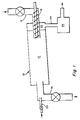
- Figure 1 of the drawings comprises a diagram of a process means for the practice of the method of the invention.
- This invention is based upon the discovery of an effective and practical means for passivating unstable oxides of uranium which enhances the properties of the oxides for subsequent processing and use, without detracting from their beneficial attributes, and the resulting passivated oxygen stable uranium oxides.
- the improved production process of this invention comprise a combination of a specific sequence of conditions which are applied as a continuous treatment to unstable oxides of uranium to overcome their normal affinity for reacting with oxygen.
- this invention entails continuously subjecting the unstable oxides of uranium to a given atmosphere while maintained at a specific temperature range over a limited period of time, including cooling the thus treated oxides of uranium down to approximately room or ambient temperatures.
- the oxides of uranium treated according to this invention typically includes the lower order oxides of uranium comprising those having an oxygen to uranium ratio range of about 1.7 to about 2.25/1, such as uranium dioxide (UO2), and thus which are unstable with a predisposition for oxidation to a higher order, for example to U3O8, U3O7, U4O9, etc. upon exposure to air or other oxidizing atmospheres.
- UO2 uranium dioxide
- a common type of uranium oxides for passivation according to the precepts of this invention consists of newly produced uranium dioxide for use in producing nuclear fuel having the usually desired low order oxide contents of an oxygen ratio of about 1.8 to about 2.2/1 and a relatively pristine exposed particle surface.
- unstable oxides of uranium are continuously subjected to a controlled atmosphere containing minuscule proportions of oxygen with the balance an inert or non-oxidizing gaseous medium, such as argon, nitrogen, carbon dioxide, carbon monoxide, methane and the like, and mixtures thereof.
- the oxygen content for the treatment of the invention should comprise about 0.3 up to about 0.6 percent by volume of the atmosphere.
- the oxygen proportion of the ambient treatment atmosphere is about 0.4 to about 0.5 percent by volume.
- This controlled atmosphere of appropriate gaseous mixtures is continuously supplied for contacting the uranium oxides throughout the treatment preferably at a rate of approximately 2 to approximately 4 kilograms weight per hour of the particulate uranium oxide to approximately 0.028 m3/minute (1 cubic foot per minute) of the gaseous mixture. Preferably, is continuously applied at a rate of about one cubic foot of gas per minute for 3 kilograms of particulate oxides of uranium per hour.
- the unstable oxides of uranium while exposed to the controlled atmosphere with the given oxygen content, are maintained in such an environment while held at a temperature within the range of about 40 to about 250°C.
- the temperature conditions applied for the treatment comprise a range of about 50 up to about 200°C.
- the apt temperature conditions for the process are most expediently maintained by removing the thermal energy generated in the exothermic oxidation reaction with the gaseous flow supplying the controlled atmosphere.
- a substantially continuous flow of the oxygen-containing gas mixture passing through the system in contact with the uranium oxide will convey away unwanted heat and govern the oxidation reaction.
- a balance between the rate of oxidation and the rate of heat removal by gas convection is preferred.
- the duration for the treatment of oxides of uranium by subjecting to the specified atmosphere and temperature is for a time period of at least about 12 minutes up to about 120 minutes.
- the treatment is carried out over a relatively brief and thus economical time of about 30 minutes up to about 60 minutes, depending of course to a considerable degree upon the capacity of the gas treating equipment and the volume of uranium oxide material undergoing treatment.
- the controlled atmosphere of inert gas mixed with the prescribed portion of oxygen is applied as a continuous stream counter-current to the particulate oxides of uranium while the uranium oxide particles are passing in a continuous flow through the length of a closed rotating reaction vessel.
- This counter-current contact between the continuous stream of the oxygen-containing gas atmosphere and the continuous flow of the particles through an elongated vessel provides effective and uniform intermingling of the gas with the particles for even reaction and removal of heat from the uranium oxide particles which terminates the oxidation reaction.
- the heat removal by the counter-current gas flow is designed to eliminate both the sensible heat of the particles entering the reactor unit and the heat generated by the controlled oxidation reaction and reduce the temperature of the particles at their discharge from the reaction unit to approximately room temperature, namely down to at least about 25°C.
- the uranium oxide particles are introduced into the reactor at a temperature preferably in the range of from 40° to 60°C.
- Passivation unit 10 comprises an elongated rotatable reaction vessel 12 constructed to provide for high intermingling contact between a continuous flow of particles moving in one direction through the vessel 12 and a continuous stream of flowing gas moving in the opposite direction through the vessel 12.
- Passivation unit 10 includes a feed inlet conduit 14 provided with an air lock valve(s) for continuously supplying particulate oxides of uranium from a source such as a processing calciner into the reaction vessel 12, and discharge outlet conduit 16 also provided with an air lock valve(s) to provide for the continuous passage of the particulate material axially the length of the rotatable vessel 12. Screw feeder 18 assists in supplying a continuous flow of particulate oxides of uranium to the vessel 12.
- the counter flowing, continuous stream of oxidizing and cooling gas providing the atmosphere within the rotatable reaction vessel 12 is added to the vessel 12 through a gas supply inlet conduit 20 having an air lock valve(s) which introduces the gas adjacent the particle discharge outlet 16.
- the residence time for the particulate oxides of uranium in passage continuously through the length of the rotating reactor vessel 12 is a function of the rotational, diameter, length, and slope of the passivating reactor vessel.
- the cooling gas atmosphere continuously passing through the reactor vessel 12 in the opposite direction to the continuous flow of particulate oxides of uranium preferably comprises nitrogen containing the prescribed proportion of oxygen.
- This gas is introduced into the reaction vessel at a relatively low temperature to cool and terminate the reaction of the particulate oxides of uranium.
- the preferred temperature of the gas at its introduction into the rotary reactor 12 is a range of approximately 15 to 25°C, more preferably 18 to 25°C.
- the mechanism of this invention comprises a controlled surface oxidation reaction which produces a protective hydrate surface layer or coating over the uranium oxide particles that inhibits subsequent oxygen chemisorption.
- the passivating surface of hydrate formed comprises a monohydrate - uranyl hydroxide - (UO2(OH)2) or dihydrate - uranyl hydroxide hydrate - (UO2(OH)2 ⁇ H20), and typically a combination of both the monohydrate and dihydrate.
- UO2(OH)2 monohydrate - uranyl hydroxide -
- UO2(OH)2 ⁇ H20 dihydrate - uranyl hydroxide hydrate -
- the proportion of either passivating hydrate formed, monohydrate or dihydrate is generally controlled by the temperature of the surface of the uranium oxide particles. At a surface temperature of above about 100°C, the controlled oxidation reaction primarily forms the monohydrate. Below about 100°C, the controlled oxidation of the surface primarily forms the dihydrate. The proportion of monohydrate formed increases as the temperature of the surface reaction increases.
- the controlled surface oxidation pursuant to the precepts at this invention produces a hydrate layer or coating of a thickness of about 3 to about 10 Angstroms.
- the treated material Upon completion of the formation of a passivating hydrate layer covering the uranium oxide particles, the treated material should be promptly cooled to room temperature. Cooling quickly to at least about 25°C completes the crystallization process of the newly formed hydrate and prevents an accelerated rapid continuing oxidation reaction.
- a mathematical model of the improved passivation process of this invention is provided to illustrate the effects of operating parameters upon the product characteristics.
- the above equations describe the oxidation reaction and heat transfer effects occurring within the system. Based upon a given set of input parameters, the below product characteristics are ascertained.
Landscapes
- Chemical & Material Sciences (AREA)
- Engineering & Computer Science (AREA)
- Ceramic Engineering (AREA)
- Organic Chemistry (AREA)
- Materials Engineering (AREA)
- Structural Engineering (AREA)
- Physics & Mathematics (AREA)
- Plasma & Fusion (AREA)
- General Engineering & Computer Science (AREA)
- High Energy & Nuclear Physics (AREA)
- Life Sciences & Earth Sciences (AREA)
- General Life Sciences & Earth Sciences (AREA)
- Geology (AREA)
- Inorganic Chemistry (AREA)
- Inorganic Compounds Of Heavy Metals (AREA)
Claims (11)
- Méthode de passivation de la fraction superficielle d'oxydes d'uranium particulaires avec la formation sur celle-ci d'une couche superficielle hydratée de protection de façon à inhiber la chimisorption de l'oxygène des surfaces des particules, comprenant les étapes de :
passage d'un flux continu d'oxydes d'uranium particulaires à une température comprise dans la gamme de 40 à 250°C à travers la longueur d'un récipient de réaction rotatif se déplacant en contact intime avec un courant continu à contre-courant d'un gaz réfrigérant comprenant de l'oxygène combiné à un gaz inerte dans une proportion d'environ 0,3 à environ 0,6% d'oxygène par volume de gaz réfrigérant. - Méthode de passivation selon la revendication 1, dans laquelle les oxydes d'uranium particulaires sont refroidis jusqu'à une température d'au moins environ 25°C.
- Méthode de passivation selon la revendication 1, dans laquelle le gaz réfrigérant comprend de l'oxygène combiné à de l'azote.
- Méthode de passivation selon la revendication 1, dans laquelle le rapport du flux d'oxydes d'uranium particulaires au courant de gaz réfrigérant vaut approximativement 2 à 4 kilogrammes par heure d'oxydes d'uranium par rapport à approximativement 0,028 m³/min (1 cubic foot par minute) de gaz réfrigérant.
- Méthode de passivation selon la revendication 4, dans laquelle le rapport du flux d'oxydes d'uranium particulaires au courant de gaz réfrigérant vaut approximativement 3 kilogrammes par heure d'oxydes d'uranium par rapport à approximativement 0,028 m³/min (1 cubic foot par minute) de gaz réfrigérant.
- Méthode de passivation selon la revendication 1 ou la revendication 2, dans laquelle la couche hydratée de protection formée sur la surface des oxydes particulaires de l'uranium est principalement un dihydrate.
- Méthode de passivation selon la revendication 1 ou la revendication 2, dans laquelle la couche hydratée de protection formée sur la surface des oxydes particulaires d'uranium est principalement un monohydrate.
- Méthode de passivation selon la revendication 1 ou la revendication 2, dans laquelle le gaz réfrigérant comprend l'oxygène combiné au gaz inerte dans une proportion d'environ 0,4 à environ 0,5% d'oxygène par volume de gaz réfrigérant.
- Méthode de passivation selon la revendication 1 ou la revendication 2, dans laquelle les oxydes d'uranium particulaires chauds sont introduits à une température d'environ 40 à environ 60°C par la longueur axiale du récipient de réaction rotatif.
- Méthode de passivation selon la revendication 1, dans laquelle le flux continu d'oxydes d'uranium particulaires chauds est introduit de manière axiale à travers un récipient de réaction rotatif, allongé et fermé se déplaçant par celui-ci en contact superficiel intime avec un courant à contre-courant continu de gaz réfrigérant.
- Méthode de passivation selon la revendication 9 ou la revendication 10, dans laquelle le gaz réfrigérant introduit dans le récipient de réaction rotatif présente une température se situant d'environ 18 à 25°C.
Applications Claiming Priority (2)
| Application Number | Priority Date | Filing Date | Title |
|---|---|---|---|
| US07/387,187 US5069888A (en) | 1989-07-31 | 1989-07-31 | Process for passivating uranium oxides to control oxidation |
| US387187 | 1995-02-13 |
Publications (2)
| Publication Number | Publication Date |
|---|---|
| EP0411299A1 EP0411299A1 (fr) | 1991-02-06 |
| EP0411299B1 true EP0411299B1 (fr) | 1995-03-15 |
Family
ID=23528847
Family Applications (1)
| Application Number | Title | Priority Date | Filing Date |
|---|---|---|---|
| EP90111830A Expired - Lifetime EP0411299B1 (fr) | 1989-07-31 | 1990-06-22 | Procédé de passivation d'oxydes d'uranium pour contrôler l'oxydation |
Country Status (5)
| Country | Link |
|---|---|
| US (1) | US5069888A (fr) |
| EP (1) | EP0411299B1 (fr) |
| JP (1) | JPH0780686B2 (fr) |
| DE (1) | DE69017788D1 (fr) |
| ES (1) | ES2069628T3 (fr) |
Families Citing this family (5)
| Publication number | Priority date | Publication date | Assignee | Title |
|---|---|---|---|---|
| US5514306A (en) * | 1993-02-01 | 1996-05-07 | General Electric Company | Process to reclaim UO2 scrap powder |
| US5434897A (en) * | 1994-03-21 | 1995-07-18 | General Electric Company | Hydride damage resistant fuel elements |
| US5897832A (en) * | 1996-04-30 | 1999-04-27 | Porter; Brooks S. | Cleaning method utilizing ozonated water and apparatus for producing ozonated water |
| KR100264739B1 (ko) * | 1997-09-01 | 2000-09-01 | 장인순 | 감손우라늄 폐기물 처리를 위한 공기조절식 산화장치 |
| US6228337B1 (en) * | 1998-12-02 | 2001-05-08 | Cameco Corporation | Method for reducing uranium trioxide |
Family Cites Families (10)
| Publication number | Priority date | Publication date | Assignee | Title |
|---|---|---|---|---|
| CA646474A (en) * | 1962-08-07 | Carteret Yvette | Method of inhibiting spontaneous oxidation of uranium dioxide powders | |
| NL250888A (fr) * | 1959-04-28 | |||
| US3923933A (en) * | 1968-10-29 | 1975-12-02 | Gen Electric | Process for preparing sintered uranium dioxide grains |
| US3761547A (en) * | 1970-07-17 | 1973-09-25 | Gen Electric | Process for controlling surface area of ceramic powders |
| US3872022A (en) * | 1970-08-10 | 1975-03-18 | Gen Electric | Sintering uranium oxide in the reaction products of hydrogen-carbon dioxide mixtures |
| US4052330A (en) * | 1975-03-20 | 1977-10-04 | Gen Electric | Sintering uranium oxide using a preheating step |
| FR2525208B1 (fr) * | 1982-04-19 | 1986-01-31 | Commissariat Energie Atomique | Procede de traitement d'une poudre d'oxyde metallique et utilisation de la poudre traitee pour la fabrication de pastilles de combustible nucleaire |
| DE3227868C2 (de) * | 1982-07-26 | 1984-07-26 | Alkem Gmbh, 6450 Hanau | Verfahren zum Behandeln von Plutoniumdioxid oder Plutonium-Uran-Mischdioxid |
| US4572810A (en) * | 1984-09-17 | 1986-02-25 | General Electric Company | Method for providing uranium hydroxide on UO2 particles prior to generation of fugitive binder for sintering |
| US4751098A (en) * | 1986-07-22 | 1988-06-14 | Westinghouse Electric Corp. | Reoxidation of partially oxidizable powders |
-
1989
- 1989-07-31 US US07/387,187 patent/US5069888A/en not_active Expired - Fee Related
-
1990
- 1990-06-22 DE DE69017788T patent/DE69017788D1/de not_active Expired - Lifetime
- 1990-06-22 EP EP90111830A patent/EP0411299B1/fr not_active Expired - Lifetime
- 1990-06-22 ES ES90111830T patent/ES2069628T3/es not_active Expired - Lifetime
- 1990-07-31 JP JP2201596A patent/JPH0780686B2/ja not_active Expired - Fee Related
Also Published As
| Publication number | Publication date |
|---|---|
| ES2069628T3 (es) | 1995-05-16 |
| DE69017788D1 (de) | 1995-04-20 |
| JPH0397624A (ja) | 1991-04-23 |
| EP0411299A1 (fr) | 1991-02-06 |
| JPH0780686B2 (ja) | 1995-08-30 |
| US5069888A (en) | 1991-12-03 |
Similar Documents
| Publication | Publication Date | Title |
|---|---|---|
| JP3106113B2 (ja) | 酸化物核燃料のペレットスクラップのリサイクル方法 | |
| US4364859A (en) | Method for producing oxide powder | |
| US4061700A (en) | Fugitive binder for nuclear fuel materials | |
| KR100293482B1 (ko) | 핵연료소결체의제조방법 | |
| US3883623A (en) | Process for controlling end-point density of sintered uranium dioxide nuclear fuel bodies and product | |
| EP0377077B1 (fr) | Procédé de fabrication d'une pastille en UO2 | |
| JPS6119952B2 (fr) | ||
| JP2905294B2 (ja) | 廃棄物を生じさせずに金属ウランからuo2燃料ペレットを製造するための方法 | |
| US6251309B1 (en) | Method of manufacturing large-grained uranium dioxide fuel pellets containing U3O8 | |
| JPH01148994A (ja) | 混合酸化物(U,Pu)O↓2ベースの核燃料ペレットの製造方法 | |
| US5514306A (en) | Process to reclaim UO2 scrap powder | |
| US5069888A (en) | Process for passivating uranium oxides to control oxidation | |
| US5066429A (en) | Method for passivating uranium oxides to control oxidation, and the oxidation resisting uranium product thereof | |
| EP0355438B1 (fr) | Procédé de passivation d'oxydes d'uranium pour contrôler l'oxydation et produit d'uranium résistant à l'oxydation | |
| JPS62297215A (ja) | Uo↓2ペレツトの結晶粒径をコントロ−ルする方法 | |
| JP2790548B2 (ja) | 核燃料燒結体の製造方法 | |
| JP2813926B2 (ja) | 原子燃料用二酸化ウラン粉末及びその製造方法 | |
| Radford et al. | Properties, blending and homogenization of (U, Th) O2-UO2 powder | |
| EP0344396B1 (fr) | Procédé de fabrication de pastilles de bioxyde d'uranium | |
| CS273319B2 (en) | Method of ferrous powders production from fine loose powdered iron trioxide | |
| KR840002150B1 (ko) | 미소결 펠릿을 제조하기 위한 혼합물의 제조방법 | |
| US5390218A (en) | Process for preparing a fuel pellet for nuclear reactor | |
| EP0150737B1 (fr) | Procédé de traitement de déchets de combustible nucléaire | |
| JPH0295298A (ja) | 酸化物核燃料焼結体の製造方法 | |
| Balakrishna et al. | Sintering of uranium dioxide as a fuel for nucler reactors—a review |
Legal Events
| Date | Code | Title | Description |
|---|---|---|---|
| PUAI | Public reference made under article 153(3) epc to a published international application that has entered the european phase |
Free format text: ORIGINAL CODE: 0009012 |
|
| AK | Designated contracting states |
Kind code of ref document: A1 Designated state(s): DE ES SE |
|
| 17P | Request for examination filed |
Effective date: 19910724 |
|
| 17Q | First examination report despatched |
Effective date: 19920720 |
|
| GRAA | (expected) grant |
Free format text: ORIGINAL CODE: 0009210 |
|
| AK | Designated contracting states |
Kind code of ref document: B1 Designated state(s): DE ES SE |
|
| REF | Corresponds to: |
Ref document number: 69017788 Country of ref document: DE Date of ref document: 19950420 |
|
| REG | Reference to a national code |
Ref country code: ES Ref legal event code: FG2A Ref document number: 2069628 Country of ref document: ES Kind code of ref document: T3 |
|
| PG25 | Lapsed in a contracting state [announced via postgrant information from national office to epo] |
Ref country code: SE Effective date: 19950615 |
|
| PG25 | Lapsed in a contracting state [announced via postgrant information from national office to epo] |
Ref country code: DE Effective date: 19950617 |
|
| PLBE | No opposition filed within time limit |
Free format text: ORIGINAL CODE: 0009261 |
|
| STAA | Information on the status of an ep patent application or granted ep patent |
Free format text: STATUS: NO OPPOSITION FILED WITHIN TIME LIMIT |
|
| 26N | No opposition filed | ||
| PGFP | Annual fee paid to national office [announced via postgrant information from national office to epo] |
Ref country code: ES Payment date: 20020710 Year of fee payment: 13 |
|
| PG25 | Lapsed in a contracting state [announced via postgrant information from national office to epo] |
Ref country code: ES Free format text: LAPSE BECAUSE OF NON-PAYMENT OF DUE FEES Effective date: 20030623 |
|
| REG | Reference to a national code |
Ref country code: ES Ref legal event code: FD2A Effective date: 20030623 |