EP0411436B1 - Verwendung von 2-Hydroxy-3-aminopropionsäure-Derivaten als Komplex-bildner, Bleichmittelstabilisatoren und Gerüststoffe in Wasch- und Reinigungsmitteln - Google Patents
Verwendung von 2-Hydroxy-3-aminopropionsäure-Derivaten als Komplex-bildner, Bleichmittelstabilisatoren und Gerüststoffe in Wasch- und Reinigungsmitteln Download PDFInfo
- Publication number
- EP0411436B1 EP0411436B1 EP90114141A EP90114141A EP0411436B1 EP 0411436 B1 EP0411436 B1 EP 0411436B1 EP 90114141 A EP90114141 A EP 90114141A EP 90114141 A EP90114141 A EP 90114141A EP 0411436 B1 EP0411436 B1 EP 0411436B1
- Authority
- EP
- European Patent Office
- Prior art keywords
- hydroxy
- aminopropionic acid
- set forth
- compounds
- washing
- Prior art date
- Legal status (The legal status is an assumption and is not a legal conclusion. Google has not performed a legal analysis and makes no representation as to the accuracy of the status listed.)
- Expired - Lifetime
Links
Classifications
-
- C—CHEMISTRY; METALLURGY
- C11—ANIMAL OR VEGETABLE OILS, FATS, FATTY SUBSTANCES OR WAXES; FATTY ACIDS THEREFROM; DETERGENTS; CANDLES
- C11D—DETERGENT COMPOSITIONS; USE OF SINGLE SUBSTANCES AS DETERGENTS; SOAP OR SOAP-MAKING; RESIN SOAPS; RECOVERY OF GLYCEROL
- C11D3/00—Other compounding ingredients of detergent compositions covered in group C11D1/00
- C11D3/16—Organic compounds
- C11D3/37—Polymers
- C11D3/3746—Macromolecular compounds obtained by reactions only involving carbon-to-carbon unsaturated bonds
- C11D3/3769—(Co)polymerised monomers containing nitrogen, e.g. carbonamides, nitriles or amines
- C11D3/3773—(Co)polymerised monomers containing nitrogen, e.g. carbonamides, nitriles or amines in liquid compositions
-
- C—CHEMISTRY; METALLURGY
- C11—ANIMAL OR VEGETABLE OILS, FATS, FATTY SUBSTANCES OR WAXES; FATTY ACIDS THEREFROM; DETERGENTS; CANDLES
- C11D—DETERGENT COMPOSITIONS; USE OF SINGLE SUBSTANCES AS DETERGENTS; SOAP OR SOAP-MAKING; RESIN SOAPS; RECOVERY OF GLYCEROL
- C11D3/00—Other compounding ingredients of detergent compositions covered in group C11D1/00
- C11D3/16—Organic compounds
- C11D3/26—Organic compounds containing nitrogen
- C11D3/33—Amino carboxylic acids
-
- C—CHEMISTRY; METALLURGY
- C11—ANIMAL OR VEGETABLE OILS, FATS, FATTY SUBSTANCES OR WAXES; FATTY ACIDS THEREFROM; DETERGENTS; CANDLES
- C11D—DETERGENT COMPOSITIONS; USE OF SINGLE SUBSTANCES AS DETERGENTS; SOAP OR SOAP-MAKING; RESIN SOAPS; RECOVERY OF GLYCEROL
- C11D3/00—Other compounding ingredients of detergent compositions covered in group C11D1/00
- C11D3/16—Organic compounds
- C11D3/37—Polymers
- C11D3/3703—Macromolecular compounds obtained otherwise than by reactions only involving carbon-to-carbon unsaturated bonds
- C11D3/3723—Polyamines or polyalkyleneimines
-
- C—CHEMISTRY; METALLURGY
- C11—ANIMAL OR VEGETABLE OILS, FATS, FATTY SUBSTANCES OR WAXES; FATTY ACIDS THEREFROM; DETERGENTS; CANDLES
- C11D—DETERGENT COMPOSITIONS; USE OF SINGLE SUBSTANCES AS DETERGENTS; SOAP OR SOAP-MAKING; RESIN SOAPS; RECOVERY OF GLYCEROL
- C11D3/00—Other compounding ingredients of detergent compositions covered in group C11D1/00
- C11D3/16—Organic compounds
- C11D3/37—Polymers
- C11D3/3746—Macromolecular compounds obtained by reactions only involving carbon-to-carbon unsaturated bonds
- C11D3/3769—(Co)polymerised monomers containing nitrogen, e.g. carbonamides, nitriles or amines
-
- C—CHEMISTRY; METALLURGY
- C11—ANIMAL OR VEGETABLE OILS, FATS, FATTY SUBSTANCES OR WAXES; FATTY ACIDS THEREFROM; DETERGENTS; CANDLES
- C11D—DETERGENT COMPOSITIONS; USE OF SINGLE SUBSTANCES AS DETERGENTS; SOAP OR SOAP-MAKING; RESIN SOAPS; RECOVERY OF GLYCEROL
- C11D3/00—Other compounding ingredients of detergent compositions covered in group C11D1/00
- C11D3/39—Organic or inorganic per-compounds
- C11D3/3902—Organic or inorganic per-compounds combined with specific additives
- C11D3/3937—Stabilising agents
- C11D3/394—Organic compounds
Definitions
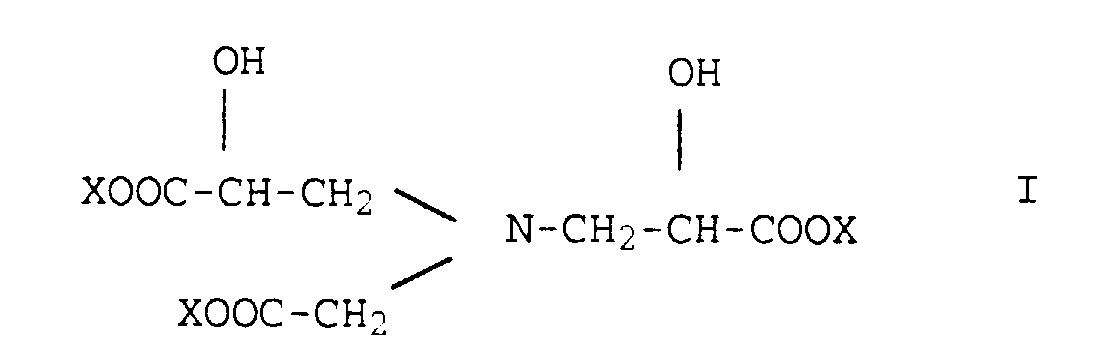
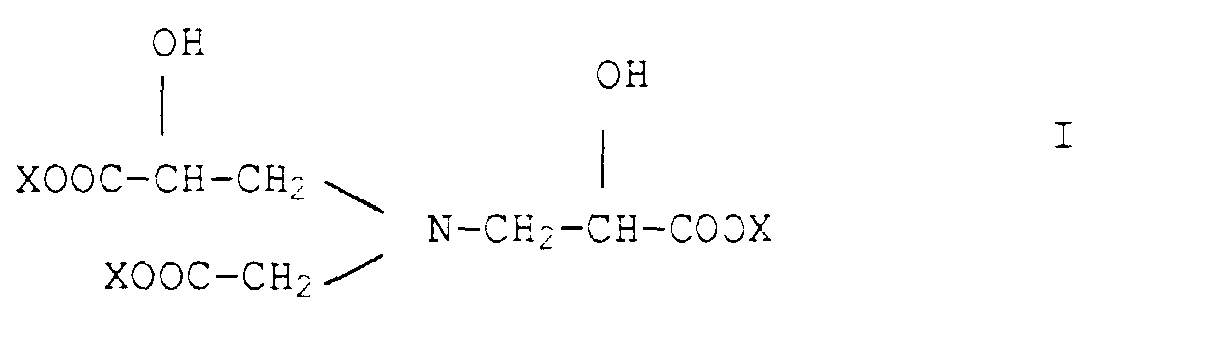
- the present invention relates to 2-hydroxy-3-aminopropionic acid derivatives of the general formula I. in which X represents hydrogen, an alkali metal or ammonium, which can be substituted by C 1 -C 4 alkyl groups or C 1 -C 4 hydroxyalkyl groups, a process for their preparation and their use as complexing agents, bleach stabilizers and builders in washing - and cleaning agents as well as complexing agents for heavy metal or alkaline earth metal ions.
- the invention also relates to washing and cleaning agents and complexing agents which contain the compounds I.
- DE-A 21 03 453 (1) relates to ⁇ -hydroxy- ⁇ -aminocarboxylic acids of the general formula IV in which R 3 and R 4 each represent an aliphatic, cycloaliphatic or araliphatic radical, but R 3 and R 4 do not denote a methyl group and also mean, inter alia, hydrogen, alkylol groups or the radical -CH 2 -CH (OH) -COOH . Can furthermore one of the radicals R 3 or R 4, a second substituted amino group -NR 3 R 4 carry.
- the compounds IV serve to mask metal ions, in particular heavy metal cations, by complexing in aqueous solution.
- the object of the present invention was therefore as bleach stabilizers to provide more suitable complexing agents.
- X stands for alkali metal ions such as lithium or in particular sodium or potassium or for the ammonium ion, which can be partially or completely substituted by C 1 -C 4 -alkyl groups or C 1 -C 4 -hydroxyalkyl groups.
- the salts of tertiary amines should be mentioned here.
- Preferred tertiary amines are trimethylamine, triethylamine, tri-n-propylamine, triisopropylamine, tri-n-butylamine, triisobutylamine and trialkanolamines such as triethanolamine or triisopropanolamine.
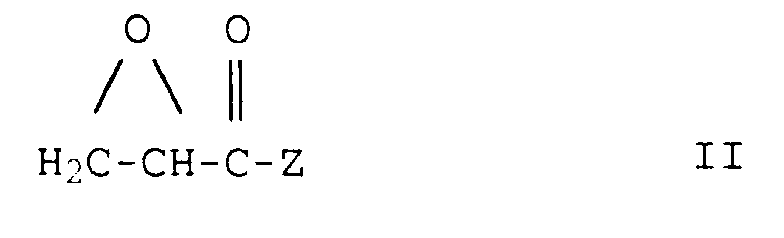
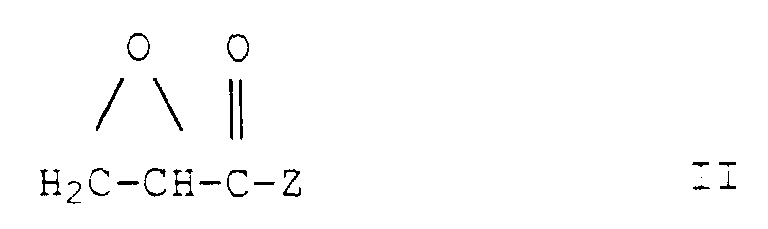
- the compounds I are advantageously by reacting a glycidic acid derivative of the general formula II in which Z represents the groups -OX, -OR 1 or -N (R 2 ) 2 , where R 1 denotes a C 1 -C 4 alkyl radical and the two radicals R 2 are hydrogen or C 1 -C 4 alkyl and are the same or different, with an amine of the general formulas III H 2 N-CH 2 COOX and subsequent hydrolysis of carboxylic acid amide or carboxylic ester groups still present.
- glycidic acid derivatives II for example, glycidic acid, if appropriate in the form of their sodium, potassium or ammonium salt, glycidamide, N-methylglycidamide, N, N-dimethylglycidamide, glycidic acid methyl ester or ethyl glycidate can be used.
- glycidamide N-methylglycidamide, N, N-dimethylglycidamide, glycidic acid methyl ester or ethyl glycidate
- the best Results are achieved with glycidamide.
- the primary amine III is glycine.
- the carboxyl group present in the above amine can also in the form of the alkali metal or the optionally substituted Ammonium salts occur.
- the reaction of the glycidic acid derivative II with the amine III is usually in water, an organic solvent like Methanol, ethanol, n-propanol, iso-propanol, tert-butanol, Dioxane or tetrahydrofuran or in mixtures of these solvents at temperatures of 10 to 100 ° C, preferably 40 to 80 ° C, and a pH of 4 to 10, preferably 6 to 9, made.
- the molar ratio of II to amine is usually 1.8: 1 to 2.7: 1, in particular 2.0: 1 to 2.3: 1.
- the reaction is followed by hydrolysis of those still present Carboxamide and carboxylic ester groups to carboxyl groups which, in a manner known per se, in an aqueous reaction medium in the presence of bases such as sodium or potassium hydroxide solution or of acids such as sulfuric or hydrochloric acid usually at temperatures of 20 up to 100 ° C, in particular 40 to 100 ° C, is carried out.
- bases such as sodium or potassium hydroxide solution or of acids such as sulfuric or hydrochloric acid usually at temperatures of 20 up to 100 ° C, in particular 40 to 100 ° C, is carried out.
- the compounds are obtained in accordance with the reaction conditions I as free carboxylic acids or in the form of salts, usually as alkali metal salts.
- the free acids can then pass through Neutralization with the appropriate bases, for example amine bases, the desired salts I prepared without difficulty will.
- the compounds I can be easily in from their solutions isolate pure form. In particular, spray or freeze drying, crystallization and precipitation. Often the solutions can also be used directly for those according to the invention Use purposes.
- the compounds I are outstandingly suitable for or alkaline earth metal ions such as iron, copper, Manganese, zinc, calcium or magnesium or mixtures of such ions complex. Because of this ability, they exhibit a variety of technical applications. Since the compounds I are biodegradable substances, they can be beneficial everywhere are used where wastewater is used in larger Amounts accumulate and must be treated before it is released into the surface water reached.
- washing and Household cleaning agents For example, washing and Household cleaning agents, industrial cleaning agents, electroplating, water treatment and polymerizations, photographic Industry, the textile industry and the paper industry as well various applications in pharmaceuticals, in cosmetics, in food and in plant nutrition.
- bleach stabilization such as sodium perborates as NaBO 2 ⁇ H 2 O 2 ⁇ 3H 2 O, peroxycarbonates peroxyphosphonates, citrate, urea and melamine-H 2 O 2 adducts, caroates, perbenzoates, Alkandipercarbonklaren, Peroxyphthalates and alkali metal hypochlorites in detergents and cleaning agents and in the hydrogen peroxide bleaching of textiles, cellulose or paper raw materials.
- Traces of heavy metals such as iron, copper and manganese occur in the washing powder itself, in the water and in the textile goods and catalyze the decomposition of the per compound or the hydrogen peroxide resulting from it.
- the complexing agents I bind these metal ions and prevent the undesired decomposition of the bleaching system during storage and in the wash liquor. This increases the efficiency of the bleaching system and fiber damage is suppressed.
- the compounds I can be used as so-called Preservatives, advantageously in an amount of 0.05 to 1 wt .-%, based on the total weight of the detergent formulation will.
- the compounds I prevent, for example, metal-catalyzed oxidative decomposition.
- They can be used to stabilize phosphates in alkaline degreasing baths and prevent the precipitation of lime soaps thereby the "tarnishing" of non-ferrous surfaces and lengthening the service life of alkaline cleaning baths.
- the cooling water treatment with the compounds I prevents deposits or dissolves existing ones.
- a particular advantage is that Possible application in alkaline medium and thus the elimination of Corrosion problems.
- complexing agents I can be used in developer or fixing baths that are prepared with hard water to the precipitation of poorly soluble calcium and magnesium salts to prevent.
- the precipitations lead to gray veils on films and images as well as deposits in the tanks, which are therefore advantageous can be avoided.
- They can be used as iron III chelate solutions be used advantageously in bleaching and bleach-fixing baths and so the replace environmentally harmful hexacyanoferrate solutions.
- Plant nutrition can help to remedy heavy metal deficits Copper, iron, manganese and zinc complexes with I can be used. This Heavy metals are added as chelates to prevent the precipitation prevent biologically inactive insoluble salts.
- flue gas scrubbing namely the simultaneous removal of NO x and SO 2 from flue gases, desulfurization according to Wellman-Lord, H 2 S oxidation, metal extraction and applications as catalysts for organic syntheses, for example air oxidation of paraffins and hydroformylation of olefins to alcohols.
- the compounds I with their excellent complex-forming properties can be used in a very special degree as Bleach stabilizers and as builders in washing and Detergents are recommended.
- the present invention also relates to means for Complexation of heavy metal or alkaline earth metal ions or Mixtures of which, depending on the application, the compounds I in an amount of 0.01 to 99 wt .-%, based on the total amount of the preparations.
- the present invention furthermore relates to detergents and cleaning agents, which are 0.01 to 20% by weight, preferably 0.05 to 10% by weight on the total amount of preparation, one or more of the compounds I included.
- detergents and cleaning agents which are 0.01 to 20% by weight, preferably 0.05 to 10% by weight on the total amount of preparation, one or more of the compounds I included.
- Complexing agents in detergents are preferred in amounts of 0.1 to 2% by weight.
- the compounds I can function as complexing agents, builders and bleach stabilizer in detergent and cleaning agent formulations also used together with other means of the prior art the general characteristics of sequestration, Incrustation inhibition, graying inhibition, primary washing effect and the bleaching effect can possibly be significantly improved.
- Detergent and cleaning agent formulations containing the compounds I contain usually as additional components, based on the total weight, 6 to 25% by weight of surfactants, 15 to 50% by weight of builder and optionally co-builder and 5 to 30% by weight of auxiliaries such as enzymes, foam regulators, Corrosion inhibitors, optical brighteners, fragrances, dyes or Formulation aids such as Sodium sulfate in the usual for this Amounts.
- auxiliaries such as enzymes, foam regulators, Corrosion inhibitors, optical brighteners, fragrances, dyes or Formulation aids such as Sodium sulfate in the usual for this Amounts.
- the 2-hydroxy-3-aminopropionic acid derivatives I are excellent complexing agents. In its capacity as a builder in washing and cleaning agents to improve the whitewash effect and to prevent Deposits on the tissue are the compounds I with, for example Ethylenediaminetetraacetic acid or 2-hydroxy-3-aminopropionic acid-N, N-diacetic acid comparable. A significantly superior effect compared to However, the above-mentioned means of the prior art can be seen in the Bleach stabilization.
- the solution was cooled with three times the volume of methanol transferred.
- the precipitate formed was filtered off and from a Recrystallized water-methanol mixture.
- the title compound was obtained in the form of a colorless crystal powder that melted above 300 ° C, in a yield of 66%.
- This compound was analogous to Example 2 by reacting Ammonia made with glycidamide. It is from the Literature (1) known.
- the hydrogen peroxide content was determined immediately after preparation and after leaving the wash liquor at 60 ° C. or 80 ° C. for 2 or 1 hour by titration with potassium permanganate in acid solution. As a result, the percentage of H 2 O 2 still present after this period was given in the table below.
- the test was carried out in such a way that a solution of 6.5 g / l of formulation (1) in water of 25 ° dH hardness was heated to 80 ° C. and, for test purposes, with 2.5 ppm of a mixture of the ions Fe 3+ , Cu 2+ and Mn 2+ in a ratio of 8: 1: 1, used in the form of their sulfates.
- the H 2 O 2 content was measured by titration with KMnO 4 in acidic solution before the heavy metal addition and after leaving the wash liquor at 80 ° C. for 2 hours.
- the following table shows the results of the tests, the 2-hydroxy-3-aminopropionic acid derivative I in its sodium salt form from Example 1 with Examples 2 and 3 according to reference (1) and ethylenediaminetetraacetic acid tetrasodium salt (EDTA-Na 4 ) as well as 2-hydroxy-3-aminopropionic acid-N, N-diacetic acid trisodium salt (ISDA-Na 3 ) according to reference (2).
- the values illustrate the superior effect of compound I.
Landscapes
- Chemical & Material Sciences (AREA)
- Life Sciences & Earth Sciences (AREA)
- Engineering & Computer Science (AREA)
- Chemical Kinetics & Catalysis (AREA)
- Oil, Petroleum & Natural Gas (AREA)
- Wood Science & Technology (AREA)
- Organic Chemistry (AREA)
- Inorganic Chemistry (AREA)
- Detergent Compositions (AREA)
- Organic Low-Molecular-Weight Compounds And Preparation Thereof (AREA)
Description

| 19,3 % | Natrium-C12-Alkylbenzolsulfonat (50 %ige wäßrige Lösung) |
| 15,4 % | Natriumperborat-Tetrahydrat |
| 30,8 % | Natriumtriphosphat |
| 2,6 % | Copolymer aus Maleinsäure und Acrylsäure (Gewichtsverhältnis 50:50, mittlere Molmasse 50.000) |
| 31,0 % | wasserfreies Natriumsulfat |
| 0,9 % | Komplexbildner I oder Vergleichssubstanz |
| 15 % | Natrium-C12-Alkylbenzolsulfonat (50 %ige wäßrige Lösung) |
| 5 % | Anlagerungsprodukt von 11 Mol Ethylenoxid an 1 Mol Talgfettalkohol |
| 20 % | Natriumperborat-Tetrahydrat |
| 6 % | Natriummetasilicat·5 H2O |
| 1,25 % | Magnesiumsilicat |
| 20 % | Natriumtriphosphat |
| 31,75 % | wasserfreies Natriumsulfat |
| 1 % | Komplexbildner I oder Vergleichssubstanz |
| Bleichmittelstabilisator | Natriumperboratstabilisierung [Rest-% H2O2] | |
| Formulierung (1) | Formulierung (2) | |
| Beispiel 1 | 60,6 | 90,0 |
| zum Vergleich: | ||
| Beispiel 2 | 25,5 | 57,4 |
| Beispiel 3 | 51,8 | 80,7 |
| EDTA-Na4 | 20,0 | 34,0 |
| ISDA-Na3 | 43,4 | 82,0 |
| ohne | 20,0 | 28,0 |
Claims (8)
- 2-Hydroxy-3-aminopropionsäure-Derivate der allgemeinen Formel Iin der X für Wasserstoff, ein Alkalimetall oder Ammonium, das durch C1-C4-Alkylgruppen oder C1-C4-Hydroxyalkylgruppen substituiert sein kann, steht.
- Nitrilo-di(2-hydroxy-3-aminopropionsäure)monoessigsäure-Trinatriumsalz.
- Verfahren zur Herstellung von 2-Hydroxy-3-aminopropionsäure-Derivaten I gemäß Anspruch oder 2, dadurch gekennzeichnet, daß man ein Glycidsäurederivat der allgemeinen Formel IIin der Z für die Gruppe -OX, -OR1 oder -N(R2)2 steht, wobei R1 einen C1-C4-Alkylrest bezeichnet und die beiden Reste R2 Wasserstoff oder C1-C4-Alkyl bedeuten und gleich oder verschieden sind, mit einem Amin der allgemeinen Formel III
- Verfahren nach Anspruch 3, dadurch gekennzeichnet, daß man als Glycidsäurederivat II Glycidsäureamid einsetzt.
- Verwendung von 2-Hydroxy-3-aminopropionsäure-Derivaten I gemäß Anspruch 1 oder 2 als Komplexbildner, Bleichmittelstabilisatoren und Gerüststoffe in Wasch- und Reinigungsmitteln.
- Verwendung von 2-Hydroxy-3-aminopropionsäure-Derivaten I gemäß Anspruch 1 oder 2 als Komplexbildner für Schwermetall- oder Erdalkalimetallionen.
- Mittel zur Komplexierung von Schwermetall- oder Erdalkalimetallionen, enthaltend 0,01 bis 99 Gew.-%, bezogen auf die Gesamtmenge der Zubereitung, einer oder mehrerer Verbindungen I gemäß Anspruch 1 oder 2.
- Wasch- und Reinigungsmittel, enthaltend 0,01 bis 20 Gew.-%, bezogen auf die Gesamtmenge der Zubereitung, einer oder mehrerer Verbindungen I gemäß Anspruch 1 oder 2.
Applications Claiming Priority (2)
| Application Number | Priority Date | Filing Date | Title |
|---|---|---|---|
| DE3925727 | 1989-08-03 | ||
| DE3925727A DE3925727A1 (de) | 1989-08-03 | 1989-08-03 | Verwendung von 2-hydroxy-3-aminopropionsaeure-derivaten als komplexbildner, bleichmittelstabilisatoren und gerueststoffe in wasch- und reinigungsmitteln |
Publications (3)
| Publication Number | Publication Date |
|---|---|
| EP0411436A2 EP0411436A2 (de) | 1991-02-06 |
| EP0411436A3 EP0411436A3 (en) | 1991-05-29 |
| EP0411436B1 true EP0411436B1 (de) | 1998-02-04 |
Family
ID=6386462
Family Applications (1)
| Application Number | Title | Priority Date | Filing Date |
|---|---|---|---|
| EP90114141A Expired - Lifetime EP0411436B1 (de) | 1989-08-03 | 1990-07-24 | Verwendung von 2-Hydroxy-3-aminopropionsäure-Derivaten als Komplex-bildner, Bleichmittelstabilisatoren und Gerüststoffe in Wasch- und Reinigungsmitteln |
Country Status (4)
| Country | Link |
|---|---|
| US (1) | US5112530A (de) |
| EP (1) | EP0411436B1 (de) |
| JP (1) | JPH03148243A (de) |
| DE (2) | DE3925727A1 (de) |
Families Citing this family (9)
| Publication number | Priority date | Publication date | Assignee | Title |
|---|---|---|---|---|
| US5362412A (en) * | 1991-04-17 | 1994-11-08 | Hampshire Chemical Corp. | Biodegradable bleach stabilizers for detergents |
| JP2886748B2 (ja) * | 1992-09-17 | 1999-04-26 | 富士写真フイルム株式会社 | 写真用処理組成物及び処理方法 |
| WO1994012606A1 (de) * | 1992-12-03 | 1994-06-09 | Basf Aktiengesellschaft | Iminodiessigsäure-derivate in reinigungsmittelformulierungen für die getränke- und nahrungsmittelindustrie, sowie für harte oberflächen aus metall, kunststoff, lack oder glas |
| JPH08510225A (ja) * | 1993-05-19 | 1996-10-29 | アクゾ ノーベル ナムローゼ フェンノートシャップ | (2−カルボキシ−3−ヒドロキシ−プロピル)−イミノジ酢酸及びその誘導体;それらの製造法及び金属イオン封鎖剤としての使用 |
| DE4445931A1 (de) * | 1994-12-22 | 1996-06-27 | Basf Ag | Verwendung von Hydroxyalkylaminocarbonsäuren als Komplexbildner |
| DE19611977A1 (de) | 1996-03-26 | 1997-10-02 | Basf Ag | Waschkraftverstärker für Waschmittel |
| US6440476B2 (en) | 1997-01-03 | 2002-08-27 | Nalco Chemical Company | Method to improve quality and appearance of leafy vegetables by using stabilized bromine |
| US5942126A (en) * | 1997-01-03 | 1999-08-24 | Nalco Chemical Company | Process to manufacture stabilized alkali or alkaline earth metal hypobromite and uses thereof in water treatment to control microbial fouling |
| EP2476314A4 (de) * | 2009-09-07 | 2015-04-29 | Lion Corp | Desinfektionsmittelzusammensetzung und desinfektionsverfahren |
Family Cites Families (11)
| Publication number | Priority date | Publication date | Assignee | Title |
|---|---|---|---|---|
| US2781388A (en) * | 1956-03-06 | 1957-02-12 | Hans S Mannheimer | Detergent sulphonic acid and sulphate salts of certain amphoteric detergents |
| US2781391A (en) * | 1956-03-06 | 1957-02-12 | Hans S Mannheimer | Detergent sulphonic acid and sulphate salts of certain amphoteric detergents |
| US2781389A (en) * | 1956-06-13 | 1957-02-12 | Hans S Mannheimer | Detergent sulphonic acid and sulphate salts of certain amphoteric detergents |
| US2781375A (en) * | 1956-07-02 | 1957-02-12 | Hans S Mannheimer | Detergent sulphonic acid and sulphate salts of certain amphoteric detergents |
| US2781379A (en) * | 1956-07-02 | 1957-02-12 | Hans S Mannheimer | Detergent sulphonic acid and sulphate salts of certain amphoteric detergents |
| US2781374A (en) * | 1956-07-02 | 1957-02-12 | Hans S Mannheimer | Detergent sulphonic acid and sulphate salts of certain amphoteric detergents |
| DE2103453A1 (de) | 1971-01-26 | 1972-08-17 | Badische Anilin- & Soda-Fabrik Ag, 6700 Ludwigshafen | alpha-Hydroxy-beta-aminocarbonsäuren |
| BE786277A (de) * | 1971-07-16 | 1973-01-15 | Procter & Gamble Europ | |
| DE3712330A1 (de) | 1987-04-11 | 1988-10-20 | Basf Ag | 2-hydroxy-3-amino-propionsaeure-n,n-diessigsaeure und ihre derivate, ihre herstellung und verwendung insbesondere als komplexbildner und diese enthaltende wasch- und reinigungsmittel |
| DE3829829A1 (de) * | 1988-09-02 | 1990-03-22 | Basf Ag | Verfahren zur herstellung des trinatriumsalzes von isoserin-n,n-diessigsaeure |
| DE3830536A1 (de) * | 1988-09-08 | 1990-03-15 | Basf Ag | Wasserhaltige fluessige waschmittelzubereitungen fuer textile materialien |
-
1989
- 1989-08-03 DE DE3925727A patent/DE3925727A1/de not_active Withdrawn
-
1990
- 1990-07-13 US US07/552,098 patent/US5112530A/en not_active Expired - Fee Related
- 1990-07-24 DE DE59010804T patent/DE59010804D1/de not_active Expired - Lifetime
- 1990-07-24 EP EP90114141A patent/EP0411436B1/de not_active Expired - Lifetime
- 1990-08-03 JP JP2205289A patent/JPH03148243A/ja active Pending
Also Published As
| Publication number | Publication date |
|---|---|
| EP0411436A2 (de) | 1991-02-06 |
| DE59010804D1 (de) | 1998-03-12 |
| JPH03148243A (ja) | 1991-06-25 |
| DE3925727A1 (de) | 1991-02-07 |
| US5112530A (en) | 1992-05-12 |
| EP0411436A3 (en) | 1991-05-29 |
Similar Documents
| Publication | Publication Date | Title |
|---|---|---|
| EP0287885B1 (de) | Verfahren zur Herstellung von Serin-N,N-diessigsäure und Derivaten | |
| EP0287846B1 (de) | 2-Hydroxy-3-amino-propionsäure-N,N-diessigsäure und ihre Derivate, ihre Herstellung und Verwendung insbesondere als Komplexbildner und diese enthaltende Wasch- und Reinigungsmittel | |
| EP0781762A1 (de) | Verfahren zur Herstellung von Glycin-N.N.-diesigsäure-Derivaten | |
| EP0695289B1 (de) | Hydroxamsäuren und hydroxamsäureether sowie ihre verwendung als komplexbildner | |
| DE69516182T2 (de) | Aminonitrile zwischenprodukte zur herstellung von alamindiessigsaüre | |
| DE4211713A1 (de) | Verfahren zur Herstellung von Aminodicarbonsäure-N,N-diessigsäuren | |
| DE102009001691A1 (de) | Wasch- oder Reinigungsmittel mit gegebenenfalls in situ erzeugtem bleichverstärkendem Übergangsmetallkomplex | |
| WO2010105962A1 (de) | Wasch- oder reinigungsmittel mit gegebenenfalls in situ erzeugtem bleichverstärkendem übergangsmetallkomplex | |
| EP0396999B1 (de) | 2-Methyl- und 2-Hydroxymethyl-serin-N,N-diessigsäure und ihre Derivate | |
| EP0411436B1 (de) | Verwendung von 2-Hydroxy-3-aminopropionsäure-Derivaten als Komplex-bildner, Bleichmittelstabilisatoren und Gerüststoffe in Wasch- und Reinigungsmitteln | |
| DE3739610A1 (de) | Nitrilo-di-aepfel-mono-essigsaeuren, verfahren zu ihrer herstellung und ihre verwendung | |
| DE2165863C3 (de) | ||
| EP0476257A1 (de) | Aminodicarbonsäuren und deren Derivate als Stabilisatoren für die Sauerstoffbleiche bei der Textilwäsche | |
| DE69635422T2 (de) | Aminonitril-Zwischenprodukte zur Herstellung von 2-Hydroxyethyliminodiessigsäure | |
| DE2416745A1 (de) | Anionaktive und kationaktive tenside enthaltende wasch- und reinigungsmittel | |
| DE2616261C3 (de) | Wasch- und Reinigungsmittel, die Carboxyl- und Hydroxylgruppen enthaltende Copolymerisate enthalten | |
| EP2304014A1 (de) | Textilschonendes waschmittel | |
| DE10216816A1 (de) | Verwendung von Aminomethylenderivaten und Aminomethylenderivate sowie Verfahren zur Herstellung derselben | |
| DE102005009136A1 (de) | Verbessertes Verfahren zur Herstellung von bifunktionellen Ammoniumnitrilen | |
| DE1794425A1 (de) | Oxydations-, bleich-, wasch- und waschhilfsmittel | |
| EP0927239A1 (de) | Verwendung von citronensäurederivaten in wasch- und reinigungsmitteln | |
| WO1995006095A2 (de) | Phenolische komplexbildner | |
| DE102008045297A1 (de) | Textilschonendes Waschmittel |
Legal Events
| Date | Code | Title | Description |
|---|---|---|---|
| PUAI | Public reference made under article 153(3) epc to a published international application that has entered the european phase |
Free format text: ORIGINAL CODE: 0009012 |
|
| AK | Designated contracting states |
Kind code of ref document: A2 Designated state(s): CH DE FR GB IT LI SE |
|
| 17P | Request for examination filed |
Effective date: 19901227 |
|
| PUAL | Search report despatched |
Free format text: ORIGINAL CODE: 0009013 |
|
| AK | Designated contracting states |
Kind code of ref document: A3 Designated state(s): CH DE FR GB IT LI SE |
|
| 17Q | First examination report despatched |
Effective date: 19941227 |
|
| GRAG | Despatch of communication of intention to grant |
Free format text: ORIGINAL CODE: EPIDOS AGRA |
|
| GRAG | Despatch of communication of intention to grant |
Free format text: ORIGINAL CODE: EPIDOS AGRA |
|
| GRAH | Despatch of communication of intention to grant a patent |
Free format text: ORIGINAL CODE: EPIDOS IGRA |
|
| GRAH | Despatch of communication of intention to grant a patent |
Free format text: ORIGINAL CODE: EPIDOS IGRA |
|
| GRAA | (expected) grant |
Free format text: ORIGINAL CODE: 0009210 |
|
| AK | Designated contracting states |
Kind code of ref document: B1 Designated state(s): CH DE FR GB IT LI SE |
|
| REG | Reference to a national code |
Ref country code: CH Ref legal event code: EP |
|
| REF | Corresponds to: |
Ref document number: 59010804 Country of ref document: DE Date of ref document: 19980312 |
|
| GBT | Gb: translation of ep patent filed (gb section 77(6)(a)/1977) |
Effective date: 19980309 |
|
| ITF | It: translation for a ep patent filed | ||
| ET | Fr: translation filed | ||
| PG25 | Lapsed in a contracting state [announced via postgrant information from national office to epo] |
Ref country code: GB Free format text: LAPSE BECAUSE OF NON-PAYMENT OF DUE FEES Effective date: 19980724 |
|
| PG25 | Lapsed in a contracting state [announced via postgrant information from national office to epo] |
Ref country code: SE Free format text: LAPSE BECAUSE OF NON-PAYMENT OF DUE FEES Effective date: 19980725 |
|
| PG25 | Lapsed in a contracting state [announced via postgrant information from national office to epo] |
Ref country code: DE Free format text: LAPSE BECAUSE OF THE APPLICANT RENOUNCES Effective date: 19980728 |
|
| PG25 | Lapsed in a contracting state [announced via postgrant information from national office to epo] |
Ref country code: LI Free format text: LAPSE BECAUSE OF NON-PAYMENT OF DUE FEES Effective date: 19980731 Ref country code: CH Free format text: LAPSE BECAUSE OF NON-PAYMENT OF DUE FEES Effective date: 19980731 |
|
| PLBE | No opposition filed within time limit |
Free format text: ORIGINAL CODE: 0009261 |
|
| STAA | Information on the status of an ep patent application or granted ep patent |
Free format text: STATUS: NO OPPOSITION FILED WITHIN TIME LIMIT |
|
| 26N | No opposition filed | ||
| REG | Reference to a national code |
Ref country code: CH Ref legal event code: PL |
|
| GBPC | Gb: european patent ceased through non-payment of renewal fee |
Effective date: 19980724 |
|
| EUG | Se: european patent has lapsed |
Ref document number: 90114141.6 |
|
| PG25 | Lapsed in a contracting state [announced via postgrant information from national office to epo] |
Ref country code: FR Free format text: LAPSE BECAUSE OF NON-PAYMENT OF DUE FEES Effective date: 19990331 |
|
| REG | Reference to a national code |
Ref country code: FR Ref legal event code: ST |
|
| PG25 | Lapsed in a contracting state [announced via postgrant information from national office to epo] |
Ref country code: IT Free format text: LAPSE BECAUSE OF NON-PAYMENT OF DUE FEES Effective date: 20050724 |