EP0411664B1 - Dérivés de 2-(2-vinylpyrrolidinylthio)carbapénème - Google Patents
Dérivés de 2-(2-vinylpyrrolidinylthio)carbapénème Download PDFInfo
- Publication number
- EP0411664B1 EP0411664B1 EP90114980A EP90114980A EP0411664B1 EP 0411664 B1 EP0411664 B1 EP 0411664B1 EP 90114980 A EP90114980 A EP 90114980A EP 90114980 A EP90114980 A EP 90114980A EP 0411664 B1 EP0411664 B1 EP 0411664B1
- Authority
- EP
- European Patent Office
- Prior art keywords
- group
- compound
- formula
- mmol
- methyl
- Prior art date
- Legal status (The legal status is an assumption and is not a legal conclusion. Google has not performed a legal analysis and makes no representation as to the accuracy of the status listed.)
- Expired - Lifetime
Links
- 0 C[C@@](*)[C@]([C@]([C@]1*)N2C(C(O)=O)=C1SC1CN(*)C(CO)C1)C2=O Chemical compound C[C@@](*)[C@]([C@]([C@]1*)N2C(C(O)=O)=C1SC1CN(*)C(CO)C1)C2=O 0.000 description 9
Classifications
-
- C—CHEMISTRY; METALLURGY
- C07—ORGANIC CHEMISTRY
- C07D—HETEROCYCLIC COMPOUNDS
- C07D487/00—Heterocyclic compounds containing nitrogen atoms as the only ring hetero atoms in the condensed system, not provided for by groups C07D451/00 - C07D477/00
- C07D487/02—Heterocyclic compounds containing nitrogen atoms as the only ring hetero atoms in the condensed system, not provided for by groups C07D451/00 - C07D477/00 in which the condensed system contains two hetero rings
- C07D487/04—Ortho-condensed systems
-
- C—CHEMISTRY; METALLURGY
- C07—ORGANIC CHEMISTRY
- C07D—HETEROCYCLIC COMPOUNDS
- C07D477/00—Heterocyclic compounds containing 1-azabicyclo [3.2.0] heptane ring systems, i.e. compounds containing a ring system of the formula:, e.g. carbapenicillins, thienamycins; Such ring systems being further condensed, e.g. 2,3-condensed with an oxygen-, nitrogen- or sulphur-containing hetero ring
- C07D477/10—Heterocyclic compounds containing 1-azabicyclo [3.2.0] heptane ring systems, i.e. compounds containing a ring system of the formula:, e.g. carbapenicillins, thienamycins; Such ring systems being further condensed, e.g. 2,3-condensed with an oxygen-, nitrogen- or sulphur-containing hetero ring with hydrogen atoms, hydrocarbon or substituted hydrocarbon radicals, directly attached in position 4, and with a carbon atom having three bonds to hetero atoms with at the most one bond to halogen, e.g. an ester or nitrile radical, directly attached in position 2
- C07D477/12—Heterocyclic compounds containing 1-azabicyclo [3.2.0] heptane ring systems, i.e. compounds containing a ring system of the formula:, e.g. carbapenicillins, thienamycins; Such ring systems being further condensed, e.g. 2,3-condensed with an oxygen-, nitrogen- or sulphur-containing hetero ring with hydrogen atoms, hydrocarbon or substituted hydrocarbon radicals, directly attached in position 4, and with a carbon atom having three bonds to hetero atoms with at the most one bond to halogen, e.g. an ester or nitrile radical, directly attached in position 2 with hydrogen atoms, hydrocarbon or substituted hydrocarbon radicals, attached in position 6
- C07D477/16—Heterocyclic compounds containing 1-azabicyclo [3.2.0] heptane ring systems, i.e. compounds containing a ring system of the formula:, e.g. carbapenicillins, thienamycins; Such ring systems being further condensed, e.g. 2,3-condensed with an oxygen-, nitrogen- or sulphur-containing hetero ring with hydrogen atoms, hydrocarbon or substituted hydrocarbon radicals, directly attached in position 4, and with a carbon atom having three bonds to hetero atoms with at the most one bond to halogen, e.g. an ester or nitrile radical, directly attached in position 2 with hydrogen atoms, hydrocarbon or substituted hydrocarbon radicals, attached in position 6 with hetero atoms or carbon atoms having three bonds to hetero atoms with at the most one bond to halogen, e.g. an ester or nitrile radical, directly attached in position 3
- C07D477/20—Sulfur atoms
-
- A—HUMAN NECESSITIES
- A61—MEDICAL OR VETERINARY SCIENCE; HYGIENE
- A61P—SPECIFIC THERAPEUTIC ACTIVITY OF CHEMICAL COMPOUNDS OR MEDICINAL PREPARATIONS
- A61P31/00—Antiinfectives, i.e. antibiotics, antiseptics, chemotherapeutics
- A61P31/04—Antibacterial agents
-
- Y—GENERAL TAGGING OF NEW TECHNOLOGICAL DEVELOPMENTS; GENERAL TAGGING OF CROSS-SECTIONAL TECHNOLOGIES SPANNING OVER SEVERAL SECTIONS OF THE IPC; TECHNICAL SUBJECTS COVERED BY FORMER USPC CROSS-REFERENCE ART COLLECTIONS [XRACs] AND DIGESTS
- Y02—TECHNOLOGIES OR APPLICATIONS FOR MITIGATION OR ADAPTATION AGAINST CLIMATE CHANGE
- Y02P—CLIMATE CHANGE MITIGATION TECHNOLOGIES IN THE PRODUCTION OR PROCESSING OF GOODS
- Y02P20/00—Technologies relating to chemical industry
- Y02P20/50—Improvements relating to the production of bulk chemicals
- Y02P20/55—Design of synthesis routes, e.g. reducing the use of auxiliary or protecting groups
Definitions
- the present invention relates to carbapenem (7-oxo-1-azabicyclo[3.2.0]hept-2-ene-2-carboxylic acid) compounds, and antibacterial agents containing such compounds as active ingredients, and processes for producing such compounds.
- carbapenem compounds such as thienamycin were isolated from the fermentation of Streptomyces cattleya (J. Am. Chem. Soc., vol. 100, p.6491 (1978)).
- Thienamycin has an excellent antibacterial spectrum and strong antibacterial activities over a wide range against gram positive bacteria and gram negative bacteria. Therefore, its development as a highly useful ⁇ -lactam agent has been expected.
- DHP-I renal dehydropeptidase I
- imipenem is likely to be decomposed by DHP-I in the human kidney. Therefore, it can not be used for treatment of the infectiousness of the genito-urinary tract. Further, it presents toxicity against the kidney due to the decomposition products. Therefore, imipenem can not be administered alone and is required to be used in combination with a DHP-I inhibitor like cilastatin (Antimicrob. Agents Chemother., vol 12 (Suppl. D), p. 1 (1983)). In recent years, imipenem has been frequently used for the treatment and prevention of infectious diseases.
- Japanese Examined Patent Publication No. 55514/1988 discloses carbapenem compounds having a 2-(aminocarbonyl or N-mono- or N,N-di-lower alkylaminocarbonyl)pyrrolidin-4-ylthio group at the 2-position of the carbapenem structure, represented by meropenem, SM-7338, as a typical compound.
- ⁇ -Lactam antibiotics exhibit selective toxicity against bacteria and show no substantial effects against animal cells. Therefore, they are widely used for treatment of infectious diseases caused by bacteria, as rare antibiotics having no side effects, and thus are highly useful drugs.
- the compounds disclosed in Japanese Examined Patent Publication No. 55514/1988, particularly meropenem, have the stability against DHP-I substantially improved.
- the antibacterial activities against the above-mentioned highly methicillin resistant Staphylococcus aureus are not adequate, and a carbapenem compound having superior antibacterial activities, is desired.
- the carbapenem compounds having a 2-[2-(N-unsubstituted, N-substituted or N,N-disubstituted aminocarbonyl)vinyl]pyrrolidin-4-ylthio group at the 2-position of the carbapenem structure, as a feature of the present invention, are novel compounds, which have never been disclosed or suggested in any literatures or patent specifications.
- the present inventors have made extensive researches with an aim to provide novel carbapenem compounds having excellent antibacterial activities particularly against highly methicillin resistant Staphylococcus aureus , which are resistant against DHP-I.
- novel carbapenem compounds having a 2-[2-(N-unsubstituted, N-substituted or N,N-disubstituted aminocarbonyl)vinyl]pyrrolidin-4-ylthio group at the 2-position of the carbapenem structure have strong antibacterial activities against gram positive bacteria such as Staphylococcus aureus and against gram negative bacteria including Pseudomonas aeruginosa and further exhibit excellent stability against DHP-I.
- the present invention has been accomplished on the basis of this discovery.
- the present invention provides a compound of the formula: wherein R1 is a methyl group, each of R2 and R3 is a hydrogen atom, each of R4 and R5 is a hydrogen atom or a C1 ⁇ 6 alkyl group; or a pharmaceutically acceptable salt or ester thereof.
- the present invention also provides a process for producing the compound of the formula (I) or a pharmaceutically acceptable salt or ester thereof, which comprises reacting a compound of the formula: wherein R1 is as defined above, R6 is a hydrogen atom or a carboxyl-protecting group, and R7 is a hydrogen atom or a hydroxyl-protecting group, or a reactive derivative thereof, with a compound of the formula: wherein R3, R4 and R5 are as defined above, and R8 is a hydrogen atom or an imino-protecting group, to obtain a compound of the formula: wherein R1, R3, R4, R5, R6, R7 and R8 are as defined above, and if necessary, removing any protecting group.
- the present invention further provides a process for producing the compound of the formula (I) or a pharmaceutically acceptable salt or ester thereof, which comprises reacting an oxidizing agent to a compound of the formula: wherein R1 is as defined above, R6 is a hydrogen atom or a carboxyl-protecting group, R7 is a hydrogen atom or a hydroxyl-protecting group, and R8 is a hydrogen atom or an imino-protecting group, to obtain a compound of the formula: wherein R1, R6, R7 and R8 are as defined above, reacting the compound of the formula (VI) with a compound of the formula: wherein R3, R4 and R5 are as defined above, and R9 is a methyl group, an ethyl group, an isopropyl group, a 2,2,2-trifluoroethyl group or a phenyl group, to obtain a compound of the formula: wherein R1, R3, R4, R5, R6, R7 and R8 are as defined above, and if necessary
- an antibacterial agent comprising an antibacterially effective amount of the compound of the formula (I) or a pharmaceutically acceptable salt or ester thereof, and a pharmaceutically acceptable carrier or diluent.
- the compound of the present invention has a basic structure of the formula: which is systematically referred to as a 7-oxo-1-azabicyclo[3.2.0]hept-2-ene-2-carboxylic acid.
- this basic structure will be referred to as a 1-carbapen-2-em-3-carboxylic acid by putting the numbers based on a commonly widely used carbapenem of the formula:
- the present invention includes optical isomers based on the asymmetrical carbon atoms at the 1-position, 5-position, 6-position and 8-position of the carbapenem structure. Among these isomers, preferred is a compound of a (5R,6S,8R) configuration i.e.
- the 2'-[2-(N-unsubstituted, N-substituted or N,N-di-substituted aminocarbonyl)vinyl]pyrrolidin-4'-ylthio group at the 2-position of the carbapenem structure also includes isomers based on the asymmetrical carbon atoms at the 2- and 4-positions of the pyrrolidine structure. Among these isomers, preferred are compounds of a (2'S,4'S) configuration and a (2'R,4'R) configuration.
- the lower alkyl group means a linear or branched alkyl group having from 1 to 6 carbon atoms, preferably from 1 to 4 carbon atoms. Particularly preferred are a methyl group, an ethyl group and a tert-butyl group.
- the carboxyl-protecting group may, for example, be a lower alkyl group such as a methyl group, an ethyl group, a propyl group, an isopropyl group or a tert-butyl group; a halogenated lower alkyl group such as a 2,2,2-trichloroethyl group or a 2,2,2-trifluoroethyl group; a lower alkanoyloxyalkyl group such as an acetoxymethyl group, a propionyloxymethyl group, a pivaloyloxymethyl group, a 1-acetoxyethyl group or a 1-propionyloxyethyl group; a lower alkoxycarbonyloxyalkyl group such as a 1-(methoxycarbonyloxy)ethyl group, a 1-(ethoxycarbonyloxy)ethyl group or a 1-(isopropoxycarbonyloxy)ethyl group; a lower alkenyl
- the hydroxyl-protecting group may, for example, be a lower alkylsilyl group such as a trimethylsilyl group or a tert-butyldimethylsilyl group; a lower alkoxymethyl group such as a methoxymethyl group or a 2-methoxyethoxymethyl group; a tetrahydropyranyl group; an aralkyl group such as a benzyl group, a p-methoxybenzyl group, a 2,4-dimethoxybenzyl group, an o-nitrobenzyl group, a p-nitrobenzyl group or a trityl group; an acyl group such as a formyl group or an acetyl group; a lower alkoxycarbonyl group such as a tert-butoxycarbonyl group, a 2-iodoethoxycarbonyl group or a 2,2,2-trichloroethoxycarbonyl group; an alkenyloxy
- the imino-protecting group may, for example, be an aralkyl group such as a benzyl group, a p-methoxybenzyl group, a 3,4-dimethoxybenzyl group, an o-nitrobenzyl group, a p-nitrobenzyl group, a benzhydryl group or a bis(p-methoxyphenyl)methyl group; a lower alkanoyl group such as a formyl group, an acetyl group, a propionyl group, a butyryl group, an oxalyl group, a succinyl group or a pivaloyl group; a halogenated lower alkanoyl group such as a chloroacetyl group, a dichloroacetyl group, a trichloroacetyl group or a trifluoroacetyl group; an arylalkanoyl group such as a phenylacetyl group
- the compound of the formula (I) can be formed into a pharmaceutically acceptable salt or ester by a conventional method.
- the salt of the compound of the formula (I) means a common pharmaceutically acceptable salt and includes salts of the carboxyl group at the 3-position of the carbapenem structure or at the nitrogen atom capable of forming a salt on the pyrrolidine ring at the 2-position of the carbapenem structure.
- the basic addition salt at said carboxyl group includes, for example, an alkali metal salt such as a sodium salt or a potassium salt; an alkaline earth metal salt such as a calcium salt or a magnesium salt; an ammonium salt; an aliphatic amine salt such as a trimethylamine salt, a triethylamine salt, a dicyclohexylamine salt, an ethanolamine salt, a diethanolamine salt, a triethanolamine salt or a procaine salt; an aralkylamine salt such as an N,N′-dibenzylethylenediamine salt; an aromatic heterocyclic amine salt such as a pyridine salt, a picoline salt, a quinoline salt or an isoquinoline salt; a quaternary ammonium salt such as a tetramethylammonium salt, a tetraethylammonium salt, a benzyltrimethylammonium salt, a benzyltriethylammoni
- the acid addition salt at the pyrrolidine base includes, for example, an inorganic salt such as a hydrochloride, a sulfate, a nitrate, a phosphate, a carbonate, a hydrogencarbonate or a perchlorate; an organic salt such as an acetate, a propionate, a lactate, a maleate, a fumarate, a tartrate, a malate, a succinate or an ascorbate; a sulfonate such as a methanesulfonate, an isethionate, a benzenesulfonate or a p-toluenesulfonate; and an acidic amino acid salt such as an aspartate or a glutamate.
- an inorganic salt such as a hydrochloride, a sulfate, a nitrate, a phosphate, a carbonate, a hydrogencarbonate or a perchlorate
- the non-toxic ester of the compound of the formula (I) means a common pharmaceutically acceptable ester at the carboxyl group at the 3-position of the carbapenem structure.
- it includes an ester with an alkanoyloxymethyl group such as an acetoxymethyl group or a pivaloyloxymethyl group, an ester with an alkoxycarbonyloxyalkyl group such as a 1-(ethoxycarbonyloxy)ethyl group, an ester with a phthalidyl group and an ester with a (5-substituted 2-oxo-1,3-dioxol-4-yl)methyl group such as a (5-methyl-2-oxo-1,3-dioxol-4-yl)methyl group.
- the compounds of the present invention can be prepared by the following processes A and B.
- the compound of the formula (I) of the present invention can be prepared by reacting a compound of the formula (II) as defined above or its reactive derivative with a compound of the formula (III) as defined above to form a compound of the formula (IV) as defined above and if necessary, removing any protecting group of the compound of the formula (IV).
- the compound of the formula (I) of the present invention can be prepared by reacting an oxidizing agent to a compound of the formula (V) as defined above, to form a compound of the formula (VI) as defined above, then reacting the compound of the formula (VI) with a compound of the formula (VII-a) or (VII-b) as defined above to form a compound of the formula (IV) as defined above, and if necessary, removing any protecting group of the compound of the formula (IV).
- the reaction of the compound of the formula (II) with the compound of the formula (III) is preferably conducted by using as the compound of the formula (II) a reactive derivative thereof.
- the compound of the formula (II) can be converted to a reactive derivative of the formula: wherein R1, R6 and R7 are as defined above, and Y is a leaving group, by reacting an activating reagent to the compound of the formula (II) in an inert organic solvent in the presence of a base.
- the inert organic solvent to be used for the reaction may, for example, be diethyl ether, tetrahydrofuran, dioxane, benzene, toluene, chlorobenzene, methylene chloride, chloroform, carbon tetrachloride, dichloroethane, trichloroethylene, acetone, ethyl acetate, acetonitrile, N,N-dimethylformamide, hexamethylphosphoric triamide or a mixture of such solvents. Particularly preferred are acetonitrile and benzene.
- the base to be used for the reaction may, for example, be a tertiary aliphatic amine such as trimethylamine, triethylamine, N,N-diisopropylethylamine, N-methylmorpholine, N-methylpyrrolidine, N-methylpiperidine, N,N-dimethylaniline, 1,8-diazabicyclo[5.4.0]undec-7-ene (DBU) or 1,5-diazabicyclo[4.3.0]non-5-ene (DBN); or an aromatic amine such as pyridine, 4-dimethylaminopyridine, picoline, lutidine, quinoline or isoquinoline. Particularly preferred are N,N-diisopropylethylamine and triethylamine.
- a tertiary aliphatic amine such as trimethylamine, triethylamine, N,N-diisopropylethylamine, N-methylmorpholine, N-
- the activating reagent to be used for the reaction may, for example, be an acid anhydride such as trifluoroacetic anhydride, methanesulfonic anhydride, trifluoromethanesulfonic anhydride or p-toluenesulfonic anhydride; or an acid chloride such as methanesulfonyl chloride, p-toluenesulfonyl chloride or diphenyl chlorophosphate. Particularly preferred is diphenyl chlorophosphate.
- Y is a leaving group such as a trifluoroacetoxy group, a methanesulfonyloxy group, a trifluoromethanesulfonyloxy group, a p-toluenesulfonyloxy group or a diphenoxyphosphoryloxy group. Particularly preferred is a diphenoxyphosphoryloxy group.
- the reaction is conducted usually within a temperature range of from -40 to 50°C, preferably from -20 to 20°C and usually completed quantitatively in from 0.5 to 3 hours.
- reaction product is treated in accordance with a usual method to obtain the reactive derivative (II′) of the compound of the formula (II) quantitatively.
- the compound of the formula (II′) may be reacted with the compound of the formula (III) without or after being isolated.
- the reaction is conducted using the above-mentioned inert organic solvent and the base, and from 1 to 2 mol, preferably from 1 to 1.5 mol, of the base and from 1 to 1.2 mol of the compound of the formula (III) are used per mol of the compound of the formula (II′).
- the reaction is conducted usually within a temperature range of -40 to 50°C, preferably from -20 to 20°C and usually completed quantitatively in from 0.5 to 3 hours.
- the compound of the formula (IV) can be prepared in one step from the compound of the formula (II). Namely, without isolating the reactive derivative of the formula (II′) prepared from the compound of the formula (II), the compound of the formula (III) is reacted thereto in the same reaction system to prepare the compound of the formula (IV) efficiently.
- To conduct the production in one step from 2 to 4 mol, preferably from 2.5 to 3.5 mol, of the base is employed per mol of the compound of the formula (II).
- a compound of the formula (I) can be obtained, if necessary, by conducting a reaction for removing a protecting group for a hydroxyl group, an imino group and a carboxyl group.
- the starting material of the formula (II) can be prepared, for example, by a method by Salzmann et al. when R1 is a hydrogen atom (J. Am. Chem. Soc., vol. 102, p.6161-6163 (1981)) or by a method by Shih et al. when R1 is a methyl group (Heterocycles, vol. 21, p.29-40 (1984)).
- the compound of the formula (III) as the starting material can be synthesized from hydroxyproline in accordance with the following reaction scheme:
- R3, R4 and R5 are as defined above
- R10 is an imino-protecting group
- R11 is a trityl group or a p-methoxybenzyl group.
- chromium oxide-pyridine complex Cold reagent
- PDC pyridinium dichromate
- PCC pyridinium chlorochromate
- 4-dimethylaminopyridinium chlorochromate or tertbutyl chromate may, for example, be mentioned.
- electrophilic reagents are oxalyl chloride, thionyl chloride, methanesulfonyl chloride, p-toluenesulfonyl chloride, benzoyl chloride, acetyl chloride, acetyl bromide, cyanuric chloride, methyl chloroformate, ethyl chloroformate, acetic anhydride, trifluoroacetic anhydride, methanesulfonic anhydride, p-toluenesulfonic anhydride, dicyclohexylcarbodiimide, a sulfur trioxide-pyridine complex, phosphorus trichloride, phosphorus oxychloride or phosphorus pentoxide may, for example, be mentioned.
- Particularly preferred electrophilic reagents are oxalyl chloride, thionyl chloride, methanesulfony
- the oxidation reaction can be carried out by properly combining such conditions as the amount of the reagent, the solvent, the reaction temperature and the reaction time, although such conditions vary depending upon the types of the compound of the formula (V) and the oxidizing reagent.
- the oxidation reaction by means of a chromium (VI) oxide-pyridine complex can be conducted in an inert solvent using from 4 to 8 mol, preferably from 5 to 6 mol, of the complex per mol of the compound of the formula (V).
- the reaction time is from 5 to 30 minutes, preferably from 10 to 15 minutes, at room temperature.
- an inert solvent such as pyridine, acetone, methylene chloride or a solvent mixture thereof, may be mentioned. Particularly preferred is methylene chloride.
- the oxidation reaction using e.g. pyridinium dichromate as the oxidizing agent can be conducted in an inert solvent using from 1 to 1.5 mol, preferably from 1.2 to 1.3 mol, of the oxidizing agent per mol of the compound of the formula (V).
- the reaction can be completed in from 2 to 5 hours at a temperature of from -10 to 20°C, preferably from 0 to 10°C.
- water or an inert organic solvent such as N,N-dimethylformamide, dimethyl sulfoxide, methylene chloride, acetone or a solvent mixture thereof, may, for example, be mentioned. Particularly preferred are N,N-dimethylformamide and methylene chloride.
- the oxidation reaction using e.g. pyridinium chlorochromate as the oxidizing agent can be conducted in an inert solvent using from 1 to 2 mol, preferably from 1.2 to 1.5 mol, of said oxidizing agent per mol of the compound of the formula (V).
- the reaction time is from 1 to 2 hours at room temperature.
- water or an inert organic solvent such as N,N-dimethylformamide, dimethyl sulfoxide, methylene chloride, acetone or a solvent mixture thereof, may be mentioned. Particularly preferred are N,N-dimethylformamide and methylene chloride.
- a weakly alkaline salt such as sodium acetate
- the oxidation reaction by means of e.g. a combination of dimethyl sulfoxide with an electrophilic reagent can be carried out in accordance with a method disclosed by D. Swern et al. in "Synthesis", p.165-185 (1981).
- the reaction can be conducted in an inert solvent at a temperature of from -75°C to room temperature by reacting from 1.5 mol to a large excess of dimethyl sulfoxide and from 1 to 2 mol of an electrophilic reagent per mol of the compound of the formula (V) to form a dimethylsulfoxonium salt, then adding and reacting a compound of the formula (V) thereto, and if necessary, reacting from 1 to 8 mol of triethylamine, to obtain a compound of the formula (VI).
- an inert organic solvent such as dimethyl sulfoxide, methylene chloride, hexane, benzene, toluene, diethyl ether, acetone, acetonitrile, hexamethylphosphoric triamide or a solvent mixture thereof, may, for example, be mentioned.
- an inert organic solvent such as dimethyl sulfoxide, methylene chloride, hexane, benzene, toluene, diethyl ether, acetone, acetonitrile, hexamethylphosphoric triamide or a solvent mixture thereof.
- the amount of the electrophilic reagent, the solvent and the reaction temperature may suitably be selected depending upon the type of the electrophilic reagent to be used for the reaction.
- the electrophilic reagent when oxalyl chloride or thionyl chloride is used as the electrophilic reagent, from 1.2 to 1.5 mol of the electrophilic reagent is added at a temperature of from -78 to -60°C to a methylene chloride solution containing from 2 to 3 mol of dimethyl sulfoxide per mol of the compound of the formula (II). This solution is stirred at the same temperature for 30 minutes. Then, to the solution of the resulting dimethylsulfoxonium salt, the compound of the formula (V) is added at a temperature of from -78 to -60°C. After stirring the mixture for from 15 to 30 minutes, from 2 to 7 mol of triethylamine is added to the reaction solution. This solution is stirred at a temperature of from -78 to -30°C for from 15 to 30 minutes and further at room temperature for from 30 to 60 minutes to complete the oxidation reaction.
- an acid anhydride such as methanesulfonic anhydride, p-toluenesulfonic anhydride or trifluoroacetic anhydride
- an acid chloride such as methanesulfonic acid chloride, p-toluenesulfonic acid chloride or benzoyl chloride
- from 1.5 to 2 mol of the electrophilic reagent is added at a temperature of from -30 to -20°C to hexamethylenephosphoric triamide, methylene chloride or a solvent mixture thereof containing 1 mol of the compound of the formula (V) and from 5 to 20 mol of dimethyl sulfoxide.
- from 2 to 4 mol of triethylamine is added to the reaction solution. This solution is stirred at room temperature for from 10 to 30 minutes to complete the oxidation reaction.
- the compound of the formula (IV) has cis(Z) and trans(E) geometrical isomers with respect to the double bond.
- the Wittig reaction by properly selecting the type of the compound of the formula (VII-a) or (VII-b), the reaction solvent and the reaction temperature, it is possible to selectively or preferentially produce either one of the (Z)-isomer or (E)-isomer.
- the Wittig reaction by a phosphorane compound of the formula (VII-a) is conducted in an inert organic solvent by reacting from 1 to 2 mol of the compound of the formula (VII-a) to 1 mol of the compound of the formula (VI) at a temperature of from 0 to 80°C, preferably at room temperature for from 2 to 6 hours.
- the inert organic solvent useful for the reaction may, for example, be methylene chloride, benzene, toluene, N,N-dimethylformamide, diethyl ether, diisopropyl ether, tetrahydrofuran, dioxane, 1,2-dimethoxyethane, hexane, methanol, ethanol or a solvent mixture thereof.
- a solvent mixture thereof By properly selecting such a solvent, it is possible to selectively or preferentially produce either one of the (Z)-isomer or the (E)-isomer.
- the phosphorane compound useful for the reaction includes, for example, aminocarbonylmethylene(triphenyl)phosphorane, N-methylaminocarbonylmethylene(triphenyl)phosphorane, N-ethylaminocarbonylmethylene (triphenyl)phosphorane, triphenyl(N-propylaminocarbonylmethylene)phosphorane, triphenyl(N-isopropylaminocarbonylmethylene)phosphorane, N,N-dimethylaminocarbonylmethylene(triphenyl)phosphorane, N,N-diethylaminocarbonylmethylene(triphenyl)phosphorane, triphenyl(N,N-dipropylaminocarbonylmethylene)phosphorane, triphenyl(N,N-diisopropylaminocarbonylmethylene)phosphorane, 1-aziridinylcarbonylmethylene(triphenyl)phosphorane, 1-azetidiny
- the Wittig reaction by a phosphonate compound of the formula (VII-b) is conducted either by reacting a base to the compound of the formula (VII-b) in the above-mentioned inert organic solvent to form an ylide and reacting the ylide with the compound of the formula (VI), or by reacting a base in the presence of both the compound of the formula (VII-b) and the compound of the formula (VI).
- the reaction proceeds smoothly under a mild condition when conducted in the presence of a catalytic amount or an excess amount of a metal chelating agent such as crown ether.
- the base useful for the reaction includes, for example, n-butyl lithium, lithium diisopropylamide, lithium hexamethyldisilazide, potassium hexamethyldisilazide, sodium hydride and cesium carbonate.
- the phosphonate compound useful for the reaction includes, for example, di(2,2,2-trifluoroethyl) (aminocarbonylmethyl)phosphonate, di(2,2,2-trifluoroethyl) (N-methylaminocarbonylmethyl)phosphonate, di(2,2,2-trifluoroethyl) (N-ethylaminocarbonylmethyl)phosphonate, di(2,2,2-trifluoroethyl) (N-propylaminocarbonylmethyl)phosphonate, di(2,2,2-trifluoroethyl) (N-isopropylaminocarbonylmethyl)phosphonate, di(2,2,2-trifluoroethyl) (N,N-dimethylaminocarbonylmethyl)phosphonate, di(2,2,2-trifluoroethyl) (N,N-diethylaminocarbonylmethyl)phosphonate, di(2,2,2-trifluoroethyl) (N,N
- the metal chelating reagent useful for the reaction includes, for example, 15-crown-5, 18-crown-6, dicyclohexano-18-crown-6, hexamethylphosphoric triamide and cryptand 222. Particularly preferred are 15-crown-5 and 18-crown-6.
- the reaction is usually conducted using from 1 to 1.15 mol of the compound of the formula (VII-b), from 1 to 5 mol of the base and, if necessary, from 1 to 5 mol of the metal chelating reagent per mol of the compound of the formula (VI).
- the reaction temperature is from -75 to 50°C, and the reaction time is from 0.5 to 3 hours.
- the compound of the formula (I) can be produced by optionally conducting the reactions for removing the protecting groups for the hydroxyl group, the imino group and the carboxyl group, as the case requires, from the compound of the formula (IV) obtained by the process A or B.
- the method varies depending upon the type of the protecting groups.
- the removal can be conducted in accordance with conventional methods, for example, by addition of a solvent for decomposition, by chemical reduction or by hydrogenation.
- the protecting group for the hydroxyl group and/or for the imino group is an aralkyloxycarbonyl group such as a benzyloxycarbonyl group or a p-nitrobenzyloxycarbonyl group
- the protecting group for the carboxyl group is an aralkyl group such as a benzyl group, a p-nitrobenzyl group or a benzhydryl group
- such protecting groups can be removed by catalytic hydrogenation by means of a platinum catalyst such as platinum oxide, platinum wire or platinum black, or a palladium catalyst such as palladium black, palladium oxide, palladium-carbon or palladium hydroxide-carbon.
- a solvent to be used for such a catalytic hydrogenation reaction methanol, ethanol, tetrahydrofuran, dioxane, acetic acid or a solvent mixture of such an organic solvent with water or with a buffer solution of e.g. a phosphate, may be used.
- the reaction can be completed in from 0.5 to 4 hours at a temperature within a range of from 0 to 50°C under hydrogen gas stream of from 1 to 4 atm.
- the protecting group for the hydroxyl group and/or the imino group is an allyloxycarbonyl group
- the protecting group for the carbonyl group is an allyl group
- such protecting groups can be removed by reacting an organo-soluble palladium complex catalyst in an inert organic solvent containing an allyl group-capturing agent (method by W. McCombie et al., J. Org. Chem., vol. 47, p. 587-590 (1982), and method by F. Guibé et al., ditto, vol. 52, p. 4984-4993 (1987)).
- the solvent useful for the reaction includes, for example, water, acetone, diethyl ether, tetrahydrofuran, dioxane, ethyl acetate, acetonitrile, methylene chloride, chloroform and a solvent mixture thereof.
- the palladium catalyst suitable for use in this reaction includes, for example, palladium-carbon, palladium hydroxide-carbon, palladium (II) chloride, palladium (II) acetate, tetrakis(triphenylphosphine)palladium (0), tetrakis(triphenoxyphosphine)palladium (0), tetrakis(triethoxyphosphine)palladium (0), bis[ethylenebis(diphenylphosphine]palladium (0), tetrakis[tri(2-furyl)phosphine]palladium (0), bis(triphenylphosphine)palladium (II) chloride and bis(triphenylphosphine)palladium (II) acetate.
- the allyl group-capturing agent may, for example, be dimedone, formic acid, acetic acid, ammonium formate, sodium formate, sodium 2-ethylhexanoate, potassium 2-ethylhexanoate, pyrrolidine, piperidine and tributyltin hydride.
- the reaction is conducted usually within a temperature range of from -10 to 50°C, preferably from 0 to 30°C using from 0.01 to 0.5 mol of the palladium complex catalyst and from 1 to 6 mol of the capturing agent relative to 1 mol of the compound of the formula (IV), and the reaction is completed usually in from 0.5 to 3 hours.
- the protecting group for the hydroxyl group and/or the imino group is an o-nitrobenzyloxycarbonyl group
- the protecting group for the carboxyl group is an o-nitrobenzyl group
- such protecting groups can be removed by a photo reaction (method by Amit et al., J. Org. Chem., vol. 39, p. 192-196 (1974)).
- the compound of the formula (I) can be isolated by usual treatment such as column chromatography using silica gel or adsorptive resin, or freeze drying or crystallization.
- the protecting group for the carboxyl group at the 3-position of the compound of the formula (IV) is a lower alkanoyloxyalkyl group such as an acetoxymethyl group or a pivaloyloxymethyl group, a methoxymethyl group, an indanyl group, or a phthalidyl group, such an ester will be physiologically hydrolyzed in vivo. Therefore, such a compound can directly be administered to a human being or to an animal without preliminarily removing the protecting group.
- the compound of the formula (V) as the starting material can be obtained by reacting a 4-mercaptopyrrolidine derivative of the formula (VIII) to an active derivative of the compound of the formula (II), as shown in the following reaction scheme (Reference Examples 8 and 9).
- R1, R6, R7 and R8 are as defined above.
- the phosphorane compound of the formula (VII-a) as the starting material can be produced in accordance with a method by Trippett et al., J. Chem. Soc., p. 3874 (1959).
- the phosphate compound of the formula (IV-b) can be produced in accordance with a method by P.D. Landor et al., J. Chem. Soc., p. 93 (1977).
- the compounds of the present invention exhibit strong antibacterial activities against various gram positive bacteria and gram negative bacteria.
- the in vitro antibacterial activities against bacteria were measured by the following agar plate dilution method (standard method by Japan Chemotherapy Society, Chemotherapy, vol. 29, p. 76-79 (1981)).
- One platinum loopful of each test microorganism incubated overnight in Mueller Hinton broth, was inoculated to Mueller Hinton agar (inoculum size: 106 CFU/ml).
- Such culture media contained antibacterial agents in various concentrations. After incubation at 37°C for 16 hours, the minimum inhibitory concentrations (MIC: »g/ml) were measured.
- the compounds of the present invention have excellent antibacterial activities against various gram positive bacteria and gram negative bacteria and are useful as antibacterial agents for the treatment and prevention of the human infectious diseases caused by such bacteria.
- Typical pathogens sensitive to the antibacterial agents of the present invention include, for example, species of genus Staphylococcus , genus Enterococcus , genus Escherichia , genus Enterobacter , genus Klebsiella , genus Serratia , genus Proteus and genus Pseudomonas .
- the compounds of the present invention exhibit excellent antibacterial activities particularly against Methicillin resistant Staphylococcus aureus and against thienamycin resistant Pseudomonas aeruginosa .
- the compounds of the present invention are very stable against DHP-I although the stability varies depending upon the individual compounds, and they are excellent also in the physicochemical stability and in the solubility in water.
- the compounds of the present invention may be used in the form of drug formulations suitable for non-oral administration, oral administration or external administration, by mixing them with carriers of solid or liquid excipients known in this field.
- the main administration route is non-oral (intravenous or intramuscular injection) administration by injection or local administration.
- Drug formulations include liquid formulations such as injection solutions, syrups or emulsions, solid formulations such as tablets, capsules or granules, and external application formulations such as ointments or suppositories. These formulations may contain additives such as a base, an assisting agent, a stabilizer, a wetting agent, an emulsifier, an absorption-promoting agent, a surfactant, etc. which are commonly employed, as the case requires.
- the additives include, for example, distilled water for injection, Ringer's solution, glucose, sucrose syrup, gelatin, edible oil, cacao butter, ethylene glycol, sucrose, corn starch, magnesium stearate and talc.
- a preferred daily dose of the active ingredient to an adult is from about 5 to 50 mg/kg, and a preferred daily dose to a child is within a range of from about 5 to 25 mg/kg, which is preferably administered once a day or in a few times a day.
- the compound of the present invention may be administered in combination with a DHP-I inhibiting agent such as cilastatin [sodium (Z)-7-(L-amino-2-carboxyethylthio)-2-(2,2-dimethylcyclopropanecarboxamide)-2-heptenoate] (Japanese Unexamined Patent publication No. 81518/1981; European Patent No. 28,778; J. Med. Chem., vol. 30, p. 1074 (1987)).
- a DHP-I inhibiting agent such as cilastatin [sodium (Z)-7-(L-amino-2-carboxyethylthio)-2-(2,2-dimethylcyclopropanecarboxamide)-2-heptenoate] (Japanese Unexamined Patent publication No. 81518/1981; European Patent No. 28,778; J. Med. Chem., vol. 30, p. 1074 (1987)).
- Silicagel 60F245 (Merck) was used as the plate, and an ultraviolet detector or ninhydrin color development method was used as a detecting means.
- silica gel for a column Wakogel® C-300 (Wako Junyaku) was used, and as silica gel for a reversed phase column, LC-SORB® SP-B-ODS (Chemco) was used.
- JASCO® 800 series Nippon Bunko
- TMS tetramethylsilane
- DSS 2,2-dimethyl-2-silapentane-5-sulfonate
- the reaction mixture was stirred at -30°C for 4 hours and at 5°C for another 16 hours, partitioned between ethyl acetate (400 ml) and water (400 ml), and the each layer separated.
- the aqueous layer was treated with ethyl acetate (200 ml) for back extraction, the combined organic layer washed successively with saturated aqueous sodium bicarbonate (300 ml) and saturated aqueous sodium chloride (300 ml), dried over anhydrous sodium sulfate and concentrated.
- Example 4-1 The same operation as in Example 4-1) was carried out by using allyl (1R,5S,6S)-2-diphenoxyphosphoryloxy-6-[(R)-1-hydroxyethyl]-1-methyl-1-carbapen-2-em-3-carboxylate (776 mg, 1.55 mmol), (E)-3-[(2S,4S)-N-allyloxycarbonyl-4-mercaptopyrrolidin-2-yl]-N-methylacrylamide (420 mg, 1.55 mmol) and N,N-diisopropylethylamine (0.27 ml, 1.55 mmol) to obtain allyl (1R,5S,6S)-2-[(2S,4S)-N-allyloxycarbonyl-2-[(E)-2-(N-methylaminocarbonyl)vinyl]pyrrolidin-4-ylthio]-1-methyl-1-carbapen-2-em-3-carboxylate (256 mg, 31.7% yield) as
- Example 4-1 The same operation as in Example 4-1) was carried out by using allyl (1R,5S,6S)-2-diphenoxyphosphoryloxy-6-[(R)-1-hydroxyethyl]-1-methyl-1-carbapen-2-em-3- carboxylate (1.17 g, 2.34 mmol), (E)-3-[(2S,4S)-N-allyloxycarbonyl-4-mercaptopyrrolidin-2-yl]-N,N-dimethylacrylamide (730 mg, 2.34 mmol) and N,N-diisopropylethylamine (0.406 ml, 2.34 mmol) to obtain allyl (1R,5S,6S)-2-[(2S,4S)-N-allyloxycarbonyl-2-[(E)-(N,N-dimethylaminocarbonyl)vinyl]pyrrolidin-4-ylthio]-1-methyl-1-carbapen-2-em-3-carboxylate (673
- reaction mixture was stirred at from 0 to 5°C for 30 minutes, washed successively with water (100 ml, twice), saturated sodium bicarbonate (100 ml) and saturated sodium chloride (100 ml), dried over anhydrous sodium sulfate, and evaporated in vacuo to afford the title compound (67.2 g, 100% yield) as an oil.
- reaction mixture was treated successively with sodium iodide (35.58 g, 237 mmol) and a solution of (2S,4R)-N-allyloxycarbonyl-2-hydroxymethyl-4-methanesulfonyloxypyrrolidine (the compound obtained in Reference Example 1-4); 55.26 g, 198 mmol) in N,N-dimethylformamide (100 ml), followed by stirring at 70°C for 5 hours, partitioned between ethyl acetate (500 ml) and water (2 l), and the each layer separated.
- the aqueous layer was treated with ethyl acetate (250 ml) for back extraction, the combined organic layer washed successively with water (1 l), 10% aqueous sodium bicarbonate (500 ml) and saturated aqueous sodium chloride (500 ml), dried over anhydrous sodium sulfate, and evaporated. The residue was subjected to flash column chromatography on silica gel (Wakogel® C-300, 600 ml; elution with ethyl acetate-hexane 1:4 ⁇ 2:3) to afford the title compound (30.63 g, 60% yield) as an oil.
- reaction mixture under ice-cooling was treated successively with N,N-diisopropylethylamine (0.73 ml, 4.2 mmol) and (2S,4S)-N-allyloxycarbonyl-2-hydroxymethyl-4-mercaptopyrrolidine (780 mg, 3.6 mmol) in acetonitrile (4 ml), stirred for 1 hour, and partitioned between ethyl acetate (60 ml) and water (40 ml).
- reaction mixture was washed each once with water, saturated aqueous sodium bicarbonate and saturated aqueous sodium chloride, and dried over anhydrous magnesium sulfate.
- aminocarbonylmethylene(triphenyl)phosphorane (0.69 g, 2.2 mmol; prepared by the method of Trippett et al., J. Chem. Soc., 3874 (1959)) and the mixture stirred at room temperature for 4 hours and concentrated.
Landscapes
- Chemical & Material Sciences (AREA)
- Organic Chemistry (AREA)
- Health & Medical Sciences (AREA)
- Nuclear Medicine, Radiotherapy & Molecular Imaging (AREA)
- Life Sciences & Earth Sciences (AREA)
- Chemical Kinetics & Catalysis (AREA)
- General Chemical & Material Sciences (AREA)
- Medicinal Chemistry (AREA)
- Communicable Diseases (AREA)
- Pharmacology & Pharmacy (AREA)
- Oncology (AREA)
- Animal Behavior & Ethology (AREA)
- General Health & Medical Sciences (AREA)
- Public Health (AREA)
- Veterinary Medicine (AREA)
- Pharmaceuticals Containing Other Organic And Inorganic Compounds (AREA)
- Nitrogen Condensed Heterocyclic Rings (AREA)
Claims (8)
- Composé représenté par la formule :
 - R¹ est un groupe méthyle ;- R² et R³ représentent chacun un atome d'hydrogène ;- R⁴ et R⁵ représentent chacun un atome d'hydrogène ou un groupe alkyle en C₁₋₆ ;ou un sel ou ester pharmaceutiquement acceptable de ce composé.
 - Composé selon la revendication 1, dans lequel la configuration stérique du composé de la formule (I) est (5R,6S,8R) ou (1R,5S,6S,8R).
- Composé selon la revendication 1, dans lequel le stéréoisomère au niveau de la double liaison du composé de la formule (I) est un isomère (E).
- Composé selon la revendication 1, qui est :· l'acide(1R,5S,6S)-2-[(2S,4S)-2-[(E)-2-(aminocarbonyl)vinyl]pyrrolidin-4-ylthio]-6-[(R)-1-hydroxyéthyl]-1-méthyl-1-carbapén-2-ème-3-carboxylique ;· l'acide(1R,5S,6S)-2-[(2S,4S)-2-[(Z)-2-(aminocarbonyl)vinyl]pyrrolidin-4-ylthio]-6-[(R)-1-hydroxyéthyl]-1-méthyl-1-carbapén-2-ème-3-carboxylique ;· l'acide (1R,5S,6S)-2-[(2S,4S)-2-[(E)-2-(N,N-diméthylaminocarbonyl)vinyl]pyrrolidin-4-ylthio]-6-[(R)-1-hydroxy-éthyl]-1-méthyl-1-carbapén-2-ème-3-carboxylique ;· l'acide (1R,5S,6S)-6-[(R)-1-hydroxyéthyl]-1-méthyl-2-[(2S,4S)-2-[(E)-2-(N-méthylaminocarbonyl)vinyl]pyrrolidin-4-ylthio]-1-carbapén-2-ème-3-carboxylique.
- Composé selon la revendication 1, qui est l'acide (1R,5S,6S)-2-[(2S,4S)-2-[(E)-2-(aminocarbonyl)vinyl]pyrrolidin-4-ylthio]-6-[(R)-1-hydroxyéthyl]-1-méthyl-1-carbapén-2-ème-3-carboxylique.
- Procédé de fabrication d'un composé représenté par la formule :

ou d'un sel ou ester pharmaceutiquement acceptable de ce composé,
qui comprend la réaction d'un composé représenté par la formule :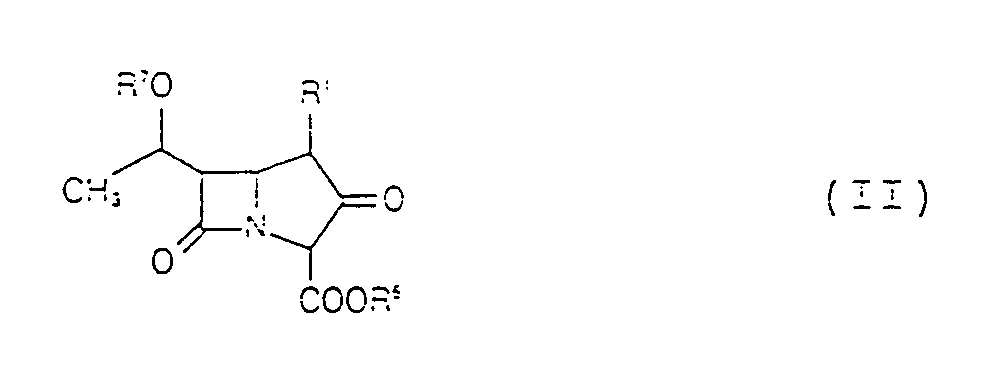 - R¹ est tel que défini ci-dessus ;- R⁶ est un atome d'hydrogène ou un groupe protecteur de carboxyle ; et- R⁷ est un atome d'hydrogène ou un groupe protecteur d'hydroxyle,ou d'un dérivé réactif de celui-ci,
avec un composé représenté par la formule : - R³, R⁴ et R⁵ sont tels que définis ci-dessus ; et- R⁸ est un atome d'hydrogène ou un groupe protecteur d'imino,pour obtenir un composé représenté par la formule :
et, si nécessaire, l'élimination de tout groupe protecteur. - Procédé de fabrication d'un composé représenté par la formule :

ou d'un sel ou ester pharmaceutiquement acceptable de ce composé,
qui comprend la réaction d'un agent oxydant sur un composé représenté par la formule : - R¹ est tel que défini ci-dessus ;- R⁶ est un atome d'hydrogène ou un groupe protecteur de carboxyle ;- R⁷ est un atome d'hydrogène ou un groupe protecteur d'hydroxyle ; et- R⁸ est un atome d'hydrogène ou un groupe protecteur d'imino,pour obtenir un composé représenté par la formule :
la réaction du composé de la formule (VI) avec un composé de la formule : - R³, R⁴ et R⁵ sont tels que définis ci-dessus ; et- R⁹ est un groupe méthyle, un groupe éthyle, un groupe isopropyle, un groupe 2,2,2-trifluoroéthyle ou un groupe phényle,afin d'obtenir un composé représenté par la formule :
et, si nécessaire, l'élimination de tout groupe protecteur. - Agent antibactérien comprenant une quantité efficace pour lutter contre les bactéries du composé représenté par la formule (I) telle que définie à la revendication 1, ou d'un sel ou ester pharmaceutiquement acceptable de ce composé, et un support ou diluant pharmaceutiquement acceptable.
Applications Claiming Priority (2)
| Application Number | Priority Date | Filing Date | Title |
|---|---|---|---|
| JP202568/89 | 1989-08-04 | ||
| JP20256889 | 1989-08-04 |
Publications (3)
| Publication Number | Publication Date |
|---|---|
| EP0411664A2 EP0411664A2 (fr) | 1991-02-06 |
| EP0411664A3 EP0411664A3 (en) | 1991-07-24 |
| EP0411664B1 true EP0411664B1 (fr) | 1995-01-18 |
Family
ID=16459655
Family Applications (1)
| Application Number | Title | Priority Date | Filing Date |
|---|---|---|---|
| EP90114980A Expired - Lifetime EP0411664B1 (fr) | 1989-08-04 | 1990-08-03 | Dérivés de 2-(2-vinylpyrrolidinylthio)carbapénème |
Country Status (8)
| Country | Link |
|---|---|
| US (1) | US5095013A (fr) |
| EP (1) | EP0411664B1 (fr) |
| JP (1) | JP2707811B2 (fr) |
| KR (1) | KR910004622A (fr) |
| AT (1) | ATE117302T1 (fr) |
| AU (1) | AU631671B2 (fr) |
| CA (1) | CA2022681C (fr) |
| DE (1) | DE69016121D1 (fr) |
Families Citing this family (5)
| Publication number | Priority date | Publication date | Assignee | Title |
|---|---|---|---|---|
| JP3048196B2 (ja) * | 1991-06-20 | 2000-06-05 | 第一製薬株式会社 | カルバペネム誘導体 |
| WO1993001192A1 (fr) * | 1991-07-09 | 1993-01-21 | Banyu Pharmaceutical Co., Ltd. | Derives de 2-carbapenem(pyrrolidinylthio substitue en position 2) |
| KR950014111A (ko) * | 1993-11-23 | 1995-06-15 | 유충식 | 새로운 카바페넴 유도체 및 그 제조방법 |
| KR100551853B1 (ko) * | 2000-07-19 | 2006-02-13 | 에프. 호프만-라 로슈 아게 | 피리미딘 유도체 |
| WO2011080736A1 (fr) | 2009-12-29 | 2011-07-07 | Mapi Pharma Hk Limited | Composés intermédiaires et procédés pour la préparation de tapentadol et de composés apparentés |
Family Cites Families (6)
| Publication number | Priority date | Publication date | Assignee | Title |
|---|---|---|---|---|
| CA1281720C (fr) * | 1984-11-08 | 1991-03-19 | Makoto Sunagawa | Composes de carbapenem et leur production |
| EP0243686B1 (fr) * | 1986-03-27 | 1992-07-15 | Sumitomo Pharmaceuticals Company, Limited | Dérivés de bêta-lactame et leur préparation |
| EP0272455B1 (fr) * | 1986-11-24 | 1993-02-10 | Fujisawa Pharmaceutical Co., Ltd. | Dérivés de l'acide 3-pyrrolidinylthio-1-azabicyclo[3.2.0]hept-2-ène-2-carboxylique |
| US4925838A (en) * | 1988-03-18 | 1990-05-15 | Fujisawa Pharmaceutical Company, Ltd. | 3-pyrrolidinylthio-1-azabicyclo[3.2.0]-hept-2-ene-2-carboxylic acid compounds |
| CA2036941A1 (fr) * | 1990-02-23 | 1991-08-24 | Isao Kawamoto | Derives du carbapenem ayant une action antibiotique, mode de preparation et d'utilisation |
| TW198034B (fr) * | 1990-03-27 | 1993-01-11 | Manyu Seiyaku Kk |
-
1990
- 1990-08-02 AU AU60122/90A patent/AU631671B2/en not_active Ceased
- 1990-08-03 CA CA002022681A patent/CA2022681C/fr not_active Expired - Fee Related
- 1990-08-03 DE DE69016121T patent/DE69016121D1/de not_active Expired - Lifetime
- 1990-08-03 AT AT90114980T patent/ATE117302T1/de not_active IP Right Cessation
- 1990-08-03 EP EP90114980A patent/EP0411664B1/fr not_active Expired - Lifetime
- 1990-08-03 US US07/562,564 patent/US5095013A/en not_active Expired - Fee Related
- 1990-08-03 JP JP2205984A patent/JP2707811B2/ja not_active Expired - Lifetime
- 1990-08-04 KR KR1019900011988A patent/KR910004622A/ko not_active Ceased
Also Published As
| Publication number | Publication date |
|---|---|
| JP2707811B2 (ja) | 1998-02-04 |
| DE69016121D1 (de) | 1995-03-02 |
| US5095013A (en) | 1992-03-10 |
| KR910004622A (ko) | 1991-03-29 |
| CA2022681C (fr) | 1996-06-18 |
| EP0411664A2 (fr) | 1991-02-06 |
| AU631671B2 (en) | 1992-12-03 |
| AU6012290A (en) | 1991-02-07 |
| JPH04154782A (ja) | 1992-05-27 |
| CA2022681A1 (fr) | 1991-02-05 |
| ATE117302T1 (de) | 1995-02-15 |
| EP0411664A3 (en) | 1991-07-24 |
Similar Documents
| Publication | Publication Date | Title |
|---|---|---|
| CA2065079C (fr) | Carbapenemes polycycliques; preparation et utilisation | |
| EP0449191B1 (fr) | Dérivés de carbapénème substitués sur la position 2 avec des goupes pyrrolidinylthio substitués | |
| CA2022681C (fr) | Derives de 2-(2-vinylpyrrolidinylthio)carbapenem | |
| EP0273747B1 (fr) | Dérivés de pénème, leur préparation et leur application | |
| DE69013131T2 (de) | 2-(2-Cyclopropylpyrrolidin-4-ylthio)carbapenemderivate. | |
| EP0202048B1 (fr) | Dérivés de carbapénème, leur préparation et compositions pharmaceutiques les contenant | |
| US5449672A (en) | Alkylaminoalkylpyrrolidinylthiocarbapenem derivatives | |
| EP0545290B1 (fr) | Dérivés d'aminoalkylpyrrolidinylthiocarbapénème | |
| US5373002A (en) | 2-(substituted pyrrolidinylthio) carbapenem derivatives | |
| NO164239B (no) | Analogifremgangsmaate for fremstilling av et terapeutisk aktivt karbapenemderivat. | |
| JP2934283B2 (ja) | カルバペネム誘導体 | |
| EP0522504A1 (fr) | Dérivés de carbapénème-2-(2-pyrrolidinylthio-substitué) | |
| AU1682599A (en) | Carbapenem derivatives | |
| JP2832742B2 (ja) | カルバペネム誘導体 | |
| JP2910356B2 (ja) | 2−(置換ピロリジニルチオ)カルバペネム誘導体 | |
| KR100191705B1 (ko) | 신규한 피롤리디닐 티오 카바페넴 유도체 및 그의 제조방법 | |
| JPH05255330A (ja) | 2−(置換ピロリジニルチオ)カルバペネム誘導体 | |
| JPH0764846B2 (ja) | 2−(置換ピロリジニルチオ)カルバペネム誘導体 | |
| KR100233233B1 (ko) | 신규 카바페넴계 항생제 | |
| NZ243468A (en) | 2-(2-substituted pyrrolidylthio)carbapenem derivatives; medicaments, | |
| KR100246950B1 (ko) | 신규 카바페넴계 항생제 및 그의 제조방법 | |
| JPH04134082A (ja) | 2−(2−シクロプロピルピロリジン−4−イルチオ)カルバペネム誘導体 | |
| JP2003183280A (ja) | カルバペネム化合物 | |
| JPWO1991009860A1 (ja) | 新規なカルバペネム誘導体 | |
| JPH05213954A (ja) | 2−(2−置換ピロリジニルチオ)カルバペネム誘導体 |
Legal Events
| Date | Code | Title | Description |
|---|---|---|---|
| PUAI | Public reference made under article 153(3) epc to a published international application that has entered the european phase |
Free format text: ORIGINAL CODE: 0009012 |
|
| AK | Designated contracting states |
Kind code of ref document: A2 Designated state(s): AT BE CH DE DK ES FR GB GR IT LI LU NL SE |
|
| PUAL | Search report despatched |
Free format text: ORIGINAL CODE: 0009013 |
|
| AK | Designated contracting states |
Kind code of ref document: A3 Designated state(s): AT BE CH DE DK ES FR GB GR IT LI LU NL SE |
|
| 17P | Request for examination filed |
Effective date: 19911107 |
|
| 17Q | First examination report despatched |
Effective date: 19930716 |
|
| GRAA | (expected) grant |
Free format text: ORIGINAL CODE: 0009210 |
|
| AK | Designated contracting states |
Kind code of ref document: B1 Designated state(s): AT BE CH DE DK ES FR GB GR IT LI LU NL SE |
|
| PG25 | Lapsed in a contracting state [announced via postgrant information from national office to epo] |
Ref country code: DK Effective date: 19950118 Ref country code: AT Effective date: 19950118 Ref country code: ES Free format text: THE PATENT HAS BEEN ANNULLED BY A DECISION OF A NATIONAL AUTHORITY Effective date: 19950118 Ref country code: BE Effective date: 19950118 Ref country code: CH Effective date: 19950118 Ref country code: FR Effective date: 19950118 Ref country code: GR Free format text: LAPSE BECAUSE OF FAILURE TO SUBMIT A TRANSLATION OF THE DESCRIPTION OR TO PAY THE FEE WITHIN THE PRESCRIBED TIME-LIMIT Effective date: 19950118 Ref country code: NL Effective date: 19950118 Ref country code: LI Effective date: 19950118 Ref country code: IT Free format text: LAPSE BECAUSE OF FAILURE TO SUBMIT A TRANSLATION OF THE DESCRIPTION OR TO PAY THE FEE WITHIN THE PRE;WARNING: LAPSES OF ITALIAN PATENTS WITH EFFECTIVE DATE BEFORE 2007 MAY HAVE OCCURRED AT ANY TIME BEFORE 2007. THE CORRECT EFFECTIVE DATE MAY BE DIFFERENT FROM THE ONE RECORDED.SCRIBED TIME-LIMIT Effective date: 19950118 |
|
| REF | Corresponds to: |
Ref document number: 117302 Country of ref document: AT Date of ref document: 19950215 Kind code of ref document: T |
|
| REF | Corresponds to: |
Ref document number: 69016121 Country of ref document: DE Date of ref document: 19950302 |
|
| PG25 | Lapsed in a contracting state [announced via postgrant information from national office to epo] |
Ref country code: SE Effective date: 19950418 |
|
| PG25 | Lapsed in a contracting state [announced via postgrant information from national office to epo] |
Ref country code: DE Effective date: 19950419 |
|
| REG | Reference to a national code |
Ref country code: CH Ref legal event code: PL |
|
| EN | Fr: translation not filed | ||
| NLV1 | Nl: lapsed or annulled due to failure to fulfill the requirements of art. 29p and 29m of the patents act | ||
| PG25 | Lapsed in a contracting state [announced via postgrant information from national office to epo] |
Ref country code: LU Free format text: LAPSE BECAUSE OF NON-PAYMENT OF DUE FEES Effective date: 19950831 |
|
| PLBE | No opposition filed within time limit |
Free format text: ORIGINAL CODE: 0009261 |
|
| STAA | Information on the status of an ep patent application or granted ep patent |
Free format text: STATUS: NO OPPOSITION FILED WITHIN TIME LIMIT |
|
| 26N | No opposition filed | ||
| PGFP | Annual fee paid to national office [announced via postgrant information from national office to epo] |
Ref country code: GB Payment date: 20000802 Year of fee payment: 11 |
|
| PG25 | Lapsed in a contracting state [announced via postgrant information from national office to epo] |
Ref country code: GB Free format text: LAPSE BECAUSE OF NON-PAYMENT OF DUE FEES Effective date: 20010803 |
|
| GBPC | Gb: european patent ceased through non-payment of renewal fee |
Effective date: 20010803 |