EP0411713A1 - Méthode et appareil pour tests discriminatoires de l'audition d'un jeune enfant - Google Patents
Méthode et appareil pour tests discriminatoires de l'audition d'un jeune enfant Download PDFInfo
- Publication number
- EP0411713A1 EP0411713A1 EP90202094A EP90202094A EP0411713A1 EP 0411713 A1 EP0411713 A1 EP 0411713A1 EP 90202094 A EP90202094 A EP 90202094A EP 90202094 A EP90202094 A EP 90202094A EP 0411713 A1 EP0411713 A1 EP 0411713A1
- Authority
- EP
- European Patent Office
- Prior art keywords
- response
- sound
- sound stimuli
- screening
- stimulus
- Prior art date
- Legal status (The legal status is an assumption and is not a legal conclusion. Google has not performed a legal analysis and makes no representation as to the accuracy of the status listed.)
- Withdrawn
Links
- 238000000034 method Methods 0.000 title claims abstract description 33
- 238000012216 screening Methods 0.000 title claims abstract description 21
- 230000004044 response Effects 0.000 claims abstract description 54
- 238000012360 testing method Methods 0.000 claims abstract description 41
- 238000012545 processing Methods 0.000 claims abstract description 12
- 238000001228 spectrum Methods 0.000 claims abstract description 10
- 230000015654 memory Effects 0.000 claims abstract description 8
- 230000003044 adaptive effect Effects 0.000 claims abstract description 5
- 230000005236 sound signal Effects 0.000 claims abstract description 4
- 230000001143 conditioned effect Effects 0.000 claims description 4
- 230000003750 conditioning effect Effects 0.000 claims description 3
- 239000002131 composite material Substances 0.000 claims 1
- 238000006243 chemical reaction Methods 0.000 description 4
- 238000010586 diagram Methods 0.000 description 3
- 230000008901 benefit Effects 0.000 description 2
- 230000001419 dependent effect Effects 0.000 description 2
- 238000011161 development Methods 0.000 description 2
- 230000006870 function Effects 0.000 description 2
- 230000000638 stimulation Effects 0.000 description 2
- 206010011891 Deafness neurosensory Diseases 0.000 description 1
- 241000282326 Felis catus Species 0.000 description 1
- 241001465754 Metazoa Species 0.000 description 1
- 238000013459 approach Methods 0.000 description 1
- 238000004891 communication Methods 0.000 description 1
- 230000003247 decreasing effect Effects 0.000 description 1
- 230000000881 depressing effect Effects 0.000 description 1
- 230000000994 depressogenic effect Effects 0.000 description 1
- 210000005069 ears Anatomy 0.000 description 1
- 230000007613 environmental effect Effects 0.000 description 1
- 238000011156 evaluation Methods 0.000 description 1
- 230000010370 hearing loss Effects 0.000 description 1
- 231100000888 hearing loss Toxicity 0.000 description 1
- 208000016354 hearing loss disease Diseases 0.000 description 1
- 230000004807 localization Effects 0.000 description 1
- 238000012544 monitoring process Methods 0.000 description 1
- 230000008569 process Effects 0.000 description 1
- 230000036647 reaction Effects 0.000 description 1
- 230000007115 recruitment Effects 0.000 description 1
- 230000000717 retained effect Effects 0.000 description 1
- 230000001953 sensory effect Effects 0.000 description 1
- 230000008961 swelling Effects 0.000 description 1
- 230000003936 working memory Effects 0.000 description 1
Images

Classifications
-
- A—HUMAN NECESSITIES
- A61—MEDICAL OR VETERINARY SCIENCE; HYGIENE
- A61B—DIAGNOSIS; SURGERY; IDENTIFICATION
- A61B5/00—Measuring for diagnostic purposes; Identification of persons
- A61B5/12—Audiometering
Definitions
- the invention relates to a method and apparatus for screening the hearing of a young child.
- the object of the invention is to deal with this and to provide a method and apparatus for testing the hearing of very young children which also makes it possible to increase the validity of the test very considerably.
- the apparatus for carrying out the abovementioned method which is provided with at least one loudspeaker for emitting the sound stimuli and a processing and control unit, is further characterized in that said processing and control unit comprises a digital memory for storing the sound stimuli in a number of frequency bands, a stimulus response unit, and a screening course processor employing an adaptive protocol program.
- the abovementioned method and apparatus according to the invention can be used to emit sound stimuli, which are controlled in intensity and spectrum, in various frequency bands and can test the responses of the babies under examination by a researcher on the basis of response assessment criteria.
- the results of said responses which are recorded by the researcher in the apparatus, determine the subsequent pattern of the screening test, which is controlled by a microprocessor with the aid of the protocol program mentioned.
- German Patent Specification 2,262,352 discloses the use of a tone sliding over a wide frequency spectrum. This cannot produce frequency-specific information about the hearing function. Serious hearing losses (for example treble loss) in children would reduce the stimulus to "warble" tones as a result of using a narrow-band sliding tone. The effectiveness of this is limited in the case of children.
- the apparatus shown in Fig. 1 for screening the hearing of a young child comprises at least one processing and control unit 1 having two loudspeakers 2, 3 for reproducing sound stimuli generated by the (8 bit, 20 kHz) audio interface 8; a stimulus-response unit 4 having three buttons with which the researcher can initiate a stimulus or the timing thereof (one button) and can record or feed in the response of the young child (one button for the right ear and one button for the left one); a keyboard 5 and a display screen 6 (for example LCD), which combination provides the researcher with the facility to feed in personal data about the baby, to select a test protocol, and to clarify the course of the screening test; a central processing and control device 10, for example a microprocessor; and a working memory 9 for storing the test protocols, the sound stimuli to be generated and the test results.
- a central processing and control device 10 for example a microprocessor
- working memory 9 for storing the test protocols, the sound stimuli to be generated and the test results.
- the apparatus further comprises an integrated modem 7 for communication with a regional computer via a standard telephone plug 11 of the telephone network.
- the apparatus also comprises some analog circuits 12, 13, 14 for converting digital sound information originating from an external source or background memory 15 to audible sound stimuli within accurately specified limits.
- the processor also contains a program for reading the sound stimuli stored in a development system into the memory of the screener.
- sound stimuli are generated which are standardized from an audiological viewpoint and which are synthesized on the basis of environmental sounds.
- a rattle, a domestic animal or other sound stimuli based on sounds which arouse babies, interest can be generated with varying intensity and frequency.
- These natural sound signals have the advantage that, like speech, they have a low response threshold for the young child. It is essential that they are selected and filtered in a manner such that the natural character is retained while a sufficiently narrow-band stimulus is nevertheless obtained.
- analog sounds are digitalized in the development system, processed further and finally stored in a memory with the amplitude being limited without distortion products outside the stimulus frequency band.
- the amplitude limitation is necessary because children having a sensory neural hearing loss are often oversensitive to signal peaks (recruitment phenomenon). With constant peak level, the mean signal level can be increased as a consequence of the amplitude limitation. This produces an effective sound stimulus.
- a response pattern is now determined, with the aid of an algorithm from the test protocol, for a large number of different sound stimuli whose frequency spectra are distributed over various frequency bands.
- the algorithm mentioned does not work through the various test frequencies consecutively but alters all the test frequency bands continuously.
- Various stimuli can be included for each frequency band, as a result of which a large variation can be achieved in said sound stimuli.
- the various frequency bands can be used interspersed with one another as determined with the aid of the test protocols.
- the test protocol processor is also able to offer the various frequency bands both to the right ear and to the left ear via two loudspeakers.
- the protocol program is also able to activate a response energizing circuit 16 so that a good response, i.e. a response assessed according to the assessment rules, is confirmed or conditioned by, for example, light signals.
- a good response i.e. a response assessed according to the assessment rules
- This can be done, for example, with a small lamp which is fitted on each loudspeaker and is able to flash.
- a separate program provides the test protocol which determines the screening course or pattern.
- the protocol processor used for this automatically caters for adequate alternation of the stimulated left and/or right ear.
- the researcher is able to determine the instant of emission of the stimulus by means of a stimulus key or button on the unit 4. By depressing the one response button or the other, he is also able to cause a good response of the one ear or the other ear of the child to be recorded.
- a time window in which the response assessment must occur is created subsequent to the sound stimulus previously emitted. Every response pattern can be tested after each stimulus against pass/fail criteria.
- the algorithm will then determine the further selection of intensity and spectrum of the subsequent sound stimuli on the basis of the response pattern.
- This makes it possible to allow for varying reaction patterns of the young children. It has been found important in this connection that the reactions of babies to sound stimuli are very dependent on many factors such as varying attention, nature of the stimuli, background noise, the way in which the test is carried out, etc. Such strongly varying reactions of these young children differ considerably from the responses such as those which are given in the currently known techniques via a pushbutton which is operated by the person concerned, an older child or an adult.
- Present apparatus can advantageously be used for the purpose of testing hearing in a diagnostic environment, it being possible to select frequency band and intensity of the stimulus and also the left or right loudspeaker with the aid of the keyboard and to retain the responses in an audiogram on the viewing screen. It is therefore also possible to condition the response visually by means of, for example, light signals from an energizing device.
- a great advantage is that the abovementioned apparatus can be linked via modem and telephone lines to a central, for example, a regionally installed, computer which makes it possible to coordinate and administratively guide a screening program centrally for a large population of young children.
- a uniform screening can be used for all the children, with the test evaluation automated centrally, and the screening protocols defined and adjusted centrally.
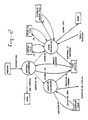
- the data flow diagram shown in Fig. 2 is an example of the protocol processing of the screening apparatus.
- ⁇ indicates the data flow and - - ⁇ indicates the control or monitoring.
- the screening apparatus is "loaded” with a protocol program which can be processed by the protocol interpreter (PI).
- the PI has access to the various files: - Sample file: digital representation of a "basic sound", for example a single tap on a tuning fork, a bird "whistle", a cat miaow, etc.
- - Stimulus file this comprises parameter data with which a stimulus can be defined with the aid of basic sounds from the sample file. A basic sound may, for example, be repeated with variable pause intervals and intensity.
- - Stimulus packet file this makes it possible to define series of stimuli with, for example, decreasing intensity.
- - Question file this makes it possible to define (administratively, in content) questions (for example multiple choice, open question etc).
- - Test results file detailed test results, response times and answers.
- the PI runs through the protocol program and in doing so generates the diverse sound stimuli and questions on the display, and records responses and answers in a file.
- the course of the protocol program is influenced by the responses.
- the PI also regulates the alternating left-right stimulation, the response conditioning by means of "LEDs and the time window for the response.
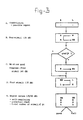
- Fig. 3 gives, diagrammatically, an example of a possible test protocol.
- this protocol three separate frequency bands are tested against a pass/fail criterion.
- Said pass/fail criterion can be adapted to the objective of the screening, for example: - a good response, i.e. a "pass", must be recorded in all the frequency bands and for both ears with a sound intensity of 35 dB, a "fail” being recorded in the converse case; and - in addition, a second good response must be recorded for the high frequency band at 35 or 40 dB.
- Table I Frequency band Level (dB) (Hz) pass I pass II L 150-1000 35 35 M 1500-3000 35 35 H 3500-6000 35 40 HH 3500-6000 40 35
- a response is indicated by the researcher with the aid of two response keys (L, R) if there is a prompt turning movement through 90° or if a clear localization occurs of one of the two loudspeakers which are set up at an angle on either side behind the child.
- the protocol program records this as a good response if the response occurs during the sound stimulus (not more than 5 sec) or within the response window after the sound stimulus (0.5). If the child turns its head to the correct side, after the key concerned is depressed, a good response is conditioned by means of small red lamps in the speakers which flash for 0.5 sec, after which the sound stimulus is discontinued.
- the protocol program caters for: - alternation of the sound stimuli, - alternating left-right stimulation (a maximum of two consective stimuli at one side), - adjustment of the level for H and HH stimuli, - discontinuation of the test if the pass criterion can no longer be reached, - discontinuation of the test as soon as the pass criterion is reached, - discontinuation of the test after a maximum of sixteen sound stimuli.
Landscapes
- Health & Medical Sciences (AREA)
- Life Sciences & Earth Sciences (AREA)
- Engineering & Computer Science (AREA)
- Physics & Mathematics (AREA)
- Pathology (AREA)
- Medical Informatics (AREA)
- Audiology, Speech & Language Pathology (AREA)
- Biophysics (AREA)
- Acoustics & Sound (AREA)
- Biomedical Technology (AREA)
- Heart & Thoracic Surgery (AREA)
- Multimedia (AREA)
- Molecular Biology (AREA)
- Surgery (AREA)
- Animal Behavior & Ethology (AREA)
- General Health & Medical Sciences (AREA)
- Public Health (AREA)
- Veterinary Medicine (AREA)
- Measurement Of The Respiration, Hearing Ability, Form, And Blood Characteristics Of Living Organisms (AREA)
Applications Claiming Priority (2)
| Application Number | Priority Date | Filing Date | Title |
|---|---|---|---|
| NL8901985A NL8901985A (nl) | 1989-08-01 | 1989-08-01 | Werkwijze en inrichting voor het screenen van het gehoor van een jong kind. |
| NL8901985 | 1989-08-01 |
Publications (1)
| Publication Number | Publication Date |
|---|---|
| EP0411713A1 true EP0411713A1 (fr) | 1991-02-06 |
Family
ID=19855132
Family Applications (1)
| Application Number | Title | Priority Date | Filing Date |
|---|---|---|---|
| EP90202094A Withdrawn EP0411713A1 (fr) | 1989-08-01 | 1990-07-31 | Méthode et appareil pour tests discriminatoires de l'audition d'un jeune enfant |
Country Status (3)
| Country | Link |
|---|---|
| US (1) | US5119826A (fr) |
| EP (1) | EP0411713A1 (fr) |
| NL (1) | NL8901985A (fr) |
Cited By (7)
| Publication number | Priority date | Publication date | Assignee | Title |
|---|---|---|---|---|
| US5428998A (en) * | 1991-09-27 | 1995-07-04 | Bam World Markets, Inc. | Method and apparatus for testing an infant for hearing defects |
| WO1999021480A1 (fr) * | 1997-10-24 | 1999-05-06 | Scientific Learning Corporation | Mesures acoustiques pour predire un retard de la lecture |
| WO2000021056A1 (fr) * | 1998-10-07 | 2000-04-13 | Scientific Learning Corporation | Test universel pour sujets handicapes en vue de l'apprentissage de langues |
| WO2001049176A1 (fr) * | 2000-01-05 | 2001-07-12 | The Babycalm Partnership | Procede et dispositif permettant de detecter et/ou de traiter la surdite congenitale |
| EP1813190A1 (fr) * | 2006-01-30 | 2007-08-01 | Siemens Audiologische Technik GmbH | Appareil pour un test auditif |
| EP2114240A4 (fr) * | 2006-10-13 | 2012-06-13 | Univ Rutgers | Procédés et systèmes de dépistage et de traitement de jeunes nourrissons présentant des déficits en termes de traitement auditif |
| US9302179B1 (en) | 2013-03-07 | 2016-04-05 | Posit Science Corporation | Neuroplasticity games for addiction |
Families Citing this family (24)
| Publication number | Priority date | Publication date | Assignee | Title |
|---|---|---|---|---|
| JPH10511472A (ja) * | 1994-12-08 | 1998-11-04 | ザ リージェンツ オブ ザ ユニバーシティ オブ カリフォルニア | 言語障害者間の語音の認識を向上させるための方法および装置 |
| US5922016A (en) * | 1996-01-26 | 1999-07-13 | Ingeborg Hochmair | Apparatus for electric stimulation of auditory nerves of a human being |
| US5811681A (en) * | 1996-04-29 | 1998-09-22 | Finnigan Corporation | Multimedia feature for diagnostic instrumentation |
| US6109107A (en) * | 1997-05-07 | 2000-08-29 | Scientific Learning Corporation | Method and apparatus for diagnosing and remediating language-based learning impairments |
| US5927988A (en) * | 1997-12-17 | 1999-07-27 | Jenkins; William M. | Method and apparatus for training of sensory and perceptual systems in LLI subjects |
| US6159014A (en) * | 1997-12-17 | 2000-12-12 | Scientific Learning Corp. | Method and apparatus for training of cognitive and memory systems in humans |
| US6019607A (en) * | 1997-12-17 | 2000-02-01 | Jenkins; William M. | Method and apparatus for training of sensory and perceptual systems in LLI systems |
| KR20000042498A (ko) * | 1998-12-22 | 2000-07-15 | 노윤성 | 컴퓨터에 의하여 운용되는자동음성응답시스템을 이용한 청력테스트 방법 및 프로그램과 소음차단구 |
| KR100345371B1 (ko) | 1999-07-02 | 2002-07-26 | 심계원 | 인터넷을 이용한 청력검사방법 및 그 프로그램을 수록한 기록매체 |
| AU2003283221A1 (en) * | 2002-12-09 | 2004-06-30 | Microsound A/S | Method of fitting portable communication device to a hearing impaired user |
| US20050175972A1 (en) * | 2004-01-13 | 2005-08-11 | Neuroscience Solutions Corporation | Method for enhancing memory and cognition in aging adults |
| US20070020595A1 (en) * | 2004-01-13 | 2007-01-25 | Posit Science Corporation | Method for enhancing memory and cognition in aging adults |
| US20050153267A1 (en) * | 2004-01-13 | 2005-07-14 | Neuroscience Solutions Corporation | Rewards method and apparatus for improved neurological training |
| US20060073452A1 (en) * | 2004-01-13 | 2006-04-06 | Posit Science Corporation | Method for enhancing memory and cognition in aging adults |
| US20070065789A1 (en) * | 2004-01-13 | 2007-03-22 | Posit Science Corporation | Method for enhancing memory and cognition in aging adults |
| US8210851B2 (en) * | 2004-01-13 | 2012-07-03 | Posit Science Corporation | Method for modulating listener attention toward synthetic formant transition cues in speech stimuli for training |
| US20060051727A1 (en) * | 2004-01-13 | 2006-03-09 | Posit Science Corporation | Method for enhancing memory and cognition in aging adults |
| US20060105307A1 (en) * | 2004-01-13 | 2006-05-18 | Posit Science Corporation | Method for enhancing memory and cognition in aging adults |
| US20070111173A1 (en) * | 2004-01-13 | 2007-05-17 | Posit Science Corporation | Method for modulating listener attention toward synthetic formant transition cues in speech stimuli for training |
| US20070134635A1 (en) * | 2005-12-13 | 2007-06-14 | Posit Science Corporation | Cognitive training using formant frequency sweeps |
| US20080057483A1 (en) * | 2006-09-05 | 2008-03-06 | Lawrence H Avidan | Apparatus and System for Testing Memory |
| US7793545B2 (en) * | 2007-10-04 | 2010-09-14 | Benson Medical Instruments Company | Audiometer with interchangeable transducer |
| US20100030101A1 (en) * | 2008-06-06 | 2010-02-04 | Durrant John D | Method And System For Acquiring Loudness Level Information |
| CN113425292A (zh) * | 2021-06-25 | 2021-09-24 | 四川大学华西医院 | 一种婴幼儿听力筛查方法及装置 |
Citations (4)
| Publication number | Priority date | Publication date | Assignee | Title |
|---|---|---|---|---|
| DE2262352A1 (de) * | 1971-12-30 | 1973-07-05 | Viennatone Hoergeraete | Gehoerpruefgeraet fuer kleinkinder |
| US3906158A (en) * | 1969-12-29 | 1975-09-16 | James Douglas Lake | Method and apparatus for conducting audiometric tests |
| US4139730A (en) * | 1977-08-10 | 1979-02-13 | Barbara Franklin | Method of testing human auditory responses |
| WO1985000509A1 (fr) * | 1983-07-19 | 1985-02-14 | Westra Electronic Gmbh | Systeme de production de signaux |
Family Cites Families (3)
| Publication number | Priority date | Publication date | Assignee | Title |
|---|---|---|---|---|
| US3938500A (en) * | 1974-08-19 | 1976-02-17 | The Board Of Trustees Of Leland Stanford Junior University | Automated newborn hearing screening apparatus and method |
| US4489610A (en) * | 1984-04-11 | 1984-12-25 | Intech Systems Corp. | Computerized audiometer |
| NZ218051A (en) * | 1986-10-23 | 1989-10-27 | Wormald Int | Audiometer with interactive graphics display to encourage responses from children |
-
1989
- 1989-08-01 NL NL8901985A patent/NL8901985A/nl not_active Application Discontinuation
-
1990
- 1990-07-31 EP EP90202094A patent/EP0411713A1/fr not_active Withdrawn
- 1990-07-31 US US07/560,576 patent/US5119826A/en not_active Expired - Fee Related
Patent Citations (4)
| Publication number | Priority date | Publication date | Assignee | Title |
|---|---|---|---|---|
| US3906158A (en) * | 1969-12-29 | 1975-09-16 | James Douglas Lake | Method and apparatus for conducting audiometric tests |
| DE2262352A1 (de) * | 1971-12-30 | 1973-07-05 | Viennatone Hoergeraete | Gehoerpruefgeraet fuer kleinkinder |
| US4139730A (en) * | 1977-08-10 | 1979-02-13 | Barbara Franklin | Method of testing human auditory responses |
| WO1985000509A1 (fr) * | 1983-07-19 | 1985-02-14 | Westra Electronic Gmbh | Systeme de production de signaux |
Non-Patent Citations (1)
| Title |
|---|
| NTIS TECH NOTES. no. 1E, January 1985, SPRINGFIELD, VA US pages 27 - 28; "Researchers refine technique to test hearing in sleeping newborns" * |
Cited By (19)
| Publication number | Priority date | Publication date | Assignee | Title |
|---|---|---|---|---|
| US5428998A (en) * | 1991-09-27 | 1995-07-04 | Bam World Markets, Inc. | Method and apparatus for testing an infant for hearing defects |
| WO1999021480A1 (fr) * | 1997-10-24 | 1999-05-06 | Scientific Learning Corporation | Mesures acoustiques pour predire un retard de la lecture |
| WO2000021056A1 (fr) * | 1998-10-07 | 2000-04-13 | Scientific Learning Corporation | Test universel pour sujets handicapes en vue de l'apprentissage de langues |
| WO2001049176A1 (fr) * | 2000-01-05 | 2001-07-12 | The Babycalm Partnership | Procede et dispositif permettant de detecter et/ou de traiter la surdite congenitale |
| EP1813190A1 (fr) * | 2006-01-30 | 2007-08-01 | Siemens Audiologische Technik GmbH | Appareil pour un test auditif |
| CN102988059B (zh) * | 2006-10-13 | 2014-09-17 | 鲁特格斯州立大学 | 获取提高正常生长的婴儿听觉或视觉的方法与系统 |
| US8231543B2 (en) | 2006-10-13 | 2012-07-31 | Rutgers, The State University Of New Jersey | Methods and systems for screening and treatment of young infants demonstrating deficits in auditory processing |
| CN102988059A (zh) * | 2006-10-13 | 2013-03-27 | 鲁特格斯州立大学 | 获取提高正常生长的婴儿听觉或视觉的方法与系统 |
| EP2114240A4 (fr) * | 2006-10-13 | 2012-06-13 | Univ Rutgers | Procédés et systèmes de dépistage et de traitement de jeunes nourrissons présentant des déficits en termes de traitement auditif |
| US8951206B2 (en) | 2006-10-13 | 2015-02-10 | Rutgers, The State University Of New Jersey | Methods and systems for screening and treatment of young infants demonstrating deficits in auditory processing |
| US9320458B2 (en) | 2006-10-13 | 2016-04-26 | Rutgers, The State University Of New Jersey | Methods and systems for screening and treatment of infants demonstrating deficits in auditory processing |
| US9308446B1 (en) | 2013-03-07 | 2016-04-12 | Posit Science Corporation | Neuroplasticity games for social cognition disorders |
| US9308445B1 (en) | 2013-03-07 | 2016-04-12 | Posit Science Corporation | Neuroplasticity games |
| US9302179B1 (en) | 2013-03-07 | 2016-04-05 | Posit Science Corporation | Neuroplasticity games for addiction |
| US9601026B1 (en) | 2013-03-07 | 2017-03-21 | Posit Science Corporation | Neuroplasticity games for depression |
| US9824602B2 (en) | 2013-03-07 | 2017-11-21 | Posit Science Corporation | Neuroplasticity games for addiction |
| US9886866B2 (en) | 2013-03-07 | 2018-02-06 | Posit Science Corporation | Neuroplasticity games for social cognition disorders |
| US9911348B2 (en) | 2013-03-07 | 2018-03-06 | Posit Science Corporation | Neuroplasticity games |
| US10002544B2 (en) | 2013-03-07 | 2018-06-19 | Posit Science Corporation | Neuroplasticity games for depression |
Also Published As
| Publication number | Publication date |
|---|---|
| NL8901985A (nl) | 1991-03-01 |
| US5119826A (en) | 1992-06-09 |
Similar Documents
| Publication | Publication Date | Title |
|---|---|---|
| US5119826A (en) | Method and apparatus for screening the hearing of a young child | |
| US4847763A (en) | Laser audiometer system | |
| Gerhardt | Acoustic spectral preferences in two cryptic species of grey treefrogs: implications for mate choice and sensory mechanisms | |
| Hammerschmidt et al. | Vocal development in squirrel monkeys | |
| EP0541315B1 (fr) | Dispositif et méthode d'audiométrie | |
| Trehub et al. | Auditory sensitivity in school-age children | |
| US4107465A (en) | Automatic audiometer system | |
| JPH01500631A (ja) | 患者が制御するマスター補聴器 | |
| CN1653787A (zh) | 用于医疗诊断和康复的多功能移动电话 | |
| Hoekstra | Frequency discrimination and frequency analysis in hearing | |
| EP1414022A1 (fr) | Systeme d'avertissement audibles | |
| Duchnowski et al. | Villchur revisited: Another look at automatic gain control simulation of recruiting hearing loss | |
| Villchur | Electronic models to simulate the effect of sensory distortions on speech perception by the deaf | |
| Soderquist | Frequency analysis and the critical band | |
| Norman et al. | Stimulus uncertainty affects perception in human echolocation: Timing, level, and spectrum. | |
| US3221100A (en) | Method and apparatus for testing hearing | |
| Harris | The auditory acuity of preadolescent monkeys. | |
| Gardner | A Pulse‐Tone Technique for Clinical Audiometric Threshold Measurements | |
| CN103405234B (zh) | 基于主频模拟调整技术的听觉障碍多维测量系统及其方法 | |
| Esser et al. | Discrimination of sinusoidally frequency-modulated sound signals mimicking species-specific communication calls in the FM-bat Phyllostomus discolor | |
| Hashino et al. | Auditory sensitivity in the zebra finch (Poephila guttata castanotis) | |
| US4007731A (en) | Means and techniques for establishing hearing deficiencies | |
| Esser et al. | Detection of frequency modulation in the FM-bat Phyllostomus discolor | |
| Wright et al. | Detection of sinusoidal amplitude modulation at unexpected rates | |
| Wienicke et al. | Auditory frequency discrimination in the squirrel monkey |
Legal Events
| Date | Code | Title | Description |
|---|---|---|---|
| PUAI | Public reference made under article 153(3) epc to a published international application that has entered the european phase |
Free format text: ORIGINAL CODE: 0009012 |
|
| 17P | Request for examination filed |
Effective date: 19901129 |
|
| AK | Designated contracting states |
Kind code of ref document: A1 Designated state(s): AT BE CH DE DK ES FR GB GR IT LI LU NL SE |
|
| 17Q | First examination report despatched |
Effective date: 19930611 |
|
| STAA | Information on the status of an ep patent application or granted ep patent |
Free format text: STATUS: THE APPLICATION IS DEEMED TO BE WITHDRAWN |
|
| 18D | Application deemed to be withdrawn |
Effective date: 19941206 |