EP0411756A2 - Funkfernsprechempfänger mit Verstärkungsregelung - Google Patents
Funkfernsprechempfänger mit Verstärkungsregelung Download PDFInfo
- Publication number
- EP0411756A2 EP0411756A2 EP90306570A EP90306570A EP0411756A2 EP 0411756 A2 EP0411756 A2 EP 0411756A2 EP 90306570 A EP90306570 A EP 90306570A EP 90306570 A EP90306570 A EP 90306570A EP 0411756 A2 EP0411756 A2 EP 0411756A2
- Authority
- EP
- European Patent Office
- Prior art keywords
- gain
- receiver
- signal
- gain control
- time slot
- Prior art date
- Legal status (The legal status is an assumption and is not a legal conclusion. Google has not performed a legal analysis and makes no representation as to the accuracy of the status listed.)
- Granted
Links
Images

Classifications
-
- H—ELECTRICITY
- H04—ELECTRIC COMMUNICATION TECHNIQUE
- H04W—WIRELESS COMMUNICATION NETWORKS
- H04W52/00—Power management, e.g. Transmission Power Control [TPC] or power classes
- H04W52/04—Transmission power control [TPC]
- H04W52/52—Transmission power control [TPC] using AGC [Automatic Gain Control] circuits or amplifiers
-
- H—ELECTRICITY
- H03—ELECTRONIC CIRCUITRY
- H03G—CONTROL OF AMPLIFICATION
- H03G3/00—Gain control in amplifiers or frequency changers
- H03G3/20—Automatic control
- H03G3/30—Automatic control in amplifiers having semiconductor devices
- H03G3/3052—Automatic control in amplifiers having semiconductor devices in bandpass amplifiers (H.F. or I.F.) or in frequency-changers used in a (super)heterodyne receiver
- H03G3/3078—Circuits generating control signals for digitally modulated signals
-
- H—ELECTRICITY
- H04—ELECTRIC COMMUNICATION TECHNIQUE
- H04B—TRANSMISSION
- H04B17/00—Monitoring; Testing
- H04B17/30—Monitoring; Testing of propagation channels
- H04B17/309—Measuring or estimating channel quality parameters
- H04B17/318—Received signal strength
Definitions
- This invention relates to receivers.
- the invention relates to receivers for radio telephone systems which operate in a Time Division Multiple Access (TDMA) system.
- TDMA Time Division Multiple Access
- GMSK Gaussian minimum shift keying technique
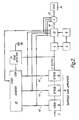
- Figure 1 is a schematic view of the TDMA format for the GSM system. 1
- this shows the basic format of one frequency channel for GSM transmissions as comprising a series of frames (Time Domain Multiple Access Frames), each frame comprising eight multiplexed time slots from different mobile stations.
- Each frame is 4.615 ms in length, and each time slot 0.577 ms in length.
- the structure of a time slot as shown comprises two sections of data separated by control bits, tail bits etc. Data is transmitted from each mobile station within a time slot in compressed format at a rate of 13 kbits ⁇ 1.
- the receiver for the GSM terminal whether it be a terminal in a mobile station or in a base station.
- the strength of the signal received by the terminal will vary and the input dynamic range may be as large as 100 dB.
- the input dynamic range may be as large as 100 dB.
- a mobile station it must not only operate in a traffic mode to receive data signals from the adjacent base station, but must also operate in a monitor mode to monitor neighbouring base stations during time slots of the frame not reserved for data transmission for hand over purposes.
- it is necessary to adjust the gain by very large amounts from time slot to time slot i.e. within 0.577 ms.
- Conventional methods of automatic gain control can not cope with such extreme demands.
- received signals at whatever level they are received must be amplified to a suitable level so that they can be accommodated within the input dynamic range of an analogue to digital (A to D) converter system which follows the intermediate frequency (IF) stage. Since the dynamic range of an A to D converter is relatively small, it is necessary to adjust the gain of the system so that each incoming pulse of RF energy is at an appropriate level.
- the amplification applied must be constant throughout the slot in order to preserve the amplitude and phase information of the incoming pulses, since the incoming pulses would be highly distorted from the original transmitted signal due to multipath reflections. In order to correct such multipath effects it is necessary to carry out equalisation processing on the input signals by means of an equaliser system, and it is therefore necessary to preserve all amplitude and phase information of the incoming pulses.
- a receiver for a mobile telephone system operating in a time division multiple access (TDMA) system includes a gain control means coupled to receive an input signal, the gain control means being switchable under the control of digital control signals between a plurality of gain and/or attenuation levels, and means for determining the value of the received signal and providing said digital control signals to set the gain or attenuation level constant for a time slot of the TDMA system, said determining means including means for recording the determined signal value to set the level of said gain control means prior to a predetermined time slot based upon measurements made during a preceding time period.
- TDMA time division multiple access
- the signal strength of the incoming signal when operating in the traffic mode, may be monitored by a logarithmic amplifier which is very fast acting, so that it can detect the incoming signal strength, and provide a signal to an A to D converter which provides digital control signals to a plurality of switched gain amplifiers connected in cascade.
- the gain is set based upon current information for the time slot immediately prior to the reception of the data for the time slot.
- the plurality of switched gain amplifiers are selectively actuated by a counter mechanism which increases the gain of the cascaded amplifiers until the amplified signal from that base station lies within the dynamic range of the A to D converter. This fact is detected and the resultant setting of the amplifiers, together with a measurement of the demodulated signal, provides an accurate measurement of received signal strength.
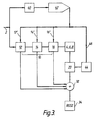
- the receiver which may be incorporated in either a mobile station or a base station of a GSM system, incorporates suitable signal processing means (not shown) for processing a received signal to provide an IF signal on a line 2.
- This IF signal is modulated according to a gaussian minimum shift keying technique, and the signal is demodulated and digitised in a demodulator and digitiser unit 4, following which the digital signals are equalised at equaliser unit 6 and processed at processor 8.
- suitable equalisation and processing techniques will be well known to those skilled in the art.
- IF line 2 is coupled to demodulator and digitiser unit 4 by a cascaded chain 10 of three switched gain amplifiers 12,14 and 16.
- Control lines 12′,14′ and 16′ are arranged to switch amplifiers 12,14 and 16 respectively between the condition in which they merely pass the signal without amplification (i.e. zero dB gain), and the condition in which amplifier 6 provides 8 dB of gain, amplifier 8 provides 16 dB of gain and amplifier provides 32 dB of gain.
- Control lines 12′,14′ and 16′ are coupled to a signal strength unit 20 and also to a counter 22.
- Counter 22 has a start input coupled to signal strength unit 20, and a stop input coupled to a peak detector 24 which is responsive to the IF signal at the input to demodulator and digitiser unit 4. Peak detector 24 responds to say 1/4 or 1/2 of an IF waveform cycle to produce an estimate of signal strength based upon the waveform peak.
- Unit 20 provides on an output line 30 a measure of signals strength detected by unit 4. This is summed at a summer 32 with the signals on lines 12′,14′ and 16′ indicating the gain provided by chain 10 in order to provide an indication of received signal strength at received signal strength indicator (RSSI) unit 34.
- RSSI received signal strength indicator
- signal strength unit 20 having memorised the signal strength of the IF input signal from preceding time slots, will provide signals on control lines 12′,14′ and 16′ to provide the appropriate amount of gain to the IF signal for the resultant IF signal to be accommodated within the dynamic range.
- the total received signal strength is indicated in RSSI unit 34.
- RSSI unit 34 In the traffic mode it can be assumed that the received signal level will only change slowly over large numbers of time slots. Between these slots the transmitted signals will be intended for other mobile stations, and may be at a completely different level.
- the mobile station will monitor base station control channel signals from adjacent base stations. These will be continuous signals of a different frequency to those frequencies used in the traffic mode signals. If the control channel signal of a base station having an unknown control channel signal strength is to monitored, then counter 22 is actuated at the beginning of the time slot by signal strength unit 20 in order to ramp up the gain provided by the switch gained amplifiers quickly, until the signal strength as detected by peak detector 24 detects that the signal strength is within the dynamic range of the A to D converter system in unit 4 and accordingly stops counter 22.
- the setting of counter 22 is memorised in unit 20 and is employed for subsequent readings.
- control channels 12,14,16 each have constant carrier amplitude, there is no slot to slot level change as in the traffic mode.
- the setting of counter 22 also provides a measure of the received signal strength, when combined by 32 with the measured amplitude of signals in unit 4 on line 30, to provide an indication of received signal strength in unit 34.
- the IF signal is applied to a logarithmic amplifier 40 which is arranged to detect the level of the IF signal.
- Amplifier 40 does this within a very short space of time and can therefore detect the IF signal strength prior to received data being received at the demodulator and digitiser unit 4.
- the output of amplifier 40 is converted to a digital value in flash A to D converter 42 and the digital value is fed via control lines 12′,14′ and 16′ to control switched gain amplifiers 12,14 and 16.
- control lines 12′,14′ and 16′ to control switched gain amplifiers 12,14 and 16.
- the signal received at unit 4 has its power level measured in signal strength unit 20 and this level is summed in summer 32 together with the gain setting of amplifiers 12,14 and 16 in order to provide an accurate measurement of the received signal strength. If the measured power at 20 is determined to be excessive or insufficient, signals are provided via a window unit 44 to provide further gain control signals on line 46 to lines 12′,14′ and 16′ during a window period occuring within the time slots.
- the automatic gain control has a relatively coarse 8 dB setting resolution. This allows precise gain setting with a small number of digital control lines, and rapid changes of gain over a wide range.
- finer resolution may be achieved.
- a finer automatic gain control is, however, superimposed on the system by use of the equaliser 6. This effectively provides a further two levels of resolution. It will be appreciated however that if, for example, sufficient switched gain amplifier stages are incorporated, it may be possible to omit the equaliser.
Landscapes
- Engineering & Computer Science (AREA)
- Computer Networks & Wireless Communication (AREA)
- Signal Processing (AREA)
- Quality & Reliability (AREA)
- Physics & Mathematics (AREA)
- Electromagnetism (AREA)
- Mobile Radio Communication Systems (AREA)
- Time-Division Multiplex Systems (AREA)
- Control Of Amplification And Gain Control (AREA)
- Circuits Of Receivers In General (AREA)
Applications Claiming Priority (2)
| Application Number | Priority Date | Filing Date | Title |
|---|---|---|---|
| GB898915172A GB8915172D0 (en) | 1989-07-01 | 1989-07-01 | Receiver gain control for radio telephone system |
| GB8915172 | 1989-07-01 |
Publications (3)
| Publication Number | Publication Date |
|---|---|
| EP0411756A2 true EP0411756A2 (de) | 1991-02-06 |
| EP0411756A3 EP0411756A3 (en) | 1992-01-02 |
| EP0411756B1 EP0411756B1 (de) | 1994-12-21 |
Family
ID=10659408
Family Applications (1)
| Application Number | Title | Priority Date | Filing Date |
|---|---|---|---|
| EP90306570A Expired - Lifetime EP0411756B1 (de) | 1989-07-01 | 1990-06-15 | Funkfernsprechempfänger mit Verstärkungsregelung |
Country Status (6)
| Country | Link |
|---|---|
| US (1) | US5251216A (de) |
| EP (1) | EP0411756B1 (de) |
| JP (1) | JPH0342925A (de) |
| AU (1) | AU630206B2 (de) |
| DE (1) | DE69015281T2 (de) |
| GB (2) | GB8915172D0 (de) |
Cited By (11)
| Publication number | Priority date | Publication date | Assignee | Title |
|---|---|---|---|---|
| EP0496507A3 (en) * | 1991-01-15 | 1993-06-30 | Nokia Mobile Phones Ltd. | Gain control in a tdma radio-telephone system |
| EP0569688A1 (de) * | 1992-04-29 | 1993-11-18 | Hagenuk Telecom GmbH | Verfahren und Gerät zur Mehrwegeschwundkompensation in einem TDMA-Empfänger |
| EP0573108A1 (de) * | 1992-06-03 | 1993-12-08 | Koninklijke Philips Electronics N.V. | System zur automatischen Kompensation der Kabeldämpfung |
| EP0674402A1 (de) * | 1994-03-23 | 1995-09-27 | AT&T Corp. | Schnelle AGC für TDMA-Funksysteme |
| EP0725479A1 (de) * | 1995-01-31 | 1996-08-07 | Nec Corporation | Mobile Radioeinheit |
| US5564074A (en) * | 1993-02-05 | 1996-10-08 | Nokia Mobile Phones Ltd. | Power control apparatus and method for a radiotelephone |
| EP0748140A3 (de) * | 1995-06-07 | 1999-05-06 | Nokia Mobile Phones Ltd. | Weiterreichen mit schnellem AGC |
| CN1049543C (zh) * | 1992-12-11 | 2000-02-16 | 艾利森电话股份有限公司 | 调节无线电信号强度信息信号的方法和装置 |
| WO2000031867A1 (en) * | 1998-11-24 | 2000-06-02 | Telefonaktiebolaget Lm Ericsson (Publ) | Automatic gain control for slotted mode operation |
| CN1080954C (zh) * | 1995-06-02 | 2002-03-13 | 摩托罗拉公司 | 无线电话接收机中使接收信号质量最佳化的装置和方法 |
| EP1239606A1 (de) * | 2001-03-05 | 2002-09-11 | Nokia Corporation | Empfänger zur Bestimmung eines Referenzwertes während der automatischen Verstärkungsregelung eines Kontrollkanals des allgemeinen Pakets |
Families Citing this family (14)
| Publication number | Priority date | Publication date | Assignee | Title |
|---|---|---|---|---|
| GB2250402B (en) * | 1990-09-28 | 1995-06-21 | Matsushita Electric Industrial Co Ltd | Power saving apparatus of a radiotelephone |
| JP2730347B2 (ja) * | 1991-10-09 | 1998-03-25 | 松下電器産業株式会社 | 受信機の自動利得制御方法 |
| US5312991A (en) * | 1992-06-09 | 1994-05-17 | Mallinckrodt Specialty Chemicals Company | Surfactant improvement for para-aminophenol process |
| US5375123A (en) * | 1993-02-05 | 1994-12-20 | Telefonakitebolaget L. M. Ericsson | Allocation of channels using interference estimation |
| US5548594A (en) * | 1993-12-28 | 1996-08-20 | Nec Corporation | Compact AGC circuit with stable characteristics |
| GB2323987B (en) * | 1994-01-29 | 1998-12-02 | Motorola Ltd | Dual mode remote radio |
| SE9403337L (sv) * | 1994-10-03 | 1995-11-27 | Ericsson Telefon Ab L M | Förfarande och anordning för att erhålla ett brett dynamiskt område hos en mottagare i ett digitalt radiotransmissionssystem |
| EP0872148B1 (de) * | 1996-01-04 | 2002-04-17 | Siemens Aktiengesellschaft | Verfahren und anordnung zum übertragen von daten in einem zellularen funksystem |
| US20010048727A1 (en) * | 2000-01-10 | 2001-12-06 | Schmutz Thomas R. | Method and apparatus for automatic gain control on a time slot by time slot basis |
| US6925072B1 (en) * | 2000-08-03 | 2005-08-02 | Ericsson Inc. | System and method for transmitting control information between a control unit and at least one sub-unit |
| US7085255B2 (en) * | 2000-10-19 | 2006-08-01 | Interdigital Technology Corporation | Selectively activated AGC signal measurement unit |
| US7068977B1 (en) * | 2002-10-11 | 2006-06-27 | Navini Networks, Inc. | Method and system for interference assessment and reduction in a wireless communication system |
| DE10255606A1 (de) * | 2002-11-28 | 2004-06-17 | Infineon Technologies Ag | Verstärkeranordnung, Empfänger mit der Verstärkeranordnung und Verfahren zum Betrieb eines programmierbaren Verstärkers |
| DE102011081245A1 (de) * | 2011-03-31 | 2012-10-04 | Rohde & Schwarz Gmbh & Co. Kg | Vorrichtung und Verfahren zum Fixieren eines Verstärkungs- bzw. Dämpfungsfaktors |
Family Cites Families (13)
| Publication number | Priority date | Publication date | Assignee | Title |
|---|---|---|---|---|
| SE338076B (de) * | 1969-12-23 | 1971-08-30 | Philips Svenska Ab | |
| JPS5544225A (en) * | 1978-09-25 | 1980-03-28 | Nec Corp | Time sharing gain adjustment circuit |
| US4581725A (en) * | 1982-07-21 | 1986-04-08 | Mobil Oil Corporation | Method and system for gain selection |
| JPS60145713A (ja) * | 1984-01-10 | 1985-08-01 | Fujitsu Ltd | 自動利得制御方式 |
| US4577310A (en) * | 1984-05-16 | 1986-03-18 | Tie/Communications, Inc. | Station interface for digital electronic telephone switching system having centralized digital audio processor |
| US4635103A (en) * | 1984-12-03 | 1987-01-06 | Rca Corporation | Phase locked loop system incorporating automatic gain control |
| FR2576472B1 (fr) * | 1985-01-22 | 1988-02-12 | Alcatel Thomson Faisceaux | Procede et dispositif de commande automatique de gain d'un recepteur en acces multiple a repartition temporelle |
| JPH01185008A (ja) * | 1988-01-19 | 1989-07-24 | Nec Corp | 利得可変増幅器 |
| CA1301859C (en) * | 1988-02-25 | 1992-05-26 | Kiyoshi Ichimura | Automatic gain control circuit |
| IE64560B1 (en) * | 1988-11-30 | 1995-08-23 | Motorola Inc | Digital automatic gain control |
| US5042082A (en) * | 1989-06-26 | 1991-08-20 | Telefonaktiebolaget L. M. Ericsson | Mobile assisted handoff |
| US4930126A (en) * | 1989-06-05 | 1990-05-29 | Motorola, Inc. | Time division multiplex system suited for burst analog transmission |
| US5029162A (en) * | 1990-03-06 | 1991-07-02 | Confertech International | Automatic gain control using root-mean-square circuitry in a digital domain conference bridge for a telephone network |
-
1989
- 1989-07-01 GB GB898915172A patent/GB8915172D0/en active Pending
-
1990
- 1990-06-15 EP EP90306570A patent/EP0411756B1/de not_active Expired - Lifetime
- 1990-06-15 DE DE69015281T patent/DE69015281T2/de not_active Expired - Fee Related
- 1990-06-15 GB GB9013399A patent/GB2233846B/en not_active Expired - Fee Related
- 1990-06-26 US US07/543,470 patent/US5251216A/en not_active Expired - Lifetime
- 1990-06-29 JP JP2170347A patent/JPH0342925A/ja active Pending
- 1990-07-02 AU AU58069/90A patent/AU630206B2/en not_active Ceased
Cited By (16)
| Publication number | Priority date | Publication date | Assignee | Title |
|---|---|---|---|---|
| US5331638A (en) * | 1991-01-15 | 1994-07-19 | Nokia Mobile Phones Ltd. | Gain control in a TDMA radio-telephone system |
| EP0496507A3 (en) * | 1991-01-15 | 1993-06-30 | Nokia Mobile Phones Ltd. | Gain control in a tdma radio-telephone system |
| EP0569688A1 (de) * | 1992-04-29 | 1993-11-18 | Hagenuk Telecom GmbH | Verfahren und Gerät zur Mehrwegeschwundkompensation in einem TDMA-Empfänger |
| EP0573108A1 (de) * | 1992-06-03 | 1993-12-08 | Koninklijke Philips Electronics N.V. | System zur automatischen Kompensation der Kabeldämpfung |
| CN1049543C (zh) * | 1992-12-11 | 2000-02-16 | 艾利森电话股份有限公司 | 调节无线电信号强度信息信号的方法和装置 |
| US5564074A (en) * | 1993-02-05 | 1996-10-08 | Nokia Mobile Phones Ltd. | Power control apparatus and method for a radiotelephone |
| EP0674402A1 (de) * | 1994-03-23 | 1995-09-27 | AT&T Corp. | Schnelle AGC für TDMA-Funksysteme |
| CN1084114C (zh) * | 1995-01-31 | 2002-05-01 | 日本电气株式会社 | 具有自动增益控制电路的移动无线单元和在所述移动无线单元中自动增益控制的方法 |
| US5884152A (en) * | 1995-01-31 | 1999-03-16 | Nec Corporation | Automatic gain control with constant gain coefficient during mobile's receive time slot |
| EP0725479A1 (de) * | 1995-01-31 | 1996-08-07 | Nec Corporation | Mobile Radioeinheit |
| CN1080954C (zh) * | 1995-06-02 | 2002-03-13 | 摩托罗拉公司 | 无线电话接收机中使接收信号质量最佳化的装置和方法 |
| EP0748140A3 (de) * | 1995-06-07 | 1999-05-06 | Nokia Mobile Phones Ltd. | Weiterreichen mit schnellem AGC |
| WO2000031867A1 (en) * | 1998-11-24 | 2000-06-02 | Telefonaktiebolaget Lm Ericsson (Publ) | Automatic gain control for slotted mode operation |
| US6563891B1 (en) | 1998-11-24 | 2003-05-13 | Telefonaktiebolaget L M Ericsson (Publ) | Automatic gain control for slotted mode operation |
| EP1239606A1 (de) * | 2001-03-05 | 2002-09-11 | Nokia Corporation | Empfänger zur Bestimmung eines Referenzwertes während der automatischen Verstärkungsregelung eines Kontrollkanals des allgemeinen Pakets |
| US7308054B2 (en) | 2001-03-05 | 2007-12-11 | Nokia Corporation | Determination of a reference value for automatic gain control of a receiver on a general packet control channel |
Also Published As
| Publication number | Publication date |
|---|---|
| AU630206B2 (en) | 1992-10-22 |
| GB2233846B (en) | 1994-07-13 |
| EP0411756A3 (en) | 1992-01-02 |
| GB2233846A (en) | 1991-01-16 |
| AU5806990A (en) | 1991-01-03 |
| GB9013399D0 (en) | 1990-08-08 |
| DE69015281D1 (de) | 1995-02-02 |
| JPH0342925A (ja) | 1991-02-25 |
| DE69015281T2 (de) | 1995-07-27 |
| US5251216A (en) | 1993-10-05 |
| EP0411756B1 (de) | 1994-12-21 |
| GB8915172D0 (en) | 1989-08-23 |
Similar Documents
| Publication | Publication Date | Title |
|---|---|---|
| EP0411756B1 (de) | Funkfernsprechempfänger mit Verstärkungsregelung | |
| US5067171A (en) | Method and apparatus for hand-off of call in progress | |
| US6330433B1 (en) | Antenna selection control circuitry | |
| US5331638A (en) | Gain control in a TDMA radio-telephone system | |
| EP0440239A2 (de) | Empfangsgerät mit Antennenauswahl-Diversity | |
| JPS61240725A (ja) | 無線伝送チヤネルの品質測定方法および装置 | |
| EP1689096A2 (de) | Sender in einem Datenübertragungssystem und zugehöriges Verfahren | |
| US5940748A (en) | Method and system for determining the integrity of a received signal | |
| JPH11187463A (ja) | 移動体無線受信機 | |
| JP2001358606A (ja) | 時分割多重方式無線装置 | |
| US6667966B2 (en) | Ambient field level monitor device for radio mobile terminal | |
| US6081564A (en) | Apparatus and methods for tracking power level of received signal in code division multiple access communication system | |
| US6032052A (en) | Apparatus and method for data transmission | |
| US20040095895A1 (en) | Method for power detection of multicarrier signals, radio transmission unit and module for such a unit | |
| JP3798596B2 (ja) | 信号検出装置 | |
| JP2871634B2 (ja) | バースト信号復調器 | |
| EP0665662A1 (de) | Einrichtung zur Detektion eines Empfangsfeldes | |
| US6567646B1 (en) | Method and apparatus in a radio communication system | |
| US20010012765A1 (en) | Method and arrangement for controlling transmitted power in a telecommunication system | |
| EP0583966A1 (de) | Automatische Verstärkungsregelung | |
| JP3324303B2 (ja) | 受信信号レベル検出回路 | |
| WO2000016490A8 (en) | Method and arrangement in a radio receiver | |
| WO1995008878A1 (en) | Method for eliminating the effect of gain variations of a distribution amplifier at a base station | |
| JP2712853B2 (ja) | 空チャンネル検出方法 | |
| JPH0437334A (ja) | 無線通信装置 |
Legal Events
| Date | Code | Title | Description |
|---|---|---|---|
| PUAI | Public reference made under article 153(3) epc to a published international application that has entered the european phase |
Free format text: ORIGINAL CODE: 0009012 |
|
| AK | Designated contracting states |
Kind code of ref document: A2 Designated state(s): DE FR IT |
|
| PUAL | Search report despatched |
Free format text: ORIGINAL CODE: 0009013 |
|
| AK | Designated contracting states |
Kind code of ref document: A3 Designated state(s): DE FR IT |
|
| 17P | Request for examination filed |
Effective date: 19920623 |
|
| 17Q | First examination report despatched |
Effective date: 19940321 |
|
| GRAA | (expected) grant |
Free format text: ORIGINAL CODE: 0009210 |
|
| ITF | It: translation for a ep patent filed | ||
| AK | Designated contracting states |
Kind code of ref document: B1 Designated state(s): DE FR IT |
|
| REF | Corresponds to: |
Ref document number: 69015281 Country of ref document: DE Date of ref document: 19950202 |
|
| ET | Fr: translation filed | ||
| PLBE | No opposition filed within time limit |
Free format text: ORIGINAL CODE: 0009261 |
|
| STAA | Information on the status of an ep patent application or granted ep patent |
Free format text: STATUS: NO OPPOSITION FILED WITHIN TIME LIMIT |
|
| 26N | No opposition filed | ||
| REG | Reference to a national code |
Ref country code: FR Ref legal event code: CD |
|
| REG | Reference to a national code |
Ref country code: FR Ref legal event code: TP |
|
| REG | Reference to a national code |
Ref country code: FR Ref legal event code: TP Free format text: PUBLIE A TORT DANS LE BOPI 98/03 SUIVANT LA NOTIFICATION DANS LE BOPI 98/07 |
|
| REG | Reference to a national code |
Ref country code: FR Ref legal event code: TP |
|
| PGFP | Annual fee paid to national office [announced via postgrant information from national office to epo] |
Ref country code: FR Payment date: 20020610 Year of fee payment: 13 |
|
| PGFP | Annual fee paid to national office [announced via postgrant information from national office to epo] |
Ref country code: DE Payment date: 20020619 Year of fee payment: 13 |
|
| PG25 | Lapsed in a contracting state [announced via postgrant information from national office to epo] |
Ref country code: DE Free format text: LAPSE BECAUSE OF NON-PAYMENT OF DUE FEES Effective date: 20040101 |
|
| PG25 | Lapsed in a contracting state [announced via postgrant information from national office to epo] |
Ref country code: FR Free format text: LAPSE BECAUSE OF NON-PAYMENT OF DUE FEES Effective date: 20040227 |
|
| REG | Reference to a national code |
Ref country code: FR Ref legal event code: ST |
|
| PG25 | Lapsed in a contracting state [announced via postgrant information from national office to epo] |
Ref country code: IT Free format text: LAPSE BECAUSE OF NON-PAYMENT OF DUE FEES Effective date: 20050615 |