EP0412038A2 - Compensation chromatique et pour désalignement dans un système de balayage à plusieurs faisceaux laser - Google Patents
Compensation chromatique et pour désalignement dans un système de balayage à plusieurs faisceaux laser Download PDFInfo
- Publication number
- EP0412038A2 EP0412038A2 EP90480088A EP90480088A EP0412038A2 EP 0412038 A2 EP0412038 A2 EP 0412038A2 EP 90480088 A EP90480088 A EP 90480088A EP 90480088 A EP90480088 A EP 90480088A EP 0412038 A2 EP0412038 A2 EP 0412038A2
- Authority
- EP
- European Patent Office
- Prior art keywords
- pulse
- scan
- laser beam
- sos
- producing
- Prior art date
- Legal status (The legal status is an assumption and is not a legal conclusion. Google has not performed a legal analysis and makes no representation as to the accuracy of the status listed.)
- Ceased
Links
Images


Classifications
-
- H—ELECTRICITY
- H04—ELECTRIC COMMUNICATION TECHNIQUE
- H04N—PICTORIAL COMMUNICATION, e.g. TELEVISION
- H04N1/00—Scanning, transmission or reproduction of documents or the like, e.g. facsimile transmission; Details thereof
- H04N1/04—Scanning arrangements, i.e. arrangements for the displacement of active reading or reproducing elements relative to the original or reproducing medium, or vice versa
- H04N1/19—Scanning arrangements, i.e. arrangements for the displacement of active reading or reproducing elements relative to the original or reproducing medium, or vice versa using multi-element arrays
- H04N1/191—Scanning arrangements, i.e. arrangements for the displacement of active reading or reproducing elements relative to the original or reproducing medium, or vice versa using multi-element arrays the array comprising a one-dimensional [1D] array
- H04N1/1911—Simultaneously or substantially simultaneously scanning picture elements on more than one main scanning line, e.g. scanning in swaths
- H04N1/1916—Simultaneously or substantially simultaneously scanning picture elements on more than one main scanning line, e.g. scanning in swaths using an array of elements displaced from one another in the main scan direction, e.g. a diagonally arranged array
-
- G—PHYSICS
- G02—OPTICS
- G02B—OPTICAL ELEMENTS, SYSTEMS OR APPARATUS
- G02B27/00—Optical systems or apparatus not provided for by any of the groups G02B1/00 - G02B26/00, G02B30/00
- G02B27/0025—Optical systems or apparatus not provided for by any of the groups G02B1/00 - G02B26/00, G02B30/00 for optical correction, e.g. distorsion, aberration
- G02B27/0031—Optical systems or apparatus not provided for by any of the groups G02B1/00 - G02B26/00, G02B30/00 for optical correction, e.g. distorsion, aberration for scanning purposes
-
- G—PHYSICS
- G06—COMPUTING OR CALCULATING; COUNTING
- G06K—GRAPHICAL DATA READING; PRESENTATION OF DATA; RECORD CARRIERS; HANDLING RECORD CARRIERS
- G06K15/00—Arrangements for producing a permanent visual presentation of the output data, e.g. computer output printers
- G06K15/02—Arrangements for producing a permanent visual presentation of the output data, e.g. computer output printers using printers
- G06K15/12—Arrangements for producing a permanent visual presentation of the output data, e.g. computer output printers using printers by photographic printing, e.g. by laser printers
- G06K15/1204—Arrangements for producing a permanent visual presentation of the output data, e.g. computer output printers using printers by photographic printing, e.g. by laser printers involving the fast moving of an optical beam in the main scanning direction
- G06K15/1219—Detection, control or error compensation of scanning velocity or position, e.g. synchronisation
-
- G—PHYSICS
- G06—COMPUTING OR CALCULATING; COUNTING
- G06K—GRAPHICAL DATA READING; PRESENTATION OF DATA; RECORD CARRIERS; HANDLING RECORD CARRIERS
- G06K15/00—Arrangements for producing a permanent visual presentation of the output data, e.g. computer output printers
- G06K15/02—Arrangements for producing a permanent visual presentation of the output data, e.g. computer output printers using printers
- G06K15/12—Arrangements for producing a permanent visual presentation of the output data, e.g. computer output printers using printers by photographic printing, e.g. by laser printers
- G06K15/1238—Arrangements for producing a permanent visual presentation of the output data, e.g. computer output printers using printers by photographic printing, e.g. by laser printers simultaneously exposing more than one point
- G06K15/1257—Arrangements for producing a permanent visual presentation of the output data, e.g. computer output printers using printers by photographic printing, e.g. by laser printers simultaneously exposing more than one point on more than one main scanning line
- G06K15/1261—Arrangements for producing a permanent visual presentation of the output data, e.g. computer output printers using printers by photographic printing, e.g. by laser printers simultaneously exposing more than one point on more than one main scanning line using an array of light sources
-
- H—ELECTRICITY
- H04—ELECTRIC COMMUNICATION TECHNIQUE
- H04N—PICTORIAL COMMUNICATION, e.g. TELEVISION
- H04N1/00—Scanning, transmission or reproduction of documents or the like, e.g. facsimile transmission; Details thereof
- H04N1/04—Scanning arrangements, i.e. arrangements for the displacement of active reading or reproducing elements relative to the original or reproducing medium, or vice versa
- H04N1/047—Detection, control or error compensation of scanning velocity or position
- H04N1/053—Detection, control or error compensation of scanning velocity or position in main scanning direction, e.g. synchronisation of line start or picture elements in a line
-
- H—ELECTRICITY
- H04—ELECTRIC COMMUNICATION TECHNIQUE
- H04N—PICTORIAL COMMUNICATION, e.g. TELEVISION
- H04N1/00—Scanning, transmission or reproduction of documents or the like, e.g. facsimile transmission; Details thereof
- H04N1/04—Scanning arrangements, i.e. arrangements for the displacement of active reading or reproducing elements relative to the original or reproducing medium, or vice versa
- H04N1/19—Scanning arrangements, i.e. arrangements for the displacement of active reading or reproducing elements relative to the original or reproducing medium, or vice versa using multi-element arrays
-
- H—ELECTRICITY
- H04—ELECTRIC COMMUNICATION TECHNIQUE
- H04N—PICTORIAL COMMUNICATION, e.g. TELEVISION
- H04N1/00—Scanning, transmission or reproduction of documents or the like, e.g. facsimile transmission; Details thereof
- H04N1/04—Scanning arrangements, i.e. arrangements for the displacement of active reading or reproducing elements relative to the original or reproducing medium, or vice versa
- H04N1/19—Scanning arrangements, i.e. arrangements for the displacement of active reading or reproducing elements relative to the original or reproducing medium, or vice versa using multi-element arrays
- H04N1/191—Scanning arrangements, i.e. arrangements for the displacement of active reading or reproducing elements relative to the original or reproducing medium, or vice versa using multi-element arrays the array comprising a one-dimensional [1D] array
- H04N1/1911—Simultaneously or substantially simultaneously scanning picture elements on more than one main scanning line, e.g. scanning in swaths
-
- G—PHYSICS
- G06—COMPUTING OR CALCULATING; COUNTING
- G06K—GRAPHICAL DATA READING; PRESENTATION OF DATA; RECORD CARRIERS; HANDLING RECORD CARRIERS
- G06K2215/00—Arrangements for producing a permanent visual presentation of the output data
- G06K2215/111—Arrangements for producing a permanent visual presentation of the output data with overlapping swaths
-
- H—ELECTRICITY
- H04—ELECTRIC COMMUNICATION TECHNIQUE
- H04N—PICTORIAL COMMUNICATION, e.g. TELEVISION
- H04N1/00—Scanning, transmission or reproduction of documents or the like, e.g. facsimile transmission; Details thereof
- H04N1/04—Scanning arrangements, i.e. arrangements for the displacement of active reading or reproducing elements relative to the original or reproducing medium, or vice versa
- H04N1/113—Scanning arrangements, i.e. arrangements for the displacement of active reading or reproducing elements relative to the original or reproducing medium, or vice versa using oscillating or rotating mirrors
- H04N1/1135—Scanning arrangements, i.e. arrangements for the displacement of active reading or reproducing elements relative to the original or reproducing medium, or vice versa using oscillating or rotating mirrors for the main-scan only
-
- H—ELECTRICITY
- H04—ELECTRIC COMMUNICATION TECHNIQUE
- H04N—PICTORIAL COMMUNICATION, e.g. TELEVISION
- H04N1/00—Scanning, transmission or reproduction of documents or the like, e.g. facsimile transmission; Details thereof
- H04N1/04—Scanning arrangements, i.e. arrangements for the displacement of active reading or reproducing elements relative to the original or reproducing medium, or vice versa
- H04N1/12—Scanning arrangements, i.e. arrangements for the displacement of active reading or reproducing elements relative to the original or reproducing medium, or vice versa using the sheet-feed movement or the medium-advance or the drum-rotation movement as the slow scanning component, e.g. arrangements for the main-scanning
-
- H—ELECTRICITY
- H04—ELECTRIC COMMUNICATION TECHNIQUE
- H04N—PICTORIAL COMMUNICATION, e.g. TELEVISION
- H04N2201/00—Indexing scheme relating to scanning, transmission or reproduction of documents or the like, and to details thereof
- H04N2201/024—Indexing scheme relating to scanning, transmission or reproduction of documents or the like, and to details thereof deleted
- H04N2201/02406—Arrangements for positioning elements within a head
- H04N2201/02439—Positioning method
-
- H—ELECTRICITY
- H04—ELECTRIC COMMUNICATION TECHNIQUE
- H04N—PICTORIAL COMMUNICATION, e.g. TELEVISION
- H04N2201/00—Indexing scheme relating to scanning, transmission or reproduction of documents or the like, and to details thereof
- H04N2201/04—Scanning arrangements
- H04N2201/047—Detection, control or error compensation of scanning velocity or position
- H04N2201/04701—Detection of scanning velocity or position
- H04N2201/0471—Detection of scanning velocity or position using dedicated detectors
-
- H—ELECTRICITY
- H04—ELECTRIC COMMUNICATION TECHNIQUE
- H04N—PICTORIAL COMMUNICATION, e.g. TELEVISION
- H04N2201/00—Indexing scheme relating to scanning, transmission or reproduction of documents or the like, and to details thereof
- H04N2201/04—Scanning arrangements
- H04N2201/047—Detection, control or error compensation of scanning velocity or position
- H04N2201/04701—Detection of scanning velocity or position
- H04N2201/04732—Detecting at infrequent intervals, e.g. once or twice per line for main-scan control
-
- H—ELECTRICITY
- H04—ELECTRIC COMMUNICATION TECHNIQUE
- H04N—PICTORIAL COMMUNICATION, e.g. TELEVISION
- H04N2201/00—Indexing scheme relating to scanning, transmission or reproduction of documents or the like, and to details thereof
- H04N2201/04—Scanning arrangements
- H04N2201/047—Detection, control or error compensation of scanning velocity or position
- H04N2201/04701—Detection of scanning velocity or position
- H04N2201/04744—Detection of scanning velocity or position by detecting the scanned beam or a reference beam
-
- H—ELECTRICITY
- H04—ELECTRIC COMMUNICATION TECHNIQUE
- H04N—PICTORIAL COMMUNICATION, e.g. TELEVISION
- H04N2201/00—Indexing scheme relating to scanning, transmission or reproduction of documents or the like, and to details thereof
- H04N2201/04—Scanning arrangements
- H04N2201/047—Detection, control or error compensation of scanning velocity or position
- H04N2201/04753—Control or error compensation of scanning position or velocity
- H04N2201/04758—Control or error compensation of scanning position or velocity by controlling the position of the scanned image area
- H04N2201/04767—Control or error compensation of scanning position or velocity by controlling the position of the scanned image area by controlling the timing of the signals, e.g. by controlling the frequency o phase of the pixel clock
- H04N2201/04781—Controlling the phase of the signals
- H04N2201/04786—Controlling a start time, e.g. for output of a line of data
-
- H—ELECTRICITY
- H04—ELECTRIC COMMUNICATION TECHNIQUE
- H04N—PICTORIAL COMMUNICATION, e.g. TELEVISION
- H04N2201/00—Indexing scheme relating to scanning, transmission or reproduction of documents or the like, and to details thereof
- H04N2201/04—Scanning arrangements
- H04N2201/047—Detection, control or error compensation of scanning velocity or position
- H04N2201/04753—Control or error compensation of scanning position or velocity
- H04N2201/04794—Varying the control or compensation during the scan, e.g. using continuous feedback or from line to line
Definitions
- This invention relates to multiple beam laser scanning systems and more particularly to electronic compensation for picture element (pel) placement errors caused by mechanical misalignment and wave-length (chromatic) variations.
- Multiple beam lasing systems can be used in a variety of applications, one of which is in a printing system where rotating polygonal mirrors are used to scan the light beams across a photoreceptive surface.
- the use of multiple laser beams in a printing system provides the capability of producing more than one line of information at a time, thus enabling high pel resolution, for example, 480 pels per inch or higher while keeping practical speeds for the rotating polygonal mirror.
- Multiple beam devices provide other capabilities as well; that is, the multiple beams can be used to alter the shape of the effective writing spot by modulating the spots with-in the spot group or they can be used to modulate the amount of light provided at each pel position.
- multiple beam systems employing discrete laser sources or employing laser array chips require precise mechanical alignment to assure that a print position (pel location) is properly located from line to line, that is, that a pel written by one laser is properly aligned with a pel written by another laser.
- Multiple beam systems which employ laser arrays require that the lasing diodes be placed on the chip to close tolerance, nevertheless, there can be some physical misplacement of the semiconductor laser diodes within the chip making it desirable to provide a system which can utilize laser arrays with some laser spot variation.
- laser array chips are typically mounted in a tilted fashion to provide correct beam alignment in the non-scan direction.
- the tilt creates an offset from beam to beam in the scan direction creating pel placement problems.
- mechanical misalignment includes :
- wavelength variation is often within a few nanometers, but can be significant enough to create pel placement problems.
- Such considerations are also true of multiple beam systems utilizing discrete laser sources. In any event, even if lasing sources are carefully matched, temperature and age can create dynamic wavelength variation which can destroy the accuracy of the system.
- laser beam position is typically amplified through printhead optics, such that a small misalignment at the laser chip or a small wavelength variation can result in a much larger error at the focal plane.
- This invention relates to electronic correction for chromatic aberrations and mechanical misalignment problems within a multiple beam laser printhead by separating the chromatic aberrations from the misalignment problems and providing separate correction techniques for each type of error.
- a constant adjustment is made to each pel position in a given scan line to correct for mechanical misalignment while de-lays are inserted into the scan line at intervals to correct for chromatic aberrations.
- Sub-pel correction is achieved for both mechanical misalignment and chromatic aberrations through the use of tapped delay lines.
- the invention is advantageously practiced by select-ing one of the laser beams as a reference beam and aligning pels produced by the other beams to the pels produced by the reference beam.
- a start reference pulse is produced by the reference beam followed by a reference beam start of scan (SOS) pulse.
- the reference beam is used to generate an end reference pulse and an end of scan (EOS) pulse.
- the time period Tnom1 is measured between the start reference pulse and the SOS pulse and the time period Tnom2 is measured between the end reference pulse and the EOS pulse.
- a non-reference laser is energized to produce a second SOS pulse and a second EOS pulse.
- the time period T1 is measured between the start reference pulse and the second SOS pulse and the time period T2 is measured between the end reference pulse and the second EOS pulse.
- the mechanical offset of the non-reference beam is calculated according to the relationship :
- the start of scan for the non-reference beam is then altered to compensate for the offset and thereby produce aligned pels at the center of process.
- Chromatic aberrations can cause misalignment of pels during the scan even though the center of process pels are aligned. Therefore, the next step is to measure the displacement time between the reference beam SOS signal and the non-reference beam SOS signal. An appropriate delay can then be inserted to align the two SOS signals and additional delays can be inserted at selected intervals throughout the non-reference scan to maintain pel placement alignment at a desired tolerance.
- the application of this invention can be illustrated within the framework of electrophotographic machines wherein prints are produced by creating an image of the subject on a photoreceptive surface, developing the image, and then fusing the image to paper or other print receiving material.
- the electrophotographic process is of the transfer type where photoreceptive material is placed around a rotating drum or arranged as a belt to be driven by a system of rollers.
- photoreceptive material is passed under a stationary charge generating station to place a relatively uniform electrostatic charge, usually several hundred volts, across the entirety of the photoreceptive surface.
- the photoreceptor is moved to an imaging station where it receives light rays from a light generating source which will discharge the photoreceptor to relatively low levels when the light source is fully powered, while the photoreceptor will continue to carry high voltage levels when the light source is turned off, or when it is powered at intermediate levels or for a relatively short duration.
- the photoreceptive material is caused to bear a charge pat-tern which corresponds to the printing, shading, etc., which is desired to be printed on the receiving material.
- Light generating sources in an electrophotographic printer are frequently comprised of lasing means in which the beam is modulated by a character generator to control the power or the length of time that a beam exposes the photoconductor in a particular pel area.
- character generators may modulate more than one beam at a time, so that more than one line of pels may be written at a time.
- the image After producing an image on the photoreceptor, the image is moved to a developing station in the machine where developing material called toner is placed on the image.
- This material is usually in the form of a powder which carries a charge designed to cause the powder to deposit on selected areas of the photo-receptor.
- the developed image is moved from the developer to a transfer station where the copy receiving material, usually paper, is juxtaposed to the developed image and a charge is placed on the backside of the paper so that when it is stripped from the photoreceptor the toner material is held on the paper and removed from the photoreceptor.
- the copy receiving material usually paper
- the remaining process steps are for permanently bonding toner material to the copy paper and clean-ing residual toner left on the photoreceptor so that it can be reused.
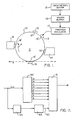
- FIG. 1 shows a typical electrophotographic machine such as would be used to implement this invention.
- Photoreceptive material 10 is placed on the surface of a drum 11 which is driven by motive means, not shown, to rotate in the direction A.
- a charge generator 12 places a uniform charge of several hundred volts across the surface of the photoreceptor at charging station 12′.
- the charged photoreceptor is mounted in a dark enclosure, not shown, and rotates to a printhead 13 which is comprised of a light generating source, such as a multiple beam laser generator.
- the light source selectively exposes the charged photoreceptor at imaging station 13′ to discharge it in areas which are desired to be developed (Discharged Area Development, DAD process), or discharge it in areas which are to remain free of toner (Charged Area Development, CAD process).
- the discharged areas of the photoreceptor are developed at developing station 14′ by developer apparatus 14 which applies toner so that the photoreceptor carries a visually perceptible image of the data.
- the charged areas are developed.
- the developed image rotates to transfer station 15′ where print paper, moving in the direction B, is juxtaposed with the surface of the photoreceptor.
- a charge opposite in polarity to the charge on the toner is placed on the backside of the print paper by transfer charge generator 15 such that when the paper is stripped from the surface of the photoreceptor, toner will be attracted to the paper and leave the surface of photoreceptor 10. Any remaining residual toner is cleaned from the photoreceptor at cleaning station 16′ by cleaning apparatus 16.
- the printhead modulator is comprised of a power supply, which will either turn the light source on for longer or shorter periods of time to accomplish varying degrees of photoreceptor discharge in accordance with the pattern data, or it will turn the light-generating source on to a greater or lesser illumination intensity in accordance with that data. In any event, modulation will occur in accordance with that data contained in memory 19. That data is sent to a raster buffer 18 and on to the printhead modulator 17.
- FIGS. 2 and 3 show optical scanning systems which can be used in the machine of FIG. 1. Either of these can be utilized in printhead 13.
- four (4) nearly coaxial laser beams 20-23 are shown emanating from a multiple beam laser array module 24.
- FIG. 3 shows a laser beam module 24′ which has four (4) discrete laser chips 5-8 whose laser beams 20-23 are passed through beam combining optics 9.
- the four (4) laser beams 20-23 are passed through a cylindrical lens 25 for focusing each of the beams onto the facets 26 of a rotating polygonal mirror.
- FIGS. 2 and 3 show a fold mirror 30, an exit window 31, the length 32 of the scan across photo-receptor 10, and beam expanding or collimating optics 33.
- a reflective surface 34 is provided to reflect light from each laser beam to photodetector 35 in order to derive start of scan (SOS) signals.
- SOS start of scan
- a similar arrangement can be used for generating end of scan (EOS) signals or a reflective surface can direct the end of scan light beam back to detector 35 so that the same detector can be used for generating both SOS and EOS signals.
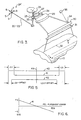
- FIG. 4 is an illustration of the need to tilt laser array module 24 in order to provide proper pel placement in the process direction P.
- pels must be placed at 480th of an inch intervals (b dimension in FIG. 4).
- the lasing spots on the array 24 would require a similar close spacing in order to locate the laser array 24 parallel to the axis P of the process direction.
- array 24 is tilted, as shown in FIG. 4, at an angle such that the lasing spots can be separated a distance a greater than b and still produce pels which are properly spaced a distance b.
- the lasing spots are offset a distance c in the scan direction S. Therefore, it is necessary in laser array systems to electronically offset the start of printing in the scan direction between laser beams in order to mate pel locations properly.
- FIG. 5 illustrates the effect of mechanical and chromatic aberrations in the production of scan lines.
- scan line 40 which may be produced by laser beam 20, FIG. 4
- scan line 41 which may be produced by laser beam 21
- Scan line 42 which may be produced by laser beam 22
- This scan line trace shows that scan line 41 exhibits no mechanical misalignment, but is reduced in size due to variations in wavelength between scan line 41 and the reference scan line 40.
- scan line 42 is produced by a lasing source of the same wavelength as scan line 41, that is, the length of scan line 42 is equal to the length of scan line 41, however, the two beams do not line up with one another since scan line 42 has been produced by a lasing source which is mechanically out of alignment with the reference scan line 40 and with scan line 41. As a result of the mechanical misalignment, all of the pels in scan line 42 are displaced a constant amount in one direction.
- FIG. 5 illustrates that in order to correct the chromatic aberration problem of scan line 41, the scan line must be extended by a time period delta t at the start of scan and similarly expanded by delta t at the end of scan.
- FIG. 5 illustrates that scan line 42 must be expand-ed by the time delta t minus the offset at the start of scan, and extended by delta t plus the mechanical offset at the end of scan.
- FIG. 6 illustrates pel placement error across the scan from start of scan to end of scan for scan line 41.
- FIG. 6 is an idealized depiction showing a linear change in pel placement across the entire scan, but is suitable for explaining the principles of the invention.
- the pel placement error may be greater from pel to pel toward the edges of the scan than at the center of the scan.
- the pel placement error may not be sym-metrical around the center of the scan, but may vary widely over the scan. Whatever the situation, it can be characterized at manufacture and the principles of this invention can be applied.
- the simplest case, which is a linear pel placement error, as shown in FIG. 6, will be used to explain the invention.
- FIG. 7 shows signals produced from the start of scan detector 35, shown in FIGS. 2 and 3, for use in separating the mechanical misalignment error from the chromatic aberration.
- the technique requires that detector 35 be either a dual detector or a detector with a mask separating the light receiving area into two active regions.
- the technique also requires a clock that is gated, that is initiated, by the start of scan (SOS) signal.
- This clock can be the system pel clock as illustrated in this em bodiment, but it can be a different precision clock if desired.
- one laser is as-signed to be the reference laser, for example, the laser which produces scan line 40 in FIG. 5. This laser is powered on to generate a start reference signal 45 and a start of scan (SOS) signal 46.
- the time period, Tnom1 is measured between these two pulses.
- the reference laser is utilized to generate an end reference signal 47 and an end of scan (EOS) signal 48.
- the time period, Tnom2 is measured between these two pulses.
- a non-reference laser is enabled to generate start of scan and end of scan pulses.
- laser 42 in FIG. 5 might be enabled to generate start of scan pulse 49 and end of scan pulse 50.
- the time period T1between reference pulse 45 and non-reference start of scan pulse 46 is measured, together with time T2between end reference pulse 47 and non-reference end of scan pulse 50. With these measurements the mechanical offset is then calculated by the following algorithm.
- FIGS. 8 and 9 show a preferred technique for correcting the mechanical offset found through the use of the signals generated in FIG. 7.
- the technique shown measures the difference between the signals 45 and 49, and the difference between the signals 47 and 50 to a sub-pel level.
- FIG. 8 illustrates that a gated clock is gated on by the start reference pulse 45, and that the pulse 49 to be measured occurs at some point during the seventh clock cycle.
- the circuit of FIG. 9 is used, employing a tapped delay line 54 to resolve the time period at which pulse 49 rises during clock pulse 7.
- the circuit of FIG. 8 first determines during which cycle of the clock that the event occurs. In this case pulse 49 occurs during the seventh clock cycle. To do that, a signal is shifted through a shift register 70 on each clock cycle. The outputs of the shift register are connected to a multiplexer 51. The control line 52 of the multiplexer determines which cycle the event is tested for, and consequently, the change in serial register output is sensed as occurring during clock cycle 7. The output 53 of multiplexer 51 is connected to a tapped delay line 54. The delay interval between successive taps determines resolution of the final measurement. Consequently, if the resolution of tapped delay line 54 is 2 nanoseconds, then that is the resolution of the final measurement.
- the total delay of all the taps in delay line 54 should exceed one clock time so that each successive test at a given clock interval overlaps with the previous and succeeding interval. In that manner, should pulse 47 occur near the change of state of the gated clock, it can still be resolved to the sub-pel accuracy of the delay line.
- the selected event that is pulse 49, initiates a succession of high resolution timing pulses A-N during clock cycle 7, as shown in FIG. 10. These pulses are each of 2 nanosecond duration and are generated through the delay line 54.
- the event, pulse 49 sets a pattern into the latches 55-57 from which the timing information is determined. For example, if the rise of pulse 49 occurs between tap A and tap B, latch 55 will possess a different setting than taps B-N.
- the maximum relative resolution is not limited by the performance of the latches since the set up time for the latches is constant from one measurement to another. Therefore, the set-up time falls out of the time measurement when the difference between two measurements is of interest. This technique, therefore, determines the rise of pulse 49 relative to pulse 45 within 2 nanoseconds.
- time interval T1 is ascertained, together with the time intervals Tnom1 and Tnom2.
- a controller performs the calculation and adjusts pel location by providing a proper delay into the timing of scan line 42, FIG. 5, so as to move that scan line in such a manner that the center of scan line 42 is along the center of reference line 40.
- scan line 42 will take a position exactly like that of scan line 41.
- it is then necessary to correct for the chromatic aberrations exhibited by scan lines 41 and 42, to expand those scan lines to equal the length of reference scan line 40.
- pel placement due to wave-length differences are less than one pel.
- a periodic delay is placed in the printing of pels throughout the scan. That is to say, if the total scan line is 7,000 pels long, it is 3,500 pels from the start of print to the center of print, where all center pels are aligned. If the total error is measured as 1/2 pel between the start of scan signals of reference scan line 40 and the scan line 41, and if the requirement is to produce pels which are never more than 1/10th pel out of alignment, a minimum of five corrections are needed over the 3,500 pel length. Therefore, a periodic correction of 1/10th pel is inserted every 700 pels during production of the scan line 41.
- FIG. 11 illustrates a circuit to perform the chromatic aberration correction.
- the pel clock is applied to a multiple tapped delay line 60. The amount of delay between each successive tap determines the resolution of the correction.
- the various taps A-N are applied to the input of digital multiplexer 61.
- a control line 62 is provided to select each phase of the pel clock and thereby ascertain the tap at which the change of state occurs in the same fashion described above with reference to FIGS. 8 and 9.
- a programmable counter 64 and phase select logic 63 can be utilized in the selection process.
- the delay in output from tap A will equal .5 pel from the center of print to a resolution of 2 nanoseconds.
- Tap B will represent a delay of .4 pel from the center of print and will be utilized to provide the delay 700 pels into the scan.
- Tap C represents a delay of .3 pel from the center of scan and will be timed to occur 1,400 pels into the scan.
- corrections of 1/10th pel are placed into the line at 2,100 pels and at 2,800 pels. On the trailing side of the center of print, similar corrections are made to the pel clock.
- a table can provide the pel count at which delays are to be implemented. Note also that scan lines can be magnified with respect to the reference creating a need for line contraction rather than expansion. The technique is the same except that the pel clock pulse is moved incrementally forward in accordance with the selected tap.
- the wavelength of a laser can vary with time and temperature, therefore, the tap which best corrects for the relative error can change over time.
- the corrections needed can change with time and temperature.
- circuits of FIGS. 8 and 11 are enabled to select the tap to be used in accordance with the detection of the reference start of scan and the start of scan for the non-reference laser periodically throughout machine use. In that manner, the correction is a dynamic correction which adapts to changes as the pulse positions shift.
Landscapes
- Engineering & Computer Science (AREA)
- Physics & Mathematics (AREA)
- Multimedia (AREA)
- Signal Processing (AREA)
- General Physics & Mathematics (AREA)
- Optics & Photonics (AREA)
- General Engineering & Computer Science (AREA)
- Theoretical Computer Science (AREA)
- Mechanical Optical Scanning Systems (AREA)
- Laser Beam Printer (AREA)
- Exposure Or Original Feeding In Electrophotography (AREA)
- Facsimile Scanning Arrangements (AREA)
- Conveying And Assembling Of Building Elements In Situ (AREA)
Applications Claiming Priority (2)
| Application Number | Priority Date | Filing Date | Title |
|---|---|---|---|
| US388537 | 1989-08-01 | ||
| US07/388,537 US4950889A (en) | 1989-08-01 | 1989-08-01 | Chromatic and misalignment compensation in a multiple beam laser scanning system |
Publications (2)
| Publication Number | Publication Date |
|---|---|
| EP0412038A2 true EP0412038A2 (fr) | 1991-02-06 |
| EP0412038A3 EP0412038A3 (en) | 1991-09-11 |
Family
ID=23534527
Family Applications (1)
| Application Number | Title | Priority Date | Filing Date |
|---|---|---|---|
| EP19900480088 Ceased EP0412038A3 (en) | 1989-08-01 | 1990-06-19 | Chromatic and misalignment compensation in a multiple beam laser scanning system |
Country Status (6)
| Country | Link |
|---|---|
| US (1) | US4950889A (fr) |
| EP (1) | EP0412038A3 (fr) |
| JP (1) | JP2584111B2 (fr) |
| BR (1) | BR9003727A (fr) |
| CA (1) | CA2018071C (fr) |
| PE (1) | PE991A1 (fr) |
Cited By (3)
| Publication number | Priority date | Publication date | Assignee | Title |
|---|---|---|---|---|
| EP0632302A1 (fr) * | 1993-06-29 | 1995-01-04 | Konica Corporation | Appareil de formation d'images |
| EP0773461A3 (fr) * | 1995-11-09 | 1998-05-27 | Kabushiki Kaisha Toshiba | Méthode et appareil pour balayage à faisceaux multiples |
| US5883385A (en) * | 1995-11-09 | 1999-03-16 | Kabushiki Kaisha Toshiba | Multibeam scanning method and apparatus with positional adjustment features |
Families Citing this family (22)
| Publication number | Priority date | Publication date | Assignee | Title |
|---|---|---|---|---|
| US5270851A (en) * | 1989-01-09 | 1993-12-14 | Canon Kabushiki Kaisha | Achromatic-type laser scanning optical system |
| JP2610352B2 (ja) * | 1990-02-28 | 1997-05-14 | 大日本スクリーン製造株式会社 | 光ビーム走査装置 |
| US5247383A (en) * | 1990-03-20 | 1993-09-21 | Olive Tree Technology, Inc. | Scanner with a post facet lens system |
| US5196957A (en) * | 1990-03-20 | 1993-03-23 | Olive Tree Technology, Inc. | Laser scanner with post-facet lens system |
| JP2651815B2 (ja) * | 1991-07-30 | 1997-09-10 | 株式会社堀場製作所 | 異物検査装置 |
| JP3147461B2 (ja) * | 1992-02-07 | 2001-03-19 | ミノルタ株式会社 | デジタル画像形成法 |
| JP3191231B2 (ja) * | 1993-04-15 | 2001-07-23 | コニカ株式会社 | 画像形成装置の主走査方向ビームずれ補正装置 |
| JP3266725B2 (ja) * | 1993-12-29 | 2002-03-18 | 旭光学工業株式会社 | 走査光学系 |
| EP0721601B1 (fr) * | 1994-08-01 | 2001-04-11 | Rodenstock Präzisionsoptik GmbH | Systeme de balayage |
| GB2312114B (en) * | 1996-04-09 | 2000-03-29 | Icg Ltd | Apparatus for and method of controlling an image recording device |
| JP4308338B2 (ja) * | 1998-01-16 | 2009-08-05 | 株式会社東芝 | ビーム光走査装置および画像形成装置 |
| JPH11227252A (ja) * | 1998-02-19 | 1999-08-24 | Fuji Xerox Co Ltd | 画像形成装置 |
| US5966231A (en) * | 1998-08-07 | 1999-10-12 | Lexmark International, Inc. | Method and apparatus for aligning multiple laser beams |
| JP2000155277A (ja) * | 1998-11-20 | 2000-06-06 | Asahi Optical Co Ltd | マルチビーム走査光学装置 |
| JP2000330050A (ja) * | 1999-03-12 | 2000-11-30 | Canon Inc | マルチビーム走査光学装置及びカラー画像形成装置 |
| US6549225B2 (en) * | 2001-02-28 | 2003-04-15 | Lexmark International, Inc. | Method of margin alignment and plane-to-plane registration in a tandem color electrophotographic machine |
| US20030016403A1 (en) * | 2001-07-13 | 2003-01-23 | Carlson Gerard J. | Characterization of a scan line produced from a facet of a scanning device |
| US6635864B2 (en) | 2001-07-13 | 2003-10-21 | Hewlett-Packard Development Company, L.P. | Measurement and correction of a scan line length error |
| US7457331B2 (en) * | 2004-10-29 | 2008-11-25 | Leica Microsystems Cms Gmbh | Optical arrangement |
| JP5013704B2 (ja) * | 2004-11-17 | 2012-08-29 | キヤノン株式会社 | マルチビームの画像出力装置、画像出力装置の制御方法 |
| US7570386B2 (en) * | 2005-09-15 | 2009-08-04 | Lexmark International, Inc. | Systems and methods that compensate for scan path errors in a multi-beam electrophotographic imaging apparatus |
| WO2008132526A1 (fr) * | 2007-04-26 | 2008-11-06 | Kokak Graphic Communications Canada Company | Imagerie de plusieurs images par variation d'une temporisation d'activation de canaux d'imagerie |
Family Cites Families (21)
| Publication number | Priority date | Publication date | Assignee | Title |
|---|---|---|---|---|
| US4053898A (en) * | 1974-09-13 | 1977-10-11 | Canon Kabushiki Kaisha | Laser recording process |
| US4059833A (en) * | 1975-02-03 | 1977-11-22 | Canon Kabushiki Kaisha | Recording position adjuster |
| US4046471A (en) * | 1975-11-03 | 1977-09-06 | International Business Machines Corporation | Dual mode electrophotographic apparatus having dual function printing beam |
| JPS5492769A (en) * | 1977-12-30 | 1979-07-23 | Fujitsu Ltd | Correction method of scanning light modulation clock |
| JPS6033019B2 (ja) * | 1978-06-05 | 1985-07-31 | 株式会社日立製作所 | 光記録装置 |
| JPS569763A (en) * | 1979-07-06 | 1981-01-31 | Canon Inc | Beam recording device |
| US4393387A (en) * | 1979-09-14 | 1983-07-12 | Canon Kabushiki Kaisha | Beam recording apparatus effecting the recording by a plurality of beams |
| JPS5667277A (en) * | 1979-11-05 | 1981-06-06 | Canon Inc | Laser recording device |
| US4443695A (en) * | 1980-01-25 | 1984-04-17 | Canon Kabushiki Kaisha | Apparatus for controlling the quantity of light |
| JPS5764718A (en) * | 1980-10-09 | 1982-04-20 | Hitachi Ltd | Laser beam printer |
| US4404571A (en) * | 1980-10-14 | 1983-09-13 | Canon Kabushiki Kaisha | Multibeam recording apparatus |
| JPS57102609A (en) * | 1980-12-18 | 1982-06-25 | Canon Inc | Method and device for scanning using plural number of beams |
| JPS57116314A (en) * | 1981-01-12 | 1982-07-20 | Canon Inc | Image recorder on multilaser beam scanning system |
| JPS57204983A (en) * | 1981-06-10 | 1982-12-15 | Canon Inc | Scan type recording device |
| JPS60205417A (ja) * | 1984-03-30 | 1985-10-17 | Photo Composing Mach Mfg Co Ltd | レ−ザカラ−記録装置における色収差補正方式 |
| US4739415A (en) * | 1984-05-01 | 1988-04-19 | Canon Kabushiki Kaisha | Image handling system capable of varying the size of a recorded image |
| US4829175A (en) * | 1985-12-05 | 1989-05-09 | Fuji Photo Film Co., Ltd. | Light beam scanning apparatus, method of correcting unevenness in scanning lines in light beam scanning apparatus, method of detecting deflection of rotational axis of light beam deflector and rotational axis deflection detecting device |
| JPS62176264A (ja) * | 1986-01-29 | 1987-08-03 | Ricoh Co Ltd | デジタルカラ−複写機 |
| JPS63132214A (ja) * | 1986-11-21 | 1988-06-04 | Dainippon Screen Mfg Co Ltd | ポリゴンミラ−のジツタ補正方法および装置 |
| JPS63217763A (ja) * | 1987-03-06 | 1988-09-09 | Hitachi Ltd | 光プリンタ |
| JPH01100509A (ja) * | 1987-10-13 | 1989-04-18 | Fuji Xerox Co Ltd | カラー画像出力装置 |
-
1989
- 1989-08-01 US US07/388,537 patent/US4950889A/en not_active Expired - Fee Related
-
1990
- 1990-06-01 CA CA002018071A patent/CA2018071C/fr not_active Expired - Fee Related
- 1990-06-19 EP EP19900480088 patent/EP0412038A3/en not_active Ceased
- 1990-06-29 JP JP2174342A patent/JP2584111B2/ja not_active Expired - Lifetime
- 1990-07-24 PE PE1990172555A patent/PE991A1/es unknown
- 1990-07-31 BR BR909003727A patent/BR9003727A/pt unknown
Cited By (4)
| Publication number | Priority date | Publication date | Assignee | Title |
|---|---|---|---|---|
| EP0632302A1 (fr) * | 1993-06-29 | 1995-01-04 | Konica Corporation | Appareil de formation d'images |
| US5583557A (en) * | 1993-06-29 | 1996-12-10 | Konica Corporation | Image forming apparatus which corrects a deviation in a distance between plural light beams |
| EP0773461A3 (fr) * | 1995-11-09 | 1998-05-27 | Kabushiki Kaisha Toshiba | Méthode et appareil pour balayage à faisceaux multiples |
| US5883385A (en) * | 1995-11-09 | 1999-03-16 | Kabushiki Kaisha Toshiba | Multibeam scanning method and apparatus with positional adjustment features |
Also Published As
| Publication number | Publication date |
|---|---|
| US4950889A (en) | 1990-08-21 |
| JP2584111B2 (ja) | 1997-02-19 |
| BR9003727A (pt) | 1991-09-03 |
| CA2018071A1 (fr) | 1991-02-01 |
| EP0412038A3 (en) | 1991-09-11 |
| PE991A1 (es) | 1991-01-26 |
| JPH0368911A (ja) | 1991-03-25 |
| CA2018071C (fr) | 1995-06-27 |
Similar Documents
| Publication | Publication Date | Title |
|---|---|---|
| US4950889A (en) | Chromatic and misalignment compensation in a multiple beam laser scanning system | |
| US4978849A (en) | Pel placement correction in the scan dimension of a multiple beam laser scanning system | |
| JP4777410B2 (ja) | 画像形成装置 | |
| US6654041B2 (en) | Image forming apparatus with photoconductive body, and computer-readable storage medium | |
| US8005321B2 (en) | Pixel clock generator, optical scanner, and image forming apparatus | |
| US5381165A (en) | Raster output scanner with process direction registration | |
| US20070030548A1 (en) | Apparatus for generating pulse-modulated signal | |
| CA2018931C (fr) | Systeme de balayage optique a faisceaux lasers multiples | |
| EP0021831A1 (fr) | Circuit d'horloge pour signaux d'image et procédé de fonctionnement d'un dispositif de visualisation à trames | |
| US5274394A (en) | Electronic adjustment of slow scan image registration in an image recording apparatus | |
| JPH04338986A (ja) | プリンタ装置 | |
| JP2004102276A (ja) | 画像形成装置 | |
| US5821978A (en) | Image forming apparatus for forming an image in use with a plurality of laser beam scanners | |
| JP4462801B2 (ja) | 画素クロック生成方法・画素クロック生成装置・光書き込み装置・画像形成装置 | |
| US6477656B1 (en) | System for generating clock pulse which the number of pulses outputted within a predetermined time period is based on the number of calculated delay stages | |
| JPH1155472A (ja) | 多色画像形成装置 | |
| US6351277B1 (en) | Direct digital synthesis pixel clock generator | |
| US20020135822A1 (en) | Clock-generating circuit and image-forming apparatus having a function of canceling scanning unevenness caused by polygon mirror | |
| US6226029B1 (en) | Aerial slow scan position control using an electronically addressable liquid crystal plate | |
| JP4083935B2 (ja) | 画像形成装置 | |
| KR20010013427A (fr) | Systeme et procede pour la commande de lecteurs laser dans un systeme d'imagerie | |
| US8054502B2 (en) | Scanning optical apparatus, image forming apparatus and image clock correction method | |
| JP2001013430A (ja) | マルチビーム画像形成装置 | |
| JP2737985B2 (ja) | レーザプリンタ | |
| JP2006305879A (ja) | 画像形成装置及び画像形成方法 |
Legal Events
| Date | Code | Title | Description |
|---|---|---|---|
| PUAI | Public reference made under article 153(3) epc to a published international application that has entered the european phase |
Free format text: ORIGINAL CODE: 0009012 |
|
| 17P | Request for examination filed |
Effective date: 19901213 |
|
| AK | Designated contracting states |
Kind code of ref document: A2 Designated state(s): BE CH DE ES FR GB IT LI NL SE |
|
| PUAL | Search report despatched |
Free format text: ORIGINAL CODE: 0009013 |
|
| AK | Designated contracting states |
Kind code of ref document: A3 Designated state(s): BE CH DE ES FR GB IT LI NL SE |
|
| 17Q | First examination report despatched |
Effective date: 19931123 |
|
| STAA | Information on the status of an ep patent application or granted ep patent |
Free format text: STATUS: THE APPLICATION HAS BEEN REFUSED |
|
| 18R | Application refused |
Effective date: 19970119 |