EP0412366B2 - Process for the preparation of 2,5-dihydrofurans - Google Patents
Process for the preparation of 2,5-dihydrofurans Download PDFInfo
- Publication number
- EP0412366B2 EP0412366B2 EP90114340A EP90114340A EP0412366B2 EP 0412366 B2 EP0412366 B2 EP 0412366B2 EP 90114340 A EP90114340 A EP 90114340A EP 90114340 A EP90114340 A EP 90114340A EP 0412366 B2 EP0412366 B2 EP 0412366B2
- Authority
- EP
- European Patent Office
- Prior art keywords
- catalyst component
- component
- weight
- general formula
- halide
- Prior art date
- Legal status (The legal status is an assumption and is not a legal conclusion. Google has not performed a legal analysis and makes no representation as to the accuracy of the status listed.)
- Expired - Lifetime
Links
- ARGCQEVBJHPOGB-UHFFFAOYSA-N 2,5-dihydrofuran Chemical class C1OCC=C1 ARGCQEVBJHPOGB-UHFFFAOYSA-N 0.000 title claims abstract description 44
- 238000000034 method Methods 0.000 title claims abstract description 30
- 238000002360 preparation method Methods 0.000 title claims abstract description 7
- GXBYFVGCMPJVJX-UHFFFAOYSA-N Epoxybutene Chemical class C=CC1CO1 GXBYFVGCMPJVJX-UHFFFAOYSA-N 0.000 claims abstract description 29
- 239000002904 solvent Substances 0.000 claims abstract description 20
- 239000002841 Lewis acid Substances 0.000 claims abstract description 13
- 150000007517 lewis acids Chemical class 0.000 claims abstract description 12
- 150000004820 halides Chemical class 0.000 claims abstract description 11
- 230000008707 rearrangement Effects 0.000 claims abstract description 11
- XMBWDFGMSWQBCA-UHFFFAOYSA-N hydrogen iodide Chemical compound I XMBWDFGMSWQBCA-UHFFFAOYSA-N 0.000 claims abstract description 9
- 229910052784 alkaline earth metal Inorganic materials 0.000 claims abstract description 7
- 150000001342 alkaline earth metals Chemical class 0.000 claims abstract description 7
- 239000001257 hydrogen Substances 0.000 claims abstract description 7
- 229910052739 hydrogen Inorganic materials 0.000 claims abstract description 7
- 229910052783 alkali metal Inorganic materials 0.000 claims abstract description 6
- PNDPGZBMCMUPRI-UHFFFAOYSA-N iodine Chemical compound II PNDPGZBMCMUPRI-UHFFFAOYSA-N 0.000 claims abstract description 6
- UFHFLCQGNIYNRP-UHFFFAOYSA-N Hydrogen Chemical compound [H][H] UFHFLCQGNIYNRP-UHFFFAOYSA-N 0.000 claims abstract description 5
- 150000001340 alkali metals Chemical class 0.000 claims abstract description 5
- 230000003197 catalytic effect Effects 0.000 claims abstract description 5
- 125000004178 (C1-C4) alkyl group Chemical group 0.000 claims abstract 3
- NLKNQRATVPKPDG-UHFFFAOYSA-M potassium iodide Chemical compound [K+].[I-] NLKNQRATVPKPDG-UHFFFAOYSA-M 0.000 claims description 47
- 239000003054 catalyst Substances 0.000 claims description 32
- -1 halogen halide Chemical class 0.000 claims description 11
- 150000003983 crown ethers Chemical class 0.000 claims description 10
- 239000002739 cryptand Substances 0.000 claims description 8
- 229920001223 polyethylene glycol Polymers 0.000 claims description 6
- 239000012429 reaction media Substances 0.000 claims description 6
- SECXISVLQFMRJM-UHFFFAOYSA-N N-Methylpyrrolidone Chemical compound CN1CCCC1=O SECXISVLQFMRJM-UHFFFAOYSA-N 0.000 claims description 5
- 229910021627 Tin(IV) chloride Inorganic materials 0.000 claims description 3
- 239000000010 aprotic solvent Substances 0.000 claims description 3
- 229910052736 halogen Inorganic materials 0.000 claims description 3
- HPGGPRDJHPYFRM-UHFFFAOYSA-J tin(iv) chloride Chemical compound Cl[Sn](Cl)(Cl)Cl HPGGPRDJHPYFRM-UHFFFAOYSA-J 0.000 claims description 3
- 229910052725 zinc Inorganic materials 0.000 claims description 3
- 239000011701 zinc Substances 0.000 claims description 3
- WYURNTSHIVDZCO-UHFFFAOYSA-N Tetrahydrofuran Chemical class C1CCOC1 WYURNTSHIVDZCO-UHFFFAOYSA-N 0.000 abstract description 10
- 239000000178 monomer Substances 0.000 abstract description 2
- 229920000909 polytetrahydrofuran Polymers 0.000 abstract description 2
- 229920001328 Polyvinylidene chloride Polymers 0.000 abstract 1
- 239000000543 intermediate Substances 0.000 abstract 1
- 239000011368 organic material Substances 0.000 abstract 1
- 229920000915 polyvinyl chloride Polymers 0.000 abstract 1
- 239000004800 polyvinyl chloride Substances 0.000 abstract 1
- 239000005033 polyvinylidene chloride Substances 0.000 abstract 1
- 238000006243 chemical reaction Methods 0.000 description 22
- 229910052740 iodine Inorganic materials 0.000 description 13
- UAYWVJHJZHQCIE-UHFFFAOYSA-L zinc iodide Chemical compound I[Zn]I UAYWVJHJZHQCIE-UHFFFAOYSA-L 0.000 description 12
- ZCYVEMRRCGMTRW-UHFFFAOYSA-N 7553-56-2 Chemical compound [I] ZCYVEMRRCGMTRW-UHFFFAOYSA-N 0.000 description 11
- 238000004821 distillation Methods 0.000 description 11
- 239000011630 iodine Substances 0.000 description 11
- 150000003839 salts Chemical class 0.000 description 9
- XEZNGIUYQVAUSS-UHFFFAOYSA-N 18-crown-6 Chemical compound C1COCCOCCOCCOCCOCCO1 XEZNGIUYQVAUSS-UHFFFAOYSA-N 0.000 description 8
- 150000001768 cations Chemical class 0.000 description 8
- 239000000203 mixture Substances 0.000 description 7
- IJGRMHOSHXDMSA-UHFFFAOYSA-N Atomic nitrogen Chemical compound N#N IJGRMHOSHXDMSA-UHFFFAOYSA-N 0.000 description 6
- 239000007789 gas Substances 0.000 description 6
- 238000007792 addition Methods 0.000 description 5
- 238000004587 chromatography analysis Methods 0.000 description 5
- 229910000039 hydrogen halide Inorganic materials 0.000 description 5
- 239000012433 hydrogen halide Substances 0.000 description 5
- 239000011541 reaction mixture Substances 0.000 description 5
- 230000007928 solubilization Effects 0.000 description 5
- 238000005063 solubilization Methods 0.000 description 5
- 229910052718 tin Inorganic materials 0.000 description 5
- JKTCBAGSMQIFNL-UHFFFAOYSA-N 2,3-dihydrofuran Chemical compound C1CC=CO1 JKTCBAGSMQIFNL-UHFFFAOYSA-N 0.000 description 4
- ATJFFYVFTNAWJD-UHFFFAOYSA-N Tin Chemical compound [Sn] ATJFFYVFTNAWJD-UHFFFAOYSA-N 0.000 description 4
- 229910052757 nitrogen Inorganic materials 0.000 description 4
- YLQBMQCUIZJEEH-UHFFFAOYSA-N tetrahydrofuran Natural products C=1C=COC=1 YLQBMQCUIZJEEH-UHFFFAOYSA-N 0.000 description 4
- VNDYJBBGRKZCSX-UHFFFAOYSA-L zinc bromide Chemical compound Br[Zn]Br VNDYJBBGRKZCSX-UHFFFAOYSA-L 0.000 description 4
- RTZKZFJDLAIYFH-UHFFFAOYSA-N Diethyl ether Chemical compound CCOCC RTZKZFJDLAIYFH-UHFFFAOYSA-N 0.000 description 3
- XTHFKEDIFFGKHM-UHFFFAOYSA-N Dimethoxyethane Chemical compound COCCOC XTHFKEDIFFGKHM-UHFFFAOYSA-N 0.000 description 3
- XEKOWRVHYACXOJ-UHFFFAOYSA-N Ethyl acetate Chemical compound CCOC(C)=O XEKOWRVHYACXOJ-UHFFFAOYSA-N 0.000 description 3
- ZMXDDKWLCZADIW-UHFFFAOYSA-N N,N-Dimethylformamide Chemical compound CN(C)C=O ZMXDDKWLCZADIW-UHFFFAOYSA-N 0.000 description 3
- 239000002202 Polyethylene glycol Substances 0.000 description 3
- YXFVVABEGXRONW-UHFFFAOYSA-N Toluene Chemical compound CC1=CC=CC=C1 YXFVVABEGXRONW-UHFFFAOYSA-N 0.000 description 3
- 239000008139 complexing agent Substances 0.000 description 3
- FVAUCKIRQBBSSJ-UHFFFAOYSA-M sodium iodide Chemical compound [Na+].[I-] FVAUCKIRQBBSSJ-UHFFFAOYSA-M 0.000 description 3
- 239000000126 substance Substances 0.000 description 3
- 239000011135 tin Substances 0.000 description 3
- NLMDJJTUQPXZFG-UHFFFAOYSA-N 1,4,10,13-tetraoxa-7,16-diazacyclooctadecane Chemical compound C1COCCOCCNCCOCCOCCN1 NLMDJJTUQPXZFG-UHFFFAOYSA-N 0.000 description 2
- XQQZRZQVBFHBHL-UHFFFAOYSA-N 12-crown-4 Chemical compound C1COCCOCCOCCO1 XQQZRZQVBFHBHL-UHFFFAOYSA-N 0.000 description 2
- VFTFKUDGYRBSAL-UHFFFAOYSA-N 15-crown-5 Chemical compound C1COCCOCCOCCOCCO1 VFTFKUDGYRBSAL-UHFFFAOYSA-N 0.000 description 2
- CSCPPACGZOOCGX-UHFFFAOYSA-N Acetone Chemical compound CC(C)=O CSCPPACGZOOCGX-UHFFFAOYSA-N 0.000 description 2
- VEXZGXHMUGYJMC-UHFFFAOYSA-M Chloride anion Chemical compound [Cl-] VEXZGXHMUGYJMC-UHFFFAOYSA-M 0.000 description 2
- IAZDPXIOMUYVGZ-UHFFFAOYSA-N Dimethylsulphoxide Chemical compound CS(C)=O IAZDPXIOMUYVGZ-UHFFFAOYSA-N 0.000 description 2
- CPELXLSAUQHCOX-UHFFFAOYSA-N Hydrogen bromide Chemical compound Br CPELXLSAUQHCOX-UHFFFAOYSA-N 0.000 description 2
- DGAQECJNVWCQMB-PUAWFVPOSA-M Ilexoside XXIX Chemical compound C[C@@H]1CC[C@@]2(CC[C@@]3(C(=CC[C@H]4[C@]3(CC[C@@H]5[C@@]4(CC[C@@H](C5(C)C)OS(=O)(=O)[O-])C)C)[C@@H]2[C@]1(C)O)C)C(=O)O[C@H]6[C@@H]([C@H]([C@@H]([C@H](O6)CO)O)O)O.[Na+] DGAQECJNVWCQMB-PUAWFVPOSA-M 0.000 description 2
- PXHVJJICTQNCMI-UHFFFAOYSA-N Nickel Chemical compound [Ni] PXHVJJICTQNCMI-UHFFFAOYSA-N 0.000 description 2
- HCHKCACWOHOZIP-UHFFFAOYSA-N Zinc Chemical compound [Zn] HCHKCACWOHOZIP-UHFFFAOYSA-N 0.000 description 2
- MVPPADPHJFYWMZ-UHFFFAOYSA-N chlorobenzene Chemical compound ClC1=CC=CC=C1 MVPPADPHJFYWMZ-UHFFFAOYSA-N 0.000 description 2
- 238000010668 complexation reaction Methods 0.000 description 2
- 150000002170 ethers Chemical class 0.000 description 2
- 238000002474 experimental method Methods 0.000 description 2
- 238000004817 gas chromatography Methods 0.000 description 2
- 239000011521 glass Substances 0.000 description 2
- 150000002367 halogens Chemical class 0.000 description 2
- 150000002730 mercury Chemical class 0.000 description 2
- 150000004010 onium ions Chemical class 0.000 description 2
- 229910052708 sodium Inorganic materials 0.000 description 2
- 239000011734 sodium Substances 0.000 description 2
- 230000003381 solubilizing effect Effects 0.000 description 2
- 229940102001 zinc bromide Drugs 0.000 description 2
- AVQQQNCBBIEMEU-UHFFFAOYSA-N 1,1,3,3-tetramethylurea Chemical compound CN(C)C(=O)N(C)C AVQQQNCBBIEMEU-UHFFFAOYSA-N 0.000 description 1
- RYHBNJHYFVUHQT-UHFFFAOYSA-N 1,4-Dioxane Chemical compound C1COCCO1 RYHBNJHYFVUHQT-UHFFFAOYSA-N 0.000 description 1
- PEHCQOOWKYRUJF-UHFFFAOYSA-N 2-methyl-2,5-dihydrofuran Chemical compound CC1OCC=C1 PEHCQOOWKYRUJF-UHFFFAOYSA-N 0.000 description 1
- AUFVJZSDSXXFOI-UHFFFAOYSA-N 2.2.2-cryptand Chemical compound C1COCCOCCN2CCOCCOCCN1CCOCCOCC2 AUFVJZSDSXXFOI-UHFFFAOYSA-N 0.000 description 1
- QGZKDVFQNNGYKY-UHFFFAOYSA-O Ammonium Chemical compound [NH4+] QGZKDVFQNNGYKY-UHFFFAOYSA-O 0.000 description 1
- ZOXJGFHDIHLPTG-UHFFFAOYSA-N Boron Chemical compound [B] ZOXJGFHDIHLPTG-UHFFFAOYSA-N 0.000 description 1
- WKBOTKDWSSQWDR-UHFFFAOYSA-N Bromine atom Chemical compound [Br] WKBOTKDWSSQWDR-UHFFFAOYSA-N 0.000 description 1
- VGGSQFUCUMXWEO-UHFFFAOYSA-N Ethene Chemical compound C=C VGGSQFUCUMXWEO-UHFFFAOYSA-N 0.000 description 1
- 239000005977 Ethylene Substances 0.000 description 1
- FXHOOIRPVKKKFG-UHFFFAOYSA-N N,N-Dimethylacetamide Chemical compound CN(C)C(C)=O FXHOOIRPVKKKFG-UHFFFAOYSA-N 0.000 description 1
- CTQNGGLPUBDAKN-UHFFFAOYSA-N O-Xylene Chemical compound CC1=CC=CC=C1C CTQNGGLPUBDAKN-UHFFFAOYSA-N 0.000 description 1
- GOOHAUXETOMSMM-UHFFFAOYSA-N Propylene oxide Chemical compound CC1CO1 GOOHAUXETOMSMM-UHFFFAOYSA-N 0.000 description 1
- RTAQQCXQSZGOHL-UHFFFAOYSA-N Titanium Chemical compound [Ti] RTAQQCXQSZGOHL-UHFFFAOYSA-N 0.000 description 1
- JIAARYAFYJHUJI-UHFFFAOYSA-L Zinc chloride Inorganic materials [Cl-].[Cl-].[Zn+2] JIAARYAFYJHUJI-UHFFFAOYSA-L 0.000 description 1
- QCWXUUIWCKQGHC-UHFFFAOYSA-N Zirconium Chemical compound [Zr] QCWXUUIWCKQGHC-UHFFFAOYSA-N 0.000 description 1
- 230000006978 adaptation Effects 0.000 description 1
- 150000001298 alcohols Chemical class 0.000 description 1
- 239000003513 alkali Substances 0.000 description 1
- 125000000217 alkyl group Chemical group 0.000 description 1
- 229910052782 aluminium Inorganic materials 0.000 description 1
- XAGFODPZIPBFFR-UHFFFAOYSA-N aluminium Chemical compound [Al] XAGFODPZIPBFFR-UHFFFAOYSA-N 0.000 description 1
- 238000004458 analytical method Methods 0.000 description 1
- 239000003849 aromatic solvent Substances 0.000 description 1
- 125000003118 aryl group Chemical group 0.000 description 1
- FNEPSTUXZLEUCK-UHFFFAOYSA-N benzo-15-crown-5 Chemical compound O1CCOCCOCCOCCOC2=CC=CC=C21 FNEPSTUXZLEUCK-UHFFFAOYSA-N 0.000 description 1
- YOUGRGFIHBUKRS-UHFFFAOYSA-N benzyl(trimethyl)azanium Chemical compound C[N+](C)(C)CC1=CC=CC=C1 YOUGRGFIHBUKRS-UHFFFAOYSA-N 0.000 description 1
- 229910052796 boron Inorganic materials 0.000 description 1
- GDTBXPJZTBHREO-UHFFFAOYSA-N bromine Substances BrBr GDTBXPJZTBHREO-UHFFFAOYSA-N 0.000 description 1
- 229910052794 bromium Inorganic materials 0.000 description 1
- 235000013877 carbamide Nutrition 0.000 description 1
- 238000006555 catalytic reaction Methods 0.000 description 1
- 239000007795 chemical reaction product Substances 0.000 description 1
- 238000004140 cleaning Methods 0.000 description 1
- 230000000536 complexating effect Effects 0.000 description 1
- 238000001816 cooling Methods 0.000 description 1
- 238000007334 copolymerization reaction Methods 0.000 description 1
- 238000005260 corrosion Methods 0.000 description 1
- 230000007797 corrosion Effects 0.000 description 1
- 239000012043 crude product Substances 0.000 description 1
- DMSZORWOGDLWGN-UHFFFAOYSA-N ctk1a3526 Chemical class NP(N)(N)=O DMSZORWOGDLWGN-UHFFFAOYSA-N 0.000 description 1
- 230000007423 decrease Effects 0.000 description 1
- 230000001419 dependent effect Effects 0.000 description 1
- YSSSPARMOAYJTE-UHFFFAOYSA-N dibenzo-18-crown-6 Chemical compound O1CCOCCOC2=CC=CC=C2OCCOCCOC2=CC=CC=C21 YSSSPARMOAYJTE-UHFFFAOYSA-N 0.000 description 1
- MXCSCGGRLMRZMF-UHFFFAOYSA-N dibenzo-30-crown-10 Chemical compound O1CCOCCOCCOCCOC2=CC=CC=C2OCCOCCOCCOCCOC2=CC=CC=C21 MXCSCGGRLMRZMF-UHFFFAOYSA-N 0.000 description 1
- JGFBRKRYDCGYKD-UHFFFAOYSA-N dibutyl(oxo)tin Chemical compound CCCC[Sn](=O)CCCC JGFBRKRYDCGYKD-UHFFFAOYSA-N 0.000 description 1
- 238000010790 dilution Methods 0.000 description 1
- 239000012895 dilution Substances 0.000 description 1
- 150000002148 esters Chemical class 0.000 description 1
- GNOIPBMMFNIUFM-UHFFFAOYSA-N hexamethylphosphoric triamide Chemical compound CN(C)P(=O)(N(C)C)N(C)C GNOIPBMMFNIUFM-UHFFFAOYSA-N 0.000 description 1
- 150000002431 hydrogen Chemical class 0.000 description 1
- 229910000042 hydrogen bromide Inorganic materials 0.000 description 1
- 229910000043 hydrogen iodide Inorganic materials 0.000 description 1
- 239000012535 impurity Substances 0.000 description 1
- 239000011261 inert gas Substances 0.000 description 1
- 150000004694 iodide salts Chemical class 0.000 description 1
- 238000002955 isolation Methods 0.000 description 1
- 238000006317 isomerization reaction Methods 0.000 description 1
- 150000002576 ketones Chemical class 0.000 description 1
- 229910003002 lithium salt Inorganic materials 0.000 description 1
- 159000000002 lithium salts Chemical class 0.000 description 1
- 150000002681 magnesium compounds Chemical class 0.000 description 1
- VGGNVBNNVSIGKG-UHFFFAOYSA-N n,n,2-trimethylaziridine-1-carboxamide Chemical compound CC1CN1C(=O)N(C)C VGGNVBNNVSIGKG-UHFFFAOYSA-N 0.000 description 1
- UCAOGXRUJFKQAP-UHFFFAOYSA-N n,n-dimethyl-5-nitropyridin-2-amine Chemical compound CN(C)C1=CC=C([N+]([O-])=O)C=N1 UCAOGXRUJFKQAP-UHFFFAOYSA-N 0.000 description 1
- 229910052759 nickel Inorganic materials 0.000 description 1
- 238000000655 nuclear magnetic resonance spectrum Methods 0.000 description 1
- HTKPDYSCAPSXIR-UHFFFAOYSA-N octyltrimethylammonium ion Chemical compound CCCCCCCC[N+](C)(C)C HTKPDYSCAPSXIR-UHFFFAOYSA-N 0.000 description 1
- 239000012430 organic reaction media Substances 0.000 description 1
- 150000002924 oxiranes Chemical class 0.000 description 1
- 125000006353 oxyethylene group Chemical group 0.000 description 1
- 150000002989 phenols Chemical class 0.000 description 1
- XYFCBTPGUUZFHI-UHFFFAOYSA-O phosphonium Chemical compound [PH4+] XYFCBTPGUUZFHI-UHFFFAOYSA-O 0.000 description 1
- 229920000151 polyglycol Polymers 0.000 description 1
- 239000010695 polyglycol Substances 0.000 description 1
- 238000006116 polymerization reaction Methods 0.000 description 1
- 229910052700 potassium Inorganic materials 0.000 description 1
- 239000011591 potassium Substances 0.000 description 1
- 159000000001 potassium salts Chemical class 0.000 description 1
- 239000000047 product Substances 0.000 description 1
- 238000004445 quantitative analysis Methods 0.000 description 1
- 230000035484 reaction time Effects 0.000 description 1
- 235000009518 sodium iodide Nutrition 0.000 description 1
- 239000000243 solution Substances 0.000 description 1
- 239000012453 solvate Substances 0.000 description 1
- 239000007858 starting material Substances 0.000 description 1
- 238000003756 stirring Methods 0.000 description 1
- HXJUTPCZVOIRIF-UHFFFAOYSA-N sulfolane Chemical compound O=S1(=O)CCCC1 HXJUTPCZVOIRIF-UHFFFAOYSA-N 0.000 description 1
- DZLFLBLQUQXARW-UHFFFAOYSA-N tetrabutylammonium Chemical compound CCCC[N+](CCCC)(CCCC)CCCC DZLFLBLQUQXARW-UHFFFAOYSA-N 0.000 description 1
- BJQWBACJIAKDTJ-UHFFFAOYSA-N tetrabutylphosphanium Chemical compound CCCC[P+](CCCC)(CCCC)CCCC BJQWBACJIAKDTJ-UHFFFAOYSA-N 0.000 description 1
- QEMXHQIAXOOASZ-UHFFFAOYSA-N tetramethylammonium Chemical compound C[N+](C)(C)C QEMXHQIAXOOASZ-UHFFFAOYSA-N 0.000 description 1
- BXYHVFRRNNWPMB-UHFFFAOYSA-N tetramethylphosphanium Chemical compound C[P+](C)(C)C BXYHVFRRNNWPMB-UHFFFAOYSA-N 0.000 description 1
- USFPINLPPFWTJW-UHFFFAOYSA-N tetraphenylphosphonium Chemical compound C1=CC=CC=C1[P+](C=1C=CC=CC=1)(C=1C=CC=CC=1)C1=CC=CC=C1 USFPINLPPFWTJW-UHFFFAOYSA-N 0.000 description 1
- 229910052719 titanium Inorganic materials 0.000 description 1
- 239000010936 titanium Substances 0.000 description 1
- 231100000331 toxic Toxicity 0.000 description 1
- 230000002588 toxic effect Effects 0.000 description 1
- 229910052723 transition metal Inorganic materials 0.000 description 1
- 150000003624 transition metals Chemical class 0.000 description 1
- ZNEOHLHCKGUAEB-UHFFFAOYSA-N trimethylphenylammonium Chemical compound C[N+](C)(C)C1=CC=CC=C1 ZNEOHLHCKGUAEB-UHFFFAOYSA-N 0.000 description 1
- 238000010626 work up procedure Methods 0.000 description 1
- 239000008096 xylene Substances 0.000 description 1
- 239000011592 zinc chloride Substances 0.000 description 1
- 235000005074 zinc chloride Nutrition 0.000 description 1
- 229910052726 zirconium Inorganic materials 0.000 description 1
- DUNKXUFBGCUVQW-UHFFFAOYSA-J zirconium tetrachloride Chemical compound Cl[Zr](Cl)(Cl)Cl DUNKXUFBGCUVQW-UHFFFAOYSA-J 0.000 description 1
Classifications
-
- C—CHEMISTRY; METALLURGY
- C07—ORGANIC CHEMISTRY
- C07D—HETEROCYCLIC COMPOUNDS
- C07D307/00—Heterocyclic compounds containing five-membered rings having one oxygen atom as the only ring hetero atom
- C07D307/02—Heterocyclic compounds containing five-membered rings having one oxygen atom as the only ring hetero atom not condensed with other rings
- C07D307/26—Heterocyclic compounds containing five-membered rings having one oxygen atom as the only ring hetero atom not condensed with other rings having one double bond between ring members or between a ring member and a non-ring member
- C07D307/28—Heterocyclic compounds containing five-membered rings having one oxygen atom as the only ring hetero atom not condensed with other rings having one double bond between ring members or between a ring member and a non-ring member with only hydrogen atoms, hydrocarbon or substituted hydrocarbon radicals, directly attached to ring carbon atoms
Definitions
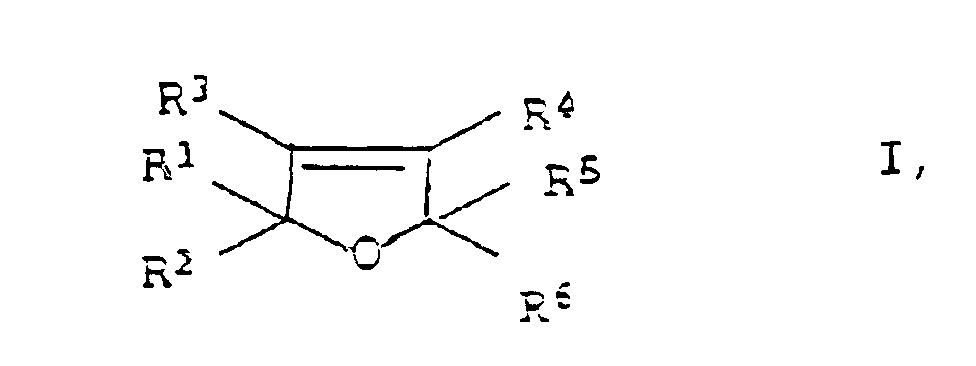
- the present invention relates to a process for the preparation of 2,5-dihydrofurans of the general formula I. in which the radicals R 1 , R 2 , R 3 , R 4 , R 5 and R 6 are identical or different and stand for hydrogen or C 1 - to C 4 -alkyl groups, by the catalytic rearrangement of 3,4-epoxy 1-butenes of the general formula II
- 2,5-dihydrofuran can be obtained by the isomerization of vinyloxirane under the action of mercury salts.
- the industrial utilization of this process is opposed by the use of the toxic mercury salt catalysts.
- US-A 3 932 468 describes the transition metal complexes and bromine or hydrogen iodide gas catalyzed rearrangement of butadiene monoxide to 2,5-dihydrofuran.
- US-A 3 996 248 needs for this Rearrangement also hydrogen bromide or iodine.
- Lewis acids such as zinc, aluminum, Boron, tin or magnesium compounds used. the reaction system continues to be potassium iodide added.
- the object was therefore to find a process which would allow 2,5-dihydrofurans to be used economically, To produce in good yields and high purity, without the disadvantages of the processes described to be afflicted.
- the 2,5-dihydrofurans which can be prepared by the process according to the invention can be unsubstituted or can carry 1 to 6, preferably 1 to 3, C 1 -C 4 -alkyl substituents.
- alkali metal, alkaline earth metal or onium halides can be used be used as component A of the catalyst system.
- alkali metal or alkaline earth metal components any of the alkali or Alkaline earth metals are used, but sodium is preferably used in the process according to the invention. and potassium halides are used.
- Ammonium, phosphonium and arsonium ions are suitable as the onium component; ammonium ions are preferred. These onium ions can carry 1 to 4 organic radicals, in particular C 1 to C 20 alkyl groups and / or aryl groups. Suitable onium ions are, for example: tetramethylammonium, tetrabutylammonium, octyltrimethylammonium, benzyltrimethylammonium, phenyltrimethylammonium, tetramethylphosphonium, tetrabutylphosphonium, tetraphenylphosphonium.
- halides can be used as the halogen component of the catalyst component A, provided catalyst component C contains iodide. Is particularly preferred as a halogen component however iodide.
- component A both a single of the salts mentioned and Mixtures of these salts can be used. However, the individual salts are preferably used.
- Component B of the catalyst system is, since it serves as a solubilizing agent for component A, component A so that the respective salts A in the reaction medium, ie in particular in alkenyloxirane II and in its mixtures with the dihydrofuran I, as described in the course of Implementation arise, be solved. Since component B, apart from the properties of bringing component A into solution and otherwise behaving stably and inertly under the reaction conditions, in principle no further requirements have to be made with regard to their chemical properties, a large number of substances can be used as component B. become.
- crown ethers, cryptands, podands, polypodands, spherands or lariate ethers which more or less specifically complex the cations of the salts A and in this way make them soluble in the reaction medium, can be used as the solubilizing agent B in the catalyst system according to the invention.
- Such complexing agents and their suitability as solubilizing agents for the salts A are described, for example, in Topics of Current Chemistry 101 , 1-82, 147-200 (1981); At the. Chem. Soc. Symp. Ser. 326 , 24 (1985); J. Am. Chem. Soc. 107 , 3645 (1985) and in contacts (Merck) 1973 (3) 36; 1977 (1) 11; 1977 (2), 16 and 1983 (1), 38.
- Dipolar-aprotic solvents can also be used as solubilizing agents for the salts A. become.
- Crown ethers preferred as solubilizing agents B are, for example, 12-crown-4, 15-crown-5, 18-crown-6, Benzo-15-crown-5, Dibenzo-18-crown-6, Dibenzo-30-crown-10.
- 12-crown-4 is particularly through solubilization of lithium salts A and 15-crown-5 and 18-crown-6 especially for solubilization of sodium or potassium salts A, while they are used for solubilizing other alkali metal cations are not or less suitable.
- crown ethers as solubilizing agents it therefore proves to be advantageous to the type of crown ether used in the or To adapt component A to existing cations, i.e. to select such crown ethers as component B, which have the best complexation and. compared to the cations present in component A. consequently also have solubilization properties.
- solubilizing agent B also as cation-selective Cryptands which act as complexing and solubilizing agents, for example [2.1.1] cryptand, [2.2. 1] -cryptand or [2.2.2] -cryptand can be used.
- Podands which also include polyethylene glycols that are made up of at least 5 and up to 200 oxyethylene units or those polyethylene glycols that have been prepared by copolymerization or block polymerization of ethylene and propylene oxide, and their mono- and diether with C 1 - to C 20 alcohols and phenols or alkylphenols, are also suitable as solubilizing agents B.
- these polyglycols are less selective and also not as effective as complexing agents for the cations of salts A as the crown ethers and cryptands described above, they must therefore be added to the reaction mixture in larger amounts per mole of A used, but this disadvantage is caused by the better availability and the much lower price of these podands, compared to the crown ethers and cryptands, more than made up for.
- a dipolar aprotic solvent which for solubilizing the catalyst component A in Suitable reaction medium are, for example, tetramethyl urea, cyclic ureas such as N, N-dimethylethylene or N, N-dimethylpropyleneurea, phosphoric acid triamides such as hexamethylphosphoric acid triamide, N-methylpyrrolidone, dimethylformamide, dimethylacetamide, sulfolane or dimethyl sulfoxide, Tetrahydrofuran, dioxane and dimethoxyethane called.
- tetramethyl urea cyclic ureas such as N, N-dimethylethylene or N, N-dimethylpropyleneurea
- phosphoric acid triamides such as hexamethylphosphoric acid triamide, N-methylpyrrolidone, dimethylformamide, dimethylacetamide, sulfolane or dimethyl sulfoxide, Tetrahydrofuran, dioxan
- solubilizing agents can be added in succession or in Mixtures for solublilization of catalyst component A are added to the reaction mixture.
- solvents which are inert under the reaction conditions such as diethyl ether, Esters such as ethyl acetate, ketones such as acetone or aromatic solvents such as toluene or xylene Dilution of the reaction mixture can be used.
- a Lewis acid or elemental iodine is used as component C of the catalyst system. Probably In this case, iodine acts as an electron acceptor similar to Lewis acids, but this is because the The fate of the iodine molecule was not tracked in the course of the implementation, a mere guess and does not rule out another way of reacting iodine.
- Lewis acids those commonly used in preparative organic chemistry can be used Lewis acids such as zinc, zirconium, titanium, nickel or tin halides can be used. Although in process according to the invention the Lewis acids are preferably used in the form of their halides, but is also the use of halogen-free Lewis acids, e.g. Dialkyltin oxides, possible. Contains the catalyst component A not an iodide, the Lewis acid C used should be an iodide. Especially the Lewis acids zinc chloride, zinc bromide and zinc iodide are preferred in the process according to the invention used.
- the catalyst components A, B and C are usually placed in the reactor and the Pumped 3,4-epoxy-1-butene (vinyloxirane).
- the Pumped 3,4-epoxy-1-butene vinyloxirane
- the catalyst components A, B and C are generally used in the following amounts, based on the vinyloxirane used: Component A 0.01 to 5% by weight, preferably 0.5 to 1% by weight Component B 0.05 to 300% by weight, preferably 1 to 100% by weight Component C 0.02 to 10% by weight, preferably 0.5 to 2% by weight.
- Component A is advantageously in a weight ratio with respect to component B.
- A: B from 1: 1 to 1:50, and generally with respect to component C in a weight ratio A: C from 1: 0.1 to 1:10.
- Component B is advantageously at least in such amounts added to the reaction mixture that most of component A of it at the reaction temperature can be solubilized.
- the components B which are the cations of the Solvate salts A less well, for example the polyethylene glycol ethers, naturally in larger ones Amounts are used as e.g. the highly complex crown ethers. Because of solubilization the amount of component A necessary for solubilizing agent B is strongly dependent on the substance to determine the optimal amount of B to be added in a simple preliminary test.
- onium halides are used as component A, which are inherently one have certain solubility in the organic reaction medium of the process. Especially with the fourfold alkyl- or aryl-substituted onium halides the solubility in the reaction medium can be so great that the addition of the solubilizing agent B can practically be dispensed with. Such an approach is claimed procedure equivalent.
- the process according to the invention is generally preferred at temperatures from 60 to 200 ° C. carried out at 90 to 180 ° C. Depending on the type and amount of the catalyst system used and in Depending on the reaction temperature, reaction times of a few minutes are generally needed up to 24 hours for a full implementation.
- the process according to the invention is generally carried out in an autoclave under the autogenous pressure of Reaction system vinyloxirane / dihydrofuran and any solvent present.
- the pressure in the reaction vessel can also be increased by injecting inert gases such as nitrogen Intrinsic pressure of the reaction system can be increased.
- the reaction can be carried out batchwise in a stirred autoclave or continuously in cascade, tube or Loop reactors take place.
- the 2,5-dihydofuran formed can be distilled from the reaction discharge be isolated.
- the 2,5-dihydrofuran thus obtained contains no iodine or hydrogen iodine impurities and can be processed without additional cleaning. That as a catalyst component iodine or the iodides used remain in the non-volatile form as ionogenic iodine during the distillation
- Distillation residue which, since it contains all catalyst components, may have to be supplemented of components A and C can advantageously be reused as a catalyst.
- the vinyloxiranes II used as starting materials can be obtained by the method from Kadesch (J. Am. Chem. Soc. 68 , 41 (1946)).
- the 2,5-dihydrofurans obtainable by the process according to the invention can be prepared by customary methods Process to the corresponding tetrahydrofurans are hydrogenated, which as a solvent and as Monomers are used to produce polytetrahydrofurans.
- Example 1 The distillation residue from Example 1 is combined with 0.3 g of potassium iodide and 0.6 g of zinc iodide a 300 ml stirred autoclave heated to 150 ° C. under nitrogen.
- the reaction with 100 g vinyl oxirane according to Example 1 and analogous workup gave 91 g of 2,5-dihydrofuran (yield 91%) and 26.7 g low volatility distillation residue, which can be used again as a catalyst.
- Example 1 The experiment of Example 1 was repeated with the only difference that the potassium iodide was against 1.4 g of sodium iodide was exchanged. After the gas chromatographic analysis were in the reaction discharge 91% 2,5-dihydrofuran was formed.
- Example 2 The experiment of Example 1 was repeated, using 1-methyl-2-vinyloxirane instead of vinyloxirane was used. 2-methyl-2,5-dihydrofuran was formed according to the result of gas chromatography Analysis in a yield of 75%.
Landscapes
- Chemical & Material Sciences (AREA)
- Organic Chemistry (AREA)
- Catalysts (AREA)
- Low-Molecular Organic Synthesis Reactions Using Catalysts (AREA)
- Epoxy Compounds (AREA)
- Heterocyclic Carbon Compounds Containing A Hetero Ring Having Oxygen Or Sulfur (AREA)
- Furan Compounds (AREA)
- Saccharide Compounds (AREA)
Abstract
Description
Die vorliegende Erfindung betrifft ein Verfahren zur Herstellung von 2,5-Dihydrofuranen der allgemeinen
Formel I


US-A 3 932 468 beschreibt die durch übergangsmetallkomplexe und Brom- oder Jodwasserstoffgas katalysierte Umlagerung von Butadienmonoxid zu 2,5-Dihydrofuran. US-A 3 996 248 benötigt für diese Umlagerung ebenfalls Brom- oder Jodwasserstoff. Zur Verbesserung der Halogenwasserstoffkatalyse werden laut dieser Patentschrift homogen im Reaktionsmedium gelöste Lewis-Säuren, wie Zink-, Aluminium-, Bor-, Zinn- oder Magnesiumverbindungen, verwendet. weiterhin wird dem Reaktionssystem Kaliumjodid zugesetzt.US-A 3 932 468 describes the transition metal complexes and bromine or hydrogen iodide gas catalyzed rearrangement of butadiene monoxide to 2,5-dihydrofuran. US-A 3 996 248 needs for this Rearrangement also hydrogen bromide or iodine. To improve hydrogen halide catalysis According to this patent, Lewis acids, such as zinc, aluminum, Boron, tin or magnesium compounds used. the reaction system continues to be potassium iodide added.
Nachteilig an diesen beiden Verfahren ist, daß infolge der Anwesenheit von Halogenwasserstoffen im Reaktionsmedium bei der destillativen Isolierung des 2,5-Dihydrofurans erhebliche Verluste auftreten und das erhaltene Dihydrofuran durch Halogenwasserstoff und/oder Jod verunreinigt ist. So fällt die Ausbeute an 2,5-Dihydrofuran nach den Angaben von US-A 3 932 468 von 78 % im Rohprodukt (bestimmt mittels Gaschromatographie) auf 58 % nach der Destillation des Produktes ab, wobei das Destillat nur einen Dihydrofurangehalt von 89 % hat. Dieses Verfahren ist daher unwirtschaftlich.A disadvantage of these two methods is that due to the presence of hydrogen halides in Reaction medium in the distillative isolation of 2,5-dihydrofuran, considerable losses occur and the dihydrofuran obtained is contaminated by hydrogen halide and / or iodine. So the yield accrues 2,5-dihydrofuran according to US-A 3,932,468 of 78% in the crude product (determined using Gas chromatography) to 58% after the distillation of the product, the distillate being only one Has dihydrofuran content of 89%. This process is therefore uneconomical.
Weitere Gründe für die Unwirtschaftlichkeit dieser Verfahren sind die Korrosionsprobleme, welche durch die Verwendung von Halogenwasserstoffkatalysatoren verursacht werden, sowie der hohe Verbrauch an Lösungsmitteln und Katalysatoren, welche nicht zurückgeführt werden können.Further reasons for the inefficiency of these processes are the corrosion problems which are caused by the use of hydrogen halide catalysts are caused, as well as the high consumption Solvents and catalysts that cannot be recycled.
Es bestand daher die Aufgabe ein Verfahren zu finden, das es erlaubt, 2,5-Dihydrofurane wirtschaftlich, in guten Ausbeuten und hoher Reinheit herzustellen, ohne mit den Nachteilen der geschilderten Verfahren behaftet zu sein.The object was therefore to find a process which would allow 2,5-dihydrofurans to be used economically, To produce in good yields and high purity, without the disadvantages of the processes described to be afflicted.
Dementsprechend wurde ein Verfahren zur Herstellung von 2,5-Dihydrofuranen der allgemeinen Formel
I


Das erfindungsgemäße Verfahren wird somit ohne einen Halogenwasserstoffzusatz ausgeführt.The process according to the invention is thus carried out without the addition of hydrogen halide.
Die nach dem erfindungsgemäßen Verfahren herstellbaren 2,5-Dihydrofurane können unsubstituiert sein oder 1 bis 6, vorzugsweise 1 bis 3 C1- bis C4-Alkylsubstituenten tragen.The 2,5-dihydrofurans which can be prepared by the process according to the invention can be unsubstituted or can carry 1 to 6, preferably 1 to 3, C 1 -C 4 -alkyl substituents.
Als Komponenten A des Katalysatorsystems können Alkalimetall-, Erdalkalimetall- oder Oniumhalogenide verwendet werden. Als Alkalimetall- oder Erdalkalimetallkomponenten kann jedes der Alkali- oder Erdalkalimetalle Anwendung finden, vorzugsweise werden im erfindungsgemäßen Verfahren jedoch Natrium- und Kaliumhalogenide benutzt.As component A of the catalyst system, alkali metal, alkaline earth metal or onium halides can be used be used. As the alkali metal or alkaline earth metal components, any of the alkali or Alkaline earth metals are used, but sodium is preferably used in the process according to the invention. and potassium halides are used.
Als Oniumkomponente eignen sich Ammonium-, Phosphonium- als auch Arsoniumionen, bevorzugt werden Ammoniumionen. Diese Oniumionen können 1 bis 4 organische Reste tragen, insbesondere C1- bis C20-Alkylgruppen und/oder Arylgruppen. Geeignete Oniumionen sind z.B.: Tetramethylammonium, Tetrabutylammonium, Octyltrimethylammonium, Benzyltrimethylammonium, Phenyltrimethylammonium, Tetramethylphosphonium, Tetrabutylphosphonium, Tetraphenylphosphonium.Ammonium, phosphonium and arsonium ions are suitable as the onium component; ammonium ions are preferred. These onium ions can carry 1 to 4 organic radicals, in particular C 1 to C 20 alkyl groups and / or aryl groups. Suitable onium ions are, for example: tetramethylammonium, tetrabutylammonium, octyltrimethylammonium, benzyltrimethylammonium, phenyltrimethylammonium, tetramethylphosphonium, tetrabutylphosphonium, tetraphenylphosphonium.
Als Halogenkomponente der Katalysatorkomponente A können sämtliche Halogenide benutzt werden, vorausgesetzt die Katalysatorkomponente C enthält Jodid. Besonders bevorzugt ist als Halogenkomponente allerdings Jodid.All halides can be used as the halogen component of the catalyst component A, provided catalyst component C contains iodide. Is particularly preferred as a halogen component however iodide.
Es versteht sich von selbst, daß als Komponente A sowohl ein einzelnes der genannten Salze als auch Mischungen dieser Salze eingesetzt werden können. Bevorzugt werden aber die einzelnen Salze verwendet.It goes without saying that as component A both a single of the salts mentioned and Mixtures of these salts can be used. However, the individual salts are preferably used.
Die Komponente B des Katalysatorsystems ist, da sie als Solubilisierungsmittel für die Komponente A dient, der Komponente A so anzupassen, daß die jeweiligen Salze A im Reaktionsmedium, d.h. insbesondere im Alkenyloxiran II sowie in dessen Mischungen mit dem Dihydrofuran I, wie sie im Laufe der Umsetzung entstehen, gelöst werden. Da an die Komponente B, außer den Eigenschaften die Komponente A in Lösung zu bringen und sich ansonsten unter den Reaktionsbedingungen stabil und inert zu verhalten, im Prinzip keine weiteren Anforderungen bezüglich ihrer chemischen Eigenschaften gestellt werden müssen, können als Komponente B eine Vielzahl von Substanzen verwendet werden. Beispielsweise können als Solubilisierungsmittel B im erfindungsgemäßen Katalysatorsystem Kronenether, Kryptanden, Podanden, Polypodanden, Sphäranden oder Lariatether, welche die Kationen der Salze A mehr oder weniger spezifisch komplexieren und auf diese Weise im Reaktionsmedium löslich machen, angewandt werden. Solche Komplexbildner und ihre Eignung als solubilisierende Agentien für die Salze A werden beispielsweise beschrieben in Topics of Current Chemistry 101, 1-82, 147-200 (1981); Am. Chem. Soc. Symp. Ser. 326, 24 (1985); J. Am. Chem. Soc. 107, 3645 (1985) sowie in Kontakte (Merck) 1973 (3) 36; 1977 (1) 11; 1977 (2), 16 und 1983 (1), 38.Component B of the catalyst system is, since it serves as a solubilizing agent for component A, component A so that the respective salts A in the reaction medium, ie in particular in alkenyloxirane II and in its mixtures with the dihydrofuran I, as described in the course of Implementation arise, be solved. Since component B, apart from the properties of bringing component A into solution and otherwise behaving stably and inertly under the reaction conditions, in principle no further requirements have to be made with regard to their chemical properties, a large number of substances can be used as component B. become. For example, crown ethers, cryptands, podands, polypodands, spherands or lariate ethers, which more or less specifically complex the cations of the salts A and in this way make them soluble in the reaction medium, can be used as the solubilizing agent B in the catalyst system according to the invention. Such complexing agents and their suitability as solubilizing agents for the salts A are described, for example, in Topics of Current Chemistry 101 , 1-82, 147-200 (1981); At the. Chem. Soc. Symp. Ser. 326 , 24 (1985); J. Am. Chem. Soc. 107 , 3645 (1985) and in contacts (Merck) 1973 (3) 36; 1977 (1) 11; 1977 (2), 16 and 1983 (1), 38.
Als Solubilisierungsmittel für die Salze A können aber auch dipolar-aprotische Lösungsmittel verwendet werden.Dipolar-aprotic solvents can also be used as solubilizing agents for the salts A. become.
Als Solubilisierungsagentien B bevorzugte Kronenether sind beispielsweise 12-Krone-4, 15-Krone-5, 18-Krone-6, Benzo-15-krone-5, Dibenzo-18-krone-6, Dibenzo-30-krone-10. Im Hinblick auf die in der oben angeführten Literatur beschriebenen kationenselektiven Komplexierungs- und somit auch Solubilisierungseigenschaften dieser Kronenether versteht es sich von selbst, daß sich beispielsweise 12-Krone-4 besonders durch Solubilisierung von Lithiumsalzen A und 15-Krone-5 bzw. 18-Krone-6 besonders zur Solubilisierung von Natrium- bzw. Kaliumsalzen A eignen, während sie zur Solubilisierung anderer Alkalimetallkationen nicht oder weniger gut geeignet sind. Bei der Anwendung von Kronenethern als Solubilisierungsmittel erweist es sich deshalb als vorteilhaft, die Art des verwendeten Kronenethers an das oder die in der Komponente A vorliegenden Kationen anzupassen, d.h. solche Kronenether als Komponente B auszuwählen, welche gegenüber den in der Komponente A vorhandenen Kationen die besten Komplexierungs- und folglich auch Solubilisierungseigenschaften haben. Crown ethers preferred as solubilizing agents B are, for example, 12-crown-4, 15-crown-5, 18-crown-6, Benzo-15-crown-5, Dibenzo-18-crown-6, Dibenzo-30-crown-10. With regard to those in the above cited literature described cation-selective complexation and thus also solubilization properties this crown ether goes without saying that, for example, 12-crown-4 is particularly through solubilization of lithium salts A and 15-crown-5 and 18-crown-6 especially for solubilization of sodium or potassium salts A, while they are used for solubilizing other alkali metal cations are not or less suitable. When using crown ethers as solubilizing agents it therefore proves to be advantageous to the type of crown ether used in the or To adapt component A to existing cations, i.e. to select such crown ethers as component B, which have the best complexation and. compared to the cations present in component A. consequently also have solubilization properties.
Entsprechendes gilt im Hinblick auf die Anpassung der Art des verwendeten Kryptanden an das in der Komponente A vorliegende Kation, falls als Solubilisierungsmittel B die ebenfalls als kationenselektive Komplexierungs- und Solubilisierungsmittel wirkenden Kryptanden, beispielswseise [2.1.1]-Kryptand, [2.2. 1]-Kryptand oder [2.2.2]-Kryptand, verwendet werden.The same applies with regard to the adaptation of the type of cryptand used to that in the Component A is present cation, if as solubilizing agent B also as cation-selective Cryptands which act as complexing and solubilizing agents, for example [2.1.1] cryptand, [2.2. 1] -cryptand or [2.2.2] -cryptand can be used.
Podanden, zu denen hier auch Polyethylenglykole, die aus mindestens 5 und bis zu 200 Oxiethylen-Einheiten aufgebaut sind oder solche Polyethylenglykole, welche durch Co- oder Blockpolymerisation von Ethylen- und Propylenoxid hergestellt worden sind, sowie deren Mono- und Diether mit C1 - bis C20-Alkoholen und Phenolen oder Alkylphenolen, gezählt werden, sind ebenfalls als Solubilisierungsmittel B geeignet. Zwar sind diese Polyglykole weniger selektiv und auch nicht so effektiv als Komplexbildner für die Kationen der Salze A wirksam wie die oben beschriebenen Kronenether und Kryptanden und müssen aus diesem Grunde in größeren Mengen pro Mol eingesetztem A zur Reaktionsmischung gegeben werden, dieser Nachteil wird aber durch die bessere Verfügbarkeit und den viel geringeren Preis dieser Podanden, verglichen mit den Kronenethern und Kryptanden, mehr als wettgemacht.Podands, which also include polyethylene glycols that are made up of at least 5 and up to 200 oxyethylene units or those polyethylene glycols that have been prepared by copolymerization or block polymerization of ethylene and propylene oxide, and their mono- and diether with C 1 - to C 20 alcohols and phenols or alkylphenols, are also suitable as solubilizing agents B. Although these polyglycols are less selective and also not as effective as complexing agents for the cations of salts A as the crown ethers and cryptands described above, they must therefore be added to the reaction mixture in larger amounts per mole of A used, but this disadvantage is caused by the better availability and the much lower price of these podands, compared to the crown ethers and cryptands, more than made up for.
Als dipolar-aprotische Lösungsmittel, welche zur Solubilisierung der Katalysatorkomponente A im Reaktionsmedium geeignet sind, seien an dieser Stelle beispielhaft Tetramethylharnstoff, cyclische Harnstoffe wie N,N-Dimethylethylen- oder N,N-Dimethylpropylenharnstoff, Phosphorsäuretriamide wie Hexamethylphosphorsäuretriamid, N-Methylpyrrolidon, Dimethylformamid, Dimethylacetamid, Sulfolan oder Dimethylsulfoxid, Tetrahydrofuran, Dioxan und Dimethoxyethan genannt.As a dipolar aprotic solvent, which for solubilizing the catalyst component A in Suitable reaction medium are, for example, tetramethyl urea, cyclic ureas such as N, N-dimethylethylene or N, N-dimethylpropyleneurea, phosphoric acid triamides such as hexamethylphosphoric acid triamide, N-methylpyrrolidone, dimethylformamide, dimethylacetamide, sulfolane or dimethyl sulfoxide, Tetrahydrofuran, dioxane and dimethoxyethane called.
Selbstverständlich können auch mehrere der genannten Solubilisierungsmittel nacheinander oder in Mischungen zur Solublilisierung der Katalysatorkomponente A zum Reaktionsansatz gegeben werden. Des weiteren können auch noch andere unter den Reaktionsbedingungen inerte Lösungsmittel wie Diethylether, Ester wie Ethylacetat, Ketone wie Aceton oder aromatische Lösungsmittel wie Toluol oder Xylol zur Verdünnung des Reaktionsansatzes verwendet werden.Of course, several of the solubilizing agents mentioned can be added in succession or in Mixtures for solublilization of catalyst component A are added to the reaction mixture. Of other solvents which are inert under the reaction conditions, such as diethyl ether, Esters such as ethyl acetate, ketones such as acetone or aromatic solvents such as toluene or xylene Dilution of the reaction mixture can be used.
Als Komponente C des Katalysatorsystems dient eine Lewis-Säure oder elementares Jod. Vermutlich wirkt das Jod in diesem Falle ähnlich den Lewis-Säuren als Elektronenakzeptor, doch ist dies, da das Schicksal des Jodmoleküls im Zuge der Umsetzung nicht verfolgt wurde, eine bloße Vermutung und schließt eine andere Reaktionsweise des Jods nicht aus.A Lewis acid or elemental iodine is used as component C of the catalyst system. Probably In this case, iodine acts as an electron acceptor similar to Lewis acids, but this is because the The fate of the iodine molecule was not tracked in the course of the implementation, a mere guess and does not rule out another way of reacting iodine.
Als Lewis-Säuren können die üblicherweise in der präparativen organischen Chemie verwendeten Lewis-Säuren wie Zink-, Zirkonium-, Titan-, Nickel- oder Zinnhalogenide verwendet werden. Zwar werden im erfindungsgemäßen Verfahren die Lewis-Säuren vorzugsweise in Form ihrer Halogenide eingesetzt, doch ist auch die Verwendung von halogenfreien Lewis-Säuren, z.B. Dialkylzinnoxiden, möglich. Enthält die Katalysatorkomponente A kein Jodid, so sollte die eingesetzte Lewis-Säure C ein Jodid sein. Besonders bevorzugt werden im erfindungsgemäßen Verfahren die Lewis-Säuren Zinkchlorid, Zinkbromid und Zinkjodid benutzt.As Lewis acids, those commonly used in preparative organic chemistry can be used Lewis acids such as zinc, zirconium, titanium, nickel or tin halides can be used. Although in process according to the invention the Lewis acids are preferably used in the form of their halides, but is also the use of halogen-free Lewis acids, e.g. Dialkyltin oxides, possible. Contains the catalyst component A not an iodide, the Lewis acid C used should be an iodide. Especially the Lewis acids zinc chloride, zinc bromide and zinc iodide are preferred in the process according to the invention used.
Die Katalysatorkomponenten A, B und C werden üblicherweise im Reaktor vorgelegt und dazu das umzusetzende 3,4-Epoxi-1-buten (Vinyloxiran) gepumpt. Diese Zugabereihenfolge ist jedoch nicht kritisch und kann umgestellt werden.The catalyst components A, B and C are usually placed in the reactor and the Pumped 3,4-epoxy-1-butene (vinyloxirane). However, this order of addition is not critical and can be changed.
Die Katalysatorkomponenten A, B und C werden im allgemeinen, bezogen auf eingesetztes Vinyloxiran,
in den folgenden Mengen eingesetzt:
Bei kleineren Katalysatormengen nimmt die Reaktionsgeschwindigkeit ab; höhere Katalysatorzusätze als die hier aufgeführten sind nicht kritisch.With smaller amounts of catalyst, the reaction rate decreases; higher catalyst additions than those listed here are not critical.
Die Komponente A wird bezüglich der Komponente B zweckmäßigerweise in einem Gewichtsverhältnis A:B von 1:1 bis 1:50, und bezüglich der Komponente C im allgemeinen in einem Gewichtsverhältnis A:C von 1:0,1 bis 1:10 verwendet. Die Komponente B wird zweckmäßigerweise mindestens in solchen Mengen zur Reaktionsmischung gegeben, daß der größte Teil der Komponente A von ihr bei der Reaktionstemperatur solubilisiert werden kann. Wie bereits erwähnt, müssen die Komponenten B, welche die Kationen der Salze A weniger gut solvatisieren, beispielsweise die Polyethylenglykolether, naturgemäß in größeren Mengen eingesetzt werden als z.B. die stark komplexierend wirkenden Kronenether. Da die zur Solubilisierung der Komponente A notwendige Menge des Solubilisierungsmittels B stark stoffabhängig ist, empfiehlt es sich, die optimale Menge an zuzusetzendem B in einem einfachen Vorversuch zu ermitteln.Component A is advantageously in a weight ratio with respect to component B. A: B from 1: 1 to 1:50, and generally with respect to component C in a weight ratio A: C from 1: 0.1 to 1:10. Component B is advantageously at least in such amounts added to the reaction mixture that most of component A of it at the reaction temperature can be solubilized. As already mentioned, the components B, which are the cations of the Solvate salts A less well, for example the polyethylene glycol ethers, naturally in larger ones Amounts are used as e.g. the highly complex crown ethers. Because of solubilization the amount of component A necessary for solubilizing agent B is strongly dependent on the substance to determine the optimal amount of B to be added in a simple preliminary test.
Ähnliches gilt, wenn als Komponente A Oniumhalogenide verwendet werden, welche inhärent eine gewisse Löslichkeit im organischen Reaktionsmedium des Verfahrens haben. Insbesondere bei den vierfach alkyl- oder arylsubstituierten Oniumhalogeniden kann die Löslichkeit im Reaktionsmedium so groß sein, daß praktisch auf den Zusatz des Solubiliserungsmittels B verzichtet werden kann. Ein solches Vorgehen ist der beanspruchten Verfahrensweise äquivalent. The same applies if onium halides are used as component A, which are inherently one have certain solubility in the organic reaction medium of the process. Especially with the fourfold alkyl- or aryl-substituted onium halides the solubility in the reaction medium can be so great that the addition of the solubilizing agent B can practically be dispensed with. Such an approach is claimed procedure equivalent.
Das erfindungsgemäße Verfahren wird im allgemeinen bei Temperaturen von 60 bis 200°C, vorzugsweise bei 90 bis 180°C durchgeführt. Je nach Art und Menge des verwendeten Katalysatorsystems und in Abhängigkeit von der Reaktionstemperatur werden im allgemeinen Reaktionszeiten von wenigen Minuten bis zu 24 Stunden für eine vollständige Umsetzung benötigt.The process according to the invention is generally preferred at temperatures from 60 to 200 ° C. carried out at 90 to 180 ° C. Depending on the type and amount of the catalyst system used and in Depending on the reaction temperature, reaction times of a few minutes are generally needed up to 24 hours for a full implementation.
Das erfindungsgemäße Verfahren wird im allgemeinen im Autoklaven unter dem Eigendruck des Reaktionssystems Vinyloxiran/Dihydrofuran und gegebenenfalls vorhandener Lösungsmittel durchgeführt. Der Druck im Reaktionsgefäß kann aber auch durch Aufpressen von Inertgasen, wie Stickstoff, über den Eigendruck des Reaktionssystems hinaus erhöht werden.The process according to the invention is generally carried out in an autoclave under the autogenous pressure of Reaction system vinyloxirane / dihydrofuran and any solvent present. However, the pressure in the reaction vessel can also be increased by injecting inert gases such as nitrogen Intrinsic pressure of the reaction system can be increased.
Die Umsetzung kann diskontinuierlich im Rührautoklaven oder kontinuierlich in Kaskaden-, Rohr- oder Schlaufenreaktoren erfolgen. Das gebildete 2,5-Dihydofuran kann aus dem Reaktionsaustrag destillativ isoliert werden. Das so erhaltene 2,5-Dihydrofuran enthält keine Verunreinigungen durch Jod oder Jodwasserstoff und kann ohne zusätzliche Reinigung weiterverarbeitet werden. Das als Katalysatorkomponente verwendete Jod bzw. die Jodide bleiben bei der Destillation als ionogenes Jod im schwerflüchtigenThe reaction can be carried out batchwise in a stirred autoclave or continuously in cascade, tube or Loop reactors take place. The 2,5-dihydofuran formed can be distilled from the reaction discharge be isolated. The 2,5-dihydrofuran thus obtained contains no iodine or hydrogen iodine impurities and can be processed without additional cleaning. That as a catalyst component iodine or the iodides used remain in the non-volatile form as ionogenic iodine during the distillation
Destillationsrückstand, der, da er sämtliche Katalysatorbestandteile enthält, gegebenenfalls nach Ergänzung der Komponenten A und C vorteilhaft als Katalysator wiederverwendet werden kann.Distillation residue, which, since it contains all catalyst components, may have to be supplemented of components A and C can advantageously be reused as a catalyst.
Die als Ausgangsmaterialien verwendeten Vinyloxirane II sind nach der Methode von Kadesch (J. Am. Chem. Soc. 68, 41 (1946)) erhältlich.The vinyloxiranes II used as starting materials can be obtained by the method from Kadesch (J. Am. Chem. Soc. 68 , 41 (1946)).
Die nach dem erfindungsgemäßen Verfahren erhältlichen 2,5-Dihydrofurane können nach üblichen Verfahren zu den entsprechenden Tetrahydrofuranen hydriert werden, welche als Lösungsmittel sowie als Monomere zur Herstellung von Polytetrahydrofuranen dienen.The 2,5-dihydrofurans obtainable by the process according to the invention can be prepared by customary methods Process to the corresponding tetrahydrofurans are hydrogenated, which as a solvent and as Monomers are used to produce polytetrahydrofurans.
1,5 g Kaliumjodid, 2,9 g Zinkjodid und 2,4 g 18-Krone-6 wurden in einem 300 ml Rührautoklaven unter Stickstoff auf 150°C erhitzt. Zu dieser Mischung wurden innerhalb von 4 Stunden 100 g Vinyloxiran unter Rühren zudosiert. Nach Ende der Vinyloxiranzugabe wurde die Temperatur noch 1 Stunde auf 150°C gehalten. Nach dem Abkühlen wurde der Autoklaveninhalt in eine Destillationsapparatur umgefüllt und destilliert. Bei der Destillation wurden 90 g 2,5-Dihydrofuran mit einem Reinheitsgrad von 98 % erhalten (Ausbeute: 90 %). Im Sumpf der Destillationsapparatur verblieben 16,8 g schwerflüchtiger Destillationsrückstand, der einen Gehalt von 15 Gew.% an ionogenem Jod hatte.1.5 g of potassium iodide, 2.9 g of zinc iodide and 2.4 g of 18-crown-6 were placed in a 300 ml stirred autoclave Nitrogen heated to 150 ° C. 100 g of vinyl oxirane were added to this mixture within 4 hours Stir metered in. After the vinyloxirane addition had ended, the temperature was raised to 150 ° C. for 1 hour held. After cooling, the contents of the autoclave were transferred to a distillation apparatus and distilled. The distillation gave 90 g of 2,5-dihydrofuran with a purity of 98% (Yield: 90%). 16.8 g of low-volatility distillation residue remained in the bottom of the distillation apparatus, which had an ionic iodine content of 15% by weight.
Der Destillationsrückstand aus Beispiel 1 wird zusammen mit 0,3 g Kaliumjodid und 0,6 g Zinkjodid in einem 300 ml Rührautoklaven unter Stickstoff auf 150°C erhitzt. Die Umsetzung mit 100 g Vinyloxiran gemäß Beispiel 1 und analoge Aufarbeitung ergaben 91 g 2,5-Dihydrofuran (Ausbeute 91 %) und 26,7 g schwerflüchtigen Destillationsrückstand, welcher erneut als Katalysator verwendbar ist.The distillation residue from Example 1 is combined with 0.3 g of potassium iodide and 0.6 g of zinc iodide a 300 ml stirred autoclave heated to 150 ° C. under nitrogen. The reaction with 100 g vinyl oxirane according to Example 1 and analogous workup gave 91 g of 2,5-dihydrofuran (yield 91%) and 26.7 g low volatility distillation residue, which can be used again as a catalyst.
1,0 g Kaliumjodid, 2,0 g Zinkjodid und 20 g Polyethylenglykoldimethylether mit einem mittleren Molekulargewicht von 2000 wurden mit 100 g Vinyloxiran in einem 300 ml Rührautoklaven 20 Stunden auf 110°C erhitzt, wobei 78 % des eingesetzten Epoxids umgesetzt wurden. Bei der Destillation des Reaktionsgemisches wurden 86,7 g eines Gemisches aus 25 Gew.% Vinyloxiran und 75 Gew.% 2,5-Dihydrofuran erhalten (Umsatz: 78 %, Selektivität: 83 %).1.0 g of potassium iodide, 2.0 g of zinc iodide and 20 g of polyethylene glycol dimethyl ether with a medium Molecular weight of 2000 were with 20 g vinyl oxirane in a 300 ml stirred autoclave for 20 hours Heated 110 ° C, with 78% of the epoxide used were converted. When distilling the reaction mixture were 86.7 g of a mixture of 25 wt.% Vinyloxiran and 75 wt.% 2,5-dihydrofuran obtained (conversion: 78%, selectivity: 83%).
1,0 g Kaliumjodid, 1,9 g Zinkjodid, 19 g Polyethylenglykoldimethylether eines mittleren Molekulargewichts von 2000 und 50 ml Tetrahydrofuran wurden in einem 300 ml Rührautoklaven auf 110°C erhitzt. Innerhalb von 12 Stunden wurden 50 g Vinyloxiran zudosiert und anschließend nochmals 2 Stunden bei 110°C gerührt. Die Destillation des Reaktionsaustrages ergab 46,5 g 2,5-Dihydrofuran (Ausbeute: 93 %) im Gemisch mit 44,4 g Tetrahydrofuran.1.0 g potassium iodide, 1.9 g zinc iodide, 19 g polyethylene glycol dimethyl ether of average molecular weight of 2000 and 50 ml of tetrahydrofuran were heated to 110 ° C. in a 300 ml stirred autoclave. 50 g of vinyl oxirane were metered in over the course of 12 hours and then again for 2 hours Stirred 110 ° C. Distillation of the reaction product gave 46.5 g of 2,5-dihydrofuran (yield: 93%) in Mixture with 44.4 g tetrahydrofuran.
50 g Vinyloxiran, 2,7 g 18-Krone-6, 0,5 g Kaliumjodid und 0,7 g Zinkbromid wurden 8 Stunden unter Eigendruck bei 120°C im Rührautoklaven gerührt. Die gaschromatographische Analyse des Reaktionsaustrages mit Chlorbenzol als internem Standard ergab einen Gehalt von 70,5 % Vinyloxiran und 15 % 2,5-Dihydrofuran, was einer Selektivität von 75 % bei 22 % Umsatz entspricht.50 g vinyl oxirane, 2.7 g 18-crown-6, 0.5 g potassium iodide and 0.7 g zinc bromide were under for 8 hours Own pressure at 120 ° C in a stirred autoclave. Gas chromatographic analysis of the reaction output with chlorobenzene as the internal standard gave a content of 70.5% vinyloxirane and 15% 2,5-dihydrofuran, which corresponds to a selectivity of 75% with 22% conversion.
1,3 g Kaliumjodid, 2,1 g 18-Krone-6, 2,0 g Jod und 50 ml Tetrahydrofuran wurden in einem 300 ml Autoklaven auf 150°C erhitzt. Innerhalb von 3 Stunden wurden 87 g Vinyloxiran zudosiert und anschließend die Reaktionstemperatur noch 1 Stunde auf 150°C gehalten. Die gaschromatographische Analyse des Reaktionsaustrages ergab einen Gehalt von 20 % Vinyloxiran und 23,3 % 2,5-Dihydrofuran, was einer Selektivität von 56 % bei 68 % Umsatz entspricht.1.3 g of potassium iodide, 2.1 g of 18-crown-6, 2.0 g of iodine and 50 ml of tetrahydrofuran were mixed in a 300 ml Autoclave heated to 150 ° C. 87 g of vinyloxirane were metered in within 3 hours and then the reaction temperature was kept at 150 ° C. for 1 hour. Gas chromatographic analysis of the Reaction discharge gave a content of 20% vinyloxirane and 23.3% 2,5-dihydrofuran, which one Selectivity of 56% corresponds to 68% conversion.
2,6 g Kaliumjodid, 6 g Zinkjodid und 45 g N-Methylpyrrolidon wurden in einem 300 ml Rührautoklaven auf 110°C erhitzt. Innerhalb von 5 Stunden wurden 100 g Vinyloxiran zudosiert und anschließend die Reaktionstemperatur noch 1 Stunde auf 110°C gehalten. Bei der anschließenden Destillation wurde das 2,5-Dihydrofuran in einer Ausbeute von 88 % erhalten.2.6 g of potassium iodide, 6 g of zinc iodide and 45 g of N-methylpyrrolidone were in a 300 ml stirred autoclave heated to 110 ° C. 100 g of vinyl oxirane were metered in over the course of 5 hours and then the Reaction temperature kept at 110 ° C for 1 hour. In the subsequent distillation Obtained 2,5-dihydrofuran in a yield of 88%.
Der Versuch von Beispiel 1 wurde wiederholt mit dem einzigen Unterschied, daß das Kaliumjodid gegen 1,4 g Natriumjodid ausgetauscht wurde. Nach der gaschromatographischen Analyse waren im Reaktionsaustrag 91 % 2,5-Dihydrofuran entstanden.The experiment of Example 1 was repeated with the only difference that the potassium iodide was against 1.4 g of sodium iodide was exchanged. After the gas chromatographic analysis were in the reaction discharge 91% 2,5-dihydrofuran was formed.
Der Versuch von Beispiel 1 wurde wiederholt, wobei anstelle von Vinyloxiran 1-Methyl-2-vinyloxiran verwendet wurde. 2-Methyl-2,5-dihydrofuran bildete sich nach dem Ergebnis der gaschromatographischen Analyse in einer Ausbeute von 75 %.The experiment of Example 1 was repeated, using 1-methyl-2-vinyloxirane instead of vinyloxirane was used. 2-methyl-2,5-dihydrofuran was formed according to the result of gas chromatography Analysis in a yield of 75%.
Ein Gemisch aus 5 g Vinyloxiran, 50 mg Kaliumjodid, 250 mg 18-Krone-6 und 100 mg Zirkoniumtetrachlorid wurde in einem Glasautoklaven 8 Stunden auf 110°C erhitzt. Der Reaktionsaustrag enthielt laut quantitativer Analyse des NMR-Spektrums 48 Gew.% Vinyloxiran und 26 Gew.% 2,5-Dihydrofuran.A mixture of 5 g vinyl oxirane, 50 mg potassium iodide, 250 mg 18-crown-6 and 100 mg zirconium tetrachloride was heated in a glass autoclave at 110 ° C for 8 hours. The reaction discharge contained aloud quantitative analysis of the NMR spectrum 48% by weight of vinyloxirane and 26% by weight of 2,5-dihydrofuran.
52 g Vinyloxiran, 0,6 g Kaliumjodid, 1,0 g 18-Krone-6 und 2 g Dibutylzinnoxid wurden in einem Rührautoklaven 8 Stunden auf 150°C erhitzt. Die gaschromatographische Analyse des Reaktionsaustrages ergab einen Gehalt von 23,8 Gew.% Vinyloxiran und 35,1 Gew.% 2,5-Dihydrofuran.52 g of vinyl oxirane, 0.6 g of potassium iodide, 1.0 g of 18-crown-6 and 2 g of dibutyltin oxide were combined in one Stirred autoclave heated to 150 ° C for 8 hours. Gas chromatographic analysis of the reaction output resulted in a content of 23.8% by weight of vinyloxirane and 35.1% by weight of 2,5-dihydrofuran.
5 g Vinyloxiran, 250 mg 18-Krone-6, 50 mg Kaliumjodid und 200 mg Zinntetrajodid wurden in einem Glasautoklaven 16 Stunden auf 120°C erhitzt. Dabei entstanden laut gaschromatographischer Analyse 34 Gew.% 2,5-Dihydrofuran.5 g vinyl oxirane, 250 mg 18-crown-6, 50 mg potassium iodide and 200 mg tin tetrajodide were combined in one Glass autoclave heated to 120 ° C for 16 hours. According to gas chromatographic analysis 34 % By weight 2,5-dihydrofuran.
Claims (6)
- A process for the preparation of 2,5-dihydrofurans of the general formula Iwhere R1, R2, R3, R4, R5 and R6 are identical or different and are hydrogen or C1-C4-alkyl, by the catalytic rearrangement of 3,4-epoxy-1-butenes of the general formula II
 which comprises the rearrangement being catalyzed without the addition of halogen halide by a system which contains components A, B and C, at from 60 to 200°C, where
 with the proviso that at least one of components A or C is an iodide, with the exception of potassium iodide in combination with N-methylpyrrolidone and tin(IV) chloride.A is a halide of an alkali metal or alkaline earth metal or an onium halide,B is an organic solubilizer for component A, andC is a Lewis acid or elemental iodine,
 - A process as claimed in claim 1, wherein catalyst component A is used in amounts of from 0.01 to 5% by weight, catalyst component B is used in amounts of from 0.05 to 300% by weight, and catalyst component C is used in amounts of from 0.02 to 10% by weight, in each case based on the weight of 3,4-epoxy-1-butene II.
- A process as claimed in claim 1, wherein the ratio by weight of catalyst component A to catalyst component B is from 1:1 to 1:50 and of catalyst component A to catalyst component C is from 1:1 to 1:10.
- A process as claimed in claim 1, wherein crown ethers, cryptands, podands, polyethylene glycols and/or dipolar aprotic solvents are used as catalyst component B.
- A process as claimed in claim 1, wherein a zinc halide is used as catalyst component C.
- A process for the preparation of 2,5-dihydrofurans of the general formulawhere R1, R2, R3, R4, R5 and R6 are identical or different and are hydrogen or C1-C4-alkyl, by the catalytic rearrangement of 3,4-epoxy-1-butenes of the general formula II
 which comprises the rearrangement being catalyzed by a system comprising components A and C, at from 60 to 200°C, where A is an onium halide which is soluble in the reaction medium and C is a Lewis acid or elemental iodine, with the proviso that at least one of components A or C is an iodide.
Applications Claiming Priority (2)
| Application Number | Priority Date | Filing Date | Title |
|---|---|---|---|
| DE3926147A DE3926147A1 (en) | 1989-08-08 | 1989-08-08 | METHOD FOR PRODUCING 2,5-DIHYDROFURANES |
| DE3926147 | 1989-08-08 |
Publications (3)
| Publication Number | Publication Date |
|---|---|
| EP0412366A1 EP0412366A1 (en) | 1991-02-13 |
| EP0412366B1 EP0412366B1 (en) | 1994-09-28 |
| EP0412366B2 true EP0412366B2 (en) | 2001-10-31 |
Family
ID=6386703
Family Applications (1)
| Application Number | Title | Priority Date | Filing Date |
|---|---|---|---|
| EP90114340A Expired - Lifetime EP0412366B2 (en) | 1989-08-08 | 1990-07-26 | Process for the preparation of 2,5-dihydrofurans |
Country Status (6)
| Country | Link |
|---|---|
| US (1) | US5034545A (en) |
| EP (1) | EP0412366B2 (en) |
| JP (1) | JP2807067B2 (en) |
| AT (1) | ATE112274T1 (en) |
| DE (2) | DE3926147A1 (en) |
| ES (1) | ES2059921T5 (en) |
Families Citing this family (15)
| Publication number | Priority date | Publication date | Assignee | Title |
|---|---|---|---|---|
| US5082956A (en) * | 1990-03-08 | 1992-01-21 | Eastman Kodak Company | Isomerization of epoxyalkenes to 2,5-dihydrofurans |
| US6201138B1 (en) * | 1990-03-08 | 2001-03-13 | Eastman Chemical Company | Isomerization of epoxyalkenes to 2,5-dihydrofurans |
| US5315019A (en) * | 1991-11-19 | 1994-05-24 | Eastman Chemical Company | Continuous process for the manufacture of 2,5-dihydrofurans from γ, δ-epoxybutenes |
| US5238889A (en) * | 1992-08-10 | 1993-08-24 | Eastman Kodak Company | Process for the separation of oligomeric materials from a catalyst mixture |
| DE4241942A1 (en) * | 1992-12-11 | 1994-06-16 | Basf Ag | Process for the preparation of 3,4-epoxy-1-butene |
| DE4339269A1 (en) * | 1993-11-18 | 1995-05-24 | Basf Ag | Process for the production of gamma-butyrolactone |
| DE4422671A1 (en) | 1994-06-30 | 1996-01-04 | Basf Ag | Process for the preparation of 2,5-dihydrofuran |
| DE4424219A1 (en) * | 1994-07-09 | 1996-01-11 | Basf Ag | Process for the preparation of 2,5-dihydrofuran |
| US5466832A (en) * | 1995-02-13 | 1995-11-14 | Eastman Chemical Company | Process for the manufacture of 2,5-dihydrofurans from γ, δ-epoxybutenes |
| US5591874A (en) * | 1995-09-29 | 1997-01-07 | Eastman Chemical Company | Process for the preparation of 2,5-dihydrofuran compounds |
| DE19539331A1 (en) * | 1995-10-23 | 1997-04-24 | Basf Ag | Process for the separation of oligomeric by-products from an isomerization catalyst |
| US6335455B1 (en) * | 1998-01-12 | 2002-01-01 | Eastman Chemical Company | Process for the production of 2,5-dihydrofuran |
| EP1086743B1 (en) * | 1999-09-21 | 2006-08-16 | Nippon Shokubai Co., Ltd. | Catalyst for production of epoxides and methods for production thereof and epoxides |
| GB0405723D0 (en) * | 2004-03-15 | 2004-04-21 | Givauden Sa | Organic compounds |
| US8404872B2 (en) * | 2006-03-17 | 2013-03-26 | Cornell University | Production of 2,5-dihydrofurans and analogous compounds |
Family Cites Families (3)
| Publication number | Priority date | Publication date | Assignee | Title |
|---|---|---|---|---|
| US3812158A (en) * | 1970-12-17 | 1974-05-21 | Petro Tex Chem Corp | Preparation of dihydrofuran from 3,4-epoxy-1-butene,3,4-dihydroxy-1-butene,or 1,4-dihydroxy-2-butene |
| US3932468A (en) * | 1974-02-08 | 1976-01-13 | Chevron Research Company | Dihydrofuran preparation |
| US3996248A (en) * | 1975-11-17 | 1976-12-07 | Chevron Research Company | Preparation of 2,5-dihydrofurans from butadiene monoxides |
-
1989
- 1989-08-08 DE DE3926147A patent/DE3926147A1/en not_active Withdrawn
-
1990
- 1990-05-23 US US07/528,048 patent/US5034545A/en not_active Expired - Lifetime
- 1990-07-26 EP EP90114340A patent/EP0412366B2/en not_active Expired - Lifetime
- 1990-07-26 AT AT90114340T patent/ATE112274T1/en not_active IP Right Cessation
- 1990-07-26 DE DE59007323T patent/DE59007323D1/en not_active Expired - Lifetime
- 1990-07-26 ES ES90114340T patent/ES2059921T5/en not_active Expired - Lifetime
- 1990-08-07 JP JP2207706A patent/JP2807067B2/en not_active Expired - Fee Related
Also Published As
| Publication number | Publication date |
|---|---|
| JP2807067B2 (en) | 1998-09-30 |
| ES2059921T3 (en) | 1994-11-16 |
| DE59007323D1 (en) | 1994-11-03 |
| EP0412366B1 (en) | 1994-09-28 |
| JPH0377877A (en) | 1991-04-03 |
| ATE112274T1 (en) | 1994-10-15 |
| US5034545A (en) | 1991-07-23 |
| ES2059921T5 (en) | 2002-04-01 |
| EP0412366A1 (en) | 1991-02-13 |
| DE3926147A1 (en) | 1991-02-14 |
Similar Documents
| Publication | Publication Date | Title |
|---|---|---|
| EP0412366B1 (en) | Process for the preparation of 2,5-dihydrofurans | |
| EP0072514A1 (en) | Process for the halogenation of organic compounds | |
| DE69008373T2 (en) | Process for the preparation of tetrabromobisphenol A. | |
| DE2628558A1 (en) | PROCESS FOR THE PREPARATION OF LOFEPRAMINE HYDROCHLORIDE | |
| EP1586563B1 (en) | Preparation of thiosulphuric acid derivatives | |
| DE2920562C2 (en) | ||
| EP1819659B1 (en) | Method for the production of phthalic dichloride | |
| EP0725066A1 (en) | Process for the production of cyclopropylalkylketones and 4,5-dihydroalkylfuranes | |
| EP0735016A1 (en) | Process for the preparation of alpha-chloroalkylarylketones | |
| EP0690053B1 (en) | Process for the preparation of 2,5 Dihydrofurans | |
| DE69413803T2 (en) | METHOD FOR PRODUCING DIAZOMETE HAND DERIVATIVES | |
| EP0003052B1 (en) | Process for the preparation of 4-methyl-5-chloromethyl-imidazole | |
| EP1054009B1 (en) | Process for preparation of 3-isochromanones by cyclisation of o-chloromethylphenylacetic acids | |
| EP0045425A1 (en) | Process for the halogenation of possibly substituted 4-tert.-butyl toluenes and the mixtures obtained therefrom of possibly substituted 4-tert.-butylbenzal halogenides, 4-tert.-butylbenzyl halogenides and 4-tert.-butylbenzo trihalogenides | |
| EP0035704B1 (en) | Process for the preparation of 2,4,6-trifluorotriazine-(1,3,5) | |
| EP0413264A1 (en) | Process for the preparation of chlorocarboxylic acid chlorides | |
| EP0110239B1 (en) | Process for the preparation of 2-hydroxy-carbazole-1-carboxylic acid | |
| DE2620968C3 (en) | Process for the preparation of 4-chloro-2-methyl-crotonaldehyde | |
| DE3915094A1 (en) | PROCESS FOR THE PREPARATION OF 2-MERCAPTO-4-METHYL-1,3-THIAZOL-5-YL-ACETIC ACID AND THEIR ESTERS | |
| DE68919691T2 (en) | METHOD FOR PRODUCING 2-BROMOETHYL ACETATE. | |
| DE2440212C2 (en) | Process for the preparation of 2,6-dibromocaproic acid or its ester | |
| DE1125421B (en) | Process for the chlorination of 2-butyne-1,4-diol | |
| DE960284C (en) | Process for the preparation of 4, 5, 6, 7, 10, 10-hexachloro-4, 7-endomethylene-4, 7, 8, 9-tetrahydrophthalane | |
| DE1643491C3 (en) | Macrocyclic polyethers and their use as cation complexing agents | |
| DE1670946C3 (en) | Process for the preparation of 2-furyl-benzimidazoles halogenated in the furyl radical |
Legal Events
| Date | Code | Title | Description |
|---|---|---|---|
| PUAI | Public reference made under article 153(3) epc to a published international application that has entered the european phase |
Free format text: ORIGINAL CODE: 0009012 |
|
| AK | Designated contracting states |
Kind code of ref document: A1 Designated state(s): AT BE CH DE ES FR GB IT LI NL SE |
|
| 17P | Request for examination filed |
Effective date: 19901227 |
|
| 17Q | First examination report despatched |
Effective date: 19930601 |
|
| GRAA | (expected) grant |
Free format text: ORIGINAL CODE: 0009210 |
|
| AK | Designated contracting states |
Kind code of ref document: B1 Designated state(s): AT BE CH DE ES FR GB IT LI NL SE |
|
| REF | Corresponds to: |
Ref document number: 112274 Country of ref document: AT Date of ref document: 19941015 Kind code of ref document: T |
|
| REF | Corresponds to: |
Ref document number: 59007323 Country of ref document: DE Date of ref document: 19941103 |
|
| REG | Reference to a national code |
Ref country code: ES Ref legal event code: FG2A Ref document number: 2059921 Country of ref document: ES Kind code of ref document: T3 |
|
| GBT | Gb: translation of ep patent filed (gb section 77(6)(a)/1977) |
Effective date: 19941020 |
|
| ITF | It: translation for a ep patent filed | ||
| EAL | Se: european patent in force in sweden |
Ref document number: 90114340.4 |
|
| ET | Fr: translation filed | ||
| PLBI | Opposition filed |
Free format text: ORIGINAL CODE: 0009260 |
|
| 26 | Opposition filed |
Opponent name: EASTMAN CHEMICAL COMPANY Effective date: 19950619 |
|
| NLR1 | Nl: opposition has been filed with the epo |
Opponent name: EASTMAN CHEMICAL COMPANY |
|
| PLBF | Reply of patent proprietor to notice(s) of opposition |
Free format text: ORIGINAL CODE: EPIDOS OBSO |
|
| PLAW | Interlocutory decision in opposition |
Free format text: ORIGINAL CODE: EPIDOS IDOP |
|
| PLAW | Interlocutory decision in opposition |
Free format text: ORIGINAL CODE: EPIDOS IDOP |
|
| PUAH | Patent maintained in amended form |
Free format text: ORIGINAL CODE: 0009272 |
|
| STAA | Information on the status of an ep patent application or granted ep patent |
Free format text: STATUS: PATENT MAINTAINED AS AMENDED |
|
| 27A | Patent maintained in amended form |
Effective date: 20011031 |
|
| AK | Designated contracting states |
Kind code of ref document: B2 Designated state(s): AT BE CH DE ES FR GB IT LI NL SE |
|
| REG | Reference to a national code |
Ref country code: CH Ref legal event code: AEN Free format text: AUFRECHTERHALTUNG DES PATENTES IN GEAENDERTER FORM |
|
| REG | Reference to a national code |
Ref country code: GB Ref legal event code: IF02 |
|
| NLR2 | Nl: decision of opposition | ||
| REG | Reference to a national code |
Ref country code: CH Ref legal event code: NV Representative=s name: SCHMAUDER & PARTNER AG PATENTANWALTSBUERO |
|
| GBTA | Gb: translation of amended ep patent filed (gb section 77(6)(b)/1977) | ||
| NLR3 | Nl: receipt of modified translations in the netherlands language after an opposition procedure | ||
| REG | Reference to a national code |
Ref country code: ES Ref legal event code: DC2A Kind code of ref document: T5 Effective date: 20020115 |
|
| PGFP | Annual fee paid to national office [announced via postgrant information from national office to epo] |
Ref country code: GB Payment date: 20040721 Year of fee payment: 15 |
|
| PGFP | Annual fee paid to national office [announced via postgrant information from national office to epo] |
Ref country code: CH Payment date: 20040729 Year of fee payment: 15 |
|
| PGFP | Annual fee paid to national office [announced via postgrant information from national office to epo] |
Ref country code: DE Payment date: 20040806 Year of fee payment: 15 |
|
| PGFP | Annual fee paid to national office [announced via postgrant information from national office to epo] |
Ref country code: NL Payment date: 20050703 Year of fee payment: 16 |
|
| PGFP | Annual fee paid to national office [announced via postgrant information from national office to epo] |
Ref country code: SE Payment date: 20050706 Year of fee payment: 16 |
|
| PGFP | Annual fee paid to national office [announced via postgrant information from national office to epo] |
Ref country code: FR Payment date: 20050708 Year of fee payment: 16 |
|
| PG25 | Lapsed in a contracting state [announced via postgrant information from national office to epo] |
Ref country code: GB Free format text: LAPSE BECAUSE OF NON-PAYMENT OF DUE FEES Effective date: 20050726 |
|
| PG25 | Lapsed in a contracting state [announced via postgrant information from national office to epo] |
Ref country code: LI Free format text: LAPSE BECAUSE OF NON-PAYMENT OF DUE FEES Effective date: 20050731 Ref country code: CH Free format text: LAPSE BECAUSE OF NON-PAYMENT OF DUE FEES Effective date: 20050731 |
|
| PGFP | Annual fee paid to national office [announced via postgrant information from national office to epo] |
Ref country code: AT Payment date: 20050811 Year of fee payment: 16 |
|
| PGFP | Annual fee paid to national office [announced via postgrant information from national office to epo] |
Ref country code: ES Payment date: 20050818 Year of fee payment: 16 |
|
| PGFP | Annual fee paid to national office [announced via postgrant information from national office to epo] |
Ref country code: BE Payment date: 20050914 Year of fee payment: 16 |
|
| PG25 | Lapsed in a contracting state [announced via postgrant information from national office to epo] |
Ref country code: DE Free format text: LAPSE BECAUSE OF THE APPLICANT RENOUNCES Effective date: 20051008 |
|
| REG | Reference to a national code |
Ref country code: CH Ref legal event code: PL |
|
| GBPC | Gb: european patent ceased through non-payment of renewal fee |
Effective date: 20050726 |
|
| PG25 | Lapsed in a contracting state [announced via postgrant information from national office to epo] |
Ref country code: AT Free format text: LAPSE BECAUSE OF NON-PAYMENT OF DUE FEES Effective date: 20060726 |
|
| PG25 | Lapsed in a contracting state [announced via postgrant information from national office to epo] |
Ref country code: SE Free format text: LAPSE BECAUSE OF NON-PAYMENT OF DUE FEES Effective date: 20060727 |
|
| PG25 | Lapsed in a contracting state [announced via postgrant information from national office to epo] |
Ref country code: BE Free format text: LAPSE BECAUSE OF NON-PAYMENT OF DUE FEES Effective date: 20060731 |
|
| PGFP | Annual fee paid to national office [announced via postgrant information from national office to epo] |
Ref country code: IT Payment date: 20060731 Year of fee payment: 17 |
|
| PG25 | Lapsed in a contracting state [announced via postgrant information from national office to epo] |
Ref country code: NL Free format text: LAPSE BECAUSE OF NON-PAYMENT OF DUE FEES Effective date: 20070201 |
|
| EUG | Se: european patent has lapsed | ||
| NLV4 | Nl: lapsed or anulled due to non-payment of the annual fee |
Effective date: 20070201 |
|
| REG | Reference to a national code |
Ref country code: FR Ref legal event code: ST Effective date: 20070330 |
|
| REG | Reference to a national code |
Ref country code: ES Ref legal event code: FD2A Effective date: 20060727 |
|
| BERE | Be: lapsed |
Owner name: *BASF A.G. Effective date: 20060731 |
|
| PG25 | Lapsed in a contracting state [announced via postgrant information from national office to epo] |
Ref country code: ES Free format text: LAPSE BECAUSE OF NON-PAYMENT OF DUE FEES Effective date: 20060727 |
|
| PG25 | Lapsed in a contracting state [announced via postgrant information from national office to epo] |
Ref country code: FR Free format text: LAPSE BECAUSE OF NON-PAYMENT OF DUE FEES Effective date: 20060731 |
|
| PG25 | Lapsed in a contracting state [announced via postgrant information from national office to epo] |
Ref country code: IT Free format text: LAPSE BECAUSE OF NON-PAYMENT OF DUE FEES Effective date: 20070726 |