EP0412460A2 - Pulsierende, gasgespeiste Lichtquelle - Google Patents
Pulsierende, gasgespeiste Lichtquelle Download PDFInfo
- Publication number
- EP0412460A2 EP0412460A2 EP90114988A EP90114988A EP0412460A2 EP 0412460 A2 EP0412460 A2 EP 0412460A2 EP 90114988 A EP90114988 A EP 90114988A EP 90114988 A EP90114988 A EP 90114988A EP 0412460 A2 EP0412460 A2 EP 0412460A2
- Authority
- EP
- European Patent Office
- Prior art keywords
- diaphragm
- fuel
- light source
- chamber
- regulator valve
- Prior art date
- Legal status (The legal status is an assumption and is not a legal conclusion. Google has not performed a legal analysis and makes no representation as to the accuracy of the status listed.)
- Granted
Links
- 239000000446 fuel Substances 0.000 claims abstract description 83
- 210000000188 diaphragm Anatomy 0.000 claims description 129
- 239000012530 fluid Substances 0.000 claims description 17
- 238000004891 communication Methods 0.000 claims description 16
- 230000006854 communication Effects 0.000 claims description 16
- 238000002485 combustion reaction Methods 0.000 claims description 15
- 230000033001 locomotion Effects 0.000 claims description 15
- 238000000034 method Methods 0.000 claims description 15
- ZMJBYMUCKBYSCP-UHFFFAOYSA-N Hydroxycitric acid Chemical compound OC(=O)C(O)C(O)(C(O)=O)CC(O)=O ZMJBYMUCKBYSCP-UHFFFAOYSA-N 0.000 claims description 2
- 238000007789 sealing Methods 0.000 claims 3
- 238000010276 construction Methods 0.000 abstract description 3
- 230000035882 stress Effects 0.000 description 8
- ATUOYWHBWRKTHZ-UHFFFAOYSA-N Propane Chemical compound CCC ATUOYWHBWRKTHZ-UHFFFAOYSA-N 0.000 description 6
- 238000005286 illumination Methods 0.000 description 4
- NNPPMTNAJDCUHE-UHFFFAOYSA-N isobutane Chemical compound CC(C)C NNPPMTNAJDCUHE-UHFFFAOYSA-N 0.000 description 4
- 239000000463 material Substances 0.000 description 4
- 230000000737 periodic effect Effects 0.000 description 4
- 239000004215 Carbon black (E152) Substances 0.000 description 3
- 239000000919 ceramic Substances 0.000 description 3
- 238000006073 displacement reaction Methods 0.000 description 3
- 229930195733 hydrocarbon Natural products 0.000 description 3
- 150000002430 hydrocarbons Chemical class 0.000 description 3
- 239000007788 liquid Substances 0.000 description 3
- 239000001294 propane Substances 0.000 description 3
- 230000002411 adverse Effects 0.000 description 2
- 239000001273 butane Substances 0.000 description 2
- 239000013078 crystal Substances 0.000 description 2
- 230000000694 effects Effects 0.000 description 2
- 239000001282 iso-butane Substances 0.000 description 2
- IJDNQMDRQITEOD-UHFFFAOYSA-N n-butane Chemical compound CCCC IJDNQMDRQITEOD-UHFFFAOYSA-N 0.000 description 2
- OFBQJSOFQDEBGM-UHFFFAOYSA-N n-pentane Natural products CCCCC OFBQJSOFQDEBGM-UHFFFAOYSA-N 0.000 description 2
- 229910000906 Bronze Inorganic materials 0.000 description 1
- 229920000459 Nitrile rubber Polymers 0.000 description 1
- 208000036366 Sensation of pressure Diseases 0.000 description 1
- 229910000831 Steel Inorganic materials 0.000 description 1
- 230000032683 aging Effects 0.000 description 1
- 229910045601 alloy Inorganic materials 0.000 description 1
- 239000000956 alloy Substances 0.000 description 1
- 239000010974 bronze Substances 0.000 description 1
- 239000004020 conductor Substances 0.000 description 1
- 230000003467 diminishing effect Effects 0.000 description 1
- 238000004146 energy storage Methods 0.000 description 1
- 239000011521 glass Substances 0.000 description 1
- 230000001788 irregular Effects 0.000 description 1
- 238000012423 maintenance Methods 0.000 description 1
- 239000002184 metal Substances 0.000 description 1
- 239000000203 mixture Substances 0.000 description 1
- ORQBXQOJMQIAOY-UHFFFAOYSA-N nobelium Chemical compound [No] ORQBXQOJMQIAOY-UHFFFAOYSA-N 0.000 description 1
- 230000000704 physical effect Effects 0.000 description 1
- 229920001084 poly(chloroprene) Polymers 0.000 description 1
- 230000003334 potential effect Effects 0.000 description 1
- 230000010349 pulsation Effects 0.000 description 1
- 230000001105 regulatory effect Effects 0.000 description 1
- 229910052594 sapphire Inorganic materials 0.000 description 1
- 239000010980 sapphire Substances 0.000 description 1
- 239000003566 sealing material Substances 0.000 description 1
- 239000010935 stainless steel Substances 0.000 description 1
- 229910001220 stainless steel Inorganic materials 0.000 description 1
- 239000010959 steel Substances 0.000 description 1
- 230000007704 transition Effects 0.000 description 1
- 239000012780 transparent material Substances 0.000 description 1
Images



Classifications
-
- F—MECHANICAL ENGINEERING; LIGHTING; HEATING; WEAPONS; BLASTING
- F21—LIGHTING
- F21S—NON-PORTABLE LIGHTING DEVICES; SYSTEMS THEREOF; VEHICLE LIGHTING DEVICES SPECIALLY ADAPTED FOR VEHICLE EXTERIORS
- F21S13/00—Non-electric lighting devices or systems employing a point-like light source; Non-electric lighting devices or systems employing a light source of unspecified shape
-
- Y—GENERAL TAGGING OF NEW TECHNOLOGICAL DEVELOPMENTS; GENERAL TAGGING OF CROSS-SECTIONAL TECHNOLOGIES SPANNING OVER SEVERAL SECTIONS OF THE IPC; TECHNICAL SUBJECTS COVERED BY FORMER USPC CROSS-REFERENCE ART COLLECTIONS [XRACs] AND DIGESTS
- Y10—TECHNICAL SUBJECTS COVERED BY FORMER USPC
- Y10T—TECHNICAL SUBJECTS COVERED BY FORMER US CLASSIFICATION
- Y10T137/00—Fluid handling
- Y10T137/8593—Systems
- Y10T137/86389—Programmer or timer
- Y10T137/86405—Repeating cycle
- Y10T137/86413—Self-cycling
Definitions
- the present invention relates to pressure regulating systems generally, and in particular, to gas fuel flow regulators for warning lights which alternate between high and low intensity.
- Reliable, weather resistant signal lights which are inexpensive to operate and require minimal routine service have numerous uses. Such lights are primarily in demand as warnings to the public near construction sites such as highway projects. Warning lights that also periodically flash or pulse are often required for these applications to maximize notice to oncoming traffic of potential hazards.
- Flashing lights have been restricted to battery powered devices which, though highly conspicuous, are limited by the performance of the batteries.
- problems posed by battery powered sources are the high cost of battery replacement, the low energy storage capacity of batteries, the need for frequent battery service, substantial decay of light output with battery aging, poor performance of batteries at low temperature, and problems associated with battery disposal.
- Hydrocarbon fuels such as propane, butane, and isobutane eliminate problems of high cost, frequency of replacement and disposal of the power source.
- continuous flashing of light between high and low intensity through regular fluctuation of fuel delivery over wide ranges of temperature typically encountered for such applications has been difficult to attain.
- Others who have attempted use of hydrocarbon fuel for warning lights have concentrated on providing a continuous flow of fuel to a burner which is then combusted in an irregular fashion to create a flickering effect. These devices are often further limited in that the flickering effect is altered by various surrounding elements such as turbulence due to proximate air currents.
- Other systems have used valves to control flow to a flame by triggering the valve to open when the difference in pressure across the valve exceeds a pre-selected level.
- the present invention relates to an apparatus and method for delivering a pulsating fuel flow to a mantle for combustion.
- a flexible diaphragm is secured within a housing and is moveable between a first position and a second position to provide a pulsed light source.
- the housing supports a lamp to which fuel is delivered for combustion.
- the flexible diaphragm moves between the first and second positions in response to variations in pressure of a combustible gas within the housing.
- the diaphragm is constructed such as to be under reduced stress in the first and second positions. In a preferred embodiment, the diaphragm can be prestressed to assure that the first and second positions correspond to concave to convex configurations of the diaphragm.
- a regulator valve opens in response to the movement of the diaphragm into the first position resulting in the delivery of fuel at an increased rate to the lamp.
- the regulator valve closes resulting in the reduction in the rate of fuel delivery to the lamp.
- a method for generating a pulsating gas fuel light involves flowing the fuel through a channel or conduit in a stem from the diaphragm chamber and delivering the fuel to a mantle for combustion.
- the diaphragm partially encloses a chamber that receives fuel through the regulator valve when the diaphragm is in the first position.
- Pulsation of flow delivered from a fuel source is achieved by having the chamber pressure exceed a threshold pressure at which the diaphragm flips to the second position thereby closing the regulator valve and terminating flow of the gas to the chamber from the fuel source.
- Pressure of the gas within the chamber then drops to below a predetermined level, causing the diaphragm to flip back to its first position, thereby opening the regulator valve and causing fuel to flow from the source into the chamber.
- the rate at which fuel flows through the orifice oscillates between minimum and maximum levels.
- pressure develops within the chamber causing the regulator valve to close.
- the flow rate from the chamber to the mantle rapidly increases to create a greatly accelerated rate of combustion at the mantle generating a flame in the mantle that produces a light approximately twenty times brighter than the light which emanates during combustion when the fuel flow rate from the chamber is at a minimum.
- the mantle thus emanates light at a relatively great intensity until pressure within the chamber diminishes. Combustion subsequently slows to a minimal rate in which very little light emanates from the mantle.
- the pulsating light source of the present invention provides a regular periodic supply of propane delivered from a fuel reservoir to an ignited mantle suitable for use as a pulsating light in adverse conditions such as construction sites for highway maintenance where the flame does not extinguish during operation.
- the gaseous fuel is delivered under pressure from a fuel reservoir to the pulsating light source through a check valve assembly and regulator valve assembly.
- the check valve operates to prevent liquid fuel from reaching the diaphragm.
- Fuel from the pulsating fuel delivery system of the present invention may be combusted by a Welsbach mantle that is suitable for road-hazard light applications; however, other means of combustion can be used.
- the fuel delivery system of the present invention can also be used for different applications in which a pulsating gas flow is desirable. These alternative embodiments include a variety of industrial and consumer applications.
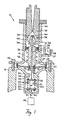
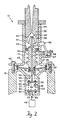
- FIG. 1 through 3 Cross sectional views of a preferred embodiment of a pulsating gas fuel supply system 10 are shown in Figures 1 through 3.
- Gaskets 24 secure diaphragm 22 between upper and lower mounts 14, 16 and can be composed of neoprene, Buna-N or some other appropriate sealing material.
- Stem 26 that moves in conjunction with the diaphragm 22 is secured near one end to the diaphragm by stem gaskets 27.
- Conduit 28 that extends through stem 26 terminates at exit aperture 38.
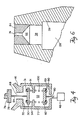
- the material forming the stem orifice positioned within aperture 38 is a hard crystal 64, preferably made of sapphire. As shown in Figure 6, the crystal 64 has a bore 74 therethrough of approximately 25 to 50 microns in diameter in this embodiment. Entrance 66 of stem orifice 64 is chamfered, and the stem orifice is set in place by an interference press-fit within exit 38.
- the stem 26 has a T-shaped bore 78 providing fluid communication between a chamber 50, whose shape is defined by lower mount 16 and diaphragm 22, and conduit 28 which directs fluid to the orifice 64.
- a biasing spring 32 is positioned between an annular ring 42 of stem 26 and adjustment nut 34.
- the biasing spring 32 urges the diaphragm 22 to one of its two possible positions as described below.
- a venturi 36 is disposed within upper mount 14 and directly above stem 26 that directs the gas to the mantle. Air inlet ports 40 provide fluid communication between surrounding air and the gas exiting the stem 26. Venturi 36 and adjustment nut 34 are threadably engaged with upper mount 14.
- Diaphragm 22 can be constructed and mounted such that it is stable in either or both of two shapes: a "first" position shown in Figure 1, which is convex relative to chamber 50, and a “second" position which is concave relative to chamber 50, shown in Figure 3.
- the diaphragm can be formed having such an intrinsic compressive stress such that it preferably assumes either the first or the second position. In either case, diaphragm 22 thereby demonstrates hysteresis whereby the level of stress in the diaphragm is lower in the first and second positions relative to its stress during movement between the two positions.
- the diaphragm 22 typically approximates 2 centimeters in diameter, is between 100 microns to 300 microns thick, and is preferably composed of stainless steel (alloy 17-7 PH or 18-8), phosphor-bronze (fine grained), blue-tempered steel or of a polymeric material, although other materials can be used.
- Upper mount 14 and lower mount 16 are contoured so that diaphragm 22 can move freely between the first and second positions. Upper mount 14 is secured to lower mount 16 by bolts 46 or by some other conventional fastener. Alternatively, upper mount 14 and lower mount 16 can be sealed or molded to form an integral housing.
- Mechanical switch 56 is secured to upper mount 14 and may be manually moved to an "on,” “off,” or “flash” position.
- switch 56 When switch 56 is in the “on” position, as shown in Figure 2, diaphragm 22 is held in a first position by switch 56 and regulator valve 30 is open.
- Spring 98 provides a biasing force at a preselected pressure that works in conjunction with diaphragm 22 to regulate the gas pressure in chamber 50.
- switch 56 In the "off” position, shown in Figure 3, switch 56 holds diaphragm 22 in a second position in which regulator valve 30 is closed.
- diaphragm 22 When the switch 56 is in the "flash” position, shown in Figure 1, diaphragm 22 is freed for periodic movement between the first and second positions. In the "flash” position, switch 58 abuts bumper 57.
- Spring 98 is under tension when switch 56 is in the "off", “on” and “flash” positions.
- Switch 56 may also be adapted to close regulator valve 30 automatically upon an
- Piezoelectric igniter 102 shown in Figure 5, is used to initiate combustion in the mantle to establish continuous lighting or to begin periodic flashing.
- Metallic electrodes 103 (only one shown) are supported by ceramic sleeve 105 proximate to mantle 20 and ignites the fuel by an electrical spark, generated when the piezoelectric element 101 is impacted by trigger 107. Note that any other suitable ignition system can be employed.
- tube 52 is supported by venturi 36 and is preferably composed of ceramic.
- Tube 52 and upper mount 14 also support a mantle 20.
- a lens 58 that is placed over mantle 20 for greater visibility and to adapt the appearance of and to collimate light emanating from mantle 20 for particular applications.
- the preferred type of lens 58 is a "Fresnel" lens.
- a metallic shield having perforations is fitted on lens 58 as a flame arrestor 72.
- Heat sink 86 composed of a suitable metal or some other heat conducting material, is secured within lens 58 for dissipating heat generated by combustion at mantle 20 and for protecting the system from adverse weather conditions.
- Cylinder 88 is composed of glass or some other transparent material. Supports 96 fix cylinder 88 about mantle 20 for conduction by the cylinder of heat away from lens 58 if the light source 10 is oriented in a substantially horizontal position.
- a check valve 82 is disposed between reservoir 48 and regulator valve 30 for preventing the flow of liquid fuel from reservoir 48 to mantle 20.
- regulator valve 30 is partially enclosed within regulator valve housing 77 of the regulator valve assembly 60.
- check valve 82 and check valve spring 100 are dimensioned and configured to provide fluid communication between reservoir 48 and regulator valve 30 when the pressure drop across check valve 82 is approximately equal to or greater than about 1 x 10⁵ Nt/m2 or any other selected pressure.
- Check valve spring 100 extends between annular rim 91 and check valve 82 and directs check valve 82 onto check valve seat 90 when the pressure drop across fuel valve 82 is less than the selected pressure difference, which in this embodiment, is about 1 x 10⁵ Nt/m2 .
- Check valve 82 and check valve spring 100 thereby prevent uncontrolled combustion and other consequences by barring flow of liquid fuel through regulator valve chamber 93 to chamber 50.
- regulator valve chamber 93 is in fluid communication with diaphragm 22 and delivers gaseous fuel from chamber 93 to chamber 50.
- the fuel is preferably propane, but butane, isobutane or other types of hydrocarbon fuels can be used.
- Mantle 20 is ignited by piezoelectric element 102, shown in Figure 5, although other conventional ignition means can also be used. Once the mantle is ignited, light is emitted therefrom, and the light is referred to as being in an ignited condition.
- Gaseous pressure within chamber 50 displaces diaphragm 22 from the first position to a second position shown in Figure 3, in opposition to the above mentioned forces maintaining diaphragm 22 in the first position.
- Pressure within chamber 50 preferably varies between approximately 14 and 40 Nt/m2 during the flash cycle.
- the diaphragm 22 Movement of the diaphragm 22 to the second position allows regulator valve 30 to be directed onto regulator valve seat 70 by regulator spring 94, which extends between regulator valve 30 and annular rim 91, thereby closing aperture 68 and terminating the flow of fuel from the regulator valve chamber 93 to diaphragm 22.
- the diaphragm can be said to reciprocate between two relatively low energy states in comparison to the diaphragm energy when in transition between these states.
- the movement of stem 26 can be directed against valve 30 by a pin 54.
- Fuel subsequently passes out of chamber 50 through conduit 28 and bore 74, as shown in Figure 6, and mixes with air drawn through air inlet ports 40 and reverse taper 62 by entrainment, through venturi 36 and tube 52, and then passes to mantle 20 where the air/gas mixture is combusted. Air is also drawn to mantle 20 from surrounding air for combustion at the mantle.
- fuel passes from chamber 50 to mantle 20 at the highest rate to obtain a peak illumination of the mantle which is highly visible. During peak illumination, the luminosity of mantle 20 is approximately 20 times more brilliant than during periods when the mantle is in a minimum brightness condition.
- the brightness of the ignited mantle can be changed by adjusting the position of venturi 36 along threads 44 of upper mount 14.
- the pressure of the fuel within chamber 50 supports diaphragm 22 in the second position.
- the pressure of the gas within chamber 50 drops below a threshold pressure, the diaphragm 22 will flip to the first position.
- Fuel in chamber 50 dissipates through conduit 28, while the diaphragm is in the second position, and the rate of combustion diminishes until the flame at mantle is barely visible, the light then being in a minimum brightness condition. Fuel in chamber 50 subsequently mixes with air entrained through air inlet ports 40, venturi 36 and tube 52 and burns at mantle 20 for providing perpetual combustion during periodic flashing of the mantle 20. Dissipation of fuel vapor while diaphragm 22 is in the second position continues until vapor pressure in chamber 50 diminishes to a pre-selected minimum pressure.
- biasing spring 32 urges diaphragm 22 from the second position back to the first position, and overcomes the diminishing force of vapor pressure in the chamber and any compressive stress or resistance to deformation within the diaphragm holding the diaphragm in the second position.
- the biasing force of biasing spring 32 can be adjusted by rotating adjustment nut 34 along threadable engagement with threads 44 of upper mount 14.
- Displacement of diaphragm 22 from the second position to the first position unseats regulator valve 30 by movement of pin 54 and re-establishes fluid communication between regulator valve chamber 93 and chamber 50. Delivery of fuel at a rapid rate from chamber 50 is thereby re-established, switching the light from the minimum brightness condition to the peak illumination condition. The cycle between maximum and minimum illuminations of the light is repeated, creating a regular, highly visible flash.
- the rate of flashing can be adjusted by varying the force of biasing spring 32, the dimensions or strength of materials of the diaphragm 22, the rate of fuel flow to the diaphragm 22, the size of orifice 74, the volume of chamber 50 or by any combination of the above or other factors. Frequency of flashes will typically approximate 65 flashes per minute, with peak illumination occupying at least 10% of the cycle period, thereby being suitable as a warning light in a wide variety of weather conditions.
- the pulsating gas fuel supply system 104 supports diaphragm 112 between switch mount 108 and stem mount 110.
- Switch mount 108 and stem mount 110 are secured by bolts 136 or by some other conventional fastener.
- diaphragm gaskets 114 which seal flexible diaphragm 112 within mounts 108 and 110.
- the stem 116 is stationary in this embodiment and is secured within stem mount 110 and a conduit 118 extends through stem 116 and terminates at exit aperture 130.
- the stem orifice 150 is set in place by an interference press fit within exit aperture 130.
- a biasing spring 124 extends between adjustment nut 126 and flexible diaphragm 112 and operates to urge the diaphragm between positions.
- a venturi 128 is disposed within stem mount 110 to control the flow of fuel and the air received through the air inlet ports 132 which provide fluid communication between surrounding air and stem orifice 150.
- Diaphragm 112 can be stable in either or both of two positions: a "first" position shown in Figure 7 and a "second" position shown in Figure 8. The diaphragm 112 moves from the first position to the second position abruptly upon passage of fuel through regulator valve 120.
- the diaphragm can be formed such that intrinsic compressive stress causes the diaphragm to assume either the first or the second position in which it has reduced energy or stress relative to any of its intermediate positions.
- Diaphragm 112 demonstrates the same physical properties as that of diaphragm 22 in the first embodiment described above.
- Mechanical switch 144 is secured to switch mount 108 and may be manually moved to an "on” or a “flash” position.
- diaphragm 112 is held in a first position by force of mechanical switch rod 172 which compresses mechanical switch spring 170 and thereby directs flexible diaphragm 112 and connecting member 142 against regulator valve 120.
- chamber 140 is in fluid communication with valve chamber 174.
- Collar 176 supports mechanical switch rod 172.
- a mantle, ceramic tube and lens can be mounted at venturi 128, as mantle 20, tube 52 and lens 58 do at venturi 36 in Figure 5 as described above regarding the first embodiment.
- Regulator valve assembly 156 operates in the same manner as regulator valve assembly 60 described in the first embodiment. Regulator spring 122 is compressed by movement of diaphragm 112 from the second position back to the first position. When check valve 160 is open, check valve spring 166 is compressed and fuel from a reservoir passes through a fuel entrance 158 into valve chamber 174. If pressure drop across check valve 160 diminishes to below a preselected minimum, the check valve will seat on check valve seat 162 and terminate flow of fuel into valve chamber 174.
- diaphragm 190 is supported between switch mount 186 and stem mount 188.
- Stem 194 is fixed to stem mount 188 and rod 214 is fixed to diaphragm 190.
- Mechanical switch assembly 206 may be manually moved to a "on", “off” or “flash” position.
- Mechanical switch rod 214 is supported by collar 212 and is actuated by mechanical switch lever 208.
- Cap 216 and rod 214 are movable between a first position of diaphragm 190, shown in Figure 9, and a second position of diaphragm 190, shown in Figure 11. When diaphragm 190 is in the first position, regulator valve 198 is unseated and regulator spring 218 is compressed for providing fluid communication between valve chamber 220 and diaphragm 190.
- a mantle, tube and lens are mounted at venturi 204, in a manner similar to mantle 20, tube 52 and lens 58 at venturi 36 in Figure 5 as described above.
Landscapes
- Engineering & Computer Science (AREA)
- General Engineering & Computer Science (AREA)
- Feeding And Controlling Fuel (AREA)
- Investigating Or Analysing Materials By The Use Of Chemical Reactions (AREA)
- Fluid-Driven Valves (AREA)
- Audible And Visible Signals (AREA)
- Gas Burners (AREA)
- Investigating Or Analysing Materials By Optical Means (AREA)
- Emergency Alarm Devices (AREA)
Applications Claiming Priority (2)
| Application Number | Priority Date | Filing Date | Title |
|---|---|---|---|
| US07/390,641 US5018963A (en) | 1989-08-07 | 1989-08-07 | Pulsating gas powered light source |
| US390641 | 1995-02-17 |
Publications (3)
| Publication Number | Publication Date |
|---|---|
| EP0412460A2 true EP0412460A2 (de) | 1991-02-13 |
| EP0412460A3 EP0412460A3 (en) | 1991-04-24 |
| EP0412460B1 EP0412460B1 (de) | 1995-10-11 |
Family
ID=23543334
Family Applications (1)
| Application Number | Title | Priority Date | Filing Date |
|---|---|---|---|
| EP19900114988 Expired - Lifetime EP0412460B1 (de) | 1989-08-07 | 1990-08-03 | Pulsierende, gasgespeiste Lichtquelle |
Country Status (6)
| Country | Link |
|---|---|
| US (1) | US5018963A (de) |
| EP (1) | EP0412460B1 (de) |
| JP (1) | JPH0379910A (de) |
| AT (1) | ATE129063T1 (de) |
| CA (1) | CA2022175A1 (de) |
| DE (1) | DE69022919T2 (de) |
Cited By (3)
| Publication number | Priority date | Publication date | Assignee | Title |
|---|---|---|---|---|
| EP0792432A4 (de) * | 1994-11-10 | 1998-11-11 | Thermo Power Corp | Treibstoffregler |
| EP0865587A4 (de) * | 1995-12-29 | 2000-01-19 | Thermolyte Corp | Tragbares gasgerät |
| US6637674B1 (en) | 1999-11-27 | 2003-10-28 | Mika Heiztechnik Gmbh | Device for supplying preferably liquid or gaseous fuels to a combustion chamber |
Families Citing this family (23)
| Publication number | Priority date | Publication date | Assignee | Title |
|---|---|---|---|---|
| JP2910485B2 (ja) * | 1993-02-19 | 1999-06-23 | 富士ゼロックス株式会社 | 画像読取装置及び画像読取方法 |
| US5601661A (en) * | 1995-07-21 | 1997-02-11 | Milstein; Joseph B. | Method of use of thermophotovoltaic emitter materials |
| US6533141B1 (en) | 2001-10-31 | 2003-03-18 | S. C. Johnson & Son, Inc. | Intermittent aerosol dispensing valve |
| US6588627B2 (en) | 2001-10-31 | 2003-07-08 | S.C. Johnson & Son, Inc. | Automatic intermittent aerosol dispensing valve |
| US6688492B2 (en) | 2002-01-24 | 2004-02-10 | S.C. Johnson & Son, Inc. | Dispensing valve |
| US6926172B2 (en) * | 2001-10-31 | 2005-08-09 | S. C. Johnson & Son, Inc. | Total release dispensing valve |
| US6612464B2 (en) | 2001-11-13 | 2003-09-02 | S. C. Johnson & Son, Inc. | Aerosol dispensing valve |
| US6478199B1 (en) | 2002-01-24 | 2002-11-12 | S. C. Johnson & Son, Inc. | Automatic valve |
| ITTO20020090A1 (it) * | 2002-02-01 | 2003-08-01 | C R F Societa Con Sortile Per | Dispositivo di illuminazione. |
| US8246344B1 (en) * | 2003-07-29 | 2012-08-21 | Samuel Schrock | Gas lamp |
| JP2005049040A (ja) * | 2003-07-30 | 2005-02-24 | Dos Santos Jose Fernandes | ガス燃焼のための装置 |
| US7195139B2 (en) * | 2004-06-29 | 2007-03-27 | S.C. Johnson & Son, Inc. | Dispensing valve |
| US8061562B2 (en) | 2004-10-12 | 2011-11-22 | S.C. Johnson & Son, Inc. | Compact spray device |
| CN102616480B (zh) | 2004-10-12 | 2014-12-10 | 约翰逊父子公司 | 一种操作分配单元的方法 |
| US8462508B2 (en) * | 2007-04-30 | 2013-06-11 | Hewlett-Packard Development Company, L.P. | Heat sink with surface-formed vapor chamber base |
| US8590743B2 (en) | 2007-05-10 | 2013-11-26 | S.C. Johnson & Son, Inc. | Actuator cap for a spray device |
| US20080290120A1 (en) * | 2007-05-25 | 2008-11-27 | Helf Thomas A | Actuator cap for a spray device |
| US8381951B2 (en) | 2007-08-16 | 2013-02-26 | S.C. Johnson & Son, Inc. | Overcap for a spray device |
| US8556122B2 (en) | 2007-08-16 | 2013-10-15 | S.C. Johnson & Son, Inc. | Apparatus for control of a volatile material dispenser |
| US8469244B2 (en) | 2007-08-16 | 2013-06-25 | S.C. Johnson & Son, Inc. | Overcap and system for spraying a fluid |
| US8387827B2 (en) | 2008-03-24 | 2013-03-05 | S.C. Johnson & Son, Inc. | Volatile material dispenser |
| DE102008058467B3 (de) * | 2008-11-21 | 2010-10-07 | Ingo Tjards | Vorrichtung zur Stromerzeugung |
| US9108782B2 (en) | 2012-10-15 | 2015-08-18 | S.C. Johnson & Son, Inc. | Dispensing systems with improved sensing capabilities |
Family Cites Families (36)
| Publication number | Priority date | Publication date | Assignee | Title |
|---|---|---|---|---|
| US221758A (en) * | 1879-11-18 | Improvement in lighting devices | ||
| DE233027C (de) * | ||||
| US1528485A (en) * | 1925-03-03 | Luminous-flame signaling apparatus | ||
| US1320209A (en) * | 1919-10-28 | Office | ||
| US1309482A (en) * | 1919-07-08 | Sas-ety gas-jet | ||
| US854880A (en) * | 1906-06-22 | 1907-05-28 | George F Ehemann | Flash-light. |
| US921272A (en) * | 1906-11-26 | 1909-05-11 | Mitchell F Mccarthy | Pressure-regulator for lamps and the like. |
| US923474A (en) * | 1908-03-19 | 1909-06-01 | Thomas Leopold Willson | Signal-light. |
| US906285A (en) * | 1908-04-25 | 1908-12-08 | Gustaf Von Post | Valve for automatically and intermittently interrupting a current of gas or liquid. |
| US1015532A (en) * | 1910-09-29 | 1912-01-23 | Frederick George Attwood | Beacon-light. |
| US1069702A (en) * | 1912-09-07 | 1913-08-12 | Thomas Jackson | Mechanism for producing gas-lighted flash-signs and the like for advertising purposes. |
| US1079272A (en) * | 1912-10-07 | 1913-11-18 | Albert Ralph Murray | Spray-burner. |
| US1673834A (en) * | 1925-04-30 | 1928-06-19 | American Gas Accumulator Compa | Flasher |
| US1912351A (en) * | 1932-04-30 | 1933-05-30 | Thomas H Mcghee | Lamp holder |
| US2135826A (en) * | 1936-10-14 | 1938-11-08 | Marischal Omer Marie Cyrille | Signaling lamp |
| CH223646A (de) * | 1940-10-02 | 1942-09-30 | Gasaccumulator Svenska Ab | Rückströmsperre zur Verhinderung des Zurückströmens eines gasförmigen Mediums in eine Leitung. |
| US2963891A (en) * | 1957-10-09 | 1960-12-13 | Rheinische Werkzeug & Maschf | Blinking liquid fuel burner |
| US3039699A (en) * | 1957-12-19 | 1962-06-19 | Georgia Tech Res Inst | Spray nozzle with vibratory head and seat |
| US3004712A (en) * | 1960-05-20 | 1961-10-17 | American Radiator & Standard | Snap-action thermostatic valve |
| US3114251A (en) * | 1960-09-29 | 1963-12-17 | Warning Lites Company Inc | Fuel control device for flasher lamps |
| US3096027A (en) * | 1960-12-01 | 1963-07-02 | Warning Lites Company Inc | Combustion controlled flasher lamp |
| US3190314A (en) * | 1962-04-30 | 1965-06-22 | White Rodgers Company | Thermostatic gas valve |
| US3078365A (en) * | 1962-05-04 | 1963-02-19 | Warning Lites Company Inc | Continuous combustion signal lamp |
| US3176709A (en) * | 1962-08-13 | 1965-04-06 | J & S Carburetor Company | Liquefied petroleum gas vaporizer having a surge chamber |
| US3210966A (en) * | 1963-10-07 | 1965-10-12 | Leggitt S H Co | Warning light |
| US3443583A (en) * | 1967-11-27 | 1969-05-13 | Webb James E | High impact pressure regulator |
| US3477613A (en) * | 1968-02-29 | 1969-11-11 | Dart Ind Inc | Aerosol dispenser actuated by propellant pressure |
| DE2206001A1 (de) * | 1972-02-09 | 1973-08-16 | Bosch Gmbh Robert | Druckschaltventil |
| GB1451105A (en) * | 1973-04-17 | 1976-09-29 | Wilson L P S | Lamps burning a vaporisable liquid fuel |
| US4077542A (en) * | 1974-12-02 | 1978-03-07 | Petterson Tor H | Unattended aerosol dispenser |
| US4240458A (en) * | 1978-04-26 | 1980-12-23 | Harper-Wyman Company | Excess pressure shutoff valve |
| US4240483A (en) * | 1979-08-01 | 1980-12-23 | Gregoric Bran F | Spoked wheel |
| US4441792A (en) * | 1980-03-04 | 1984-04-10 | Canon Kabushiki Kaisha | Telecentric projection lenses |
| US4496308A (en) * | 1982-08-16 | 1985-01-29 | The Gillette Company | Shock mounting for incandescent mantle |
| US4497339A (en) * | 1982-08-16 | 1985-02-05 | The Gillette Company | Two-stage pressure regulator |
| US4475882A (en) * | 1982-08-16 | 1984-10-09 | The Gillette Company | Gas mantle with aspirated pilot light |
-
1989
- 1989-08-07 US US07/390,641 patent/US5018963A/en not_active Expired - Fee Related
-
1990
- 1990-07-27 CA CA 2022175 patent/CA2022175A1/en not_active Abandoned
- 1990-08-03 DE DE69022919T patent/DE69022919T2/de not_active Expired - Fee Related
- 1990-08-03 AT AT90114988T patent/ATE129063T1/de not_active IP Right Cessation
- 1990-08-03 EP EP19900114988 patent/EP0412460B1/de not_active Expired - Lifetime
- 1990-08-06 JP JP2207959A patent/JPH0379910A/ja active Pending
Cited By (3)
| Publication number | Priority date | Publication date | Assignee | Title |
|---|---|---|---|---|
| EP0792432A4 (de) * | 1994-11-10 | 1998-11-11 | Thermo Power Corp | Treibstoffregler |
| EP0865587A4 (de) * | 1995-12-29 | 2000-01-19 | Thermolyte Corp | Tragbares gasgerät |
| US6637674B1 (en) | 1999-11-27 | 2003-10-28 | Mika Heiztechnik Gmbh | Device for supplying preferably liquid or gaseous fuels to a combustion chamber |
Also Published As
| Publication number | Publication date |
|---|---|
| ATE129063T1 (de) | 1995-10-15 |
| DE69022919D1 (de) | 1995-11-16 |
| EP0412460B1 (de) | 1995-10-11 |
| US5018963A (en) | 1991-05-28 |
| DE69022919T2 (de) | 1996-04-11 |
| EP0412460A3 (en) | 1991-04-24 |
| JPH0379910A (ja) | 1991-04-04 |
| CA2022175A1 (en) | 1991-02-08 |
Similar Documents
| Publication | Publication Date | Title |
|---|---|---|
| US5018963A (en) | Pulsating gas powered light source | |
| US5608290A (en) | LED flashing lantern | |
| US5310336A (en) | Lighter | |
| CA2171777A1 (en) | Liquid fuel lantern | |
| US3620660A (en) | Lighting devices for gas burners | |
| US4497339A (en) | Two-stage pressure regulator | |
| US3843311A (en) | Lantern with igniter | |
| US4832595A (en) | Torch nozzle assembly | |
| US4475882A (en) | Gas mantle with aspirated pilot light | |
| US3172456A (en) | Igniting system | |
| US2393508A (en) | Semiautomatic safety lighter | |
| US4867191A (en) | Solar activated gas light control module | |
| US2135826A (en) | Signaling lamp | |
| US5601357A (en) | Portable gas appliance | |
| US4496308A (en) | Shock mounting for incandescent mantle | |
| CN2286815Y (zh) | 燃气具限时接通、意外熄火自动安全阀 | |
| GB2216244A (en) | Windshielded gas burner | |
| US2872871A (en) | High capacity fuel pump | |
| EP0703409A1 (de) | Flüssiggasverbrennungsvorrichtung | |
| EP0101035A2 (de) | Gasgespeiste tragbare Lampe | |
| RU15384U1 (ru) | Испарительная горелка | |
| US3363437A (en) | Frame-type holding arrangement for suspended incandescent mantles in high-intensity lanterns | |
| US2022897A (en) | Safety flare burner and snuffer | |
| KR102446705B1 (ko) | 가스 가로등 | |
| US392192A (en) | Cigar-lighter |
Legal Events
| Date | Code | Title | Description |
|---|---|---|---|
| PUAI | Public reference made under article 153(3) epc to a published international application that has entered the european phase |
Free format text: ORIGINAL CODE: 0009012 |
|
| AK | Designated contracting states |
Kind code of ref document: A2 Designated state(s): AT BE CH DE ES FR GB IT LI NL SE |
|
| PUAL | Search report despatched |
Free format text: ORIGINAL CODE: 0009013 |
|
| AK | Designated contracting states |
Kind code of ref document: A3 Designated state(s): AT BE CH DE ES FR GB IT LI NL SE |
|
| 17P | Request for examination filed |
Effective date: 19911011 |
|
| 17Q | First examination report despatched |
Effective date: 19930510 |
|
| RAP1 | Party data changed (applicant data changed or rights of an application transferred) |
Owner name: WHITE CONSOLIDATED INDUSTRIES, INC. |
|
| GRAA | (expected) grant |
Free format text: ORIGINAL CODE: 0009210 |
|
| AK | Designated contracting states |
Kind code of ref document: B1 Designated state(s): AT BE CH DE ES FR GB IT LI NL SE |
|
| PG25 | Lapsed in a contracting state [announced via postgrant information from national office to epo] |
Ref country code: IT Free format text: LAPSE BECAUSE OF FAILURE TO SUBMIT A TRANSLATION OF THE DESCRIPTION OR TO PAY THE FEE WITHIN THE PRE;WARNING: LAPSES OF ITALIAN PATENTS WITH EFFECTIVE DATE BEFORE 2007 MAY HAVE OCCURRED AT ANY TIME BEFORE 2007. THE CORRECT EFFECTIVE DATE MAY BE DIFFERENT FROM THE ONE RECORDED.SCRIBED TIME-LIMIT Effective date: 19951011 Ref country code: BE Effective date: 19951011 Ref country code: LI Effective date: 19951011 Ref country code: CH Effective date: 19951011 Ref country code: NL Free format text: LAPSE BECAUSE OF FAILURE TO SUBMIT A TRANSLATION OF THE DESCRIPTION OR TO PAY THE FEE WITHIN THE PRESCRIBED TIME-LIMIT Effective date: 19951011 Ref country code: AT Effective date: 19951011 Ref country code: ES Free format text: THE PATENT HAS BEEN ANNULLED BY A DECISION OF A NATIONAL AUTHORITY Effective date: 19951011 |
|
| REF | Corresponds to: |
Ref document number: 129063 Country of ref document: AT Date of ref document: 19951015 Kind code of ref document: T |
|
| REF | Corresponds to: |
Ref document number: 69022919 Country of ref document: DE Date of ref document: 19951116 |
|
| ET | Fr: translation filed | ||
| NLV1 | Nl: lapsed or annulled due to failure to fulfill the requirements of art. 29p and 29m of the patents act | ||
| REG | Reference to a national code |
Ref country code: CH Ref legal event code: PL |
|
| PLBE | No opposition filed within time limit |
Free format text: ORIGINAL CODE: 0009261 |
|
| STAA | Information on the status of an ep patent application or granted ep patent |
Free format text: STATUS: NO OPPOSITION FILED WITHIN TIME LIMIT |
|
| 26N | No opposition filed | ||
| PGFP | Annual fee paid to national office [announced via postgrant information from national office to epo] |
Ref country code: GB Payment date: 19990702 Year of fee payment: 10 |
|
| PGFP | Annual fee paid to national office [announced via postgrant information from national office to epo] |
Ref country code: FR Payment date: 19990802 Year of fee payment: 10 Ref country code: SE Payment date: 19990802 Year of fee payment: 10 |
|
| PGFP | Annual fee paid to national office [announced via postgrant information from national office to epo] |
Ref country code: DE Payment date: 19990831 Year of fee payment: 10 |
|
| PG25 | Lapsed in a contracting state [announced via postgrant information from national office to epo] |
Ref country code: GB Free format text: LAPSE BECAUSE OF NON-PAYMENT OF DUE FEES Effective date: 20000803 |
|
| PG25 | Lapsed in a contracting state [announced via postgrant information from national office to epo] |
Ref country code: SE Free format text: LAPSE BECAUSE OF NON-PAYMENT OF DUE FEES Effective date: 20000804 |
|
| GBPC | Gb: european patent ceased through non-payment of renewal fee |
Effective date: 20000803 |
|
| EUG | Se: european patent has lapsed |
Ref document number: 90114988.0 |
|
| PG25 | Lapsed in a contracting state [announced via postgrant information from national office to epo] |
Ref country code: FR Free format text: LAPSE BECAUSE OF NON-PAYMENT OF DUE FEES Effective date: 20010430 |
|
| PG25 | Lapsed in a contracting state [announced via postgrant information from national office to epo] |
Ref country code: DE Free format text: LAPSE BECAUSE OF NON-PAYMENT OF DUE FEES Effective date: 20010501 |
|
| REG | Reference to a national code |
Ref country code: FR Ref legal event code: ST |