EP0413233A2 - Copolyamide mit erhöhter Glasübergangstemperatur - Google Patents
Copolyamide mit erhöhter Glasübergangstemperatur Download PDFInfo
- Publication number
- EP0413233A2 EP0413233A2 EP19900115121 EP90115121A EP0413233A2 EP 0413233 A2 EP0413233 A2 EP 0413233A2 EP 19900115121 EP19900115121 EP 19900115121 EP 90115121 A EP90115121 A EP 90115121A EP 0413233 A2 EP0413233 A2 EP 0413233A2
- Authority
- EP
- European Patent Office
- Prior art keywords
- phenyl
- copolyamides
- bis
- alkyl
- copolyamide
- Prior art date
- Legal status (The legal status is an assumption and is not a legal conclusion. Google has not performed a legal analysis and makes no representation as to the accuracy of the status listed.)
- Withdrawn
Links
- 230000007704 transition Effects 0.000 title 1
- 239000004952 Polyamide Substances 0.000 claims abstract description 32
- 229920002647 polyamide Polymers 0.000 claims abstract description 32
- 230000009477 glass transition Effects 0.000 claims abstract description 22
- 150000004985 diamines Chemical class 0.000 claims abstract description 19
- 150000001991 dicarboxylic acids Chemical class 0.000 claims abstract description 10
- -1 p-carboxyphenyl Chemical group 0.000 claims description 20
- OFOBLEOULBTSOW-UHFFFAOYSA-N Malonic acid Chemical compound OC(=O)CC(O)=O OFOBLEOULBTSOW-UHFFFAOYSA-N 0.000 claims description 11
- 229910052739 hydrogen Inorganic materials 0.000 claims description 10
- 239000001257 hydrogen Substances 0.000 claims description 10
- UFHFLCQGNIYNRP-UHFFFAOYSA-N Hydrogen Chemical compound [H][H] UFHFLCQGNIYNRP-UHFFFAOYSA-N 0.000 claims description 8
- 125000000217 alkyl group Chemical group 0.000 claims description 7
- 229910052799 carbon Inorganic materials 0.000 claims description 7
- ZAMOUSCENKQFHK-UHFFFAOYSA-N Chlorine atom Chemical compound [Cl] ZAMOUSCENKQFHK-UHFFFAOYSA-N 0.000 claims description 6
- 125000002496 methyl group Chemical group [H]C([H])([H])* 0.000 claims description 6
- 239000000460 chlorine Substances 0.000 claims description 5
- 229910052801 chlorine Inorganic materials 0.000 claims description 5
- 229910052736 halogen Inorganic materials 0.000 claims description 5
- 150000002367 halogens Chemical class 0.000 claims description 5
- 150000002431 hydrogen Chemical class 0.000 claims description 5
- 125000004400 (C1-C12) alkyl group Chemical group 0.000 claims description 4
- 125000004209 (C1-C8) alkyl group Chemical group 0.000 claims description 4
- RQTCKSKEVIHLLY-UHFFFAOYSA-N 2-[4-[1-[4-(2-carboxyphenoxy)phenyl]-3,3,5-trimethylcyclohexyl]phenoxy]benzoic acid Chemical compound C1C(C)CC(C)(C)CC1(C=1C=CC(OC=2C(=CC=CC=2)C(O)=O)=CC=1)C(C=C1)=CC=C1OC1=CC=CC=C1C(O)=O RQTCKSKEVIHLLY-UHFFFAOYSA-N 0.000 claims description 4
- WKBOTKDWSSQWDR-UHFFFAOYSA-N Bromine atom Chemical compound [Br] WKBOTKDWSSQWDR-UHFFFAOYSA-N 0.000 claims description 4
- 125000000041 C6-C10 aryl group Chemical group 0.000 claims description 4
- OKTJSMMVPCPJKN-UHFFFAOYSA-N Carbon Chemical group [C] OKTJSMMVPCPJKN-UHFFFAOYSA-N 0.000 claims description 4
- 239000000654 additive Substances 0.000 claims description 4
- 125000001797 benzyl group Chemical group [H]C1=C([H])C([H])=C(C([H])=C1[H])C([H])([H])* 0.000 claims description 4
- 150000007933 aliphatic carboxylic acids Chemical group 0.000 claims description 3
- QVGXLLKOCUKJST-UHFFFAOYSA-N atomic oxygen Chemical compound [O] QVGXLLKOCUKJST-UHFFFAOYSA-N 0.000 claims description 3
- GDTBXPJZTBHREO-UHFFFAOYSA-N bromine Substances BrBr GDTBXPJZTBHREO-UHFFFAOYSA-N 0.000 claims description 3
- 229910052794 bromium Inorganic materials 0.000 claims description 3
- 239000003365 glass fiber Substances 0.000 claims description 3
- 229910052760 oxygen Inorganic materials 0.000 claims description 3
- 239000001301 oxygen Substances 0.000 claims description 3
- 125000004430 oxygen atom Chemical group O* 0.000 claims description 3
- 125000001997 phenyl group Chemical group [H]C1=C([H])C([H])=C(*)C([H])=C1[H] 0.000 claims description 3
- 125000004434 sulfur atom Chemical group 0.000 claims description 3
- UAABXWQOYLBDDK-UHFFFAOYSA-N 2-[4-[1-[4-(2-carboxyphenoxy)phenyl]cyclohexyl]phenoxy]benzoic acid Chemical compound OC(=O)C1=CC=CC=C1OC1=CC=C(C2(CCCCC2)C=2C=CC(OC=3C(=CC=CC=3)C(O)=O)=CC=2)C=C1 UAABXWQOYLBDDK-UHFFFAOYSA-N 0.000 claims description 2
- KXDHJXZQYSOELW-UHFFFAOYSA-N Carbamic acid Chemical class NC(O)=O KXDHJXZQYSOELW-UHFFFAOYSA-N 0.000 claims description 2
- 150000003951 lactams Chemical class 0.000 claims description 2
- 150000001721 carbon Chemical group 0.000 claims 1
- 229930185605 Bisphenol Natural products 0.000 abstract description 9
- VPWNQTHUCYMVMZ-UHFFFAOYSA-N 4,4'-sulfonyldiphenol Chemical class C1=CC(O)=CC=C1S(=O)(=O)C1=CC=C(O)C=C1 VPWNQTHUCYMVMZ-UHFFFAOYSA-N 0.000 abstract description 6
- NAQMVNRVTILPCV-UHFFFAOYSA-N hexane-1,6-diamine Chemical compound NCCCCCCN NAQMVNRVTILPCV-UHFFFAOYSA-N 0.000 description 24
- YXFVVABEGXRONW-UHFFFAOYSA-N Toluene Chemical compound CC1=CC=CC=C1 YXFVVABEGXRONW-UHFFFAOYSA-N 0.000 description 15
- QQVIHTHCMHWDBS-UHFFFAOYSA-N isophthalic acid Chemical compound OC(=O)C1=CC=CC(C(O)=O)=C1 QQVIHTHCMHWDBS-UHFFFAOYSA-N 0.000 description 14
- QTBSBXVTEAMEQO-UHFFFAOYSA-N Acetic acid Chemical compound CC(O)=O QTBSBXVTEAMEQO-UHFFFAOYSA-N 0.000 description 11
- 238000006243 chemical reaction Methods 0.000 description 10
- 238000002360 preparation method Methods 0.000 description 10
- XLYOFNOQVPJJNP-UHFFFAOYSA-N water Substances O XLYOFNOQVPJJNP-UHFFFAOYSA-N 0.000 description 10
- YMWUJEATGCHHMB-UHFFFAOYSA-N Dichloromethane Chemical compound ClCCl YMWUJEATGCHHMB-UHFFFAOYSA-N 0.000 description 9
- 150000002576 ketones Chemical class 0.000 description 9
- QGZKDVFQNNGYKY-UHFFFAOYSA-N Ammonia Chemical compound N QGZKDVFQNNGYKY-UHFFFAOYSA-N 0.000 description 8
- VEXZGXHMUGYJMC-UHFFFAOYSA-N Hydrochloric acid Chemical compound Cl VEXZGXHMUGYJMC-UHFFFAOYSA-N 0.000 description 8
- 238000010992 reflux Methods 0.000 description 8
- ISWSIDIOOBJBQZ-UHFFFAOYSA-N Phenol Chemical compound OC1=CC=CC=C1 ISWSIDIOOBJBQZ-UHFFFAOYSA-N 0.000 description 7
- WFDIJRYMOXRFFG-UHFFFAOYSA-N acetic acid anhydride Natural products CC(=O)OC(C)=O WFDIJRYMOXRFFG-UHFFFAOYSA-N 0.000 description 7
- KKEYFWRCBNTPAC-UHFFFAOYSA-N Terephthalic acid Chemical compound OC(=O)C1=CC=C(C(O)=O)C=C1 KKEYFWRCBNTPAC-UHFFFAOYSA-N 0.000 description 6
- 125000004429 atom Chemical group 0.000 description 6
- JBKVHLHDHHXQEQ-UHFFFAOYSA-N epsilon-caprolactam Chemical compound O=C1CCCCCN1 JBKVHLHDHHXQEQ-UHFFFAOYSA-N 0.000 description 6
- 239000007789 gas Substances 0.000 description 6
- RLSSMJSEOOYNOY-UHFFFAOYSA-N m-cresol Chemical compound CC1=CC=CC(O)=C1 RLSSMJSEOOYNOY-UHFFFAOYSA-N 0.000 description 6
- 239000011541 reaction mixture Substances 0.000 description 6
- POSWICCRDBKBMH-UHFFFAOYSA-N 3,3,5-trimethylcyclohexan-1-one Chemical compound CC1CC(=O)CC(C)(C)C1 POSWICCRDBKBMH-UHFFFAOYSA-N 0.000 description 5
- 230000008018 melting Effects 0.000 description 5
- 238000002844 melting Methods 0.000 description 5
- 239000000203 mixture Substances 0.000 description 5
- IJGRMHOSHXDMSA-UHFFFAOYSA-N Atomic nitrogen Chemical compound N#N IJGRMHOSHXDMSA-UHFFFAOYSA-N 0.000 description 4
- IAZDPXIOMUYVGZ-UHFFFAOYSA-N Dimethylsulphoxide Chemical compound CS(C)=O IAZDPXIOMUYVGZ-UHFFFAOYSA-N 0.000 description 4
- 239000002253 acid Substances 0.000 description 4
- 229910021529 ammonia Inorganic materials 0.000 description 4
- 239000003054 catalyst Substances 0.000 description 4
- 238000000921 elemental analysis Methods 0.000 description 4
- IXCSERBJSXMMFS-UHFFFAOYSA-N hydrogen chloride Substances Cl.Cl IXCSERBJSXMMFS-UHFFFAOYSA-N 0.000 description 4
- 229910000041 hydrogen chloride Inorganic materials 0.000 description 4
- 150000002825 nitriles Chemical class 0.000 description 4
- 229920006114 semi-crystalline semi-aromatic polyamide Polymers 0.000 description 4
- 239000000126 substance Substances 0.000 description 4
- UMPGNGRIGSEMTC-UHFFFAOYSA-N 4-[1-(4-hydroxyphenyl)-3,3,5-trimethylcyclohexyl]phenol Chemical compound C1C(C)CC(C)(C)CC1(C=1C=CC(O)=CC=1)C1=CC=C(O)C=C1 UMPGNGRIGSEMTC-UHFFFAOYSA-N 0.000 description 3
- SLXKOJJOQWFEFD-UHFFFAOYSA-N 6-aminohexanoic acid Chemical compound NCCCCCC(O)=O SLXKOJJOQWFEFD-UHFFFAOYSA-N 0.000 description 3
- OKKJLVBELUTLKV-UHFFFAOYSA-N Methanol Chemical compound OC OKKJLVBELUTLKV-UHFFFAOYSA-N 0.000 description 3
- KWYUFKZDYYNOTN-UHFFFAOYSA-M Potassium hydroxide Chemical compound [OH-].[K+] KWYUFKZDYYNOTN-UHFFFAOYSA-M 0.000 description 3
- HEMHJVSKTPXQMS-UHFFFAOYSA-M Sodium hydroxide Chemical compound [OH-].[Na+] HEMHJVSKTPXQMS-UHFFFAOYSA-M 0.000 description 3
- 230000002378 acidificating effect Effects 0.000 description 3
- 229960002684 aminocaproic acid Drugs 0.000 description 3
- 229920006020 amorphous polyamide Polymers 0.000 description 3
- IISBACLAFKSPIT-UHFFFAOYSA-N bisphenol A Chemical compound C=1C=C(O)C=CC=1C(C)(C)C1=CC=C(O)C=C1 IISBACLAFKSPIT-UHFFFAOYSA-N 0.000 description 3
- 239000003795 chemical substances by application Substances 0.000 description 3
- 150000001875 compounds Chemical class 0.000 description 3
- 238000009833 condensation Methods 0.000 description 3
- 230000005494 condensation Effects 0.000 description 3
- 238000004519 manufacturing process Methods 0.000 description 3
- 238000000034 method Methods 0.000 description 3
- 150000002989 phenols Chemical class 0.000 description 3
- 230000008569 process Effects 0.000 description 3
- 150000003839 salts Chemical class 0.000 description 3
- 238000007711 solidification Methods 0.000 description 3
- 230000008023 solidification Effects 0.000 description 3
- CYSGHNMQYZDMIA-UHFFFAOYSA-N 1,3-Dimethyl-2-imidazolidinon Chemical compound CN1CCN(C)C1=O CYSGHNMQYZDMIA-UHFFFAOYSA-N 0.000 description 2
- JEANOXXXGPLTOI-UHFFFAOYSA-N 2,4,4-trimethylcyclohexan-1-one Chemical compound CC1CC(C)(C)CCC1=O JEANOXXXGPLTOI-UHFFFAOYSA-N 0.000 description 2
- NXXYKOUNUYWIHA-UHFFFAOYSA-N 2,6-Dimethylphenol Chemical compound CC1=CC=CC(C)=C1O NXXYKOUNUYWIHA-UHFFFAOYSA-N 0.000 description 2
- XIYKIDUZNPHROL-UHFFFAOYSA-N 2-[4-[1-[4-(2-cyanophenoxy)phenyl]cyclohexyl]phenoxy]benzonitrile Chemical compound N#CC1=CC=CC=C1OC1=CC=C(C2(CCCCC2)C=2C=CC(OC=3C(=CC=CC=3)C#N)=CC=2)C=C1 XIYKIDUZNPHROL-UHFFFAOYSA-N 0.000 description 2
- DZIHTWJGPDVSGE-UHFFFAOYSA-N 4-[(4-aminocyclohexyl)methyl]cyclohexan-1-amine Chemical class C1CC(N)CCC1CC1CCC(N)CC1 DZIHTWJGPDVSGE-UHFFFAOYSA-N 0.000 description 2
- GJNGXPDXRVXSEH-UHFFFAOYSA-N 4-chlorobenzonitrile Chemical compound ClC1=CC=C(C#N)C=C1 GJNGXPDXRVXSEH-UHFFFAOYSA-N 0.000 description 2
- CNPURSDMOWDNOQ-UHFFFAOYSA-N 4-methoxy-7h-pyrrolo[2,3-d]pyrimidin-2-amine Chemical compound COC1=NC(N)=NC2=C1C=CN2 CNPURSDMOWDNOQ-UHFFFAOYSA-N 0.000 description 2
- SDDLEVPIDBLVHC-UHFFFAOYSA-N Bisphenol Z Chemical compound C1=CC(O)=CC=C1C1(C=2C=CC(O)=CC=2)CCCCC1 SDDLEVPIDBLVHC-UHFFFAOYSA-N 0.000 description 2
- RTZKZFJDLAIYFH-UHFFFAOYSA-N Diethyl ether Chemical compound CCOCC RTZKZFJDLAIYFH-UHFFFAOYSA-N 0.000 description 2
- CPELXLSAUQHCOX-UHFFFAOYSA-N Hydrogen bromide Chemical compound Br CPELXLSAUQHCOX-UHFFFAOYSA-N 0.000 description 2
- 229910010084 LiAlH4 Inorganic materials 0.000 description 2
- LRHPLDYGYMQRHN-UHFFFAOYSA-N N-Butanol Chemical compound CCCCO LRHPLDYGYMQRHN-UHFFFAOYSA-N 0.000 description 2
- 229920002292 Nylon 6 Polymers 0.000 description 2
- NBIIXXVUZAFLBC-UHFFFAOYSA-N Phosphoric acid Chemical compound OP(O)(O)=O NBIIXXVUZAFLBC-UHFFFAOYSA-N 0.000 description 2
- QAOWNCQODCNURD-UHFFFAOYSA-N Sulfuric acid Chemical compound OS(O)(=O)=O QAOWNCQODCNURD-UHFFFAOYSA-N 0.000 description 2
- WYURNTSHIVDZCO-UHFFFAOYSA-N Tetrahydrofuran Chemical compound C1CCOC1 WYURNTSHIVDZCO-UHFFFAOYSA-N 0.000 description 2
- WNLRTRBMVRJNCN-UHFFFAOYSA-N adipic acid Chemical compound OC(=O)CCCCC(O)=O WNLRTRBMVRJNCN-UHFFFAOYSA-N 0.000 description 2
- WTEOIRVLGSZEPR-UHFFFAOYSA-N boron trifluoride Chemical compound FB(F)F WTEOIRVLGSZEPR-UHFFFAOYSA-N 0.000 description 2
- 125000004432 carbon atom Chemical group C* 0.000 description 2
- 238000001460 carbon-13 nuclear magnetic resonance spectrum Methods 0.000 description 2
- 239000003426 co-catalyst Substances 0.000 description 2
- 230000000052 comparative effect Effects 0.000 description 2
- 238000001816 cooling Methods 0.000 description 2
- YWEUIGNSBFLMFL-UHFFFAOYSA-N diphosphonate Chemical compound O=P(=O)OP(=O)=O YWEUIGNSBFLMFL-UHFFFAOYSA-N 0.000 description 2
- 239000000945 filler Substances 0.000 description 2
- 238000001914 filtration Methods 0.000 description 2
- 239000011521 glass Substances 0.000 description 2
- 238000002329 infrared spectrum Methods 0.000 description 2
- 239000012280 lithium aluminium hydride Substances 0.000 description 2
- OETHQSJEHLVLGH-UHFFFAOYSA-N metformin hydrochloride Chemical compound Cl.CN(C)C(=N)N=C(N)N OETHQSJEHLVLGH-UHFFFAOYSA-N 0.000 description 2
- 239000002808 molecular sieve Substances 0.000 description 2
- 229910052757 nitrogen Inorganic materials 0.000 description 2
- 239000012299 nitrogen atmosphere Substances 0.000 description 2
- QWVGKYWNOKOFNN-UHFFFAOYSA-N o-cresol Chemical compound CC1=CC=CC=C1O QWVGKYWNOKOFNN-UHFFFAOYSA-N 0.000 description 2
- DLYUQMMRRRQYAE-UHFFFAOYSA-N phosphorus pentoxide Inorganic materials O1P(O2)(=O)OP3(=O)OP1(=O)OP2(=O)O3 DLYUQMMRRRQYAE-UHFFFAOYSA-N 0.000 description 2
- 238000001556 precipitation Methods 0.000 description 2
- 239000002243 precursor Substances 0.000 description 2
- 238000000425 proton nuclear magnetic resonance spectrum Methods 0.000 description 2
- 230000035484 reaction time Effects 0.000 description 2
- 239000012779 reinforcing material Substances 0.000 description 2
- VYPSYNLAJGMNEJ-UHFFFAOYSA-N silicon dioxide Inorganic materials O=[Si]=O VYPSYNLAJGMNEJ-UHFFFAOYSA-N 0.000 description 2
- URGAHOPLAPQHLN-UHFFFAOYSA-N sodium aluminosilicate Chemical compound [Na+].[Al+3].[O-][Si]([O-])=O.[O-][Si]([O-])=O URGAHOPLAPQHLN-UHFFFAOYSA-N 0.000 description 2
- 239000002904 solvent Substances 0.000 description 2
- 239000007858 starting material Substances 0.000 description 2
- 238000003756 stirring Methods 0.000 description 2
- 125000001424 substituent group Chemical group 0.000 description 2
- JIAARYAFYJHUJI-UHFFFAOYSA-L zinc dichloride Chemical compound [Cl-].[Cl-].[Zn+2] JIAARYAFYJHUJI-UHFFFAOYSA-L 0.000 description 2
- RYHBNJHYFVUHQT-UHFFFAOYSA-N 1,4-Dioxane Chemical compound C1COCCO1 RYHBNJHYFVUHQT-UHFFFAOYSA-N 0.000 description 1
- PXGZQGDTEZPERC-UHFFFAOYSA-N 1,4-cyclohexanedicarboxylic acid Chemical compound OC(=O)C1CCC(C(O)=O)CC1 PXGZQGDTEZPERC-UHFFFAOYSA-N 0.000 description 1
- MNKAMLMLSBHWMW-UHFFFAOYSA-N 2,2-dimethylcyclooctan-1-one Chemical compound CC1(C)CCCCCCC1=O MNKAMLMLSBHWMW-UHFFFAOYSA-N 0.000 description 1
- BIQQEOKHAUBBGB-UHFFFAOYSA-N 2,3,3,5-tetramethylcycloheptan-1-one Chemical compound CC1CCC(=O)C(C)C(C)(C)C1 BIQQEOKHAUBBGB-UHFFFAOYSA-N 0.000 description 1
- IWOORFWEZGNMPW-UHFFFAOYSA-N 2,3,3-trimethylcyclohexan-1-one Chemical compound CC1C(=O)CCCC1(C)C IWOORFWEZGNMPW-UHFFFAOYSA-N 0.000 description 1
- RZQRIBYBTHKBPK-UHFFFAOYSA-N 2,3,3-trimethylcyclopentan-1-one Chemical compound CC1C(=O)CCC1(C)C RZQRIBYBTHKBPK-UHFFFAOYSA-N 0.000 description 1
- VGVRPFIJEJYOFN-UHFFFAOYSA-N 2,3,4,6-tetrachlorophenol Chemical class OC1=C(Cl)C=C(Cl)C(Cl)=C1Cl VGVRPFIJEJYOFN-UHFFFAOYSA-N 0.000 description 1
- DSBUDTYUVWSSPD-UHFFFAOYSA-N 2,3,5,5-tetramethylcycloheptan-1-one Chemical compound CC1CC(C)(C)CCC(=O)C1C DSBUDTYUVWSSPD-UHFFFAOYSA-N 0.000 description 1
- DPQHRXRAZHNGRU-UHFFFAOYSA-N 2,4,4-trimethylhexane-1,6-diamine Chemical compound NCC(C)CC(C)(C)CCN DPQHRXRAZHNGRU-UHFFFAOYSA-N 0.000 description 1
- HOLHYSJJBXSLMV-UHFFFAOYSA-N 2,6-dichlorophenol Chemical compound OC1=C(Cl)C=CC=C1Cl HOLHYSJJBXSLMV-UHFFFAOYSA-N 0.000 description 1
- MWXYTNVRKXXINS-UHFFFAOYSA-N 2,7,7-trimethylcyclooctan-1-one Chemical compound CC1CCCCC(C)(C)CC1=O MWXYTNVRKXXINS-UHFFFAOYSA-N 0.000 description 1
- OPFJTQHGIBKUAN-UHFFFAOYSA-N 2-[4-[1-[4-(2-cyanophenoxy)phenyl]-3,3,5-trimethylcyclohexyl]phenoxy]benzonitrile Chemical compound C1C(C)CC(C)(C)CC1(C=1C=CC(OC=2C(=CC=CC=2)C#N)=CC=1)C(C=C1)=CC=C1OC1=CC=CC=C1C#N OPFJTQHGIBKUAN-UHFFFAOYSA-N 0.000 description 1
- CDMGNVWZXRKJNS-UHFFFAOYSA-N 2-benzylphenol Chemical compound OC1=CC=CC=C1CC1=CC=CC=C1 CDMGNVWZXRKJNS-UHFFFAOYSA-N 0.000 description 1
- NZHZXZREENEERJ-UHFFFAOYSA-N 2-butyl-3,3,4-trimethylcyclohexan-1-one Chemical compound CCCCC1C(=O)CCC(C)C1(C)C NZHZXZREENEERJ-UHFFFAOYSA-N 0.000 description 1
- XWYVLTRWDRKVHU-UHFFFAOYSA-N 2-butyl-3,3,4-trimethylcyclopentan-1-one Chemical compound CCCCC1C(=O)CC(C)C1(C)C XWYVLTRWDRKVHU-UHFFFAOYSA-N 0.000 description 1
- KBISFCUIEKTJEW-UHFFFAOYSA-N 2-butyl-3,3-dimethylcyclopentan-1-one Chemical compound CCCCC1C(=O)CCC1(C)C KBISFCUIEKTJEW-UHFFFAOYSA-N 0.000 description 1
- FZZMTSNZRBFGGU-UHFFFAOYSA-N 2-chloro-7-fluoroquinazolin-4-amine Chemical compound FC1=CC=C2C(N)=NC(Cl)=NC2=C1 FZZMTSNZRBFGGU-UHFFFAOYSA-N 0.000 description 1
- ISPYQTSUDJAMAB-UHFFFAOYSA-N 2-chlorophenol Chemical compound OC1=CC=CC=C1Cl ISPYQTSUDJAMAB-UHFFFAOYSA-N 0.000 description 1
- MVRPPTGLVPEMPI-UHFFFAOYSA-N 2-cyclohexylphenol Chemical compound OC1=CC=CC=C1C1CCCCC1 MVRPPTGLVPEMPI-UHFFFAOYSA-N 0.000 description 1
- UTULSHMCEREFCR-UHFFFAOYSA-N 3,3,4-trimethyl-2-propan-2-ylcyclopentan-1-one Chemical compound CC(C)C1C(=O)CC(C)C1(C)C UTULSHMCEREFCR-UHFFFAOYSA-N 0.000 description 1
- JKONWEHOIIXXRN-UHFFFAOYSA-N 3,3,4-trimethylcyclohexan-1-one Chemical compound CC1CCC(=O)CC1(C)C JKONWEHOIIXXRN-UHFFFAOYSA-N 0.000 description 1
- ANEGGVOMHWVLTN-UHFFFAOYSA-N 3,3,4-trimethylcyclopentan-1-one Chemical compound CC1CC(=O)CC1(C)C ANEGGVOMHWVLTN-UHFFFAOYSA-N 0.000 description 1
- MWGDYVWTNUHIQB-UHFFFAOYSA-N 3,3,5,5-tetramethylcycloheptan-1-one Chemical compound CC1(C)CCC(=O)CC(C)(C)C1 MWGDYVWTNUHIQB-UHFFFAOYSA-N 0.000 description 1
- HNZBTZAZHHJOBM-UHFFFAOYSA-N 3,3,5-trimethylcycloheptan-1-one Chemical compound CC1CCC(=O)CC(C)(C)C1 HNZBTZAZHHJOBM-UHFFFAOYSA-N 0.000 description 1
- RQSOYFCJVXBPSR-UHFFFAOYSA-N 3,3-dimethylcycloheptan-1-one Chemical compound CC1(C)CCCCC(=O)C1 RQSOYFCJVXBPSR-UHFFFAOYSA-N 0.000 description 1
- ZVJQBBYAVPAFLX-UHFFFAOYSA-N 3,3-dimethylcyclohexan-1-one Chemical compound CC1(C)CCCC(=O)C1 ZVJQBBYAVPAFLX-UHFFFAOYSA-N 0.000 description 1
- JSYAQLZSGHPSJD-UHFFFAOYSA-N 3,3-dimethylcyclopentan-1-one Chemical compound CC1(C)CCC(=O)C1 JSYAQLZSGHPSJD-UHFFFAOYSA-N 0.000 description 1
- FPNZOUJIEOSYEB-UHFFFAOYSA-N 3,4,4-trimethylcyclohexan-1-one Chemical compound CC1CC(=O)CCC1(C)C FPNZOUJIEOSYEB-UHFFFAOYSA-N 0.000 description 1
- DIXFJWMIUSSKNT-UHFFFAOYSA-N 3,5,5-trimethylcycloheptan-1-one Chemical compound CC1CC(=O)CCC(C)(C)C1 DIXFJWMIUSSKNT-UHFFFAOYSA-N 0.000 description 1
- RNLHGQLZWXBQNY-UHFFFAOYSA-N 3-(aminomethyl)-3,5,5-trimethylcyclohexan-1-amine Chemical compound CC1(C)CC(N)CC(C)(CN)C1 RNLHGQLZWXBQNY-UHFFFAOYSA-N 0.000 description 1
- HORNXRXVQWOLPJ-UHFFFAOYSA-N 3-chlorophenol Chemical compound OC1=CC=CC(Cl)=C1 HORNXRXVQWOLPJ-UHFFFAOYSA-N 0.000 description 1
- SINCOHHNSCMYME-UHFFFAOYSA-N 3-ethyl-3-methyl-4-propan-2-ylcyclohexan-1-one Chemical compound CCC1(C)CC(=O)CCC1C(C)C SINCOHHNSCMYME-UHFFFAOYSA-N 0.000 description 1
- CULUYVDAKOQDJQ-UHFFFAOYSA-N 3-ethyl-3-methyl-4-propan-2-ylcyclopentan-1-one Chemical compound CCC1(C)CC(=O)CC1C(C)C CULUYVDAKOQDJQ-UHFFFAOYSA-N 0.000 description 1
- HPFWICIZVJFFNM-UHFFFAOYSA-N 3-ethyl-3-methylcyclohexan-1-one Chemical compound CCC1(C)CCCC(=O)C1 HPFWICIZVJFFNM-UHFFFAOYSA-N 0.000 description 1
- IUZULRVGAITOOO-UHFFFAOYSA-N 3-ethyl-3-methylcyclopentan-1-one Chemical compound CCC1(C)CCC(=O)C1 IUZULRVGAITOOO-UHFFFAOYSA-N 0.000 description 1
- LOMDULYNXSSXAM-UHFFFAOYSA-N 3-methyl-3-(4-methylpentyl)cyclohexan-1-one Chemical compound CC(C)CCCC1(C)CCCC(=O)C1 LOMDULYNXSSXAM-UHFFFAOYSA-N 0.000 description 1
- BYMMLKKZWRAKQV-UHFFFAOYSA-N 4,4-dimethylcycloheptan-1-one Chemical compound CC1(C)CCCC(=O)CC1 BYMMLKKZWRAKQV-UHFFFAOYSA-N 0.000 description 1
- PXQMSTLNSHMSJB-UHFFFAOYSA-N 4,4-dimethylcyclohexan-1-one Chemical compound CC1(C)CCC(=O)CC1 PXQMSTLNSHMSJB-UHFFFAOYSA-N 0.000 description 1
- IGSBHTZEJMPDSZ-UHFFFAOYSA-N 4-[(4-amino-3-methylcyclohexyl)methyl]-2-methylcyclohexan-1-amine Chemical compound C1CC(N)C(C)CC1CC1CC(C)C(N)CC1 IGSBHTZEJMPDSZ-UHFFFAOYSA-N 0.000 description 1
- TWAOMCBAAUJRDH-UHFFFAOYSA-N 4-[2-[1-[2-(4-carboxyphenoxy)phenyl]-3,3,5-trimethylcyclohexyl]phenoxy]benzoic acid Chemical compound C1C(C)CC(C)(C)CC1(C=1C(=CC=CC=1)OC=1C=CC(=CC=1)C(O)=O)C1=CC=CC=C1OC1=CC=C(C(O)=O)C=C1 TWAOMCBAAUJRDH-UHFFFAOYSA-N 0.000 description 1
- WDDUKJWHQDQCLJ-UHFFFAOYSA-N 4-butyl-3,3,5-trimethylcyclohexan-1-one Chemical compound CCCCC1C(C)CC(=O)CC1(C)C WDDUKJWHQDQCLJ-UHFFFAOYSA-N 0.000 description 1
- BEISIWACDYSFJD-UHFFFAOYSA-N 4-ethyl-2,3,4-trimethylcyclopentan-1-one Chemical compound CCC1(C)CC(=O)C(C)C1C BEISIWACDYSFJD-UHFFFAOYSA-N 0.000 description 1
- LOKSUEDSRBXVJV-UHFFFAOYSA-N 4-ethyl-4-methyl-3-propan-2-ylcyclohexan-1-one Chemical compound CCC1(C)CCC(=O)CC1C(C)C LOKSUEDSRBXVJV-UHFFFAOYSA-N 0.000 description 1
- MABKONZEVCZGAJ-UHFFFAOYSA-N 4-ethyl-4-methylcyclohexan-1-one Chemical compound CCC1(C)CCC(=O)CC1 MABKONZEVCZGAJ-UHFFFAOYSA-N 0.000 description 1
- NKJIFDNZPGLLSH-UHFFFAOYSA-N 4-nitrobenzonitrile Chemical compound [O-][N+](=O)C1=CC=C(C#N)C=C1 NKJIFDNZPGLLSH-UHFFFAOYSA-N 0.000 description 1
- SZUWRIBQCMULKV-UHFFFAOYSA-N 5-ethyl-2,5-dimethylcycloheptan-1-one Chemical compound CCC1(C)CCC(C)C(=O)CC1 SZUWRIBQCMULKV-UHFFFAOYSA-N 0.000 description 1
- 239000005995 Aluminium silicate Substances 0.000 description 1
- 229910015900 BF3 Inorganic materials 0.000 description 1
- 239000005711 Benzoic acid Substances 0.000 description 1
- WPYMKLBDIGXBTP-UHFFFAOYSA-N Benzoic acid Natural products OC(=O)C1=CC=CC=C1 WPYMKLBDIGXBTP-UHFFFAOYSA-N 0.000 description 1
- XDTMQSROBMDMFD-UHFFFAOYSA-N Cyclohexane Chemical compound C1CCCCC1 XDTMQSROBMDMFD-UHFFFAOYSA-N 0.000 description 1
- RWSOTUBLDIXVET-UHFFFAOYSA-N Dihydrogen sulfide Chemical compound S RWSOTUBLDIXVET-UHFFFAOYSA-N 0.000 description 1
- VGGSQFUCUMXWEO-UHFFFAOYSA-N Ethene Chemical compound C=C VGGSQFUCUMXWEO-UHFFFAOYSA-N 0.000 description 1
- 239000005977 Ethylene Substances 0.000 description 1
- KRHYYFGTRYWZRS-UHFFFAOYSA-N Fluorane Chemical compound F KRHYYFGTRYWZRS-UHFFFAOYSA-N 0.000 description 1
- 239000004609 Impact Modifier Substances 0.000 description 1
- JHWNWJKBPDFINM-UHFFFAOYSA-N Laurolactam Chemical compound O=C1CCCCCCCCCCCN1 JHWNWJKBPDFINM-UHFFFAOYSA-N 0.000 description 1
- 238000005481 NMR spectroscopy Methods 0.000 description 1
- 229920002302 Nylon 6,6 Polymers 0.000 description 1
- 229910021627 Tin(IV) chloride Inorganic materials 0.000 description 1
- 238000006887 Ullmann reaction Methods 0.000 description 1
- AQQDYJIGNDTVDW-UHFFFAOYSA-N [2-[4-[1-[4-[2-(aminomethyl)phenoxy]phenyl]cyclohexyl]phenoxy]phenyl]methanamine Chemical compound NCC1=CC=CC=C1OC1=CC=C(C2(CCCCC2)C=2C=CC(OC=3C(=CC=CC=3)CN)=CC=2)C=C1 AQQDYJIGNDTVDW-UHFFFAOYSA-N 0.000 description 1
- FDLQZKYLHJJBHD-UHFFFAOYSA-N [3-(aminomethyl)phenyl]methanamine Chemical compound NCC1=CC=CC(CN)=C1 FDLQZKYLHJJBHD-UHFFFAOYSA-N 0.000 description 1
- ISKQADXMHQSTHK-UHFFFAOYSA-N [4-(aminomethyl)phenyl]methanamine Chemical compound NCC1=CC=C(CN)C=C1 ISKQADXMHQSTHK-UHFFFAOYSA-N 0.000 description 1
- 238000005299 abrasion Methods 0.000 description 1
- 239000001361 adipic acid Substances 0.000 description 1
- 235000011037 adipic acid Nutrition 0.000 description 1
- 150000001338 aliphatic hydrocarbons Chemical class 0.000 description 1
- 229910000147 aluminium phosphate Inorganic materials 0.000 description 1
- 235000012211 aluminium silicate Nutrition 0.000 description 1
- VSCWAEJMTAWNJL-UHFFFAOYSA-K aluminium trichloride Chemical compound Cl[Al](Cl)Cl VSCWAEJMTAWNJL-UHFFFAOYSA-K 0.000 description 1
- 125000003277 amino group Chemical group 0.000 description 1
- 150000004945 aromatic hydrocarbons Chemical class 0.000 description 1
- 235000010233 benzoic acid Nutrition 0.000 description 1
- LLEMOWNGBBNAJR-UHFFFAOYSA-N biphenyl-2-ol Chemical class OC1=CC=CC=C1C1=CC=CC=C1 LLEMOWNGBBNAJR-UHFFFAOYSA-N 0.000 description 1
- 239000006229 carbon black Substances 0.000 description 1
- 125000003178 carboxy group Chemical group [H]OC(*)=O 0.000 description 1
- 150000008280 chlorinated hydrocarbons Chemical class 0.000 description 1
- 239000003086 colorant Substances 0.000 description 1
- 229920001577 copolymer Polymers 0.000 description 1
- 150000001896 cresols Chemical class 0.000 description 1
- 239000013078 crystal Substances 0.000 description 1
- 230000007423 decrease Effects 0.000 description 1
- 239000012024 dehydrating agents Substances 0.000 description 1
- WNAHIZMDSQCWRP-UHFFFAOYSA-N dodecane-1-thiol Chemical compound CCCCCCCCCCCCS WNAHIZMDSQCWRP-UHFFFAOYSA-N 0.000 description 1
- 239000000975 dye Substances 0.000 description 1
- 150000002148 esters Chemical class 0.000 description 1
- PHWSCBWNPZDYRI-UHFFFAOYSA-N ethyl 4-nitrobenzoate Chemical compound CCOC(=O)C1=CC=C([N+]([O-])=O)C=C1 PHWSCBWNPZDYRI-UHFFFAOYSA-N 0.000 description 1
- 125000001495 ethyl group Chemical group [H]C([H])([H])C([H])([H])* 0.000 description 1
- 238000001704 evaporation Methods 0.000 description 1
- 230000008020 evaporation Effects 0.000 description 1
- 239000010433 feldspar Substances 0.000 description 1
- 239000003063 flame retardant Substances 0.000 description 1
- 230000008570 general process Effects 0.000 description 1
- 229910000042 hydrogen bromide Inorganic materials 0.000 description 1
- 229910000040 hydrogen fluoride Inorganic materials 0.000 description 1
- 229910000037 hydrogen sulfide Inorganic materials 0.000 description 1
- 239000012442 inert solvent Substances 0.000 description 1
- 150000002500 ions Chemical class 0.000 description 1
- NLYAJNPCOHFWQQ-UHFFFAOYSA-N kaolin Chemical compound O.O.O=[Al]O[Si](=O)O[Si](=O)O[Al]=O NLYAJNPCOHFWQQ-UHFFFAOYSA-N 0.000 description 1
- 239000000314 lubricant Substances 0.000 description 1
- 239000010445 mica Substances 0.000 description 1
- 229910052618 mica group Inorganic materials 0.000 description 1
- 239000012764 mineral filler Substances 0.000 description 1
- 239000006082 mold release agent Substances 0.000 description 1
- 239000000178 monomer Substances 0.000 description 1
- 238000000465 moulding Methods 0.000 description 1
- ZETYUTMSJWMKNQ-UHFFFAOYSA-N n,n',n'-trimethylhexane-1,6-diamine Chemical class CNCCCCCCN(C)C ZETYUTMSJWMKNQ-UHFFFAOYSA-N 0.000 description 1
- 150000002828 nitro derivatives Chemical class 0.000 description 1
- 239000010449 novaculite Substances 0.000 description 1
- 239000003208 petroleum Substances 0.000 description 1
- 239000012071 phase Substances 0.000 description 1
- 229910052698 phosphorus Inorganic materials 0.000 description 1
- 239000011574 phosphorus Substances 0.000 description 1
- 239000000049 pigment Substances 0.000 description 1
- 229920002857 polybutadiene Polymers 0.000 description 1
- 238000006068 polycondensation reaction Methods 0.000 description 1
- 229920000193 polymethacrylate Polymers 0.000 description 1
- 229920000137 polyphosphoric acid Polymers 0.000 description 1
- 159000000001 potassium salts Chemical class 0.000 description 1
- 239000010453 quartz Substances 0.000 description 1
- 229920005989 resin Polymers 0.000 description 1
- 239000011347 resin Substances 0.000 description 1
- 238000007127 saponification reaction Methods 0.000 description 1
- 229920006395 saturated elastomer Polymers 0.000 description 1
- 150000004760 silicates Chemical class 0.000 description 1
- 239000007790 solid phase Substances 0.000 description 1
- 239000003381 stabilizer Substances 0.000 description 1
- 238000001256 steam distillation Methods 0.000 description 1
- 238000006467 substitution reaction Methods 0.000 description 1
- 239000000454 talc Substances 0.000 description 1
- 229910052623 talc Inorganic materials 0.000 description 1
- YLQBMQCUIZJEEH-UHFFFAOYSA-N tetrahydrofuran Natural products C=1C=COC=1 YLQBMQCUIZJEEH-UHFFFAOYSA-N 0.000 description 1
- 150000003568 thioethers Chemical class 0.000 description 1
- HPGGPRDJHPYFRM-UHFFFAOYSA-J tin(iv) chloride Chemical compound Cl[Sn](Cl)(Cl)Cl HPGGPRDJHPYFRM-UHFFFAOYSA-J 0.000 description 1
- XJDNKRIXUMDJCW-UHFFFAOYSA-J titanium tetrachloride Chemical compound Cl[Ti](Cl)(Cl)Cl XJDNKRIXUMDJCW-UHFFFAOYSA-J 0.000 description 1
- 239000002699 waste material Substances 0.000 description 1
- 150000003739 xylenols Chemical class 0.000 description 1
- 239000010457 zeolite Substances 0.000 description 1
- 239000011592 zinc chloride Substances 0.000 description 1
- 235000005074 zinc chloride Nutrition 0.000 description 1
Classifications
-
- C—CHEMISTRY; METALLURGY
- C08—ORGANIC MACROMOLECULAR COMPOUNDS; THEIR PREPARATION OR CHEMICAL WORKING-UP; COMPOSITIONS BASED THEREON
- C08G—MACROMOLECULAR COMPOUNDS OBTAINED OTHERWISE THAN BY REACTIONS ONLY INVOLVING UNSATURATED CARBON-TO-CARBON BONDS
- C08G69/00—Macromolecular compounds obtained by reactions forming a carboxylic amide link in the main chain of the macromolecule
- C08G69/40—Polyamides containing oxygen in the form of ether groups
Definitions
- the invention relates to copolyamides with an elevated glass transition temperature which contain 3-30% by weight of polyamide units based on dicarboxylic acids and / or diamines of certain cycloaliphatic bisphenols of the formula I. (Substituents as described below.)
- polyamides Due to the combination of excellent properties, polyamides have become very important for technical applications.
- the semi-crystalline polyamides are used because of their high toughness, rigidity, abrasion resistance and hardness for the production of molded parts that are used in the automotive sector as covers and housing parts technical devices, also used in the electrical sector.
- the polyamides are often mixed with glass fibers or mineral fillers.
- the modulus of elasticity of the partially crystalline polyamides decreases significantly in the area of the glass transition temperature. However, it is desirable for many applications if this waste is shifted to higher temperatures, particularly in the case of glass fiber-reinforced polyamides, so that the high rigidity is maintained even beyond the range of the glass transition temperature of 20-60 ° C.
- the glass transition temperature of polyamides can be increased by producing copolyamides from the polyamides known per se with the use of dicarboxylic acids, cycloaliphatic bisphenols and a diamine.
- the invention thus relates to partially crystalline or amorphous copolyamides which contain certain amounts of dicarboxylic acids or diamines of cycloaliphatic bisphenols of the formula (I) and which have a glass transition temperature which is at least 5 ° C. higher than that of the base polyamides.
- Suitable dicarboxylic acids are e.g. obtained from the corresponding bisphenols by reaction with halogen or nitro derivatives of benzoic acid.
- Y1 and Y2 independently of one another for oxygen or sulfur atoms, but preferably oxygen atoms
- Z1 and Z2 independently of one another for o-, m- or p-carboxyphenyl, aliphatic carboxylic acid residues or o-, m- or p-benzylamine, but preferably for 4-carboxyphenyl
- R1 and R2 independently of one another are hydrogen, halogen, preferably chlorine or bromine, C1-C8-alkyl, C5-C6-cycloalkyl, C6-C10-aryl and C7-C12-aralkyl, preferably phenyl-C1-C4-alkyl, especially benzyl
- R 1 and R 2 are particularly preferably hydrogen
- m is an integer from 4 to 7, preferably 4 or 5
- R3 and R4 can be selected individually for each X, independently of one another hydrogen is a C1-C12-alkyl or C1
- the proviso applies that at least one atom X, the radicals R3 and R4 are simultaneously alkyl and in particular the radicals are in the 3,3-position on the cyclohexane radical.
- phenols of the formula (III) are known from the literature or are obtained by processes known from the literature Lich (see, for example, for cresols and xylenols, Ullmann's Encyclopedia of Industrial Chemistry 4th revised and expanded edition, Volume 15, pages 61-77, Verlag Chemie-Weinheim-New York 1978; for chlorophenols, Ullmanns Encyklopedia of Industrial Chemistry, 4th Edition, Verlag Chemie, 1975, volume 9, pages 573-582; and for alkylphenols, Ullmann's Encyclopedia of Industrial Chemistry, 4th edition, Verlag Chemie 1979, volume 18, pages 191-214).
- Suitable phenols of the formula III are: phenol, o-cresol, m-cresol, 2,6-dimethylphenol, 2-chlorophenol, 3-chlorophenol, 2,6-dichlorophenol, 2-cyclohexylphenol, phenylphenols and o-benzylphenol.
- ketones of formula (IV) are known from the literature (see, for example, Beilsteins Handbuch der Organischen Chemie, 7th volume, 4th edition, Springer-Verlag, Berlin, 1925 and the corresponding supplementary volumes 1 to 4; J. Am. Chem. Soc. Vol 79 (1957), pages 1488-1492; U.S. Patent 2,692,289; Allen et al., J. Chem. Soc., (1959), 2186-2192 and J. Org. Chem. Vol. 38, (1973) , Pages 4431-4435; and J. Am. Chem. Soc. 87 , (1965), pages 1353-1364.
- a general process for the preparation of ketones of the formula is described, for example, in "Organikum, 15th edition, 1977, VEB-Deutscher Verlag dermaschineen, Berlin, for example page 698.
- ketones of the formula (V) are: 3,3-dimethylcyclopentanone, 3,3-dimethylcyclohexanone, 4,4-dimethylcyclohexanone, 3-ethyl-3-methylcyclopentanone, 2,3,3-trimethylcyclopentanone, 3,3,4-trimethylcyclopenta non, 3,3-dimethylcycloheptanone, 4,4-dimethylcycloheptanone, 3-ethyl-3-methylcyclohexanone, 4-ethyl-4-methylcyclohexanone, 2,3,3-trimethylcyclohexanone, 2,4,4-trimethylcyclohexanone, 3,3, 4-trimethylcyclohexanone, 3,3,5-trimethylcyclohexanone, 3,4,4-trimethylcyclohexanone, 3,3,5-trimethylcycloheptanone, 3,5,5-trimethylcycloheptanone, 5-ethyl-2,5-dimethylcycloheptanone, 5-eth
- Bisphenol preparation generally uses 2 to 10 moles, preferably 2.5 to 6 moles of phenol (III) per mole of ketone (IV). Preferred reaction times are 1 to 100 hours. In general, temperatures from -30 ° C to 300 ° C, preferably from -15 ° C to 150 ° C and at pressures from 1 to 20 bar, preferably from 1 to 10 bar.
- the condensation is generally carried out in the presence of acidic catalysts.
- acidic catalysts examples are hydrogen chloride, hydrogen bromide, hydrogen fluoride, boron trifluoride, aluminum trichloride, zinc dichloride, titanium tetrachloride, tin tetrachloride, phosphorus halides, phosphorus pentoxide, phosphoric acid, concentrated hydrochloric acid or sulfuric acid and mixtures of acetic acid and acetic anhydride.
- acidic ion exchangers is also possible.
- reaction can be carried out by adding co-catalysts such as C1-C18 alkyl mercaptans, hydrogen sulfide, thiophenols, thioacids and dialkyl sulfides, preferably in amounts of 0.01-0.4 mol / mol ketone, particularly preferably 0.05-0 , 2 mol / mol ketone can be accelerated.
- co-catalysts such as C1-C18 alkyl mercaptans, hydrogen sulfide, thiophenols, thioacids and dialkyl sulfides
- the condensation can be carried out without a solvent or in the presence of an inert solvent (for example aliphatic and aromatic hydrocarbon, chlorinated hydrocarbon).
- an inert solvent for example aliphatic and aromatic hydrocarbon, chlorinated hydrocarbon.
- the catalyst also acts as a dehydrating agent, it is not necessary to use additional dehydrating agents, but the latter is in any case advantageous for achieving good sales if the catalyst used does not bind the water of reaction.
- Suitable dehydrating agents are, for example, acetic anhydride, zeolites, polyphosphoric acid and phosphorus pentoxide.
- Preferred in formula (I) are 1-2 atoms X, in particular only one atom X, R3 and R4 simultaneously alkyl.
- the preferred alkyl radical is methyl; ethyl or C3-C6-alkyl radicals, which can be straight-chain or branched, can also be used.
- the X atoms in the ⁇ -position to the di-phenyl-substituted C atom (C-1) are preferably not dialkyl-substituted, but disubstitution with alkyl in the ⁇ -position in C-1 is preferred (3,3-position). Another preferred substitution by alkyl is in the 5-position.
- diamines which are suitable for the production of polyamides are suitable as diamines which are used together with the dicarboxylic acids to be used according to the invention.
- Preferred examples are hexamethylene diamine, 2,2,4- and 2,4,4-trimethylhexamethylene diamine, isophorone diamine, m- and p-xylylenediamine and the isomeric bis- (4-aminocyclohexyl) methanes.
- Suitable dicarboxylic acids which are used together with the diamines I to be used according to the invention are the customary dicarboxylic acids listed for the polyamide base.
- the proportion of the copolyamide units according to the invention should be 3-30% by weight, preferably 5-20% by weight, based on the copolyamide. However, it should be at least so high that the glass transition temperature is increased by at least 5 ° C compared to the base polyamide.
- polyamides can be considered as basic polyamides.
- the partially crystalline polyamides 6, 46, 66, 610, 11, 12 and copolyamides of polyamide 6 or 66 in particular with terephthalic acid and / or isophthalic acid and / or hexahydroterephthalic acid and hexamethylenediamine, and also the amorphous polyamides from terephthalic acid and the isomeric trimethylhexamethylenediamines , Isophthalic acid and hexamethylenediamine, isophthalic acid, 3,3'-dimethyl-4,4'-diaminodicyclohexylmethane and laurolactam, also from isophthalic acid, terephthalic acid, hexamethylenediamine and bis (4-aminocyclohexyl) methane.
- copolyamides according to the invention are prepared by the continuous or discontinuous processes known from the prior art, by polycondensing the monomers directly or as a salt, optionally with the addition of water, at 200-300 ° C. until the desired molecular weight is reached.
- a low-molecular precondensate can also be post-condensed in the solid phase.
- the copolyamides according to the invention can contain the usual additives, for example auxiliaries such as lubricants and mold release agents, stabilizers, flame retardants, colorants, and also fillers, in particular as reinforcing materials, glass fibers in amounts of 10-60% by weight, based on the mixture as a whole.
- auxiliaries such as lubricants and mold release agents, stabilizers, flame retardants, colorants, and also fillers, in particular as reinforcing materials, glass fibers in amounts of 10-60% by weight, based on the mixture as a whole.
- Micro-glass balls, chalk, quartz such as novaculite and silicates such as feldspar, mica, talc, wolastonite and kaolin in calcined and non-calcined form are preferred as additional fillers and reinforcing materials wise in silanized form.
- dyes and pigments in particular carbon black and / or nigrosine bases are to be mentioned, as well as impact modifier additives, for example based on copolymers of ethylene, poly (meth) acrylates, grafted polybutadienes and SAN resins.
- copolyamides according to the invention are notable for an elevated glass transition temperature, so that they retain their rigidity at elevated temperature compared to the base polyamides. They can therefore be used to produce moldings, in particular for the motor vehicle sector and for technical devices.
- the relative viscosity measured on a 1% solution in m-cresol at 25 ° C in an Ubbelohde viscometer, is 2.6.
- the copolyamide has a glass transition temperature, determined by DSC, of 133 ° C.
- Example 1 As in Example 1, 91.70 g of salt of isophthalic acid and hexamethylene diamine, 17.45 g of 1,1-bis [4- (carboxyphenoxy) phenyl] -3,3,5-trimethylcyclohexane and 4.44 g of hexamethylene diamine (are condensed) 2% excess).
- the copolyamide is transparent after solidification. The relative viscosity is 3.17.
- the glass transition temperature is 141 ° C.
- a polyamide is only produced from isophthalic acid and hexamethylenediamine.
- the Product is transparent, it has a relative viscosity of 2.7 and a glass transition temperature of 128 ° C.
- polyamide 6 analogously to Example 3, but without the addition of 1,1-bis [(4-carboxyphenoxy) phenyl] -3,5,5-trimethylcyclohexane and hexamethylene diamine according to the invention, leads to a cloudy polyamide with a relative viscosity of 3.4 and a glass transition temperature of 45 ° C.
- ester was saponified under alkaline conditions and the dicarboxylic acid isolated and recrystallized from acetic acid (mp 273 ° C.)
- the dicarboxylic acid (6b) is accessible via the dinitrile (6a) and its saponification by the following process, the diamine 6c from the dinitrile (6a) by reduction:
- the diamine is accessible by LiAlH4 reduction of the dinitrile from Example 6a) in tetrahydrofuran solution.
- the diamine of the formula is accessible from the dinitrile precursor described in Example 7a) by LiAlH4 reduction in anhydrous dioxane.
- Example 8 is repeated with 8.13 g of 1,1-bis- [4- (aminomethylphenoxy) phenyl] acrylohexane (6c) instead of the diamine (7c).
- a polyamide with a relative viscosity of 3.5 and a glass transition temperature of 61 ° C. is obtained.
Landscapes
- Chemical & Material Sciences (AREA)
- Health & Medical Sciences (AREA)
- Chemical Kinetics & Catalysis (AREA)
- Medicinal Chemistry (AREA)
- Polymers & Plastics (AREA)
- Organic Chemistry (AREA)
- Polyamides (AREA)
- Compositions Of Macromolecular Compounds (AREA)
Abstract
Gegenstand der Erfindung sind Copolyamide mit erhöhter Glasübergangstemperatur, die 3-30 Gew.-% an Polyamideinheiten auf Basis von Dicarbonsäuren und/oder Diaminen bestimmter cycloaliphatischer Bisphenole der Formel I enthalten <IMAGE> (Substituenten siehe Beschreibung)
Description
- Gegenstand der Erfindung sind Copolyamide mit erhöhter Glasübergangstemperatur, die 3-30 Gew.-% an Polyamideinheiten auf Basis von Dicarbonsäuren und/oder Diaminen bestimmter cycloaliphatischer Bisphenole der Formel I enthalten

- Polyamide haben aufgrund der Kombination hervorragender Eigenschaften große Bedeutung für technische Anwendungen erlangt. So werden die teilkristallinen Polyamide wegen ihrer hohen Zähigkeit, Steifigkeit, Abriebfestigkeit und Härte zur Herstellung von Formteilen benutzt, die im Automobilbereich, als Abdeckungen und Gehäuseteile für technische Geräte, ferner im Elektrosektor Verwendung finden. Zur Erhöhung der Steifigkeit werden die Polyamide häufig mit Glasfasern oder mineralischen Füllstoffen versetzt.
- Im Bereich der Glasübergangstemperatur nimmt der Elastizitätsmodul der teilkristallinen Polyamide deutlich ab. Es ist aber für viele Anwendungen wünschenswert, wenn dieser Abfall insbesondere bei glasfaserverstärkten Polyamiden zu höheren Temperaturen hin verschoben wird, damit die hohe Steifigkeit auch über den Bereich der Glasübergangstemperatur von 20-60°C hinaus erhalten bleibt.
- Im Gegensatz zu den teilkristallinen Polyamiden ist im Bereich der Glasübergangstemperatur und darüber bei amorphen Polyamiden keine Formbeständigkeit und Steifigkeit mehr vorhanden, die Polyamide sind in diesem Temperaturbereich in der Praxis nicht verwendbar. Um die amorphen Polyamide auch bei höheren Temperaturen einsetzen zu können, ist man daher ebenfalls daran interessiert, ihre Glasübergangstemperatur anzuheben.
- Es wurde nun überraschenderweise gefunden, daß man die Glasübergangstemperatur von Polyamiden erhöhen kann, indem man Copolyamide aus den an sich bekannten Polyamiden unter Mitverwendung von Dicarbonsäuren von cycloaliphatischen Bisphenolen und einem Diamin herstellt.
- Gegenstand der Erfindung sind also teilkristalline oder amorphe Copolyamide, die bestimmte Mengen an Dicarbonsäuren oder Diaminen von cycloaliphatischen Bisphenolen der Formel (I) enthalten und die gegenüber den Basispolyamiden um eine wenigstens 5°C erhöhte Glasübergangstemperatur aufweisen.
- Gegenstand der Erfindung sind somit teilkristalline oder amorphe, gegebenenfalls übliche Zusatzstoffe enthaltende Copolyamide mit erhöhter Glastemperatur, dadurch gekennzeichnet, daß sie im Copolyamid
- 1. 3-30 Gew.-%, vorzugsweise 5-20 Gew.-%, Polyamideinheiten aus
1a) einer Dicarbonsäure bzw. einem Diamin der Formel
Y₁ und Y₂ unabhängig voneinander für Sauerstoff- oder Schwefelstoffatome, bevorzugt jedoch Sauerstoffatome,
Z₁ und Z₂ unabhängig voneinander für o-, m- oder p-Carboxyphenyl, aliphatische Carbonsäurereste bzw. o-, m- oder p-Benzylamin, vorzugsweise jedoch für 4-Carboxyphenyl,
R₁ und R₂ unabhängig voneinander für Wasserstoff, Halogen (bevorzugt Chlor oder Brom), C₁-C₈-Alkyl, C₅-C₆-Cycloalkyl, C₆-C₁₀-Aryl und C₇-C₁₂-Aralkyl, bevorzugt Phenyl-C₁-C₄-alkyl, insbesondere Benzyl, besonders bevorzugt ist R₁ und R₂ Wasserstoff,
m für eine ganze Zahl von 4 bis 7, bevorzugt 4 oder 5,
R₃ und R₄ für jedes X individuell wählbar, unabhängig voneinander Wasserstoff ein C₁-C₁₂-Alkyl oder C₁-C₁₂-Isoalkyl, vorzugsweise H oder Methyl
und
X für Kohlenstoff steht,
vorzugsweise mit der Maßgabe, daß an mindestens einem Atom X, R₃ und R₄ gleichzeitig Alkyl sind,
und
1b) einem Diamin bzw. einer Dicarbonsäure,
enthalten und - 2) die restlichen Polyamideinheiten des Basispolyamids aus üblichen Polyamiden auf Basis Lactamen, Aminocarbonsäuren, und/oder Diaminen/Dicarbonsäuren bestehen
- Geeignete Dicarbonsäuren werden z.B. aus den entsprechenden Bisphenolen durch Umsetzung mit Halogen- oder Nitroderivaten der Benzoesäure erhalten.
- Es kommen insbesondere Verbindungen der Formel (I) in Betracht,

Y₁ und Y₂ unabhängig voneinander für Sauerstoff- oder Schwefelstoffatome, bevorzugt jedoch Sauerstoffatome,
Z₁ und Z₂ unabhängig voneinander für o-, m- oder p-Carboxyphenyl, aliphatische Carbonsäurereste bzw. o-, m- oder p-Benzylamin, vorzugsweise jedoch für 4-Carboxyphenyl,
R₁ und R₂ unabhängig voneinander Wasserstoff, Halogen, bevorzugt Chlor oder Brom, C₁-C₈-Alkyl, C₅-C₆-Cycloalkyl, C₆-C₁₀-Aryl und C₇-C₁₂-Aralkyl, bevorzugt Phenyl-C₁-C₄-Alkyl, insbesondere Benzyl, besonders bevorzugt ist R₁ und R₂ Wasserstoff,
m eine ganze Zahl von 4 bis 7, bevorzugt 4 oder 5,
R₃ und R₄ für jedes X individuell wählbar, unabhängig voneinander Wasserstoff ein C₁-C₁₂-Alkyl oder C₁-C₁₂-Isoalkyl, vorzugsweise H oder Methyl
und
X Kohlenstoff steht. - Vorzugsweise gilt dabei die Maßgabe, daß an mindestens einem Atom X, die Reste R₃ und R₄ gleichzeitig Alkyl sind und insbesondere die Reste in 3,3-Stellung am Cyclohexanrest stehen.
- Bevorzugt sind Verbindungen der Formel I mit 5 und 6 C-Atomen im Ring des cycloaliphatischen Rests (m = 4 oder 5 in Formel (I)), beispielsweise der Formeln
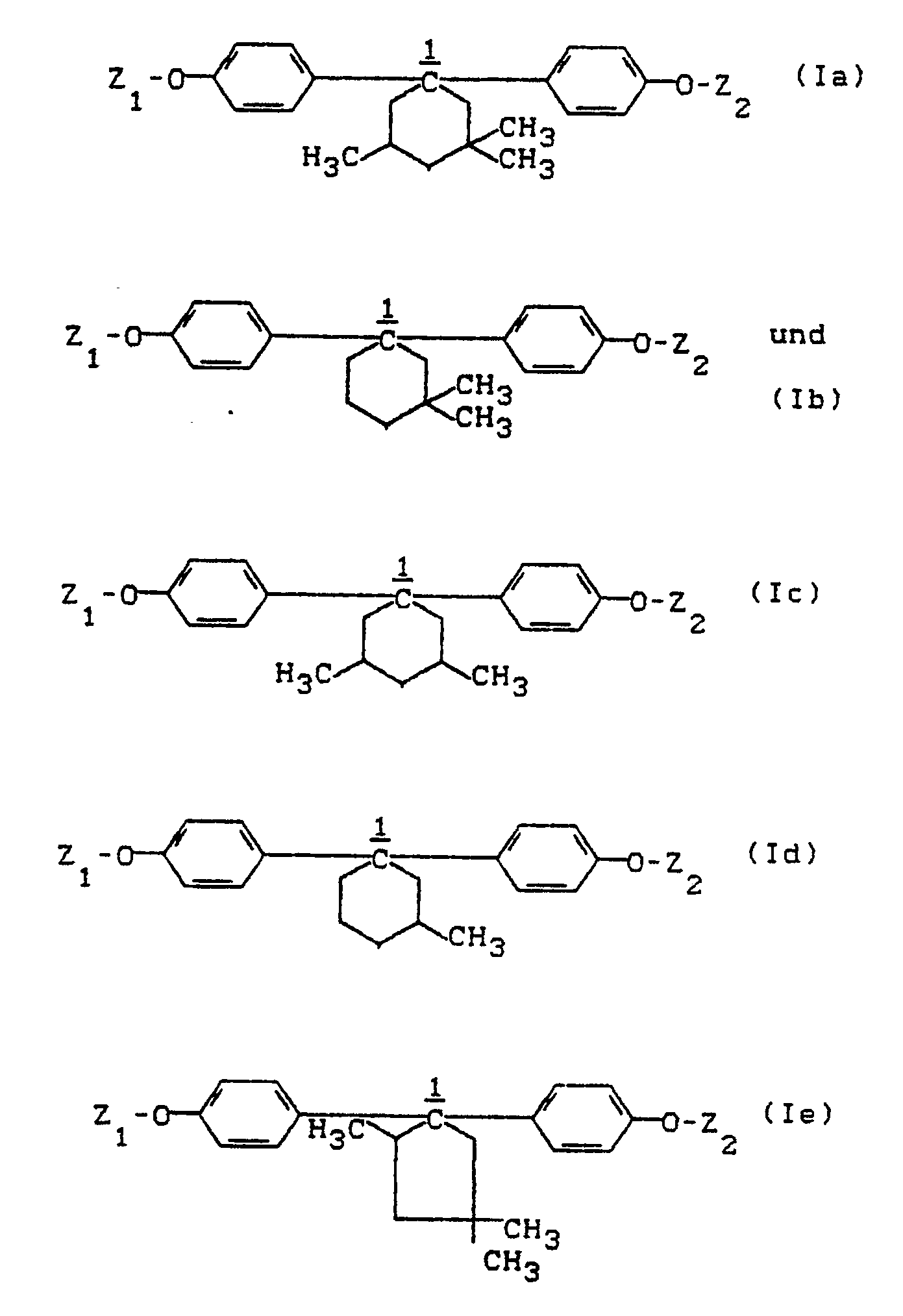
- Die Ausgangsmaterialien Dihydroxydiphenylcycloalkane der Formel (II)


- Die Herstellung von Bisphenolen der Formel (II) ist den unveröffentlichten deutschen Patentanmeldungen P 38 32 396 und P 38 33 953.6 zu entnehmen.
- Die Phenole der Formel (III) sind teilweise literaturbekannt oder nach literaturbekannten Verfahren erhält lich (siehe beispielsweise für Kresole und -Xylenole, Ullmanns Encyklopädie der technischen Chemie 4. neubearbeitete und erweiterte Auflage, Band 15, Seiten 61 - 77, Verlag Chemie-Weinheim-New York 1978; für Chlorphenole, Ullmanns Encyklopädie der technischen Chemie, 4. Auflage, Verlag Chemie, 1975, Band 9, Seiten 573-582; und für Alkylphenole, Ullmanns Encyklopädie der technischen Chemie, 4. Auflage, Verlag Chemie 1979, Band 18, Seiten 191-214).
- Beispiele für geeignete Phenole der Formel III sind: Phenol, o-Kresol, m-Kresol, 2,6-Dimethylphenol, 2-Chlorphenol, 3-Chlorphenol, 2,6-Dichlorphenol, 2-Cyclohexylphenol, Phenylphenole und o-Benzylphenol.
- Die Ketone der Formel (IV) sind literaturbekannt (siehe beispielsweise Beilsteins Handbuch der Organischen Chemie, 7. Band, 4. Auflage, Springer-Verlag, Berlin, 1925 und die entsprechenden Ergänzungsbände 1 bis 4; J. Am. Chem. Soc. Vol 79 (1957), Seiten 1488-1492; US-PS 2 692 289; Allen et al., J. Chem. Soc., (1959), 2186-2192 und J. Org. Chem. Vol. 38, (1973), Seiten 4431-4435; sowie J. Am. Chem. Soc. 87, (1965), Seite 1353-1364. Ein allgemeines Verfahren zur Herstellung von Ketonen der Formel ist beispielsweise in "Organikum, 15. Auflage, 1977, VEB-Deutscher Verlag der Wissenschaften, Berlin, beispielsweise Seite 698. beschrieben.
- Beispiele für (bekannte) Ketone der Formel (V) sind:
3,3-Dimethylcyclopentanon, 3,3-Dimethylcyclohexanon, 4,4-Dimethylcyclohexanon, 3-Ethyl-3-Methylcyclopentanon, 2,3,3-Trimethylcyclopentanon, 3,3,4-Trimethylcyclopenta non, 3,3-Dimethylcycloheptanon, 4,4-Dimethylcycloheptanon, 3-Ethyl-3-methylcyclohexanon, 4-Ethyl-4-methylcyclohexanon, 2,3,3-Trimethylcyclohexanon, 2,4,4-Trimethylcyclohexanon, 3,3,4-Trimethylcyclohexanon, 3,3,5-Trimethylcyclohexanon, 3,4,4-Trimethylcyclohexanon, 3,3,5-Trimethylcycloheptanon, 3,5,5-Trimethylcycloheptanon, 5-Ethyl-2,5-dimethylcycloheptanon, 2,3,3,5-Tetramethylcycloheptanon, 2,3,5,5-Tetramethylcycloheptanon, 3,3,5,5-Tetramethylcycloheptanon, 4-Ethyl-2,3,4-trimethylcyclopentanon, 3-Ethyl-4-isopropyl-3-methyl-cyclopentanon, 4-sec. Butyl-3,3-dimethylcyclopentanon, 2-Isopropyl-3,3,4-trimethylcyclopentanon, 3-Ethyl-4-isopropyl-3-methyl-cyclohexanon, 4-Ethyl-3-isopropyl-4-methyl-cyclohexanon, 3-sec.Butyl-4,4-dimethylcyclohexanon, 2-Butyl-3,3,4-trimethylcyclopentanon, 2-Butyl-3,3,4-trimethylcyclohexanon, 4-Butyl-3,3,5-trimethylcyclohexanon, 3-Isohexyl-3-methylcyclohexanon, 2,2-Dimethylcyclooctanon, und 3,3,8-Trimethylcyclooctanon. - Beispiele für bevorzugte Ketone sind

- Zur Bisphenolherstellung werden im allgemeinen 2 bis 10 Mol, vorzugsweise 2,5 bis 6 Mol Phenol (III) pro Mol Keton (IV), verwendet. Bevorzugte Reaktionszeiten betragen 1 bis 100 Stunden. Im allgemeinen arbeitet man bei Temperaturen von -30°C bis 300°C, vorzugsweise von -15°C bis 150°C und bei Drücken von 1 bis 20 bar, vorzugsweise von 1 bis 10 bar.
- Die Kondensation wird im allgemeinen in Gegenwart saurer Katalysatoren durchgeführt. Beispiele sind Chlorwasserstoff, Bromwasserstoff, Fluorwasserstoff, Bortrifluorid, Aluminiumtrichlorid, Zinkdichlorid, Titantetrachlorid, Zinntetrachlorid, Phosphorhalogenide, Phosphorpentoxid, Phosphorsäure, konzentrierte Salzsäure oder Schwefelsäure sowie Mischungen aus Essigsäure und Acetanhydrid. Die Verwendung saurer Ionenaustauscher ist ebenfalls möglich.
- Weiterhin kann die Umsetzung durch Zugabe von Co-Katalysatoren wie C₁-C₁₈-Alkyl-Mercaptanen, Schwefelwasserstoff, Thiophenolen, Thiosäuren und Dialkylsulfiden, bevorzugt in Mengen von 0,01 - 0,4 Mol/Mol Keton, insbesondere bevorzugt 0,05 - 0,2 Mol/Mol Keton beschleunigt werden.
- Die Kondensation kann ohne Lösungsmittel oder in Gegenwart eines inerten Lösungsmittels (z.B. aliphatischer und aromatischer Kohlenwasserstoff, Chlorkohlenwasserstoff) durchgeführt werden.
- In den Fällen, in denen der Katalysator gleichzeitig als wasserentziehendes Mittel fungiert, ist es nicht erforderlich, zusätzlich wasserentziehende Mittel einzusetzen, letzteres ist jedoch zur Erzielung guter Umsätze in jedem Fall dann vorteilhaft, wenn der eingesetzte Katalysator das Reaktionswasser nicht bindet.
- Geeignete wasserentziehende Mittel sind beispielsweise Acetanhydrid, Zeolithe, Polyphosphorsäure und Phosphorpentoxid.
- Man kann Phenol und Keton im Molverhältnis zwischen 2:1 und 10:1, vorzugsweise zwischen 2,5 : 1 und 6 : 1 bei Temperaturen zwischen -30°C und 300°C, vorzugsweise zwischen -15°C und 150°C und bei Drücken von 1 bis 20 bar, vorzugsweise von 1 bis 10 bar in Anwesenheit saurer Katalysatoren und gegebenenfalls in Anwesenheit von Co-Katalysatoen und/oder Lösungsmitteln und/oder wasserentziehenden Mitteln umsetzen.
- Bevorzugt sind in Formel (I) an 1 - 2 Atomen X, insbesondere nur an einem Atom X, R³ und R⁴ gleichzeitig Alkyl. Bevorzugter Alkylrest ist Methyl; ebenfalls verwendbar sind Ethyl oder C₃-C₆-Alkylreste, die geradkettig oder verzweigt sein können. Die X-Atome in α-Stellung zu dem di-phenylsubstituierten C-Atom (C-1) sind bevorzugt nicht dialkylsubstituiert, dagegen ist die Disubstitution mit Alkyl in β-Stellung in C-1 bevorzugt (3,3-Stellung). Eine weitere bevorzugte Substitution durch Alkyl ist in 5-Stellung.
- Die Herstellung von Verbindungen der Formel I ist Gegenstand der unveröffentlichen Patentanmeldung P 3 834 661.3 (Le A 26 341). Sie erfolgt beispielsweise durch Umsetzung von Dihydroxydiphenylcycloalkanen (II) (Bedeutung der Substituenten wie bei Formel (I)) in Form der Kaliumsalze mit p-Chlorbenzonitril und anschließende Verseifung der Nitril- zu Carboxylgruppen. Diamine lassen sich durch Reduktion der Nitril- zu Aminogruppen erhalten. Weitere Herstellungsbeispiele zu (II) sind im Beispielteil dieser Anmeldung angegeben.
- Als Diamine, die zusammen mit den erfindungsgemäß zu verwendenden Dicarbonsäuren eingesetzt werden, sind grundsätzlich alle zur Herstellung von Polyamiden in Betracht kommenden Diamine geeignet. Bevorzugte Beispiele sind Hexamethylendiamin, 2,2,4- und 2,4,4-Trimethylhexamethylendiamin, Isophorondiamin, m- und p-Xylylendiamin und die isomeren Bis-(4-aminocyclohexyl)-methane.
- Als Dicarbonsäuren, die zusammen mit den erfindungsgemäß zu verwendenden Diaminen I eingesetzt werden, kommen die üblichen, für die Basis Polyamide aufgeführten Dicarbonsäuren in Betracht.
- Der Anteil an den erfindungsgemäßen Copolyamideinheiten sollte 3-30 Gew.-%, vorzugsweise 5-20 Gew.-%, bezogen auf das Copolyamid, betragen. Er sollte jedoch wenigstens so hoch sein, daß die Glasübergangstemperatur gegenüber dem Basispolyamid um wenigstens 5°C erhöht ist.
- Als Basispolyamide kommen grundsätzlich alle Polyamide in Betracht. Von besonderer Bedeutung sind beispielsweise die teilkristallinen Polyamide 6, 46, 66, 610, 11, 12 sowie Copolyamide von Polyamid 6 oder 66 insbesondere mit Terephthalsäure und/oder Isophthalsäure und/oder Hexahydroterephthalsäure und Hexamethylendiamin, ferner die amorphen Polyamide aus Terephthalsäure und den isomeren Trimethylhexamethylendiaminen, Isophthalsäure und Hexamethylendiamin, Isophthalsäure, 3,3′-Dimethyl-4,4′-diaminodicyclohexylmethan und Laurinlactam, ferner aus Isophthalsäure, Terephthalsäure, Hexamethylendiamin und Bis-(4-aminocyclohexyl)-methan.
- Die Herstellung der erfindungsgemäßen Copolyamide erfolgt nach den aus dem Stand der Technik bekannten, kontinuierlichen oder diskontinuierlichen Verfahren, indem man die Monomeren direkt oder als Salz, gegebenenfalls unter Zusatz von Wasser, bei 200 - 300°C bis zum Erreichen des gewünschten Molekulargewichts polykondensiert. Man kann auch ein niedermolekulares Vorkondensat in der Festphase nachkondensieren.
- Die erfindungsgemäßen Copolyamide können die üblichen Zusätze, z.B. Hilfsmittel wie Gleit- und Entformungsmittel, Stabilisatoren, Flammschutzmittel, farbgebende Mittel, ferner Füllstoffe, insbesondere als Verstärkungsstoffe, Glasfasern in Mengen von 10-60 Gew.-%, bezogen auf die gesamte Mischung enthalten. Als weitere Füll- und Verstärkungsstoffe kommen Mikroglaskugeln, Kreide, Quarze wie beispielsweise Novaculit und Silikate wie Feldspat, Glimmer, Talkum, Wolastonit sowie Kaolin in kalzinierter und nicht kalzinierter Form, vorzugs weise in silanierter Form, in Betracht. Außerdem sind Farbstoffe und Pigmente, insbesondere Farbruße und/oder Nigrosinbasen zu nennen, ferner Schlagzähmodifikatoren-Zusätze beispielsweise auf der Basis von Copolymerisaten des Ethylens, Poly(meth)acrylaten, gepfropften Polybutadienen und SAN-Harzen.
- Die erfindungsgemäßen Copolyamide zeichnen sich durch eine erhöhte Glasübergangstemperatur aus, so daß sie gegenüber den Basispolyamiden ihre Steifigkeit bei erhöhter Temperatur behalten. Sie können daher Herstellung von Formkörpern, insbesondere für den Kraftfahrzeugsektor und für technische Geräte, dienen.
- Man kondensiert 108,90 g Salz aus Isophthalsäure und Hexamethylendiamin, 4,36 g 1,1-Bis-[4-(carboxyphenoxy)-phenyl]-3,3,5-trimethylcyclohexan und 1,82 g Hexamethylendiamin (in dieser Menge ist ein Überschuß von 2 % enthalten, um Verluste durch Verdampfen zu kompensieren) unter Rühren in einer Stickstoffatmosphäre zunächst 1 Stunde bei 220°C, dann 2 Stunden bei 270°C. Man erhält eine klare, fast farblose Schmelze. Das Copolyamid ist nach dem Erstarren transparent. Die relative Viskosität, gemessen an einer einprozentigen Lösung in m-Kresol bei 25°C in einem Ubbelohde-Viskosimeter, beträgt 2,6. Das Copolyamid hat eine Glasübergangstemperatur, bestimmt durch DSC, von 133°C.
- Wie in Beispiel 1 kondensiert man 91,70 g Salz aus Isophthalsäure und Hexamethylendiamin, 17,45 g 1,1-Bis[4-(carboxyphenoxy)-phenyl]-3,3,5-trimethylcyclohexan und 4,44 g Hexamethylendiamin (enthält 2 % Überschuß). Das Copolyamid ist nach dem Erstarren transparent. Die relative Viskosität beträgt 3,17. Die Glasübergangstemperatur ist 141°C.
- Wie in Beispiel 1 beschrieben, stellt man ein Polyamid nur aus Isophthalsäure und Hexamethylendiamin her. Das Produkt ist transparent, es hat eine relative Viskosität von 2,7 und eine Glasübergangstemperatur von 128°C.
- Man erhitzt 71 g ε-Caprolactam, 10,43 ε-Aminocapronsäure, 17,27 g 1,1-Bis-[carboxyphenoxy)-phenyl]-cyclohexan und 4,03 g Hexamethylendiamin (in dieser Menge ist ein Überschuß von 2 % enthalten) eine Stunde bei 200°C und 7 Stunden bei 270°C unter Rühren in einer Stickstoffatmosphäre. Das Polyamid ist nach dem Erstarren trübe, es hat eine relative Viskosität von 3,0 und eine Glasübergangstemperatur von 62°C.
- Die Polykondensation von 71 g ε-Caprolactam, 10,43 g ε-Aminocapronsäure, 17,45 g 1,1-Bis-[4-(carboxyphenoxy)-phenyl]-3,3,5-trimethylcyclohexan und 3,76 g Hexamethylendiamin wie in Beispiel 3 beschrieben, ergibt ein Polyamid mit einer relativen Viskosität von 3,1 und einer Glasübergangstemperatur von 66°C.
- Die Herstellung von Polyamid 6 analog Beispiel 3, jedoch ohne den erfindungsgemäßen Zusatz von 1,1-Bis[(4-carboxyphenoxy)-phenyl]-3,5,5-trimethylcyclohexan und Hexamethylendiamin, führt zu einem trüben Polyamid mit einer relativen Viskosität von 3,4 und einer Glasübergangstemperatur von 45°C.
-

- (0,05 M), 8,9 g 45 %ige Natronlauge (0,1 M), 100 ml Dimethylsulfoxid und 60 ml Toluol werden in einer Rührapparatur mit Wasserabscheider unter N₂ zum Rückfluß erhitzt, bis kein Wasser mehr abgeschieden wird. Danach wird statt Wasserabscheider eine Soxhlet-Apparatur aufgesetzt, die mit Molekularsieb 4 Å beschickt ist. Die Mischung wird 1 h unter N₂ zum Rückfluß erhitzt und anschließend die Soxhlet-Apparatur durch einen absteigenden Kühler ersetzt. Es wird so lange destilliert (in der Hauptsache Toluol), bis eine Innentemperatur von 145°C erreicht ist. Danach werden 23,4 g p-Nitrobenzoesäureethylester zugegeben und das Reaktionsgemisch unter N₂ 12 h bei 120°C umgesetzt. Nach Abkühlung wurde in viel H₂O eingegossen und mehrfach mit Methylenchlorid ausgeschüttelt. Die Methylenchlorid-Phasen wurden eindestilliert. Der Rückstand (11 g) wurde durch NMR-Spektroskopie als in der Hauptsache als Bisester

- Der Ester wurde alkalisch verseift und die Dicarbonsäure isoliert und aus Essigsäure umkristallisiert (Fp 273°C)
- In einem 1 l-Rundkolben mit Rührer, Tropftrichter, Thermometer, Rückflußkühler und Gaseinleitungsrohr werden 7,5 Mol (705 g) Phenol und 0,15 Mol (30,3 g) Dodecylthiol vorgelegt und bei 28 bis 30°C mit trockenem HCl-Gas gesättigt. Zu dieser Lösung werden innerhalb von 3 Stunden eine Lösung von 1,5 Mol (210 g) Dihydroisophoron (3,3,5-Trimethyl-cyclohexan-1-on) und 1,5 Mol (151 g) Phenol zugetropft, wobei weiterhin HCl-Gas durch die Reaktionslösung zugeleitet wird. Nach beendeter Zugabe leitet man für weitere 5 Stunden HCl-Gas ein. Man läßt 8 Stunden bei Zimmertemperatur nachreagieren. Anschließend wird das überschüssige Phenol durch Wasserdampfdestillation entfernt. Der verbleibende Rückstand wird zweimal mit Petrolether (60-90) und einmal mit Methylenchlorid heiß extrahiert und abfiltriert.
Ausbeute: 370 g 1,1-Bis(4-hydroxyphenyl)-3,3,5-trimethylcyclohexan.
Schmelzpunkt: 205 bis 207°C - Die Dicarbonsäure (6b) ist nach folgendem Verfahren über das Dinitril (6a) und dessen Verseifung zugänglich, das Diamin 6c aus dem Dinitril (6a) durch Reduktion:
- In einem 500-ml Dreihalskolben, ausgerüstet mit Rührer, Thermometer, Wasserabscheider und Rückflußkühler werden 40,2 g (0,15 mol) Bis-(4-hydroxyphenyl)cyclohexan (Bisphenol Z), 42,08 g (0,30 mol) 40 %ige Kalilauge, 80 g N,N′-Dimethylimidazolidin-2-on (DMI) und 100 ml Toluol chargiert und anschließend so lange am Rückfluß gehalten, bis alles Wasser aus dem System entfernt ist. Danach werden 41,25 g (0,30 mol) p-Chlorbenzonitril zugesetzt und die Reaktionsmischung auf 195°C erhitzt. Nach 6 h Reaktionszeit wird die Reaktionsmischung am Rotationsverdampfer eingeengt und aus n-Butanol umkristallisiert.
Ausbeute: 76,2 %
Schmelzpunkt: 160°C
Gesamtchlor: 0,014 %
anorganisches Chlor: 39 ppmElementaranalyse: C H N O theoretisch 81,7 5,53 5,96 6,81 gefunden 81,2 5,82 5,93 7,06 - Die ¹H- und ¹³C-NMR-Spektra entsprechen der chemischen Formel

- In einem 250-ml Dreihalskolben, ausgerüstet mit Rührer, Thermometer, Gaseinleitungsrohr und Rückflußkühler werden 18,8 g (0,04 mol) 1,1-Bis[4(cyanophenoxy) phenyl]-cyclohexan (aus Beispiel 5a)), 44,8 g (0,4 mol) 50 %ige Kalilauge und 50 ml DMI eingewogen. Die Reaktionsmischung wird unter Stickstoffeinleitung 24 h am Rückfluß gehalten. Während der Reaktion spaltet Ammoniak ab, und das anfangs kaum lösliche Nitril geht nach und nach in Lösung. Zum Schluß wird die Lösung klar. Das Fortschreiten der Reaktion wird durch Prüfung der Ammoniakentwicklung und durch Messung der Säurezahl des probeweise gefällten Produktes verfolgt. Nach beendeter Reaktion wird das Produkt durch Fällung in 600 ml verdünnter Salzsäure und anschließende Filtration isoliert.
Ausbeute: quantitativ
Schmelzpunkt: 240°C (Essigsäure)
Säurezahl (SZ): 218-220 (theoretisch 220)Elementaranalyse: C H O theoretisch 75,59 5,51 18,9 gefunden 74,80 5,56 19,0 - Die ¹H- und ¹³C-NMR-Spektra entsprechen der chemischen Formel

-

- Das Diamin ist durch LiAlH₄-Reduktion des Dinitrils von Beispiel 6a) in Tetrahydrofuran-Lösung zugänglich.
- 23,29 g des 1,1-Bis-(4-hydroxyphenyl)-3,3,5-trimethylcyclohexans (vgl. Beispiel 5) Dimethylsulfoxid und 65 ml Toluol werden in einer Rührapparatur mit Wasserabscheider unter N₂ zum Rückfluß erhitzt, bis kein Wasser mehr abgeschieden wird. Danach wird statt Wasserabscheider eine Soxhlet-Apparatur aufgesetzt, die mit Molekularsieb 4 Å beschicht ist. Die Mischung wird 1 h unter N₂ zum Rückfluß erhitzt und anschließend die Soxhlet-Apparatur durch einen absteigenden Kühler ersetzt. Es wird so lange destilliert (in der Hauptsache Toluol), bis eine Innentemperatur von 145°C erreicht ist. Danach werden 24,44 g 4-Nitrobenzonitril (0,165 M) zugegeben und das Reaktionsgemisch unter N₂ 7 h bei 100°C umgesetzt. Nach Abkühlen wurden die abgeschiedenen Kristalle abgesaugt, mit H₂O und anschließend mit Methanol gewaschen und getrocknet.
Ausbeute: 24,92 g (65 % d.Th.)
Schmelzpunkt; 177-178°CElementaranalyse: C H N berechnet: 82,0 6,29 5,46 gefunden: 81,7 6,55 5,66 - Das 1H- und das IR-Spektrum entsprechen der chemischen Formel des Dinitrils:

- In einem 250-ml-Dreihalskolben, ausgerüstet mit Rührer, Thermometer, Gaseinleitungsrohr und Rückflußkühler werden 20,46 g (0,04 mol) 1,1-Bis[4-(cyanophenoxy)-phenyl]-3,3,5-trimethylcyclohexan (aus Beispiel 7a), 44,8 g (0,4 mol) 50%ige Kalilauge und 50 ml DMI eingewogen. Die Reaktionsmischung wird unter Stickstoffeinleitung 24 h am Rückfluß gehalten. Während der Reaktion spaltet Ammoniak ab, und das anfangs kaum lösliche Nitril geht nach und nach in Lösung. Zum Schluß wird die Lösung klar. Das Fortschreiten der Reaktion wird durch Prüfung der Ammoniakentwicklung und durch Messung der Säurezahl des probeweise gefällten Produktes verfolgt. Nach beendeter Reaktion wird das Produkt durch Fällung in 600 ml verdünnter Salzsäure und anschließende Filtration isoliert.
- Die Ausbeute war quantitativ. Das Produkt zeigte folgende Eigenschaften:
Schmelzpunkt: 273°C (Essigsäure)
Säurezahl (SZ): 203 - 205 (theoretisch 204)Elementaranalyse: C H O berechnet 76,34 6,22 17,43 gefunden 76,20 6,33 17,60 - Das ¹H- und das ¹³C-IR-Spektrum bestätigen die chemische Formel der Dicarbonsäure:

- Das Diamin der Formel

- 35,5 g ε-Caprolactam, 5,22 g ε-Amino-capronsäure, 8,26 g 1,1-Bis-[4-(aminomethylphenoxy)-phenyl]-3,3,5-trimethylcyclohexan (7c) und 2,31 g Adipinsäure werden 1 Stunde auf 200°C und 6 Stunden auf 270°C erhitzt (unter N₂, leicht gerührt). Das gebildete Polyamid hat eine relative Viskosität von 3,1 (1 %, m-Kresol, 25°C) und eine Glasübergangstemperatur von 62°C.
- Beispiel 8 wird mit 8,13 g 1,1-Bis-[4-(aminomethylphenoxy)-phenyl]-acrylohexan (6c) anstelle des Diamin (7c) wiederholt. Es wird ein Polyamid mit einer relativen Viskosität von 3,5 und einer Glastemperatur von 61°C erhalten.
Claims (8)
1. Teilkristalline oder amorphe, gegebenenfalls übliche Zusatzstoffe enthaltende Copolyamide mit erhöhter Glastemperatur, dadurch gekennzeichnet, daß sie im Copolyamid
1) 3-30 Gew.-%, Polyamideinheiten aus
1a) einer Dicarbonsäure bzw. einem Diamin der Formel 
worin
Y₁ und Y₂ unabhängig voneinander für Sauerstoff- oder Schwefelstoffatome, bevorzugt jedoch Sauerstoffatome,
Z₁ und Z₂ unabhängig voneinander für o-, m- oder p-Carboxyphenyl, aliphatische Carbonsäurereste bzw. o-, m- oder p-Benzylamin, vorzugsweise jedoch für 4-Carboxyphenyl,
R₁ und R₂ unabhängig voneinander für Wasserstoff, Halogen (bevorzugt Chlor oder Brom), C₁-C₈-Alkyl, C₅-C₆-Cycloalkyl, C₆-C₁₀-Aryl und C₇-C₁₂-Aralkyl, bevorzugt Phenyl-C₁-C₄-alkyl, insbesondere Benzyl,
m für eine ganze Zahl von 4 bis 7, bevorzugt 4 oder 5,
R₃ und R₄ für jedes X individuell wählbar, unabhängig voneinander Wasserstoff ein C₁-C₁₂-Alkyl oder C₁-C₁₂-Isoalkyl,
und
X für Kohlenstoff steht,
und
1b) einem Diamin bzw. einer Dicarbonsäure,
enthalten und
2) die restlichen Polyamideinheiten des Basispolyamids aus üblichen Polyamiden auf Basis Lactamen, Aminocarbonsäuren, und/oder Diaminen/Dicarbonsäuren bestehen
und das Copolyamid eine gegenüber dem Basispolyamid um wenigstens 5°C erhöhte Glasübergangstemperatur aufweist.
1) 3-30 Gew.-%, Polyamideinheiten aus
1a) einer Dicarbonsäure bzw. einem Diamin der Formel
Y₁ und Y₂ unabhängig voneinander für Sauerstoff- oder Schwefelstoffatome, bevorzugt jedoch Sauerstoffatome,
Z₁ und Z₂ unabhängig voneinander für o-, m- oder p-Carboxyphenyl, aliphatische Carbonsäurereste bzw. o-, m- oder p-Benzylamin, vorzugsweise jedoch für 4-Carboxyphenyl,
R₁ und R₂ unabhängig voneinander für Wasserstoff, Halogen (bevorzugt Chlor oder Brom), C₁-C₈-Alkyl, C₅-C₆-Cycloalkyl, C₆-C₁₀-Aryl und C₇-C₁₂-Aralkyl, bevorzugt Phenyl-C₁-C₄-alkyl, insbesondere Benzyl,
m für eine ganze Zahl von 4 bis 7, bevorzugt 4 oder 5,
R₃ und R₄ für jedes X individuell wählbar, unabhängig voneinander Wasserstoff ein C₁-C₁₂-Alkyl oder C₁-C₁₂-Isoalkyl,
und
X für Kohlenstoff steht,
und
1b) einem Diamin bzw. einer Dicarbonsäure,
enthalten und
2) die restlichen Polyamideinheiten des Basispolyamids aus üblichen Polyamiden auf Basis Lactamen, Aminocarbonsäuren, und/oder Diaminen/Dicarbonsäuren bestehen
und das Copolyamid eine gegenüber dem Basispolyamid um wenigstens 5°C erhöhte Glasübergangstemperatur aufweist.
2. Copolyamide gemäß Anspruch 1, dadurch gekennzeichnet, daß 5 bis 20 Gew.-% Polyamideinheiten aus I1a) bzw. I1b) im Copolyamid enthalten sind.
3. Copolyamide gemäß Ansprüchen 1 und 2, dadurch gekennzeichnet, daß die Copolyamideinheiten 1 so aufgebaut sind, daß die Reste R₁ und R₂ Wasserstoff und die Reste R₃ und R₄ Wasserstoff oder Methyl sind, wobei mindestens einer der Reste R₃ oder R₄ Methyl sein muß.
4. Copolyamide gemäß Ansprüchen 1 bis 3, dadurch gekennzeichnet, daß die Copolyamideinheiten I so aufgebaut sind, daß zumindest an einem Kohlenstoffatom X die Reste R₃ und R₄ gleichzeitig Alkyl sind.
5. Copolyamide gemäß Ansprüchen 1 bis 2, dadurch gekennzeichnet, daß sie den Formel (Ia) bis (Ie) entsprechen.
6. Copolyamide gemäß Ansprüchen 1 bis 5, dadurch gekennzeichnet, daß die Dicarbonsäure 1,1-Bis-[4-(carboxyphenoxy)-phenyl]-cyclohexan oder 1,1-Bis-[4-(carboxyphenoxy)-phenyl]-3,3,5-trimethylcyclohexan ist.
7. Copolyamide gemäß Ansprüchen 1-6, dadurch gekennzeichnet, daß das Diamin 1,1-Bis-[4-(aminomethylphenoxy)-phenyl-]-cyclohexan oder 1,1-Bis-[4-(aminomethylphenoxy)-phenyl-]-3,3,5-trimethylcyclohexan ist.
8. Copolyamide gemäß Ansprüchen 1 bis 7, dadurch gekennzeichnet, daß sie 10-60 Gew.-% Glasfasern enthalten.
Applications Claiming Priority (2)
| Application Number | Priority Date | Filing Date | Title |
|---|---|---|---|
| DE19893927321 DE3927321A1 (de) | 1989-08-18 | 1989-08-18 | Copolyamide mit erhoehter glasuebergangstemperatur |
| DE3927321 | 1989-08-18 |
Publications (1)
| Publication Number | Publication Date |
|---|---|
| EP0413233A2 true EP0413233A2 (de) | 1991-02-20 |
Family
ID=6387383
Family Applications (1)
| Application Number | Title | Priority Date | Filing Date |
|---|---|---|---|
| EP19900115121 Withdrawn EP0413233A2 (de) | 1989-08-18 | 1990-08-07 | Copolyamide mit erhöhter Glasübergangstemperatur |
Country Status (3)
| Country | Link |
|---|---|
| EP (1) | EP0413233A2 (de) |
| JP (1) | JPH0391531A (de) |
| DE (1) | DE3927321A1 (de) |
Cited By (1)
| Publication number | Priority date | Publication date | Assignee | Title |
|---|---|---|---|---|
| EP0576951A1 (de) * | 1992-07-03 | 1994-01-05 | Bayer Ag | Schwerentflammbare Polyamidformmassen |
Families Citing this family (1)
| Publication number | Priority date | Publication date | Assignee | Title |
|---|---|---|---|---|
| CN110156985B (zh) * | 2019-04-30 | 2021-12-21 | 珠海派锐尔新材料有限公司 | 一种高流动无规共聚半芳香尼龙及其制备方法 |
-
1989
- 1989-08-18 DE DE19893927321 patent/DE3927321A1/de not_active Withdrawn
-
1990
- 1990-08-07 EP EP19900115121 patent/EP0413233A2/de not_active Withdrawn
- 1990-08-14 JP JP21382790A patent/JPH0391531A/ja active Pending
Cited By (1)
| Publication number | Priority date | Publication date | Assignee | Title |
|---|---|---|---|---|
| EP0576951A1 (de) * | 1992-07-03 | 1994-01-05 | Bayer Ag | Schwerentflammbare Polyamidformmassen |
Also Published As
| Publication number | Publication date |
|---|---|
| DE3927321A1 (de) | 1991-02-21 |
| JPH0391531A (ja) | 1991-04-17 |
Similar Documents
| Publication | Publication Date | Title |
|---|---|---|
| DE3788891T2 (de) | Arylcyclobuten enthaltende Zusammenstellungen und polymerische Zusammenstellungen, die daraus hergestellt werden. | |
| EP0363760A1 (de) | Aromatische Ether | |
| EP0279387B1 (de) | Verfahren zur Isolierung von 4,4'-Dichlordiphenylsulfon | |
| US2794822A (en) | Novel dibasic aromatic acids and derivatives thereof | |
| DE2116262A1 (de) | Diketopiperazinrmge enthaltende Verbindungen und Verfahren zu ihrer Her stellung | |
| EP0023572A1 (de) | Verfahren zur Herstellung von Gemischen alkylierter aromatischer Polyhydroxyverbindungen, diese Produktmischungen und deren Verwendung zur Herstellung von Polycarbonaten | |
| DE2730991A1 (de) | Herstellung von halogenphenolen | |
| DE3927321A1 (de) | Copolyamide mit erhoehter glasuebergangstemperatur | |
| EP0175151A1 (de) | 2,4-Dichlor-3-alkyl-6-nitrophenole sowie ein Verfahren zu deren Herstellung | |
| EP0711744B1 (de) | Verfahren zur Herstellung von acylsubstituierten Resorcinolen | |
| EP0498847B1 (de) | Verfahren zur herstellung von 1,4-bis-(4-hydroxybenzoyl)-benzol | |
| EP0069062B1 (de) | Aminoalkylsubstituierte aromatische Amine und ein Verfahren zu deren Herstellung | |
| DE1004168B (de) | Verfahren zur Herstellung von dimeren m-Isopropenylphenolen | |
| EP1506163A1 (de) | Verfahren zur katalysatorfreien herstellung von alkoxybenzonitrilen | |
| DE3445644A1 (de) | Neue diaminoalkyldiphenylether, ein verfahren zu ihrer herstellung sowie deren verwendung | |
| EP0332124B1 (de) | Verfahren zur Herstellung von halogenhaltigen aromatischen Verbindungen | |
| EP0077537B1 (de) | Verfahren zur Herstellung von 6-Chlor-3-toluidin-4-sulfonsäure | |
| US3419611A (en) | Hydrated 1,3-diaminoadamantanes and preparation thereof | |
| DE1909520B2 (de) | Verfahren zur herstellung aromatischer diamine | |
| DE112005000006T5 (de) | Verfahren zur Herstellung einer Polysulfidverbindung und diese enthaltende Kautschukzusammensetzung | |
| DE3542481A1 (de) | Verfahren zur herstellung aromatischer polyketone | |
| EP0558943B1 (de) | Fluorsubstituierte vicinale Glykole, ein Verfahren zu ihrer Herstellung sowie ihre Verwendung | |
| DE3531838A1 (de) | Verfahren zur herstellung von bis-(fluorbenzoyl)-verbindungen | |
| EP0313948A2 (de) | Verfahren zur Herstellung von aromatischen Polyethersulfonen | |
| AT357145B (de) | Verfahren zur herstellung von trans-cyclohexan- 1,4-diisocyanat |
Legal Events
| Date | Code | Title | Description |
|---|---|---|---|
| PUAI | Public reference made under article 153(3) epc to a published international application that has entered the european phase |
Free format text: ORIGINAL CODE: 0009012 |
|
| 17P | Request for examination filed |
Effective date: 19900813 |
|
| AK | Designated contracting states |
Kind code of ref document: A2 Designated state(s): DE FR GB IT |
|
| 18W | Application withdrawn |
Withdrawal date: 19910312 |
|
| STAA | Information on the status of an ep patent application or granted ep patent |
Free format text: STATUS: THE APPLICATION HAS BEEN WITHDRAWN |
|
| R18W | Application withdrawn (corrected) |
Effective date: 19910312 |