EP0413277A1 - Peptide mit bradykininantagonistischer Wirkung - Google Patents
Peptide mit bradykininantagonistischer Wirkung Download PDFInfo
- Publication number
- EP0413277A1 EP0413277A1 EP90115455A EP90115455A EP0413277A1 EP 0413277 A1 EP0413277 A1 EP 0413277A1 EP 90115455 A EP90115455 A EP 90115455A EP 90115455 A EP90115455 A EP 90115455A EP 0413277 A1 EP0413277 A1 EP 0413277A1
- Authority
- EP
- European Patent Office
- Prior art keywords
- substituted
- formula
- aryl
- amino
- peptide
- Prior art date
- Legal status (The legal status is an assumption and is not a legal conclusion. Google has not performed a legal analysis and makes no representation as to the accuracy of the status listed.)
- Granted
Links
- 108090000765 processed proteins & peptides Proteins 0.000 title claims abstract description 66
- 101800004538 Bradykinin Proteins 0.000 title claims abstract description 12
- QXZGBUJJYSLZLT-UHFFFAOYSA-N H-Arg-Pro-Pro-Gly-Phe-Ser-Pro-Phe-Arg-OH Natural products NC(N)=NCCCC(N)C(=O)N1CCCC1C(=O)N1C(C(=O)NCC(=O)NC(CC=2C=CC=CC=2)C(=O)NC(CO)C(=O)N2C(CCC2)C(=O)NC(CC=2C=CC=CC=2)C(=O)NC(CCCN=C(N)N)C(O)=O)CCC1 QXZGBUJJYSLZLT-UHFFFAOYSA-N 0.000 title claims abstract description 12
- QXZGBUJJYSLZLT-FDISYFBBSA-N bradykinin Chemical compound NC(=N)NCCC[C@H](N)C(=O)N1CCC[C@H]1C(=O)N1[C@H](C(=O)NCC(=O)N[C@@H](CC=2C=CC=CC=2)C(=O)N[C@@H](CO)C(=O)N2[C@@H](CCC2)C(=O)N[C@@H](CC=2C=CC=CC=2)C(=O)N[C@@H](CCCNC(N)=N)C(O)=O)CCC1 QXZGBUJJYSLZLT-FDISYFBBSA-N 0.000 title claims abstract description 12
- 102100035792 Kininogen-1 Human genes 0.000 title 1
- 239000005557 antagonist Substances 0.000 title 1
- -1 aromatic amino acid Chemical class 0.000 claims abstract description 65
- 150000001413 amino acids Chemical class 0.000 claims abstract description 23
- 125000003118 aryl group Chemical group 0.000 claims abstract description 18
- 125000004391 aryl sulfonyl group Chemical group 0.000 claims abstract description 14
- 125000004435 hydrogen atom Chemical class [H]* 0.000 claims abstract description 14
- 125000001072 heteroaryl group Chemical group 0.000 claims abstract description 12
- 102400000967 Bradykinin Human genes 0.000 claims abstract description 11
- 239000001257 hydrogen Substances 0.000 claims abstract description 11
- 229910052739 hydrogen Inorganic materials 0.000 claims abstract description 11
- 125000004453 alkoxycarbonyl group Chemical group 0.000 claims abstract description 9
- 125000001589 carboacyl group Chemical group 0.000 claims abstract description 8
- 125000000217 alkyl group Chemical group 0.000 claims abstract description 6
- 125000004390 alkyl sulfonyl group Chemical group 0.000 claims abstract description 4
- 101710097732 Bradykinin-related peptides Proteins 0.000 claims abstract description 3
- 230000001575 pathological effect Effects 0.000 claims abstract description 3
- 150000003254 radicals Chemical class 0.000 claims description 31
- 235000001014 amino acid Nutrition 0.000 claims description 24
- 125000006239 protecting group Chemical group 0.000 claims description 22
- 229910052736 halogen Inorganic materials 0.000 claims description 15
- 150000002367 halogens Chemical class 0.000 claims description 15
- 150000001875 compounds Chemical class 0.000 claims description 14
- 125000002795 guanidino group Chemical group C(N)(=N)N* 0.000 claims description 13
- ODKSFYDXXFIFQN-BYPYZUCNSA-N L-arginine Chemical compound OC(=O)[C@@H](N)CCCN=C(N)N ODKSFYDXXFIFQN-BYPYZUCNSA-N 0.000 claims description 12
- KDXKERNSBIXSRK-YFKPBYRVSA-N L-lysine Chemical group NCCCC[C@H](N)C(O)=O KDXKERNSBIXSRK-YFKPBYRVSA-N 0.000 claims description 12
- 125000003282 alkyl amino group Chemical group 0.000 claims description 12
- 125000003917 carbamoyl group Chemical group [H]N([H])C(*)=O 0.000 claims description 12
- WRHZVMBBRYBTKZ-UHFFFAOYSA-N pyrrole-2-carboxylic acid Chemical compound OC(=O)C1=CC=CN1 WRHZVMBBRYBTKZ-UHFFFAOYSA-N 0.000 claims description 12
- 125000000229 (C1-C4)alkoxy group Chemical group 0.000 claims description 11
- COLNVLDHVKWLRT-MRVPVSSYSA-N D-phenylalanine Chemical compound OC(=O)[C@H](N)CC1=CC=CC=C1 COLNVLDHVKWLRT-MRVPVSSYSA-N 0.000 claims description 10
- 125000000623 heterocyclic group Chemical group 0.000 claims description 10
- 125000004178 (C1-C4) alkyl group Chemical group 0.000 claims description 9
- 125000004397 aminosulfonyl group Chemical group NS(=O)(=O)* 0.000 claims description 9
- 150000003839 salts Chemical class 0.000 claims description 9
- 229930182832 D-phenylalanine Natural products 0.000 claims description 8
- 125000003277 amino group Chemical group 0.000 claims description 8
- 238000002360 preparation method Methods 0.000 claims description 8
- COLNVLDHVKWLRT-QMMMGPOBSA-N L-phenylalanine Chemical compound OC(=O)[C@@H](N)CC1=CC=CC=C1 COLNVLDHVKWLRT-QMMMGPOBSA-N 0.000 claims description 7
- ONIBWKKTOPOVIA-UHFFFAOYSA-N Proline Chemical compound OC(=O)C1CCCN1 ONIBWKKTOPOVIA-UHFFFAOYSA-N 0.000 claims description 7
- 125000002924 primary amino group Chemical group [H]N([H])* 0.000 claims description 7
- 125000004169 (C1-C6) alkyl group Chemical group 0.000 claims description 6
- 125000006552 (C3-C8) cycloalkyl group Chemical group 0.000 claims description 6
- IJGRMHOSHXDMSA-UHFFFAOYSA-N Atomic nitrogen Chemical compound N#N IJGRMHOSHXDMSA-UHFFFAOYSA-N 0.000 claims description 6
- UFHFLCQGNIYNRP-UHFFFAOYSA-N Hydrogen Chemical compound [H][H] UFHFLCQGNIYNRP-UHFFFAOYSA-N 0.000 claims description 6
- 210000004899 c-terminal region Anatomy 0.000 claims description 6
- 239000012634 fragment Substances 0.000 claims description 6
- 125000002496 methyl group Chemical group [H]C([H])([H])* 0.000 claims description 6
- DOYOPBSXEIZLRE-UHFFFAOYSA-N pyrrole-3-carboxylic acid Natural products OC(=O)C=1C=CNC=1 DOYOPBSXEIZLRE-UHFFFAOYSA-N 0.000 claims description 6
- OUYCCCASQSFEME-QMMMGPOBSA-N L-tyrosine Chemical compound OC(=O)[C@@H](N)CC1=CC=C(O)C=C1 OUYCCCASQSFEME-QMMMGPOBSA-N 0.000 claims description 5
- 125000001997 phenyl group Chemical group [H]C1=C([H])C([H])=C(*)C([H])=C1[H] 0.000 claims description 5
- GEYBMYRBIABFTA-VIFPVBQESA-N O-methyl-L-tyrosine Chemical compound COC1=CC=C(C[C@H](N)C(O)=O)C=C1 GEYBMYRBIABFTA-VIFPVBQESA-N 0.000 claims description 4
- 125000004432 carbon atom Chemical group C* 0.000 claims description 4
- 125000003178 carboxy group Chemical group [H]OC(*)=O 0.000 claims description 4
- 229910052801 chlorine Inorganic materials 0.000 claims description 4
- 239000000460 chlorine Substances 0.000 claims description 4
- 125000000956 methoxy group Chemical group [H]C([H])([H])O* 0.000 claims description 4
- COLNVLDHVKWLRT-UHFFFAOYSA-N phenylalanine Natural products OC(=O)C(N)CC1=CC=CC=C1 COLNVLDHVKWLRT-UHFFFAOYSA-N 0.000 claims description 4
- OUYCCCASQSFEME-UHFFFAOYSA-N tyrosine Natural products OC(=O)C(N)CC1=CC=C(O)C=C1 OUYCCCASQSFEME-UHFFFAOYSA-N 0.000 claims description 4
- 125000004768 (C1-C4) alkylsulfinyl group Chemical group 0.000 claims description 3
- 125000004769 (C1-C4) alkylsulfonyl group Chemical group 0.000 claims description 3
- 125000004209 (C1-C8) alkyl group Chemical group 0.000 claims description 3
- BWKMGYQJPOAASG-UHFFFAOYSA-N 1,2,3,4-tetrahydroisoquinoline-3-carboxylic acid Chemical compound C1=CC=C2CNC(C(=O)O)CC2=C1 BWKMGYQJPOAASG-UHFFFAOYSA-N 0.000 claims description 3
- 125000004105 2-pyridyl group Chemical group N1=C([*])C([H])=C([H])C([H])=C1[H] 0.000 claims description 3
- 125000000175 2-thienyl group Chemical group S1C([*])=C([H])C([H])=C1[H] 0.000 claims description 3
- 125000003349 3-pyridyl group Chemical group N1=C([H])C([*])=C([H])C([H])=C1[H] 0.000 claims description 3
- 125000001541 3-thienyl group Chemical group S1C([H])=C([*])C([H])=C1[H] 0.000 claims description 3
- 125000004203 4-hydroxyphenyl group Chemical group [H]OC1=C([H])C([H])=C(*)C([H])=C1[H] 0.000 claims description 3
- 125000004172 4-methoxyphenyl group Chemical group [H]C1=C([H])C(OC([H])([H])[H])=C([H])C([H])=C1* 0.000 claims description 3
- WKBOTKDWSSQWDR-UHFFFAOYSA-N Bromine atom Chemical group [Br] WKBOTKDWSSQWDR-UHFFFAOYSA-N 0.000 claims description 3
- 125000004104 aryloxy group Chemical group 0.000 claims description 3
- GDTBXPJZTBHREO-UHFFFAOYSA-N bromine Chemical group BrBr GDTBXPJZTBHREO-UHFFFAOYSA-N 0.000 claims description 3
- 229910052794 bromium Inorganic materials 0.000 claims description 3
- 125000004093 cyano group Chemical group *C#N 0.000 claims description 3
- 125000004122 cyclic group Chemical group 0.000 claims description 3
- 125000000113 cyclohexyl group Chemical group [H]C1([H])C([H])([H])C([H])([H])C([H])(*)C([H])([H])C1([H])[H] 0.000 claims description 3
- HXEACLLIILLPRG-RXMQYKEDSA-N l-pipecolic acid Natural products OC(=O)[C@H]1CCCCN1 HXEACLLIILLPRG-RXMQYKEDSA-N 0.000 claims description 3
- 125000000449 nitro group Chemical class [O-][N+](*)=O 0.000 claims description 3
- 229910052757 nitrogen Inorganic materials 0.000 claims description 3
- 125000000636 p-nitrophenyl group Chemical group [H]C1=C([H])C(=C([H])C([H])=C1*)[N+]([O-])=O 0.000 claims description 3
- 125000005544 phthalimido group Chemical group 0.000 claims description 3
- HXEACLLIILLPRG-UHFFFAOYSA-N pipecolic acid Chemical compound OC(=O)C1CCCCN1 HXEACLLIILLPRG-UHFFFAOYSA-N 0.000 claims description 3
- IYKLZBIWFXPUCS-VIFPVBQESA-N (2s)-2-(naphthalen-1-ylamino)propanoic acid Chemical compound C1=CC=C2C(N[C@@H](C)C(O)=O)=CC=CC2=C1 IYKLZBIWFXPUCS-VIFPVBQESA-N 0.000 claims description 2
- CNMAQBJBWQQZFZ-LURJTMIESA-N (2s)-2-(pyridin-2-ylamino)propanoic acid Chemical compound OC(=O)[C@H](C)NC1=CC=CC=N1 CNMAQBJBWQQZFZ-LURJTMIESA-N 0.000 claims description 2
- CVZZNRXMDCOHBG-UHFFFAOYSA-N 2-azaniumyl-3-(2-chlorophenyl)propanoate Chemical compound OC(=O)C(N)CC1=CC=CC=C1Cl CVZZNRXMDCOHBG-UHFFFAOYSA-N 0.000 claims description 2
- WTOFYLAWDLQMBZ-UHFFFAOYSA-N 2-azaniumyl-3-thiophen-2-ylpropanoate Chemical compound OC(=O)C(N)CC1=CC=CS1 WTOFYLAWDLQMBZ-UHFFFAOYSA-N 0.000 claims description 2
- NYCRCTMDYITATC-UHFFFAOYSA-N 2-fluorophenylalanine Chemical compound OC(=O)C(N)CC1=CC=CC=C1F NYCRCTMDYITATC-UHFFFAOYSA-N 0.000 claims description 2
- JJDJLFDGCUYZMN-QMMMGPOBSA-N 3-chloro-L-phenylalanine Chemical compound OC(=O)[C@@H](N)CC1=CC=CC(Cl)=C1 JJDJLFDGCUYZMN-QMMMGPOBSA-N 0.000 claims description 2
- XWHHYOYVRVGJJY-QMMMGPOBSA-N 4-fluoro-L-phenylalanine Chemical compound OC(=O)[C@@H](N)CC1=CC=C(F)C=C1 XWHHYOYVRVGJJY-QMMMGPOBSA-N 0.000 claims description 2
- 125000001255 4-fluorophenyl group Chemical group [H]C1=C([H])C(*)=C([H])C([H])=C1F 0.000 claims description 2
- NIGWMJHCCYYCSF-UHFFFAOYSA-N Fenclonine Chemical compound OC(=O)C(N)CC1=CC=C(Cl)C=C1 NIGWMJHCCYYCSF-UHFFFAOYSA-N 0.000 claims description 2
- QUOGESRFPZDMMT-YFKPBYRVSA-N L-homoarginine Chemical group OC(=O)[C@@H](N)CCCCNC(N)=N QUOGESRFPZDMMT-YFKPBYRVSA-N 0.000 claims description 2
- LEIKGVHQTKHOLM-IUCAKERBSA-N Pro-Pro-Gly Chemical compound OC(=O)CNC(=O)[C@@H]1CCCN1C(=O)[C@H]1NCCC1 LEIKGVHQTKHOLM-IUCAKERBSA-N 0.000 claims description 2
- 230000002378 acidificating effect Effects 0.000 claims description 2
- 125000001931 aliphatic group Chemical group 0.000 claims description 2
- 125000004429 atom Chemical group 0.000 claims description 2
- WTOFYLAWDLQMBZ-LURJTMIESA-N beta(2-thienyl)alanine Chemical compound OC(=O)[C@@H](N)CC1=CC=CS1 WTOFYLAWDLQMBZ-LURJTMIESA-N 0.000 claims description 2
- 125000001309 chloro group Chemical group Cl* 0.000 claims description 2
- 125000005553 heteroaryloxy group Chemical group 0.000 claims description 2
- VWHRYODZTDMVSS-QMMMGPOBSA-N m-fluoro-L-phenylalanine Chemical compound OC(=O)[C@@H](N)CC1=CC=CC(F)=C1 VWHRYODZTDMVSS-QMMMGPOBSA-N 0.000 claims description 2
- 230000001404 mediated effect Effects 0.000 claims description 2
- 230000007935 neutral effect Effects 0.000 claims description 2
- 125000003854 p-chlorophenyl group Chemical group [H]C1=C([H])C(*)=C([H])C([H])=C1Cl 0.000 claims description 2
- 108010087846 prolyl-prolyl-glycine Proteins 0.000 claims description 2
- 230000001960 triggered effect Effects 0.000 claims description 2
- 125000002887 hydroxy group Chemical group [H]O* 0.000 claims 3
- 239000008194 pharmaceutical composition Substances 0.000 claims 1
- 102000004196 processed proteins & peptides Human genes 0.000 abstract description 29
- 238000000034 method Methods 0.000 abstract description 20
- 238000010647 peptide synthesis reaction Methods 0.000 abstract description 3
- 230000001225 therapeutic effect Effects 0.000 abstract description 2
- 239000003152 bradykinin antagonist Substances 0.000 abstract 1
- 125000000753 cycloalkyl group Chemical group 0.000 abstract 1
- 239000011347 resin Substances 0.000 description 27
- 229920005989 resin Polymers 0.000 description 27
- 230000015572 biosynthetic process Effects 0.000 description 18
- 238000003786 synthesis reaction Methods 0.000 description 18
- ZMXDDKWLCZADIW-UHFFFAOYSA-N N,N-Dimethylformamide Chemical compound CN(C)C=O ZMXDDKWLCZADIW-UHFFFAOYSA-N 0.000 description 17
- YMWUJEATGCHHMB-UHFFFAOYSA-N Dichloromethane Chemical compound ClCCl YMWUJEATGCHHMB-UHFFFAOYSA-N 0.000 description 16
- 239000000243 solution Substances 0.000 description 15
- DTQVDTLACAAQTR-UHFFFAOYSA-N Trifluoroacetic acid Chemical compound OC(=O)C(F)(F)F DTQVDTLACAAQTR-UHFFFAOYSA-N 0.000 description 14
- 150000003862 amino acid derivatives Chemical class 0.000 description 13
- 125000003088 (fluoren-9-ylmethoxy)carbonyl group Chemical group 0.000 description 11
- 238000005859 coupling reaction Methods 0.000 description 11
- 230000008878 coupling Effects 0.000 description 9
- 238000010168 coupling process Methods 0.000 description 9
- SECXISVLQFMRJM-UHFFFAOYSA-N N-Methylpyrrolidone Chemical compound CN1CCCC1=O SECXISVLQFMRJM-UHFFFAOYSA-N 0.000 description 7
- QTBSBXVTEAMEQO-UHFFFAOYSA-N Acetic acid Chemical compound CC(O)=O QTBSBXVTEAMEQO-UHFFFAOYSA-N 0.000 description 6
- NQRYJNQNLNOLGT-UHFFFAOYSA-N Piperidine Chemical compound C1CCNCC1 NQRYJNQNLNOLGT-UHFFFAOYSA-N 0.000 description 6
- 239000003153 chemical reaction reagent Substances 0.000 description 6
- KRKNYBCHXYNGOX-UHFFFAOYSA-N citric acid Chemical compound OC(=O)CC(O)(C(O)=O)CC(O)=O KRKNYBCHXYNGOX-UHFFFAOYSA-N 0.000 description 6
- 150000002148 esters Chemical class 0.000 description 6
- 125000004356 hydroxy functional group Chemical group O* 0.000 description 6
- DVBUCBXGDWWXNY-SFHVURJKSA-N (2s)-5-(diaminomethylideneamino)-2-(9h-fluoren-9-ylmethoxycarbonylamino)pentanoic acid Chemical compound C1=CC=C2C(COC(=O)N[C@@H](CCCN=C(N)N)C(O)=O)C3=CC=CC=C3C2=C1 DVBUCBXGDWWXNY-SFHVURJKSA-N 0.000 description 5
- NPZTUJOABDZTLV-UHFFFAOYSA-N hydroxybenzotriazole Substances O=C1C=CC=C2NNN=C12 NPZTUJOABDZTLV-UHFFFAOYSA-N 0.000 description 5
- 239000000203 mixture Substances 0.000 description 5
- 239000002904 solvent Substances 0.000 description 5
- BDNKZNFMNDZQMI-UHFFFAOYSA-N 1,3-diisopropylcarbodiimide Chemical compound CC(C)N=C=NC(C)C BDNKZNFMNDZQMI-UHFFFAOYSA-N 0.000 description 4
- ASOKPJOREAFHNY-UHFFFAOYSA-N 1-Hydroxybenzotriazole Chemical compound C1=CC=C2N(O)N=NC2=C1 ASOKPJOREAFHNY-UHFFFAOYSA-N 0.000 description 4
- QOSSAOTZNIDXMA-UHFFFAOYSA-N Dicylcohexylcarbodiimide Chemical compound C1CCCCC1N=C=NC1CCCCC1 QOSSAOTZNIDXMA-UHFFFAOYSA-N 0.000 description 4
- AHVYPIQETPWLSZ-UHFFFAOYSA-N N-methyl-pyrrolidine Natural products CN1CC=CC1 AHVYPIQETPWLSZ-UHFFFAOYSA-N 0.000 description 4
- 230000001476 alcoholic effect Effects 0.000 description 4
- 150000001408 amides Chemical class 0.000 description 4
- 125000001797 benzyl group Chemical group [H]C1=C([H])C([H])=C(C([H])=C1[H])C([H])([H])* 0.000 description 4
- 230000008569 process Effects 0.000 description 4
- 238000010532 solid phase synthesis reaction Methods 0.000 description 4
- 239000000725 suspension Substances 0.000 description 4
- 230000002792 vascular Effects 0.000 description 4
- ZAMOUSCENKQFHK-UHFFFAOYSA-N Chlorine atom Chemical compound [Cl] ZAMOUSCENKQFHK-UHFFFAOYSA-N 0.000 description 3
- QMMFVYPAHWMCMS-UHFFFAOYSA-N Dimethyl sulfide Chemical compound CSC QMMFVYPAHWMCMS-UHFFFAOYSA-N 0.000 description 3
- XEKOWRVHYACXOJ-UHFFFAOYSA-N Ethyl acetate Chemical compound CCOC(C)=O XEKOWRVHYACXOJ-UHFFFAOYSA-N 0.000 description 3
- 239000007825 activation reagent Substances 0.000 description 3
- 239000000654 additive Substances 0.000 description 3
- 150000001412 amines Chemical class 0.000 description 3
- 230000003042 antagnostic effect Effects 0.000 description 3
- 239000000969 carrier Substances 0.000 description 3
- 238000006243 chemical reaction Methods 0.000 description 3
- 238000003776 cleavage reaction Methods 0.000 description 3
- 239000002552 dosage form Substances 0.000 description 3
- 230000000694 effects Effects 0.000 description 3
- 125000004029 hydroxymethyl group Chemical group [H]OC([H])([H])* 0.000 description 3
- 239000000825 pharmaceutical preparation Substances 0.000 description 3
- 210000001147 pulmonary artery Anatomy 0.000 description 3
- 230000000717 retained effect Effects 0.000 description 3
- 230000007017 scission Effects 0.000 description 3
- 125000000999 tert-butyl group Chemical group [H]C([H])([H])C(*)(C([H])([H])[H])C([H])([H])[H] 0.000 description 3
- DHBXNPKRAUYBTH-UHFFFAOYSA-N 1,1-ethanedithiol Chemical compound CC(S)S DHBXNPKRAUYBTH-UHFFFAOYSA-N 0.000 description 2
- OEBIVOHKFYSBPE-UHFFFAOYSA-N 4-Benzyloxybenzyl alcohol Chemical compound C1=CC(CO)=CC=C1OCC1=CC=CC=C1 OEBIVOHKFYSBPE-UHFFFAOYSA-N 0.000 description 2
- ODKSFYDXXFIFQN-UHFFFAOYSA-N Arginine Chemical compound OC(=O)C(N)CCCNC(N)=N ODKSFYDXXFIFQN-UHFFFAOYSA-N 0.000 description 2
- 241000700199 Cavia porcellus Species 0.000 description 2
- HNDVDQJCIGZPNO-RXMQYKEDSA-N D-histidine Chemical compound OC(=O)[C@H](N)CC1=CN=CN1 HNDVDQJCIGZPNO-RXMQYKEDSA-N 0.000 description 2
- FEWJPZIEWOKRBE-JCYAYHJZSA-N Dextrotartaric acid Chemical compound OC(=O)[C@H](O)[C@@H](O)C(O)=O FEWJPZIEWOKRBE-JCYAYHJZSA-N 0.000 description 2
- QUSNBJAOOMFDIB-UHFFFAOYSA-N Ethylamine Chemical compound CCN QUSNBJAOOMFDIB-UHFFFAOYSA-N 0.000 description 2
- KRHYYFGTRYWZRS-UHFFFAOYSA-N Fluorane Chemical compound F KRHYYFGTRYWZRS-UHFFFAOYSA-N 0.000 description 2
- VZCYOOQTPOCHFL-OWOJBTEDSA-N Fumaric acid Chemical compound OC(=O)\C=C\C(O)=O VZCYOOQTPOCHFL-OWOJBTEDSA-N 0.000 description 2
- WQZGKKKJIJFFOK-GASJEMHNSA-N Glucose Natural products OC[C@H]1OC(O)[C@H](O)[C@@H](O)[C@@H]1O WQZGKKKJIJFFOK-GASJEMHNSA-N 0.000 description 2
- 125000000174 L-prolyl group Chemical group [H]N1C([H])([H])C([H])([H])C([H])([H])[C@@]1([H])C(*)=O 0.000 description 2
- GUBGYTABKSRVRQ-QKKXKWKRSA-N Lactose Chemical compound OC[C@H]1O[C@@H](O[C@H]2[C@H](O)[C@@H](O)C(O)O[C@@H]2CO)[C@H](O)[C@@H](O)[C@H]1O GUBGYTABKSRVRQ-QKKXKWKRSA-N 0.000 description 2
- CPLXHLVBOLITMK-UHFFFAOYSA-N Magnesium oxide Chemical compound [Mg]=O CPLXHLVBOLITMK-UHFFFAOYSA-N 0.000 description 2
- ISWSIDIOOBJBQZ-UHFFFAOYSA-N Phenol Chemical compound OC1=CC=CC=C1 ISWSIDIOOBJBQZ-UHFFFAOYSA-N 0.000 description 2
- UIIMBOGNXHQVGW-UHFFFAOYSA-M Sodium bicarbonate Chemical compound [Na+].OC([O-])=O UIIMBOGNXHQVGW-UHFFFAOYSA-M 0.000 description 2
- FAPWRFPIFSIZLT-UHFFFAOYSA-M Sodium chloride Chemical compound [Na+].[Cl-] FAPWRFPIFSIZLT-UHFFFAOYSA-M 0.000 description 2
- FEWJPZIEWOKRBE-UHFFFAOYSA-N Tartaric acid Natural products [H+].[H+].[O-]C(=O)C(O)C(O)C([O-])=O FEWJPZIEWOKRBE-UHFFFAOYSA-N 0.000 description 2
- 239000002253 acid Substances 0.000 description 2
- 230000004913 activation Effects 0.000 description 2
- 239000004480 active ingredient Substances 0.000 description 2
- 125000003368 amide group Chemical group 0.000 description 2
- 150000008064 anhydrides Chemical class 0.000 description 2
- RDOXTESZEPMUJZ-UHFFFAOYSA-N anisole Chemical compound COC1=CC=CC=C1 RDOXTESZEPMUJZ-UHFFFAOYSA-N 0.000 description 2
- 125000003710 aryl alkyl group Chemical group 0.000 description 2
- 230000000903 blocking effect Effects 0.000 description 2
- 150000001768 cations Chemical class 0.000 description 2
- 125000004218 chloromethyl group Chemical group [H]C([H])(Cl)* 0.000 description 2
- 230000008602 contraction Effects 0.000 description 2
- 238000007796 conventional method Methods 0.000 description 2
- BGRWYRAHAFMIBJ-UHFFFAOYSA-N diisopropylcarbodiimide Natural products CC(C)NC(=O)NC(C)C BGRWYRAHAFMIBJ-UHFFFAOYSA-N 0.000 description 2
- 239000000839 emulsion Substances 0.000 description 2
- 229910052731 fluorine Inorganic materials 0.000 description 2
- 239000011737 fluorine Substances 0.000 description 2
- 125000000524 functional group Chemical group 0.000 description 2
- 239000008103 glucose Substances 0.000 description 2
- 229910000040 hydrogen fluoride Inorganic materials 0.000 description 2
- 239000003701 inert diluent Substances 0.000 description 2
- 239000002674 ointment Substances 0.000 description 2
- 229920000642 polymer Polymers 0.000 description 2
- 241000894007 species Species 0.000 description 2
- 125000003003 spiro group Chemical group 0.000 description 2
- 239000003381 stabilizer Substances 0.000 description 2
- 239000000126 substance Substances 0.000 description 2
- 239000011975 tartaric acid Substances 0.000 description 2
- 235000002906 tartaric acid Nutrition 0.000 description 2
- HNKJADCVZUBCPG-UHFFFAOYSA-N thioanisole Chemical compound CSC1=CC=CC=C1 HNKJADCVZUBCPG-UHFFFAOYSA-N 0.000 description 2
- 230000000699 topical effect Effects 0.000 description 2
- VZCYOOQTPOCHFL-UHFFFAOYSA-N trans-butenedioic acid Natural products OC(=O)C=CC(O)=O VZCYOOQTPOCHFL-UHFFFAOYSA-N 0.000 description 2
- LWIHDJKSTIGBAC-UHFFFAOYSA-K tripotassium phosphate Chemical compound [K+].[K+].[K+].[O-]P([O-])([O-])=O LWIHDJKSTIGBAC-UHFFFAOYSA-K 0.000 description 2
- REITVGIIZHFVGU-IBGZPJMESA-N (2s)-2-(9h-fluoren-9-ylmethoxycarbonylamino)-3-[(2-methylpropan-2-yl)oxy]propanoic acid Chemical compound C1=CC=C2C(COC(=O)N[C@@H](COC(C)(C)C)C(O)=O)C3=CC=CC=C3C2=C1 REITVGIIZHFVGU-IBGZPJMESA-N 0.000 description 1
- VVQIIIAZJXTLRE-QMMMGPOBSA-N (2s)-2-amino-6-[(2-methylpropan-2-yl)oxycarbonylamino]hexanoic acid Chemical compound CC(C)(C)OC(=O)NCCCC[C@H](N)C(O)=O VVQIIIAZJXTLRE-QMMMGPOBSA-N 0.000 description 1
- WAMWSIDTKSNDCU-ZETCQYMHSA-N (2s)-2-azaniumyl-2-cyclohexylacetate Chemical group OC(=O)[C@@H](N)C1CCCCC1 WAMWSIDTKSNDCU-ZETCQYMHSA-N 0.000 description 1
- SNZIFNXFAFKRKT-NSHDSACASA-N (2s)-2-azaniumyl-3-[4-[(2-methylpropan-2-yl)oxy]phenyl]propanoate Chemical compound CC(C)(C)OC1=CC=C(C[C@H]([NH3+])C([O-])=O)C=C1 SNZIFNXFAFKRKT-NSHDSACASA-N 0.000 description 1
- QTWZCODKTSUZJN-LJAQVGFWSA-N (2s)-5-[[amino-[(2,2,5,7,8-pentamethyl-3,4-dihydrochromen-6-yl)sulfonylamino]methylidene]amino]-2-(9h-fluoren-9-ylmethoxycarbonylamino)pentanoic acid Chemical compound C12=CC=CC=C2C2=CC=CC=C2C1COC(=O)N[C@H](C(O)=O)CCCN=C(N)NS(=O)(=O)C(C(C)=C1C)=C(C)C2=C1OC(C)(C)CC2 QTWZCODKTSUZJN-LJAQVGFWSA-N 0.000 description 1
- IZKGGDFLLNVXNZ-KRWDZBQOSA-N (2s)-5-amino-2-(9h-fluoren-9-ylmethoxycarbonylamino)-5-oxopentanoic acid Chemical compound C1=CC=C2C(COC(=O)N[C@@H](CCC(=O)N)C(O)=O)C3=CC=CC=C3C2=C1 IZKGGDFLLNVXNZ-KRWDZBQOSA-N 0.000 description 1
- JBZXLQHJZHITMW-RXYZOABWSA-N (2s,3as,7as)-1-(9h-fluoren-9-ylmethoxycarbonyl)-2,3,3a,4,5,6,7,7a-octahydroindole-2-carboxylic acid Chemical compound C12=CC=CC=C2C2=CC=CC=C2C1COC(=O)N1[C@H]2CCCC[C@H]2C[C@H]1C(=O)O JBZXLQHJZHITMW-RXYZOABWSA-N 0.000 description 1
- ONOURAAVVKGJNM-SCZZXKLOSA-N (2s,3r)-2-azaniumyl-3-phenylmethoxybutanoate Chemical compound [O-]C(=O)[C@@H]([NH3+])[C@@H](C)OCC1=CC=CC=C1 ONOURAAVVKGJNM-SCZZXKLOSA-N 0.000 description 1
- GOUUPUICWUFXPM-XIKOKIGWSA-N (2s,4r)-1-(9h-fluoren-9-ylmethoxycarbonyl)-4-hydroxypyrrolidine-2-carboxylic acid Chemical compound C1[C@H](O)C[C@@H](C(O)=O)N1C(=O)OCC1C2=CC=CC=C2C2=CC=CC=C21 GOUUPUICWUFXPM-XIKOKIGWSA-N 0.000 description 1
- OQHKEWIEKYQINX-UHFFFAOYSA-N 1,2,3,3a,4,5,6,6a-octahydrocyclopenta[b]pyrrol-1-ium-2-carboxylate Chemical compound C1CCC2NC(C(=O)O)CC21 OQHKEWIEKYQINX-UHFFFAOYSA-N 0.000 description 1
- NSENYWQRQUNUGD-UHFFFAOYSA-N 1,2,3,4,4a,5,6,7,8,8a-decahydroisoquinolin-2-ium-3-carboxylate Chemical compound C1CCCC2CNC(C(=O)O)CC21 NSENYWQRQUNUGD-UHFFFAOYSA-N 0.000 description 1
- DIWCUPFNJXAUAE-UHFFFAOYSA-N 1,2,3,4,4a,5,6,7,8,8a-decahydroquinolin-1-ium-2-carboxylate Chemical compound C1CCCC2NC(C(=O)O)CCC21 DIWCUPFNJXAUAE-UHFFFAOYSA-N 0.000 description 1
- DQJOCEQKMJIKLJ-UHFFFAOYSA-N 1,2-oxazolidine-3-carboxylic acid Chemical compound OC(=O)C1CCON1 DQJOCEQKMJIKLJ-UHFFFAOYSA-N 0.000 description 1
- LMDZBCPBFSXMTL-UHFFFAOYSA-N 1-ethyl-3-(3-dimethylaminopropyl)carbodiimide Chemical compound CCN=C=NCCCN(C)C LMDZBCPBFSXMTL-UHFFFAOYSA-N 0.000 description 1
- AVFZOVWCLRSYKC-UHFFFAOYSA-N 1-methylpyrrolidine Chemical compound CN1CCCC1 AVFZOVWCLRSYKC-UHFFFAOYSA-N 0.000 description 1
- WSMBEQKQQASPPL-UHFFFAOYSA-N 2,3,3a,4,5,6,7,7a-octahydro-1h-isoindole-1-carboxylic acid Chemical compound C1CCCC2C(C(=O)O)NCC21 WSMBEQKQQASPPL-UHFFFAOYSA-N 0.000 description 1
- ZYJLQIFSQDFEQU-UHFFFAOYSA-N 2,3,3a,4,5,7a-hexahydro-1h-indole-2-carboxylic acid Chemical compound C1CC=CC2NC(C(=O)O)CC21 ZYJLQIFSQDFEQU-UHFFFAOYSA-N 0.000 description 1
- 125000001917 2,4-dinitrophenyl group Chemical group [H]C1=C([H])C(=C([H])C(=C1*)[N+]([O-])=O)[N+]([O-])=O 0.000 description 1
- LXUNZSDDXMPKLP-UHFFFAOYSA-N 2-Methylbenzenethiol Chemical compound CC1=CC=CC=C1S LXUNZSDDXMPKLP-UHFFFAOYSA-N 0.000 description 1
- SRXRBNCPSVMKIE-UHFFFAOYSA-N 2-azaspiro[4.4]nonane-3-carboxylic acid Chemical compound C1NC(C(=O)O)CC11CCCC1 SRXRBNCPSVMKIE-UHFFFAOYSA-N 0.000 description 1
- QATSWWZBTBBYRX-UHFFFAOYSA-N 2-azaspiro[4.5]decane-3-carboxylic acid Chemical compound C1NC(C(=O)O)CC21CCCCC2 QATSWWZBTBBYRX-UHFFFAOYSA-N 0.000 description 1
- XBEMWFUKTKDJKP-UHFFFAOYSA-N 2-azoniabicyclo[3.1.0]hexane-3-carboxylate Chemical compound N1C(C(=O)O)CC2CC21 XBEMWFUKTKDJKP-UHFFFAOYSA-N 0.000 description 1
- YRCGAHTZOXPQPR-UHFFFAOYSA-N 2-ethylnonanoic acid Chemical compound CCCCCCCC(CC)C(O)=O YRCGAHTZOXPQPR-UHFFFAOYSA-N 0.000 description 1
- QTWJRLJHJPIABL-UHFFFAOYSA-N 2-methylphenol;3-methylphenol;4-methylphenol Chemical compound CC1=CC=C(O)C=C1.CC1=CC=CC(O)=C1.CC1=CC=CC=C1O QTWJRLJHJPIABL-UHFFFAOYSA-N 0.000 description 1
- LINBWYYLPWJQHE-UHFFFAOYSA-N 3-(9h-fluoren-9-ylmethoxycarbonylamino)propanoic acid Chemical compound C1=CC=C2C(COC(=O)NCCC(=O)O)C3=CC=CC=C3C2=C1 LINBWYYLPWJQHE-UHFFFAOYSA-N 0.000 description 1
- BMVVXSIHLQYXJJ-UHFFFAOYSA-N 3-azoniabicyclo[2.2.1]heptane-2-carboxylate Chemical compound C1CC2C(C(=O)O)NC1C2 BMVVXSIHLQYXJJ-UHFFFAOYSA-N 0.000 description 1
- YDIUZWIFYIATRZ-UHFFFAOYSA-N 3-azoniabicyclo[2.2.2]octane-2-carboxylate Chemical compound C1CC2C(C(=O)O)NC1CC2 YDIUZWIFYIATRZ-UHFFFAOYSA-N 0.000 description 1
- HJBLUNHMOKFZQX-UHFFFAOYSA-N 3-hydroxy-1,2,3-benzotriazin-4-one Chemical compound C1=CC=C2C(=O)N(O)N=NC2=C1 HJBLUNHMOKFZQX-UHFFFAOYSA-N 0.000 description 1
- 125000006181 4-methyl benzyl group Chemical group [H]C1=C([H])C(=C([H])C([H])=C1C([H])([H])[H])C([H])([H])* 0.000 description 1
- 125000006418 4-methylphenylsulfonyl group Chemical group 0.000 description 1
- JLLYLQLDYORLBB-UHFFFAOYSA-N 5-bromo-n-methylthiophene-2-sulfonamide Chemical compound CNS(=O)(=O)C1=CC=C(Br)S1 JLLYLQLDYORLBB-UHFFFAOYSA-N 0.000 description 1
- QGZKDVFQNNGYKY-UHFFFAOYSA-N Ammonia Chemical compound N QGZKDVFQNNGYKY-UHFFFAOYSA-N 0.000 description 1
- 206010002383 Angina Pectoris Diseases 0.000 description 1
- 239000004475 Arginine Substances 0.000 description 1
- UXVMQQNJUSDDNG-UHFFFAOYSA-L Calcium chloride Chemical compound [Cl-].[Cl-].[Ca+2] UXVMQQNJUSDDNG-UHFFFAOYSA-L 0.000 description 1
- 241000700198 Cavia Species 0.000 description 1
- 229920002261 Corn starch Polymers 0.000 description 1
- XUJNEKJLAYXESH-UHFFFAOYSA-N Cysteine Chemical compound SCC(N)C(O)=O XUJNEKJLAYXESH-UHFFFAOYSA-N 0.000 description 1
- 241001071944 Cyta Species 0.000 description 1
- AGPKZVBTJJNPAG-RFZPGFLSSA-N D-Isoleucine Chemical compound CC[C@@H](C)[C@@H](N)C(O)=O AGPKZVBTJJNPAG-RFZPGFLSSA-N 0.000 description 1
- QNAYBMKLOCPYGJ-UWTATZPHSA-N D-alanine Chemical compound C[C@@H](N)C(O)=O QNAYBMKLOCPYGJ-UWTATZPHSA-N 0.000 description 1
- QNAYBMKLOCPYGJ-UHFFFAOYSA-N D-alpha-Ala Natural products CC([NH3+])C([O-])=O QNAYBMKLOCPYGJ-UHFFFAOYSA-N 0.000 description 1
- 150000008574 D-amino acids Chemical class 0.000 description 1
- ROHFNLRQFUQHCH-RXMQYKEDSA-N D-leucine Chemical compound CC(C)C[C@@H](N)C(O)=O ROHFNLRQFUQHCH-RXMQYKEDSA-N 0.000 description 1
- QIVBCDIJIAJPQS-SECBINFHSA-N D-tryptophane Chemical compound C1=CC=C2C(C[C@@H](N)C(O)=O)=CNC2=C1 QIVBCDIJIAJPQS-SECBINFHSA-N 0.000 description 1
- OUYCCCASQSFEME-MRVPVSSYSA-N D-tyrosine Chemical compound OC(=O)[C@H](N)CC1=CC=C(O)C=C1 OUYCCCASQSFEME-MRVPVSSYSA-N 0.000 description 1
- KZSNJWFQEVHDMF-SCSAIBSYSA-N D-valine Chemical compound CC(C)[C@@H](N)C(O)=O KZSNJWFQEVHDMF-SCSAIBSYSA-N 0.000 description 1
- KCXVZYZYPLLWCC-UHFFFAOYSA-N EDTA Chemical compound OC(=O)CN(CC(O)=O)CCN(CC(O)=O)CC(O)=O KCXVZYZYPLLWCC-UHFFFAOYSA-N 0.000 description 1
- 206010015150 Erythema Diseases 0.000 description 1
- 244000165918 Eucalyptus papuana Species 0.000 description 1
- 208000010201 Exanthema Diseases 0.000 description 1
- PXGOKWXKJXAPGV-UHFFFAOYSA-N Fluorine Chemical compound FF PXGOKWXKJXAPGV-UHFFFAOYSA-N 0.000 description 1
- ZDXPYRJPNDTMRX-UHFFFAOYSA-N Glutamine Chemical compound OC(=O)C(N)CCC(N)=O ZDXPYRJPNDTMRX-UHFFFAOYSA-N 0.000 description 1
- 229920000084 Gum arabic Polymers 0.000 description 1
- 101001039684 Homo sapiens mRNA cap guanine-N7 methyltransferase Proteins 0.000 description 1
- 102000008100 Human Serum Albumin Human genes 0.000 description 1
- 108091006905 Human Serum Albumin Proteins 0.000 description 1
- VEXZGXHMUGYJMC-UHFFFAOYSA-N Hydrochloric acid Chemical compound Cl VEXZGXHMUGYJMC-UHFFFAOYSA-N 0.000 description 1
- CPELXLSAUQHCOX-UHFFFAOYSA-N Hydrogen bromide Chemical compound Br CPELXLSAUQHCOX-UHFFFAOYSA-N 0.000 description 1
- 206010020751 Hypersensitivity Diseases 0.000 description 1
- 208000001953 Hypotension Diseases 0.000 description 1
- DGAQECJNVWCQMB-PUAWFVPOSA-M Ilexoside XXIX Chemical compound C[C@@H]1CC[C@@]2(CC[C@@]3(C(=CC[C@H]4[C@]3(CC[C@@H]5[C@@]4(CC[C@@H](C5(C)C)OS(=O)(=O)[O-])C)C)[C@@H]2[C@]1(C)O)C)C(=O)O[C@H]6[C@@H]([C@H]([C@@H]([C@H](O6)CO)O)O)O.[Na+] DGAQECJNVWCQMB-PUAWFVPOSA-M 0.000 description 1
- 206010061218 Inflammation Diseases 0.000 description 1
- DCXYFEDJOCDNAF-REOHCLBHSA-N L-asparagine Chemical compound OC(=O)[C@@H](N)CC(N)=O DCXYFEDJOCDNAF-REOHCLBHSA-N 0.000 description 1
- VGALFAWDSNRXJK-VIFPVBQESA-N L-aspartic acid beta-benzyl ester Chemical compound OC(=O)[C@@H](N)CC(=O)OCC1=CC=CC=C1 VGALFAWDSNRXJK-VIFPVBQESA-N 0.000 description 1
- ROHFNLRQFUQHCH-UHFFFAOYSA-N Leucine Chemical compound CC(C)CC(N)C(O)=O ROHFNLRQFUQHCH-UHFFFAOYSA-N 0.000 description 1
- KAFHLONDOVSENM-HNNXBMFYSA-N O-Benzyl-L-tyrosine Chemical compound C1=CC(C[C@H](N)C(O)=O)=CC=C1OCC1=CC=CC=C1 KAFHLONDOVSENM-HNNXBMFYSA-N 0.000 description 1
- 206010030113 Oedema Diseases 0.000 description 1
- 208000002193 Pain Diseases 0.000 description 1
- 240000002390 Pandanus odoratissimus Species 0.000 description 1
- 235000005311 Pandanus odoratissimus Nutrition 0.000 description 1
- NBIIXXVUZAFLBC-UHFFFAOYSA-N Phosphoric acid Chemical compound OP(O)(O)=O NBIIXXVUZAFLBC-UHFFFAOYSA-N 0.000 description 1
- 229920000954 Polyglycolide Polymers 0.000 description 1
- 239000004793 Polystyrene Substances 0.000 description 1
- OFOBLEOULBTSOW-UHFFFAOYSA-N Propanedioic acid Natural products OC(=O)CC(O)=O OFOBLEOULBTSOW-UHFFFAOYSA-N 0.000 description 1
- 208000003251 Pruritus Diseases 0.000 description 1
- 229920002472 Starch Polymers 0.000 description 1
- QAOWNCQODCNURD-UHFFFAOYSA-N Sulfuric acid Chemical compound OS(O)(=O)=O QAOWNCQODCNURD-UHFFFAOYSA-N 0.000 description 1
- 235000019486 Sunflower oil Nutrition 0.000 description 1
- 241000534944 Thia Species 0.000 description 1
- 206010052428 Wound Diseases 0.000 description 1
- 208000027418 Wounds and injury Diseases 0.000 description 1
- 239000000205 acacia gum Substances 0.000 description 1
- 235000010489 acacia gum Nutrition 0.000 description 1
- 150000007513 acids Chemical class 0.000 description 1
- 230000003213 activating effect Effects 0.000 description 1
- 230000000996 additive effect Effects 0.000 description 1
- 230000001270 agonistic effect Effects 0.000 description 1
- 239000003513 alkali Substances 0.000 description 1
- 125000003545 alkoxy group Chemical group 0.000 description 1
- 230000007815 allergy Effects 0.000 description 1
- 125000000539 amino acid group Chemical group 0.000 description 1
- 239000010775 animal oil Substances 0.000 description 1
- 125000003435 aroyl group Chemical group 0.000 description 1
- 206010003246 arthritis Diseases 0.000 description 1
- 208000006673 asthma Diseases 0.000 description 1
- 230000008901 benefit Effects 0.000 description 1
- WQZGKKKJIJFFOK-VFUOTHLCSA-N beta-D-glucose Chemical compound OC[C@H]1O[C@@H](O)[C@H](O)[C@@H](O)[C@@H]1O WQZGKKKJIJFFOK-VFUOTHLCSA-N 0.000 description 1
- UCMIRNVEIXFBKS-UHFFFAOYSA-N beta-alanine Chemical compound NCCC(O)=O UCMIRNVEIXFBKS-UHFFFAOYSA-N 0.000 description 1
- GPRLTFBKWDERLU-UHFFFAOYSA-N bicyclo[2.2.2]octane Chemical compound C1CC2CCC1CC2 GPRLTFBKWDERLU-UHFFFAOYSA-N 0.000 description 1
- 229920002988 biodegradable polymer Polymers 0.000 description 1
- 239000004621 biodegradable polymer Substances 0.000 description 1
- 210000001124 body fluid Anatomy 0.000 description 1
- 239000010839 body fluid Substances 0.000 description 1
- 230000037396 body weight Effects 0.000 description 1
- 125000000484 butyl group Chemical group [H]C([*])([H])C([H])([H])C([H])([H])C([H])([H])[H] 0.000 description 1
- 239000001110 calcium chloride Substances 0.000 description 1
- 235000011148 calcium chloride Nutrition 0.000 description 1
- 229910001628 calcium chloride Inorganic materials 0.000 description 1
- 239000002775 capsule Substances 0.000 description 1
- 150000001718 carbodiimides Chemical class 0.000 description 1
- 239000012159 carrier gas Substances 0.000 description 1
- 239000012876 carrier material Substances 0.000 description 1
- 230000003197 catalytic effect Effects 0.000 description 1
- 239000002738 chelating agent Substances 0.000 description 1
- 238000000576 coating method Methods 0.000 description 1
- 239000003026 cod liver oil Substances 0.000 description 1
- 235000012716 cod liver oil Nutrition 0.000 description 1
- 239000008120 corn starch Substances 0.000 description 1
- 239000006071 cream Substances 0.000 description 1
- 229930003836 cresol Natural products 0.000 description 1
- 239000013078 crystal Substances 0.000 description 1
- 239000003405 delayed action preparation Substances 0.000 description 1
- UXGNZZKBCMGWAZ-UHFFFAOYSA-N dimethylformamide dmf Chemical compound CN(C)C=O.CN(C)C=O UXGNZZKBCMGWAZ-UHFFFAOYSA-N 0.000 description 1
- 231100000673 dose–response relationship Toxicity 0.000 description 1
- 239000008298 dragée Substances 0.000 description 1
- 239000003814 drug Substances 0.000 description 1
- 229940079593 drug Drugs 0.000 description 1
- 239000003995 emulsifying agent Substances 0.000 description 1
- 238000011067 equilibration Methods 0.000 description 1
- 231100000321 erythema Toxicity 0.000 description 1
- 201000005884 exanthem Diseases 0.000 description 1
- 238000002474 experimental method Methods 0.000 description 1
- 238000004992 fast atom bombardment mass spectroscopy Methods 0.000 description 1
- 125000005519 fluorenylmethyloxycarbonyl group Chemical group 0.000 description 1
- 125000001153 fluoro group Chemical group F* 0.000 description 1
- 239000001530 fumaric acid Substances 0.000 description 1
- 239000007789 gas Substances 0.000 description 1
- 239000000499 gel Substances 0.000 description 1
- 239000008187 granular material Substances 0.000 description 1
- 125000005843 halogen group Chemical group 0.000 description 1
- 210000003405 ileum Anatomy 0.000 description 1
- 239000007943 implant Substances 0.000 description 1
- 238000011065 in-situ storage Methods 0.000 description 1
- 230000004054 inflammatory process Effects 0.000 description 1
- 208000014674 injury Diseases 0.000 description 1
- 238000001990 intravenous administration Methods 0.000 description 1
- PNDPGZBMCMUPRI-UHFFFAOYSA-N iodine Chemical compound II PNDPGZBMCMUPRI-UHFFFAOYSA-N 0.000 description 1
- 230000007803 itching Effects 0.000 description 1
- 235000015110 jellies Nutrition 0.000 description 1
- 239000008274 jelly Substances 0.000 description 1
- 239000007788 liquid Substances 0.000 description 1
- 238000011068 loading method Methods 0.000 description 1
- 239000006210 lotion Substances 0.000 description 1
- 208000012866 low blood pressure Diseases 0.000 description 1
- 102100040949 mRNA cap guanine-N7 methyltransferase Human genes 0.000 description 1
- ZLNQQNXFFQJAID-UHFFFAOYSA-L magnesium carbonate Chemical compound [Mg+2].[O-]C([O-])=O ZLNQQNXFFQJAID-UHFFFAOYSA-L 0.000 description 1
- 239000001095 magnesium carbonate Substances 0.000 description 1
- 229910000021 magnesium carbonate Inorganic materials 0.000 description 1
- 235000014380 magnesium carbonate Nutrition 0.000 description 1
- 239000000395 magnesium oxide Substances 0.000 description 1
- 235000012245 magnesium oxide Nutrition 0.000 description 1
- MSWIFFGHKBTPMY-VFUQPONKSA-L magnesium;(e)-4-octadecoxy-4-oxobut-2-enoate Chemical compound [Mg+2].CCCCCCCCCCCCCCCCCCOC(=O)\C=C\C([O-])=O.CCCCCCCCCCCCCCCCCCOC(=O)\C=C\C([O-])=O MSWIFFGHKBTPMY-VFUQPONKSA-L 0.000 description 1
- VZCYOOQTPOCHFL-UPHRSURJSA-N maleic acid Chemical compound OC(=O)\C=C/C(O)=O VZCYOOQTPOCHFL-UPHRSURJSA-N 0.000 description 1
- 239000011976 maleic acid Substances 0.000 description 1
- 229940126601 medicinal product Drugs 0.000 description 1
- FFEARJCKVFRZRR-UHFFFAOYSA-N methionine Chemical compound CSCCC(N)C(O)=O FFEARJCKVFRZRR-UHFFFAOYSA-N 0.000 description 1
- UZKWTJUDCOPSNM-UHFFFAOYSA-N methoxybenzene Substances CCCCOC=C UZKWTJUDCOPSNM-UHFFFAOYSA-N 0.000 description 1
- XELZGAJCZANUQH-UHFFFAOYSA-N methyl 1-acetylthieno[3,2-c]pyrazole-5-carboxylate Chemical compound CC(=O)N1N=CC2=C1C=C(C(=O)OC)S2 XELZGAJCZANUQH-UHFFFAOYSA-N 0.000 description 1
- IOPLHGOSNCJOOO-UHFFFAOYSA-N methyl 3,4-diaminobenzoate Chemical compound COC(=O)C1=CC=C(N)C(N)=C1 IOPLHGOSNCJOOO-UHFFFAOYSA-N 0.000 description 1
- 239000003094 microcapsule Substances 0.000 description 1
- 150000007522 mineralic acids Chemical class 0.000 description 1
- 238000002156 mixing Methods 0.000 description 1
- 210000004400 mucous membrane Anatomy 0.000 description 1
- 125000001624 naphthyl group Chemical group 0.000 description 1
- 239000007923 nasal drop Substances 0.000 description 1
- 229940100662 nasal drops Drugs 0.000 description 1
- FEMOMIGRRWSMCU-UHFFFAOYSA-N ninhydrin Chemical compound C1=CC=C2C(=O)C(O)(O)C(=O)C2=C1 FEMOMIGRRWSMCU-UHFFFAOYSA-N 0.000 description 1
- UMRZSTCPUPJPOJ-KNVOCYPGSA-N norbornane Chemical compound C1C[C@H]2CC[C@@H]1C2 UMRZSTCPUPJPOJ-KNVOCYPGSA-N 0.000 description 1
- CQYBNXGHMBNGCG-RNJXMRFFSA-N octahydroindole-2-carboxylic acid Chemical compound C1CCC[C@H]2N[C@H](C(=O)O)C[C@@H]21 CQYBNXGHMBNGCG-RNJXMRFFSA-N 0.000 description 1
- 210000000056 organ Anatomy 0.000 description 1
- 150000007524 organic acids Chemical class 0.000 description 1
- 235000005985 organic acids Nutrition 0.000 description 1
- 238000010979 pH adjustment Methods 0.000 description 1
- 230000036407 pain Effects 0.000 description 1
- 239000000813 peptide hormone Substances 0.000 description 1
- JLKXXDAJGKKSNK-UHFFFAOYSA-N perchloric acid;pyridine Chemical compound OCl(=O)(=O)=O.C1=CC=NC=C1 JLKXXDAJGKKSNK-UHFFFAOYSA-N 0.000 description 1
- 125000000405 phenylalanyl group Chemical group 0.000 description 1
- 235000011007 phosphoric acid Nutrition 0.000 description 1
- 229920002401 polyacrylamide Polymers 0.000 description 1
- 239000004633 polyglycolic acid Substances 0.000 description 1
- 229920002223 polystyrene Polymers 0.000 description 1
- 229910000160 potassium phosphate Inorganic materials 0.000 description 1
- 235000011009 potassium phosphates Nutrition 0.000 description 1
- 230000036316 preload Effects 0.000 description 1
- 235000018102 proteins Nutrition 0.000 description 1
- 102000004169 proteins and genes Human genes 0.000 description 1
- 108090000623 proteins and genes Proteins 0.000 description 1
- 230000005588 protonation Effects 0.000 description 1
- 230000002685 pulmonary effect Effects 0.000 description 1
- VNUORQWNUXXHLX-UHFFFAOYSA-N pyrazolidine-3-carboxylic acid Chemical compound OC(=O)C1CCNN1 VNUORQWNUXXHLX-UHFFFAOYSA-N 0.000 description 1
- 230000006340 racemization Effects 0.000 description 1
- 206010037844 rash Diseases 0.000 description 1
- 206010039083 rhinitis Diseases 0.000 description 1
- 125000003156 secondary amide group Chemical group 0.000 description 1
- 230000035945 sensitivity Effects 0.000 description 1
- UQDJGEHQDNVPGU-UHFFFAOYSA-N serine phosphoethanolamine Chemical compound [NH3+]CCOP([O-])(=O)OCC([NH3+])C([O-])=O UQDJGEHQDNVPGU-UHFFFAOYSA-N 0.000 description 1
- 230000035939 shock Effects 0.000 description 1
- 238000007086 side reaction Methods 0.000 description 1
- 239000011734 sodium Substances 0.000 description 1
- 229910052708 sodium Inorganic materials 0.000 description 1
- 235000017557 sodium bicarbonate Nutrition 0.000 description 1
- 229910000030 sodium bicarbonate Inorganic materials 0.000 description 1
- 239000011780 sodium chloride Substances 0.000 description 1
- 239000007790 solid phase Substances 0.000 description 1
- 230000019100 sperm motility Effects 0.000 description 1
- 239000007921 spray Substances 0.000 description 1
- 235000019698 starch Nutrition 0.000 description 1
- 239000008107 starch Substances 0.000 description 1
- 239000007858 starting material Substances 0.000 description 1
- 238000007920 subcutaneous administration Methods 0.000 description 1
- ZERULLAPCVRMCO-UHFFFAOYSA-N sulfure de di n-propyle Natural products CCCSCCC ZERULLAPCVRMCO-UHFFFAOYSA-N 0.000 description 1
- 235000011149 sulphuric acid Nutrition 0.000 description 1
- 239000002600 sunflower oil Substances 0.000 description 1
- 230000009885 systemic effect Effects 0.000 description 1
- 239000003826 tablet Substances 0.000 description 1
- 125000005931 tert-butyloxycarbonyl group Chemical group [H]C([H])([H])C(OC(*)=O)(C([H])([H])[H])C([H])([H])[H] 0.000 description 1
- 238000012360 testing method Methods 0.000 description 1
- WROMPOXWARCANT-UHFFFAOYSA-N tfa trifluoroacetic acid Chemical compound OC(=O)C(F)(F)F.OC(=O)C(F)(F)F WROMPOXWARCANT-UHFFFAOYSA-N 0.000 description 1
- DZLNHFMRPBPULJ-UHFFFAOYSA-N thioproline Chemical compound OC(=O)C1CSCN1 DZLNHFMRPBPULJ-UHFFFAOYSA-N 0.000 description 1
- 210000001519 tissue Anatomy 0.000 description 1
- 238000009901 transfer hydrogenation reaction Methods 0.000 description 1
- 230000008733 trauma Effects 0.000 description 1
- ITMCEJHCFYSIIV-UHFFFAOYSA-N triflic acid Chemical compound OS(=O)(=O)C(F)(F)F ITMCEJHCFYSIIV-UHFFFAOYSA-N 0.000 description 1
- 125000002221 trityl group Chemical group [H]C1=C([H])C([H])=C([H])C([H])=C1C([*])(C1=C(C(=C(C(=C1[H])[H])[H])[H])[H])C1=C([H])C([H])=C([H])C([H])=C1[H] 0.000 description 1
- QIVBCDIJIAJPQS-UHFFFAOYSA-N tryptophan Chemical compound C1=CC=C2C(CC(N)C(O)=O)=CNC2=C1 QIVBCDIJIAJPQS-UHFFFAOYSA-N 0.000 description 1
- 125000001493 tyrosinyl group Chemical group [H]OC1=C([H])C([H])=C(C([H])=C1[H])C([H])([H])C([H])(N([H])[H])C(*)=O 0.000 description 1
- 210000004291 uterus Anatomy 0.000 description 1
- 239000008158 vegetable oil Substances 0.000 description 1
- 235000013311 vegetables Nutrition 0.000 description 1
- 238000005303 weighing Methods 0.000 description 1
Classifications
-
- C—CHEMISTRY; METALLURGY
- C07—ORGANIC CHEMISTRY
- C07K—PEPTIDES
- C07K7/00—Peptides having 5 to 20 amino acids in a fully defined sequence; Derivatives thereof
- C07K7/04—Linear peptides containing only normal peptide links
- C07K7/06—Linear peptides containing only normal peptide links having 5 to 11 amino acids
-
- C—CHEMISTRY; METALLURGY
- C07—ORGANIC CHEMISTRY
- C07K—PEPTIDES
- C07K7/00—Peptides having 5 to 20 amino acids in a fully defined sequence; Derivatives thereof
- C07K7/04—Linear peptides containing only normal peptide links
- C07K7/18—Kallidins; Bradykinins; Related peptides
-
- A—HUMAN NECESSITIES
- A61—MEDICAL OR VETERINARY SCIENCE; HYGIENE
- A61P—SPECIFIC THERAPEUTIC ACTIVITY OF CHEMICAL COMPOUNDS OR MEDICINAL PREPARATIONS
- A61P43/00—Drugs for specific purposes, not provided for in groups A61P1/00-A61P41/00
-
- A—HUMAN NECESSITIES
- A61—MEDICAL OR VETERINARY SCIENCE; HYGIENE
- A61K—PREPARATIONS FOR MEDICAL, DENTAL OR TOILETRY PURPOSES
- A61K38/00—Medicinal preparations containing peptides
Definitions
- the invention relates to new peptides with bradykinin antagonistic activity and a process for their preparation.
- Bradykinin antagonistic peptides are described in WO 86/07263, in which u. a. L-Pro in position 7 of the peptide hormone bradykinin or other bradykinin analogues by a D-amino acid such as D-Phe, D-Thi, D-Pal, CDF, D-Nal, MDY, D-Phg, D-His, D-Trp , D-Tyr, D-hPhe, D-Val, D-Ala, D-His, D-Ile, D-Leu and DOMT.
- a. L-Pro in position 7 of the peptide hormone bradykinin or other bradykinin analogues by a D-amino acid such as D-Phe, D-Thi, D-Pal, CDF, D-Nal, MDY, D-Phg, D-His, D-Trp , D-Tyr, D-hPhe, D-Val,
- the invention has for its object to find new effective peptides with bradykinin antagonistic activity.
- radicals of heterocycles from the following group are particularly suitable:
- heterocycles on which the above-mentioned radicals are based are known, for example, from US-A 4 344 949, US-A 4 374 847, US-A 4 350 704, EP-A 50 800, EP-A 31 741, EP-A 51 020, EP-A 49 658, EP-A 49 605 , EP-A 29 488, EP-A 46 953, EP-A 52 870, EP-A 271 865, DE-A 32 26 768, DE-A 31 51 690, DE-A 32 10 496, DE-A 32 11 397, DE-A 32 11 676, DE-A 32 27 055, DE-A 32 42 151, DE-A 32 46 503 and DE-A 32 46 757.
- alkyl can be straight-chain or branched. The same applies to residues derived therefrom, such as alkoxy, aralkyl or alkanoyl.
- (C6-C12) aryl is preferably phenyl, naphthyl or biphenylyl. Residues derived therefrom, such as aryloxy, aralkyl or aroyl, are to be formulated accordingly.
- Halo stands for fluorine, chlorine, bromine or iodine, preferably chlorine.
- alkali or alkaline earth salts salts with physiologically compatible amines and salts with inorganic or organic acids such as e.g. HCl, HBr, H2SO4, H3PO4, maleic acid, fumaric acid, citric acid, tartaric acid, acetic acid in question.
- inorganic or organic acids such as e.g. HCl, HBr, H2SO4, H3PO4, maleic acid, fumaric acid, citric acid, tartaric acid, acetic acid in question.
- E represents the residue of an aromatic amino acid in the L or D configuration which contains 6 to 14 C atoms as ring members in the aryl part, such as phenylalanine which is optionally substituted by halogen in the 2-, 3- or 4-position , Tyrosine, O-methyltyrosine, 2-thienylalanine, 2-pyridylalanine or naphthylalanine;
- F ' is the residue of a basic amino acid in the L or D configuration, such as Arg or Lys, where the guanidino group or amino group of the side chain can be substituted by A as described under a1) or a2), or a residue -NH- (CH2) n - with
- C means Pro-Pro-Gly, Hyp-Pro-Gly or Pro-Hyp-Gly
- E means Phe or Thia
- F means Ser, Hser, Lys, Leu, Val, Nle, Ile or Thr K stands for a direct bond
- M stands for a direct bond
- G represents the residue of a heterocyclic ring system of the formula IV, the residues of the heterocycles pyrrolidine-2-carboxylic acid; Piperidine-2-carboxylic acid; 1,2,3,4-tetrahydroisoquinoline-3-carboxylic acid, cis- and trans-decahydroisoquinoline-3-carboxylic acid; cis-endo-, cis-exo-, trans-octahydroindole-2-carboxylic acid, cis-endo-, cis-exo-, trans-octahydrocyclopentano [b] pyrrole-2-carboxylic acid or hydroxy
- peptides of the present invention were prepared by generally known methods of peptide chemistry, see, for example, Houben-Weyl, Methods of Organic Chemistry, Volume 15/2, preferably by means of solid-phase synthesis, as described, for example, by B. Merrifield, J.Am. Chem. Soc. 85 , 2149 (1963) or RC Sheppard, Int.J. Peptide Protein Res. 21 , 118 (1983) or prepared by equivalent known methods.
- Urethane protective groups such as, for example, the tert-butyloxycarbonyl (Boc) or fluorenylmethyloxycarbonyl (Fmoc) protective group are used as the ⁇ -amino protective group.
- the functional groups in the side chain of amino acids are additionally protected by suitable protective groups (see, for example, TWGreene, "Protective Groups in Organic Synthesis”), primarily Arg (Tos), Arg (Mts), Arg (Mtr), Arg (Pmc), Asp (OBzl), Asp (OBut), Cys (4-MeBzl), Cys (Acm), Cys (SBut), Glu (OBzl ), Glu (OBut), His (Tos), His (Fmoc), His (Dnp), His (Trt), Lys (Cl-Z), Lys (Boc), Met (O), Ser (Bzl), Ser (But), Thr (Bzl), Thr (But), Trp (Mts), Trp (CHO), Tyr (Br-Z), Tyr (Bzl) or Tyr (But).
- suitable protective groups see, for example, TWGreene, "Protective Groups in Organic Synthesis”
- Solid phase synthesis begins at the C-terminal end of the peptide with the coupling of a protected amino acid to a corresponding resin.
- Such starting materials can be obtained by linking a protected amino acid to a polystyrene or polyacrylamide resin modified with a chloromethyl, hydroxymethyl, benzhydrylamino (BHA), methylbenzhydrylamino (MBHA) group via an ester or amide bond.
- BHA benzhydrylamino
- MBHA methylbenzhydrylamino
- the resins used as the carrier material are commercially available. BHA and MBHA resins are commonly used when the synthesized peptide is said to contain a free amide group at the C-terminus.
- the peptide is to contain a secondary amide group at the C-terminal end, a chloromethyl or hydroxymethyl resin is used and the cleavage is carried out with the corresponding amines. If, for example, the ethylamide is to be obtained, the peptide can be cleaved from the resin using ethylamine, the cleavage of the side chain protective groups subsequently taking place using other suitable reagents.
- the amino acids protected below are coupled one after the other in the desired order.
- a suitable reagent e.g. Trifluoroacetic acid in methylene chloride in the case of the Boc protective group or a 20% solution of piperidine in dimethylformamide in the case of the Fmoc protective group.
- the amino acids protected below are coupled one after the other in the desired order.
- the intermediate N-terminally protected peptide resins are unblocked by the above-described reagents before being linked to the subsequent amino acid derivative.
- activation reagents used in peptide synthesis can be used as coupling reagents, but especially carbodiimides such as N, N'-dicyclohexylcarbodiimide, N, N'-diisopropylcarbodiimide or N-ethyl-N ′ - (3-dimethylaminopropyl) carbodiimide.
- the coupling can be carried out directly by adding amino acid derivative with the activating reagent and optionally an additive which suppresses racemization, such as 1-hydroxybenzotriazole (HOBt) (W. Koenig, R. Geiger, Chem. Ber.
- the coupling or activation of the amino acid derivatives with one of the activation reagents mentioned above can be carried out in dimethylformamide, N-methylpyrrolidone or methylene chloride or a mixture of the solvents mentioned.
- the activated amino acid derivative is usually used in a 1.5 to 4-fold excess. In cases where incomplete coupling occurs, the coupling reaction is repeated without first carrying out the deblocking of the ⁇ -amino group of the peptide resin necessary for the coupling of the next amino acid.
- the successful course of the coupling reaction can be achieved using the ninhydrin reaction, as described, for example, by E. Kaiser et al. Anal. Biochem. 34 595 (1970).
- the synthesis can also be carried out automatically, for example using a model 430A peptide synthesizer from Applied Biosystems, it being possible to use either the synthesis programs provided by the device manufacturer or else those created by the user himself. The latter are used in particular when using amino acid derivatives protected with the Fmoc group.
- the resin peptide can be reacted with such as, for example, liquid hydrogen fluoride (preferably in the case of the peptides prepared by the Boc method) or trifluoroacetic acid (preferably in the case of those synthesized by the Fmoc method) Peptides).
- liquid hydrogen fluoride preferably in the case of the peptides prepared by the Boc method
- trifluoroacetic acid preferably in the case of those synthesized by the Fmoc method
- the peptide is obtained as the acid amide when cleaved with hydrogen fluoride or trifluoromethanesulfonic acid. Further processes for the preparation of peptide amides are described in EP-A 271 865 and EP-A 322 348.
- the peptide amides are cleaved from the resin by treatment with medium-strength acids usually used in peptide synthesis (for example trifluoroacetic acid), substances such as phenol, cresol, thiocresol, anisole, thioanisole, ethanedithiol, dimethyl sulfide, ethyl methyl sulfide or similar individually used in solid phase synthesis as cation scavengers or a mixture of two or more of these auxiliaries can be added.
- the trifluoroacetic acid can also be used diluted by suitable solvents, such as methylene chloride.
- the peptide synthesized on a specially modified carrier resin is cleaved with 1% trifluoroacetic acid in methylene chloride, as described, for example, by RC Sheppard J. Chem. Soc., Chem. Comm. 1982 , 587. If individual tert-butyl or benzyl side chain protective groups are to be retained, a suitable combination of the synthesis and cleavage methods is used.
- the modified carrier resin described by Sheppard is also used for the synthesis of peptides with a C-terminal amide group or an ⁇ -amino or ⁇ -guanidinoalkyl group. After synthesis, the fully protected peptide in the side chain cleaved from the resin and then reacted in a classic solution synthesis with the corresponding amine or ⁇ -aminoalkylamine or ⁇ -guanidinoalkylamine, any further functional groups which may be present can be temporarily protected in a known manner.
- the peptides of the present invention were preferably synthesized using the solid phase technique according to two general protecting group tactics:
- the synthesis was carried out with an automatic peptide synthesizer Model 430 A from Applied Biosystems using Boc or Fmoc protective groups for the temporary blocking of the ⁇ -amino group.
- the peptides with a free carboxyl group at the C-terminal end were synthesized on a 4- (hydroxymethyl) phenylacetamidomethylpolystyrene resin (RB Merrifield, J.Org. Chem. 43 , 2845 (1978)) from Applied, functionalized with the corresponding Boc-amino acid Biosystems.
- An MBHA resin from the same company was used to prepare the peptide amides.
- N, N'-dicyclohexylcarbodiimide or N, N'-diisopropylcarbodiimide served as activation reagents.
- the activation took place as a symmetrical anhydride, as HOBt ester or HOObt ester in CH2Cl2, CH2Cl2 - DMF mixtures or NMP. 2-4 equivalents of activated amino acid derivative were used for the coupling used. In cases where the coupling was incomplete, the reaction was repeated.
- the amino acid derivatives as HOBt or HOObt esters were activated directly in the amino acid cartridges supplied by the device manufacturer by adding a solution of diisopropylcarbodiimide in DMF to the previously weighed mixture of amino acid derivative and HOBt or HOObt.
- Fmoc-amino acid-OObt esters prepared in substance as described in EP-A 247 573 can also be used.
- the Fmoc protecting group was split off with a 20% solution of piperidine in DMF in the reaction vessel.
- the excess reactive amino acid derivative used was 1.5 to 2.5 equivalents. If the coupling was not complete, it was repeated as with the Boc method.
- the peptides according to the invention individually or in combination, have a bradykinin-antagonistic effect which can be tested in different models (see Handbook of Exp. Pharmacol. Vol. 25, Springer Verlag, 1970, pp. 53-55). B on the isolated rat uterus, on the guinea pig ileum or on the isolated pulmonary matter of the guinea pig.
- Guinea pigs are used to test the peptides according to the invention on the isolated pulmonary artery (Dunkin Hartley) weighing 400 - 450 g killed by a blow to the neck.
- the chest is opened and the pulmonary artery carefully dissected out.
- the surrounding tissue is carefully removed and the pulmonary artery cut spirally at an angle of 45 °.
- the vascular strip 2.5 cm long and 3 - 4 mm wide, is fixed in a 10 ml organ bath filled with Ringer's solution. Composition of the solution in mmol / l NaCl 154 KCl 5.6 CaCl2 1.9 NaHCO3 2.4 Glucose 5.0
- the solution is bubbled with 95% O2 and 5% CO2 and heated to 37 ° C.
- the pH is 7.4, the preload on the vascular strip is 1.0 g.
- the isotonic contraction changes are recorded with a lever attachment and an HF modem (odometer) from Hugo Sachs and registered on a compensation recorder (BEC, Goerz Metrawatt SE 460).
- the experiment is started after 1 hour of equilibration. After the vascular strips have reached their maximum sensitivity to 2 x 10 ⁇ 7 mol / l bradykinin - bradykinin leads to contraction of the vascular strips - the peptides are dosed at 5 x 10 ⁇ 8 - 1 x 10 ⁇ 5 mol / l for 10 minutes each Allow to take effect and compare the decrease in the effect of bradykinin compared to the control after re-administration of bradykinin.
- the peptides are used in the doses 1 x 10 l - 1 x 10 ⁇ 3 mol / l.
- the therapeutic benefit of the peptides according to the invention includes all pathological conditions which are mediated, triggered or supported by bradykinin and bradykinin-related peptides. This includes Traumas such as wounds, burns, rashes, erythema, edema, angina, arthritis, asthma, allergies, rhinitis, shock, inflammation, low blood pressure, pain, itching and altered sperm motility.
- Traumas such as wounds, burns, rashes, erythema, edema, angina, arthritis, asthma, allergies, rhinitis, shock, inflammation, low blood pressure, pain, itching and altered sperm motility.
- the invention therefore also relates to the use of peptides of the formula I as medicinal products and pharmaceutical preparations which contain these compounds.
- compositions contain an effective amount of the active ingredient of the formula I - individually or in combination - together with an inorganic or organic pharmaceutically usable carrier.
- the application can be enteral, parenteral - such as. B. subcutaneously, i. m. or I. v. -, sublingually, epicutaneously, nasally, rectally, intravaginally, intrabuccally or by inhalation.
- the dosage of the active ingredient depends on the warm-blooded species, body weight, age and the type of application.
- the pharmaceutical preparations of the present invention are produced in known dissolving, mixing, granulating or coating processes.
- the active compounds are mixed with the additives customary for this, such as carriers, stabilizers or inert diluents, and brought into suitable dosage forms by conventional methods, such as tablets, dragées, push-fit capsules, aqueous, alcoholic or oily suspensions or aqueous, alcoholic or oily solutions.
- suitable dosage forms such as tablets, dragées, push-fit capsules, aqueous, alcoholic or oily suspensions or aqueous, alcoholic or oily solutions.
- inert carriers e.g. Gum arabic, magnesia, magnesium carbonate, potassium phosphate, milk sugar, glucose, magnesium stearyl fumarate or starch, especially corn starch.
- the preparation can take place both as dry and moist granules.
- Vegetable or animal oils such as sunflower oil and cod liver oil, are suitable as oily carriers or solvents.
- a preparation for topical use can be in the form of an aqueous or oily solution, lotion, emulsion or jelly, ointment or fatty ointment or, if possible, in spray form, it being possible, if appropriate, to improve the adhesion by adding a polymer.
- the compounds are mixed with the additives customary for this, such as stabilizers or inert diluents, and brought into suitable dosage forms by conventional methods, such as aqueous, alcoholic or oily suspensions or aqueous, alcoholic or oily solutions.
- Aqueous chelating agents, ethylenediamine-N, N, N ′, N′-tetraacetic acid, citric acid, tartaric acid or salts thereof can be added to aqueous intranasal preparations.
- the nasal solutions can be applied using a dosing atomizer or as nasal drops with a viscosity-increasing proportion or nasal gels or nasal creams.
- nebulizers or compressed gas packs using inert carrier gases can be used.
- the active compounds or their physiologically tolerable salts are brought into solution, suspension or emulsion with the customary pharmaceutical auxiliaries, for example for isotonication or pH adjustment, and solubilizers, emulsifiers or other auxiliaries.
- injectable sustained-release preparations makes sense.
- dosage forms for. B. oily crystal suspensions, microcapsules, rods or implants are used, the latter made of tissue-compatible polymers, in particular biodegradable polymers, such as. B. can be built on the basis of polylactic acid-polyglycolic acid copolymers or human albumin.
- a suitable dose range for topical and inhalation use forms are solutions with 0.01-5 mg / ml, with systemic application forms 0.01-10 mg / kg are suitable.
- H- (D) -Arg-Arg-Pro-Hyp-Gly-Phe-Ser- (D) -Phe-Oic-Arg-OH was with a peptide synthesizer model 430 A from Applied Biosystems using the Fmoc Method gradually built up on a p-benzyloxybenzyl alcohol resin from Novabiochem (loading approx. 0.5 mmol / g resin) esterified with Fmoc-Arg (Mtr) -OH. 1 g of the resin was used and the synthesis was carried out using a synthesis program modified for the Fmoc method.
- the peptide was cleaved from the resin with simultaneous removal of the side chain protecting groups using trifluoroacetic acid using thioanisole and ethanedithiol as cation scavengers.
- the residue obtained after the trifluoroacetic acid had been stripped off was digested several times with ethyl acetate and centrifuged. The remaining residue was chromatographed on ®Sephadex LH 20 with 10% acetic acid. The fractions containing the pure peptide were pooled and freeze-dried MS (FAB): 1292.4 (M + H)
Landscapes
- Chemical & Material Sciences (AREA)
- Organic Chemistry (AREA)
- Health & Medical Sciences (AREA)
- General Health & Medical Sciences (AREA)
- Medicinal Chemistry (AREA)
- Life Sciences & Earth Sciences (AREA)
- Biochemistry (AREA)
- Proteomics, Peptides & Aminoacids (AREA)
- Molecular Biology (AREA)
- Genetics & Genomics (AREA)
- Biophysics (AREA)
- Pharmacology & Pharmacy (AREA)
- Engineering & Computer Science (AREA)
- Public Health (AREA)
- Veterinary Medicine (AREA)
- Animal Behavior & Ethology (AREA)
- Chemical Kinetics & Catalysis (AREA)
- Bioinformatics & Cheminformatics (AREA)
- Nuclear Medicine, Radiotherapy & Molecular Imaging (AREA)
- General Chemical & Material Sciences (AREA)
- Medicines That Contain Protein Lipid Enzymes And Other Medicines (AREA)
- Peptides Or Proteins (AREA)
- Preparation Of Compounds By Using Micro-Organisms (AREA)
- Organic Low-Molecular-Weight Compounds And Preparation Thereof (AREA)
Abstract
Description
- Die Erfindung betrifft neue Peptide mit bradykinin-antagonistischer Wirkung sowie ein Verfahren zu deren Herstellung.
- Bradykinin-antagonistische Peptide werden in WO 86/07263 beschrieben, bei denen u. a. L-Pro in Position 7 des Peptidhormons Bradykinin oder anderer Bradykininanaloga durch eine D-Aminosäure, wie D-Phe, D-Thi, D-Pal, CDF, D-Nal, MDY, D-Phg, D-His, D-Trp, D-Tyr, D-hPhe, D-Val, D-Ala, D-His, D-Ile, D-Leu und DOMT ersetzt ist.
- Der Erfindung liegt die Aufgabe zugrunde, neue wirksame Peptide mit bradykinin-antagonistischer Wirkung zu finden.
- Diese Aufgabe wird gelöst durch die Peptide der Formel I
A-B-C-E-F-K-(D)-Phe-G-M-F′-I (I),
in welcher
A - a₁) Wasserstoff,
(C₁-C₈)-Alkyl,
(C₁-C₈)-Alkanoyl,
(C₁-C₈)-Alkoxycarbonyl oder
(C₁-C₈)-Alkylsulfonyl bedeutet,
in welchen jeweils 1, 2 oder 3 Wasserstoffatome gegebenenfalls durch 1, 2 oder 3 gleiche oder verschiedene Reste aus der Reihe
Carboxy,
Amino,
(C₁-C₄)-Alkyl,
(C₁-C₄)-Alkylamino,
Hydroxy,
(C₁-C₄)-Alkoxy,
Halogen,
Di-(C₁-C₄)-alkylamino,
Carbamoyl,
Sulfamoyl,
(C₁-C₄)-Alkoxycarbonyl,
(C₆-C₁₂)-Aryl und
(C₆-C₁₂)-Aryl-(C₁-C₅)-alkyl ersetzt sind,
oder in welchen jeweils 1 Wasserstoffatom gegebenenfalls durch einen Rest aus der Reihe
(C₃-C₈)-Cycloalkyl,
(C₁-C₄)-Alkylsulfonyl,
(C₁-C₄)-Alkylsulfinyl,
(C₆-C₁₂)-Aryl-(C₁-C₄)-alkylsulfonyl,
(C₆-C₁₂)-Aryl-(C₁-C₄)-alkylsulfinyl,
(C₆-C₁₂)-Aryloxy,
(C₃-C₉)-Heteroaryl und
(C₃-C₉)-Heteroaryloxy
und
1 oder 2 Wasserstoffatome durch 1 oder 2 gleiche oder verschiedene Reste aus der Reihe
Carboxy,
Amino,
(C₁-C₄)-Alkylamino,
Hydroxy,
(C₁-C₄)-Alkoxy,
Halogen,
Di-(C₁-C₄)-alkylamino,
Carbamoyl,
Sulfamoyl,
(C₁-C₄)-Alkoxycarbonyl,
(C₆-C₁₂)-Aryl und
(C₆-C₁₂)-Aryl-(C₁-C₅)-alkyl
ersetzt sind, - a₂) (C₃-C₈)-Cycloalkyl,
Carbamoyl, das gegebenenfalls am Stickstoff durch (C₁-C₆)-Alkyl oder (C₆-C₁₂)-Aryl substituiert sein kann,
(C₆-C₁₂)-Aryl,
(C₇-C₁₃)-Aryloyl
(C₆-C₁₂)-Arylsulfonyl,
(C₃-C₉)-Heteroaryl, oder (C₃-C₉)-Heteroaryloyl
bedeutet, wobei in den unter a₁) und a₂) definierten Resten jeweils Aryl, Heteroaryl, Aryloyl, Arylsulfonyl und Heteroaryloyl gegebenenfalls durch 1, 2, 3 oder 4 gleiche oder verschiedene Reste aus der Reihe
Carboxy,
Amino,
Nitro,
(C₁-C₄)-Alkylamino,
Hydroxy,
(C₁-C₄)-Alkyl,
(C₁-C₄)-Alkoxy,
Halogen,
Cyano,
Di-(C₁-C₄)-alkylamino,
Carbamoyl,
Sulfamoyl und
(C₁-C₄)-Alkoxycarbonyl
substituiert ist, oder - a₃) einen Rest der Formel II bedeutet,

- Falls nicht anders angegeben, steht die Abkürzung eines Aminosäurerestes ohne einen Stereodeskriptor für den Rest in der L-Form (vgl. Schröder, Lübke, The Peptides, Band I, New York 1965, Seiten XXII-XXIII; Houben-Weyl, Methoden der Organischen Chemie, Band XV/1 und 2, Stuttgart 1974), wie z. B.
Aad, Abu, γAbu, ABz, 2ABz, εAca, Ach, Acp, Adpd, Ahb, Aib, βAib, Ala, βAla, ΔAla, Alg, All, Ama, Amt, Ape, Apm, Apr, Arg, Asn, Asp, Asu, Aze, Azi, Bai, Bph, Can, Cit, Cys, Cyta, Daad, Dab, Dadd, Dap, Dapm, Dasu, Djen, Dpa, Dtc, Fel, Gln, Glu, Gly, Guv, hAla, hArg, hCys, hGln, hGlu, His, hIle, hLeu, hLys, hMet, hPhe, hPro, hSer, hThr, hTrp, hTyr, Hyl, Hyp, 3Hyp, Ile, Ise, Iva, Kyn, Lant, Lcn, Leu, Lsg, Lys, βLys, ΔLys, Met, Mim, Min, nArg, Nle, Nva, Oly, Orn, Pan, Pec, Pen, Phe, Phg, Pic, Pro, ΔPro, Pse, Pya, Pyr, Pza, Qin, Ros, Sar, Sec, Sem, Ser, Thi, βThi, Thr, Thy, Thx, Tia, Tle, Tly, Trp, Trta, Tyr, Val. - Als Rest eines heterocyclischen Ringsystems der Formel IV kommen insbesondere Reste von Heterocyclen aus der folgenden Gruppe in Betracht:
- Pyrrolidin-2-carbonsäure; Piperidin-2-carbonsäure; 1,2,3,4-Tetrahydroisochinolin-3-carbonsäure; Decahydroisochinolin-3-carbonsäure; Octahydroindol-2-carbonsäure; Decahydrochinolin-2-carbonsäure; Octahydrocyclopenta[b]pyrrol-2-carbonsäure; 2-Aza-bicyclo[2.2.2]octan-3-carbonsäure; 2-Azabicyclo[2.2.1]heptan-3-carbonsäure; 2-Azabicyclo[3.1.0]hexan-3-carbonsäure; 2-Azaspiro[4.4]nonan-3-carbonsäure; 2-Azaspiro[4.5]-decan-3-carbonsäure; Spiro[(bicyclo[2.2.1]-heptan)-2,3-pyrrolidin-5-carbonsäure]; Spiro[(bicyclo[2.2.2]octan)-2,3-pyrrolidin-5-carbonsäure]; 2-Azatricyclo[4.3.0.16,9]decan-3-carbonsäure; Decahydrocyclohepta[b]pyrrol-2-carbonsäure; Decahydrocycloocta[b]pyrrol-2-carbonsäure; Octahydrocyclopenta[c]pyrrol-2-carbonsäure; Octahydroisoindol-1-carbonsäure; 2,3,3a,4,6a-Hexahydrocyclopenta[b]pyrrol-2-carbonsäure; 2,3,3a,4,5,7a-Hexahydroindol-2-carbonsäure; Tetrahydrothiazol-4-carbonsäure; Isoxazolidin-3-carbonsäure; Pyrazolidin-3-carbonsäure; Hydroxyprolin-2-carbonsäure; die alle gegebenenfalls substituiert sein können:

- Die oben genannten Resten zugrundeliegenden Heterocyclen sind beispielsweise bekannt aus
US-A 4 344 949, US-A 4 374 847, US-A 4 350 704, EP-A 50 800, EP-A 31 741, EP-A 51 020, EP-A 49 658, EP-A 49 605, EP-A 29 488, EP-A 46 953, EP-A 52 870, EP-A 271 865, DE-A 32 26 768, DE-A 31 51 690, DE-A 32 10 496, DE-A 32 11 397, DE-A 32 11 676, DE-A 32 27 055, DE-A 32 42 151, DE-A 32 46 503 und DE-A 32 46 757. - Ferner werden einige dieser Heterocyclen vorgeschlagen in DE-A 38 18 850.3.
- Falls im Einzelfall nicht anders angegeben, kann Alkyl geradkettig der verzweigt sein. Entsprechendes gilt für davon abgeleitete Reste wie Alkoxy, Aralkyl oder Alkanoyl.
- (C₆-C₁₂)-Aryl bedeutet vorzugsweise Phenyl, Naphtyl oder Biphenylyl. Entsprechend sind davon abgeleitete Reste, wie Aryloxy, Aralkyl oder Aroyl, zu formulieren.
- Halo steht für Fluor, Chlor, Brom oder Jod, vorzugsweise für Chlor.
- Als Salze kommen insbesondere Alkali- oder Erdalkalisalze, Salze mit physiologisch verträglichen Aminen und Salze mit anorganischen oder organischen Säuren wie z.B. HCl, HBr, H₂SO₄, H₃PO₄, Maleinsäure, Fumarsäure, Citronensäure, Weinsäure, Essigsäure in Frage.
- Bevorzugt sind Peptide der Formel I, in welcher
B Arg, Lys, Orn, 2,4-Diaminobutyroyl oder einen L-Homoargininrest bedeutet, wobei jeweils die Amino- bzw. die Guanidinogruppe der Seitenkette durch A wie unter a₁) oder a₂) beschrieben substituiert sein kann;
E für den Rest einer aromatischen Aminosäure in der L- oder D-Konfiguration steht, die im Arylteil 6 bis 14 C-Atome als Ringglieder enthält, wie Phenylalanin, das gegebenenfalls durch Halogen in der 2-, 3- oder 4-Position substituiert ist, Tyrosin, O-Methyltyrosin, 2-Thienylalanin, 2-Pyridylalanin oder Naphthylalanin;
F′ den Rest einer basischen Aminosäure in der L- oder D-Konfiguration, wie Arg oder Lys bedeutet, wobei die Guanidinogruppe bzw. Aminogruppe der Seitenkette durch A wie unter a₁) oder a₂) beschrieben substituiert sein kann, oder einen Rest -NH-(CH₂)n - mit n = 2 bis 8 - bedeutet;
K für den Rest -NH-(CH₂)x-CO- mit x = 2-4 steht oder eine direkte Bindung bedeutet;
(D)-Phe D-Phenylalanin, das gegebenenfalls im Phenylteil durch Halogen oder (C₁-C₄)-Alkoxy substituiert sein kann, bedeutet. - Besonders bevorzugt sind Peptide der Formel I, in welcher
B Arg, Orn oder Lys bedeutet, wobei die Guanidinogruppe bzw. die Aminogruppe der Seitenkette unsubstituiert ist oder durch (C₁-C₈)-Alkanoyl, (C₇-C₁₃)-Aryloyl, (C₃-C₉)-Heteroaryloyl, (C₁-C₈)-Alkylsulfonyl oder (C₆-C₁₂)-Arylsulfonyl substituiert sein kann, wobei die Aryl-, Heteroaryl-, Aryloyl-, Arylsulfonyl- und Heteroaryloylreste wie unter a₂) beschrieben mit gegebenenfalls 1, 2, 3 oder 4 gleichen oder verschiedenen Resten substituiert sein können.
E Phenylalanin, 2-Chlorphenylalanin, 3-Chlorphenylalanin, 4-Chlorphenylalanin, 2-Fluorphenylalanin, 3-Fluorphenylalanin, 4-Fluorphenylalanin, Tyrosin, O-Methyltyrosin oder β-(2-Thienyl)alanin bedeutet;
K für eine direkte Bindung steht
M für eine direkte Bindung steht und
(D)-Phe D-Phenylalanin bedeutet, das gegebenenfalls durch Fluor, Chlor, Brom oder Methoxy substituiert sein kann. - Ganz besonders bevorzugt sind Peptide der Formel I, in welcher
A Wasserstoff, (D)- oder (L)-H-Arg, (D)- oder (L)-H-Lys oder (D)- oder (L)-H-Orn bedeutet,
B Arg, Orn oder Lys bedeutet, wobei die Guanidinogruppe bzw. die Aminogruppe der Seitenkette durch Wasserstoff, (C₁-C₈)-Alkanoyl, (C₇-C₁₃)-Aryloyl, (C₃-C₉)-Heteroaryloyl, (C₁-C₈)-Alkylsulfonyl oder (C₆-C₁₂)-Arylsulfonyl substituiert sein kann, wobei die Aryl-, Heteroaryl-, Aryloyl-, Arylsulfonyl- und Heteroaryloylreste gegebenenfalls mit 1, 2, 3 oder 4 gleichen oder verschiedenen Resten aus der Reihe Methyl, Methoxy und Halogen substituiert sein können.
C Pro-Pro-Gly, Hyp-Pro-Gly oder Pro-Hyp-Gly bedeutet
E Phe oder Thia bedeutet
F Ser, Hser, Lys, Leu, Val, Nle, Ile oder Thr bedeutet
K für eine direkte Bindung steht
M für eine direkte Bindung steht
G für den Rest eines heterocyclischen Ringsystems der Formel IV steht, wobei die Reste der Heterocyclen Pyrrolidin-2-carbonsäure; Piperidin-2-carbonsäure; 1,2,3,4-Tetrahydroisochinolin-3-carbonsäure, cis- und trans-Decahydroisochinolin-3-carbonsäure; cis-endo-, cis-exo-, trans-Octahydroindol-2-carbonsäure, cis-endo-, cis-exo-, trans-Octahydrocyclopentano[b]pyrrol-2-carbonsäure oder Hydroxyprolin-2-carbonsäure bevorzugt sind,
F′ Arg bedeutet
I für OH steht und
(D)-Phe D-Phenylalanin bedeutet. - Die Erfindung betrifft weiterhin ein Verfahren zur Herstellung von Peptiden der Formel I, das dadurch gekennzeichnet ist, daß man
- a) ein Fragment mit C-terminaler freier Carboxylgruppe oder dessen aktiviertes Derivat mit einem entsprechenden Fragment mit N-terminaler freier Aminogruppe umsetzt oder
- b) das Peptid stufenweise aufbaut,
in der nach (a) oder (b) erhaltenen Verbindung gegebenenfalls eine oder mehrere zum Schutz anderer Funktionen temporär eingeführte Schutzgruppen abspaltet und die so erhaltenen Verbindungen der Formel I gegebenenfalls in ihr physiologisch verträgliches Salz überführt. - Die Peptide der vorliegenden Erfindung wurden nach allgemein bekannten Methoden der Peptidchemie, siehe z.B. Houben-Weyl, Methoden der organischen Chemie, Band 15/2, bevorzugt mittels Festphasensynthese wie z.B. von B. Merrifield, J.Am.Chem.Soc. 85, 2149 (1963) oder R. C. Sheppard, Int.J.Peptide Protein Res. 21, 118 (1983) beschrieben oder durch äquivalente bekannte Methoden hergestellt. Als α-Aminoschutzgruppe werden Urethanschutzgruppen wie z.B. die tert.-Butyloxycarbonyl(Boc)- oder Fluorenylmethyloxycarbonyl(Fmoc)-Schutzgruppe verwendet. Falls zur Verhinderung von Nebenreaktionen oder für die Synthese spezieller Peptide erforderlich, sind die funktionellen Gruppen in der Seitenkette von Aminosäuren durch geeignete Schutzgruppen (siehe z.B. T.W.Greene, "Protective Groups in Organic Synthesis") zusätzlich geschützt, wobei in erster Linie
Arg(Tos), Arg(Mts), Arg(Mtr), Arg(Pmc), Asp(OBzl), Asp(OBut), Cys(4-MeBzl), Cys(Acm), Cys(SBut), Glu(OBzl), Glu(OBut), His(Tos), His(Fmoc), His(Dnp), His(Trt), Lys(Cl-Z), Lys(Boc), Met(O), Ser(Bzl), Ser(But), Thr(Bzl), Thr(But), Trp (Mts), Trp(CHO), Tyr(Br-Z), Tyr(Bzl) oder Tyr(But) eingesetzt werden. - Die Festphasensynthese beginnt am C-terminalen Ende des Peptids mit der Kupplung einer geschützten Aminosäure an ein entsprechendes Harz. Derartige Ausgangsmaterialien können durch Verknüpfung einer geschützten Aminosäure mit einem mit einer Chlormethyl-, Hydroxymethyl-, Benzhydrylamino(BHA)-, Methylbenzhydrylamino(MBHA)-Gruppe modifiziertem Polystyrol- oder Polyacrylamid-Harz über eine Ester- bzw. Amidbindung erhalten werden. Die als Trägermaterial verwendeten Harze sind kommerziell erhältlich. BHA- und MBHA-Harze werden für gewöhnlich verwendet, wenn das synthetisierte Peptid am C-Terminus eine freie Amidgruppe enthalten soll. Falls das Peptid eine sekundäre Amidgruppe am C-terminalen Ende enthalten soll wird ein Chlormethyl- bzw. Hydroxymethyl-Harz verwendet und die Abspaltung mit den entsprechenden Aminen durchgeführt. Will man z.B das Ethylamid erhalten, kann das Peptid mit Ethylamin vom Harz abgespalten werden, wobei die Abspaltung der Seitenketten-Schutzgruppen nachfolgend durch andere geeignete Reagenzien, erfolgt. Sollen im Peptid die tert.- Butyl-Schutzgruppen der Aminosäure Seitenkette erhalten bleiben, so wird die Synthese mit der Fmoc-Schutzgruppe zur temporären Blockierung der α-Amino-Gruppe der Aminosäure unter Verwendung der z.B. bei R.C. Sheppard, J.Chem.Soc., Chem.Comm. 1982, 587 beschriebenen Methodik durchgeführt, wobei die Guanidino-Funktion des Arginins durch Protonierung mit Pyridinium-Perchlorat geschützt wird und der Schutz der anderen in der Seitenkette funktionalisierten Aminosäuren mit durch katalytische Transferhydrierung (A. Felix et al. J. Org. Chem. 13, 4194 (1978) oder durch Natrium in flüssigem Ammoniak (W.Roberts, J.Am.Chem.Soc. 76, 6203 (1954)) abspaltbaren Benzylschutzgruppen erfolgt.
- Nach Abspaltung der Aminoschutzgruppe der an das Harz gekuppelten Aminosäure mit einem geeigneten Reagenz, wie z.B. Trifluoressigsäure in Methylenchlorid im Falle der Boc-Schutzgruppe oder einer 20 %igen Lösung von Piperidin in Dimethylformamid im Falle der Fmoc-Schutzgruppe, werden die nachfolgend geschützten Aminosäuren nacheinander in der gewünschten Reihenfolge aufgekuppelt. Die intermediär entstehenden N-terminal geschützten Peptidharze werden vor der Verknüpfung mit dem nachfolgenden Aminosäurederivat durch die vorbeschriebenen Reagenzien entblockiert.
- Als Kupplungsreagenz können alle möglichen in der Peptidsynthese verwendeten Aktivierungs-Reagenzien, siehe z.B. Houben-Weyl, Methoden der organischen Chemie, Band 15/2, verwendet werden, insbesondere aber Carbodiimide wie z.B. N,N′-Dicyclohexylcarbodiimid, N,N′-Diisopropylcarbodiimid oder N-Ethyl-N′-(3-dimethylaminopropyl)carbodiimid. Die Kupplung kann dabei direkt durch Addition von Aminosäurederivat mit dem Aktivierungsreagenz und gegebenenfalls einem die Racemisierung unterdrückenden Zusatz wie z.B. 1-Hydroxybenzotriazol (HOBt) (W. König, R. Geiger, Chem. Ber. 103, 708 (1970)) oder 3-Hydroxy-4-oxo-3,4-dihydrobenzotriazin (HOObt) (W. König, R.Geiger, Chem.Ber. 103, 2054 (1970) zum Harz durchgeführt werden oder aber die Voraktivierung des Aminosäurederivats als symmetrisches Anhydrid oder HOBt- bzw. HOObt-Ester kann separat erfolgen und die Lösung der aktivierten Spezies in einem geeigneten Lösungsmittel zum kupplungsfähigen Peptidharz gegeben werden.
- Die Kupplung bzw. Aktivierung der Aminosäurederivate mit einem der oben genannten Aktivierungsreagenzien kann in Dimethylformamid, N-Methylpyrrolidon oder Methylenchlorid oder einer Mischung aus den genannten Lösungsmitteln durchgeführt werden. Das aktivierte Aminosäurederivat wird üblicherweise in einem 1,5 bis 4 fachen Überschuß eingesetzt. In Fällen, in denen eine unvollständige Kupplung eintritt, wird die Kupplungsreaktion wiederholt, ohne vorher die für die Kupplung der nächstfolgenden Aminosäure nötige Entblockierung der α-Aminogruppe des Peptidharzes durchzuführen.
- Der erfolgreiche Ablauf der Kupplungsreaktion kann mittels der Ninhydrin-Reaktion, wie z.B. von E.Kaiser et al. Anal. Biochem. 34 595 (1970) beschrieben, überprüft werden. Die Synthese kann auch automatisiert z.B. mit einem Peptid-Synthesizer Modell 430A der Fa. Applied Biosystems durchgeführt werden, wobei entweder die vom Gerätehersteller vorgesehenen Syntheseprogramme oder aber auch vom Benutzer selbst erstellte verwendet werden können. Letztere werden insbesondere bei der Verwendung von mit der Fmoc-Gruppe geschützten Aminosäurederivaten eingesetzt.
- Nach Synthese der Peptide in der vorgehend beschriebenen Weise kann das Peptid vom Harz mit Reagenzien, wie z.B. flüssigem Fluorwasserstoff (bevorzugt bei den nach der Boc-Methode hergestellten Peptiden) oder Trifluoressigsäure (bevorzugt bei den nach der Fmoc-Methode synthetisierten Peptiden) abgespalten werden. Diese Reagenzien spalten nicht nur das Peptid vom Harz sondern auch die weiteren Seitenkettenschutzgruppen der Aminosäurederivate. Auf diese Weise erhält man außer bei der Verwendung von BHA- und MBHA-Harzen das Peptid in Form der freien Säure. Bei den BHA- bzw. MBHA-Harzen erhält man bei der Spaltung mit Fluorwasserstoff oder Trifluormethansulfonsäure das Peptid als Säureamid. Weitere Verfahren zur Herstellung von Peptidamiden sind in den EP-A 271 865 und EP-A 322 348 beschrieben. Hier erfolgt die Abspaltung der Peptidamide vom Harz durch Behandlung mit in der Peptidsynthese üblicherweise verwendeten mittelstarken Säuren (z.B. Trifluoressigsäure) wobei als Kationenfänger Substanzen wie Phenol, Kresol, Thiokresol, Anisol, Thioanisol, Ethandithiol, Dimethylsulfid, Ethylmethylsulfid oder ähnliche in der Festphasensynthese übliche Kationenfänger einzeln oder eine Mischung von zwei oder mehr dieser Hilfsmittel zugesetzt werden. Die Trifluoressigsäure kann dabei auch durch geeignete Lösungsmittel, wie z.B. Methylenchlorid, verdünnt angewendet werden.
- Falls die tert.-Butyl bzw. Benzylseitenketten-Schutzgruppen der Peptide erhalten bleiben sollen, wird die Abspaltung des an einem besonders modifizierten Trägerharz synthetisierten Peptides mit 1 % Trifluoressigsäure in Methylenchlorid durchgeführt, wie z.B. bei R.C. Sheppard J.Chem.Soc., Chem.Comm. 1982, 587 beschrieben. Sollen einzelne tert.-Butyl bzw. Benzylseitenketten-Schutzgruppen erhalten bleiben, so verwendet man eine geeignete Kombination der Synthese- und Abspaltmethoden.
- Für die Synthese von Peptiden mit einer C-terminalen Amidgruppierung oder einer ω-Amino- bzw. ω-Guanidinoalkylgruppierung wird ebenfalls das von Sheppard beschriebene modifizierte Trägerharz verwendet. Nach der Synthese wird das in der Seitenkette vollgeschützte Peptid vom Harz abgespalten und anschließend in klassischer Lösungssynthese mit dem entsprechenden Amin bzw. ω-Aminoalkylamin oder ω-Guanidinoalkylamin umgesetzt, wobei gegebenenfalls vorhandene weitere funktionelle Gruppen in bekannter Weise temporär geschützt werden können.
- Ein weiteres Verfahren zur Herstellung von Peptiden mit einer ω-Aminoalkylgruppierung ist in der EP-A 264 802 beschrieben.
- Die Peptide der vorliegende Erfindung wurden vorzugsweise unter Verwendung der Festphasentechnik nach zwei generellen Schutzgruppentaktiken synthetisiert:
- Die Synthese erfolgte mit einem automatischen Peptidsynthesizer Modell 430 A der Fa. Applied Biosystems unter Verwendung von Boc- bzw. Fmoc-Schutzgruppen zur temporären Blockierung der α-Aminogruppe.
- Bei Verwendung der Boc-Schutzgruppe wurden für die Synthese die vom Hersteller des Gerätes vorprogrammierten Synthesezyklen benutzt.
- Die Synthese der Peptide mit einer freien Carboxylgruppe am C-terminalen Ende erfolgte an einem mit der entsprechenden Boc-Aminosäure funktionalisiertem 4-(Hydroxymethyl)phenylacetamidomethylpolystyrolharz (R.B. Merrifield, J.Org. Chem. 43, 2845 (1978)) der Fa. Applied Biosystems. Für die Herstellung der Peptidamide wurde ein MBHA-Harz derselben Firma verwendet.
Als Aktivierungsreagenzien dienten N,N′-Dicyclohexylcarbodiimid oder N,N′-Diisopropylcarbodiimid. Die Aktivierung erfolgte als symmetrisches Anhydrid, als HOBt-Ester oder HOObt-Ester in CH₂Cl₂, CH₂Cl₂ - DMF-Gemischen oder NMP. Für die Kupplung wurden 2-4 Äquivalente an aktiviertem Aminosäurederivat eingesetzt. Für Fälle in denen die Kupplung unvollständig verlief, wurde die Reaktion wiederholt. - Bei der Verwendung der Fmoc-Schutzgruppe zum temporären Schutz der α-Aminogruppe wurden für die Synthese mit dem automatischen Peptid-Synthesizer Modell 430A der Fa. Applied Biosystems eigene Syntheseprogramme eingegeben. Die Synthese erfolgte an einem p-Benzyloxybenzylalkohol-Harz (S. Wang, J.Am.Chem.Soc. 95, 1328 (1973)) der Fa. Bachem das nach bekannter Methode (E. Atherton et al. J.C.S.Chem. Comm. 1981, 336) mit der entsprechenden Aminosäure verestert war. Die Aktivierung der Aminosäurederivate als HOBt- oder HOObt-Ester erfolgte direkt in den vom Gerätehersteller gelieferten Aminosäurecartridges durch Zugabe einer Lösung von Diisopropylcarbodiimid in DMF zu der vorher eingewogenen Mischung aus Aminosäurederivat und HOBt oder HOObt. Ebenfalls eingesetzt werden können in Substanz hergestellte Fmoc-Aminosäure-OObt Ester wie sie in EP-A 247 573 beschrieben sind. Die Abspaltung der Fmoc-Schutzgruppe erfolgte mit einer 20 %igen Lösung von Piperidin in DMF im Reaktionsgefäß. Der verwendete Überschuß an reaktivem Aminosäurederivat betrug 1,5 bis 2,5 Äquivalente. Falls die Kupplung nicht vollständig war, wurde sie wie bei der Boc-Methode wiederholt.
- Die erfindungsgemäßen Peptide haben einzeln oder in Kombination eine bradykinin-antagonistische Wirkung, die in verschiedenen Modellen getestet werden kann (s. Handbook of Exp. Pharmacol. Vol. 25, Springer Verlag, 1970, S. 53 - 55), so z. B am isolierten Rattenuterus, am Meerschweinchenileum oder an der isolierten Pulmonalaterie des Meerschweinchens.
- Für die Testung der erfindungsgemäßen Peptide an der isolierten Arteria pulmonalis werden Meerschweinchen (Dunkin Hartley) mit einem Gewicht von 400 - 450 g durch Genickschlag getötet.
- Der Brustkorb wird geöffnet und die Arteria pulmonalis vorsichtig herauspräpariert. Das umliegende Gewebe wird sorgfältig entfernt und die Arteria pulmonalis in einem Winkel von 45° spiralig aufgeschnitten.
- Der Gefäßstreifen von 2,5 cm Länge und 3 - 4 mm Breite wird in einem 10 ml fassenden Organbad, das mit Ringerlösung gefüllt ist, fixiert.
Zusammensetzung der Lösung in mmol/l NaCl 154 KCl 5,6 CaCl₂ 1,9 NaHCO₃ 2,4 Glukose 5,0 - Die Lösung wir mit 95 % O₂ und 5 % CO₂ durchperlt und auf 37° C erwärmt. Der pH beträgt 7,4, die Vorlast am Gefäßstreifen beträgt 1,0 g.
- Die isotonische Kontraktionsänderungen werden mit einem Hebelvorsatz und einem HF-Modem (Wegmesser) von Hugo Sachs erfaßt und auf einen Kompensationsschreiber (BEC, Goerz Metrawatt SE 460) registriert.
- Nach 1 Stunde Äquilibrierung wird mit dem Versuch begonnen. Nachdem die Gefäßstreifen ihre maximale Empfindlichkeit gegenüber 2 x 10⁻⁷ mol/l Bradykinin erreicht haben - Bradykinin führt zu einer Kontraktion der Gefäßstreifen - werden die Peptide in den Dosen 5 x 10⁻⁸ - 1 x 10⁻⁵ mol/l jeweils 10 Minuten einwirken lassen und nach erneuter Gabe von Bradykinin die Abnahme des Effektes von Bradykinin gegenüber der Kontrolle verglichen.
- Zur Erkennung eines partialagonistischen Effektes werden die Peptide in den Dosen 1 x 10⁻⁵ - 1 x 10⁻³ mol/l verwendet.
- Die aus den Dosiswirkungskurven errechneten IC₅₀-Werte der erfindungsgemäßen Peptide sind in der Tabelle 1 aufgeführt.

- Der therapeutische Nutzen der erfindungsgemäßen Peptide umfaßt alle pathologischen Zustände, die durch Bradykinin und Bradykinin verwandte Peptide vermittelt, ausgelöst oder unterstützt werden. Dies beinhaltet u.a. Traumata, wie Wunden, Verbrennungen, Ausschläge, Erytheme, Ödeme, Angina, Arthritis, Asthma, Allergien, Rhinitis, Schock, Entzündungen, niedriger Blutdruck, Schmerz, Juckreiz und veränderte Sperma-Motilität.
- Die Erfindung betrifft daher auch die Verwendung von Peptiden der Formel I als Heilmittel und pharmazeutische Präparate, die diese Verbindungen enthalten.
- Pharmazeutische Präparate enthalten eine wirksame Menge des Wirkstoffs der Formel I - einzeln oder in Kombination - zusammen mit einem anorganischen oder organischen pharmazeutisch verwendbaren Trägerstoff.
- Die Anwendung kann enteral, parenteral - wie z. B. subkutan, i. m. oder i. v. -, sublingual, epikutan, nasal, rektal, intravaginal, intrabukkal oder per Inhalation erfolgen. Die Dosierung des Wirkstoffs hängt von der Warmblüter-Spezies, dem Körpergewicht, Alter und von der Applikationsart ab.
- Die pharmazeutischen Präparate der vorliegenden Erfindung werden in an sich bekannten Lösungs-, Misch-, Granulier- oder Dragierverfahren hergestellt.
- Für die orale Anwendungsform oder zur Applikation auf die Schleimhäute werden die aktiven Verbindungen mit den dafür üblichen Zusatzstoffen wie Trägerstoffen, Stabilisatoren oder inerten Verdünnungsmitteln vermischt und durch übliche Methoden in geeignete Darreichungsformen gebracht, wie Tabletten, Dragees, Steckkapseln, wäßrige, alkoholische oder ölige Suspensionen oder wäßrige, alkoholische oder ölige Lösungen. Als inerte Träger können z.B. Gummi arabicum, Magnesia, Magnesiumcarbonat, Kaliumphosphat, Milchzucker, Glucose, Magnesiumstearylfumarat oder Stärke, insbesondere Maisstärke verwendet werden. Dabei kann die Zubereitung sowohl als Trocken- und Feuchtgranulat erfolgen. Als ölige Trägerstoffe oder Lösungsmittel kommen beispielsweise pflanzliche oder tierische Öle in Betracht, wie Sonnenblumenöl und Lebertran.
- Ein Präparat für die topische Anwendung kann als wäßrige oder ölige Lösung, Lotion, Emulsion oder Gelee, Salbe oder Fettsalbe oder, falls möglich, in Sprayform vorliegen, wobei gegebenenfalls durch Zusatz eines Polymers die Haftung verbessert werden kann.
- Für die intranasale Anwendungsform werden die Verbindungen mit den dafür üblichen Zusatzstoffen wie Stabilisatoren oder inerten Verdünnungsmitteln vermischt und durch übliche Methoden in geeignete Darreichungsformen gebracht, wie wäßrige, alkoholische oder ölige Suspensionen oder wäßrige, alkoholische oder ölige Lösungen. Wäßrigen intranasalen Zubereitungen können Chelatbildner, Ethylendiamin-N,N,N′,N′-tetraessigsäure, Citronensäure, Weinsäure oder deren Salze zugefügt werden. Die Applikation der Nasallösungen kann mittels Dosierzerstäuber erfolgen oder als Nasaltropfen mit viskositätserhöhendem Anteil bzw. Nasengels oder Nasencremes.
- Für die inhalative Anwendung können Vernebler oder Druckgaspackungen unter Verwendung inerter Trägergase benutzt werden.
- Zur intravenösen, subkutanen, epikutanen oder intradermalen Applikation werden die aktiven Verbindungen oder deren physiologisch verträgliche Salze, gewünschtenfalls mit den pharmazeutisch üblichen Hilfsstoffen, beispielsweise zur Isotonierung oder pH-Einstellung sowie Lösungsvermittler, Emulgatoren, oder anderen Hilfsstoffen, in Lösung, Suspension oder Emulsion gebracht.
- Aufgrund der kurzen Halbwertszeiten einiger der beschriebenen Arzneistoffe in Körperflüssigkeiten ist der Einsatz von injizierbaren Retardzubereitungen sinnvoll. Als Arzneiformen können z. B. ölige Kristallsuspensionen, Mikrokapseln, Rods oder Implantate verwendet werden, wobei die letzteren aus gewebeverträglichen Polymeren, insbesondere bioabbaubaren Polymeren, wie z. B. auf der Basis von Polymilchsäure-Polyglykolsäure-Copolymeren oder Humanalbumin aufgebaut sein können.
- Ein geeigneter Dosisbereich für topische und inhalative Anwendungsformen sind Lösungen mit 0,01-5 mg/ml, bei systemischen Applikationsformen sind 0,01-10 mg/kg geeignet.
- Die für Aminosäuren verwendeten Abkürzungen entsprechen dem in der Peptidchemie üblichen drei Buchstaben-Code wie er in Europ. J. Biochem. 138, 9 (1984) beschrieben ist. Weitere verwendete Abkürzungen sind nachfolgend aufgelistet.
Acm Acetamidomethyl
ε-Ahx ε-Aminohexanoyl
Aoc cis, endo-2-Azabicyclo[3.3.0]octan-3-S-carbonyl
Boc tert.-Butyloxycarbonyl
But tert.-Butyl
Bzl Benzyl
CDF Chlor-(D)-phenylalanyl
Cha Cyclohexylalanyl
Chg Cyclohexylglycyl
Cl-Z 4-Chlor-benzyloxycarbonyl
DMF Dimethylformamid
DOMT 0-Methyl-(D)-Threonyl
Dnp 2,4-Dinitrophenyl
Fmoc 9-Fluorenylmethyloxycarbonyl
MDY 0-Methyl-(D)-Tyrosyl
Me Methyl
4-Mebzl 4-Methylbenzyl
Mtr 4-Methoxy-2,3,6-trimethylphenyllsulfonyl
Mts Mesitylen-2-sulfonyl
Nal Naphthylalanyl
NMP N-Methylpyrrolidin
Npg Neopentylglycyl
Oic cis-endo-Octahydroindol-2-carbonyl
Opr Isoxazolidin-3-ylcarbonyl
Pal Pyridylalanyl
Pmc 2,2,5,7,8-Pentamethylchroman-6-sulfonyl
Tbg tert.-Butylglycyl
TFA Trifluoressigsäure
Tcs 4-Methylphenylsulfonyl
Thia 2-Thienylalanyl
Tic 1,2,3,4-Tetrahydroisochinolin-3-ylcarbonyl
Trt Trityl - Die folgenden Beispiele sollen die bevorzugten Methoden zur Festphasen-Synthese der erfindungsgemäßen Peptide verdeutlichen, ohne daß die Erfindung darauf eingeschränkt wäre.
- Man verwendete folgende Aminosäure-Derivate:
Fmoc-Arg(Mtr)-OH, Boc-(D)-Arg-OH, Fmoc-Arg(Pmc)-OH, Fmoc-Hyp-OH, Fmoc-Pro-OObt, Fmoc-Gly-OObt, Fmoc-Phe-OObt, Fmoc-Ser(tBu)-OObt, Fmoc-(D)-Phe-OH, Fmoc-Gln-OH, Fmoc-Aoc-OH, Fmoc-Thia-OH, Fmoc-Opr-OH, Fmoc-(D)-Asn-OH, Fmoc-β-Ala-OH, Fmoc-Oic-OH. - H-(D)-Arg-Arg-Pro-Hyp-Gly-Phe-Ser-(D)-Phe-Oic-Arg-OH wurde mit einem Peptid-Synthesizer Modell 430 A der Fa. Applied Biosystems unter Verwendung der Fmoc-Methode an einem mit Fmoc-Arg(Mtr)-OH veresterten p-Benzyloxybenzylalkohol-Harz der Fa. Novabiochem (Beladung ca. 0,5 mmol/g Harz) stufenweise aufgebaut. Es wurde 1 g des Harzes eingesetzt und die Synthese mit Hilfe eines für die Fmoc-Methode modifizierten Synthese-Programmes durchgeführt.
- In die Cartridges des Synthesizers wurden jeweils 1 mmol der Aminosäurederivate mit freier Carboxylgruppe zusammen mit 0,95 mmol HOObt eingewogen. Die Voraktivierung dieser Aminosäuren erfolgte direkt in den Cartridges durch Lösen in 4 ml DMF und Zugabe von 2 ml einer 0,55 mol Lösung von Diisopropylcarbodiimid in DMF.
Die HOObt-Ester der anderen Aminosäuren wurden in 6 ml NMP gelöst und dann ebenso wie die in situ voraktivierten Aminosäuren an das vorher mit 20 % Piperidin in DMF entblockierte Harz gekuppelt. Nach beendeter Synthese wurde das Peptid unter gleichzeitiger Entfernung der Seitenkettenschutzgruppen mit Trifluoressigsäure unter Verwendung von Thioanisol und Ethandithiol als Kationenfänger vom Harz abgespalten. Der nach Abziehen der Trifluoressigsäure erhaltene Rückstand wurde mehrfach mit Essigester digeriert und zentrifugiert. Der verbliebene Rückstand wurde an ®Sephadex LH 20 mit 10 %iger Essigsäure chromatographiert. Die das reine Peptid enthaltenden Fraktionen wurden vereinigt und gefriergetrocknet
MS(FAB) : 1292,4 (M+H)
R² Wasserstoff oder Methyl bedeutet,
R³ Wasserstoff oder
(C₁-C₆)-Alkyl, vorzugsweise (C₁-C₄)-Alkyl,
das gegebenenfalls durch
Amino,
substituiertes Amino,
Hydroxy,
Carboxy,
Carbamoyl,
Guanidino,
substituiertes Guanidino,
Ureido,
Mercapto,
Methylmercapto,
Phenyl,
4-Chlorphenyl,
4-Fluorphenyl,
4-Nitrophenyl,
4-Methoxyphenyl,
4-Hydroxyphenyl,
Phthalimido,
4-Imidazolyl,
3-Indolyl,
2-Thienyl,
3-Thienyl,
2-Pyridyl,
3-Pyridyl oder
Cyclohexyl monosubstituiert ist, bedeuten,
wobei substituiertes Amino für eine Verbindung -NH-A- und substituiertes Guanidino für eine Verbindung -NH-C(NH)-NH-A stehen, in denen
A wie unter a₁) oder a₂) definiert ist;
B für eine basische Aminosäure in der L- oder D-Konfiguration steht, die in der Seitenkette substituiert sein kann;
C für eine Verbindung der Formel IIIa oder IIIb steht

G′ unabhängig voneinander einen Rest der Formel IV

R⁴ und R⁵ zusammen mit den diese tragenden Atomen ein heterocyclisches mono, bi- oder tricyclisches Ringsystem mit 2 bis 15 C-Atomen bilden und
n 2 bis 8 ist;
E für den Rest einer aromatischen Aminosäure steht;
F unabhängig voneinander den Rest einer neutralen, sauren oder basischen, aliphatischen oder aromatischen Aminosäure bedeutet, die in der Seitenkette substituiert sein kann, oder für eine direkte Bindung steht;
(D)-Phe D-Phenylalanin bedeutet, das im Phenylteil gegebenenfalls substituiert sein kann;
G wie G′ oben definiert ist oder eine direkte Bindung bedeutet;
F′ wie F definiert ist, einen Rest -NH-(CH₂)n-, mit n = 2 bis 8, bedeutet, oder, falls G keine direkte Bindung bedeutet, für eine direkte Bindung stehen kann und,
I -OH, -NH₂ oder -NHC₂H₅ ist,
K den Rest -NH-(CH₂)x-CO- mit x = 1-4 bedeutet oder für eine direkte Bindung steht, und
M wie F definiert ist
sowie deren physiologisch verträgliche Salze.
Claims (8)
A-B-C-E-F-K-(D)-Phe-G-M-F′-I (I),
in welcher
A a₁) Wasserstoff,
(C₁-C₈)-Alkyl,
(C₁-C₈) -Alkanoyl,
(C₁-C₈)-Alkoxycarbonyl oder
(C₁-C₈)-Alkylsulfonyl bedeutet,
in welchen jeweils 1, 2 oder 3 Wasserstoffatome gegebenenfalls durch 1, 2 oder 3 gleiche oder verschiedene Reste aus der Reihe
Carboxy,
Amino,
(C₁-C₄)-Alkyl,
(C₁-C₄)-Alkylamino,
Hydroxy,
(C₁-C₄)-Alkoxy,
Halogen,
Di-(C₁-C₄)-alkylamino,
Carbamoyl,
Sulfamoyl,
(C₁-C₄)-Alkoxycarbonyl,
(C₆-C₁₂)-Aryl und
(C₆-C₁₂)-Aryl-(C₁-C₅)-alkyl ersetzt sind,
oder in welchen jeweils 1 Wasserstoffatom gegebenenfalls durch einen Rest aus der Reihe
(C₃-C₈)-Cycloalkyl,
(C₁-C₄)-Alkylsulfonyl,
(C₁-C₄)-Alkylsulfinyl,
(C₆-C₁₂)-Aryl-(C₁-C₄)-alkylsulfonyl,
(C₆-C₁₂)-Aryl-(C₁-C₄)-alkylsulfinyl,
(C₆-C₁₂)-Aryloxy,
(C₃-C₉)-Heteroaryl und
(C₃-C₉)-Heteroaryloxy
und
1 oder 2 Wasserstoffatome durch 1 oder 2 gleiche oder verschiedene Reste aus der Reihe
Carboxy,
Amino,
(C₁-C₄)-Alkylamino,
Hydroxy,
(C₁-C₄)-Alkoxy,
Halogen,
Di-(C₁-C₄)-alkylamino,
Carbamoyl,
Sulfamoyl,
(C₁-C₄)-Alkoxycarbonyl,
(C₆-C₁₂)-Aryl und
(C₆-C₁₂)-Aryl-(C₁-C₅)-alkyl
ersetzt sind,
a₂) (C₃-C₈)-Cycloalkyl,
Carbamoyl, das gegebenenfalls am Stickstoff durch (C₁-C₆)-Alkyl oder (C₆-C₁₂)-Aryl substituiert sein kann,
(C₆-C₁₂)-Aryl,
(C₇-C₁₈)-Aryloyl,
(C₆-C₁₂)-Arylsulfonyl oder
(C₃-C₉)-Heteroaryl oder (C₃-C₉)-Heteroaryloyl
bedeutet, wobei in den unter a₁) und a₂) definierten Resten jeweils Heteroaryl, Aryloyl, Arylsulfonyl und Heteroaryloyl gegebenenfalls durch 1, 2, 3 oder 4 gleiche oder verschiedene Reste aus der Reihe
Carboxy,
Amino,
Nitro,
(C₁-C₄)-Alkylamino,
Hydroxy,
(C₁-C₄)-Alkyl,
(C₁-C₄)-Alkoxy,
Halogen,
Cyano,
Di-(C₁-C₄)-alkylamino,
Carbamoyl,
Sulfamoyl und
(C₁-C₄)-Alkoxycarbonyl
substituiert ist, oder
a₃) einen Rest der Formel II bedeutet,

R² Wasserstoff oder Methyl bedeutet,
R³ Wasserstoff oder
(C₁-C₆)-Alkyl, vorzugsweise (C₁-C₄)-Alkyl,
das gegebenenfalls durch
Amino,
substituiertes Amino,
Hydroxy,
Carboxy,
Carbamoyl,
Guanidino,
substituiertes Guanidino,
Ureido,
Mercapto,
Methylmercapto,
Phenyl,
4-Chlorphenyl,
4-Fluorphenyl,
4-Nitrophenyl,
4-Methoxyphenyl,
4-Hydroxyphenyl,
Phthalimido,
4-Imidazolyl,
3-Indolyl,
2-Thienyl,
3-Thienyl,
2-Pyridyl,
3-Pyridyl oder
Cyclohexyl monosubstituiert ist, bedeuten,
wobei substituiertes Amino für eine Verbindung -NH-A- und substituiertes Guanidino für eine Verbindung -NH-C(NH)-NH-A stehen, in denen
A wie unter a₁) oder a₂) definiert ist;
B für eine basische Aminosäure in der L- oder D-Konfiguration steht, die in der Seitenkette substituiert sein kann;
C für eine Verbindung der Formel IIIa oder IIIb steht

G′ unabhängig voneinander einen Rest der Formel IV
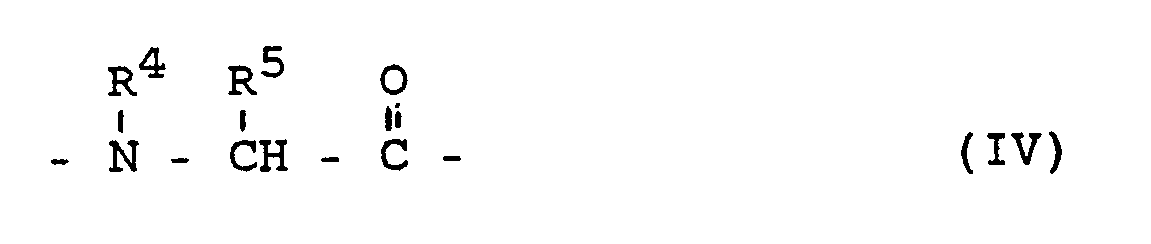
R⁴ und R⁵ zusammen mit den diese tragenden Atomen ein heterocyclisches mono, bi- oder tricyclisches Ringsystem mit 2 bis 15 C-Atomen bilden,
und n 2 bis 8 ist;
E für den Rest einer aromatischen Aminosäure steht;
F unabhängig voneinander den Rest einer neutralen, sauren oder basischen, aliphatischen oder aromatischen Aminosäure bedeutet, die in der Seitenkette substituiert sein kann, oder für eine direkte Bindung steht;
(D)-Phe D-Phenylalanin bedeutet, das im Phenylteil gegebenenfalls substituiert sein kann;
G wie G′ oben definiert ist oder eine direkte Bindung bedeutet;
F′ wie F definiert ist, einen Rest -NH-(CH₂)n-, mit n = 2 bis 8, bedeutet, oder, falls G keine direkte Bindung bedeutet, für eine direkte Bindung stehen kann und,
I -OH, -NH₂ oder -NHC₂H₅ ist,
K den Rest -NH-(CH₂)x-CO- mit x = 1-4 bedeutet oder für eine direkte Bindung steht, und
M wie F definiert ist.
sowie deren physiologisch verträgliche Salze.
B Arg, Lys, Orn, 2,4-Diaminobutyroyl oder einen L-Homoargininrest bedeutet, wobei jeweils die Amino- bzw. die Guanidinogruppe der Seitenkette durch A wie unter a₁) oder a₂) in Anspruch 1 beschrieben substituiert sein kann;
E für den Rest einer aromatischen Aminosäure in der L- oder D-Konfiguration steht, die im Arylteil 6 bis 14 C-Atome als Ringglieder enthält, wie Phenylalanin, das gegebenenfalls durch Halogen in der 2-, 3- oder 4-Position substituiert ist, Tyrosin, O-Methyltyrosin, 2-Thienylalanin, 2-Pyridylalanin oder Naphthylalanin;
F′ den Rest einer basischen Aminosäure in der L- oder D-Konfiguration, wie Arg oder Lys bedeutet, wobei die Guanidinogruppe bzw. Aminogruppe der Seitenkette durch A wie unter a₁) oder a₂) in Anspruch 1 beschrieben substituiert sein kann, oder einen Rest -NH-(CH₂)n - mit n = 2 bis 8 - bedeutet und
K für den Rest -NH-(CH₂)x-CO- mit x = 2-4 steht oder eine direkte Bindung bedeutet.
(D)-Phe D-Phenylalanin, das gegebenenfalls im Phenylteil durch Halogen oder (C₁-C₄)-Alkoxy substituiert sein kann, bedeutet.
B Arg, Orn oder Lys bedeutet, wobei die Guanidinogruppe bzw. die Aminogruppe der Seitenkette unsubstituiert ist oder durch (C₁-C₈)-Alkanoyl, (C₇-C₁₃)-Aryloyl, (C₃-C₉)-Heteroaryloyl, (C₁-C₈)-Alkylsulfonyl oder (C₆-C₁₂)-Arylsulfonyl substituiert sein kann, wobei die Aryl-, Heteroaryl-, Aryloyl-, Arylsulfonyl- und Heteroaryloylreste wie unter a₂) beschrieben mit gegebenenfalls 1, 2, 3 oder 4 gleichen oder verschiedenen Resten substituiert sein können,
E Phenylalanin, 2-Chlorphenylalanin, 3-Chlorphenylalanin, 4-Chlorphenylalanin, 2-Fluorphenylalanin, 3-Fluorphenylalanin, 4-Fluorphenylalanin, Tyrosin, O-Methyltyrosin oder β-(2-Thienyl)alanin bedeutet und
K für eine direkte Bindung steht
M für eine direkte Bindung steht und
(D)-Phe D-Phenylalanin bedeutet, das gegebenenfalls durch Chlor, Brom oder Methoxy substituiert sein kann.
A Wasserstoff, (D)- oder (L)-H-Arg, (D)- oder (L)-H-Lys oder (D)- oder (L)-H-Orn bedeutet;
B Arg, Orn oder Lys bedeutet, wobei die Guanidinogruppe bzw. die Aminogruppe der Seitenkette durch Wasserstoff, (C₁-C₈)-Alkanoyl, (C₇-C₁₃)-Aryloyl, (C₃-C₉-Heteroaryloyl, (C₁-C₈)-Alkylsulfonyl oder (C₆-C₁₂)-Arylsulfonyl substituiert sein kann, wobei die Aryl-, Heteroaryl-, Aryloyl-, Arylsulfonyl- und Heteroaryloylreste gegebenenfalls mit 1, 2, 3 oder 4 gleichen oder verschiedenen Resten aus der Reihe Methyl, Methoxy und Halogen substitiuiert sein können,
C Pro-Pro-Gly, Hyp-Pro-Gly oder Pro-Hyp-Gly bedeutet
E Phe oder Thia bedeutet
F Ser, Hser, Lys, Leu, Val, Nle, Ile oder Thr bedeutet
K für eine direkte Bindung steht
M für eine direkte Bindung steht
G für den Rest eines heterocyclischen Ringsystems der Formel IV steht, wobei die Reste der Heterocyclen Pyrrolidin-2-carbonsäure; Piperidin-2-carbonsäure; 1,2,3,4-Tetrahydroisochinolin-3-carbonsäure, cis- und trans-Decahydroisochinolin-3-carbonsäure; cis-endo-, cis-exo-, trans-Octahydroindol-2-carbonsäure, cis-endo-, cis-exo-, trans-Octahydrocyclopentano[b]pyrrol-2-carbonsäure oder Hydroxyprolin-2-carbonsäure bevorzugt sind,
F′ Arg bedeutet
I für OH steht und
(D)-Phe D-Phenylalanin bedeutet.
in der nach (a) oder (b) erhaltenen Verbindung gegebenenfalls eine oder mehrere zum Schutz anderer Funktionen temporär eingeführte Schutzgruppen abspaltet und die so erhaltenen Verbindungen der Formel I gegebenenfalls in ihr physiologisch verträgliches Salz überführt.
Applications Claiming Priority (2)
| Application Number | Priority Date | Filing Date | Title |
|---|---|---|---|
| DE3926822A DE3926822A1 (de) | 1989-08-14 | 1989-08-14 | Peptide mit bradykinin-antagonistischer wirkung |
| DE3926822 | 1989-08-14 |
Publications (2)
| Publication Number | Publication Date |
|---|---|
| EP0413277A1 true EP0413277A1 (de) | 1991-02-20 |
| EP0413277B1 EP0413277B1 (de) | 1994-11-23 |
Family
ID=6387091
Family Applications (1)
| Application Number | Title | Priority Date | Filing Date |
|---|---|---|---|
| EP90115455A Expired - Lifetime EP0413277B1 (de) | 1989-08-14 | 1990-08-11 | Peptide mit bradykininantagonistischer Wirkung |
Country Status (24)
| Country | Link |
|---|---|
| EP (1) | EP0413277B1 (de) |
| JP (1) | JP2997519B2 (de) |
| KR (1) | KR0173976B1 (de) |
| CN (1) | CN1034577C (de) |
| AT (1) | ATE114320T1 (de) |
| AU (1) | AU638735B2 (de) |
| CA (1) | CA2023194C (de) |
| CY (1) | CY2029A (de) |
| CZ (1) | CZ284783B6 (de) |
| DD (1) | DD297169A5 (de) |
| DE (2) | DE3926822A1 (de) |
| DK (1) | DK0413277T3 (de) |
| ES (1) | ES2065445T3 (de) |
| FI (1) | FI102759B1 (de) |
| HU (1) | HU208324B (de) |
| IE (1) | IE65356B1 (de) |
| IL (1) | IL95357A (de) |
| LT (1) | LT3868B (de) |
| NO (1) | NO178433C (de) |
| NZ (1) | NZ234861A (de) |
| PT (1) | PT94982B (de) |
| RU (1) | RU2081880C1 (de) |
| SK (1) | SK280787B6 (de) |
| ZA (1) | ZA906381B (de) |
Cited By (16)
| Publication number | Priority date | Publication date | Assignee | Title |
|---|---|---|---|---|
| EP0618809A4 (de) * | 1991-04-19 | 1994-07-28 | Scios Nova Inc | Bradykinin typische peptide. |
| EP0564972A3 (en) * | 1992-04-04 | 1994-10-05 | Hoechst Ag | Peptides with n-terminal modifications having bradykinin antagonistic activity |
| US5380875A (en) * | 1991-06-06 | 1995-01-10 | Hitachi Chemical Company, Ltd. | Hydroxyproline derivatives and preparative process therefor |
| US5385889A (en) * | 1991-04-19 | 1995-01-31 | Scios Nova Inc. | Bradykinin antagonist peptides |
| US5444048A (en) * | 1992-10-08 | 1995-08-22 | Scios Nova, Inc. | Bradykinin antagonist pseudopeptide derivatives of olefinic aminoalkanoic acids |
| US5541286A (en) * | 1992-10-08 | 1996-07-30 | Scios Nova Inc. | Bradykinin antagonist pseudopeptide derivatives of olefinic aminoalkanoic acids |
| US5543496A (en) * | 1993-02-17 | 1996-08-06 | Scios Nova Inc. | Cyclic bradykinin antagonist peptides |
| US5610142A (en) * | 1992-10-08 | 1997-03-11 | Scios Inc. | Bradykinin antagonist pseudopeptide derivatives of substituted 4-keto-1,3,8-triazaspiro[4.5]decan-3-alkanoic acids |
| FR2739553A1 (fr) * | 1995-10-06 | 1997-04-11 | Oreal | Utilisation d'antagonistes de la bradykinine pour stimuler ou induire la pousse des cheveux et/ou stopper leur chute |
| US5670619A (en) * | 1991-12-21 | 1997-09-23 | Hoechst Aktiengesellschaft | Bradykinin-antagonists for the treatment of acute pancreatitis |
| US5686565A (en) * | 1992-10-08 | 1997-11-11 | Scios Inc. | Bradykinin antagonist pseudopeptide derivatives of aminoalkanoic acids and related olefins |
| US5817756A (en) * | 1993-09-09 | 1998-10-06 | Scios Inc. | Pseudo- and non-peptide bradykinin receptor antagonists |
| US6316413B1 (en) * | 1996-12-04 | 2001-11-13 | Fournier Industrie Et Sante | Peptide agonists of bradykinin B2 receptor |
| US6458923B1 (en) | 1991-12-12 | 2002-10-01 | Scios Inc. | Modified position (7) bradykinin antagonist peptides |
| US6770741B1 (en) | 1991-04-19 | 2004-08-03 | Scios Inc. | Bradykinin antagonist peptides |
| AU2005265131B2 (en) * | 2004-06-17 | 2012-02-23 | Infinity Discovery, Inc. | Compounds and methods for inhibiting the interaction of BCL proteins with binding partners |
Families Citing this family (4)
| Publication number | Priority date | Publication date | Assignee | Title |
|---|---|---|---|---|
| DE4013270A1 (de) * | 1990-04-26 | 1991-10-31 | Hoechst Ag | Peptide mit bradykinin-antagonistischer wirkung |
| CZ203693A3 (en) * | 1991-04-01 | 1994-07-13 | Cortech | Bradykinin antagonists |
| DE19612067A1 (de) * | 1996-03-27 | 1997-10-02 | Hoechst Ag | Verwendung von Bradykinin-Antagonisten zur Herstellung von Arzneimitteln zur Behandlung von chronisch fibrogenetischen Lebererkrankungen und akuten Lebererkrankungen |
| KR101707887B1 (ko) * | 2016-11-22 | 2017-02-17 | 홍인석 | 방향제 시트가 부착된 포장지 제조장치 및 제조방법 |
Citations (1)
| Publication number | Priority date | Publication date | Assignee | Title |
|---|---|---|---|---|
| WO1989001781A1 (en) * | 1987-09-02 | 1989-03-09 | Stewart John M | Bradykinin antagonist peptides |
Family Cites Families (4)
| Publication number | Priority date | Publication date | Assignee | Title |
|---|---|---|---|---|
| US4693993A (en) | 1985-06-13 | 1987-09-15 | Stewart John M | Bradykinin antagonist peptides |
| DE3618218A1 (de) | 1986-05-30 | 1987-12-03 | Hoechst Ag | Aminosaeure-oobt-ester, verfahren zu deren herstellung und deren verwendung |
| DE3635670A1 (de) | 1986-10-21 | 1988-04-28 | Hoechst Ag | Synthese von peptid-aminoalkylamiden und peptidhydraziden mittels festphasenmethode |
| EP0332688A4 (en) * | 1987-09-02 | 1990-09-26 | John M. Stewart | Bradykinin antagonist peptides |
-
1989
- 1989-08-14 DE DE3926822A patent/DE3926822A1/de not_active Withdrawn
-
1990
- 1990-08-10 NZ NZ234861A patent/NZ234861A/en unknown
- 1990-08-10 FI FI903971A patent/FI102759B1/fi active IP Right Grant
- 1990-08-11 DK DK90115455.9T patent/DK0413277T3/da active
- 1990-08-11 ES ES90115455T patent/ES2065445T3/es not_active Expired - Lifetime
- 1990-08-11 DE DE59007747T patent/DE59007747D1/de not_active Expired - Lifetime
- 1990-08-11 EP EP90115455A patent/EP0413277B1/de not_active Expired - Lifetime
- 1990-08-11 AT AT90115455T patent/ATE114320T1/de not_active IP Right Cessation
- 1990-08-13 AU AU60924/90A patent/AU638735B2/en not_active Expired
- 1990-08-13 SK SK3979-90A patent/SK280787B6/sk not_active IP Right Cessation
- 1990-08-13 CZ CS903979A patent/CZ284783B6/cs not_active IP Right Cessation
- 1990-08-13 CN CN90106915A patent/CN1034577C/zh not_active Expired - Lifetime
- 1990-08-13 ZA ZA906381A patent/ZA906381B/xx unknown
- 1990-08-13 IL IL9535790A patent/IL95357A/en unknown
- 1990-08-13 JP JP2211764A patent/JP2997519B2/ja not_active Expired - Lifetime
- 1990-08-13 IE IE292390A patent/IE65356B1/en not_active IP Right Cessation
- 1990-08-13 KR KR1019900012424A patent/KR0173976B1/ko not_active Expired - Fee Related
- 1990-08-13 DD DD90343416A patent/DD297169A5/de not_active IP Right Cessation
- 1990-08-13 HU HU904989A patent/HU208324B/hu unknown
- 1990-08-13 NO NO903545A patent/NO178433C/no not_active IP Right Cessation
- 1990-08-13 CA CA002023194A patent/CA2023194C/en not_active Expired - Lifetime
- 1990-08-13 PT PT94982A patent/PT94982B/pt not_active IP Right Cessation
-
1992
- 1992-01-28 RU SU925010606A patent/RU2081880C1/ru active
-
1993
- 1993-11-12 LT LTIP1466A patent/LT3868B/lt not_active IP Right Cessation
-
1998
- 1998-02-20 CY CY202998A patent/CY2029A/xx unknown
Patent Citations (1)
| Publication number | Priority date | Publication date | Assignee | Title |
|---|---|---|---|---|
| WO1989001781A1 (en) * | 1987-09-02 | 1989-03-09 | Stewart John M | Bradykinin antagonist peptides |
Cited By (22)
| Publication number | Priority date | Publication date | Assignee | Title |
|---|---|---|---|---|
| US5385889A (en) * | 1991-04-19 | 1995-01-31 | Scios Nova Inc. | Bradykinin antagonist peptides |
| US6770741B1 (en) | 1991-04-19 | 2004-08-03 | Scios Inc. | Bradykinin antagonist peptides |
| US6288036B1 (en) | 1991-04-19 | 2001-09-11 | Scios Inc. | Bradykinin type peptides |
| EP0618809A4 (de) * | 1991-04-19 | 1994-07-28 | Scios Nova Inc | Bradykinin typische peptide. |
| US5380875A (en) * | 1991-06-06 | 1995-01-10 | Hitachi Chemical Company, Ltd. | Hydroxyproline derivatives and preparative process therefor |
| US6458923B1 (en) | 1991-12-12 | 2002-10-01 | Scios Inc. | Modified position (7) bradykinin antagonist peptides |
| US5670619A (en) * | 1991-12-21 | 1997-09-23 | Hoechst Aktiengesellschaft | Bradykinin-antagonists for the treatment of acute pancreatitis |
| US5597803A (en) * | 1992-04-04 | 1997-01-28 | Hoechst Aktiengesellschaft | Bradykinin peptides with modifications at the N terminus |
| EP0564972A3 (en) * | 1992-04-04 | 1994-10-05 | Hoechst Ag | Peptides with n-terminal modifications having bradykinin antagonistic activity |
| US5610142A (en) * | 1992-10-08 | 1997-03-11 | Scios Inc. | Bradykinin antagonist pseudopeptide derivatives of substituted 4-keto-1,3,8-triazaspiro[4.5]decan-3-alkanoic acids |
| US5552383A (en) * | 1992-10-08 | 1996-09-03 | Scios Nova Inc. | Bradykinin antagonist pseudopeptide derivatives of aminoalkanoic acids and related olefins |
| US5686565A (en) * | 1992-10-08 | 1997-11-11 | Scios Inc. | Bradykinin antagonist pseudopeptide derivatives of aminoalkanoic acids and related olefins |
| US5541286A (en) * | 1992-10-08 | 1996-07-30 | Scios Nova Inc. | Bradykinin antagonist pseudopeptide derivatives of olefinic aminoalkanoic acids |
| US5521158A (en) * | 1992-10-08 | 1996-05-28 | Scios Nova Inc. | Pseudopeptide bradykinin receptor antagonists |
| US5444048A (en) * | 1992-10-08 | 1995-08-22 | Scios Nova, Inc. | Bradykinin antagonist pseudopeptide derivatives of olefinic aminoalkanoic acids |
| US5543496A (en) * | 1993-02-17 | 1996-08-06 | Scios Nova Inc. | Cyclic bradykinin antagonist peptides |
| US5817756A (en) * | 1993-09-09 | 1998-10-06 | Scios Inc. | Pseudo- and non-peptide bradykinin receptor antagonists |
| FR2739553A1 (fr) * | 1995-10-06 | 1997-04-11 | Oreal | Utilisation d'antagonistes de la bradykinine pour stimuler ou induire la pousse des cheveux et/ou stopper leur chute |
| WO1997013493A1 (fr) * | 1995-10-06 | 1997-04-17 | L'oreal | Utilisation d'antagonistes de la bradykinine pour stimuler ou induire la pousse des cheveux et/ou stopper leur chute |
| US6468972B1 (en) | 1995-10-06 | 2002-10-22 | Societe L'oreal S.A. | Method to promote, stimulate and/or delay hair loss by a brady kinin antagonist |
| US6316413B1 (en) * | 1996-12-04 | 2001-11-13 | Fournier Industrie Et Sante | Peptide agonists of bradykinin B2 receptor |
| AU2005265131B2 (en) * | 2004-06-17 | 2012-02-23 | Infinity Discovery, Inc. | Compounds and methods for inhibiting the interaction of BCL proteins with binding partners |
Also Published As
Similar Documents
| Publication | Publication Date | Title |
|---|---|---|
| EP0370453B1 (de) | Peptide mit bradykinin-antagonistischer Wirkung | |
| EP0413277B1 (de) | Peptide mit bradykininantagonistischer Wirkung | |
| EP0564972B1 (de) | Peptide mit Modifikationen am N-Terminus mit bradykininantagonistischer Wirkung | |
| US5648333A (en) | Peptides having bradykinin antagonist action | |
| EP0455133B1 (de) | Peptide mit bradykinin-antagonistischer Wirkung | |
| DD284030A5 (de) | Verfahren zur herstellung von peptiden mit bradykinin-antagonistischer wirkung | |
| CN1034416Y (zh) | 有舒缓激肽拮抗作用的肽的制备方法 | |
| LT3872B (en) | Novel peptides and pharmaceutical compositions containing them | |
| LV10285B (en) | Peptides as bradykinin-antagonists |
Legal Events
| Date | Code | Title | Description |
|---|---|---|---|
| PUAI | Public reference made under article 153(3) epc to a published international application that has entered the european phase |
Free format text: ORIGINAL CODE: 0009012 |
|
| AK | Designated contracting states |
Kind code of ref document: A1 Designated state(s): AT BE CH DE DK ES FR GB GR IT LI LU NL SE |
|
| 17P | Request for examination filed |
Effective date: 19901221 |
|
| 17Q | First examination report despatched |
Effective date: 19930312 |
|
| GRAA | (expected) grant |
Free format text: ORIGINAL CODE: 0009210 |
|
| AK | Designated contracting states |
Kind code of ref document: B1 Designated state(s): AT BE CH DE DK ES FR GB GR IT LI LU NL SE |
|
| REF | Corresponds to: |
Ref document number: 114320 Country of ref document: AT Date of ref document: 19941215 Kind code of ref document: T |
|
| REF | Corresponds to: |
Ref document number: 59007747 Country of ref document: DE Date of ref document: 19950105 |
|
| ITF | It: translation for a ep patent filed | ||
| ET | Fr: translation filed | ||
| EAL | Se: european patent in force in sweden |
Ref document number: 90115455.9 |
|
| REG | Reference to a national code |
Ref country code: ES Ref legal event code: FG2A Ref document number: 2065445 Country of ref document: ES Kind code of ref document: T3 |
|
| REG | Reference to a national code |
Ref country code: GR Ref legal event code: FG4A Free format text: 3014404 |
|
| GBT | Gb: translation of ep patent filed (gb section 77(6)(a)/1977) |
Effective date: 19950130 |
|
| REG | Reference to a national code |
Ref country code: DK Ref legal event code: T3 |
|
| PLBE | No opposition filed within time limit |
Free format text: ORIGINAL CODE: 0009261 |
|
| STAA | Information on the status of an ep patent application or granted ep patent |
Free format text: STATUS: NO OPPOSITION FILED WITHIN TIME LIMIT |
|
| 26N | No opposition filed | ||
| REG | Reference to a national code |
Ref country code: GB Ref legal event code: IF02 |
|
| PGFP | Annual fee paid to national office [announced via postgrant information from national office to epo] |
Ref country code: FR Payment date: 20090814 Year of fee payment: 20 Ref country code: DK Payment date: 20090813 Year of fee payment: 20 Ref country code: ES Payment date: 20090902 Year of fee payment: 20 |
|
| PGFP | Annual fee paid to national office [announced via postgrant information from national office to epo] |
Ref country code: SE Payment date: 20090806 Year of fee payment: 20 Ref country code: AT Payment date: 20090812 Year of fee payment: 20 Ref country code: LU Payment date: 20090824 Year of fee payment: 20 Ref country code: CH Payment date: 20090814 Year of fee payment: 20 Ref country code: GB Payment date: 20090805 Year of fee payment: 20 Ref country code: NL Payment date: 20090803 Year of fee payment: 20 Ref country code: DE Payment date: 20090831 Year of fee payment: 20 |
|
| PGFP | Annual fee paid to national office [announced via postgrant information from national office to epo] |
Ref country code: BE Payment date: 20090825 Year of fee payment: 20 |
|
| PGFP | Annual fee paid to national office [announced via postgrant information from national office to epo] |
Ref country code: IT Payment date: 20090814 Year of fee payment: 20 |
|
| PGFP | Annual fee paid to national office [announced via postgrant information from national office to epo] |
Ref country code: GR Payment date: 20090717 Year of fee payment: 20 |
|
| REG | Reference to a national code |
Ref country code: CH Ref legal event code: PL |
|
| REG | Reference to a national code |
Ref country code: NL Ref legal event code: V4 Effective date: 20100811 |
|
| REG | Reference to a national code |
Ref country code: DK Ref legal event code: EUP |
|
| BE20 | Be: patent expired |
Owner name: *HOECHST A.G. Effective date: 20100811 |
|
| REG | Reference to a national code |
Ref country code: GB Ref legal event code: PE20 Expiry date: 20100810 |
|
| EUG | Se: european patent has lapsed | ||
| REG | Reference to a national code |
Ref country code: ES Ref legal event code: FD2A Effective date: 20100812 |
|
| PG25 | Lapsed in a contracting state [announced via postgrant information from national office to epo] |
Ref country code: NL Free format text: LAPSE BECAUSE OF EXPIRATION OF PROTECTION Effective date: 20100811 |
|
| PG25 | Lapsed in a contracting state [announced via postgrant information from national office to epo] |
Ref country code: GB Free format text: LAPSE BECAUSE OF EXPIRATION OF PROTECTION Effective date: 20100810 |
|
| PG25 | Lapsed in a contracting state [announced via postgrant information from national office to epo] |
Ref country code: DE Free format text: LAPSE BECAUSE OF EXPIRATION OF PROTECTION Effective date: 20100811 |