EP0413391A2 - Système et méthode de codage de la parole - Google Patents
Système et méthode de codage de la parole Download PDFInfo
- Publication number
- EP0413391A2 EP0413391A2 EP19900202178 EP90202178A EP0413391A2 EP 0413391 A2 EP0413391 A2 EP 0413391A2 EP 19900202178 EP19900202178 EP 19900202178 EP 90202178 A EP90202178 A EP 90202178A EP 0413391 A2 EP0413391 A2 EP 0413391A2
- Authority
- EP
- European Patent Office
- Prior art keywords
- codebook
- filtered
- perceptually weighted
- speech
- speech samples
- Prior art date
- Legal status (The legal status is an assumption and is not a legal conclusion. Google has not performed a legal analysis and makes no representation as to the accuracy of the status listed.)
- Granted
Links
Images

Classifications
-
- H—ELECTRICITY
- H03—ELECTRONIC CIRCUITRY
- H03M—CODING; DECODING; CODE CONVERSION IN GENERAL
- H03M7/00—Conversion of a code where information is represented by a given sequence or number of digits to a code where the same, similar or subset of information is represented by a different sequence or number of digits
-
- G—PHYSICS
- G10—MUSICAL INSTRUMENTS; ACOUSTICS
- G10L—SPEECH ANALYSIS TECHNIQUES OR SPEECH SYNTHESIS; SPEECH RECOGNITION; SPEECH OR VOICE PROCESSING TECHNIQUES; SPEECH OR AUDIO CODING OR DECODING
- G10L19/00—Speech or audio signals analysis-synthesis techniques for redundancy reduction, e.g. in vocoders; Coding or decoding of speech or audio signals, using source filter models or psychoacoustic analysis
- G10L19/04—Speech or audio signals analysis-synthesis techniques for redundancy reduction, e.g. in vocoders; Coding or decoding of speech or audio signals, using source filter models or psychoacoustic analysis using predictive techniques
- G10L19/08—Determination or coding of the excitation function; Determination or coding of the long-term prediction parameters
- G10L19/12—Determination or coding of the excitation function; Determination or coding of the long-term prediction parameters the excitation function being a code excitation, e.g. in code excited linear prediction [CELP] vocoders
-
- G—PHYSICS
- G10—MUSICAL INSTRUMENTS; ACOUSTICS
- G10L—SPEECH ANALYSIS TECHNIQUES OR SPEECH SYNTHESIS; SPEECH RECOGNITION; SPEECH OR VOICE PROCESSING TECHNIQUES; SPEECH OR AUDIO CODING OR DECODING
- G10L19/00—Speech or audio signals analysis-synthesis techniques for redundancy reduction, e.g. in vocoders; Coding or decoding of speech or audio signals, using source filter models or psychoacoustic analysis
- G10L2019/0001—Codebooks
- G10L2019/0002—Codebook adaptations
-
- G—PHYSICS
- G10—MUSICAL INSTRUMENTS; ACOUSTICS
- G10L—SPEECH ANALYSIS TECHNIQUES OR SPEECH SYNTHESIS; SPEECH RECOGNITION; SPEECH OR VOICE PROCESSING TECHNIQUES; SPEECH OR AUDIO CODING OR DECODING
- G10L19/00—Speech or audio signals analysis-synthesis techniques for redundancy reduction, e.g. in vocoders; Coding or decoding of speech or audio signals, using source filter models or psychoacoustic analysis
- G10L2019/0001—Codebooks
- G10L2019/0013—Codebook search algorithms
- G10L2019/0014—Selection criteria for distances
Definitions
- the present invention relates to a speech coding system and to a method of encoding speech and more particularly to a code excited speech coder which has application in digitised speech transmission systems.
- FIG. 1 of the accompanying drawings is a block schematic diagram of a proposal for implementing CELP and is disclosed for example in a paper "Fast CELP Coding Based on Algebraic Codes" by J-P Adoul, P. Mabilleau, M. Delprat and S. Morissette and read at International Conference on Acoustics Speech and Signal Processing (ICASSP) 1987 and reproduced on pages 1957 to 1960 of ICASSP87.
- IASSP International Conference on Acoustics Speech and Signal Processing
- CELP is a speech coding technique which consists in representing a residual signal by an optimum temporal waveform of a code-book with respect to subjective error criteria. More particularly a codebook sequence c k is selected which minimises the energy in a perceptually weighted signal y(n) by for example using Mean Square Error (MSE) criterion to select the sequence.
- MSE Mean Square Error
- a two-dimensional code-book 10 which stores random vectors c k (n) is coupled to a gain stage 12.
- the signal output r ⁇ (n) from the gain stage 12 is applied to a first inverse filter 14 constituting a long term predictor and having a characteristic 1/B(z), the filter 14 being used to synthesise pitch.
- a second inverse filter 16 constituting a short term predictor and having a characteristic 1/A(z) is connected to receive the output ê(n) of the first filter 14.
- the second filter synthesises the spectral envelope and provides an output ⁇ (n) which is supplied to an inverting input of a summing stage 18.
- a source of original speech 20 is connected to a non-inverting input of the summing stage 18.
- the output x(n) of the summing stage is applied to a perceptual weighting filter 22 having a characteristic W(z) and providing an output y(n).
- the comparatively high quality speech at low bit rate is achieved through an analysis-by-synthesis procedure using both short-term and long-term prediction.
- This procedure consists of finding the best sequence in the code-book which is optimum with respect to a subjective error criterion.
- Each code word or sequence c k is scaled by an optimum gain factor G k and is processed through the first and second inverse filters 14,16.
- the difference x(n) between the original and the synthetic signals, that is s(n) and ⁇ (n) is processed through the perceptual weighting filter 22 and the "best" sequence is then chosen to minimise the energy of the perceptual error signal y(n).
- Two reported criticisms of the proposal shown in Figure 1 are the large number of computations arising from the search procedure to find the best sequence and the computations required from filtering of all the sequences through both long-term and short-term predictors.
- FIG. 2 A block schematic implementation of one of these ideas is shown in Figure 2 of the accompanying drawings in which the same reference numerals as have been used in Figure 1 to indicate corresponding parts.
- the perceptual weighting filter W(z) can be moved to the signal input paths to the summing stage 18.
- the original speech from the source 20 is processed through an analysis filter 24 having a characteristic A(z) yielding a residual signal e(n) from which pitch parameters are derived.
- the residual signal e(n) is processed through an inverse filter 26 having a characteristic 1/A(z/ ⁇ ) and yielding a signal s′(n) which is applied to the non-inverting input of the summing stage 18.
- the short term predictor constituted by the second inverse filter 16 ( Figure 1) is replaced by an inverse filter 28 having a characteristic 1/A(z/ ⁇ ) which produces an output ⁇ ′(n).
- the signal ê(n-T) is known and does not depend on the codeword currently being tested if T is constrained to be always greater than N.
- the pitch predictor 1/B(z) it is possible for the pitch predictor 1/B(z) to be removed from the signal path from the two-dimensional codebook 10 if the signal bê(n-T) is subtracted from the residual signal in the path from the speech source 20.
- the signal ê(n-T) is obtained by processing the delayed signal r ⁇ (n-T) through the pitch predictor 1/B(z); and r ⁇ n-T is computed from already known codewords, chosen from preceding blocks, provided that the pitch period T is restricted to values greater than the block size N.
- the operation of the pitch predictor can also be considered in terms of a dynamic adaptive codebook.
- This paper also discloses a scheme whereby the long term predictor 1/B(z) and the memory of the short-term predictor 1/A(z/ ⁇ ) are removed from the signal path from the codebook 10. As a consequence it is possible to reduce two filtering operations on each codeword to a single memoryless filtering per codeword with a significant cut in the computational load.
- a speech coding system comprising means for filtering digitised speech samples to form perceptually weighted speech samples, a one-dimensional codebook, means for filtering entries read-out from the codebook, and means for comparing the filtered codebook entries with the perceptually weighted speech signals to obtain a codebook index which gives the minimum perceptually weighted error when the speech is resynthesised.
- a method of encoding speech in which digitised speech samples are filtered to produce perceptually weighted speech samples, entries are selected from a 1-dimensional code book and are filtered to form a filtered codebook, the perceptually weighted speech samples are compared with entries from the filtered codebook to obtain a codebook index which gives the minimum perceptually weighted error when the speech is resynthesised.
- a significant reduction in the computational load of the CELP coder is achieved because the processing consists of filtering this codebook in its entirety using the perceptually weighted synthesis filter once for each set of filter coefficients produced by linear predictive analysis of the digitised speech samples.
- the updating of the filter coefficients may be once every four frames of digitised speech samples, each frame having a duration of for example 5mS.
- the filtered codebook is then searched to find the optimum framelength sequence which minimises the error between the perceptually weighted input speech and the chosen sequence.
- every pth entry of the filtered codebook may be searched, where p is greater than unity.
- adjacent entries in the filtered codebook are correlated then by not searching each entry the computational load can be reduced without unduly affecting the quality of the speech or alternatively a longer codebook can be searched for the same computational load giving the possibility of better speech quality.
- the comparison is effected by calculating the sum of the cross products using the equation: where E k is the overall error term, N is the number of digitised samples in a frame, n is the sample number, x is the signal being matched with the codebook, g k is the unscaled filtered codebook sequence, and k is the codebook index
- the computation can be reduced (at some cost in speech quality) by evaluating every mth term of this cross product and maximising where m is an integer having a low value.
- the speech coding system may further comprise means for forming a long term predictor using a dynamic adaptive codebook comprising scaled entries selected from the filtered codebook together with entries from the dynamic adaptive codebook, means for comparing entries from the dynamic adaptive codebook with perceptually weighted speech samples, means for determining an index which gives the smallest difference between the dynamic adaptive codebook entry and the perceptually weighted speech samples, means for subtracting the determined entry from the perceptually weighted speech samples, and means for comparing the difference signal obtained from the subtraction with entries from the filtered codebook to obtain the filtered codebook index which gives the best match.
- Means may be provided for combining the filtered codebook entry which gives the best match with the corresponding dynamic adaptive codebook entry to form coded perceptually weighted speech samples, and for filtering the coded perceptually weighted speech samples to provide synthesised speech.
- the dynamic adaptive codebook may comprise a first-in, first-out storage device of predetermined capacity, the input signals to the storage device comprising the coded perceptually weighted speech samples.
- the filtering means for filtering the coded perceptually weighted samples may comprise means for producing an inverse transfer function compared to the transfer function used to produce the perceptually weighted speech samples.
- a method of deriving speech comprising forming a filtered codebook by filtering a one dimensional codebook using a filter whose coefficients are specified in an input signal, selecting a predetermined sequence specified by a codebook index in the input signal, adjusting the amplitude of the selected predetermined sequence in response to a gain signal contained in the input signal, restoring the pitch of the selected predetermined sequence in response to pitch predictor index and gain signals contained in the input signal, and applying the pitch restored sequence to deweighting and inverse synthesis filters to produce a speech signal.
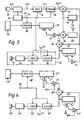
- a speech source 20 is coupled to a stage 30 which quantises the speech and segments it into frames of 5mS duration.
- the segmented speech s(n) is supplied to an analysis filter 24 having a transfer function A(z) and to a linear predictive coder (LPC) 32 which calculates the filter coefficients a i .
- the residual signal r(n) from the filter 24 is then processed in a perceptually weighted synthesis filter 26 having a transfer function 1/A(z/ ⁇ ).
- the perceptually weighted residual signal s w (n) is applied to a non-inverting input of a subtracting stage 34 (which is implemented as a summing stage having inverting and non-inverting inputs).
- the output of the summing stage 34 is supplied to the non-inverting input of another subtracting stage 36.
- a one dimensional (1-D) codebook 110 containing white Gaussian random number sequences is connected to a perceptually weighted synthesis filter 28 which filters the codebook entries and supplies the results to a 1-D filtered codebook 37 which constitutes a temporal master codebook.
- the codebook sequences are supplied in turn to a gain stage 12 having a gain G.
- the scaled coded sequences from the gain stage 12 are applied to the inverting input of the subtracting stage 36 and to an input of a summing stage 38.
- the output of the stage 38 comprises a pitch prediction signal which is applied to pitch delay stage 40, which introduces a preselected delay T, and to a stage 42 for decoding the speech.
- the pitch delay stage 40 may comprise a first-in, first-out (FIFO) storage device.
- the delayed pitch prediction signal is applied to a gain stage 44 which has a gain b.
- the scaled pitch prediction signal is applied to an input of the summing stage 38 and to an inverting input of the subtracting stage 34.
- a first mean square error stage 46 is also connected to the output of the subtracting stage 34 and provides an error signal E A which is used to minimise variance with respect to pitch prediction.
- a second mean square error stage 48 is connected to the output of the subtracting stage 36 to produce a perceptual error signal E B which is used to minimise the variance with respect to the filtered codebook 37.
- speech from the source 20 is segmented into frames of 40 samples, each frame having a duration of 5mS.
- Each frame is passed through the analysis and weighting filters 24, 26; the coefficients a i for which filters are derived by linear predictive analysis of the digitised speech samples. In a typical application, ten prediction coefficients are required and these are updated every 20mS (the block rate).
- the scaled (long term) pitch prediction is subtracted from the perceptually weighted residual signals s w (n) from the filter 26. As long as the scaled pitch prediction uses only information from previously processed speech the optimum pitch delay T and gain b (stage 44) can be calculated to minimise the error E A at the output of the MSE stage 46.
- the 1-D codebook 110 comprises 1024 elements all of which are filtered once per 20mS block by the perceptual weighting filter 28, the coefficients of which correspond to those of the filter 26.
- the codebook search is carried-out by examining vectors composed of 40 adjacent elements from the filtered codebook 37. During the search the starting position of the vector is incremented by one or more for each codebook entry and the value of the gain G (stage 12) is calculated to give the minimum error E B at the output of the MSE 48. Thus the codebook index and the gain G for the minimum perceptual error are found.
- This information is then used in the synthesis of the output speech using for example the stage 42 which comprises a deweighting analysis filter 50, an inverse synthesis filter 52, an output transducer 54, and, optionally, a global post filter 56.
- the coefficients of the filters 50 and 52 are derived from the LPC 32.
- the information transmitted comprises the LPC coefficients, the codebook index, the codebook gain, the pitch predictor index and the pitch predictor gain.
- a receiver having a copy of the unfiltered 1-D codebook can regenerate the filtered codebook for each speech block from the received filter coefficients and then synthesise the original speech.
- these coefficients were quantised as log-area ratios (L.A.R.'s) which also minimised their sensitivity to quantisation distortion.
- these coefficients may be quantised by using line spectral pairs (LSP) or using inverse sine coefficients.
- LSP line spectral pairs
- a block of 10 LPC coefficients quantised as LARs can be represented as 40 bits per 20mS.
- the figure of 40 bits is made-up by quantising the 1st and 2nd LPC coefficients using 6 bits each, the 3rd and 4th LPC coefficients using 5 bits each, the 5th and 6th LPC coefficients using 4 bits each, the 7th and 8th LPC coefficients using 3 bits each and the 9th and 10th LPC coefficients using 2 bits each.
- the number of bits per second is 2000.
- the frame rate which is updated once every 5mS comprises codebook index - 10 bits, codebook gain, which has been quantised logarithmically, -5 bits + sign bit, pitch predictor index - 7 bits and pitch predictor gain - 4 bits. This totals 27 bits which corresponds to 5400 bits per second.
- the total bit rate (2000 + 5400) is 7400 bits per second.
- the comparison of the filtered codebook sequences with the pitchless perceptually weighted residual on the output of the subtracting stage 34 is carried out by calculating the sum of the cross-products using the equation: where E is the overall error term, N is the number of digitised samples in a frame, n is the sample number, x is the signal being matched with the codebook, g k is the unscaled filtered codebook sequence, and k is the codebook index.
- E is the overall error term
- N is the number of digitised samples in a frame
- n is the sample number
- x the signal being matched with the codebook
- g k is the unscaled filtered codebook sequence
- k is the codebook index.
- FIG. 4 illustrates a receiver.
- the receiver comprises features which are also shown in the embodiment of Figure 3, the corresponding features have been identified by primed reference numerals.
- the data received by the receiver will comprise the LPC coefficients which are applied to a terminal 60, the codebook index and gain which are respectively applied to terminals 62, 64, and the pitch predictor index and gain which are respectively applied to terminals 66, 68.
- a one dimensional codebook 110′ is filtered in a perceptually weighted synthesis filter 28′ and the outputs are used to form a filtered codebook 37′.
- the appropriate sequence from the filtered codebook 37′ is selected in response to the codebook index signal and is applied to a gain stage which has its gain specified in the received signal.
- the gain adjusted sequence is applied to the pitch predictor 40′ whose delay is adjusted by the pitch predictor index and the output is applied to a gain stage 44′ whose gain is specified by the pitch predictor gain signal.
- the sequence with the restored pitch prediction is applied to a deweighting analysis filter 50′ having a characteristic A(z/ ⁇ ).
- the output r dw (n) from the filter 50′ is applied to an inverse synthesis filter 52′ which has a characteristic 1/A(z).
- the coefficients for the filters 50′, 52′ are specified in the received signal and are updated every block (or four frames).
- the output of the filter 52′ can be applied directly to an output transducer 54′ or indirectly via a global post filter 56′ which enhances the speech quality by enhancing the noise suppression at the expense of some speech distortion.
- the embodiment illustrated in Figure 3 may be modified in order to simplify its construction, to reduce the degree of computation or to improve the speech quality without increasing the amount of computation.
- analysis and weighting filters may be combined.
- the size of the 1-dimensional codebook may be reduced.
- the perceptual error estimation may be carried out on a sub-sampled version of the perceptual error signal. This would reduce the calculation required for the long term predictor and also in the codebook search.
- a full search of the filtered codebook may not be needed since adjacent entries are correlated. Alternatively a longer codebook could be searched, giving better speech quality. In either case every pth entry is searched, where p is greater than unity.
- Filtering computation could be reduced if two half length codebooks were used. One could be filtered with the weighting filter from the current frame, the other could be retained from the previous frame. Similarly, one of these half length codebooks could be derived from previously selected codebook entries.
- a fixed weighting filter may be used for filtering the codebook.
Landscapes
- Engineering & Computer Science (AREA)
- Computational Linguistics (AREA)
- Signal Processing (AREA)
- Health & Medical Sciences (AREA)
- Audiology, Speech & Language Pathology (AREA)
- Human Computer Interaction (AREA)
- Physics & Mathematics (AREA)
- Acoustics & Sound (AREA)
- Multimedia (AREA)
- Theoretical Computer Science (AREA)
- Compression, Expansion, Code Conversion, And Decoders (AREA)
Applications Claiming Priority (2)
| Application Number | Priority Date | Filing Date | Title |
|---|---|---|---|
| GB8918677A GB2235354A (en) | 1989-08-16 | 1989-08-16 | Speech coding/encoding using celp |
| GB8918677 | 1989-08-16 |
Publications (3)
| Publication Number | Publication Date |
|---|---|
| EP0413391A2 true EP0413391A2 (fr) | 1991-02-20 |
| EP0413391A3 EP0413391A3 (en) | 1991-07-24 |
| EP0413391B1 EP0413391B1 (fr) | 1996-11-27 |
Family
ID=10661702
Family Applications (1)
| Application Number | Title | Priority Date | Filing Date |
|---|---|---|---|
| EP90202178A Expired - Lifetime EP0413391B1 (fr) | 1989-08-16 | 1990-08-10 | Système et méthode de codage de la parole |
Country Status (11)
| Country | Link |
|---|---|
| US (1) | US5140638B1 (fr) |
| EP (1) | EP0413391B1 (fr) |
| JP (1) | JP3392412B2 (fr) |
| KR (1) | KR100275054B1 (fr) |
| AU (1) | AU648479B2 (fr) |
| BR (1) | BR9003987A (fr) |
| CA (1) | CA2023167C (fr) |
| DE (1) | DE69029232T2 (fr) |
| FI (1) | FI903990A7 (fr) |
| GB (1) | GB2235354A (fr) |
| HU (1) | HUT58157A (fr) |
Cited By (2)
| Publication number | Priority date | Publication date | Assignee | Title |
|---|---|---|---|---|
| EP0592151A1 (fr) * | 1992-10-09 | 1994-04-13 | AT&T Corp. | Interpolation de fréquence et temps avec utilisation pour le codage de languages à faible débit |
| EP0684702A3 (fr) * | 1994-05-27 | 2000-02-23 | Kabushiki Kaisha Toshiba | Dispositif de quantification vectorielle |
Families Citing this family (30)
| Publication number | Priority date | Publication date | Assignee | Title |
|---|---|---|---|---|
| WO1992006470A1 (fr) * | 1990-09-28 | 1992-04-16 | N.V. Philips' Gloeilampenfabrieken | Procede et systeme de codage de signaux analogiques |
| CA2483324C (fr) * | 1991-06-11 | 2008-05-06 | Qualcomm Incorporated | Vocodeur a debit variable |
| US5694519A (en) * | 1992-02-18 | 1997-12-02 | Lucent Technologies, Inc. | Tunable post-filter for tandem coders |
| JP2953238B2 (ja) * | 1993-02-09 | 1999-09-27 | 日本電気株式会社 | 音質主観評価予測方式 |
| FR2702590B1 (fr) * | 1993-03-12 | 1995-04-28 | Dominique Massaloux | Dispositif de codage et de décodage numériques de la parole, procédé d'exploration d'un dictionnaire pseudo-logarithmique de délais LTP, et procédé d'analyse LTP. |
| TW271524B (fr) | 1994-08-05 | 1996-03-01 | Qualcomm Inc | |
| US5742734A (en) * | 1994-08-10 | 1998-04-21 | Qualcomm Incorporated | Encoding rate selection in a variable rate vocoder |
| US6263307B1 (en) | 1995-04-19 | 2001-07-17 | Texas Instruments Incorporated | Adaptive weiner filtering using line spectral frequencies |
| GB9512284D0 (en) * | 1995-06-16 | 1995-08-16 | Nokia Mobile Phones Ltd | Speech Synthesiser |
| JP3616432B2 (ja) * | 1995-07-27 | 2005-02-02 | 日本電気株式会社 | 音声符号化装置 |
| FR2742568B1 (fr) * | 1995-12-15 | 1998-02-13 | Catherine Quinquis | Procede d'analyse par prediction lineaire d'un signal audiofrequence, et procedes de codage et de decodage d'un signal audiofrequence en comportant application |
| US5819213A (en) * | 1996-01-31 | 1998-10-06 | Kabushiki Kaisha Toshiba | Speech encoding and decoding with pitch filter range unrestricted by codebook range and preselecting, then increasing, search candidates from linear overlap codebooks |
| TW317051B (fr) * | 1996-02-15 | 1997-10-01 | Philips Electronics Nv | |
| JP3970327B2 (ja) * | 1996-02-15 | 2007-09-05 | コーニンクレッカ フィリップス エレクトロニクス エヌ ヴイ | 複雑さが軽減された信号送信システム |
| US5751901A (en) * | 1996-07-31 | 1998-05-12 | Qualcomm Incorporated | Method for searching an excitation codebook in a code excited linear prediction (CELP) coder |
| US5864813A (en) * | 1996-12-20 | 1999-01-26 | U S West, Inc. | Method, system and product for harmonic enhancement of encoded audio signals |
| US6477496B1 (en) | 1996-12-20 | 2002-11-05 | Eliot M. Case | Signal synthesis by decoding subband scale factors from one audio signal and subband samples from different one |
| US6782365B1 (en) | 1996-12-20 | 2004-08-24 | Qwest Communications International Inc. | Graphic interface system and product for editing encoded audio data |
| US6463405B1 (en) | 1996-12-20 | 2002-10-08 | Eliot M. Case | Audiophile encoding of digital audio data using 2-bit polarity/magnitude indicator and 8-bit scale factor for each subband |
| US6516299B1 (en) | 1996-12-20 | 2003-02-04 | Qwest Communication International, Inc. | Method, system and product for modifying the dynamic range of encoded audio signals |
| US5864820A (en) * | 1996-12-20 | 1999-01-26 | U S West, Inc. | Method, system and product for mixing of encoded audio signals |
| US5845251A (en) * | 1996-12-20 | 1998-12-01 | U S West, Inc. | Method, system and product for modifying the bandwidth of subband encoded audio data |
| FI113571B (fi) * | 1998-03-09 | 2004-05-14 | Nokia Corp | Puheenkoodaus |
| US7072832B1 (en) * | 1998-08-24 | 2006-07-04 | Mindspeed Technologies, Inc. | System for speech encoding having an adaptive encoding arrangement |
| US6691084B2 (en) | 1998-12-21 | 2004-02-10 | Qualcomm Incorporated | Multiple mode variable rate speech coding |
| KR100341398B1 (ko) * | 2000-01-27 | 2002-06-22 | 오길록 | 씨이엘피형 보코더의 코드북 검색 방법 |
| US6879955B2 (en) * | 2001-06-29 | 2005-04-12 | Microsoft Corporation | Signal modification based on continuous time warping for low bit rate CELP coding |
| JP2010034794A (ja) * | 2008-07-28 | 2010-02-12 | Fujitsu Ltd | オーディオ符号化装置、オーディオ符号化プログラム及びオーディオ符号化方法 |
| EP2109096B1 (fr) * | 2008-09-03 | 2009-11-18 | Svox AG | Synthèse vocale avec contraintes dynamiques |
| US9117455B2 (en) * | 2011-07-29 | 2015-08-25 | Dts Llc | Adaptive voice intelligibility processor |
Family Cites Families (4)
| Publication number | Priority date | Publication date | Assignee | Title |
|---|---|---|---|---|
| DE3335358A1 (de) * | 1983-09-29 | 1985-04-11 | Siemens AG, 1000 Berlin und 8000 München | Verfahren zur bestimmung von sprachspektren fuer die automatische spracherkennung und sprachcodierung |
| DE3779351D1 (fr) * | 1986-03-28 | 1992-07-02 | American Telephone And Telegraph Co., New York, N.Y., Us | |
| IT1195350B (it) * | 1986-10-21 | 1988-10-12 | Cselt Centro Studi Lab Telecom | Procedimento e dispositivo per la codifica e decodifica del segnale vocale mediante estrazione di para metri e tecniche di quantizzazione vettoriale |
| GB8630820D0 (en) * | 1986-12-23 | 1987-02-04 | British Telecomm | Stochastic coder |
-
1989
- 1989-08-16 GB GB8918677A patent/GB2235354A/en not_active Withdrawn
-
1990
- 1990-08-06 US US07563473 patent/US5140638B1/en not_active Expired - Lifetime
- 1990-08-10 EP EP90202178A patent/EP0413391B1/fr not_active Expired - Lifetime
- 1990-08-10 DE DE69029232T patent/DE69029232T2/de not_active Expired - Fee Related
- 1990-08-13 CA CA002023167A patent/CA2023167C/fr not_active Expired - Lifetime
- 1990-08-13 JP JP21490090A patent/JP3392412B2/ja not_active Expired - Lifetime
- 1990-08-13 FI FI903990A patent/FI903990A7/fi not_active Application Discontinuation
- 1990-08-13 HU HU904991A patent/HUT58157A/hu unknown
- 1990-08-13 BR BR909003987A patent/BR9003987A/pt not_active Application Discontinuation
- 1990-08-14 KR KR1019900012501A patent/KR100275054B1/ko not_active Expired - Lifetime
- 1990-08-14 AU AU61000/90A patent/AU648479B2/en not_active Expired
Non-Patent Citations (6)
| Title |
|---|
| ICASSP'89 (1989 INTERNATIONAL CONFERENCE ON ACOUSTICS, SPEECH, AND SIGNAL PROCESSING, Glasgow, 23rd - 26th May 1989, vol. 1, pages 65-68, IEEE, New York, US; N.S. JAYANT et al.: "Speech coding with time-varying bit allocations to excitation and LPC parameters" * |
| PROCESSING, Glasgow, 23rd - 26th May 1989, vol. 1, pages 65-68, IEEE, New York, US; N.S. JAYANT et al.: "Speech coding with time-varying bit allocations to excitation and LPC parameters" * |
| SIGNAL PROCESSING IV (PROCEEDINGS OF EUSIPCO'88, FOURTH EUROPEAN SIGNAL PROCESSING CONFERENCE, Grenoble, 5th - 8th September 1988), vol. II, pages 871-874, North-Holland, Amsterdam, NL; F. BOTTAU et al.: "On different vector predictive coding schemes and their application to low bit rates speech coding" * |
| SPEECH COMMUNICATION, vol. 7, no. 2, July 1988, pages 217-226, Amsterdam, NL; A. LE GUYADER et al.: "A robust and fast CELP coder at 16 Kbit/s" * |
| SPEECH COMMUNICATION, vol. 7, no. 3, October 1988, pages 305-316, Amsterdam, NL; W.B. KLEIJN et al.: "An efficient stochastically excited linear predictive coding algorithm for high quality bit rate transmission of speech" * |
| SPEECH COMMUNICATION, vol. 8, no. 4, December 1989, pages 363-369, Amsterdam, NL; J.-M. MÜLLER: "Improving performance of code excited LPC-coders by joint optimization" * |
Cited By (3)
| Publication number | Priority date | Publication date | Assignee | Title |
|---|---|---|---|---|
| EP0592151A1 (fr) * | 1992-10-09 | 1994-04-13 | AT&T Corp. | Interpolation de fréquence et temps avec utilisation pour le codage de languages à faible débit |
| US5577159A (en) * | 1992-10-09 | 1996-11-19 | At&T Corp. | Time-frequency interpolation with application to low rate speech coding |
| EP0684702A3 (fr) * | 1994-05-27 | 2000-02-23 | Kabushiki Kaisha Toshiba | Dispositif de quantification vectorielle |
Also Published As
| Publication number | Publication date |
|---|---|
| AU6100090A (en) | 1991-02-21 |
| BR9003987A (pt) | 1991-09-03 |
| KR910005589A (ko) | 1991-03-30 |
| FI903990A0 (fi) | 1990-08-13 |
| EP0413391A3 (en) | 1991-07-24 |
| US5140638A (en) | 1992-08-18 |
| FI903990A7 (fi) | 1991-02-17 |
| DE69029232D1 (de) | 1997-01-09 |
| KR100275054B1 (ko) | 2000-12-15 |
| GB8918677D0 (en) | 1989-09-27 |
| HU904991D0 (en) | 1991-01-28 |
| JP3392412B2 (ja) | 2003-03-31 |
| CA2023167A1 (fr) | 1991-02-17 |
| CA2023167C (fr) | 2002-01-29 |
| DE69029232T2 (de) | 1997-04-30 |
| US5140638B1 (en) | 1999-07-20 |
| GB2235354A (en) | 1991-02-27 |
| JPH0395600A (ja) | 1991-04-19 |
| EP0413391B1 (fr) | 1996-11-27 |
| HUT58157A (en) | 1992-01-28 |
| AU648479B2 (en) | 1994-04-21 |
Similar Documents
| Publication | Publication Date | Title |
|---|---|---|
| EP0413391B1 (fr) | Système et méthode de codage de la parole | |
| EP0802524B1 (fr) | Codeur de parole | |
| US8364473B2 (en) | Method and apparatus for receiving an encoded speech signal based on codebooks | |
| EP0409239B1 (fr) | Procédé pour le codage et le décodage de la parole | |
| EP0957472B1 (fr) | Dispositif de codage et décodage de la parole | |
| EP1221694A1 (fr) | Codeur/decodeur vocal | |
| EP0657874B1 (fr) | Codeur de voix et procédé pour chercher des livres de codage | |
| EP1162604B1 (fr) | Codeur de la parole de haute qualité à faible débit binaire | |
| US7680669B2 (en) | Sound encoding apparatus and method, and sound decoding apparatus and method | |
| US5526464A (en) | Reducing search complexity for code-excited linear prediction (CELP) coding | |
| US5873060A (en) | Signal coder for wide-band signals | |
| EP0578436B1 (fr) | Application sélective de techniques de codage de parole | |
| CA2090205C (fr) | Systeme de codage de paroles | |
| JP3360545B2 (ja) | 音声符号化装置 | |
| JP3153075B2 (ja) | 音声符号化装置 | |
| JP3047761B2 (ja) | 音声符号化装置 | |
| JP3192051B2 (ja) | 音声符号化装置 | |
| JP3092654B2 (ja) | 信号符号化装置 | |
| JPH09179593A (ja) | 音声符号化装置 | |
| JP2907019B2 (ja) | 音声符号化装置 | |
| JPWO2000000963A1 (ja) | 音声符号化装置 |
Legal Events
| Date | Code | Title | Description |
|---|---|---|---|
| PUAI | Public reference made under article 153(3) epc to a published international application that has entered the european phase |
Free format text: ORIGINAL CODE: 0009012 |
|
| AK | Designated contracting states |
Kind code of ref document: A2 Designated state(s): DE FR GB IT SE |
|
| PUAL | Search report despatched |
Free format text: ORIGINAL CODE: 0009013 |
|
| AK | Designated contracting states |
Kind code of ref document: A3 Designated state(s): DE FR GB IT SE |
|
| 17P | Request for examination filed |
Effective date: 19920124 |
|
| RAP3 | Party data changed (applicant data changed or rights of an application transferred) |
Owner name: N.V. PHILIPS' GLOEILAMPENFABRIEKEN Owner name: PHILIPS ELECTRONICS UK LIMITED |
|
| 17Q | First examination report despatched |
Effective date: 19940421 |
|
| GRAG | Despatch of communication of intention to grant |
Free format text: ORIGINAL CODE: EPIDOS AGRA |
|
| GRAH | Despatch of communication of intention to grant a patent |
Free format text: ORIGINAL CODE: EPIDOS IGRA |
|
| GRAH | Despatch of communication of intention to grant a patent |
Free format text: ORIGINAL CODE: EPIDOS IGRA |
|
| GRAH | Despatch of communication of intention to grant a patent |
Free format text: ORIGINAL CODE: EPIDOS IGRA |
|
| GRAA | (expected) grant |
Free format text: ORIGINAL CODE: 0009210 |
|
| AK | Designated contracting states |
Kind code of ref document: B1 Designated state(s): DE FR GB IT SE |
|
| REF | Corresponds to: |
Ref document number: 69029232 Country of ref document: DE Date of ref document: 19970109 |
|
| ITF | It: translation for a ep patent filed | ||
| ET | Fr: translation filed | ||
| PLBE | No opposition filed within time limit |
Free format text: ORIGINAL CODE: 0009261 |
|
| STAA | Information on the status of an ep patent application or granted ep patent |
Free format text: STATUS: NO OPPOSITION FILED WITHIN TIME LIMIT |
|
| 26N | No opposition filed | ||
| REG | Reference to a national code |
Ref country code: FR Ref legal event code: CD |
|
| PGFP | Annual fee paid to national office [announced via postgrant information from national office to epo] |
Ref country code: FR Payment date: 20010824 Year of fee payment: 12 |
|
| PGFP | Annual fee paid to national office [announced via postgrant information from national office to epo] |
Ref country code: SE Payment date: 20010828 Year of fee payment: 12 |
|
| PGFP | Annual fee paid to national office [announced via postgrant information from national office to epo] |
Ref country code: GB Payment date: 20010831 Year of fee payment: 12 |
|
| PGFP | Annual fee paid to national office [announced via postgrant information from national office to epo] |
Ref country code: DE Payment date: 20011015 Year of fee payment: 12 |
|
| REG | Reference to a national code |
Ref country code: GB Ref legal event code: IF02 |
|
| PG25 | Lapsed in a contracting state [announced via postgrant information from national office to epo] |
Ref country code: GB Free format text: LAPSE BECAUSE OF NON-PAYMENT OF DUE FEES Effective date: 20020810 |
|
| PG25 | Lapsed in a contracting state [announced via postgrant information from national office to epo] |
Ref country code: SE Free format text: LAPSE BECAUSE OF NON-PAYMENT OF DUE FEES Effective date: 20020811 |
|
| PG25 | Lapsed in a contracting state [announced via postgrant information from national office to epo] |
Ref country code: DE Free format text: LAPSE BECAUSE OF NON-PAYMENT OF DUE FEES Effective date: 20030301 |
|
| EUG | Se: european patent has lapsed | ||
| GBPC | Gb: european patent ceased through non-payment of renewal fee |
Effective date: 20020810 |
|
| PG25 | Lapsed in a contracting state [announced via postgrant information from national office to epo] |
Ref country code: FR Free format text: LAPSE BECAUSE OF NON-PAYMENT OF DUE FEES Effective date: 20030430 |
|
| REG | Reference to a national code |
Ref country code: FR Ref legal event code: ST |
|
| PG25 | Lapsed in a contracting state [announced via postgrant information from national office to epo] |
Ref country code: IT Free format text: LAPSE BECAUSE OF NON-PAYMENT OF DUE FEES Effective date: 20050810 |