EP0413662A2 - Neue Polyarylenether - Google Patents
Neue Polyarylenether Download PDFInfo
- Publication number
- EP0413662A2 EP0413662A2 EP90810597A EP90810597A EP0413662A2 EP 0413662 A2 EP0413662 A2 EP 0413662A2 EP 90810597 A EP90810597 A EP 90810597A EP 90810597 A EP90810597 A EP 90810597A EP 0413662 A2 EP0413662 A2 EP 0413662A2
- Authority
- EP
- European Patent Office
- Prior art keywords
- formula
- mol
- group
- structural element
- formulas
- Prior art date
- Legal status (The legal status is an assumption and is not a legal conclusion. Google has not performed a legal analysis and makes no representation as to the accuracy of the status listed.)
- Withdrawn
Links
Classifications
-
- C—CHEMISTRY; METALLURGY
- C08—ORGANIC MACROMOLECULAR COMPOUNDS; THEIR PREPARATION OR CHEMICAL WORKING-UP; COMPOSITIONS BASED THEREON
- C08G—MACROMOLECULAR COMPOUNDS OBTAINED OTHERWISE THAN BY REACTIONS ONLY INVOLVING UNSATURATED CARBON-TO-CARBON BONDS
- C08G65/00—Macromolecular compounds obtained by reactions forming an ether link in the main chain of the macromolecule
- C08G65/34—Macromolecular compounds obtained by reactions forming an ether link in the main chain of the macromolecule from hydroxy compounds or their metallic derivatives
- C08G65/38—Macromolecular compounds obtained by reactions forming an ether link in the main chain of the macromolecule from hydroxy compounds or their metallic derivatives derived from phenols
- C08G65/40—Macromolecular compounds obtained by reactions forming an ether link in the main chain of the macromolecule from hydroxy compounds or their metallic derivatives derived from phenols from phenols (I) and other compounds (II), e.g. OH-Ar-OH + X-Ar-X, where X is halogen atom, i.e. leaving group
- C08G65/4012—Other compound (II) containing a ketone group, e.g. X-Ar-C(=O)-Ar-X for polyetherketones
-
- C—CHEMISTRY; METALLURGY
- C08—ORGANIC MACROMOLECULAR COMPOUNDS; THEIR PREPARATION OR CHEMICAL WORKING-UP; COMPOSITIONS BASED THEREON
- C08G—MACROMOLECULAR COMPOUNDS OBTAINED OTHERWISE THAN BY REACTIONS ONLY INVOLVING UNSATURATED CARBON-TO-CARBON BONDS
- C08G75/00—Macromolecular compounds obtained by reactions forming a linkage containing sulfur with or without nitrogen, oxygen, or carbon in the main chain of the macromolecule
- C08G75/20—Polysulfones
- C08G75/23—Polyethersulfones
Definitions
- the present invention relates to new polyarylene ethers, a process for their preparation and their use as engineering materials.
- EP-A 282096 describes the synthesis of polyarylene ether ketones and sulfones with 1,1′-bi-4-naphthoxy structural units. From M. Tokarzewska, J. Pol. Sci., Part A-1, Vol. 6,777-784, (1968) aliphatic-aromatic polyethers made from diphenols and bis- (chloromethyl) derivatives known, the units of 2,2′-dihydroxydinaphthyl- (1,1 ′) - Type included. Furthermore, JP Kokai's 213,219 / 86; 11,726 / 87 and 75,032 / 88 described polyether ketones with structural elements derived from naphthalenediols. These do not in all respects meet the high demands that are placed on a high-quality thermoplastic resin today. In particular, the glass transition point is unsatisfactory, which leads to insufficient heat resistance or generally insufficient thermal stability. Furthermore, the solvent resistance is insufficient.
- the object of the present invention was to provide polyarylene ethers which are suitable as engineering materials with very good mechanical properties and at the same time have a low melting temperature, a high glass transition temperature, high solvent resistance and preferably partial crystallinity. Surprisingly, this is achieved by incorporating structural elements into the polyarylene ether ketone chain which are derived from 2,2'-dihydroxydinaphthyl.
- the present invention relates to polyarylene ethers which, based on the total amount of the structural elements present in the polyether resin, 10-100 mol% of a recurring structural element of the formula I. 0-50 mol% of a recurring structural element of the formula II, 0-90 mol% of a recurring structural element of the formula III ⁇ OA ⁇ -OA ⁇ (III) and O-50 mol% of a recurring structural element of the formula IV ⁇ OA ⁇ -OA ⁇ (IV) contain, in which A represents a group of the formulas Va or Vb, where X is -CO-, a is the number 0, 1 or 2 and b is the number 2 or 3, furthermore A 'is a group of the formulas VIa or VIb, where Y represents -SO- or -SO2-, c represents the numbers 0 and 1 and d represents the number 2, and A ⁇ represents a group of the formulas VIIa to VIIe, where Z is a direct bond, -C (CH3) 2-, -C (
- the polyarylene ethers according to the invention preferably contain 25-100 mol% of a recurring structural element of the formula I and 0-75 mol% of a recurring structural element of the formula III and / or 0-50 mol% of a recurring structural element of the formula IV.
- Particularly preferred polyarylene ethers are those in which A is a group of the formula Va, in particular in which a is zero.
- polyarylene ethers in which A 'is a group of the formula VIa, in particular in which c is zero.
- Polyarylene ethers in which A ⁇ is a group of the formulas VIIa and / or VIIc, with Z in the meaning of -CO- or a direct bond, are particularly preferred.
- polyarylene ethers wherein A in the formulas I and / or III the group and A 'in formulas II and IV the group mean.
- the polyarylene ethers according to the invention can be prepared, for example, by using a compound of the formulas VIIIa, VIIIb, IXa and / or IXb wherein X, Y, a, b, c and d have the meanings given above and Hal represents halogen, in particular fluorine or chlorine, with 1,1'-bi-2-naphthol alone, or with a mixture of this compound and one contains up to 90 mol% diphenol Formula X, HO-A ⁇ -OH (X) wherein A ⁇ has the meaning given above, polycondensed in a conventional manner in the presence of alkaline catalysts in a polar aprotic solvent.
- the corresponding alkali metal or alkaline earth metal phenolates for example the potassium or calcium phenolates or corresponding mixtures, can also be used in a manner known per se.
- the polycondensation reaction is usually carried out in approximately equimolar ratios of the compounds VIIIa, VIIIb, IXa, IXb: 1,1′-Bi-2-naphthol or (1,1′-Bi-2-naphthol + X).
- approximately equimolar amounts are understood to mean a molar ratio of 0.8: 1.2 to 1.2: 0.8.
- a molar ratio of 0.95: 1.05 to 1.05: 0.95 is preferred.
- Alkaline and alkaline earth metal carbonates such as sodium, potassium or calcium carbonate or mixtures thereof, are generally used as alkaline catalysts in this process; however, other alkaline reagents such as sodium hydroxide, potassium hydroxide or calcium hydroxide can also be used.
- Polar, aprotic solvents which can be used in the process for the preparation of the polyether resins according to the invention are, for example, dimethyl sulfoxide, dimethylacetamide, diethylacetamide, tetramethylurea, N-methylcaprolactam, N-methylpyrrolidone and preferably diphenyl sulfone.
- reaction is expediently carried out at elevated temperature, preferably up to the reflux temperature of the solvent, that is to say up to about 350.degree.
- an entrainer e.g. Chlorobenzene, xylene or toluene in order to be able to remove the water formed during the reaction azeotropically from the reaction mixture.
- the compounds of the formulas VIIIa, VIIIb, IXa and IXb are known and some of them are commercially available. Suitable compounds of these formulas are, for example, 4,4'-difluorobenzophenone, 1,3-bis (4-fluorobenzoyl) benzene, 4,4'-dichlorobenzophenone, 4,4'-difluorodiphenyl sulfone or 4,4'-dichlorodiphenyl sulfone.
- 1,1'-Bi-2-naphthol is known and commercially available.
- the compounds of formula X are also known compounds, and most of them are commercially available.
- suitable dihydric phenols of the formula VI are hydroquinone, resorcinol, 4,4'-dihydroxydiphenyl;4,4'-dihydroxydiphenyl ether, 4,4'-dihydroxydiphenyl sulfone, 4,4'-dihydroxybenzophenone, 4,4'-dihydroxydiphenylmethane, 4,4'-dihydroxydiphenylthioether, 2,2-di- (4-hydroxyphenyl) propane or dihydroxynaphthalene.
- the polyether resins according to the invention can be used in the manner customary for thermoplastics and e.g. are processed into moldings or films, or used as matrix resins, adhesives or coating agents.
- customary additives such as, for example, fillers, pigments, stabilizers or reinforcing agents, such as carbon, boron or glass fibers, can be added.
- Another application for the polyarylene ethers according to the invention is the modification of other plastics. These can basically be thermoplastics or thermosets.
- the polyarylene ethers according to the invention are preferably suitable as matrix resins for the production of fiber composite systems, it being possible to use the usual fibers used for reinforcing industrial materials as reinforcing fibers.
- These can be organic or inorganic fibers, natural fibers or synthetic fibers, such as aramid fibers, and can be present as fiber bundles, as oriented or non-oriented fibers or as continuous fibers.
- glass, asbestos, boron, carbon and metal fibers are used as reinforcing fibers.
- the polyarylene ethers according to the invention can be used widely as industrial materials.
- Examples 1-6 A mixture of 28.63 g (0.1000 mol) of 1,1′-Bi-2-naphthol, 75.68 g of diphenyl sulfone, 15.53 is placed in a round bottom flask equipped with a stirrer, protective gas connection and distillation bridge under nitrogen g (0.1124 mol) of potassium carbonate and 57.6 g of xylene are heated at a bath temperature of 200 ° C. and a xylene / water mixture is distilled off. At the end of the distillation, a vacuum (5 mbar) is applied briefly.
- reaction mixture is removed from the flask, pulverized, with 2 added molar hydrochloric acid, extracted first with water and then with acetone.
- the polymer cleaned in this way is dried in a vacuum drying cabinet up to a temperature of 240 ° C.
- a polyether ketone with binaphthol units produced in this way has a glass transition temperature of 225 ° C. determined by DSC and a melting temperature of 310 ° C.
- the polymers are insoluble in acetone, methylene chloride and only to a small extent 1%) in N-methylpyrrolidone, but are soluble in gel-free in conc. Sulfuric acid.
- the solubility in conc. Sulfuric acid proves the presence of a linear, i.e. uncrosslinked polyether ketones.
- the polymers show clear crystalline components in X-ray studies.
- a polyether ketone produced according to Example 2 is pressed in a plate press at 250 ° C. with a force of 3000 N for 10 minutes. The result is a flexible film that can be repeatedly bent and folded without breaking.
- the film (thickness: 0.13 mm) has a tensile strength of 60 MPa and an elongation at break of 8% (according to DIN 53455).
- Table 2 Relative crystallinity of the polymers synthesized with 1,1′-Bi-2-naphthol Example according to table 1 Degree of crystallinity 1 not determined 2nd 0.24 3rd 0.46 4th 0.47 5 0.35 6 0.39 7 not determined 8th 0.17 9 0.37
Landscapes
- Chemical & Material Sciences (AREA)
- Health & Medical Sciences (AREA)
- Chemical Kinetics & Catalysis (AREA)
- Medicinal Chemistry (AREA)
- Polymers & Plastics (AREA)
- Organic Chemistry (AREA)
- Polyethers (AREA)
Abstract
Polyarylenether, die bezogen auf die Gesamtmenge der im Polyetherharz vorhandenen Strukturelemente, 10-100 Mol-% eines wiederkehrenden Strukturelements der Formel I

0-50 Mol-% eines wiederkehrenden Strukturelements der Formel II,

0-90 Mol-% eines wiederkehrenden Strukturelements der Formel III ⁅O-A˝-O-A⁆ (III) und 0-50 Mo₁-% eines wiederkehrenden Strukturelements der Formel IV ⁅O-A˝-O-A′⁆
enthalten, worin A eine Gruppe der Formeln Va oder Vb darstellt, 
wobei X für-CO-, a für die Zahlen 0,1 oder 2 und b für die Zahlen 2oder3 stehen, ferner A′ eine Gruppe der Formeln VIa oder VIb darstellt,
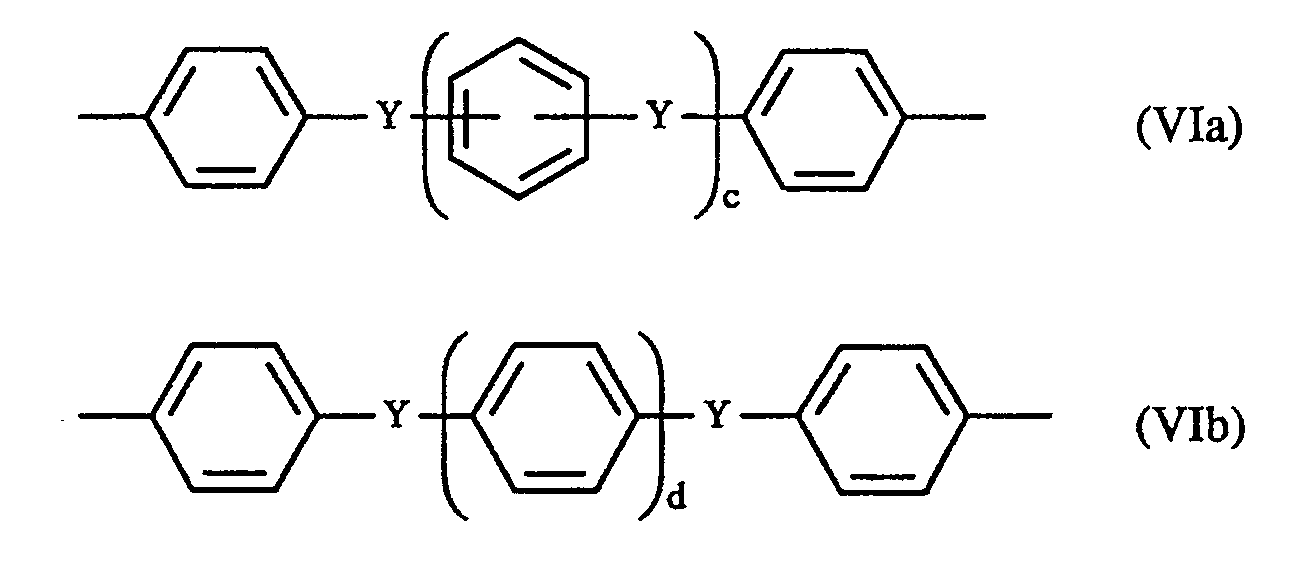
wobei Y für -SO- oder -SO₂-, c für die Zahlen 0 und 1 und d für die Zahl 2 stehen, und A˝ eine Gruppe der Formeln VIIa bis VIIe darstellt,
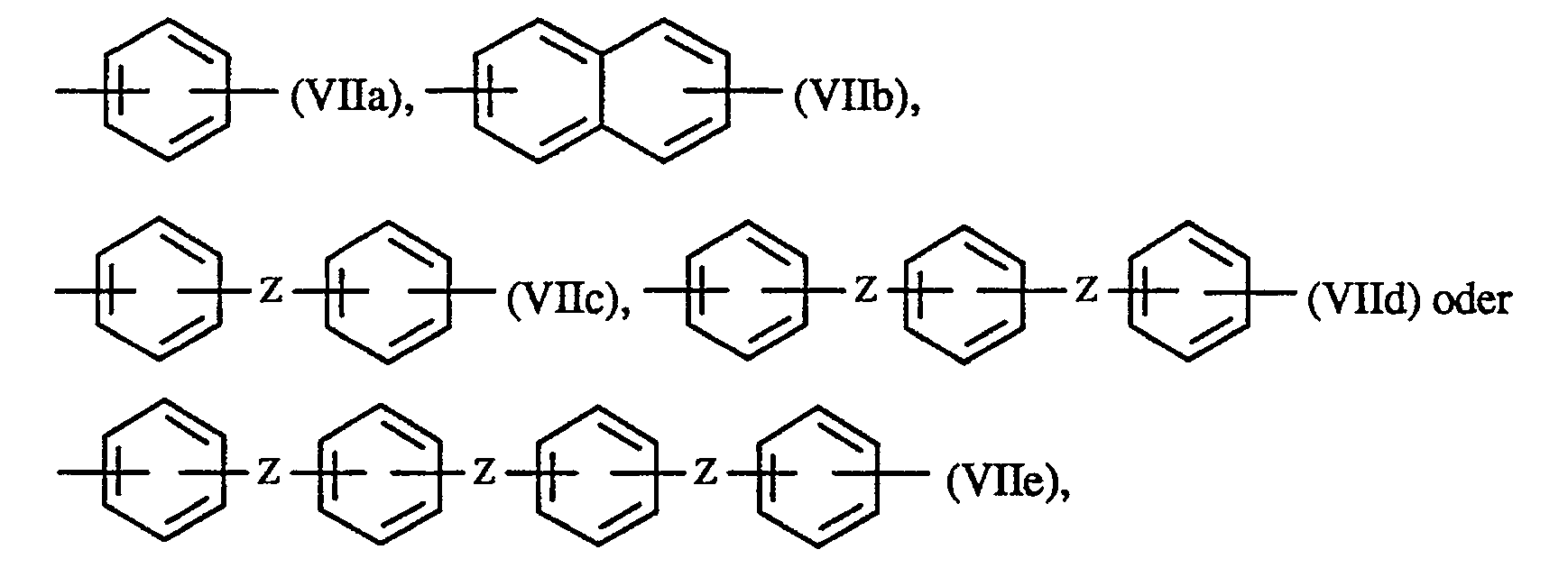
wobei Z für eine direkte Bindung, -C(CH₃)₂-, -C(CF₃)₂-, -S-,-SO-, -SO₂-, -O-oder -CO- steht.
enthalten, worin A eine Gruppe der Formeln Va oder Vb darstellt,
Diese technischen Werkstoffe zeichnen sich durch sehr gute mechanische und thermische Eigenschaften aus.
Description
- Die vorliegende Erfindung betrifft neue Polyarylenether, ein Verfahren zu deren Herstellung und deren Verwendung als technische Werkstoffe.
- In EP-A 282096 wird die Synthese von Polyarylenether-ketonen und -sulfonen mit 1,1′-Bi-4-naphthoxy-Struktureinheiten beschrieben. Weiter sind aus M. Tokarzewska, J. Pol. Sci., Part A-1, Vol. 6,777-784, (1968) aliphatische-aromatische Polyether aus Diphenolen und Bis-(chlormethyl)-Derivaten bekannt, die Einheiten vom 2,2′-Dihydroxydinaphthyl-(1,1′)-Typ enthalten. Weiter sind in den JP Kokai's 213,219/86; 11,726/87 und 75,032/88 Polyetherketone mit Strukturelementen beschrieben, die sich von Naphthalindiolen ableiten.
Diese genügen nicht in aller Hinsicht den hohen Anforderungen, welche heute an ein hochwertiges thermoplastisches Harz gestellt werden. So befriedigt insbesondere der Glasübergangspunkt nicht, was zu ungenügender Wärmeformbeständigkeit oder allgemein nicht genügender thermischer Stabilität führt. Weiter ist die Lösungsmittelbeständigkeit ungenügend. - Aufgabe der vorliegenden Erfindung war es, Polyarylenether bereitzustellen, welche sich als technische Werkstoffe mit sehr guten mechanischen Eigenschaften eignen und gleichzeitig eine niedrige Schmelztemperatur, eine hohe Glasübergangstemperatur, eine hohe Lösungsmittelbeständigkeit und vorzugsweise Teilkristallinität aufweisen.
Ueberraschenderweise wird dies dadurch erreicht, dass in die Polyarylenether-keton-Kette Strukturelemente eingebaut werden, die sich vom 2,2′-Dihydroxydinaphthyl ableiten. - Die vorliegende Erfindung betrifft Polyarylenether, die bezogen auf die Gesamtmenge der im Polyetherharz vorhandenen Strukturelemente, 10-100 Mol-% eines wiederkehrenden Strukturelements der Formel I


und O-50 Mol-% eines wiederkehrenden Strukturelements der Formel IV ⁅O-A˝-O-A⁆ (IV)
enthalten, worin A eine Gruppe der Formeln Va oder Vb darstellt,


- Vorzugsweise enthalten die erfindungsgemässen Polyarylenether 25-100 Mol-% eines wiederkehrenden Strukturelements der Formel I und 0-75 Mol-% eines wiederkehrenden Strukturelements der Formel III und/oder 0-50 Mol-% eines wiederkehrenden Strukturelements der Formel IV.
- Besonders bevorzugte Polyarylenether sind die, worin A eine Gruppe der Formel Va, insbesondere worin a den Wert Null aufweist, bedeutet.
- Ebenfalls bevorzugt sind Polyarylenether, worin A′ eine Gruppe der Formel VIa, insbesondere worin c den Wert Null aufweist, bedeutet.
- Die bevorzugte Bedeutung von Y in den Formeln VIa und VIb ist -SO₂-.
- Speziell bevorzugt sind Polyarylenether, worin A˝ eine Gruppe der Formeln VIIa und/oder VIIc, mit Z in der Bedeutung von -CO- oder einer direkten Bindung, bedeutet.
- Ganz von speziellem Interesse sind Polyarylenether, worin A in den Formeln I und/oderIII die Gruppe


- Die erfindungsgemässen Polyarylenether können z.B. hergestellt werden, indem man eine Verbindung der Formeln VIIIa, VIIIb, IXa und/oder IXb

Formel X,
HO-A˝-OH (X)
worin A˝ die oben gegebene Bedeutung hat, in an sich bekannter Weise in Gegenwart alkalischer Katalysatoren in einem polaren aprotischen Lösungsmittel polykondensiert. - Anstelle des Diphenols der Formel X oder des 1,1′-Bi-2-naphthols können in an sich bekannter Weise auch die entsprechenden Alkali- oder Erdalkali-Phenolate, z.B. die Kalium- oder Calciumphenolate oder entsprechende Gemische, eingesetzt werden.
- Ueblicherweise wird die Polykondensationsreaktion in etwa äquimolaren Verhältnissen der Verbindungen VIIIa, VIIIb, IXa, IXb: 1,1′-Bi-2-naphthol bzw. (1,1′-Bi-2-naphthol + X) durchgeführt. Unter etwa äquimolaren Mengen versteht man in diesem Zusammenhang ein Molverhältnis von 0,8:1,2 bis 1,2:0,8. Bevorzugt ist ein Molverhältnis von 0,95:1,05 bis 1,05:0,95.
- Als alkalische Katalysatoren verwendet man in diesem Verfahren in der Regel Alkali- und Erdalkalicarbonate, wie Natrium-, Kalium- oder Calciumcarbonat oder deren Gemische; doch können auch andere alkalische Reagentien, wie Natriumhydroxid, Kaliumhydroxid oder Calciumhydroxid Verwendung finden.
- Polare, aprotische Lösungsmittel, die beim Verfahren zur Herstellung der erfindungsgemässen Polyetherharze eingesetzt werden können, sind beispielsweise Dimethylsulfoxid, Dimethylacetamid, Diethylacetamid, Tetramethylharnstoff, N-Methylcaprolactam, N-Methylpyrrolidon und bevorzugt Diphenylsulfon.
- Die Reaktion wird zweckmässig bei erhöhter Temperatur durchgeführt, vorzugsweise bis zur Rückfluss-Temperatur des Losungsmittels, also etwa bis 350°C.
- Häufig empfiehlt sich die Mitverwendung eines Schleppmittels, wie z.B. Chlorbenzol, Xylol oder Toluol, um das bei der Umsetzung gebildete Wasser azeotrop aus dem Reaktionsgemisch entfernen zu können.
- Die Verbindungen der Formeln VIIIa, VIIIb, IXa und IXb sind bekannt und zum Teil im Handel erhältlich. Geeignete Verbindungen dieser Formeln sind beispielsweise 4,4′-Difluorobenzophenon, 1,3-Bis-(4-fluorobenzoyl)benzol, 4,4′-Dichlorobenzophenon, 4,4′-Difluorodiphenylsulfon oder 4,4′-Dichlorodiphenylsulfon.
- 1,1′-Bi-2-naphthol ist bekannt und im Handel erhältlich.
- Die Verbindungen der Formel X stellen auch bekannte Verbindungen dar, und sind grösstenteils im Handel erhältlich. Beispiele für geeignete zweiwertige Phenole der Formel VI sind Hydrochinon, Resorcin, 4,4′-Dihydroxydiphenyl; 4,4′-Dihydroxydiphenylether, 4,4′-Dihydroxydiphenylsulfon, 4,4′-Dihydroxybenzophenon, 4,4′-Dihydroxydiphenylmethan, 4,4′-Dihydroxydiphenylthioether, 2,2-Di-(4-hydroxyphenyl) propan oder Dihydroxynaphthalin.
- Die erfindungsgemässen Polyetherharze können in der für Thermoplaste üblichen Weise eingesetzt und z.B. zu Formkörpern oder Folien verarbeitet werden, oder als Matrixharze, Klebstoffe oder Ueberzugsmittel eingesetzt werden. Vor der Verarbeitung der beispielsweise als Presspulver, Folie oder Schmelze vorliegenden Polyarylenether können übliche Zusatzstoffe, wie beispielsweise Füllstoffe, Pigmente, Stabilisatoren oder Verstärkungsmittel, wie Kohlenstoff-, Bor- oder Glasfasern, zugegeben werden. Eine weitere Anwendungsmöglichkeit für die erfindungsgemässen Polyarylenether besteht in der Modifizierung anderer Kunststoffe. Diese können grundsätzlich Thermoplaste oder Duromere sein.
- Vorzugsweise eignen sich die erfindungsgemässen Polyarylenether als Matrixharze für die Herstellung von Faserverbundsystemen, wobei man als Verstärkungsfasern die üblichen bei der Verstärkung technischer Werkstoffe verwendeten Fasern einsetzen kann. Diese können organische oder anorganische Fasern, Naturfasern oder Synthesefasern, wie Aramid-Fasern sein, und als Faserbündel, als orientierte oder nicht-orientierte Fasern oder als Endlosfasern vorliegen. Beispielsweise verwendet man als Verstärkungsfasern Glas-, Asbest-, Bor-, Kohlenstoff- und Metallfasern.
- Wie die oben geschilderte Anwendungspalette zeigt, sind die erfindungsgemässen Polyarylenether breit als technische Werkstoffe einsetzbar.
- Beispiele 1-6: In einem Rundkolben mit Rührer, Schutzgasanschluss und Destillationsbrücke wird unter Stickstoff eine Mischung aus 28,63 g (0,1000 Mol) 1,1′-Bi-2-naphthol, 75,68 g Diphenylsulfon, 15,53 g (0,1124 Mol) Kaliumcarbonat und 57,6 g Xylol bei einer Badtemperatur von 200°C erhitzt und ein Xylol/Wasser-Gemisch abdestilliert Gegen Ende der Destillation wird dabei kurzzeitig Vakuum (5 mbar) angelegt. Sodann werden 21,40g (0,0981 Mol) 4,4′-Difluorbenzophenon zu der Reaktionsmischung gegeben und die Temperatur mit 2°C/min auf 250°C erhöht und dort 1 Stunde belassen. Die Temperatur wird danach weiter auf 320°C gesteigert. Nach 1,5 Stunden erfolgt eine Zugabe von 0,49 g (0,0023 Mol) 4,4′-Difluorbenzophenon und nach weiteren 30 Minuten noch einmal 0,24g (0,0011 Mol) 4,4′-Difluorbenzophenon. Sodann wird die Temperatur auf 350°C erhöht und 3,5 Stunden beibehalten.
- Nach Abkühlen wird die Reaktionsmischung dem Kolben entnommen, pulverisiert, mit 2 molarer Salzsäure versetzt, zunächst mit Wasser und dann mit Aceton extrahiert. Das so gereinigte Polymere wird im Vakummtrockenschrank bis zu einer Temperatur von 240°C getrocknet. Ein auf diese Weise hergegestelltes Polyetherketon mit Binaphthol-Einheiten besitzt eine durch DSC bestimmte Glasübergangstemperatur von 225°C und eine Schmelztemperatur von 310°C.
- Die in der nachstehenden Tabelle angegebenen Beispiele 2-6 werden in analoger Weise hergestellt.
- Die Polymeren sind unlöslich in Aceton, Methylenchlorid und nur in geringem Masse 1%) in N-Methylpyrrolidon, aber gelfrei löslich in konz. Schwefelsäure. Die Löslichkeit in konz. Schwefelsäure beweist das Vorliegen eines linearen, d.h. unvernetzten Polyetherketons.
- Die Polymeren zeigen bei röntgenographischen Untersuchungen deutliche kristalline Anteile. Durch röntgenographische Untersuchung mittels Pulverdiffraktometrie (Pulverdiffraktometer Philips PW 1710) mit CuKα-Strahlung in Reflexionsgeometrie wurde die relative Kristallinität von ausgewählten Beispielen bestimmt. Aus den in der Tabelle 2 angegebenen Werten (Verhältnis kristalline Fläche zu kristalline und amorphe Fläche = Kristallinitätsgrad, Auswertung erfolgt gemäss C.-L. Ong, W.-L. Chung, M.-F. Sheu, J.-H. Lin 33rd Int. SAMPE Symposium, 1988, S .1307) ist eindeutig erkennbar, dass (teil-)kristalline Polymere vorliegen.
- Ein nach Beispiel 2 hergestelltes Polyetherketon wird in einer Plattenpresse bei 250°C mit einer Kraft von 3000 N während 10 Minuten gepresst. Man erhält einen flexiblen Film, der sich wiederholt ohne Bruch biegen und falten lässt. Der Film (Dicke: 0,13 mm) weist eine Zugfestigkeit von 60 MPa und eine Bruchdehnung von 8 % auf (nach DIN 53455).


Tabelle 2 Relative Kristallinität der mit 1,1′-Bi-2-naphthol synthetisierten Polymeren Beispiel gemäss Tabelle 1 Kristallinitätsgrad 1 nicht bestimmt 2 0,24 3 0,46 4 0,47 5 0,35 6 0,39 7 nicht bestimmt 8 0,17 9 0,37
Claims (9)
1. Verfahren zur Herstellung von Polyarylenethern, die bezogen auf die Gesamtmenge der im Polyetherharz vorhandenen Strukturelemente, 10-100 Mol-% eines wiederkehrenden Strukturelements der Formel I

0-50 Mol-% eines wiederkehrenden Strukturelements der Formel II,

0-90 Mol-% eines wiederkehrenden Strukturelements der Formel III ⁅O-A˝-O-A⁆ (III)
und 0-50 Mol-% eines wiederkehrenden Strukturelements der Formel IV ⁅O-A˝-O-A′⁆ (IV)
enthalten, worin A eine Gruppe der Formeln Va oder Vb darstellt, 
wobei X für -CO-, a für die Zahlen 0, 1 oder 2 und b für die Zahlen 2 oder 3 stehen, ferner A′ eine Gruppe der Formeln VIa oder VIb darstellt,
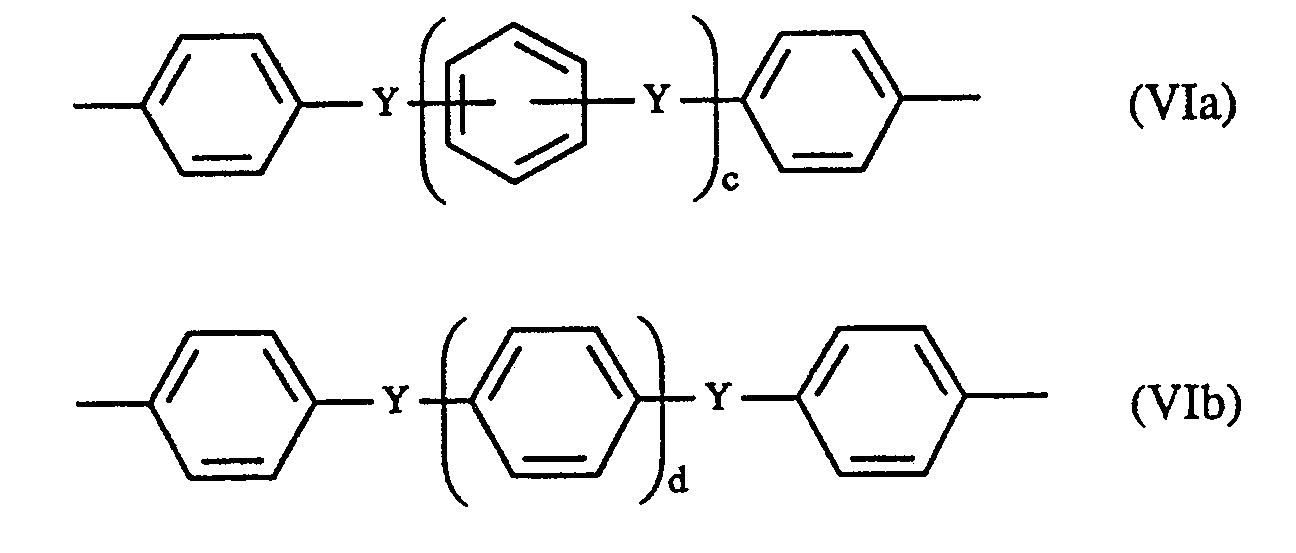
wobei Y für-SO- oder -SO₂-, c für die Zahlen 0 und 1 und d für die Zahl 2 stehen, und A˝ eine Gruppe der Formeln VIIa bis VIIe darstellt,

wobei Z für eine direkte Bindung, -C(CH₃)₂-, -C(CF₃)₂-, -S-, -SO-, -SO₂-, -O- oder -CO- steht, dadurch gekennzeichnet, dass man eine Verbindung der Formeln VIIIa, VIIIb, IXa und/oder IXb,

worin X, Y, a, b, c und d die oben angegebenen Bedeutungen haben und Hal für Halogen, insbesondere Fluor oder Chlor steht, mit 1,1′-Bi-2-naphthol allein, oder mit einem Gemisch aus dieser Verbindung und einem darin bis zu 90 Mol-% enthaltenen Diphenol der Formel X,
HO-A˝-OH (X)
worin A˝ die oben gegebene Bedeutung hat, in an sich bekannter Weise in Gegenwart alkalischer Katalysatoren in einem polaren aprotischen Lösungsmittel polykondensiert
und 0-50 Mol-% eines wiederkehrenden Strukturelements der Formel IV ⁅O-A˝-O-A′⁆ (IV)
enthalten, worin A eine Gruppe der Formeln Va oder Vb darstellt,
HO-A˝-OH (X)
worin A˝ die oben gegebene Bedeutung hat, in an sich bekannter Weise in Gegenwart alkalischer Katalysatoren in einem polaren aprotischen Lösungsmittel polykondensiert
2. Verfahren zur Herstellung von Polyarylenethern gemäss Anspruch 1, die 25-100 Mol-% eines wiederkehrenden Strukturelements der Formel I und 0.75 Mol-% eines wiederkehrenden Strukturelements der Formel III und/oder 0-50 Mol-% eines wiederkehrenden Strukturelements der Formel IV enthalten.
3. Verfahren zur Herstellung von Polyarylenethern gemäss Anspruch 1, worin A eine Gruppe der Formel Va bedeutet.
4. Verfahren zur Herstellung von Polyarylenethern gemäss Anspruch 1, worin A′ eine Gruppe der Formel VIa bedeutet.
5. Verfahren zur Herstellung von Polyarylenethern gemäss Anspruch 4, worin Y -SO₂- bedeutet.
6. Verfahren zur Herstellung von Polyarylenethern gemäss Anspruch 1, worin A˝ in den Formeln III und/oder IV eine Gruppe der Formeln VIIa und/oder VIIc, mit Z in der Bedeutung von -CO- oder einer direkten Bindung, bedeutet.
7. Verfahren zur Herstellung von Polyarylenethern gemäss Anspruch 1, worin A die Gruppe

und A′ die Gruppe

bedeuten.
8. Verfahren gemäss Anspruch 1, wobei anstelle des Diphenols der Formel X oder des 1,1′-Bi-2-naphthols die entsprechenden Alkali- oder Erdalkali-Phenolate eingesetzt werden.
Applications Claiming Priority (2)
| Application Number | Priority Date | Filing Date | Title |
|---|---|---|---|
| CH297489 | 1989-08-15 | ||
| CH2974/89 | 1989-08-15 |
Publications (2)
| Publication Number | Publication Date |
|---|---|
| EP0413662A2 true EP0413662A2 (de) | 1991-02-20 |
| EP0413662A3 EP0413662A3 (en) | 1991-10-23 |
Family
ID=4245821
Family Applications (1)
| Application Number | Title | Priority Date | Filing Date |
|---|---|---|---|
| EP19900810597 Withdrawn EP0413662A3 (en) | 1989-08-15 | 1990-08-07 | Polyaryleneethers |
Country Status (3)
| Country | Link |
|---|---|
| EP (1) | EP0413662A3 (de) |
| JP (1) | JPH0388829A (de) |
| CA (1) | CA2023166A1 (de) |
Cited By (3)
| Publication number | Priority date | Publication date | Assignee | Title |
|---|---|---|---|---|
| US7176278B2 (en) | 2001-08-30 | 2007-02-13 | Biorexis Technology, Inc. | Modified transferrin fusion proteins |
| WO2008075010A1 (en) * | 2006-12-21 | 2008-06-26 | Victrex Manufacturing Limited | Composite material |
| US7867972B2 (en) | 2006-07-24 | 2011-01-11 | Pharmacia & Upjohn Company, Llc | Fusion protein of exendin-4 to a transferrin (Tf) polypeptide |
Family Cites Families (1)
| Publication number | Priority date | Publication date | Assignee | Title |
|---|---|---|---|---|
| US4806617A (en) * | 1987-03-13 | 1989-02-21 | The B.F. Goodrich Company | Poly(dinaphthyl arylene ether) and preparation thereof |
-
1990
- 1990-08-07 EP EP19900810597 patent/EP0413662A3/de not_active Withdrawn
- 1990-08-13 CA CA002023166A patent/CA2023166A1/en not_active Abandoned
- 1990-08-15 JP JP2215675A patent/JPH0388829A/ja active Pending
Cited By (4)
| Publication number | Priority date | Publication date | Assignee | Title |
|---|---|---|---|---|
| US7176278B2 (en) | 2001-08-30 | 2007-02-13 | Biorexis Technology, Inc. | Modified transferrin fusion proteins |
| US7867972B2 (en) | 2006-07-24 | 2011-01-11 | Pharmacia & Upjohn Company, Llc | Fusion protein of exendin-4 to a transferrin (Tf) polypeptide |
| US8158579B2 (en) | 2006-07-24 | 2012-04-17 | Biorexis Pharmaceutical Corporation | Fusion protein of an exendin to modified transferrin |
| WO2008075010A1 (en) * | 2006-12-21 | 2008-06-26 | Victrex Manufacturing Limited | Composite material |
Also Published As
| Publication number | Publication date |
|---|---|
| EP0413662A3 (en) | 1991-10-23 |
| JPH0388829A (ja) | 1991-04-15 |
| CA2023166A1 (en) | 1991-02-16 |
Similar Documents
| Publication | Publication Date | Title |
|---|---|---|
| EP0388358B1 (de) | Neue Polyarylenether | |
| EP0157732B1 (de) | Vernetzbare, lineare Polyätherharze | |
| DE3382700T2 (de) | Verwendung eines amorphen aromatischen thermoplastischen Polymeren. | |
| DE2733905C2 (de) | Verfahren zur Herstellung von aromatischen Polyäthern | |
| EP0297363A2 (de) | Hochtemperaturbeständige thermoplastische formmassen mit verbesserter Schmelzestabilität | |
| EP2440599B1 (de) | Verfahren zur herstellung von polyarylenether-blockcopolymeren | |
| EP0275035A2 (de) | Verfahren zur Herstellung von Polyaryletherketonen | |
| EP0327984A2 (de) | Polyaryletherketone mit verbesserter Verarbeitbarkeit | |
| DE2734200A1 (de) | Polyharnstoffharzmassen und ihre verwendung | |
| DE2206836A1 (de) | Polyketone und Verfahren zu ihrer Herstellung | |
| EP0332012A1 (de) | Hochtemperaturbeständige Polyarylethersulfon-/Polyaryletherketon-Formmassen mit verbesserter Phasenbindung | |
| DE4121138A1 (de) | Polyarylenether und ihre verwendung | |
| DE3587778T2 (de) | Kristallines aromatisches Polyketon und Verfahren zu seiner Herstellung. | |
| EP0467847A1 (de) | Polyarylenether mit Tetraphenylethylen-Einheiten | |
| EP0479192A2 (de) | Modifizierte Polyarylenether-Blockcopolymere | |
| EP0413662A2 (de) | Neue Polyarylenether | |
| DE3700810A1 (de) | Hochtemperaturbestaendige polyaryletherketone | |
| DE4121139A1 (de) | Verfahren zur herstellung von polyarylenethern und ihre verwendung | |
| DE4237768A1 (en) | New polyarylene ether derivs. with reduced viscosity - used to prepare moulded bodies, foils, fibres and membranes, as matrix resins, adhesives or coating agents or as polymer additives | |
| EP0412934B1 (de) | Modifizierte Polyarylenethersulfone | |
| DE3636558A1 (de) | Hochtemperaturbestaendige polyethersulfon/polyetherketon-blockcopolykondensate | |
| EP0447358A2 (de) | Lösliche Polyarylenethersulfone | |
| EP0383725A2 (de) | Neue Polyether | |
| DE3421949C2 (de) | ||
| EP0210136B1 (de) | Vernetzbare Polyätherharze |
Legal Events
| Date | Code | Title | Description |
|---|---|---|---|
| PUAI | Public reference made under article 153(3) epc to a published international application that has entered the european phase |
Free format text: ORIGINAL CODE: 0009012 |
|
| 17P | Request for examination filed |
Effective date: 19900809 |
|
| AK | Designated contracting states |
Kind code of ref document: A2 Designated state(s): DE ES FR GB IT NL SE |
|
| PUAL | Search report despatched |
Free format text: ORIGINAL CODE: 0009013 |
|
| AK | Designated contracting states |
Kind code of ref document: A3 Designated state(s): DE ES FR GB IT NL SE |
|
| STAA | Information on the status of an ep patent application or granted ep patent |
Free format text: STATUS: THE APPLICATION IS DEEMED TO BE WITHDRAWN |
|
| 18D | Application deemed to be withdrawn |
Effective date: 19940301 |