EP0414323A2 - Appareil d'enregistrement et/ou de reproduction pour suppot d'information en forme de bande - Google Patents
Appareil d'enregistrement et/ou de reproduction pour suppot d'information en forme de bande Download PDFInfo
- Publication number
- EP0414323A2 EP0414323A2 EP90202244A EP90202244A EP0414323A2 EP 0414323 A2 EP0414323 A2 EP 0414323A2 EP 90202244 A EP90202244 A EP 90202244A EP 90202244 A EP90202244 A EP 90202244A EP 0414323 A2 EP0414323 A2 EP 0414323A2
- Authority
- EP
- European Patent Office
- Prior art keywords
- drive wheels
- carrier
- plane
- drive
- wheels
- Prior art date
- Legal status (The legal status is an assumption and is not a legal conclusion. Google has not performed a legal analysis and makes no representation as to the accuracy of the status listed.)
- Withdrawn
Links
- 238000004804 winding Methods 0.000 claims abstract description 42
- 230000000149 penetrating effect Effects 0.000 description 2
- 238000013459 approach Methods 0.000 description 1
- 230000007935 neutral effect Effects 0.000 description 1
- 230000002093 peripheral effect Effects 0.000 description 1
Images

Classifications
-
- G—PHYSICS
- G11—INFORMATION STORAGE
- G11B—INFORMATION STORAGE BASED ON RELATIVE MOVEMENT BETWEEN RECORD CARRIER AND TRANSDUCER
- G11B15/00—Driving, starting or stopping record carriers of filamentary or web form; Driving both such record carriers and heads; Guiding such record carriers or containers therefor; Control thereof; Control of operating function
- G11B15/18—Driving; Starting; Stopping; Arrangements for control or regulation thereof
- G11B15/22—Stopping means
Definitions
- the invention relates to a recording and / or reproducing device for a tape-shaped recording medium which runs between two rotatably drivable winding cores, with two winding mandrels provided for driving the two winding cores, with two rotatably drivable drive wheels connected to the two winding mandrels and with one for braking of the two drive wheels provided braking device, which has a carrier which can be adjusted essentially perpendicularly to a plane through the axes of the two drive wheels and which passes through this plane and on which two braking surfaces are provided for cooperation with the two drive wheels, at a distance from the plane in a first direction perpendicular to the plane are and on which acts from the plane in a direction opposite to the first direction opposite an adjusting device for adjusting the carrier.
- a device is known for example from DE-AS 10 81 686.
- the carrier of the braking device is essentially bar-shaped and arranged perpendicular to the plane through the axes of the two drive wheels in the area between the two drive wheels.
- the invention has set itself the task of avoiding the difficulties mentioned above and designing a device of the type mentioned above so that the distance between the two drive wheels can be as small as possible and that in the area between the two drive wheels others to cooperate with the two Drive wheels provided device parts can be arranged.
- the invention is characterized in that the carrier is frame-shaped and has two carrier sections passing through the plane through the axes of the two drive wheels, each of which is arranged laterally along one of the two drive wheels outside the region between the two drive wheels. Due to the frame-shaped design of the carrier, it is advantageously achieved that the distance between the two drive wheels can be chosen to be small and that other device parts provided for cooperation with the two drive wheels can be arranged in the area between the two drive wheels. As a result of the small distance between the two drive wheels, they can have the largest possible diameter for a given center distance of the same, which is advantageous with regard to the largest possible speed reduction and the greatest possible torque that can be transmitted to the drive wheels.
- the two carrier sections of the carrier passing through the plane through the axes of the two drive wheels are arranged to run laterally along the end faces of the drive wheels facing the winding mandrels.
- the two support sections viewed transversely to the axial direction of the winding mandrels, can be accommodated within the space already provided for the winding mandrels, which is advantageous in terms of the smallest possible structural height.
- the carrier sections can lie within the area occupied by the two drive wheels, which is advantageous in view of the most compact possible design in the direction transverse to the axes of the drive wheels.
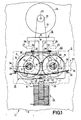
- FIG. 1 shows schematically in plan view a part of a recording and reproducing device according to a first exemplary embodiment, which is essential for the invention, for a device housed in a cassette Magnetic tape with two drive wheels each connected to a winding mandrel and with a braking device for the two drive wheels, which has a frame-shaped carrier which has two carrier sections which pass through the plane through the axes of the two drive wheels and which are arranged running along the end faces of the drive wheels facing the winding mandrels .
- FIG. 2 shows, analogously to FIG.
- a recording and reproducing device in which a braking device for two drive wheels each connected to a winding mandrel has a frame-shaped support, the two of which support the plane through the axes of the two drive wheels has penetrating carrier sections, which are arranged running along the regions of the peripheral sides of the two drive wheels facing away from one another.
- 3 shows, analogously to FIGS.
- a recording and reproducing device in which a braking device for two drive wheels each connected to a winding mandrel has a frame-shaped carrier, the two of which are the plane through the axes of the two Carrier sections penetrating drive wheels, which are arranged running along the end faces of the drive wheels facing away from the winding mandrels.
- FIG. 1 schematically shows part of a recording and reproducing device 1 for a tape-shaped recording medium 2, which is designed as a magnetic tape.
- the magnetic tape 2 is accommodated in a cassette 3 which can be inserted into the device 1 and is shown schematically in FIG. 1 with dash-dotted lines.
- the device has a trough-shaped cassette holder, not shown.
- the magnetic tape 2 runs in the cassette 3 between two side-by-side, rotatably drivable winding cores 4 and 5, which are rotatably mounted between the two main walls of the cassette and onto which differently sized tape windings 6 and 7 are wound in the situation shown in FIG.
- the magnetic tape 2 is guided from one to the other of the two winding cores 4 and 5 along a long narrow side 8 of the cassette, in which openings are provided in a known manner, through which not shown Magnetic heads on the device for recording and reproducing and for deleting information signals, for example voice signals, can be brought into a scanning connection with the magnetic tape 2.
- the device 1 To drive the two winding cores 4 and 5, the device 1 has two rotatably drivable winding mandrels 10 and 11, which are rotatably mounted on an essentially plate-shaped chassis 9 and which come into drive connection with the two winding cores 4 and 5 when a cassette 3 is inserted into the device .
- a drive wheel 12 or 13 With each of the two mandrels 10 and 11, a drive wheel 12 or 13 is coaxially connected.
- the two drive wheels 12 and 13 are designed as friction wheels and are provided on the circumference with an annular rubber covering 14 and 15.
- the device 1 To drive the two friction wheels 12 and 13, the device 1 has a drive shaft 16 which is arranged centrally between the two friction wheels and which can optionally be brought into a non-positive drive connection with the rubber linings 14 and 15 of the two friction wheels 12 and 13.
- the drive shaft 16 is rotatably mounted on the free end of an arm 17 of a three-armed bracket 18.
- the bearing block 18 is pivotally mounted on the chassis 9 with a bearing shaft 19.
- a drive wheel 20 is coaxially connected to the drive shaft 16 in a rotationally fixed manner and can be driven by a further drive wheel 22 via a drive shaft 21.
- the further pin wheel 22 is fastened on the shaft 23 of a motor 24 which can be driven in opposite directions of rotation at constant speed. Via this drive connection, the drive shaft 16 can optionally be driven by the motor 24 in opposite directions of rotation.
- the bearing block 18 can be pivoted in the opposite pivoting directions from the neutral central position shown in FIG. 1, in which it is held, for example, by means of a return spring, not shown, in order to bring the drive shaft 16 selectively to one of the two friction wheels 12 and 13 in a force-locking drive connection.
- a schematically indicated key 25 the bearing block 18 can be pivoted counterclockwise according to FIG. 1 via an adjusting device indicated symbolically by an arrow 26, in which case the drive shaft 16 with the friction wheel 13 comes into non-positive drive connection.
- actuating a schematically indicated further key 27 the bearing block 18 according to FIG. 1 can be pivoted clockwise via a further adjustment device symbolically indicated by an arrow 28, the drive shaft 16 then coming into non-positive drive connection with the friction wheel 12.
- the drive shaft 16 When the drive shaft 16 is pressed against the friction wheel 13, the drive shaft 16 is driven clockwise by the motor 24 at a constant speed. Characterized the winding core 5 is driven counterclockwise via the friction wheel 13 and the winding mandrel 11 and the magnetic tape 2 is wound onto the winding core 5. This corresponds to an operating mode "normal advance” in which the magnetic tape 2 is moved in the direction of the arrow 29 along the narrow side 8 of the cassette along the magnetic heads (not shown), wherein in a first track of the magnetic tape 2 information signals can be recorded or reproduced on the magnetic tape .
- the drive shaft 16 When the drive shaft 16 is pressed against the friction wheel 12, the drive shaft 16 is driven counterclockwise by the motor 24 at a constant speed.
- the winding core 4 is driven in a clockwise direction via the friction wheel 12 and the winding mandrel 10 and the magnetic tape 2 is wound onto the winding core 4.
- a braking device 30 is provided for the two friction wheels 12 and 13.
- the braking device 30 has a support 33 for two braking surfaces for the two friction wheels, which is adjustable perpendicularly to the plane through the axes 31 and 32 of the two friction wheels 12 and 13 and is displaceably guided in a manner not shown.
- the plane through the axes 31 and 32 of the two friction pads 12 and 13 is shown in FIG. 1 with a dash-dotted line and is designated by reference number 34.
- the carrier 33 is advantageously in the form of a frame and has two flat carrier sections 35 and 36 passing through the plane 34 through the axes 31 and 32 of the two friction wheels 12 and 13, each of which outside the area between the two friction wheels on one of the two friction wheels 12 and 13 is arranged laterally along.
- these two carrier sections 35 and 36 are arranged to run laterally along the end faces of the two friction wheels 12 and 13 facing the winding mandrels 10 and 11.
- a first direction, indicated by an arrow 37 and perpendicular to the plane 34 from the plane 34, the two flat carrier sections 35 and 36 are connected to one another via a likewise flat web 38, which is angled at a right angle with respect to the carrier sections 35 and 36.
- two braking surfaces 39 and 40 are provided for the two friction wheels 12 and 13, which are formed directly by two boundary surfaces of the web 38 and which can be brought into operative connection with the rubber linings 14 and 15 of the friction wheels 12 and 13.
- a second direction indicated by an arrow 41 and perpendicular to the plane 34, from the plane 34, the two flat support sections 35 and 36 are connected to one another via a flat web 42 lying on the same level as the support sections 35 and 36.
- An adjustment device 43 for adjusting the carrier 33 acts on this web 42.
- the adjustment device 43 is formed by a plunger armature magnet, the plunger armature 44 of which is coupled to the flat web 42 of the carrier 33 via a pin-slot connection 45.
- a pin 46 protrudes from the web 42, on which a leaf spring 47 engages, which is supported with its free ends on two stops 48 and 49 arranged stationary in the device and which loads the carrier 33 in the direction of the arrow 37 and in this way presses the carrier 33 with its web 38 against two limit stops 50 and 51 arranged stationary in the device when the plunger magnet 43 is not energized.
- a drive shaft 16 for driving the two friction wheels can advantageously be arranged in the area between the two friction wheels 12 and 13, and the diameter of the two friction wheels can also advantageously be as possible be chosen large, which is advantageous with regard to the greatest possible speed reduction and the greatest possible torque that can be transmitted from the drive shaft 16 to the friction wheels 12 and 13.
- the flat carrier sections 35 and 36 and the flat web 42 of the carrier 33 are arranged to run along the end faces of the friction wheels 12 and 13 facing the winding mandrels 10 and 11, these parts of the carrier 33 are transverse to the axial direction of the winding mandrels 10 and 11 seen housed within the space already provided for the mandrels, which is advantageous in terms of the lowest possible height.
- the carrier sections 35 and 36 and the web 42 of the carrier 33 lie essentially within the area occupied by the two friction wheels 12 and 13, so that these parts of the carrier 33 also in the direction the axes 31 and 32 seen compared to the friction wheels do not take up any additional space, which in view of the most compact design possible in the direction transverse to the axes of the Friction wheels is advantageous.
- the frame-shaped carrier 33 of the braking device 30 is rectangular and the two carrier sections 35 and 36 passing through the plane 34 through the axes 31 and 32 of the two friction wheels 12 and 13 and the two the carrier sections 35 and 36 connecting webs 38 and 42 are substantially at the same level as the two friction wheels 12 and 13.
- the carrier sections 35 and 36 are arranged on the opposite sides of the circumferential sides of the two friction wheels 12 and 13 extending laterally along.
- Such a design and arrangement of the carrier 33 of the braking device 30 has the advantage that the carrier 33 in the axial direction of the friction wheels does not require any additional space in relation to the friction wheels.
- a tension spring 54 is provided as a return spring for the carrier 33 of the braking device 30, which is suspended on the one hand on the bearing shaft 19 of the bearing block 18 and on the other hand on a pin 55 projecting from the web 38.
- the frame-shaped carrier 33 of the braking device 30 is arranged opposite the friction wheels 12 and 13 in such a way that its carrier sections 35 and 36, which define the plane 34 through the axes 31 and 32 of the two friction wheels 12 and 13, along which the end faces of the friction wheels facing away from the winding mandrels 10 and 11 are arranged to run laterally.
- the carrier 33 of the braking device 30 lies essentially below the two friction wheels 12 and 13, as a result of which the friction wheels are arranged close to the main wall of the cassette 3 facing them and the winding mandrels 10 and 11 can accordingly be made short .
- the braking surfaces 39 and 40 of the braking device 30 are connected to the angled web 38 of the carrier 33 by the boundary surfaces of two, just as in the device according to FIG Brake shoes 52 and 53 made of rubber.
- a drive shaft 16 for driving the two friction wheels and the diameter of the two friction wheels 12 and 13 can advantageously be arranged in the area between the two friction wheels 12 and 13 due to the frame-shaped design of the carrier 33 of the braking device 30 be chosen as large as possible.
- Arranging the drive shaft 16 between the two friction wheels 12 and 13, as is the case with the devices according to the three exemplary embodiments described above, is particularly advantageous if, as in the case of the devices described above, so-called reverse devices are involved, in which the two winding cores 4 and 5 are to be driven in opposite directions of rotation, but otherwise in the same way via the friction wheels 12 and 13, in order to be able to drive the magnetic tape 2 in the same way in opposite tape running directions for recording and playback.
- a frame-shaped support of a braking device can also be oval-shaped.
- a magnet of a different type or a mechanical adjusting device can also be provided as the adjusting device for a frame-shaped carrier of a braking device instead of a plunger armature magnet.
- a drive shaft for driving the drive wheels connected to the winding mandrels a drive friction wheel or a drive gearwheel can also be provided, in the latter case the drive wheels connected to the winding mandrels being designed as gearwheels which have coaxial cylindrical approaches to the same with which the the frame-shaped support of a braking device provided braking surfaces cooperate.
Landscapes
- Braking Arrangements (AREA)
- Winding Of Webs (AREA)
Applications Claiming Priority (2)
| Application Number | Priority Date | Filing Date | Title |
|---|---|---|---|
| AT201689A AT392701B (de) | 1989-08-25 | 1989-08-25 | Aufzeichnungs- und/oder wiedergabegeraet fuer einen bandfoermigen aufzeichnungstraeger |
| AT2016/89 | 1989-08-25 |
Publications (2)
| Publication Number | Publication Date |
|---|---|
| EP0414323A2 true EP0414323A2 (fr) | 1991-02-27 |
| EP0414323A3 EP0414323A3 (en) | 1991-08-14 |
Family
ID=3526004
Family Applications (1)
| Application Number | Title | Priority Date | Filing Date |
|---|---|---|---|
| EP19900202244 Withdrawn EP0414323A3 (en) | 1989-08-25 | 1990-08-21 | Recording and/or reproducing apparatus for a tape-like recorder |
Country Status (3)
| Country | Link |
|---|---|
| EP (1) | EP0414323A3 (fr) |
| JP (1) | JPH0388162A (fr) |
| AT (1) | AT392701B (fr) |
Families Citing this family (2)
| Publication number | Priority date | Publication date | Assignee | Title |
|---|---|---|---|---|
| US5079301A (en) * | 1990-08-08 | 1992-01-07 | Shell Oil Company | Molecularly miscible polymer blends of polyvinyl phenol and polyacetal |
| JP4789440B2 (ja) * | 2004-07-30 | 2011-10-12 | 大和ハウス工業株式会社 | 壁体、バルコニー手摺壁、建物、並びに壁体内空間の通気方法 |
Family Cites Families (8)
| Publication number | Priority date | Publication date | Assignee | Title |
|---|---|---|---|---|
| US2793039A (en) * | 1952-04-24 | 1957-05-21 | Wilcox Gay Corp | Tape recorder and playback device |
| DE1167078B (de) * | 1954-07-09 | 1964-04-02 | Bernard Lowe | Auf ein Aufnahme- und/oder Wiedergabegeraet aufsetzbare Haltevorrichtung fuer Bandspulen |
| DE1081686B (de) * | 1955-07-01 | 1960-05-12 | Dr Siegmund Loewe | Tonbandgeraet mit zwei entgegengesetzt drehenden Tonrollen |
| FR2180227A5 (fr) * | 1972-04-10 | 1973-11-23 | Fauris Sa | |
| FR2357976A1 (fr) * | 1976-07-05 | 1978-02-03 | Roussel Francois | Dispositif d'entrainement et de freinage d'une bande magnetique plus specialement d'une bande magnetique de cassette |
| JPS56167054U (fr) * | 1980-05-09 | 1981-12-10 | ||
| DE3118708A1 (de) * | 1981-05-12 | 1982-12-02 | Licentia Patent-Verwaltungs-Gmbh, 6000 Frankfurt | Laufwerk fuer ein magnetbandgeraet, insbesondere einen videorecorder |
| AT392700B (de) * | 1989-08-25 | 1991-05-27 | Philips Nv | Aufzeichnungs- und/oder wiedergabegeraet fuer einen bandfoermigen aufzeichnungstraeger |
-
1989
- 1989-08-25 AT AT201689A patent/AT392701B/de not_active IP Right Cessation
-
1990
- 1990-08-21 EP EP19900202244 patent/EP0414323A3/de not_active Withdrawn
- 1990-08-22 JP JP21912490A patent/JPH0388162A/ja active Pending
Also Published As
| Publication number | Publication date |
|---|---|
| EP0414323A3 (en) | 1991-08-14 |
| ATA201689A (de) | 1990-10-15 |
| AT392701B (de) | 1991-05-27 |
| JPH0388162A (ja) | 1991-04-12 |
Similar Documents
| Publication | Publication Date | Title |
|---|---|---|
| EP0403001B1 (fr) | Appareil à bande magnétique comportant une tête magnétique | |
| DE2221743A1 (de) | Antriebsvorrichtung zur linearen Einstellung von Magnetkoepfen | |
| DE69027132T2 (de) | Magnetband-Längsaufzeichnungssystem, Magnetbandgerät und Magnetkopf. | |
| DE3781439T2 (de) | Bandladung von magnetischem aufnahme- und wiedergabegeraet. | |
| DE1524964C3 (de) | Aufzeichnungs- und/oder Wiedergabegerät | |
| DE3146594C2 (de) | Kleinvideokassette und zugehöriger Adapter | |
| EP0126973A1 (fr) | Mémoire à disques avec dispositif de positionnement et aimant de verrouillage | |
| DE69214475T2 (de) | Antriebsvorrichtung für die Bremsen eines Bandaufzeichnungsgerätes | |
| DE1261331B (de) | Kleintonbandgeraet | |
| DE69016877T2 (de) | Bandkassettenlade- / entladevorrichtung. | |
| DE69223171T2 (de) | Aufzeichnungs/Wiedergabegerät | |
| AT392701B (de) | Aufzeichnungs- und/oder wiedergabegeraet fuer einen bandfoermigen aufzeichnungstraeger | |
| EP0257597B1 (fr) | Entraînement d'enroulement et de bande | |
| DE3700889A1 (de) | Antriebsmechanismus fuer die andruckrolle eines bandabspielgeraetes | |
| DE2807272A1 (de) | Geraet zum aufzeichnen und/oder wiedergeben von informationen auf bandfoermige aufzeichnungstraeger | |
| EP0123802A2 (fr) | Embrayage de distribution | |
| EP0025914A1 (fr) | Cassette à bande et appareil à bande, en particulier cassette à bande magnétique et appareil à bande magnétique | |
| EP0350105A2 (fr) | Appareil d'enregistrement et/ou de reproduction à support d'information en forme de bande | |
| DE3688865T2 (de) | Kassettenaufnahme- und Wiedergabegerät. | |
| EP0246694A2 (fr) | Appareil d'enregistrement et/ou de reproduction | |
| EP0414322B1 (fr) | Appareil d'enregistrement et/ou de reproduction pour un support d'information en forme de bande | |
| AT396854B (de) | Magnetbandgerät mit einer zum abtasten eines magnetbandes vorgesehenen magnetkopfeinheit | |
| DE2615109C3 (de) | Antriebsvorrichtung für Kassettenmagnetbandgeräte mit digitaler Aufzeichnung | |
| DE972912C (de) | Transportable, in eine Aufzeichnungs- oder Wiedergabemaschine einsteckbare gehaeuseartige Aufzeichnungs- oder Wiedergabeeinheit | |
| AT393755B (de) | Magnetbandgeraet mit einem magnetkopf |
Legal Events
| Date | Code | Title | Description |
|---|---|---|---|
| PUAI | Public reference made under article 153(3) epc to a published international application that has entered the european phase |
Free format text: ORIGINAL CODE: 0009012 |
|
| AK | Designated contracting states |
Kind code of ref document: A2 Designated state(s): CH DE FR GB LI |
|
| PUAL | Search report despatched |
Free format text: ORIGINAL CODE: 0009013 |
|
| AK | Designated contracting states |
Kind code of ref document: A3 Designated state(s): CH DE FR GB LI |
|
| STAA | Information on the status of an ep patent application or granted ep patent |
Free format text: STATUS: THE APPLICATION IS DEEMED TO BE WITHDRAWN |
|
| 18D | Application deemed to be withdrawn |
Effective date: 19920215 |