EP0414367A1 - Module de séparation à membranes à feuilles transversales, composants de celui-ci et méthodes relatives - Google Patents
Module de séparation à membranes à feuilles transversales, composants de celui-ci et méthodes relatives Download PDFInfo
- Publication number
- EP0414367A1 EP0414367A1 EP90307672A EP90307672A EP0414367A1 EP 0414367 A1 EP0414367 A1 EP 0414367A1 EP 90307672 A EP90307672 A EP 90307672A EP 90307672 A EP90307672 A EP 90307672A EP 0414367 A1 EP0414367 A1 EP 0414367A1
- Authority
- EP
- European Patent Office
- Prior art keywords
- sleeves
- membrane
- wafer
- permeate
- wafers
- Prior art date
- Legal status (The legal status is an assumption and is not a legal conclusion. Google has not performed a legal analysis and makes no representation as to the accuracy of the status listed.)
- Ceased
Links
- 239000012528 membrane Substances 0.000 title claims abstract description 124
- 238000000926 separation method Methods 0.000 title claims abstract description 33
- 238000000034 method Methods 0.000 title claims abstract description 16
- 235000012431 wafers Nutrition 0.000 claims abstract description 131
- 239000012466 permeate Substances 0.000 claims abstract description 50
- 239000012530 fluid Substances 0.000 claims abstract description 45
- 239000012465 retentate Substances 0.000 claims abstract description 39
- 230000002093 peripheral effect Effects 0.000 claims abstract description 29
- 238000004519 manufacturing process Methods 0.000 claims abstract description 8
- 239000007788 liquid Substances 0.000 claims description 14
- 230000005484 gravity Effects 0.000 claims description 3
- 230000000284 resting effect Effects 0.000 claims description 2
- 239000011800 void material Substances 0.000 claims description 2
- 239000000463 material Substances 0.000 description 19
- 239000004593 Epoxy Substances 0.000 description 12
- 239000000203 mixture Substances 0.000 description 10
- 239000007789 gas Substances 0.000 description 7
- 238000013461 design Methods 0.000 description 5
- 238000004382 potting Methods 0.000 description 5
- 238000007789 sealing Methods 0.000 description 4
- 230000006835 compression Effects 0.000 description 3
- 238000007906 compression Methods 0.000 description 3
- 239000002184 metal Substances 0.000 description 3
- 238000005452 bending Methods 0.000 description 2
- 239000008280 blood Substances 0.000 description 2
- 210000004369 blood Anatomy 0.000 description 2
- 238000010276 construction Methods 0.000 description 2
- 230000002950 deficient Effects 0.000 description 2
- 239000000706 filtrate Substances 0.000 description 2
- 238000001914 filtration Methods 0.000 description 2
- 230000008018 melting Effects 0.000 description 2
- 238000002844 melting Methods 0.000 description 2
- 238000002360 preparation method Methods 0.000 description 2
- 230000002829 reductive effect Effects 0.000 description 2
- 238000001223 reverse osmosis Methods 0.000 description 2
- 125000006850 spacer group Chemical group 0.000 description 2
- XLYOFNOQVPJJNP-UHFFFAOYSA-N water Substances O XLYOFNOQVPJJNP-UHFFFAOYSA-N 0.000 description 2
- 239000004831 Hot glue Substances 0.000 description 1
- 229910000831 Steel Inorganic materials 0.000 description 1
- 239000000853 adhesive Substances 0.000 description 1
- 230000001070 adhesive effect Effects 0.000 description 1
- 239000002390 adhesive tape Substances 0.000 description 1
- 230000002411 adverse Effects 0.000 description 1
- 230000004888 barrier function Effects 0.000 description 1
- 230000015572 biosynthetic process Effects 0.000 description 1
- 150000001875 compounds Chemical class 0.000 description 1
- 239000012141 concentrate Substances 0.000 description 1
- 230000007547 defect Effects 0.000 description 1
- 230000008021 deposition Effects 0.000 description 1
- 230000001627 detrimental effect Effects 0.000 description 1
- 238000007599 discharging Methods 0.000 description 1
- 230000000694 effects Effects 0.000 description 1
- 239000000835 fiber Substances 0.000 description 1
- 239000008246 gaseous mixture Substances 0.000 description 1
- 238000010438 heat treatment Methods 0.000 description 1
- 238000003780 insertion Methods 0.000 description 1
- 230000037431 insertion Effects 0.000 description 1
- 238000001471 micro-filtration Methods 0.000 description 1
- 238000012986 modification Methods 0.000 description 1
- 230000004048 modification Effects 0.000 description 1
- 230000001706 oxygenating effect Effects 0.000 description 1
- 238000012856 packing Methods 0.000 description 1
- 230000000149 penetrating effect Effects 0.000 description 1
- 230000000717 retained effect Effects 0.000 description 1
- 238000009987 spinning Methods 0.000 description 1
- 229910001220 stainless steel Inorganic materials 0.000 description 1
- 239000010935 stainless steel Substances 0.000 description 1
- 239000010959 steel Substances 0.000 description 1
- 229920001187 thermosetting polymer Polymers 0.000 description 1
- 239000003643 water by type Substances 0.000 description 1
- 238000003466 welding Methods 0.000 description 1
Images




Classifications
-
- B—PERFORMING OPERATIONS; TRANSPORTING
- B29—WORKING OF PLASTICS; WORKING OF SUBSTANCES IN A PLASTIC STATE IN GENERAL
- B29C—SHAPING OR JOINING OF PLASTICS; SHAPING OF MATERIAL IN A PLASTIC STATE, NOT OTHERWISE PROVIDED FOR; AFTER-TREATMENT OF THE SHAPED PRODUCTS, e.g. REPAIRING
- B29C41/00—Shaping by coating a mould, core or other substrate, i.e. by depositing material and stripping-off the shaped article; Apparatus therefor
- B29C41/02—Shaping by coating a mould, core or other substrate, i.e. by depositing material and stripping-off the shaped article; Apparatus therefor for making articles of definite length, i.e. discrete articles
- B29C41/20—Shaping by coating a mould, core or other substrate, i.e. by depositing material and stripping-off the shaped article; Apparatus therefor for making articles of definite length, i.e. discrete articles incorporating preformed parts or layers, e.g. moulding inserts or for coating articles
-
- B—PERFORMING OPERATIONS; TRANSPORTING
- B01—PHYSICAL OR CHEMICAL PROCESSES OR APPARATUS IN GENERAL
- B01D—SEPARATION
- B01D63/00—Apparatus in general for separation processes using semi-permeable membranes
- B01D63/08—Flat membrane modules
- B01D63/081—Manufacturing thereof
-
- B—PERFORMING OPERATIONS; TRANSPORTING
- B01—PHYSICAL OR CHEMICAL PROCESSES OR APPARATUS IN GENERAL
- B01D—SEPARATION
- B01D63/00—Apparatus in general for separation processes using semi-permeable membranes
- B01D63/08—Flat membrane modules
- B01D63/082—Flat membrane modules comprising a stack of flat membranes
-
- B—PERFORMING OPERATIONS; TRANSPORTING
- B29—WORKING OF PLASTICS; WORKING OF SUBSTANCES IN A PLASTIC STATE IN GENERAL
- B29C—SHAPING OR JOINING OF PLASTICS; SHAPING OF MATERIAL IN A PLASTIC STATE, NOT OTHERWISE PROVIDED FOR; AFTER-TREATMENT OF THE SHAPED PRODUCTS, e.g. REPAIRING
- B29C70/00—Shaping composites, i.e. plastics material comprising reinforcements, fillers or preformed parts, e.g. inserts
- B29C70/68—Shaping composites, i.e. plastics material comprising reinforcements, fillers or preformed parts, e.g. inserts by incorporating or moulding on preformed parts, e.g. inserts or layers, e.g. foam blocks
- B29C70/84—Shaping composites, i.e. plastics material comprising reinforcements, fillers or preformed parts, e.g. inserts by incorporating or moulding on preformed parts, e.g. inserts or layers, e.g. foam blocks by moulding material on preformed parts to be joined
- B29C70/845—Shaping composites, i.e. plastics material comprising reinforcements, fillers or preformed parts, e.g. inserts by incorporating or moulding on preformed parts, e.g. inserts or layers, e.g. foam blocks by moulding material on preformed parts to be joined by moulding material on a relative small portion of the preformed parts
-
- B—PERFORMING OPERATIONS; TRANSPORTING
- B29—WORKING OF PLASTICS; WORKING OF SUBSTANCES IN A PLASTIC STATE IN GENERAL
- B29C—SHAPING OR JOINING OF PLASTICS; SHAPING OF MATERIAL IN A PLASTIC STATE, NOT OTHERWISE PROVIDED FOR; AFTER-TREATMENT OF THE SHAPED PRODUCTS, e.g. REPAIRING
- B29C2791/00—Shaping characteristics in general
- B29C2791/001—Shaping in several steps
-
- B—PERFORMING OPERATIONS; TRANSPORTING
- B29—WORKING OF PLASTICS; WORKING OF SUBSTANCES IN A PLASTIC STATE IN GENERAL
- B29K—INDEXING SCHEME ASSOCIATED WITH SUBCLASSES B29B, B29C OR B29D, RELATING TO MOULDING MATERIALS OR TO MATERIALS FOR MOULDS, REINFORCEMENTS, FILLERS OR PREFORMED PARTS, e.g. INSERTS
- B29K2063/00—Use of EP, i.e. epoxy resins or derivatives thereof, as moulding material
-
- B—PERFORMING OPERATIONS; TRANSPORTING
- B29—WORKING OF PLASTICS; WORKING OF SUBSTANCES IN A PLASTIC STATE IN GENERAL
- B29K—INDEXING SCHEME ASSOCIATED WITH SUBCLASSES B29B, B29C OR B29D, RELATING TO MOULDING MATERIALS OR TO MATERIALS FOR MOULDS, REINFORCEMENTS, FILLERS OR PREFORMED PARTS, e.g. INSERTS
- B29K2091/00—Use of waxes as moulding material
Definitions
- This invention relates generally to a separation apparatus, or module, employing transverse sheets of semipermeable membranes for separating a fluid into permeate and retentate portions.
- the invention also relates to the use of a plurality of waters coaxially disposed and compressed within a module having ports for admitting a fluid and for discharging the permeate and retentate portions of the fluid.
- Each wafer contains a plurality of short sleeves of membrane sheets wrapped around a porous support. The ends of each porous support terminate at the exterior surface of the wafer, through which the filtered permeate flows.
- the module is useful in microfiltration applications and can be employed for the separation of gases, liquids and mixtures thereof, hereinafter referred to as liquid feedstreams.
- liquid feedstreams gases, liquids and mixtures thereof, hereinafter referred to as liquid feedstreams.
- membrane materials can be selected from known compositions as well as new membrane compositions which are continually being developed.
- the wafers employ relatively short membrane sheets which are no greater in length than the diameter of the wafer which is, in turn, significantly less than the overall length of the separation module.
- membranes in various forms, such as sheets and hollow fibres, for the separation of fluids to obtain a desired portion of the fluid is well known.
- one or several components of the feed fluid permeate through the membrane and are collected as the permeate portion.
- the portion of the fluid that cannot pass through the membrane, the retentate, is retained and discharged as fresh portions of the fluid be be separated are supplied to the membrane.
- Membrane separation modules are of two different types; hollow fibre and sheet membrane.
- the modules of the present invention are of the latter type.
- the two most common configurations for sheet membrane modules have been of the plate and frame type or of the spiral wrap type.
- a sheet of membrane material is compressed between two rigid frames which hold it flat, provide support against the differential fluid pressure, and provide fluid flow ports to direct the fluid streams across the membrane surface.
- the plate and frame design requires a large number of components, with commensurate costs, per unit of membrane area. Sealing the frames against the membranes to achieve a tight seal without damaging the membrane is a problem.
- US Pat No. 3,684.097 for instance, provides a plate and frame device for oxygenating or dialyzing blood which includes a pair of frames having rectangular openings and a gas permeable membrane on each face. A plurality of frames are stacked upon each other in substantial contact to define a thin blood film flow space therebetween.
- US Pat No. 4,115,274 is directed toward a reverse osmosis desalinating apparatus which employs a series of porous discs, each covered on both sides by a membrane. The discs are compressed at their edges between pairs of moduli rotated through 180° to provide a zig-zag flow path. Desalinated water enters the porous discs by reverse osmosis and flows radially outward for collection.
- US Pat No. 4,735,718 is directed toward a multilayer membrane separator for the filtration of liquids.
- the separator provides at least two membrane units, each unit having first and second membrane sheet layers adhered to a filtrate spacer layer.
- First and second retentate spacers are in direct contact with first and second membranes, respectively and provide a plurality of channels for passage of filtrate and retentate.
- a sheet of porous support material is enclosed is a long sleeve of sheet membrane.
- the sleeve is typically formed by folding a web of membrane over a web of porous support material then sealing the two edges of the membrane.
- the long section of sleeve is then rolled into a spiral so that a fluid to be treated can flow from one edge of the spiral to the other in the axial direction.
- the permeating fluid flows within the spiral sleeve and is collected by a permeate manifold at the centre of the spiral.
- the spiral wrap design requires the permeate to flow around inside the spiral sleeve and through the porous support material for considerable distances. This results in performance penalties caused by a significant permeate pressure drop.
- an object of the present invention to provide a separation wafer, carrying a plurality of supported transverse semipermeable membrane sheets.
- the present invention includes a wafer providing transverse sheets of semipermeable membrane.
- Such wafers include peripheral support means defining a generally cylindrical ring and having inside and outside faces and upper and lower faces and a plurality of transverse sheet membrane sleeves carried within the peripheral support means.
- the present invention also provides apparatus for the separation of a fluid into permeate and retentate portions. It includes a plurality of transverse sheet membrane wafers, each wafer, in turn, comprising a plurality of semipermeable membrane sleeves arranged chord-wise of the wafer and peripheral support means encompassing the opposite open ends of the membrane sleeves and having inside and outside faces and upper and lower faces.
- the apparatus further includes vessel means providing a first port for receiving the fluid, a second port for withdrawing the retentate and a third port for withdrawing the permeate; means for compressing the plurality of wafers in axial alignment; and permeate chamber means within the vessel, separate from the feedstream and the retentate by the means for compressing and said peripheral support means.
- the present invention also provides a method for the separation of fluid feedstreams into permeate and retentate portions which includes the steps of providing a separation module having a feedstream inlet, a retentate chamber connected by a plurality of wafers in axial alignment, each wafer comprising a plurality of semipermeable membrane sleeves arranged chord-wise of the wafer and peripheral support means encompassing the opposite open ends of the membrane sleeves.
- the remaining steps include directing the feedstream through the feedstream inlet and over the wafers; separating the feedstream into a permeate portion, which permeates the membrane sleeves and flows through the peripheral support means into the permeate chamber, and a retentate portion, which passes around the membrane sleeves and into the retentate chamber; and removing the permeate and the retentate from the module.
- Another method for the separation of fluid feedstreams into permeate and retentate portions includes the steps of feeding the fluid into a module containing a plurality of semipermeable membrane sleeves arranged chord-wise in parallel alignment and being oriented perpendicularly with respect to the longitudinal axis of the module; providing separate chambers for the permeate, communicating with the interior of the sleeves, and for the retentate, communicating with the areas between the membrane sleeves; and removing the permeate and retentate from the module.
- the present invention provides a method for the manufacture of separation wafers having an outer peripheral wall and a plurality of semipermeable membrane sheet sleeves carried transversely within the wafer which includes the steps of providing a rotatable mould, partially closed at the top by a slinger plate; placing a plurality of the semipermeable membrane sleeves within the rotatable mould, rotating the mould at a speed sufficient to produce several hundred times the force of gravity at the periphery while pouring a first solidifiable liquid onto the slinger plate to form a first annular ring within the mould encompassing a portion of the sleeves; allowing the first ring to harden and then pouring a second solidifiable liquid onto the slinger plate to form the outer peripheral wall, encompassing a greater portion of the sleeves; stopping the rotation of the mould and removing the assembly of components therefrom; and removing the first ring and the sleeves encompassed therein from the outer peripheral wall whereby a portion of the sleeves pass through the peripheral wall and open to the exterior of the wafer.
- the basic component of the separation apparatus of the present invention is a cylinder, depicted in Fig. 1 and hereinafter referred to as a wafer 10.
- the wafer 10 comprises an outer annular potting ring or peripheral support means 11 having upper and lower surfaces 12 and 13, respectively, an inner and outer cylindrical surfaces, 14 and 15, respectively.
- a plurality of short sleeves 16 of sheet membrane are wrapped around a support material 18 and are arrayed in a staggered, transverse and perpendicular orientation to the axis of the wafer.
- Each sleeve 16 is integrally mounted within the potting ring 11 and the opposite ends 19 and 20 thereof penetrate the ring and terminate at the outer surface 15.
- each sleeve 16 provides a continuous web of membrane material 21 which is folded over a web of support material 18.
- the upper and lower edges 22 and 23 are joined and sealed tight, forming a seam 24 which protrudes away from the support web and is opposite the folded edge 25.
- the sleeve 16 is open at the ends 19 and 20. Joint sealing can be accomplished in any suitable manner including the use of a liquid adhesive, a hot melt adhesive, adhesive tape, or heat and pressure on the membrane edges 22 and 23.
- composition of the semipermeable membrane substantially any membrane currently available, or which may subsequently become available, can be employed.
- composition and preparation of semipermeable membranes for the separation of a variety of gas mixtures and liquid mixtures is well known to those skilled in the art, a detailed description thereof is not provided herein, it being understood that the present invention is not limited to any specific semipermeable membrane or method of preparation or fabrication.
- the sleeves 16 are initially formed or cut into rectangular sections slightly longer than the outer diameter of wafer 10, depicted in phantom in Fig. 3, for assembly as will be discussed hereinbelow.
- Each sleeve 16 can be positioned on a porous support shelf 26 which separates adjacent sleeves 16.
- Support web 18 and support shelf 26 preferably comprise a screen of plastic or other suitable material which will allow the passage of gases and liquids therethrough.
- the thickness of the web 18 is not critical but may be about three times greater than the thickness of the membrance sheet 21.
- a coarser, thicker screen can be employed so as not to unduly restrict passage of the feedstream through the wafer. Section of materials may be made on the basis of strength and also resistance to the feedstream, as will be apparent to those skilled in the art.
- the wafers 10 are manufactured by a potting technique utilizing a centrifuge.
- a mould 30 is provided which comprises a bottom section 31, fastened to the spindle 32 of a centrifuge (not shown), a side mould section 33, a top mould section 34 and a slinger plate 35.
- the inside 36 of mould 30 is provided with four identical support brackets 38A-D, each said bracket providing 90 degree opposed faces 39 and 40.
- the support shelves 26 are cut to fit within all four brackets while the sleeves 16 are positioned between opposed bracket pairs 38A-38C or 38B-38D, that is, the length of sleeve 16 is the same as the length of shelf 26 but the width is narrower.
- a porous support shelf 26 is placed within the bottom of the mould.
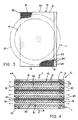
- Sleeves 16 are then placed in the mould with adjacent sleeves separated by subsequent shelves 26 and with seams 24 pointing in alternating directions, or 180° apart, as depicted in Fig. 5 by placement between brackets 38A-38C and then 38B-38D.
- the stack of sleeves and porous separator sheets is stacked to a height slightly less than the inside of mould 30 and, in turn, the wafer height.
- the mould top 34 is fastened in place and the mould is spun in a centrifuge to a speed sufficient to produce several hundred times the force of gravity at the periphery of the mould.
- thermosetting material such as wax
- a thermosetting material such as wax
- the wax is flung from the slinger plate and flows to the periphery 41 of the mould where it forms a ring 42 due to the centrigal force.
- the wax is allowed to cool and harded.
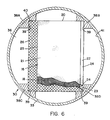
- a pottant material such as epoxy is poured into the mould to form a second ring, annular ring 11, of smaller diameter supported on the ring of wax. It is important that the wax level be sufficiently high to prevent epoxy from entering the open ends of the membrane sleeves (Fig. 7).
- an epoxy tubesheet, ring 11 is formed with the wax sealed membrane sleeves penetrating the ring of epoxy at both sides.
- the seal is made more secure by being potted in the epoxy and a barrier is formed which blocks the flow of feed fluid on one side of the transverse membrane sleeve. Because the orientation and offset of the membrane sleeves 16 is staggered, the feed fluid is thus forced to flow in a serpentine path from one side of the wafer to the other as it moves axially as depicted in Fig. 9.
- mould rotation is stopped and the wax and epoxy assembly is removed from the mould 30 by first heating to melt enough of the wax to free the assembly from the mould wall and brackets 38A-38D.
- the wax and excess membrane sleeve length which protrudes beyond the periphery of the epoxy ring 11 is removed by slicing while turning thewafer on the lathe fixture.
- the wax can be recovered to be reused by melting the wax and filtering out the embedded debris.
- the trimmed wafer is heated to a temperature above the melting point of the wax to allow any remaining wax to flow out of the wafer.
- the flat sides of the wafer are finished as necessary to make suitable sealing surfaces for the wafer stack.
- the mould top 34 is provided with an annular rim 43 which forms a channel 44 for receipt of an O-ring to effect a seal between wafers when they are stacked together axially.
- a section of a wafer 10 is depicted.
- a feestream material which can be gas or liquid, is depicted by the arrows F, and enters the wafer 10 to contact the first wafer sleeve 16A.
- a portion of the feedstream will be permeable to the membrane sheet 21 while the majority will flow around the end 25 and through the porous shelf 26, separating sleeves 16A and 16B.
- the second sleeve 16B terminates short of the ring 11, a void 45 is provided for passage of the feedstream material.
- the feedstream fluid cannot pass through the sleeve seam 24 at the opposite end and thus, the fluid flows axially through the wafer in a serpentine path (Fig. 9) defined by the staggered membrane sleeves.
- the fluid contacts both sides of each membrane sleeve and is in residence within the water 10 for a sufficent time to allow permeable material to flow into the sleeve interior, which is maintained by the web 18.
- this material or permeate flows within the sleeve in a direction perpendicular to the wafer 10. Because the sleeves 16 pass through the ring 11 of each wafer, as depicted in Fig. 4, the permeate P exists the exterior surface 15 while the remaining fluid or retentate R passes axially through the wafer 10. While a wafer can be provided with enough membrane sleeves to filter a given volume of feedstream in normal practice, a plurality of wafers 10 can be stacked axially within a cylindrical apparatus or module.
- the module of the present invention is indicated generally by the numeral 60. It employs a vessel 61 which comprises a cylindrical housing 62, base 63, upper housing 64 and removable top 65. Near the bottom of housing 62 a support shelf 66 is provided upon which the wafers 10 are stacked. Module 60 also provides feed, permeate and retentate ports 68, 69 and 70, respectively, as well as feedstream chamber 71, permeate chamber 72 and retentate chamber 73, which will be discussed hereinbelow. Finally, means for compressing the stack of wafers, referred to generally by the numeral 74, are provided.
- the cylindrical housing 62 and base 63 and upper housing 64 are preferably constructed of steel or other metal such as stainless steel. Although they may be manufactured as separate componenets, they are joined together by welding or other suitable means to form a continuous one-piece module 60, to which the top 65 is affixed.
- the use of metal of proper thickness is desirable as a safeguard against catastrophic failure of one or more wafers.
- the wafers 10 are placed within the module 60 with the first one rested upon internal shelf 66 and each subsequent one resting on the preceding wafer. In order to aid in the insertion and withdrawal of the wafers 10 they can first be loaded into a cylindrical wire basket or cage (not shown) which is itself then lowered into the module 10. During assembly and subsequent use of the module 60 it is important that the wafers 10 be sealed together to prevent the feedstream from passing between contiguous rings 11 and contaminating the permeate. As best depicted in Figs. 1 and 9, this is accomplished by fitting O-rings 80 into recesses 43 in the upper face 12 of each ring 10. An O-ring can also be located on internal shelf 66.
- Compression means 74 comprises generally a plurality of bolts and nuts 81 and 82 and a throat member 83.
- An outer flange 84 is part of upper housing member 64 to which the top is affixed by bolts 81, which pass through axially aligned bores in flange 84 and top 65, and nuts 82.
- Feed port 68 is welded or otherwise affixed within top 65 and member 83 is affixed at its opposite end. The feedstream F is fed into the port 68 through the feed chamber 71, defined by the throat 83, and into contact with the uppermost wafer 10.
- the throat 83 carries at least one metal piston ring 85 to seal the permeate chamber 72 and its rests against the uppermost wafer 10.
- Use of a piston ring provides a safeguard where the module 60 is employed with flammable feedstreams. It should be evident that as the top 65 and flange 84 are joined together, the throat 83 urges the stack of wafers firmly against support shelf 66.
- Flow of the feedstream through the wafer 10 and the module 60 is depicted schematically in Fig. 9.
- the support shelves 26, which may be optionally employed, have been removed.
- the length of the module is sufficient to insure that when the feedstream has passed through all of the wafers, the retentate, existing the last wafer is relatively free of the material that was filtered, the permeate.
- the module 60 has been described generally herein. A more complete description of the module and variations thereof, as presented in our copending European patent application number 90304842.9, the subject matter of which is incorporated herein by reference. Irrespective of the module construction selected, the wafers of the present invention can be employed to produce a separation apparatus capable of separating a variety of gas mixtures and liquid mixtures, depending upon the composition of the semipermeable membrane 21 selected to form the sleeves 16.
- the present invention also provides a method for the separation of fluid feedstreams into permeate and retentate portions.
- the fluid that can be separated can include gaseous mixtures or liquid mixtrues.
- the fluid feedstream, gas or liquid is fed to the module 60 via port 68 into the feedstream chamber 71.
- the module provides a plurality of wafers 10 which separate the feedstream chamber 71 at one end, from the retentate chamber 73, at the opposite end.
- the wafers 10 are arranged axially as individual units, compressed together in the module 60 and the like.
- each membrane sleeve is oriented perpendicularly to the longitudinal axis A of the module.
- the permeable portion of the fluid enters the sleeve 16 and flows through the web 18 thereof and through the peripheral support 11 of the wafer to enter the permeate chamber 72.
- the latter is formed between the walls of the module and the coaxially aligned supports 11 of the wafers. In this step the fluid becomes separated into permeate and retentate portions which are ultimately removed from the module.
- modules and wafers disclosed herein fulfill the objects of the present invention.
- the modular nature of the individual wafers allows modules of almost any length to be assembled from one size of wafer, merely by adding wafers to the stack. Many different module configurations can be assembled with only a few different wafer diameters.
- wafers can be tested individually prior to assembly of the module and thus, defective wafers can be removed from the module and discarded with less loss of semipermeable membrane, than where an entire conventional module must be replaced because the membrane component sheets or hollow fibres, are all joined together.
- the transverse sheet membrane module provides several advantages over the plate and frame and spiral wrap types. Because fluid flow pressure losses of the permeate in the membrane sleeve are detrimental to the performance of membrane separation processes, the longer the flow path in the sleeve, the more performance is adversely affected. Cost considerations, however, favour larger diameter modules with fewer sleeve connections at the permeate manifold which require longer sleeves. An economic trade-off must be made between the module diameter, the number of membrane sleeve connections, and the performance penalty incurred by the sleeve length. Conversely, the transverse sheet membrane module of the present invention is composed of a large number of short membrane sleeves which are efficiently potted in a single step. Permeate flow losses in the membrane sleeve can be controlled to very low levels and/or the thickness of the porous support material can be reduced for a higher volumetrlc packing efficiency in the module.
- membrane sleeves are not subject to bending or significant compression force as during spiral wrapping. Once the membrane sleeves are placed in the centrifugal potting mould, they are not subject to additional handling and once potted, the sleeves are not subject to any mechanical stresses.
- the transverse sheet membrane module design imbeds the potentially weak membrane side seam seal in epoxy. A rigid cylinder of epoxy handles all modularisation forces and protects the membrane surface from accidential damage during assembly and transportation.
- the wafers are modular building blocks for the transverse sheet membrane module.
- the modular nature of the wafers allows modules of almost any length to be assembled from one size of wafer. Many different module configurations can be assembled with a few different wafer sizes. Higher production yields can be achieved because wafers can be tested individually prior to module assembly. Defective wafers can be eliminated with less loss of assembly time and with smaller loss of membrane then discarding a whole module. if an average module is made of twenty wafers, than a catastrophic defect can be eliminated by discarding 5 percent of the module rather than 100 percent.
- transverse sheet membrane module design has higher feed fluid flow velocities than a comparable diameter spiral wrap module.
- the serpentine flow path of the feed fluid insures a high velocity at the fluid/membrane interface which reduces the tendency of retentate to concentrate near the membrane surface by keeping it swept away with bulk feed fluid flow. Reduced concentration polarisation results in better membrane performance.
Landscapes
- Engineering & Computer Science (AREA)
- Chemical & Material Sciences (AREA)
- Chemical Kinetics & Catalysis (AREA)
- Mechanical Engineering (AREA)
- Manufacturing & Machinery (AREA)
- Composite Materials (AREA)
- Separation Using Semi-Permeable Membranes (AREA)
Applications Claiming Priority (2)
| Application Number | Priority Date | Filing Date | Title |
|---|---|---|---|
| US07/383,742 US5000855A (en) | 1989-07-21 | 1989-07-21 | Transverse sheet membrane separation module, components thereof and related methods |
| US383742 | 1989-07-21 |
Publications (1)
| Publication Number | Publication Date |
|---|---|
| EP0414367A1 true EP0414367A1 (fr) | 1991-02-27 |
Family
ID=23514511
Family Applications (1)
| Application Number | Title | Priority Date | Filing Date |
|---|---|---|---|
| EP90307672A Ceased EP0414367A1 (fr) | 1989-07-21 | 1990-07-12 | Module de séparation à membranes à feuilles transversales, composants de celui-ci et méthodes relatives |
Country Status (6)
| Country | Link |
|---|---|
| US (1) | US5000855A (fr) |
| EP (1) | EP0414367A1 (fr) |
| JP (1) | JPH0360724A (fr) |
| BR (1) | BR9003535A (fr) |
| CA (1) | CA2021504A1 (fr) |
| IL (1) | IL94789A0 (fr) |
Cited By (8)
| Publication number | Priority date | Publication date | Assignee | Title |
|---|---|---|---|---|
| FR2666519A1 (fr) * | 1990-09-07 | 1992-03-13 | Seitz Filter Werke | Module et dispositif de filtration pour separer et filtrer des fluides selon la methode a ecoulement transversal et procede pour fabriquer le module. |
| EP0722768A1 (fr) * | 1995-01-20 | 1996-07-24 | Oxyphen Gmbh Dresden | Bloc de filtre à courant transversal |
| RU2170136C1 (ru) * | 2000-06-06 | 2001-07-10 | Государственный научный центр Российской Федерации Физико-энергетический институт им. акад. А.И. Лейпунского | Многослойный фильтрующий материал для ультра- и микрофильтрации и способ его изготовления |
| EP1657042A1 (fr) * | 2004-11-15 | 2006-05-17 | Rudolf Erhard | Procédé de moulage centrifuge pour l'encadrement un bord et moule utilisant un tel procédé |
| EP1864709A3 (fr) * | 2006-06-05 | 2008-10-29 | Celgard LLC | Contacteur de membrane |
| DE102013020503A1 (de) * | 2013-12-11 | 2015-06-11 | Mann + Hummel Gmbh | Befeuchtungseinrichtung, insbesondere für eine Brennstoffzelle |
| RU171027U1 (ru) * | 2017-01-27 | 2017-05-17 | Федеральное государственное бюджетное образовательное учреждение высшего образования "Волгоградский государственный технический университет" (ВолгГТУ) | Фильтрующий элемент |
| WO2019141498A1 (fr) * | 2018-01-16 | 2019-07-25 | Nanostone Water Inc. | Modules membranaires à défauts limités et procédés associés |
Families Citing this family (9)
| Publication number | Priority date | Publication date | Assignee | Title |
|---|---|---|---|---|
| US5164081A (en) * | 1989-03-24 | 1992-11-17 | The Standard Oil Company | Apparatus for separation and for treatment of fluid feedstreams, wafers for use therein and related methods |
| US5238562A (en) * | 1992-10-13 | 1993-08-24 | Transfair Corporation | Fiber membrane elements and modules and methods of fabrication for improved fluid separation |
| US5332498A (en) * | 1992-10-13 | 1994-07-26 | Transfair Corporation | Integrated hollow fiber membrane permeators and method of fabricating integrated permeators |
| EP2193834A1 (fr) * | 2005-12-20 | 2010-06-09 | Tangenx Technology Corporation | Ensemble de filtrage et procédés de fabrication et d'utilisation associés |
| US8512442B2 (en) | 2011-05-23 | 2013-08-20 | Aaron Oken | Selective polysulfide composite membrane |
| US20160151743A1 (en) * | 2014-05-08 | 2016-06-02 | Thetis Environmental Inc. | Potted flat sheet membrane filtration module |
| CA3037541C (fr) | 2018-12-11 | 2024-04-30 | Thetis Environmental Inc. | Methode d'empotage de plaques planes dans un boitier cylindrique |
| US11938423B2 (en) * | 2020-10-15 | 2024-03-26 | New York University In Abu Dhabi Corporation | Paper capillary lateral flow fluid filter for bacterial and nanometer sized particle contamination |
| CN114563325B (zh) * | 2022-03-15 | 2024-08-23 | 中国科学院苏州纳米技术与纳米仿生研究所 | 电学Ca膜法水渗透率测试的装置及水渗透率的测试方法 |
Citations (5)
| Publication number | Priority date | Publication date | Assignee | Title |
|---|---|---|---|---|
| GB1292952A (en) * | 1968-10-18 | 1972-10-18 | William Boby And Company Ltd | Membrane packs |
| US4115274A (en) * | 1975-12-13 | 1978-09-19 | Gesellschaft Fur Kernenergieverwertung In Schiffbau Und Schiffahrt Mbh. | Apparatus for desalinating water by reverse osmosis |
| AT379520B (de) * | 1984-03-01 | 1986-01-27 | Vogelbusch Gmbh | Einrichtung zur trennung von fluessigen oder gasfoermigen stoffgemischen |
| DE3507532A1 (de) * | 1985-03-04 | 1986-09-04 | Gkss - Forschungszentrum Geesthacht Gmbh, 2054 Geesthacht | Vorrichtung zum filtern und trennen von fluessigen und gasfoermigen medien |
| GB2173421A (en) * | 1985-03-06 | 1986-10-15 | Geesthacht Gkss Forschung | Diaphragm-equipped fluid treating apparatus |
Family Cites Families (14)
| Publication number | Priority date | Publication date | Assignee | Title |
|---|---|---|---|---|
| US546527A (en) * | 1895-09-17 | Filter | ||
| US661189A (en) * | 1900-03-15 | 1900-11-06 | Francis James Olsen | Apparatus for filtering water. |
| US3492698A (en) * | 1965-12-22 | 1970-02-03 | Du Pont | Centrifugal casting apparatus for forming a cast wall member extending transversely across an elongated bundle of substantially parallel hollow filaments of a fluid permeation separation apparatus |
| US3494465A (en) * | 1968-09-16 | 1970-02-10 | Dorr Oliver Inc | Selectively permeable membrane separation apparatus |
| US3684097A (en) * | 1970-07-02 | 1972-08-15 | Gen Electric | Blood component exchange device |
| FR2207747B1 (fr) * | 1972-11-24 | 1975-07-04 | Rhone Poulenc Ind | |
| US4051041A (en) * | 1973-03-21 | 1977-09-27 | Gambro Ag | Device for diffusion of substances between two fluids through semipermeable membranes |
| FR2383694A1 (fr) * | 1977-03-18 | 1978-10-13 | Rhone Poulenc Ind | Appareil a membranes planes utilisable notamment en permeation gazeuse et procede pour son obtention |
| US4210536A (en) * | 1978-09-19 | 1980-07-01 | Albany International Corp. | Hollow filament separatory module |
| US4207192A (en) * | 1978-09-19 | 1980-06-10 | Albany International Corp. | Hollow filament separatory module and method of fabrication |
| FR2461885A1 (fr) * | 1979-07-17 | 1981-02-06 | Ind Plastiques | Dispositif formant enveloppe pour un empilement, appareil comportant ledit dispositif et procede de montage dudit appareil |
| US4735718A (en) * | 1983-05-04 | 1988-04-05 | Millipore Corporation | Multilayer membrane separator |
| JPS60193469A (ja) * | 1984-03-14 | 1985-10-01 | 三菱レイヨン株式会社 | 中空糸膜型人工肺 |
| US4639353A (en) * | 1984-04-24 | 1987-01-27 | Mitsubishi Rayon Co., Ltd. | Blood oxygenator using a hollow-fiber membrane |
-
1989
- 1989-07-21 US US07/383,742 patent/US5000855A/en not_active Expired - Fee Related
-
1990
- 1990-06-19 IL IL94789A patent/IL94789A0/xx unknown
- 1990-07-12 EP EP90307672A patent/EP0414367A1/fr not_active Ceased
- 1990-07-19 CA CA002021504A patent/CA2021504A1/fr not_active Abandoned
- 1990-07-20 BR BR909003535A patent/BR9003535A/pt not_active Application Discontinuation
- 1990-07-21 JP JP2193789A patent/JPH0360724A/ja active Pending
Patent Citations (5)
| Publication number | Priority date | Publication date | Assignee | Title |
|---|---|---|---|---|
| GB1292952A (en) * | 1968-10-18 | 1972-10-18 | William Boby And Company Ltd | Membrane packs |
| US4115274A (en) * | 1975-12-13 | 1978-09-19 | Gesellschaft Fur Kernenergieverwertung In Schiffbau Und Schiffahrt Mbh. | Apparatus for desalinating water by reverse osmosis |
| AT379520B (de) * | 1984-03-01 | 1986-01-27 | Vogelbusch Gmbh | Einrichtung zur trennung von fluessigen oder gasfoermigen stoffgemischen |
| DE3507532A1 (de) * | 1985-03-04 | 1986-09-04 | Gkss - Forschungszentrum Geesthacht Gmbh, 2054 Geesthacht | Vorrichtung zum filtern und trennen von fluessigen und gasfoermigen medien |
| GB2173421A (en) * | 1985-03-06 | 1986-10-15 | Geesthacht Gkss Forschung | Diaphragm-equipped fluid treating apparatus |
Cited By (14)
| Publication number | Priority date | Publication date | Assignee | Title |
|---|---|---|---|---|
| FR2666519A1 (fr) * | 1990-09-07 | 1992-03-13 | Seitz Filter Werke | Module et dispositif de filtration pour separer et filtrer des fluides selon la methode a ecoulement transversal et procede pour fabriquer le module. |
| GB2248408A (en) * | 1990-09-07 | 1992-04-08 | Seitz Filter Werke | Filter module |
| US5225080A (en) * | 1990-09-07 | 1993-07-06 | Seitz-Filter-Werke Theo & Geo Seitz Gmbh Und Co. | Filtration module and device for separating and filtering fluids in a crossflow process |
| GB2248408B (en) * | 1990-09-07 | 1994-05-25 | Seitz Filter Werke | Improved filter module and method of manufacture thereof |
| EP0722768A1 (fr) * | 1995-01-20 | 1996-07-24 | Oxyphen Gmbh Dresden | Bloc de filtre à courant transversal |
| RU2170136C1 (ru) * | 2000-06-06 | 2001-07-10 | Государственный научный центр Российской Федерации Физико-энергетический институт им. акад. А.И. Лейпунского | Многослойный фильтрующий материал для ультра- и микрофильтрации и способ его изготовления |
| EP1657042A1 (fr) * | 2004-11-15 | 2006-05-17 | Rudolf Erhard | Procédé de moulage centrifuge pour l'encadrement un bord et moule utilisant un tel procédé |
| WO2006051109A1 (fr) * | 2004-11-15 | 2006-05-18 | Rudolf Gmbh | Procede de moulage par centrifugation pour realiser un encadrement et moule de delimitation a cet effet |
| EP1864709A3 (fr) * | 2006-06-05 | 2008-10-29 | Celgard LLC | Contacteur de membrane |
| US7641795B2 (en) | 2006-06-05 | 2010-01-05 | Celgard Llc | Membrane contactor |
| DE102013020503A1 (de) * | 2013-12-11 | 2015-06-11 | Mann + Hummel Gmbh | Befeuchtungseinrichtung, insbesondere für eine Brennstoffzelle |
| DE102013020503B4 (de) * | 2013-12-11 | 2015-10-29 | Mann + Hummel Gmbh | Befeuchtungseinrichtung und Brennstoffzellenanordnung |
| RU171027U1 (ru) * | 2017-01-27 | 2017-05-17 | Федеральное государственное бюджетное образовательное учреждение высшего образования "Волгоградский государственный технический университет" (ВолгГТУ) | Фильтрующий элемент |
| WO2019141498A1 (fr) * | 2018-01-16 | 2019-07-25 | Nanostone Water Inc. | Modules membranaires à défauts limités et procédés associés |
Also Published As
| Publication number | Publication date |
|---|---|
| IL94789A0 (en) | 1991-04-15 |
| JPH0360724A (ja) | 1991-03-15 |
| CA2021504A1 (fr) | 1991-01-22 |
| BR9003535A (pt) | 1991-08-27 |
| US5000855A (en) | 1991-03-19 |
Similar Documents
| Publication | Publication Date | Title |
|---|---|---|
| US5174900A (en) | Apparatus for separation and for treatment of fluid feedstreams, wafers for use therein and related methods | |
| US5000855A (en) | Transverse sheet membrane separation module, components thereof and related methods | |
| US5460720A (en) | Pleated membrane crossflow fluid separation device | |
| EP0238737B1 (fr) | Assemblage de membranes pour disque de séparation de fluides | |
| EP0454918B1 (fr) | Module de séparation à fibres creuses et méthode pour son utilisation | |
| EP0610323B1 (fr) | Dispositif de permeation a faisceau de fibres multiples | |
| CN1078092C (zh) | 中空纤维过滤器芯 | |
| KR102532833B1 (ko) | 유체의 분리를 위한 중공 사막 카트리지 및 모듈 | |
| US6702941B1 (en) | Fluid treatment elements adapted for cross flow treatment | |
| EP1598105B1 (fr) | Module a membranes de fibres creuses et agencement de tels modules | |
| US5100556A (en) | Transverse sheet membrane separation module, components thereof and related methods | |
| US20020108906A1 (en) | Multi-stage filtration and softening module and reduced scaling operation | |
| US5164081A (en) | Apparatus for separation and for treatment of fluid feedstreams, wafers for use therein and related methods | |
| HU206278B (en) | Apparatus with membrane filtering carrying out for fluid permeable fraction and concentrate fraction and method for producing membrane-stack filtering unit | |
| US20130043187A1 (en) | Hollow fiber membrane module for use in a tubular pressure vessel | |
| KR20020042666A (ko) | 다단계 여과 및 연화 모듈과 스케일이 적은 여과 방법 | |
| US3494465A (en) | Selectively permeable membrane separation apparatus | |
| EP3606647A1 (fr) | Ensemble de module enroulé en spirale comprenant une surveillance de pression intégrée | |
| EP0296881B1 (fr) | Module à membrane perméable sous forme de multiples feuilles | |
| US20040129637A1 (en) | Multi-stage filtration and softening module and reduced scaling operation | |
| US20080230488A1 (en) | Pleated, Crossflow Fluid Treatment Elements, Methods for Making Them, and Methods for Treating Cellular Solutions | |
| ES2385634T3 (es) | Módulo de membrana enrollada en espiral con medios de control de flujo y su aplicación para tratamiento de fluidos | |
| AU2002236864B2 (en) | Hollow fiber membrane cassette | |
| US12337282B2 (en) | Potted flat sheet membrane filtration module | |
| JP2004524140A5 (fr) |
Legal Events
| Date | Code | Title | Description |
|---|---|---|---|
| PUAI | Public reference made under article 153(3) epc to a published international application that has entered the european phase |
Free format text: ORIGINAL CODE: 0009012 |
|
| AK | Designated contracting states |
Kind code of ref document: A1 Designated state(s): AT BE CH DE DK ES FR GB GR IT LI LU NL SE |
|
| 17P | Request for examination filed |
Effective date: 19910809 |
|
| 17Q | First examination report despatched |
Effective date: 19930421 |
|
| STAA | Information on the status of an ep patent application or granted ep patent |
Free format text: STATUS: THE APPLICATION HAS BEEN REFUSED |
|
| 18R | Application refused |
Effective date: 19950608 |