EP0414522A1 - Rollschuh - Google Patents
Rollschuh Download PDFInfo
- Publication number
- EP0414522A1 EP0414522A1 EP90309205A EP90309205A EP0414522A1 EP 0414522 A1 EP0414522 A1 EP 0414522A1 EP 90309205 A EP90309205 A EP 90309205A EP 90309205 A EP90309205 A EP 90309205A EP 0414522 A1 EP0414522 A1 EP 0414522A1
- Authority
- EP
- European Patent Office
- Prior art keywords
- pad
- brake pad
- road surface
- socket
- frame
- Prior art date
- Legal status (The legal status is an assumption and is not a legal conclusion. Google has not performed a legal analysis and makes no representation as to the accuracy of the status listed.)
- Withdrawn
Links
- 230000001815 facial effect Effects 0.000 claims abstract description 15
- 239000000463 material Substances 0.000 claims description 19
- 239000002184 metal Substances 0.000 claims description 12
- 230000002401 inhibitory effect Effects 0.000 claims description 7
- 230000007246 mechanism Effects 0.000 description 3
- 230000002411 adverse Effects 0.000 description 2
- 210000002683 foot Anatomy 0.000 description 2
- 230000003993 interaction Effects 0.000 description 2
- 230000014759 maintenance of location Effects 0.000 description 2
- 230000009471 action Effects 0.000 description 1
- 230000006978 adaptation Effects 0.000 description 1
- 210000003423 ankle Anatomy 0.000 description 1
- 230000001066 destructive effect Effects 0.000 description 1
- 230000001788 irregular Effects 0.000 description 1
- 238000012423 maintenance Methods 0.000 description 1
- 238000000034 method Methods 0.000 description 1
- 238000012986 modification Methods 0.000 description 1
- 230000004048 modification Effects 0.000 description 1
- 230000008569 process Effects 0.000 description 1
- 230000009467 reduction Effects 0.000 description 1
- 229920002994 synthetic fiber Polymers 0.000 description 1
Images
Classifications
-
- A—HUMAN NECESSITIES
- A63—SPORTS; GAMES; AMUSEMENTS
- A63C—SKATES; SKIS; ROLLER SKATES; DESIGN OR LAYOUT OF COURTS, RINKS OR THE LIKE
- A63C17/00—Roller skates; Skate-boards
- A63C17/04—Roller skates; Skate-boards with wheels arranged otherwise than in two pairs
- A63C17/06—Roller skates; Skate-boards with wheels arranged otherwise than in two pairs single-track type
-
- A—HUMAN NECESSITIES
- A63—SPORTS; GAMES; AMUSEMENTS
- A63C—SKATES; SKIS; ROLLER SKATES; DESIGN OR LAYOUT OF COURTS, RINKS OR THE LIKE
- A63C17/00—Roller skates; Skate-boards
- A63C17/14—Roller skates; Skate-boards with brakes, e.g. toe stoppers, freewheel roller clutches
- A63C17/1436—Roller skates; Skate-boards with brakes, e.g. toe stoppers, freewheel roller clutches contacting the ground
Definitions
- the invention relates to roller skates and brakes usable with such skates and provides a safer, more effective, easier to use brake suitable for both experienced and inexperienced skaters.
- Roller skate frames generally have a brake at either the front or rear thereof, with the rear position being the more frequently used position because a brake at the front of the skate requires the skater to lean forward to engage the brake and can adversely affect the skater's balance and even cause the skater to fall.
- Rear positioned roller skate brakes are actuated by the skater pivoting rearwardly about the axis of the rear skate wheel and swinging the skate from the normal coasting position to a braking position where the brake drags against the road surface and brings the skater to a stop.
- Brakes such as these are shown in the following patents: 3,287,023 G.K. Ware November 22, 1966 2,826,422 C.W. Snyder March 11, 1958 2,343,007 M. Goldenberg February 29, 1944 805,942 G.M. Beals November 28, 1905 4,392,659 K. Yoshimoto July 12, 1983 4,273,345 Ben Dor et al June 16, 1981
- An effective brake assembly positioned rearward of the skate must not extend sideward beyond the width of the skate frame, or the brake may snag on roadside obstacles and affect the skater's balance or cause him to fall.
- An effective rear mounted brake must also be configured to avoid snagging when the skater encounters an incline such as a driveway apron or when he crosses irregular height cracks on sidewalks or roads.
- Prior art brakes have avoided the problem of dragging when incline or cracks are encountered by spacing the brake pad sufficiently upward from the road surface to avoid unwanted contact.
- a skater must pivot such a brake through an arc of at least fifteen degrees and often even more to bring the brake pad into frictional contact with the road surface.
- Prior art brake systems have positioned their brake pads so that only a fractional part of the road engaging braking surface contacts the road surface when the brake is first employed. As the brake wears away during break-in use, the surface area which engages the road surface gradually increases. However, in order to apply that increasing braking surface to the road, a still greater arc of swing must be completed by the skater to bring the more worn brake pad to the road surface. It is desirable that the brake be configured to provide a maximum level of friction surface immediately on deployment without requiring a break-in period.
- a working brake housing and pad must also be lightweight, strong, durable and aesthetically pleasing to the eye.
- the invention described hereafter provides a solution for these needs and provides a much improved brake system.
- a roller skate comprising: a roller skate frame having front and rear ends and including a brake pad housing at one end of said frame; a plurality of wheels including a rear wheel, each said wheel being mounted to said frame for rotation about an axis, and at least two of said wheels being coasting wheels positioned to contact the road surface during coasting on the skate, the axes of rotation of said coasting wheels defining a first plane; and a brake pad attached to said brake housing, extending downwardly therefrom and including a base confronting the road surface; said base being a substantially flat surface adapted for full facial engagement with the road surface; said skate frame being pivotable about said rear wheel axis between a first position, wherein said coasting wheels contact the road surface and a second position, wherein said flat surface of said base of said brake pad is in full facial engagement with the road surface.
- Said full facial engagement between said flat surface of said base and the road surface may occur when said first plane and said road surface intersect at an angle which is between eleven and thirteen degrees.
- said flat surface of said base defines a second plane, and said first and second planes intersect at an angle which is between eleven and thirteen degrees.
- said angle is approximately twelve degrees.
- Said base may have a rectangular cross section to increase the contact surface area between said base and the road surface so as to increase stopping effectiveness of said brake pad.
- said housing includes a socket, said socket having first and second lateral side walls with each said side wall having an aperture, and the said apertures being substantially coaxial, with their common axis being substantially parallel to said wheel axes; the brake pad being mateably mounted within said socket; said brake pad including a rigid metal plate within said pad, said plate being closely surrounded by the material of the pad body and oriented substantially perpendicular to said wheel axes when said pad is mateably received in said socket, said body and plate having a hollow bore substantially coaxial with said apertures of said frame to define a continuous passage through said pad body, plate and side walls; fastening means passing through said continuous passage to securely retain said brake pad within said socket; said rigid plate inhibiting wear on said pad which might otherwise result from rubbing of said body against said fastening means and in addition further defining a brake pad wear indicator to audibly and visibly indicate need for pad replacement when said material of said body wears away to expose said plate to direct frictional contact with the road surface.
- the present invention further provides a roller skate comprising: a frame having a rear end; a plurality of wheels rotatably mounted to said frame for rotation about a plurality of substantially parallel axes: said frame including a brake pad housing at said rear end of said frame and said housing including a socket, said socket having first and second lateral side walls with each said side wall having an aperture, and the said apertures being substantially coaxial, with their common axis being substantially parallel to said wheel axes; a brake pad being mateably mounted within said socket and extending downwardly therefrom toward and confronting the road surface; said brake pad including a rigid metal plate within said pad, said plate being closely surrounded by the material of the brake pad body and oriented substantially perpendicular to said wheel axes when said pad is mateably received in said socket, said body and plate having a hollow bore substantially coaxial with said apertures of said frame to define a continuous passage through said pad body, plate and side walls; fastening means passing through said continuous passage to securely retain said brake pad within said socket; and said rigid
- Said plate may be a washer.
- said brake pad has first and second side faces and said plate is positioned substantially medially between said side faces.
- said socket has an arcuate cross section
- said pad has an arcuate protrusion mateably received in said arcuate cross section socket.
- Said arcuate protrusion may have a substantially constant radius of curvature centered on said passage.
- said plate is a circular washer and is positioned concentric with said arcuate protrusion.
- said socket includes a transverse slot substantially parallel to said passage, and said pad includes a transverse rib positioned to be mateably received within said slot to inhibit forward and rearward rotation of said protrusion about said passage during braking operation.
- said pad has said protrusion spaced inwardly a predetermined distance from said first and second lateral side walls to define a pair of lateral ledges with a said lateral ledge on each side of said protrusion to permit said frame side walls to contact and bear against said lateral ledges to further retain and stabilize said brake pad in said socket.
- said socket includes a transverse slot substantially parallel to said wheel axes, and said pad includes a transverse rib positioned to be mateably received within said slot to inhibit forward and rearward rocking of said protrusion about said passsage during braking operations.
- a roller skate and brake usable by a skater for skating on a road surface comprising: a roller skate boot; a roller skate frame carried by said boot, said frame having front and rear ends and including a brake pad housing at one end of said frame; a plurality of wheels including a rear wheel, each said wheel rotatably mounted to said frame for rotation about an axis, with all said axes being parallel and at least two of said wheels being coasting wheels positioned to contact the road surface during coasting on the skate, said axes of said coasting wheels defining a first plane; a brake pad comprising a body of rubber material or the like attached to said brake housing, extending downardly therefrom and including a base confronting the road surface for selective frictional engagement with the road surface; said base being a substantially flat surface adapted for full facial engagement between said flat surface of said base and the road surface; and said skate frame being pivotable about said rear wheel axis between a first position, wherein said coasting wheels contact the road surface and
- the present invention yet further provides a roller skate and brake usable by a skater for skating on a road surface, comprising: a roller skate boot,; a roller skate frame having a rear end and carried by said boot; a plurality of wheels rotatably mounted to said frame for rotation about a plurality of substantially parallel axes: said frame including a brake pad housing at said rear end of said frame and said frame including a socket, said socket having first and second lateral side walls with each said side wall having an aperture, and the said apertures being substantially coaxial, with their common axis being substantially parallel to said wheel axes; a brake pad comprised of a body of rubber material or the like mateably mounted within said socket and extending downwardly therefrom toward and confronting the road surface; said brake pad body including a rigid metal plate within said pad, said plate being closely surrounded by said material and oriented substantially perpendicular to said wheel axes when said pad is mateably received in said socket, said body and plate having a hollow bore substantially coaxial with said apertures of said
- a roller skate and brake is provided with a new brake housing and brake pad which may be deployed against a road surface by pivoting the skate about its rear wheel through an arc of approximately twelve degrees.
- This significantly reduced arc offers improved braking results while permitting the skater to better retain his balance and to apply the brake without the extensive rearward pivoting required by prior art brake systems.
- the brake pad also offers a significantly larger, flat rectangular road engaging surface which achieves full facial contact with the road surface throughout the use life of the brake, avoiding the need for a break-in period.
- the rectangular cross section contact area of the brake's base may be positioned directly behind the skate frame without increasing the brake width so much that the brake extends beyond the side profile of the skate frame. The structure thus permits use of the larger brake pad without any higher risk of snagging the brake on obstructions on either side of the skater's path.
- a metal plate is positioned inside the brake pad body to serve as a wear indicator. As the plate becomes exposed to the road surface as a result of brake pad wear, continued use of the brake causes the brake pad to vibrate in a distinct manner which is immediately noticeable to the skater and alerts the skater to the need for brake replacement. The dragging of the metal plate on the road surface during braking also generates a distinctive sound which further alerts the skater.
- the adoption of a brake pad with a larger, more effective road engaging surface has ben found to require a brake housing and pad with a stronger retention and mounting arrangement in order to counter the stronger reaction forces applied to the brake housing during braking.
- the brake pad has an upwardly extending arcuate protuberance which is received within the socket of the brake housing, and a screw and nut passes through a horizontal passage which extends through the housing, brake pad, and metal plate.
- the upper section of the brake pad is structured to interact with the side walls, front wall, and rear wall of the brake housing to stabilize the pad and to prevent torquing and twisting of the pad which might dislodge it from the housing.
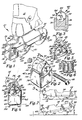
- an in-line roller skate and brake 10 includes a boot 12 for wear by a skater, and a strong, lightweight, molded roller skate frame 14 formed of synthetic material and carried by the boot 12.
- a plurality of wheels here shown in Figure 7 as wheels 15, 16, and 17 are rotatably mounted to the frame 14 for rotation about a plurality of axles having parallel axes 20, each of the wheels being mounted to the frame by bolt and nut combinations 24, or the like which serve as axles.
- the frame 14 will normally carry three to five wheels, and frames having up to five or more wheels are within the purview of the invention.
- each of the wheels has its central axis in a common plane 95 which is substantially parallel to the road surface 96, and all the wheels engage the road surface during coasting and are coasting wheels.
- Some four wheeled skates are structured to have their intermediate wheels positioned lower than the front and rear wheels, and utilize only the intermediate wheels as coasting wheels. Skates with wheels at different levels may be used with the brake described herein and are within the purview of the invention.
- a brake pad housing 26 is located at the rear end 13 of frame 14 and is provided with first and second lateral sidewalls 28 and 30, a rear wall 32, a front wall 33, and a cap 34 which joins the transverse surface 35 of the frame.
- a screw aperture 36 passes through lateral sidewalls 28 and 30 and is oriented parallel to the axes 20 of wheels 15, 16, and 17 and receives a screw 38 which threads into nut 40 so as to securely retain brake pad 42 within a rigid socket 44 located between the sidewalls 28 and 30.
- the socket 44 when viewed from the side, as best shown in figure 4, has an arcuate cross section 46 with a substantially constant radius.
- a slot 48 is located within the socket 44 and extends transversely across the top thereof.
- the brake housing has been shown as being an integral part of the frame 14, it should be understood that the housing could be a separate housing unit mounted either at the rear of the skate frame 14, or alternatively used with other roller skates, and such alternatives are within the purview of the invention.
- the brake pad 42 is an integrally molded body of rubber or other like material possessing a high coefficient of friction to achieve efficient braking action when the pad is urged against the road surface 96.
- the term "road surface” as used herein is not limited to actual road surfaces and encompasses any usable surface on which roller skating can be done, including without limitation, roads, sidewalks, decks or the like, including indoor and outdoor surfaces. It has been found that molded rubber having a durometer hardness of between 85 and 95 provides excellent results when used as the material for the brake pad body.
- the brake pad 42 has a generally rectangular cross section as viewed from above, and the cross section may be square or elongated in the forward or rearward travel directions 43 of the skate. It is desirable that the width of the brake pad as measured between faces 58 and 60 not exceed the width of the frame 14 so as to avoid snagging of the brake pad against obstacles that might be encountered along the skater's path.
- the pad 42 has a base 50 which has a substantially flat surface which defines a plane 45 and which is angled relative to front face 76 so base 50 can be held against the road surface 96 with the flat base surface being in full facial engagement with the road surface.
- the plane 45 of base 50 is positioned at an angle between eleven and thirteen degrees relative to the plane 95. Accordingly, the skater can tilt the skate frame 14 back through the angle A, not exceeding thirteen degrees, and bring the base 50 into substantially full facial engagement with the road surface 96.
- an arcuate protrusion 52 having a generally uniform radius extends transversely across the upper portion of brake pad 42 and has flat ends 54 and 56 spaced inwardly from first and second generally parallel side faces 58 and 60, respectively.
- a straight, horizontal bore 62 is formed within the arcuate protrusion 52, extends between ends 54 and 56 and is substantially concentric with the protrusion 52.
- the bore 62 is positioned to align coaxially with the apertures 36 through the side walls 28 and 30 of the brake housing and the apertures 36 and bore 62 form a continuous passage 62.
- An upwardly extending and transversely oriented rib 64 is formed at the top of the protrusion 52 and is mateably received within the slot 48 of socket 44 when the pad 42 is attached to the brake housing 26.
- First and second lateral ledges 66 and 68 are positioned below the ends 54 and 56, respectively, of the protrusion 52 and recessed inwardly a predetermined distance from side faces 58 and 60, respectively to provide seats for side walls 28 and 30, each side wall having its lower edge 70 closely engaging a lateral ledge.
- the side walls 28 and 30 also sandwich the ends 54 and 56 and when the screw 38 and nut 40 are installed, the side walls closely confine the ends of the protrusion and restrict lateral moving or twisting of the brake pad in the socket to assure firm, permanent retention.
- front ledge 74 and rear ledge 72 are formed adjacent the front and rear of arcuate protrusion 52 and space the protrusion inwardly a predetermined distance from the front and rear pad faces 78 and 76, respectively.
- These front and rear ledges receive the lower edges 80 and 82 of the brake housing, and these edges cooperate with the ledges, to inhibit forward and rearward rocking of the pad about the passage 62 during braking operation.
- a rigid metal plate 84 Positioned within the body of the pad 42 is a rigid metal plate 84, which may consist of a conventional washer having a central aperture 86 which is coaxial with and part of passage 62.
- the plate 84 provides additional support and rigidity to the protrusion 52, and when the pad is installed in the housing 26 and screw 38 and nut 40 tightly installed in the passage 62, the plate 84 bears against the shaft of the screw 38, providing additional support to the protrusion and inhibiting undesirable wear between the screw and the rubber material along passage 62.
- the plate 84 serves as a wear indicator for the brake pad, providing a mechanism by which when the base 50 wears down, the edge of plate 84 becomes exposed as shown in Figure 5, and the lower edge 88 begins to drag on the road surface 96 during braking.
- edge 88 drags, highly noticeable vibration is generated and immediately sensed by the skater, and the feel of the brake, as perceived by the skater, changes dramatically.
- the dragging of the plate also generates a distinctive sound which serves to immediately alert the skater that it is necessary to remove the worn brake pad and replace it with a new pad.
- the metal plate 84 may take the form of a more elongated body 90 extending downwardly and ending adjacent base 50, and such an alternative unit is shown by phantom extension line 90 which designates the outer periphery of an extended plate which is within the purview of the invention.
- the extended plate 90 can provide a highly desirable wear indicator to alert the skater that pad replacement should be considered before substantial further wear occurs.
- the smaller, alternative plate structure represented by washer 92 is more suitable where the pad 26 will be used for indoor skating, and the destructive rubbing that might occur between a metal plate and a wooden or synthetic floor surface is to be avoided. In such a situation the washer 92 will be exposed as a wear indicator only when pad wear reaches a more advanced state. When such a state is needed, the washer alerts the skater that the lower edge 70 of the brake housing 26 is in jeopardy of being worn away unless the brake pad is replaced.
- each roller skate 10 is provided with a frame 14 having a brake housing 26 at the rear thereof with a brake pad 42 attached thereto as described.
- the skater When the skater wishes to actuate the brake, he raises the front end 11 of one or both of his skates, causing the skate to pivot about the axis 20 of rear wheel 15. As this pivoting motion occurs, the skate moves from its initial coasting or riding position 98 and swings through an arc A to the braking position 100 (Fig 7) where the base 50 contacts the road surface 96. Because the size of the arc A is approximately twelve degrees, the skater need raise the front end 11 of his skate only about twelve degrees to bring the generally flat, high friction base 50 of the brake pad into full facial engagement with the road surface. The longer rectangular flat base 50, with its increased surface area rapidly slows and stops skate movement.
- the skater does not have to bend his ankles or lean rearwardly to the extent required by prior art braking systems, and he is able to remain better balanced and to feel more in control during the stopping process.
- the reduction of the arc A to approximately twelve degrees makes the skate 10 safer, much easier to operate for new skaters, and significantly reduces the time required to learn how to operate the skate brake.
- the rigid plate 84 bears against the screw 38 as braking forces are applied to the base 50 of the brake pad.
- the plate absorbs wear which would otherwise occur between screw 38 and passage 62 and reinforces the brake pad, providing additional strength and rigidity to the protuberance 52 at the point of its contact with the screw.
- Front and rear ledges 74 and 72 interact with edges 80 and 82 of downwardly extending front wall 33 and rear wall 32, respectively, the rear ledge 72 moving into contact with rear wall 32 during braking and the rear wall serving as a deterrent against counterclockwise rotation or twisting of the brake pad about the passage 62 ( Figure 4).
- the front wall 33 of the housing similarly interacts with the front ledge 74 of the pad to prevent unwanted clockwise rotation or twisting of the pad about the passage 62.
- the base 50 After sufficient braking use of brake pad 42, the base 50 will wear down until eventually as shown in Figure 5 the lowermost edge 88 of plate 84 becomes exposed at its intersection with the worn base 50′.
- the dragging interaction between the plate 84 and the road surface generates a distinct vibration which can be immediately felt and sensed by the skater and alerts him that the brake pad needs replacement.
- the dragging interaction between the lower end 88 of the plate 84 against the road surface also generates a highly distinctive sound audible to the skater and alerts the skater to the need for brake pad replacement.
- Use of the plate 82 as a wear indicator thus provides a positive sign to skaters that skate maintenance is needed and helps assure that brake pad replacement occurs in a timely manner.
Landscapes
- Motorcycle And Bicycle Frame (AREA)
Applications Claiming Priority (2)
| Application Number | Priority Date | Filing Date | Title |
|---|---|---|---|
| US397184 | 1989-08-23 | ||
| US07/397,184 US5052701A (en) | 1989-08-23 | 1989-08-23 | Roller skate with pivoting brake |
Publications (1)
| Publication Number | Publication Date |
|---|---|
| EP0414522A1 true EP0414522A1 (de) | 1991-02-27 |
Family
ID=23570164
Family Applications (1)
| Application Number | Title | Priority Date | Filing Date |
|---|---|---|---|
| EP90309205A Withdrawn EP0414522A1 (de) | 1989-08-23 | 1990-08-22 | Rollschuh |
Country Status (2)
| Country | Link |
|---|---|
| US (1) | US5052701A (de) |
| EP (1) | EP0414522A1 (de) |
Cited By (4)
| Publication number | Priority date | Publication date | Assignee | Title |
|---|---|---|---|---|
| EP0613705A1 (de) * | 1993-03-05 | 1994-09-07 | NORDICA S.p.A | Bremsvorrichtung, insbesondere für Kufen |
| US5460390A (en) * | 1992-06-30 | 1995-10-24 | Miller; Andrew | Sparking brake pad for in-line roller skates |
| FR2749184A1 (fr) * | 1996-05-30 | 1997-12-05 | Salomon Sa | Patin a roues en ligne a chassis articule |
| US6059297A (en) * | 1993-04-05 | 2000-05-09 | Salomon S.A. | Braking device for roller skates |
Families Citing this family (37)
| Publication number | Priority date | Publication date | Assignee | Title |
|---|---|---|---|---|
| CA2064517A1 (en) * | 1991-06-13 | 1992-12-14 | Paul G. Moldenhauer | Progressively actuated brake for a roller skate |
| US5211409A (en) * | 1992-02-04 | 1993-05-18 | Out Of Line Sports, Inc. | Mechanically activated skate brake and method |
| US5253882A (en) * | 1992-02-04 | 1993-10-19 | Out Of Line Sports, Inc. | Hand activated skate brake and method |
| US5664794A (en) * | 1992-02-04 | 1997-09-09 | Out Of Line Sports, Inc. | Ground engaging movable skate brake |
| US5704619A (en) * | 1992-02-04 | 1998-01-06 | Out Of Line Sports, Inc. | Slidable skate brake and methods |
| DE69304595T2 (de) * | 1992-04-29 | 1997-01-23 | Nordica Spa | Bremsvorrichtung an Rollschuh |
| US5465984A (en) * | 1992-04-29 | 1995-11-14 | Nordica S.P.A. | Braking device particularly for skates |
| US5232231A (en) * | 1992-08-12 | 1993-08-03 | Bruce Carlsmith | Brake for roller skates |
| US5918888A (en) * | 1992-09-01 | 1999-07-06 | Nordica S.P.A. | Braking device particularly for skates |
| US5348320A (en) * | 1992-10-23 | 1994-09-20 | Hyde Athletic Industries, Inc. | Adjustable skate brake |
| US5280931A (en) * | 1992-11-20 | 1994-01-25 | Thistle Sports Enterprises, Inc. | Roller brake |
| ATE165523T1 (de) * | 1992-11-30 | 1998-05-15 | Benetton Sportsystem Spa | Rollschuh mit bremsvorrichtung |
| US6007076A (en) * | 1992-11-30 | 1999-12-28 | Nordica S.P.A, | Braking device particularly for skates |
| USD347672S (en) | 1993-01-28 | 1994-06-07 | Rollerblade, Inc. | In-line skate |
| US6047973A (en) * | 1993-02-25 | 2000-04-11 | Amore; Robert | In-line skate brakes |
| US6168172B1 (en) | 1993-07-19 | 2001-01-02 | K-2 Corporation | In-line roller skate |
| US5470085A (en) * | 1993-07-19 | 1995-11-28 | K-2 Corporation | Braking apparatus for in-line roller skates |
| US5437466B1 (en) * | 1993-07-19 | 1997-11-18 | K 2 Corp | In-line roller skate |
| US5401038A (en) * | 1993-08-26 | 1995-03-28 | David G. Peck | Mechanical brake for in-line roller skates |
| US5375859A (en) * | 1993-08-26 | 1994-12-27 | David G. Peck | Mechanical brake for in-line roller skate |
| USD364437S (en) | 1994-01-10 | 1995-11-21 | Seneca Sports, Inc. | Toe stop for in-line skate |
| US5472218A (en) * | 1994-01-10 | 1995-12-05 | Seneca Sports, Inc. | In-line wheeled skate and toe stop |
| USD361814S (en) | 1994-01-21 | 1995-08-29 | K-2 Corporation | In-line roller skate brake |
| USD362042S (en) | 1994-05-20 | 1995-09-05 | Robert Amore | Roller skate brake |
| US5630597A (en) * | 1994-09-07 | 1997-05-20 | Klukos; Edward O. | Brake system for roller skates |
| US5511803A (en) * | 1994-09-07 | 1996-04-30 | Klukos; Edward O. | Brake for roller skates |
| US6131922A (en) * | 1994-09-07 | 2000-10-17 | Klukos; Edward O. | Roller skate brake arrangement |
| US5738360A (en) * | 1995-08-29 | 1998-04-14 | Harmony Sports, Inc. | Toe pick and skate frame for in-line skates |
| ITTV980001A1 (it) * | 1998-01-09 | 1999-07-09 | Benetton Sportsystem Spa | Dispositivo per la rigenerazione di un freno, particolarmente per patt ini |
| US6065762A (en) * | 1998-03-11 | 2000-05-23 | Brelvi; Nazir A | Multidirectional in-line roller skate |
| US6478312B1 (en) | 2000-06-23 | 2002-11-12 | Gary M. Petrucci | Brake system for a wheeled article |
| WO2003004114A1 (en) | 2001-05-23 | 2003-01-16 | Arben Vrapi | Roller skate all-wheels braking system |
| US8684243B1 (en) * | 2010-05-17 | 2014-04-01 | Chalktrail.com LLC | Chalk holding devices for bicycles, scooters and skateboards |
| US8556275B1 (en) | 2011-03-31 | 2013-10-15 | Riedell Shoes, Inc. | Truck assembly |
| CA3038099C (en) * | 2011-03-31 | 2021-01-26 | Riedell Shoes, Inc. | Truck assembly |
| US8857824B2 (en) | 2011-03-31 | 2014-10-14 | Riedell Shoes, Inc. | Truck assembly |
| US8684369B1 (en) * | 2012-09-24 | 2014-04-01 | Harmony Sports Inc. | Ball pick |
Citations (8)
| Publication number | Priority date | Publication date | Assignee | Title |
|---|---|---|---|---|
| US805942A (en) * | 1905-04-20 | 1905-11-28 | Hayward M Bartlett | Roller-skate brake. |
| US2343007A (en) * | 1940-01-30 | 1944-02-29 | Goldenberg Michael | Roller skate unit and roller skate shoe |
| US2826422A (en) * | 1955-09-20 | 1958-03-11 | Charles W Snyder | Brake for roller skates |
| DE1098420B (de) * | 1954-07-17 | 1961-01-26 | Erich Dornseif | Rollschuh mit einstellbarem Bremsklotz |
| US3287023A (en) * | 1964-07-16 | 1966-11-22 | Chicago Roller Skate Co | Roller skate |
| US4273345A (en) * | 1978-10-02 | 1981-06-16 | Ben Dor Effraim | Roller skate |
| US4392659A (en) * | 1980-11-25 | 1983-07-12 | Hanshin Sogyo Co., Ltd. | Two-wheeled roller skate |
| EP0295824A2 (de) * | 1987-06-12 | 1988-12-21 | Rollerblade, Inc. | Einspuriger Rollschuh mit Gestell und Radnaben |
Family Cites Families (22)
| Publication number | Priority date | Publication date | Assignee | Title |
|---|---|---|---|---|
| US32346A (en) * | 1861-05-21 | Apparatus for forming- hat-bodies | ||
| US864333A (en) * | 1905-12-21 | 1907-08-27 | Paul Georg Pilz | Roller-skate. |
| US2191018A (en) * | 1937-10-01 | 1940-02-20 | Ickenroth Anthony | Roller skate brake |
| US2220557A (en) * | 1938-04-28 | 1940-11-05 | User Armand | Skate |
| US2644692A (en) * | 1951-05-28 | 1953-07-07 | Kahlert Ernest | Roller skate |
| US2872201A (en) * | 1955-09-28 | 1959-02-03 | Jesse Noland | Roller skate brake attachment |
| US2941812A (en) * | 1958-04-21 | 1960-06-21 | Cleveland Skate Co Inc | Toe stop structure for roller skate |
| US3003776A (en) * | 1959-02-24 | 1961-10-10 | Chicago Roller Skate Co | Toe stop arrangement |
| US3112119A (en) * | 1961-04-25 | 1963-11-26 | Corlise M Sweet | Roller skate with heel brake |
| US3112120A (en) * | 1962-03-14 | 1963-11-26 | Chicago Roller Skate Co | Toe stop |
| FR1341539A (fr) * | 1962-08-03 | 1963-11-02 | Patin à roulettes | |
| FR1402028A (fr) * | 1964-04-20 | 1965-06-11 | Perfectionnements aux dispositifs pour charger les pistolets de scellement et analogues | |
| FR88532E (fr) * | 1965-07-27 | 1967-02-17 | Patin à roulettes | |
| US4108450A (en) * | 1976-04-28 | 1978-08-22 | Bernard Cote | Roller skate |
| US4088335A (en) * | 1976-09-21 | 1978-05-09 | Greb Industries Limited | Skate construction |
| AT373127B (de) * | 1979-01-19 | 1983-12-27 | Seidel Sigurd Dipl Ing | Mehrteiliger eishockey-schuh |
| US4298209A (en) * | 1979-07-23 | 1981-11-03 | John Peters | Detachable roller skate with rear brake |
| USRE32346E (en) | 1979-11-05 | 1987-02-03 | Trend Products Group | Trainer/learner skate |
| US4418929A (en) * | 1980-04-07 | 1983-12-06 | Gray William J | Single roller skate |
| US4492385A (en) * | 1982-07-21 | 1985-01-08 | Olson Scott B | Skate having an adjustable blade or wheel assembly |
| US4417737A (en) * | 1982-09-13 | 1983-11-29 | Hyman Suroff | Self-propelled roller skate |
| KR880001522Y1 (ko) * | 1985-07-12 | 1988-04-21 | 심현진 | 로울러 스케이트 |
-
1989
- 1989-08-23 US US07/397,184 patent/US5052701A/en not_active Expired - Fee Related
-
1990
- 1990-08-22 EP EP90309205A patent/EP0414522A1/de not_active Withdrawn
Patent Citations (8)
| Publication number | Priority date | Publication date | Assignee | Title |
|---|---|---|---|---|
| US805942A (en) * | 1905-04-20 | 1905-11-28 | Hayward M Bartlett | Roller-skate brake. |
| US2343007A (en) * | 1940-01-30 | 1944-02-29 | Goldenberg Michael | Roller skate unit and roller skate shoe |
| DE1098420B (de) * | 1954-07-17 | 1961-01-26 | Erich Dornseif | Rollschuh mit einstellbarem Bremsklotz |
| US2826422A (en) * | 1955-09-20 | 1958-03-11 | Charles W Snyder | Brake for roller skates |
| US3287023A (en) * | 1964-07-16 | 1966-11-22 | Chicago Roller Skate Co | Roller skate |
| US4273345A (en) * | 1978-10-02 | 1981-06-16 | Ben Dor Effraim | Roller skate |
| US4392659A (en) * | 1980-11-25 | 1983-07-12 | Hanshin Sogyo Co., Ltd. | Two-wheeled roller skate |
| EP0295824A2 (de) * | 1987-06-12 | 1988-12-21 | Rollerblade, Inc. | Einspuriger Rollschuh mit Gestell und Radnaben |
Cited By (6)
| Publication number | Priority date | Publication date | Assignee | Title |
|---|---|---|---|---|
| US5460390A (en) * | 1992-06-30 | 1995-10-24 | Miller; Andrew | Sparking brake pad for in-line roller skates |
| EP0613705A1 (de) * | 1993-03-05 | 1994-09-07 | NORDICA S.p.A | Bremsvorrichtung, insbesondere für Kufen |
| US5435580A (en) * | 1993-03-05 | 1995-07-25 | Nordica S.P.A. | Braking device particularly for skates |
| US6059297A (en) * | 1993-04-05 | 2000-05-09 | Salomon S.A. | Braking device for roller skates |
| FR2749184A1 (fr) * | 1996-05-30 | 1997-12-05 | Salomon Sa | Patin a roues en ligne a chassis articule |
| EP0810010A3 (de) * | 1996-05-30 | 1999-12-01 | Salomon S.A. | Einspuriger Rollschuh mit einem schwenkbarem Rahmen |
Also Published As
| Publication number | Publication date |
|---|---|
| US5052701A (en) | 1991-10-01 |
Similar Documents
| Publication | Publication Date | Title |
|---|---|---|
| US5052701A (en) | Roller skate with pivoting brake | |
| US5303940A (en) | Skate having angularly mounted wheels | |
| US5486011A (en) | Spring biased braking device for in-line roller skates | |
| US5067736A (en) | Slotted brake for in-line roller skate | |
| US5088748A (en) | Anti-lock braking system for skates | |
| US6193249B1 (en) | Turning mechanism for tandem wheeled vehicles and vehicles employing the same | |
| US5639104A (en) | In-line roller skate | |
| EP0518694B1 (de) | Langsam anziehende Bremse für einen Rollschuh | |
| US5470085A (en) | Braking apparatus for in-line roller skates | |
| US5393078A (en) | Skate with in-line wheels | |
| WO1996040393A1 (en) | Roller skate with brake | |
| US5472218A (en) | In-line wheeled skate and toe stop | |
| US6065761A (en) | In-line roller skate equipped with a brake acting on the wheels | |
| EP0607817B1 (de) | Bremsvorrichtung für einspurige Rollschuhe | |
| US5413362A (en) | Front wheel brake for roller skate | |
| US20100225100A1 (en) | Skating and boarding system having a mounting adapter and interchangeable components | |
| US5738360A (en) | Toe pick and skate frame for in-line skates | |
| CA2083339A1 (en) | Braking device, particularly for skates with aligned wheels | |
| US5899465A (en) | Roller skate with brake | |
| WO1996026775A1 (en) | An in-line skate with suspension | |
| WO1994019073A1 (en) | In-line skate brakes | |
| US20100314204A1 (en) | Braking apparatus for a skateboard | |
| US6666462B2 (en) | Brake for inline skates | |
| US6199668B1 (en) | Device for regenerating a brake particularly for skates | |
| US6354608B1 (en) | Independent wheel suspension system |
Legal Events
| Date | Code | Title | Description |
|---|---|---|---|
| PUAI | Public reference made under article 153(3) epc to a published international application that has entered the european phase |
Free format text: ORIGINAL CODE: 0009012 |
|
| AK | Designated contracting states |
Kind code of ref document: A1 Designated state(s): AT BE CH DE FR GB IT LI NL SE |
|
| 17P | Request for examination filed |
Effective date: 19910814 |
|
| 17Q | First examination report despatched |
Effective date: 19920820 |
|
| STAA | Information on the status of an ep patent application or granted ep patent |
Free format text: STATUS: THE APPLICATION IS DEEMED TO BE WITHDRAWN |
|
| 18D | Application deemed to be withdrawn |
Effective date: 19930104 |