EP0414902B1 - Batterie mit vollständig festen sekundärzellen - Google Patents
Batterie mit vollständig festen sekundärzellen Download PDFInfo
- Publication number
- EP0414902B1 EP0414902B1 EP90900986A EP90900986A EP0414902B1 EP 0414902 B1 EP0414902 B1 EP 0414902B1 EP 90900986 A EP90900986 A EP 90900986A EP 90900986 A EP90900986 A EP 90900986A EP 0414902 B1 EP0414902 B1 EP 0414902B1
- Authority
- EP
- European Patent Office
- Prior art keywords
- oxide
- lithium
- batteries
- methyl
- polymer
- Prior art date
- Legal status (The legal status is an assumption and is not a legal conclusion. Google has not performed a legal analysis and makes no representation as to the accuracy of the status listed.)
- Expired - Lifetime
Links
- 239000007787 solid Substances 0.000 title abstract 2
- 229920000642 polymer Polymers 0.000 claims abstract description 41
- 239000003792 electrolyte Substances 0.000 claims abstract description 25
- WHXSMMKQMYFTQS-UHFFFAOYSA-N Lithium Chemical compound [Li] WHXSMMKQMYFTQS-UHFFFAOYSA-N 0.000 claims abstract description 17
- 229910052744 lithium Inorganic materials 0.000 claims abstract description 17
- YBMRDBCBODYGJE-UHFFFAOYSA-N germanium dioxide Chemical compound O=[Ge]=O YBMRDBCBODYGJE-UHFFFAOYSA-N 0.000 claims abstract description 12
- JKQOBWVOAYFWKG-UHFFFAOYSA-N molybdenum trioxide Chemical compound O=[Mo](=O)=O JKQOBWVOAYFWKG-UHFFFAOYSA-N 0.000 claims abstract description 10
- VYPSYNLAJGMNEJ-UHFFFAOYSA-N Silicium dioxide Chemical compound O=[Si]=O VYPSYNLAJGMNEJ-UHFFFAOYSA-N 0.000 claims abstract description 8
- MCMNRKCIXSYSNV-UHFFFAOYSA-N Zirconium dioxide Chemical compound O=[Zr]=O MCMNRKCIXSYSNV-UHFFFAOYSA-N 0.000 claims abstract description 8
- WMWLMWRWZQELOS-UHFFFAOYSA-N bismuth(iii) oxide Chemical compound O=[Bi]O[Bi]=O WMWLMWRWZQELOS-UHFFFAOYSA-N 0.000 claims abstract description 8
- ZKATWMILCYLAPD-UHFFFAOYSA-N niobium pentoxide Chemical compound O=[Nb](=O)O[Nb](=O)=O ZKATWMILCYLAPD-UHFFFAOYSA-N 0.000 claims abstract description 8
- 229910011255 B2O3 Inorganic materials 0.000 claims abstract description 4
- 229910000733 Li alloy Inorganic materials 0.000 claims abstract description 4
- 229910003069 TeO2 Inorganic materials 0.000 claims abstract description 4
- 229910052681 coesite Inorganic materials 0.000 claims abstract description 4
- 229910052906 cristobalite Inorganic materials 0.000 claims abstract description 4
- JKWMSGQKBLHBQQ-UHFFFAOYSA-N diboron trioxide Chemical compound O=BOB=O JKWMSGQKBLHBQQ-UHFFFAOYSA-N 0.000 claims abstract description 4
- 239000001989 lithium alloy Substances 0.000 claims abstract description 4
- 239000000377 silicon dioxide Substances 0.000 claims abstract description 4
- 235000012239 silicon dioxide Nutrition 0.000 claims abstract description 4
- 229910052682 stishovite Inorganic materials 0.000 claims abstract description 4
- LAJZODKXOMJMPK-UHFFFAOYSA-N tellurium dioxide Chemical compound O=[Te]=O LAJZODKXOMJMPK-UHFFFAOYSA-N 0.000 claims abstract description 4
- 229910052905 tridymite Inorganic materials 0.000 claims abstract description 4
- ZNOKGRXACCSDPY-UHFFFAOYSA-N tungsten(VI) oxide Inorganic materials O=[W](=O)=O ZNOKGRXACCSDPY-UHFFFAOYSA-N 0.000 claims abstract description 4
- 239000000203 mixture Substances 0.000 claims description 16
- 125000002496 methyl group Chemical group [H]C([H])([H])* 0.000 claims description 10
- 239000013543 active substance Substances 0.000 claims description 9
- 229910003002 lithium salt Inorganic materials 0.000 claims description 9
- 159000000002 lithium salts Chemical class 0.000 claims description 9
- 125000003903 2-propenyl group Chemical group [H]C([*])([H])C([H])=C([H])[H] 0.000 claims description 8
- 239000000126 substance Substances 0.000 claims description 8
- 125000005529 alkyleneoxy group Chemical group 0.000 claims description 7
- 239000001257 hydrogen Substances 0.000 claims description 6
- 229910052739 hydrogen Inorganic materials 0.000 claims description 6
- 125000004435 hydrogen atom Chemical group [H]* 0.000 claims description 6
- 150000001875 compounds Chemical class 0.000 claims description 5
- 125000001495 ethyl group Chemical group [H]C([H])([H])C([H])([H])* 0.000 claims description 4
- 125000001436 propyl group Chemical group [H]C([*])([H])C([H])([H])C([H])([H])[H] 0.000 claims description 4
- 239000006182 cathode active material Substances 0.000 claims description 2
- 230000015572 biosynthetic process Effects 0.000 abstract description 3
- 210000001787 dendrite Anatomy 0.000 abstract description 3
- 210000004027 cell Anatomy 0.000 abstract 2
- 239000007788 liquid Substances 0.000 abstract 1
- 239000007773 negative electrode material Substances 0.000 abstract 1
- 239000007774 positive electrode material Substances 0.000 abstract 1
- 239000000243 solution Substances 0.000 description 25
- 239000010408 film Substances 0.000 description 24
- WYURNTSHIVDZCO-UHFFFAOYSA-N Tetrahydrofuran Chemical compound C1CCOC1 WYURNTSHIVDZCO-UHFFFAOYSA-N 0.000 description 22
- 239000011888 foil Substances 0.000 description 11
- 239000010935 stainless steel Substances 0.000 description 11
- 229910001220 stainless steel Inorganic materials 0.000 description 11
- YLQBMQCUIZJEEH-UHFFFAOYSA-N tetrahydrofuran Natural products C=1C=COC=1 YLQBMQCUIZJEEH-UHFFFAOYSA-N 0.000 description 11
- -1 transition metal chalcogen compounds Chemical class 0.000 description 11
- 239000002904 solvent Substances 0.000 description 10
- ZWEHNKRNPOVVGH-UHFFFAOYSA-N 2-Butanone Chemical compound CCC(C)=O ZWEHNKRNPOVVGH-UHFFFAOYSA-N 0.000 description 9
- XTHFKEDIFFGKHM-UHFFFAOYSA-N Dimethoxyethane Chemical compound COCCOC XTHFKEDIFFGKHM-UHFFFAOYSA-N 0.000 description 9
- GKTNLYAAZKKMTQ-UHFFFAOYSA-N n-[bis(dimethylamino)phosphinimyl]-n-methylmethanamine Chemical compound CN(C)P(=N)(N(C)C)N(C)C GKTNLYAAZKKMTQ-UHFFFAOYSA-N 0.000 description 9
- 238000002360 preparation method Methods 0.000 description 9
- 239000007864 aqueous solution Substances 0.000 description 7
- 239000011248 coating agent Substances 0.000 description 7
- 238000000576 coating method Methods 0.000 description 7
- MHCFAGZWMAWTNR-UHFFFAOYSA-M lithium perchlorate Chemical compound [Li+].[O-]Cl(=O)(=O)=O MHCFAGZWMAWTNR-UHFFFAOYSA-M 0.000 description 7
- 229910001486 lithium perchlorate Inorganic materials 0.000 description 7
- XLYOFNOQVPJJNP-UHFFFAOYSA-N water Substances O XLYOFNOQVPJJNP-UHFFFAOYSA-N 0.000 description 7
- WEVYAHXRMPXWCK-UHFFFAOYSA-N Acetonitrile Chemical compound CC#N WEVYAHXRMPXWCK-UHFFFAOYSA-N 0.000 description 6
- RTZKZFJDLAIYFH-UHFFFAOYSA-N Diethyl ether Chemical compound CCOCC RTZKZFJDLAIYFH-UHFFFAOYSA-N 0.000 description 6
- OKKJLVBELUTLKV-UHFFFAOYSA-N Methanol Chemical compound OC OKKJLVBELUTLKV-UHFFFAOYSA-N 0.000 description 6
- PXHVJJICTQNCMI-UHFFFAOYSA-N Nickel Chemical compound [Ni] PXHVJJICTQNCMI-UHFFFAOYSA-N 0.000 description 6
- 230000000052 comparative effect Effects 0.000 description 6
- 229910001416 lithium ion Inorganic materials 0.000 description 6
- 238000004519 manufacturing process Methods 0.000 description 6
- 239000000565 sealant Substances 0.000 description 6
- LFQSCWFLJHTTHZ-UHFFFAOYSA-N Ethanol Chemical compound CCO LFQSCWFLJHTTHZ-UHFFFAOYSA-N 0.000 description 5
- 238000007599 discharging Methods 0.000 description 5
- 238000000034 method Methods 0.000 description 5
- 239000000843 powder Substances 0.000 description 5
- RUOJZAUFBMNUDX-UHFFFAOYSA-N propylene carbonate Chemical compound CC1COC(=O)O1 RUOJZAUFBMNUDX-UHFFFAOYSA-N 0.000 description 5
- CSCPPACGZOOCGX-UHFFFAOYSA-N Acetone Chemical compound CC(C)=O CSCPPACGZOOCGX-UHFFFAOYSA-N 0.000 description 4
- 229910000838 Al alloy Inorganic materials 0.000 description 4
- OKTJSMMVPCPJKN-UHFFFAOYSA-N Carbon Chemical compound [C] OKTJSMMVPCPJKN-UHFFFAOYSA-N 0.000 description 4
- HBBGRARXTFLTSG-UHFFFAOYSA-N Lithium ion Chemical compound [Li+] HBBGRARXTFLTSG-UHFFFAOYSA-N 0.000 description 4
- JFBZPFYRPYOZCQ-UHFFFAOYSA-N [Li].[Al] Chemical compound [Li].[Al] JFBZPFYRPYOZCQ-UHFFFAOYSA-N 0.000 description 4
- LYCAIKOWRPUZTN-UHFFFAOYSA-N ethylene glycol Natural products OCCO LYCAIKOWRPUZTN-UHFFFAOYSA-N 0.000 description 4
- 238000010438 heat treatment Methods 0.000 description 4
- KWGKDLIKAYFUFQ-UHFFFAOYSA-M lithium chloride Chemical compound [Li+].[Cl-] KWGKDLIKAYFUFQ-UHFFFAOYSA-M 0.000 description 4
- NUJOXMJBOLGQSY-UHFFFAOYSA-N manganese dioxide Chemical compound O=[Mn]=O NUJOXMJBOLGQSY-UHFFFAOYSA-N 0.000 description 4
- 239000000155 melt Substances 0.000 description 4
- 238000002156 mixing Methods 0.000 description 4
- 239000003960 organic solvent Substances 0.000 description 4
- BASFCYQUMIYNBI-UHFFFAOYSA-N platinum Chemical compound [Pt] BASFCYQUMIYNBI-UHFFFAOYSA-N 0.000 description 4
- 239000000758 substrate Substances 0.000 description 4
- RYGMFSIKBFXOCR-UHFFFAOYSA-N Copper Chemical compound [Cu] RYGMFSIKBFXOCR-UHFFFAOYSA-N 0.000 description 3
- 239000006230 acetylene black Substances 0.000 description 3
- 238000006243 chemical reaction Methods 0.000 description 3
- 229910052802 copper Inorganic materials 0.000 description 3
- 239000010949 copper Substances 0.000 description 3
- 239000013078 crystal Substances 0.000 description 3
- 238000001035 drying Methods 0.000 description 3
- 238000004880 explosion Methods 0.000 description 3
- WGCNASOHLSPBMP-UHFFFAOYSA-N hydroxyacetaldehyde Natural products OCC=O WGCNASOHLSPBMP-UHFFFAOYSA-N 0.000 description 3
- 229910001496 lithium tetrafluoroborate Inorganic materials 0.000 description 3
- 238000005259 measurement Methods 0.000 description 3
- 229910052759 nickel Inorganic materials 0.000 description 3
- 229920001343 polytetrafluoroethylene Polymers 0.000 description 3
- 239000004810 polytetrafluoroethylene Substances 0.000 description 3
- 238000010791 quenching Methods 0.000 description 3
- 230000000171 quenching effect Effects 0.000 description 3
- 150000003839 salts Chemical class 0.000 description 3
- RYHBNJHYFVUHQT-UHFFFAOYSA-N 1,4-Dioxane Chemical compound C1COCCO1 RYHBNJHYFVUHQT-UHFFFAOYSA-N 0.000 description 2
- 229910001558 CF3SO3Li Inorganic materials 0.000 description 2
- DGAQECJNVWCQMB-PUAWFVPOSA-M Ilexoside XXIX Chemical compound C[C@@H]1CC[C@@]2(CC[C@@]3(C(=CC[C@H]4[C@]3(CC[C@@H]5[C@@]4(CC[C@@H](C5(C)C)OS(=O)(=O)[O-])C)C)[C@@H]2[C@]1(C)O)C)C(=O)O[C@H]6[C@@H]([C@H]([C@@H]([C@H](O6)CO)O)O)O.[Na+] DGAQECJNVWCQMB-PUAWFVPOSA-M 0.000 description 2
- 229910001290 LiPF6 Inorganic materials 0.000 description 2
- 239000004743 Polypropylene Substances 0.000 description 2
- 229910000831 Steel Inorganic materials 0.000 description 2
- 238000002441 X-ray diffraction Methods 0.000 description 2
- 229910052783 alkali metal Inorganic materials 0.000 description 2
- 150000001340 alkali metals Chemical class 0.000 description 2
- 150000004703 alkoxides Chemical class 0.000 description 2
- ZSTLPJLUQNQBDQ-UHFFFAOYSA-N azanylidyne(dihydroxy)-$l^{5}-phosphane Chemical compound OP(O)#N ZSTLPJLUQNQBDQ-UHFFFAOYSA-N 0.000 description 2
- 239000011230 binding agent Substances 0.000 description 2
- 239000003795 chemical substances by application Substances 0.000 description 2
- 239000006258 conductive agent Substances 0.000 description 2
- SBZXBUIDTXKZTM-UHFFFAOYSA-N diglyme Chemical compound COCCOCCOC SBZXBUIDTXKZTM-UHFFFAOYSA-N 0.000 description 2
- 239000008151 electrolyte solution Substances 0.000 description 2
- UBIJTWDKTYCPMQ-UHFFFAOYSA-N hexachlorophosphazene Chemical compound ClP1(Cl)=NP(Cl)(Cl)=NP(Cl)(Cl)=N1 UBIJTWDKTYCPMQ-UHFFFAOYSA-N 0.000 description 2
- 150000002576 ketones Chemical class 0.000 description 2
- 229910001540 lithium hexafluoroarsenate(V) Inorganic materials 0.000 description 2
- 229910001537 lithium tetrachloroaluminate Inorganic materials 0.000 description 2
- 238000002844 melting Methods 0.000 description 2
- 230000008018 melting Effects 0.000 description 2
- 239000004745 nonwoven fabric Substances 0.000 description 2
- 230000035515 penetration Effects 0.000 description 2
- 229910052697 platinum Inorganic materials 0.000 description 2
- 229920002627 poly(phosphazenes) Polymers 0.000 description 2
- 239000005518 polymer electrolyte Substances 0.000 description 2
- 229920001155 polypropylene Polymers 0.000 description 2
- 230000002035 prolonged effect Effects 0.000 description 2
- 238000010992 reflux Methods 0.000 description 2
- 238000007151 ring opening polymerisation reaction Methods 0.000 description 2
- 238000007493 shaping process Methods 0.000 description 2
- 229910052708 sodium Inorganic materials 0.000 description 2
- 239000011734 sodium Substances 0.000 description 2
- 239000010959 steel Substances 0.000 description 2
- 239000010409 thin film Substances 0.000 description 2
- 238000005303 weighing Methods 0.000 description 2
- NWUYHJFMYQTDRP-UHFFFAOYSA-N 1,2-bis(ethenyl)benzene;1-ethenyl-2-ethylbenzene;styrene Chemical compound C=CC1=CC=CC=C1.CCC1=CC=CC=C1C=C.C=CC1=CC=CC=C1C=C NWUYHJFMYQTDRP-UHFFFAOYSA-N 0.000 description 1
- ATVJXMYDOSMEPO-UHFFFAOYSA-N 3-prop-2-enoxyprop-1-ene Chemical compound C=CCOCC=C ATVJXMYDOSMEPO-UHFFFAOYSA-N 0.000 description 1
- 206010061218 Inflammation Diseases 0.000 description 1
- 239000004698 Polyethylene Substances 0.000 description 1
- 239000004793 Polystyrene Substances 0.000 description 1
- 229910003092 TiS2 Inorganic materials 0.000 description 1
- 239000002253 acid Substances 0.000 description 1
- 150000001298 alcohols Chemical class 0.000 description 1
- 150000001346 alkyl aryl ethers Chemical class 0.000 description 1
- 239000000010 aprotic solvent Substances 0.000 description 1
- 239000012300 argon atmosphere Substances 0.000 description 1
- 239000012298 atmosphere Substances 0.000 description 1
- UNTBPXHCXVWYOI-UHFFFAOYSA-O azanium;oxido(dioxo)vanadium Chemical compound [NH4+].[O-][V](=O)=O UNTBPXHCXVWYOI-UHFFFAOYSA-O 0.000 description 1
- 238000009835 boiling Methods 0.000 description 1
- 150000001786 chalcogen compounds Chemical class 0.000 description 1
- 238000010276 construction Methods 0.000 description 1
- 230000008878 coupling Effects 0.000 description 1
- 238000010168 coupling process Methods 0.000 description 1
- 238000005859 coupling reaction Methods 0.000 description 1
- 238000011033 desalting Methods 0.000 description 1
- 238000011161 development Methods 0.000 description 1
- 230000000694 effects Effects 0.000 description 1
- 150000002170 ethers Chemical class 0.000 description 1
- 230000002349 favourable effect Effects 0.000 description 1
- 229910002804 graphite Inorganic materials 0.000 description 1
- 239000010439 graphite Substances 0.000 description 1
- 230000003301 hydrolyzing effect Effects 0.000 description 1
- 239000011261 inert gas Substances 0.000 description 1
- 230000004054 inflammatory process Effects 0.000 description 1
- 230000003993 interaction Effects 0.000 description 1
- 239000003456 ion exchange resin Substances 0.000 description 1
- 229920003303 ion-exchange polymer Polymers 0.000 description 1
- 150000002500 ions Chemical class 0.000 description 1
- 239000003273 ketjen black Substances 0.000 description 1
- 238000004898 kneading Methods 0.000 description 1
- QLOAVXSYZAJECW-UHFFFAOYSA-N methane;molecular fluorine Chemical compound C.FF QLOAVXSYZAJECW-UHFFFAOYSA-N 0.000 description 1
- 229910052961 molybdenite Inorganic materials 0.000 description 1
- CWQXQMHSOZUFJS-UHFFFAOYSA-N molybdenum disulfide Chemical compound S=[Mo]=S CWQXQMHSOZUFJS-UHFFFAOYSA-N 0.000 description 1
- 229910052982 molybdenum disulfide Inorganic materials 0.000 description 1
- 239000004570 mortar (masonry) Substances 0.000 description 1
- 239000008188 pellet Substances 0.000 description 1
- 229920000573 polyethylene Polymers 0.000 description 1
- 229920002223 polystyrene Polymers 0.000 description 1
- 239000011148 porous material Substances 0.000 description 1
- 230000001737 promoting effect Effects 0.000 description 1
- 238000000746 purification Methods 0.000 description 1
- 239000000376 reactant Substances 0.000 description 1
- 238000009877 rendering Methods 0.000 description 1
- 238000011160 research Methods 0.000 description 1
- 230000000717 retained effect Effects 0.000 description 1
- 238000007789 sealing Methods 0.000 description 1
- 238000004528 spin coating Methods 0.000 description 1
- 238000001694 spray drying Methods 0.000 description 1
- 238000009210 therapy by ultrasound Methods 0.000 description 1
- 238000012546 transfer Methods 0.000 description 1
- 229910052723 transition metal Inorganic materials 0.000 description 1
Images

Classifications
-
- H—ELECTRICITY
- H01—ELECTRIC ELEMENTS
- H01M—PROCESSES OR MEANS, e.g. BATTERIES, FOR THE DIRECT CONVERSION OF CHEMICAL ENERGY INTO ELECTRICAL ENERGY
- H01M4/00—Electrodes
- H01M4/02—Electrodes composed of, or comprising, active material
- H01M4/36—Selection of substances as active materials, active masses, active liquids
- H01M4/48—Selection of substances as active materials, active masses, active liquids of inorganic oxides or hydroxides
- H01M4/485—Selection of substances as active materials, active masses, active liquids of inorganic oxides or hydroxides of mixed oxides or hydroxides for inserting or intercalating light metals, e.g. LiTi2O4 or LiTi2OxFy
-
- C—CHEMISTRY; METALLURGY
- C08—ORGANIC MACROMOLECULAR COMPOUNDS; THEIR PREPARATION OR CHEMICAL WORKING-UP; COMPOSITIONS BASED THEREON
- C08G—MACROMOLECULAR COMPOUNDS OBTAINED OTHERWISE THAN BY REACTIONS ONLY INVOLVING UNSATURATED CARBON-TO-CARBON BONDS
- C08G79/00—Macromolecular compounds obtained by reactions forming a linkage containing atoms other than silicon, sulfur, nitrogen, oxygen, and carbon with or without the latter elements in the main chain of the macromolecule
- C08G79/02—Macromolecular compounds obtained by reactions forming a linkage containing atoms other than silicon, sulfur, nitrogen, oxygen, and carbon with or without the latter elements in the main chain of the macromolecule a linkage containing phosphorus
- C08G79/025—Polyphosphazenes
-
- C—CHEMISTRY; METALLURGY
- C08—ORGANIC MACROMOLECULAR COMPOUNDS; THEIR PREPARATION OR CHEMICAL WORKING-UP; COMPOSITIONS BASED THEREON
- C08L—COMPOSITIONS OF MACROMOLECULAR COMPOUNDS
- C08L85/00—Compositions of macromolecular compounds obtained by reactions forming a linkage in the main chain of the macromolecule containing atoms other than silicon, sulfur, nitrogen, oxygen and carbon; Compositions of derivatives of such polymers
- C08L85/02—Compositions of macromolecular compounds obtained by reactions forming a linkage in the main chain of the macromolecule containing atoms other than silicon, sulfur, nitrogen, oxygen and carbon; Compositions of derivatives of such polymers containing phosphorus
-
- H—ELECTRICITY
- H01—ELECTRIC ELEMENTS
- H01M—PROCESSES OR MEANS, e.g. BATTERIES, FOR THE DIRECT CONVERSION OF CHEMICAL ENERGY INTO ELECTRICAL ENERGY
- H01M10/00—Secondary cells; Manufacture thereof
- H01M10/05—Accumulators with non-aqueous electrolyte
- H01M10/052—Li-accumulators
-
- H—ELECTRICITY
- H01—ELECTRIC ELEMENTS
- H01M—PROCESSES OR MEANS, e.g. BATTERIES, FOR THE DIRECT CONVERSION OF CHEMICAL ENERGY INTO ELECTRICAL ENERGY
- H01M10/00—Secondary cells; Manufacture thereof
- H01M10/05—Accumulators with non-aqueous electrolyte
- H01M10/056—Accumulators with non-aqueous electrolyte characterised by the materials used as electrolytes, e.g. mixed inorganic/organic electrolytes
- H01M10/0564—Accumulators with non-aqueous electrolyte characterised by the materials used as electrolytes, e.g. mixed inorganic/organic electrolytes the electrolyte being constituted of organic materials only
- H01M10/0565—Polymeric materials, e.g. gel-type or solid-type
-
- H—ELECTRICITY
- H01—ELECTRIC ELEMENTS
- H01M—PROCESSES OR MEANS, e.g. BATTERIES, FOR THE DIRECT CONVERSION OF CHEMICAL ENERGY INTO ELECTRICAL ENERGY
- H01M4/00—Electrodes
- H01M4/02—Electrodes composed of, or comprising, active material
- H01M4/36—Selection of substances as active materials, active masses, active liquids
- H01M4/48—Selection of substances as active materials, active masses, active liquids of inorganic oxides or hydroxides
-
- H—ELECTRICITY
- H01—ELECTRIC ELEMENTS
- H01M—PROCESSES OR MEANS, e.g. BATTERIES, FOR THE DIRECT CONVERSION OF CHEMICAL ENERGY INTO ELECTRICAL ENERGY
- H01M4/00—Electrodes
- H01M4/02—Electrodes composed of, or comprising, active material
- H01M4/13—Electrodes for accumulators with non-aqueous electrolyte, e.g. for lithium-accumulators; Processes of manufacture thereof
- H01M4/131—Electrodes based on mixed oxides or hydroxides, or on mixtures of oxides or hydroxides, e.g. LiCoOx
-
- Y—GENERAL TAGGING OF NEW TECHNOLOGICAL DEVELOPMENTS; GENERAL TAGGING OF CROSS-SECTIONAL TECHNOLOGIES SPANNING OVER SEVERAL SECTIONS OF THE IPC; TECHNICAL SUBJECTS COVERED BY FORMER USPC CROSS-REFERENCE ART COLLECTIONS [XRACs] AND DIGESTS
- Y02—TECHNOLOGIES OR APPLICATIONS FOR MITIGATION OR ADAPTATION AGAINST CLIMATE CHANGE
- Y02E—REDUCTION OF GREENHOUSE GAS [GHG] EMISSIONS, RELATED TO ENERGY GENERATION, TRANSMISSION OR DISTRIBUTION
- Y02E60/00—Enabling technologies; Technologies with a potential or indirect contribution to GHG emissions mitigation
- Y02E60/10—Energy storage using batteries
Definitions
- the present invention relates to novel all solidstate secondary batteries, and more particularly to secondary batteries having excellent charge-discharge characteristics, containing no solvent and usable with safety over a wide temperature range of from low to high temperatures.
- lithium batteries are in wide use as batteries of high energy density and high voltage. These batteries comprise a positive electrode of manganese dioxide or graphite fluoride, and a negative electrode of lithium and afford a high voltage of at least 3 V. However, they are primary batteries and are not chargeable.
- lithium secondary batteries which can be charged are dischargeable many times at a high energy density and high voltage and therefore have many advantages.
- active research has been made on such batteries in many fields, those which are fully serviceable still remain to be developed.
- transition metal chalcogen compounds such as MoS2 and TiS2, and oxides such as MnO2, Cr3O8 and V2O5 are used as positive electrode active substances, and lithium, lithium-aluminum alloy, etc. as negative electrode active substances.
- electrolytic solutions are proposed which are prepared by dissolving an electrolyte such as LiClO4 or LiBF4 in propylene carbonate, 1,2-di-methoxyethane or like aprotic organic solvent.
- the secondary batteries heretofore developed are still unsatisfactory because of the following problems.
- the first of the problems is attributable to the organic solvents used for electrolytic solutions.
- Many of the aprotic solvents widely used at present are low in boiling point and inflammable, are liable to stain neighboring parts and cause ignition or inflammation due to spillage or a break and have a likelihood of explosion due to an error in use or overcurrent. Further repeated discharge and charge electrolytically form on the negative electrode a dendritic deposit of metallic lithium, which gradually grows to eventually cause short-circuiting on reaching the positive electrode.
- the second problem arises from the use of the chalcogen compound, oxide or like crystalline substance as the positive electrode substance.
- penetration of Li ions into the crystal lattice due to discharge collapses the crystal structure, rendering the substance unable to retain the original characteristics as crystals.
- This phenomenon occurs especially markedly in the case of deep discharge involving penetration of a large quantity of Li ions, such that if deep discharge is repeated several times, the battery becomes unserviceable owing to a great decrease in its capacity.
- Sequlir et al. disclose a novel battery comprising a thin film of solvent-free polymer electrolyte (Extended Abstracts, 163rd Meeting, Electrochemical Society, 1983, 83, 751 Abstract, No.493).
- the literature merely mentions that the electrolyte is found usable at a medium temperature of about 100°C when tested, indicating that it is not usable at room temperature.
- P.M. Blonsky et al. further state that polyphosphazene is useful as an electrolyte for use in electrochemical batteries (J. Am. Chem. Soc., 106, 6854, 1984). Nevertheless, they merely show data as to a.c. conductivity in the range of 30°C to 97°C and fail to realize charge and discharge with d.c.
- J P-A-116758/ 1986 proposes the use as the positive electrode active substance of an amorphous substance prepared by adding P2O5 to V2O5 and melting and quenching the mixture.
- the battery thus proposed is not completely free of the second problem, with the first problem still remaining unsolved.
- Japanese Patent Application No. 1028/1987 discloses a battery wherein an oligoethyleneoxypolyphosphazene is used as the electrolyte and a layer of V2O5 as the positive electrode active substance to overcome the first and second problems, whereas the disclosed battery has yet to be improved in resistance to excessive discharging and in charge-discharge characteristics.
- An object of the present invention is to provide an all solidstate secondary battery substantially free of formation of dendrite and spillage, having no iginitability because of the features of flame retardancy and low vapor pressure, excellent in safety against explosion, rupture or the like and also in resistance to excessive discharging and having a prolonged charge-discharge cycle life.
- the ratio of the oxide A to V2O5 is up to 0.5, preferably 0.001 to 0.3. If the V2O5 is present singly, insufficient resistance to excessive discharging will result, whereas ratios exceeding 0.5 lead to a lower discharge capacity and are therefore undesirable.
- the oxide of layer structure prepared by adding to V2O5 other oxide has excellent resistance to excessive discharging, the high resistance appears attributable to the presence of the oxide added which serves as a kind of anchor for the oxide of layer structure having a loose bond to reinforce the layer structure. For this reason, the above effect is available even if the oxide is added in a very small amount. If z is less than 0.1, the oxide of layer structure becomes crystallized, whereas if it is over 1.6, an excess of water reacts with Li to impair the characteristics of the battery. Thus, z values outside the above range are not desirable.
- oxide in the form of a layer referes to an oxide which is in the form of a layer parallel to a flat substrate and exhibits the X-ray diffraction shown in FIG. 1 when made into a film on the substrate by the method to be described below.
- the oxide of layer structure can be prepared by a usual method.
- an aqueous oxide solution is prepared from V2O5 and the oxide to be added thereto, by mixing together these oxides in a predetermined ratio, melting the mixture, bringing the melt into contact with a cooled steel plate or copper roll for quenching, and dissolving the resulting mixture in water.
- the melt may be directly placed into water for quenching to thereby prepare the aqueous solution.
- the aqueous solution can be prepared by mixing together an alkoxide VO(OR)3 of V2O5 and an alkoxide of the other oxide in a predetermined ratio and thereafter hydrolyzing the mixture. It is also possible to treat an aqueous solution of ammonium vanadate or the like with an ion exchange resin to remove the ammonium ions.
- the desired oxide of layer structure can be obtained by drying the aqueous oxide solution thus prepared.
- the aqueous solution can be dried by various methods according to the contemplated purpose, for example, by spray-drying to obtain a powder or by spin coating to form a thin film.
- a positive electrode can therefore be prepared with use of the oxide of layer structure by coating an electrically conductive substrate of nickel, stainless steel or the like directly with the aqueous solution and drying the coating to form a film, or by admixing an electrically conductive powder of acetylene black, Ketjenblack, graphite or the like with the oxide powder to give conductivity thereto, further admixing a finely divided binder as of polytetrafluoroethylene, polyethylene or polystyrene with the mixture as required, kneading the resulting mixture, and shaping the mixture into pellets or a sheet of a specified thickness as deposites on netting or the like of stainless steel, nickel or the like.
- a suitable amount of electrolyte for use in the invention may be admixed in place of or along with the binder, followed by shaping similarly.
- a suitable amount of such an electrolyte is dissolved in the aqueous solution of oxide of layer structure, and the resulting solution is dried and formed into a film or is made into a dry powder so as to be mixed with the conductive powder.
- the negative electrode active substance to be used in the present invention is lithium or a lithium alloy.
- the substance is made into a sheet, and an electrically conductive net of nickel, stainless steel or the like is clad with the sheet.
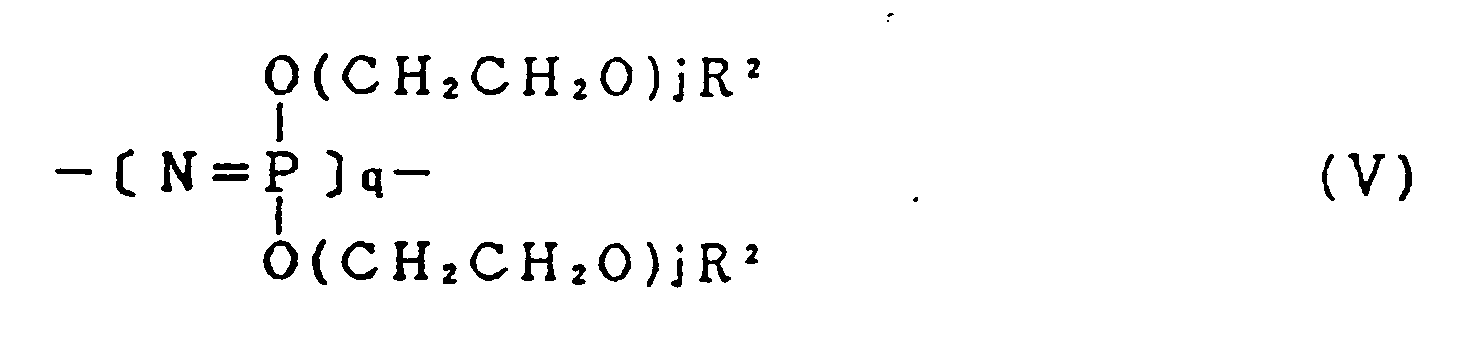
- the polymers represented by the formulae (I) to (VII) consist essentially of a polyphosphazene wherein an inorganic high polymer skeleton having the main chain of phosphonitrile with excellent flexibility and low-temperature characteristics is provided with oligoalkyleneoxy side chains having high affinity for ions, so that the polymer exhibits high conductivity through the transfer of lithium ions only.
- These polymers have a high molecular weight and are suitable for overcoming the foregoing problems of lithium secondary batteries along with the high conductivity of lithium ions.
- the phosphazene polymer (a) can be obtained as a rubberlike product, for example, by reacting the lithium salt of an oligoalkyleneoxytrifluorobutylsulfonic acid and an alcoholate of oligoethyleneoxy monoalkyl ether with dichlorophosphonitrile polymer in a solvent, followed by desalting and purification.
- the polymer When the phosphazene polymer is to be used as an electrolyte, the polymer can be easily made into a film by dissolving the polymer in an ether solvent such as dimethoxyethane or tetrahydrofuran Accordingly, it is convenient to form the film by applying the polymer solution to the negative electrode or positive electrode and removing the solvent from the coating, or to form the film first and interpose the film between the positive electrode and the negative electrode.
- an ether solvent such as dimethoxyethane or tetrahydrofuran
- the polymer for use in the compound (b) is one wherein an inorganic high polymer skeleton having the main chain of phosphonitrile is provided with oligoalkyleneoxy groups and allyl groups.
- This polymer is soft, soluble in water and capable of dissolving some salts therein.
- the side chain having an allyl group introduced therein at its terminal end can be crosslinked at the terminal end, permitting the polymer to exhibit excellent shape retentivity when made into a film without losing the characteristics of the skeleton and side chains.
- the oligoalkyleneoxypolyphosphazene having allyl groups can be prepared, for example, by preparing an oligoalkylene glycol monoalkyl ether and an alkali metal alcoholate of oligoalkylene glycol monoallyl ether, and reacting predetermined amounts of the ether and the alcoholate with dichlorophosphonitrile polymer obtained by subjecting hexachlorotriphosphonitrile to ring-opening polymerization.
- the reaction can be conducted by mixing the reactants together at a temperature of up to about 40°C with use of a usual organic solvent such as tetrahydrofuran (THF) or diglyme and subsequently refluxing the mixture with heating for several hours.
- the alkali metal to be used is suitably sodium, lithium or the like.
- the polymer can be used as an electrolyte in the form of a film which is prepared from a uniform solution obtained by adding a solvent solution of a lithium salt to a solution of the polymer in a solvent such as one given below.
- a solvent solution of a lithium salt to a solution of the polymer in a solvent such as one given below.
- the solution to be formed into the film or the film obtained may be rendered complex by heating, ultrasonic or ultraviolet irradiation or like treatment.
- useful solvents are THF, dioxane, dimethoxyethane and like ethers, acetone, methyl ethyl ketone (MEK) and like ketones, methanol, ethanol and like alcohols, acetonitrile, propylene carbonate, etc.
- allyl groups present in the molecule of the polymer in the compound (b) for use in the invention act effectively in connection with the complex product forming treatment. More specifically, it is thought that the polymer is made into and retained in a form which is favorable for use as the battery electrode by coupling between the allyl groups and a reaction or interaction between the allyl group and the added salt.
- the preferred lithium salt for use in the compound (b) of the invention is at least one of LiClO4, LiAlCl4, LiBF4, LiCl, LiPF6, LiAsF6, CF3SO3Li, etc.
- u means the average number of repeating alkyleneoxy units and is 1 to 20, preferably 5 to 12. High lithium ion conduction can be obtained by suitably selecting the u value.
- v is a real value in the range of 3 ⁇ v ⁇ 200000. The flowability and mechanical properties of the polymer is adjustable by selecting the v value, so that the polymer to be used can be given the characteristics desirable for the contemplated purpose.
- the polymer can be prepared, for example, by preparing a sodium alcoholate of oligoalkylene glycol monoalkyl ether and reacting a predetermined amount of the alcoholate with dichlorophosphonitrile polymer obtained by subjecting hexachlorotriphosphonitrile to ring-opening polymerization.
- the reaction can be carried out by mixing the components together at a temperature of up to about 40°C with use of a usual organic solvent such as tetrahydrofuran or diglyme and subsequently refluxing the mixture with heating for several hours.
- the polymer can be in the form of a film which is prepared from a uniform solution obtained by adding a solvent solution of a lithium salt to a solution of the polymer in a solvent such as tetrahydrofuran, dioxane, dimethoxyethane or like ether, acetone, methyl ethyl ketone or like ketone, methanol, ethanol or like alcohol, acetonitrile, propylene carbonate or the like.
- a solvent such as tetrahydrofuran, dioxane, dimethoxyethane or like ether, acetone, methyl ethyl ketone or like ketone, methanol, ethanol or like alcohol, acetonitrile, propylene carbonate or the like.
- the preferred lithium salt to be used in the solution (c) is at least one salt selected from among LiClO4, LiAlCl4, LiBF4, LiCl, LiPF6, LiAsF6, CF3SO3Li, etc.
- the battery of the invention is fabricated, for example, by coating a specified stainless steel plate with an aqueous solution of the oxide of layer structure, drying the solution, applying to the coating a solution of the polymer electrolyte prepared in advance, removing the solvent from the resulting coating to form a film, placing over the film a lithium-coated stainless steel plate prepared separately in an inert gas atmosphere, and vacuum-sealing the assembly with use of a sealant.
- a separator film formed with minute pores and impregnated with the electrolyte is also usable.
- Fig. 2 shows an embodiment of all solidstate secondary battery of the invention, which is an example of battery of the sheet type. The invention is applicable not only to batteries of this type but also to batteries of the button type or cylinder type.
- Indicated at 1 is a film of oxide of layer structure, at 2 metallic lithium, at 3 a film of electrolyte, at 4 stainless steel foil, and at 5 a sealant.
- the present invention will be described in greater detail with reference to the following examples.
- the batteries to be described below were all fabricated in an argon atmosphere.
- Batteries were fabricated in the same manner as in Example 1 with the exception of varying the proportion of oxide to be admixed with V2O5 for the positive electrode and using a phosphazene polymer having an average molecular weight of about 1,500,000 and represented by the formula [NP ⁇ O(CH2CH2O)7CH2CH2CFHCF2SO3Li ⁇ 0.41 ⁇ O(CH2CH2O)7CH3 ⁇ 1.59 ]n and lithium-aluminum alloy for the negative electrode.
- the oxides of layer structure were dried at 200°C for 5 hours.
- the batteries were subjected to charge-discharge cycles (constant current 0.5mA) between 4 V and 2 V to measure the average amount of discharge during 100 cycles. Table 2 shows the results.
- Batteries were fabricated in the same manner as in Example 1 with the exception of using an oxide of layer structure represented by (V2O5) 0.9 ⁇ (MoO3) 0.1 ⁇ 0.3H2O for the positive electrode and the phosphazene polymer listed in Table 3. The batteries were checked for the capacity retentivity. Table 3 shows the results.
- the oxide of layer structure was dried at 200°C for 3 hours.
- the batteries were subjected to charge-discharge cycles (constant current 0.5mA) between 4V and 2 V and checked for the average amount of discharge during 100 cycles. Table 5 shows the results.
- These batteries were subjected to deep charge-discharge cycles at a constant current of 0.5mA between 4 V and 2 V and checked for the capacity retentivity (relative to the initial discharge capacity which was taken as 100%).
- the results are listed in Table 6, which also shows the result achieved by a battery wherein V2O5 was singly used as an oxide of layer structure (Comparative Example 12).
- Batteries were fabricated in the same manner as in Example 7 with the exception of varying the proportion of the oxide to be admixed with V2O5 to form an oxide of layer structure for the positive electrode and using an electrolyte polymer having an average molecular weight of about 210,000 and represented by the formula [NP ⁇ O(CH2CH2O) 5.2 CH3 ⁇ 2]n and lithium-aluminum alloy for the negative electrode.
- the oxides of layer structure here dried at 200°C for 3 hours.
- the batteries here subjected to charge-discharge cycles (constant current 0.5mA) between 4 V and 2 V and checked for the average amount of discharge for 100 cycles. Table 8 shows the results.
- Batteries were fabricated in the same manner as in Example 7 with the exception of using a electrolyte polymer having an average molecular weight of about 2,000,000 and represented by the formula [NP ⁇ O-(CH2CH2O) 7.0 CH3 ⁇ 2]n .
- the batteries were subjected to deep charge-discharge cycles at a constant current of 0.5mA between 4 V and 2 V and checked for the capacity retentivity (relative to the initial discharge capacity which was taken as 100%) every cycle.
- the results are given in Table 9, which also shows the result achieved by a battery wherein V2O5 was used singly as an oxide of layer structure (Comparative Example 17).
- Batteries were fabricated in the same manner as in Example 7 with the exception of using an oxide of layer structure represented by the formula (V2O5) 0.95 ⁇ (GeO2) 0.05 ⁇ 0.3H2O for the positive electrode and further using the electrolyte polymers listed in Table 10.
- the batteries were subjected to charge-discharge cycles at a constant current of 0.5mA between 4 V and 2 V and checked for the average amount of discharge for 100 cycles.
- Table 10 shows the results.
- the polymers used were about 1,000,000 in average molecular weight.
- the invention provides a useful all solidstate secondary battery which is substantially free of spillage and formation of dendrite, has no iginitability because of the features of flame retardancy and low vapor pressure, is excellent in safety against explosion, repture or the like and also in resistance to excessive discharging and has a prolonged charge-discharge cycle life.
Landscapes
- Chemical & Material Sciences (AREA)
- Chemical Kinetics & Catalysis (AREA)
- General Chemical & Material Sciences (AREA)
- Electrochemistry (AREA)
- Inorganic Chemistry (AREA)
- Manufacturing & Machinery (AREA)
- Organic Chemistry (AREA)
- Engineering & Computer Science (AREA)
- Health & Medical Sciences (AREA)
- Polymers & Plastics (AREA)
- Medicinal Chemistry (AREA)
- Physics & Mathematics (AREA)
- Condensed Matter Physics & Semiconductors (AREA)
- Dispersion Chemistry (AREA)
- General Physics & Mathematics (AREA)
- Secondary Cells (AREA)
- Battery Electrode And Active Subsutance (AREA)
Claims (1)
- Festkörper-Sekundärbatterie, umfassend ein Oxid mit Schichtstruktur der Formel
(V₂O₅ )x·(A)y·zH₂O
worin x+y = 1, 0 < y ≦ 0,5, z = 0,1 bis 1,6 und A mindestens ein Oxid ist, ausgewählt unter GeO₂, SiO₂, B₂O₃, MoO₃, WO₃, Nb₂O₅, TeO₂, Bi₂O₃, Cr₃O₈ und ZrO₂, wobei das Oxid der Formel als Kathoden-aktives Material fungiert, Lithium oder eine Lithiumlegierung als negative Elektroden-aktives Material fungiert und mindestens eine der unten genannten Substanzen (a) bis (c) als Elektrolyt fungiert:(a) Oligoalkylenoxypolyphosphazene mit einer Fluoralkylsulfongruppe, umfassend Segmente der folgenden Formeln (I), (II) und (III) in beliebiger Anordnung

 (b) Komplexverbindungen eines Lithiumsalzes und eines Oligoalkylenoxypolyphosphazens mit Allylgruppen, umfassend Segmente der folgenden Formeln (IV), (V) und (VI) in beliebiger Anordnung
 (c) Lösungen eines Lithiumsalzes in einem Polymer der folgenden Formel (VII)
Applications Claiming Priority (6)
| Application Number | Priority Date | Filing Date | Title |
|---|---|---|---|
| JP319234/88 | 1988-12-16 | ||
| JP63319234A JP2819027B2 (ja) | 1988-12-16 | 1988-12-16 | 全固体二次電池 |
| JP63319235A JPH02165566A (ja) | 1988-12-16 | 1988-12-16 | 全固体二次電池 |
| JP319235/88 | 1988-12-16 | ||
| JP1028317A JP3053404B2 (ja) | 1989-02-06 | 1989-02-06 | 全固体リチウム二次電池 |
| JP28317/89 | 1989-02-06 |
Publications (3)
| Publication Number | Publication Date |
|---|---|
| EP0414902A1 EP0414902A1 (de) | 1991-03-06 |
| EP0414902A4 EP0414902A4 (en) | 1991-09-18 |
| EP0414902B1 true EP0414902B1 (de) | 1994-03-09 |
Family
ID=27286161
Family Applications (1)
| Application Number | Title | Priority Date | Filing Date |
|---|---|---|---|
| EP90900986A Expired - Lifetime EP0414902B1 (de) | 1988-12-16 | 1989-12-14 | Batterie mit vollständig festen sekundärzellen |
Country Status (4)
| Country | Link |
|---|---|
| US (1) | US5153080A (de) |
| EP (1) | EP0414902B1 (de) |
| DE (1) | DE68913736T2 (de) |
| WO (1) | WO1990007198A1 (de) |
Cited By (2)
| Publication number | Priority date | Publication date | Assignee | Title |
|---|---|---|---|---|
| US7776478B2 (en) | 2005-07-15 | 2010-08-17 | Cymbet Corporation | Thin-film batteries with polymer and LiPON electrolyte layers and method |
| US7931989B2 (en) | 2005-07-15 | 2011-04-26 | Cymbet Corporation | Thin-film batteries with soft and hard electrolyte layers and method |
Families Citing this family (14)
| Publication number | Priority date | Publication date | Assignee | Title |
|---|---|---|---|---|
| JP2997741B2 (ja) * | 1992-07-29 | 2000-01-11 | セイコーインスツルメンツ株式会社 | 非水電解質二次電池及びその製造方法 |
| US5279624A (en) * | 1992-11-27 | 1994-01-18 | Gould Inc. | Solder sealed solid electrolyte cell housed within a ceramic frame and the method for producing it |
| US5494495A (en) * | 1994-10-11 | 1996-02-27 | Micron Communications, Inc. | Method of forming button-type batteries |
| US5548055A (en) * | 1995-01-13 | 1996-08-20 | Sri International | Single-ion conducting solid polymer electrolytes |
| US5705293A (en) * | 1997-01-09 | 1998-01-06 | Lockheed Martin Energy Research Corporation | Solid state thin film battery having a high temperature lithium alloy anode |
| WO2003079468A1 (fr) * | 2002-03-19 | 2003-09-25 | Bridgestone Corporation | Electrode positive pour pile au lithium et procede de production associe, pile au lithium |
| US11996517B2 (en) | 2011-06-29 | 2024-05-28 | Space Charge, LLC | Electrochemical energy storage devices |
| US10601074B2 (en) | 2011-06-29 | 2020-03-24 | Space Charge, LLC | Rugged, gel-free, lithium-free, high energy density solid-state electrochemical energy storage devices |
| US11527774B2 (en) | 2011-06-29 | 2022-12-13 | Space Charge, LLC | Electrochemical energy storage devices |
| US9853325B2 (en) | 2011-06-29 | 2017-12-26 | Space Charge, LLC | Rugged, gel-free, lithium-free, high energy density solid-state electrochemical energy storage devices |
| US10707526B2 (en) | 2015-03-27 | 2020-07-07 | New Dominion Enterprises Inc. | All-inorganic solvents for electrolytes |
| US10707531B1 (en) | 2016-09-27 | 2020-07-07 | New Dominion Enterprises Inc. | All-inorganic solvents for electrolytes |
| US11251430B2 (en) | 2018-03-05 | 2022-02-15 | The Research Foundation For The State University Of New York | ϵ-VOPO4 cathode for lithium ion batteries |
| EP3762989A4 (de) | 2018-03-07 | 2021-12-15 | Space Charge, LLC | Dünnfilm-festkörper-energiespeichervorrichtungen |
Family Cites Families (8)
| Publication number | Priority date | Publication date | Assignee | Title |
|---|---|---|---|---|
| JPS6191868A (ja) * | 1984-10-09 | 1986-05-09 | Matsushita Electric Ind Co Ltd | 非水電解質二次電池 |
| US4675260A (en) * | 1984-11-12 | 1987-06-23 | Nippon Telegraph And Telephone Corporation | Lithium battery including vanadium pentoxide base amorphous cathode active material |
| JPS61254626A (ja) * | 1985-04-30 | 1986-11-12 | リサ−チ・コ−ポレイシヨン | 電気化学電池用ポリホスフアゼンベ−ス電解質 |
| JPS62274555A (ja) * | 1986-05-23 | 1987-11-28 | Toshiba Battery Co Ltd | 非水溶媒二次電池 |
| JPS62296375A (ja) * | 1986-06-16 | 1987-12-23 | Yuasa Battery Co Ltd | 高分子複合材料の製造法 |
| JPH0721060B2 (ja) * | 1986-12-26 | 1995-03-08 | 大塚化学株式会社 | アリル基を有するオリゴエチレンオキシポリホスファゼンを用いたアルカリ金属二次電池 |
| US4803137A (en) * | 1987-05-19 | 1989-02-07 | Bridgestone Corporation | Non-aqueous electrolyte secondary cell |
| JPH06191868A (ja) * | 1992-12-24 | 1994-07-12 | Nippon Sheet Glass Co Ltd | フレーク状ガラスの製造方法 |
-
1989
- 1989-12-14 EP EP90900986A patent/EP0414902B1/de not_active Expired - Lifetime
- 1989-12-14 DE DE68913736T patent/DE68913736T2/de not_active Expired - Fee Related
- 1989-12-14 WO PCT/JP1989/001252 patent/WO1990007198A1/ja not_active Ceased
-
1990
- 1990-12-14 US US07/555,477 patent/US5153080A/en not_active Expired - Fee Related
Cited By (3)
| Publication number | Priority date | Publication date | Assignee | Title |
|---|---|---|---|---|
| US7776478B2 (en) | 2005-07-15 | 2010-08-17 | Cymbet Corporation | Thin-film batteries with polymer and LiPON electrolyte layers and method |
| US7931989B2 (en) | 2005-07-15 | 2011-04-26 | Cymbet Corporation | Thin-film batteries with soft and hard electrolyte layers and method |
| US7939205B2 (en) | 2005-07-15 | 2011-05-10 | Cymbet Corporation | Thin-film batteries with polymer and LiPON electrolyte layers and method |
Also Published As
| Publication number | Publication date |
|---|---|
| DE68913736T2 (de) | 1994-06-30 |
| WO1990007198A1 (fr) | 1990-06-28 |
| EP0414902A4 (en) | 1991-09-18 |
| US5153080A (en) | 1992-10-06 |
| DE68913736D1 (de) | 1994-04-14 |
| EP0414902A1 (de) | 1991-03-06 |
Similar Documents
| Publication | Publication Date | Title |
|---|---|---|
| US7455935B2 (en) | Ion-conductive electrolyte and cell employing the same | |
| US5153080A (en) | All solidstate secondary battery | |
| EP0576686B1 (de) | Zelle | |
| EP2863468B1 (de) | Elektrolyt für batterien mit nichtwässrigem elektrolyt und batterie mit diesem nichtwässrigen elektrolyt | |
| EP2006940B1 (de) | Kathodenmischung und Batterie mit wasserfreiem Elektrolyt | |
| EP3200260B1 (de) | Polymerelektrolyt für eine lithiumsekundärbatterie und lithiumsekundärbatterie damit | |
| US5114809A (en) | All solid-state lithium secondary battery | |
| EP2575199A1 (de) | Lithiumionen-Sekundärbatterie | |
| JP2740960B2 (ja) | リチウム二次電池 | |
| KR20140026841A (ko) | 복합양극활물질, 이를 채용한 양극 및 리튬 전지 | |
| Pateriya et al. | Polymer composites for lithium-ion batteries | |
| JP7523659B2 (ja) | 固体電解質製造用組成物、これを用いる固体電解質及びリチウム二次電池 | |
| US5780185A (en) | Cathode materials for lithium batteries and methods for producing the same | |
| EP0404578A1 (de) | Sekundärbatterie | |
| JP2819027B2 (ja) | 全固体二次電池 | |
| JP3218285B2 (ja) | 有機電解質電池 | |
| CN121039857A (zh) | 用于全固态电池组的固体聚合物电解质 | |
| JP3136610B2 (ja) | 電池及びその製造方法 | |
| KR20190021099A (ko) | 유기 전해액, 및 이를 포함하는 리튬 전지 | |
| JPH06220147A (ja) | イオン伝導性高分子化合物 | |
| JP3393621B2 (ja) | リチウム二次電池用正極材料およびその製造方法 | |
| JP2004071340A (ja) | 非水電解液及び非水電解質二次電池 | |
| JPH05178948A (ja) | イオン伝導性高分子化合物 | |
| JP3053404B2 (ja) | 全固体リチウム二次電池 | |
| JPH05325961A (ja) | リチウム電池 |
Legal Events
| Date | Code | Title | Description |
|---|---|---|---|
| PUAI | Public reference made under article 153(3) epc to a published international application that has entered the european phase |
Free format text: ORIGINAL CODE: 0009012 |
|
| 17P | Request for examination filed |
Effective date: 19900814 |
|
| AK | Designated contracting states |
Kind code of ref document: A1 Designated state(s): DE FR GB |
|
| A4 | Supplementary search report drawn up and despatched | ||
| AK | Designated contracting states |
Kind code of ref document: A4 Designated state(s): DE FR GB |
|
| 17Q | First examination report despatched |
Effective date: 19930430 |
|
| GRAA | (expected) grant |
Free format text: ORIGINAL CODE: 0009210 |
|
| AK | Designated contracting states |
Kind code of ref document: B1 Designated state(s): DE FR GB |
|
| REF | Corresponds to: |
Ref document number: 68913736 Country of ref document: DE Date of ref document: 19940414 |
|
| ET | Fr: translation filed | ||
| PLBE | No opposition filed within time limit |
Free format text: ORIGINAL CODE: 0009261 |
|
| STAA | Information on the status of an ep patent application or granted ep patent |
Free format text: STATUS: NO OPPOSITION FILED WITHIN TIME LIMIT |
|
| 26N | No opposition filed | ||
| PGFP | Annual fee paid to national office [announced via postgrant information from national office to epo] |
Ref country code: GB Payment date: 20011203 Year of fee payment: 13 |
|
| PGFP | Annual fee paid to national office [announced via postgrant information from national office to epo] |
Ref country code: DE Payment date: 20011228 Year of fee payment: 13 |
|
| REG | Reference to a national code |
Ref country code: GB Ref legal event code: IF02 |
|
| PGFP | Annual fee paid to national office [announced via postgrant information from national office to epo] |
Ref country code: FR Payment date: 20020129 Year of fee payment: 13 |
|
| PG25 | Lapsed in a contracting state [announced via postgrant information from national office to epo] |
Ref country code: GB Free format text: LAPSE BECAUSE OF NON-PAYMENT OF DUE FEES Effective date: 20021214 |
|
| PG25 | Lapsed in a contracting state [announced via postgrant information from national office to epo] |
Ref country code: DE Free format text: LAPSE BECAUSE OF NON-PAYMENT OF DUE FEES Effective date: 20030701 |
|
| GBPC | Gb: european patent ceased through non-payment of renewal fee |
Effective date: 20021214 |
|
| PG25 | Lapsed in a contracting state [announced via postgrant information from national office to epo] |
Ref country code: FR Free format text: LAPSE BECAUSE OF NON-PAYMENT OF DUE FEES Effective date: 20030901 |
|
| REG | Reference to a national code |
Ref country code: FR Ref legal event code: ST |