EP0415189A2 - Verfahren zur Herstellung von Aminobenzylalkoholen - Google Patents
Verfahren zur Herstellung von Aminobenzylalkoholen Download PDFInfo
- Publication number
- EP0415189A2 EP0415189A2 EP90115683A EP90115683A EP0415189A2 EP 0415189 A2 EP0415189 A2 EP 0415189A2 EP 90115683 A EP90115683 A EP 90115683A EP 90115683 A EP90115683 A EP 90115683A EP 0415189 A2 EP0415189 A2 EP 0415189A2
- Authority
- EP
- European Patent Office
- Prior art keywords
- formula
- aminobenzoic acid
- acid ester
- electrolysis
- aminobenzyl
- Prior art date
- Legal status (The legal status is an assumption and is not a legal conclusion. Google has not performed a legal analysis and makes no representation as to the accuracy of the status listed.)
- Withdrawn
Links
Classifications
-
- C—CHEMISTRY; METALLURGY
- C07—ORGANIC CHEMISTRY
- C07C—ACYCLIC OR CARBOCYCLIC COMPOUNDS
- C07C213/00—Preparation of compounds containing amino and hydroxy, amino and etherified hydroxy or amino and esterified hydroxy groups bound to the same carbon skeleton
-
- C—CHEMISTRY; METALLURGY
- C25—ELECTROLYTIC OR ELECTROPHORETIC PROCESSES; APPARATUS THEREFOR
- C25B—ELECTROLYTIC OR ELECTROPHORETIC PROCESSES FOR THE PRODUCTION OF COMPOUNDS OR NON-METALS; APPARATUS THEREFOR
- C25B3/00—Electrolytic production of organic compounds
- C25B3/01—Products
- C25B3/07—Oxygen containing compounds
-
- C—CHEMISTRY; METALLURGY
- C25—ELECTROLYTIC OR ELECTROPHORETIC PROCESSES; APPARATUS THEREFOR
- C25B—ELECTROLYTIC OR ELECTROPHORETIC PROCESSES FOR THE PRODUCTION OF COMPOUNDS OR NON-METALS; APPARATUS THEREFOR
- C25B3/00—Electrolytic production of organic compounds
- C25B3/01—Products
- C25B3/09—Nitrogen containing compounds
-
- C—CHEMISTRY; METALLURGY
- C25—ELECTROLYTIC OR ELECTROPHORETIC PROCESSES; APPARATUS THEREFOR
- C25B—ELECTROLYTIC OR ELECTROPHORETIC PROCESSES FOR THE PRODUCTION OF COMPOUNDS OR NON-METALS; APPARATUS THEREFOR
- C25B3/00—Electrolytic production of organic compounds
- C25B3/20—Processes
- C25B3/25—Reduction
Definitions
- This invention relates to a process for the preparation of aminobenzyl alcohols by electrochemical reduction of aminobenzoic acid esters.
- Esters of benzoic acid have also been reduced electrochemically.
- MM Baizer and H. Lund: "Organic Elelctrochemistry", M. Dekker, New York 1983, pp. 380-381 state that a mixture is formed in a cathode reaction of methyl or ethyl benzoate in a strongly acidic medium on a lead cathode , which consists almost equally of benzyl alcohol and benzyl ether.
- the electroreduction of nitrogen-containing heterocyclic-aromatic carboxylic acid esters, such as imidazole-4-carboxylic acid esters, in the strongly acidic aqueous electrolyte leads to a 1: 1 mixture of alcohol and ether (US Pat. No. 4,055,573).
- the formation of such mixtures is explained by the following reaction mechanism (see the above-mentioned reference "Organic Electrochemistry", p. 380).
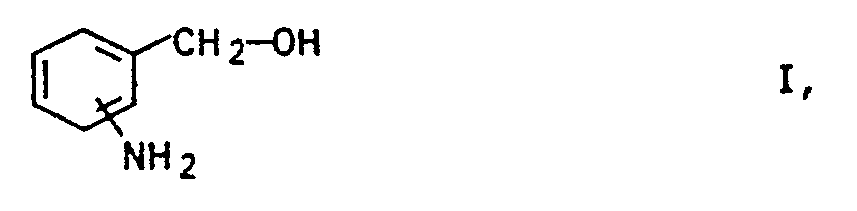
- aminobenzyl alcohols of the formula can advantageously produce if you have aminobenzoic acid ester of the formula in which R is an alkyl radical with 1 to 4 carbon atoms, cathodically reduced in a strongly acidic electrolyte. According to the new process, the aminobenzyl alcohols are surprisingly obtained in good yields and high purity without the formation of any appreciable formation of aminobenzyl alkyl ethers.
- R represents an alkyl radical with 1 to 4 carbon atoms, such as methyl, ethyl, propyl or butyl.
- the methyl esters, in particular the methyl anthranilic acid, are preferred as starting compounds.
- the aminobenzoic acid ester is used in dissolved or suspended form, preferably in an aqueous electrolyte at a pH of less than 1.
- the pH can be adjusted by adding acids such as hydrochloric acid, phosphoric acid, benzenesulfonic acid, p-toluenesulfonic acid or preferably sulfuric acid.
- Aqueous acidic catholytes which do not contain any electrolysis auxiliaries are preferably used.
- Their content of benzoic acid ester is e.g. between 1 and 10% by weight, preferably between 2 and 7% by weight.
- the catholyte has a content of benzoic acid ester from 2 to 10% by weight of sulfuric acid from 5 to 20% by weight and of water from 70 to 93% by weight.
- Aqueous mineral acids, preferably aqueous sulfuric acid are advantageously used as the anolyte.
- the electrolysis is carried out in conventional electrolysis cells (trough cells, flow cells, etc.), preferably in divided cells.
- Monopolar or bipolar cells are particularly suitable, in which the anode and cathode space through a diaphragm, for. B. are separated from a porous plate, a glass filter or a commercially available ion exchange membrane.
- cation exchange membranes are preferably used as the diaphragm.
- cathodes with a high hydrogen overvoltage such as those made from mercury, cadmium, lead, zinc, tin, graphite or amalgamated metals (Pb, Cu).
- Lead is preferably used as the cathode material.
- anode material does not play an important role in the invention. It is expedient to use materials which are largely stable under anodic loading, such as noble metals, titanium, manganese dioxide, graphite doped with noble metal oxides, but preferably lead dioxide.
- the cathode current density is z. B. 1 to 30 A / dm2, in particular 3 to 15 A / dm2.
- the aminobenzyl alcohols are valuable intermediates, for example for the manufacture of pharmaceuticals.
- the cathode compartment with a lead cathode (area 2 dm2) was separated from the anode compartment with a Pb / PbO2 anode (area 2 dm2) by a cation exchange membrane commercially available under the name ®NAFION.
- the anolyte consists of a 10% aqueous sulfuric acid.
- the orange-colored electrolysis discharge is adjusted to a pH of 9 to 10 with aqueous ammonia solution.
- the precipitate is sucked off through a pressure filter. After drying the filter residue, 10.3 g of an oligomer are obtained.
- the alkaline mother liquor is extracted four times with 500 ml of methyl tert-butyl ether and concentrated on a rotary evaporator. 52.8 g of ivory-white o-aminobenzyl alcohol are obtained in> 95% purity (mp. 81-83 ° C., lit .: 83 ° C.) corresponding to a material yield of 72%.
- a gas chromatographic analysis (30 m capillary column DB 1701) of the product shows that the o-aminobenzyl methyl ether content is less than 1%.
Landscapes
- Chemical & Material Sciences (AREA)
- Organic Chemistry (AREA)
- Engineering & Computer Science (AREA)
- Chemical Kinetics & Catalysis (AREA)
- Electrochemistry (AREA)
- Materials Engineering (AREA)
- Metallurgy (AREA)
- Electrolytic Production Of Non-Metals, Compounds, Apparatuses Therefor (AREA)
- Organic Low-Molecular-Weight Compounds And Preparation Thereof (AREA)
Abstract
Description
- Diese Erfindung betrifft ein Verfahren zur Herstellung von Aminobenzylalkoholen durch elektrochemische Reduktion von Aminobenzoesäureester.
- Es sind schon zahlreiche Verfahren zur Reduktion aromatischer Carbonsäuren oder deren Ester vorgeschlagen worden. So hat man für die Herstellung von o-Aminobenzylalkohol aus Anthranilsäurederivaten z.B. komplexe Hydride herangezogen. Neben Lithiumaluminiumhydrid (J. Am. Chem. Soc. 69, 2548 (1947)) sind beispielsweise auch Boran-Methylsulfid (J. Org. Chem. 39, 3052 (1974)) oder Lithiumtriethylborhydrid (Aldrichimica Acta 7, 32 (1974)) geeignet. Diese komplexen Hydride haben jedoch den Nachteil, daß sie teuer, sauerstoff- und/oder feuchtigkeitsempfindlich sind und oft nur in trocknen, aprotischen Lösungsmitteln unter besonderen Vorsichtsmaßnahmen umgesetzt werden können.
- Aus J. Chem. Soc. 1942, 98-102 ist die elektrochemische Reduktion von Anthranilsäure zu o-Aminobenzylalkohol bekannt. Dieses Verfahren hat jedoch den Nachteil, daß es nur in mäßigen Ausbeuten zu einem Produkt führt, daß erst nach einer verlustreichen Umkristallisation in reiner Form isoliert werden kann.
- Man hat auch schon Ester der Benzoesäure elektrochemisch reduziert. So wird in M.M. Baizer und H. Lund: "Organic Elelctrochemistry", M. Dekker, New York 1983, S. 380-381 angegeben, daß bei der kathodischen Reaktion von Methyl- oder Ethylbenzoat in stark saurem Medium an einer Bleikathode ein Gemisch entsteht, das annähernd zu gleichen Teilen aus Benzylalkohol und Benzylether besteht. Auch die Elektroreduktion von stickstoffhaltigen heterocyclisch-aromatischen Carbonsäureestern, wie Imidazol-4-carbonsäureester im stark sauren wäßrigen Elektrolyten führt zu einem 1:1-Gemisch aus Alkohol und Ether (US-PS 4 055 573). Die Bildung derartiger Gemische wird durch folgenden Reaktionsmechanismus erklärt (s. die oben erwähnten Literaturstelle "Organic Electrochemistry", S. 380).

- Es hat daher nicht an Versuchen gefehlt, die Bildung der Benzylalkohole zur Hauptreaktion zu machen. Das gelingt dann, wenn man Benzoesäureester in einem sauren wäßrigen Elektrolyten, der wasserlösliche Hilfsstoffe, wie Alkohole, Tetrahydrofuran oder Acetonitril enthält, bei einem pH-Wert bis 4 (J 6 2297 482) oder in alkoholischer Lösung in Gegenwart von Tetraalkylammoniumsalzen und Essigsäure bei einem pH von über 3 (Liebigs Ann. Chem. 1977, 2036-2047; DE 2 428 878) elektroreduziert.
- Von einer Übertragung dieser Methoden auf eine elektrochemische Herstellung von Aminobenzylalkoholen aus Anthranilsäureestern konnten keine brauchbaren Ergebnisse erwartet werden. Es war vielmehr damit zu rechnen, daß es durch Nebenreaktionen zwischen der Aminogruppe der Ausgangsverbindung und der Aldehydgruppe der bei der Reduktion zwangsläufig entstehenden Zwischenverbindung in erheblichem Maße zu einer Bildung dimerer bzw. oligomerer Produkte kommt und damit nur stark verminderte Ausbeuten erhalten werden.
- Es wurde nur gefunden, daß man Aminobenzylalkohole der Formel


- In den Aminobenzoesäureestern der Formel (I) steht die Aminogruppe in ortho-, meta- oder para-Stellung. R steht für einen Alkylrest mit 1 bis 4 C-Atomen, wie für Methyl, Ethyl, Propyl oder Butyl. Als Ausgangsverbindungen sind die Methylester, insbesondere der Anthranilsäuremethylester bevorzugt.
- Für die elektrochemische Reduktion wird der Aminobenzoesäureester in gelöster oder suspendierter Form, vorzugsweise in einem wäßrigen Elektrolyten bei einem pH-Wert von kleiner als 1 eingesetzt. Die Einstellung des pH-Wertes kann durch zugabe von Säuren, wie Salzsäure, Phosphorsäure, Benzolsulfonsäure, p-Toluolsulfonsäure oder vorzugsweise Schwefelsäure erfolgen.
- Bevorzugt werden wäßrige saure Katholyten eingesetzt, die keine Elektrolyse-Hilfsstoffe enthalten. Ihr Gehalt an Benzoesäureester liegt z.B. zwischen 1 und 10 Gew.%, vorzugsweise zwischen 2 und 7 Gew.%. So hat der Katholyt z.B. einen Gehalt an Benzoesäureester von 2 bis 10 Gew.% an Schwefelsäure von 5 bis 20 Gew.% und an Wasser von 70 bis 93 Gew.%. Als Anolyt verwendet man zweckmäßigerweise wäßrige Mineralsäuren, vorzugsweise wäßrige Schwefelsäure.
- Die Elektrolyse wird in üblichen Elektrolysezellen (Trogzellen, Durchflußzellen usw.), vorzugsweise in geteilten zellen, durchgeführt. Besonders geeignet sind monopolare oder bipolare zellen, bei denen Anoden- und Kathodenraum durch ein Diaphragma, z. B. aus einer porösen Platte, einem Glasfilter oder einer handelsüblichen Ionenaustauschermembrane, getrennt sind. Zur Aufrechterhaltung einer ausgegelichenen pH-Bilanz werden bevorzugt Kationenaustauschermembranen als Diaphragma eingesetzt.
- Man verwendet zweckmäßigerweise Kathoden mit einer hohen Wasserstoffüberspannung, wie solche aus Quecksilber, Cadmium, Blei, Zink, Zinn, Graphit oder amalgierten Metallen (Pb, Cu). Bevorzugt wird Blei als Kathodenmaterial eingesetzt. Um ein Absinken der Stromausbeute zu vermeiden, kann es nach längeren Elektrolysezeiten zweckmäßig sein, die Kathode durch kurzzeitiges Kurzschließen zu reinigen. Die Wahl des Anodenmaterials spielt keine erfindungswesentliche Rolle. Zweckmäßigerweise wird man solche Materialien verwenden, die unter anodischer Belastung weitgehend stabil sind, wie Edelmetalle, mit Edelmetalloxiden dotiertes Titan, Mangandioxid, Graphit, bevorzugt jedoch Bleidioxid.
- Man führt die Elektrolyse z. B. bei Temperaturen zwischen 0 und 50°C, vorzugsweise bei 10 bis 30°C durch. Die Kathodenstromdichte beträgt z. B. 1 bis 30 A/dm², insbesondere 3 bis 15 A/dm².
- Nach der Elektrolyse arbeitet man z. B. so auf, daß man den Elektrolyseaustrag mit einer Base wie Natronlauge oder vorzugsweise Ammoniak alkalisch stellt (pH 8-10), die ausgefallenen Oligomeren durch Filtration entfernt und die Mutterlauge mit Methyl-tert.Butylether extrahiert. Nach dem Entfernen des Extraktionsmittels erhält man z.B. aus Anthranilsäuremethylester elfenbeinweißen o-Aminobenzylalkohol in 95 %iger Reinheit, so daß sich weitere Reinigungsschritte, wie eine Umkristallisation erübrigen.
- Die Aminobenzylalkohole sind wertvolle Zwischenprodukte, z.B. für die Herstellung von Pharmazeutika.
- Ein Katholyt bestehend aus 90 g Anthranilsäuremethylester, 200 g konzentrierter Schwefelsäure und 1710 g Wasser (pH des Katholyten = 0,2) wird mit einer Temperatur von 20°C über ein Vorratsgefäß und Wärmetauscher durch den Kathodenraum einer geteilten Elektrolysezelle gepumpt. Der Kathodenraum mit einer Bleikathode (Fläche 2 dm²) wurde vom Anodenraum mit einer Pb/PbO₂-Anode (Fläche 2 dm²) durch eine im Handel unter der Bezeichnung ®NAFION erhältiche Kationenaustauchermembrane getrennt. Der Anolyt besteht aus einer 10 %igen wäßrigen Schwefelsäure. Die Elektrolyse wird mit einer Stromdichte von 7,5 A/dm² betrieben. Nach 12 Stunden Elektrolysedauer (180 Ah = 10 F/mol) wird die Elektrolyse abgebrochen und der Katholyt aufgearbeitet.
- Der orangegefärbte Elektrolyseaustrag wird mit wäßriger Ammoniaklösung auf einen pH-Wert von 9 bis 10 gestellt. Der ausgefallene Niederschlag wird über eine Drucknutsche abgesaugt. Nach dem Trocknen des Filterrückstandes erhält man 10,3 g eines Oligomeren. Die alkalische Mutterlauge wird viermal mit 500 ml Methyl-tert.Butylether extrahiert und am Rotationsverdampfer scharf eingeengt. Man erhält 52,8 g elfenbeinweißen o-Aminobenzylalkohol in > 95 %iger Reinheit (Fp. 81-83°C, Lit.: 83°C) entsprechend einer Materialausbeute von 72 %. Durch eine gaschromatographische Analyse (30 m Kapillarsäule DB 1701) des Produktes wird ein Gehalt an o-Aminobenzylmethylether von kleiner als 1 % festgestellt.
- Ein Katholyt bestehend aus 140 g Anthranilsäuremethylester, 300 g konz. Schwefelsäure und 1660 g Wasser (pH des Katholyten = -0,3) wird analog zu Beispiel 1 bei einer Stromdichte von 10 A/dm² elektrolysiert. Nach einem Ladungsverbrauch entsprechend 10 F/mol Anthranilsäuremethylester wird die Elektrolyse abgebrochen und, wie in Beispiel 1 beschrieben, aufgearbeitet. Man erhält 80,3 g o-Aminobenzylalkohol in > 95 %iger Reinheit (Fp. 81-82°C) entsprechend einer Materialausbeute von 70 %.
- Ein Katholyt bestehend aus 90 g m-Aminobenzoesäureethylester, 200 g konzentrierter Schwefelsäure und 1710 g Wasser (pH des Katholyten = 0,18) wird entsprechend Beispiel 1 elektrolysiert und aufgearbeitet (Extraktionsmittel Isobutylacetat). Man erhält 39,4 g m-Aminobenzylalkohol in > 95 %iger Reinheit (Fp. 88-90°C, Lit. 90-92°C) entsprechend einer Materialausbeute von 43 %.
Claims (4)

Applications Claiming Priority (2)
| Application Number | Priority Date | Filing Date | Title |
|---|---|---|---|
| DE3928290 | 1989-08-26 | ||
| DE3928290A DE3928290A1 (de) | 1989-08-26 | 1989-08-26 | Verfahren zur herstellung von aminobenzylalkoholen |
Publications (2)
| Publication Number | Publication Date |
|---|---|
| EP0415189A2 true EP0415189A2 (de) | 1991-03-06 |
| EP0415189A3 EP0415189A3 (en) | 1991-06-12 |
Family
ID=6387970
Family Applications (1)
| Application Number | Title | Priority Date | Filing Date |
|---|---|---|---|
| EP19900115683 Withdrawn EP0415189A3 (en) | 1989-08-26 | 1990-08-16 | Process for the preparation of aminbenzylalcohol |
Country Status (3)
| Country | Link |
|---|---|
| EP (1) | EP0415189A3 (de) |
| JP (1) | JPH03107490A (de) |
| DE (1) | DE3928290A1 (de) |
Cited By (2)
| Publication number | Priority date | Publication date | Assignee | Title |
|---|---|---|---|---|
| CN101660171B (zh) * | 2009-09-09 | 2011-01-05 | 淮北煤炭师范学院 | 一种电解制备氨基丙醇的方法 |
| CN111748825A (zh) * | 2019-03-28 | 2020-10-09 | 万华化学集团股份有限公司 | 一种成对电极反应制备ε-己内酯的方法 |
Families Citing this family (2)
| Publication number | Priority date | Publication date | Assignee | Title |
|---|---|---|---|---|
| TW267151B (de) * | 1993-11-11 | 1996-01-01 | Shoin Chain Block Kk | |
| JP3086874B2 (ja) | 1998-12-02 | 2000-09-11 | 象印チエンブロック株式会社 | チェーンレバーホイスト |
Family Cites Families (2)
| Publication number | Priority date | Publication date | Assignee | Title |
|---|---|---|---|---|
| DE177490C (de) * | ||||
| DE166181C (de) * |
-
1989
- 1989-08-26 DE DE3928290A patent/DE3928290A1/de not_active Withdrawn
-
1990
- 1990-08-16 EP EP19900115683 patent/EP0415189A3/de not_active Withdrawn
- 1990-08-27 JP JP2222683A patent/JPH03107490A/ja active Pending
Cited By (2)
| Publication number | Priority date | Publication date | Assignee | Title |
|---|---|---|---|---|
| CN101660171B (zh) * | 2009-09-09 | 2011-01-05 | 淮北煤炭师范学院 | 一种电解制备氨基丙醇的方法 |
| CN111748825A (zh) * | 2019-03-28 | 2020-10-09 | 万华化学集团股份有限公司 | 一种成对电极反应制备ε-己内酯的方法 |
Also Published As
| Publication number | Publication date |
|---|---|
| DE3928290A1 (de) | 1991-02-28 |
| JPH03107490A (ja) | 1991-05-07 |
| EP0415189A3 (en) | 1991-06-12 |
Similar Documents
| Publication | Publication Date | Title |
|---|---|---|
| EP0012215B1 (de) | 2-Hydroxybutansulfonsaures Cholin und dessen Verwendung als Leitsalz | |
| FI74945C (fi) | Foerfarande foer framstaellning av hydroksifoereningar genom elektrokemisk reduktion. | |
| DE3928290A1 (de) | Verfahren zur herstellung von aminobenzylalkoholen | |
| DE2630927A1 (de) | Verfahren zur herstellung von phthalidcarbonsaeure-(5) | |
| EP0578946B1 (de) | Elektrochemisches Verfahren zur Reduktion von Oxalsäure zu Glyoxylsäure | |
| DE3873476T2 (de) | Verfahren zur herstellung von anilinderivaten. | |
| JPS6342713B2 (de) | ||
| EP0638665A1 (de) | Verfahren zur Herstellung von Bezaldehyddialkylacetalen | |
| DE2642496C2 (de) | Verfahren zur Herstellung von p-Hydroxymethylbenzoesäure | |
| EP0100498B1 (de) | Verfahren zur Herstellung von Dichlormilchsäure oder dem Nitril oder Amid der Dichlormilchsäure | |
| DE2617808C2 (de) | Verfahren zur Herstellung von Aminomethoxybenzolen aus Nitrobenzolen | |
| DE2403446C2 (de) | Verfahren zur Herstellung hydrierter Indole | |
| DE19844061B4 (de) | Verfahren zur Herstellung von N-Alkanoylcysteinen | |
| DE2262851C3 (de) | Verfahren zur Herstellung von Phenylhydroxylaminen | |
| EP0179377B1 (de) | Verfahren zur Herstellung von 1-Alkoxyisochromanen und neue 1-Alkoxy-alkylisochromane | |
| JP2622115B2 (ja) | ベンジルアルコール類の製造方法 | |
| JP2632832B2 (ja) | ポリフルオロベンジルアルコールの製造方法 | |
| WO2006005531A1 (de) | Verfahren zur herstellung von primären aminen mit einer an ein aliphatisches oder cycloaliphatisches c-atom gebunden primären aminogruppe und einer cyclopropyl-einheit | |
| JPH072837A (ja) | Dl−ホモシスチンから電気化学的方法によりn−アセチルホモシステインチオラクトンを調製する方法 | |
| EP0513577B1 (de) | Verfahren zur Herstellung von 1-Alkoxyisochromanen | |
| WO2003020679A1 (de) | Verfahren zur herstellung von oxo-cyclohexyl- oder oxo-cyclohexylenderivaten | |
| DE2144419C3 (de) | Verfahren zur elektrochemischen Herstellung von Phthalld | |
| EP4585720A1 (de) | Elektrochemisches verfahren zur herstellung von 1,2,3,4-butantetracarbonsäuretetraalkylestern | |
| DE2409117A1 (de) | Verfahren zur herstellung von propiolsaeure | |
| NO171373B (no) | Fremgangsmaate for fremstilling av biskarbamater |
Legal Events
| Date | Code | Title | Description |
|---|---|---|---|
| PUAI | Public reference made under article 153(3) epc to a published international application that has entered the european phase |
Free format text: ORIGINAL CODE: 0009012 |
|
| 17P | Request for examination filed |
Effective date: 19901227 |
|
| AK | Designated contracting states |
Kind code of ref document: A2 Designated state(s): BE CH DE ES FR GB IT LI NL |
|
| PUAL | Search report despatched |
Free format text: ORIGINAL CODE: 0009013 |
|
| AK | Designated contracting states |
Kind code of ref document: A3 Designated state(s): BE CH DE ES FR GB IT LI NL |
|
| 17Q | First examination report despatched |
Effective date: 19921210 |
|
| STAA | Information on the status of an ep patent application or granted ep patent |
Free format text: STATUS: THE APPLICATION HAS BEEN WITHDRAWN |
|
| 18W | Application withdrawn |
Withdrawal date: 19930618 |