EP0415213B1 - Aminogruppen aufweisende Copolymerisate, ein Verfahren zu ihrer Herstellung und ihre Verwendung als Bindemittel oder Bindemittelkomponente - Google Patents
Aminogruppen aufweisende Copolymerisate, ein Verfahren zu ihrer Herstellung und ihre Verwendung als Bindemittel oder Bindemittelkomponente Download PDFInfo
- Publication number
- EP0415213B1 EP0415213B1 EP90115875A EP90115875A EP0415213B1 EP 0415213 B1 EP0415213 B1 EP 0415213B1 EP 90115875 A EP90115875 A EP 90115875A EP 90115875 A EP90115875 A EP 90115875A EP 0415213 B1 EP0415213 B1 EP 0415213B1
- Authority
- EP
- European Patent Office
- Prior art keywords
- copolymers
- weight
- amino groups
- radical
- amino
- Prior art date
- Legal status (The legal status is an assumption and is not a legal conclusion. Google has not performed a legal analysis and makes no representation as to the accuracy of the status listed.)
- Expired - Lifetime
Links
- 229920001577 copolymer Polymers 0.000 title claims abstract description 61
- 238000000034 method Methods 0.000 title claims abstract description 22
- 125000003277 amino group Chemical group 0.000 title claims abstract description 20
- 239000011230 binding agent Substances 0.000 title claims description 11
- 238000002360 preparation method Methods 0.000 title description 11
- 125000004432 carbon atom Chemical group C* 0.000 claims abstract description 36
- 150000004985 diamines Chemical class 0.000 claims abstract description 20
- 125000002924 primary amino group Chemical group [H]N([H])* 0.000 claims abstract description 15
- 229910052799 carbon Inorganic materials 0.000 claims abstract description 12
- 229930195733 hydrocarbon Natural products 0.000 claims abstract description 8
- 239000004215 Carbon black (E152) Substances 0.000 claims abstract description 7
- 229920006395 saturated elastomer Polymers 0.000 claims abstract description 7
- 150000001875 compounds Chemical class 0.000 claims abstract description 6
- 238000004519 manufacturing process Methods 0.000 claims abstract description 5
- -1 hydrocarbon radical Chemical class 0.000 claims description 42
- 239000000178 monomer Substances 0.000 claims description 33
- 238000006243 chemical reaction Methods 0.000 claims description 20
- 239000002904 solvent Substances 0.000 claims description 17
- IJGRMHOSHXDMSA-UHFFFAOYSA-N Atomic nitrogen Chemical compound N#N IJGRMHOSHXDMSA-UHFFFAOYSA-N 0.000 claims description 14
- UFHFLCQGNIYNRP-UHFFFAOYSA-N Hydrogen Chemical compound [H][H] UFHFLCQGNIYNRP-UHFFFAOYSA-N 0.000 claims description 14
- 150000003254 radicals Chemical class 0.000 claims description 14
- 239000001257 hydrogen Substances 0.000 claims description 12
- 229910052739 hydrogen Inorganic materials 0.000 claims description 12
- 239000000203 mixture Substances 0.000 claims description 12
- 229920000642 polymer Polymers 0.000 claims description 11
- 125000002496 methyl group Chemical group [H]C([H])([H])* 0.000 claims description 10
- 229910052757 nitrogen Inorganic materials 0.000 claims description 7
- 125000003917 carbamoyl group Chemical group [H]N([H])C(*)=O 0.000 claims description 5
- 125000001495 ethyl group Chemical group [H]C([H])([H])C([H])([H])* 0.000 claims description 5
- ZAMOUSCENKQFHK-UHFFFAOYSA-N Chlorine atom Chemical compound [Cl] ZAMOUSCENKQFHK-UHFFFAOYSA-N 0.000 claims description 4
- 125000003545 alkoxy group Chemical group 0.000 claims description 4
- 230000015572 biosynthetic process Effects 0.000 claims description 4
- 239000000460 chlorine Substances 0.000 claims description 4
- 229910052801 chlorine Inorganic materials 0.000 claims description 4
- RTZKZFJDLAIYFH-UHFFFAOYSA-N ether Substances CCOCC RTZKZFJDLAIYFH-UHFFFAOYSA-N 0.000 claims description 4
- 150000002431 hydrogen Chemical class 0.000 claims description 4
- WCYWZMWISLQXQU-UHFFFAOYSA-N methyl Chemical compound [CH3] WCYWZMWISLQXQU-UHFFFAOYSA-N 0.000 claims description 4
- RNLHGQLZWXBQNY-UHFFFAOYSA-N 3-(aminomethyl)-3,5,5-trimethylcyclohexan-1-amine Chemical group CC1(C)CC(N)CC(C)(CN)C1 RNLHGQLZWXBQNY-UHFFFAOYSA-N 0.000 claims description 3
- 125000004018 acid anhydride group Chemical group 0.000 claims description 3
- 239000000853 adhesive Substances 0.000 claims description 3
- 230000001070 adhesive effect Effects 0.000 claims description 3
- 125000001153 fluoro group Chemical group F* 0.000 claims description 3
- 239000000976 ink Substances 0.000 claims description 3
- FPYJFEHAWHCUMM-UHFFFAOYSA-N maleic anhydride Chemical compound O=C1OC(=O)C=C1 FPYJFEHAWHCUMM-UHFFFAOYSA-N 0.000 claims description 3
- 239000008199 coating composition Substances 0.000 claims description 2
- 239000000376 reactant Substances 0.000 claims description 2
- 238000007789 sealing Methods 0.000 claims description 2
- 125000001931 aliphatic group Chemical group 0.000 claims 2
- 229930195734 saturated hydrocarbon Natural products 0.000 claims 2
- BJMIFHFMTGLMBX-UHFFFAOYSA-N 3-(aminomethyl)-1-methylcyclohexan-1-amine Chemical compound CC1(N)CCCC(CN)C1 BJMIFHFMTGLMBX-UHFFFAOYSA-N 0.000 claims 1
- XPOGLCBPDGXAAC-UHFFFAOYSA-N 4-(aminomethyl)-1-methylcyclohexan-1-amine Chemical compound CC1(N)CCC(CN)CC1 XPOGLCBPDGXAAC-UHFFFAOYSA-N 0.000 claims 1
- 125000003118 aryl group Chemical group 0.000 claims 1
- XLYOFNOQVPJJNP-UHFFFAOYSA-N water Substances O XLYOFNOQVPJJNP-UHFFFAOYSA-N 0.000 description 14
- 238000007334 copolymerization reaction Methods 0.000 description 6
- 230000008030 elimination Effects 0.000 description 4
- 238000003379 elimination reaction Methods 0.000 description 4
- 239000003999 initiator Substances 0.000 description 4
- ZWEHNKRNPOVVGH-UHFFFAOYSA-N 2-Butanone Chemical compound CCC(C)=O ZWEHNKRNPOVVGH-UHFFFAOYSA-N 0.000 description 3
- LHOKCCUPZYSAJG-UHFFFAOYSA-N 6-oxohexyl acetate Chemical compound CC(=O)OCCCCCC=O LHOKCCUPZYSAJG-UHFFFAOYSA-N 0.000 description 3
- DKPFZGUDAPQIHT-UHFFFAOYSA-N Butyl acetate Natural products CCCCOC(C)=O DKPFZGUDAPQIHT-UHFFFAOYSA-N 0.000 description 3
- CTQNGGLPUBDAKN-UHFFFAOYSA-N O-Xylene Chemical compound CC1=CC=CC=C1C CTQNGGLPUBDAKN-UHFFFAOYSA-N 0.000 description 3
- YXFVVABEGXRONW-UHFFFAOYSA-N Toluene Chemical compound CC1=CC=CC=C1 YXFVVABEGXRONW-UHFFFAOYSA-N 0.000 description 3
- 150000008064 anhydrides Chemical group 0.000 description 3
- 238000004821 distillation Methods 0.000 description 3
- 150000002148 esters Chemical class 0.000 description 3
- 229920001002 functional polymer Polymers 0.000 description 3
- FUZZWVXGSFPDMH-UHFFFAOYSA-N hexanoic acid Chemical compound CCCCCC(O)=O FUZZWVXGSFPDMH-UHFFFAOYSA-N 0.000 description 3
- 125000002887 hydroxy group Chemical group [H]O* 0.000 description 3
- 238000006011 modification reaction Methods 0.000 description 3
- VLKZOEOYAKHREP-UHFFFAOYSA-N n-Hexane Chemical compound CCCCCC VLKZOEOYAKHREP-UHFFFAOYSA-N 0.000 description 3
- 239000003973 paint Substances 0.000 description 3
- 238000006116 polymerization reaction Methods 0.000 description 3
- 239000000047 product Substances 0.000 description 3
- 238000003756 stirring Methods 0.000 description 3
- 239000008096 xylene Substances 0.000 description 3
- HXVNBWAKAOHACI-UHFFFAOYSA-N 2,4-dimethyl-3-pentanone Chemical compound CC(C)C(=O)C(C)C HXVNBWAKAOHACI-UHFFFAOYSA-N 0.000 description 2
- OZDGMOYKSFPLSE-UHFFFAOYSA-N 2-Methylaziridine Chemical compound CC1CN1 OZDGMOYKSFPLSE-UHFFFAOYSA-N 0.000 description 2
- RXGUIWHIADMCFC-UHFFFAOYSA-N 2-Methylpropyl 2-methylpropionate Chemical compound CC(C)COC(=O)C(C)C RXGUIWHIADMCFC-UHFFFAOYSA-N 0.000 description 2
- NIXOWILDQLNWCW-UHFFFAOYSA-M Acrylate Chemical compound [O-]C(=O)C=C NIXOWILDQLNWCW-UHFFFAOYSA-M 0.000 description 2
- XDTMQSROBMDMFD-UHFFFAOYSA-N Cyclohexane Chemical compound C1CCCCC1 XDTMQSROBMDMFD-UHFFFAOYSA-N 0.000 description 2
- YNQLUTRBYVCPMQ-UHFFFAOYSA-N Ethylbenzene Chemical compound CCC1=CC=CC=C1 YNQLUTRBYVCPMQ-UHFFFAOYSA-N 0.000 description 2
- IMNFDUFMRHMDMM-UHFFFAOYSA-N N-Heptane Chemical compound CCCCCCC IMNFDUFMRHMDMM-UHFFFAOYSA-N 0.000 description 2
- 239000004793 Polystyrene Substances 0.000 description 2
- PPBRXRYQALVLMV-UHFFFAOYSA-N Styrene Chemical compound C=CC1=CC=CC=C1 PPBRXRYQALVLMV-UHFFFAOYSA-N 0.000 description 2
- 238000007259 addition reaction Methods 0.000 description 2
- QUKGYYKBILRGFE-UHFFFAOYSA-N benzyl acetate Chemical compound CC(=O)OCC1=CC=CC=C1 QUKGYYKBILRGFE-UHFFFAOYSA-N 0.000 description 2
- 150000001244 carboxylic acid anhydrides Chemical group 0.000 description 2
- 238000000576 coating method Methods 0.000 description 2
- 238000001816 cooling Methods 0.000 description 2
- JHIVVAPYMSGYDF-UHFFFAOYSA-N cyclohexanone Chemical compound O=C1CCCCC1 JHIVVAPYMSGYDF-UHFFFAOYSA-N 0.000 description 2
- 125000005442 diisocyanate group Chemical group 0.000 description 2
- FKRCODPIKNYEAC-UHFFFAOYSA-N ethyl propionate Chemical compound CCOC(=O)CC FKRCODPIKNYEAC-UHFFFAOYSA-N 0.000 description 2
- 238000005227 gel permeation chromatography Methods 0.000 description 2
- 238000010438 heat treatment Methods 0.000 description 2
- AOGQPLXWSUTHQB-UHFFFAOYSA-N hexyl acetate Chemical compound CCCCCCOC(C)=O AOGQPLXWSUTHQB-UHFFFAOYSA-N 0.000 description 2
- 230000007062 hydrolysis Effects 0.000 description 2
- 238000006460 hydrolysis reaction Methods 0.000 description 2
- IQPQWNKOIGAROB-UHFFFAOYSA-N isocyanate group Chemical group [N-]=C=O IQPQWNKOIGAROB-UHFFFAOYSA-N 0.000 description 2
- HJOVHMDZYOCNQW-UHFFFAOYSA-N isophorone Chemical compound CC1=CC(=O)CC(C)(C)C1 HJOVHMDZYOCNQW-UHFFFAOYSA-N 0.000 description 2
- 239000003960 organic solvent Substances 0.000 description 2
- 229920002223 polystyrene Polymers 0.000 description 2
- 239000011541 reaction mixture Substances 0.000 description 2
- 238000007142 ring opening reaction Methods 0.000 description 2
- 239000007787 solid Substances 0.000 description 2
- CIHOLLKRGTVIJN-UHFFFAOYSA-N tert‐butyl hydroperoxide Chemical compound CC(C)(C)OO CIHOLLKRGTVIJN-UHFFFAOYSA-N 0.000 description 2
- RYHBNJHYFVUHQT-UHFFFAOYSA-N 1,4-Dioxane Chemical compound C1COCCO1 RYHBNJHYFVUHQT-UHFFFAOYSA-N 0.000 description 1
- DURPTKYDGMDSBL-UHFFFAOYSA-N 1-butoxybutane Chemical compound CCCCOCCCC DURPTKYDGMDSBL-UHFFFAOYSA-N 0.000 description 1
- LGJCFVYMIJLQJO-UHFFFAOYSA-N 1-dodecylperoxydodecane Chemical group CCCCCCCCCCCCOOCCCCCCCCCCCC LGJCFVYMIJLQJO-UHFFFAOYSA-N 0.000 description 1
- VOBUAPTXJKMNCT-UHFFFAOYSA-N 1-prop-2-enoyloxyhexyl prop-2-enoate Chemical compound CCCCCC(OC(=O)C=C)OC(=O)C=C VOBUAPTXJKMNCT-UHFFFAOYSA-N 0.000 description 1
- HFZLSTDPRQSZCQ-UHFFFAOYSA-N 1-pyrrolidin-3-ylpyrrolidine Chemical compound C1CCCN1C1CNCC1 HFZLSTDPRQSZCQ-UHFFFAOYSA-N 0.000 description 1
- YAJYJWXEWKRTPO-UHFFFAOYSA-N 2,3,3,4,4,5-hexamethylhexane-2-thiol Chemical compound CC(C)C(C)(C)C(C)(C)C(C)(C)S YAJYJWXEWKRTPO-UHFFFAOYSA-N 0.000 description 1
- ZFFMLCVRJBZUDZ-UHFFFAOYSA-N 2,3-dimethylbutane Chemical group CC(C)C(C)C ZFFMLCVRJBZUDZ-UHFFFAOYSA-N 0.000 description 1
- OZAIFHULBGXAKX-UHFFFAOYSA-N 2-(2-cyanopropan-2-yldiazenyl)-2-methylpropanenitrile Chemical compound N#CC(C)(C)N=NC(C)(C)C#N OZAIFHULBGXAKX-UHFFFAOYSA-N 0.000 description 1
- XMNIXWIUMCBBBL-UHFFFAOYSA-N 2-(2-phenylpropan-2-ylperoxy)propan-2-ylbenzene Chemical compound C=1C=CC=CC=1C(C)(C)OOC(C)(C)C1=CC=CC=C1 XMNIXWIUMCBBBL-UHFFFAOYSA-N 0.000 description 1
- KRDXTHSSNCTAGY-UHFFFAOYSA-N 2-cyclohexylpyrrolidine Chemical compound C1CCNC1C1CCCCC1 KRDXTHSSNCTAGY-UHFFFAOYSA-N 0.000 description 1
- 125000000954 2-hydroxyethyl group Chemical group [H]C([*])([H])C([H])([H])O[H] 0.000 description 1
- OMIGHNLMNHATMP-UHFFFAOYSA-N 2-hydroxyethyl prop-2-enoate Chemical compound OCCOC(=O)C=C OMIGHNLMNHATMP-UHFFFAOYSA-N 0.000 description 1
- FRIBMENBGGCKPD-UHFFFAOYSA-N 3-(2,3-dimethoxyphenyl)prop-2-enal Chemical compound COC1=CC=CC(C=CC=O)=C1OC FRIBMENBGGCKPD-UHFFFAOYSA-N 0.000 description 1
- GUVXRTZEZHKKHP-UHFFFAOYSA-N 3-(2-aminoethyl)-1,2,2-trimethylcyclopentan-1-amine Chemical compound CC1(C)C(CCN)CCC1(C)N GUVXRTZEZHKKHP-UHFFFAOYSA-N 0.000 description 1
- CYGGKONQZBLFNI-UHFFFAOYSA-N 3-(4-aminobutyl)-1-butylcyclopentan-1-amine Chemical compound CCCCC1(N)CCC(CCCCN)C1 CYGGKONQZBLFNI-UHFFFAOYSA-N 0.000 description 1
- YGEOKRAGCYITDI-UHFFFAOYSA-N 3-(aminomethyl)-3-ethyl-1,2-dimethylcyclopentan-1-amine Chemical compound CCC1(CN)CCC(C)(N)C1C YGEOKRAGCYITDI-UHFFFAOYSA-N 0.000 description 1
- VXKUOGVOWWPRNM-UHFFFAOYSA-N 3-ethoxypropyl acetate Chemical compound CCOCCCOC(C)=O VXKUOGVOWWPRNM-UHFFFAOYSA-N 0.000 description 1
- QOXOZONBQWIKDA-UHFFFAOYSA-N 3-hydroxypropyl Chemical group [CH2]CCO QOXOZONBQWIKDA-UHFFFAOYSA-N 0.000 description 1
- OFNISBHGPNMTMS-UHFFFAOYSA-N 3-methylideneoxolane-2,5-dione Chemical compound C=C1CC(=O)OC1=O OFNISBHGPNMTMS-UHFFFAOYSA-N 0.000 description 1
- WTABCWUOODEUBH-UHFFFAOYSA-N 4-(4-aminobutan-2-yl)-1-methylcyclohexan-1-amine Chemical compound NCCC(C)C1CCC(C)(N)CC1 WTABCWUOODEUBH-UHFFFAOYSA-N 0.000 description 1
- GROXWFLIHKIYEN-UHFFFAOYSA-N 4-(4-aminobutyl)-4-butyl-1-ethylcyclohexan-1-amine Chemical compound NCCCCC1(CCCC)CCC(N)(CC)CC1 GROXWFLIHKIYEN-UHFFFAOYSA-N 0.000 description 1
- SXIFAEWFOJETOA-UHFFFAOYSA-N 4-hydroxy-butyl Chemical group [CH2]CCCO SXIFAEWFOJETOA-UHFFFAOYSA-N 0.000 description 1
- VGVHNLRUAMRIEW-UHFFFAOYSA-N 4-methylcyclohexan-1-one Chemical compound CC1CCC(=O)CC1 VGVHNLRUAMRIEW-UHFFFAOYSA-N 0.000 description 1
- NOWKCMXCCJGMRR-UHFFFAOYSA-N Aziridine Chemical compound C1CN1 NOWKCMXCCJGMRR-UHFFFAOYSA-N 0.000 description 1
- OMPJBNCRMGITSC-UHFFFAOYSA-N Benzoylperoxide Chemical group C=1C=CC=CC=1C(=O)OOC(=O)C1=CC=CC=C1 OMPJBNCRMGITSC-UHFFFAOYSA-N 0.000 description 1
- 0 CCC(C)C(N(CC(C)=O)**)=O Chemical compound CCC(C)C(N(CC(C)=O)**)=O 0.000 description 1
- BVKZGUZCCUSVTD-UHFFFAOYSA-L Carbonate Chemical compound [O-]C([O-])=O BVKZGUZCCUSVTD-UHFFFAOYSA-L 0.000 description 1
- 239000004971 Cross linker Substances 0.000 description 1
- ZAFNJMIOTHYJRJ-UHFFFAOYSA-N Diisopropyl ether Chemical compound CC(C)OC(C)C ZAFNJMIOTHYJRJ-UHFFFAOYSA-N 0.000 description 1
- LFQSCWFLJHTTHZ-UHFFFAOYSA-N Ethanol Chemical compound CCO LFQSCWFLJHTTHZ-UHFFFAOYSA-N 0.000 description 1
- 239000001293 FEMA 3089 Substances 0.000 description 1
- OFOBLEOULBTSOW-UHFFFAOYSA-N Malonic acid Chemical compound OC(=O)CC(O)=O OFOBLEOULBTSOW-UHFFFAOYSA-N 0.000 description 1
- CERQOIWHTDAKMF-UHFFFAOYSA-N Methacrylic acid Chemical compound CC(=C)C(O)=O CERQOIWHTDAKMF-UHFFFAOYSA-N 0.000 description 1
- NTIZESTWPVYFNL-UHFFFAOYSA-N Methyl isobutyl ketone Chemical compound CC(C)CC(C)=O NTIZESTWPVYFNL-UHFFFAOYSA-N 0.000 description 1
- UIHCLUNTQKBZGK-UHFFFAOYSA-N Methyl isobutyl ketone Natural products CCC(C)C(C)=O UIHCLUNTQKBZGK-UHFFFAOYSA-N 0.000 description 1
- KYIKRXIYLAGAKQ-UHFFFAOYSA-N abcn Chemical compound C1CCCCC1(C#N)N=NC1(C#N)CCCCC1 KYIKRXIYLAGAKQ-UHFFFAOYSA-N 0.000 description 1
- 125000002777 acetyl group Chemical group [H]C([H])([H])C(*)=O 0.000 description 1
- 239000002253 acid Substances 0.000 description 1
- 150000001252 acrylic acid derivatives Chemical class 0.000 description 1
- 150000003863 ammonium salts Chemical class 0.000 description 1
- 229940072049 amyl acetate Drugs 0.000 description 1
- PGMYKACGEOXYJE-UHFFFAOYSA-N anhydrous amyl acetate Natural products CCCCCOC(C)=O PGMYKACGEOXYJE-UHFFFAOYSA-N 0.000 description 1
- WURBFLDFSFBTLW-UHFFFAOYSA-N benzil Chemical group C=1C=CC=CC=1C(=O)C(=O)C1=CC=CC=C1 WURBFLDFSFBTLW-UHFFFAOYSA-N 0.000 description 1
- 235000019400 benzoyl peroxide Nutrition 0.000 description 1
- 229940007550 benzyl acetate Drugs 0.000 description 1
- 238000009835 boiling Methods 0.000 description 1
- GDTBXPJZTBHREO-UHFFFAOYSA-N bromine Substances BrBr GDTBXPJZTBHREO-UHFFFAOYSA-N 0.000 description 1
- 229910052794 bromium Inorganic materials 0.000 description 1
- 125000001246 bromo group Chemical group Br* 0.000 description 1
- 238000012662 bulk polymerization Methods 0.000 description 1
- IWTBWSGPDGPTIB-UHFFFAOYSA-N butanoyl butaneperoxoate Chemical group CCCC(=O)OOC(=O)CCC IWTBWSGPDGPTIB-UHFFFAOYSA-N 0.000 description 1
- 230000000711 cancerogenic effect Effects 0.000 description 1
- 231100000315 carcinogenic Toxicity 0.000 description 1
- 230000015556 catabolic process Effects 0.000 description 1
- 239000007795 chemical reaction product Substances 0.000 description 1
- 238000004140 cleaning Methods 0.000 description 1
- 239000011248 coating agent Substances 0.000 description 1
- 125000000113 cyclohexyl group Chemical group [H]C1([H])C([H])([H])C([H])([H])C([H])(*)C([H])([H])C1([H])[H] 0.000 description 1
- AVKNGPAMCBSNSO-UHFFFAOYSA-N cyclohexylmethanamine Chemical compound NCC1CCCCC1 AVKNGPAMCBSNSO-UHFFFAOYSA-N 0.000 description 1
- 238000006731 degradation reaction Methods 0.000 description 1
- LSXWFXONGKSEMY-UHFFFAOYSA-N di-tert-butyl peroxide Chemical compound CC(C)(C)OOC(C)(C)C LSXWFXONGKSEMY-UHFFFAOYSA-N 0.000 description 1
- 239000012933 diacyl peroxide Substances 0.000 description 1
- 125000004177 diethyl group Chemical group [H]C([H])([H])C([H])([H])* 0.000 description 1
- SBZXBUIDTXKZTM-UHFFFAOYSA-N diglyme Chemical compound COCCOCCOC SBZXBUIDTXKZTM-UHFFFAOYSA-N 0.000 description 1
- WNAHIZMDSQCWRP-UHFFFAOYSA-N dodecane-1-thiol Chemical compound CCCCCCCCCCCCS WNAHIZMDSQCWRP-UHFFFAOYSA-N 0.000 description 1
- 150000002170 ethers Chemical class 0.000 description 1
- 238000002474 experimental method Methods 0.000 description 1
- 229910052731 fluorine Inorganic materials 0.000 description 1
- 239000011737 fluorine Substances 0.000 description 1
- 238000010528 free radical solution polymerization reaction Methods 0.000 description 1
- 239000003502 gasoline Substances 0.000 description 1
- 231100001261 hazardous Toxicity 0.000 description 1
- RYQVLJDFAJOUST-UHFFFAOYSA-N heptan-2-one;heptan-3-one Chemical compound CCCCCC(C)=O.CCCCC(=O)CC RYQVLJDFAJOUST-UHFFFAOYSA-N 0.000 description 1
- MNWFXJYAOYHMED-UHFFFAOYSA-M heptanoate Chemical compound CCCCCCC([O-])=O MNWFXJYAOYHMED-UHFFFAOYSA-M 0.000 description 1
- 150000002430 hydrocarbons Chemical class 0.000 description 1
- 150000002432 hydroperoxides Chemical class 0.000 description 1
- 125000005462 imide group Chemical group 0.000 description 1
- 239000011261 inert gas Substances 0.000 description 1
- 239000012442 inert solvent Substances 0.000 description 1
- 229910052500 inorganic mineral Inorganic materials 0.000 description 1
- GJRQTCIYDGXPES-UHFFFAOYSA-N iso-butyl acetate Natural products CC(C)COC(C)=O GJRQTCIYDGXPES-UHFFFAOYSA-N 0.000 description 1
- 125000000959 isobutyl group Chemical group [H]C([H])([H])C([H])(C([H])([H])[H])C([H])([H])* 0.000 description 1
- FGKJLKRYENPLQH-UHFFFAOYSA-M isocaproate Chemical compound CC(C)CCC([O-])=O FGKJLKRYENPLQH-UHFFFAOYSA-M 0.000 description 1
- 125000001449 isopropyl group Chemical group [H]C([H])([H])C([H])(*)C([H])([H])[H] 0.000 description 1
- OQAGVSWESNCJJT-UHFFFAOYSA-N isovaleric acid methyl ester Natural products COC(=O)CC(C)C OQAGVSWESNCJJT-UHFFFAOYSA-N 0.000 description 1
- 150000002576 ketones Chemical class 0.000 description 1
- 125000000040 m-tolyl group Chemical group [H]C1=C([H])C(*)=C([H])C(=C1[H])C([H])([H])[H] 0.000 description 1
- OETHQSJEHLVLGH-UHFFFAOYSA-N metformin hydrochloride Chemical compound Cl.CN(C)C(=N)N=C(N)N OETHQSJEHLVLGH-UHFFFAOYSA-N 0.000 description 1
- 125000000956 methoxy group Chemical group [H]C([H])([H])O* 0.000 description 1
- 239000011707 mineral Substances 0.000 description 1
- 238000012986 modification Methods 0.000 description 1
- 230000004048 modification Effects 0.000 description 1
- 150000002762 monocarboxylic acid derivatives Chemical class 0.000 description 1
- YKYONYBAUNKHLG-UHFFFAOYSA-N n-Propyl acetate Natural products CCCOC(C)=O YKYONYBAUNKHLG-UHFFFAOYSA-N 0.000 description 1
- 125000004108 n-butyl group Chemical group [H]C([H])([H])C([H])([H])C([H])([H])C([H])([H])* 0.000 description 1
- 125000001280 n-hexyl group Chemical group C(CCCCC)* 0.000 description 1
- 125000000740 n-pentyl group Chemical group [H]C([H])([H])C([H])([H])C([H])([H])C([H])([H])C([H])([H])* 0.000 description 1
- 125000004123 n-propyl group Chemical group [H]C([H])([H])C([H])([H])C([H])([H])* 0.000 description 1
- 238000006386 neutralization reaction Methods 0.000 description 1
- ZWWQICJTBOCQLA-UHFFFAOYSA-N o-propan-2-yl (propan-2-yloxycarbothioyldisulfanyl)methanethioate Chemical compound CC(C)OC(=S)SSC(=S)OC(C)C ZWWQICJTBOCQLA-UHFFFAOYSA-N 0.000 description 1
- 125000003261 o-tolyl group Chemical group [H]C1=C([H])C(*)=C(C([H])=C1[H])C([H])([H])[H] 0.000 description 1
- TVMXDCGIABBOFY-UHFFFAOYSA-N octane Chemical compound CCCCCCCC TVMXDCGIABBOFY-UHFFFAOYSA-N 0.000 description 1
- 125000001037 p-tolyl group Chemical group [H]C1=C([H])C(=C([H])C([H])=C1*)C([H])([H])[H] 0.000 description 1
- 150000002978 peroxides Chemical class 0.000 description 1
- 150000004978 peroxycarbonates Chemical class 0.000 description 1
- 125000001997 phenyl group Chemical group [H]C1=C([H])C([H])=C(*)C([H])=C1[H] 0.000 description 1
- 229920000058 polyacrylate Polymers 0.000 description 1
- 125000001501 propionyl group Chemical group O=C([*])C([H])([H])C([H])([H])[H] 0.000 description 1
- 229940090181 propyl acetate Drugs 0.000 description 1
- LLHKCFNBLRBOGN-UHFFFAOYSA-N propylene glycol methyl ether acetate Chemical compound COCC(C)OC(C)=O LLHKCFNBLRBOGN-UHFFFAOYSA-N 0.000 description 1
- 238000010526 radical polymerization reaction Methods 0.000 description 1
- 239000002994 raw material Substances 0.000 description 1
- 238000010992 reflux Methods 0.000 description 1
- 238000007363 ring formation reaction Methods 0.000 description 1
- 238000007127 saponification reaction Methods 0.000 description 1
- 239000000565 sealant Substances 0.000 description 1
- DCKVNWZUADLDEH-UHFFFAOYSA-N sec-butyl acetate Chemical compound CCC(C)OC(C)=O DCKVNWZUADLDEH-UHFFFAOYSA-N 0.000 description 1
- 238000007086 side reaction Methods 0.000 description 1
- 238000003860 storage Methods 0.000 description 1
- 239000000126 substance Substances 0.000 description 1
- 230000002194 synthesizing effect Effects 0.000 description 1
- 150000003505 terpenes Chemical class 0.000 description 1
- 235000007586 terpenes Nutrition 0.000 description 1
- WYKYCHHWIJXDAO-UHFFFAOYSA-N tert-butyl 2-ethylhexaneperoxoate Chemical compound CCCCC(CC)C(=O)OOC(C)(C)C WYKYCHHWIJXDAO-UHFFFAOYSA-N 0.000 description 1
- GJBRNHKUVLOCEB-UHFFFAOYSA-N tert-butyl benzenecarboperoxoate Chemical compound CC(C)(C)OOC(=O)C1=CC=CC=C1 GJBRNHKUVLOCEB-UHFFFAOYSA-N 0.000 description 1
- NQPDZGIKBAWPEJ-UHFFFAOYSA-N valeric acid Chemical compound CCCCC(O)=O NQPDZGIKBAWPEJ-UHFFFAOYSA-N 0.000 description 1
Classifications
-
- C—CHEMISTRY; METALLURGY
- C08—ORGANIC MACROMOLECULAR COMPOUNDS; THEIR PREPARATION OR CHEMICAL WORKING-UP; COMPOSITIONS BASED THEREON
- C08F—MACROMOLECULAR COMPOUNDS OBTAINED BY REACTIONS ONLY INVOLVING CARBON-TO-CARBON UNSATURATED BONDS
- C08F212/00—Copolymers of compounds having one or more unsaturated aliphatic radicals, each having only one carbon-to-carbon double bond, and at least one being terminated by an aromatic carbocyclic ring
-
- C—CHEMISTRY; METALLURGY
- C09—DYES; PAINTS; POLISHES; NATURAL RESINS; ADHESIVES; COMPOSITIONS NOT OTHERWISE PROVIDED FOR; APPLICATIONS OF MATERIALS NOT OTHERWISE PROVIDED FOR
- C09D—COATING COMPOSITIONS, e.g. PAINTS, VARNISHES OR LACQUERS; FILLING PASTES; CHEMICAL PAINT OR INK REMOVERS; INKS; CORRECTING FLUIDS; WOODSTAINS; PASTES OR SOLIDS FOR COLOURING OR PRINTING; USE OF MATERIALS THEREFOR
- C09D157/00—Coating compositions based on unspecified polymers obtained by reactions only involving carbon-to-carbon unsaturated bonds
- C09D157/04—Copolymers in which only the monomer in minority is defined
-
- C—CHEMISTRY; METALLURGY
- C08—ORGANIC MACROMOLECULAR COMPOUNDS; THEIR PREPARATION OR CHEMICAL WORKING-UP; COMPOSITIONS BASED THEREON
- C08F—MACROMOLECULAR COMPOUNDS OBTAINED BY REACTIONS ONLY INVOLVING CARBON-TO-CARBON UNSATURATED BONDS
- C08F8/00—Chemical modification by after-treatment
- C08F8/30—Introducing nitrogen atoms or nitrogen-containing groups
- C08F8/32—Introducing nitrogen atoms or nitrogen-containing groups by reaction with amines
Definitions
- the invention relates to novel copolymers of olefinically unsaturated monomers having primary amino groups, a process for the preparation of the new compounds and their use as binders or binder components.
- Copolymers of olefinically unsaturated monomers containing primary amino groups are already known.
- EP-A-0 101 962 describes, for example, polymers with primary amino groups, a process for their preparation and their use. These amino-functional polymers are prepared in such a way that in a first step a hydroxyl-containing ester of an ⁇ , ⁇ -olefinically unsaturated mono- or dicarboxylic acid and a dihydric alcohol, for example hydroxyethyl acrylate with a diisocyanate in an equivalent ratio of NCO to OH groups of greater than 1: 1 is implemented. This results in an ⁇ , ⁇ -olefinically unsaturated mono- or diisocyanate, which in a second step is radically polymerized with other monomers to form an isocyanate-functional copolymer.
- a hydroxyl-containing ester of an ⁇ , ⁇ -olefinically unsaturated mono- or dicarboxylic acid and a dihydric alcohol for example hydroxyethyl acrylate with a diisocyanate in an equivalent ratio of
- the isocyanate groups of the copolymer obtained are converted into ammonium salts with excess mineral acid (conc. HCl) and water with elimination of CO2 and then neutralized in a fourth step by addition of base (methanolic KOH). Copolymers with free amino groups result.
- this process has the disadvantage that even in the first step, the production of isocyanate-functional monomers, no completely uniform 1: 1 adducts are obtained, which in the second step, the polymerization, can lead to crosslinked products, if not previously complex Cleaning procedure was carried out.
- Another disadvantage is the very complex preparation of the amino-functional polymers with a total of four reaction steps.
- a further disadvantage of this process is that there is a risk that under the drastic hydrolysis and neutralization conditions (conc. HCl, KOH) not only the hydrolysis of the isocyanate groups, but also a partial saponification of the (meth) acrylic ester units will take place, which is a Degradation of the polymer results.
- EP-A-0 179 954 describes two-component coating systems made of amino-functional and epoxy-functional polyacrylate systems.
- the manufacturing takes place of the amino-functional polymer in such a way that a carboxyl-functional copolymer is prepared in a first step using (meth) acrylic acid as the functional monomer together with other monomers.
- this copolymer is reacted with propyleneimine, ring opening taking place to form primary amino groups.
- propyleneimine such as ethyleneimine
- the invention also relates to the use of the new copolymers as binders or binder components for solvent-containing coating compositions, sealing compounds, adhesives or printing inks.
- copolymers according to the invention can be prepared, for example, by the process according to the invention.
- an intramolecular copolymer A ') having carboxylic anhydride groups is prepared, which is then converted in a second stage by reaction with suitable diamines into the amino-functional copolymers A) according to the invention.
- Typical examples of monomers a) are e.g. Itaconic anhydride, maleic anhydride, with maleic anhydride being preferred.
- Suitable or preferred radicals R6 or R9 are methyl, ethyl, n-propyl, isopropyl, n-butyl, isobutyl, n-pentyl, n-hexyl, 2-ethylhexyl, n-octyl, n-decyl or n-dodecyl, 2-hydroxyethyl, 3-hydroxypropyl or 2-hydroxypropyl and 4-hydroxybutyl.
- Suitable or preferred R8 radicals are hydrogen, methyl, ethyl, chlorine and fluorine radicals.
- R8 are aliphatic radicals of the type just mentioned for R6, with the exception of methyl and hydroxyalkyl radicals and also phenyl, cyclohexyl, 2-, 3- and 4-methylphenyl, propoxy, n -Butoxy or aminocarbonyl residues.
- any mixtures of monomers a) on the one hand and b) on the other hand can be used in the preparation of the copolymers A ′), but preference is given to those copolymers A ′) which are prepared from a monomer mixture whose component b) is 5 - Assemble 50 wt .-% of ester group-free monomers of the above general formula, which in turn preferably consist of 50-100 wt .-% of styrene.
- the copolymers A ') can be prepared by copolymerizing the monomers mentioned by way of example by customary free-radical polymerization processes, such as bulk or solution polymerization.
- the monomers are copolymerized at temperatures of 60-200 ° C., preferably 80-160 ° C. (preferably in the presence of hydroxyl-containing monomers at 80-140 ° C.) in the presence of radical formers and, if appropriate, molecular weight regulators.
- the copolymerization is preferably carried out in inert solvents at solids contents of 30-95% by weight.
- suitable solvents are, for example, esters such as propyl acetate, butyl acetate, isobutyl acetate, sec-butyl acetate, amyl acetate, hexyl acetate, benzyl acetate, ethyl propionate, butyl propionate, isobutyl isobutyrate, ethoxypropyl acetate, propylene glycol methyl ether acetate, oxohexyl acetate ( ⁇ Ethers such as diisopropyl ether, dibutyl ether, dioxane, dimethyl diglycol, hydrocarbons such as gasoline, turpentine oil, solvent naphtha, terpenes, hexane, heptane, octane, cyclohexane, toluene,
- Preferred solvents are those whose boiling point under normal conditions is ⁇ 110 ° C and those solvents which form an azeotrope with water, e.g. Xylene, butyl acetate, solvent naphta, oxohexyl acetate.
- the copolymerization can be carried out continuously or batchwise. Usually in a polymerization reactor the monomer mixture and the initiator are metered in uniformly and continuously, and at the same time the corresponding amount of polymer is continuously removed. Chemically almost uniform copolymers can preferably be produced in this way. Copolymers which are almost chemically uniform can also be prepared by letting the reaction mixture run into a stirred kettle at a constant speed without removing the polymer.
- a part of the monomers can also be initially introduced, for example, in solvents of the type mentioned, and the remaining monomers and auxiliaries can be introduced separately or together into this original at the reaction temperature.
- the polymerization takes place at an overpressure of 0-20 bar.
- the initiators are used in amounts of 0.05-15% by weight, based on the total amount of the monomers.
- Suitable initiators are conventional radical initiators such as aliphatic azo compounds such as azodiisobutyronitrile, azo-bis-2-methylvaleronitrile, 1,1'-azo-bis-1-cyclohexanenitrile and 2,2'-azo-bis-isobutyric acid alkyl esters; symmetrical diacyl peroxides, for example acetyl, propionyl or butyryl peroxide, benzoyl peroxides substituted with bromine, nitro, methyl or methoxy groups, lauryl peroxides; symmetrical peroxidicarbonates, for example diethyl, diisopropyl, dicyclohexyl and dibenzoyl peroxidicarbonate; tert-butyl peroxy-2-ethylhexanoate, tert-butyl perbenzoate or tert-butylphenyl peracetate and peroxycarbonates such as tert-butyl-N- (phen
- customary regulators can be used in the production. Examples include tert-dodecyl mercaptan, n-dodecyl mercaptan or diisopropylxanthogen disulfide.
- the regulators can be added in amounts of 0.1-10% by weight, based on the total amount of the monomers.
- the solutions of the copolymers A ′) obtained in the copolymerization reaction can then be fed to the modification reaction without further working up.
- Particularly suitable diamines of this type are e.g. 1-amino-1-methyl-4 (3) aminomethylcyclohexane, which is generally present as a mixture of the 4- and 3-aminomethyl isomers, 1-amino-1-methyl-4- (4-aminobut-2-yl) -cyclohexane, 1-amino-1,2,2-trimethyl-3- (2-aminoethyl) -cyclopentane or 1-amino-3-aminomethyl-3,5,5-trimethylcyclohexane (IPDA).
- 1-amino-1-methyl-4 (3) aminomethylcyclohexane which is generally present as a mixture of the 4- and 3-aminomethyl isomers
- 1-amino-1-methyl-4- (4-aminobut-2-yl) -cyclohexane 1-amino-1,2,2-trimethyl-3- (2-aminoethyl) -cyclopentane
- IPDA 1-amino-3-aminomethyl-3,
- the anhydride-functional copolymers A ') and the diamines are used in amounts such that the equivalent ratio of amino groups bonded to a primary carbon atom to acid anhydride groups of at least 1: 1, generally 1: 1 to 2: 1, preferably 1 : 1 to 1.5: 1 and particularly preferably from 1: 1 to 1.2: 1.
- Suitable solvents for the modification reaction in which there is first a ring opening of the anhydride ring by the amino group bonded to the primary carbon atom with formation of a half-amide structure, and in which a ring-closure reaction then takes place again with elimination of water and formation of an imide group, e.g. the solvents preferably used in the preparation of the anhydride-functional copolymers A ').
- the diamine which can also consist of a mixture of several diamines of the type mentioned, is optionally introduced together with suitable solvents, heated to temperatures of ⁇ 80 ° C and then at temperatures of 80 to 200 ° C, preferably at 100 up to 150 ° C, the dissolved anhydride-functional copolymer added.
- the course of the reaction can be selected such that the water of reaction is distilled off azeotropically on the water separator in addition to the addition of the polymer.
- the entire amount of anhydride-functional can initially Copolymer added and then split off the water of reaction and, preferably azeotropically, distilled off.
- the elimination of water is carried out at 110 to 200.degree. C., preferably at 120 to 150.degree. C., until either the theoretical amount of water has been split off or no more water is split off.
- the elimination of water can e.g. are accelerated by an inert gas stream which is either passed through the reaction mixture or passed over.
- the molecular weights Mw of the amino-functional copolymers A) correspond approximately to the molecular weights Mw of the anhydride-functional copolymers A ') determined by gel permeation chromatography (standard polystyrene), increased by the calculated molecular weight of the diamines used, minus the amount of water split off.
- amino-functional copolymers A) according to the invention are readily soluble in organic solvents.
- Part I is placed in a 1 l reaction vessel with stirring, cooling and heating devices and heated to the reaction temperature.
- Part II is then metered in with stirring over the course of 1.5 hours.
- the mixture is heated to the reflux temperature and heated on the water separator until the theoretical amount of water has been split off or until no more water is split off.
- the resulting amino-functional copolymer can then be adjusted to the desired solids content by distilling off solvent.
- compositions of parts I and II and the reaction temperatures are listed in Table 2 together with the characteristic data of the amino-functional copolymers obtained.
Landscapes
- Chemical & Material Sciences (AREA)
- Organic Chemistry (AREA)
- Chemical Kinetics & Catalysis (AREA)
- Polymers & Plastics (AREA)
- Medicinal Chemistry (AREA)
- Health & Medical Sciences (AREA)
- Materials Engineering (AREA)
- General Chemical & Material Sciences (AREA)
- Wood Science & Technology (AREA)
- Engineering & Computer Science (AREA)
- Life Sciences & Earth Sciences (AREA)
- Addition Polymer Or Copolymer, Post-Treatments, Or Chemical Modifications (AREA)
- Macromolecular Compounds Obtained By Forming Nitrogen-Containing Linkages In General (AREA)
- Paints Or Removers (AREA)
- Polymers With Sulfur, Phosphorus Or Metals In The Main Chain (AREA)
- Polysaccharides And Polysaccharide Derivatives (AREA)
- Saccharide Compounds (AREA)
Description
- Die Erfindung betrifft neue primäre Aminogruppen aufweisende Copolymerisate von olefinisch ungesättigten Monomeren, ein Verfahren zur Herstellung der neuen Verbindungen und ihre Verwendung als Bindemittel oder Bindemittelkomponente.
- Primäre Aminogruppen aufweisende Copolymerisate von olefinisch ungesättigten Monomeren sind bereits bekannt.
- Die EP-A-0 101 962 beschreibt beispielsweise Polymerisate mit primären Aminogruppen, ein Verfahren zu ihrer Herstellung und ihre Verwendung. Die Herstellung dieser aminofunktionellen Polymerisate erfolgt dergestalt, daß in einem ersten Schritt ein hydroxylhaltiger Ester aus einer α,β-olefinisch ungesättigten Mono- oder Dicarbonsäure und einem zweiwertigen Alkohol, z.B. Hydroxyethylacrylat mit einem Diisocyanat in einem Äquivalentverhältnis von NCO- zu OH-Gruppen von größer als 1 : 1 umgesetzt wird. Daraus resultiert ein α,β-olefinisch ungesättigtes Mono- oder Diisocyanat, welches in einem zweiten Schritt mit anderen Monomeren zu einem isocyanatfunktionellen Copolymerisat radikalisch polymerisiert wird. In einem dritten Schritt werden die Isocyanatgruppen des erhaltenen Copolymerisats mit überschüssiger Mineralsäure (konz. HCl) und Wasser unter Abspaltung von CO₂ in Ammoniumsalze überführt und anschließend in einem vierten Schritt durch Basenzusatz (methanolische KOH) neutralisiert. Es resultieren Copolymerisate mit freien Aminogruppen. Dieses Verfahren hat jedoch den Nachteil, daß schon bei dem ersten Schritt, der Herstellung von isocyanatfunktionellen Monomeren, keine vollständig einheitlichen 1 : 1-Addukte erhalten werden, was in dem zweiten Schritt, der Polymerisation, zu vernetzten Produkten führen kann, wenn zuvor kein aufwendiges Reinigungsverfahren durchgeführt wurde. Ein weiterer Nachteil besteht in der sehr aufwendigen Herstellung der aminofunktionellen Polymerisate mit insgesamt vier Reaktionsschritten. Weiterhin erweist sich bei diesem Verfahren als nachteilig, daß die Gefahr besteht, daß unter den drastischen Hydrolyse- und Neutralisationsbedingungen (konz. HCl, KOH) nicht nur die Hydrolyse der Isocyanatgruppen, sondern auch eine teilweise Verseifung der (Meth)acrylsäureestereinheiten stattfindet, was einen Abbau des Polymeren zur Folge hat.
- Die EP-A-0 179 954 beschreibt Zweikomponenten-Beschichtungssysteme aus aminofunktionellen und epoxyfunktionellen Polyacrylatsystemen. Dabei erfolgt die Herstellung des aminofunktionellen Polymers dergestalt, daß in einem ersten Schritt unter Verwendung von (Meth)acrylsäure als funktionellem Monomer zusammen mit anderen Monomeren ein carboxylfunktionelles Copolymerisat hergestellt wird. Zur Einführung der Aminogruppen wird dieses Copolymerisat mit Propylenimin umgesetzt, wobei eine Ringöffnung unter Ausbildung von primären Aminogruppen erfolgt. Ein schwerwiegender Nachteil dieses Verfahrens besteht in der Tatsache, daß Propylenimin, wie Ethylenimin, eine äußerst gefährliche Substanz ist, die sich im Tierversuch als eindeutig krebserzeugend erwiesen hat.
- In den US-Patenten 4 659 770 und 4 699 936 werden aminofunktionelle Copolymerisate beschrieben, die als Bindemittelkomponente in Zweikomponentenlacken Anwendung finden. Ihre Herstellung erfolgt dergestalt, daß zunächst aminofunktionelle (Meth)acrylatmonomere dadurch synthetisiert werden, daß Alkandioldi(meth)acrylate wie z.B. Hexandioldiacrylat in solchen Mengenverhältnissen mit Diaminen umgesetzt werden, daß 1 : 1 Addukte resultieren, welche sowohl freie Aminogruppen als auch ungesättigte (Meth)acrylatgruppen aufweisen. Diese aminofunktionellen Monomeren werden anschließend mit anderen ungesättigten Monomeren copolymerisiert, wobei aminofunktionelle Copolymerisate erhalten werden. Als nachteilig erweist sich bei diesem Verfahren, daß die Herstellung und Verarbeitung der aminofunktionellen Monomeren nicht unproblematisch ist. So kann nicht ausgeschlossen werden, daß neben den gewünschten 1 : 1-Addukten auch höhermolekulare Oligomere entstehen, die sich bei dem späteren Copolymerisationsprozeß als die Gelbildung fördernde, ungesättigte Vernetzer erweisen. Als weiterer Nachteil ist anzuführen, daß Monomere, welche zugleich eine ungesättigte, aktivierte (Meth)acrylatdoppelbindung und eine freie, primäre Aminogruppe aufweisen, nicht lagerstabil sind, weil beide Gruppierungen miteinander schon bei Raumtemperatur eine Additionsreaktion eingehen. Diese Additionsreaktion läuft bei erhöhten Temperaturen, wie z.B. den angegebenen Reaktionstemperaturen (90 - 100°C) noch erheblich schneller ab, so daß dabei unerwünschte Nebenreaktionen ablaufen können, die gelierte Produkte zur Folge haben. Als besonders nachteilig erweist sich bei diesem Verfahren auch, daß bei radikalischen Copolymerisationsprozessen, bei denen Aminogruppen vorliegen, stets stark dunkel gefärbte Produkte entstehen, die z.B. für die Anwendung als Bindemittel für hochwertige Lacke völlig ungeeignet sind.
- Es war die der Erfindung zugrundeliegende Aufgabe, neue Copolymerisate, welche primäre Aminogruppen aufweisen, bereitzustellen, die nicht mit den genannten Nachteilen des Standes der Technik behaftet sind. Die neuen Copolymerisate sollen durch Verwendung von ungefährlichen, preiswerten, allgemein zugänglichen Rohstoffen leicht und ohne Komplikationen herstellbar sein und sich in üblichen organischen Lösungsmitteln gut lösen, wobei möglichst farblose bis wenig gefärbte Polymerlösungen resultieren.
- Diese Aufgabe konnte durch die Bereitstellung der nachstehend näher beschriebenen Copolymerisate gelöst werden.
- Gegenstand der Erfindung sind Copolymerisate mit einem als Gewichtsmittel bestimmten Molekulargewicht Mw von 1.500 - 75.000 von olefinisch ungesättigten Verbindungen, gekennzeichnet durch einen Gehalt an primären Aminogruppen von 0,1 - 4,5 Gew.-% in Form von in die Polymerkette eingebauten Struktureinheiten der Formel (I)

wobei - Q
- für einen gesättigten aliphatisch-cycloaliphatischen Kohlenwasserstoffrest steht, wie er durch Entfernung der Aminogruppen aus einem aliphatisch-cycloaliphatischen diprimären Diamin mit einer an ein primäres Kohlenstoffatom gebundenen Aminogruppe und einer an ein sekundäres oder tertiäres Kohlenstoffatom gebundenen Aminogruppe erhalten wird.
- Gegenstand der Erfindung ist auch ein Verfahren zur Herstellung dieser Copolymerisate, welches dadurch gekennzeichnet ist, daß man in einem ersten Reaktionsschritt
- a) 1 - 40 Gew-Teile copolymerisierbare anhydridfunktionelle Monomere
und - b) 60 - 99 Gew.-Teile sonstige copolymerisierbare Monomere der allgemeinen Formeln (II), (III) und (IV)

- R₆
- für einen linearen oder verzweigten aliphatischen Kohlenwasserstoffrest mit 1 - 18 Kohlenstoffatomen und/oder einem Hydroxyalkylrest mit 2 bis 4 Kohlenstoffatomen steht,
- R₇
- für Wasserstoff, einen Methyl-, Ethyl-, Chlor-oder Fluorsubstituenten steht,
- R₈
- für einen aromatischen Kohlenwasserstoffrest mit 6 - 12 Kohlenstoffatomen, eine Alkoxylgruppe mit 2 - 7 Kohlenstoffatomen oder eine Aminocarbonylgruppe, die gegebenenfalls am Stickstoff, gegebenenfalls Etherbrücken aufweisende, Alkylsubstituenten mit 1 - 6 Kohlenstoffatomen tragen, steht, und
- R₉
- bezüglich seiner Bedeutung der für R₆ gemachten Definition entspricht, jedoch mit R₆ nicht identisch sein muß,
H₂N-Q-NH₂
unter Ausbildung von Struktureinheiten der Formel (I) zur Reaktion bringt,
wobei
- Q
- die obengenannte Bedeutung hat,
Art und Mengenverhältnisse der Reaktionspartner im übrigen so gewählt werden, daß die resultierenden Copolymerisate einen Gehalt an primären Aminogruppen von 0,1 - 4,5 Gew.-% aufweisen. - Gegenstand der Erfindung ist auch die Verwendung der neuen Copolymerisate als Bindemittel oder Bindemittelkomponente für lösungsmittelhaltige Beschichtungsmittel, Dichtmassen, Klebstoffe oder Druckfarben.
- Die erfindungsgemäßen Copolymerisate enthalten 0,1 - 4,5, vorzugsweise 0,3 - 3,0 Gew.-% an primären Aminogruppen und weisen ein als Gewichtsmittel bestimmtes, nach der Methode der Gelpermeationschromatographie ermittelbares Molekulargewicht (Standard Polystyrol) von 1.500 bis 75.000, vorzugsweise 2.000 bis 50.000 und besonders bevorzugt 2.500 bis 30.000 auf. Die primären Aminogruppen liegen in den Copolymerisaten in Form von Struktureinheiten der bereits oben genannten allgemeinen Formel (I) und vorzugsweise in Form von in die Polymerketten eingebauten Struktureinheiten der allgemeinen Formel (V)

vor, wobei - R₁
- für Wasserstoff oder einen Alkylrest mit 1 - 4 Kohlenstoffatomen, vorzugsweise ein Methylrest steht,
- R₂ und R₃
- für gleiche oder verschiedene Reste stehen und jeweils einen zweiwertigen gesättigten aliphatischen Kohlenwasserstoffrest mit 1 - 6, vorzugsweise 1 - 5 Kohlenstoffatomen, bedeuten, wobei die Summe der Anzahl der Kohlenstoffatome der Reste R₂ und R₃ 3 - 8, vorzugsweise 4 - 6, beträgt,
- R₄
- für Wasserstoff oder einen Alkylrest mit 1 - 4 Kohlenstoffatomen, vorzugsweise für Wasserstoff oder einen Methylrest steht,
- R₅
- für einen zweiwertigen, gesättigten aliphatischen Kohlenwasserstoffrest mit 1 - 4, insbesondere 1 - 3 Kohlenstoffatomen steht und
- n
- für 0 oder 1 steht.
- Die Herstellung der erfindungsgemäßen Copolymerisate kann beispielsweise nach dem erfindungsgemäßen Verfahren erfolgen. Hierbei wird in der ersten Reaktionsstufe zunächst ein intramolekulares Carbonsäureanhydridgruppen aufweisendes Copolymerisat A′) hergestellt, welches anschließend in einer zweiten Stufe durch Umsetzung mit geeigneten Diaminen in die erfindungsgemäßen aminofunktionellen Copolymerisate A) überführt wird.
- Zur Herstellung der Copolymerisate A′) wird vorzugsweise ein Monomerengemisch verwendet, welches aus
- a) 1 - 40, vorzugsweise 2 - 30 Gew.-Teilen copolymerisierbaren, Anhydridgruppen enthaltenden Monomeren und
- b) 60 - 99, vorzugsweise 70 - 98 Gew.-Teilen sonstigen copolymerisierbaren Monomeren der allgemeinen Formeln (II), (III) und (IV)

- R₆
- für einen linearen oder verzweigten aliphatischen Kohlenwasserstoffrest mit 1 bis 18 Kohlenstoffatomen und/oder einen Hydroxyalkylrest mit 2 - 4 Kohlenstoffatomen steht,
- R₇
- für Wasserstoff, einen Methyl-, Ethyl-, Chlor- oder Fluorsubstituenten steht,
- R₈
- für einen aromatischen Kohlenwasserstoffrest mit 6 - 12 Kohlenstoffatomen (hierunter sollen auch aliphatische Substituenten aufweisende aromatische Reste verstanden werden), eine Alkoxygruppe mit 2 - 7 Kohlenstoffatomen oder eine Aminocarbonylgruppe, die gegebenenfalls am Stickstoff, gegebenenfalls Etherbrücken aufweisende, Alkylsubstituenten mit 1 - 6 Kohlenstoffatomen tragen, steht, und
- R₉
- bezüglich seiner Bedeutung der für R₆ gemachten Definition entspricht, mit R₆ jedoch nicht identisch zu sein braucht.
- Typische Beispiele für Monomere a) sind z.B. Itaconsäureanhydrid, Maleinsäureanhydrid, wobei Maleinsäureanhydrid bevorzugt ist.
- Unter den Monomeren b) sind insbesondere solche der genannten allgemeinen Formeln bevorzugt, für welche
- R₆
- für einen linearen oder verzweigten aliphatischen Kohlenwasserstoffrest mit 1 - 8 Kohlenstoffatomen und/oder einen Hydroxyalkylrest mit 2 - 4 Kohlenstoffatomen steht,
- R₇
- für Wasserstoff oder eine Methylgruppe steht,
- R₈
- für einen aromatischen Kohlenwasserstoffrest mit 6 - 12 Kohlenstoffatomen (hierunter sollen auch aliphatische Substituenten aufweisende aromatische Reste verstanden werden), eine Alkoxygruppe mit 2 - 7 Kohlenstoffatomen oder eine Aminocarbonylgruppe, die gegebenenfalls am Stickstoff einen, gegebenenfalls Etherbrücken aufweisenden, Alkylsubstituenten mit 1 - 6 Kohlenstoffatomen trägt, steht, und
- R₉
- bezüglich seiner Bedeutung der zuletzt für R₆ gemachten Definition entspricht.
- Typische Beispiele für geeignete bzw. bevorzugte Reste R₆ bzw. R₉ sind Methyl-, Ethyl-, n-Propyl, Isopropyl-, n-Butyl-, Isobutyl-, n-Pentyl-, n-Hexyl-, 2-Ethylhexyl-, n-Octyl-, n-Decyl- oder n-Dodecyl- 2-Hydroxyethyl-, 3-Hydroxypropyl- oder 2-Hydroxypropyl- und 4-Hydroxybutyl.
- Typische Beispiele für geeignete bzw. bevorzugte Reste R₈ sind Wasserstoff-, Methyl-, Ethyl-, Chlor- und Fluorreste.
- Typische Beispiele für geeignete bzw. bevorzugte Reste R₈ sind aliphatische Reste der soeben für R₆ beispielhaft genannten Art, mit Ausnahme von Methyl- und Hydroxyalkylresten und außerdem Phenyl-, Cyclohexyl-, 2-, 3- und 4-Methylphenyl-, Propoxy-, n-Butoxy- oder Aminocarbonyl-Reste.
- Bei der Herstellung der Copolymerisate A′) können grundsätzlich beliebige Gemische von Monomeren a) einerseits und b) andererseits zum Einsatz gelangen, wobei jedoch solche Copolymerisate A′) bevorzugt sind, die aus einem Monomerengemisch hergestellt werden, dessen Komponente b) sich zu 5 - 50 Gew.-% aus Estergruppen-freien Monomeren der oben genannten allgemeinen Formel zusammensetzen, die bevorzugt ihrerseits zu 50 - 100 Gew.-% aus Styrol bestehen.
- Die Herstellung der Copolymerisate A′) kann durch Copolymerisation der beispielhaft genannten Monomeren nach üblichen radikalischen Polymerisationsverfahren erfolgen, wie beispielsweise Masse- oder Lösungspolymerisation.
- Dabei werden die Monomeren bei Temperaturen von 60 - 200°C, vorzugsweise 80 - 160°C (in Anwesenheit von Hydroxylgruppen aufweisenden Monomeren vorzugsweise bei 80 - 140°C) in Gegenwart von Radikalbildnern und gegebenenfalls Molekulargewichtsreglern copolymerisiert.
- Die Copolymerisation wird vorzugsweise in inerten Lösungsmitteln bei Feststoffgehalten von 30 - 95 Gew.-% durchgeführt. Geeignete Lösungsmittel sind beispielsweise Ester wie Propylacetat, Butylacetat, Isobutylacetat, sec.-Butylacetat, Amylacetat, Hexylacetat, Benzylacetat, Ethylpropionat, Butylpropionat, Isobutylisobutyrat, Ethoxypropylacetat, Propylenglykolmethyletheracetat, Oxohexylacetat (®Exxate 600), Oxoheptylacetat (®Exxate 700), z.B. Ether wie Diisopropylether, Dibutylether, Dioxan, Dimethyldiglykol, Kohlenwasserstoffe wie Benzin, Terpentinöl, Solventnaphta, Terpene, Hexan, Heptan, Octan, Cyclohexan, Toluol, Xylol, Ethylbenzol, Ketone wie Methylethylketon, Methylisobutylketon, Methyl-n-amylketon, Methylisoamylketon, Diethylketon, Ethylbutylketon, Diisopropylketon, Cyclohexanon, Methylcyclohexanon, Isophoron oder beliebige Gemische derartiger Lösemittel.
- Bevorzugt sind solche Lösemittel, deren Siedepunkt bei Normalbedingungen ≧ 110°C beträgt und solche Lösemittel, die mit Wasser ein Azeotrop bilden wie z.B. Xylol, Butylacetat, Solventnaphta, Oxohexylacetat.
- Die Copolymerisation kann kontinuierlich oder diskontinuierlich erfolgen. Üblicherweise wird in einem Polymerisationsreaktor gleichmäßig und kontinuierlich die Monomermischung und der Initiator eindosiert und gleichzeitig die entsprechende Menge Polymerisat kontinuierlich abgeführt. Vorzugsweise können so chemisch nahezu einheitliche Copolymere hergestellt werden. Chemisch nahezu einheitliche Copolymere können auch hergestellt werden, indem man die Reaktionsmischung mit konstanter Geschwindigkeit in einen Rührkessel einlaufen läßt, ohne das Polymerisat abzuführen.
- Man kann auch einen Teil der Monomeren beispielsweise in Lösungsmitteln der genannten Art vorlegen und die restlichen Monomeren und Hilfsmittel getrennt oder gemeinsam in diese Vorlage bei der Reaktionstemperatur eintragen.
- Im allgemeinen erfolgt die Polymerisation bei einem Überdruck von 0 - 20 bar. Die Initiatoren werden in Mengen von 0,05 - 15 Gew.-%, bezogen auf die Gesamtmenge der Monomeren, eingesetzt.
- Geeignete Initiatoren sind übliche Radikalstarter wie z.B. aliphatische Azoverbindungen wie Azodiisobuttersäurenitril, Azo-bis-2-methylvaleronitril, 1,1′-Azo-bis-1-cyclohexannitril und 2,2′-Azo-bis-isobuttersäure-alkylester; symmetrische Diacylperoxide, z.B. Acetyl-, Propionyl- oder Butyrylperoxid, mit Brom-, Nitro-, Methyl- oder Methoxygruppen substituierte Benzoylperoxide, Laurylperoxide; symmetrische Peroxidicarbonate, z.B. Diethyl-, Diisopropyl-, Dicyclohexyl- sowie Dibenzoylperoxidicarbonat; tert.-Butylperoxy-2-ethylhexanoat, tert.-Butylperbenzoat oder tert.-Butylphenylperacetat sowie Peroxycarbonate wie z.B. tert.-Butyl-N-(phenylperoxy)carbonat oder tert.-Butyl-N-(2-, 3- oder 4-chlorphenylperoxy)-carbonat; Hydroperoxide wie beispielsweise tert.-Butylhydroperoxid Cumolhydroperoxid; Dialkylperoxide wie Di-cumylperoxid; tert.-Butyl-cumylperoxid oder Di-tert.-butylperoxid.
- Zur Regelung des Molekulargewichtes der Copolymerisate können übliche Regler bei der Herstellung eingesetzt werden. Beispielhaft genannt seien tert.-Dodecyl-mercaptan, n-Dodecylmercaptan oder Diisopropylxanthogendisulfid. Die Regler können in Mengen von 0,1 - 10 Gew.-%, bezogen auf die Gesamtmenge der Monomeren, zugegeben werden.
- Die bei der Copolymerisationsreaktion anfallenden Lösungen der Copolymerisate A′) können dann ohne weitere Aufarbeitung der Modifizierungsreaktion zugeführt werden Selbstverständlich ist es jedoch auch möglich, die Copolymerisate destillativ von gegebenenfalls noch vorliegenden Restmengen an nicht umgesetzten Monomeren und gegebenenfalls Lösungsmittel zu befreien und die als Destillationsrückstand vorliegenden Copolymerisate A′) zu modifizieren.
- Zur Herstellung der aminofunktionellen Copolymerisate A) werden die Carbonsäureanhydridgruppen enthaltenden Copolymerisate A′) mit geeigneten Diaminen der Formel (VI)
H₂N-Q-NH₂ (VI)
vorzugsweise der Formel (VII)
modifiziert, wobei - Q, R₁, R₂, R₃, R₄, R₅ und n
- die bereits oben genannte Bedeutung bzw. bevorzugte Bedeutung haben.
- Besonders gut geeignete derartige Diamine sind z.B. 1-Amino-1-methyl-4(3)-aminomethylcyclohexan, welches im allgemeinen als Gemisch der 4- und 3-Aminomethyl-Isomeren vorliegt, 1-Amino-1-methyl-4-(4-aminobut-2-yl)-cyclohexan, 1-Amino-1,2,2-trimethyl-3-(2-aminoethyl)-cyclopentan oder 1-Amino-3-aminomethyl-3,5,5-trimethylcyclohexan (IPDA).
- Geeignet sind jedoch auch z.B. 1-Amino-1-n-butyl-3-(4-aminobut-1-yl)-cyclopentan, 1-Amino-1-ethyl-4-n-butyl-4-(4-aminobut-1-yl)-cyclohexan oder 1-Amino-1,2-dimethyl-3-ethyl-3-aminomethylcyclopentan.
- Die Herstellung der beispielhaft genannten Diamine mit einer an ein primäres Kohlenstoffatom gebundenen Aminogruppe und einer an ein tertiäres Kohlenstoffatom gebundenen Aminogruppe ist beispielsweise in der EP-A-0 153 561 (= US-A-4 613 685) beschrieben.
- Zur Durchführung des erfindungsgemäßen Modifizierungsverfahrens werden die anhydridfunktionellen Copolymerisate A′) und die Diamine in solchen Mengen eingesetzt, die einem Äquivalentverhältnis von an ein primäres Kohlenstoffatom gebundenen Aminogruppen zu Säureanhydridgruppen von mindestens 1 : 1, im allgemeinen 1 : 1 bis 2 : 1, vorzugsweise 1 : 1 bis 1,5 : 1 und besonders bevorzugt von 1 : 1 bis 1,2 : 1, entsprechen.
- Geeignete Lösungsmittel für die Modifizierungsreaktion, bei der zunächst eine Ringöffnung des Anhydridringes durch die an das primäre Kohlenstoffatom gebundene Aminogruppe unter Ausbildung einer Halbamidstruktur erfolgt, und bei der anschließend wieder eine Ringschlußreaktion unter Wasserabspaltung und Ausbildung einer Imidgruppe abläuft, sind z.B. die bei der Herstellung der anhydridfunktionellen Copolymerisate A′) bevorzugt verwendeten Lösungsmittel.
- Bei dem erfindungsgemäßen Verfahren wird das Diamin, das auch aus einem Gemisch von mehreren Diaminen der genannten Art bestehen kann, gegebenenfalls zusammen mit geeigneten Lösungsmitteln vorgelegt, auf Temperaturen ≧ 80°C erhitzt und dann bei Temperaturen von 80 bis 200°C, bevorzugt bei 100 bis 150°C, das gelöste anhydridfunktionelle Copolymerisat zudosiert. Dabei kann die Reaktionsführung so gewählt werden, daß parallel zur Zugabe des Polymerisats das Reaktionswasser am Wasserabscheider azeotrop abdestilliert wird. Nach einer Verfahrensvariante kann auch zunächst die gesamte Menge anhydridfunktionellen Copolymerisats zugegeben und im Anschluß daran das Reaktionswasser abgespalten und, vorzugsweise azeotrop, abdestilliert werden.
- Die Wasserabspaltung wird bei 110 bis 200°C, vorzugsweise bei 120 bis 150°C so lange durchgeführt, bis entweder die theoretische Wassermenge abgespalten ist, oder kein Wasser mehr abgespalten wird. Die Wasserabspaltung kann z.B. durch einen Inertgasstrom, der entweder durch die Reaktionsmischung geleitet oder übergeleitet wird, beschleunigt werden.
- Nach Abschluß der Modifizierungsreaktion kann, falls erforderlich, überschüssiges Diamin, bevorzugt azeotrop mit einem geeigneten Lösungsmittel wie z.B. Xylol, Butylacetat, Solvent Naphta, Oxohexylacetat, durch kurzes Andestillieren aus dem Endprodukt entfernt werden.
- Die Molekulargewichte Mw der aminofunktionellen Copolymerisate A) entsprechen in etwa den durch Gelpermeationschromatographie (Standard Polystyrol) ermittelten Molekulargewichten Mw der anhydridfunktionellen Copolymerisate A′), erhöht um das berechnete Molekulargewicht der eingesetzten Diamine, abzüglich der abgespaltenen Wassermenge.
- Die erfindungsgemäßen, aminofunktionellen Copolymerisate A) sind in organischen Lösungsmitteln gut löslich.
- Sie können z.B. als Bindemittel oder Bindemittelkomponente in lösungsmittelhaltigen Lacken, Beschichtungsmitteln, Dichtmassen, Klebstoffen oder Druckfarben eingesetzt werden.
- In den nachfolgenden Beispielen beziehen sich alle Angaben in "Teilen" und "Prozent", falls nicht anders vermerkt, auf das Gewichte.
- Allgemeine Herstellvorschrift für die Anhydridgruppen enthaltenden Copolymerisate A′₁ bis A′₁₀
In einem 4-l-Reaktionsgefäß mit Rühr-, Kühl- und Heizvorrichtung wird Teil I vorgelegt und auf Reaktionstemperatur aufgeheizt. Dann werden parallel Teil II (Zugabe über einen Zeitraum von insgesamt 2 Stunden) und Teil III (Zugabe über einen Zeitraum von insgesamt 2,5 Stunden) zudosiert. Anschließend wird 2 Stunden bei der Reaktionstemperatur nachgerührt. - Die Reaktionstemperaturen und die Zusammensetzungen der Teile I bis III sind in Tabelle 1, zusammen mit den Kenndaten der erhaltenen Copolymerisate A′) aufgeführt.

- Allgemeine Herstellvorschrift für die Umsetzung der anhydridfunktionellen Copolymerisate A'₁ - A'₁₀ mit Diaminen zu den aminofunktionellen Copolymerisaten A₁ - A₁₀.
- In einem 1-1-Reaktionsgefäß mit Rühr-, Kühl- und Heizvorrichtungen wird Teil I vorgelegt und auf Reaktionstemperatur aufgeheizt. Anschließend wird Teil II innerhalb 1,5 Stunden unter Rühren zudosiert. Nach Zugabe von Teil II wird auf Rückflußtemperatur aufgeheizt und so lange am Wasserabscheider erhitzt, bis die theoretische Menge Wasser abgespalten ist, bzw. bis sich kein Wasser mehr abspaltet. Danach kann das entstandene aminofunktionelle Copolymerisat noch durch Abdestillieren von Lösungsmittel auf den jeweils gewünschten Festgehalt eingestellt werden.
- Die Zusammensetzungen der Teile I und II sowie die Reaktionstemperaturen sind zusammen mit den Kenndaten der erhaltenen aminofunktionellen Copolymerisate in Tabelle 2 aufgeführt.

Claims (8)
- Copolymerisate mit einem als Gewichtsmittel bestimmten Molekulargewicht Mw von 1.500 - 75.000 von olefinisch ungesättigten Verbindungen, gekennzeichnet durch einen Gehalt an primären Aminogruppen von 0,1 - 4,5 Gew.-% in Form von in die Polymerkette eingebauten Struktureinheiten der Formel (I)
 Q für einen gesättigten aliphatisch-cycloaliphatischen Kohlenwasserstoffrest steht, wie er durch Entfernung der Aminogruppen aus einem aliphatisch-cycloaliphatischen diprimären Diamin mit einer an ein primäres Kohlenstoffatom gebundenen Aminogruppe und einer an ein sekundäres oder tertiäres Kohlenstoffatom gebundenen Aminogruppe erhalten wird.
 - Copolymerisate gemäß Anspruch 1, gekennzeichnet durch einen Gehalt an primären Aminogruppen von 0,3 - 3,0 Gew.-% in Form von in die Polymerkette eingebauten Struktureinheiten der Formel (V)
 R₁ für Wasserstoff oder einen Alkylrest mit 1 - 4 Kohlenstoffatomen steht,R₂ und R₃ für gleiche oder verschiedene Reste stehen und jeweils zweiwertige gesättigte Kohlenwasserstoffreste mit 1 - 6 Kohlenstoffatomen bedeuten, wobei die Summe der Anzahl der Kohlenstoffatome dieser Reste 3 - 8 beträgt,R₄ für Wasserstoff oder einen Alkylrest mit 1 - 4 Kohlenstoffatomen steht,R₅ für einen zweiwertigen, gesättigten Kohlenwasserstoffrest mit 1 - 4 Kohlenstoffatomen steht undn für 0 oder 1 steht.
 - Copolymerisate gemäß Anspruch 2, gekennzeichnet durch einen Gehalt an primären Aminogruppen von 0,3 - 3,0 Gew.-% in Form von in die Polymerkette eingebauten Struktureinheiten der in Anspruch 2 genannten Formel, wobeiR₁ für Wasserstoff oder einen Methylrest steht,R₂ und R₃ für gleiche oder verschiedene Reste stehen und jeweils einen zweiwertigen gesättigten Kohlenwasserstoffrest mit 1 - 5 Kohlenstoffatomen bedeuten, wobei die Summe der Anzahl der Kohlenstoffatome dieser Reste 4 - 6 beträgt,R₄ für Wasserstoff oder einen Methylrest steht,R₅ für einen zweiwertigen gesättigten aliphatischen Kohlenwasserstoffrest mit 1 - 3 Kohlenstoffatomen steht undn für 0 oder 1 steht.
- Verfahren zur Herstellung von Copolymerisaten gemäß Anspruch 1, dadurch gekennzeichnet, daß man in einem ersten Reaktionsschritta) 1 - 40 Gew.-Teile copolymerisierbare anhydridfunktionelle Monomere
undb) 60 - 99 Gew.-Teile sonstige copolymerisierbare Monomere der allgemeinen Formeln (II), (III) und (IV) R₆ für einen linearen oder verzweigten aliphatischen Kohlenwasserstoffrest mit 1 - 18 Kohlenstoffatomen und/oder einem Hydroxyalkylrest mit 2 bis 4 Kohlenstoffatomen steht,R₇ für Wasserstoff, einen Methyl-, Ethyl-, Chlor- oder Fluorsubstituenten steht,R₈ für einen aromatischen Kohlenwasserstoffrest mit 6 - 12 Kohlenstoffatomen, eine Alkoxylgruppe mit 2 - 7 Kohlenstoffatomen oder eine Aminocarbonylgruppe, die gegebenenfalls am Stickstoff, gegebenenfalls Etherbrücken aufweisende, Alkylsubstituenten mit 1 - 6 Kohlenstoffatomen tragen, steht, undR₉ bezüglich seiner Bedeutung der für R₆ gemachten Definition entspricht, jedoch mit R₆ nicht identisch sein muß,durch radikalisch initiierte Copolymerisation in ein anhydrid-, bzw. anhydrid- und hydroxyfunktionelles Copolymerisat überführt und in einem zweiten Reaktionsschritt das so erhaltene Copolymerisat durch Reaktion mit Diaminen der Formel (VI)
H₂N-Q-NH₂ (VI)
unter Ausbildung von Struktureinheiten der in Anspruch 1 genannten Formel zur Reaktion bringt,
wobeiQ die in Anspruch 1 genannte Bedeutung hat,die Menge des eingesetzten Diamins einem Äquivalentverhältnis von an ein primäres Kohlenstoffatom gebundenen Aminogruppen zu im Copolymerisat gebundenen Säureanhydridgruppen von mindestens 1 : 1 entspricht und
Art und Mengenverhältnisse der Reaktionspartner im übrigen so gewählt werden, daß die resultierenden Copolymerisate einen Gehalt an primären Aminogruppen von 0,1 - 4,5 Gew.-% aufweisen. - Verfahren gemäß Anspruch 4, dadurch gekennzeichnet, daß man als Diamine solche der allgemeinen Formel (VII)
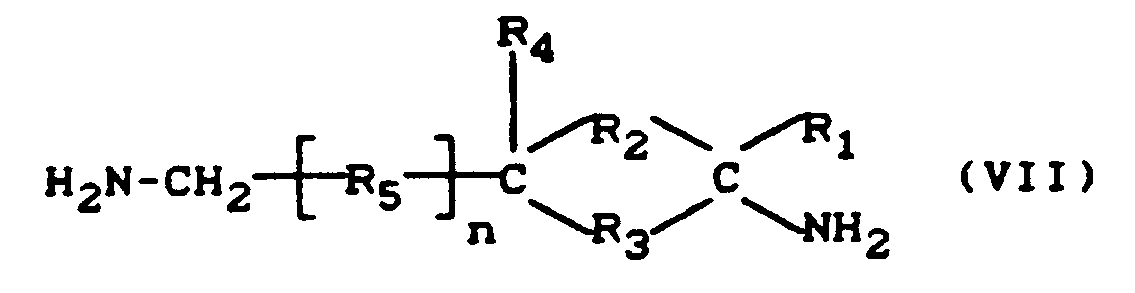 R₁, R₂, R₃, R₄, R₅ und n die in Anspruch 2 genannte Bedeutung haben.
 - Verfahren gemäß Anspruch 4 und 5, dadurch gekennzeichnet, daß man als Diamin 1-Amino-3-aminomethyl-3,5,5-trimethyl-cyclohexan oder das aus 1-Amino-1-methyl-4-aminomethylcyclohexan und 1-Amino-1-methyl-3-aminomethylcyclohexan bestehende Isomerengemisch verwendet.
- Verfahren gemäß Anspruch 4 - 6, dadurch gekennzeichnet, daß man als anhydridfunktionelles Monomer Maleinsäureanhydrid verwendet.
- Verwendung der Copolymerisate gemäß Anspruch 1 - 3 als Bindemittel oder Bindemittelkomponente für lösungsmittelhaltige Beschichtungsmittel, Dichtmassen, Klebstoffe oder Druckfarben.
Priority Applications (1)
| Application Number | Priority Date | Filing Date | Title |
|---|---|---|---|
| AT90115875T ATE104320T1 (de) | 1989-09-01 | 1990-08-18 | Aminogruppen aufweisende copolymerisate, ein verfahren zu ihrer herstellung und ihre verwendung als bindemittel oder bindemittelkomponente. |
Applications Claiming Priority (2)
| Application Number | Priority Date | Filing Date | Title |
|---|---|---|---|
| DE3928991 | 1989-09-01 | ||
| DE3928991A DE3928991A1 (de) | 1989-09-01 | 1989-09-01 | Aminogruppen aufweisende copolymerisate, ein verfahren zu ihrer herstellung und ihre verwendung als bindemittel oder bindemittelkomponente |
Publications (3)
| Publication Number | Publication Date |
|---|---|
| EP0415213A2 EP0415213A2 (de) | 1991-03-06 |
| EP0415213A3 EP0415213A3 (en) | 1992-02-05 |
| EP0415213B1 true EP0415213B1 (de) | 1994-04-13 |
Family
ID=6388377
Family Applications (1)
| Application Number | Title | Priority Date | Filing Date |
|---|---|---|---|
| EP90115875A Expired - Lifetime EP0415213B1 (de) | 1989-09-01 | 1990-08-18 | Aminogruppen aufweisende Copolymerisate, ein Verfahren zu ihrer Herstellung und ihre Verwendung als Bindemittel oder Bindemittelkomponente |
Country Status (10)
| Country | Link |
|---|---|
| US (1) | US5064922A (de) |
| EP (1) | EP0415213B1 (de) |
| JP (1) | JPH0393816A (de) |
| KR (1) | KR910006344A (de) |
| AT (1) | ATE104320T1 (de) |
| BR (1) | BR9004259A (de) |
| CA (1) | CA2023721C (de) |
| DD (1) | DD298113A5 (de) |
| DE (2) | DE3928991A1 (de) |
| ES (1) | ES2063215T3 (de) |
Families Citing this family (7)
| Publication number | Priority date | Publication date | Assignee | Title |
|---|---|---|---|---|
| US5462743A (en) * | 1992-10-30 | 1995-10-31 | Medipro Sciences Limited | Substance transfer system for topical application |
| US5548031A (en) * | 1993-11-19 | 1996-08-20 | Tosoh Corporation | Copolymer production process |
| DE19711548A1 (de) * | 1997-03-20 | 1998-09-24 | Bayer Ag | Verfahren zur Herstellung von 1-Amino-1-methyl-3(4)-aminomethylcyclohexan |
| DE19711549A1 (de) * | 1997-03-20 | 1998-09-24 | Bayer Ag | Verfahren zur Herstellung von 1-Amino-1-methyl-3(4)-aminomethylcyclohexan |
| NL1005928C2 (nl) * | 1997-04-29 | 1998-11-02 | Dsm Nv | Copolymeer dat in of aan de hoofdketen éen of meer amine-gesubstitueerde imidegroepen bevat en een werkwijze voor de bereiding hiervan. |
| KR101696290B1 (ko) * | 2009-02-25 | 2017-01-13 | 유니띠까 가부시키가이샤 | 폴리올레핀 공중합체, 그 폴리올레핀 공중합체를 사용한 수성 분산체와 그 제조 방법, 및 그 폴리올레핀 공중합체를 사용한 적층체 |
| FR3045362B1 (fr) * | 2015-12-22 | 2020-11-06 | Oreal | Procede de traitement cosmetique des matieres keratiniques avec un polymere ethylenique d'anhydride maleique |
Family Cites Families (7)
| Publication number | Priority date | Publication date | Assignee | Title |
|---|---|---|---|---|
| US3639357A (en) * | 1968-03-01 | 1972-02-01 | Eastman Kodak Co | Process for preparing substituted maleimide polymers |
| DE2534603C2 (de) * | 1975-08-02 | 1984-10-31 | Basf Ag, 6700 Ludwigshafen | Verfahren zur Herstellung von Copolymerisaten mit N-Dialkyl-N-amido-Gruppen |
| US4426491A (en) * | 1980-06-23 | 1984-01-17 | Union Carbide Corporation | Curable physical mixtures and composites therefrom |
| DE3229047A1 (de) * | 1982-08-04 | 1984-02-09 | Hoechst Ag, 6230 Frankfurt | Polymerisate mit primaeren aminogruppen, ihre herstellung und verwendung |
| US4525521A (en) * | 1983-10-14 | 1985-06-25 | E. I. Du Pont De Nemours And Company | Coating composition of an acrylic polymer having amino ester groups and a glycidyl acrylic polymer |
| US4659770A (en) * | 1986-02-03 | 1987-04-21 | E.I. Du Pont De Nemours And Company | Coating composition of an amine polymer and a blocked polyisocyanate |
| US4699936A (en) * | 1986-02-27 | 1987-10-13 | E. I. Du Pont De Nemours And Company | Coating composition of an amine polymer and an epoxy resin |
-
1989
- 1989-09-01 DE DE3928991A patent/DE3928991A1/de not_active Withdrawn
-
1990
- 1990-08-18 DE DE59005335T patent/DE59005335D1/de not_active Expired - Fee Related
- 1990-08-18 EP EP90115875A patent/EP0415213B1/de not_active Expired - Lifetime
- 1990-08-18 AT AT90115875T patent/ATE104320T1/de not_active IP Right Cessation
- 1990-08-18 ES ES90115875T patent/ES2063215T3/es not_active Expired - Lifetime
- 1990-08-21 CA CA002023721A patent/CA2023721C/en not_active Expired - Fee Related
- 1990-08-27 US US07/573,611 patent/US5064922A/en not_active Expired - Fee Related
- 1990-08-29 BR BR909004259A patent/BR9004259A/pt not_active Application Discontinuation
- 1990-08-30 JP JP2226821A patent/JPH0393816A/ja active Pending
- 1990-08-30 KR KR1019900013471A patent/KR910006344A/ko not_active Withdrawn
- 1990-09-03 DD DD90343792A patent/DD298113A5/de not_active IP Right Cessation
Also Published As
| Publication number | Publication date |
|---|---|
| CA2023721A1 (en) | 1991-03-02 |
| JPH0393816A (ja) | 1991-04-18 |
| DD298113A5 (de) | 1992-02-06 |
| ES2063215T3 (es) | 1995-01-01 |
| KR910006344A (ko) | 1991-04-29 |
| EP0415213A2 (de) | 1991-03-06 |
| DE3928991A1 (de) | 1991-03-07 |
| ATE104320T1 (de) | 1994-04-15 |
| DE59005335D1 (de) | 1994-05-19 |
| US5064922A (en) | 1991-11-12 |
| EP0415213A3 (en) | 1992-02-05 |
| BR9004259A (pt) | 1991-09-03 |
| CA2023721C (en) | 1999-07-27 |
Similar Documents
| Publication | Publication Date | Title |
|---|---|---|
| DE69508038T2 (de) | Hydroxyfunctionelle Acrylatharze, Verfahren zu deren Herstellung und deren Reaktionsprodukte | |
| EP0506703B1 (de) | Lösliche vernetzbare copolymerisate auf der basis von vinylester-, vinylaromat- und acrylatmonomeren, verfahren zu ihrer herstellung sowie ihre verwendung in beschichtungsmitteln | |
| DE2513516B2 (de) | Waessrige ueberzugsmasse | |
| EP2291413B1 (de) | Verfahren zur herstellung einer wässrigen polymerisatdispersion | |
| DE3924618A1 (de) | Ueberzugsmittel auf der basis von carboxylgruppenhaltigen polymeren und epoxidgruppenhaltigen vernetzern, verfahren zur herstellung des ueberzugsmittels sowie seine verwendung | |
| EP0794970A1 (de) | Verfahren zur zweistufigen herstellung von wässrigen, selbstvernetzenden copolymerisatdispersionen und deren verwendung für lacke | |
| EP0496210A2 (de) | Verwendung von Zweikomponenten-Systemen zur Herstellung von Einbrennbeschichtungen | |
| EP1862485B1 (de) | Wässrige Kopolymerisatdispersionen mit verbesserter Blockfestigkeit | |
| DE3607250C2 (de) | ||
| WO2000037521A1 (de) | Wässrige 2k-pur-systeme mit erhöhter schlagzähigkeit, hohen beständigkeitseigenschaften und guten optischen eigenschaften, ein verfahren zu ihrer herstellung und ihre verwendung | |
| EP0416360B1 (de) | Sekundäre Aminogruppen aufweisende Copolymerisate, ein Verfahren zu ihrer Herstellung und ihre Verwendung als Bindemittel oder Bindemittelkomponente | |
| EP0279311B1 (de) | Die Verwendung von Bindemittelkombinationen in lösungsmittelhaltigen Beschichtungsmitteln für Kraftfahrzeugteile | |
| EP0415213A2 (de) | Aminogruppen aufweisende Copolymerisate, ein Verfahren zu ihrer Herstellung und ihre Verwendung als Bindemittel oder Bindemittelkomponente | |
| DE602004001354T2 (de) | Zweikomponenten-Beschichtungszusammensetzungen | |
| EP0328962B1 (de) | Isocyanat- und Säureanhydridgruppen enthaltende Copolymerisate, ein Verfahren zu ihrer Herstellung und ihre Verwendung als Bindemittelkomponente | |
| EP1270619A2 (de) | Wässrige Sekundärdispersionen | |
| EP0475981B1 (de) | Carboxylgruppen und ggf. tertiäre aminogruppen enthaltende copolymere, verfahren zu ihrer herstellung und ihre verwendung in beschichtungsmassen | |
| EP0302373B1 (de) | Verfahren zur Herstellung von feuchtigkeitshärtenden Bindemittelkompositionen und ihre Verwendung | |
| EP0841352B1 (de) | Verfahren zur Herstellung von Polyacrylatsekundär-dispersionen | |
| EP1711545B1 (de) | Lösemittelarme, oh-funktionelle dispersionen ii | |
| EP0452696A2 (de) | Wässrige Lösungen oder Dispersionen von hydroxyfunktionellen Copolymerisaten, ein Verfahren zu ihrer Herstellung und ihrer Verwendung | |
| EP0372295B1 (de) | Wässrige Lösungen oder Dispersionen von selbstvernetzenden Bindemitteln, ein Verfahren zu ihrer Herstellung und ihre Verwendung | |
| DE10361274A1 (de) | Lösemittelarme, OH-funktionelle Dispersionen | |
| DE19530522C1 (de) | Hydroxylgruppen enthaltende Copolymerisate auf Basis von (Meth)acrylaten, ihr Herstellungsverfahren und ihre Verwendung in festkörperreichen Beschichtungsmitteln | |
| DE4412655A1 (de) | Wasserverdünnbare Bindemittel, wäßrige Lacke, die diese Bindemittel enthalten, und Verfahren zur Grundierung oder einschichtigen Lackierung von Kunststoffen |
Legal Events
| Date | Code | Title | Description |
|---|---|---|---|
| PUAI | Public reference made under article 153(3) epc to a published international application that has entered the european phase |
Free format text: ORIGINAL CODE: 0009012 |
|
| 17P | Request for examination filed |
Effective date: 19900820 |
|
| AK | Designated contracting states |
Kind code of ref document: A2 Designated state(s): AT BE CH DE ES FR GB IT LI NL SE |
|
| PUAL | Search report despatched |
Free format text: ORIGINAL CODE: 0009013 |
|
| AK | Designated contracting states |
Kind code of ref document: A3 Designated state(s): AT BE CH DE ES FR GB IT LI NL SE |
|
| 17Q | First examination report despatched |
Effective date: 19930930 |
|
| GRAA | (expected) grant |
Free format text: ORIGINAL CODE: 0009210 |
|
| AK | Designated contracting states |
Kind code of ref document: B1 Designated state(s): AT BE CH DE ES FR GB IT LI NL SE |
|
| REF | Corresponds to: |
Ref document number: 104320 Country of ref document: AT Date of ref document: 19940415 Kind code of ref document: T |
|
| REF | Corresponds to: |
Ref document number: 59005335 Country of ref document: DE Date of ref document: 19940519 |
|
| GBT | Gb: translation of ep patent filed (gb section 77(6)(a)/1977) |
Effective date: 19940505 |
|
| ITF | It: translation for a ep patent filed | ||
| ET | Fr: translation filed | ||
| REG | Reference to a national code |
Ref country code: ES Ref legal event code: FG2A Ref document number: 2063215 Country of ref document: ES Kind code of ref document: T3 |
|
| EAL | Se: european patent in force in sweden |
Ref document number: 90115875.8 |
|
| PLBE | No opposition filed within time limit |
Free format text: ORIGINAL CODE: 0009261 |
|
| STAA | Information on the status of an ep patent application or granted ep patent |
Free format text: STATUS: NO OPPOSITION FILED WITHIN TIME LIMIT |
|
| 26N | No opposition filed | ||
| ITTA | It: last paid annual fee | ||
| PGFP | Annual fee paid to national office [announced via postgrant information from national office to epo] |
Ref country code: SE Payment date: 19960729 Year of fee payment: 7 |
|
| PG25 | Lapsed in a contracting state [announced via postgrant information from national office to epo] |
Ref country code: SE Free format text: LAPSE BECAUSE OF NON-PAYMENT OF DUE FEES Effective date: 19970819 |
|
| EUG | Se: european patent has lapsed |
Ref document number: 90115875.8 |
|
| REG | Reference to a national code |
Ref country code: GB Ref legal event code: IF02 |
|
| PGFP | Annual fee paid to national office [announced via postgrant information from national office to epo] |
Ref country code: AT Payment date: 20030826 Year of fee payment: 14 |
|
| PGFP | Annual fee paid to national office [announced via postgrant information from national office to epo] |
Ref country code: CH Payment date: 20030827 Year of fee payment: 14 |
|
| PG25 | Lapsed in a contracting state [announced via postgrant information from national office to epo] |
Ref country code: AT Free format text: LAPSE BECAUSE OF NON-PAYMENT OF DUE FEES Effective date: 20040818 |
|
| PG25 | Lapsed in a contracting state [announced via postgrant information from national office to epo] |
Ref country code: LI Free format text: LAPSE BECAUSE OF NON-PAYMENT OF DUE FEES Effective date: 20040831 Ref country code: CH Free format text: LAPSE BECAUSE OF NON-PAYMENT OF DUE FEES Effective date: 20040831 |
|
| REG | Reference to a national code |
Ref country code: CH Ref legal event code: PL |
|
| PGFP | Annual fee paid to national office [announced via postgrant information from national office to epo] |
Ref country code: DE Payment date: 20050716 Year of fee payment: 16 |
|
| PGFP | Annual fee paid to national office [announced via postgrant information from national office to epo] |
Ref country code: ES Payment date: 20050803 Year of fee payment: 16 |
|
| PGFP | Annual fee paid to national office [announced via postgrant information from national office to epo] |
Ref country code: GB Payment date: 20050817 Year of fee payment: 16 |
|
| PGFP | Annual fee paid to national office [announced via postgrant information from national office to epo] |
Ref country code: NL Payment date: 20050831 Year of fee payment: 16 Ref country code: BE Payment date: 20050831 Year of fee payment: 16 |
|
| PGFP | Annual fee paid to national office [announced via postgrant information from national office to epo] |
Ref country code: FR Payment date: 20060728 Year of fee payment: 17 |
|
| PG25 | Lapsed in a contracting state [announced via postgrant information from national office to epo] |
Ref country code: BE Free format text: LAPSE BECAUSE OF NON-PAYMENT OF DUE FEES Effective date: 20060831 |
|
| PGFP | Annual fee paid to national office [announced via postgrant information from national office to epo] |
Ref country code: IT Payment date: 20060831 Year of fee payment: 17 |
|
| PG25 | Lapsed in a contracting state [announced via postgrant information from national office to epo] |
Ref country code: DE Free format text: LAPSE BECAUSE OF NON-PAYMENT OF DUE FEES Effective date: 20070301 Ref country code: NL Free format text: LAPSE BECAUSE OF NON-PAYMENT OF DUE FEES Effective date: 20070301 |
|
| GBPC | Gb: european patent ceased through non-payment of renewal fee |
Effective date: 20060818 |
|
| NLV4 | Nl: lapsed or anulled due to non-payment of the annual fee |
Effective date: 20070301 |
|
| REG | Reference to a national code |
Ref country code: FR Ref legal event code: ST Effective date: 20070430 |
|
| REG | Reference to a national code |
Ref country code: ES Ref legal event code: FD2A Effective date: 20060819 |
|
| PG25 | Lapsed in a contracting state [announced via postgrant information from national office to epo] |
Ref country code: GB Free format text: LAPSE BECAUSE OF NON-PAYMENT OF DUE FEES Effective date: 20060818 |
|
| BERE | Be: lapsed |
Owner name: *BAYER A.G. Effective date: 20060831 |
|
| PG25 | Lapsed in a contracting state [announced via postgrant information from national office to epo] |
Ref country code: ES Free format text: LAPSE BECAUSE OF NON-PAYMENT OF DUE FEES Effective date: 20060819 |
|
| PG25 | Lapsed in a contracting state [announced via postgrant information from national office to epo] |
Ref country code: FR Free format text: LAPSE BECAUSE OF NON-PAYMENT OF DUE FEES Effective date: 20060831 |
|
| PG25 | Lapsed in a contracting state [announced via postgrant information from national office to epo] |
Ref country code: IT Free format text: LAPSE BECAUSE OF NON-PAYMENT OF DUE FEES Effective date: 20070818 |