EP0415497A2 - Méthode de synchronisation de processeurs parralléles utilisant des canaux et méthode de compilation minimisant les dépendances de données interprocesseur - Google Patents
Méthode de synchronisation de processeurs parralléles utilisant des canaux et méthode de compilation minimisant les dépendances de données interprocesseur Download PDFInfo
- Publication number
- EP0415497A2 EP0415497A2 EP90202285A EP90202285A EP0415497A2 EP 0415497 A2 EP0415497 A2 EP 0415497A2 EP 90202285 A EP90202285 A EP 90202285A EP 90202285 A EP90202285 A EP 90202285A EP 0415497 A2 EP0415497 A2 EP 0415497A2
- Authority
- EP
- European Patent Office
- Prior art keywords
- stream
- nodes
- processor
- scheduling
- processors
- Prior art date
- Legal status (The legal status is an assumption and is not a legal conclusion. Google has not performed a legal analysis and makes no representation as to the accuracy of the status listed.)
- Granted
Links
Images



Classifications
-
- G—PHYSICS
- G06—COMPUTING OR CALCULATING; COUNTING
- G06F—ELECTRIC DIGITAL DATA PROCESSING
- G06F8/00—Arrangements for software engineering
- G06F8/40—Transformation of program code
- G06F8/41—Compilation
- G06F8/45—Exploiting coarse grain parallelism in compilation, i.e. parallelism between groups of instructions
-
- G—PHYSICS
- G06—COMPUTING OR CALCULATING; COUNTING
- G06F—ELECTRIC DIGITAL DATA PROCESSING
- G06F8/00—Arrangements for software engineering
- G06F8/40—Transformation of program code
- G06F8/41—Compilation
- G06F8/45—Exploiting coarse grain parallelism in compilation, i.e. parallelism between groups of instructions
- G06F8/458—Synchronisation, e.g. post-wait, barriers, locks
Definitions
- the present invention relates generally to methods of synchronizing multiprocessors having parallel processors for execution of parallel related instruction streams and also to compiling methods for generating the streams.
- the invention relates to techniques for substantially minimizing cross-stream event or data dependencies and to the enforcement of event or data dependencies between processors utilizing channels for communicating between the processors in a synchronizing fashion.
- VLIW Very Long Instruction Word
- Known machines of this type utilize a compiler based upon trace scheduling (see, for example, J.A. Fisher, "TRACE SCHEDULING: A TECHNIQUE FOR GLOBAL MICROCODE COMPACTION", IEEE Trans. on Computers, Vol. 7, No. C-30, pp. 478-490, July 1981) to detect and schedule extra-loop parallelism in sequential parts of the program and also exploit loop-level parallelism by unrolling the loops and converting loop-level parallelism into extra-loop parallelism.
- the VLIW machine consists of multiple processors that operate in lockstep executing instructions fetched from a single instruction stream.
- the long instruction word allows initiation of several fine-grained operations in each instruction, allowing operations to be scheduled for parallel execution by different processors.
- the lockstep operation of the processors implicitly guarantees that the processors are synchronized, the speed of a VLIW machine is severely compromised by events occurring during run-time which are unpredictable at compile-time. For example, memory bank access conflicts cannot always be avoided as the operands required for an operation may not be known at compile-time. Such run-time events can cause delay in completion of one of the operations in a long instruction which will delay completion of the entire instruction.
- VLIW architecture to multiple instruction stream architecture requires means to synchronize the parallel processors to assure that data developed by one processor and needed by another has been already written by the one processor to shared storage means when the other processor attempts to read the storage means.
- shared storage means for enabling data to be passed between processors also requires additional synchronization to assure that the data in a memory location has been read by all processors needing it before other data is written thereto.
- One method of synchronizing processors is by the provision of barriers in the instruction streams, as explained in my co-pending application Serial No. 227,276, PHA 21.452, filed August 2, 1988, to assure the temporal order of cross-processor events such as the writing to and reading from shared memory.
- parallel processors are synchronized in a different way; namely by using cross-stream communication of dependent data between processors for synchronizing these processors.
- the HEP multiprocessor (see B.J. Smith, "ARCHITECTURE AND APPLICATIONS OF THE HEP MULTIPROCESSOR COMPUTER SYSTEM", REAL-TIME SIGNAL PROCESSING, Vol. 298, pp. 241-248, August, 1981 and J.S. Kowalik, Editor, "PARALLEL MIMD COMPUTATION: HEP SUPERCOMPUTER AND ITS APPLICATIONS", MIT Press, 1985) implements a large number of channels capable of synchronizing communication of data between processors by adding a synchronization bit to every location in shared memory and in the register set. Control bits in each instruction indicate whether a read operation is unconditional or must wait until the location is "full".
- the synchronization bit does not generally cause a processor to stall if the bit is not in the proper state. Rather, a process stalls leaving the program counter and the instruction unchanged in the process. Execution shifts to another process and the unexecuted instruction is reattempted only when its process makes the next trip through the pipeline. Meanwhile, instructions from other streams are issued to keep the pipeline full. Consequently, the HEP approach is not particularly useful unless the number of streams exceed the number of processors in the system. Also, the potentially infinite number of channels implemented in shared memory are not useful for communicating processor synchronizing events or data because of their relative slowness compared to channels implemented in registers.
- channels implemented in registers though useful for communicating synchronizing events, are inherently limited in number in order to be able to be addressed in typical instructions referring to one or more registers or functions. Consequently, the number of cross-processor dependent events or data requiring synchronizing as a result of the application of known compilation techniques for VLIW architecture for typical sequential programs may exceed the number of useful channels available to enforce such dependencies.
- the synchronization of these synchronization redundant data dependencies is guaranteed by the enforcement through one or more register channels each associated to a particular cross-processor data dependency characterized by a temporal sequence of one or more write-read pairs beginning with a second write by the other processor, not earlier than the first write, and a next to last read by said other processor not later than said last read.
- the temporal order of the various write or read events is determined by the register channels and the relative locations of the writes or reads in the instruction streams for the various processors.
- the sequential program is first described as a directed acyclic graph of nodes, representing operations, and directed edges representing data dependencies, and the nodes are scheduled into the plurality of instruction streams.
- the edges between nodes then are either intra-stream or inter-stream edges.
- the scheduling is such that the nodes are ordered in the streams in a manner that the intra-stream edges are directed downstream implicitly enforcing the data dependencies represented by the intra-stream edges.
- the inter-stream edges represent cross-stream (or cross-processor) data dependencies requiring transfer of data between processors.
- synchronization redundant cross-stream edges are identified allowing the non-synchronization redundant cross-stream edges to be scheduled as write-read pairs on a limited number of synchronizing data transfer means implemented as channel registers.
- the method of scheduling the nodes into streams is chosen to substantially minimize the number of resulting inter-stream edges. This is accomplished by determining the scheduling in inverse order with respect to the processing and, by particular, by first identifying unscheduled nodes having the greatest height in the graph which nodes are then scheduled into different streams in a manner minimizing the production of inter-stream edges. Still another feature of this method is that after the nodes having the greatest height are scheduled, sub-graphs rooted from said nodes are identified and an equal number of nodes from each sub-graph in order of descending node height are scheduled into the same respective streams as the rooting nodes.
- An additional feature of the compiling method is the identification among inter-stream edges of candidates for re-use of the same synchronizing data transfer means.
- the invention is further characterized by the identification of implicit synchronizations caused by the possibility of blocking to writing on re-used inter-processor data transfer means and the further identification among inter-stream edges of those edges rendered synchronized-redundant thereby.
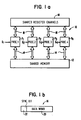
- a multiprocessor 10, organized in Multiple Instruction stream Multiple Data stream (MIMD) form comprising a plurality of processors P1-P4 (four in number being illustrative) for respectively performing sequential instructions in an equal number of instruction streams S1-S4.
- Streams S1-S4 are respectively input to the processors P1-P4 from a suitable instruction memory means (not shown).
- each processor includes its own internal registers and possibly its own memory which provide means for data developed by a processor to be stored for later use by that processor in conjunction with downstream operations in the instruction stream for the same processor.
- the multiprocessor 10 also includes a conventional shared random access memory 12 comprising a relatively large number of memory locations which can be selectively read or written by any of the processors P1-P4 via address and data lines 14 directed between each processor and shared memory 12.
- the shared memory 12 cannot be used for passing cross-processor or cross-stream dependent data between processors without other means for synchronization being applied. This is because the shared memory 12 has no implicit means for assuring that a value is not read before it is written (i.e. the memory location has been first filled) and a new value is not written to a memory location until after an existing value in the memory location has been read (i.e. the memory location has been first emptied).
- a limited number of shared register channels 16 are provided to be accessed by any of the processors P1-P4 at substantially the same relatively rapid rate that each processor would access one of its internal registers, via data, address and control lines 18 from the respective processors.
- said register channels 16 also have the communication attributes or semantics of channels, allowing the blocking to reading or to writing for synchronizing purposes.
- Each of the shared register channels 16 includes an area 20 for storage of a data word, of the same form or number of bits as could be stored in a shared memory location, plus an additional area 22 for a synchronization bit indicating whether the register channel is full or empty.
- the instruction sets of the processors include conventional write and read instructions directed to shared memory 12 and preferably the following instructions for the shared register channels 16:
- a read can taken place when the synchronization bit is "one" indicating the channel is full.
- the synchronization bit is left unchanged by the non-destructive read enabling a subsequent read. As long as the synchronization bit is "zero" the register channel is blocked to reading.
- the synchronization bit is set to "zero".
- the synchronization bit is "zero"
- the value is written and the synchronization bit is set to "one" indicating the register channel is full; as long as the synchronization bit is "one", the register channel is blocked to writing.
- the instruction streams S1-S4 are generated by compiling a sequential program so as to take advantage of fine-grained parallelism in a program by identifying sequences of operations which can be performed in parallel on different processors. This requires analysis of data or event dependencies between operations in the sequential program.
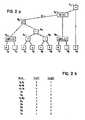
- nodes which are numbered N1 through N17 for purposes of reference, and directed lines between nodes representing data or event dependencies termed "edges".
- nodes N1 through N9 represent operations producing the various data for the illustrative program steps
- nodes N10 through N17 represent the performance of the sequential program steps upon said data.
- N15 receives a data value from N14 and receives data in the form of address value from N10.
- N15 assigns (writes) the value to the address, developing a[i].
- N16 receives an address from N13 and reads that address to evaluate a[j].
- Figure 2b sets forth the depths and heights of the various nodes in the graph of Figure 2a. If the graph is analogized to a family tree with each edge being directed from a child node to its immediate parent node, then for depth purposes, N17 has a depth equal to one and each other node has the depth of its immediate parent plus one. For height purposes, each of nodes N1 through N9 have a height equal to one and each other node has a height of one plus the height of its tallest child.
- the nodes should be selected for scheduling into plural instruction streams with the nodes of the greatest depth and/or the least height in the DAG generally to be performed first and the nodes of the least depth and/or the greatest height generally to be performed last.
- the following treatise is based only on the tree of Figure 2a, the invention is likewise applicable to generalize acyclic graphs in which a child can have more than one parent in that a particular data is used twice or more times.
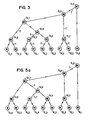
- Figure 3 shows a directed acyclic graph (DAG), similar to that of Figure 2a, with the nodes represented as circles which contain the designations N1-N14, the operations being deleted because only the form of the DAG is now important.
- Each node is also labelled with one of the designations S 1,1 -S 1,9 and S 2,2 -S 2,8 to indicate the scheduling by a naive method of assignment of the nodes respectively in first and second instruction streams for execution by respective first and second parallel processors.
- N3-N6 are respectively assigned in order as: the first instruction in the first stream S( 1,1 ); the first instruction in the second stream (S 2,1 ); the second instruction in the first stream (S 1,2 ); and the second instruction in the second stream (S 2,2 ).
- the next level of node depth ready to be scheduled is next identified as nodes N1, N2, N11 and N12, and the alternative assignment among the instruction streams of the identified nodes is continued. Thereafter, further levels of node depth are identified and scheduled until all nodes are scheduled.
- eight edges, labelled "E" are inter-stream or cross-stream representing data dependencies required to be enforced between processors.
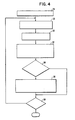
- Figure 4 is a flow chart of the compiling method for scheduling the nodes into multiple instruction streams in accordance with the principles of the invention which will minimize the number of inter-stream edges produced.
- the scheduling of the nodes is determined in inverse order as starting from the top and based, among other things, on node height rather than depth.
- the height of each node is determined in the DAG.
- step 28 a list is generated in order of height of the nodes ready to be scheduled.
- step 30 it is determined whether the nodes ready to be scheduled are less than the number of processors (or streams).
- step 32 the number of nodes ready to be scheduled, up to the number of processors, are scheduled on different processors such that, where possible, the node is scheduled on the same processor as its immediate parent (or parents).
- Step 34 determines whether a node was scheduled on each processor in the preceding step and whether each such node is the root (parent) of a sub-graph. If so, step 36 is performed in which an equal number of the highest nodes from the smallest sub-graphs rooted at these nodes are scheduled on the same processors as the rooting node. If step 34 was false there is a branch to step 38 which ordinarily follows step 36. In step 38 it is determined if nodes remain to be scheduled. If so, there is a branch back to step 28; if not the scheduling process stops.
- N16 roots two sub-graphs rather than a single sub-graph causing step 34 to be false, step 38 to be true resulting in return to step 28.
- nodes N15 and N14 are identified as ready to be scheduled and they are scheduled in step 32 as S 2,7 and S 1,8 respectively.
- step 34 is again false ultimately causing return to step 28 and the identification therein of nodes of N10 through N13 as ready to be scheduled.
- nodes N10 and N11 are respectively scheduled as S 2,6 and S 1,7 .
- S 1,8 roots two sub-graphs step 28 is returned to with the identification of nodes N12 and N13 as ready to be scheduled.
- Nodes N12 and N13 are respectively scheduled as S 1,6 and S 2,5 . Thereafter, nodes N1 through N9 are identified as ready for scheduling and in similar sequential steps N1 through N9 are assigned in pairs as follows: N1; N3 as S 2,4 ; S 1,5 N2; N4 as S 2,3 ; S 1,4 N5; N4 as S 1,3 ; S 2,2 N6; N8 as S 1,2 ; S 1,1
- step 36 which schedules an equal number of highest nodes from the sub-graphs on the same processor as the rooting node is scheduled.
- Figure 5b illustrates the rearrangement of the nodes of Figure 5a in the order of the scheduling, into two columns representing the first and second instruction streams S1 and S2 respectively.
- the operations in streams S1 and S2 are preformed respectively by processors P1 and P2 in downstream order.
- Various edges directed between nodes in the same column are referred to as inter-stream edges and are all directed downstream.
- the two edges E produced directed between columns are termed "cross-stream", “cross-processor” or "inter-stream” edges.
- synchronization of the edges E are provided by a limited number of register channels whichs, by blocking to reading unless they have been written, assure that the execution of stream S2 will stall if necessary just prior to N15, waiting for the result of N14 in stream S1 to be determined. Similarly, execution of stream S1 may stall just prior to N17 waiting for the result of N16 to be determined in stream S2.
- the same register channel may be re-used to enforce both the inter-stream edges E because the order of traversal of these edges is guaranteed by N16 being downstream from N15.
- FIGS 6a and 6b depict the conditions for safe re-use.
- Each Figure illustrates three instruction streams S i , S j , S k with Write/Read pairs to a register channel enforcing or synchronizing inter-stream edges "E" each directed from a write operation "W” to a read operation "R". This enforcement is due to the semantics of the channel blocking to reading if it has not yet been written.
- a first inter-stream edge is directed from W1, scheduled in S i , to R1, scheduled in S j
- a second edge is directed from W2, scheduled in S j downstream from R1 to R2 scheduled in stream S k .
- each edge may be assigned to the same register channel C1, there being no possibility that W2 could occur in time before W1 or that R2 could occur in time before R1.
- Figure 6b three inter-stream edges are illustrated with a first edge directed from W1 to R1, assigned to C1, a second edge directed from W2 to R2, assigned to C2, (although it would have been assigned also to C1), and a third edge directed from W3 to R3 for which C1 is re-used. This re-use is permitted because W2 is downstream from R1 and W3 is downstream from R2 assuring the temporal order of enforcement of the inter-stream edges.
- Figure 7 illustrates another situation where channel register re-use is permitted but creates an additional synchronization termed an "implicit" synchronization.
- first and second edges are directed from S i to S j with W2 being downstream from W1 in S i and R2 being downstream from R1 and S j . If both edges are enforced by the same register channel C1, there arises the possibility of C1 blocking to W2 until R1 occurs. This is represented by an inter-stream implicit synchronization U directed from R1 to W2.
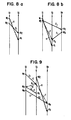
- FIG 8a shows the simple case of a first inter-stream edge V which is redundantly synchronized by a second inter-stream edge E.
- edges V and E are directed W1 and W2 in streams S i respectively to R1 and R2 in stream S j .
- W2 is downstream from W1 and R1 is downstream from R2, enforcing E will assure that V is enforced.
- W2 must be after W1 and R1 must be after R2, forcing R2 to be after W2 assures that R1 is after W1. Consequently, the data dependency represented by V need not be enforced by a register channel and W1 and R1 can instead be directed to shared memory 12.
- Figure 8b shows an implied sychronization T created by second and third edges E.
- an implied synchronization T is directed from the beginning to the end of a series of enforcements of synchronizations and downstreams movements.
- the implied synchronization T then makes edge V directed from W1 to R1 synchronization redundant according to the rule of Figure 8a.
- the synchronization redundancy of V can be directly established by a rule requiring a series of downstream movements and enforcements of synchronizations directly from W1 to R1.
- Figure 9 illustrates the interaction of the aforementioned types of synchronizations.
- implicit synchronization U directed from R1 to W3 due to the re-use of C1 as in Figure 7, together with the edge from W1 to R1, the downstream movement from W3 to W4 and the edge from W4 to R4, create the implied synchronization T from R1 to R4 which then renders edge V synchronization redundant.
- Figure 10 is a flow chart of the further compiling method according to the invention for register channel assignment, the input to which is the directed acyclic graph (DAG) which in step 40 is scheduled into plural instruction streams, as in Figure 4, and the resultant inter-stream edges E are identified.
- DAG directed acyclic graph
- step 42 implied synchronizations, as in figure 8b are added by identifying sequences of edges among three or more streams as in Figure 8b.
- step 44 synchronization redundancies are identified according to the principles of Figures 8a, 8b or 9 and, as a result, the inter-stream edges are divided into two classes, synchronization redundant and non-synchronization redundant.
- the synchronization redundant edges are scheduled in step 46, by a write to and a read from shared memory 12, while the non-synchronization redundant edges are further analyzed for register channel assignment.
- step 48 a branch is developed which in the initial reiteration, or first pass, goes to step 50 in which candidates among the non-synchronization redundant edges for re-use of channels, not producing implicit synchronizations, as in Figures 6a and 6b are identified and scheduled by re-suse of the channels.
- the branch in step 48 causes step 50 to be bypassed because such candidates for channel re-use have already been assigned.
- step 52 it is determined whether the remaining number of non-synchronization redundant edges exceed the number of remaining channels available for assignment. If not, the remaining edges are scheduled in step 54. If however, more edges remain than available channels, then step 56 is reached wherein another candidate for channel re-use is identified.
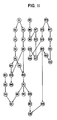
- Figure 11 is a directed acyclic graph (DAG) of a typical program. It is of the inner loop of the program "ENTCAF and ENTRE: Evaluation of Normalized Taylor Coefficients of an Analytic Function” CACM 14 (10), October 1971, pp. 669-675, which DAG is from Thomas L. Rodeheffer, "COMPILING ORDINARY PROGRAMS FOR EXECUTION ON AN ASYNCHRONOUS MULTIPROCESSOR", Ph. D. Dissertation, Carnegie-Mellon University, 1985.
- DAG directed acyclic graph
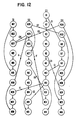
- Figure 12 shows the rearrangement of the DAG of Figure 11 into four streams S1-S4 with the nodes ordered in the streams in accordance with the principles of the present invention. It should now be noted that only 11 inter-stream edges are produced, two of which are synchronization redundant. The nine non-synchronization redundant inter-stream edges are enforced by only 6 register channels C1-C6 in view of two re-uses of C1 and 1 re-use of C2.
- N c N b (p-1)/2
- N b is the number of nodes in the program basic block.
- each node need not be assigned an incremental height of one but instead might have and incremental height proportional to the expected length of time its operation would take. Thus, each node would have a height equal to its incremental height plus the height of its tallest child.
Landscapes
- Engineering & Computer Science (AREA)
- General Engineering & Computer Science (AREA)
- Theoretical Computer Science (AREA)
- Software Systems (AREA)
- Physics & Mathematics (AREA)
- General Physics & Mathematics (AREA)
- Devices For Executing Special Programs (AREA)
- Multi Processors (AREA)
Applications Claiming Priority (2)
| Application Number | Priority Date | Filing Date | Title |
|---|---|---|---|
| US400178 | 1989-08-29 | ||
| US07/400,178 US5317734A (en) | 1989-08-29 | 1989-08-29 | Method of synchronizing parallel processors employing channels and compiling method minimizing cross-processor data dependencies |
Publications (3)
| Publication Number | Publication Date |
|---|---|
| EP0415497A2 true EP0415497A2 (fr) | 1991-03-06 |
| EP0415497A3 EP0415497A3 (en) | 1993-03-10 |
| EP0415497B1 EP0415497B1 (fr) | 1997-07-23 |
Family
ID=23582531
Family Applications (1)
| Application Number | Title | Priority Date | Filing Date |
|---|---|---|---|
| EP90202285A Expired - Lifetime EP0415497B1 (fr) | 1989-08-29 | 1990-08-27 | Méthode de compilation minimisant les dépendances de données interprocesseur |
Country Status (4)
| Country | Link |
|---|---|
| US (1) | US5317734A (fr) |
| EP (1) | EP0415497B1 (fr) |
| JP (1) | JP2980178B2 (fr) |
| DE (1) | DE69031100T2 (fr) |
Cited By (8)
| Publication number | Priority date | Publication date | Assignee | Title |
|---|---|---|---|---|
| US6782521B2 (en) * | 1992-03-31 | 2004-08-24 | Seiko Epson Corporation | Integrated structure layout and layout of interconnections for an instruction execution unit of an integrated circuit chip |
| US8117606B2 (en) | 2007-06-04 | 2012-02-14 | Infosys Technologies Ltd. | System and method for application migration in a grid computing environment |
| EP2447895A3 (fr) * | 2010-10-29 | 2012-11-28 | Fujitsu Limited | Schéma de synchronisation pour l'indexation parallèle distribuée d'applications interactives client-serveur |
| US8832065B2 (en) | 2010-10-29 | 2014-09-09 | Fujitsu Limited | Technique for coordinating the distributed, parallel crawling of interactive client-server applications |
| US9032067B2 (en) | 2010-03-12 | 2015-05-12 | Fujitsu Limited | Determining differences in an event-driven application accessed in different client-tier environments |
| US9208054B2 (en) | 2011-02-14 | 2015-12-08 | Fujitsu Limited | Web service for automated cross-browser compatibility checking of web applications |
| US9400962B2 (en) | 2010-10-29 | 2016-07-26 | Fujitsu Limited | Architecture for distributed, parallel crawling of interactive client-server applications |
| CN112148455A (zh) * | 2020-09-29 | 2020-12-29 | 星环信息科技(上海)有限公司 | 一种任务处理方法、设备及介质 |
Families Citing this family (75)
| Publication number | Priority date | Publication date | Assignee | Title |
|---|---|---|---|---|
| DE68927946T2 (de) * | 1988-08-02 | 1997-10-16 | Philips Electronics Nv | Verfahren und Vorrichtung für die Synchronisierung von parallelen Prozessoren unter Verwendung einer unscharf definierten Sperre |
| US5418915A (en) * | 1990-08-08 | 1995-05-23 | Sumitomo Metal Industries, Ltd. | Arithmetic unit for SIMD type parallel computer |
| US5539911A (en) * | 1991-07-08 | 1996-07-23 | Seiko Epson Corporation | High-performance, superscalar-based computer system with out-of-order instruction execution |
| JP2772304B2 (ja) * | 1992-04-10 | 1998-07-02 | 富士通株式会社 | 並列処理の負荷均一化方法 |
| US5819088A (en) * | 1993-03-25 | 1998-10-06 | Intel Corporation | Method and apparatus for scheduling instructions for execution on a multi-issue architecture computer |
| US5642501A (en) * | 1994-07-26 | 1997-06-24 | Novell, Inc. | Computer method and apparatus for asynchronous ordered operations |
| US5614914A (en) * | 1994-09-06 | 1997-03-25 | Interdigital Technology Corporation | Wireless telephone distribution system with time and space diversity transmission for determining receiver location |
| JP2908739B2 (ja) * | 1994-12-16 | 1999-06-21 | インターナショナル・ビジネス・マシーンズ・コーポレイション | 多重プロセッサ・システムにおけるcpuのモニタリング・システム及び方法 |
| US5669001A (en) * | 1995-03-23 | 1997-09-16 | International Business Machines Corporation | Object code compatible representation of very long instruction word programs |
| US5742821A (en) * | 1995-11-08 | 1998-04-21 | Lucent Technologies Inc. | Multiprocessor scheduling and execution |
| US5887174A (en) * | 1996-06-18 | 1999-03-23 | International Business Machines Corporation | System, method, and program product for instruction scheduling in the presence of hardware lookahead accomplished by the rescheduling of idle slots |
| US5924128A (en) * | 1996-06-20 | 1999-07-13 | International Business Machines Corporation | Pseudo zero cycle address generator and fast memory access |
| US6215821B1 (en) * | 1996-08-07 | 2001-04-10 | Lucent Technologies, Inc. | Communication system using an intersource coding technique |
| CA2263679C (fr) * | 1996-09-20 | 2003-07-08 | Comsat Corporation | Demodulation de donnees echantillonnees de maniere asynchrone au moyen de l'estimation des echantillons par detection-transition dans un environnement a plusieurs porteuses partagees |
| US6278754B1 (en) * | 1996-09-20 | 2001-08-21 | Comsat Corporation | Demodulation of asynchronously sampled data by means of detection-transition sample estimation in a shared multi-carrier environment |
| US5872990A (en) * | 1997-01-07 | 1999-02-16 | International Business Machines Corporation | Reordering of memory reference operations and conflict resolution via rollback in a multiprocessing environment |
| US6317774B1 (en) * | 1997-01-09 | 2001-11-13 | Microsoft Corporation | Providing predictable scheduling of programs using a repeating precomputed schedule |
| JP3730740B2 (ja) * | 1997-02-24 | 2006-01-05 | 株式会社日立製作所 | 並列ジョブ多重スケジューリング方法 |
| US6044222A (en) * | 1997-06-23 | 2000-03-28 | International Business Machines Corporation | System, method, and program product for loop instruction scheduling hardware lookahead |
| JPH11134197A (ja) * | 1997-10-29 | 1999-05-21 | Fujitsu Ltd | Vliw方式計算機用のコンパイル装置及び方法並びにコンパイル実行プログラムを格納した記録媒体 |
| US6075935A (en) * | 1997-12-01 | 2000-06-13 | Improv Systems, Inc. | Method of generating application specific integrated circuits using a programmable hardware architecture |
| US6044456A (en) * | 1998-01-05 | 2000-03-28 | Intel Corporation | Electronic system and method for maintaining synchronization of multiple front-end pipelines |
| US6314493B1 (en) | 1998-02-03 | 2001-11-06 | International Business Machines Corporation | Branch history cache |
| US6718541B2 (en) * | 1999-02-17 | 2004-04-06 | Elbrus International Limited | Register economy heuristic for a cycle driven multiple issue instruction scheduler |
| US6457173B1 (en) * | 1999-08-20 | 2002-09-24 | Hewlett-Packard Company | Automatic design of VLIW instruction formats |
| US7062767B1 (en) * | 2000-09-05 | 2006-06-13 | Raza Microelectronics, Inc. | Method for coordinating information flow between components |
| JP2002116915A (ja) * | 2000-10-10 | 2002-04-19 | Fujitsu Ltd | コンパイラ並列化スケジュール方法 |
| JP2002268895A (ja) * | 2001-03-09 | 2002-09-20 | Nec Corp | 命令スケジューリング装置及び命令スケジューリング方法 |
| US7415601B2 (en) * | 2002-06-28 | 2008-08-19 | Motorola, Inc. | Method and apparatus for elimination of prolog and epilog instructions in a vector processor using data validity tags and sink counters |
| US7159099B2 (en) * | 2002-06-28 | 2007-01-02 | Motorola, Inc. | Streaming vector processor with reconfigurable interconnection switch |
| US7140019B2 (en) * | 2002-06-28 | 2006-11-21 | Motorola, Inc. | Scheduler of program instructions for streaming vector processor having interconnected functional units |
| US7581215B1 (en) * | 2003-06-30 | 2009-08-25 | Sun Microsystems, Inc. | Dependency analysis system and method |
| CA2439137A1 (fr) | 2003-08-08 | 2005-02-08 | Ibm Canada Limited - Ibm Canada Limitee | Technique d'ordonnancement amelioree pour traitement en pipeline |
| US7290122B2 (en) * | 2003-08-29 | 2007-10-30 | Motorola, Inc. | Dataflow graph compression for power reduction in a vector processor |
| US20050289530A1 (en) * | 2004-06-29 | 2005-12-29 | Robison Arch D | Scheduling of instructions in program compilation |
| US7392516B2 (en) * | 2004-08-05 | 2008-06-24 | International Business Machines Corporation | Method and system for configuring a dependency graph for dynamic by-pass instruction scheduling |
| US20060048123A1 (en) * | 2004-08-30 | 2006-03-02 | International Business Machines Corporation | Modification of swing modulo scheduling to reduce register usage |
| US7444628B2 (en) * | 2004-08-30 | 2008-10-28 | International Business Machines Corporation | Extension of swing modulo scheduling to evenly distribute uniform strongly connected components |
| US7624386B2 (en) | 2004-12-16 | 2009-11-24 | Intel Corporation | Fast tree-based generation of a dependence graph |
| EP1859346B1 (fr) * | 2005-03-04 | 2012-01-11 | Hewlett-Packard Development Company, L.P. | Procede et dispositif permettant de faciliter le debit de pipelines |
| EP1975791A3 (fr) * | 2007-03-26 | 2009-01-07 | Interuniversitair Microelektronica Centrum (IMEC) | Procédé pour conversion de code automatisée |
| US7860900B2 (en) * | 2008-02-25 | 2010-12-28 | Microsoft Corporation | Consistently signaling state changes |
| US7945768B2 (en) * | 2008-06-05 | 2011-05-17 | Motorola Mobility, Inc. | Method and apparatus for nested instruction looping using implicit predicates |
| US20090313616A1 (en) * | 2008-06-16 | 2009-12-17 | Cheng Wang | Code reuse and locality hinting |
| US7856544B2 (en) * | 2008-08-18 | 2010-12-21 | International Business Machines Corporation | Stream processing in super node clusters of processors assigned with stream computation graph kernels and coupled by stream traffic optical links |
| US9106233B1 (en) * | 2009-02-25 | 2015-08-11 | Marvell Israel (M.I.S.L) Ltd. | Method and apparatus for synchronization |
| US10698859B2 (en) | 2009-09-18 | 2020-06-30 | The Board Of Regents Of The University Of Texas System | Data multicasting with router replication and target instruction identification in a distributed multi-core processing architecture |
| US9021241B2 (en) | 2010-06-18 | 2015-04-28 | The Board Of Regents Of The University Of Texas System | Combined branch target and predicate prediction for instruction blocks |
| US8447849B2 (en) * | 2010-11-09 | 2013-05-21 | Cisco Technology, Inc. | Negotiated parent joining in directed acyclic graphs (DAGS) |
| US9367658B2 (en) * | 2011-06-22 | 2016-06-14 | Maxeler Technologies Ltd. | Method and apparatus for designing and generating a stream processor |
| US9513976B2 (en) * | 2011-12-30 | 2016-12-06 | Intel Corporation | Providing extended memory semantics with atomic memory operations |
| US8880951B2 (en) | 2012-04-06 | 2014-11-04 | Fujitsu Limited | Detection of dead widgets in software applications |
| FR3021433B1 (fr) * | 2014-05-21 | 2016-06-24 | Kalray | Systeme de synchronisation inter-processeurs |
| US10936316B2 (en) | 2015-09-19 | 2021-03-02 | Microsoft Technology Licensing, Llc | Dense read encoding for dataflow ISA |
| US10198263B2 (en) | 2015-09-19 | 2019-02-05 | Microsoft Technology Licensing, Llc | Write nullification |
| US10452399B2 (en) | 2015-09-19 | 2019-10-22 | Microsoft Technology Licensing, Llc | Broadcast channel architectures for block-based processors |
| US10871967B2 (en) | 2015-09-19 | 2020-12-22 | Microsoft Technology Licensing, Llc | Register read/write ordering |
| US11016770B2 (en) | 2015-09-19 | 2021-05-25 | Microsoft Technology Licensing, Llc | Distinct system registers for logical processors |
| US10768936B2 (en) | 2015-09-19 | 2020-09-08 | Microsoft Technology Licensing, Llc | Block-based processor including topology and control registers to indicate resource sharing and size of logical processor |
| US10180840B2 (en) | 2015-09-19 | 2019-01-15 | Microsoft Technology Licensing, Llc | Dynamic generation of null instructions |
| US10678544B2 (en) | 2015-09-19 | 2020-06-09 | Microsoft Technology Licensing, Llc | Initiating instruction block execution using a register access instruction |
| US10719321B2 (en) | 2015-09-19 | 2020-07-21 | Microsoft Technology Licensing, Llc | Prefetching instruction blocks |
| US10776115B2 (en) | 2015-09-19 | 2020-09-15 | Microsoft Technology Licensing, Llc | Debug support for block-based processor |
| US11977891B2 (en) | 2015-09-19 | 2024-05-07 | Microsoft Technology Licensing, Llc | Implicit program order |
| US11126433B2 (en) | 2015-09-19 | 2021-09-21 | Microsoft Technology Licensing, Llc | Block-based processor core composition register |
| JP6489985B2 (ja) * | 2015-09-24 | 2019-03-27 | ルネサスエレクトロニクス株式会社 | プログラム開発支援装置およびプログラム開発支援ソフトウェア |
| US11151446B2 (en) * | 2015-10-28 | 2021-10-19 | Google Llc | Stream-based accelerator processing of computational graphs |
| US10990326B2 (en) | 2017-05-31 | 2021-04-27 | Fmad Engineering Kabushiki Gaisha | High-speed replay of captured data packets |
| US11128740B2 (en) | 2017-05-31 | 2021-09-21 | Fmad Engineering Kabushiki Gaisha | High-speed data packet generator |
| US11392317B2 (en) * | 2017-05-31 | 2022-07-19 | Fmad Engineering Kabushiki Gaisha | High speed data packet flow processing |
| US12493432B2 (en) | 2017-05-31 | 2025-12-09 | Fmad Engineering (Sng) Pte Ltd. | High speed data packet flow processing with offload |
| US10423358B1 (en) | 2017-05-31 | 2019-09-24 | FMAD Engineering GK | High-speed data packet capture and storage with playback capabilities |
| US11036438B2 (en) | 2017-05-31 | 2021-06-15 | Fmad Engineering Kabushiki Gaisha | Efficient storage architecture for high speed packet capture |
| GB2580348A (en) | 2019-01-03 | 2020-07-22 | Graphcore Ltd | Compilation method |
| US12184520B2 (en) | 2022-02-21 | 2024-12-31 | FMAD Engineering (SNG) Pte. Ltd. | High-speed packet filtering |
Family Cites Families (7)
| Publication number | Priority date | Publication date | Assignee | Title |
|---|---|---|---|---|
| US4553203A (en) * | 1982-09-28 | 1985-11-12 | Trw Inc. | Easily schedulable horizontal computer |
| US4698752A (en) * | 1982-11-15 | 1987-10-06 | American Telephone And Telegraph Company At&T Bell Laboratories | Data base locking |
| US4837676A (en) * | 1984-11-05 | 1989-06-06 | Hughes Aircraft Company | MIMD instruction flow computer architecture |
| US4847755A (en) * | 1985-10-31 | 1989-07-11 | Mcc Development, Ltd. | Parallel processing method and apparatus for increasing processing throughout by parallel processing low level instructions having natural concurrencies |
| US4891787A (en) * | 1986-12-17 | 1990-01-02 | Massachusetts Institute Of Technology | Parallel processing system with processor array having SIMD/MIMD instruction processing |
| US4916652A (en) * | 1987-09-30 | 1990-04-10 | International Business Machines Corporation | Dynamic multiple instruction stream multiple data multiple pipeline apparatus for floating-point single instruction stream single data architectures |
| US4989131A (en) * | 1988-07-26 | 1991-01-29 | International Business Machines Corporation | Technique for parallel synchronization |
-
1989
- 1989-08-29 US US07/400,178 patent/US5317734A/en not_active Expired - Lifetime
-
1990
- 1990-08-27 EP EP90202285A patent/EP0415497B1/fr not_active Expired - Lifetime
- 1990-08-27 DE DE69031100T patent/DE69031100T2/de not_active Expired - Lifetime
- 1990-08-28 JP JP2224510A patent/JP2980178B2/ja not_active Expired - Lifetime
Non-Patent Citations (3)
| Title |
|---|
| ICS'87, 2ND INTERNATIONAL CONFERENCE ON SUPERCOMPUTING, vol. 3, 1987, pages 141-148; R. GUPTA et al.: "Region scheduling" * |
| ICS'88, 1988 INTERNATIONAL CONFERENCE ON SUPERCOMPUTING, St. Malo, 4th - 8th July 1988, pages 207-215; F. ALLEN et al.: "A framework for determining useful parallelism" * |
| PROCEEDINGS OF THE 21ST ANNUAL HAWAII INTERNATIONAL CONFERENCE ON SYSTEM SCIENCES, Kailua-Kona, HI, 5th - 8th January 1988, vol. 1, pages 148-156; R. GUPTA et al.: "A matching approach to utilizing fine-grained parallelism" * |
Cited By (10)
| Publication number | Priority date | Publication date | Assignee | Title |
|---|---|---|---|---|
| US6782521B2 (en) * | 1992-03-31 | 2004-08-24 | Seiko Epson Corporation | Integrated structure layout and layout of interconnections for an instruction execution unit of an integrated circuit chip |
| US7174525B2 (en) | 1992-03-31 | 2007-02-06 | Seiko Epson Corporation | Integrated structure layout and layout of interconnections for an instruction execution unit of an integrated circuit chip |
| US7555738B2 (en) | 1992-03-31 | 2009-06-30 | Seiko Epson Corporation | Integrated structure layout and layout of interconnections for an instruction execution unit of an integrated circuit chip |
| US8117606B2 (en) | 2007-06-04 | 2012-02-14 | Infosys Technologies Ltd. | System and method for application migration in a grid computing environment |
| US9032067B2 (en) | 2010-03-12 | 2015-05-12 | Fujitsu Limited | Determining differences in an event-driven application accessed in different client-tier environments |
| EP2447895A3 (fr) * | 2010-10-29 | 2012-11-28 | Fujitsu Limited | Schéma de synchronisation pour l'indexation parallèle distribuée d'applications interactives client-serveur |
| US8832065B2 (en) | 2010-10-29 | 2014-09-09 | Fujitsu Limited | Technique for coordinating the distributed, parallel crawling of interactive client-server applications |
| US9400962B2 (en) | 2010-10-29 | 2016-07-26 | Fujitsu Limited | Architecture for distributed, parallel crawling of interactive client-server applications |
| US9208054B2 (en) | 2011-02-14 | 2015-12-08 | Fujitsu Limited | Web service for automated cross-browser compatibility checking of web applications |
| CN112148455A (zh) * | 2020-09-29 | 2020-12-29 | 星环信息科技(上海)有限公司 | 一种任务处理方法、设备及介质 |
Also Published As
| Publication number | Publication date |
|---|---|
| US5317734A (en) | 1994-05-31 |
| JP2980178B2 (ja) | 1999-11-22 |
| EP0415497B1 (fr) | 1997-07-23 |
| JPH0397059A (ja) | 1991-04-23 |
| DE69031100D1 (de) | 1997-09-04 |
| DE69031100T2 (de) | 1998-02-12 |
| EP0415497A3 (en) | 1993-03-10 |
Similar Documents
| Publication | Publication Date | Title |
|---|---|---|
| US5317734A (en) | Method of synchronizing parallel processors employing channels and compiling method minimizing cross-processor data dependencies | |
| US5802374A (en) | Synchronizing parallel processors using barriers extending over specific multiple-instruction regions in each instruction stream | |
| Fisher | Microcode compaction | |
| Midkiff et al. | Compiler algorithms for synchronization | |
| US6044222A (en) | System, method, and program product for loop instruction scheduling hardware lookahead | |
| US5832272A (en) | Apparatus and method for parallel computation | |
| JP2738692B2 (ja) | 並列化コンパイル方法 | |
| Ebcioğlu | A compilation technique for software pipelining of loops with conditional jumps | |
| US4251861A (en) | Cellular network of processors | |
| US5127092A (en) | Apparatus and method for collective branching in a multiple instruction stream multiprocessor where any of the parallel processors is scheduled to evaluate the branching condition | |
| US5386562A (en) | Circular scheduling method and apparatus for executing computer programs by moving independent instructions out of a loop | |
| Ly et al. | Scheduling using behavioral templates | |
| US20140007061A1 (en) | Staged loop instructions | |
| US5367684A (en) | Register allocation using an improved register candidate usage matrix | |
| Chan et al. | Run-time support for the automatic parallelization of Java programs | |
| US20040088529A1 (en) | Method and system for the design of pipelines of processors | |
| EP0442623A2 (fr) | Réduction du délai de pipeline par levage de code dans des compilateurs | |
| Puschner | Transforming execution-time boundable code into temporally predictable code | |
| Tokoro et al. | An approach to microprogram optimization considering resource occupancy and instruction formats | |
| Mateti et al. | Parallel algorithms for the single source shortest path problem | |
| Park | Synthesis of High-Speed Digital Systems. | |
| Midkiff | Automatic generation of synchronization instructions for parallel processors | |
| Gupta | Employing register channels for the exploitation of instruction level parallelism | |
| Bratvold | Determining useful parallelism in higher order functions | |
| de Groot et al. | Rate-optimal scheduling of recursive DSP algorithms based on the scheduling-range chart |
Legal Events
| Date | Code | Title | Description |
|---|---|---|---|
| PUAI | Public reference made under article 153(3) epc to a published international application that has entered the european phase |
Free format text: ORIGINAL CODE: 0009012 |
|
| AK | Designated contracting states |
Kind code of ref document: A2 Designated state(s): DE FR GB NL |
|
| PUAL | Search report despatched |
Free format text: ORIGINAL CODE: 0009013 |
|
| AK | Designated contracting states |
Kind code of ref document: A3 Designated state(s): DE FR GB NL |
|
| 17P | Request for examination filed |
Effective date: 19930827 |
|
| 17Q | First examination report despatched |
Effective date: 19951221 |
|
| GRAG | Despatch of communication of intention to grant |
Free format text: ORIGINAL CODE: EPIDOS AGRA |
|
| GRAH | Despatch of communication of intention to grant a patent |
Free format text: ORIGINAL CODE: EPIDOS IGRA |
|
| GRAH | Despatch of communication of intention to grant a patent |
Free format text: ORIGINAL CODE: EPIDOS IGRA |
|
| GRAA | (expected) grant |
Free format text: ORIGINAL CODE: 0009210 |
|
| AK | Designated contracting states |
Kind code of ref document: B1 Designated state(s): DE FR GB NL |
|
| PG25 | Lapsed in a contracting state [announced via postgrant information from national office to epo] |
Ref country code: NL Free format text: LAPSE BECAUSE OF FAILURE TO SUBMIT A TRANSLATION OF THE DESCRIPTION OR TO PAY THE FEE WITHIN THE PRESCRIBED TIME-LIMIT Effective date: 19970723 |
|
| REF | Corresponds to: |
Ref document number: 69031100 Country of ref document: DE Date of ref document: 19970904 |
|
| ET | Fr: translation filed | ||
| NLV1 | Nl: lapsed or annulled due to failure to fulfill the requirements of art. 29p and 29m of the patents act | ||
| PLBE | No opposition filed within time limit |
Free format text: ORIGINAL CODE: 0009261 |
|
| STAA | Information on the status of an ep patent application or granted ep patent |
Free format text: STATUS: NO OPPOSITION FILED WITHIN TIME LIMIT |
|
| 26N | No opposition filed | ||
| REG | Reference to a national code |
Ref country code: FR Ref legal event code: CD |
|
| REG | Reference to a national code |
Ref country code: GB Ref legal event code: IF02 |
|
| PGFP | Annual fee paid to national office [announced via postgrant information from national office to epo] |
Ref country code: FR Payment date: 20050812 Year of fee payment: 16 |
|
| PGFP | Annual fee paid to national office [announced via postgrant information from national office to epo] |
Ref country code: GB Payment date: 20050830 Year of fee payment: 16 |
|
| GBPC | Gb: european patent ceased through non-payment of renewal fee |
Effective date: 20060827 |
|
| REG | Reference to a national code |
Ref country code: FR Ref legal event code: ST Effective date: 20070430 |
|
| PG25 | Lapsed in a contracting state [announced via postgrant information from national office to epo] |
Ref country code: GB Free format text: LAPSE BECAUSE OF NON-PAYMENT OF DUE FEES Effective date: 20060827 |
|
| PG25 | Lapsed in a contracting state [announced via postgrant information from national office to epo] |
Ref country code: FR Free format text: LAPSE BECAUSE OF NON-PAYMENT OF DUE FEES Effective date: 20060831 |
|
| PGFP | Annual fee paid to national office [announced via postgrant information from national office to epo] |
Ref country code: DE Payment date: 20090821 Year of fee payment: 20 |
|
| PG25 | Lapsed in a contracting state [announced via postgrant information from national office to epo] |
Ref country code: DE Free format text: LAPSE BECAUSE OF EXPIRATION OF PROTECTION Effective date: 20100827 |