EP0415856A2 - Wiederaufladbarer elektrochemischer Generator mit Festkörperpolymeren - Google Patents
Wiederaufladbarer elektrochemischer Generator mit Festkörperpolymeren Download PDFInfo
- Publication number
- EP0415856A2 EP0415856A2 EP90420361A EP90420361A EP0415856A2 EP 0415856 A2 EP0415856 A2 EP 0415856A2 EP 90420361 A EP90420361 A EP 90420361A EP 90420361 A EP90420361 A EP 90420361A EP 0415856 A2 EP0415856 A2 EP 0415856A2
- Authority
- EP
- European Patent Office
- Prior art keywords
- metal
- cathode
- anode
- generator
- electrolyte
- Prior art date
- Legal status (The legal status is an assumption and is not a legal conclusion. Google has not performed a legal analysis and makes no representation as to the accuracy of the status listed.)
- Granted
Links
- 229920000642 polymer Polymers 0.000 title claims abstract description 16
- 239000007787 solid Substances 0.000 title claims abstract description 12
- 239000003792 electrolyte Substances 0.000 claims abstract description 16
- 125000004433 nitrogen atom Chemical group N* 0.000 claims abstract description 12
- NINIDFKCEFEMDL-UHFFFAOYSA-N Sulfur Chemical group [S] NINIDFKCEFEMDL-UHFFFAOYSA-N 0.000 claims abstract description 11
- 230000021615 conjugation Effects 0.000 claims abstract description 9
- 150000003573 thiols Chemical class 0.000 claims abstract description 5
- 229910052751 metal Inorganic materials 0.000 claims description 35
- 239000002184 metal Substances 0.000 claims description 35
- 125000004434 sulfur atom Chemical group 0.000 claims description 15
- 229910052717 sulfur Inorganic materials 0.000 claims description 13
- WHXSMMKQMYFTQS-UHFFFAOYSA-N Lithium Chemical group [Li] WHXSMMKQMYFTQS-UHFFFAOYSA-N 0.000 claims description 12
- 229910052744 lithium Inorganic materials 0.000 claims description 12
- 229910052757 nitrogen Inorganic materials 0.000 claims description 12
- 239000005518 polymer electrolyte Substances 0.000 claims description 11
- 239000000203 mixture Substances 0.000 claims description 9
- 239000011593 sulfur Substances 0.000 claims description 9
- KYQCOXFCLRTKLS-UHFFFAOYSA-N Pyrazine Chemical compound C1=CN=CC=N1 KYQCOXFCLRTKLS-UHFFFAOYSA-N 0.000 claims description 8
- 238000006243 chemical reaction Methods 0.000 claims description 7
- IJGRMHOSHXDMSA-UHFFFAOYSA-N Atomic nitrogen Chemical compound N#N IJGRMHOSHXDMSA-UHFFFAOYSA-N 0.000 claims description 6
- ISAKRJDGNUQOIC-UHFFFAOYSA-N Uracil Chemical compound O=C1C=CNC(=O)N1 ISAKRJDGNUQOIC-UHFFFAOYSA-N 0.000 claims description 6
- 150000001768 cations Chemical class 0.000 claims description 6
- 125000000623 heterocyclic group Chemical group 0.000 claims description 6
- 125000000962 organic group Chemical group 0.000 claims description 5
- 230000002441 reversible effect Effects 0.000 claims description 5
- 229910052723 transition metal Inorganic materials 0.000 claims description 5
- PCNDJXKNXGMECE-UHFFFAOYSA-N Phenazine Natural products C1=CC=CC2=NC3=CC=CC=C3N=C21 PCNDJXKNXGMECE-UHFFFAOYSA-N 0.000 claims description 4
- 239000011149 active material Substances 0.000 claims description 4
- QVGXLLKOCUKJST-UHFFFAOYSA-N atomic oxygen Chemical compound [O] QVGXLLKOCUKJST-UHFFFAOYSA-N 0.000 claims description 4
- 229920001940 conductive polymer Polymers 0.000 claims description 4
- 238000005520 cutting process Methods 0.000 claims description 4
- 125000004122 cyclic group Chemical group 0.000 claims description 4
- 229910052760 oxygen Inorganic materials 0.000 claims description 4
- 239000001301 oxygen Substances 0.000 claims description 4
- 150000003839 salts Chemical class 0.000 claims description 4
- 150000003624 transition metals Chemical class 0.000 claims description 4
- JYEUMXHLPRZUAT-UHFFFAOYSA-N 1,2,3-triazine Chemical compound C1=CN=NN=C1 JYEUMXHLPRZUAT-UHFFFAOYSA-N 0.000 claims description 3
- UFHFLCQGNIYNRP-UHFFFAOYSA-N Hydrogen Chemical compound [H][H] UFHFLCQGNIYNRP-UHFFFAOYSA-N 0.000 claims description 3
- 239000006229 carbon black Substances 0.000 claims description 3
- 150000004662 dithiols Chemical class 0.000 claims description 3
- 239000011532 electronic conductor Substances 0.000 claims description 3
- 125000005842 heteroatom Chemical group 0.000 claims description 3
- 229910052739 hydrogen Inorganic materials 0.000 claims description 3
- 239000001257 hydrogen Substances 0.000 claims description 3
- 230000009467 reduction Effects 0.000 claims description 3
- VLLMWSRANPNYQX-UHFFFAOYSA-N thiadiazole Chemical compound C1=CSN=N1.C1=CSN=N1 VLLMWSRANPNYQX-UHFFFAOYSA-N 0.000 claims description 3
- 229940035893 uracil Drugs 0.000 claims description 3
- 229920003171 Poly (ethylene oxide) Polymers 0.000 claims description 2
- 239000004721 Polyphenylene oxide Substances 0.000 claims description 2
- 229910052783 alkali metal Inorganic materials 0.000 claims description 2
- 150000001340 alkali metals Chemical class 0.000 claims description 2
- 229910052784 alkaline earth metal Inorganic materials 0.000 claims description 2
- 150000001342 alkaline earth metals Chemical class 0.000 claims description 2
- 230000002427 irreversible effect Effects 0.000 claims description 2
- 229920000570 polyether Polymers 0.000 claims description 2
- 239000002195 soluble material Substances 0.000 claims 1
- 239000000126 substance Substances 0.000 claims 1
- 229920001021 polysulfide Polymers 0.000 abstract description 6
- 238000007254 oxidation reaction Methods 0.000 abstract description 5
- 230000003647 oxidation Effects 0.000 abstract description 4
- 230000007246 mechanism Effects 0.000 abstract description 3
- 239000011368 organic material Substances 0.000 abstract description 3
- 238000012668 chain scission Methods 0.000 abstract 1
- 239000000463 material Substances 0.000 description 9
- 239000010406 cathode material Substances 0.000 description 7
- BIGYLAKFCGVRAN-UHFFFAOYSA-N 1,3,4-thiadiazolidine-2,5-dithione Chemical compound S=C1NNC(=S)S1 BIGYLAKFCGVRAN-UHFFFAOYSA-N 0.000 description 6
- ZEQIWKHCJWRNTH-UHFFFAOYSA-N 1h-pyrimidine-2,4-dithione Chemical compound S=C1C=CNC(=S)N1 ZEQIWKHCJWRNTH-UHFFFAOYSA-N 0.000 description 5
- 230000001351 cycling effect Effects 0.000 description 5
- 230000008901 benefit Effects 0.000 description 4
- 239000002131 composite material Substances 0.000 description 4
- 229910001416 lithium ion Inorganic materials 0.000 description 4
- 239000005077 polysulfide Substances 0.000 description 4
- 150000008117 polysulfides Polymers 0.000 description 4
- WEVYAHXRMPXWCK-UHFFFAOYSA-N Acetonitrile Chemical compound CC#N WEVYAHXRMPXWCK-UHFFFAOYSA-N 0.000 description 3
- 229910000733 Li alloy Inorganic materials 0.000 description 3
- 229910003092 TiS2 Inorganic materials 0.000 description 3
- 150000001875 compounds Chemical class 0.000 description 3
- -1 for example: MoO2 Chemical class 0.000 description 3
- 239000001989 lithium alloy Substances 0.000 description 3
- 238000007717 redox polymerization reaction Methods 0.000 description 3
- OKTJSMMVPCPJKN-UHFFFAOYSA-N Carbon Chemical compound [C] OKTJSMMVPCPJKN-UHFFFAOYSA-N 0.000 description 2
- PXHVJJICTQNCMI-UHFFFAOYSA-N Nickel Chemical compound [Ni] PXHVJJICTQNCMI-UHFFFAOYSA-N 0.000 description 2
- 239000002253 acid Substances 0.000 description 2
- 150000001923 cyclic compounds Chemical class 0.000 description 2
- 230000006378 damage Effects 0.000 description 2
- QXYJCZRRLLQGCR-UHFFFAOYSA-N dioxomolybdenum Chemical compound O=[Mo]=O QXYJCZRRLLQGCR-UHFFFAOYSA-N 0.000 description 2
- 239000010408 film Substances 0.000 description 2
- NUJOXMJBOLGQSY-UHFFFAOYSA-N manganese dioxide Chemical compound O=[Mn]=O NUJOXMJBOLGQSY-UHFFFAOYSA-N 0.000 description 2
- 238000004519 manufacturing process Methods 0.000 description 2
- 238000006116 polymerization reaction Methods 0.000 description 2
- 241000894007 species Species 0.000 description 2
- 150000003568 thioethers Chemical class 0.000 description 2
- LKMJVFRMDSNFRT-UHFFFAOYSA-N 2-(methoxymethyl)oxirane Chemical compound COCC1CO1 LKMJVFRMDSNFRT-UHFFFAOYSA-N 0.000 description 1
- ZCYVEMRRCGMTRW-UHFFFAOYSA-N 7553-56-2 Chemical compound [I] ZCYVEMRRCGMTRW-UHFFFAOYSA-N 0.000 description 1
- 229910000873 Beta-alumina solid electrolyte Inorganic materials 0.000 description 1
- 241001529297 Coregonus peled Species 0.000 description 1
- IAYPIBMASNFSPL-UHFFFAOYSA-N Ethylene oxide Chemical compound C1CO1 IAYPIBMASNFSPL-UHFFFAOYSA-N 0.000 description 1
- DGAQECJNVWCQMB-PUAWFVPOSA-M Ilexoside XXIX Chemical compound C[C@@H]1CC[C@@]2(CC[C@@]3(C(=CC[C@H]4[C@]3(CC[C@@H]5[C@@]4(CC[C@@H](C5(C)C)OS(=O)(=O)[O-])C)C)[C@@H]2[C@]1(C)O)C)C(=O)O[C@H]6[C@@H]([C@H]([C@@H]([C@H](O6)CO)O)O)O.[Na+] DGAQECJNVWCQMB-PUAWFVPOSA-M 0.000 description 1
- 229910001216 Li2S Inorganic materials 0.000 description 1
- FYYHWMGAXLPEAU-UHFFFAOYSA-N Magnesium Chemical compound [Mg] FYYHWMGAXLPEAU-UHFFFAOYSA-N 0.000 description 1
- 240000008042 Zea mays Species 0.000 description 1
- JDZCKJOXGCMJGS-UHFFFAOYSA-N [Li].[S] Chemical compound [Li].[S] JDZCKJOXGCMJGS-UHFFFAOYSA-N 0.000 description 1
- BNOODXBBXFZASF-UHFFFAOYSA-N [Na].[S] Chemical compound [Na].[S] BNOODXBBXFZASF-UHFFFAOYSA-N 0.000 description 1
- 239000006230 acetylene black Substances 0.000 description 1
- 239000000654 additive Substances 0.000 description 1
- 230000000996 additive effect Effects 0.000 description 1
- 229910045601 alloy Inorganic materials 0.000 description 1
- 239000000956 alloy Substances 0.000 description 1
- 150000001450 anions Chemical class 0.000 description 1
- 230000015572 biosynthetic process Effects 0.000 description 1
- 229910052799 carbon Inorganic materials 0.000 description 1
- 230000003197 catalytic effect Effects 0.000 description 1
- 239000006182 cathode active material Substances 0.000 description 1
- 239000004020 conductor Substances 0.000 description 1
- 229920001577 copolymer Polymers 0.000 description 1
- 230000008878 coupling Effects 0.000 description 1
- 238000010168 coupling process Methods 0.000 description 1
- 238000005859 coupling reaction Methods 0.000 description 1
- 239000013078 crystal Substances 0.000 description 1
- 238000012691 depolymerization reaction Methods 0.000 description 1
- 238000006073 displacement reaction Methods 0.000 description 1
- 238000001035 drying Methods 0.000 description 1
- 230000000694 effects Effects 0.000 description 1
- 239000007772 electrode material Substances 0.000 description 1
- 239000008151 electrolyte solution Substances 0.000 description 1
- 230000002349 favourable effect Effects 0.000 description 1
- 239000011521 glass Substances 0.000 description 1
- 159000000011 group IA salts Chemical class 0.000 description 1
- 238000007731 hot pressing Methods 0.000 description 1
- 239000012535 impurity Substances 0.000 description 1
- 229910052500 inorganic mineral Inorganic materials 0.000 description 1
- 239000011630 iodine Substances 0.000 description 1
- 229910052740 iodine Inorganic materials 0.000 description 1
- 150000002500 ions Chemical class 0.000 description 1
- 239000007788 liquid Substances 0.000 description 1
- 239000011777 magnesium Substances 0.000 description 1
- 229910052749 magnesium Inorganic materials 0.000 description 1
- 238000000034 method Methods 0.000 description 1
- 239000011707 mineral Substances 0.000 description 1
- 230000007935 neutral effect Effects 0.000 description 1
- 229910052759 nickel Inorganic materials 0.000 description 1
- 150000002894 organic compounds Chemical class 0.000 description 1
- 238000002161 passivation Methods 0.000 description 1
- XAEFZNCEHLXOMS-UHFFFAOYSA-M potassium benzoate Chemical compound [K+].[O-]C(=O)C1=CC=CC=C1 XAEFZNCEHLXOMS-UHFFFAOYSA-M 0.000 description 1
- 230000008569 process Effects 0.000 description 1
- 238000006479 redox reaction Methods 0.000 description 1
- 229910052708 sodium Inorganic materials 0.000 description 1
- 239000011734 sodium Substances 0.000 description 1
- 229910001415 sodium ion Inorganic materials 0.000 description 1
- 239000007790 solid phase Substances 0.000 description 1
- 230000007928 solubilization Effects 0.000 description 1
- 238000005063 solubilization Methods 0.000 description 1
- 239000000243 solution Substances 0.000 description 1
- 230000007480 spreading Effects 0.000 description 1
- 238000003892 spreading Methods 0.000 description 1
- 230000006641 stabilisation Effects 0.000 description 1
- 238000011105 stabilization Methods 0.000 description 1
- 230000002459 sustained effect Effects 0.000 description 1
- 239000010409 thin film Substances 0.000 description 1
- 150000003918 triazines Chemical class 0.000 description 1
Images

Classifications
-
- H—ELECTRICITY
- H01—ELECTRIC ELEMENTS
- H01M—PROCESSES OR MEANS, e.g. BATTERIES, FOR THE DIRECT CONVERSION OF CHEMICAL ENERGY INTO ELECTRICAL ENERGY
- H01M10/00—Secondary cells; Manufacture thereof
- H01M10/05—Accumulators with non-aqueous electrolyte
- H01M10/052—Li-accumulators
-
- H—ELECTRICITY
- H01—ELECTRIC ELEMENTS
- H01M—PROCESSES OR MEANS, e.g. BATTERIES, FOR THE DIRECT CONVERSION OF CHEMICAL ENERGY INTO ELECTRICAL ENERGY
- H01M10/00—Secondary cells; Manufacture thereof
- H01M10/05—Accumulators with non-aqueous electrolyte
- H01M10/056—Accumulators with non-aqueous electrolyte characterised by the materials used as electrolytes, e.g. mixed inorganic/organic electrolytes
- H01M10/0564—Accumulators with non-aqueous electrolyte characterised by the materials used as electrolytes, e.g. mixed inorganic/organic electrolytes the electrolyte being constituted of organic materials only
- H01M10/0565—Polymeric materials, e.g. gel-type or solid-type
-
- H—ELECTRICITY
- H01—ELECTRIC ELEMENTS
- H01M—PROCESSES OR MEANS, e.g. BATTERIES, FOR THE DIRECT CONVERSION OF CHEMICAL ENERGY INTO ELECTRICAL ENERGY
- H01M4/00—Electrodes
- H01M4/02—Electrodes composed of, or comprising, active material
- H01M4/13—Electrodes for accumulators with non-aqueous electrolyte, e.g. for lithium-accumulators; Processes of manufacture thereof
- H01M4/136—Electrodes based on inorganic compounds other than oxides or hydroxides, e.g. sulfides, selenides, tellurides, halogenides or LiCoFy
-
- H—ELECTRICITY
- H01—ELECTRIC ELEMENTS
- H01M—PROCESSES OR MEANS, e.g. BATTERIES, FOR THE DIRECT CONVERSION OF CHEMICAL ENERGY INTO ELECTRICAL ENERGY
- H01M4/00—Electrodes
- H01M4/02—Electrodes composed of, or comprising, active material
- H01M4/36—Selection of substances as active materials, active masses, active liquids
- H01M4/60—Selection of substances as active materials, active masses, active liquids of organic compounds
-
- Y—GENERAL TAGGING OF NEW TECHNOLOGICAL DEVELOPMENTS; GENERAL TAGGING OF CROSS-SECTIONAL TECHNOLOGIES SPANNING OVER SEVERAL SECTIONS OF THE IPC; TECHNICAL SUBJECTS COVERED BY FORMER USPC CROSS-REFERENCE ART COLLECTIONS [XRACs] AND DIGESTS
- Y02—TECHNOLOGIES OR APPLICATIONS FOR MITIGATION OR ADAPTATION AGAINST CLIMATE CHANGE
- Y02E—REDUCTION OF GREENHOUSE GAS [GHG] EMISSIONS, RELATED TO ENERGY GENERATION, TRANSMISSION OR DISTRIBUTION
- Y02E60/00—Enabling technologies; Technologies with a potential or indirect contribution to GHG emissions mitigation
- Y02E60/10—Energy storage using batteries
Definitions
- the present invention describes a new type of fully solid state rechargeable electrochemical generator using a new type of cathode made up of organic compounds rich in polysulfide type bonds, see -SS-, capable of being reduced and reversibly oxidized during cycles. discharge / charge.
- Solid state polymer electrolyte generators already exist and generally use electrodes of lithium or lithium alloys, as described in Canadian Patent No. 1,165,814, as an anode, often associated with cathodes usually consisting of oxides or sulfides of transition metals such as for example: MoO2, V6O13 MnO2 and TiS2.
- cathodes usually consisting of oxides or sulfides of transition metals such as for example: MoO2, V6O13 MnO2 and TiS2.
- the mobile species involved in the accumulator is the Li+ ion; in some cases lithium is replaced by sodium or by divalent species such as magnesium or lead.
- the cathode of rechargeable lithium generators currently used generally works on the principle of inserting a small diameter ion capable of reversibly inserting and disinserting into a mineral, crystalline or amorphous structure, during successive discharge cycles. /charge.
- Other cathode materials have also been described for example in US Patent No. 4,683,181, which involve displacement reactions of the type: FeS + 2Li+ ⁇ Fe + Li2S and prove to be rechargeable despite complete destruction of the crystal structures.
- cathode materials offer interesting characteristics; however, some of these materials are expensive, for example TiS2, or scarce, or offer cycling performance and theoretical energy densities that are still limited. The presence of transition metals with sometimes marked catalytic properties often limits the cycling performance or the useful life of this type of cathode.
- Elemental sulfur more than transition metal sulfides, has characteristics which make it attractive as a possible cathode material, in particular at the level of the energy mass density close to 2,600 Wh / Kg vs 490 Wh / Kg for TiS2 by example.
- Various attempts have been made to take advantage of sulfur and polysulfides as the cathode material. This is the case, among others, of sodium-sulfur generators operating at high temperature and using solid conductors by sodium ions, beta alumina and glasses.
- An object of the present invention resides in the production of a positive electrode based on polysulphides and consisting of a class of solid organic materials involving a depolymerization / redox polymerization reaction by cutting the bonds -SS- present in the material. organic.
- Another object of the invention is to make the reaction involving the sulfur reversible by a conjugation mechanism which allows the delocalization of the charges which are brought into play by the electrochemical process between the sulfur atoms and nitrogen atoms in the conjugated position. .
- Another object of the invention is to ensure that the materials constituting the positive electrode benefit from some of the characteristics of elemental sulfur and have marked potential advantages compared to the materials already known, particularly in terms of cycling, energy mass, cost and abundance.
- Another object of the invention resides in the use of materials which are particularly well suited for applications where the cost, the ease of implementation as well as the mass density of energy of a generator are critical, in particular in the case of generators for electric propulsion.
- Another object of the present invention consists in the development of rechargeable generators with polymer electrolytes, preferably operating on lithium and in which redox polymerization electrode materials are used as cathode.
- the present invention relates to a solid state rechargeable electrochemical generator comprising an anode of a metal M, in generally pure or alloyed form which can constitute a source of cations of said metal, in contact with a polymer electrolyte consisting of at least one salt.
- M representing a metal which can enter into the composition of an anode which can be brought into contact with said polymer electrolyte and, of a cathode also in contact with said electrolyte and with an electronic conductor consisting of at least one metal, carbon black or an electronically conductive polymer; said cathode in the at least partially charged state containing at least one polymer characterized by chains of the XSRS- (SRS) n -SRSX ′ type, or n is a number equal to or greater than 0,
- S is sulfur and R denotes an organic, cyclic and difunctional group comprising carbons carrying the two sulfur atoms S of dithiol, said carbons being chemically linked with at least one nitrogen atom so as to allow
- the group R is a heterocycle allowing each sulfur atom attached to this cycle to ensure conjugation of the bonds with at least one nitrogen atom of the heterocycle.
- the group R is chosen from uracil, thiadiazole, triazine and pyrazine.
- the metal M is preferably an alkali metal, an alkaline earth metal or a bivalent transition metal.
- an electrolyte consisting of a polymer containing polyether chains, more particularly polyethylene oxide. Lithium is the most commonly used metal.
- the generator is assembled in the partially or fully discharged state, the cathode being mainly in the form of short chains terminated at both ends by SRSM groups where S, R, and M are such that defined above.
- the cathode then contains metal M of the anode in ionic form.
- a more or less important part of the metal of the anode is present in the cathode; preferably in symmetrical form MS-RS- (SRS) m SR-SM where m is a number less than n, or in the entirely reduced form MS-R-SM where M represents lithium and R and S are as defined above .
- SRS symmetrical form MS-RS-
- m is a number less than n
- MS-R-SM where M represents lithium and R and S are as defined above .
- the active materials of the cathode are partially dissolved in the electrolyte and form on the surface of the anode an electrically insulating but ionically conductive film which protects the anode from an irreversible chemical reaction and complete with soluble cathode materials.
- R can also denote a cyclic and at least difunctional organic group comprising carbons carrying at least two sulfur atoms of the thiol.
- the invention obviously also relates to the cathode per se as defined above.
- the organic materials constituting the generator and the cathode according to the present invention use the duplicative oxidation reaction of anions derived from thiols to form disulfide bonds: 2Li+ ⁇ SR ⁇ 2e ⁇ + 2Li+ + RSSR
- This redox coupling can operate in solid phase with molecules having at least two sulfur atoms of thiol type.
- the redox reaction then corresponds to a polymerization which can be represented by the following reaction: LiS-R-SLi ⁇ e ⁇ + Li+ + (1 / n + 2) LiS-RS (SRS) n SR-SLi
- These two cyclic compounds are examples of molecules giving linear polymers by oxidation and in which each sulfur atom is conjugated with at least one nitrogen atom in position adjacent to the carbon carrying the sulfur bond.
- Lithium generators based on dimercaptothiadiazole and dithiouracil have very high theoretical mass energies, 1030 and 1070 Wh / Kg respectively at 3 Volts.
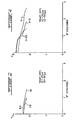
- the generator of Figure 1 (a) is illustrated in the charged state, 1 represents the anode, Li o or lithium alloy, fully charged, 2 represents the polymer electrolyte conductive by Li+ ions, 3 represents the collector of the cathode, metal and / or black or polymer with electronic conduction and 4 represents the active material of the cathode in the charged state, mainly in RSSR form, generally present in the form of composite mixture with the electrolyte 2.
- the second generator, Figure 1 (b) is shown in the discharged state.
- 5 shows the anode, Li O or Li alloy o, partially or predominantly in the discharged state
- 6 shows the conductive polymer electrolyte by the Li+ ions
- 7 shows the active cathode material in the discharged state, mainly in Li-SRS-Li form, generally present in the form of a composite mixture with the electrolyte 6 itself capable of containing a more or less large soluble fraction of the active compound of the cathode.
- the compounds corresponding to the formula R-S-S-R used for the examples which follow can be prepared by oxidation with iodine of the alkaline salts or of the corresponding acid.
- the potassium salt Aldrich Cat. No. 13,943-2
- the acid form Aldrich, Cat. No. 15, 846-1
- the generator consists of a lithium anode of about 40 microns thick laminated on a strip of nickel
- the polymer electrolyte is a copolymer mainly consisting of ethylene oxide and -15 mol% of methyl glycidyl ether in which a salt of (CF3SO2) 2NLi is dissolved in the ratio: oxygen of the polymer / lithium of 30/1
- the positive electrode consists of a mixture of solid dithiouracil in polymerized form, of an acetylene black additive and of the polymer electrolyte previously described; the proportions by weight of the mixture are: dithiouracil 43%, black 14% and polymer 43%.
- the composite cathode and the electrolyte are prepared in the form of thin films about 20 microns thick by spreading and then drying a solution of the electrolyte in acetonitrile, in the case of the composite cathode.
- the black and the dithiouracil are first dispersed mechanically in the electrolyte solution.
- the Coulomb capacity of the positive electrode thus formed is 1.6 C / cm2 and the effective surface of the cathode is 3.86 cm2.
- the generator is assembled by hot pressing, around 60 ° C.
- the electromotive force observed after assembly is 2.84 Volts.
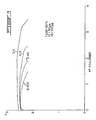
- Figure 2 illustrates the appearance of the discharge tray in the first cycle (D-1) as well as in cycles 2 and 12 (D-2 and D-12). It is noted that after an initial loss of capacity the generator retains its capacity and that the discharge plate remains substantially the same.
- Example 2 Similar to that of Example 1, but which is cycled at 60 ° C.
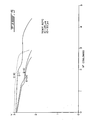
- the results are illustrated in FIG. 3 and confirm a behavior in cycling equivalent to that observed at room temperature but with a lower ohmic drop and a higher rate of use of the material.
- the pace of the discharge plate takes a stable form with an average discharge voltage close to 2.5V.
- a temporary ohmic drop effect is visible at the start of the discharge and could be explained by a variation in the conductivity of the cathode material during discharge or by the destruction of a passivation film on the lithium electrode which may result from a partial solubilization of the cathode material in the electrolyte or the presence of impurities in the latter. This still poorly identified phenomenon does not affect the good cycling properties of the generator.
- the active material of the cathode is poly (2.5 dimercaptothiadiazole).
- the mass proportions of the materials used are respectively: 44% for poly (dimercaptothiadiazole), 12% for black and 44% for the electrolyte.
- the electromotive force observed at the start is in this case 3.06 Volts.
- the generator is then cycled for 20 consecutive cycles.
- the discharge trays are illustrated in Figure 4 and confirm the excellent cyclability of the system after an initial drop in capacity after the first discharge.
- FIG. 5 illustrates the evolution of the discharge plates during successive cycles and clearly confirms the excellent cyclability of the system after an initial stabilization of the performances.
- the electromotive force initially observed is 3.05 Volts and the average discharge plate is close to 2.6V but with two plates substantially equivalent to ⁇ 2.8V and 2.5V.
- This figure also illustrates the appearance of the discharge and charge plates in cycle 10 (D-10 and C-10). Although not illustrated in this figure, we also observe at 60 ° C and even more at 80 ° C.
Landscapes
- Chemical & Material Sciences (AREA)
- Chemical Kinetics & Catalysis (AREA)
- Electrochemistry (AREA)
- General Chemical & Material Sciences (AREA)
- Engineering & Computer Science (AREA)
- Manufacturing & Machinery (AREA)
- Inorganic Chemistry (AREA)
- Physics & Mathematics (AREA)
- Materials Engineering (AREA)
- Condensed Matter Physics & Semiconductors (AREA)
- Dispersion Chemistry (AREA)
- General Physics & Mathematics (AREA)
- Secondary Cells (AREA)
- Battery Electrode And Active Subsutance (AREA)
- Fats And Perfumes (AREA)
- Compositions Of Macromolecular Compounds (AREA)
Applications Claiming Priority (2)
| Application Number | Priority Date | Filing Date | Title |
|---|---|---|---|
| CA610115 | 1989-09-01 | ||
| CA000610115A CA1341507C (fr) | 1989-09-01 | 1989-09-01 | Generateur a l'etat solide fonctionnant par polymerisation redox |
Publications (3)
| Publication Number | Publication Date |
|---|---|
| EP0415856A2 true EP0415856A2 (de) | 1991-03-06 |
| EP0415856A3 EP0415856A3 (en) | 1991-07-03 |
| EP0415856B1 EP0415856B1 (de) | 2000-07-12 |
Family
ID=4140545
Family Applications (1)
| Application Number | Title | Priority Date | Filing Date |
|---|---|---|---|
| EP90420361A Revoked EP0415856B1 (de) | 1989-09-01 | 1990-07-27 | Wiederaufladbarer elektrochemischer Generator mit Festkörperpolymeren |
Country Status (5)
| Country | Link |
|---|---|
| EP (1) | EP0415856B1 (de) |
| JP (1) | JP2698471B2 (de) |
| AT (1) | ATE194730T1 (de) |
| CA (1) | CA1341507C (de) |
| DE (1) | DE69033581T2 (de) |
Cited By (8)
| Publication number | Priority date | Publication date | Assignee | Title |
|---|---|---|---|---|
| EP0495895A4 (en) * | 1989-10-13 | 1993-02-03 | The Regents Of The University Of California | Cell for making secondary batteries |
| EP0534407A1 (de) * | 1991-09-24 | 1993-03-31 | Matsushita Electronics Corporation, Ltd. | Reversible Elektrode |
| EP0569037A1 (de) * | 1992-05-07 | 1993-11-10 | Matsushita Electric Industrial Co., Ltd. | Reversible Elektrode |
| EP0569038A1 (de) * | 1992-05-07 | 1993-11-10 | Matsushita Electric Industrial Co., Ltd. | Reversible Elektrode |
| EP0650208A1 (de) * | 1993-10-21 | 1995-04-26 | Alcatel | Kathodenmaterial für elektrochemische Batterie |
| WO2011089754A1 (ja) | 2010-01-21 | 2011-07-28 | 平松産業株式会社 | 炭素繊維製不織布、炭素繊維、及びその製造方法、電極、電池、及びフィルタ |
| WO2017175401A1 (ja) | 2016-04-04 | 2017-10-12 | テックワン株式会社 | 炭素繊維、炭素繊維材製造方法、電気デバイス、二次電池、及び製品 |
| DE112016002671T5 (de) | 2016-10-19 | 2018-07-19 | Tec One Co., Ltd. | Kohlenstoff-Silizium-Verbundmaterial, negative Elektrode, Sekundärbatterie und Herstellungsverfahren für Kohlenstoff-Silizium-Verbundmaterial |
Families Citing this family (3)
| Publication number | Priority date | Publication date | Assignee | Title |
|---|---|---|---|---|
| DE102012200827A1 (de) * | 2012-01-20 | 2013-07-25 | Leibniz-Institut Für Festkörper- Und Werkstoffforschung Dresden E.V. | Verwendung eines Polymernetzwerkes als Kathodenmaterial für wiederaufladbare Batterien |
| KR20230121111A (ko) * | 2020-12-14 | 2023-08-17 | 에스이에스 홀딩스 피티이. 엘티디. | 비플루오르화 하이브리드-에테르 공용매 시스템을 포함하는전해질, 이러한 전해질을 제조하는 방법, 및 이러한 전해질을 활용하는 전기화학 소자 |
| CN113725445B (zh) * | 2021-08-17 | 2023-04-28 | 中国科学院上海微系统与信息技术研究所 | 一种高效能的全固态钠-氧-水电池 |
Family Cites Families (1)
| Publication number | Priority date | Publication date | Assignee | Title |
|---|---|---|---|---|
| US4833048A (en) | 1988-03-31 | 1989-05-23 | The United States Of America As Represented By The United States Department Of Energy | Metal-sulfur type cell having improved positive electrode |
-
1989
- 1989-09-01 CA CA000610115A patent/CA1341507C/fr not_active Expired - Lifetime
-
1990
- 1990-07-27 DE DE69033581T patent/DE69033581T2/de not_active Expired - Fee Related
- 1990-07-27 EP EP90420361A patent/EP0415856B1/de not_active Revoked
- 1990-07-27 AT AT90420361T patent/ATE194730T1/de not_active IP Right Cessation
- 1990-08-31 JP JP2232300A patent/JP2698471B2/ja not_active Expired - Lifetime
Non-Patent Citations (5)
| Title |
|---|
| Journal of the Electrochemical Society, vol 136, No. 3, March 1989, pages 661-664, Manchester, NH, US; S. J. Visco et al.: A novel class of organsulfur electrodes for energy storage * |
| JOURNAL OF THE ELECTROCHEMICAL SOCIETY, vol. 135, no. 12, December 1988, pages 2905-2909, Manchester, NH, US; S.J. VISCO et al.: "Ionic conductivity of organosulfur melts for advanced storage electrodes" * |
| JOURNAL OF THE ELECTROCHEMICAL SOCIETY, vol. 136, no. 3, March 1989, pages 661-664, Manchester, NH, US; S.J. VISCO et al.: "A novel class of organosulfur electrodes for energy storage" * |
| PROC. ELECTROCHEM. SOC., 90-5, PROC. SYMP. RECHARGABLE LITHIUM BATTERIES, 1989, pages 220-232, Berkeley, US; M. LIU et al.: "All-solid-state thin-film rechargeable lithium batteries using solid redox polymerization electrodes" * |
| PROC. ELECTROCHEM. SOC., 90-5, PROC. SYMP. RECHARGEABLE LITHIUM BATTERIES, 1989, pages 233-245, Berkeley, US; M. LIU et al.: "Electrochemical investigations of novel solid redox polymerization electrodes" * |
Cited By (14)
| Publication number | Priority date | Publication date | Assignee | Title |
|---|---|---|---|---|
| EP0495895A4 (en) * | 1989-10-13 | 1993-02-03 | The Regents Of The University Of California | Cell for making secondary batteries |
| US5413882A (en) * | 1991-09-24 | 1995-05-09 | Matsushita Electric Industrial Co., Ltd. | Composite electrode |
| EP0534407A1 (de) * | 1991-09-24 | 1993-03-31 | Matsushita Electronics Corporation, Ltd. | Reversible Elektrode |
| EP0569037A1 (de) * | 1992-05-07 | 1993-11-10 | Matsushita Electric Industrial Co., Ltd. | Reversible Elektrode |
| EP0569038A1 (de) * | 1992-05-07 | 1993-11-10 | Matsushita Electric Industrial Co., Ltd. | Reversible Elektrode |
| US5348819A (en) * | 1992-05-07 | 1994-09-20 | Matsushita Electric Industrial Co., Ltd. | Reversible electrode |
| US5370947A (en) * | 1992-05-07 | 1994-12-06 | Matsushita Electric Industrial Co., Ltd. | Reversible electrode |
| EP0650208A1 (de) * | 1993-10-21 | 1995-04-26 | Alcatel | Kathodenmaterial für elektrochemische Batterie |
| FR2711843A1 (fr) * | 1993-10-21 | 1995-05-05 | Alsthom Cge Alcatel | Matériau cathodique pour générateur électrochimique. |
| US5496662A (en) * | 1993-10-21 | 1996-03-05 | Alcatel Alsthom Compagnie Generale D'electricite | Cathode material for an electric cell |
| WO2011089754A1 (ja) | 2010-01-21 | 2011-07-28 | 平松産業株式会社 | 炭素繊維製不織布、炭素繊維、及びその製造方法、電極、電池、及びフィルタ |
| WO2017175401A1 (ja) | 2016-04-04 | 2017-10-12 | テックワン株式会社 | 炭素繊維、炭素繊維材製造方法、電気デバイス、二次電池、及び製品 |
| DE112016002671T5 (de) | 2016-10-19 | 2018-07-19 | Tec One Co., Ltd. | Kohlenstoff-Silizium-Verbundmaterial, negative Elektrode, Sekundärbatterie und Herstellungsverfahren für Kohlenstoff-Silizium-Verbundmaterial |
| DE112016002671B4 (de) | 2016-10-19 | 2024-10-31 | Tec One Co., Ltd. | Kohlenstoff-Silizium-Verbundmaterial, negative Elektrode, Sekundärbatterie und Herstellungsverfahren für Kohlenstoff-Silizium-Verbundmaterial sowie dessen Verwendung |
Also Published As
| Publication number | Publication date |
|---|---|
| JPH0393169A (ja) | 1991-04-18 |
| JP2698471B2 (ja) | 1998-01-19 |
| EP0415856A3 (en) | 1991-07-03 |
| DE69033581T2 (de) | 2001-04-12 |
| DE69033581D1 (de) | 2000-08-17 |
| CA1341507C (fr) | 2006-06-13 |
| EP0415856B1 (de) | 2000-07-12 |
| ATE194730T1 (de) | 2000-07-15 |
Similar Documents
| Publication | Publication Date | Title |
|---|---|---|
| EP0966769B1 (de) | Neue elektrodenmaterialen aus ionischen polychinoid-derivaten und deren verwendungen in elektrochemischen generatoren | |
| EP0165827B1 (de) | Elektrochemischer Generator mit zusammengesetzten Elektroden | |
| RU2402842C2 (ru) | Химический источник электроэнергии и способ его изготовления | |
| US6117590A (en) | Electroactive high storage capacity polyacetylene-co-polysulfur materials and electrolytic cells containing same | |
| EP0267106B1 (de) | Ionenleitendes Material | |
| EP1466379B1 (de) | Hochstabilitätspolymerelektrolyt, dessen verwendung in elektrochemischen systemen | |
| KR19990022715A (ko) | 전기활성 고저장 용량 폴리카본-설파이드 물질및 동등물을함유하는 전해전지 | |
| JP2011521405A (ja) | リチウム陰極を有する充電式バッテリー | |
| CN1335653A (zh) | 用于锂硫电池的电解液以及包括这种电解液的锂硫电池 | |
| EP0415856B1 (de) | Wiederaufladbarer elektrochemischer Generator mit Festkörperpolymeren | |
| CH649655A5 (fr) | Procede pour prolonger la duree d'utilisation des piles non aqueuses. | |
| EP0614240B1 (de) | Aufladbarer lithiumenthaltender elektrochemischen Stromgenerator | |
| EP2583333B1 (de) | Elektrochemischer lithiumakkumulator mit spezifischer bipolarer architektur | |
| FR2465326A1 (fr) | Generateur electrochimique a electrolyte non aqueux | |
| EP0901180A1 (de) | Aufladbare Lithium Batterie mit organischem Elektrolyten und Kohlenstoffanode | |
| EP0250518B1 (de) | Schwefelhaltige, elektronische, leitfähige stickstoff-polymere, verfahren zur herstellung derselben und dieselben verwendender elektrochemischer generator | |
| CN101084595B (zh) | 用于锂-硫电池的电解质以及含有该电解质的锂-硫电池 | |
| EP3317912B1 (de) | Verbindung als additiv in einem elektrolyt für eine ionenflussbatterie | |
| KR20030014347A (ko) | 비수성 전지에서 캐소드용 산화환원 재료 | |
| US6309778B1 (en) | Electroactive high storage capacity polyacetylene-co-polysulfur materials and electrolytic cells containing same | |
| EP3898522B1 (de) | Negativelektroden-aktivmaterial auf der basis von eisen und lithiumhydroxysulfid | |
| CN101107733B (zh) | 关于使用硫或硫化合物的电池的电解质组合物的改进 | |
| JPH0831449A (ja) | 二次電池用高容量電池 | |
| FR2772990A1 (fr) | Additifs pour ameliorer la reversibilite d'une electrode de carbone d'un generateur electrochimique secondaire a ions lithium | |
| JP3111506B2 (ja) | 可逆性電極 |
Legal Events
| Date | Code | Title | Description |
|---|---|---|---|
| PUAI | Public reference made under article 153(3) epc to a published international application that has entered the european phase |
Free format text: ORIGINAL CODE: 0009012 |
|
| AK | Designated contracting states |
Kind code of ref document: A2 Designated state(s): AT BE CH DE DK ES FR GB GR IT LI LU NL SE |
|
| PUAL | Search report despatched |
Free format text: ORIGINAL CODE: 0009013 |
|
| AK | Designated contracting states |
Kind code of ref document: A3 Designated state(s): AT BE CH DE DK ES FR GB GR IT LI LU NL SE |
|
| 17P | Request for examination filed |
Effective date: 19911119 |
|
| 17Q | First examination report despatched |
Effective date: 19930823 |
|
| 19A | Proceedings stayed before grant |
Effective date: 19940325 |
|
| 19F | Resumption of proceedings before grant (after stay of proceedings) |
Effective date: 20000502 |
|
| GRAA | (expected) grant |
Free format text: ORIGINAL CODE: 0009210 |
|
| AK | Designated contracting states |
Kind code of ref document: B1 Designated state(s): AT BE CH DE DK ES FR GB GR IT LI LU NL SE |
|
| PG25 | Lapsed in a contracting state [announced via postgrant information from national office to epo] |
Ref country code: NL Free format text: LAPSE BECAUSE OF FAILURE TO SUBMIT A TRANSLATION OF THE DESCRIPTION OR TO PAY THE FEE WITHIN THE PRESCRIBED TIME-LIMIT Effective date: 20000712 Ref country code: GR Free format text: LAPSE BECAUSE OF NON-PAYMENT OF DUE FEES Effective date: 20000712 Ref country code: ES Free format text: THE PATENT HAS BEEN ANNULLED BY A DECISION OF A NATIONAL AUTHORITY Effective date: 20000712 Ref country code: AT Free format text: LAPSE BECAUSE OF FAILURE TO SUBMIT A TRANSLATION OF THE DESCRIPTION OR TO PAY THE FEE WITHIN THE PRESCRIBED TIME-LIMIT Effective date: 20000712 |
|
| REF | Corresponds to: |
Ref document number: 194730 Country of ref document: AT Date of ref document: 20000715 Kind code of ref document: T |
|
| REG | Reference to a national code |
Ref country code: CH Ref legal event code: EP |
|
| PG25 | Lapsed in a contracting state [announced via postgrant information from national office to epo] |
Ref country code: LU Free format text: LAPSE BECAUSE OF NON-PAYMENT OF DUE FEES Effective date: 20000727 |
|
| PG25 | Lapsed in a contracting state [announced via postgrant information from national office to epo] |
Ref country code: LI Free format text: LAPSE BECAUSE OF NON-PAYMENT OF DUE FEES Effective date: 20000731 Ref country code: CH Free format text: LAPSE BECAUSE OF NON-PAYMENT OF DUE FEES Effective date: 20000731 Ref country code: BE Free format text: LAPSE BECAUSE OF NON-PAYMENT OF DUE FEES Effective date: 20000731 |
|
| REF | Corresponds to: |
Ref document number: 69033581 Country of ref document: DE Date of ref document: 20000817 |
|
| GBT | Gb: translation of ep patent filed (gb section 77(6)(a)/1977) |
Effective date: 20000727 |
|
| ITF | It: translation for a ep patent filed | ||
| PG25 | Lapsed in a contracting state [announced via postgrant information from national office to epo] |
Ref country code: SE Free format text: LAPSE BECAUSE OF FAILURE TO SUBMIT A TRANSLATION OF THE DESCRIPTION OR TO PAY THE FEE WITHIN THE PRESCRIBED TIME-LIMIT Effective date: 20001012 Ref country code: DK Free format text: LAPSE BECAUSE OF FAILURE TO SUBMIT A TRANSLATION OF THE DESCRIPTION OR TO PAY THE FEE WITHIN THE PRESCRIBED TIME-LIMIT Effective date: 20001012 |
|
| NLV1 | Nl: lapsed or annulled due to failure to fulfill the requirements of art. 29p and 29m of the patents act | ||
| BERE | Be: lapsed |
Owner name: HYDRO-QUEBEC Effective date: 20000731 |
|
| REG | Reference to a national code |
Ref country code: CH Ref legal event code: PL |
|
| PLBQ | Unpublished change to opponent data |
Free format text: ORIGINAL CODE: EPIDOS OPPO |
|
| PLBI | Opposition filed |
Free format text: ORIGINAL CODE: 0009260 |
|
| PLBF | Reply of patent proprietor to notice(s) of opposition |
Free format text: ORIGINAL CODE: EPIDOS OBSO |
|
| 26 | Opposition filed |
Opponent name: THE REGENTS OF THE UNIVERSITY OF CALIFORNIA Effective date: 20010412 |
|
| PLBF | Reply of patent proprietor to notice(s) of opposition |
Free format text: ORIGINAL CODE: EPIDOS OBSO |
|
| PLBF | Reply of patent proprietor to notice(s) of opposition |
Free format text: ORIGINAL CODE: EPIDOS OBSO |
|
| REG | Reference to a national code |
Ref country code: GB Ref legal event code: IF02 |
|
| PGFP | Annual fee paid to national office [announced via postgrant information from national office to epo] |
Ref country code: GB Payment date: 20030630 Year of fee payment: 14 |
|
| PGFP | Annual fee paid to national office [announced via postgrant information from national office to epo] |
Ref country code: DE Payment date: 20030714 Year of fee payment: 14 |
|
| PGFP | Annual fee paid to national office [announced via postgrant information from national office to epo] |
Ref country code: FR Payment date: 20030728 Year of fee payment: 14 |
|
| RDAF | Communication despatched that patent is revoked |
Free format text: ORIGINAL CODE: EPIDOSNREV1 |
|
| RDAG | Patent revoked |
Free format text: ORIGINAL CODE: 0009271 |
|
| STAA | Information on the status of an ep patent application or granted ep patent |
Free format text: STATUS: PATENT REVOKED |
|
| 27W | Patent revoked |
Effective date: 20030823 |
|
| GBPR | Gb: patent revoked under art. 102 of the ep convention designating the uk as contracting state |
Free format text: 20030823 |