EP0416409A2 - Verringerung der Stromspitzen in CMOS-Schalttreibern - Google Patents
Verringerung der Stromspitzen in CMOS-Schalttreibern Download PDFInfo
- Publication number
- EP0416409A2 EP0416409A2 EP90116326A EP90116326A EP0416409A2 EP 0416409 A2 EP0416409 A2 EP 0416409A2 EP 90116326 A EP90116326 A EP 90116326A EP 90116326 A EP90116326 A EP 90116326A EP 0416409 A2 EP0416409 A2 EP 0416409A2
- Authority
- EP
- European Patent Office
- Prior art keywords
- transistors
- channel
- gate
- cmos
- gates
- Prior art date
- Legal status (The legal status is an assumption and is not a legal conclusion. Google has not performed a legal analysis and makes no representation as to the accuracy of the status listed.)
- Withdrawn
Links
Images
Classifications
-
- H—ELECTRICITY
- H03—ELECTRONIC CIRCUITRY
- H03K—PULSE TECHNIQUE
- H03K3/00—Circuits for generating electric pulses; Monostable, bistable or multistable circuits
-
- H—ELECTRICITY
- H03—ELECTRONIC CIRCUITRY
- H03K—PULSE TECHNIQUE
- H03K5/00—Manipulating of pulses not covered by one of the other main groups of this subclass
- H03K5/15—Arrangements in which pulses are delivered at different times at several outputs, i.e. pulse distributors
- H03K5/151—Arrangements in which pulses are delivered at different times at several outputs, i.e. pulse distributors with two complementary outputs
-
- H—ELECTRICITY
- H03—ELECTRONIC CIRCUITRY
- H03K—PULSE TECHNIQUE
- H03K17/00—Electronic switching or gating, i.e. not by contact-making and –breaking
- H03K17/16—Modifications for eliminating interference voltages or currents
- H03K17/161—Modifications for eliminating interference voltages or currents in field-effect transistor switches
- H03K17/162—Modifications for eliminating interference voltages or currents in field-effect transistor switches without feedback from the output circuit to the control circuit
- H03K17/163—Soft switching
-
- H—ELECTRICITY
- H03—ELECTRONIC CIRCUITRY
- H03K—PULSE TECHNIQUE
- H03K17/00—Electronic switching or gating, i.e. not by contact-making and –breaking
- H03K17/51—Electronic switching or gating, i.e. not by contact-making and –breaking characterised by the components used
- H03K17/56—Electronic switching or gating, i.e. not by contact-making and –breaking characterised by the components used by the use, as active elements, of semiconductor devices
- H03K17/687—Electronic switching or gating, i.e. not by contact-making and –breaking characterised by the components used by the use, as active elements, of semiconductor devices the devices being field-effect transistors
- H03K17/6871—Electronic switching or gating, i.e. not by contact-making and –breaking characterised by the components used by the use, as active elements, of semiconductor devices the devices being field-effect transistors the output circuit comprising more than one controlled field-effect transistor
- H03K17/6872—Electronic switching or gating, i.e. not by contact-making and –breaking characterised by the components used by the use, as active elements, of semiconductor devices the devices being field-effect transistors the output circuit comprising more than one controlled field-effect transistor using complementary field-effect transistors
-
- H—ELECTRICITY
- H03—ELECTRONIC CIRCUITRY
- H03K—PULSE TECHNIQUE
- H03K19/00—Logic circuits, i.e. having at least two inputs acting on one output; Inverting circuits
- H03K19/003—Modifications for increasing the reliability for protection
- H03K19/00346—Modifications for eliminating interference or parasitic voltages or currents
- H03K19/00361—Modifications for eliminating interference or parasitic voltages or currents in field effect transistor circuits
Definitions
- the invention relates to CMOS switch drivers in which switching or clock signals are provided to a plurality of N channel and P channel transistors in a complementary metal oxide semiconductor (CMOS) system.
- CMOS complementary metal oxide semiconductor
- the P channel transistors typically have their source electrodes returned to a common positive power supply rail and the N channel transistors typically have their sources returned to the common negative power supply rail.
- the P channel transistor gates are at the positive rail potential they are off and when the gates are at the negative rail potential they are turned full on.
- the N channel transistor gates are at the negative rail potential they are off and when their gates are at the positive rail potential they are turned full on.
- the P and N channel transistor gates should be driven by rail-to-rail switching signals.
- the switching signal must pass through the linear device operating region. For this condition a current flow will occur while the linear region is being traversed. This is called the spike current which results in power dissipation during the transition. If the switching is rapid the spike is narrow and the dissipated power is low.
- a switch driver is required to drive a number of switch transistors its output transistors must be made relatively large. This results in a large spike current which can be troublesome.
- the spike current acts to heat the integrated circuit chip and this is undesirable, particularly where a high operating frequency is required.
- the spike current must be produced by the power supply and, due to power supply regulation, supply rail noise is produced.
- Japanese patent publication 57161 was published in 1975 and represents prior art to the present invention.
- a CMOS noninverting gate circuit is disclosed.
- the gate is shown as having a transfer function that displays substantial hysteresis and a low spike current. While this prior art publication is relevant, it does not disclose the circuit of the invention.
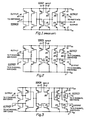
- FIG. 1 is a schematic diagram of a typical prior art CMOS switch driver which is employed to drive a plurality of P and N channel transistors.
- An operating power supply is connected + to V DD terminal 10 and - to V SS terminal 11.
- An input signal is connected to terminal 12 and its complement to terminal 13.
- input terminals 12-13 are driven in paraphase by a clock signal obtained from a common oscillator.
- An in-phase output appears at terminal 14 and this signal is intended to drive the gates of the plurality of N channel switch transistors.
- the complement will appear at terminal 15 and is intended to drive the gates of the plurality of P channel switch transistors.
- This choice of transistor drive is arbitrary and the choice could be made on a complementary basis.
- transistors 20 and 21 form an inverter gate that drives transistors 22 and 23 which form a second inverter gate.
- the second inverter gate in turn drives transistors 24 and 25 which form a third inverter gate.
- Outputs 14 and 15 provide complementary drives and are taken respectively from the second and third inverter gates.
- Transistors 22-25 are typically required to drive a relatively large number of CMOS switch transistors and are therefore typically quite large. This invokes a large spike current that places a severe requirement on the operating power supply and results in substantial IC chip heating.
- transistors 20 and 21 are only required to drive the gates of transistors 22 and 23. Thus, transistors 20 and 21 are relatively small and do not contribute significantly to the spike current.
- the circuit of figure 1 displays mirror symmetry in that transistors 20-25 are duplicated on the left-hand half of the circuit and they are operated complementarily.
- the output at terminal 16 is in phase with the signal at terminal 12 and the output at terminal 17 is complementary thereto.
- both halves of the circuit switch when the devices are driven through their linear regions, their spike current contributions are additive and therefore particularly troublesome.
- the invention tends to reduce the current spikes in a CMOS switch driver without reducing its driving capability.
- the switch driver is constructed in the usual manner of cascading three CMOS inverter gates.
- the latter two of these gates employ large area devices that are capable of driving a plurality of switches.
- the last inverter gate has an output dedicated to driving the CMOS P channel switches and the penultimate inverter gate is dedicated to driving the CMOS N channel switches.
- the last inverter gate includes a resistance element in series with the transistor drains and has its output taken from the P channel transistor drain.
- the penultimate inverter gate also has a resistance element coupled in series between the transistor drains and its output is taken from the H channel transistor drain.
- the drain of the penultimate inverter gate P channel transistor is directly connected to the gate of the last inverter gate P channel transistor.
- the gate of the last inverter gate N channel transistor is directly conected to the drain of the N channel transistor in the penultimate inverter gate.
- resistor 27 and 28 have been added to the output inverter gates.
- Resistor 27 is coupled between the drains of transistors 22 and 23 which form the penultimate output inverter gate.
- Resistor 28 is coupled between the drains of transistors 24 and 25 which form the last inverter gate.
- Transistors 20 and 21 form the first or input inverter gate and node 26 comprises its output.
- Node 26 will be driven substantially rail-to-rail in response to an oscillator signal at terminal 12.
- transistor 21 is driven in phase with the signal at terminal 12 from the mirror symmetry opposite half of the circuit.
- Node 26 directly drives the gates of transistors 22 and 23.
- the drain of transistor 22 is directly connected to the gate of transistor 24, the drain of which provides output terminal 15.
- the drain of transistor 23 provides output terminal 14 and is also directly connected to the gate of transistor 25.
- transistors 22-25 are all large area devices capable of substantial output drive. Thus, all four have a substantial gate capacitance.
- transistor 23 When node 26 is driven high, transistor 23 will be turned on fast and transistor 22 will be turned off fast. As the potential at node 26 passes through the devices linear region, a current spike will occur in transistors 22 and 23, but its magnitude will be limited by resistor 27. By making resistor 27 large, with respect to the on resistance of the FET's, the spike can be kept reasonably small. Since the rapid rise of node 26 will rapidly turn transistor 23 on to its maximum conduction state, terminal 14 will go low quickly. Conduction in transistor 23, which has a large area, can quickly discharge the capacitance represented by a plurality of N channel switches connected to terminal 14 and therefore turn them off rapidly. This action will also turn transistor 25 on rapidly.
- transistor 22 When node 26 is driven low transistor 22 will be rapidly turned on and transistor 23 will rapidly be turned off. The rapid turn on of transistor 22 will rapidly turn transistor 24 off. Terminal 14, which drives the plurality of N channel switches, will slowly be pulled up through resistor 27. This provides a slow turn on of the N channel switches as well as transistor 25. Again, it can be seen that since transistor 24 turns on quickly and transistor 25 turns on slowly, the current spike in transistors 24 and 25 is avoided.
- the circuit of figure 2 will drive the output terminal 14 up slowly and down rapidly, which will switch the N channel transistors connected thereto off rapidly and on slowly.
- Terminal 15 will be operated to slowly turn the P channel transistors connected thereto off and on. This action avoids any spike current in the third inverter gate and minimizes the spike current in the penultimate gate. Since the first inverter gate employs small transistors its spike current can be neglected. This circuit configuration also ensures staggered conduction in the driven N and P channel switch transistors so that they too avoid spike currents.
- Figure 3 shows an alternative embodiment of the invenion.
- N channel transistors 29 and 30 respectively replace resistors 27 and 28 of figure 2.
- the gates of transistors 29 and 30 are returned to the positive supply rail so that they are fully turned on.
- the N channel transistors act like resistors which have a relatively high value determined by their geometry.
- transistors 29 and 30 each could have a W/L of 6/30 microns. This would produce a resistance value of about 5k ohms.
- transis tors 29 and 30 are illustrated as N channel devices, P channel transistors, with their gates returned to the negative supply rail, could be used. Otherwise, the functioning of the circuit of figure 3 is the same as that of figure 2.
- the circuit of figure 2 was constructed using the following transistor sizes: TRANSISTOR CHANNEL TYPE W/L DIMENSIONS (MICRONS) 20 P 60/5 21 N 5/25 22 P 400/5 23 N 200/5 24 P 400/5 25 N 200/5
- Resistors 27 and 28 were each 5000 ohms.
- a 25 kHz clock signal was applied to terminal 12 and its complement to terminal 13.
- the outputs at terminals 14 and 15 could respectively drive 4 switches of conventional CMOS design. This represents a capacitive load of about 30 picofarads at each output terminal.
- the circuit functioned adequately to drive the switches and displayed a spike current of less than 15% of that of the prior art circuit as represented in figure 1.
Landscapes
- Physics & Mathematics (AREA)
- Nonlinear Science (AREA)
- Engineering & Computer Science (AREA)
- Computer Hardware Design (AREA)
- Computing Systems (AREA)
- General Engineering & Computer Science (AREA)
- Mathematical Physics (AREA)
- Electronic Switches (AREA)
Applications Claiming Priority (2)
| Application Number | Priority Date | Filing Date | Title |
|---|---|---|---|
| US07/404,244 US5089728A (en) | 1989-09-06 | 1989-09-06 | Spike current reduction in cmos switch drivers |
| US404244 | 1995-03-15 |
Publications (2)
| Publication Number | Publication Date |
|---|---|
| EP0416409A2 true EP0416409A2 (de) | 1991-03-13 |
| EP0416409A3 EP0416409A3 (en) | 1991-12-27 |
Family
ID=23598791
Family Applications (1)
| Application Number | Title | Priority Date | Filing Date |
|---|---|---|---|
| EP19900116326 Withdrawn EP0416409A3 (en) | 1989-09-06 | 1990-08-25 | Spike current reduction in cmos switch drivers |
Country Status (4)
| Country | Link |
|---|---|
| US (1) | US5089728A (de) |
| EP (1) | EP0416409A3 (de) |
| JP (1) | JPH03232316A (de) |
| KR (1) | KR910007260A (de) |
Cited By (2)
| Publication number | Priority date | Publication date | Assignee | Title |
|---|---|---|---|---|
| NL9201779A (nl) * | 1991-10-14 | 1993-05-03 | Mitsubishi Electric Corp | Werkwijze en inrichting voor een met hoge snelheid werkend uitgangsorgaan. |
| EP0511858A3 (de) * | 1991-05-01 | 1995-02-15 | Winbond Electronics North Amer |
Families Citing this family (5)
| Publication number | Priority date | Publication date | Assignee | Title |
|---|---|---|---|---|
| US5247209A (en) * | 1992-05-12 | 1993-09-21 | Acer Incorporated | Supply independent constant output circuit having fast stabilization |
| US5444410A (en) * | 1993-06-30 | 1995-08-22 | National Semiconductor Corporation | Controlled-transitioni-time line driver |
| JPH11510039A (ja) * | 1996-05-31 | 1999-08-31 | フィリップス エレクトロニクス ネムローゼ フェンノートシャップ | 電気装置とバッテリホルダとを具える電気機器 |
| US5774009A (en) * | 1997-02-14 | 1998-06-30 | Standard Microsystems Corporation | RTC oscillator amplifier circuit with improved noise immunity |
| JP2006313814A (ja) * | 2005-05-09 | 2006-11-16 | Oki Electric Ind Co Ltd | 半導体装置 |
Family Cites Families (3)
| Publication number | Priority date | Publication date | Assignee | Title |
|---|---|---|---|---|
| JPS5057161A (de) * | 1973-09-17 | 1975-05-19 | ||
| JPH0738583B2 (ja) * | 1985-01-26 | 1995-04-26 | 株式会社東芝 | 半導体集積回路 |
| JPS63215220A (ja) * | 1987-03-04 | 1988-09-07 | Nec Corp | プリドライバ−回路 |
-
1989
- 1989-09-06 US US07/404,244 patent/US5089728A/en not_active Expired - Lifetime
-
1990
- 1990-08-25 EP EP19900116326 patent/EP0416409A3/en not_active Withdrawn
- 1990-08-31 KR KR1019900013613A patent/KR910007260A/ko not_active Withdrawn
- 1990-09-06 JP JP2234612A patent/JPH03232316A/ja active Pending
Cited By (2)
| Publication number | Priority date | Publication date | Assignee | Title |
|---|---|---|---|---|
| EP0511858A3 (de) * | 1991-05-01 | 1995-02-15 | Winbond Electronics North Amer | |
| NL9201779A (nl) * | 1991-10-14 | 1993-05-03 | Mitsubishi Electric Corp | Werkwijze en inrichting voor een met hoge snelheid werkend uitgangsorgaan. |
Also Published As
| Publication number | Publication date |
|---|---|
| JPH03232316A (ja) | 1991-10-16 |
| EP0416409A3 (en) | 1991-12-27 |
| US5089728A (en) | 1992-02-18 |
| KR910007260A (ko) | 1991-04-30 |
Similar Documents
| Publication | Publication Date | Title |
|---|---|---|
| JP3067687B2 (ja) | Igbt駆動回路 | |
| EP0344604A2 (de) | Ausgangsschaltung für Halbleiter IC | |
| US7239185B2 (en) | Driver circuit connected to pulse shaping circuitry | |
| US5073727A (en) | Cmos inverter with noise reduction feedback means | |
| JP2567172B2 (ja) | 半導体回路の出力段に配置される出力回路 | |
| US5552731A (en) | Integrated control circuit with a level shifter for switching an electronic switch | |
| EP0196113B1 (de) | Tri-state-Pufferschaltung | |
| EP0683564A1 (de) | Stromschaltende Schaltung | |
| US6414524B1 (en) | Digital output buffer for MOSFET device | |
| EP0281113A2 (de) | Halbleiter - Pufferschaltung | |
| US5089728A (en) | Spike current reduction in cmos switch drivers | |
| JPS61154312A (ja) | 駆動回路 | |
| EP0473409B1 (de) | BiCMOS logische Schaltung | |
| JP2576779B2 (ja) | 信号出力回路 | |
| JPH02301323A (ja) | レベルシフト回路 | |
| JP2929869B2 (ja) | 3ステート・バッファ回路 | |
| JPH0653800A (ja) | 出力回路 | |
| JP2785569B2 (ja) | 3ステート・バッファ回路 | |
| JPH01228319A (ja) | 半導体集積回路 | |
| JPH05160706A (ja) | Cmos出力バッファ回路 | |
| JPH05206840A (ja) | 半導体集積回路 | |
| JPS62224117A (ja) | 信号出力回路 | |
| JPH0683051B2 (ja) | 出力回路 | |
| JPH06120794A (ja) | スイッチング装置 | |
| JPH06120790A (ja) | スタンバイフラグ回路 |
Legal Events
| Date | Code | Title | Description |
|---|---|---|---|
| PUAI | Public reference made under article 153(3) epc to a published international application that has entered the european phase |
Free format text: ORIGINAL CODE: 0009012 |
|
| AK | Designated contracting states |
Kind code of ref document: A2 Designated state(s): DE FR GB IT NL |
|
| PUAL | Search report despatched |
Free format text: ORIGINAL CODE: 0009013 |
|
| AK | Designated contracting states |
Kind code of ref document: A3 Designated state(s): DE FR GB IT NL |
|
| 17P | Request for examination filed |
Effective date: 19920509 |
|
| 17Q | First examination report despatched |
Effective date: 19941130 |
|
| STAA | Information on the status of an ep patent application or granted ep patent |
Free format text: STATUS: THE APPLICATION IS DEEMED TO BE WITHDRAWN |
|
| 18D | Application deemed to be withdrawn |
Effective date: 19950411 |