EP0416672A1 - Elektrisch leitfähige Polymermischungen, abgeleitet von substituierten oder unsubstituierten Pyrrolen, und Verfahren zu ihrer Herstellung - Google Patents
Elektrisch leitfähige Polymermischungen, abgeleitet von substituierten oder unsubstituierten Pyrrolen, und Verfahren zu ihrer Herstellung Download PDFInfo
- Publication number
- EP0416672A1 EP0416672A1 EP90202100A EP90202100A EP0416672A1 EP 0416672 A1 EP0416672 A1 EP 0416672A1 EP 90202100 A EP90202100 A EP 90202100A EP 90202100 A EP90202100 A EP 90202100A EP 0416672 A1 EP0416672 A1 EP 0416672A1
- Authority
- EP
- European Patent Office
- Prior art keywords
- composition
- alkyl
- salt
- polypyrrole
- conductive polymer
- Prior art date
- Legal status (The legal status is an assumption and is not a legal conclusion. Google has not performed a legal analysis and makes no representation as to the accuracy of the status listed.)
- Granted
Links
- 239000000203 mixture Substances 0.000 title claims abstract description 45
- 229920001940 conductive polymer Polymers 0.000 title claims abstract description 20
- 238000000034 method Methods 0.000 title claims abstract description 14
- 150000003233 pyrroles Chemical class 0.000 title claims description 13
- 238000002360 preparation method Methods 0.000 title claims description 6
- 229920000128 polypyrrole Polymers 0.000 claims abstract description 19
- 125000003010 ionic group Chemical group 0.000 claims abstract description 8
- MHGOKSLTIUHUBF-UHFFFAOYSA-N 2-ethylhexyl sulfate Chemical group CCCCC(CC)COS(O)(=O)=O MHGOKSLTIUHUBF-UHFFFAOYSA-N 0.000 claims abstract description 5
- KAESVJOAVNADME-UHFFFAOYSA-N Pyrrole Chemical compound C=1C=CNC=1 KAESVJOAVNADME-UHFFFAOYSA-N 0.000 claims description 38
- -1 alkaline earth metal salt Chemical class 0.000 claims description 12
- 125000000217 alkyl group Chemical group 0.000 claims description 10
- 150000003839 salts Chemical class 0.000 claims description 10
- 125000005526 alkyl sulfate group Chemical group 0.000 claims description 7
- 239000011148 porous material Substances 0.000 claims description 7
- 239000012429 reaction media Substances 0.000 claims description 6
- 229910021578 Iron(III) chloride Inorganic materials 0.000 claims description 5
- 125000001931 aliphatic group Chemical group 0.000 claims description 5
- 125000004432 carbon atom Chemical group C* 0.000 claims description 5
- 150000008040 ionic compounds Chemical class 0.000 claims description 5
- RBTARNINKXHZNM-UHFFFAOYSA-K iron trichloride Chemical compound Cl[Fe](Cl)Cl RBTARNINKXHZNM-UHFFFAOYSA-K 0.000 claims description 5
- 229910052784 alkaline earth metal Inorganic materials 0.000 claims description 4
- 150000001875 compounds Chemical class 0.000 claims description 3
- 238000006116 polymerization reaction Methods 0.000 claims description 3
- 239000000126 substance Substances 0.000 claims description 3
- VEXZGXHMUGYJMC-UHFFFAOYSA-N Hydrochloric acid Chemical group Cl VEXZGXHMUGYJMC-UHFFFAOYSA-N 0.000 claims description 2
- 239000003513 alkali Substances 0.000 claims description 2
- 150000001412 amines Chemical class 0.000 claims description 2
- 150000003863 ammonium salts Chemical class 0.000 claims description 2
- 239000012431 aqueous reaction media Substances 0.000 claims description 2
- 150000004714 phosphonium salts Chemical class 0.000 claims description 2
- 159000000000 sodium salts Chemical class 0.000 claims description 2
- 229920006395 saturated elastomer Polymers 0.000 claims 1
- OKKJLVBELUTLKV-UHFFFAOYSA-N Methanol Chemical compound OC OKKJLVBELUTLKV-UHFFFAOYSA-N 0.000 description 18
- 229920000642 polymer Polymers 0.000 description 13
- XLYOFNOQVPJJNP-UHFFFAOYSA-N water Substances O XLYOFNOQVPJJNP-UHFFFAOYSA-N 0.000 description 13
- 239000003792 electrolyte Substances 0.000 description 12
- 239000003990 capacitor Substances 0.000 description 8
- QAOWNCQODCNURD-UHFFFAOYSA-L sulfate group Chemical group S(=O)(=O)([O-])[O-] QAOWNCQODCNURD-UHFFFAOYSA-L 0.000 description 7
- PXHVJJICTQNCMI-UHFFFAOYSA-N Nickel Chemical compound [Ni] PXHVJJICTQNCMI-UHFFFAOYSA-N 0.000 description 6
- 150000001450 anions Chemical class 0.000 description 6
- 150000001768 cations Chemical class 0.000 description 6
- 238000003756 stirring Methods 0.000 description 6
- 239000000843 powder Substances 0.000 description 5
- DHCLVCXQIBBOPH-UHFFFAOYSA-N Glycerol 2-phosphate Chemical compound OCC(CO)OP(O)(O)=O DHCLVCXQIBBOPH-UHFFFAOYSA-N 0.000 description 4
- RUOJZAUFBMNUDX-UHFFFAOYSA-N propylene carbonate Chemical compound CC1COC(=O)O1 RUOJZAUFBMNUDX-UHFFFAOYSA-N 0.000 description 4
- WEVYAHXRMPXWCK-UHFFFAOYSA-N Acetonitrile Chemical compound CC#N WEVYAHXRMPXWCK-UHFFFAOYSA-N 0.000 description 3
- 239000004952 Polyamide Substances 0.000 description 3
- 239000004743 Polypropylene Substances 0.000 description 3
- 238000002788 crimping Methods 0.000 description 3
- 230000001351 cycling effect Effects 0.000 description 3
- MOTZDAYCYVMXPC-UHFFFAOYSA-N dodecyl hydrogen sulfate Chemical compound CCCCCCCCCCCCOS(O)(=O)=O MOTZDAYCYVMXPC-UHFFFAOYSA-N 0.000 description 3
- 229940043264 dodecyl sulfate Drugs 0.000 description 3
- 150000002500 ions Chemical class 0.000 description 3
- NQXWGWZJXJUMQB-UHFFFAOYSA-K iron trichloride hexahydrate Chemical compound O.O.O.O.O.O.[Cl-].Cl[Fe+]Cl NQXWGWZJXJUMQB-UHFFFAOYSA-K 0.000 description 3
- MHCFAGZWMAWTNR-UHFFFAOYSA-M lithium perchlorate Chemical compound [Li+].[O-]Cl(=O)(=O)=O MHCFAGZWMAWTNR-UHFFFAOYSA-M 0.000 description 3
- 229910001486 lithium perchlorate Inorganic materials 0.000 description 3
- 238000004519 manufacturing process Methods 0.000 description 3
- 239000000178 monomer Substances 0.000 description 3
- 229910052759 nickel Inorganic materials 0.000 description 3
- 229920002647 polyamide Polymers 0.000 description 3
- 229920001155 polypropylene Polymers 0.000 description 3
- DGSDBJMBHCQYGN-UHFFFAOYSA-M sodium;2-ethylhexyl sulfate Chemical compound [Na+].CCCCC(CC)COS([O-])(=O)=O DGSDBJMBHCQYGN-UHFFFAOYSA-M 0.000 description 3
- 238000003860 storage Methods 0.000 description 3
- PAYRUJLWNCNPSJ-UHFFFAOYSA-N Aniline Chemical compound NC1=CC=CC=C1 PAYRUJLWNCNPSJ-UHFFFAOYSA-N 0.000 description 2
- VEXZGXHMUGYJMC-UHFFFAOYSA-M Chloride anion Chemical compound [Cl-] VEXZGXHMUGYJMC-UHFFFAOYSA-M 0.000 description 2
- WHXSMMKQMYFTQS-UHFFFAOYSA-N Lithium Chemical compound [Li] WHXSMMKQMYFTQS-UHFFFAOYSA-N 0.000 description 2
- 229910002651 NO3 Inorganic materials 0.000 description 2
- NHNBFGGVMKEFGY-UHFFFAOYSA-N Nitrate Chemical compound [O-][N+]([O-])=O NHNBFGGVMKEFGY-UHFFFAOYSA-N 0.000 description 2
- WYURNTSHIVDZCO-UHFFFAOYSA-N Tetrahydrofuran Chemical compound C1CCOC1 WYURNTSHIVDZCO-UHFFFAOYSA-N 0.000 description 2
- 229910052783 alkali metal Inorganic materials 0.000 description 2
- 239000012298 atmosphere Substances 0.000 description 2
- 125000004429 atom Chemical group 0.000 description 2
- QLZHNIAADXEJJP-UHFFFAOYSA-L dioxido-oxo-phenyl-$l^{5}-phosphane Chemical compound [O-]P([O-])(=O)C1=CC=CC=C1 QLZHNIAADXEJJP-UHFFFAOYSA-L 0.000 description 2
- SSILHZFTFWOUJR-UHFFFAOYSA-N hexadecane-1-sulfonic acid Chemical compound CCCCCCCCCCCCCCCCS(O)(=O)=O SSILHZFTFWOUJR-UHFFFAOYSA-N 0.000 description 2
- 125000001905 inorganic group Chemical group 0.000 description 2
- XEEYBQQBJWHFJM-UHFFFAOYSA-N iron Substances [Fe] XEEYBQQBJWHFJM-UHFFFAOYSA-N 0.000 description 2
- 229910052744 lithium Inorganic materials 0.000 description 2
- TWBKZBJAVASNII-UHFFFAOYSA-N pentadecane-1-sulfonic acid Chemical compound CCCCCCCCCCCCCCCS(O)(=O)=O TWBKZBJAVASNII-UHFFFAOYSA-N 0.000 description 2
- 229920001467 poly(styrenesulfonates) Polymers 0.000 description 2
- 229960002796 polystyrene sulfonate Drugs 0.000 description 2
- 239000011970 polystyrene sulfonate Substances 0.000 description 2
- 229940066528 trichloroacetate Drugs 0.000 description 2
- YNJBWRMUSHSURL-UHFFFAOYSA-N trichloroacetic acid Chemical compound OC(=O)C(Cl)(Cl)Cl YNJBWRMUSHSURL-UHFFFAOYSA-N 0.000 description 2
- OXHNLMTVIGZXSG-UHFFFAOYSA-N 1-Methylpyrrole Chemical compound CN1C=CC=C1 OXHNLMTVIGZXSG-UHFFFAOYSA-N 0.000 description 1
- QGZKDVFQNNGYKY-UHFFFAOYSA-O Ammonium Chemical compound [NH4+] QGZKDVFQNNGYKY-UHFFFAOYSA-O 0.000 description 1
- 229910021135 KPF6 Inorganic materials 0.000 description 1
- 229920000265 Polyparaphenylene Polymers 0.000 description 1
- 238000010521 absorption reaction Methods 0.000 description 1
- 230000032683 aging Effects 0.000 description 1
- 150000001340 alkali metals Chemical class 0.000 description 1
- HSFWRNGVRCDJHI-UHFFFAOYSA-N alpha-acetylene Natural products C#C HSFWRNGVRCDJHI-UHFFFAOYSA-N 0.000 description 1
- 239000012736 aqueous medium Substances 0.000 description 1
- 239000012300 argon atmosphere Substances 0.000 description 1
- 229920001577 copolymer Polymers 0.000 description 1
- 238000007599 discharging Methods 0.000 description 1
- 238000009826 distribution Methods 0.000 description 1
- YRIUSKIDOIARQF-UHFFFAOYSA-N dodecyl benzenesulfonate Chemical compound CCCCCCCCCCCCOS(=O)(=O)C1=CC=CC=C1 YRIUSKIDOIARQF-UHFFFAOYSA-N 0.000 description 1
- GVGUFUZHNYFZLC-UHFFFAOYSA-N dodecyl benzenesulfonate;sodium Chemical compound [Na].CCCCCCCCCCCCOS(=O)(=O)C1=CC=CC=C1 GVGUFUZHNYFZLC-UHFFFAOYSA-N 0.000 description 1
- 229940071161 dodecylbenzenesulfonate Drugs 0.000 description 1
- 239000002019 doping agent Substances 0.000 description 1
- 125000001495 ethyl group Chemical group [H]C([H])([H])C([H])([H])* 0.000 description 1
- 229920001519 homopolymer Polymers 0.000 description 1
- 150000002484 inorganic compounds Chemical class 0.000 description 1
- 229910010272 inorganic material Inorganic materials 0.000 description 1
- 238000003780 insertion Methods 0.000 description 1
- 230000037431 insertion Effects 0.000 description 1
- 150000002505 iron Chemical class 0.000 description 1
- 239000007788 liquid Substances 0.000 description 1
- UZZYXUGECOQHPU-UHFFFAOYSA-N octyl hydrogen sulfate Chemical group CCCCCCCCOS(O)(=O)=O UZZYXUGECOQHPU-UHFFFAOYSA-N 0.000 description 1
- 150000002894 organic compounds Chemical class 0.000 description 1
- 150000004028 organic sulfates Chemical class 0.000 description 1
- 239000007800 oxidant agent Substances 0.000 description 1
- 229920001197 polyacetylene Polymers 0.000 description 1
- 229920000123 polythiophene Polymers 0.000 description 1
- 229940080264 sodium dodecylbenzenesulfonate Drugs 0.000 description 1
- WFRKJMRGXGWHBM-UHFFFAOYSA-M sodium;octyl sulfate Chemical compound [Na+].CCCCCCCCOS([O-])(=O)=O WFRKJMRGXGWHBM-UHFFFAOYSA-M 0.000 description 1
- 239000002904 solvent Substances 0.000 description 1
- YLQBMQCUIZJEEH-UHFFFAOYSA-N tetrahydrofuran Natural products C=1C=COC=1 YLQBMQCUIZJEEH-UHFFFAOYSA-N 0.000 description 1
- JOXIMZWYDAKGHI-UHFFFAOYSA-N toluene-4-sulfonic acid Chemical compound CC1=CC=C(S(O)(=O)=O)C=C1 JOXIMZWYDAKGHI-UHFFFAOYSA-N 0.000 description 1
- ITMCEJHCFYSIIV-UHFFFAOYSA-M triflate Chemical compound [O-]S(=O)(=O)C(F)(F)F ITMCEJHCFYSIIV-UHFFFAOYSA-M 0.000 description 1
Images
Classifications
-
- C—CHEMISTRY; METALLURGY
- C08—ORGANIC MACROMOLECULAR COMPOUNDS; THEIR PREPARATION OR CHEMICAL WORKING-UP; COMPOSITIONS BASED THEREON
- C08G—MACROMOLECULAR COMPOUNDS OBTAINED OTHERWISE THAN BY REACTIONS ONLY INVOLVING UNSATURATED CARBON-TO-CARBON BONDS
- C08G81/00—Macromolecular compounds obtained by interreacting polymers in the absence of monomers, e.g. block polymers
- C08G81/02—Macromolecular compounds obtained by interreacting polymers in the absence of monomers, e.g. block polymers at least one of the polymers being obtained by reactions involving only carbon-to-carbon unsaturated bonds
-
- C—CHEMISTRY; METALLURGY
- C08—ORGANIC MACROMOLECULAR COMPOUNDS; THEIR PREPARATION OR CHEMICAL WORKING-UP; COMPOSITIONS BASED THEREON
- C08G—MACROMOLECULAR COMPOUNDS OBTAINED OTHERWISE THAN BY REACTIONS ONLY INVOLVING UNSATURATED CARBON-TO-CARBON BONDS
- C08G61/00—Macromolecular compounds obtained by reactions forming a carbon-to-carbon link in the main chain of the macromolecule
- C08G61/12—Macromolecular compounds containing atoms other than carbon in the main chain of the macromolecule
- C08G61/122—Macromolecular compounds containing atoms other than carbon in the main chain of the macromolecule derived from five- or six-membered heterocyclic compounds, other than imides
- C08G61/123—Macromolecular compounds containing atoms other than carbon in the main chain of the macromolecule derived from five- or six-membered heterocyclic compounds, other than imides derived from five-membered heterocyclic compounds
- C08G61/124—Macromolecular compounds containing atoms other than carbon in the main chain of the macromolecule derived from five- or six-membered heterocyclic compounds, other than imides derived from five-membered heterocyclic compounds with a five-membered ring containing one nitrogen atom in the ring
-
- H—ELECTRICITY
- H01—ELECTRIC ELEMENTS
- H01B—CABLES; CONDUCTORS; INSULATORS; SELECTION OF MATERIALS FOR THEIR CONDUCTIVE, INSULATING OR DIELECTRIC PROPERTIES
- H01B1/00—Conductors or conductive bodies characterised by the conductive materials; Selection of materials as conductors
- H01B1/06—Conductors or conductive bodies characterised by the conductive materials; Selection of materials as conductors mainly consisting of other non-metallic substances
- H01B1/12—Conductors or conductive bodies characterised by the conductive materials; Selection of materials as conductors mainly consisting of other non-metallic substances organic substances
- H01B1/124—Intrinsically conductive polymers
- H01B1/127—Intrinsically conductive polymers comprising five-membered aromatic rings in the main chain, e.g. polypyrroles, polythiophenes
Definitions
- the present invention relates to compositions of electrically conductive polymers derived from pyrrole polymers, substituted or not, containing ionic groups formed by an alkyl-sulfate group.
- the invention also relates to a process for the preparation of these compositions by chemical polymerization of pyrrole and / or substituted pyrrole in the presence of such ionic groups.
- the morphology developed is characterized in particular by a large pore volume and an adequate pore size distribution.
- the present invention aims to provide new compositions of electrically conductive polymers based on pyrrole which have the above-mentioned specific properties.
- the invention relates to a composition
- a composition comprising an electrically conductive polymer, chosen from polypyrrole and / or substituted polypyrrole, and ionic groups which comprise at least one alkyl-sulfate group, the alkyl being a saturated aliphatic chain. , branched or not, and comprising 8 carbon atoms.
- polypyrrole and / or substituted polypyrrole is meant all polymers derived from pyrrole and / or substituted pyrroles, that is to say homopolymers and copolymers comprising pyrrole or substituted pyrrole units.
- substituted pyrroles we usually mean the pyrroles substituted in position 3 or 3 and 4 and N-methylpyrrole. The best results have been obtained with unsubstituted pyrrole.
- ionic compound containing an alkyl sulphate group is meant any organic or inorganic compound capable of giving such alkyl sulphate groups.
- an alkyl sulfate salt Usually it comes from an alkali or alkaline earth metal salt, a phosphonium salt, an ammonium salt or an amine derivative.
- an alkali metal salt Particularly preferably it comes from a sodium salt.
- alkyl sulphate group the alkyl group of which is a saturated aliphatic chain, branched or not, comprising 8 carbon atoms, is preferably understood to mean the unbranched octyl sulphate group and the 2-ethylhexyl sulphate group. The best results have been obtained with the 2-ethyl hexylsulfate group.
- compositions according to the invention usually contain 0.01 to 0.9 parts of ionic compound containing an alkyl sulphate group per part of pyrrole and / or substituted pyrrole and preferably 0.05 to 0.5 and in a particularly preferred manner 0.05 to 0.4.
- compositions according to the invention may advantageously contain other ionic groups, such as of organic or inorganic origin.
- they contain as inorganic group a chloride, a sulfate or a nitrate and as organic grouping of groups of the type: trichloroacetate, phenylphosphonate, glycerol-2-phosphate, pentadecylsulfonate, hexadecylsulfonate, polyvinylsulfonate, polystyrenesulfonate, dodecylbenzenesulfonate, tosylate, trifluoromethanesulfonate, dodecylsulfate.
- they contain an inorganic group. The best results have been obtained when the composition also contains a chloride group.
- the pore volume of the compositions according to the invention is usually greater than 1 cm3.g ⁇ 1 and is preferably between 1.5 and 5 cm3.g ⁇ 1. The best results have been obtained with a composition according to the invention having a pore volume greater than 3.5 cm3.g ⁇ 1.
- the present invention also relates to a process for the preparation of the compositions according to the invention.
- the invention relates to a process for the preparation of a composition
- a composition comprising an electrically conductive polymer chosen from polypyrrole and / or substituted polypyrrole by chemical polymerization of pyrrole and / or substituted pyrrole in an aqueous reaction medium comprising an ionic compound comprising an alkyl-sulfate group, the alkyl being a saturated aliphatic chain, branched or not, comprising 8 carbon atoms.
- ionic compound comprising an alkyl sulphate group Generally, 0.03 to 3 moles of the ionic compound comprising an alkyl sulphate group are used per mole of pyrrole and / or substituted pyrrole, usually 0.05 to 1.5 moles and preferably 0.10 to 0, 60 mole.
- a ferric salt is also used.
- an organic or inorganic ferric salt is used.
- a chloride, a sulfate or a nitrate is used as the inorganic ferric salt and as organic ferric salt, compounds of the type: trichloroacetate, phenylphosphonate, glycerol-2-phosphate, pentadecylsulfonate, hexadecylsulfonate, polyvinylsulfonate, polystyrenesulfonate, dodecylbenzenesulfonatesulfonatesulfonatesulfonatesulfonatesulfonatesulfonate , dodecylsulfate.
- ferric salt Generally, 0.3 to 5 moles of ferric salt are used per mole of pyrrole and / or of substituted pyrrole. Good results have been obtained with concentrations of between 2 and 3 moles of ferric salt per mole of pyrrole and / or substituted pyrrole.
- the process according to the invention is preferably carried out in an aqueous medium, but the amount of water required can vary between wide limits and depends essentially on the other components.
- the temperature at which the process is carried out is generally between 0 and 50 ° C and preferably between 5 and 40 ° C when operating at atmospheric pressure.
- the pressure at which the process is carried out is not critical in itself. It is generally between 0.1 and 10 bars and preferably it is equal to atmospheric pressure.
- the process according to the invention can be carried out in any apparatus or any reactor making it possible to combine the operating conditions described above.
- compositions of the invention can be used for their properties of electrical conductivity, electromagnetic absorption and thermal conductivity and more particularly for the production of electroconductive devices.
- composition comprising an electrically conductive polymer according to the invention can be doped with cations or anions during the charging or discharging of the system, the cations or anions come from the electrolyte.
- the electrolytes are generally chosen from the conductive salts of formula C+A ⁇ in which C+ is a cation and in which A ⁇ is an anion.
- the cation C+ is usually chosen from ammonium, alkaline-earth or alkaline ions, the R4N+ and R4P+ ions (R being an alkyl radical, such as the ethyl and butyl radicals for example) and preferably from the Li+ cations , Na+ or K+, or complex ions such as (Bu) 4N+ or (Et) 4N+, used preferably in the form of LiCLO4, KPF6, (Bu) 4NClO4 and (Et) 4NClO4 in solution in a solvent such as acetonitrile, tetrahydrofuran or propylene carbonate.
- R4N+ and R4P+ ions R being an alkyl radical, such as the ethyl and butyl radicals for example
- Li+ cations Na+ or K+
- complex ions such as (Bu) 4N+ or (Et) 4N+, used preferably in the form of LiCLO4, KPF6, (Bu)
- the anion A ⁇ is chosen from the ions ClO4 ⁇ , AsF6 ⁇ , SbF6 ⁇ , SO42 ⁇ , C6H5SO3 ⁇ , BF4 ⁇ , PF6 ⁇ , CF3SO3 ⁇ , I3 ⁇ , Br ⁇ and NO3 ⁇ . The best results have been obtained with the ClO4 ⁇ ion.
- compositions according to the invention can advantageously be used in electrochemical storage systems of the capacitor or capacitor type with high energy density and long cycling time.
- the capacitors consist of two electrodes separated by an electrolyte, at least one of the two electrodes consists of the composition comprising an electrically conductive polymer according to the invention.
- These specific high energy electrochemical capacitors can be symmetrical (the two electrodes are identical) or asymmetrical (the two electrodes are different in nature).
- the counter electrode is formed either by a different conductive polymer, or by an alkali metal or an insertion compound.
- the counter-electrode can be formed by a p-doped polymer such as in particular the other electrically conductive polymers based on polypyrroles, substituted or not, polythiophenes, substituted or not, polyacetylene, polyphenylene or aniline polymer.
- composition comprising a conductive polymer according to the invention can also be used in the production of rechargeable batteries, of generator, of battery or of electric accumulator whose anodes (respectively cathodes) consist of electrodes constituted by or coated with films formed by these compositions, according to the invention, doped with anions (respectively cations).
- the flask is kept for 2 hours at 20 ° C. with stirring.
- the polymer obtained is filtered, then washed 3 times with 500 ml of water, 3 times with 500 ml of a 50/50 mixture of water and methanol and then 3 times with 500 ml of methanol.
- the polymer is dried under vacuum at 20 ° C and 2670 Pa (20 mm Hg) overnight.
- a black powder is obtained with a yield - polymer calculated as undoped / monomer - of approximately 77% by weight.
- This powder is pressed at 20 ° C for a few minutes under a pressure of 19.6.107 Pa (ie 2 tonnes per cm2).
- the wafer obtained has a conductivity of 38 S.cm ⁇ 1.
- the elementary composition of the conductive polymer obtained is C / H / N / Cl / S / Fe: 5.2 / 6.2 / 1 / 0.19 / 0.14 / 0.00 in gram atoms.
- composition comprising the conductive polymer contains 62% of polypyrrole.
- a symmetrical supercapacitor is produced, the two electrodes are identical and produced from the composition as obtained in Example 1.
- composition is dried under vacuum (26.7 Pa, ie 0.2 mm Hg) at 50 ° C for 15 hours.
- this composition is pressed at 20 ° C for 20 seconds under a pressure of 6.4.107 Pa (or 650 kg per cm2).
- the tablet thus impregnated is impregnated with the electrolyte consisting of LiClO4 (1M) dissolved in propylene carbonate.
- the diameter of the tablet is 14 mm, this tablet forms the electrode and consists of 80 mg of doped polypyrrole.
- the electrolytic separator consists of a polyamide felt impregnated with electrolyte; this felt also serves as an electrolyte reserve.
- the two electrodes and the electrolytic separator are stacked and mounted in a nickel case with a diameter of 20 mm and a thickness of 2 mm.
- the seal is ensured after crimping by a polypropylene seal.
- the series and transfer resistances measured in complex impedance between 65 KHz and 0.1 Hz are respectively equal to 12 ⁇ and 70 ⁇ .
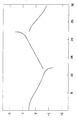
- FIG. 1 A cycling curve of this capacitor between - 1.5 V and + 1.5 V at 500 ⁇ A at 25 ° C. is shown in Figure 1.
- the time in hours is shown on the abscissa, the voltage seen is shown on the ordinate.
- the average capacity of the element is 12.3 F; which corresponds to a mass capacity of the electrode of 307 F / g of electrode, or 128 A.h / kg. electrode for an operating voltage difference of 1.5 V.
- the flask is kept for 2 hours at 20 ° C. with stirring.
- the polymer thus obtained is filtered, then washed 3 times with 500 ml of water, 3 times with 500 ml of a 50/50 mixture of water and methanol and then 3 times with 500 ml of methanol.
- the polymer is dried under vacuum at 20 ° C and 2670 Pa (20 mm Hg) overnight.
- a black powder is obtained with a yield - polymer calculated as undoped / monomer - of approximately 75% by weight.
- This powder is pressed at 20 ° C for a few minutes under a pressure of 19.6.107 Pa (ie 2 tonnes per cm2).
- the wafer obtained has a conductivity of 40 S.cm ⁇ 1.
- the elementary composition of the conductive polymer obtained is C / H / N / Cl / S / Fe: 5.3 / 6.8 / 1 / 0.14 / 0.18 / 0.00 in gram atoms.
- composition comprising the conductive polymer contains 57% of polypyrrole.
- a symmetrical supercapacitor is produced, the two electrodes of which are identical and produced from the composition as obtained in Example 3.
- composition is dried as obtained in Example 3 under vacuum (26.7 Pa or 0.2 mm Hg) at 50 ° C for 15 hours.
- this composition is pressed at 20 ° C for 20 seconds under a pressure of 6.4.107 Pa (or 650 kg per cm2).
- the tablet thus impregnated is impregnated with the electrolyte constituted by LiClO4 (1M) dissolved in propylene carbonate.
- the diameter of the tablet is 14 mm, this tablet forms the electrode and consists of 75 mg of doped polypyrrole.
- the electrolytic separator consists of a polyamide felt impregnated with electrolyte; this felt also serves as an electrolyte reserve.
- the two electrodes and the electrolytic separator are stacked and mounted in a nickel case with a diameter of 20 mm and a thickness of 2 mm.
- the seal is ensured after crimping by a polypropylene seal.
- the series and transfer resistances measured in complex impedance between 65 KHz and 0.1 Hz are respectively equal to 18 ⁇ and 60 ⁇ .
- the average capacity of the element is 9.36 F; which corresponds to a mass capacity of the electrode of 234 F / g of electrode.
- the flask is kept for 2 hours at 20 ° C. with stirring.
- the polymer composition thus obtained is filtered, then washed 3 times with 500 ml of water, 3 times with 500 ml of a 50/50 mixture of water and methanol and then 3 times with 500 ml of methanol.
- this composition is dried under vacuum at 20 ° C and 2670 Pa (20 mm Hg) overnight.
- a black powder is obtained with a yield - polymer calculated as undoped / monomer - of approximately 89% by weight.
- the final composition comprising the conductive polymer contains 44% of polypyrrole.
- a rechargeable generator is produced with the composition as obtained in Example 5.
- the negative electrode is formed from pure lithium, it is a lithium disc 14 mm in diameter and 200 ⁇ m thick.
- the positive electrode is produced from the composition as obtained above.
- the composition is dried under vacuum (26.7 Pa or 0.2 mm Hg) at 50 ° C for 15 hours then pressed at 20 ° C for 20 seconds under a pressure of 6.4.107 Pa (or 650 by cm2). Then the tablet thus obtained is impregnated with the electrolyte consisting of LiClO4 (1M) dissolved in propylene carbonate. The diameter of the tablet is 14 mm, this tablet forms the positive electrode and contains 73 mg of doped polypyrrole.
- the electrolytic separator consists of a polyamide felt impregnated with electrolyte; this felt also serves as an electrolyte reserve.
- the two electrodes and the electrolytic separator are pressed together and mounted in a nickel case with a diameter of 20 mm and a thickness of 2 mm.
- the seal is ensured after crimping by a polypropylene seal.
- the measured open circuit voltage is 3.20 V.
- the series and transfer resistances measured in complex impedance between 65 KHz and 0.1 Hz are equal to 20 ⁇ and 900 ⁇ respectively.
- the average capacity of the element returned in discharge is 5.4 mA.h, which corresponds to a mass capacity of the positive electrode comprising the dopant of 74 A.h / kg of electrode.
Landscapes
- Chemical & Material Sciences (AREA)
- Health & Medical Sciences (AREA)
- Chemical Kinetics & Catalysis (AREA)
- Medicinal Chemistry (AREA)
- Polymers & Plastics (AREA)
- Organic Chemistry (AREA)
- Physics & Mathematics (AREA)
- Spectroscopy & Molecular Physics (AREA)
- Polyoxymethylene Polymers And Polymers With Carbon-To-Carbon Bonds (AREA)
- Compositions Of Macromolecular Compounds (AREA)
- Fixed Capacitors And Capacitor Manufacturing Machines (AREA)
Applications Claiming Priority (2)
| Application Number | Priority Date | Filing Date | Title |
|---|---|---|---|
| FR8910951 | 1989-08-14 | ||
| FR8910951A FR2650833B1 (fr) | 1989-08-14 | 1989-08-14 | Compositions de polymeres conducteurs d'electricite derives de pyrrole substitue ou non et procede pour leur obtention |
Publications (2)
| Publication Number | Publication Date |
|---|---|
| EP0416672A1 true EP0416672A1 (de) | 1991-03-13 |
| EP0416672B1 EP0416672B1 (de) | 1995-07-26 |
Family
ID=9384752
Family Applications (1)
| Application Number | Title | Priority Date | Filing Date |
|---|---|---|---|
| EP90202100A Expired - Lifetime EP0416672B1 (de) | 1989-08-14 | 1990-08-02 | Elektrisch leitfähige Polymermischungen, abgeleitet von substituierten oder unsubstituierten Pyrrolen, und Verfahren zu ihrer Herstellung |
Country Status (7)
| Country | Link |
|---|---|
| US (1) | US5236627A (de) |
| EP (1) | EP0416672B1 (de) |
| JP (1) | JP2968568B2 (de) |
| KR (1) | KR910004714A (de) |
| AT (1) | ATE125557T1 (de) |
| DE (1) | DE69021154T2 (de) |
| FR (1) | FR2650833B1 (de) |
Families Citing this family (16)
| Publication number | Priority date | Publication date | Assignee | Title |
|---|---|---|---|---|
| US5674654A (en) * | 1996-09-19 | 1997-10-07 | Eastman Kodak Company | Imaging element containing an electrically-conductive polymer blend |
| WO2002014400A1 (en) * | 2000-08-14 | 2002-02-21 | Pharmacia Corporation | Process for the preparation of water soluble polypyrrole |
| ES2199665B1 (es) * | 2002-01-31 | 2005-03-01 | Centro De Tecnologias Electroquimicas Fundacion Cidetec | Compuestos de polipirrol altamente conductores y procedimiento para su preparacion. |
| US20040231119A1 (en) * | 2003-05-21 | 2004-11-25 | Brenneman Keith R. | Method of electrolytic deposition of an intrinsically conductive polymer upon a non-conductive substrate |
| WO2005037889A1 (es) * | 2003-10-21 | 2005-04-28 | Fundacion Cidetec | Compuestos de polipirrol altamente conductores y procedimiento para su preparación |
| JP4853404B2 (ja) * | 2007-07-02 | 2012-01-11 | マツダ株式会社 | 車両の乗員保護装置 |
| US8405956B2 (en) * | 2009-06-01 | 2013-03-26 | Avx Corporation | High voltage electrolytic capacitors |
| US8605411B2 (en) | 2010-09-16 | 2013-12-10 | Avx Corporation | Abrasive blasted conductive polymer cathode for use in a wet electrolytic capacitor |
| US8514547B2 (en) | 2010-11-01 | 2013-08-20 | Avx Corporation | Volumetrically efficient wet electrolytic capacitor |
| US8259435B2 (en) | 2010-11-01 | 2012-09-04 | Avx Corporation | Hermetically sealed wet electrolytic capacitor |
| US9053861B2 (en) | 2012-03-16 | 2015-06-09 | Avx Corporation | Wet capacitor cathode containing a conductive coating formed anodic electrochemical polymerization of a colloidal suspension |
| US8971020B2 (en) | 2012-03-16 | 2015-03-03 | Avx Corporation | Wet capacitor cathode containing a conductive copolymer |
| US9129747B2 (en) | 2012-03-16 | 2015-09-08 | Avx Corporation | Abrasive blasted cathode of a wet electrolytic capacitor |
| US8971019B2 (en) | 2012-03-16 | 2015-03-03 | Avx Corporation | Wet capacitor cathode containing an alkyl-substituted poly(3,4-ethylenedioxythiophene) |
| US9076592B2 (en) | 2012-03-16 | 2015-07-07 | Avx Corporation | Wet capacitor cathode containing a conductive coating formed anodic electrochemical polymerization of a microemulsion |
| US9117616B2 (en) | 2012-07-13 | 2015-08-25 | Sp Tech Co., Ltd. | Dielectric barrier discharge-type electrode structure for generating plasma having conductive body protrusion on electrodes |
Citations (3)
| Publication number | Priority date | Publication date | Assignee | Title |
|---|---|---|---|---|
| EP0129070A2 (de) * | 1983-05-25 | 1984-12-27 | BASF Aktiengesellschaft | Verfahren zur Herstellung von Poly(heteroaromaten) und nach diesem Verfahren erhaltene filmförmige Produkte |
| US4697000A (en) * | 1984-09-04 | 1987-09-29 | Rockwell International Corporation | Process for producing polypyrrole powder and the material so produced |
| DE3640205A1 (de) * | 1986-11-25 | 1988-06-01 | Basf Ag | Verfahren zur herstellung von elektrisch leitfaehigen filmfoermigen pyrrol-polymeren |
Family Cites Families (16)
| Publication number | Priority date | Publication date | Assignee | Title |
|---|---|---|---|---|
| ZA8420B (en) * | 1983-01-24 | 1985-02-27 | Lubrizol Enterprises Inc | Electronically conducting polypyrrole and co-polymers of pyrrole,compositions containing them,methods for making them,and electro-chemical cells using them |
| DE3327012A1 (de) * | 1983-07-27 | 1985-02-07 | Basf Ag, 6700 Ludwigshafen | Verfahren zur elektrochemischen polymerisation von pyrrolen, anode zur durchfuehrung dieses verfahrens sowie nach diesem verfahren erhaltene produkte |
| US4697001A (en) * | 1984-09-04 | 1987-09-29 | Rockwell International Corporation | Chemical synthesis of conducting polypyrrole |
| GB8517622D0 (en) * | 1985-07-12 | 1985-08-21 | Secr Defence | Electrically conducting conjugated polymers |
| US4818646A (en) * | 1985-10-03 | 1989-04-04 | Ricoh Company, Ltd. | Polypyrrole film and method of producing the same |
| US4731408A (en) * | 1985-12-20 | 1988-03-15 | Polaroid Corporation | Processable conductive polymers |
| WO1987005914A1 (en) * | 1986-03-24 | 1987-10-08 | The Regents Of The University Of California | Self-doped polymers |
| EP0253594A3 (de) * | 1986-07-16 | 1989-10-11 | COOKSON GROUP plc | Polymerisierbare Thiophen-Monomere, deren Herstellung und deren hergestellte Polymere |
| US5023133A (en) * | 1986-12-12 | 1991-06-11 | The Lubrizol Corporation | Acid sensor |
| US4892678A (en) * | 1987-02-19 | 1990-01-09 | Agency Of Industrial Science & Technology, Ministry Of International Trade & Industry | Thiophene derivative polymer and a polymer composition thereof |
| JP2578881B2 (ja) * | 1987-02-25 | 1997-02-05 | 昭和電工株式会社 | ラジカル重合性組成物 |
| US4847115A (en) * | 1987-08-10 | 1989-07-11 | Rockwell International Corporation | Chemical synthesis of conducting polypyrrole using uniform oxidant/dopant reagents |
| US4880508A (en) * | 1988-02-12 | 1989-11-14 | The United States Of America As Represented By The United States Department Of Energy | Water-soluble conductive polymers |
| US4929389A (en) * | 1988-02-12 | 1990-05-29 | The United States Of America As Represented By The Department Of Energy | Water-soluble conductive polymers |
| DE3813362A1 (de) * | 1988-04-21 | 1989-11-02 | Bayer Ag | Elektrisch leitfaehige polyheteroaromaten und ein verfahren zu ihrer herstellung |
| US4959162A (en) * | 1989-02-03 | 1990-09-25 | The United States Of America As Represented By The United States Department Of Energy | Colloidal polypyrrole |
-
1989
- 1989-08-14 FR FR8910951A patent/FR2650833B1/fr not_active Expired - Fee Related
-
1990
- 1990-08-02 AT AT90202100T patent/ATE125557T1/de not_active IP Right Cessation
- 1990-08-02 EP EP90202100A patent/EP0416672B1/de not_active Expired - Lifetime
- 1990-08-02 DE DE69021154T patent/DE69021154T2/de not_active Expired - Fee Related
- 1990-08-08 US US07/564,065 patent/US5236627A/en not_active Expired - Fee Related
- 1990-08-10 KR KR1019900012279A patent/KR910004714A/ko not_active Withdrawn
- 1990-08-14 JP JP2214881A patent/JP2968568B2/ja not_active Expired - Lifetime
Patent Citations (3)
| Publication number | Priority date | Publication date | Assignee | Title |
|---|---|---|---|---|
| EP0129070A2 (de) * | 1983-05-25 | 1984-12-27 | BASF Aktiengesellschaft | Verfahren zur Herstellung von Poly(heteroaromaten) und nach diesem Verfahren erhaltene filmförmige Produkte |
| US4697000A (en) * | 1984-09-04 | 1987-09-29 | Rockwell International Corporation | Process for producing polypyrrole powder and the material so produced |
| DE3640205A1 (de) * | 1986-11-25 | 1988-06-01 | Basf Ag | Verfahren zur herstellung von elektrisch leitfaehigen filmfoermigen pyrrol-polymeren |
Non-Patent Citations (2)
| Title |
|---|
| JOURNAL OF COLLOID AND INTERFACE SCIENCE vol. 118, no. 2, août 1987, pages 411-416, Academic Press, Inc.; S.P. ARMES et al.: "Aqueous Dispersions of Electrically Conducting Monodisperse Polypyrrole Particles" * |
| MAKROMOLEKULARE CHEMIE vol. 5, no. 3, mars 1984, pages 157-164, Heidelberg, DE; W. WERNET et al.: "A new series of conducting polymers with layered structure: Polypyrrole n-alkylsulfates and n-alkylsulfonates" * |
Also Published As
| Publication number | Publication date |
|---|---|
| US5236627A (en) | 1993-08-17 |
| FR2650833A1 (fr) | 1991-02-15 |
| EP0416672B1 (de) | 1995-07-26 |
| FR2650833B1 (fr) | 1991-11-08 |
| KR910004714A (ko) | 1991-03-29 |
| JPH03121156A (ja) | 1991-05-23 |
| ATE125557T1 (de) | 1995-08-15 |
| DE69021154T2 (de) | 1996-04-04 |
| JP2968568B2 (ja) | 1999-10-25 |
| DE69021154D1 (de) | 1995-08-31 |
Similar Documents
| Publication | Publication Date | Title |
|---|---|---|
| EP0416672B1 (de) | Elektrisch leitfähige Polymermischungen, abgeleitet von substituierten oder unsubstituierten Pyrrolen, und Verfahren zu ihrer Herstellung | |
| CA2163336C (fr) | Materiau a conduction ionique presentant de bonnes proprietes anti-corrosion | |
| EP2482374B1 (de) | Elektrode für elektrochemische Vorrichtung und elektrochemische Vorrichtung dafür | |
| EP0208254A2 (de) | Sekundärbatterie | |
| CN107768741A (zh) | 低共熔体电解质及其在二次锌电池中的应用 | |
| US5284723A (en) | Electrochemical energy storage devices comprising electricaly conductive polymer and their uses | |
| US10826118B2 (en) | Process for preparing unipolar cation-conducting ionomers from difluoro ionic monomers | |
| WO2006017898A1 (en) | Zwitterionic additives for electrochemical devices | |
| EP3422463A1 (de) | Wässriger polymerelektrolyt | |
| CN103038923A (zh) | 二次电池、功能聚合物、以及它的合成方法 | |
| EP0413382B1 (de) | Elektrisch leitfähige Polymeren enthaltende elektrochemische Energiespeicher und ihre Verwendung | |
| EP0469667B1 (de) | Zusammensetzungen aus elektrisch leitfähigen Polymeren von substituiertem oder nichtsubstituiertem Pyrrol, Verfahren für ihren Erhalt und Verwendung dieser Zusammensetzungen | |
| EP3110873A1 (de) | Neue lithiumdotierte materialien auf der basis von pernigranilin | |
| KR20250098942A (ko) | 중합체 전해질 및 이의 제조 방법 | |
| EP4651228A1 (de) | Zusammensetzung zur elektrodenbildung, additiv und gelierungsinhibitor | |
| KR101222093B1 (ko) | 올리고에테르 설페이트를 포함하는 이온 전도성 물질 | |
| EP3649107A1 (de) | Als einzelionen-leitender polymerelektrolyt nützliche sulfonamid-makromoleküle | |
| WO2016016393A1 (en) | Fluorinated carbamates as solvent for lithium-ion electrolytes | |
| US10693127B2 (en) | Alkaline storage battery | |
| KR100337394B1 (ko) | 디설파이드가 부분적으로 결합된 폴리아닐린의 제조 방법및 이를 포함하는 양극 | |
| FR2717612A1 (fr) | Composé ionique portant un substituant fluorosulfonyle, son utilisation pour l'élaboration d'un matériau à conduction ionique. | |
| EP4651238A1 (de) | Zusammensetzung zur elektrodenbildung und additiv | |
| JPS62296377A (ja) | セパレ−タを有しない電気化学的電池 | |
| FR2717620A1 (fr) | Additif limitant la corrosion du collecteur dans une cellule électrochimique. | |
| JPS63224160A (ja) | 二次電池 |
Legal Events
| Date | Code | Title | Description |
|---|---|---|---|
| PUAI | Public reference made under article 153(3) epc to a published international application that has entered the european phase |
Free format text: ORIGINAL CODE: 0009012 |
|
| 17P | Request for examination filed |
Effective date: 19901227 |
|
| AK | Designated contracting states |
Kind code of ref document: A1 Designated state(s): AT BE CH DE DK ES FR GB GR IT LI LU NL SE |
|
| RAP1 | Party data changed (applicant data changed or rights of an application transferred) |
Owner name: SOLVAY |
|
| RAP1 | Party data changed (applicant data changed or rights of an application transferred) |
Owner name: SOLVAY (SOCIETE ANONYME) |
|
| 17Q | First examination report despatched |
Effective date: 19930830 |
|
| GRAA | (expected) grant |
Free format text: ORIGINAL CODE: 0009210 |
|
| AK | Designated contracting states |
Kind code of ref document: B1 Designated state(s): AT BE CH DE DK ES FR GB GR IT LI LU NL SE |
|
| PG25 | Lapsed in a contracting state [announced via postgrant information from national office to epo] |
Ref country code: IT Free format text: LAPSE BECAUSE OF FAILURE TO SUBMIT A TRANSLATION OF THE DESCRIPTION OR TO PAY THE FEE WITHIN THE PRE;WARNING: LAPSES OF ITALIAN PATENTS WITH EFFECTIVE DATE BEFORE 2007 MAY HAVE OCCURRED AT ANY TIME BEFORE 2007. THE CORRECT EFFECTIVE DATE MAY BE DIFFERENT FROM THE ONE RECORDED.SCRIBED TIME-LIMIT Effective date: 19950726 Ref country code: ES Free format text: THE PATENT HAS BEEN ANNULLED BY A DECISION OF A NATIONAL AUTHORITY Effective date: 19950726 Ref country code: AT Effective date: 19950726 Ref country code: NL Free format text: LAPSE BECAUSE OF NON-PAYMENT OF DUE FEES Effective date: 19950726 Ref country code: DK Effective date: 19950726 Ref country code: GR Free format text: LAPSE BECAUSE OF FAILURE TO SUBMIT A TRANSLATION OF THE DESCRIPTION OR TO PAY THE FEE WITHIN THE PRESCRIBED TIME-LIMIT Effective date: 19950726 |
|
| REF | Corresponds to: |
Ref document number: 125557 Country of ref document: AT Date of ref document: 19950815 Kind code of ref document: T |
|
| PG25 | Lapsed in a contracting state [announced via postgrant information from national office to epo] |
Ref country code: CH Effective date: 19950831 Ref country code: LI Effective date: 19950831 Ref country code: LU Free format text: LAPSE BECAUSE OF NON-PAYMENT OF DUE FEES Effective date: 19950831 |
|
| REF | Corresponds to: |
Ref document number: 69021154 Country of ref document: DE Date of ref document: 19950831 |
|
| PG25 | Lapsed in a contracting state [announced via postgrant information from national office to epo] |
Ref country code: SE Effective date: 19951026 |
|
| GBT | Gb: translation of ep patent filed (gb section 77(6)(a)/1977) |
Effective date: 19951014 |
|
| NLV1 | Nl: lapsed or annulled due to failure to fulfill the requirements of art. 29p and 29m of the patents act | ||
| REG | Reference to a national code |
Ref country code: CH Ref legal event code: PL |
|
| PLBE | No opposition filed within time limit |
Free format text: ORIGINAL CODE: 0009261 |
|
| STAA | Information on the status of an ep patent application or granted ep patent |
Free format text: STATUS: NO OPPOSITION FILED WITHIN TIME LIMIT |
|
| 26N | No opposition filed | ||
| PGFP | Annual fee paid to national office [announced via postgrant information from national office to epo] |
Ref country code: BE Payment date: 19970819 Year of fee payment: 8 |
|
| PG25 | Lapsed in a contracting state [announced via postgrant information from national office to epo] |
Ref country code: BE Free format text: LAPSE BECAUSE OF NON-PAYMENT OF DUE FEES Effective date: 19980831 |
|
| BERE | Be: lapsed |
Owner name: S.A. SOLVAY Effective date: 19980831 |
|
| PGFP | Annual fee paid to national office [announced via postgrant information from national office to epo] |
Ref country code: DE Payment date: 20010723 Year of fee payment: 12 |
|
| PGFP | Annual fee paid to national office [announced via postgrant information from national office to epo] |
Ref country code: GB Payment date: 20010801 Year of fee payment: 12 |
|
| PGFP | Annual fee paid to national office [announced via postgrant information from national office to epo] |
Ref country code: FR Payment date: 20010810 Year of fee payment: 12 |
|
| REG | Reference to a national code |
Ref country code: GB Ref legal event code: IF02 |
|
| PG25 | Lapsed in a contracting state [announced via postgrant information from national office to epo] |
Ref country code: GB Free format text: LAPSE BECAUSE OF NON-PAYMENT OF DUE FEES Effective date: 20020802 |
|
| PG25 | Lapsed in a contracting state [announced via postgrant information from national office to epo] |
Ref country code: DE Free format text: LAPSE BECAUSE OF NON-PAYMENT OF DUE FEES Effective date: 20030301 |
|
| GBPC | Gb: european patent ceased through non-payment of renewal fee |
Effective date: 20020802 |
|
| PG25 | Lapsed in a contracting state [announced via postgrant information from national office to epo] |
Ref country code: FR Free format text: LAPSE BECAUSE OF NON-PAYMENT OF DUE FEES Effective date: 20030430 |
|
| REG | Reference to a national code |
Ref country code: FR Ref legal event code: ST |