EP0416865A1 - Synthetisches Quarzglas und Verfahren zu dessen Herstellung - Google Patents
Synthetisches Quarzglas und Verfahren zu dessen Herstellung Download PDFInfo
- Publication number
- EP0416865A1 EP0416865A1 EP90309654A EP90309654A EP0416865A1 EP 0416865 A1 EP0416865 A1 EP 0416865A1 EP 90309654 A EP90309654 A EP 90309654A EP 90309654 A EP90309654 A EP 90309654A EP 0416865 A1 EP0416865 A1 EP 0416865A1
- Authority
- EP
- European Patent Office
- Prior art keywords
- silica
- methyl silicate
- glass
- temperature
- ammonia
- Prior art date
- Legal status (The legal status is an assumption and is not a legal conclusion. Google has not performed a legal analysis and makes no representation as to the accuracy of the status listed.)
- Granted
Links
- VYPSYNLAJGMNEJ-UHFFFAOYSA-N Silicium dioxide Chemical compound O=[Si]=O VYPSYNLAJGMNEJ-UHFFFAOYSA-N 0.000 title claims abstract description 122
- 238000004519 manufacturing process Methods 0.000 title claims abstract description 10
- 239000000377 silicon dioxide Substances 0.000 claims abstract description 38
- LFQCEHFDDXELDD-UHFFFAOYSA-N tetramethyl orthosilicate Chemical compound CO[Si](OC)(OC)OC LFQCEHFDDXELDD-UHFFFAOYSA-N 0.000 claims abstract description 33
- 238000000034 method Methods 0.000 claims abstract description 30
- QGZKDVFQNNGYKY-UHFFFAOYSA-N ammonia Natural products N QGZKDVFQNNGYKY-UHFFFAOYSA-N 0.000 claims abstract description 27
- VHUUQVKOLVNVRT-UHFFFAOYSA-N Ammonium hydroxide Chemical compound [NH4+].[OH-] VHUUQVKOLVNVRT-UHFFFAOYSA-N 0.000 claims abstract description 11
- 238000005245 sintering Methods 0.000 claims abstract description 8
- XLYOFNOQVPJJNP-UHFFFAOYSA-N water Substances O XLYOFNOQVPJJNP-UHFFFAOYSA-N 0.000 claims abstract description 7
- 239000007787 solid Substances 0.000 claims abstract description 6
- 238000010438 heat treatment Methods 0.000 claims abstract description 4
- 229910021529 ammonia Inorganic materials 0.000 claims description 8
- 238000006243 chemical reaction Methods 0.000 claims description 8
- 239000000654 additive Substances 0.000 claims description 6
- 230000000996 additive effect Effects 0.000 claims description 6
- 239000002245 particle Substances 0.000 claims description 6
- 238000005261 decarburization Methods 0.000 claims description 2
- 239000006185 dispersion Substances 0.000 claims description 2
- 239000011521 glass Substances 0.000 abstract description 9
- 239000000843 powder Substances 0.000 abstract description 5
- 230000007062 hydrolysis Effects 0.000 description 7
- 238000006460 hydrolysis reaction Methods 0.000 description 7
- 239000013078 crystal Substances 0.000 description 5
- OKKJLVBELUTLKV-UHFFFAOYSA-N Methanol Chemical compound OC OKKJLVBELUTLKV-UHFFFAOYSA-N 0.000 description 3
- 230000000052 comparative effect Effects 0.000 description 3
- 239000004065 semiconductor Substances 0.000 description 3
- 239000002904 solvent Substances 0.000 description 3
- -1 alkoxy silane Chemical compound 0.000 description 2
- 125000002887 hydroxy group Chemical group [H]O* 0.000 description 2
- 239000012535 impurity Substances 0.000 description 2
- 229910000077 silane Inorganic materials 0.000 description 2
- VXEGSRKPIUDPQT-UHFFFAOYSA-N 4-[4-(4-methoxyphenyl)piperazin-1-yl]aniline Chemical compound C1=CC(OC)=CC=C1N1CCN(C=2C=CC(N)=CC=2)CC1 VXEGSRKPIUDPQT-UHFFFAOYSA-N 0.000 description 1
- XUIMIQQOPSSXEZ-UHFFFAOYSA-N Silicon Chemical compound [Si] XUIMIQQOPSSXEZ-UHFFFAOYSA-N 0.000 description 1
- 239000004809 Teflon Substances 0.000 description 1
- 229920006362 Teflon® Polymers 0.000 description 1
- BOTDANWDWHJENH-UHFFFAOYSA-N Tetraethyl orthosilicate Chemical compound CCO[Si](OCC)(OCC)OCC BOTDANWDWHJENH-UHFFFAOYSA-N 0.000 description 1
- 239000003377 acid catalyst Substances 0.000 description 1
- 230000002378 acidificating effect Effects 0.000 description 1
- 230000001476 alcoholic effect Effects 0.000 description 1
- 239000012300 argon atmosphere Substances 0.000 description 1
- 230000015572 biosynthetic process Effects 0.000 description 1
- 238000011109 contamination Methods 0.000 description 1
- 238000007796 conventional method Methods 0.000 description 1
- 238000009770 conventional sintering Methods 0.000 description 1
- 230000018044 dehydration Effects 0.000 description 1
- 238000006297 dehydration reaction Methods 0.000 description 1
- IJKVHSBPTUYDLN-UHFFFAOYSA-N dihydroxy(oxo)silane Chemical compound O[Si](O)=O IJKVHSBPTUYDLN-UHFFFAOYSA-N 0.000 description 1
- 239000012153 distilled water Substances 0.000 description 1
- 239000000835 fiber Substances 0.000 description 1
- 244000144992 flock Species 0.000 description 1
- 239000006260 foam Substances 0.000 description 1
- 230000003301 hydrolyzing effect Effects 0.000 description 1
- 230000010354 integration Effects 0.000 description 1
- 239000007788 liquid Substances 0.000 description 1
- 230000008018 melting Effects 0.000 description 1
- 238000002844 melting Methods 0.000 description 1
- 230000015654 memory Effects 0.000 description 1
- 239000000203 mixture Substances 0.000 description 1
- 230000007935 neutral effect Effects 0.000 description 1
- 238000010979 pH adjustment Methods 0.000 description 1
- 238000010298 pulverizing process Methods 0.000 description 1
- 239000000376 reactant Substances 0.000 description 1
- 230000009257 reactivity Effects 0.000 description 1
- 238000007670 refining Methods 0.000 description 1
- 239000005871 repellent Substances 0.000 description 1
- 230000000717 retained effect Effects 0.000 description 1
- RMAQACBXLXPBSY-UHFFFAOYSA-N silicic acid Chemical compound O[Si](O)(O)O RMAQACBXLXPBSY-UHFFFAOYSA-N 0.000 description 1
- 229910052710 silicon Inorganic materials 0.000 description 1
- 239000010703 silicon Substances 0.000 description 1
- 150000003377 silicon compounds Chemical class 0.000 description 1
- 239000005049 silicon tetrachloride Substances 0.000 description 1
- 238000003980 solgel method Methods 0.000 description 1
- 238000007711 solidification Methods 0.000 description 1
- 230000008023 solidification Effects 0.000 description 1
- 238000003756 stirring Methods 0.000 description 1
- 238000003786 synthesis reaction Methods 0.000 description 1
- UQMOLLPKNHFRAC-UHFFFAOYSA-N tetrabutyl silicate Chemical compound CCCCO[Si](OCCCC)(OCCCC)OCCCC UQMOLLPKNHFRAC-UHFFFAOYSA-N 0.000 description 1
- 239000013638 trimer Substances 0.000 description 1
- 235000012431 wafers Nutrition 0.000 description 1
Images
Classifications
-
- C—CHEMISTRY; METALLURGY
- C03—GLASS; MINERAL OR SLAG WOOL
- C03B—MANUFACTURE, SHAPING, OR SUPPLEMENTARY PROCESSES
- C03B19/00—Other methods of shaping glass
- C03B19/12—Other methods of shaping glass by liquid-phase reaction processes
-
- C—CHEMISTRY; METALLURGY
- C03—GLASS; MINERAL OR SLAG WOOL
- C03C—CHEMICAL COMPOSITION OF GLASSES, GLAZES OR VITREOUS ENAMELS; SURFACE TREATMENT OF GLASS; SURFACE TREATMENT OF FIBRES OR FILAMENTS MADE FROM GLASS, MINERALS OR SLAGS; JOINING GLASS TO GLASS OR OTHER MATERIALS
- C03C3/00—Glass compositions
- C03C3/04—Glass compositions containing silica
- C03C3/06—Glass compositions containing silica with more than 90% silica by weight, e.g. quartz
-
- C—CHEMISTRY; METALLURGY
- C03—GLASS; MINERAL OR SLAG WOOL
- C03C—CHEMICAL COMPOSITION OF GLASSES, GLAZES OR VITREOUS ENAMELS; SURFACE TREATMENT OF GLASS; SURFACE TREATMENT OF FIBRES OR FILAMENTS MADE FROM GLASS, MINERALS OR SLAGS; JOINING GLASS TO GLASS OR OTHER MATERIALS
- C03C2201/00—Glass compositions
- C03C2201/02—Pure silica glass, e.g. pure fused quartz
-
- C—CHEMISTRY; METALLURGY
- C03—GLASS; MINERAL OR SLAG WOOL
- C03C—CHEMICAL COMPOSITION OF GLASSES, GLAZES OR VITREOUS ENAMELS; SURFACE TREATMENT OF GLASS; SURFACE TREATMENT OF FIBRES OR FILAMENTS MADE FROM GLASS, MINERALS OR SLAGS; JOINING GLASS TO GLASS OR OTHER MATERIALS
- C03C2203/00—Production processes
- C03C2203/20—Wet processes, e.g. sol-gel process
- C03C2203/26—Wet processes, e.g. sol-gel process using alkoxides
-
- C—CHEMISTRY; METALLURGY
- C03—GLASS; MINERAL OR SLAG WOOL
- C03C—CHEMICAL COMPOSITION OF GLASSES, GLAZES OR VITREOUS ENAMELS; SURFACE TREATMENT OF GLASS; SURFACE TREATMENT OF FIBRES OR FILAMENTS MADE FROM GLASS, MINERALS OR SLAGS; JOINING GLASS TO GLASS OR OTHER MATERIALS
- C03C2203/00—Production processes
- C03C2203/20—Wet processes, e.g. sol-gel process
- C03C2203/30—Additives
- C03C2203/32—Catalysts
-
- Y—GENERAL TAGGING OF NEW TECHNOLOGICAL DEVELOPMENTS; GENERAL TAGGING OF CROSS-SECTIONAL TECHNOLOGIES SPANNING OVER SEVERAL SECTIONS OF THE IPC; TECHNICAL SUBJECTS COVERED BY FORMER USPC CROSS-REFERENCE ART COLLECTIONS [XRACs] AND DIGESTS
- Y02—TECHNOLOGIES OR APPLICATIONS FOR MITIGATION OR ADAPTATION AGAINST CLIMATE CHANGE
- Y02P—CLIMATE CHANGE MITIGATION TECHNOLOGIES IN THE PRODUCTION OR PROCESSING OF GOODS
- Y02P40/00—Technologies relating to the processing of minerals
- Y02P40/50—Glass production, e.g. reusing waste heat during processing or shaping
- Y02P40/57—Improving the yield, e-g- reduction of reject rates
-
- Y—GENERAL TAGGING OF NEW TECHNOLOGICAL DEVELOPMENTS; GENERAL TAGGING OF CROSS-SECTIONAL TECHNOLOGIES SPANNING OVER SEVERAL SECTIONS OF THE IPC; TECHNICAL SUBJECTS COVERED BY FORMER USPC CROSS-REFERENCE ART COLLECTIONS [XRACs] AND DIGESTS
- Y10—TECHNICAL SUBJECTS COVERED BY FORMER USPC
- Y10S—TECHNICAL SUBJECTS COVERED BY FORMER USPC CROSS-REFERENCE ART COLLECTIONS [XRACs] AND DIGESTS
- Y10S65/00—Glass manufacturing
- Y10S65/901—Liquid phase reaction process
Definitions
- the present invention relates to synthetic silica glass and a method for manufacture thereof. More particularly, the invention relates to synthetic silica glass having high purity which exhibits high viscosities at high temperatures.
- the inventive glass performs well when made into heat-resistant devices and used in a semiconductor single crystal ingot pulling apparatus.
- Crucibles such as those used in single crystal pulling apparatuses, and especially those used in silicon single crystal pulling apparatuses, are commonly made from natural quartz glass because of its excellent heat-resistant property.
- natural quartz glass contains a relatively large amount of impurities which results in serious contamination problems with single crystal ingots.
- the tendency towards higher integration of semiconductor memories has increased the demand for single crystal semiconductors of higher purity. This has resulted in an increased occurrence of out-of-specification wafers. Attempts have been made to develop methods for making high purity synthetic silica glass that can replace natural quartz glass.
- An example of such a method involves hydrolyzing a silicon compound such as silicon tetrachloride in an oxyhydrogen flame to obtain silica grains. After melting the silica grains, the resulting quartz glass is cast in the shape of a crucible, etc.
- a problem with this method is that since as much as 1000 ppm of OH groups are retained in the glass, the viscosity becomes excessively low at high temperatures, and, in the vacuum, the glass foams at high temperatures.
- Another example of such method employs a plasma jet flame in place of the oxyhydrogen flame.
- the cost of this method is high and it is difficult to carry out on a mass production basis.
- sol-gel method wherein an alkoxysilane is hydrolyzed in an alcoholic solvent in the presence of an acid catalyst to obtain silica, which is then sintered to form a synthetic silica glass.
- this method is disadvantageous because of an excessive tendency to retain OH groups and long manufacturing times. Also, it is difficult to obtain silica glass which maintains a high viscosity at high temperature.
- the present inventors have developed the following methods based on the sol-gel process for manufacturing synthetic silica glass having high viscosities at high temperatures:
- the present process is advantageous because it: (1) allows the hydrolysis of the methyl silicate to proceed spontaneously and thus continuously, e. g., by continuously dripping the reactants into the reactor; (2) increases the compactness of the silicate obtained from the hydrolysis; (3) lowers the conventional sintering temperature range of 1,500 - 1,900 °C to 1,400 - 1,600 °C; and (4) makes it easy to pulverize the sintered silica body, by such means as a roll mill, so that the refining process can be dispensed with and hence the energy cost is reduced.
- the invented method provides for the manufacture of synthetic silica glass having high viscosities at high temperatures with an improved production efficiency.
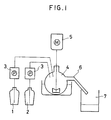
- Fig. 1 is a schematic vertical cross-sectional drawing of an apparatus wherein methyl silicate is dehydrated according to the method of the invention.
- the synthesis of silica by way of hydrolysis of an alkoxy silane comprises reacting methyl silicate and aqueous ammonia as by simultaneously dripping each into a reactor.
- This operation can be conducted, for example, in an apparatus which is schematically shown in Fig. 1 wherein reference numeral 1 designates a container for methyl silicate and 2 a container for aqueous ammonia.
- Each container is provided with a quantity measuring pump 3 connected to a reactor 4, which is equipped with a motor driven stirrer 5 and an exhaust port 6 to let out the product into a silica tank 7.
- Predetermined amounts of the methyl silicate and aqueous ammonia are taken from the containers 1 and 2, respectively, by means of the quantity measuring pump 3, and simultaneously dripped into the reactor 4.
- the hydrolysis of the methyl silicate begins at the start of the simultaneous dripping, and is continued by stirring of the reactor contents.
- the silica product is collected in the silica tank 7.
- the alkoxy silane used must be methyl silicate, for if ethyl silicate or methyl silicate trimer, for example, is used, the reactivity is so low that the resulting silica particles will be excessively small, and if butyl silicate is used, it is so water-repellent that the hydrolysis scarcely proceeds.
- the concentration of the ammonia in the aqueous ammonia used is preferably from about 15 to 25 weight %, and the reaction temperature is preferably from about 20 to 45 °C.
- silica particles When the hydrolysis of the methyl silicate is by dripping the methyl silicate and the aqueous ammonia simultaneously, the hydrolysis proceeds on its own, and continuously produces silica particles. This simplifies the reaction process and the product silica particles are relatively large, having a mean particle diameter of 300 to 700 nm. The silica particles are dehydrated until the water content becomes 20 to 30 %.
- This silica is then dispersed in pure water to obtain a silica dispersion solution, which is then adjusted with ammonia to a pH value of from about 9 to 13. If the solution is neutral or acidic, the strength of the resulting silica glass tends to be poor, and if the basicity of the solution is too strong, e. g., the pH value is 13 or greater, particles are formed which weaken the strength of the resulting silica glass. Therefore, in order to impart appropriate strength to the silica glass, it is necessary to restrict the pH value of the silica dispersion solution to the range of from about 9 to 13.
- methyl silicate is added to this alkaline silica dispersion solution to thereby solidify the silica in the solution. If the amount of the additive methyl silicate is too small, the solidification will be insufficient so that the strength of the resulting silica glass will be poor, and if the amount of the additive methyl silicate is excessive, the resulting silica glass tends to have reduced high-temperature viscosity. Accordingly, the amount of the methyl silicate added according to the invention, must be such that the silica in the methyl silicate accounts for 5 to 20 % of the all silica existing in the silica dispersion solution.
- the silica lumps thus obtained are then heated, dehydrated, de-solvented, decarburized and eventually sintered.
- the heating temperature for the dehydration, de-solventing, and decarburization is preferably from about 800 to 1,000°C.
- the dehydrated, de-solvented, decarburized silica lumps are then s intered to form a sintered synthetic silica glass body.
- this sintering was conducted at a relatively high temperature range, namely, 1,500 to 1,900 °C; however, with the inventive silica lumps obtained through the above-described method, the sintering temperature range can be relatively low, namely, from aobut 1,400 to 1,600 °C, and the sintering time can be as short as 1 to 2 hours.
- the thus sintered synthetic silica glass lumps can be pulverized and screened to provide synthetic silica glass powder.
- the synthetic silica glass lumps obtained with the present invention are easy to crack by means of a roll mill or the like, so that the pulverization step is facilitated. Also, since the possibility of pollution of the synthesized glass with impurities is minimized, the refinery step can be done away with.
- the synthetic silica glass obtained in accordance with the method of the invention has the advantage of forming a high-quality synthetic silica glass body having high viscosities at high temperatures. This is particularly advantageous when the cracked glass powder is sintered for about 30 minutes at a temperature above 1,700 °C, e. g., 1,950 °C, and is fused and molded into a shaped body, e.g., a crucible.
- Fig. 1 the reactor apparatus shown in Fig. 1 was employed. Methyl silicate and 20 weight % aqueous ammonia were simultaneously dripped into a 5-liter reactor 4 at respective rates of 26.5 lit./hr and 17.2 lit./hr, while the mixture in the reactor 4 was maintained at 40 to 50 °C to thereby undergo a reaction. The reaction was terminated after five hours. A silica sol liquid having a silica concentration of 23 % was obtained, which was then dehydrated to give a silica product having a moisture content of 25 weight %.
- the silica in an amount of 8 kg was dispersed in 5 liters of distilled water, and the dispersion solution was mixed with 350 liters of 29 weight % aqueous ammonia to thereby produce a pH value of 11.
- Methyl silicate was added to samples of this silica dispersion solution in amounts such that the silica contained in the additive methyl silicate accounted for 5 weight %, 10 weight %, 20 weight %, 30 weight %, and 40 weight %, respectively, of the all silica existing in the silica dispersion solution, whereupon the solution was solidified.
- the solids obtained were heated to 1,000 °C, dehydrated, de-solvented, decarburized, and eventually sintered at 1,480 ⁇ 10 °C.
- the sintered solids were crushed by a roller made of quartz glass, and classified by means of teflon mesh sieves to obtain powders of 50 - 100 mesh, which were then sintered at 1,950 °C for 30 minutes in an argon atmosphere, and melted and molded into plates measuring 200mm ⁇ 200 mm ⁇ 100mm. The viscosity of these plates at 1,400 °C were measured and the results are shown in the Table.
Landscapes
- Chemical & Material Sciences (AREA)
- Engineering & Computer Science (AREA)
- Chemical Kinetics & Catalysis (AREA)
- Materials Engineering (AREA)
- Organic Chemistry (AREA)
- Manufacturing & Machinery (AREA)
- Life Sciences & Earth Sciences (AREA)
- General Chemical & Material Sciences (AREA)
- Geochemistry & Mineralogy (AREA)
- Silicon Compounds (AREA)
- Glass Melting And Manufacturing (AREA)
- Glass Compositions (AREA)
Applications Claiming Priority (2)
| Application Number | Priority Date | Filing Date | Title |
|---|---|---|---|
| JP228906/89 | 1989-09-04 | ||
| JP1228906A JPH0393638A (ja) | 1989-09-04 | 1989-09-04 | 合成石英ガラス粉の製造方法 |
Publications (2)
| Publication Number | Publication Date |
|---|---|
| EP0416865A1 true EP0416865A1 (de) | 1991-03-13 |
| EP0416865B1 EP0416865B1 (de) | 1993-12-08 |
Family
ID=16883709
Family Applications (1)
| Application Number | Title | Priority Date | Filing Date |
|---|---|---|---|
| EP90309654A Expired - Lifetime EP0416865B1 (de) | 1989-09-04 | 1990-09-04 | Synthetisches Quarzglas und Verfahren zu dessen Herstellung |
Country Status (4)
| Country | Link |
|---|---|
| US (1) | US5021073A (de) |
| EP (1) | EP0416865B1 (de) |
| JP (1) | JPH0393638A (de) |
| DE (1) | DE69005063T2 (de) |
Families Citing this family (7)
| Publication number | Priority date | Publication date | Assignee | Title |
|---|---|---|---|---|
| US6110852A (en) * | 1994-12-26 | 2000-08-29 | Mitsubishi Chemical Corporation | Process for producing synthetic quartz glass powder |
| EP0844212B1 (de) * | 1996-11-20 | 2002-04-24 | Mitsubishi Chemical Corporation | Kieselsäuregel, synthetisches Quarzglaspulver und Formkörper aus Quarzglas |
| KR20030068730A (ko) * | 2002-02-16 | 2003-08-25 | 삼성전자주식회사 | 솔-젤 공정의 매크로 버블 제거 방법 |
| DE10260320B4 (de) * | 2002-12-20 | 2006-03-30 | Wacker Chemie Ag | Verglaster SiO2-Formkörper, Verfahren zu seiner Herstellung und Vorrichtung |
| JP2010159198A (ja) * | 2008-12-09 | 2010-07-22 | Nippon Electric Glass Co Ltd | プラズマディスプレイパネル用誘電体材料 |
| US8197782B2 (en) * | 2010-02-08 | 2012-06-12 | Momentive Performance Materials | Method for making high purity metal oxide particles and materials made thereof |
| US9249028B2 (en) | 2010-02-08 | 2016-02-02 | Momentive Performance Materials Inc. | Method for making high purity metal oxide particles and materials made thereof |
Citations (1)
| Publication number | Priority date | Publication date | Assignee | Title |
|---|---|---|---|---|
| EP0310486A2 (de) * | 1987-09-30 | 1989-04-05 | Shin-Etsu Chemical Co., Ltd. | Verfahren zur Herstellung von Kieselglas |
Family Cites Families (3)
| Publication number | Priority date | Publication date | Assignee | Title |
|---|---|---|---|---|
| DE3390375T1 (de) * | 1982-12-23 | 1985-02-07 | Suwa Seikosha Co. Ltd., Tokio/Tokyo | Verfahren zur Herstellung von Siliciumdioxidglas |
| JPS6191024A (ja) * | 1984-10-05 | 1986-05-09 | Seiko Epson Corp | 円筒状シリカ系ガラスの製造方法 |
| US4680049A (en) * | 1986-08-15 | 1987-07-14 | Gte Laboratories Incorporated | Process for molding optical components of silicate glass to a near net shape optical precision |
-
1989
- 1989-09-04 JP JP1228906A patent/JPH0393638A/ja active Granted
-
1990
- 1990-08-31 US US07/576,224 patent/US5021073A/en not_active Expired - Lifetime
- 1990-09-04 EP EP90309654A patent/EP0416865B1/de not_active Expired - Lifetime
- 1990-09-04 DE DE90309654T patent/DE69005063T2/de not_active Expired - Fee Related
Patent Citations (1)
| Publication number | Priority date | Publication date | Assignee | Title |
|---|---|---|---|---|
| EP0310486A2 (de) * | 1987-09-30 | 1989-04-05 | Shin-Etsu Chemical Co., Ltd. | Verfahren zur Herstellung von Kieselglas |
Non-Patent Citations (1)
| Title |
|---|
| CHEMICAL ABSTRACTS, vol. 108, no. 16, 18 April 1988 Columbus, Ohio, USA page 299; ref. no. 136475Q & JP-A-62292627 (SEIKO EPSON) (19-12-1987) * |
Also Published As
| Publication number | Publication date |
|---|---|
| US5021073A (en) | 1991-06-04 |
| EP0416865B1 (de) | 1993-12-08 |
| JPH0574535B2 (de) | 1993-10-18 |
| DE69005063D1 (de) | 1994-01-20 |
| DE69005063T2 (de) | 1994-04-21 |
| JPH0393638A (ja) | 1991-04-18 |
Similar Documents
| Publication | Publication Date | Title |
|---|---|---|
| US4241037A (en) | Process for purifying silicon | |
| US4539194A (en) | Method for production of pure silicon | |
| JPH072513A (ja) | 合成石英ガラス粉の製造方法 | |
| JP2617822B2 (ja) | 非焼結状クリストバライト粒子の製造方法 | |
| EP0692461B1 (de) | Synthetisches Silikaglaspulver | |
| EP0416865B1 (de) | Synthetisches Quarzglas und Verfahren zu dessen Herstellung | |
| KR100294312B1 (ko) | 합성석영유리분말및그의제조방법 | |
| JP2001220157A (ja) | 非晶質合成シリカ粉体及びこれを用いたガラス成形体 | |
| CN111170706A (zh) | 一种利用废硅泥制备蒸压加气混凝土砌块的方法 | |
| JPS62176928A (ja) | 石英ガラス粉末の製造方法 | |
| JP2528315B2 (ja) | 高純度球状シリカの製造方法 | |
| US5028247A (en) | Process for the preparation of silica glass powders | |
| KR20110052564A (ko) | 규소-기재 그린 바디 | |
| JP3040310B2 (ja) | 合成石英ガラスの製造方法 | |
| JP3318946B2 (ja) | 粉状乾燥ゲル、シリカガラス粉末及びシリカガラス溶融成形品の製造方法 | |
| RU2049060C1 (ru) | Способ получения жидкого стекла | |
| JPH0159975B2 (de) | ||
| JP3806956B2 (ja) | 合成石英ガラス粉の製造方法 | |
| JPH0151443B2 (de) | ||
| JPH07277723A (ja) | クリストバライト粒子の製造方法 | |
| JPH0798666B2 (ja) | 合成石英ガラス粉の製造方法 | |
| JPH0563416B2 (de) | ||
| JPH0521855B2 (de) | ||
| JPH0776100B2 (ja) | ガラス成形体の製造方法 | |
| JPH08231214A (ja) | 合成石英ガラス粉の製造方法 |
Legal Events
| Date | Code | Title | Description |
|---|---|---|---|
| PUAI | Public reference made under article 153(3) epc to a published international application that has entered the european phase |
Free format text: ORIGINAL CODE: 0009012 |
|
| AK | Designated contracting states |
Kind code of ref document: A1 Designated state(s): DE FR GB |
|
| 17P | Request for examination filed |
Effective date: 19910816 |
|
| 17Q | First examination report despatched |
Effective date: 19930217 |
|
| GRAA | (expected) grant |
Free format text: ORIGINAL CODE: 0009210 |
|
| AK | Designated contracting states |
Kind code of ref document: B1 Designated state(s): DE FR GB |
|
| REF | Corresponds to: |
Ref document number: 69005063 Country of ref document: DE Date of ref document: 19940120 |
|
| ET | Fr: translation filed | ||
| PLBE | No opposition filed within time limit |
Free format text: ORIGINAL CODE: 0009261 |
|
| STAA | Information on the status of an ep patent application or granted ep patent |
Free format text: STATUS: NO OPPOSITION FILED WITHIN TIME LIMIT |
|
| 26N | No opposition filed | ||
| REG | Reference to a national code |
Ref country code: GB Ref legal event code: IF02 |
|
| PGFP | Annual fee paid to national office [announced via postgrant information from national office to epo] |
Ref country code: GB Payment date: 20030903 Year of fee payment: 14 |
|
| PGFP | Annual fee paid to national office [announced via postgrant information from national office to epo] |
Ref country code: FR Payment date: 20030909 Year of fee payment: 14 |
|
| PGFP | Annual fee paid to national office [announced via postgrant information from national office to epo] |
Ref country code: DE Payment date: 20030911 Year of fee payment: 14 |
|
| PG25 | Lapsed in a contracting state [announced via postgrant information from national office to epo] |
Ref country code: GB Free format text: LAPSE BECAUSE OF NON-PAYMENT OF DUE FEES Effective date: 20040904 |
|
| PG25 | Lapsed in a contracting state [announced via postgrant information from national office to epo] |
Ref country code: DE Free format text: LAPSE BECAUSE OF NON-PAYMENT OF DUE FEES Effective date: 20050401 |
|
| GBPC | Gb: european patent ceased through non-payment of renewal fee |
Effective date: 20040904 |
|
| PG25 | Lapsed in a contracting state [announced via postgrant information from national office to epo] |
Ref country code: FR Free format text: LAPSE BECAUSE OF NON-PAYMENT OF DUE FEES Effective date: 20050531 |
|
| REG | Reference to a national code |
Ref country code: FR Ref legal event code: ST |