EP0417439A2 - Silyl derivatives of 2-allyl phenol - Google Patents
Silyl derivatives of 2-allyl phenol Download PDFInfo
- Publication number
- EP0417439A2 EP0417439A2 EP90114174A EP90114174A EP0417439A2 EP 0417439 A2 EP0417439 A2 EP 0417439A2 EP 90114174 A EP90114174 A EP 90114174A EP 90114174 A EP90114174 A EP 90114174A EP 0417439 A2 EP0417439 A2 EP 0417439A2
- Authority
- EP
- European Patent Office
- Prior art keywords
- allyl
- phenoxy
- silane
- allyl phenol
- silyl derivatives
- Prior art date
- Legal status (The legal status is an assumption and is not a legal conclusion. Google has not performed a legal analysis and makes no representation as to the accuracy of the status listed.)
- Withdrawn
Links
Classifications
-
- C—CHEMISTRY; METALLURGY
- C08—ORGANIC MACROMOLECULAR COMPOUNDS; THEIR PREPARATION OR CHEMICAL WORKING-UP; COMPOSITIONS BASED THEREON
- C08F—MACROMOLECULAR COMPOUNDS OBTAINED BY REACTIONS ONLY INVOLVING CARBON-TO-CARBON UNSATURATED BONDS
- C08F8/00—Chemical modification by after-treatment
-
- C—CHEMISTRY; METALLURGY
- C07—ORGANIC CHEMISTRY
- C07F—ACYCLIC, CARBOCYCLIC OR HETEROCYCLIC COMPOUNDS CONTAINING ELEMENTS OTHER THAN CARBON, HYDROGEN, HALOGEN, OXYGEN, NITROGEN, SULFUR, SELENIUM OR TELLURIUM
- C07F7/00—Compounds containing elements of Groups 4 or 14 of the Periodic Table
- C07F7/02—Silicon compounds
- C07F7/08—Compounds having one or more C—Si linkages
- C07F7/18—Compounds having one or more C—Si linkages as well as one or more C—O—Si linkages
- C07F7/1804—Compounds having Si-O-C linkages
-
- C—CHEMISTRY; METALLURGY
- C08—ORGANIC MACROMOLECULAR COMPOUNDS; THEIR PREPARATION OR CHEMICAL WORKING-UP; COMPOSITIONS BASED THEREON
- C08F—MACROMOLECULAR COMPOUNDS OBTAINED BY REACTIONS ONLY INVOLVING CARBON-TO-CARBON UNSATURATED BONDS
- C08F210/00—Copolymers of unsaturated aliphatic hydrocarbons having only one carbon-to-carbon double bond
-
- C—CHEMISTRY; METALLURGY
- C08—ORGANIC MACROMOLECULAR COMPOUNDS; THEIR PREPARATION OR CHEMICAL WORKING-UP; COMPOSITIONS BASED THEREON
- C08F—MACROMOLECULAR COMPOUNDS OBTAINED BY REACTIONS ONLY INVOLVING CARBON-TO-CARBON UNSATURATED BONDS
- C08F30/00—Homopolymers or copolymers of compounds having one or more unsaturated aliphatic radicals, each having only one carbon-to-carbon double bond, and containing phosphorus, selenium, tellurium or a metal
- C08F30/04—Homopolymers or copolymers of compounds having one or more unsaturated aliphatic radicals, each having only one carbon-to-carbon double bond, and containing phosphorus, selenium, tellurium or a metal containing a metal
- C08F30/08—Homopolymers or copolymers of compounds having one or more unsaturated aliphatic radicals, each having only one carbon-to-carbon double bond, and containing phosphorus, selenium, tellurium or a metal containing a metal containing silicon
-
- C—CHEMISTRY; METALLURGY
- C08—ORGANIC MACROMOLECULAR COMPOUNDS; THEIR PREPARATION OR CHEMICAL WORKING-UP; COMPOSITIONS BASED THEREON
- C08F—MACROMOLECULAR COMPOUNDS OBTAINED BY REACTIONS ONLY INVOLVING CARBON-TO-CARBON UNSATURATED BONDS
- C08F8/00—Chemical modification by after-treatment
- C08F8/12—Hydrolysis
-
- C—CHEMISTRY; METALLURGY
- C08—ORGANIC MACROMOLECULAR COMPOUNDS; THEIR PREPARATION OR CHEMICAL WORKING-UP; COMPOSITIONS BASED THEREON
- C08K—Use of inorganic or non-macromolecular organic substances as compounding ingredients
- C08K5/00—Use of organic ingredients
- C08K5/54—Silicon-containing compounds
-
- C—CHEMISTRY; METALLURGY
- C08—ORGANIC MACROMOLECULAR COMPOUNDS; THEIR PREPARATION OR CHEMICAL WORKING-UP; COMPOSITIONS BASED THEREON
- C08L—COMPOSITIONS OF MACROMOLECULAR COMPOUNDS
- C08L23/00—Compositions of homopolymers or copolymers of unsaturated aliphatic hydrocarbons having only one carbon-to-carbon double bond; Compositions of derivatives of such polymers
- C08L23/02—Compositions of homopolymers or copolymers of unsaturated aliphatic hydrocarbons having only one carbon-to-carbon double bond; Compositions of derivatives of such polymers not modified by chemical after-treatment
-
- C—CHEMISTRY; METALLURGY
- C08—ORGANIC MACROMOLECULAR COMPOUNDS; THEIR PREPARATION OR CHEMICAL WORKING-UP; COMPOSITIONS BASED THEREON
- C08F—MACROMOLECULAR COMPOUNDS OBTAINED BY REACTIONS ONLY INVOLVING CARBON-TO-CARBON UNSATURATED BONDS
- C08F210/00—Copolymers of unsaturated aliphatic hydrocarbons having only one carbon-to-carbon double bond
- C08F210/04—Monomers containing three or four carbon atoms
- C08F210/06—Propene
-
- C—CHEMISTRY; METALLURGY
- C08—ORGANIC MACROMOLECULAR COMPOUNDS; THEIR PREPARATION OR CHEMICAL WORKING-UP; COMPOSITIONS BASED THEREON
- C08F—MACROMOLECULAR COMPOUNDS OBTAINED BY REACTIONS ONLY INVOLVING CARBON-TO-CARBON UNSATURATED BONDS
- C08F210/00—Copolymers of unsaturated aliphatic hydrocarbons having only one carbon-to-carbon double bond
- C08F210/16—Copolymers of ethene with alpha-alkenes, e.g. EP rubbers
Definitions
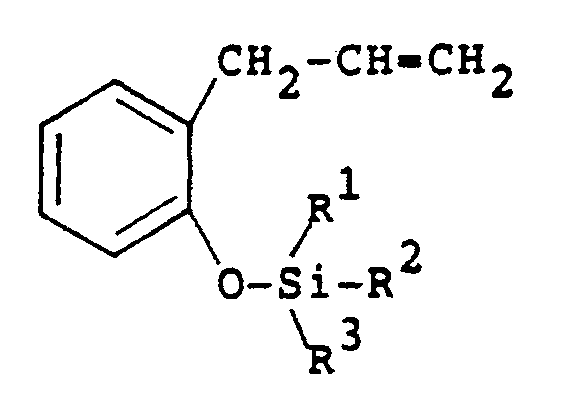
- This invention relates to new silyl derivatives of a certain substituted phenol, specifically to silyl derivatives of 2-allyl phenol.
- it relates to compositions of the formula wherein R1, R2 and R3 are independently selected from linear, branched, and cyclic hydrocarbon groups having from one to about eight carbon atoms.
- comonomers for propylene may be made by protecting the oxygen of a copolymerizable hydroxy-containing compound by substituting the hydrogen thereof with a silyl group having a minimum steric bulk, i.e., at least about three carbon atoms surrounding it.
- the compound 2-allyl phenol is known.
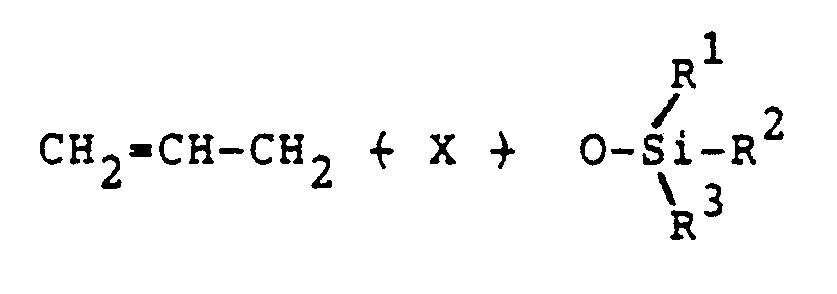
- Silylated monomers of the general formula where ( ⁇ X ) ⁇ may be a divalent connecting group are suggested in our above-mentioned co-pending application as comonomers for propylene for the introduction of functional sites to copolymers made by Ziegler-Natta catalysis.
- R1, R2 and R3 are independently selected from linear, branched, and cyclic hydrocarbon groups having from one to about eight carbon atoms. It includes (2-allyl) phenoxy triisopropyl silane, (2-allyl) phenoxy dimethyl phenyl silane, (2-allyl) phenoxy diphenyl methyl silane, (2-allyl) phenoxy trimethyl silane, and (2-allyl) phenoxy triethyl silane.
- Example 2 The synthetic method described in Example 1 was used to prepare (2-allyl) phenoxy tri- iso -propyl silane.
- Example 3 The synthetic method described in Example 1 was used to prepare (2-allyl) phenoxy diphenylmethyl silane.
- Standard inert atmosphere techniques were used to exclude moisture and oxygen throughout the manipulations recited below for copolymerization of monomers such as those described above with lower olefins such as propylene.
- the solvents were freshly distilled from sodium and triethyl aluminum (TEA) over which they had been refluxing for at least 18 hours under an inert atmosphere.
- the inert gas atmosphere in the flask was replaced with the gaseous comonomer (propylene or ethylene) by a minimum of 3 cycles of evacuation and refilling back to atmospheric pressure with the comonomer.
- the solution was stirred for at least 10 minutes (usually longer) to allow the solvent to become saturated with the comonomer. Pressure was maintained at about one atmosphere via a bubbler.
- an "external donor” which usually was diphenyl dimethoxy silane or phenyl triethoxy silane, if one was being used, and the other comonomer.
- the polymerization was initiated by the addition of the transition metal containing co-catalyst, which was a titanium tetrachloride on a magnesium chloride support.
- the reaction was quenched by the addition of acidified alcohol (HCl in iso-propanol, ethanol, and/or methanol).
- acidified alcohol HCl in iso-propanol, ethanol, and/or methanol.
- the quenched reaction slurry was combined with the alcohol solution of volume at least twice the original volume of the inert reaction solvent.
- the resultant slurry was stirred for at least 45 minutes and then filtered. This treatment not only stopped the reaction, it dissolved catalyst residues and removed the silyl groups and thus regenerated the hydroxyl groups.
- the slurry was combined with enough water to make the filtration proceed at a convenient rate.
- the polymer was resuspended in alcohol, stirred, filtered and vacuum dried overnight. Boiling heptane soluble content was determined by standard methods.
- This mixture was then lowered into an oil bath which was maintained at 50° C and 0.095g of the titanium co-catalyst (which served to initiate the polymerization) were added.
- the reaction proceeded over a period of two hours and was subsequently quenched by the addition of approximately 300 ml of acidified isopropanol.
- Stirring of this alcoholic suspension continued for approximately one hour followed by filtration of the product and resuspension of the polymer in isopropanol with stirring for one-half hour. The product was then filtered and vacuum dried.
Landscapes
- Chemical & Material Sciences (AREA)
- Organic Chemistry (AREA)
- Health & Medical Sciences (AREA)
- Chemical Kinetics & Catalysis (AREA)
- Medicinal Chemistry (AREA)
- Polymers & Plastics (AREA)
- General Chemical & Material Sciences (AREA)
- Addition Polymer Or Copolymer, Post-Treatments, Or Chemical Modifications (AREA)
Abstract

where R¹, R² and R³ are independently selected from alkyl and phenyl groups having up to about twelve carbon atoms. They may be made by silylating the corresponding hydroxyl compound. They are useful as comonomers for olefins to introduce functional sites by Ziegler-Natta catalyst systems.
Description
- This is a continuation-in-part of our co-pending application Serial No. 257,895 filed October 14, 1988, entitled "Incorporation of Functional Groups in Polymers", which is a continuation-in-part of our now abandoned application Serial No. 047,960 filed May 8, 1987, also entitled "Incorporation of Functional Groups in Polymers"; the entire specification and claims of both applications are incorporated herein by reference.
- This invention relates to new silyl derivatives of a certain substituted phenol, specifically to silyl derivatives of 2-allyl phenol. In particular, it relates to compositions of the formula

- In European Patent Application No. 88900936.1 (see corresponding PCT International Publication No. WO88/08856, November 17, 1988) and our co-pending patent application Serial No. 257,895, it is disclosed that comonomers for propylene may be made by protecting the oxygen of a copolymerizable hydroxy-containing compound by substituting the hydrogen thereof with a silyl group having a minimum steric bulk, i.e., at least about three carbon atoms surrounding it.
- The compound 2-allyl phenol is known.
- Silylated monomers of the general formula
- The peculiar advantage of 2-allyl phenol as a potential comonomer in its silylated form apparently has not been seen in the prior art; it is believed this comonomer is novel as a composition of matter.
- The invention herein is a series of new compounds of the formula

- Following are examples of the preparation of compounds which fall within the above general formula.
- All manipulations were performed under inert atmosphere using standard Schlenk techniques. All liquid reagents and solvents were purged with inert gas prior to their introduction into the reaction system. 58.36g (0.435 mol) of 2-allyl phenol was added to a 1000 ml round bottom flask with an argon inlet followed by 150 ml of toluene. The mixture was cooled to 0°C and 10.07g (0.438 mol) sodium chunks were added in three aliquots. The cold bath was removed one-half hour after the final sodium addition. The formation of NaCl precipitate eventually caused the mixture to stop stirring and therefore after two hours, 50 ml of tetrahydrofuran were added. The mixture stirred at room temperature overnight.
- 425 ml of heptane were then added and thc precipitate was allowed to settle out over a period of two hours. The mixture wad filtered through fritted glass with Celite and produced a clear, gold solution. The low boiling components were removed by atmospheric distillation up to a temperature of 120°C. Vacuum distillation of the resultant solution yielded a major component which was distilled at 130-132°C (2 mm Hg). The collected product represented a 63% yield and were characterized by ¹H NMR and gcms.
- Standard inert atmosphere techniques were used to exclude moisture and oxygen throughout the manipulations recited below for copolymerization of monomers such as those described above with lower olefins such as propylene.
- A round bottom flask fitted with a side arm, magnetic stirring bar and a stopper, which apparatus had been assembled hot from a drying oven and was then either evacuated and refilled with inert gas several times or (and) purged with the inert gas for at least 15 minutes, was charged with a given amount of solvent, heptane or toluene, usually 125 ml. The solvents were freshly distilled from sodium and triethyl aluminum (TEA) over which they had been refluxing for at least 18 hours under an inert atmosphere. Immediately after the solvent had been charged to the flask alkyl aluminum co-catalyst, which was in the form of a heptane solution of about 25 wt% (0.715 g/ml in heptane), was also added to the flask which was then lowered into a thermostated oil bath and magnetic stirring was begun.
- At this point the inert gas atmosphere in the flask was replaced with the gaseous comonomer (propylene or ethylene) by a minimum of 3 cycles of evacuation and refilling back to atmospheric pressure with the comonomer. After the third cycle, the solution was stirred for at least 10 minutes (usually longer) to allow the solvent to become saturated with the comonomer. Pressure was maintained at about one atmosphere via a bubbler.
- Next were added an "external donor", which usually was diphenyl dimethoxy silane or phenyl triethoxy silane, if one was being used, and the other comonomer. The polymerization was initiated by the addition of the transition metal containing co-catalyst, which was a titanium tetrachloride on a magnesium chloride support.
- As the gaseous comonomer was consumed it was replaced by maintaining the pressure constant at one atmosphere via a bubbler.
- After a predetermined period of time (generally about two hours) the reaction was quenched by the addition of acidified alcohol (HCl in iso-propanol, ethanol, and/or methanol). The quenched reaction slurry was combined with the alcohol solution of volume at least twice the original volume of the inert reaction solvent. The resultant slurry was stirred for at least 45 minutes and then filtered. This treatment not only stopped the reaction, it dissolved catalyst residues and removed the silyl groups and thus regenerated the hydroxyl groups.
- If the filtration proceeded very slowly, the slurry was combined with enough water to make the filtration proceed at a convenient rate.
- The polymer was resuspended in alcohol, stirred, filtered and vacuum dried overnight. Boiling heptane soluble content was determined by standard methods.
- A 500 ml round bottom flask which was fitted with a sidearm was evacuated and refilled with argon three times. To this flask were added 125 ml of dry, degassed heptane followed by 3.8 ml (0.018 mol) of (2-allyl) phenoxy trimethyl silane. The solution was subsequently saturated with propylene and 5.3 ml of the triethylaluminum co-catalyst (0.715 g/ml in heptane) was injected into the flask.
- This mixture was then lowered into an oil bath which was maintained at 50° C and 0.095g of the titanium co-catalyst (which served to initiate the polymerization) were added. The reaction proceeded over a period of two hours and was subsequently quenched by the addition of approximately 300 ml of acidified isopropanol. Stirring of this alcoholic suspension continued for approximately one hour followed by filtration of the product and resuspension of the polymer in isopropanol with stirring for one-half hour. The product was then filtered and vacuum dried.
Claims (6)
Applications Claiming Priority (2)
| Application Number | Priority Date | Filing Date | Title |
|---|---|---|---|
| US405245 | 1989-09-11 | ||
| US07/405,245 US4970329A (en) | 1987-05-08 | 1989-09-11 | Silyl derivatives of 2-allyl phenol |
Publications (2)
| Publication Number | Publication Date |
|---|---|
| EP0417439A2 true EP0417439A2 (en) | 1991-03-20 |
| EP0417439A3 EP0417439A3 (en) | 1992-06-03 |
Family
ID=23602886
Family Applications (1)
| Application Number | Title | Priority Date | Filing Date |
|---|---|---|---|
| EP19900114174 Withdrawn EP0417439A3 (en) | 1989-09-11 | 1990-07-24 | Silyl derivatives of 2-allyl phenol |
Country Status (4)
| Country | Link |
|---|---|
| US (1) | US4970329A (en) |
| EP (1) | EP0417439A3 (en) |
| JP (1) | JPH03106890A (en) |
| CA (1) | CA2024895C (en) |
Families Citing this family (5)
| Publication number | Priority date | Publication date | Assignee | Title |
|---|---|---|---|---|
| US5329037A (en) * | 1987-05-08 | 1994-07-12 | Aristech Chemical Corporation | Incorporation of functional groups in polymers |
| US5367090A (en) * | 1987-05-08 | 1994-11-22 | Aristech Chemical Corporation | Incorporation of functional groups in polymers |
| US5296626A (en) * | 1987-05-08 | 1994-03-22 | Aristech Chemical Corporation | Incorporation of functional groups in polymers |
| US5266663A (en) * | 1989-07-05 | 1993-11-30 | Aristech Chemical Corporation | Silyl derivatives of eugenol |
| JP5033613B2 (en) * | 2006-12-26 | 2012-09-26 | 日本ポリプロ株式会社 | Olefin copolymer, method for producing the same, and method for modifying the copolymer |
Family Cites Families (8)
| Publication number | Priority date | Publication date | Assignee | Title |
|---|---|---|---|---|
| US2611778A (en) * | 1949-11-29 | 1952-09-23 | Dow Corning | Halophenoxysilanes |
| US3083219A (en) * | 1961-03-15 | 1963-03-26 | Gen Electric | Intercondensation of tetrahydrofuran with organohalosilanes |
| US3489783A (en) * | 1966-09-06 | 1970-01-13 | Hooker Chemical Corp | Alkaryloxy substituted hydroxy silanes and siloxanes |
| JPS601190A (en) * | 1983-06-18 | 1985-01-07 | Tokuyama Soda Co Ltd | Preparation of silyl ester of p-halogenated phenol |
| JPS6023384A (en) * | 1983-07-18 | 1985-02-05 | Tokuyama Soda Co Ltd | Method for producing silyl esters of alkylphenols |
| WO1988008856A1 (en) * | 1987-05-08 | 1988-11-17 | Aristech Chemical Corporation | Incorporation of functional groups in polymers |
| JPS6423259A (en) * | 1987-07-20 | 1989-01-25 | Canon Kk | Electrophotographic sensitive body |
| US4783495A (en) * | 1987-11-20 | 1988-11-08 | Ciba-Geigy Corporation | (Hydroxyphenyl) silane stabilizers |
-
1989
- 1989-09-11 US US07/405,245 patent/US4970329A/en not_active Expired - Lifetime
-
1990
- 1990-07-24 EP EP19900114174 patent/EP0417439A3/en not_active Withdrawn
- 1990-09-07 CA CA002024895A patent/CA2024895C/en not_active Expired - Fee Related
- 1990-09-10 JP JP2237270A patent/JPH03106890A/en active Pending
Also Published As
| Publication number | Publication date |
|---|---|
| JPH03106890A (en) | 1991-05-07 |
| CA2024895A1 (en) | 1991-03-12 |
| CA2024895C (en) | 2000-02-22 |
| EP0417439A3 (en) | 1992-06-03 |
| US4970329A (en) | 1990-11-13 |
Similar Documents
| Publication | Publication Date | Title |
|---|---|---|
| EP0671417A2 (en) | Components and catalysts for the copolymerisation of olefins | |
| KR0173849B1 (en) | Organosilane compounds | |
| EP0773241B1 (en) | Solid catalyst component for polymerizing olefins and catalyst for polymerization of olefins | |
| US5008421A (en) | Silyl derivatives of 2,6-dimethyl-4-allyl phenol | |
| US5547912A (en) | Solid catalyst component for polymerizing olefins and catalyst containing the same | |
| CA2046239C (en) | Catalyst for the polymerization of alpha-olefins containing trifluoro-propyl substituted silane compounds | |
| US4916248A (en) | Silyl derivatives of 2, 6-dimethyl-4-allyl phenol | |
| CA2018728A1 (en) | Preparation of alkyl methacrylate monomers for anionic polymerization | |
| US4970329A (en) | Silyl derivatives of 2-allyl phenol | |
| US5110971A (en) | Silyl derivatives of eugenol | |
| KR0139089B1 (en) | Catalyst System for Polymerization of Olefin | |
| US5244853A (en) | Catalyst component for ethylene polymerization | |
| US4968653A (en) | Propylene polymerization catalyst | |
| US4452912A (en) | Process for producing a supported catalyst for the polymerization of .alpha. | |
| US5266663A (en) | Silyl derivatives of eugenol | |
| EP0290151B1 (en) | Transition metal composition | |
| JP3244225B2 (en) | Catalytic polymerization of olefin | |
| US5206323A (en) | Silyl derivatives of eugenol | |
| EP0576413B1 (en) | Electron donors for improved olefin polymerization | |
| KR100347077B1 (en) | Organosilicon compound, Ziegler-Natta catalyst containing the same and process for polymerization of olefins | |
| US5036147A (en) | Propylene polymerization method | |
| KR810001604B1 (en) | Olefine polymerization catalyst and polymerization process | |
| CN109251258A (en) | Broad distribution polypropylene catalytic component, component preparation method and catalyst thereof | |
| GB2191778A (en) | Olefin polymerisation catalyst composition |
Legal Events
| Date | Code | Title | Description |
|---|---|---|---|
| PUAI | Public reference made under article 153(3) epc to a published international application that has entered the european phase |
Free format text: ORIGINAL CODE: 0009012 |
|
| AK | Designated contracting states |
Kind code of ref document: A2 Designated state(s): AT BE CH DE FR GB IT LI LU NL |
|
| PUAL | Search report despatched |
Free format text: ORIGINAL CODE: 0009013 |
|
| AK | Designated contracting states |
Kind code of ref document: A3 Designated state(s): AT BE CH DE FR GB IT LI LU NL |
|
| 17P | Request for examination filed |
Effective date: 19920827 |
|
| 17Q | First examination report despatched |
Effective date: 19950426 |
|
| STAA | Information on the status of an ep patent application or granted ep patent |
Free format text: STATUS: THE APPLICATION IS DEEMED TO BE WITHDRAWN |
|
| 18D | Application deemed to be withdrawn |
Effective date: 19951107 |