EP0417705A1 - Procédé et système pour mise au rebut de boues d'égout aqueuses - Google Patents
Procédé et système pour mise au rebut de boues d'égout aqueuses Download PDFInfo
- Publication number
- EP0417705A1 EP0417705A1 EP90117411A EP90117411A EP0417705A1 EP 0417705 A1 EP0417705 A1 EP 0417705A1 EP 90117411 A EP90117411 A EP 90117411A EP 90117411 A EP90117411 A EP 90117411A EP 0417705 A1 EP0417705 A1 EP 0417705A1
- Authority
- EP
- European Patent Office
- Prior art keywords
- cement
- gas
- quicklime
- sewage sludge
- solids
- Prior art date
- Legal status (The legal status is an assumption and is not a legal conclusion. Google has not performed a legal analysis and makes no representation as to the accuracy of the status listed.)
- Granted
Links
- 238000000034 method Methods 0.000 title claims abstract description 35
- 239000010801 sewage sludge Substances 0.000 title claims abstract description 35
- 239000004568 cement Substances 0.000 claims abstract description 56
- ODINCKMPIJJUCX-UHFFFAOYSA-N Calcium oxide Chemical compound [Ca]=O ODINCKMPIJJUCX-UHFFFAOYSA-N 0.000 claims abstract description 44
- 239000000292 calcium oxide Substances 0.000 claims abstract description 22
- 235000012255 calcium oxide Nutrition 0.000 claims abstract description 22
- 239000002994 raw material Substances 0.000 claims abstract description 22
- 239000007787 solid Substances 0.000 claims abstract description 22
- 239000000463 material Substances 0.000 claims abstract description 18
- 230000018044 dehydration Effects 0.000 claims abstract description 11
- 238000006297 dehydration reaction Methods 0.000 claims abstract description 11
- 239000010802 sludge Substances 0.000 claims abstract description 11
- 238000002156 mixing Methods 0.000 claims abstract description 7
- 238000006243 chemical reaction Methods 0.000 claims abstract description 5
- XLYOFNOQVPJJNP-UHFFFAOYSA-N water Chemical compound O XLYOFNOQVPJJNP-UHFFFAOYSA-N 0.000 claims description 25
- QGZKDVFQNNGYKY-UHFFFAOYSA-N Ammonia Chemical compound N QGZKDVFQNNGYKY-UHFFFAOYSA-N 0.000 claims description 14
- 238000004821 distillation Methods 0.000 claims description 8
- 239000000126 substance Substances 0.000 claims description 6
- 229910021529 ammonia Inorganic materials 0.000 claims description 5
- 239000002893 slag Substances 0.000 claims description 4
- 239000002245 particle Substances 0.000 claims description 3
- 239000010459 dolomite Substances 0.000 claims description 2
- 229910000514 dolomite Inorganic materials 0.000 claims description 2
- 238000001914 filtration Methods 0.000 claims 1
- 238000010438 heat treatment Methods 0.000 claims 1
- 239000000203 mixture Substances 0.000 claims 1
- 238000011144 upstream manufacturing Methods 0.000 claims 1
- 239000007789 gas Substances 0.000 abstract description 15
- 239000000446 fuel Substances 0.000 abstract description 4
- 239000002699 waste material Substances 0.000 abstract description 3
- AXCZMVOFGPJBDE-UHFFFAOYSA-L calcium dihydroxide Chemical compound [OH-].[OH-].[Ca+2] AXCZMVOFGPJBDE-UHFFFAOYSA-L 0.000 description 6
- 239000000920 calcium hydroxide Substances 0.000 description 6
- 235000011116 calcium hydroxide Nutrition 0.000 description 6
- 229910001861 calcium hydroxide Inorganic materials 0.000 description 6
- 239000000470 constituent Substances 0.000 description 5
- 241000196324 Embryophyta Species 0.000 description 4
- VHUUQVKOLVNVRT-UHFFFAOYSA-N Ammonium hydroxide Chemical compound [NH4+].[OH-] VHUUQVKOLVNVRT-UHFFFAOYSA-N 0.000 description 3
- 235000008733 Citrus aurantifolia Nutrition 0.000 description 3
- 235000011941 Tilia x europaea Nutrition 0.000 description 3
- 235000011114 ammonium hydroxide Nutrition 0.000 description 3
- 239000002361 compost Substances 0.000 description 3
- 239000000428 dust Substances 0.000 description 3
- 239000004571 lime Substances 0.000 description 3
- XEEYBQQBJWHFJM-UHFFFAOYSA-N Iron Chemical compound [Fe] XEEYBQQBJWHFJM-UHFFFAOYSA-N 0.000 description 2
- 235000019738 Limestone Nutrition 0.000 description 2
- VYPSYNLAJGMNEJ-UHFFFAOYSA-N Silicium dioxide Chemical compound O=[Si]=O VYPSYNLAJGMNEJ-UHFFFAOYSA-N 0.000 description 2
- QAOWNCQODCNURD-UHFFFAOYSA-N Sulfuric acid Chemical compound OS(O)(=O)=O QAOWNCQODCNURD-UHFFFAOYSA-N 0.000 description 2
- 238000013019 agitation Methods 0.000 description 2
- PNEYBMLMFCGWSK-UHFFFAOYSA-N aluminium oxide Inorganic materials [O-2].[O-2].[O-2].[Al+3].[Al+3] PNEYBMLMFCGWSK-UHFFFAOYSA-N 0.000 description 2
- 230000000694 effects Effects 0.000 description 2
- 238000000855 fermentation Methods 0.000 description 2
- 230000004151 fermentation Effects 0.000 description 2
- 239000006028 limestone Substances 0.000 description 2
- 238000004519 manufacturing process Methods 0.000 description 2
- 238000006386 neutralization reaction Methods 0.000 description 2
- 229910000069 nitrogen hydride Inorganic materials 0.000 description 2
- 239000000843 powder Substances 0.000 description 2
- 239000010865 sewage Substances 0.000 description 2
- 206010067482 No adverse event Diseases 0.000 description 1
- 240000007594 Oryza sativa Species 0.000 description 1
- 235000007164 Oryza sativa Nutrition 0.000 description 1
- 239000011398 Portland cement Substances 0.000 description 1
- 230000002411 adverse Effects 0.000 description 1
- 238000001354 calcination Methods 0.000 description 1
- 239000003795 chemical substances by application Substances 0.000 description 1
- 238000002485 combustion reaction Methods 0.000 description 1
- 230000003247 decreasing effect Effects 0.000 description 1
- 238000010586 diagram Methods 0.000 description 1
- 238000001035 drying Methods 0.000 description 1
- 239000010842 industrial wastewater Substances 0.000 description 1
- 229910052742 iron Inorganic materials 0.000 description 1
- 235000009566 rice Nutrition 0.000 description 1
- 239000000377 silicon dioxide Substances 0.000 description 1
- 238000007711 solidification Methods 0.000 description 1
- 230000008023 solidification Effects 0.000 description 1
- 239000002351 wastewater Substances 0.000 description 1
- 238000004065 wastewater treatment Methods 0.000 description 1
Images
Classifications
-
- C—CHEMISTRY; METALLURGY
- C04—CEMENTS; CONCRETE; ARTIFICIAL STONE; CERAMICS; REFRACTORIES
- C04B—LIME, MAGNESIA; SLAG; CEMENTS; COMPOSITIONS THEREOF, e.g. MORTARS, CONCRETE OR LIKE BUILDING MATERIALS; ARTIFICIAL STONE; CERAMICS; REFRACTORIES; TREATMENT OF NATURAL STONE
- C04B2/00—Lime, magnesia or dolomite
- C04B2/02—Lime
- C04B2/04—Slaking
- C04B2/06—Slaking with addition of substances, e.g. hydrophobic agents ; Slaking in the presence of other compounds
- C04B2/066—Making use of the hydration reaction, e.g. the reaction heat for dehydrating gypsum; Chemical drying by using unslaked lime
-
- C—CHEMISTRY; METALLURGY
- C04—CEMENTS; CONCRETE; ARTIFICIAL STONE; CERAMICS; REFRACTORIES
- C04B—LIME, MAGNESIA; SLAG; CEMENTS; COMPOSITIONS THEREOF, e.g. MORTARS, CONCRETE OR LIKE BUILDING MATERIALS; ARTIFICIAL STONE; CERAMICS; REFRACTORIES; TREATMENT OF NATURAL STONE
- C04B7/00—Hydraulic cements
- C04B7/24—Cements from oil shales, residues or waste other than slag
-
- Y—GENERAL TAGGING OF NEW TECHNOLOGICAL DEVELOPMENTS; GENERAL TAGGING OF CROSS-SECTIONAL TECHNOLOGIES SPANNING OVER SEVERAL SECTIONS OF THE IPC; TECHNICAL SUBJECTS COVERED BY FORMER USPC CROSS-REFERENCE ART COLLECTIONS [XRACs] AND DIGESTS
- Y02—TECHNOLOGIES OR APPLICATIONS FOR MITIGATION OR ADAPTATION AGAINST CLIMATE CHANGE
- Y02E—REDUCTION OF GREENHOUSE GAS [GHG] EMISSIONS, RELATED TO ENERGY GENERATION, TRANSMISSION OR DISTRIBUTION
- Y02E50/00—Technologies for the production of fuel of non-fossil origin
- Y02E50/30—Fuel from waste, e.g. synthetic alcohol or diesel
-
- Y—GENERAL TAGGING OF NEW TECHNOLOGICAL DEVELOPMENTS; GENERAL TAGGING OF CROSS-SECTIONAL TECHNOLOGIES SPANNING OVER SEVERAL SECTIONS OF THE IPC; TECHNICAL SUBJECTS COVERED BY FORMER USPC CROSS-REFERENCE ART COLLECTIONS [XRACs] AND DIGESTS
- Y02—TECHNOLOGIES OR APPLICATIONS FOR MITIGATION OR ADAPTATION AGAINST CLIMATE CHANGE
- Y02P—CLIMATE CHANGE MITIGATION TECHNOLOGIES IN THE PRODUCTION OR PROCESSING OF GOODS
- Y02P40/00—Technologies relating to the processing of minerals
- Y02P40/10—Production of cement, e.g. improving or optimising the production methods; Cement grinding
-
- Y—GENERAL TAGGING OF NEW TECHNOLOGICAL DEVELOPMENTS; GENERAL TAGGING OF CROSS-SECTIONAL TECHNOLOGIES SPANNING OVER SEVERAL SECTIONS OF THE IPC; TECHNICAL SUBJECTS COVERED BY FORMER USPC CROSS-REFERENCE ART COLLECTIONS [XRACs] AND DIGESTS
- Y02—TECHNOLOGIES OR APPLICATIONS FOR MITIGATION OR ADAPTATION AGAINST CLIMATE CHANGE
- Y02P—CLIMATE CHANGE MITIGATION TECHNOLOGIES IN THE PRODUCTION OR PROCESSING OF GOODS
- Y02P40/00—Technologies relating to the processing of minerals
- Y02P40/40—Production or processing of lime, e.g. limestone regeneration of lime in pulp and sugar mills
- Y02P40/45—Production or processing of lime, e.g. limestone regeneration of lime in pulp and sugar mills using fuels from renewable energy sources
Definitions
- This invention relates to a system for disposal of aqueous sewage sludge by using it to make cement. Recently, amounts of sewage sludge released mainly from waste water treatment plants are increasing year by year, and are being treated by various processes.
- sewage sludge is mixed with fermentation auxiliaries, such as rice hulls and saw dust, and subjected to fermentation to produce compost.
- fermentation auxiliaries such as rice hulls and saw dust
- This compost is used for farmland, but its consumption is limited in quantity, and it is difficult to consume and reduce large amounts of compost.
- Another method is to throw untreated sewage sludge into the seas. But regulations are gradually becoming stricter and this method is not desirable in view of the need for protection of the environment. Another method is to spread the sludge on farmland expecting fertilizing effects, but it is difficult to dispose of large amounts by this method.
- Untreated sewage sludge is used in land reclamation, or sewage sludge is solidified with a solidification agent such as cement or lime and used in reclamation.
- a solidification agent such as cement or lime
- Sewage sludge has been burned in order to reduce the volume.
- this method releases large amounts of ash, which are usually disposed of by reclamation and hence the disposable amounts are limited. Part of the ash is used in architectural and horticultural materials, but amounts of consumption in these areas are also limited. Furthermore, this method has the inherent problem of high combustion costs.
- a system for utilizing sewage sludge comprising a combination of a dehydration process for dehydrating the sewage sludge by mixing a quicklime-containing material, a cement conversion process for putting solids released from the dehydration process in a cement kiln with other cement raw materials to yield cement, and a gas treatment process for introducing gases released from the dehydration process into a cement burning process.
- Sewage sludge in the present invention means sludge released mainly from sewage treatment plants, and includes sludges released from treatment of raw sewage, home waste water, and industrial waste water. Water contents of these sludges are normally 60% or more.
- the quicklime-containing material to be mixed with sewage sludge in the present invention comprises CaO which reacts with the water in the sewage sludge to produce slaked lime.
- the quicklime-containing material includes quicklime, calcined dolomite, granulated slag, and blast furnace slag and contains at least 30% CaO, preferably at least 70%; other constituents may also be present if they do not interfere with the production of cement.
- the quicklime-containing material has a particle diameter of 70 mm or less, preferably 30 mm or less.
- the ratio of sewage sludge to the quicklime-containing material is not specifically limited, however, since it is necessary to dehydrate the sewage sludge by mixing to produce solids which can be converted into cement in the subsequent process, the ratio of quicklime-containing material/sewage sludge is typically 51.5 to 0.5, preferably 1 to 0.7.
- Mixing is accomplished by mechanical agitation using a paddle mixer, pug mill, or the like, at a rotational speed of 10 to 80 rpm, preferably 20 to 50 rpm, and for a mixing time of 1 to 30 minutes, preferably 3 to 20 minutes.
- the solids, containing 20% or less of water, produced by the dehydration process comprise slaked lime and the solid constituents of the sewage sludge.
- the solids produced by the dehydration process are then converted into cement.
- the solids are put into a cement raw material handling system such as a dryer or a mill at a cement plant. Then, in the cement kiln, the slaked lime and inorganic substances in the solid constituents of the sludge become the raw materials of the cement, and organic substances in the solid constituents of the sludge become fuel for cement burning.
- the dehydration process releases malodorous gases such as ammonia (NH3) which are treated by introducing them into the cement burning process.
- gases are generated together with dust, which is mainly slaked lime fine powder, and water vapor which has adverse effects on cement burning in a dry process. Therefore, it is desirable that such fine powder be removed as by a bag filter or the like and water vapor be removed as by a distillation column or the like. Thereafter, the result is introduced by way of a rear port of the cement kiln, into the cement burning process. This decomposes the malodorous gases and, in particular, denitration occurs due to the ammonia. Water vapor is collected as drain water from the distillation column. When the drain water is dilute ammonia water, it is neutralized and then discharged.
- NH3 ammonia
- the present invention can treat sewage sludge entirely in the cement plant and does not release any wastes. Furthermore, organic substances in the sludge can be utilized as a fuel, thereby supplying heat for cement burning and reducing the NO x content of the cement kiln exhaust gas.
- Cement types that can be produced by cement burning to which the present invention is applied are not specifically limited and include Portland cement and alumina cement.
- the ratio of the sludge that can be utilized is also not specifically limited. When the amount of the sludge solid constituents is 30 weight % or less based on the total amount of the cement raw materials, the sludge can be treated with no adverse effects on the properties of the resulting cement.
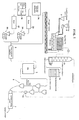
- Fig.1 shows a cement burning process in a cement plant to which the present invention is applied.
- lime raw material stored in a stockyard 1A and silica, alumina, and iron-based raw materials stored in a stockyard 1B are respectively introduced into raw material crusher 4 through dryers 2A and 2B and feeders 3A and 3B.
- raw material crusher 4 introduced into raw material silo 5, preheated by raw material preheater 6, and then fired in cement burning kiln 7 into cement clinkers.
- the above procedure is the same as that in ordinary cement production plants.
- Sewage sludge and a quicklime-based material are respectively introduced from hoppers 8 and 9 into mixer 10, which is a paddle mixer.
- the sewage sludge and quicklime-based material are reacted in mixer 10 at an agitation speed of 30 rpm, and the resulting solids are transferred by ager/carrier 11 to raw material crusher 4.
- Water vapor generated from mixer 10 is passed through bag filter 12 to collect dust such as slaked lime, and the remaining water vapor is introduced into distillation column 13. Water vapor is removed by distillation column 13, and remaining gases, which mainly comprise ammonia, are introduced into calcining furnace 6a. Dilute ammonia water released from distillation column 13 is neutralized in neutralization tank 14 and discharged as clean water.
- This cement plant operates 24 hours a day using 3,000 tons/day (lime-containing raw materials are approximately 80% of the input) to produce 2,000 tons/day of cement.
- Sewage sludge containing 78% water from hopper 8 and quicklime of 30 mm or less in particle size from hopper 9 were introduced at rates of 5 tons/hour (120 tons/day) and 5 tons/hour (120 tons/day), respectively, into mixer 10.
- Solids produced by mixer 10 were charged into raw material crusher 4 through ager/carrier 11. During this operation, the amount of limestone in the cement raw materials was reduced by 9 tons per hour. Furthermore, heat of 2.75 million Kcal per hour was produced from organic substances contained in the solid components of the sewage sludge.
- raw material crusher 4 in the above- described Examples, but these may be introduced into the lime-containing raw material in stockyard 1A or dryer 2A.
- the present invention converts sewage sludge into cement without releasing wastes, and reduces the amount of fuel needed for cement burning and the NO x content of the exhaust gas.
Landscapes
- Chemical & Material Sciences (AREA)
- Engineering & Computer Science (AREA)
- Ceramic Engineering (AREA)
- Materials Engineering (AREA)
- Structural Engineering (AREA)
- Organic Chemistry (AREA)
- Chemical Kinetics & Catalysis (AREA)
- Treatment Of Sludge (AREA)
- Processing Of Solid Wastes (AREA)
Applications Claiming Priority (2)
| Application Number | Priority Date | Filing Date | Title |
|---|---|---|---|
| JP1232733A JP2803855B2 (ja) | 1989-09-11 | 1989-09-11 | 下水汚泥の資源化システム |
| JP232733/89 | 1989-09-11 |
Publications (2)
| Publication Number | Publication Date |
|---|---|
| EP0417705A1 true EP0417705A1 (fr) | 1991-03-20 |
| EP0417705B1 EP0417705B1 (fr) | 1995-05-24 |
Family
ID=16943928
Family Applications (1)
| Application Number | Title | Priority Date | Filing Date |
|---|---|---|---|
| EP90117411A Expired - Lifetime EP0417705B1 (fr) | 1989-09-11 | 1990-09-10 | Procédé et système pour mise au rebut de boues d'égout aqueuses |
Country Status (3)
| Country | Link |
|---|---|
| EP (1) | EP0417705B1 (fr) |
| JP (1) | JP2803855B2 (fr) |
| DE (1) | DE69019643T2 (fr) |
Cited By (6)
| Publication number | Priority date | Publication date | Assignee | Title |
|---|---|---|---|---|
| WO1994004290A1 (fr) * | 1992-08-19 | 1994-03-03 | British Technology Group Inter-Corporate Licensing Limited | Procede d'encapsulation de matieres residuaires |
| WO1995025075A1 (fr) * | 1994-03-16 | 1995-09-21 | Cement Industry Environmental Consortium | Procede et dispositif de regulation des emissions polluantes a l'occasion des operations de combustion |
| WO2002096820A1 (fr) * | 2001-05-30 | 2002-12-05 | Vattenfall Ab | Procede et dispositif d'extinction de la chaux |
| CN102923923A (zh) * | 2012-10-12 | 2013-02-13 | 北京水泥厂有限责任公司 | 利用处置污泥来降低氮氧化物的方法 |
| CN103626380A (zh) * | 2013-11-20 | 2014-03-12 | 同济大学 | 一种石灰干化城市生活污水污泥水泥窑处置前的进一步脱水方法 |
| CN107459305A (zh) * | 2017-08-04 | 2017-12-12 | 福建港湾岩土工程集团有限公司 | 一种将城市淤泥加工成陶粒的固化剂 |
Families Citing this family (13)
| Publication number | Priority date | Publication date | Assignee | Title |
|---|---|---|---|---|
| JP4629170B2 (ja) * | 1999-03-25 | 2011-02-09 | 太平洋セメント株式会社 | ポルトランドセメントクリンカおよびポルトランドセメント |
| JP4110749B2 (ja) * | 2001-05-29 | 2008-07-02 | 三菱マテリアル株式会社 | 汚泥及び可燃性廃棄物の処理方法 |
| KR100554009B1 (ko) * | 2004-07-01 | 2006-02-22 | 주식회사 젝시엔 | 유기성 슬러지의 처리 방법 및 장치 |
| JP4775045B2 (ja) * | 2006-03-14 | 2011-09-21 | 宇部興産株式会社 | 還元性せっこう組成物、その製造方法およびセメント系固化材と固化処理方法 |
| JP5854507B2 (ja) * | 2012-02-27 | 2016-02-09 | 太平洋セメント株式会社 | バイオマス系廃棄物の利用方法及びセメント原燃料化装置 |
| JP2017205682A (ja) * | 2016-05-16 | 2017-11-24 | 株式会社トクヤマ | 建設発生土及び/又は汚泥の改良体の製造方法、及び該改良体を用いたセメントクリンカーの製造方法 |
| RU2756513C1 (ru) | 2018-01-18 | 2021-10-01 | Кавасаки Дзюкогио Кабусики Кайся | Способ обработки шлама и система для производства цемента |
| CN110557945A (zh) | 2018-04-04 | 2019-12-10 | 太平洋工程株式会社 | 有机污泥的处理装置及处理方法 |
| JP7143233B2 (ja) * | 2019-02-05 | 2022-09-28 | 太平洋セメント株式会社 | 焼却灰の処理方法 |
| GB2586951B (en) * | 2019-06-12 | 2024-01-31 | Ardex Group Gmbh | A method and apparatus for processing water treatment residuals |
| CN110577349A (zh) * | 2019-10-23 | 2019-12-17 | 深圳研源环境科技有限公司 | 建筑泥浆处理工艺及应用 |
| CN112876184A (zh) * | 2021-02-01 | 2021-06-01 | 重庆大学 | 一种淤泥固化剂及其制备方法和使用方法 |
| JP7802759B2 (ja) * | 2022-03-30 | 2026-01-20 | 太平洋セメント株式会社 | 有機汚泥の処理装置及び処理方法 |
Citations (6)
| Publication number | Priority date | Publication date | Assignee | Title |
|---|---|---|---|---|
| FR2282407A1 (fr) * | 1974-08-21 | 1976-03-19 | Coopers Swindon Ltd | Traitement des sediments d'eaux usees |
| DE2917123A1 (de) * | 1978-04-28 | 1979-11-08 | Nihon Automatic Machinery Mfg | Verfahren und vorrichtung zum behandeln von verunreinigtem wasser |
| EP0124038A2 (fr) * | 1983-04-29 | 1984-11-07 | ECODECO S.p.A. | Procédé pour la fabrication d'un matériau cimenteux à partir de boues urbaines et de sous-produits industriels |
| EP0141932A2 (fr) * | 1983-08-25 | 1985-05-22 | Klöckner-Humboldt-Deutz Aktiengesellschaft | Procédé et installation pour l'élimination sans substance nuisible de matières nocives et résiduaires de pouvoir calorifique inférieur, en particulier des déchets, par combustion |
| EP0162215A1 (fr) * | 1984-03-27 | 1985-11-27 | Alexander Grisar | Procédé pour la mise au rebut de déchets combustibles |
| DE3542004A1 (de) * | 1985-11-28 | 1987-06-04 | Kloeckner Humboldt Deutz Ag | Trocknung und verbrennung von schlaemmen beim brennprozess mineralischer stoffe |
Family Cites Families (3)
| Publication number | Priority date | Publication date | Assignee | Title |
|---|---|---|---|---|
| DE3542145A1 (de) * | 1985-11-28 | 1987-06-04 | Krupp Polysius Ag | Verfahren zur herstellung von zement |
| DE3545317A1 (de) * | 1985-12-20 | 1987-06-25 | Kloeckner Humboldt Deutz Ag | Verfahren und anlage zur entstickung von abgasen |
| JP5938175B2 (ja) | 2011-07-15 | 2016-06-22 | 出光興産株式会社 | 含窒素芳香族複素環誘導体およびそれを用いた有機エレクトロルミネッセンス素子 |
-
1989
- 1989-09-11 JP JP1232733A patent/JP2803855B2/ja not_active Expired - Fee Related
-
1990
- 1990-09-10 DE DE69019643T patent/DE69019643T2/de not_active Expired - Fee Related
- 1990-09-10 EP EP90117411A patent/EP0417705B1/fr not_active Expired - Lifetime
Patent Citations (6)
| Publication number | Priority date | Publication date | Assignee | Title |
|---|---|---|---|---|
| FR2282407A1 (fr) * | 1974-08-21 | 1976-03-19 | Coopers Swindon Ltd | Traitement des sediments d'eaux usees |
| DE2917123A1 (de) * | 1978-04-28 | 1979-11-08 | Nihon Automatic Machinery Mfg | Verfahren und vorrichtung zum behandeln von verunreinigtem wasser |
| EP0124038A2 (fr) * | 1983-04-29 | 1984-11-07 | ECODECO S.p.A. | Procédé pour la fabrication d'un matériau cimenteux à partir de boues urbaines et de sous-produits industriels |
| EP0141932A2 (fr) * | 1983-08-25 | 1985-05-22 | Klöckner-Humboldt-Deutz Aktiengesellschaft | Procédé et installation pour l'élimination sans substance nuisible de matières nocives et résiduaires de pouvoir calorifique inférieur, en particulier des déchets, par combustion |
| EP0162215A1 (fr) * | 1984-03-27 | 1985-11-27 | Alexander Grisar | Procédé pour la mise au rebut de déchets combustibles |
| DE3542004A1 (de) * | 1985-11-28 | 1987-06-04 | Kloeckner Humboldt Deutz Ag | Trocknung und verbrennung von schlaemmen beim brennprozess mineralischer stoffe |
Cited By (9)
| Publication number | Priority date | Publication date | Assignee | Title |
|---|---|---|---|---|
| WO1994004290A1 (fr) * | 1992-08-19 | 1994-03-03 | British Technology Group Inter-Corporate Licensing Limited | Procede d'encapsulation de matieres residuaires |
| GB2284808A (en) * | 1992-08-19 | 1995-06-21 | British Tech Group Int | Process for encapsulating a waste material |
| GB2284808B (en) * | 1992-08-19 | 1996-06-05 | British Tech Group Int | Process for encapsulating a waste material |
| US5562590A (en) * | 1992-08-19 | 1996-10-08 | British Technology Group Limited | Process for encapsulating a waste material |
| WO1995025075A1 (fr) * | 1994-03-16 | 1995-09-21 | Cement Industry Environmental Consortium | Procede et dispositif de regulation des emissions polluantes a l'occasion des operations de combustion |
| WO2002096820A1 (fr) * | 2001-05-30 | 2002-12-05 | Vattenfall Ab | Procede et dispositif d'extinction de la chaux |
| CN102923923A (zh) * | 2012-10-12 | 2013-02-13 | 北京水泥厂有限责任公司 | 利用处置污泥来降低氮氧化物的方法 |
| CN103626380A (zh) * | 2013-11-20 | 2014-03-12 | 同济大学 | 一种石灰干化城市生活污水污泥水泥窑处置前的进一步脱水方法 |
| CN107459305A (zh) * | 2017-08-04 | 2017-12-12 | 福建港湾岩土工程集团有限公司 | 一种将城市淤泥加工成陶粒的固化剂 |
Also Published As
| Publication number | Publication date |
|---|---|
| DE69019643T2 (de) | 1995-11-30 |
| JP2803855B2 (ja) | 1998-09-24 |
| DE69019643D1 (de) | 1995-06-29 |
| EP0417705B1 (fr) | 1995-05-24 |
| JPH0398700A (ja) | 1991-04-24 |
Similar Documents
| Publication | Publication Date | Title |
|---|---|---|
| US5217624A (en) | Method for the disposal of aqueous sewage sludge | |
| EP0417705B1 (fr) | Procédé et système pour mise au rebut de boues d'égout aqueuses | |
| US5435923A (en) | Method for the treatment of sewage sludge and the like | |
| KR101925418B1 (ko) | 인산비료의 제조 방법 | |
| US20050066860A1 (en) | Use of organic waste/mineral by-product mixtures in cement manufacturing processes | |
| US5199987A (en) | Method of producing cement clinker | |
| US4226712A (en) | Method and apparatus for treating water containing wastes | |
| CN100569400C (zh) | 燃烧灰的处理方法 | |
| CN105819644B (zh) | 一种含油污泥无害化处理系统及方法 | |
| EP0889859A1 (fr) | Systeme de manutention et d'acheminement de boues | |
| JP3225372B2 (ja) | 汚泥の脱水乾燥焼却システム | |
| JP3684410B2 (ja) | 下水汚泥の処理方法および下水汚泥処理物 | |
| JP4040035B2 (ja) | 下水汚泥の処理方法および装置 | |
| EP0124038A2 (fr) | Procédé pour la fabrication d'un matériau cimenteux à partir de boues urbaines et de sous-produits industriels | |
| JP3356859B2 (ja) | 汚泥の処理方法 | |
| JPH1135358A (ja) | 人工軽量骨材の製造方法 | |
| JP2000176492A (ja) | 汚泥処理方法、及びセメントクリンカー焼成装置 | |
| JP4387040B2 (ja) | 土壌改良材及び/又は有機性肥料並びにその製造方法 | |
| JPH07323299A (ja) | 汚泥の資源化方法 | |
| JP3901986B2 (ja) | ばいじんの処理方法及びばいじんの処理装置 | |
| JP3682669B2 (ja) | 有機質含有汚泥の処理方法 | |
| KR100256021B1 (ko) | 하수오니 처리방법 | |
| JPS6082192A (ja) | 有機性汚泥の処理方法 | |
| JPH09323099A (ja) | 汚泥の処理方法 | |
| JPH0650505A (ja) | 燃料兼用脱硫剤およびその製造方法 |
Legal Events
| Date | Code | Title | Description |
|---|---|---|---|
| PUAI | Public reference made under article 153(3) epc to a published international application that has entered the european phase |
Free format text: ORIGINAL CODE: 0009012 |
|
| AK | Designated contracting states |
Kind code of ref document: A1 Designated state(s): CH DE GB LI |
|
| 17P | Request for examination filed |
Effective date: 19910524 |
|
| 17Q | First examination report despatched |
Effective date: 19920902 |
|
| GRAA | (expected) grant |
Free format text: ORIGINAL CODE: 0009210 |
|
| AK | Designated contracting states |
Kind code of ref document: B1 Designated state(s): CH DE GB LI |
|
| REF | Corresponds to: |
Ref document number: 69019643 Country of ref document: DE Date of ref document: 19950629 |
|
| PGFP | Annual fee paid to national office [announced via postgrant information from national office to epo] |
Ref country code: GB Payment date: 19950830 Year of fee payment: 6 |
|
| RIN2 | Information on inventor provided after grant (corrected) |
Free format text: YAMANE, ISAO, C/O ONODA CEMENT CO., LTD. * SAITO, TORU, C/O ONODA CEMENT CO., LTD. * SHIMODA, MASAO, C/O ONODA CHEMICO CO.,LTD. * KOUCHI, SATOSHI, C/O ONODA CHEMICO CO., LTD. |
|
| PGFP | Annual fee paid to national office [announced via postgrant information from national office to epo] |
Ref country code: DE Payment date: 19951127 Year of fee payment: 6 |
|
| PGFP | Annual fee paid to national office [announced via postgrant information from national office to epo] |
Ref country code: CH Payment date: 19951201 Year of fee payment: 6 |
|
| PLBE | No opposition filed within time limit |
Free format text: ORIGINAL CODE: 0009261 |
|
| STAA | Information on the status of an ep patent application or granted ep patent |
Free format text: STATUS: NO OPPOSITION FILED WITHIN TIME LIMIT |
|
| 26N | No opposition filed | ||
| PG25 | Lapsed in a contracting state [announced via postgrant information from national office to epo] |
Ref country code: GB Effective date: 19960910 |
|
| PG25 | Lapsed in a contracting state [announced via postgrant information from national office to epo] |
Ref country code: LI Effective date: 19960930 Ref country code: CH Effective date: 19960930 |
|
| GBPC | Gb: european patent ceased through non-payment of renewal fee |
Effective date: 19960910 |
|
| REG | Reference to a national code |
Ref country code: CH Ref legal event code: PL |
|
| PG25 | Lapsed in a contracting state [announced via postgrant information from national office to epo] |
Ref country code: DE Effective date: 19970603 |