EP0417765A2 - Verfahren zum Herstellen einer porösen Form - Google Patents
Verfahren zum Herstellen einer porösen Form Download PDFInfo
- Publication number
- EP0417765A2 EP0417765A2 EP90117579A EP90117579A EP0417765A2 EP 0417765 A2 EP0417765 A2 EP 0417765A2 EP 90117579 A EP90117579 A EP 90117579A EP 90117579 A EP90117579 A EP 90117579A EP 0417765 A2 EP0417765 A2 EP 0417765A2
- Authority
- EP
- European Patent Office
- Prior art keywords
- mold
- porous
- foamed body
- porous mold
- forming
- Prior art date
- Legal status (The legal status is an assumption and is not a legal conclusion. Google has not performed a legal analysis and makes no representation as to the accuracy of the status listed.)
- Withdrawn
Links
Images
Classifications
-
- B—PERFORMING OPERATIONS; TRANSPORTING
- B29—WORKING OF PLASTICS; WORKING OF SUBSTANCES IN A PLASTIC STATE IN GENERAL
- B29C—SHAPING OR JOINING OF PLASTICS; SHAPING OF MATERIAL IN A PLASTIC STATE, NOT OTHERWISE PROVIDED FOR; AFTER-TREATMENT OF THE SHAPED PRODUCTS, e.g. REPAIRING
- B29C51/00—Shaping by thermoforming, i.e. shaping sheets or sheet like preforms after heating, e.g. shaping sheets in matched moulds or by deep-drawing; Apparatus therefor
- B29C51/26—Component parts, details or accessories; Auxiliary operations
- B29C51/30—Moulds
- B29C51/36—Moulds specially adapted for vacuum forming, Manufacture thereof
- B29C51/365—Porous moulds
-
- B—PERFORMING OPERATIONS; TRANSPORTING
- B22—CASTING; POWDER METALLURGY
- B22C—FOUNDRY MOULDING
- B22C9/00—Moulds or cores; Moulding processes
- B22C9/02—Sand moulds or like moulds for shaped castings
- B22C9/04—Use of lost patterns
- B22C9/046—Use of patterns which are eliminated by the liquid metal in the mould
-
- B—PERFORMING OPERATIONS; TRANSPORTING
- B22—CASTING; POWDER METALLURGY
- B22F—WORKING METALLIC POWDER; MANUFACTURE OF ARTICLES FROM METALLIC POWDER; MAKING METALLIC POWDER; APPARATUS OR DEVICES SPECIALLY ADAPTED FOR METALLIC POWDER
- B22F3/00—Manufacture of workpieces or articles from metallic powder characterised by the manner of compacting or sintering; Apparatus specially adapted therefor ; Presses and furnaces
- B22F3/12—Both compacting and sintering
- B22F3/1208—Containers or coating used therefor
- B22F3/1258—Container manufacturing
-
- B—PERFORMING OPERATIONS; TRANSPORTING
- B28—WORKING CEMENT, CLAY, OR STONE
- B28B—SHAPING CLAY OR OTHER CERAMIC COMPOSITIONS; SHAPING SLAG; SHAPING MIXTURES CONTAINING CEMENTITIOUS MATERIAL, e.g. PLASTER
- B28B1/00—Producing shaped prefabricated articles from the material
- B28B1/26—Producing shaped prefabricated articles from the material by slip-casting, i.e. by casting a suspension or dispersion of the material in a liquid-absorbent or porous mould, the liquid being allowed to soak into or pass through the walls of the mould; Moulds therefor ; specially for manufacturing articles starting from a ceramic slip; Moulds therefor
- B28B1/261—Moulds therefor
- B28B1/262—Mould materials; Manufacture of moulds or parts thereof
Definitions
- This invention relates to a method of producing a porous mold for casting a molten metal or a slurry of metal powder, ceramic powder or the like.
- the first method comprises solidifying the dispersion medium in the cast slurry in a porous mold by cooling, and then, removing the mold.
- the second method comprises exuding the dispersion medium from the cast slurry through the porous mold to induce formability, and then removing the porous mold. It is known to pressurize the slurry in the porous mold or to suck in vacuo from the outside of the porous mold for the purpose of accelerating the exudation (Motoki, "Ceramic Manufacturing Process I", p 123, p 257, Giho-do Shuppan, 1978). After demolding, the residual dispersion medium is removed by heating.
- the third method comprises removing the dispersion medium in the cast slurry by thermal decomposition or extraction with a liquid or a supercritical fluid, while, the slurry is placed in a porous mold.
- the cast slurry is converted into a molded body having formability, and then, the porous mold is removed (Japanese Patent Application No. 63-218300).
- the molded bodies so produced are sintered to obtain sintered bodies.
- a most suitable method for a complex shape comprises forming a porous layer on the surface of a vanishable pattern and removing the pattern to obtain a porous mold (Japanese Patent KOKOKU No. 53-16362).
- wax or urea is melted or half-melted, and injected into a mold.
- the mold is cooled to solidify the wax or urea, and demolded to obtain a molded body.
- the molded body is used as the vanishable pattern for producing the porous mold.
- An object of the invention is to provide a method of producing a porous mold for casting a molten metal or a slurry of metal powder, ceramic powder or the like which does not have a problem of the deformation, cracks or demolding.
- Another object of the invention is to provide a method of producing a porous mold for casting a molten metal or a slurry of metal powder, ceramic powder or the like of which the dimentional deviation can be neglected.
- Another object of the invention is to provide a method of producing a porous mold for casting a molten metal or a slurry of metal powder, ceramic powder or the like inexpensively.
- the present invention provides a method of producing a porous mold which has achieved the above objects by using a foamed body as the pattern.
- the method of the invention is of producing a porous mold for casting a molten metal or a slurry of metal powder, ceramic powder or the like, and comprises foaming a plastic in a forming mold, forming a porous layer becoming the porous mold on the surface of the foamed body, and removing the foamed body.
- the plastic which foams in the forming mold is polyurethane resin, epoxy resin, urea resin, polystyrene resin, polyethylene resin, polypropylene resin, ABS resin, polyvinyl chloride resin or the like.
- a suitable expansion ratio is 5 to 200 times. When the expansion ratio is less than 5 times, the filling of the plastic in the forming mold is insufficient, and the transferability becomes inferior. While, when it is beyond 200 times, the strength of the foamed body is weak due to the low density. The foamed body is liable to be broken or deformed.
- the foaming of the plastic may be conducted according to a known method, such as adding a foaming agent.
- the foraming agent includes aliphatic hydrocarbons, cyclic hydrocarhons and halogenated hydrocarbons each having a great evaporation rate, and the compounds to generate a gas like nitrogen gas or carbon dioxide gas such as azo compounds, nitroso compounds and sulfonyl compounds.
- the plastic as the foaming raw material may be granules or liquid, and the latter is preferred.
- the boundary pattern of the foamed granules is occasionally transferred to the surface of the molded body to damage the surface smoothness.
- An example of the granular plastics is polystyrene formed from expandable polystyrene beads containing an aliphatic hydrocarbon such as propane, butane or pentane as the foaming agent. The beads are filled into a forming mold directly or after preliminary expansion, ancl they are expanded by heating with steam or the like to bind each other to form a pattern.
- liquid plastics includes polyurethane resin, epoxy resin and urea resin.
- a suitable temperature for the expansion depends on the kind of the plastic, the kind of the foaming agent and the like, and it is usually in the range from ordinary temperature to 250°C.
- a preferable temperature is near the temperature used for forming the porous layer.
- the difference between the expansion temperature and the temperature for forming the porous layer is great, deformation occurs during adjusting the temperature of the foamed body to the temperature for forming the porous layer resulting to degrade the dimensional accuracy. Therefore, to render the temperature difference less than 120°C is preferred.
- polyurethane resin, epoxy resin and urea resin are preferable because of expandable at ordinary temperature.
- the forming mold may be anyone capable of expanding the foaming raw material in the cavity and taking the solidified foamed body out of the forming mold.
- the forming mold is usually a split mold capable of separating it into two pieces or more, and made of metal, plastic, wood or the like. When the foaming raw material is liquid, an inlet for the foaming raw material is necessary.
- the foamed body is solidified through the reaction, termination and cooling.
- the porous layer becoming the porous mold is formed on the surface of the solidified foamed body taken out of the forming mold.
- the material composing the porous layer As the material composing the porous layer, gypsum, ceramic powders blended with an organic or inorganic binder, porous sintered ceramics such as alumina, porous sintered metals such a stainless steel, foamed organic materials having continuous pores, etc. are applicable.
- the ceramic powders blended with an organic or inorganic binder include ceramic shell molds used for casting molten metal which are applicable to the invention as it is.
- the shell molds are produced by forming a ceramic powder layer such as zircon, alumina or mullite blended with a hydrolyzate of ethyl silicate, colloidal silica or the like as the binder on the surface of the foamed body.
- a coating layer of the aforementioned material is formed on the surface by applying a slurry thereof, immersing the foamed body in the slurry or the like, and then dried.
- the application means may be conventional such as brushing or spraying.
- the thickness of the coating layer is controlled by the concentration of the slurry, the times of applying or immersing or the like.
- a composite porous layer having various compositions can be formed by repeating the application or immersion using the slurries of which the composition varies.
- the vanishable pattern t.e. the foamed body
- the removal means may be thermal decomposition or burning or extraction with a solvent.
- the solvent may be liquid or supercritical fluid.
- polystyrene foamed body it can be removed by the extraction with ethyl acetate, acetone, ethylene dichloride, chloroform, carbon tetrachloride, benzene, toluene, xylene or the like.
- the porous mold thus obtained is used for casting a molten metal or a slurry of metal powder, ceramic powder or the like by a known method. According to the material of the porous mold, some molds are used as it is, and some other molds are strengthed by heat treatment or the like prior to use.
- the filling into the forming mold is performed by foaming, and the formability appears by the solidification of the foamed body through the termination of the foaming reaction and cooling.
- the foamed body is a vanishable pattern removable by heating, solvent extraction or the like, and the porous mold can be obtained by removing the foamed body after the porous layer is formed. Because of using a plastic foamed body as the vanishable pattern, the problems of the conventional method utilizing the solidification of melted wax or urea, such as deformation, cracks, dimensional deviation of the pattern, can be avoided. As a result, the porous molds having a high dimentional accuracy can be produced in a high yield.
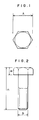
- the forming mold used was a three pieces split type separable in the longitudinal direction having a cavity of the bolt form shown in Figures 1 and 2, and was made of silicone rubber.
- Two-component type polyurethane foaming raw material was poured in the mold at ordinary temperature, and kept for 3 minutes.
- the polyurethane foaming raw material was expanded 5 times, and filled the cavity.
- the forming mold was detached, and the solidified foamed body was taken out.
- the size of 20 pieces of the foamed body thus produced was measured, and found that each size of A, B, C, D in the figure conformed with the design size within -0.08 to 0.11 %.
- the surface of the foamed bodies were smooth, and the transferability was excellent.
- Solution I was a mixture of 70 parts by weight of methanol and 30 parts by weight of inorganic polysilazane oil
- Solution II was a slurry of 30 parts by wight of methanol, 50 parts by weight of zircon flour of minus 130 mesh and 20 parts by weight of inorganic polysilazane oil
- Solution III was a slurry of 50 parts by weight of methanol and 50 parts by weight of zircon sand of minus 325 mesh
- Solution IV was a slurry of 50 parts by weight of methanol and 50 parts by weight of high alumina sand having a grain size of 0.3 to 0.7 mm.
- the above solutions were kept at ordinary temperature, and the sedimentation was prevented by stirring using an electromagnetic stirrer.
- the above foamed body was immersed in the solution I for 5 seconds, and taken out followed by drying. Then, it was immersed in the solution II for 30 seconds, taken out and dried, immersed in the solution III, and taken out and dried. The immersion in the solution II and the solution III was repeated again. Subsequently, it was immersed in the solution II for 5 seconds, taken out and dried, immersed in the solution IV for 30 seconds, and taken out and dried. This treated body was immersed in the solution II for 3 seconds, and taken out and dried.
- the treated body was set in an atmosphere heating furnace, and heated to 600°C at a rate of 100°C/hr. The temperature was kept at 600°C for 5 hours, and then cooled naturally. During heating the foamed body disappeared entirely, and 20 pieces of the porous mold were obtained without defects such as cracking.
- Each porous mold was cut into two pieces in the longitudinal direction, and the size of A, B, C, D portions shown in Figures 1 and 2 was measured. Each size was within -0.08 to 0.12 % of the design size. The thickness of the porous layer was 3 to 4 mm.
- Expandable polystyrene beads (Sekisui Chemical Co., Ltd.) having a diameter of 300 ⁇ m were mixed with water, and heated to boil with stirring. The beads were preliminarily expanded about 20 times in diameter in the boiling water.
- the expanded beads were naturally dried for 24 hours, and sieved to remove agglomerates.
- the preliminarily expanded beads were put in a forming mold of three pieces split type separable in the longitidinal direction having a cavity of the bolt form shown in Figures 1 and 2. Subsequently, a flexible hose was joined to the filling inlet, and steam at 160°C at 6 atm. was blown in the cavity and effused from the joining portion of the forming mold. After keeping the above state for 30 minutes, the supply of steam was stopped, and naturally cooled. The size of 20 pieces of the foamed body thus produced was measured, and found that each size of A, B, C, D in the figure conformed with the design size within 0.51 to 0.60 %. Thought a granular pattern was observed on the surface, the transferability was excellent.
- Example 2 Similar to Example 1, the four solutions of I, II, III, IV were prepared, and coated on the surface of the above polystyrene foamed body. The treated body was immersed in acetone for 24 hours, and the foamed body was dissolved out. The remaining ceramic shell was taken out and dried. The polystyrene disappeared entirely, and 20 pieces of the porous mold thus obtained had no defect such as cracking. Each porous mold was cut into two pieces in the longitudinal direction, and the size of A, B, C, D portions shown in Figures 1 and 2 was measured. Each size was within 0.50 to 0.59 % of the design size. The thickness of the porous layer was 3 to 4 mm.
- a tank with a heater was joined to a forming mold of three pieces split type separable in the longitudinal direction having a cavity of the bolt form shown in Figures 1 and 2 by a flexible hose with a heater.
- Paraffin wax having a melting point of 75 to 85°C was put in the tank, and heated upto 80°C with stirring.
- the upper space of the tank was sucked in vacuo, and the wax was defoamed with stirring for 30 minutes. Then, the upper space was pressurized by the compressed at 5 kg/cm2, and the paraffin wax was injected into the forming mold. After allowing to stand for 20 minutes, the pressure was released, and the molded pattern was taken out.
Landscapes
- Engineering & Computer Science (AREA)
- Mechanical Engineering (AREA)
- Manufacturing & Machinery (AREA)
- Chemical & Material Sciences (AREA)
- Ceramic Engineering (AREA)
- Dispersion Chemistry (AREA)
- Powder Metallurgy (AREA)
- Moulds, Cores, Or Mandrels (AREA)
Applications Claiming Priority (2)
| Application Number | Priority Date | Filing Date | Title |
|---|---|---|---|
| JP23686289A JPH03103376A (ja) | 1989-09-14 | 1989-09-14 | 多孔質型の製造方法 |
| JP236862/89 | 1989-09-14 |
Publications (2)
| Publication Number | Publication Date |
|---|---|
| EP0417765A2 true EP0417765A2 (de) | 1991-03-20 |
| EP0417765A3 EP0417765A3 (en) | 1992-08-12 |
Family
ID=17006901
Family Applications (1)
| Application Number | Title | Priority Date | Filing Date |
|---|---|---|---|
| EP19900117579 Withdrawn EP0417765A3 (en) | 1989-09-14 | 1990-09-12 | Method of producing porous mold |
Country Status (2)
| Country | Link |
|---|---|
| EP (1) | EP0417765A3 (de) |
| JP (1) | JPH03103376A (de) |
Cited By (4)
| Publication number | Priority date | Publication date | Assignee | Title |
|---|---|---|---|---|
| EP0526927A3 (en) * | 1991-07-20 | 1993-11-10 | Sinterstahl Gmbh | Process for preparing articles for sintering by cold isostatic pressing of powder in single-use press forms |
| CN102328074A (zh) * | 2011-07-22 | 2012-01-25 | 浙江一火科技有限公司 | 一种硬质合金喷嘴及其制造方法 |
| CN102441671A (zh) * | 2010-10-14 | 2012-05-09 | 陈宗杰 | 一种哑铃或铃片配重块的生产工艺 |
| CN109079134A (zh) * | 2018-08-01 | 2018-12-25 | 岑星毅 | 一种法兰盘的制作模具 |
Families Citing this family (1)
| Publication number | Priority date | Publication date | Assignee | Title |
|---|---|---|---|---|
| RU2700434C2 (ru) * | 2016-10-24 | 2019-09-17 | Евгений Михайлович Костромин | Способ изготовления моделей для литья по газифицируемым моделям и газифицируемая модель, полученная указанным способом |
Family Cites Families (4)
| Publication number | Priority date | Publication date | Assignee | Title |
|---|---|---|---|---|
| GB2123335A (en) * | 1982-06-25 | 1984-02-01 | Oldham And Crowther | Moulds of rigid plastics foam |
| JPS6224851A (ja) * | 1985-07-25 | 1987-02-02 | Tsuneo Yamashita | 消失性の模型を用いる減圧鋳造方法 |
| US4633929A (en) * | 1985-10-16 | 1987-01-06 | Air Products And Chemicals, Inc. | Method for producing metal castings |
| US4773466A (en) * | 1987-12-14 | 1988-09-27 | Arco Chemical Company | Process for preparing polycarbonate copolymer foam suitable for lost foam casting |
-
1989
- 1989-09-14 JP JP23686289A patent/JPH03103376A/ja active Pending
-
1990
- 1990-09-12 EP EP19900117579 patent/EP0417765A3/en not_active Withdrawn
Cited By (5)
| Publication number | Priority date | Publication date | Assignee | Title |
|---|---|---|---|---|
| EP0526927A3 (en) * | 1991-07-20 | 1993-11-10 | Sinterstahl Gmbh | Process for preparing articles for sintering by cold isostatic pressing of powder in single-use press forms |
| CN102441671A (zh) * | 2010-10-14 | 2012-05-09 | 陈宗杰 | 一种哑铃或铃片配重块的生产工艺 |
| CN102328074A (zh) * | 2011-07-22 | 2012-01-25 | 浙江一火科技有限公司 | 一种硬质合金喷嘴及其制造方法 |
| CN109079134A (zh) * | 2018-08-01 | 2018-12-25 | 岑星毅 | 一种法兰盘的制作模具 |
| CN109079134B (zh) * | 2018-08-01 | 2021-06-18 | 温州祥茂汽车部件有限公司 | 一种法兰盘的制作模具 |
Also Published As
| Publication number | Publication date |
|---|---|
| JPH03103376A (ja) | 1991-04-30 |
| EP0417765A3 (en) | 1992-08-12 |
Similar Documents
| Publication | Publication Date | Title |
|---|---|---|
| EP0466419B1 (de) | Kernentfernung aus Formkörpern | |
| US5021213A (en) | Method of casting powder | |
| US5181549A (en) | Method for manufacturing porous articles | |
| US5262100A (en) | Method of core removal from molded products | |
| KR20240014043A (ko) | 경사 기능 물품의 압출 기반 3d 인쇄용 슬러리 공급원료, 상온 및 저압에서의 금속/세라믹 물품 캐스팅, 방법 및 이를 위한 시스템 | |
| US4812278A (en) | Process for preparing mold | |
| EP0968062B1 (de) | Verfahren zur herstellung von völlig dichten metallformen | |
| US4530722A (en) | Binder and refractory compositions and methods | |
| CA1223112A (en) | Ceramic shell moulds, manufacture and use | |
| US6481490B1 (en) | Investment casting patterns and method | |
| EP3448605B1 (de) | Verfahren, gehäuse und vorrichtung zur herstellung eines bauteils | |
| US3248763A (en) | Ceramic, multilayer graphite mold and method of fabrication | |
| EP0417765A2 (de) | Verfahren zum Herstellen einer porösen Form | |
| EP3112048B1 (de) | Feingussform mit variablem durchmesser für vernetzte metallschäume | |
| US3296666A (en) | Method of preparing an investment mold for use in precision casting | |
| US4602667A (en) | Method for making investment casting molds | |
| US3686006A (en) | Refractory cores and methods of making the same | |
| CN117500624A (zh) | 用于基于挤出的3d打印功能梯度制品和在室温和低压下铸造金属/陶瓷制品的浆料原料及其方法和系统 | |
| JPH01154846A (ja) | 流動し易く堅固に硬化された砂型の空隙部で金属を鋳造する方法 | |
| US5248552A (en) | Molding core | |
| JPH075929B2 (ja) | 粉体の鋳込み成形方法 | |
| US4664948A (en) | Method for coating refractory molds | |
| GB2253400A (en) | Casting mould | |
| US3321005A (en) | Method of making shell molds for casting reactive metals | |
| GB2155484A (en) | Binder and refractory compositions |
Legal Events
| Date | Code | Title | Description |
|---|---|---|---|
| PUAI | Public reference made under article 153(3) epc to a published international application that has entered the european phase |
Free format text: ORIGINAL CODE: 0009012 |
|
| AK | Designated contracting states |
Kind code of ref document: A2 Designated state(s): DE FR GB |
|
| PUAL | Search report despatched |
Free format text: ORIGINAL CODE: 0009013 |
|
| AK | Designated contracting states |
Kind code of ref document: A3 Designated state(s): DE FR GB |
|
| STAA | Information on the status of an ep patent application or granted ep patent |
Free format text: STATUS: THE APPLICATION IS DEEMED TO BE WITHDRAWN |
|
| 18D | Application deemed to be withdrawn |
Effective date: 19930213 |