EP0417769B1 - Verfahren zum Trocknen von fotografischen lichtempfindlichen Materialien in automatischen Entwicklungsgeräte - Google Patents
Verfahren zum Trocknen von fotografischen lichtempfindlichen Materialien in automatischen Entwicklungsgeräte Download PDFInfo
- Publication number
- EP0417769B1 EP0417769B1 EP90117587A EP90117587A EP0417769B1 EP 0417769 B1 EP0417769 B1 EP 0417769B1 EP 90117587 A EP90117587 A EP 90117587A EP 90117587 A EP90117587 A EP 90117587A EP 0417769 B1 EP0417769 B1 EP 0417769B1
- Authority
- EP
- European Patent Office
- Prior art keywords
- drying
- temperature
- zone
- sensitive material
- photographic light
- Prior art date
- Legal status (The legal status is an assumption and is not a legal conclusion. Google has not performed a legal analysis and makes no representation as to the accuracy of the status listed.)
- Expired - Lifetime
Links
- 238000001035 drying Methods 0.000 title claims description 99
- 239000000463 material Substances 0.000 title claims description 70
- 238000000034 method Methods 0.000 title claims description 24
- 238000012545 processing Methods 0.000 claims description 24
- 239000000084 colloidal system Substances 0.000 description 6
- 108010010803 Gelatin Proteins 0.000 description 3
- 235000010724 Wisteria floribunda Nutrition 0.000 description 3
- 238000011161 development Methods 0.000 description 3
- 229920000159 gelatin Polymers 0.000 description 3
- 239000008273 gelatin Substances 0.000 description 3
- 235000019322 gelatine Nutrition 0.000 description 3
- 235000011852 gelatine desserts Nutrition 0.000 description 3
- 230000008961 swelling Effects 0.000 description 3
- 238000012360 testing method Methods 0.000 description 3
- 238000005406 washing Methods 0.000 description 3
- 239000011230 binding agent Substances 0.000 description 2
- 229920001971 elastomer Polymers 0.000 description 2
- 239000000839 emulsion Substances 0.000 description 2
- 238000005259 measurement Methods 0.000 description 2
- 238000007664 blowing Methods 0.000 description 1
- 230000007423 decrease Effects 0.000 description 1
- 230000003247 decreasing effect Effects 0.000 description 1
- 230000007547 defect Effects 0.000 description 1
- 230000007812 deficiency Effects 0.000 description 1
- 238000011156 evaluation Methods 0.000 description 1
- 239000004816 latex Substances 0.000 description 1
- 229920000126 latex Polymers 0.000 description 1
- 239000007788 liquid Substances 0.000 description 1
- 230000000704 physical effect Effects 0.000 description 1
- 229920000642 polymer Polymers 0.000 description 1
- 239000011347 resin Substances 0.000 description 1
- 229920005989 resin Polymers 0.000 description 1
- 230000001953 sensory effect Effects 0.000 description 1
- 229910052709 silver Inorganic materials 0.000 description 1
- 239000004332 silver Substances 0.000 description 1
- -1 silver halide Chemical class 0.000 description 1
- XLYOFNOQVPJJNP-UHFFFAOYSA-N water Substances O XLYOFNOQVPJJNP-UHFFFAOYSA-N 0.000 description 1
- 238000004078 waterproofing Methods 0.000 description 1
Images

Classifications
-
- G—PHYSICS
- G03—PHOTOGRAPHY; CINEMATOGRAPHY; ANALOGOUS TECHNIQUES USING WAVES OTHER THAN OPTICAL WAVES; ELECTROGRAPHY; HOLOGRAPHY
- G03D—APPARATUS FOR PROCESSING EXPOSED PHOTOGRAPHIC MATERIALS; ACCESSORIES THEREFOR
- G03D15/00—Apparatus for treating processed material
- G03D15/02—Drying; Glazing
- G03D15/027—Drying of plates or prints
Definitions
- This invention relates to a method of drying photographic light-sensitive materials in an automatic processor in order to ensure excellent dimensional stability in photographic light-sensitive materials.
- a silver halide photographic material has layers containing a hydrophilic colloid binder such as gelatin on at least one side of a support.
- Hydrophilic colloid layers tend to stretch in proportion with changes in humidity and/or temperature. These dimensional changes to a photographic light-sensitive material, particularly those used in graphic arts, can be a serious defect.
- JP-A as used herein means an "unexamined published Japanese patent application”
- one method of increasing drying speed involved using a flow of drying air that was slow and weak during the first half of the drying step, and then fast and strong during the latter half of the drying step.
- Another method involves lowering the preheating temperature of the heater when light-sensitive materials were not in the apparatus to use energy more economically.
- Another art consisted of detecting the temperature and the humidity of the room in which the automatic processor was installed (hereinafter “the surrounding temperature and humidity") and controlling the drying in the automatic processor based on this information so that the light-sensitive materials are not overdried or underdried.
- drying of a photographic light-sensitive material after having dried out 65 % of the moisture content of the photographic light-sensitive material is carried out at least under the control based on temperature and humidity conditions of the area where the automatic processor ia installed.
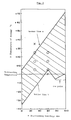
- the temperature of the drying step (b) falls within the zone which satisfies the following equations: when 0 ⁇ R ⁇ 100, D ⁇ 2/3*R + Q + 5, when 0 ⁇ R ⁇ 60, D ⁇ 2/3*R + Q - 35, and when 60 ⁇ R ⁇ 100, D ⁇ -2/3*R + Q + 45, wherein D represents the temperature (°C) of the drying step (b) and is more than the dew point, and R and Q represent the humidity (% RH) and the temperature (°C) of the area where the automatic processor is installed, respectively.
- the zone is shown in Figure 1 as the shaded part hereinafter.
- the dry-processing portion of an automatic processor is divided into two zones, the front and the rear, and individual temperatures of the drying zones are set independently based on the surrounding temperature and humidity where the automatic processor is installed.
- the light-sensitive material which has been washed and just squeezed is dried in the front zone till 65% or less of the moisture present in the material just after squeezing is removed, and in the rear zone the thus pre-dried material is dried at the temperature determined in accordance with the conditions illustrated by the shaded part of Figure 1 shown hereinafter.
- a method of drying a photographic light-sensitive material in an automatic processor comprising a dry-processsing portion having two zones, wherein said method comprises steps (a) and (b):
- Figure 1 shows the conditions of the drying temperature in the dry-processing portion of an automatic processor that ensure satisfactory dimensional stability for light-sensitive materials under a wide rang of temperatures and relative humidity.
- the surrounding humidity (% RH) is the abscissa and the drying temperature (°C) is the ordinate.
- the shaded part surrounded by the border line a, the border line b and the dew points indicates the area in which satisfactory dimensional stability can be acquired.
- Figure 2 represents the results of Examples 1 and 2 plotted on the graph of the drying temperature conditions illustrated in Figure 1.
- the round marks ( ⁇ ) indicate points of excellent dimensional stability, while the cross marks ( ⁇ ) show those of poor dimensional stability.
- development-processing includes development, fixation and washing steps.
- squeezeing describes a procedure of removing the moisture on the surface of a light-sensitive material using rollers (e.g., made of rubber or resin) or an air squeeze technique consisting of blowing air against the surface following the washing step.
- the dry-processing portion of an automatic processor is divided into two zones.
- the temperature of each zone is controlled independently.
- the drying in the first zone is set to a temperature higher than room temperature in order that the drying of the light-sensitive material is began rapidly.
- the second zone is adjusted so that the temperature falls within the shaded area of Figure 1.
- the front zone is called the first drying zone
- the rear zone is called the second drying zone.
- VU-100 produced by Fuji Photo Film Co., Ltd., was used as sample, and processed under various conditions.
- the variously processed films were examined for dimensional stability using a pin gauge. Two holes measuring 8 mm in diameter were made at an interval of 200 mm in each sample which had been exposed overall prior to development-processing, and the distance between the two holes was measured accurately with the pin gauge with the accuracy of 1/1000 mm precision. This dimension was taken as X (in mm). Each sample was then developed, fixed, washed, and dried, and the distance between the holes determined after the lapse of 5 minutes from the conclusion of the processing as Y (in mm).
- the processing conditions employed are set forth in Table 1.
- the rate of dimensional change caused by processing was evaluated in terms of a percentage using the expression, ((Y-X)/200) ⁇ 100.
- a film elongates or shrinks by more than 20 ⁇ m over 200 mm, this is generally accepted in the industry as a "dimensional deviation". Consequently, excellent dimensional stability involves a rate of dimensional change from -0.01% to +0.01%.
- Temperature conditions in the first and second zones are shown in Table 2.
- the percentage of the moisture removed by drying in the first drying zone was expressed by ((a-b)/(a-c)) ⁇ 100, where the weight of the light-sensitive material just after squeezing with rubber rolls subsequent to the steps with liquids, including development, fixation and washing steps, was taken as "a” (in grams); the weight of the light-sensitive material just after the passage through the first drying zone was taken as "b” (in grams); and the weight of the light-sensitive material which had come to equilibrium with the surrounding temperature and humidity after the processing was taken as "c" (in grams).
- the flow rate of drying air was set to 40 l/s; this rate was modified for both the first and the second drying zones.
- the rate of dimensional change was determined under the drying conditions A to L shown in Table 2.
- the surrounding temperature-humidity condition was adjusted to 25°C-30% RH.
- the measurement of the rate of dimensional change was carried out under the surrounding temperature-humidity condition.
- the term "the temperature of drying air” as used herein is synonymous with the term "the temperature of drying”.
- the results obtained are shown in Table 2.
- Each of the values for the rate of dimensional change (dimensional change rate) shown in Tables is an average of 5 values evaluated by the above-mentioned measurement.
- the passing time of the light-sensitive materials is 10 seconds in each of the first zone and the second zone.
- a light-sensitive material expands when the drying temperature is raised.
- Table 2 when the drying temperature of the first drying zone was set to 60°C, the percentage of moisture removed in the first drying zone was more than 65% and the desired dimensional stability was not attained no matter what drying temperature was used in the second drying zone.
- the drying temperature of the first drying zone when the drying temperature of the first drying zone was set to 50°C or lower, the percentage of moisture removed in the first drying zone was 65% or less, and it became feasible to enhance the dimensional stability by setting the temperature of the second drying zone based on the surrounding temperature and humidity.
- desirable dimensional stability is obtainable by setting the drying temperature of the second zone to the surrounding temperature plus 25°C or lower after 65% of moisture contained in the light-sensitive material has been removed in the first zone.
- the passing time of the light-sensitive materials is 10 seconds in each of the first zone and the second zone.
- the percentage of moisture removed in the first drying zone by the drying under the conditions shown in Table 3 was 65% or less under 25°C and 60% RH.
- the drying temperature of the first drying zone was set to any temperature, it was possible to improve the dimensional stability by setting the drying temperature of the second drying zone based on the surrounding temperature and humidity.
- desirable dimensional stability was attained by setting the temperature of the drying air of the second drying zone to the surrounding temperature plus 5°C or higher.
- Rates of dimensional change under varied conditions were examined in the same manner as in Example 1, that is, under the drying condition that a first drying zone was set at a temperature of 50°C and a second drying zone was set at a temperature of 30°C, under which excellent dimensional stability was ensured in Example 1, was adopted, except that flow rates of the drying air were changed as indicated.
- the surrounding temperature-humidity condition was 25°C-30% RH. The results obtained are shown in Table 4.
- the passing time of the light-sensitive materials is 10 seconds in each of the first zone and the second zone.
- the higher the flow rate of the drying air the more quickly the light-sensitive material dried.
- the dimensional stability decreased when a flow rate of the drying air was increased to such an extent that a proportion of the moisture removed by the drying in the first drying zone exceeded 65%.
- dimensional stability remained good as long as the moisture removed in the first drying zone was 65% or less.
- LS-2000 produced by Fuji Photo Film Co., Ltd., was employed as light-sensitive material, and examined for a rate of dimensional change in the same manner as in Example 1. Both the emulsion and backing layers of LS-2000 were thicker when dried, and exhibited a greater degree of swelling in water than those of VU-100.
- the passing time of the light-sensitive materials is 10 seconds in each of the first zone and the second zone.
- LS-2000 films were used as samples of a light-sensitive material, and examined for dimensional stability under a surrounding temperature-humidity condition of 25°C and 60% RH in the same manner as in Example 1. Since LS-2000 has a great degree of swelling, it was possible that it would not be completely dried when it emerged from the automatic processor. Therefore, dryness tests were carried out simultaneously with the determination of dimensional change rates. The dryness test was a sensory test involving dryness judged by a finger touch to determine whether the light-sensitive material was completely dried when it emerged from the automatic processor via the dry-processing portion.
- the passing time of the light-sensitive materials is 10 seconds in each of the first zone and the second zone.
- An automatic processor modified to have a first drying zone wherein a photographic light-sensitive material is dried with infrared heaters in which the temperature is set based on temperature and humidity conditions in an area where the automatic processor is installed and a second drying zone wherein the photographic light-sensitive material is dried out with drying air having the temperature set based on temperature and humidity conditions in an area where the automatic processor is installed was used.
- the rate of dimensional change of Samples 1 to 16 as shown in Table 7 was measured in the same manner as in Example 1.
- the conditions of surrounding and drying are shown in Table 8. The results were that the rate of dimensional change of each of Samples 1 to 16 was from 0.002 to 0.006%. It can be apparently seen that the use of the method of drying of the present invention results in the improvement of the rate of dimensional change and good performance of the photographic light-sensitive material.
Landscapes
- Physics & Mathematics (AREA)
- General Physics & Mathematics (AREA)
- Photographic Processing Devices Using Wet Methods (AREA)
- Drying Of Solid Materials (AREA)
Claims (4)
- Verfahren zum Trocknen eines photographischen lichtempfindlichen Materials nach der Entwicklungsverarbeitung in einer automatischen Verarbeitungseinrichtung umfassend einen Trockenverarbeitungsteil, wobei das Verfahren die Trocknungsschritte (a) und (b) umfaßt:(a) Trocknen des photographischen lichtempfindlichen Materials soweit, daß 65% des Feuchtigkeitsgehaltes des photographischen Materials direkt nach dem Abpressen (squeezing) ausgetrocknet werden; und anschließend(b) Trocknen des photographischen lichtempfindlichen Materials bei einer Temperatur, welche auf der Grundlage der Temperatur- und Feuchtigkeitsbedingungen des Bereichs, in dem die automatische Verarbeitungseinrichtung installiert ist, eingestellt wird.
- Verfahren nach Anspruch 1, worin die Temperatur des Trocknungsschritts (b) in dem Bereich liegt, welcher die folgenden Gleichungen erfüllt:


- Verfahren zum Trocknen eines photographischen lichtempfindlichen Materials in einer automatischen Verarbeitungseinrichtung umfassend einen Trockenverarbeitungsteil mit zwei Bereichen, wobei das Verfahren die Schritte (a) und (b) umfaßt:(a) Trocknen des photographischen lichtempfindlichen Materials in dem ersten Bereich des Trockenverarbeitungsteils soweit, daß 65% oder weniger des Feuchtigkeitsgehalts des photographischen lichtempfindlichen Materials direkt nach dem Abpressen ausgetrocknet werden; und anschließend(b) Trocknen des photographischen lichtempfindlichen Materials in dem zweiten Bereich des Trockenverarbeitungsteils bei einer Temperatur, die in dem Bereich liegt, welcher die folgenden Gleichungen erfüllt:


- Verfahren nach Anspruch 3, worin 40% bis 65% des Feuchtigkeitsgehalts des photographischen lichtempfindlichen Materials direkt nach dem Abpressen in dem ersten Bereich ausgetrocknet wird und der verbleibende Feuchtigkeitsgehalt des photographischen lichtempfindlichen Materials in dem zweiten Bereich ausgetrocknet wird.
Applications Claiming Priority (2)
| Application Number | Priority Date | Filing Date | Title |
|---|---|---|---|
| JP23927189 | 1989-09-14 | ||
| JP239271/89 | 1989-09-14 |
Publications (3)
| Publication Number | Publication Date |
|---|---|
| EP0417769A2 EP0417769A2 (de) | 1991-03-20 |
| EP0417769A3 EP0417769A3 (en) | 1992-03-25 |
| EP0417769B1 true EP0417769B1 (de) | 1995-01-11 |
Family
ID=17042276
Family Applications (1)
| Application Number | Title | Priority Date | Filing Date |
|---|---|---|---|
| EP90117587A Expired - Lifetime EP0417769B1 (de) | 1989-09-14 | 1990-09-12 | Verfahren zum Trocknen von fotografischen lichtempfindlichen Materialien in automatischen Entwicklungsgeräte |
Country Status (3)
| Country | Link |
|---|---|
| US (1) | US5032493A (de) |
| EP (1) | EP0417769B1 (de) |
| DE (1) | DE69015932T2 (de) |
Families Citing this family (2)
| Publication number | Priority date | Publication date | Assignee | Title |
|---|---|---|---|---|
| JP3417605B2 (ja) * | 1993-07-20 | 2003-06-16 | 富士写真フイルム株式会社 | 感光材料乾燥制御方法及び装置 |
| US5906862A (en) * | 1997-04-02 | 1999-05-25 | Minnesota Mining And Manufacturing Company | Apparatus and method for drying a coating on a substrate |
Family Cites Families (5)
| Publication number | Priority date | Publication date | Assignee | Title |
|---|---|---|---|---|
| FR2296360A7 (fr) * | 1974-12-27 | 1976-07-23 | Atams Srl | Secheuse automatique a cycle de deshumidification a froid pour pellicules et cartes photographiques |
| JPS51101530A (de) * | 1975-03-05 | 1976-09-08 | Fuji Photo Film Co Ltd | |
| DE2528923A1 (de) * | 1975-06-28 | 1977-01-20 | Agfa Gevaert Ag | Verfahren und vorrichtung zum trocknen von bandfoermigem material |
| JPH0612433B2 (ja) * | 1983-12-26 | 1994-02-16 | コニカ株式会社 | ハロゲン化銀カラー写真感光材料の処理方法 |
| JPH01213642A (ja) * | 1988-02-20 | 1989-08-28 | Konica Corp | ハロゲン化銀写真感光材料の処理方法 |
-
1990
- 1990-09-12 EP EP90117587A patent/EP0417769B1/de not_active Expired - Lifetime
- 1990-09-12 DE DE69015932T patent/DE69015932T2/de not_active Expired - Lifetime
- 1990-09-14 US US07/582,568 patent/US5032493A/en not_active Expired - Lifetime
Also Published As
| Publication number | Publication date |
|---|---|
| EP0417769A3 (en) | 1992-03-25 |
| DE69015932T2 (de) | 1995-05-18 |
| US5032493A (en) | 1991-07-16 |
| EP0417769A2 (de) | 1991-03-20 |
| DE69015932D1 (de) | 1995-02-23 |
Similar Documents
| Publication | Publication Date | Title |
|---|---|---|
| US4225665A (en) | Photographic element in which the antistatic layer is interlinked in the base | |
| EP0110771B1 (de) | Kapillarförmige Transportvorrichtung, versehen mit einer die Viskosität der transportierten Flüssigkeit erhöhenden Anordnung | |
| Kiparissides et al. | A study of viscous dissipation in the calendering of power‐law fluids | |
| CN113776982B (zh) | 一种基于机器视觉的石材含水率检测方法及装置 | |
| US5032493A (en) | Method of drying photographic light-sensitive materials in automatic processor | |
| EP0114868B1 (de) | Vinylacetatcopolymere, latex-zusammensetzungen damit und anwendung | |
| JPH08262625A (ja) | 保護オーバーコートを有する写真要素 | |
| JP2000511103A (ja) | 特殊輪郭形エッジガイド | |
| Simpson et al. | Dependence of the water vapor diffusion coefficient of aspen (Populus spec.) on moisture content | |
| US3630836A (en) | Controlling the cutting to hydration ratio in the refining of pulp | |
| US4363871A (en) | Light-sensitive photographic material | |
| Kelkar et al. | A rotating sphere viscometer | |
| EP0123576A2 (de) | Copolymere von Acrylonitril, Latex-Zusammensetzungen und Schutzüberzug für fotografische Elemente Acrylonitril-Copolymere enthaltend | |
| GB2110400A (en) | Silver halide photographic light-sensitive material | |
| CURTIS BUSK JR et al. | A dye diffusion technique to evaluate gel properties | |
| Bernard et al. | Comparison of sodium dodecyl sulfate-polyacrylamide gel electrophoresis with quantitative methods for the analysis of cadmium-induced proteinuria | |
| JPH03174156A (ja) | 自動現像処理装置における写真感光材料の乾燥方法 | |
| JPH04207175A (ja) | 海苔乾燥度合いの自動検出による海苔の乾燥法 | |
| James et al. | Molecular size distributions of lignosulphonates by thin layer chromatography | |
| EP0360616B1 (de) | Lichtempfindliches, photographisches, zur Schnellverarbeitung geeignetes Silberhalogenidmaterial mit reduzierter Krümmung | |
| JPH07164031A (ja) | 圧延反り予測・制御装置 | |
| JP2775257B2 (ja) | 乾燥機構及びその乾燥機構を有する自動現像機 | |
| US3697278A (en) | Photographic material comprising a silver halide element with an overlayer of gelatin hardened with mucochloric acid | |
| Afifi‐Effat et al. | Temperature drop turbidimetry as a means for the rapid determination of the polydispersities of polymers: Polystyrene | |
| Cummings et al. | Stress and failure prediction for the drying, tempering, and cooling of extruded durum semolina |
Legal Events
| Date | Code | Title | Description |
|---|---|---|---|
| PUAI | Public reference made under article 153(3) epc to a published international application that has entered the european phase |
Free format text: ORIGINAL CODE: 0009012 |
|
| AK | Designated contracting states |
Kind code of ref document: A2 Designated state(s): DE FR GB |
|
| PUAL | Search report despatched |
Free format text: ORIGINAL CODE: 0009013 |
|
| AK | Designated contracting states |
Kind code of ref document: A3 Designated state(s): DE FR GB |
|
| 17P | Request for examination filed |
Effective date: 19920710 |
|
| 17Q | First examination report despatched |
Effective date: 19930903 |
|
| GRAA | (expected) grant |
Free format text: ORIGINAL CODE: 0009210 |
|
| AK | Designated contracting states |
Kind code of ref document: B1 Designated state(s): DE FR GB |
|
| PG25 | Lapsed in a contracting state [announced via postgrant information from national office to epo] |
Ref country code: FR Effective date: 19950111 |
|
| REF | Corresponds to: |
Ref document number: 69015932 Country of ref document: DE Date of ref document: 19950223 |
|
| EN | Fr: translation not filed | ||
| PLBE | No opposition filed within time limit |
Free format text: ORIGINAL CODE: 0009261 |
|
| STAA | Information on the status of an ep patent application or granted ep patent |
Free format text: STATUS: NO OPPOSITION FILED WITHIN TIME LIMIT |
|
| 26N | No opposition filed | ||
| REG | Reference to a national code |
Ref country code: GB Ref legal event code: IF02 |
|
| REG | Reference to a national code |
Ref country code: GB Ref legal event code: 732E |
|
| PGFP | Annual fee paid to national office [announced via postgrant information from national office to epo] |
Ref country code: GB Payment date: 20090909 Year of fee payment: 20 |
|
| PGFP | Annual fee paid to national office [announced via postgrant information from national office to epo] |
Ref country code: DE Payment date: 20090821 Year of fee payment: 20 |
|
| REG | Reference to a national code |
Ref country code: GB Ref legal event code: PE20 Expiry date: 20100911 |
|
| PG25 | Lapsed in a contracting state [announced via postgrant information from national office to epo] |
Ref country code: GB Free format text: LAPSE BECAUSE OF EXPIRATION OF PROTECTION Effective date: 20100911 |
|
| PG25 | Lapsed in a contracting state [announced via postgrant information from national office to epo] |
Ref country code: DE Free format text: LAPSE BECAUSE OF EXPIRATION OF PROTECTION Effective date: 20100912 |