EP0417875A2 - 1-Methoxypyrimidinyl-1H-1,2,4-triazol-3-sulfonsäurenitroanilide, Verfahren zu ihrer Herstellung und ihre Verwendung als Mittel mit herbizider Wirkung - Google Patents
1-Methoxypyrimidinyl-1H-1,2,4-triazol-3-sulfonsäurenitroanilide, Verfahren zu ihrer Herstellung und ihre Verwendung als Mittel mit herbizider Wirkung Download PDFInfo
- Publication number
- EP0417875A2 EP0417875A2 EP90250232A EP90250232A EP0417875A2 EP 0417875 A2 EP0417875 A2 EP 0417875A2 EP 90250232 A EP90250232 A EP 90250232A EP 90250232 A EP90250232 A EP 90250232A EP 0417875 A2 EP0417875 A2 EP 0417875A2
- Authority
- EP
- European Patent Office
- Prior art keywords
- general formula
- sulfonic acid
- agents
- triazole
- methyl
- Prior art date
- Legal status (The legal status is an assumption and is not a legal conclusion. Google has not performed a legal analysis and makes no representation as to the accuracy of the status listed.)
- Granted
Links
- 0 *c1nc(*)n[n]1* Chemical compound *c1nc(*)n[n]1* 0.000 description 3
- SWZMRKNNCGNTLN-UHFFFAOYSA-N Nc1cccc(N=O)c1N Chemical compound Nc1cccc(N=O)c1N SWZMRKNNCGNTLN-UHFFFAOYSA-N 0.000 description 1
Classifications
-
- C—CHEMISTRY; METALLURGY
- C07—ORGANIC CHEMISTRY
- C07D—HETEROCYCLIC COMPOUNDS
- C07D403/00—Heterocyclic compounds containing two or more hetero rings, having nitrogen atoms as the only ring hetero atoms, not provided for by group C07D401/00
- C07D403/02—Heterocyclic compounds containing two or more hetero rings, having nitrogen atoms as the only ring hetero atoms, not provided for by group C07D401/00 containing two hetero rings
- C07D403/04—Heterocyclic compounds containing two or more hetero rings, having nitrogen atoms as the only ring hetero atoms, not provided for by group C07D401/00 containing two hetero rings directly linked by a ring-member-to-ring-member bond
-
- A—HUMAN NECESSITIES
- A01—AGRICULTURE; FORESTRY; ANIMAL HUSBANDRY; HUNTING; TRAPPING; FISHING
- A01N—PRESERVATION OF BODIES OF HUMANS OR ANIMALS OR PLANTS OR PARTS THEREOF; BIOCIDES, e.g. AS DISINFECTANTS, AS PESTICIDES OR AS HERBICIDES; PEST REPELLANTS OR ATTRACTANTS; PLANT GROWTH REGULATORS
- A01N43/00—Biocides, pest repellants or attractants, or plant growth regulators containing heterocyclic compounds
- A01N43/64—Biocides, pest repellants or attractants, or plant growth regulators containing heterocyclic compounds having rings with three nitrogen atoms as the only ring hetero atoms
- A01N43/647—Triazoles; Hydrogenated triazoles
- A01N43/653—1,2,4-Triazoles; Hydrogenated 1,2,4-triazoles
Definitions
- the invention relates to new 1-methoxypyrimidyl-1H-1,2,4-triazole-3-sulfonic acid nitroanilides, processes for their preparation and their use as agents with herbicidal activity.
- herbicidally active triazole sulfonamides of the formula and their salts claimed in the R1 is hydrogen, a substituted or unsubstituted alkyl, alkenyl, alkynyl, cycloalkyl, aryl, aralkyl, acyl, alkoxycarbonyl, aminocarbonyl or sulfonyl or a heterocyclic group
- R2 is hydrogen, halogen, cyano, hydroxy, mercapto, a substituted or unsubstituted alkyl, alkenyl, alkynyl, alkoxy, alkylthio, alkylsulfinyl, alkylsulfonyl, acyl, alkoxycarbonyl, aminocarbonyl or amino or a heterocyclic group
- R3 is a substituted or unsubstituted heterocyclic, benzoheterocyclic, aryl or aralkyl group and R4 is
- 1-methoxypyrimidinyl-1H-1,2,4-triazole-3-sulfonic acid nitroanilides of the general formula I are preferred in the R1 is methyl, methoxy, allyloxy or propargyloxy and R2 is methyl or methoxy, mean with the restriction that R1 is not methyl when R2 is methoxy.
- the compounds according to the invention are thus 1H-1,2,4-triazole-3-sulfonic acid amide derivatives which carry a phenyl group (with fixed substituents) on the sulfonic acid amide bond and in which the triazole is in the 1-position by a 4,6-dimethoxy-pyrimidine 2-yl group or a 4-methoxy-6-methyl-pyrimidin-2-yl group is substituted.
- the compounds according to the invention are characterized by a good herbicidal action, in particular by a high activity against important rice weeds combined with good selectivity in water rice. This combination of good activity against important rice weeds with good selectivity in water rice is not discernible in the compounds mentioned in EP application 0 246 749.
- the individual process variants are preferably carried out in the presence of a diluent. All solvents which are inert to the reagents used can be used for this purpose.
- solvents or diluents are water, aliphatic, alicyclic and aromatic hydrocarbons, each of which may optionally be chlorinated, such as, for example, hexane, cyclohexane, petroleum ether, ligroin, benzene, toluene, xylene, methylene chloride, chloroform, carbon tetrachloride, ethylene chloride and trichlorethylene, Ethers such as diisopropyl ether, dibutyl ether, propylene oxide, dioxane and tetrahydrofuran, ketones such as acetone, methyl ethyl ketone, methyl isopropyl ketone and methyl isobutyl ketone, nitriles such as acetonitrile and propionitrile, alcohols such as methanol, ethanol, isopropanol and butanol Ethylene glycol, esters such as ethylene glyco
- the reactions are preferably carried out between room temperature and the boiling point of the respective reaction mixture.
- the reactions can be carried out at the pressure of the environment, although they can also be carried out at elevated or reduced pressure.
- Process variant A) is preferably carried out in chlorinated hydrocarbons, such as dichloromethane or dichloroethane, in the presence of a catalyst or acid acceptor.
- a catalyst or acid acceptor examples include tertiary amines such as triethylamine, diisopropylethylamine, N-methylmorpholine, 4-dimethylaminopyridine and pyridine.
- Pyridine can be used both as a catalyst and as a solvent in this reaction.
- Process variant B) is preferably carried out in inert solvents, such as dioxane, tetrahydrofuran, dimethylformamide or N-methylpyrrolidinone, optionally in the presence of a catalyst.
- inert solvents such as dioxane, tetrahydrofuran, dimethylformamide or N-methylpyrrolidinone
- acid-binding agents are metal hydrides, tert.
- Amines such as triethylamine or diisopropylethylamine and inorganic bases such as alkali or alkaline earth metal hydroxides or carbonates.
- the compounds according to the invention prepared by the abovementioned processes can be isolated from the reaction mixture by the customary processes, for example by distilling off the solvent used under normal or reduced pressure, by precipitation with water or by extraction.
- An increased degree of purity can generally be obtained by purification by column chromatography and by fractional distillation or crystallization.
- the compounds according to the invention are generally colorless and odorless crystals which have little solubility in water and in aliphatic hydrocarbons, such as petroleum ether, hexane, pentane and cyclohexane, and are highly soluble in halogenated hydrocarbons, such as chloroform, methylene chloride and carbon tetrachloride, aromatic hydrocarbons, such as Benzene, toluene and xylene, ethers such as diethyl ether, tetrahydrofuran and dioxane, Carboxylic acid nitriles such as acetonitrile, alcohols such as methanol and ethanol, carboxylic acid amides such as dimethylformamide and sulfoxides such as dimethyl sulfoxide.
- aliphatic hydrocarbons such as petroleum ether, hexane, pentane and cyclohexane
- halogenated hydrocarbons such as chloroform, methylene
- the compounds of the general formulas II, III, IV and V can be prepared by processes described in the literature, in particular by the processes mentioned in EP application 0 246 749.
- the compounds according to the invention show a good herbicidal action. This effect extends to monocot and dicot weeds with good selectivity in various crops, such as water rice.
- the compounds according to the invention can be used, for example, in the following plant genera:
- the application rates in the pre- and post-emergence vary between 0.01 and 1 kg / ha.
- the compounds according to the invention can be used either alone, in a mixture with one another or with other active compounds. If necessary, other pesticides or pesticides can be added depending on the desired purpose. If it is intended to broaden the spectrum of activity, other herbicides can also be added.
- action-enhancing additives such as organic solvents, wetting agents and oils. Such additives may therefore allow the active ingredient dosage to be reduced.
- the labeled active ingredients or their mixtures are expediently in the form of preparations, such as powders, scattering agents, granules, solutions, emulsions or suspensions, with the addition of liquid and / or solid carriers or diluents and, if appropriate, adhesives, wetting agents, emulsifiers and / or Dispersing aids applied.
- Suitable liquid carriers are, for example, aliphatic and aromatic hydrocarbons, such as benzene, toluene, xylene, cyclohexanone, isophorone, dimethyl sulfoxide, dimethylformamide, mineral oil fractions and vegetable oils.
- Minerals for example bentonite, silica gel, talc, kaolin, attapulgite, limestone, and vegetable products, for example flours, are suitable as solid carriers.
- Examples of surface-active substances include calcium ligninsulfonate, polyethylene alkylphenyl ether, naphthalenesulfonic acids and their salts, phenolsulfonic acids and their salts, formaldehyde condensates, fatty alcohol sulfates and substituted benzenesulfonic acids and their salts.
- the proportion of the active ingredient (s) in the various preparations can vary within wide limits.
- the agents contain about 10 to 90 percent by weight of active ingredient, about 90 to 10 percent by weight of liquid or solid carriers and optionally up to 20 percent by weight of surface-active agents.
- the agents can be applied in the customary manner, for example using water as a carrier in spray liquor amounts of about 100 to 1000 liters / ha.
- Use of the agents in the so-called low-volume and ultra-low-volume process is just as possible as their application in the form of so-called microgranules.
- preparations can be prepared in a manner known per se, for example by grinding or mixing processes. If desired, preparations of the individual components can also be mixed only shortly before they are used, as is done in practice, for example, in the so-called tank-mixing process.
- the compounds listed in the table were applied in the greenhouse with the application rates also mentioned.
- the active ingredients in the form of preparations were pipetted onto the water surface in vessels with 1500 ml of water.
- the test plant species were used pre-emergence and in the 1- to 5-leaf stage.
- the damage to the plants was assessed three weeks after the application.
- the compounds according to the invention showed a strong action against Cyperus difformis and Eleocharis acicularis with simultaneous selectivity in water rice.
- the compounds listed in the table were applied in the greenhouse with the application rates also mentioned.
- the active ingredients in the form of preparations were pipetted onto the water surface in vessels with 1500 ml of water.
- the test plant species were used pre-emergence and in the 1- to 5-leaf stage.
- the damage to the plants was assessed three weeks after the application.
- the compound according to the invention showed a strong action against Monochoria vaginalis with simultaneous selectivity in water rice. The comparison agent was less effective.
- the compounds listed in the table were applied in the greenhouse with the application rates also mentioned.
- the active ingredients in the form of preparations were pipetted onto the water surface in vessels with 1500 ml of water.
- the test plant species were used pre-emergence and in the 1- to 5-leaf stage.
- the damage to the plants was assessed three weeks after the application.
- the compound according to the invention showed a strong action against Scirpus juncoides with simultaneous selectivity in water rice.
- the comparison agent was less effective.
- the compounds listed in the table were applied in the greenhouse with the application rates also mentioned.
- the active ingredients in the form of preparations were pipetted onto the water surface in vessels with 1500 ml of water.
- the test plant species were used pre-emergence and in the 1- to 5-leaf stage.
- the damage to the plants was assessed three weeks after the application.
- the compound according to the invention showed a strong action against Cyperus serotinus with simultaneous selectivity in water rice.
- the comparison agent was less effective.
Landscapes
- Chemical & Material Sciences (AREA)
- Organic Chemistry (AREA)
- Life Sciences & Earth Sciences (AREA)
- Agronomy & Crop Science (AREA)
- Pest Control & Pesticides (AREA)
- Plant Pathology (AREA)
- Health & Medical Sciences (AREA)
- Engineering & Computer Science (AREA)
- Dentistry (AREA)
- General Health & Medical Sciences (AREA)
- Wood Science & Technology (AREA)
- Zoology (AREA)
- Environmental Sciences (AREA)
- Agricultural Chemicals And Associated Chemicals (AREA)
- Plural Heterocyclic Compounds (AREA)
Abstract
Description
- Der Erfindung betrifft neue 1-Methoxypyrimidyl-1H-1,2,4,-triazol-3-sulfonsäurennitroanilide, Verfahren zu ihrer Herstellung und ihre Verwendung als Mittel mit herbidizer Wirkung.
- In der EP-Anmeldung 0 246 749 werden herbizid wirksame Triazolsulfonamide der Formel

R¹ Wasserstoff, ein substituiertes oder unsubstituiertes Alkyl, Alkenyl, Alkinyl, Cycloalkyl, Aryl, Aralkyl, Acyl, Alkoxycarbonyl, Aminocarbonyl oder Sulfonyl oder eine heterocyclische Gruppe,
R² Wasserstoff, Halogen, Cyano, Hydroxy, Mercapto, ein substituiertes oder unsubstituiertes Alkyl, Alkenyl, Alkinyl, Alkoxy, Alkylthio, Alkylsulfinyl, Alkylsulfonyl, Acyl, Alkoxycarbonyl, Aminocarbonyl oder Amino oder eine heterocyclische Gruppe,
R³ eine substituierte oder unsubstituierte heterocyclische, benzoheterocyclische, Aryl- oder Aralkyl-Gruppe und
R⁴ Wasserstoff, ein substituiertes oder unsubstituiertes Alkyl, Alkenyl, Alkinyl, Acyl, Alkylsulfonyl, Alkoxycarbonyl, Aminocarbonyl oder Aralkyl oder eine Gruppe der Formel
- Wir haben nun gefunden, daß eine spezielle Gruppe von Verbindungen innerhalb dieses breiten Patentanspruches besonders wertvolle Eigenschaften besitzt. Die Auswahl dieser Gruppe war weder aus der früheren Veröffentlichung voraussehbar, noch konnte vorhergesehen werden, daß diese Gruppe von Verbindungen besondere Vorteile zeigen würde.
- Gemäß der Erfindung werden bevorzugt 1-Methoxypyrimidinyl-1H-1,2,4-triazol-3-sulfonsäurenitroanilide der allgemeinen Formel I
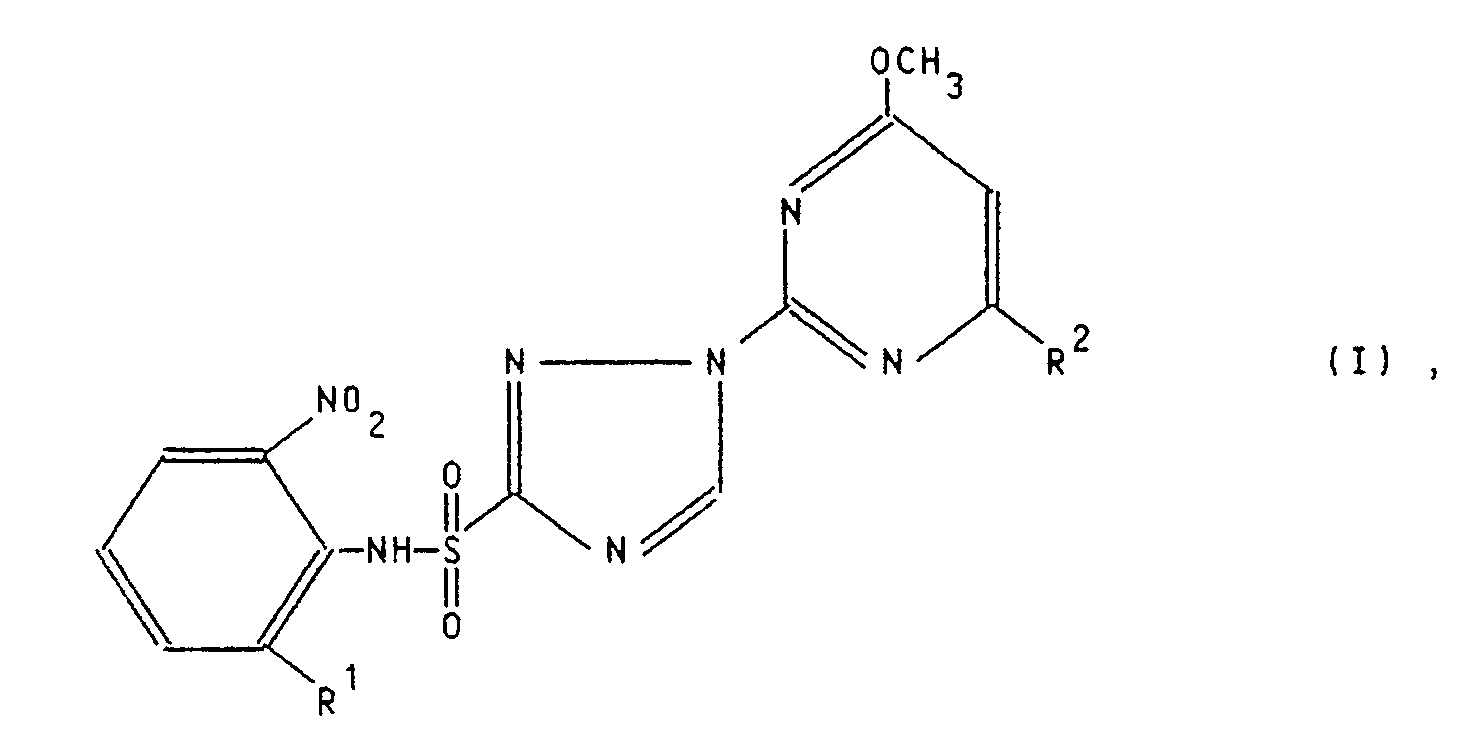
R¹ Methyl, Methoxy, Allyloxy oder Propargyloxy und
R² Methyl oder Methoxy,
bedeuten mit der Einschränkung, daß R¹ nicht Methyl ist, wenn R² Methoxy darstellt. - Die erfindungsgemäßen Verbindungen sind somit 1H-1,2,4-Triazol-3-sulfonsäureamidderivate, die an der Sulfonsäureamidbindung eine Phenylgruppe (mit festgelegten Substituenten) tragen und bei denen das Triazol in 1-Stellung durch eine 4,6-Dimethoxy-pyrimidin-2-yl-gruppe oder eine 4-Methoxy-6-methyl-pyrimidin-2-yl-gruppe substituiert ist.
- Die erfindungsgemäßen Verbindungen sind gekennzeichnet durch eine gute herbizide Wirkung, insbesondere durch eine hohe Wirksamkeit gegen wichtige Reisunkräuter verbunden mit einer guten Selektivität in Wasserreis. Diese Kombination einer guten Wirksamkeit gegen wichtige Reisunkräuter mit einer guten Selektivität in Wasserreis ist bei den Verbindungen, die in der EP-Anmeldung 0 246 749 genannt sind, nicht erkennbar.
- Die erfindungsgemäßen Verbindungen der allgemeinen Formel I können zum Beispiel hergestellt werden, indem man
- A) Nitroanilide der allgemeinen Formel II


- B) eine Verbindung der allgemeinen Formel IV


- Die einzelnen Verfahrensvarianten werden vorzugsweise in Gegenwart eines Verdünnungsmittels durchgeführt. Zu diesem Zweck können sämtliche gegenüber den verwendeten Reagenzien inerte Lösungsmittel verwendet werden.
- Beispiele für solche Lösungsmittel beziehungsweise Verdünnungsmittel sind Wasser, aliphatische, alicyclische und aromatische Kohlenwasserstoffe, die jeweils gegebenenfalls chloriert sein können, wie zum Beispiel Hexan, Cyclohexan, Petrolether, Ligroin, Benzol, Toluol, Xylol, Methylenchlorid, Chloroform, Kohlenstofftetrachlorid, Ethylenchlorid und Trichlorethylen, Ether, wie zum Beispiel Diisopropylether, Dibutylether, Propylenoxid, Dioxan und Tetrahydrofuran, Ketone, wie zum Beispiel Aceton, Methylethylketon, Methylisopropylketon und Methylisobutylketon, Nitrile, wie zum Beispiel Acetonitril und Propionitril, Alkohole, wie zum Beispiel Methanol, Ethanol, Isopropanol, Butanol und Ethylenglycol, Ester, wie zum Beispiel Ethylacetat und Amylacetat, Säureamide, wie Beispiel Dimethylformamid und Dimethylacetamid, Sulfone und Sulfoxide, wie Beispiel Dimethylsulfoxid und Sulfolan, und Basen, wie zum Beispiel Pyridin.
- Die Reaktionen werden vorzugsweise zwischen Raumtemperatur und dem Siedepunkt des jeweiligen Reaktionsgemisches durchgeführt. Die Reaktionen lassen sich bei dem Druck der Umgebung durchführen, wenngleich sie auch bei erhöhtem beziehungsweise vermindertem Druck durchgeführt werden können.
- Die Verfahrensvariante A) wird vorzugsweise in chlorierten Kohlenwasserstoffen, wie Dichlormethan oder Dichlorethan, in Anwesenheit eines Katalysators beziehungsweise Säureakzeptors durchgeführt. Beispiele hierfür sind tertiäre Amine, wie zum Beispiel Triethylamin, Diisopropylethylamin, N-Methylmorpholin, 4-Dimethylaminopyridin und Pyridin. Pyridin kann sowohl als Katalysator als auch als Lösungsmittel bei dieser Reaktion verwendet werden.
- Die Verfahrensvariante B) wird bevorzugt in inerten Lösungsmitteln, wie Dioxan, Tetrahydrofuran, Dimethylformamid oder N-Methylpyrrolidinon, gegebenenfalls in Anwesenheit eines Katalysators durchgeführt. Beispiele für säurebindende Mittel sind Metallhydride, tert. Amine, wie zum Beispiel Triethylamin oder Diisopropylethylamin und anorganische Basen, wie zum Beispiel Alkali- oder Erdalkalihydroxide oder- carbonate.
- Die nach den oben genannten Verfahren hergestellten erfindungsgemäßen Verbindungen können nach den üblichen Verfahren aus dem Reaktionsgemisch isoliert werden, beispielsweise durch Abdestillieren des eingesetzten Lösungsmittels bei normalem oder vermindertem Druck, durch Ausfällen mit Wasser oder durch Extraktion.
- Ein erhöhter Reinheitsgrad kann in der Regel durch säulenchromatographische Aufreinigung sowie durch fraktionierte Destillation oder Kristallisation erhalten werden.
- Die erfindungsgemäßen Verbindungen stellen in der Regel farb- und geruchlose Kristalle dar, die wenig löslich in Wasser und in aliphatischen Kohlenwasserstoffen, wie Petrolether, Hexan, Pentan und Cyclohexan, gut löslich in halogenierten Kohlenwasserstoffen, wie Chloroform, Methylenchlorid und Tetrachlorkohlenstoff, aromatischen Kohlenwasserstoffen, wie Benzol, Toluol und Xylol, Ethern, wie Diethylether, Tetrahydrofuran und Dioxan, Carbonsäurenitrilen, wie Acetonitril, Alkoholen, wie Methanol und Ethanol, Carbonsäureamiden, wie Dimethylformamid, und Sulfoxiden, wie Dimethylsulfoxid, sind.
- Die Verbindungen der allgemeinen Formeln II, III, IV und V können nach in der Literatur beschriebenen Verfahren hergestellt werden, insbesondere nach den in der EP-Anmeldung 0 246 749 genannten Verfahren.
- Wie bereits weiter oben ausgeführt, zeigen die erfindungsgemäßen Verbindungen eine gute Herbizidwirkung. Diese Wirkung erstreckt sich auf monokotyle und dikotyle Unkräuter bei einer guten Selektivität in verschiedenen Nutzpflanzen, wie zum Beispiel in Wasserreis.
- Die erfindungsgemäßen Verbindungen können zum Beispiel bei den folgenden Pflanzengattungen verwendet werden:
- Dikotyle Unkräuter der Gattungen Sinapis, Lepidium, Galium, Stellaria, Matricaria, Anthemis, Galinsoga, Chenopodium, Brassica, Urtica, Senecio, Amaranthus, Portulaca, Xanthium, Convolvulus, Ipomoea, Polygonum, Sesbania, Ambrosia, Cirsium, Carduus, Sonchus, Solanum, Rorippa, Lamium, Veronica, Abutilon, Datura, Viola, Galeopsis, Papaver, Centaurea und Chrysanthemum.
- Monokotyle Unkräuter der Gattungen Avena, Alopecurus, Echinochloa, Setaria, Panicum, Digitaria, Poa, Eleusine, Brachiaria, Lolium, Bromus, Cyperus, Agropyron, Sagittaria, Monochoria, Fimbristylis, Eleocharis, Ischaemum und Apera.
- Die Aufwandmengen schwanken je nach Anwendungsart im Vor- und Nachauflauf in Grenzen zwischen 0,01 bis 1 kg/ha.
- Die erfindungsgemäßen Verbindungen können entweder allein, in Mischung miteinander oder mit anderen Wirkstoffen angewendet werden. Gegebenenfalls können andere Pflanzenschutz- oder Schädlingsbekämpfungsmittel je nach dem gewünschten Zweck zugesetzt werden. Sofern eine Verbreiterung des Wirkungsspektrums beabsichtigt ist, können auch andere Herbizide zugesetzt werden.
- Beispielsweise eignen sich als herbizid wirksame Mischungspartner diejenigen Wirkstoffe, die in Weed Abstracts, Vol. 38, No. 3, 1989, unter dem Titel "List of common names and abbreviations employed for currently used herbicides and plant growth regulators in Weed Abstracts" aufgeführt sind.
- Eine Förderung der Wirkintensität und der Wirkungsgeschwindigkeit kann zum Beispiel durch wirkungssteigernde Zusätze, wie organische Lösungsmittel, Netzmittel und Öle, erzielt werden. Solche Zusätze lassen daher gegebenenfalls eine Verringerung der Wirkstoffdosierung zu.
- Zweckmäßig werden die gekennzeichneten Wirkstoffe oder deren Mischungen in Form von Zubereitungen, wie Pulvern, Streumitteln, Granulaten, Lösungen, Emulsionen oder Suspensionen, unter Zusatz von flüssigen und/oder festen Trägerstoffen beziehungsweise Verdünnungsmitteln und gegebenenfalls Haft-, Netz-, Emulgier- und/oder Dispergierhilfsmitteln angewandt.
- Geeignete flüssige Trägerstoffe sind zum Beispiel aliphatische und aromatische Kohlenwasserstoffe, wie Benzol, Toluol, Xylol, Cyclohexanon, Isophoron, Dimethylsulfoxid, Dimethylformamid, weiterhin Mineralölfraktionen und Pflanzenöle.
- Als feste Trägerstoffe eignen sich Mineralien, zum Beispiel Bentonit, Silicagel, Talkum, Kaolin, Attapulgit, Kalkstein, und pflanzliche Produkte, zum Beispiel Mehle.
- An oberflächenaktiven Stoffen sind zu nennen zum Beispiel Calciumligninsulfonat, Polyethylenalkylphenylether, Naphthalinsulfonsäuren und deren Salze, Phenolsulfonsäuren und deren Salze, Formaldehydkondensate, Fettalkoholsulfate sowie substituierte Benzolsulfonsäuren und deren Salze.
- Der Anteil des beziehungsweise der Wirkstoffe(s) in den verschiedenen Zubereitungen kann in weiten Grenzen variieren. Beispielsweise enthalten die Mittel etwa 10 bis 90 Gewichtsprozent Wirkstoff, etwa 90 bis 10 Gewichtsprozent flüssige oder feste Trägerstoffe sowie gegebenenfalls bis zu 20 Gewichtsprozent oberflächenaktive Stoffe.
- die Ausbringung der Mittel kann in üblicher Weise erfolgen, zum Beispiel mit Wasser als Träger in Spritzbrühmengen etwa 100 bis 1000 Liter/ha. Eine Anwendung der Mittel im sogenannten Low-Volume und Ultra-Low-Volume-Verfahren ist ebenso möglich wie ihre Applikation in Form von sogenannten Mikrogranulaten.
- Die Herstellung dieser Zubereitungen kann in an sich bekannter Art und Weise, zum Beispiel durch Mahl- oder Mischverfahren, durchgeführt werden. Gewünschtenfalls können Zubereitungen der Einzelkomponenten auch erst kurz vor ihrer Verwendung gemischt werden, wie es zum Beispiel im sogenannten Tankmixverfahren in der Praxis durchgeführt wird.
- Zur Herstellung der verschiedenen Zubereitungen werden zum Beispiel die folgenden Bestandteile eingesetzt:
- A) Spritzpulver
- 1.) 25 Gewichtsprozent Wirkstoff
60 Gewichtsprozent Kaolin
10 Gewichtsprozent Kieselsäure
5 Gewichtsprozent einer Mischung aus dem Calciumsalz der Ligninsulfonsäure und dem Natriumsalz des N-Methyl-N-oleyl-taurins - 2.) 40 Gewichtsprozent Wirkstoff
25 Gewichtsprozent Tonmineralien
25 Gewichtsprozent Kieselsäure
10 Gewichtsprozent einer Mischung aus dem Calciumsalz der Ligninsulfonsäure und Alkylphenylpolyglycolethern
- 1.) 25 Gewichtsprozent Wirkstoff
- B) Paste
45 Gewichtsprozent Wirkstoff
5 Gewichtsprozent Natriumaluminiumsilikat
15 Gewichtsprozent Cetylpolyglycolether mit 8 Mol Ethylenoxid
2 Gewichtsprozent Spindelöl
10 Gewichtsprozent Polyethylenglycol
23 Gewichtsprozent Wasser - C) Emulsionskonzentrat
25 Gewichtsprozent Wirkstoff
15 Gewichtsprozent Cyclohexanon
55 Gewichtsprozent Xylol
5 Gewichtsprozent einer Mischung aus dem Calciumsalz der Dodecylbenzolsulfonsäure und Nonylphenylpolyoxyethylen - Die nachstehenden Beispiele erläutern die Herstellung der erfindungsgemäßen Verbindungen:
- 3,23 g (10 mMol) 1H-1,2,4-Triazol-3-sulfonsäure-6-nitro-2-propargyloxyanilid und 2,76 g (20 mMol) Kaliumcarbonat in 25 ml Dimethylformid werden unter Schutzgas 10 Minuten auf 50°C erhitzt. Nach dem Abkühlen auf 0°C und Zugabe von 2,18 g (10 mMol) 4,6-Dimethoxy-2-methylsulfonylpyrimidin läßt man die Mischung auf Raumtemperatur erwärmen und rührt sie 20 Stunden nach. Die Reaktionslösung wird im 300 ml eiskalte, gesättigte Natriumchlorid-Lösung eingerührt und mit 2 N Salzsäurelösung angesäuert (pH 4). Die Kristalle werden abgesaugt und durch Chromatographie an Kieselgel mit Hexan/Essigestergemischen (0 bis 100 % Essigester) gereinigt.
Ausbeute: 2,77 g = 60 % der Theorie
Fp. : 177 - 181 °C - Analog wurden auch die folgenden erfindungsgemäßen Verbindungen hergestellt:
Beispiel Name der Verbindung Physikalische Konstante 2 1-(4-Methoxy-6-methyl-pyrimidin-2-yl)-1H-1,2,4-triazol-3-sulfonsäure-(2-methyl-6-nitroanilid) Fp.: 203-204oC 3 1-(4,6-Dimethoxy-pyrimidin-2-yl)-1H-1,2,4-triazol-3-sulfonsäure-(2-methoxy-6-nitroanilid) Fp.: 226-229oC 4 1-(4,6-Dimethoxy-pyrimidin-2-yl)-1H-1,2,4-triazol-3-sulfonsäure-(2-allyloxy-6-nitroanalid) Fp.: 134-137oC 5 1-(4-Methoxy-6-methyl-pyrimidin-2-yl)-1H-1,2,4-triazol-3-sulfonsäure-(2-methoxy-6-nitroanlid) Fp.: 193-196oC 6 1-(4-Methoxy-6-methyl-pyrimidin-2-yl)-1H-1,2,4-triazol-3-sulfonsäure-(2-allyloxy-6-nitroanilid) Fp.: 179-184oC 7 1-(4-Methoxy-6-methyl-pyrimidin-2-yl)-1H-1,2,4-triazol-3-sulfonsäure-(6-nitro-2-propargyloxyanilid Fp.: 187-191oC - Die folgenden Beispiele erläutern die Anwendungsmöglichkeiten der erfindungsgemäßen Verbindungen:
- Im Gewächshaus wurden die in der Tabelle aufgeführten Verbindungen mit den ebenfalls erwähnten Aufwandmengen appliziert. Hierzu wurden die Wirkstoffe in Form von Zubereitungen auf die Wasseroberfläche in Gefäße mit 1500 ml Wasser pipettiert. Die Testpflanzenarten wurden im Vorauflauf und im 1- bis 5-Blatt-Stadium eingesetzt. Drei Wochen nach der Applikation wurde die Schädigung der Pflanzen bonitiert. Die erfindungsgemäßen Verbindungen zeigten eine starke Wirkung gegen Cyperus difformis und Eleocharis acicularis bei gleichzeitiger Selektivität in Wasserreis.
- In der folgenden Tabelle bedeuten:
0 = keine Schädigung
1 = schwache Schädigung
2 = mittlere Schädigung
3 = starke Schädigung
4 = total vernichtet
ORYSA = Oryza sativa
CYPDI = Cyperus difformis
ELOAC = Eleocharis acicularis
- Im Gewächshaus wurden die in der Tabelle aufgeführten Verbindungen mit den ebenfalls erwähnten Aufwandmengen appliziert. Hierzu wurden die Wirkstoffe in Form von Zubereitungen auf die Wasseroberfläche in Gefäße mit 1500 ml Wasser pipettiert. Die Testpflanzenarten wurden im Vorauflauf und im 1- bis 5-Blatt-Stadium eingesetzt. Drei Wochen nach der Applikation wurde die Schädigung der Pflanzen bonitiert. Die erfindungsgemäße Verbindung zeigte eine starke Wirkung gegen Monochoria vaginalis bei gleichzeitiger Selektivität in Wasserreis. Das Vergleichsmittel war schwächer wirksam.
- In der folgenden Tabelle bedeuten:
0 = keine Schädigung
1 = schwache Schädigung
2 = mittlere Schädigung
3 = starke Schädigung
4 = total vernichtet
ORYSA: Oryza sativa
MOOVA: Monochoria vaginalis
- Im Gewächshaus wurden die in der Tabelle aufgeführten Verbindungen mit den ebenfalls erwähnten Aufwandmengen appliziert. Hierzu wurden die Wirkstoffe in Form von Zubereitungen auf die Wasseroberfläche in Gefäße mit 1500 ml Wasser pipettiert. Die Testpflanzenarten wurden im Vorauflauf und im 1- bis 5-Blatt-Stadium eingesetzt. Drei Wochen nach der Applikation wurde die Schädigung der Pflanzen bonitiert. Die erfindungsgemäße Verbindung zeigte eine starke Wirkung gegen Scirpus juncoides bei gleichzeitiger Selektivität in Wasserreis. Das Vergleichsmittel war schwächer wirksam.
- In der folgenden Tabelle bedeuten:
0 = keine Schädigung
1 = schwache Schädigung
2 = mittlere Schädigung
3 = starke Schädigung
4 = total vernichtet
ORYSA = Oryza sativa
SCPJU = Scirpus juncoides
- Im Gewächshaus wurden die in der Tabelle aufgeführten Verbindungen mit den ebenfalls erwähnten Aufwandmengen appliziert. Hierzu wurden die Wirkstoffe in Form von Zubereitungen auf die Wasseroberfläche in Gefäße mit 1500 ml Wasser pipettiert. Die Testpflanzenarten wurden im Vorauflauf und im 1- bis 5-Blatt-Stadium eingesetzt. Drei Wochen nach der Applikation wurde die Schädigung der Pflanzen bonitiert. Die erfindungsgemäße Verbindung zeigte eine starke Wirkung gegen Cyperus serotinus bei gleichzeitiger Selektivität in Wasserreis. Das Vergleichsmittel war schwächer wirksam.
- In der folgenden Tabelle bedeuten:
0 = keine Schädigung
1 = schwache Schädigung
2 = mittlere Schädigung
3 = starke Schädigung
4 = total vernichtet
ORYSA = Oryza sativa
CYPSE = Cyperus serotinus
Claims (5)

R¹ Methyl, Methoxy, Allyloxy oder Propargyloxy und
R² Methyl oder Methoxy
bedeuten mit der Einschränkung, daß R¹ nicht Methyl ist, wenn R² Methoxy darstellt.


Priority Applications (1)
| Application Number | Priority Date | Filing Date | Title |
|---|---|---|---|
| AT90250232T ATE89279T1 (de) | 1989-09-14 | 1990-09-11 | 1-methoxypyrimidinyl-1h-1,2,4-triazol-3sulfons|urenitroanilide, verfahren zu ihrer herstellung und ihre verwendung als mittel mit herbizider wirkung. |
Applications Claiming Priority (2)
| Application Number | Priority Date | Filing Date | Title |
|---|---|---|---|
| DE3931060 | 1989-09-14 | ||
| DE3931060A DE3931060A1 (de) | 1989-09-14 | 1989-09-14 | 1-methoxypyrimidinyl-1h-1,2,4-triazol-3- sulfonsaeurenitroanilide, verfahren zu ihrer herstellung und ihre verwendung als mittel mit herbizider wirkung |
Publications (3)
| Publication Number | Publication Date |
|---|---|
| EP0417875A2 true EP0417875A2 (de) | 1991-03-20 |
| EP0417875A3 EP0417875A3 (en) | 1991-08-21 |
| EP0417875B1 EP0417875B1 (de) | 1993-05-12 |
Family
ID=6389632
Family Applications (1)
| Application Number | Title | Priority Date | Filing Date |
|---|---|---|---|
| EP90250232A Expired - Lifetime EP0417875B1 (de) | 1989-09-14 | 1990-09-11 | 1-Methoxypyrimidinyl-1H-1,2,4-triazol-3-sulfonsäurenitroanilide, Verfahren zu ihrer Herstellung und ihre Verwendung als Mittel mit herbizider Wirkung |
Country Status (14)
| Country | Link |
|---|---|
| US (1) | US5094682A (de) |
| EP (1) | EP0417875B1 (de) |
| JP (1) | JPH03169877A (de) |
| KR (1) | KR910006278A (de) |
| CN (1) | CN1026047C (de) |
| AT (1) | ATE89279T1 (de) |
| BR (1) | BR9004597A (de) |
| DE (2) | DE3931060A1 (de) |
| DK (1) | DK0417875T3 (de) |
| ES (1) | ES2058770T3 (de) |
| HU (1) | HU206705B (de) |
| IL (1) | IL95608A0 (de) |
| MY (1) | MY107258A (de) |
| PH (1) | PH27366A (de) |
Cited By (2)
| Publication number | Priority date | Publication date | Assignee | Title |
|---|---|---|---|---|
| WO2000037460A1 (fr) * | 1998-12-22 | 2000-06-29 | Ube Industries, Ltd. | Composes de 5-azolylpyrimidine, procede de preparation de ces composes et germicides a usage agricole et horticole |
| EP2417123A2 (de) * | 2009-04-06 | 2012-02-15 | Agios Pharmaceuticals, Inc. | Therapeutische zusammensetzungen und damit in zusammenhang stehende anwendungsverfahren |
Families Citing this family (2)
| Publication number | Priority date | Publication date | Assignee | Title |
|---|---|---|---|---|
| KR100415595B1 (ko) * | 1995-07-25 | 2004-05-12 | 가부시키가이샤 에스디에스 바이오테크 | 수전용제초제조성물 |
| GB2487559B (en) | 2011-01-26 | 2015-10-07 | Georgie Mark Reginald Swan | Support device |
Family Cites Families (2)
| Publication number | Priority date | Publication date | Assignee | Title |
|---|---|---|---|---|
| EP0246749A3 (de) * | 1986-05-17 | 1988-08-31 | AgrEvo UK Limited | Herbizide Triazole |
| DE3813885A1 (de) * | 1988-04-20 | 1989-11-02 | Schering Ag | 1-chlorpyrimidinyl-1h-1,2,4-triazol-3-sulfonsaeureamide, verfahren zu ihrer herstellung und ihre verwendung als mittel mit herbizider, fungizider und pflanzenwachstumsregulierender wirkung |
-
1989
- 1989-09-14 DE DE3931060A patent/DE3931060A1/de not_active Withdrawn
-
1990
- 1990-09-07 IL IL95608A patent/IL95608A0/xx unknown
- 1990-09-11 ES ES90250232T patent/ES2058770T3/es not_active Expired - Lifetime
- 1990-09-11 DK DK90250232.7T patent/DK0417875T3/da active
- 1990-09-11 AT AT90250232T patent/ATE89279T1/de active
- 1990-09-11 EP EP90250232A patent/EP0417875B1/de not_active Expired - Lifetime
- 1990-09-11 DE DE9090250232T patent/DE59001431D1/de not_active Expired - Fee Related
- 1990-09-11 MY MYPI90001565A patent/MY107258A/en unknown
- 1990-09-13 PH PH41202A patent/PH27366A/en unknown
- 1990-09-13 KR KR1019900014454A patent/KR910006278A/ko not_active Abandoned
- 1990-09-13 BR BR909004597A patent/BR9004597A/pt not_active Application Discontinuation
- 1990-09-13 HU HU905898A patent/HU206705B/hu not_active IP Right Cessation
- 1990-09-14 CN CN90107724A patent/CN1026047C/zh not_active Expired - Fee Related
- 1990-09-14 JP JP2242864A patent/JPH03169877A/ja active Pending
- 1990-09-14 US US07/582,251 patent/US5094682A/en not_active Expired - Fee Related
Cited By (2)
| Publication number | Priority date | Publication date | Assignee | Title |
|---|---|---|---|---|
| WO2000037460A1 (fr) * | 1998-12-22 | 2000-06-29 | Ube Industries, Ltd. | Composes de 5-azolylpyrimidine, procede de preparation de ces composes et germicides a usage agricole et horticole |
| EP2417123A2 (de) * | 2009-04-06 | 2012-02-15 | Agios Pharmaceuticals, Inc. | Therapeutische zusammensetzungen und damit in zusammenhang stehende anwendungsverfahren |
Also Published As
| Publication number | Publication date |
|---|---|
| US5094682A (en) | 1992-03-10 |
| HUT54675A (en) | 1991-03-28 |
| ATE89279T1 (de) | 1993-05-15 |
| KR910006278A (ko) | 1991-04-29 |
| EP0417875A3 (en) | 1991-08-21 |
| DK0417875T3 (da) | 1993-08-16 |
| EP0417875B1 (de) | 1993-05-12 |
| DE3931060A1 (de) | 1991-03-28 |
| BR9004597A (pt) | 1991-09-10 |
| JPH03169877A (ja) | 1991-07-23 |
| CN1026047C (zh) | 1994-10-05 |
| MY107258A (en) | 1995-10-31 |
| HU206705B (en) | 1992-12-28 |
| PH27366A (en) | 1993-06-21 |
| DE59001431D1 (de) | 1993-06-17 |
| IL95608A0 (en) | 1991-06-30 |
| ES2058770T3 (es) | 1994-11-01 |
| CN1050189A (zh) | 1991-03-27 |
Similar Documents
| Publication | Publication Date | Title |
|---|---|---|
| EP0338465B1 (de) | 1-Chlorpyrimidinyl-1H-1,2,4-triazol-3-sulfonsäureamide, Verfahren zu ihrer Herstellung und ihre Verwendung als Mittel mit herbizider Wirkung | |
| EP0409368B1 (de) | Substituierte alfa-Pyrimidinyloxy-carbonsäurederivate, Verfahren zu ihrer Herstellung und ihre Verwendung als Mittel mit herbizider, fungizider und pflanzenwachstumsregulierender Wirkung | |
| EP0297490A1 (de) | 6,7-Dihydro-pyrazolo(1,5-a) (1,3,5)triazin-2-sulfonsäureamide, Verfahren zu ihrer Herstellung und ihre Verwendung als Mittel mit herbizider und pflanzenwuchsregulierender Wirkung | |
| EP0137358A2 (de) | 1,3-Diaryl-5-methylen-perhydropyrimidin-2-one | |
| DE3813886A1 (de) | 1-triazinyl-1h-1,2,4-triazol-3- sulfonsaeureamide, verfahren zu ihrer herstellung und ihre verwendung als mittel mit herbizider, fungizider und pflanzenwachstumsregulierender wirkung | |
| DE3825041A1 (de) | Pyrido(3,2-e)(1,2,4)triazolo(1,5-a)pyrimidin- 2-sulfonsaeureamide, verfahren zu ihrer herstellung und ihre verwendung als mittel mit herbizider, pflanzenwachstumsregulierender und fungizider wirkung | |
| EP0915873A1 (de) | Substituierte pyrazolyl-pyrazolderivate, verfahren zu ihrer herstellung und ihre verwendung als mittel mit herbizider wirkung | |
| DE3737748A1 (de) | 3-arylsulfonylamino-1h-1,2,4-triazole, verfahren zu ihrer herstellung und ihre verwendung als mittel mit herbizider und wachstumsregulierender wirkung | |
| EP0417875B1 (de) | 1-Methoxypyrimidinyl-1H-1,2,4-triazol-3-sulfonsäurenitroanilide, Verfahren zu ihrer Herstellung und ihre Verwendung als Mittel mit herbizider Wirkung | |
| EP0422751B1 (de) | Substituierte 2-Pyrimidinyl- und 2-Triazinylessigsäurederivate, Verfahren zu ihrer Herstellung und ihre Verwendung als Mittel mit herbizider, Fungizider und Pflanzenwachstumsregulierender Wirkung | |
| EP0272628A2 (de) | 6,7-Dihydro-[1,2,4]triazolo[1,5-a][1,3,5]triazin-2-sulfonsäureamide, Verfahren zu ihrer Herstellung und ihre Verwendung als Mittel mit herbizider und wachstumsregulierender Wirkung | |
| EP0409369A2 (de) | Substituierte Pyrimidinyloxy-(thio)- und Triazinyloxy(thio)-acrylsäurederivate, Verfahren zu ihrer Herstellung und ihre Verwendung als Mittel mit herbizider, fungizider und pflanzenwachstumsregulierender Wirkung | |
| EP0410552A1 (de) | Substituierte 4-Heteroaroylpyrazole, Verfahren zur Herstellung dieser Verbindungen und ihre Verwendung als Mittel mit herbizider Wirkung | |
| DE3539386A1 (de) | N-(s-triazolo(1,5-a)pyrimidin-2-yl)-2-alkoxy-benzolsulfonamide, verfahren zur herstellung dieser verbindungen sowie diese enthaltende mittel mit herbizider und pflanzenwachstumsregulierender wirkung | |
| EP0049416A2 (de) | Substituierte 6-Halogen-tert.-butyl-1,2,4-triazin-5-one, Verfahren zu ihrer Herstellung sowie ihre Verwendung als Herbizide | |
| DE4002365A1 (de) | Substituierte (beta)-pyrimidinyloxy(thio)- und (beta)-triazinyloxy(thio)cycloalkylcarbonsaeurederivate, verfahren zu ihrer herstellung und ihre verwendung als mittel mit herbizider, fungizider und pflanzenwachstumsregulierender wirkung | |
| EP0173319A1 (de) | Substituierte Arylsulfonylguanidine | |
| DE3825043A1 (de) | 3-methylsulfonyl-pyrazolo(1,5-a)pyrimidin-sulfonsaeureamide, verfahren zu ihrer herstellung und ihre verwendung als mittel mit herbizider, pflanzenwuchsregulierender und fungizider wirkung | |
| DE4035758A1 (de) | Substituierte (alpha)-pyrimidinyloxy(thio)- und (alpha)-triazinyloxy(thio)-carbonsaeurederivate, verfahren zu ihrer herstellung und ihre verwendung als mittel mit herbizider, fungizider und pflanzenwachstumsregulierender wirkung | |
| EP0173323A1 (de) | Amidinoazole | |
| EP0397295A2 (de) | 2-Phenyl-perhydro-isoindol-1-one und -1-thione, Verfahren zu ihrer Herstellung und ihre Verwendung als Mittel mit herbizider Wirkung | |
| DE4026177A1 (de) | Substituierte 2-pyrimidinylmethyl- und 2-triazinylmethylbenzoe- und nicotinsaeurederivate, verfahren zu ihrer herstellung und ihre verwendung als mittel mit herbizider, fungizider und pflanzenwachstums-regulierender wirkung | |
| DE19535842A1 (de) | Herbizide 3- bzw. 3,4-heterosubstituierte Pyrrolinone | |
| DE4008181A1 (de) | Substituierte 2-amino-1,2,4-triazolo(1,5-a)pyrimidine und -triazine, verfahren zu ihrer herstellung und ihre verwendung als mittel mit herbizider wirkung | |
| DE3513488A1 (de) | Herbizide mittel |
Legal Events
| Date | Code | Title | Description |
|---|---|---|---|
| PUAI | Public reference made under article 153(3) epc to a published international application that has entered the european phase |
Free format text: ORIGINAL CODE: 0009012 |
|
| 17P | Request for examination filed |
Effective date: 19900911 |
|
| AK | Designated contracting states |
Kind code of ref document: A2 Designated state(s): AT BE CH DE DK ES FR GB GR IT LI LU NL SE |
|
| PUAL | Search report despatched |
Free format text: ORIGINAL CODE: 0009013 |
|
| AK | Designated contracting states |
Kind code of ref document: A3 Designated state(s): AT BE CH DE DK ES FR GB GR IT LI LU NL SE |
|
| 17Q | First examination report despatched |
Effective date: 19920217 |
|
| GRAA | (expected) grant |
Free format text: ORIGINAL CODE: 0009210 |
|
| AK | Designated contracting states |
Kind code of ref document: B1 Designated state(s): AT BE CH DE DK ES FR GB GR IT LI LU NL SE |
|
| REF | Corresponds to: |
Ref document number: 89279 Country of ref document: AT Date of ref document: 19930515 Kind code of ref document: T |
|
| REF | Corresponds to: |
Ref document number: 59001431 Country of ref document: DE Date of ref document: 19930617 |
|
| ITF | It: translation for a ep patent filed | ||
| REG | Reference to a national code |
Ref country code: DK Ref legal event code: T3 |
|
| ET | Fr: translation filed | ||
| REG | Reference to a national code |
Ref country code: GR Ref legal event code: FG4A Free format text: 3008305 |
|
| GBT | Gb: translation of ep patent filed (gb section 77(6)(a)/1977) |
Effective date: 19930730 |
|
| EPTA | Lu: last paid annual fee | ||
| PGFP | Annual fee paid to national office [announced via postgrant information from national office to epo] |
Ref country code: LU Payment date: 19940801 Year of fee payment: 5 |
|
| PGFP | Annual fee paid to national office [announced via postgrant information from national office to epo] |
Ref country code: FR Payment date: 19940808 Year of fee payment: 5 |
|
| PGFP | Annual fee paid to national office [announced via postgrant information from national office to epo] |
Ref country code: CH Payment date: 19940812 Year of fee payment: 5 Ref country code: AT Payment date: 19940812 Year of fee payment: 5 |
|
| PGFP | Annual fee paid to national office [announced via postgrant information from national office to epo] |
Ref country code: SE Payment date: 19940815 Year of fee payment: 5 Ref country code: GB Payment date: 19940815 Year of fee payment: 5 |
|
| PGFP | Annual fee paid to national office [announced via postgrant information from national office to epo] |
Ref country code: DK Payment date: 19940816 Year of fee payment: 5 |
|
| PGFP | Annual fee paid to national office [announced via postgrant information from national office to epo] |
Ref country code: BE Payment date: 19940830 Year of fee payment: 5 |
|
| PGFP | Annual fee paid to national office [announced via postgrant information from national office to epo] |
Ref country code: NL Payment date: 19940930 Year of fee payment: 5 |
|
| REG | Reference to a national code |
Ref country code: ES Ref legal event code: FG2A Ref document number: 2058770 Country of ref document: ES Kind code of ref document: T3 |
|
| EAL | Se: european patent in force in sweden |
Ref document number: 90250232.7 |
|
| PGFP | Annual fee paid to national office [announced via postgrant information from national office to epo] |
Ref country code: GR Payment date: 19950831 Year of fee payment: 6 |
|
| PGFP | Annual fee paid to national office [announced via postgrant information from national office to epo] |
Ref country code: ES Payment date: 19950908 Year of fee payment: 6 |
|
| PG25 | Lapsed in a contracting state [announced via postgrant information from national office to epo] |
Ref country code: LU Free format text: LAPSE BECAUSE OF NON-PAYMENT OF DUE FEES Effective date: 19950911 Ref country code: GB Effective date: 19950911 Ref country code: DK Effective date: 19950911 Ref country code: AT Effective date: 19950911 |
|
| REG | Reference to a national code |
Ref country code: DK Ref legal event code: EBP |
|
| PG25 | Lapsed in a contracting state [announced via postgrant information from national office to epo] |
Ref country code: SE Effective date: 19950912 |
|
| PG25 | Lapsed in a contracting state [announced via postgrant information from national office to epo] |
Ref country code: LI Effective date: 19950930 Ref country code: CH Effective date: 19950930 Ref country code: BE Effective date: 19950930 |
|
| BERE | Be: lapsed |
Owner name: SCHERING A.G. BERLIN UND BERGKAMEN Effective date: 19950930 |
|
| PG25 | Lapsed in a contracting state [announced via postgrant information from national office to epo] |
Ref country code: NL Effective date: 19960401 |
|
| GBPC | Gb: european patent ceased through non-payment of renewal fee |
Effective date: 19950911 |
|
| REG | Reference to a national code |
Ref country code: CH Ref legal event code: PL |
|
| PG25 | Lapsed in a contracting state [announced via postgrant information from national office to epo] |
Ref country code: FR Effective date: 19960531 |
|
| NLV4 | Nl: lapsed or anulled due to non-payment of the annual fee |
Effective date: 19960401 |
|
| EUG | Se: european patent has lapsed |
Ref document number: 90250232.7 |
|
| PGFP | Annual fee paid to national office [announced via postgrant information from national office to epo] |
Ref country code: DE Payment date: 19960824 Year of fee payment: 7 |
|
| REG | Reference to a national code |
Ref country code: FR Ref legal event code: ST |
|
| PG25 | Lapsed in a contracting state [announced via postgrant information from national office to epo] |
Ref country code: ES Free format text: LAPSE BECAUSE OF THE APPLICANT RENOUNCES Effective date: 19960912 |
|
| PG25 | Lapsed in a contracting state [announced via postgrant information from national office to epo] |
Ref country code: GR Free format text: THE PATENT HAS BEEN ANNULLED BY A DECISION OF A NATIONAL AUTHORITY Effective date: 19970331 |
|
| REG | Reference to a national code |
Ref country code: GR Ref legal event code: MM2A Free format text: 3008305 |
|
| PG25 | Lapsed in a contracting state [announced via postgrant information from national office to epo] |
Ref country code: DE Free format text: LAPSE BECAUSE OF NON-PAYMENT OF DUE FEES Effective date: 19980603 |
|
| REG | Reference to a national code |
Ref country code: ES Ref legal event code: FD2A Effective date: 19991007 |
|
| PG25 | Lapsed in a contracting state [announced via postgrant information from national office to epo] |
Ref country code: IT Free format text: LAPSE BECAUSE OF NON-PAYMENT OF DUE FEES Effective date: 20050911 |
|
| PLBE | No opposition filed within time limit |
Free format text: ORIGINAL CODE: 0009261 |
|
| STAA | Information on the status of an ep patent application or granted ep patent |
Free format text: STATUS: NO OPPOSITION FILED WITHIN TIME LIMIT |