EP0418575A2 - Process for the manufacture of plates, foils, or sheet-like materials and process for the manufacture of presensitized lithographic printing plates - Google Patents
Process for the manufacture of plates, foils, or sheet-like materials and process for the manufacture of presensitized lithographic printing plates Download PDFInfo
- Publication number
- EP0418575A2 EP0418575A2 EP90116032A EP90116032A EP0418575A2 EP 0418575 A2 EP0418575 A2 EP 0418575A2 EP 90116032 A EP90116032 A EP 90116032A EP 90116032 A EP90116032 A EP 90116032A EP 0418575 A2 EP0418575 A2 EP 0418575A2
- Authority
- EP
- European Patent Office
- Prior art keywords
- carbon atoms
- aqueous solution
- hydrolyzate
- silane
- condensate
- Prior art date
- Legal status (The legal status is an assumption and is not a legal conclusion. Google has not performed a legal analysis and makes no representation as to the accuracy of the status listed.)
- Withdrawn
Links
- 238000007639 printing Methods 0.000 title claims abstract description 41
- 238000004519 manufacturing process Methods 0.000 title claims abstract description 11
- 238000000034 method Methods 0.000 title claims description 38
- 239000000463 material Substances 0.000 title claims description 10
- 239000011888 foil Substances 0.000 title description 2
- BLRPTPMANUNPDV-UHFFFAOYSA-N Silane Chemical compound [SiH4] BLRPTPMANUNPDV-UHFFFAOYSA-N 0.000 claims abstract description 19
- 239000007864 aqueous solution Substances 0.000 claims abstract description 19
- 229910000077 silane Inorganic materials 0.000 claims abstract description 19
- 229910052782 aluminium Inorganic materials 0.000 claims abstract description 17
- XAGFODPZIPBFFR-UHFFFAOYSA-N aluminium Chemical compound [Al] XAGFODPZIPBFFR-UHFFFAOYSA-N 0.000 claims abstract description 17
- 238000007645 offset printing Methods 0.000 claims abstract description 9
- -1 alkyl radicals Chemical class 0.000 claims description 40
- 125000004432 carbon atom Chemical group C* 0.000 claims description 25
- 150000001875 compounds Chemical class 0.000 claims description 19
- 150000005840 aryl radicals Chemical class 0.000 claims description 9
- 229910052739 hydrogen Inorganic materials 0.000 claims description 9
- 239000001257 hydrogen Substances 0.000 claims description 9
- 229910020148 K2ZrF6 Inorganic materials 0.000 claims description 8
- 150000002431 hydrogen Chemical class 0.000 claims description 6
- 229910052783 alkali metal Inorganic materials 0.000 claims description 5
- 150000001340 alkali metals Chemical class 0.000 claims description 5
- 229910000838 Al alloy Inorganic materials 0.000 claims description 4
- ZAMOUSCENKQFHK-UHFFFAOYSA-N Chlorine atom Chemical compound [Cl] ZAMOUSCENKQFHK-UHFFFAOYSA-N 0.000 claims description 4
- 229910052801 chlorine Inorganic materials 0.000 claims description 4
- 239000000460 chlorine Substances 0.000 claims description 4
- TWNQGVIAIRXVLR-UHFFFAOYSA-N oxo(oxoalumanyloxy)alumane Chemical compound O=[Al]O[Al]=O TWNQGVIAIRXVLR-UHFFFAOYSA-N 0.000 claims description 4
- 150000003254 radicals Chemical class 0.000 claims description 4
- 229910052708 sodium Inorganic materials 0.000 claims description 4
- WKBOTKDWSSQWDR-UHFFFAOYSA-N Bromine atom Chemical compound [Br] WKBOTKDWSSQWDR-UHFFFAOYSA-N 0.000 claims description 3
- UFHFLCQGNIYNRP-UHFFFAOYSA-N Hydrogen Chemical compound [H][H] UFHFLCQGNIYNRP-UHFFFAOYSA-N 0.000 claims description 3
- GDTBXPJZTBHREO-UHFFFAOYSA-N bromine Substances BrBr GDTBXPJZTBHREO-UHFFFAOYSA-N 0.000 claims description 3
- 229910052794 bromium Inorganic materials 0.000 claims description 3
- 150000001244 carboxylic acid anhydrides Chemical group 0.000 claims description 3
- 229910052700 potassium Inorganic materials 0.000 claims description 3
- 229910052719 titanium Inorganic materials 0.000 claims description 3
- 229910052726 zirconium Inorganic materials 0.000 claims description 3
- 239000000203 mixture Substances 0.000 abstract description 10
- KRHYYFGTRYWZRS-UHFFFAOYSA-M Fluoride anion Chemical compound [F-] KRHYYFGTRYWZRS-UHFFFAOYSA-M 0.000 abstract description 2
- 239000000243 solution Substances 0.000 description 24
- 230000000052 comparative effect Effects 0.000 description 16
- 238000011161 development Methods 0.000 description 12
- 239000002253 acid Substances 0.000 description 10
- 239000000975 dye Substances 0.000 description 10
- PUZPDOWCWNUUKD-UHFFFAOYSA-M sodium fluoride Chemical compound [F-].[Na+] PUZPDOWCWNUUKD-UHFFFAOYSA-M 0.000 description 10
- XLYOFNOQVPJJNP-UHFFFAOYSA-N water Substances O XLYOFNOQVPJJNP-UHFFFAOYSA-N 0.000 description 10
- 150000004756 silanes Chemical group 0.000 description 9
- 238000003860 storage Methods 0.000 description 9
- KTBDNSOWRGZLJK-UHFFFAOYSA-N 2-dimethoxyphosphorylethyl(trimethoxy)silane Chemical compound CO[Si](OC)(OC)CCP(=O)(OC)OC KTBDNSOWRGZLJK-UHFFFAOYSA-N 0.000 description 8
- ISAOCJYIOMOJEB-UHFFFAOYSA-N benzoin Chemical compound C=1C=CC=CC=1C(O)C(=O)C1=CC=CC=C1 ISAOCJYIOMOJEB-UHFFFAOYSA-N 0.000 description 8
- 238000012360 testing method Methods 0.000 description 8
- 230000007062 hydrolysis Effects 0.000 description 7
- 238000006460 hydrolysis reaction Methods 0.000 description 7
- LYCAIKOWRPUZTN-UHFFFAOYSA-N Ethylene glycol Chemical compound OCCO LYCAIKOWRPUZTN-UHFFFAOYSA-N 0.000 description 6
- VEXZGXHMUGYJMC-UHFFFAOYSA-N Hydrochloric acid Chemical compound Cl VEXZGXHMUGYJMC-UHFFFAOYSA-N 0.000 description 6
- 239000011230 binding agent Substances 0.000 description 6
- 239000000976 ink Substances 0.000 description 6
- VVBLNCFGVYUYGU-UHFFFAOYSA-N 4,4'-Bis(dimethylamino)benzophenone Chemical class C1=CC(N(C)C)=CC=C1C(=O)C1=CC=C(N(C)C)C=C1 VVBLNCFGVYUYGU-UHFFFAOYSA-N 0.000 description 5
- CERQOIWHTDAKMF-UHFFFAOYSA-N Methacrylic acid Chemical compound CC(=C)C(O)=O CERQOIWHTDAKMF-UHFFFAOYSA-N 0.000 description 5
- 244000028419 Styrax benzoin Species 0.000 description 5
- 235000000126 Styrax benzoin Nutrition 0.000 description 5
- 235000008411 Sumatra benzointree Nutrition 0.000 description 5
- 229960002130 benzoin Drugs 0.000 description 5
- 239000011248 coating agent Substances 0.000 description 5
- 238000000576 coating method Methods 0.000 description 5
- 125000001495 ethyl group Chemical group [H]C([H])([H])C([H])([H])* 0.000 description 5
- 235000019382 gum benzoic Nutrition 0.000 description 5
- 125000002496 methyl group Chemical group [H]C([H])([H])* 0.000 description 5
- 239000000178 monomer Substances 0.000 description 5
- 229920000642 polymer Polymers 0.000 description 5
- 238000012545 processing Methods 0.000 description 5
- 239000011775 sodium fluoride Substances 0.000 description 5
- 235000013024 sodium fluoride Nutrition 0.000 description 5
- 239000000126 substance Substances 0.000 description 5
- 239000000654 additive Substances 0.000 description 4
- 125000003178 carboxy group Chemical group [H]OC(*)=O 0.000 description 4
- MTHSVFCYNBDYFN-UHFFFAOYSA-N diethylene glycol Chemical compound OCCOCCO MTHSVFCYNBDYFN-UHFFFAOYSA-N 0.000 description 4
- 150000004673 fluoride salts Chemical class 0.000 description 4
- 239000004014 plasticizer Substances 0.000 description 4
- 239000000047 product Substances 0.000 description 4
- 125000001436 propyl group Chemical group [H]C([*])([H])C([H])([H])C([H])([H])[H] 0.000 description 4
- 230000005855 radiation Effects 0.000 description 4
- 239000000758 substrate Substances 0.000 description 4
- LXSIHXFNFUHKPO-UHFFFAOYSA-N 2-trihydroxysilylethylphosphonic acid Chemical compound O[Si](O)(O)CCP(O)(O)=O LXSIHXFNFUHKPO-UHFFFAOYSA-N 0.000 description 3
- GXDMUOPCQNLBCZ-UHFFFAOYSA-N 3-(3-triethoxysilylpropyl)oxolane-2,5-dione Chemical compound CCO[Si](OCC)(OCC)CCCC1CC(=O)OC1=O GXDMUOPCQNLBCZ-UHFFFAOYSA-N 0.000 description 3
- VVQNEPGJFQJSBK-UHFFFAOYSA-N Methyl methacrylate Chemical compound COC(=O)C(C)=C VVQNEPGJFQJSBK-UHFFFAOYSA-N 0.000 description 3
- 150000001252 acrylic acid derivatives Chemical class 0.000 description 3
- 239000012190 activator Substances 0.000 description 3
- 239000002585 base Substances 0.000 description 3
- 125000001797 benzyl group Chemical group [H]C1=C([H])C([H])=C(C([H])=C1[H])C([H])([H])* 0.000 description 3
- 239000012954 diazonium Substances 0.000 description 3
- LXCYSACZTOKNNS-UHFFFAOYSA-N diethoxy(oxo)phosphanium Chemical compound CCO[P+](=O)OCC LXCYSACZTOKNNS-UHFFFAOYSA-N 0.000 description 3
- YLFBFPXKTIQSSY-UHFFFAOYSA-N dimethoxy(oxo)phosphanium Chemical compound CO[P+](=O)OC YLFBFPXKTIQSSY-UHFFFAOYSA-N 0.000 description 3
- 239000003112 inhibitor Substances 0.000 description 3
- 239000003999 initiator Substances 0.000 description 3
- 229920003145 methacrylic acid copolymer Polymers 0.000 description 3
- 125000001570 methylene group Chemical group [H]C([H])([*:1])[*:2] 0.000 description 3
- 239000011734 sodium Substances 0.000 description 3
- 238000012719 thermal polymerization Methods 0.000 description 3
- AAAQKTZKLRYKHR-UHFFFAOYSA-N triphenylmethane Chemical compound C1=CC=CC=C1C(C=1C=CC=CC=1)C1=CC=CC=C1 AAAQKTZKLRYKHR-UHFFFAOYSA-N 0.000 description 3
- WPWHSFAFEBZWBB-UHFFFAOYSA-N 1-butyl radical Chemical compound [CH2]CCC WPWHSFAFEBZWBB-UHFFFAOYSA-N 0.000 description 2
- SMZOUWXMTYCWNB-UHFFFAOYSA-N 2-(2-methoxy-5-methylphenyl)ethanamine Chemical compound COC1=CC=C(C)C=C1CCN SMZOUWXMTYCWNB-UHFFFAOYSA-N 0.000 description 2
- NIXOWILDQLNWCW-UHFFFAOYSA-N 2-Propenoic acid Natural products OC(=O)C=C NIXOWILDQLNWCW-UHFFFAOYSA-N 0.000 description 2
- VVXLFFIFNVKFBD-UHFFFAOYSA-N 4,4,4-trifluoro-1-phenylbutane-1,3-dione Chemical compound FC(F)(F)C(=O)CC(=O)C1=CC=CC=C1 VVXLFFIFNVKFBD-UHFFFAOYSA-N 0.000 description 2
- HRPVXLWXLXDGHG-UHFFFAOYSA-N Acrylamide Chemical compound NC(=O)C=C HRPVXLWXLXDGHG-UHFFFAOYSA-N 0.000 description 2
- RTZKZFJDLAIYFH-UHFFFAOYSA-N Diethyl ether Chemical compound CCOCC RTZKZFJDLAIYFH-UHFFFAOYSA-N 0.000 description 2
- PEDCQBHIVMGVHV-UHFFFAOYSA-N Glycerine Chemical compound OCC(O)CO PEDCQBHIVMGVHV-UHFFFAOYSA-N 0.000 description 2
- QIGBRXMKCJKVMJ-UHFFFAOYSA-N Hydroquinone Chemical compound OC1=CC=C(O)C=C1 QIGBRXMKCJKVMJ-UHFFFAOYSA-N 0.000 description 2
- 229910020491 K2TiF6 Inorganic materials 0.000 description 2
- PPBRXRYQALVLMV-UHFFFAOYSA-N Styrene Chemical compound C=CC1=CC=CC=C1 PPBRXRYQALVLMV-UHFFFAOYSA-N 0.000 description 2
- QAOWNCQODCNURD-UHFFFAOYSA-N Sulfuric acid Chemical compound OS(O)(=O)=O QAOWNCQODCNURD-UHFFFAOYSA-N 0.000 description 2
- 238000005299 abrasion Methods 0.000 description 2
- 150000007513 acids Chemical class 0.000 description 2
- DZBUGLKDJFMEHC-UHFFFAOYSA-N acridine Chemical compound C1=CC=CC2=CC3=CC=CC=C3N=C21 DZBUGLKDJFMEHC-UHFFFAOYSA-N 0.000 description 2
- 230000001476 alcoholic effect Effects 0.000 description 2
- 229910045601 alloy Inorganic materials 0.000 description 2
- 239000000956 alloy Substances 0.000 description 2
- 150000004056 anthraquinones Chemical class 0.000 description 2
- 230000006399 behavior Effects 0.000 description 2
- RWCCWEUUXYIKHB-UHFFFAOYSA-N benzophenone Chemical compound C=1C=CC=CC=1C(=O)C1=CC=CC=C1 RWCCWEUUXYIKHB-UHFFFAOYSA-N 0.000 description 2
- 239000012965 benzophenone Substances 0.000 description 2
- 150000008366 benzophenones Chemical class 0.000 description 2
- WERYXYBDKMZEQL-UHFFFAOYSA-N butane-1,4-diol Chemical compound OCCCCO WERYXYBDKMZEQL-UHFFFAOYSA-N 0.000 description 2
- 239000012876 carrier material Substances 0.000 description 2
- 239000007859 condensation product Substances 0.000 description 2
- 150000001989 diazonium salts Chemical class 0.000 description 2
- 239000000539 dimer Substances 0.000 description 2
- 150000002009 diols Chemical class 0.000 description 2
- 150000002148 esters Chemical class 0.000 description 2
- QSHDDOUJBYECFT-UHFFFAOYSA-N mercury Chemical compound [Hg] QSHDDOUJBYECFT-UHFFFAOYSA-N 0.000 description 2
- 125000001997 phenyl group Chemical group [H]C1=C([H])C([H])=C(*)C([H])=C1[H] 0.000 description 2
- 239000000049 pigment Substances 0.000 description 2
- 229920005862 polyol Polymers 0.000 description 2
- 150000003077 polyols Chemical class 0.000 description 2
- NROKBHXJSPEDAR-UHFFFAOYSA-M potassium fluoride Chemical compound [F-].[K+] NROKBHXJSPEDAR-UHFFFAOYSA-M 0.000 description 2
- 230000002940 repellent Effects 0.000 description 2
- 239000005871 repellent Substances 0.000 description 2
- 235000011149 sulphuric acid Nutrition 0.000 description 2
- 150000003512 tertiary amines Chemical class 0.000 description 2
- ZIBGPFATKBEMQZ-UHFFFAOYSA-N triethylene glycol Chemical compound OCCOCCOCCO ZIBGPFATKBEMQZ-UHFFFAOYSA-N 0.000 description 2
- DNIAPMSPPWPWGF-VKHMYHEASA-N (+)-propylene glycol Chemical compound C[C@H](O)CO DNIAPMSPPWPWGF-VKHMYHEASA-N 0.000 description 1
- DNIAPMSPPWPWGF-GSVOUGTGSA-N (R)-(-)-Propylene glycol Chemical compound C[C@@H](O)CO DNIAPMSPPWPWGF-GSVOUGTGSA-N 0.000 description 1
- KETQAJRQOHHATG-UHFFFAOYSA-N 1,2-naphthoquinone Chemical compound C1=CC=C2C(=O)C(=O)C=CC2=C1 KETQAJRQOHHATG-UHFFFAOYSA-N 0.000 description 1
- 150000005184 1,3-dinitrobenzenes Chemical class 0.000 description 1
- YPFDHNVEDLHUCE-UHFFFAOYSA-N 1,3-propanediol Substances OCCCO YPFDHNVEDLHUCE-UHFFFAOYSA-N 0.000 description 1
- 150000005208 1,4-dihydroxybenzenes Chemical class 0.000 description 1
- TZMSYXZUNZXBOL-UHFFFAOYSA-N 10H-phenoxazine Chemical compound C1=CC=C2NC3=CC=CC=C3OC2=C1 TZMSYXZUNZXBOL-UHFFFAOYSA-N 0.000 description 1
- KWVGIHKZDCUPEU-UHFFFAOYSA-N 2,2-dimethoxy-2-phenylacetophenone Chemical compound C=1C=CC=CC=1C(OC)(OC)C(=O)C1=CC=CC=C1 KWVGIHKZDCUPEU-UHFFFAOYSA-N 0.000 description 1
- JWVWYFAPZYEQQQ-UHFFFAOYSA-N 2,2-dimethylpropane-1,1-diol;2,2-dimethylpropane-1,3-diol Chemical compound CC(C)(C)C(O)O.OCC(C)(C)CO JWVWYFAPZYEQQQ-UHFFFAOYSA-N 0.000 description 1
- QUASZQPLPKGIJY-UHFFFAOYSA-N 2-[2-[2-(2-hydroxyethoxy)ethoxy]ethoxy]ethyl prop-2-enoate Chemical class OCCOCCOCCOCCOC(=O)C=C QUASZQPLPKGIJY-UHFFFAOYSA-N 0.000 description 1
- SHKUUQIDMUMQQK-UHFFFAOYSA-N 2-[4-(oxiran-2-ylmethoxy)butoxymethyl]oxirane Chemical compound C1OC1COCCCCOCC1CO1 SHKUUQIDMUMQQK-UHFFFAOYSA-N 0.000 description 1
- MHOFGBJTSNWTDT-UHFFFAOYSA-M 2-[n-ethyl-4-[(6-methoxy-3-methyl-1,3-benzothiazol-3-ium-2-yl)diazenyl]anilino]ethanol;methyl sulfate Chemical compound COS([O-])(=O)=O.C1=CC(N(CCO)CC)=CC=C1N=NC1=[N+](C)C2=CC=C(OC)C=C2S1 MHOFGBJTSNWTDT-UHFFFAOYSA-M 0.000 description 1
- ZCDADJXRUCOCJE-UHFFFAOYSA-N 2-chlorothioxanthen-9-one Chemical compound C1=CC=C2C(=O)C3=CC(Cl)=CC=C3SC2=C1 ZCDADJXRUCOCJE-UHFFFAOYSA-N 0.000 description 1
- YCMLQMDWSXFTIF-UHFFFAOYSA-N 2-methylbenzenesulfonimidic acid Chemical compound CC1=CC=CC=C1S(N)(=O)=O YCMLQMDWSXFTIF-UHFFFAOYSA-N 0.000 description 1
- SQHWUYVHKRVCMD-UHFFFAOYSA-N 2-n,2-n-dimethyl-10-phenylphenazin-10-ium-2,8-diamine;chloride Chemical compound [Cl-].C12=CC(N(C)C)=CC=C2N=C2C=CC(N)=CC2=[N+]1C1=CC=CC=C1 SQHWUYVHKRVCMD-UHFFFAOYSA-N 0.000 description 1
- FBDVZTRAKUSSKE-UHFFFAOYSA-N 2-trimethoxysilylethylphosphonic acid Chemical compound CO[Si](OC)(OC)CCP(O)(O)=O FBDVZTRAKUSSKE-UHFFFAOYSA-N 0.000 description 1
- DZNJMLVCIZGWSC-UHFFFAOYSA-N 3',6'-bis(diethylamino)spiro[2-benzofuran-3,9'-xanthene]-1-one Chemical compound O1C(=O)C2=CC=CC=C2C21C1=CC=C(N(CC)CC)C=C1OC1=CC(N(CC)CC)=CC=C21 DZNJMLVCIZGWSC-UHFFFAOYSA-N 0.000 description 1
- ZADOWCXTUZWAKL-UHFFFAOYSA-N 3-(3-trimethoxysilylpropyl)oxolane-2,5-dione Chemical compound CO[Si](OC)(OC)CCCC1CC(=O)OC1=O ZADOWCXTUZWAKL-UHFFFAOYSA-N 0.000 description 1
- ADUMIBSPEHFSLA-UHFFFAOYSA-N 4-[bis(4-aminophenyl)methyl]aniline Chemical compound C1=CC(N)=CC=C1C(C=1C=CC(N)=CC=1)C1=CC=C(N)C=C1 ADUMIBSPEHFSLA-UHFFFAOYSA-N 0.000 description 1
- VKVJAWNFDVEVBK-UHFFFAOYSA-N 4-trimethoxysilylbutanoic acid Chemical compound CO[Si](OC)(OC)CCCC(O)=O VKVJAWNFDVEVBK-UHFFFAOYSA-N 0.000 description 1
- DEXFNLNNUZKHNO-UHFFFAOYSA-N 6-[3-[4-[2-(2,3-dihydro-1H-inden-2-ylamino)pyrimidin-5-yl]piperidin-1-yl]-3-oxopropyl]-3H-1,3-benzoxazol-2-one Chemical compound C1C(CC2=CC=CC=C12)NC1=NC=C(C=N1)C1CCN(CC1)C(CCC1=CC2=C(NC(O2)=O)C=C1)=O DEXFNLNNUZKHNO-UHFFFAOYSA-N 0.000 description 1
- LSIKFJXEYJIZNB-UHFFFAOYSA-N 9-Nitroanthracene Chemical compound C1=CC=C2C([N+](=O)[O-])=C(C=CC=C3)C3=CC2=C1 LSIKFJXEYJIZNB-UHFFFAOYSA-N 0.000 description 1
- 229920002126 Acrylic acid copolymer Polymers 0.000 description 1
- KYNSBQPICQTCGU-UHFFFAOYSA-N Benzopyrane Chemical compound C1=CC=C2C=CCOC2=C1 KYNSBQPICQTCGU-UHFFFAOYSA-N 0.000 description 1
- 229910001369 Brass Inorganic materials 0.000 description 1
- NLZUEZXRPGMBCV-UHFFFAOYSA-N Butylhydroxytoluene Chemical compound CC1=CC(C(C)(C)C)=C(O)C(C(C)(C)C)=C1 NLZUEZXRPGMBCV-UHFFFAOYSA-N 0.000 description 1
- RTMBGDBBDQKNNZ-UHFFFAOYSA-L C.I. Acid Blue 3 Chemical compound [Ca+2].C1=CC(N(CC)CC)=CC=C1C(C=1C(=CC(=C(O)C=1)S([O-])(=O)=O)S([O-])(=O)=O)=C1C=CC(=[N+](CC)CC)C=C1.C1=CC(N(CC)CC)=CC=C1C(C=1C(=CC(=C(O)C=1)S([O-])(=O)=O)S([O-])(=O)=O)=C1C=CC(=[N+](CC)CC)C=C1 RTMBGDBBDQKNNZ-UHFFFAOYSA-L 0.000 description 1
- CPLFBVOHVSZFGZ-UHFFFAOYSA-N CO[Si](OC)(OC)CCP(Cl)(Cl)=O Chemical compound CO[Si](OC)(OC)CCP(Cl)(Cl)=O CPLFBVOHVSZFGZ-UHFFFAOYSA-N 0.000 description 1
- RYGMFSIKBFXOCR-UHFFFAOYSA-N Copper Chemical compound [Cu] RYGMFSIKBFXOCR-UHFFFAOYSA-N 0.000 description 1
- DGAQECJNVWCQMB-PUAWFVPOSA-M Ilexoside XXIX Chemical compound C[C@@H]1CC[C@@]2(CC[C@@]3(C(=CC[C@H]4[C@]3(CC[C@@H]5[C@@]4(CC[C@@H](C5(C)C)OS(=O)(=O)[O-])C)C)[C@@H]2[C@]1(C)O)C)C(=O)O[C@H]6[C@@H]([C@H]([C@@H]([C@H](O6)CO)O)O)O.[Na+] DGAQECJNVWCQMB-PUAWFVPOSA-M 0.000 description 1
- OAZWDJGLIYNYMU-UHFFFAOYSA-N Leucocrystal Violet Chemical compound C1=CC(N(C)C)=CC=C1C(C=1C=CC(=CC=1)N(C)C)C1=CC=C(N(C)C)C=C1 OAZWDJGLIYNYMU-UHFFFAOYSA-N 0.000 description 1
- UBUCNCOMADRQHX-UHFFFAOYSA-N N-Nitrosodiphenylamine Chemical compound C=1C=CC=CC=1N(N=O)C1=CC=CC=C1 UBUCNCOMADRQHX-UHFFFAOYSA-N 0.000 description 1
- IPRJXAGUEGOFGG-UHFFFAOYSA-N N-butylbenzenesulfonamide Chemical compound CCCCNS(=O)(=O)C1=CC=CC=C1 IPRJXAGUEGOFGG-UHFFFAOYSA-N 0.000 description 1
- 229910003202 NH4 Inorganic materials 0.000 description 1
- 229910004883 Na2SiF6 Inorganic materials 0.000 description 1
- GRYLNZFGIOXLOG-UHFFFAOYSA-N Nitric acid Chemical compound O[N+]([O-])=O GRYLNZFGIOXLOG-UHFFFAOYSA-N 0.000 description 1
- NBIIXXVUZAFLBC-UHFFFAOYSA-N Phosphoric acid Chemical compound OP(O)(O)=O NBIIXXVUZAFLBC-UHFFFAOYSA-N 0.000 description 1
- 239000002202 Polyethylene glycol Substances 0.000 description 1
- 206010070834 Sensitisation Diseases 0.000 description 1
- 239000004115 Sodium Silicate Substances 0.000 description 1
- 229910000831 Steel Inorganic materials 0.000 description 1
- YSMRWXYRXBRSND-UHFFFAOYSA-N TOTP Chemical compound CC1=CC=CC=C1OP(=O)(OC=1C(=CC=CC=1)C)OC1=CC=CC=C1C YSMRWXYRXBRSND-UHFFFAOYSA-N 0.000 description 1
- GSEJCLTVZPLZKY-UHFFFAOYSA-N Triethanolamine Chemical compound OCCN(CCO)CCO GSEJCLTVZPLZKY-UHFFFAOYSA-N 0.000 description 1
- ZJCCRDAZUWHFQH-UHFFFAOYSA-N Trimethylolpropane Chemical compound CCC(CO)(CO)CO ZJCCRDAZUWHFQH-UHFFFAOYSA-N 0.000 description 1
- HCHKCACWOHOZIP-UHFFFAOYSA-N Zinc Chemical compound [Zn] HCHKCACWOHOZIP-UHFFFAOYSA-N 0.000 description 1
- YPUUJXJNGYKHBS-UHFFFAOYSA-N [SiH3]O.P(O)(O)=O Chemical compound [SiH3]O.P(O)(O)=O YPUUJXJNGYKHBS-UHFFFAOYSA-N 0.000 description 1
- DZBUGLKDJFMEHC-UHFFFAOYSA-O acridine;hydron Chemical compound C1=CC=CC2=CC3=CC=CC=C3[NH+]=C21 DZBUGLKDJFMEHC-UHFFFAOYSA-O 0.000 description 1
- 230000000996 additive effect Effects 0.000 description 1
- WNLRTRBMVRJNCN-UHFFFAOYSA-N adipic acid Chemical class OC(=O)CCCCC(O)=O WNLRTRBMVRJNCN-UHFFFAOYSA-N 0.000 description 1
- 150000001298 alcohols Chemical class 0.000 description 1
- 239000003513 alkali Substances 0.000 description 1
- 229910052910 alkali metal silicate Inorganic materials 0.000 description 1
- 125000005137 alkenylsulfonyl group Chemical group 0.000 description 1
- 150000005215 alkyl ethers Chemical class 0.000 description 1
- 125000000217 alkyl group Chemical group 0.000 description 1
- 125000003368 amide group Chemical group 0.000 description 1
- 150000001408 amides Chemical class 0.000 description 1
- PYKYMHQGRFAEBM-UHFFFAOYSA-N anthraquinone Natural products CCC(=O)c1c(O)c2C(=O)C3C(C=CC=C3O)C(=O)c2cc1CC(=O)OC PYKYMHQGRFAEBM-UHFFFAOYSA-N 0.000 description 1
- 125000003118 aryl group Chemical group 0.000 description 1
- WURBFLDFSFBTLW-UHFFFAOYSA-N benzil Chemical compound C=1C=CC=CC=1C(=O)C(=O)C1=CC=CC=C1 WURBFLDFSFBTLW-UHFFFAOYSA-N 0.000 description 1
- XJHABGPPCLHLLV-UHFFFAOYSA-N benzo[de]isoquinoline-1,3-dione Chemical compound C1=CC(C(=O)NC2=O)=C3C2=CC=CC3=C1 XJHABGPPCLHLLV-UHFFFAOYSA-N 0.000 description 1
- 230000015572 biosynthetic process Effects 0.000 description 1
- QDVNNDYBCWZVTI-UHFFFAOYSA-N bis[4-(ethylamino)phenyl]methanone Chemical compound C1=CC(NCC)=CC=C1C(=O)C1=CC=C(NCC)C=C1 QDVNNDYBCWZVTI-UHFFFAOYSA-N 0.000 description 1
- HXTBYXIZCDULQI-UHFFFAOYSA-N bis[4-(methylamino)phenyl]methanone Chemical compound C1=CC(NC)=CC=C1C(=O)C1=CC=C(NC)C=C1 HXTBYXIZCDULQI-UHFFFAOYSA-N 0.000 description 1
- 239000010951 brass Substances 0.000 description 1
- 229960001506 brilliant green Drugs 0.000 description 1
- HXCILVUBKWANLN-UHFFFAOYSA-N brilliant green cation Chemical compound C1=CC(N(CC)CC)=CC=C1C(C=1C=CC=CC=1)=C1C=CC(=[N+](CC)CC)C=C1 HXCILVUBKWANLN-UHFFFAOYSA-N 0.000 description 1
- UDSAIICHUKSCKT-UHFFFAOYSA-N bromophenol blue Chemical compound C1=C(Br)C(O)=C(Br)C=C1C1(C=2C=C(Br)C(O)=C(Br)C=2)C2=CC=CC=C2S(=O)(=O)O1 UDSAIICHUKSCKT-UHFFFAOYSA-N 0.000 description 1
- WGSURTBRGJGKBY-UHFFFAOYSA-N butane-1,1-diol oxiran-2-ylmethyl prop-2-enoate Chemical compound CCCC(O)O.C=CC(=O)OCC1CO1.C=CC(=O)OCC1CO1 WGSURTBRGJGKBY-UHFFFAOYSA-N 0.000 description 1
- 125000000484 butyl group Chemical group [H]C([*])([H])C([H])([H])C([H])([H])C([H])([H])[H] 0.000 description 1
- 150000001728 carbonyl compounds Chemical class 0.000 description 1
- 125000002915 carbonyl group Chemical group [*:2]C([*:1])=O 0.000 description 1
- 125000003096 carboxylic acid amide acetal group Chemical group 0.000 description 1
- 150000001732 carboxylic acid derivatives Chemical class 0.000 description 1
- 239000000969 carrier Substances 0.000 description 1
- 238000006243 chemical reaction Methods 0.000 description 1
- 239000007795 chemical reaction product Substances 0.000 description 1
- 239000003638 chemical reducing agent Substances 0.000 description 1
- 239000003795 chemical substances by application Substances 0.000 description 1
- 239000000470 constituent Substances 0.000 description 1
- 239000002872 contrast media Substances 0.000 description 1
- 229920001577 copolymer Polymers 0.000 description 1
- 229910052802 copper Inorganic materials 0.000 description 1
- 239000010949 copper Substances 0.000 description 1
- 238000004132 cross linking Methods 0.000 description 1
- 230000006378 damage Effects 0.000 description 1
- 230000008021 deposition Effects 0.000 description 1
- 230000006866 deterioration Effects 0.000 description 1
- 230000002542 deteriorative effect Effects 0.000 description 1
- 125000004386 diacrylate group Chemical group 0.000 description 1
- 238000009792 diffusion process Methods 0.000 description 1
- 125000005442 diisocyanate group Chemical group 0.000 description 1
- RXCBCUJUGULOGC-UHFFFAOYSA-H dipotassium;tetrafluorotitanium;difluoride Chemical compound [F-].[F-].[F-].[F-].[F-].[F-].[K+].[K+].[Ti+4] RXCBCUJUGULOGC-UHFFFAOYSA-H 0.000 description 1
- 238000007598 dipping method Methods 0.000 description 1
- KSYURTCLCUKLSF-UHFFFAOYSA-H disodium;hexafluorozirconium(2-) Chemical compound [F-].[F-].[F-].[F-].[F-].[F-].[Na+].[Na+].[Zr+4] KSYURTCLCUKLSF-UHFFFAOYSA-H 0.000 description 1
- 238000001035 drying Methods 0.000 description 1
- 230000000694 effects Effects 0.000 description 1
- 239000000839 emulsion Substances 0.000 description 1
- 125000004185 ester group Chemical group 0.000 description 1
- 230000032050 esterification Effects 0.000 description 1
- 238000005886 esterification reaction Methods 0.000 description 1
- LRMHFDNWKCSEQU-UHFFFAOYSA-N ethoxyethane;phenol Chemical compound CCOCC.OC1=CC=CC=C1 LRMHFDNWKCSEQU-UHFFFAOYSA-N 0.000 description 1
- GATNOFPXSDHULC-UHFFFAOYSA-N ethylphosphonic acid Chemical compound CCP(O)(O)=O GATNOFPXSDHULC-UHFFFAOYSA-N 0.000 description 1
- 150000002222 fluorine compounds Chemical class 0.000 description 1
- 125000000524 functional group Chemical group 0.000 description 1
- 235000011187 glycerol Nutrition 0.000 description 1
- VOZRXNHHFUQHIL-UHFFFAOYSA-N glycidyl methacrylate Chemical compound CC(=C)C(=O)OCC1CO1 VOZRXNHHFUQHIL-UHFFFAOYSA-N 0.000 description 1
- 229910052735 hafnium Inorganic materials 0.000 description 1
- 229910052736 halogen Inorganic materials 0.000 description 1
- 229920006158 high molecular weight polymer Polymers 0.000 description 1
- 125000002768 hydroxyalkyl group Chemical group 0.000 description 1
- 238000003384 imaging method Methods 0.000 description 1
- 150000002460 imidazoles Chemical class 0.000 description 1
- 229910052500 inorganic mineral Inorganic materials 0.000 description 1
- 150000002500 ions Chemical class 0.000 description 1
- 125000001449 isopropyl group Chemical group [H]C([H])([H])C([H])(*)C([H])([H])[H] 0.000 description 1
- 229910052744 lithium Inorganic materials 0.000 description 1
- 239000000314 lubricant Substances 0.000 description 1
- FDZZZRQASAIRJF-UHFFFAOYSA-M malachite green Chemical compound [Cl-].C1=CC(N(C)C)=CC=C1C(C=1C=CC=CC=1)=C1C=CC(=[N+](C)C)C=C1 FDZZZRQASAIRJF-UHFFFAOYSA-M 0.000 description 1
- 229940107698 malachite green Drugs 0.000 description 1
- 239000006224 matting agent Substances 0.000 description 1
- 229910052753 mercury Inorganic materials 0.000 description 1
- 150000002734 metacrylic acid derivatives Chemical class 0.000 description 1
- 229910001512 metal fluoride Inorganic materials 0.000 description 1
- 239000011707 mineral Substances 0.000 description 1
- 235000010755 mineral Nutrition 0.000 description 1
- DNIAPMSPPWPWGF-UHFFFAOYSA-N monopropylene glycol Natural products CC(O)CO DNIAPMSPPWPWGF-UHFFFAOYSA-N 0.000 description 1
- LXCJGJYAOVCKLO-UHFFFAOYSA-N n-cyclohexyl-n-hydroxynitrous amide Chemical class O=NN(O)C1CCCCC1 LXCJGJYAOVCKLO-UHFFFAOYSA-N 0.000 description 1
- 230000007935 neutral effect Effects 0.000 description 1
- 229910017604 nitric acid Inorganic materials 0.000 description 1
- RBXVOQPAMPBADW-UHFFFAOYSA-N nitrous acid;phenol Chemical class ON=O.OC1=CC=CC=C1 RBXVOQPAMPBADW-UHFFFAOYSA-N 0.000 description 1
- XKLJHFLUAHKGGU-UHFFFAOYSA-N nitrous amide Chemical class ON=N XKLJHFLUAHKGGU-UHFFFAOYSA-N 0.000 description 1
- 230000003287 optical effect Effects 0.000 description 1
- 150000002896 organic halogen compounds Chemical class 0.000 description 1
- 230000003647 oxidation Effects 0.000 description 1
- 238000007254 oxidation reaction Methods 0.000 description 1
- WXZMFSXDPGVJKK-UHFFFAOYSA-N pentaerythritol Chemical compound OCC(CO)(CO)CO WXZMFSXDPGVJKK-UHFFFAOYSA-N 0.000 description 1
- 235000011007 phosphoric acid Nutrition 0.000 description 1
- 125000005498 phthalate group Chemical class 0.000 description 1
- 229920000058 polyacrylate Polymers 0.000 description 1
- 238000006068 polycondensation reaction Methods 0.000 description 1
- 229920000728 polyester Polymers 0.000 description 1
- 229920001223 polyethylene glycol Polymers 0.000 description 1
- 229920005596 polymer binder Polymers 0.000 description 1
- 239000002491 polymer binding agent Substances 0.000 description 1
- 238000006116 polymerization reaction Methods 0.000 description 1
- 229920000166 polytrimethylene carbonate Polymers 0.000 description 1
- 229920002635 polyurethane Polymers 0.000 description 1
- 239000004814 polyurethane Substances 0.000 description 1
- 239000011698 potassium fluoride Substances 0.000 description 1
- 235000003270 potassium fluoride Nutrition 0.000 description 1
- 239000002244 precipitate Substances 0.000 description 1
- 238000001556 precipitation Methods 0.000 description 1
- 238000002203 pretreatment Methods 0.000 description 1
- 230000002035 prolonged effect Effects 0.000 description 1
- 235000013772 propylene glycol Nutrition 0.000 description 1
- JTDPJYXDDYUJBS-UHFFFAOYSA-N quinoline-2-carbohydrazide Chemical compound C1=CC=CC2=NC(C(=O)NN)=CC=C21 JTDPJYXDDYUJBS-UHFFFAOYSA-N 0.000 description 1
- 238000007788 roughening Methods 0.000 description 1
- 150000003839 salts Chemical class 0.000 description 1
- 230000008313 sensitization Effects 0.000 description 1
- 150000003384 small molecules Chemical class 0.000 description 1
- 229910052911 sodium silicate Inorganic materials 0.000 description 1
- NTHWMYGWWRZVTN-UHFFFAOYSA-N sodium silicate Chemical compound [Na+].[Na+].[O-][Si]([O-])=O NTHWMYGWWRZVTN-UHFFFAOYSA-N 0.000 description 1
- FTUYQIPAPWPHNC-UHFFFAOYSA-M sodium;4-[[4-[benzyl(ethyl)amino]phenyl]-[4-[benzyl(ethyl)azaniumylidene]cyclohexa-2,5-dien-1-ylidene]methyl]benzene-1,3-disulfonate Chemical compound [Na+].C=1C=C(C(=C2C=CC(C=C2)=[N+](CC)CC=2C=CC=CC=2)C=2C(=CC(=CC=2)S([O-])(=O)=O)S([O-])(=O)=O)C=CC=1N(CC)CC1=CC=CC=C1 FTUYQIPAPWPHNC-UHFFFAOYSA-M 0.000 description 1
- 238000005507 spraying Methods 0.000 description 1
- 238000010186 staining Methods 0.000 description 1
- 238000010561 standard procedure Methods 0.000 description 1
- 239000010959 steel Substances 0.000 description 1
- RINCXYDBBGOEEQ-UHFFFAOYSA-N succinic anhydride Chemical group O=C1CCC(=O)O1 RINCXYDBBGOEEQ-UHFFFAOYSA-N 0.000 description 1
- 238000004381 surface treatment Methods 0.000 description 1
- 125000005369 trialkoxysilyl group Chemical group 0.000 description 1
- 229920006305 unsaturated polyester Polymers 0.000 description 1
- JOYRKODLDBILNP-UHFFFAOYSA-N urethane group Chemical group NC(=O)OCC JOYRKODLDBILNP-UHFFFAOYSA-N 0.000 description 1
- 150000003673 urethanes Chemical class 0.000 description 1
- 238000005406 washing Methods 0.000 description 1
- 238000009736 wetting Methods 0.000 description 1
- 229910052725 zinc Inorganic materials 0.000 description 1
- 239000011701 zinc Substances 0.000 description 1
Classifications
-
- B—PERFORMING OPERATIONS; TRANSPORTING
- B41—PRINTING; LINING MACHINES; TYPEWRITERS; STAMPS
- B41N—PRINTING PLATES OR FOILS; MATERIALS FOR SURFACES USED IN PRINTING MACHINES FOR PRINTING, INKING, DAMPING, OR THE LIKE; PREPARING SUCH SURFACES FOR USE AND CONSERVING THEM
- B41N3/00—Preparing for use and conserving printing surfaces
- B41N3/03—Chemical or electrical pretreatment
- B41N3/038—Treatment with a chromium compound, a silicon compound, a phophorus compound or a compound of a metal of group IVB; Hydrophilic coatings obtained by hydrolysis of organometallic compounds
Definitions
- the invention relates to a process for the production of plate, film or tape-shaped materials based on roughened and anodically oxidized aluminum or one of its alloys, the aluminum oxide layers of which with an aqueous solution of a silane hydrolyzate and / or condensate, which is a further addition contains, are treated.
- the invention also relates to a process for the production of sensitized planographic printing plates by post-treatment of mechanically, chemically and / or electrochemically roughened and anodically oxidized aluminum substrates and their use as offset printing plates.
- Offset printing plates generally consist of a layer support, on which a radiation-sensitive reproduction layer is applied, with the aid of which an image is photomechanically generated from a template. After the printing form has been produced, the layer support carries the color-bearing image areas during later printing and at the same time forms the water-bearing image background (non-image areas) in the image-free areas.
- the substrate which is to be suitable for light-sensitive material for producing a printing form, on the one hand that the printing image areas developed from the copying layer of the material adhere very firmly to it, and on the other hand that it represents a hydrophilic background and its repellent effect compared to oleophilic printing inks under the requirements of the printing process. Therefore, the substrate must always have a certain porous surface structure so that its surface can retain enough water to be sufficiently repellent to the printing ink used in printing.
- Aluminum, steel, copper, brass or zinc foils can be used as the carrier material for light-sensitive layers.
- aluminum is roughened mechanically, chemically and / or electrochemically, if necessary pickled and anodized.
- electrochemical roughening in HCl and / or HNO3 as well as the anodic oxidation in H2SO4 and / or H3PO4 as standard methods.
- complex fluorides cf. for example DE-A-1 300 415, DE-A-1 796 159, GB-A-1 128 506 and US-A-3 440 050
- Zr, Hf or Ti for example of Zr, Hf or Ti
- K2ZrF6 and sodium silicate see, for example, DE-A-28 10 309
- polyvinylphosphonic acid for the aftertreatment leads to good printing properties of the printing plates, but the deposition of the polyvinylphosphonic acid on the support material can lead to production difficulties, such as the formation of an extremely sparingly soluble precipitate by reaction with Al3+ ions, which leads to wetting difficulties or to layer breakouts leads when printing.
- Hydrolysates of special silanes bearing hydrophilic end groups as described in DE-A-36 27 757, DE-A-36 27 758 and EP-A-0 256 256, EP-A-0 256 255 and US-A-4 782 000 are described, are suitable to avoid the disadvantages mentioned above.
- silanes are used for the aftertreatment of offset carriers, the printing plates made from them are characterized by excellent storage stability.
- the person skilled in the art is aware that in some cases the hydrophilicity is increased to such an extent that the processing latitude of the printing plates when developing with aqueous / alkaline developers can only be very narrow, since, for example, the developer resistance of the image-carrying parts is reduced so that the finest structures depicted in particular can be detached during development.
- the present invention relates to a process for the production of plate, film or tape-shaped materials based on mechanically, chemically and / or electrochemically roughened and anodically oxidized aluminum or aluminum alloy, the aluminum oxide layers of which are mixed with an aqueous solution of a hydrolyzate and / or condensate at least one silane of the general formula (I) X- (CH2) y -Si (R1) n (OR2) 3-n (I), wherein R1 and R2 are the same or different and are alkyl radicals having 1 to 9 carbon atoms or aryl radicals having 6 to 12 carbon atoms and X is one of the radicals stands for R3 for hydrogen, an alkyl radical with 1 to 9 carbon atoms, a carboxylic acid radical with 1 to 9 carbon atoms or one of this carboxylic acid radical and that bound to R3 HO- - H rest formed carboxylic acid anhydride ring, R4 and R5 are the same or different from each other and represent an al
- the aqueous solution used according to the invention for the treatment of the aluminum oxide layers preferably has a pH of 1.5 to 6.0.
- the treatment with the aqueous solution is preferably carried out within 5 to 120 seconds at temperatures of 10 to 90 ° C., the aqueous solution used for the treatment being 0.5 to 100 g / l of a hydrolyzate and / or condensate of at least one silane contains general formula (I) and 0.1 to 50 g / l of at least one compound of general formula (II) or (III).
- M in the general formula (II) or (III) preferably represents Na or K.
- K2ZrF6 is particularly preferred as an additive to the aqueous solution of the silane hydrolyzate and / or condensate.
- the present invention also relates to a process for the production of sensitized planographic printing plates or offset printing plates from a support and a light-sensitive copying layer which is applied to this support, the supports to be used for this being aftertreated by the process according to the invention before coating with the light-sensitive copying layer.
- the aluminum supports (aluminum or aluminum alloys) to be used for the process according to the invention are mechanically, chemically and / or electrochemically pretreated and anodized in the usual way.
- the aluminum (alloy) support pretreated as indicated above is aftertreated by customary application methods such as spraying or dipping, an excess is removed, if appropriate, by rinsing with water and, before coating with the light-sensitive copying layer, generally at a temperature of 50 to 120 ° C dried.
- the hydrolyzate or condensate of the silane is expediently used in aqueous or alcoholic solution and can be prepared in a customary manner by, if appropriate acid-catalyzed, hydrolysis from the underlying silanes of the general formula (I).
- silanes of the general formula (I) are used for the process according to the invention, X- (CH2) y -Si (R1) n (OR2) 3-n (I) wherein R1 and R2 are the same or different from each other and for alkyl radicals with 1 to 9, preferably 1 to 4 carbon atoms, such as methyl, ethyl, propyl, isopropyl, butyl, isobutyl radicals or for aryl radicals with 6 to 12 carbon atoms, such as phenyl -, Benzyl or methylphenyl radicals are and X represents one of the radicals R3 is hydrogen, an alkyl radical with 1 to 9, preferably 1 to 5 carbon atoms, for example methyl, ethyl, propyl or butyl radical, a carboxylic acid radical with 1 to 9, preferably 1 to 4 carbon atoms, for example -COOH, - CH2COOH, -C2H4-COOH,
- silanes are (3-trimethoxysilylpropyl) carboxylic acid, (3-triethoxysilylpropyl) succinic anhydride, (2-trimethoxysilylethyl) dimethylphosphonate, (2-triethoxysilylethyl) diethyl phosphonate, (3-triethoxysilylpropyl) diethyl phosphonate, (2-trimethoxysilylethyl) phosphonic acid and (2-trimethoxysilylethyl) phosphonic acid dichloride.
- Silanes are particularly preferred (3-triethoxysilylpropyl) succinic anhydride, (2-Trimethoxysilylethyl) dimethyl phosphonic acid and (2-triethoxysilylethyl) diethylphosphonate.
- hydrolysis of such silanes can be carried out in a conventional manner by dissolving the silane in water, if appropriate in the presence of acids, in aqueous solutions of alcohols or in concentrated mineral acids, such as e.g. HCl done.
- condensates can also form during hydrolysis.
- hydrolyzates and condensates as well as mixtures of hydrolyzates and condensates of the abovementioned silanes are suitable for the process according to the invention, as long as it is ensured that the hydrolysates or condensates are completely dissolved in the aqueous or alcoholic solution.
- fluorides of the general formulas (II) and (III) are sodium fluoride, potassium fluoride, sodium hexafluorozirconate, potassium hexafluorozirconate, sodium hexafluorotitanate, potassium hexafluorotitanate and Na2SiF6 (sodium hexafluorosilicate).
- Particularly preferred fluorides are sodium fluoride and potassium hexafluorozirconate.
- the fluorides of the general formula (II) and / or (III) are generally in amounts of 0.01 to 5, preferably 0.05 to 2% by weight, the silane hydrolyzates in amounts from 0.05 to 10, preferably 0.1 to 4 wt .-% contain.
- the pH of these aqueous solutions is preferably in the range from pH 1.5 to 6, in particular at pH 2 to 4.
- the pH can be brought to the desired value by adding suitable substances.
- the aftertreatment of the aluminum supports with the aqueous solutions according to the invention is preferably carried out at temperatures of 10 to 90, in particular 20 to 70 ° C.
- the duration of the treatment is preferably between 5 to 120, in particular 10 to 60 seconds.
- the post-treated aluminum support After the treatment according to the invention of the pretreated aluminum support with the solution of the mixture of hydrolyzate or condensate of the silane and the fluorine compound of the formula (II) and / or (III) and drying the thin layer, the post-treated aluminum support can be provided in the usual way with the light-sensitive copying layer. It is a radiation sensitive coating.
- photopolymerizable mixtures which contain, in a known manner, photopolymerizable olefinically unsaturated compounds, such as monomers and / or oligomers, which are at least partially multiply olefinically unsaturated and which, in the presence of photoinitiator systems, rapidly dissolve in products which are difficult or insoluble in developers in the presence of actinic light get transferred.
- photopolymerizable olefinically unsaturated compounds which are known per se for binders which can be crosslinked with UV light and for photopolymer printing plates are suitable, the type and amount depending on the intended use of the mixtures and on the polymer binder which may also be used and with which they are compatible should be.
- this layer contains a photocrosslinkable polymer as binder and a multifunctional, ethylenically unsaturated monomer and a photoinitiator system consisting of one or more components and also conventional additives, such as suitable dyes, thermal polymerization inhibitors and plasticizers.
- a photocrosslinkable polymer as binder and a multifunctional, ethylenically unsaturated monomer and a photoinitiator system consisting of one or more components and also conventional additives, such as suitable dyes, thermal polymerization inhibitors and plasticizers.
- Suitable polymers are, for example, methyl methacrylate / methacrylic acid copolymers, styrene / methacrylic acid copolymers and methacrylic acid / acrylic acid copolymers, and optionally also polyurethanes, unsaturated polyesters and / or polyester urethanes.
- Suitable olefinically unsaturated compounds are, for example, di- and polyacrylates and methacrylates, such as can be prepared by esterification of diols or polyols with acrylic acid or methacrylic acid, such as the di- and tri (meth) acrylates of ethylene glycol, diethylene glycol, triethylene glycol, polyethylene glycol with a Molecular weight up to about 500, 1,2-propanediol, 1,3-propanediol, neopentyl glycol (2,2-dimethylpropanediol), 1,4-butanediol, 1,1,1-trimethylolpropane, glycerin or pentaerythritol; furthermore the monoacrylates and monomethacrylates of such diols and polyols, such as, for example, ethylene glycol or di-, tri- or tetraethylene glycol monoacrylates, monomers with two or more olefinically unsaturated bonds
- Suitable photoinitiators are the photoinitiators or photoinitiator systems which are customary and known per se for photosensitive, photopolymerizable recording materials. Examples include: benzoin, benzoin ethers, especially benzoin alkyl ethers, substituted benzoin, alkyl ethers of substituted benzoin, such as e.g. ⁇ -methyl benzoalkyl ether or ⁇ -hydroxymethyl benzo alkyl ether; Benziles, benzil ketals, especially benzil dimethyl ketal, benzil methyl ethyl ketal or benzil methyl benzyl ketal; the acylphosphine oxide compounds known and effective as photoinitiators, e.g.
- 2, 4, 6-trimethylbenzoyldiarylphosphine oxide 2, 4, 6-trimethylbenzoyldiarylphosphine oxide; Benzophenone, derivatives of benzophenone, 4,4'-dimethylaminobenzophenone, 4,4'-diethylaminobenzophenone, derivatives of Michler's ketone; Anthraquinone and substituted anthraquinones; aryl substituted imidazoles or their derivatives, e.g. 2,4,5-triarylimidazole dimers; 2-chlorothioxanthone and the acridine or phenacin derivatives effective as photoinitiators.
- Examples of initiator systems are combinations of the initiators mentioned with sensitization aids or activators, such as, in particular, tertiary amines.
- Typical examples of such initiator systems are combinations of benzophenone or benzophenone derivatives with tertiary amines, such as triethanolamine or Michler's ketone; or mixtures of 2,4,5-triarylimidazole dimers and 2-mercaptobenzoquinazole or the leuco bases of triphenylmethane dyes.
- tertiary amines such as triethanolamine or Michler's ketone
- 2,4,5-triarylimidazole dimers and 2-mercaptobenzoquinazole or the leuco bases of triphenylmethane dyes The choice of suitable photoinitiators or photoinitiator systems is familiar to the person skilled in the art.
- the photoinitiators or photoinitiator systems are generally present in the photopolymerizable recording layer in amounts of 0.001 to 10% by weight, preferably in amounts of 0.05 to 5% by weight, based on the photopolymerizable recording layer.
- additives and / or auxiliaries that can be contained in the photopolymerizable recording layer include, for example, thermal polymerization inhibitors, dyes and / or pigments, photochromic compounds or systems, sensitometric regulators, plasticizers, flow control agents, matting agents or lubricants and the like .
- Suitable thermal polymerization inhibitors are, for example, hydroquinone, hydroquinone derivatives, 2,6-di-t-butyl-p-cresol, nitrophenols, N-nitrosoamines, such as N-nitrosodiphenylamine or the salts of N-nitrosocyclohexylhydroxylamine.
- dyes and / or pigments which can act both as a contrast agent and to strengthen the layer include Brilliant Green Dye (CI 42 040), Viktoria-Reinblau FGA, Viktoria-Reinblau BO (CI 42 595), Viktoria-Blau B (CI 44 045), rhoadamine 6G (CI-45 160), triphenylmethane dyes, naphthalimide dyes and 3'-phenyl-7-dimethylamino-2,2'-spiro-di (2H-1-benzopyran).
- Photochromic systems that change their color reversibly or irreversibly when exposed to actinic light without the photopolymerization process disturb, are, for example, leuco dyes together with suitable activators.
- leuco dyes are the leuco bases of the triphenylmethane dyes, such as crystal violet leuco base and malachite green leuco base, leuco basic blue, leuco pararosaniline, leuko patent blue A or V; Rhodamine B base is also suitable.
- Suitable activators for these photochromic compounds include organic halogen compounds which release halogen radicals when exposed to actinic light, or hexaarylbisimidazoles.
- the sensitometric controllers include compounds such as 9-nitroanthracene, 10,10'-bisanthrone, phenazinium, phenoxazinium, acridinium or phenothiazinium dyes, especially in combination with mild reducing agents, 1,3-dinitrobenzenes and the like.
- the known low-molecular or high-molecular esters such as phthalates or adipates, toluenesulfonamide or tricresyl phosphate, can serve as plasticizers.
- the additives and / or auxiliary substances are present in the photopolymerizable recording layers in the effective amounts known and known for these substances.
- the copying layers can of course also contain other constituents.
- the following light-sensitive compositions or compounds can be used in the coating of the carrier materials: positive-working o-quinonediazides, in particular o-naphthoquinonediazides such as naphthoquinone- (1,2) -diazide- (2) -sulfonic acid esters or amides, which can be of low or higher molecular weight, as reproduction layers containing photosensitive compounds; negative working reproduction layers with condensation products from aromatic diazonium salts and compounds with active carbonyl groups; negative-working, mixed condensation products of aromatic diazonium compounds containing reproduction layers, the products with at least one unit each from a condensable aromatic diazonium salt compound and a condensable compound such as a phenol ether or an aromatic thioether, connected by a divalent intermediate derived from a condensable carbonyl compound, such as a methylene group, exhibit; positive-working layers
- coated offset printing plates obtained from the post-treated substrates according to the invention are converted into the desired printing form in a known manner by imagewise exposure or irradiation and washing out of the non-image areas with a developer, preferably an aqueous developer solution.
- the radiation-sensitive layer can therefore contain diazonium compounds, ordinary polymeric condensates, quinonediazides or photopolymers. Preference is given to photopolymers and in particular the reaction product from the polymerization of methyl methacrylate and methacrylic acid as binders and ethylenically unsaturated monomers and in particular butanediol diglycidyl diacrylate as the crosslinking component.
- the process according to the invention makes it possible, by using a wide variety of functional groups, such as those bound to the hydrolyzed silane as radicals X, to functionalize the support surface in a manner related to the particular problem (increase in the hydrophilicity of the support, increase in the adhesion of the polymer).
- the firm binding of the silane hydrolyzate to the carrier ensures the necessary storage stability of the printing plate, since destruction of the light-sensitive layer by diffusion of the aftertreatment substance into the layer is prevented, as can be the case with other aftertreatment processes, and secondly for long runs, because this intermediate layer adheres firmly to the surface during printing.
- the inventive method increases the processing latitude both in terms of development times and in terms of the pH values of the developers, so that longer development times and / or aggressive developers practically no changes in the copying properties, such as dot gain, optical resolution or reproduction of finest structures compared to short development times with mild developers.
- the printing plates were exposed by means of a commercial offset imagesetter (5 kW high-pressure mercury lamp) through a test negative (Ugra step wedge).
- the finished printing forms were then colored by wiping with offset printing ink.
- the fully colored wedge steps were determined depending on the sheet aftertreatment and development time, and the imaging of fine microlines and halftone dots was assessed.
- the printing plates produced in this way were additionally checked for their run-time stability on a printing machine (Heidelberg GTO).
- printing plates were subjected to an accelerated storage test in a climatic cabinet at 60 ° C and 50% humidity and checked at intervals for residual layer-free developability by examining the developed samples by applying offset printing ink with regard to the color acceptance behavior of the non-image areas (toning).
- [2- (Trihydroxysilyl)] ethylphosphonic acid can, as described in US Pat. No. 3,780,127 or US Pat. No. 3,816,550, by hydrolysis of [2- (trialkoxysilyl)] ethylphosphonic acid dialkyl ester (alkyl is preferably methyl or ethyl) in conc . HCl can be obtained. After removing excess hydrochloric acid, the product obtained in this way can be diluted with water.
- An electrochemically roughened by AC treatment in aqueous HCl solution and anodized in H2SO4 oxidized aluminum sheet with an oxide weight of 3 g / m2 is coated with a light-sensitive mixture so that the layer weight is 2 g / m2.
- the photosensitive mixture has the following composition: 59% binder (copolymer of methyl methacrylate / methacrylic acid (70:30), the carboxyl groups of which are partially esterified with glycidyl methacrylate; K value of a 1% solution 35; acid number 65 mg KOH / g polymer) 30% monomer (diacrylate of 1,4-butanediol diglycidyl ether) 2% Michler's ketone 6% 2- (4'-methoxynaphthyl-1 ') - 4,6-bis- (trichloromethyl) -s-triazine 1% bromophenol blue 2% plasticizer (benzenesulfonic acid-n-butylamide)
- the support coated in this way is exposed by means of a commercially available offset exposure device (mercury vapor lamp (5 kW)) through a UGRA step wedge and developed with an aqueous alkaline developer. Then be The fully cross-linked wedge steps and the storage stability of the unexposed printing plate in the climatic cabinet at 60 ° C and 50% relative humidity (accelerated storage test) are determined by exposing and developing the printing plate again after a corresponding storage period, and an emulsion of bold ink and water on this printing form is applied. The time is determined after the hydrophilicity has been reduced to such an extent that the non-image areas take on color during the staining test as a result of the increased temperature and atmospheric humidity. Likewise, adhesion and durability of the printing plates are determined by means of a pressure test.
- a printing plate as described in Comparative Example 1 is produced, with the difference that the roughened and anodized support is coated with an aqueous 1% solution of the hydrolyzate / condensate of (2-trimethoxysilylethyl) phosphonic acid dimethyl ester for 20 seconds before coating with the light-sensitive material undergoes at 50 ° C.
Landscapes
- Chemical & Material Sciences (AREA)
- Organic Chemistry (AREA)
- Printing Plates And Materials Therefor (AREA)
Abstract
Die Erfindung betrifft ein Verfahren zur Herstellung einer sensibilisierten Flachdruckplatte aus einem auf übliche Weise mechanisch, chemisch und/oder elektrochemisch vorbehandelten und anodisch oxidierten Aluminiumträger und einer lichtempfindlichen Kopierschicht, die auf diesen Träger aufgebracht wird, wobei der Träger vor dem Aufbringen der lichtempfindlichen Kopierschicht mit einer wäßrigen Lösung eines Gemisches aus einem Fluorid und einem Hydrolysat oder Kondensat eines Silans nachbehandelt wird. Diese Flachdruckplatten eignen sich insbesondere für den Offsetdruck.The invention relates to a method for producing a sensitized planographic printing plate from a mechanically, chemically and / or electrochemically pretreated and anodically oxidized aluminum support and a light-sensitive copying layer which is applied to this support, the support being coated with a prior to the application of the light-sensitive copying layer aftertreated aqueous solution of a mixture of a fluoride and a hydrolyzate or condensate of a silane. These planographic printing plates are particularly suitable for offset printing.
Description
Die Erfindung betrifft ein Verfahren zur Herstellung von platten-, folien- oder bandförmigen Materialien auf Basis von aufgerauhten und anodisch oxidiertem Aluminium oder einer seiner Legierungen, wobei deren Aluminiumoxidschichten mit einer wäßrigen Lösung eines Silan-Hydrolysats und/oder -Kondensats, die einen weiteren Zusatz enthält, nachbehandelt werden. Die Erfindung betrifft ebenso ein Verfahren zur Herstellung von sensibilisierten Flachdruckplatten durch Nachbehandlung von mechanisch, chemisch und/oder elektrochemisch aufgerauhten und anodisch oxidierten Aluminiumträgern und deren Verwendung als Offsetdruckplatten.The invention relates to a process for the production of plate, film or tape-shaped materials based on roughened and anodically oxidized aluminum or one of its alloys, the aluminum oxide layers of which with an aqueous solution of a silane hydrolyzate and / or condensate, which is a further addition contains, are treated. The invention also relates to a process for the production of sensitized planographic printing plates by post-treatment of mechanically, chemically and / or electrochemically roughened and anodically oxidized aluminum substrates and their use as offset printing plates.
Offsetdruckplatten bestehen im allgemeinen aus einem Schichtträger, auf dem eine strahlungsempfindliche Reproduktionsschicht aufgebracht ist, mit deren Hilfe von einer Vorlage ein Bild auf photomechanischem Weg erzeugt wird. Nach Herstellung der Druckform trägt der Schichtträger die beim späteren Drucken farbführenden Bildstellen und bildet zugleich an den bildfreien Stellen den wasserführenden Bildhintergrund (Nichtbildstellen).Offset printing plates generally consist of a layer support, on which a radiation-sensitive reproduction layer is applied, with the aid of which an image is photomechanically generated from a template. After the printing form has been produced, the layer support carries the color-bearing image areas during later printing and at the same time forms the water-bearing image background (non-image areas) in the image-free areas.
Man verlangt daher von einem Schichtträger, der für lichtempfindliches Material zum Herstellen einer Druckform geeignet sein soll, einerseits, daß die aus der Kopierschicht des Materials entwickelten druckenden Bildstellen auf ihm sehr fest haften, und andererseits, daß er einen hydrophilen Bilduntergrund darstellt und seine abstoßende Wirkung gegenüber oleophilen Druckfarben unter den Anforderungen des Druckprozesses beibehält. Deshalb muß der Schichtträger auch immer im gewissen Grade eine poröse Oberflächenstruktur aufweisen, damit dessen Oberfläche genügend Wasser zurückhalten kann, um gegenüber der beim Drucken verwendeten Druckfarbe in ausreichendem Maße abstoßend zu wirken.It is therefore required of a substrate which is to be suitable for light-sensitive material for producing a printing form, on the one hand that the printing image areas developed from the copying layer of the material adhere very firmly to it, and on the other hand that it represents a hydrophilic background and its repellent effect compared to oleophilic printing inks under the requirements of the printing process. Therefore, the substrate must always have a certain porous surface structure so that its surface can retain enough water to be sufficiently repellent to the printing ink used in printing.
Als Trägermaterial lichtempfindlicher Schichten können Aluminium-, Stahl-, Kupfer-, Messing- oder Zinkfolien verwendet werden.Aluminum, steel, copper, brass or zinc foils can be used as the carrier material for light-sensitive layers.
Für Ofsetdruckplatten werden in der Regel Aluminium und Aluminiumlegierungen eingesetzt, welche durch eine Reihe von Vorbehandlungsschritten modifiziert werden, um eine gute Haftung der strahlungsempfindlichen Schicht und somit hohe Druckauflagen zu gewährleisten.For offset printing plates, aluminum and aluminum alloys are generally used, which are modified through a series of pretreatment steps in order to ensure good adhesion of the radiation-sensitive layer and thus long print runs.
Beispielsweise wird Aluminium mechanisch, chemisch und/oder elektrochemisch aufgerauht, ggf. zwischengebeizt und anodisch oxidiert. Dem Fachmann sind als Standardmethoden das elektrochemische Aufrauhen in HCl und/oder HNO₃ sowie die anodische Oxidation in H₂SO₄ und/oder H₃PO₄ bekannt.For example, aluminum is roughened mechanically, chemically and / or electrochemically, if necessary pickled and anodized. The person skilled in the art knows the electrochemical roughening in HCl and / or HNO₃ as well as the anodic oxidation in H₂SO₄ and / or H₃PO₄ as standard methods.
Nach dem Stand der Technik ist es üblich, solche anodisierten Trägermaterialien zur Verbesserung der Schichthaftung, zur Steigerung der Hydrophilie bzw. zur Erleichterung der Entwickelbarkeit der lichtempfindlichen Kopierschichten einem weiteren Behandlungsschritt zu unterziehen. In der Patentliteratur sind unter anderem Methoden wie Silikatisierung (vgl. z.B. DE-A-25 32 769 bzw. US-A-3 902 976), oder die Behandlung mit Polyvinylphosphonsäure (vgl. z.B. DE-B-1 134 093, US-A-3 276 868, DE-B-1 621 478 und US-A-4 153 461) beschrieben.According to the prior art, it is customary to subject such anodized support materials to a further treatment step in order to improve the layer adhesion, to increase the hydrophilicity or to facilitate the developability of the light-sensitive copying layers. The patent literature includes methods such as silicating (see, for example, DE-A-25 32 769 or US-A-3 902 976), or treatment with polyvinylphosphonic acid (see, for example, DE-B-1 134 093, US Pat. A-3 276 868, DE-B-1 621 478 and US-A-4 153 461).
Auch der Einsatz komplexer Fluoride (vgl. z.B. DE-A-1 300 415, DE-A-1 796 159, GB-A-1 128 506 und US-A-3 440 050), beispielsweise von Zr, Hf oder Ti sowie die sukzessive Nachbehandlung mit K₂ZrF₆ und Natriumsilikat (vgl. z.B. DE-A-28 10 309) sind bereits bekannt.The use of complex fluorides (cf. for example DE-A-1 300 415, DE-A-1 796 159, GB-A-1 128 506 and US-A-3 440 050), for example of Zr, Hf or Ti as well the successive aftertreatment with K₂ZrF₆ and sodium silicate (see, for example, DE-A-28 10 309) are already known.
Die oben beschriebenen Methoden sind jedoch mit mehr oder weniger großen Nachteilen behaftet. So muß bei der Behandlung mit Alkalislikaten eine gewisse Verschlechterung der Lagerfähigkeit hingenommen werden.However, the methods described above have more or less major disadvantages. For example, a certain deterioration in the shelf life must be accepted when treated with alkali metal silicates.
Die Verwendung von Polyvinylphosphonsäure zur Trägernachbehandlung führt zwar zu guten drucktechnischen Eigenschaften der Druckplatten, die Abscheidung der Polyvinylphosphonsäure auf dem Trägermaterial kann jedoch zu produktionstechnischen Schwierigkeiten, wie Bildung eines extrem schwerlöslichen Niederschlags durch Reaktion mit Al³⁺-Ionen, führen, welcher zu Benetzungsschwierigkeiten oder zu Schichtausbrüchen beim Drucken führt.The use of polyvinylphosphonic acid for the aftertreatment leads to good printing properties of the printing plates, but the deposition of the polyvinylphosphonic acid on the support material can lead to production difficulties, such as the formation of an extremely sparingly soluble precipitate by reaction with Al³⁺ ions, which leads to wetting difficulties or to layer breakouts leads when printing.
Hydrolysate spezieller, hydrophile Endgruppen tragender Silane, wie sie in DE-A-36 27 757, DE-A-36 27 758 bzw. EP-A-0 256 256, EP-A-0 256 255 und US-A-4 782 000 beschrieben sind, sind geeignet, die oben genannten Nachteile zu vermeiden.Hydrolysates of special silanes bearing hydrophilic end groups, as described in DE-A-36 27 757, DE-A-36 27 758 and EP-A-0 256 256, EP-A-0 256 255 and US-A-4 782 000 are described, are suitable to avoid the disadvantages mentioned above.
Werden diese Silane zur Nachbehandlung von Offsetträgern eingesetzt, zeichnen sich die daraus hergestellten Druckplatten durch eine hervorragende Lagerstabilität aus.If these silanes are used for the aftertreatment of offset carriers, the printing plates made from them are characterized by excellent storage stability.
Dem Fachmann ist jedoch bekannt, daß die Hydrophilie in manchen Fällen so stark erhöht wird, daß der Verarbeitungsspielraum der Druckplatten beim Entwickeln mit wäßig/alkalischen Entwicklern nur sehr schmal sein kann, da beispielsweise die Entwicklerresistenz der bildführenden Teile verringert wird, so daß es während der Entwicklung zum Ablösen insbesondere feinster abgebildeter Strukturen kommen kann.However, the person skilled in the art is aware that in some cases the hydrophilicity is increased to such an extent that the processing latitude of the printing plates when developing with aqueous / alkaline developers can only be very narrow, since, for example, the developer resistance of the image-carrying parts is reduced so that the finest structures depicted in particular can be detached during development.
Aufgabe der vorliegenden Erfindung war es daher, eine Nachbehandlung zu finden, welche der Druckplatte eine hervorragende Lagerstabilität verleiht und gleichzeitig den Verarbeitungsspielraum erhöht, so daß sich das Kopierverhalten der Druckplatte auch nach längerem Entwickeln insbesondere mit stark alkalischen Entwicklern nicht verändert.It was therefore an object of the present invention to find an aftertreatment which gives the printing plate excellent storage stability and at the same time increases the processing latitude, so that the copying behavior of the printing plate does not change even after prolonged development, especially with strongly alkaline developers.
Es war daher überraschend, daß die erfindungsgemäße Nachbehandlung von nach dem Stand der Technik vorbehandelten Aluminiumträgern mit einer durch Hydrolyse von Silanen gebildeten wäßrigen Lösung von Silanhydrolysat, die zusätzlich ein freies oder komplex gebundenes Fluorid enthält, die hydrophilen Eigenschaften des Trägers stark verbessert und gleichzeitig eine sehr hohe Entwicklerresistenz (Alkaliresistenz) selbst feinster photogehärterer Teile der lichtempfindlichen Schicht ergibt, so daß sich die bildmäßig belichtete Druckplatte durch einen sehr breiten Verarbeitungsspielraum beim Entwickeln auszeichnet.It was therefore surprising that the aftertreatment according to the invention of aluminum supports pretreated according to the prior art with an aqueous solution of silane hydrolyzate formed by hydrolysis of silanes, which additionally contains a free or complex-bonded fluoride, greatly improves the hydrophilic properties of the support and at the same time greatly high developer resistance (alkali resistance) of even the finest photohardened parts of the light-sensitive layer results, so that the image-wise exposed printing plate is characterized by a very wide processing latitude during development.
Gegenstand der vorliegenden Erfindung ist ein Verfahren zur Herstellung von platten-, folien- oder bandförmigen Materialien auf der Basis von mechanisch, chemisch und/oder elektrochemisch aufgerauhtem und anodisch oxidiertem Aluminium oder Aluminiumlegierung, wobei deren Aluminiumoxidschichten mit einer wäßrigen Lösung eines Hydrolysats und/oder Kondensats mindestens eines Silans der allgemeinen Formel (I)
X-(CH₂)y-Si(R¹)n(OR²)3-n (I),
worin R¹ und R² untereinander gleich oder verschieden sind und für Alkylreste mit 1 bis 9 Kohlenstoffatomen oder für Arylreste mit 6 bis 12 Kohlenstoffatomen stehen und X für einen der Reste

HO-

gebildeten Carbonsäureanhydridring steht, R⁴ und R⁵ untereinander gleich oder verschieden sind und für einen Alkylrest mit 1 bis 9 Kohlenstoffatomen oder einen Arylrest mit 6 bis 12 Kohlenstoffatomen stehen, R⁶ für Wasserstoff, einen Alkylrest mit 1 bis 9 Kohlenstoffatomen oder einen Arylrest mit 6 bis 12 Kohlenstoffatomen,
Z für Wasserstoff oder ein Alkalimetall,
Hal für Chlor oder Brom,
y für eine ganze Zahl von 1 bis 4 und
n = 0, 1 oder 2
stehen, behandelt werden, das dadurch gekennzeichnet ist, daß die wäßrige Lösung des Silan-Hydrolysats und/oder -Kondensats zusätzlich mindestens eine Verbindung der allgemeinen Formeln (II) oder (III)

enthält.The present invention relates to a process for the production of plate, film or tape-shaped materials based on mechanically, chemically and / or electrochemically roughened and anodically oxidized aluminum or aluminum alloy, the aluminum oxide layers of which are mixed with an aqueous solution of a hydrolyzate and / or condensate at least one silane of the general formula (I)
X- (CH₂) y -Si (R¹) n (OR²) 3-n (I),
wherein R¹ and R² are the same or different and are alkyl radicals having 1 to 9 carbon atoms or aryl radicals having 6 to 12 carbon atoms and X is one of the radicals
HO-
formed carboxylic acid anhydride ring, R⁴ and R⁵ are the same or different from each other and represent an alkyl radical with 1 to 9 carbon atoms or an aryl radical with 6 to 12 carbon atoms, R⁶ represents hydrogen, an alkyl radical with 1 to 9 carbon atoms or an aryl radical with 6 to 12 carbon atoms ,
Z represents hydrogen or an alkali metal,
Hal for chlorine or bromine,
y for an integer from 1 to 4 and
n = 0, 1 or 2
are treated, which is characterized in that the aqueous solution of the silane hydrolyzate and / or condensate additionally at least one compound of the general formulas (II) or (III)
contains.
Die zur Behandlung der Aluminiumoxidschichten erfindungsgemäß verwendete wäßrige Lösung weist vorzugsweise einen pH-Wert von 1,5 bis 6,0 auf.The aqueous solution used according to the invention for the treatment of the aluminum oxide layers preferably has a pH of 1.5 to 6.0.
Die Behandlung mit der wäßrigen Lösung wird vorzugsweise innerhalb von 5 bis 120 Sekunden bei Temperaturen von 10 bis 90°C durchgeführt, wobei die für die Behandlung verwendete wäßrige Lösung 0,5 bis 100 g/l eines Hydrolysats und/oder Kondensats mindestens eines Silans der allgemeinen Formel (I) und 0,1 bis 50 g/l mindestens einer Verbindung der allgemeinen Formel (II) oder (III) enthält.The treatment with the aqueous solution is preferably carried out within 5 to 120 seconds at temperatures of 10 to 90 ° C., the aqueous solution used for the treatment being 0.5 to 100 g / l of a hydrolyzate and / or condensate of at least one silane contains general formula (I) and 0.1 to 50 g / l of at least one compound of general formula (II) or (III).
M in der allgemeinen Formel (II) oder (III) steht vorzugsweise für Na oder K.M in the general formula (II) or (III) preferably represents Na or K.
Besonders bevorzugt als Zusatz zur wäßrigen Lösung des Silan-Hydrolysats und/oder -Kondensats ist K₂ZrF₆.K₂ZrF₆ is particularly preferred as an additive to the aqueous solution of the silane hydrolyzate and / or condensate.
Gegenstand der vorliegenden Erfindung ist außerdem ein Verfahren zur Herstellung von sensibilisierten Flachdruckplatten oder Offsetdruckplatten aus einem Träger und einer lichtempfindlichen Kopierschicht, die auf diesen Träger aufgebracht wird, wobei man die dafür zu verwendenden Träger vor der Beschichtung mit der lichtempfindlichen Kopierschicht nach dem erfindungsgemäßen Verfahren nachbehandelt.The present invention also relates to a process for the production of sensitized planographic printing plates or offset printing plates from a support and a light-sensitive copying layer which is applied to this support, the supports to be used for this being aftertreated by the process according to the invention before coating with the light-sensitive copying layer.
Zum erfindungsgemäßen Verfahren ist im einzelnen folgendes auszuführen.The following is to be explained in detail about the method according to the invention.
Die für das erfindungsgemäße Verfahren einzusetzenden Aluminiumträger (Aluminium oder Legierungen des Aluminiums) sind auf übliche Weise mechanisch, chemisch und/oder elektrochemisch vorbehandelt und anodisch oxidiert.The aluminum supports (aluminum or aluminum alloys) to be used for the process according to the invention are mechanically, chemically and / or electrochemically pretreated and anodized in the usual way.
Derartige Vorbehandlungsmethoden sind beispielsweise beschrieben in Wernick, Pinner, Zurbrügg, Weiner, "Die Oberflächenbehandlung von Aluminium", Eugen G. Leuze Verlag, 1977.Such pretreatment methods are described, for example, in Wernick, Pinner, Zurbrugg, Weiner, "The surface treatment of aluminum", Eugen G. Leuze Verlag, 1977.
Beim erfindungsgemäßen Verfahren wird der wie oben angegeben vorbehandelte Aluminium(legierung)s-Träger durch übliche Applikationsverfahren wie Sprühen oder Tauchen nachbehandelt, ein Überschuß gegebenenfalls durch Spülen mit Wasser entfernt und vor dem Beschichten mit der lichtempfindlichen Kopierschicht im allgemeinen bei einer Temperatur von 50 bis 120°C getrocknet.In the process according to the invention, the aluminum (alloy) support pretreated as indicated above is aftertreated by customary application methods such as spraying or dipping, an excess is removed, if appropriate, by rinsing with water and, before coating with the light-sensitive copying layer, generally at a temperature of 50 to 120 ° C dried.
Das Hydrolysat oder Kondensat des Silans wird zweckmäßigerweise in wäßriger oder alkoholischer Lösung eingesetzt und läßt sich in üblicher Weise durch, gegebenenfalls säurekatalysierte, Hydrolyse aus den zugrundeliegenden Silanen der allgemeinen Formel (I) herstellen.The hydrolyzate or condensate of the silane is expediently used in aqueous or alcoholic solution and can be prepared in a customary manner by, if appropriate acid-catalyzed, hydrolysis from the underlying silanes of the general formula (I).
Wie bereits oben ausgeführt, werden für das erfindungsgemäße Verfahren Silane der allgemeinen Formel (I) eingesetzt,
X-(CH₂)y-Si(R¹)n(OR²)3-n (I)
worin R¹ und R² untereinander gleich oder verschieden sind und für Alkylreste mit 1 bis 9, vorzugsweise 1 bis 4 Kohlenstoffatomen, wie z.B. Methyl-, Ethyl-, Propyl-, Isopropyl, Butyl, Isobutylreste oder für Arylreste mit 6 bis 12 Kohlenstoffatomen, wie Phenyl-, Benzyl- oder Methylphenylreste stehen und X für einen der Reste

HO-

gebildeten Carbonsäureanhydridring, z.B. einen Bernsteinsäureanhydridring, steht,
R⁴ und R⁵ untereinander gleich oder verschieden sind und für einen Alkylrest mit 1 bis 9, vorzugsweise 1 bis 4 Kohlenstoffatomen, z.B. Methyl-, Ethyl-, Propyl-, Butylrest oder einen Arylrest mit 6 bis 12 Kohlenstoffatomen, z.B. Phenyl, Benzyl, Methylphenylrest stehen,
R⁶ für Wasserstoff, einen Alkylrest mit 1 bis 9, vorzugsweise 1 bis 4 Kohlenstoffatomen, z.B. Methyl-, Ethyl-, Propyl-, Butylreste oder einen Arylrest mit 6 bis 12 Kohlenstoffatomen, z.B. Phenyl-, Benzyl-, Methylphenylrest,
Z für Wasserstoff oder ein Alkalimetall, wie Li, Na, K oder auch NH₄,
Hal für Chlor oder Brom, vorzugsweise Chlor,
y für eine ganze Zahl von 1 bis 4, insbesondere 3,
n = 0, 1 oder 2
stehen.As already stated above, silanes of the general formula (I) are used for the process according to the invention,
X- (CH₂) y -Si (R¹) n (OR²) 3-n (I)
wherein R¹ and R² are the same or different from each other and for alkyl radicals with 1 to 9, preferably 1 to 4 carbon atoms, such as methyl, ethyl, propyl, isopropyl, butyl, isobutyl radicals or for aryl radicals with 6 to 12 carbon atoms, such as phenyl -, Benzyl or methylphenyl radicals are and X represents one of the radicals
HO-
formed carboxylic acid anhydride ring, for example a succinic anhydride ring,
R⁴ and R⁵ are the same or different from each other and represent an alkyl radical with 1 to 9, preferably 1 to 4 carbon atoms, for example methyl, ethyl, propyl, butyl radical or an aryl radical with 6 to 12 carbon atoms, for example phenyl, benzyl, methylphenyl radical ,
R⁶ represents hydrogen, an alkyl radical with 1 to 9, preferably 1 to 4 carbon atoms, for example methyl, ethyl, propyl, butyl radicals or an aryl radical with 6 to 12 carbon atoms, for example phenyl, benzyl, methylphenyl radical,
Z for hydrogen or an alkali metal, such as Li, Na, K or NH₄,
Hal for chlorine or bromine, preferably chlorine,
y for an integer from 1 to 4, in particular 3,
n = 0, 1 or 2
stand.
Beispiele für bevorzugte Silane sind
(3-Trimethoxysilylpropyl)carbonsäure,
(3-Triethoxysilylpropyl)bernsteinsäureanhydrid,
(2-Trimethoxysilylethyl)phosphonsäuredimethylester,
(2-Triethoxysilylethyl)phosphonsäurediethylester,
(3-Triethoxysilylpropyl)phosphonsäurediethylester,
(2-Trimethoxysilylethyl)phosphonsäure sowie
(2-Trimethoxysilylethyl)phosphonsäuredichlorid.Examples of preferred silanes are
(3-trimethoxysilylpropyl) carboxylic acid,
(3-triethoxysilylpropyl) succinic anhydride,
(2-trimethoxysilylethyl) dimethylphosphonate,
(2-triethoxysilylethyl) diethyl phosphonate,
(3-triethoxysilylpropyl) diethyl phosphonate,
(2-trimethoxysilylethyl) phosphonic acid and
(2-trimethoxysilylethyl) phosphonic acid dichloride.
Besonders bevorzugte Silane sind
(3-Triethoxysilylpropyl)bernsteinsäureanhydrid,
(2-Trimethoxysilylethyl)phosphonsäuredimethylester sowie
(2-Triethoxysilylethyl)phosphonsäurediethylester.Silanes are particularly preferred
(3-triethoxysilylpropyl) succinic anhydride,
(2-Trimethoxysilylethyl) dimethyl phosphonic acid and
(2-triethoxysilylethyl) diethylphosphonate.
Die Hydrolyse derartiger Silane kann auf übliche Weise durch Lösung des Silans in Wasser, gegebenenfalls in Anwesenheit von Säuren, in wäßrigen Lösungen von Alkoholen oder in konzentrierten Mineralsäuren, wie z.B. HCl erfolgen. In gewissem Umfang können bei der Hydrolyse auch Kondensate entstehen. Sowohl Hydrolysate als auch Kondensate als auch Gemische von Hydrolysaten und Kondensaten der oben genannten Silane sind für das erfindungsgemäße Verfahren geeignet, solange gewährleistet ist, daß die Hydrolysate oder Kondensate in der wäßrigen oder alkoholischen Lösung vollständig gelöst sind.The hydrolysis of such silanes can be carried out in a conventional manner by dissolving the silane in water, if appropriate in the presence of acids, in aqueous solutions of alcohols or in concentrated mineral acids, such as e.g. HCl done. To a certain extent, condensates can also form during hydrolysis. Both hydrolyzates and condensates as well as mixtures of hydrolyzates and condensates of the abovementioned silanes are suitable for the process according to the invention, as long as it is ensured that the hydrolysates or condensates are completely dissolved in the aqueous or alcoholic solution.
Beispiele für Fluoride der allgemeinen Formeln (II) und (III) sind Natriumfluorid, Kaliumfluorid, Natriumhexafluorozirkonat, Kaliumhexafluorozirkonat, Natriumhexafluorotitanat, Kaliumhexafluorotitanat sowie Na₂SiF₆ (Natriumhexafluorosilikat).Examples of fluorides of the general formulas (II) and (III) are sodium fluoride, potassium fluoride, sodium hexafluorozirconate, potassium hexafluorozirconate, sodium hexafluorotitanate, potassium hexafluorotitanate and Na₂SiF₆ (sodium hexafluorosilicate).
Besonders bevorzugte Fluoride sind Natriumfluorid und Kaliumhexafluorozirkonat.Particularly preferred fluorides are sodium fluoride and potassium hexafluorozirconate.
In den für das erfindungsgemäße Verfahren einzusetzenden wäßrigen Nachbehandlungslösungen sind die Fluoride der allgemeinen Formel (II) und/oder (III) im allgemeinen in Mengen von 0,01 bis 5, bevorzugt 0,05 bis 2 Gew.-%, die Silanhydrolysate in Mengen von 0,05 bis 10, bevorzugt 0,1 bis 4 Gew.-% enthalten. Der pH-Wert dieser wäßrigen Lösungen liegt vorzugsweise im Bereich von pH 1,5 bis 6, insbesondere bei pH 2 bis 4.In the aqueous aftertreatment solutions to be used for the process according to the invention, the fluorides of the general formula (II) and / or (III) are generally in amounts of 0.01 to 5, preferably 0.05 to 2% by weight, the silane hydrolyzates in amounts from 0.05 to 10, preferably 0.1 to 4 wt .-% contain. The pH of these aqueous solutions is preferably in the range from pH 1.5 to 6, in particular at pH 2 to 4.
Der pH-Wert kann gegebenenfalls durch Zugabe von geeigneten Substanzen auf den gewünschten Wert gebracht werden.If necessary, the pH can be brought to the desired value by adding suitable substances.
Die erfindungsgemäße Nachbehandlung der Aluminiumträger mit den wäßrigen Lösungen erfolgt bevorzugt bei Temperaturen von 10 bis 90, insbesondere 20 bis 70°C; die Dauer der Behandlung liegt vorzugsweise zwischen 5 bis 120, insbesondere 10 bis 60 Sekunden.The aftertreatment of the aluminum supports with the aqueous solutions according to the invention is preferably carried out at temperatures of 10 to 90, in particular 20 to 70 ° C. the duration of the treatment is preferably between 5 to 120, in particular 10 to 60 seconds.
Nach der erfindungsgemäßen Behandlung des vorbehandelten Aluminiumträgers mit der Lösung des Gemisches von Hydrolysat oder Kondensat des Silans und der Fluorverbindung der Formel (II) und/oder (III) sowie Trocknen der dünnen Schicht kann der nachbehandelte Aluminiumträger auf übliche Weise mit der lichtempfindlichen Kopierschicht versehen werden. Dabei handelt es sich um eine strahlungsempfindliche Beschichtung. Hierzu eignen sich photopolymerisierbare Mischungen, die in bekannter Weise photopolymerisierbare olefinisch ungesättigte Verbindungen, wie Monomere und/oder Oligomere enthalten, die zumindest teilweise mehrfach olefinisch ungesättigt sind und sich in Gegenwart von Photoinitiatorsystemen rasch durch Bestrahlung mit aktinischem Licht in in Entwicklern schwer- oder unlösliche Produkte überführen lassen. Dabei eignen sich die photopolymerisierbaren olefinisch ungesättigten Verbindungen, die für mit UV-Licht vernetzbare Bindemittel und für Photopolymer-Druckplatten an sich bekannt sind, wobei sich Art und Menge nach dem Anwendungszweck der Mischungen richten sowie nach dem gegebenenfalls mitverwendeten polymeren Bindemittel, mit dem sie verträglich sein sollen. In einer bevorzugten Ausführungsform enthält diese Schicht ein photovernetzbares Polymeres als Bindemittel und ein mehrfunktionelles, ethylenisch ungesättigtes Monomer sowie ein aus einer oder mehreren Komponenten bestehendes Photoinitiatorsystem und außerdem übliche Zusätze, wie geeignete Farbstoffe, thermische Polymerisationsinhibitoren und Weichmacher. Anschließend wird die Schicht getrocknet.After the treatment according to the invention of the pretreated aluminum support with the solution of the mixture of hydrolyzate or condensate of the silane and the fluorine compound of the formula (II) and / or (III) and drying the thin layer, the post-treated aluminum support can be provided in the usual way with the light-sensitive copying layer. It is a radiation sensitive coating. Suitable for this purpose are photopolymerizable mixtures which contain, in a known manner, photopolymerizable olefinically unsaturated compounds, such as monomers and / or oligomers, which are at least partially multiply olefinically unsaturated and which, in the presence of photoinitiator systems, rapidly dissolve in products which are difficult or insoluble in developers in the presence of actinic light get transferred. The photopolymerizable olefinically unsaturated compounds which are known per se for binders which can be crosslinked with UV light and for photopolymer printing plates are suitable, the type and amount depending on the intended use of the mixtures and on the polymer binder which may also be used and with which they are compatible should be. In a preferred embodiment, this layer contains a photocrosslinkable polymer as binder and a multifunctional, ethylenically unsaturated monomer and a photoinitiator system consisting of one or more components and also conventional additives, such as suitable dyes, thermal polymerization inhibitors and plasticizers. The layer is then dried.
Geeignete Polymere sind beispielsweise Methylmethacrylat/Methacrylsäure-Copolymere, Styrol/Methacrylsäure-Copolymere und Methacrylsäure/Acrylsäure-Copolymere, sowie gegebenenfalls auch Polyurethane, ungesättigte Polyester und/oder Polyesterurethane.Suitable polymers are, for example, methyl methacrylate / methacrylic acid copolymers, styrene / methacrylic acid copolymers and methacrylic acid / acrylic acid copolymers, and optionally also polyurethanes, unsaturated polyesters and / or polyester urethanes.
Geeignete olefinisch ungesättigte Verbindungen sind z.B. Di- und Polyacrylate und -methacrylate, wie sie durch Veresterung von Diolen oder Polyolen mit Acrylsäure oder Methacrylsäure hergestellt werden können, wie die Di- und Tri(meth)acrylate von Ethylenglykol, Diethylenglykol, Triethylenglykol, Polyethylenglykol mit einem Molekulargewicht bis etwa 500, 1,2-Propandiol, 1,3-Propandiol, Neopentylglykol (2,2-Dimethylpropandiol), 1,4-Butandiol, 1,1,1-Trimethylolpropan, Glycerin oder Pentaerythrit; ferner die Monoacrylate und Monomethacrylate solcher Diole und Polyole, wie z.B. Ethylenglykol- oder Di-, Tri- oder Tetraethylenglykol-monoacrylate, Monomere mit zwei- oder mehr olefinisch ungesättigten Bindungen, die Urethangruppen und/oder Amidgruppen enthalten, wie die aus aliphatischen Diolen der vorstehend genannten Art, organischen Diisocyanaten und Hydroxyalkyl(meth)acrylaten hergestellten niedermolekularen Verbindungen. Genannt seien auch Acrylsäure, Methacrylsäure sowie deren Derivate wie (Meth)acrylamid, N-Hydroxymethyl(meth)acrylamid oder (Meth)acrylate von Monoalkoholen mit 1 bis 6 C-Atomen.Suitable olefinically unsaturated compounds are, for example, di- and polyacrylates and methacrylates, such as can be prepared by esterification of diols or polyols with acrylic acid or methacrylic acid, such as the di- and tri (meth) acrylates of ethylene glycol, diethylene glycol, triethylene glycol, polyethylene glycol with a Molecular weight up to about 500, 1,2-propanediol, 1,3-propanediol, neopentyl glycol (2,2-dimethylpropanediol), 1,4-butanediol, 1,1,1-trimethylolpropane, glycerin or pentaerythritol; furthermore the monoacrylates and monomethacrylates of such diols and polyols, such as, for example, ethylene glycol or di-, tri- or tetraethylene glycol monoacrylates, monomers with two or more olefinically unsaturated bonds which contain urethane groups and / or amide groups, such as those from aliphatic diols of the above mentioned type, organic diisocyanates and hydroxyalkyl (meth) acrylates produced low molecular weight compounds. Also mentioned are acrylic acid, methacrylic acid and their derivatives such as (meth) acrylamide, N-hydroxymethyl (meth) acrylamide or (meth) acrylates of monoalcohols with 1 to 6 carbon atoms.
Als Photoinitiatoren kommen die für lichtempfindliche, photopolymerisierbare Aufzeichnungsmaterialien üblichen und an sich bekannten Photoinitiatoren bzw. Photoinitiatorsysteme in Betracht. Beispielhaft seien hierfür genannt: Benzoin, Benzoinether, insbesondere Benzoinalkylether, substituierte Benzoine, Alkylether von substituierten Benzoinen, wie z.B. α-Methylbenzoinalkylether oder α-Hydroxymethylbenzoinalkylether; Benzile, Benzilketale, insbesondere Benzildimethylketal, Benzilmethylethylketal oder Benzilmethylbenzylketal; die als Photoinitiator bekannten und wirksamen Acylphosphinoxid-Verbindungen, wie z.B. 2, 4, 6-Trimethylbenzoyldiarylphosphinoxid; Benzophenon, Derivate des Benzophenons, 4,4′-Dimethylaminobenzophenon, 4,4′-Diethylaminobenzophenon, Derivate von Michler's Keton; Anthrachinon und substituierte Anthrachinone; arylsubstituierte Imidazole oder deren Derivate, wie z.B. 2,4,5-Triarylimidazoldimere; 2-Chlorthioxanthon und die als Photoinitiatoren wirksamen Acridin- oder Phenacin-Derivate. Beispiele für Initiatorsysteme sind Kombinationen der genannten Initiatoren mit Sensibilisierungshilfsmitteln oder Aktivatoren, wie insbesondere tertiären Aminen. Typische Beispiele für solche Initiatorsysteme sind Kombinationen aus Benzophenon oder Benzophenon-Derivaten mit tertiären Aminen, wie Triethanolamin oder Michler's Keton; oder Gemische aus 2,4,5-Triarylimidazol-Dimeren und 2-Mercaptobenzochinazol oder den Leukobasen von Triphenylmethanfarbstoffen. Die Auswahl der geeigneten Photoinitiatoren bzw. Photoinitiator-Systeme ist dem Fachmann geläufig. Die Photoinitiatoren bzw. Photoinitiatorsysteme sind in der photopolymerisierbaren Aufzeichnungsschicht im allgemeinen in Mengen von 0,001 bis 10 Gew.-%, vorzugsweise in Mengen von 0,05 bis 5 Gew.-%, bezogen auf die photopolymerisierbare Aufzeichnungsschicht, enthalten.Suitable photoinitiators are the photoinitiators or photoinitiator systems which are customary and known per se for photosensitive, photopolymerizable recording materials. Examples include: benzoin, benzoin ethers, especially benzoin alkyl ethers, substituted benzoin, alkyl ethers of substituted benzoin, such as e.g. α-methyl benzoalkyl ether or α-hydroxymethyl benzo alkyl ether; Benziles, benzil ketals, especially benzil dimethyl ketal, benzil methyl ethyl ketal or benzil methyl benzyl ketal; the acylphosphine oxide compounds known and effective as photoinitiators, e.g. 2, 4, 6-trimethylbenzoyldiarylphosphine oxide; Benzophenone, derivatives of benzophenone, 4,4'-dimethylaminobenzophenone, 4,4'-diethylaminobenzophenone, derivatives of Michler's ketone; Anthraquinone and substituted anthraquinones; aryl substituted imidazoles or their derivatives, e.g. 2,4,5-triarylimidazole dimers; 2-chlorothioxanthone and the acridine or phenacin derivatives effective as photoinitiators. Examples of initiator systems are combinations of the initiators mentioned with sensitization aids or activators, such as, in particular, tertiary amines. Typical examples of such initiator systems are combinations of benzophenone or benzophenone derivatives with tertiary amines, such as triethanolamine or Michler's ketone; or mixtures of 2,4,5-triarylimidazole dimers and 2-mercaptobenzoquinazole or the leuco bases of triphenylmethane dyes. The choice of suitable photoinitiators or photoinitiator systems is familiar to the person skilled in the art. The photoinitiators or photoinitiator systems are generally present in the photopolymerizable recording layer in amounts of 0.001 to 10% by weight, preferably in amounts of 0.05 to 5% by weight, based on the photopolymerizable recording layer.
Als weitere Zusatz- und/oder Hilfsstoffe, die in der photopolymerisierbaren Aufzeichnungsschicht enthalten sein können, kommen z.B. thermische Polymerisationsinhibitoren, Farbstoffe und/oder Pigmente, photochrome Verbindungen bzw. Systeme, sensitometrische Regler, Weichmacher, Verlaufshilfsmittel, Mattierungs- oder Gleitmittel und dergleichen in Betracht. Geeignete thermische Polymerisationsinhibitoren sind z.B. Hydrochinon, Hydrochinon-Derivate, 2,6-Di-t.-butyl-p-kresol, Nitrophenole, N-Nitrosoamine, wie N-Nitrosodiphenylamin oder die Salze des N-Nitrosocyclohexylhydroxylamins. Beispiele für Farbstoffe und/oder Pigmente, die sowohl als Kontrastmittel als auch schichtverfestigend wirken können, sind u.a. Brilliant Green Dye (C.I. 42 040), Viktoria-Reinblau FGA, Viktoria-Reinblau BO (C.I. 42 595), Viktoria-Blau B (C.I. 44 045), Rhoadamin 6G (C.I- 45 160), Triphenylmethanfarbstoffe, Naphthalimidfarbstoffe und 3′-Phenyl-7-Dimethylamino-2,2′-spiro-di(2H-1-benzopyran). Photochrome Systeme, die bei Belichtung mit aktinischem Licht reversibel oder irreversibel ihre Farbe ändern, ohne hierbei den Photopolymerisationsprozeß zu stören, sind z.B. Leukofarbstoffe zusammen mit geeigneten Aktivatoren. Als Beispiele für Leukofarbstoffe seien die Leukobasen der Triphenylmethanfarbstoffe, wie Kristallviolett-Leukobase und Malachitgrün-Leukobase, Leuko-Basischblau, Leuko-Pararosanilin, Leuko-Patentblau A oder V genannt; ferner kommt auch Rhodamin B-Base in Betracht. Als Aktivatoren für diese photochromen Verbindungen kommen u.a. organische Halogenverbindungen, die bei Belichtung mit aktinischem Licht Halogenradikale abspalten, oder Hexaarylbisimidazole in Betracht. Zu den sensitometrischen Reglern gehören Verbindungen wie z.B. 9-Nitroanthracen, 10,10′-Bisanthron, Phenazinium-, Phenoxazinium-, Acridinium- oder Phenothiazinium-Farbstoffe, insbesondere in Kombination mit milden Reduktionsmitteln, 1,3-Dinitrobenzole und ähnliche. Als Weichmacher können die an sich bekannten und üblichen niedermolekularen oder hochmolekularen Ester, wie Phthalate oder Adipate, Toluolsulfonamid oder Tricresylphosphat, dienen. Die Zusatz- und/oder Hilfsstoffe sind in den photopolymerisierbaren Aufzeichnungsschichten in den für diese Stoffe üblichen und bekannten wirksamen Mengen vorhanden.Other additives and / or auxiliaries that can be contained in the photopolymerizable recording layer include, for example, thermal polymerization inhibitors, dyes and / or pigments, photochromic compounds or systems, sensitometric regulators, plasticizers, flow control agents, matting agents or lubricants and the like . Suitable thermal polymerization inhibitors are, for example, hydroquinone, hydroquinone derivatives, 2,6-di-t-butyl-p-cresol, nitrophenols, N-nitrosoamines, such as N-nitrosodiphenylamine or the salts of N-nitrosocyclohexylhydroxylamine. Examples of dyes and / or pigments which can act both as a contrast agent and to strengthen the layer include Brilliant Green Dye (CI 42 040), Viktoria-Reinblau FGA, Viktoria-Reinblau BO (CI 42 595), Viktoria-Blau B (CI 44 045), rhoadamine 6G (CI-45 160), triphenylmethane dyes, naphthalimide dyes and 3'-phenyl-7-dimethylamino-2,2'-spiro-di (2H-1-benzopyran). Photochromic systems that change their color reversibly or irreversibly when exposed to actinic light without the photopolymerization process disturb, are, for example, leuco dyes together with suitable activators. Examples of leuco dyes are the leuco bases of the triphenylmethane dyes, such as crystal violet leuco base and malachite green leuco base, leuco basic blue, leuco pararosaniline, leuko patent blue A or V; Rhodamine B base is also suitable. Suitable activators for these photochromic compounds include organic halogen compounds which release halogen radicals when exposed to actinic light, or hexaarylbisimidazoles. The sensitometric controllers include compounds such as 9-nitroanthracene, 10,10'-bisanthrone, phenazinium, phenoxazinium, acridinium or phenothiazinium dyes, especially in combination with mild reducing agents, 1,3-dinitrobenzenes and the like. The known low-molecular or high-molecular esters, such as phthalates or adipates, toluenesulfonamide or tricresyl phosphate, can serve as plasticizers. The additives and / or auxiliary substances are present in the photopolymerizable recording layers in the effective amounts known and known for these substances.
Außer den lichtempfindlichen Substanzen können die Kopierschichten selbstverständlich noch andere Bestandteile enthalten. Insbesondere können die folgenden lichtempfindlichen Massen oder Verbindungen bei der Beschichtung der Trägermaterialien eingesetzt werden:
positiv-arbeitende o-Chinondiazide, insbesondere o-Naphthochinondiazide wie Naphthochinon-(1,2)-diazid-(2)-sulfonsäureester oder -amide, die nieder- oder höhermolekular sein können, als lichtempfindliche Verbindung enthaltende Reproduktionsschichten; negativ arbeitende Reproduktionsschichten mit Kondensationsprodukten aus aromatischen Diazoniumsalzen und Verbindungen mit aktiven Carbonylgruppen;
negativ-arbeitende, Mischkondensationsprodukte aromatischer Diazoniumverbindungen enthaltende Reproduktionsschichten, die Produkte mit mindestens je einer Einheit aus einer kondensationsfähigen aromatischen Diazoniumsalzverbindung und einer kondensationsfähigen Verbindung wie einem Phenolether oder einem aromatischen Thioether, verbunden durch ein zweibindiges, von einer kondensationsfähigen Carbonylverbindung abgeleitetes Zwischenglied, wie einer Methylengruppe, aufweisen;
positiv-arbeitende Schichten, die eine bei Bestrahlung Säure abspaltende Verbindung, eine monomere oder polymere Verbindung, die mindestens eine durch Säure abspaltbare C-O-C-Gruppe aufweist (z.B. eine Orthocarbonsäureestergruppe oder eine Carbonsäureamidacetalgruppe) und gegebenenfalls ein Bindemittel enthalten;
sowie negativ-arbeitende Schichten, die als lichtempfindliche Verbindung ein Diazoniumsalz-Polykondensationsprodukt oder eine organische Azidoverbindung und als Bindemittel ein hochmolekulares Polymeres mit seitenständigen Alkenylsulfonyl- oder Cycloalkenylsulfonylurethan-Gruppen enthalten.In addition to the light-sensitive substances, the copying layers can of course also contain other constituents. In particular, the following light-sensitive compositions or compounds can be used in the coating of the carrier materials:
positive-working o-quinonediazides, in particular o-naphthoquinonediazides such as naphthoquinone- (1,2) -diazide- (2) -sulfonic acid esters or amides, which can be of low or higher molecular weight, as reproduction layers containing photosensitive compounds; negative working reproduction layers with condensation products from aromatic diazonium salts and compounds with active carbonyl groups;
negative-working, mixed condensation products of aromatic diazonium compounds containing reproduction layers, the products with at least one unit each from a condensable aromatic diazonium salt compound and a condensable compound such as a phenol ether or an aromatic thioether, connected by a divalent intermediate derived from a condensable carbonyl compound, such as a methylene group, exhibit;
positive-working layers which contain a compound which releases acid upon irradiation, a monomeric or polymeric compound which has at least one COC group which can be split off by acid (for example an orthocarboxylic acid ester group or a carboxylic acid amide acetal group) and optionally a binder;
and also negative-working layers which contain a diazonium salt polycondensation product or an organic azido compound as the photosensitive compound and a high molecular weight polymer with pendant alkenylsulfonyl or cycloalkenylsulfonylurethane groups as the binder.
Die aus den erfindungsgemäß nachbehandelten Trägermaterialien erhaltenen beschichteten Offsetdruckplatten werden in bekannter Weise durch bildmäßiges Belichten oder Bestrahlen und Auswaschen der Nichtbildbereiche mit einem Entwickler, vorzugsweise einer wäßrigen Entwicklerlösung, in die gewünschte Druckform überführt.The coated offset printing plates obtained from the post-treated substrates according to the invention are converted into the desired printing form in a known manner by imagewise exposure or irradiation and washing out of the non-image areas with a developer, preferably an aqueous developer solution.
Die strahlungsempfindliche Schicht kann also Diazoniumverbindungen, gewöhnliche polymere Kondensate, Chinondiazide oder Photopolymere enthalten. Photopolymeren und davon insbesondere dem Reaktionsprodukt aus der Polymerisation von Methylmethacrylat und Methacrylsäure als Bindemittel sowie ethylenisch ungesättigten Monomeren und davon insbesondere Butandioldiglycidyldiacrylat als vernetzender Komponente, wird dabei der Vorzug gegeben.The radiation-sensitive layer can therefore contain diazonium compounds, ordinary polymeric condensates, quinonediazides or photopolymers. Preference is given to photopolymers and in particular the reaction product from the polymerization of methyl methacrylate and methacrylic acid as binders and ethylenically unsaturated monomers and in particular butanediol diglycidyl diacrylate as the crosslinking component.
Das erfindungsgemäße Verfahren ermöglicht es, durch Verwendung unterschiedlichster funktioneller Gruppen, wie sie als Reste X am hydrolysierten Silan gebunden sind, die Trägeroberfläche in einer auf das jeweilige Problem (Erhöhung der Hydrophilie des Trägers, Erhöhung der Haftung des Polymeren) bezogenen Weise zu funktionalisieren. Die feste Bindung des Silanhydrolysats an den Träger sorgt dabei einerseits für die notwendige Lagerstabilität der Druckplatte, da ein Zerstören der lichtempfindlichen Schicht durch Diffusion des Nachbehandlungsstoffes in die Schicht verhindert wird, wie es bei anderen Nachbehandlungsverfahren der Fall sein kann, und andererseits für hohe Auflagen, da diese Zwischenschicht während des Druckens fest auf der Oberfläche haftet.The process according to the invention makes it possible, by using a wide variety of functional groups, such as those bound to the hydrolyzed silane as radicals X, to functionalize the support surface in a manner related to the particular problem (increase in the hydrophilicity of the support, increase in the adhesion of the polymer). The firm binding of the silane hydrolyzate to the carrier ensures the necessary storage stability of the printing plate, since destruction of the light-sensitive layer by diffusion of the aftertreatment substance into the layer is prevented, as can be the case with other aftertreatment processes, and secondly for long runs, because this intermediate layer adheres firmly to the surface during printing.
Besondere Vorteile des Zusatzes der F-Verbindungen in Kombination mit den Silanhydrolysaten/-kondensaten sind die Erhöhung der Entwicklerresistenz der druckenden Schicht, insbesondere bei Verwendung stark alkalischer Entwickler, ohne daß sich dadurch die Lagerstabilität verschlechtert. Die höhere Entwicklerresistenz ermöglicht einen sehr breiten Verarbeitungsspielraum während des Entwickelns. In der Praxis werden verschiedene Entwicklungsmaschinen eingesetzt, die sich teilweise recht stark in ihren Prozeßzeiten, d.h. in ihren Entwicklungszeiten, unterscheiden. Ebenso werden in der Praxis wäßrig/alkalische Entwickler verwendet, deren pH-Werte von fast neutral bis stark alkalisch reichen.Particular advantages of adding the F compounds in combination with the silane hydrolyzates / condensates are the increase in the developer resistance of the printing layer, in particular when using strongly alkaline developers, without the storage stability thereby deteriorating. The higher developer resistance enables a very wide range of processing options during development. In practice, various development machines are used, some of which differ considerably in their process times, ie in their development times. Likewise, aqueous / alkaline developers are used in practice, the pH values of which range from almost neutral to strongly alkaline.
Das erfindungsgemäße Verfahren erhöht den Verarbeitungsspielraum sowohl hinsichtlich der Entwicklungszeiten als auch hinsichtlich der pH-Werte der Entwickler, so daß längere Entwicklungszeiten und/oder aggressive Entwickler praktisch keine Veränderungen der kopiertechnischen Eigenschaften, wie Punktzuwachs, optische Auflösung oder Wiedergabe feinster Strukturen im Vergleich zu kurzen Entwicklungszeiten mit milden Entwicklern ergeben.The inventive method increases the processing latitude both in terms of development times and in terms of the pH values of the developers, so that longer development times and / or aggressive developers practically no changes in the copying properties, such as dot gain, optical resolution or reproduction of finest structures compared to short development times with mild developers.
Zur weiteren Verdeutlichung der Erfindung dienen die folgenden Beispiele.The following examples serve to further illustrate the invention.
Die in den Beispielen und Vergleichsbeispielen angegebenen Teile und Prozente beziehen sich, sofern nicht anders angegeben, auf das Gewicht.The parts and percentages given in the examples and comparative examples relate to the weight, unless stated otherwise.
Die Ergebnisse der Versuche sind in der Tabelle angegeben.The results of the tests are given in the table.
Die Druckplatten wurden mittels eines handelsüblichen Offsetbelichters (5-kW-Quecksilberhochdrucklampe) durch ein Testnegativ (Ugra-Stufenkeil) belichtet.The printing plates were exposed by means of a commercial offset imagesetter (5 kW high-pressure mercury lamp) through a test negative (Ugra step wedge).
Anschließend wurde mit einem handelsüblichen wäßrig/alkalischen Entwickler (z.B. Nylolith® EN 10 der BASF Aktiengesellschaft) entwickelt, wobei zwei identische Muster 30 bzw. 120 Sekunden entwickelt wurden.It was then developed using a commercially available aqueous / alkaline developer (e.g. Nylolith® EN 10 from BASF Aktiengesellschaft), two identical samples being developed for 30 and 120 seconds, respectively.
Anschließend wurden die fertigen Druckformen durch überwischen mit offsettypischer Druckfarbe eingefärbt.The finished printing forms were then colored by wiping with offset printing ink.
Es wurden die voll eingefärbten Keilstufen in Abhängigkeit von der Blechnachbehandlung und Entwicklungsdauer bestimmt sowie die Abbildung feiner Mikrolinien und Rasterpunkte beurteilt.The fully colored wedge steps were determined depending on the sheet aftertreatment and development time, and the imaging of fine microlines and halftone dots was assessed.
Die auf diese Weise hergestellten Druckplatten wurden zusätzlich auf einer Druckmaschine (Heidelberger GTO) auf ihre Auflagenfestigkeit hin untersucht.The printing plates produced in this way were additionally checked for their run-time stability on a printing machine (Heidelberg GTO).
Des weiteren wurden Druckplatten einem beschleunigten Lagertest in einem Klimaschrank bei 60°C und 50 % Luftfeuchtigkeit unterzogen und in zeitlichen Abständen auf restschichtfreie Entwickelbarkeit geprüft, indem die entwickelten Proben durch Applikation von Offsetdruckfarbe hinsichtlich des Farbannahmeverhaltens der Nichtbildstellen (Tonen) untersucht wurden.In addition, printing plates were subjected to an accelerated storage test in a climatic cabinet at 60 ° C and 50% humidity and checked at intervals for residual layer-free developability by examining the developed samples by applying offset printing ink with regard to the color acceptance behavior of the non-image areas (toning).
Die Hydroylse von (3-Triethoxysilylpropyl)bernsteinsäureanhydrid erfolgte gemäß Beispiel 1 der EP-A-0 256 256.The hydrolysis of (3-triethoxysilylpropyl) succinic anhydride was carried out according to Example 1 of EP-A-0 256 256.
Die Hydrolyse von (2-Trimethoxysilylethyl)phosphonsäuredimethylester erfolgte gemäß Beispiel 13 der EP-A-0 256 256.The hydrolysis of (2-trimethoxysilylethyl) phosphonic acid dimethyl ester was carried out according to Example 13 of EP-A-0 256 256.
[2-(Trihydroxysilyl)]ethylphosphonsäure kann, wie in US-PS 3 780 127 bzw. US-PS 3 816 550 beschrieben, durch Hydrolyse von [2-(Trialkoxysilyl)]ethylphosphonsäuredialkylester (Alkyl ist bevorzugt Methyl oder Ethyl-) in konz. HCl gewonnen werden. Nach Entfernen überschüssiger Salzsäure kann das so erhaltene Produkt mit Wasser verdünnt werden.[2- (Trihydroxysilyl)] ethylphosphonic acid can, as described in US Pat. No. 3,780,127 or US Pat. No. 3,816,550, by hydrolysis of [2- (trialkoxysilyl)] ethylphosphonic acid dialkyl ester (alkyl is preferably methyl or ethyl) in conc . HCl can be obtained. After removing excess hydrochloric acid, the product obtained in this way can be diluted with water.
Es ist zweckmäßig, beim Ansetzen der Nachbehandlungslösung zunächst das Metallfluorid vorzulösen, bevor das entsprechende Phosphonsäuresilanol zugegeben wird, um eine eventuelle Fällung der Komponenten auszuschließen.When preparing the aftertreatment solution, it is expedient to first dissolve the metal fluoride before the corresponding phosphonic acid silanol is added in order to rule out possible precipitation of the components.
Wird die Nachbehandlung bei höheren Temperaturen durchgeführt, kann es vorteilhaft sein, einen mittleren pH-Wert von 3 bis 4 einzustellen.If the aftertreatment is carried out at higher temperatures, it may be advantageous to set an average pH of 3 to 4.
Ein elektrochemisch durch Wechselstrombehandlung in wäßriger HCl-Lösung aufgerauhtes und anodisch in H₂SO₄ oxidiertes Aluminiumblech mit einem Oxidgewicht von 3 g/m² wird mit einem lichtempfindlichen Gemisch so beschichtet, daß das Schichtgewicht 2 g/m² beträgt.An electrochemically roughened by AC treatment in aqueous HCl solution and anodized in H₂SO₄ oxidized aluminum sheet with an oxide weight of 3 g / m² is coated with a light-sensitive mixture so that the layer weight is 2 g / m².
Das lichtempfindliche Gemisch besitzt folgende Zusammensetzung:
59 % Bindemittel (Copolymerisat aus Methacrylsäuremethylester/Methacrylsäure (70:30), dessen Carboxylgruppen partiell mit Glycidylmethacrylat verestert sind; K-Wert einer 1 %igen Lösung 35; Säurezahl 65 mg KOH/g Polym.)
30 % Monomer (Diacrylat des 1,4-Butandioldiglycidylethers)
2 % Michler's Keton
6 % 2-(4′-Methoxynaphthyl-1′)-4,6-bis-(trichlormethyl)-s-triazin
1 % Bromphenolblau
2 % Weichmacher (Benzolsulfonsäure-n-butylamid)The photosensitive mixture has the following composition:
59% binder (copolymer of methyl methacrylate / methacrylic acid (70:30), the carboxyl groups of which are partially esterified with glycidyl methacrylate; K value of a 1% solution 35; acid number 65 mg KOH / g polymer)
30% monomer (diacrylate of 1,4-butanediol diglycidyl ether)
2% Michler's ketone
6% 2- (4'-methoxynaphthyl-1 ') - 4,6-bis- (trichloromethyl) -s-triazine
1% bromophenol blue
2% plasticizer (benzenesulfonic acid-n-butylamide)
Der so beschichtete Träger wird mittels handelsüblichem Offsetbelichter (Quecksilberdampflampe (5 kW)) durch einen UGRA-Stufenkeil belichtet und mit einem wäßrig alkalischen Entwickler entwickelt. Anschließend werden die voll vernetzten Keilstufen sowie die Lagerstabilität der unbelichteten Druckplatte im Klimaschrank bei 60°C und 50 % relativer Feuchte (beschleunigter Lagertest) bestimmt, indem nach entsprechender Lagerzeit die Druckplatte wiederum belichtet und entwickelt wird, und auf diese Druckform eine Emulsion aus fetter Farbe und Wasser aufgetragen wird. Es wird die Dauer bestimmt, nachdem infolge der erhöhten Temperatur und Luftfeuchtigkeit die Hydrophilie derart verringert wurde, daß beim Anfärbetest die Nichtbildstellen Farbe annehmen. Ebenso werden mittels Druckversuch Haftung und Auflagenbeständigkeit der Druckplatten bestimmt.The support coated in this way is exposed by means of a commercially available offset exposure device (mercury vapor lamp (5 kW)) through a UGRA step wedge and developed with an aqueous alkaline developer. Then be The fully cross-linked wedge steps and the storage stability of the unexposed printing plate in the climatic cabinet at 60 ° C and 50% relative humidity (accelerated storage test) are determined by exposing and developing the printing plate again after a corresponding storage period, and an emulsion of bold ink and water on this printing form is applied. The time is determined after the hydrophilicity has been reduced to such an extent that the non-image areas take on color during the staining test as a result of the increased temperature and atmospheric humidity. Likewise, adhesion and durability of the printing plates are determined by means of a pressure test.
Es wird eine wie in Vergleichsbeispiel 1 beschriebene Druckplatte hergestellt mit dem Unterschied, daß der aufgerauhte und anodisierte Träger vor der Beschichtung mit dem lichtempfindlichen Material einer Nachbehandlung mit einer wäßrigen 1 %igen Lösung des Hydrolysats/Kondensats von (2-Trimethoxysilylethyl)phosphonsäuredimethylester für 20 Sekunden bei 50°C unterzogen wird.A printing plate as described in Comparative Example 1 is produced, with the difference that the roughened and anodized support is coated with an aqueous 1% solution of the hydrolyzate / condensate of (2-trimethoxysilylethyl) phosphonic acid dimethyl ester for 20 seconds before coating with the light-sensitive material undergoes at 50 ° C.
Es wird wie in Vergleichsbeispiel 2 beschrieben verfahren mit dem Unterschied, daß die Nachbehandlung mit einer 1 %igen wäßrigen Lösung von Polyvinylphosphonsäure durchgeführt wird.The procedure is as described in Comparative Example 2, with the difference that the aftertreatment is carried out with a 1% aqueous solution of polyvinylphosphonic acid.
Wie Vergleichsbeispiel 2, jedoch anstelle der Lösung des Hydrolysats des (2-Trimethoxysilylethyl)phosphonsäuredimethylesters wird wäßrige, 0,2 %ige K₂ZrF₆-Lösung eingesetzt.Like Comparative Example 2, but instead of the solution of the hydrolyzate of (2-trimethoxysilylethyl) phosphonic acid dimethyl ester, an aqueous 0.2% K₂ZrF₆ solution is used.
Wie Vergleichsbeispiel 2, jedoch anstelle der Lösung des Hydrolysats von (2-Trimethoxysilylethyl)phosphonsäuredimethylesters wird wäßrige 0,2 %ige K₂TiF₆-Lösung eingesetzt.Like Comparative Example 2, but instead of the solution of the hydrolyzate of (2-trimethoxysilylethyl) phosphonic acid dimethyl ester, an aqueous 0.2% K₂TiF₆ solution is used.
Es wird wie in Vergleichsbeispiel 2 beschrieben verfahren, mit dem Unterschied, daß die Nachbehandlung zunächst mit einer 0,2 % K₂ZrF₆-Lösung durchgeführt wird, anschließend kräftig mit VE-Wasser (= vollentsalztes Wasser) gespült wird, und danach mit einer 0,5 %igen Lösung des Hydrolysats von (2-Trimethoxysilylethyl)phosphonsäuredimethylester nachbehandelt und anschließend mit VE-Wasser nochmals gespült wird.The procedure is as described in Comparative Example 2, with the difference that the aftertreatment is first carried out with a 0.2% K₂ZrF₆ solution, then vigorously with demineralized water (= fully desalinated Water) is rinsed, and then treated with a 0.5% solution of the hydrolyzate of (2-trimethoxysilylethyl) dimethyl phosphonate and then rinsed again with demineralized water.
Es wird wie im Vergleichsbeispiel 2 beschrieben verfahren, mit dem Unterschied, daß die Nachbehandlung zunächst mit einer 0,5 %igen Lösung des Hydrolysats von (2-Trimethoxysilylethyl)phosphonsäuredimethylester durchgeführt wird und nach Spülung mit VE-Wasser dann mit einer 0,2 %igen K₂ZrF₆-Lösung nachbehandelt wird.The procedure is as described in Comparative Example 2, with the difference that the aftertreatment is first carried out with a 0.5% solution of the hydrolyzate of (2-trimethoxysilylethyl) phosphonic acid dimethyl ester and then after rinsing with demineralized water with a 0.2% igen K₂ZrF₆ solution is treated.
Es wird wie in Vergleichsbeispiel 2 beschrieben verfahren, die Nachbehandlungslösung wird jedoch wie folgt hergestellt:The procedure is as described in Comparative Example 2, but the aftertreatment solution is prepared as follows:
Zu einer 0,2 %igen K₂ZrF₆-Lösung wird das Hydrolysat von (2-Trimethoxysilylethyl)phosphonsäuredimethylester (= (Trihydroxysilylethyl)phosphonsäure) zugegeben, so daß die Lösung 0,5 %ig bezogen auf die Trihydroxysilylethylphosphonsäure ist.The hydrolyzate of (2-trimethoxysilylethyl) phosphonic acid dimethyl ester (= (trihydroxysilylethyl) phosphonic acid) is added to a 0.2% K₂ZrF₆ solution, so that the solution is 0.5% based on the trihydroxysilylethylphosphonic acid.
Es wird wie in Beispiel 1 beschrieben verfahren, die Nachbehandlungslösung enthält jedoch 0,2 % K₂TiF₆ und 0,5 % des Hydrolysats von (2-Trimethoxysilylethyl)phosphonsäuredimethylester.The procedure is as described in Example 1, but the aftertreatment solution contains 0.2% K₂TiF₆ and 0.5% of the hydrolyzate of (2-trimethoxysilylethyl) phosphonic acid dimethyl ester.
Es wird wie in Beispiel 1 beschrieben verfahren, die Nachbehandlungslösung enthält jedoch 0,2 % NaF und 0,5 % des in Beispiel 1 genannten Hydrolysats von (2-Trimethoxysilylethyl)phosphonsäuredimethylester.The procedure is as described in Example 1, but the aftertreatment solution contains 0.2% NaF and 0.5% of the hydrolyzate of (2-trimethoxysilylethyl) dimethylphosphonate mentioned in Example 1.
Es wird wie in Beispiel 1 beschrieben verfahren, die Nachbehandlungslösung enthält jedoch 0,2 % NaF und 0,5 % des Hydrolysats/Kondensats aus (3-Trimethoxysilylpropyl)bernsteinsäureanhydrid.The procedure is as described in Example 1, but the aftertreatment solution contains 0.2% NaF and 0.5% of the hydrolyzate / condensate from (3-trimethoxysilylpropyl) succinic anhydride.
Es wird verfahren wie in Beispiel 4 beschrieben, doch wird NaF durch 0,2 % K₂ZrF₆ ersetzt.The procedure is as described in Example 4, but NaF is replaced by 0.2% K₂ZrF₆.
Druckmaschine: Heidelberger GTO Bogenoffsetmaschine
Auflagenhöhe: 150.000 Drucke
Beurteilung: Als Motiv wurde der UGRA-Offset-Testkeil verwendet. Insbesondere wurden im Druck die wiedergegebenen Keilstufen sowie die Mikrolinien beurteilt.
- I Bis 150.000 Drucke Verlust von maximal 1 Keilstufe; 4 µm-Linien werden nicht angegriffen;
- II Bis 150.000 Drucke Verlust von mindestens 2 Keilstufen; feinste beständige Mikrolinien: 12 µm;
- III Ausbrüche/Abrieb aus Vollfläche; Verlust des Stufenkeils im Druck: kompletter Abrieb; feinste beständige Mikrolinien: 15 µm.
Print run: 150,000 prints
Assessment: The UGRA offset test wedge was used as the motif. In particular, the reproduced wedge steps and the microlines were assessed in the print.
- I Up to 150,000 prints Loss of up to 1 wedge step; 4 µm lines are not attacked;
- II Up to 150,000 prints loss of at least 2 wedge steps; finest stable microlines: 12 µm;
- III breakouts / abrasion from full surface; Loss of the step wedge in the print: complete abrasion; finest stable microlines: 15 µm.
Es ist überraschend und von Bedeutung, daß sich bei der Nachbehandlung die F-Verbindungen der allgemeinen Formeln (II) oder (III) und die Silanhydrolysate der allgemeinen Formel (I) in ein und demselben Bad befinden müssen.It is surprising and important that the F compounds of the general formulas (II) or (III) and the silane hydrolyzates of the general formula (I) must be in one and the same bath in the aftertreatment.
Eine sukzessive Nachbehandlung, egal in welcher Reihenfolge, ergibt keine Verbesserung, wie die Vergleichsbeispiele 6 und 7 belegen.A successive aftertreatment, regardless of the order, does not result in an improvement, as the comparative examples 6 and 7 demonstrate.
Claims (7)
X-(CH₂)y-Si(R¹)n(OR²)3-n (I)
worin R¹ und R² untereinander gleich oder verschieden sind und für Alkylreste mit 1 bis 9 Kohlenstoffatomen oder für Arylreste mit 6 bis 12 Kohlenstoffatomen stehen und X für einen der Reste
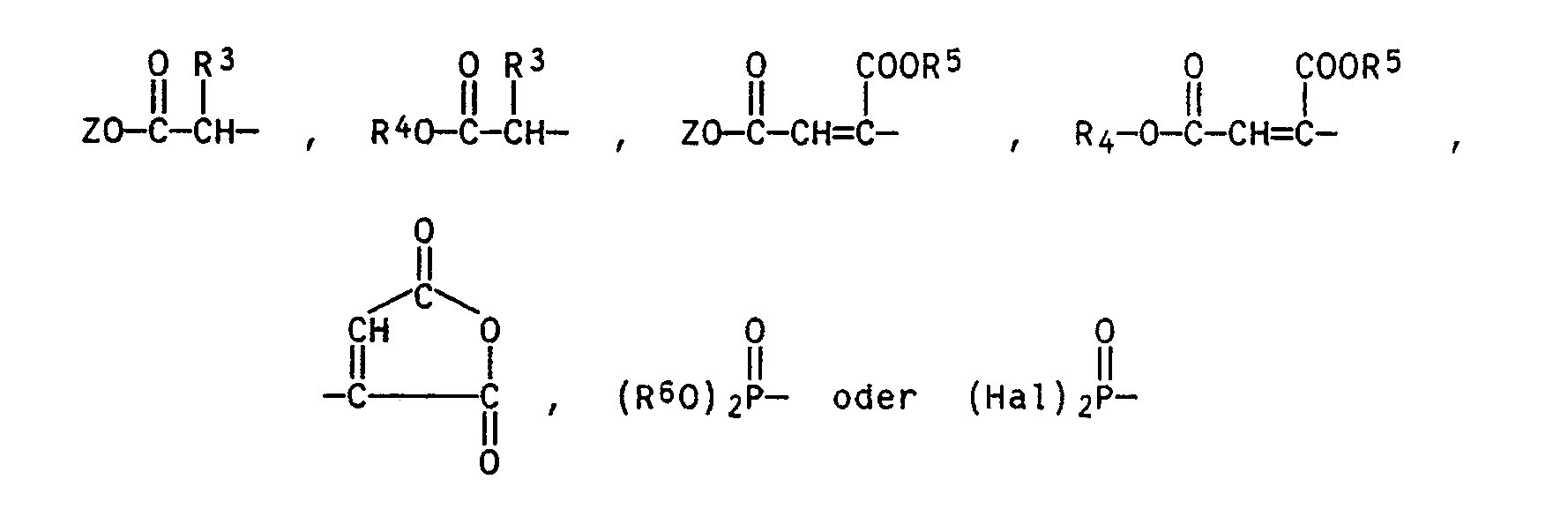
HO-


gebildeten Carbonsäureanhydridring steht, R⁴ und R⁵ untereinander gleich oder verschieden sind und für einen Alkylrest mit 1 bis 9 Kohlenstoffatomen oder einen Arylrest mit 6 bis 12 Kohlenstoffatomen stehen,
R⁶ für Wasserstoff, einen Alkylrest mit 1 bis 9 Kohlenstoffatomen oder einen Arylrest mit 6 bis 12 Kohlenstoffatomen,
Z für Wasserstoff oder ein Alkalimetall,
Hal für Chlor oder Brom,
y für eine ganze Zahl von 1 bis 4 und
n = 0, 1 oder 2
stehen, behandelt werden, dadurch gekennzeichnet, daß die wäßrige Lösung des Silan-Hydrolysats und/oder -Kondensats zusätzlich mindestens eine Verbindung der allgemeinen Formeln (II) oder (III)

enthält.1. Process for the production of plate, film or tape-shaped materials based on mechanically, chemically and / or electrochemically roughened and anodized aluminum or aluminum alloy, the aluminum oxide layers of which with an aqueous solution of a hydrolyzate and / or condensate of at least one silane general formula (I),
X- (CH₂) y -Si (R¹) n (OR²) 3-n (I)
wherein R¹ and R² are the same or different and are alkyl radicals having 1 to 9 carbon atoms or aryl radicals having 6 to 12 carbon atoms and X is one of the radicals
HO-
formed carboxylic acid anhydride ring, R⁴ and R⁵ are identical or different from one another and represent an alkyl radical with 1 to 9 carbon atoms or an aryl radical with 6 to 12 carbon atoms,
R⁶ represents hydrogen, an alkyl radical with 1 to 9 carbon atoms or an aryl radical with 6 to 12 carbon atoms,
Z represents hydrogen or an alkali metal,
Hal for chlorine or bromine,
y for an integer from 1 to 4 and
n = 0, 1 or 2
stand, are treated, characterized in that the aqueous solution of the silane hydrolyzate and / or condensate additionally at least one compound of the general formulas (II) or (III)
contains.
Applications Claiming Priority (2)
| Application Number | Priority Date | Filing Date | Title |
|---|---|---|---|
| DE3928794 | 1989-08-31 | ||
| DE3928794A DE3928794A1 (en) | 1989-08-31 | 1989-08-31 | METHOD FOR PRODUCING PANEL, FILM OR BELT-FOAMING MATERIALS AND METHOD FOR PRODUCING SENSITIVATED FLAT PRINTING PLATES |
Publications (2)
| Publication Number | Publication Date |
|---|---|
| EP0418575A2 true EP0418575A2 (en) | 1991-03-27 |
| EP0418575A3 EP0418575A3 (en) | 1992-02-05 |
Family
ID=6388250
Family Applications (1)
| Application Number | Title | Priority Date | Filing Date |
|---|---|---|---|
| EP19900116032 Withdrawn EP0418575A3 (en) | 1989-08-31 | 1990-08-22 | Process for the manufacture of plates, foils, or sheet-like materials and process for the manufacture of presensitized lithographic printing plates |
Country Status (6)
| Country | Link |
|---|---|
| US (1) | US5073475A (en) |
| EP (1) | EP0418575A3 (en) |
| JP (1) | JPH0392391A (en) |
| DE (1) | DE3928794A1 (en) |
| FI (1) | FI904195A7 (en) |
| NO (1) | NO903798L (en) |
Cited By (1)
| Publication number | Priority date | Publication date | Assignee | Title |
|---|---|---|---|---|
| WO2013182328A1 (en) | 2012-06-05 | 2013-12-12 | Agfa Graphics Nv | A lithographic printing plate precursor |
Families Citing this family (3)
| Publication number | Priority date | Publication date | Assignee | Title |
|---|---|---|---|---|
| US5481084A (en) * | 1991-03-18 | 1996-01-02 | Aluminum Company Of America | Method for treating a surface such as a metal surface and producing products embodying such including lithoplate |
| US5187046A (en) * | 1991-03-18 | 1993-02-16 | Aluminum Company Of America | Arc-grained lithoplate |
| US5665251A (en) * | 1994-11-23 | 1997-09-09 | International Business Machines Corporation | RIE image transfer process for plating |
Family Cites Families (5)
| Publication number | Priority date | Publication date | Assignee | Title |
|---|---|---|---|---|
| US3440050A (en) * | 1965-02-05 | 1969-04-22 | Polychrome Corp | Lithographic plate |
| GB1235863A (en) * | 1967-09-25 | 1971-06-16 | Polychrome Corp | Lithographic printing plates |
| DE3627757A1 (en) * | 1986-08-16 | 1988-02-18 | Basf Ag | METHOD FOR PRODUCING FLAT PRINTING PLATES |
| DE3627758A1 (en) * | 1986-08-16 | 1988-02-18 | Basf Ag | METHOD FOR PRODUCING ELECTROPHOTOGRAPHIC RECORDING ELEMENTS |
| DE3740698A1 (en) * | 1987-12-01 | 1989-06-15 | Basf Ag | METHOD FOR THE ANODIC OXIDATION OF THE SURFACE OF ALUMINUM OR ALUMINUM ALLOYS |
-
1989
- 1989-08-31 DE DE3928794A patent/DE3928794A1/en not_active Withdrawn
-
1990
- 1990-08-22 EP EP19900116032 patent/EP0418575A3/en not_active Withdrawn
- 1990-08-23 US US07/571,231 patent/US5073475A/en not_active Expired - Fee Related
- 1990-08-24 FI FI904195A patent/FI904195A7/en not_active IP Right Cessation
- 1990-08-29 JP JP2225455A patent/JPH0392391A/en active Pending
- 1990-08-30 NO NO90903798A patent/NO903798L/en unknown
Cited By (2)
| Publication number | Priority date | Publication date | Assignee | Title |
|---|---|---|---|---|
| WO2013182328A1 (en) | 2012-06-05 | 2013-12-12 | Agfa Graphics Nv | A lithographic printing plate precursor |
| US9329479B2 (en) | 2012-06-05 | 2016-05-03 | Agfa Graphics Nv | Lithographic printing plate precusor |
Also Published As
| Publication number | Publication date |
|---|---|
| NO903798D0 (en) | 1990-08-30 |
| JPH0392391A (en) | 1991-04-17 |
| DE3928794A1 (en) | 1991-03-07 |
| NO903798L (en) | 1991-03-01 |
| FI904195A0 (en) | 1990-08-24 |
| FI904195A7 (en) | 1991-03-01 |
| US5073475A (en) | 1991-12-17 |
| EP0418575A3 (en) | 1992-02-05 |
Similar Documents
| Publication | Publication Date | Title |
|---|---|---|
| DE3332640C2 (en) | ||
| DE2607207C2 (en) | Process for the production of planographic printing forms with laser beams | |
| DE2725762C2 (en) | Process for the production of a lithographic printing form | |
| DE3931525B4 (en) | Photosensitive composition | |
| EP0256256B1 (en) | Process for the manufacture of lithographic printing plates | |
| EP0689941A1 (en) | Hydrophilized support material and recording material produced therewith | |
| DE2828891C2 (en) | ||
| DE2747231A1 (en) | STARTING PLATE FOR THE MANUFACTURING OF DRY FLAT PRINTED PLATES AND THEIR USE THEREOF | |
| EP0244748B1 (en) | Photosensitive composition and photosensitive registration material prepared therefrom | |
| DE69620556T2 (en) | Aqueous developable, negative working, photosensitive composition with improved image contrast | |
| DE1797308A1 (en) | Photosensitive layer and recording material | |
| EP0248395B1 (en) | Photosensitive registration element | |
| DE3134054A1 (en) | ELECTROCHEMICAL DEVELOPMENT METHOD FOR REPRODUCTION LAYERS | |
| DE69322989T2 (en) | Photosensitive composition | |
| EP0161461B1 (en) | Process for the anodic oxidation of aluminium and its use as a support material for offset printing plates | |
| EP0418575A2 (en) | Process for the manufacture of plates, foils, or sheet-like materials and process for the manufacture of presensitized lithographic printing plates | |
| EP0141056A1 (en) | Process for the single step anodic oxidation of aluminium substrates for offset printing plates | |
| DE3924811A1 (en) | Graft polymer with unsaturated side chains, this containing light-sensitive mixture and recording material made from it | |
| DE68911786T2 (en) | Photosensitive composition. | |
| DE4338437C2 (en) | Photosensitive resin composition | |
| EP0681221B1 (en) | Light-sensitive material and process for preparation of planographic printing plates | |
| EP0429955B1 (en) | Process for preparing a negative-working printing plate | |
| DE69224801T2 (en) | Photosensitive composition | |
| DE3507193A1 (en) | LIGHT SENSITIVE MIXTURE | |
| EP0413216A2 (en) | Photopolymerizable transfer material |
Legal Events
| Date | Code | Title | Description |
|---|---|---|---|
| PUAI | Public reference made under article 153(3) epc to a published international application that has entered the european phase |
Free format text: ORIGINAL CODE: 0009012 |
|
| 17P | Request for examination filed |
Effective date: 19901227 |
|
| AK | Designated contracting states |
Kind code of ref document: A2 Designated state(s): AT BE CH DE DK ES FR GB IT LI NL SE |
|
| PUAL | Search report despatched |
Free format text: ORIGINAL CODE: 0009013 |
|
| AK | Designated contracting states |
Kind code of ref document: A3 Designated state(s): AT BE CH DE DK ES FR GB IT LI NL SE |
|
| STAA | Information on the status of an ep patent application or granted ep patent |
Free format text: STATUS: THE APPLICATION HAS BEEN WITHDRAWN |
|
| 18W | Application withdrawn |
Withdrawal date: 19931112 |