EP0418773A2 - Stratifié À dimensions stables, et utilisation et méthode de fabrication de ce produit - Google Patents
Stratifié À dimensions stables, et utilisation et méthode de fabrication de ce produit Download PDFInfo
- Publication number
- EP0418773A2 EP0418773A2 EP90117828A EP90117828A EP0418773A2 EP 0418773 A2 EP0418773 A2 EP 0418773A2 EP 90117828 A EP90117828 A EP 90117828A EP 90117828 A EP90117828 A EP 90117828A EP 0418773 A2 EP0418773 A2 EP 0418773A2
- Authority
- EP
- European Patent Office
- Prior art keywords
- composite body
- perforated
- plastic films
- dimensionally stable
- perforations
- Prior art date
- Legal status (The legal status is an assumption and is not a legal conclusion. Google has not performed a legal analysis and makes no representation as to the accuracy of the status listed.)
- Withdrawn
Links
Images

Classifications
-
- B—PERFORMING OPERATIONS; TRANSPORTING
- B32—LAYERED PRODUCTS
- B32B—LAYERED PRODUCTS, i.e. PRODUCTS BUILT-UP OF STRATA OF FLAT OR NON-FLAT, e.g. CELLULAR OR HONEYCOMB, FORM
- B32B3/00—Layered products comprising a layer with external or internal discontinuities or unevennesses, or a layer of non-planar shape; Layered products comprising a layer having particular features of form
- B32B3/26—Layered products comprising a layer with external or internal discontinuities or unevennesses, or a layer of non-planar shape; Layered products comprising a layer having particular features of form characterised by a particular shape of the outline of the cross-section of a continuous layer; characterised by a layer with cavities or internal voids ; characterised by an apertured layer
- B32B3/266—Layered products comprising a layer with external or internal discontinuities or unevennesses, or a layer of non-planar shape; Layered products comprising a layer having particular features of form characterised by a particular shape of the outline of the cross-section of a continuous layer; characterised by a layer with cavities or internal voids ; characterised by an apertured layer characterised by an apertured layer, the apertures going through the whole thickness of the layer, e.g. expanded metal, perforated layer, slit layer regular cells B32B3/12
-
- B—PERFORMING OPERATIONS; TRANSPORTING
- B32—LAYERED PRODUCTS
- B32B—LAYERED PRODUCTS, i.e. PRODUCTS BUILT-UP OF STRATA OF FLAT OR NON-FLAT, e.g. CELLULAR OR HONEYCOMB, FORM
- B32B27/00—Layered products comprising a layer of synthetic resin
- B32B27/06—Layered products comprising a layer of synthetic resin as the main or only constituent of a layer, which is next to another layer of the same or of a different material
- B32B27/08—Layered products comprising a layer of synthetic resin as the main or only constituent of a layer, which is next to another layer of the same or of a different material of synthetic resin
-
- C—CHEMISTRY; METALLURGY
- C09—DYES; PAINTS; POLISHES; NATURAL RESINS; ADHESIVES; COMPOSITIONS NOT OTHERWISE PROVIDED FOR; APPLICATIONS OF MATERIALS NOT OTHERWISE PROVIDED FOR
- C09J—ADHESIVES; NON-MECHANICAL ASPECTS OF ADHESIVE PROCESSES IN GENERAL; ADHESIVE PROCESSES NOT PROVIDED FOR ELSEWHERE; USE OF MATERIALS AS ADHESIVES
- C09J7/00—Adhesives in the form of films or foils
- C09J7/20—Adhesives in the form of films or foils characterised by their carriers
- C09J7/22—Plastics; Metallised plastics
-
- C—CHEMISTRY; METALLURGY
- C09—DYES; PAINTS; POLISHES; NATURAL RESINS; ADHESIVES; COMPOSITIONS NOT OTHERWISE PROVIDED FOR; APPLICATIONS OF MATERIALS NOT OTHERWISE PROVIDED FOR
- C09J—ADHESIVES; NON-MECHANICAL ASPECTS OF ADHESIVE PROCESSES IN GENERAL; ADHESIVE PROCESSES NOT PROVIDED FOR ELSEWHERE; USE OF MATERIALS AS ADHESIVES
- C09J7/00—Adhesives in the form of films or foils
- C09J7/20—Adhesives in the form of films or foils characterised by their carriers
- C09J7/29—Laminated material
-
- C—CHEMISTRY; METALLURGY
- C09—DYES; PAINTS; POLISHES; NATURAL RESINS; ADHESIVES; COMPOSITIONS NOT OTHERWISE PROVIDED FOR; APPLICATIONS OF MATERIALS NOT OTHERWISE PROVIDED FOR
- C09J—ADHESIVES; NON-MECHANICAL ASPECTS OF ADHESIVE PROCESSES IN GENERAL; ADHESIVE PROCESSES NOT PROVIDED FOR ELSEWHERE; USE OF MATERIALS AS ADHESIVES
- C09J7/00—Adhesives in the form of films or foils
- C09J7/30—Adhesives in the form of films or foils characterised by the adhesive composition
- C09J7/35—Heat-activated
-
- F—MECHANICAL ENGINEERING; LIGHTING; HEATING; WEAPONS; BLASTING
- F41—WEAPONS
- F41H—ARMOUR; ARMOURED TURRETS; ARMOURED OR ARMED VEHICLES; MEANS OF ATTACK OR DEFENCE, e.g. CAMOUFLAGE, IN GENERAL
- F41H5/00—Armour; Armour plates
- F41H5/02—Plate construction
- F41H5/023—Armour plate, or auxiliary armour plate mounted at a distance of the main armour plate, having cavities at its outer impact surface, or holes, for deflecting the projectile
-
- F—MECHANICAL ENGINEERING; LIGHTING; HEATING; WEAPONS; BLASTING
- F41—WEAPONS
- F41H—ARMOUR; ARMOURED TURRETS; ARMOURED OR ARMED VEHICLES; MEANS OF ATTACK OR DEFENCE, e.g. CAMOUFLAGE, IN GENERAL
- F41H5/00—Armour; Armour plates
- F41H5/02—Plate construction
- F41H5/04—Plate construction composed of more than one layer
- F41H5/0471—Layered armour containing fibre- or fabric-reinforced layers
- F41H5/0478—Fibre- or fabric-reinforced layers in combination with plastics layers
-
- B—PERFORMING OPERATIONS; TRANSPORTING
- B32—LAYERED PRODUCTS
- B32B—LAYERED PRODUCTS, i.e. PRODUCTS BUILT-UP OF STRATA OF FLAT OR NON-FLAT, e.g. CELLULAR OR HONEYCOMB, FORM
- B32B2305/00—Condition, form or state of the layers or laminate
- B32B2305/02—Cellular or porous
- B32B2305/026—Porous
-
- B—PERFORMING OPERATIONS; TRANSPORTING
- B32—LAYERED PRODUCTS
- B32B—LAYERED PRODUCTS, i.e. PRODUCTS BUILT-UP OF STRATA OF FLAT OR NON-FLAT, e.g. CELLULAR OR HONEYCOMB, FORM
- B32B2307/00—Properties of the layers or laminate
- B32B2307/50—Properties of the layers or laminate having particular mechanical properties
- B32B2307/514—Oriented
-
- B—PERFORMING OPERATIONS; TRANSPORTING
- B32—LAYERED PRODUCTS
- B32B—LAYERED PRODUCTS, i.e. PRODUCTS BUILT-UP OF STRATA OF FLAT OR NON-FLAT, e.g. CELLULAR OR HONEYCOMB, FORM
- B32B2307/00—Properties of the layers or laminate
- B32B2307/70—Other properties
- B32B2307/732—Dimensional properties
- B32B2307/734—Dimensional stability
-
- C—CHEMISTRY; METALLURGY
- C09—DYES; PAINTS; POLISHES; NATURAL RESINS; ADHESIVES; COMPOSITIONS NOT OTHERWISE PROVIDED FOR; APPLICATIONS OF MATERIALS NOT OTHERWISE PROVIDED FOR
- C09J—ADHESIVES; NON-MECHANICAL ASPECTS OF ADHESIVE PROCESSES IN GENERAL; ADHESIVE PROCESSES NOT PROVIDED FOR ELSEWHERE; USE OF MATERIALS AS ADHESIVES
- C09J2301/00—Additional features of adhesives in the form of films or foils
- C09J2301/10—Additional features of adhesives in the form of films or foils characterized by the structural features of the adhesive tape or sheet
- C09J2301/16—Additional features of adhesives in the form of films or foils characterized by the structural features of the adhesive tape or sheet by the structure of the carrier layer
- C09J2301/162—Additional features of adhesives in the form of films or foils characterized by the structural features of the adhesive tape or sheet by the structure of the carrier layer the carrier being a laminate constituted by plastic layers only
Definitions
- the invention relates to a dimensionally stable composite body in the form of a flat or curved plate, from a number of layered, pressed together, thermoplastic plastic films, which are coated on at least one side with a sealing layer, the melting point of which is lower than the melting point of each of the plastic films and the mono- and / or biaxially stretched, a process for its production and its use.
- thermosetting and thermoplastic polymer materials the mechanical properties of which are improved many times over the unreinforced polymer by incorporating reinforcing materials in the form of textile, glass, carbon or aramid fibers.
- a process-specific measure of this technique namely the use of individual film layers, enables the targeted installation of functional layers at any point on the shaped body and thus the tailoring of properties of the finished shaped body.
- biaxially stretched films can be combined with monoaxial or undrawn films of the same or a different type in order to influence the fracture-mechanical behavior of the molded article in the desired manner.
- the product characteristics achieved in this way are often not sufficient to meet the extreme mechanical requirements of highly stressed materials in practice.
- AT-PS 383 542 is a rigid molded body, such as a plate or a tube, from a plurality of stacked and / or juxtaposed and pressed together, oriented, ie stretched, thermoplastic plastic carrier in film, ribbon, monofilament or fiber form described.
- the stretched plastic carriers on the sides that come into contact with the layers on top of and / or next to one another are coated with thermoplastic, the coating material having a lower crystallite melting temperature than the plastic carriers and the thickness of two adjacent coating dimensions materials is less than the thickness of a plastic carrier.
- the method proposed in the Austrian patent specification AT-PS 383 542 provides high-strength, mechanically stable plates by applying pressure to stretched, coextruded thin plastic films, under the action of heat, the plastic carriers coated on the mutual contact surfaces with thermoplastic plastic at a temperature above the crystallite melting temperature of the Coating material and below the crystallite melting temperature of the plastic carrier are pressed.
- the basic principle of this process compared to alternative plate-making technologies, such as extrusion, casting and calendering, offers the possibility of preventing a noteworthy drop in the mechanical and physical properties achieved by stretching a single plastic carrier by pressing at elevated temperature, so that the molded body , despite its larger dimensions, which substantially exceed the dimensions of the individual plastic carrier, approximately has the mechanical and technological properties of an individual stretched plastic carrier.
- targeted functional layers can either be applied to the surface of the plate or in the form of intermediate layers in the type and structure of the films used Plate are inserted, and on the other hand, corresponding surface structures can be created by selecting suitable press dies.
- the object of the present invention is to develop a dimensionally stable composite body of the type described at the outset into a mechanically high-strength, flexurally rigid, but at the same time, lightweight, composite body.
- This object is achieved in that at least some of the plastic films forming the composite have perforations and that the perforated plastic films are layered one on top of the other in such a way that their perforations overlap or are offset from one another.
- they are the composite body-forming plastic films on the one hand full-surface, homogeneous plastic films without perforations and on the other hand perforated plastic films in a geometrical arrangement, and the perforated and full-surface plastic films are alternately layered so that the perforations are offset from one another.
- the composite body is formed by pressing perforated laminates, each laminate having a thickness of up to 1 mm and consisting of several perforated plastic films.
- the composite body is formed by pressing perforated plastic plates a few millimeters thick, and the individual plastic plate consists of a plurality of laminates pressed in perforated form. It is thus possible for the composite body to be formed by pressing perforated plastic plates a few millimeters thick and for the individual plastic plate to consist of laminates which are only perforated after lamination.
- the composite body expediently consists of at least one perforated plastic plate which is embedded between two non-perforated cover plates.
- the composite body can consist of a plurality of perforated plastic plates which are embedded between two non-perforated cover plates, the perforations being offset from one another to the plastic plate.
- the plastic films are perforated before the pressing, which are layered after the perforation to form a stack of films, the perforations of all plastic films being aligned and / or alternating are offset against each other, and the film stack is finally pressed into an inseparable composite body using heat.
- the composite body is used as a breakthrough and bullet-resistant shielding material in the security field, as a light, high-strength construction element in machine and apparatus construction, in vehicle, automobile and aircraft construction, as a wall, formwork, support and drainage element in deep , Tunnel and high construction and as a decorative cladding component in facade, exhibition stand and interior construction.
- a composite body according to the invention has practically no impairment of its strength properties, but has a reduced weight due to the perforations.
- the mechanical properties of the finished composite body can be specifically determined and at the same time weight reductions of a maximum of 50 to 60% compared to a composite body made of solid material can be realized.
- biaxially stretched films made of polypropylene and polyester are used to produce the composite body.
- These foils are characterized by a low purchase price and, as a result of the biaxial orientation, have high mechanical strength.
- a composite body made from it is an inexpensive semi-finished construction product. The emphasis on polypropylene and polyester films as the base material of the composite body in no way precludes other suitable polymer materials or polymer combinations as the starting material for the composite body.
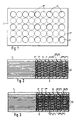
- the first embodiment according to Figures 1 and 2 represents a simple embodiment of a composite body 1 in the form of a homogeneous, flat plate, which consists of a number of thin, mono- and / or biaxially stretched, coextruded plastic films 5 ', 5 ⁇ , 5 ′′′ outer sealing layers 10 was assembled under pressure and temperature.
- the two outer, full-surface cover films 6 include the plastic films 5 ', 5 ⁇ , 5 ′′′, which form the total thickness of the composite body 1.
- the plastic films 5 ', 5 ⁇ , 5 ′′′ have perforations 7', 7 ⁇ , 7 ′′′ in the form of any shaped recesses. In the example according to FIG. 1, they are shown as round holes.
- FIG. 1 In the plan view of Fig. 1 show the perforations 7 ', which are drawn with full lines that there are recesses in the top plastic film 5'.
- the perforations 7 ⁇ in the underlying plastic film 5 ⁇ are shown in dashed lines, while the perforations 7 ′′′ in the third plastic film 5 ′′′ from above (see FIG. 2) with the perforations 7 'of the top plastic film to cover and therefore in the Top view of FIG. 1 are not recognizable.
- Each of the plastic films 5 ', 5 ⁇ , 5 ′′′ ... carries at least one sealing layer 10, which during the thermal Compression of the composite body melts, the melt filling the perforations 7 ', 7 ⁇ , 7 ′′′ ... and after cooling produces an inseparable bond between the individual plastic films.
- An alternate layering of perforated plastic films 5 ', 5 ⁇ , 5 ′′′ ... with full-area films 5 has the second embodiment of the composite body 1 shown in Fig. 3.
- the stack of perforated and full-area films 5 ', 5 ⁇ 5 ′′′ and 5 is enclosed by cover films 6, which have a greater thickness than the films of the stack.
- the perforations 7 'and 7 ⁇ or 7 ⁇ and 7 ′′′ are congruent or offset from each other.
- the cover films 6 are both structured in relief, but it is obvious that both can also be smooth or only the upper or only the lower cover film can be smooth.
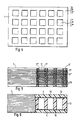
- the third embodiment of the composite body 1 according to FIGS. 4 and 5 differs from the exemplary embodiments according to FIGS. 1 to 3 in that the stratification of the individual plastic films 5 ', 5 ⁇ , 5 ′′′ takes place in such a way that the perforations 7', 7 ⁇ , 7 ′′′ cover.
- This geometric arrangement results in a composite body in the form of a heavy-duty perforated plate with open cross sections.
- the exemplary embodiments of the composite body shown in FIGS. 1 to 5 are produced from thin, stretched foils in the thickness range from 10 to 500 ⁇ m, the production of the composite body in the same way is of course also possible from much thicker laminates.
- the thin plastic films 5 ', 5 ⁇ , 5 ′′′ or 5 are replaced by laminates 2', 2 ⁇ , 2 ′′′ or 2 lying in the thickness range of several millimeters, which are made in a preliminary stage in an identical manner to the composite body the film single cell layers are thermally braced. It is irrelevant for the end result whether the perforations are already punched into the individual foils intended for the production of the laminate or only afterwards in the fully pressed laminate.
- the laminates are indicated by parenthesized reference numbers 2 ', 2 ⁇ , 2 ′′′ and 2.
- the fourth embodiment of the invention shown in FIG. 6 has an increased axial moment of inertia of the composite body 1 against bending stress, by increasing the thickness of the resilient cross-section while minimizing the weight increase due to the increased thickness of the composite body 1. This is achieved by combining the two cover plates 4 with a high-strength spacer plate 13 having cutouts 12 and thus significantly reduced in weight , which is equipped on the top and bottom with a sealing layer 10.
- the composite body 1 can be produced in one operation either by pressing appropriately layered, full-surface or already perforated film layers, or by combining the laminates pressed and perforated from individual films in separate individual steps.
- the fifth embodiment of the composite body 1 shown in Figure 7 has a plurality of thin perforated plastic plates 9 ', 9 ⁇ , 9 ′′′ between the two cover plates 4.
- This concept enables the tailoring of composite bodies tailored to the load or the respective area of application.
- the thickness and number of plastic plates and their arrangement in the layer composite for example varying the plate thickness from the inside out, can be changed.
- the properties of the finished composite body can be influenced by the choice of the perforation geometry, that is to say the cross-sectional size, shape and hole division of each individual plate, and the geometric arrangement of the perforations in the overall composite.
- FIG. 8 shows a sixth embodiment of the composite body 1.
- perforated plastic plates 9 ', 9 ⁇ and 9 ⁇ , 9 ′′′ additional full-surface plastic plates 9 installed.
- This sandwich construction lends itself to the combination of panels made of different materials, whereby in addition to polymeric materials in non-reinforced form, also through materials such as glass, textile, metal or carbon fibers, also through metal sheets or metal mesh or textiles made of natural or synthetic materials Fiber reinforced, polymeric materials come into consideration. It is necessary to install suitable adhesion promoters or adhesive layers for the connection of different materials.
- Both cover plates 4 are structured in relief, but only one cover plate can be structured, while the other cover plate is smooth.
- the seventh embodiment shown in FIG. 9 differs from this in that it has a perforated surface.
- the composite body 1 is composed of plastic plates 14 ', 14 ⁇ , ... 14 iv with perforations 15', 15 ⁇ ... 15 iv , which have different diameters or dimensions and are mutually offset so that the perforations of the plastic sheets stacked one on top of the other overlap in spite of mutual displacement, and are connected to one another when viewed in the direction of the sheet thickness, ie form open cross sections.
- layers of the plastic plates are also possible in which the offset of the perforations leads to closed cross sections. 9 shows the sealing layers 10 on the individual plastic plates.
- perforated plastic plates 14 ', 14' consisting of different polymers with such perforated plates 14, the perforations 15 of which are made of different materials 16, 16 ', 16'. .. are filled out, extensive options for property modification of the composite body.
- perforations of the plates 14 for example die-cuts made of polymers, metals, natural or synthetic textiles, glass, ceramics, wood, leather, natural or synthetic rubbers corresponding to the perforation shape can be used.
- Shaped bodies in the form of spheres for example made of metal, or mineral materials, such as glass or ceramic, and platelets, for example, also come out as filler material Mica, or granules, such as polymer granules, into consideration.
- the perforations can also be filled with powders and dusts of any kind. If liquids are used whose evaporation temperature is above the pressing temperature, these materials can also be used.
- reactive media such as foamable products, the reaction mechanism of which is triggered either when the molded body is manufactured or only when it is subjected to a specific load, for example thermal stress in the event of fire, or air contact in the event of mechanical damage to the composite body.
- the installation of reactive components results in plates with a so-called “self-healing effect", ie reactions of released products on damaged areas of the composite body cause the local defect to be closed.
- Thermoplastic plastic films with at least one heat seal layer are suitable for producing the multilayer composite bodies.
- Films made of thermoplastics from the group of polyesters and polyolefins are particularly suitable.
- Polyester is to be understood as meaning polyester homopolymers and copolymers, mixtures of different polyesters and mixtures of polyesters with other polymers.
- propylene homopolymers or copolymers are used as polyesters, the latter being predominantly composed of propylene units.
- the coatings which are usually used for this purpose in film production can be used as heat-sealing layers. These are preferably statistical copolymers of ethylene-propylene units and copolyesters containing ethylene terephthalate and isophthalate units. Furthermore, ethylene-vinyl acetate copolymers, polyurethanes, polyvinyl butyral, acrylate copolymers and copolyamides are suitable as sealing or adhesion promoter layers.
- films of the type described above have a thickness in the range from 10 to 300 ⁇ m, in particular from 40 to 200 ⁇ m.
- the thickness of the heat seal layer, which is applied to the plastic film or the plastic plate on one or both sides, usually does not exceed 10% of the thickness of the carrier film and is in the range from 0.5 to 5 ⁇ m.
- the starting material for producing the composite body In addition to the laminates described, pressed from a number of plastic films in a separate step, several mm thick, stiff plastic plates that are already pressed from the laminates are suitable as the starting material for producing the composite body.
- the perforations can either be made in the starting foils or can be made afterwards on the laminates or plastic plates by punching.
- Construction elements with high mechanical strength and the lowest possible weight are aimed for.
- the labyrinthine structure of the composite body makes it particularly suitable for use as a breakthrough and bullet-resistant shielding material.
- Composite bodies can be used for drainage systems in road, tunnel and civil engineering. It can also be used as a screen and noise shield with reduced wind loads.
Landscapes
- Chemical & Material Sciences (AREA)
- Organic Chemistry (AREA)
- Engineering & Computer Science (AREA)
- General Engineering & Computer Science (AREA)
- Ceramic Engineering (AREA)
- Laminated Bodies (AREA)
Applications Claiming Priority (2)
| Application Number | Priority Date | Filing Date | Title |
|---|---|---|---|
| DE3931451 | 1989-09-21 | ||
| DE3931451A DE3931451A1 (de) | 1989-09-21 | 1989-09-21 | Dimensionsstabiler verbundkoerper, verfahren zu seiner herstellung und seine verwendung |
Publications (2)
| Publication Number | Publication Date |
|---|---|
| EP0418773A2 true EP0418773A2 (fr) | 1991-03-27 |
| EP0418773A3 EP0418773A3 (en) | 1991-11-13 |
Family
ID=6389848
Family Applications (1)
| Application Number | Title | Priority Date | Filing Date |
|---|---|---|---|
| EP19900117828 Withdrawn EP0418773A3 (en) | 1989-09-21 | 1990-09-17 | Dimensionally stable laminate, its use, and method of manufacture |
Country Status (3)
| Country | Link |
|---|---|
| EP (1) | EP0418773A3 (fr) |
| JP (1) | JPH03138135A (fr) |
| DE (1) | DE3931451A1 (fr) |
Cited By (5)
| Publication number | Priority date | Publication date | Assignee | Title |
|---|---|---|---|---|
| US5356705A (en) * | 1992-01-09 | 1994-10-18 | The Dow Chemical Company | Laminated, weatherable film-capped siding structure |
| WO2002011978A1 (fr) * | 2000-08-08 | 2002-02-14 | 3M Innovative Properties Company | Films polymères du type tissu |
| WO2003059750A3 (fr) * | 2002-01-16 | 2004-03-04 | Mega Plast S A | Film etirable |
| US7138169B2 (en) | 2003-03-05 | 2006-11-21 | 3M Innovative Properties Company | Cloth-like polymeric film with directional tear |
| EP3484603A4 (fr) * | 2016-07-18 | 2020-03-18 | Entegris, Inc. | Film d'espaceur avec bande de lamination intégrée |
Families Citing this family (3)
| Publication number | Priority date | Publication date | Assignee | Title |
|---|---|---|---|---|
| JPH10291250A (ja) * | 1997-02-24 | 1998-11-04 | Sekisui Chem Co Ltd | ポリオレフィン成形体及びその製造方法 |
| DE19853265C1 (de) * | 1998-11-18 | 2000-07-20 | Hightech Produktions Ges M B H | Gleitbrett |
| DE102018105246B4 (de) | 2017-04-25 | 2024-02-15 | Deutsches Zentrum für Luft- und Raumfahrt e.V. | Verfahren zur Herstellung eines verstärkten Faserverbundwerkstoffs, Faserverbundwerkstoff und Luft- oder Raumfahrzeug |
Family Cites Families (7)
| Publication number | Priority date | Publication date | Assignee | Title |
|---|---|---|---|---|
| DE1704996A1 (de) * | 1967-07-18 | 1971-07-22 | Gustav Sachsenroeder Sen | Verfahren zur Herstellung von Schichtpressstoffen |
| US3919382A (en) * | 1971-12-29 | 1975-11-11 | Union Carbide Corp | Expanding process with non-aligned molds |
| US4274901A (en) * | 1978-03-24 | 1981-06-23 | The United States Of America As Represented By The Administrator Of The National Aeronautics And Space Administration | Method of making a partial interlaminar separation composite system |
| AT383542B (de) * | 1985-01-25 | 1987-07-10 | Harald Dipl Ing Schobermayr | Steifer formkoerper aus miteinander verpressten orientierten kunststofftraegern sowie verfahren zu seiner herstellung |
| JP2602016B2 (ja) * | 1986-09-01 | 1997-04-23 | 日東電工株式会社 | 補強型多孔質シート |
| DE3708780A1 (de) * | 1987-03-18 | 1988-09-29 | Helio Folien Gmbh | Mehrlagige folie |
| US4935271A (en) * | 1988-09-06 | 1990-06-19 | W. R. Grace & Co.-Conn. | Lettuce packaging film |
-
1989
- 1989-09-21 DE DE3931451A patent/DE3931451A1/de not_active Withdrawn
-
1990
- 1990-09-17 EP EP19900117828 patent/EP0418773A3/de not_active Withdrawn
- 1990-09-20 JP JP2251679A patent/JPH03138135A/ja active Pending
Cited By (11)
| Publication number | Priority date | Publication date | Assignee | Title |
|---|---|---|---|---|
| US5356705A (en) * | 1992-01-09 | 1994-10-18 | The Dow Chemical Company | Laminated, weatherable film-capped siding structure |
| WO2002011978A1 (fr) * | 2000-08-08 | 2002-02-14 | 3M Innovative Properties Company | Films polymères du type tissu |
| US6635334B1 (en) | 2000-08-08 | 2003-10-21 | 3M Innovative Properties Company | Cloth-like polymeric films |
| KR100736190B1 (ko) * | 2000-08-08 | 2007-07-06 | 쓰리엠 이노베이티브 프로퍼티즈 캄파니 | 직물형 중합체 필름 |
| WO2003059750A3 (fr) * | 2002-01-16 | 2004-03-04 | Mega Plast S A | Film etirable |
| US7682683B2 (en) | 2002-01-16 | 2010-03-23 | Mega Plast S.A. | Stretch film |
| US7138169B2 (en) | 2003-03-05 | 2006-11-21 | 3M Innovative Properties Company | Cloth-like polymeric film with directional tear |
| CN100415842C (zh) * | 2003-03-05 | 2008-09-03 | 3M创新有限公司 | 定向撕裂的布状聚合薄膜 |
| EP3484603A4 (fr) * | 2016-07-18 | 2020-03-18 | Entegris, Inc. | Film d'espaceur avec bande de lamination intégrée |
| US12036512B2 (en) | 2016-07-18 | 2024-07-16 | Entegris, Inc. | Spacer film with integrated lamination strip |
| US12594528B2 (en) | 2016-07-18 | 2026-04-07 | Entegris, Inc. | Spacer film with integrated lamination strip |
Also Published As
| Publication number | Publication date |
|---|---|
| DE3931451A1 (de) | 1991-04-11 |
| JPH03138135A (ja) | 1991-06-12 |
| EP0418773A3 (en) | 1991-11-13 |
Similar Documents
| Publication | Publication Date | Title |
|---|---|---|
| DE69532193T2 (de) | Wärmeleitfähige nichtmetallische wabenstrukturen und verfahren | |
| EP2715835B1 (fr) | Module accumulateur d'énergie constitué de plusieurs éléments d'accumulateur notamment en forme de prisme, procédé de production d'un module accumulateur d'énergie et procédé de production d'une plaque d'extrémité pour un module accumulateur d'énergie | |
| DE60018969T2 (de) | Stützstruktur für verbundbauteile | |
| DE69321549T2 (de) | Verformbarer verbundvliesstoff und herstellverfahren hierfür | |
| EP0557597B1 (fr) | Laminé pour l'isolation acoustique et thermique | |
| DE3620388A1 (de) | Draenmatte mit hoher druckbestaendigkeit | |
| DE19939227B4 (de) | Verbundwerkstoff | |
| DE102013206086A1 (de) | Mehrschichtiges Strukturbauteil | |
| WO2007088048A1 (fr) | Element isolant absorbant le BRUIT et dote de mouLures de renfort | |
| EP0229977A2 (fr) | Revêtement d'atténuation de bruit pour le compartiment du moteur d'une automobile | |
| DE69023551T2 (de) | Panzerungssystem mit Eigenschaften gegen Durchlöcherung. | |
| DE3934555A1 (de) | Faserverstaerktes sandwichlaminat fuer hochbeanspruchbare, hochsteife, flaechige strukturbauteile, insbesondere karosserieteile von kraftfahrzeugen | |
| EP0418772A2 (fr) | Stratifié à dimensions stables, et méthode de fabrication de ce produit | |
| EP0418773A2 (fr) | Stratifié À dimensions stables, et utilisation et méthode de fabrication de ce produit | |
| EP0428786B1 (fr) | Revêtement d'atténuation de bruit pour le compartiment du moteur d'une automobile et son procédé de fabrication | |
| DE102008062678B4 (de) | Verbundbauteil mit einer Wabenstruktur | |
| DE102006056612B4 (de) | Verfahren zur Herstellung eines sandwichartig aufgebauten Verbundmaterials und Verbundmaterial | |
| DE10317670A1 (de) | Hohlkammerelement für Kraftfahrzeuge | |
| EP1250498A1 (fr) | Composant et son procede de production | |
| DE10060816A1 (de) | Mehrschichtiger Formkörper mit lokal begrenzten Verstärkungselementen | |
| EP0445638A2 (fr) | Stratifié à haute résistance à base de feuilles thermoplastiques comprimées et procédé de fabrication | |
| DE3013134C2 (de) | Verfahren zur Herstellung von Formteilen durch Tiefziehen und/oder Verpressen | |
| EP1698452A1 (fr) | Panneau composite | |
| DE3911958C2 (de) | Verwendung einer Leichtmetalltafel, die auf beiden Seiten mit ultrahochmolekularem Polyethylen beklebt ist, als Preßblech und Verfahren zur Herstellung des Preßblechs | |
| WO2015097155A1 (fr) | Corps composite et coque de siège |
Legal Events
| Date | Code | Title | Description |
|---|---|---|---|
| PUAI | Public reference made under article 153(3) epc to a published international application that has entered the european phase |
Free format text: ORIGINAL CODE: 0009012 |
|
| AK | Designated contracting states |
Kind code of ref document: A2 Designated state(s): AT BE CH DE FR GB IT LI LU NL SE |
|
| PUAL | Search report despatched |
Free format text: ORIGINAL CODE: 0009013 |
|
| AK | Designated contracting states |
Kind code of ref document: A3 Designated state(s): AT BE CH DE FR GB IT LI LU NL SE |
|
| 17P | Request for examination filed |
Effective date: 19920327 |
|
| STAA | Information on the status of an ep patent application or granted ep patent |
Free format text: STATUS: THE APPLICATION HAS BEEN WITHDRAWN |
|
| 18W | Application withdrawn |
Withdrawal date: 19930212 |