EP0418804A1 - Dünner weichmagnetischer Film - Google Patents
Dünner weichmagnetischer Film Download PDFInfo
- Publication number
- EP0418804A1 EP0418804A1 EP90117911A EP90117911A EP0418804A1 EP 0418804 A1 EP0418804 A1 EP 0418804A1 EP 90117911 A EP90117911 A EP 90117911A EP 90117911 A EP90117911 A EP 90117911A EP 0418804 A1 EP0418804 A1 EP 0418804A1
- Authority
- EP
- European Patent Office
- Prior art keywords
- thin film
- soft magnetic
- amorphous
- magnetic
- phase
- Prior art date
- Legal status (The legal status is an assumption and is not a legal conclusion. Google has not performed a legal analysis and makes no representation as to the accuracy of the status listed.)
- Granted
Links
Images


Classifications
-
- H—ELECTRICITY
- H01—ELECTRIC ELEMENTS
- H01F—MAGNETS; INDUCTANCES; TRANSFORMERS; SELECTION OF MATERIALS FOR THEIR MAGNETIC PROPERTIES
- H01F1/00—Magnets or magnetic bodies characterised by the magnetic materials therefor; Selection of materials for their magnetic properties
- H01F1/01—Magnets or magnetic bodies characterised by the magnetic materials therefor; Selection of materials for their magnetic properties of inorganic materials
- H01F1/03—Magnets or magnetic bodies characterised by the magnetic materials therefor; Selection of materials for their magnetic properties of inorganic materials characterised by their coercivity
- H01F1/032—Magnets or magnetic bodies characterised by the magnetic materials therefor; Selection of materials for their magnetic properties of inorganic materials characterised by their coercivity of hard-magnetic materials
- H01F1/04—Magnets or magnetic bodies characterised by the magnetic materials therefor; Selection of materials for their magnetic properties of inorganic materials characterised by their coercivity of hard-magnetic materials metals or alloys
-
- H—ELECTRICITY
- H01—ELECTRIC ELEMENTS
- H01F—MAGNETS; INDUCTANCES; TRANSFORMERS; SELECTION OF MATERIALS FOR THEIR MAGNETIC PROPERTIES
- H01F41/00—Apparatus or processes specially adapted for manufacturing or assembling magnets, inductances or transformers; Apparatus or processes specially adapted for manufacturing materials characterised by their magnetic properties
- H01F41/14—Apparatus or processes specially adapted for manufacturing or assembling magnets, inductances or transformers; Apparatus or processes specially adapted for manufacturing materials characterised by their magnetic properties for applying magnetic films to substrates
- H01F41/18—Apparatus or processes specially adapted for manufacturing or assembling magnets, inductances or transformers; Apparatus or processes specially adapted for manufacturing materials characterised by their magnetic properties for applying magnetic films to substrates by cathode sputtering
-
- G—PHYSICS
- G11—INFORMATION STORAGE
- G11B—INFORMATION STORAGE BASED ON RELATIVE MOVEMENT BETWEEN RECORD CARRIER AND TRANSDUCER
- G11B5/00—Recording by magnetisation or demagnetisation of a record carrier; Reproducing by magnetic means; Record carriers therefor
- G11B5/127—Structure or manufacture of heads, e.g. inductive
-
- G—PHYSICS
- G11—INFORMATION STORAGE
- G11B—INFORMATION STORAGE BASED ON RELATIVE MOVEMENT BETWEEN RECORD CARRIER AND TRANSDUCER
- G11B5/00—Recording by magnetisation or demagnetisation of a record carrier; Reproducing by magnetic means; Record carriers therefor
- G11B5/127—Structure or manufacture of heads, e.g. inductive
- G11B5/31—Structure or manufacture of heads, e.g. inductive using thin films
-
- H—ELECTRICITY
- H01—ELECTRIC ELEMENTS
- H01F—MAGNETS; INDUCTANCES; TRANSFORMERS; SELECTION OF MATERIALS FOR THEIR MAGNETIC PROPERTIES
- H01F10/00—Thin magnetic films, e.g. of one-domain structure
- H01F10/08—Thin magnetic films, e.g. of one-domain structure characterised by magnetic layers
- H01F10/10—Thin magnetic films, e.g. of one-domain structure characterised by magnetic layers characterised by the composition
- H01F10/12—Thin magnetic films, e.g. of one-domain structure characterised by magnetic layers characterised by the composition being metals or alloys
- H01F10/13—Amorphous metallic alloys, e.g. glassy metals
-
- H—ELECTRICITY
- H01—ELECTRIC ELEMENTS
- H01F—MAGNETS; INDUCTANCES; TRANSFORMERS; SELECTION OF MATERIALS FOR THEIR MAGNETIC PROPERTIES
- H01F10/00—Thin magnetic films, e.g. of one-domain structure
- H01F10/08—Thin magnetic films, e.g. of one-domain structure characterised by magnetic layers
- H01F10/10—Thin magnetic films, e.g. of one-domain structure characterised by magnetic layers characterised by the composition
- H01F10/18—Thin magnetic films, e.g. of one-domain structure characterised by magnetic layers characterised by the composition being compounds
- H01F10/187—Amorphous compounds
Definitions
- This invention relates to a soft magnetic thin film used as, for example, a core material for a magnetic head. More particularly, it relates to a novel soft magnetic amorphous alloy thin film having a high magnetic flux density and a high electrical resistivity.
- a magnetic recording/reproducing apparatus such as a video tape recorder (VTR)
- VTR video tape recorder
- a so-called metal tape in which powders of magnetic metals, such as Fe, Co or Ni, are used as magnetic powders
- evaporated tape in which a magnetic metal material is directly deposited by, for example, vacuum evaporation, on the base film, are advancing briskly.
- a higher saturation magnetic flux density is required of the material for a magnetic head employed for recording and/or reproduction.
- the ferrite material which is frequently employed as the magnetic head material, has only a low saturation magnetic flux density, such that it is difficult to produce a soft magnetic material having a saturation magnetic flux density exceeding 5000 Gauss, so that it is difficult to cope with the tendency towards a higher coercivity of the recording medium satisfactorily.
- a composite magnetic head in which a magnetic core of the magnetic head is of a composite structure of ferrite or ceramics, and in which soft magnetic thin films having a high saturation magnetic flux density and the soft magnetic thin films abut on each other to form a magnetic gap, or a thin film magnetic head in which magnetic cores and coils are formed by a thin film technique and are sandwiched with insulating films in-between to form a multi-layered structure.
- the soft magnetic thin films there are known an Fe-Al-Si alloy magnetic thin film (so-called Sendust thin film) having a high saturation magnetic flux density, or a permalloy thin film.
- Sendust thin film having a high saturation magnetic flux density
- permalloy thin film a permalloy thin film.
- these soft magnetic metallic thin films exhibit a low electrical resistivity of not higher than 100 microhm/cm, because they are of an alloy material, and are deteriorated in magnetic characteristics in the high frequency range, above all, in the frequency range of the order of megahertzes, on account of eddy current losses. Such deterioration in magnetic characteristics in the high frequency range is extremely inconvenient in view of the required high density recording that is recording at shorter wavelengths.
- metal-metalloid amorphous alloy magnetic thin films such as Fe-B, Fe-Si-B or Fe-Co-Si-B thin films, which are produced by a liquid quenching method or a gas phase quenching method.
- These films are of a single-phase amorphous structure, which may be said to be a homogeneous structure.
- the electrical resistivity of these films, while being higher than that of the then films of Sendust, which is a crystal soft magnetic material, is at most 150 microhms/cm or thereabouts, while their saturation magnetic flux density is 11000 Gauss or thereabouts.
- the saturation magnetic flux density of the conventional soft magnetic thin films In general, for raising the saturation magnetic flux density of the conventional soft magnetic thin films, it is necessary to increase the amount of magnetic metals, such as Fe or Co, as a result of which the electrical resistivity is lowered. This means that the saturation magnetic flux density and the electrical resistivity represent contradictory properties in the case of the soft magnetic thin films formed of a magnetic alloy material, such that it has been difficult to achieve a high saturation magnetic flux density and a high electrical resistivity simultaneously.
- M stands for at least one of Fe or Co
- G stands for at least one of B
- Si or P
- L stands for at least one of Si, Al, Zn or Ti
- 3d transition metal elements which prove to be magnetic materials, such as one or two of Fe or Co, are preferred as the element M.
- metalloid element G One or more of B, Si or P is preferred as the metalloid element G. These metalloid elements are effective to render the alloy more susceptive to be amorphous, while affording soft magnetic properties to the amorphous structure with the transition metal element M.
- the percentage y of these metalloid elements G should be 15 ⁇ y ⁇ 28 since, with y ⁇ 15, an amorphous state is not achieved and, with y ⁇ 28, the saturation magnetic flux density becomes lesser than 6000 G.
- LOv is an oxide of the element L. Similarly to the metalloid element G, the oxide LOv renders the alloy more susceptive to be amorphous.
- the electrical resistivity of the thin film may be improved significantly by addition of a minor amount of the oxide LOv to the MG system amorphous soft magnetic substance. However, soft magnetic Properties of the thin film may not be realized in this manner. It is therefore preferred that the percentage z of the oxide LOv be 2 ⁇ z ⁇ 10. If z is less than 2 atomic percent, the electrical resistivity cannot be raised sufficiently, whereas, if z exceeds 10 atomic percent, soft magnetic properties are lowered.
- compositional range is such as shown enclosed by a hatching line in Fig. 1.
- a soft magnetic amorphous alloy thin film having satisfactory magnetic properties may be obtained by setting the composition so as to be within the region shown in Fig. 1.
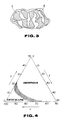
- the soft magnetic amorphous alloy thin film of the present invention may be inferred to be a two-phase hybrid or mixed structure which, as shown in Fig. 3, is comprised of a magnetic amorphous phase 1 consisting mainly of a transition metal element M (M-G) and a nonmagnetic amorphous phase II surrounding the phase I and composed of an oxide (G-L-O).
- M-G transition metal element M
- G-L-O oxide
- the soft magnetic amorphous alloy thin film of the present invention is prepared by a sputtering technique using a target comprised of an array of square plates of an oxide (LOv) on an MG base alloy disk.
- LOv oxide
- oxygen may in this case be bonded preferentially with Fe, so that not only the magnetic properties are lowered considerably, but also it becomes difficult to achieve n high electrical resistivity.
- the argon gas pressure during sputtering is preferably 2 to 100 mTorr.
- the amorphous film produced by sputtering is heat-treated at a temperature not higher than the crystallization temperature of the film material.
- the soft magnetic amorphous alloy thin film of the present invention may be inferred to be a two-phase hybrid structure or mixed structure comprised of a magnetic amorphous phase I consisting mainly of the transition metal element M (M-G) and a nonmagnetic amorphous phase II surrounding the phase I and composed of a metalloid element G and an oxide LO v (G-L-O), as shown in Fig. 3.
- M-G transition metal element M
- G-L-O oxide LO v
- the magnetic amorphous phase I of a low electrical resistivity is interrupted by the nonmagnetic amorphous phase II of a high electrical resistivity so that the film as a whole exhibits a high electrical resistivity.
- the magnetic amorphous phase I is interrupted electrically by the nonmagnetic amorphous phase II, adjacent regions of the phase I formed by interruption are spaced apart by an extremely small distance and are connected to one another magnetically, such that the magnetic properties, above all, the saturation magnetic flux density, of the film as a whole are higher than those of the metal-metal system one-phase amorphous magnetic thin film, such as CoZrNb.
- the crystal soft magnetic thin film such as the Sendust thin film, exhibits uniaxial anisotropy that is, directivity, in its magnetic properties, on account of its crystal magnetic anisotropy.
- the soft magnetic amorphous alloy within film of the present invention exhibits magnetically isotropic soft magnetic properties in the film surface, since the film material is amorphous and the magnetic amorphous phase I is dispersed finely. These isotropic soft magnetic properties may not be realized with the conventional crystal magnetic soft thin film or a one-phase amorphous magnetic thin film.
- an amorphous thin film of the composition (Co 0.8 Fe 0.2 ) x By (SiO2) z is formed.
- a CoFeB alloy and an oxide of L were as targets, and were sputtered simultaneously by the RF magnetron sputtering method to produce an amorphous thin film.
- a crystal glass 30 mm by 3 mm by 0.5 mm, a quartz glass 10 mm by 10 mm by 1 mm or pyrex glass 25 mm by 40 mm by 1 mm could be used.
- incident wave power 100-400W reflected wave power 1-4W vacuum reached 7x10 ⁇ 7 Torr or lower electrode-to-electrode distance 50 mm pre-sputtering time 30 minutes sputtering time 0.5 to 3 hours argon gas pressure 2 to 100 mTorr substrate temperature water-cooled
- the film prepared by sputtering was examined by X-ray diffraction as to whether it was crystal or amorphous.
- the amorphous film such as that described above was head-treated under predetermined conditions.
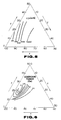
- Fig. 4 shows the results of the above-mentioned X-ray diffraction analyses of the films produced with various different compositional ratios.
- the SiO2 contents are in the range of 0 to 50 atomic percent, the film produced by sputtering becomes amorphous, even with reduced B contents.
- the oxides are also effective in forming an amorphous structure.
- This amorphous alloy thin film is destitute of crystal magnetic anisotropy, so that at tends to exhibit soft magnetic properties.
- Fig. 5 shows the values of electrical resistivity for the various compositional ratios. It may be seen from Fig. 5 that, with increase in the oxide contents, the electrical resistivity tends to be increased significantly. It is noted that, in the hatched region of Fig. 1, the electrical resistivity is of the order of 150 to 2000 ⁇ cm, which is higher than the corresponding value of the conventional soft magnetic metallic material.
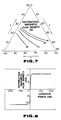
- Fig. 7 shows the saturation magnetic flux density for various different compositional ratios. It is seen from Fig. 7 that the saturation magnetic flux density is approximately proportional to the transition metal element contents. Within the hatched region shown in Fig. 1, the saturation magnetic flux density reaches a higher value of not less than 6000 Gauss.
- the halo-shaped curve of Fig. 8 proper to the amorphous material indicates that the film represented by the above composition is amorphous.
- the film has a saturation magnetic flux density of 11000 Gauss and a coercive force of 0.2 Oe so that it is superior in soft magnetic properties.
- the frequency is plotted on the horizontal axis, while the effective permeability is plotted on the vertical axis.
- the effective permeability equal to about 800 extends substantially to the high frequency region of 50 MHz.
- the film thickness is 4 ⁇ m.
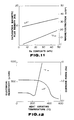
- Fig. 11 shows the relation of the saturation magnetic flux density and magnetostriction, both plotted on the vertical axis, with the CoFe compositional ratio plotted on the horizontal axis. It is seen from Fig. 11 that, with the Fe contents in the transition elements in the range of 0 to 50 atomic percent, the saturation magnetic flux density and the magnetostriction tend to be increased in proportion to the increase in Fe contents. Thus the magnetostriction may be adjusted by changing the Co-Fe mixing ratio.
- the heat-treating time is one hour.
- the electrical resistivity is constant at approximately 500 ⁇ cm at the eat-treating temperature of 250 °C or lower, and is decreased acutely at the heat-treating temperature of 250 °C or higher.
- the coercivity becomes lowest at approximately 220 °C.
- the heat-treating temperature of 220 °C is most desirable. It is noted that the optimum heat-treating temperature is changed with the compositional ratio of the amorphous film.
- the soft magnetic amorphous alloy thin film of the present embodiment shows soft magnetic properties of a high electrical resistivity and a high saturation magnetic flux density and thus undergoes low losses in the high frequency region within the range of the compositional ratios of 15 ⁇ y ⁇ 28 and 2 ⁇ z ⁇ 10.
- transition metal elements such as Or, Mn or Ti, Mo, Ru, Pd, Hf, Ta, W or Pt may be added to the transition metal element M.
- the elements contributing to the amorphousness are not limited to the above elements, but metalloids such as C, Ge, As, Sb or Sn, or metals such as Zr, Nb, Ta, Ti, Y, Hf or Pd, may also be employed.
- oxides oxides of elements such as Ti, Sn, Or, W, Ta, Mo or V may also be employed.
- the soft magnetic amorphous alloy thin film of the present invention which is formed of a transition metal, a metalloid and an oxide and which has a hetero-amorphous two-phase structure of a magnetic amorphous phase and a nonmagnetic amorphous phase, the two properties which are contradictory to each other, namely the high electrical resistivity and the high saturation magnetic flux density, may be achieved simultaneously.
- a soft magnetic amorphous alloy thin film may be provided which is lesser in eddy current losses and superior in high frequency characteristics and which may be controlled in magnetostriction and may be applied to a magnetic head technology for short wavelength recording.
- the soft magnetic amorphous alloy thin film of the present invention may be used satisfactorily with a metal tape having a high coercive force because the film is low in coercive force and has a high saturation magnetic flux density as compared with the Sendust thin film or a one-phase amorphous magnetic thin film.
- the soft magnetic amorphous alloy thin film of the present invention is not crystalline in structure and does not exhibit uniaxial anisotropy due for example to crystal magnetic anisotropy, so that it may be said to be an isotropic soft magnetic material. Hence, it may be applied advantageously to a magnetic head since there is no necessity of taking the direction of the crystal grains into consideration.
Landscapes
- Engineering & Computer Science (AREA)
- Power Engineering (AREA)
- Manufacturing & Machinery (AREA)
- Thin Magnetic Films (AREA)
- Soft Magnetic Materials (AREA)
Applications Claiming Priority (2)
| Application Number | Priority Date | Filing Date | Title |
|---|---|---|---|
| JP244461/89 | 1989-09-20 | ||
| JP1244461A JP2821627B2 (ja) | 1989-09-20 | 1989-09-20 | 軟磁性非晶質合金薄膜 |
Publications (2)
| Publication Number | Publication Date |
|---|---|
| EP0418804A1 true EP0418804A1 (de) | 1991-03-27 |
| EP0418804B1 EP0418804B1 (de) | 1993-06-23 |
Family
ID=17118994
Family Applications (1)
| Application Number | Title | Priority Date | Filing Date |
|---|---|---|---|
| EP90117911A Expired - Lifetime EP0418804B1 (de) | 1989-09-20 | 1990-09-18 | Dünner weichmagnetischer Film |
Country Status (5)
| Country | Link |
|---|---|
| US (1) | US5133814A (de) |
| EP (1) | EP0418804B1 (de) |
| JP (1) | JP2821627B2 (de) |
| KR (1) | KR0177922B1 (de) |
| DE (1) | DE69002044T2 (de) |
Cited By (2)
| Publication number | Priority date | Publication date | Assignee | Title |
|---|---|---|---|---|
| EP0735549A3 (de) * | 1995-03-30 | 1997-01-08 | Toshiba Kk | Weichmagnetischer dünner Film und Dünnfilmmagnetelement unter Verwendung desselben |
| EP0901135A3 (de) * | 1997-09-04 | 1999-04-14 | Matsushita Electric Industrial Co., Ltd. | Magnetischer dünner Film und Magnetelement unter Verwendung desselben |
Families Citing this family (4)
| Publication number | Priority date | Publication date | Assignee | Title |
|---|---|---|---|---|
| JP3730366B2 (ja) * | 1997-07-03 | 2006-01-05 | 株式会社東芝 | 薄膜磁気素子 |
| US6815096B2 (en) * | 2001-05-16 | 2004-11-09 | Tdk Corporation | Soft magnetic thin film and thin film magnetic head using the same |
| US20090046397A1 (en) * | 2007-08-15 | 2009-02-19 | Freescale Semiconductor, Inc. | Methods and apparatus for a synthetic anti-ferromagnet structure with improved thermal stability |
| JP2023124672A (ja) * | 2022-02-25 | 2023-09-06 | Tdk株式会社 | ナノグラニュラー磁性膜および電子部品 |
Citations (1)
| Publication number | Priority date | Publication date | Assignee | Title |
|---|---|---|---|---|
| EP0167118A2 (de) * | 1984-06-30 | 1986-01-08 | Research Development Corporation of Japan | Sauerstoff enthaltende ferromagnetische amorphe Legierungen und Verfahren zu ihrer Herstellung |
Family Cites Families (1)
| Publication number | Priority date | Publication date | Assignee | Title |
|---|---|---|---|---|
| JPS54113097A (en) * | 1978-01-27 | 1979-09-04 | Victor Co Of Japan Ltd | Cermet type magnetic substance |
-
1989
- 1989-09-20 JP JP1244461A patent/JP2821627B2/ja not_active Expired - Fee Related
-
1990
- 1990-08-24 KR KR1019900013065A patent/KR0177922B1/ko not_active Expired - Fee Related
- 1990-09-17 US US07/583,877 patent/US5133814A/en not_active Expired - Lifetime
- 1990-09-18 DE DE90117911T patent/DE69002044T2/de not_active Expired - Fee Related
- 1990-09-18 EP EP90117911A patent/EP0418804B1/de not_active Expired - Lifetime
Patent Citations (1)
| Publication number | Priority date | Publication date | Assignee | Title |
|---|---|---|---|---|
| EP0167118A2 (de) * | 1984-06-30 | 1986-01-08 | Research Development Corporation of Japan | Sauerstoff enthaltende ferromagnetische amorphe Legierungen und Verfahren zu ihrer Herstellung |
Non-Patent Citations (1)
| Title |
|---|
| JOURNAL OF APPLIED PHYSICS. vol. 64, no. 8, 15 October 1988, NEW YORK US pages 4251 - 4253; R.L.Holtz et Al.: "Amorphous iron particles in cosputtered Fe-SiO2 films" * |
Cited By (5)
| Publication number | Priority date | Publication date | Assignee | Title |
|---|---|---|---|---|
| EP0735549A3 (de) * | 1995-03-30 | 1997-01-08 | Toshiba Kk | Weichmagnetischer dünner Film und Dünnfilmmagnetelement unter Verwendung desselben |
| US5750273A (en) * | 1995-03-30 | 1998-05-12 | Kabushiki Kaisha Toshiba | Soft magnetic thin film and thin film magnetic element using the same |
| EP0901135A3 (de) * | 1997-09-04 | 1999-04-14 | Matsushita Electric Industrial Co., Ltd. | Magnetischer dünner Film und Magnetelement unter Verwendung desselben |
| US6231968B1 (en) | 1997-09-04 | 2001-05-15 | Matsushita Electric Industrial Co., Ltd. | Magnetic thin film and magnetic device using the same |
| EP1170758A1 (de) * | 1997-09-04 | 2002-01-09 | Matsushita Electric Industrial Co., Ltd. | Magnetischer dünner Film und Magnetelement unter Verwendung desselben |
Also Published As
| Publication number | Publication date |
|---|---|
| EP0418804B1 (de) | 1993-06-23 |
| KR0177922B1 (ko) | 1999-05-15 |
| JP2821627B2 (ja) | 1998-11-05 |
| KR910007009A (ko) | 1991-04-30 |
| JPH03106003A (ja) | 1991-05-02 |
| US5133814A (en) | 1992-07-28 |
| DE69002044D1 (de) | 1993-07-29 |
| DE69002044T2 (de) | 1994-02-03 |
Similar Documents
| Publication | Publication Date | Title |
|---|---|---|
| EP0300511B1 (de) | Magnetkopf | |
| KR960006055B1 (ko) | 연자성 박막 | |
| US5452167A (en) | Soft magnetic multilayer films for magnetic head | |
| US6822831B2 (en) | Magnetic thin film, magnetic thin film forming method, and recording head | |
| EP0735549A2 (de) | Weichmagnetischer dünner Film und Dünnfilmmagnetelement unter Verwendung desselben | |
| EP0418804B1 (de) | Dünner weichmagnetischer Film | |
| JPWO2001039219A1 (ja) | 磁性薄膜、磁性薄膜成膜方法、および記録ヘッド | |
| Kataoka et al. | High frequency permeability of nanocrystalline Fe–Cu–Nb–Si–B single and multilayer films | |
| JPH07116563B2 (ja) | Fe基軟磁性合金 | |
| JP2950917B2 (ja) | 軟磁性薄膜 | |
| EP0178634B1 (de) | Amorpher weichmagnetischer dünner Film | |
| US4743313A (en) | Amorphous alloy for use in magnetic heads | |
| EP0502535B1 (de) | Magnetknopf | |
| JP2866911B2 (ja) | 磁気ヘッド | |
| JP2774702B2 (ja) | 軟磁性薄膜およびそれを用いた薄膜磁気ヘッド | |
| JP3232592B2 (ja) | 磁気ヘッド | |
| JP2784105B2 (ja) | 軟磁性薄膜 | |
| JP2979557B2 (ja) | 軟磁性膜 | |
| Nago et al. | Substrate bias effect on the magnetic properties of Fe-Ta-N films | |
| JP2635421B2 (ja) | 軟磁性合金膜 | |
| JP2727274B2 (ja) | 軟磁性薄膜 | |
| JP2774708B2 (ja) | 軟磁性薄膜およびそれを用いた薄膜磁気ヘッド | |
| JPH01175707A (ja) | 積層軟磁性薄膜 | |
| JP2584687B2 (ja) | 軟磁性薄膜の製造方法 | |
| JP2574901B2 (ja) | 薄膜磁気ヘッド及びその製造方法 |
Legal Events
| Date | Code | Title | Description |
|---|---|---|---|
| PUAI | Public reference made under article 153(3) epc to a published international application that has entered the european phase |
Free format text: ORIGINAL CODE: 0009012 |
|
| AK | Designated contracting states |
Kind code of ref document: A1 Designated state(s): DE FR GB |
|
| 17P | Request for examination filed |
Effective date: 19910624 |
|
| 17Q | First examination report despatched |
Effective date: 19910904 |
|
| GRAA | (expected) grant |
Free format text: ORIGINAL CODE: 0009210 |
|
| AK | Designated contracting states |
Kind code of ref document: B1 Designated state(s): DE FR GB |
|
| REF | Corresponds to: |
Ref document number: 69002044 Country of ref document: DE Date of ref document: 19930729 |
|
| ET | Fr: translation filed | ||
| PLBE | No opposition filed within time limit |
Free format text: ORIGINAL CODE: 0009261 |
|
| STAA | Information on the status of an ep patent application or granted ep patent |
Free format text: STATUS: NO OPPOSITION FILED WITHIN TIME LIMIT |
|
| 26N | No opposition filed | ||
| PGFP | Annual fee paid to national office [announced via postgrant information from national office to epo] |
Ref country code: FR Payment date: 20010911 Year of fee payment: 12 |
|
| PGFP | Annual fee paid to national office [announced via postgrant information from national office to epo] |
Ref country code: DE Payment date: 20011001 Year of fee payment: 12 |
|
| REG | Reference to a national code |
Ref country code: GB Ref legal event code: IF02 |
|
| PG25 | Lapsed in a contracting state [announced via postgrant information from national office to epo] |
Ref country code: DE Free format text: LAPSE BECAUSE OF NON-PAYMENT OF DUE FEES Effective date: 20030401 |
|
| PG25 | Lapsed in a contracting state [announced via postgrant information from national office to epo] |
Ref country code: FR Free format text: LAPSE BECAUSE OF NON-PAYMENT OF DUE FEES Effective date: 20030603 |
|
| REG | Reference to a national code |
Ref country code: FR Ref legal event code: ST |
|
| PGFP | Annual fee paid to national office [announced via postgrant information from national office to epo] |
Ref country code: GB Payment date: 20060913 Year of fee payment: 17 |
|
| GBPC | Gb: european patent ceased through non-payment of renewal fee |
Effective date: 20070918 |
|
| PG25 | Lapsed in a contracting state [announced via postgrant information from national office to epo] |
Ref country code: GB Free format text: LAPSE BECAUSE OF NON-PAYMENT OF DUE FEES Effective date: 20070918 |