EP0419067A2 - Système de calculateur avec appareil d'exploitation d'une porte sérielle à tamponnage supplémentaire utilisant un protocole avec mécanisme de blocage - Google Patents
Système de calculateur avec appareil d'exploitation d'une porte sérielle à tamponnage supplémentaire utilisant un protocole avec mécanisme de blocage Download PDFInfo
- Publication number
- EP0419067A2 EP0419067A2 EP19900309469 EP90309469A EP0419067A2 EP 0419067 A2 EP0419067 A2 EP 0419067A2 EP 19900309469 EP19900309469 EP 19900309469 EP 90309469 A EP90309469 A EP 90309469A EP 0419067 A2 EP0419067 A2 EP 0419067A2
- Authority
- EP
- European Patent Office
- Prior art keywords
- data
- buffering
- output
- input
- processing means
- Prior art date
- Legal status (The legal status is an assumption and is not a legal conclusion. Google has not performed a legal analysis and makes no representation as to the accuracy of the status listed.)
- Withdrawn
Links
Images




Classifications
-
- G—PHYSICS
- G06—COMPUTING OR CALCULATING; COUNTING
- G06F—ELECTRIC DIGITAL DATA PROCESSING
- G06F13/00—Interconnection of, or transfer of information or other signals between, memories, input/output devices or central processing units
- G06F13/38—Information transfer, e.g. on bus
Definitions
- the present invention relates to a computer system and particularly to a computer system having apparatus for exploiting serial port extended buffering by using a protocol override mechanism for devices having protocol based upon character at a time processing.
- serial port data transmission When discussing serial port data transmission, it is generally intended to mean conventional serial port data transmission such as is conducted through what is known in the industry as an RS232C port (IEEE Standard). These ports allow the input and output of data in a serial or bitstream fashion.
- RS232C port IEEE Standard
- UARTs Universal Asynchronous Receiver Transmitter
- RS232C interface hardware are capable of only buffering a single character for output and a single character for input at a time.
- Examples of devices which are attached to serial ports in computer systems typically include printers, plotters, and modems, although this list is not all inclusive and is not limited to only those devices listed.
- single-tasking or more commonly as now known, single-threaded software, such as PC DOS, as well as PC DOS applications such as commercially available hypervisor software
- this single character buffering does not present a problem.
- single-tasking software e.g., single-tasking operating systems, typically use polling techniques to read/write the port one character at a time. Since only a single task is being conducted, this does not present a problem.
- An aim of the present invention is to provide a computer system having apparatus for permitting the maximum exploitation of the new device extended buffering capability while remaining compatible with devices that use existing protocols.
- the method of the present invention preferably comprises the steps of disabling (overriding) and/or minimizing (not overriding) the control buffering which is typically conducted by the processing means.
- minimizing is meant setting the receive buffer trigger level at a single character and only transmitting a single character at a time, and in this document the terms “minimizing” and “not overriding” are used interchangeably and mean the same thing.
- the terms “disabling” and “overriding” are also used interchangeably and mean the same thing.
- a test output or input of serial data is conducted to a predetermined connected peripheral device while overriding the control buffering, for example, a printer, to determine if the connected peripheral device is capable of extended serial data buffering greater than the buffering capabilities of the processing means.
- the buffering control is re-enabled when the capabilities of the peripheral to perform extended serial data buffering is determined to be about equal to or less than the buffering capabilities of the processing means.
- the buffering control is maintained disabled if the capabilities of the peripheral to perform extended serial data buffering is greater than the buffering capabilities of the processing means.
- a computer system comprising: a serial port for permitting serial input and output of data, a multi-tasking operating system for generating interrupts to drive the serial port, means for conducting the input and output of data including processing means for providing controlled buffering of the input and output of data; characterised in that the computer system further comprises: disabling means for selectively disabling the controlled buffering by the processing means whereby rate of data input and output can be increased to a peripheral connectable to the system having extended serial buffering capability greater than the buffering capability of the processing means which is connected to the means for conducting input and output of data when the peripheral is connected thereto.
- a computer system comprising: a serial port for permitting serial input and output of data, a multi-tasking operating system for generating interrupts to drive the serial port, means for conducting the input and output of data including processing means for providing controlled buffering of the input and output of data; characterised in that the computer system further comprises: enabling means for enabling buffering by the processing means by setting a predetermined interrupt trigger level equivalent to single character processing to reduce the probability of data loss during increase interrupt latency conditions.
- a serial port for permitting serial input and output of data, a multi-tasking operating system for generating interrupts to drive the serial port, and means for conducting the input and output of data including processing means for providing controlled buffering of the input and output of data; a method for conducting the data input and output comprising the steps of: disabling the controlled buffering provided by the processing means; conducting a test output of serial data to a predetermined connectable peripheral for determining if the connectable peripheral when connected is capable of extended serial data buffering greater than the buffering capabilities of the processing means; and one of re-enabling the buffering control if the capabilities of the peripheral to perform extended serial data buffering is about equal to or less than the buffering capabilities of the processing means, or maintaining the disabled buffering control if the capabilities of the connectable peripheral to perform extended serial data is buffering greater than the buffering capabilities of the processing means.
- the present invention is directed to an improvement in a computer system having means for conducting input/output of data in a serial manner.
- the computer system is controlled by a multi-tasking operating system which employs interrupts to drive a serial port.
- the means for conducting input/output of data includes processing means for controlled buffering of the input/output of the data.
- the improvement resides in the provision of disabling means for selectively disabling the controlled buffering by the processing means whereby the input/output rate of data can be increased to a peripheral having extended serial buffering capability greater than the buffering capability of the processing means which is connected to the means for conducting input/output of data.
- the device driver for the serial port input/output will use the extended buffering capabilities of the peripheral hardware to its maximum benefit regardless of whether the device driver is
- the extended hardware buffering capabilities available due to the current hardware plans of numerous companies applies to the new RS232C hardware technology being placed in, for example, presently commercially available IBM workstations and serial adapters.
- Such devices include the commercially available IBM PS/2 workstations as well, with respect to the serial adapters, those adapters commercially available which employ the National Semiconductor 16550A UART, or equivalent, such as is available from IBM Corporation.
- 16 characters can be given to the transmit hardware during the processing of one transmitter empty interrupt.
- a 16 character receive buffer is available with a settable trigger level. The trigger level determines when the receive hardware will generate a "receive data ready interrupt".
- the device driver In order to implement the system compatibly, when output handshaking using DSR (Data Set Ready), CTS (Clear To Send), or DCD (Data Carrier Detect) is enabled, the device driver will normally cause the hardware with extended buffering capabilities to still generate an interrupt for every character that needs to be transmitted. By requesting the device driver to override this normal buffering control processing, the potential transmit throughput of the system is significantly increased, the system has significantly more processing power available for other activities (for high baud rates), and more communication ports are supportable at a given baud rate.
- the term "override" when used to refer to the buffering control is intended to mean modification of the buffering control to maximise the utilisation of the buffering capability of the peripheral device without totally disabling the flow control processing of the system.
- a FIFO is a First-In First-Out buffer.
- the size of a FIFO can vary. In this example the size of the FIFO is 16 bytes.
- a UART is a Universal Asynchronous Receiver Transmitter, as previously discussed. The UART has two FIFOs. One for receive data and one for transmit data. These devices are conventional and well-known to those of ordinary skill in this art.
- the asynchronous (async) device driver 105 sends transmit data to the UART 101 by writing data to an input/output port on the UART 101.
- the data will normally flow over the system data bus that connects the system processor to the input/output devices.
- the async device driver 105 receives data from the UART 101 by reading data from an input/output port on the UART 101. Another input/output port is used by the async device driver 105 to read/write the modem control signals on the UART 101.
- the async device driver 105 will control the modes of operation of the UART 101 by sending commands to an input/output port.
- the data normally flows between the system processor 103 where the async device driver 105 is executing and the UART 101 over the system data bus.
- the UART 101 can generate an interrupt for the system processor 103.
- the interrupt causes the system processor 103 to give control to the async device driver 105.
- the async device driver 105 will then be able to determine that the UART 101 wants to be serviced by the async device driver 105.
- arrows going to/from the bottom of the UART 101 in Fig. 1 show how the UART 101 is connected to an external RS232C communications port (not shown). There are separate lines for transmit and receive data as well as lines for every modem control signal. This is conventional and the implementation well-known to those of ordinary skill in the art from a review of Fig. 1.
- One command (control commands) that the async device driver can send the UART 101 is to enable or disable the FIFO capabilities of the UART 101. The following describes the operation if the UART 101 FIFO is disabled.
- the async device driver 105 sends one byte (character) of data to the UART 101 to be transmitted. After the UART 101 has transmitted the byte of data, the UART 101 will generate an interrupt for the system processor 103. The async device driver 105 receives the interrupt and provides the next byte to the UART 101 to be transmitted. When the UART 101 receives a byte of data, it will generate an interrupt for the system processor 103. The async device driver 105 receives an interrupt and reads the byte of data from the UART 101.
- the async device driver 105 can command the UART 101 to enable its FIFO capabilities.
- the following discussion assumes a FIFO size of 16 bytes. UARTs can be built with different size FIFOs.
- the async device driver 105 will give 16 bytes of data to the UART 101 to be transmitted. After the UART 101 has transmitted the 16 bytes of data the UART 101 will generate an interrupt for the system processor 103.
- the async device driver 105 will get the interrupt and give the next 16 bytes to the UART 101 to be transmitted.
- the async device driver 105 can give less than 16 bytes at a time to the UART 101 and the UART 101 will transmit whatever data it is given.
- the async device driver 105 commands the UART 101 to generate an interrupt after a certain number of bytes have been received by the UART 101.
- the selectable number of bytes is also known as the "trigger level".
- the trigger level is set by the device driver 105 to minimize the number of system processor 103 interrupts while also leaving enough time after the interrupt for the async device driver 105 to read all the data from the receive FIFO before it fills up.
- the UART 101 will generate an interrupt from the system processor 103 after the trigger level number of bytes have been received by the UART 101 into its receive FIFO.
- the async device driver 105 gets the interrupt and will read all the bytes from the UART 101 receive FIFO.
- the async device driver 105 can read and write the modem control signals.
- the modem control signals do not directly effect the UART 101 transmit and receive operations.
- the async device driver 105 interprets and sets these signals.
- the async device driver 105 also controls the operation of the UART 101 based on the state of the modem control signals. This is how the operation of the UART 101 is indirectly effected by the state of the modem control signals.
- Fig. 2 there is shown a serial device connected to the system via an IEEE standard RS232C connection or comparable interface.
- the two example devices shown are a serial printer 1 and a modem 3.
- the specific devices 5a and 7a of the system hardware are controlled by their respective device drivers 5b and 7b, the serial port device driver 9 being one of the drivers, and also the focus for the improvement of this disclosure.
- the operating system 11 and application programs 13 Above this level resides the operating system 11 and application programs 13.
- Application programs 13 send and receive data and control information through flow lines 15 to and from the serial port device driver 9 in a conventional and well known manner through the operating system 11.
- Fig. 3A if output handshaking (as conventionally understood by those of ordinary skill in the art) is disabled at NO on the right hand path of the chart, then the serial device driver (9 at Fig. 2) can turn on the transmit FIFO and transmit multiple characters, i.e., bytes (16 in this example), before generating an interrupt and repeating the loop as shown, the termination of which is event from pseudo code set forth hereinafter in its corresponding "while" statement.
- Fig. 3B if output handshaking is disabled at NO1 on the right hand path, then the flow is the same as is shown in Fig. 3A. If the override invention is disabled at NO2, by sending a command to the device driver, also on the right hand path, then the driver 9 at Fig. 2 is forced to work on a single character at a time as described in the previous Fig. 3A.
- the FIFO can be turned on even though output handshaking is enabled.
- the device driver 9 in Fig. 2 will be capable of transmitting multiple characters, i.e., bytes (16 in this example), before generating an interrupt and repeating the loop of Fig. 3B.
- this is how compatibility is preserved while optimising system performance, and is the essence of this invention.
- the device driver 9 in Fig. 2 can turn on the receive FIFO and receive an interrupt only after more than one character, i.e., byte, has been received; (the number to be received before generating an interrupt is controlled by the device driver by setting the receive FIFO "trigger level").
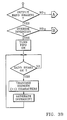
- Fig. 4A The problem depicted in Fig. 4A is that if input sensitivity is enabled at YES on the left side of the path, the receive trigger level must be set to one. As is shown in Fig. 4A this causes an interrupt to be generated for every character.
- This figure also shows another aspect of this invention. More specifically, even without the override aspect of the invention being active, the receive FIFO will be activated even though the trigger level must be set to one. This takes advantage of the FIFO to avoid loss of a character in cases where the system interrupt latency has exceeded the inter-character arrival rate.
- system interrupt latency is meant the time between the time the hardware generates the interrupt and the device driver gets control due to the interrupt.
- the device driver 9 in Fig. 2 can enable the receive FIFO and set the trigger level at greater than one.
- the device driver 9 in Fig. 2 will be capable of receiving multiple characters, i.e., bytes (16 in this example), for each interrupt process.
- Fig. 5A if XON/XOFF flow control is disabled at NO on the right side path of the path, then the device driver 9 in Fig. 2 can turn on the FIFO and transmit multiple characters, i.e., bytes (16 in this example), before generating an interrupt.
- Fig. 5A The problem depicted in Fig. 5A is that if XON/XOFF flow control is enabled at YES on the left side of the path, then the transmit FIFO must be disabled to preserve compatibility with the maximum number of devices.
- the device driver 9 in Fig. 2 can enable the FIFO thereby allowing multiple characters, i.e., bytes (16 in this example), to be transmitted for every interrupt which must be processed.
- the following implementation is a module representative of the invention as described with reference to Fig. 4A and 4B for input sensitivity control in accordance with the method.
Landscapes
- Engineering & Computer Science (AREA)
- Theoretical Computer Science (AREA)
- Physics & Mathematics (AREA)
- General Engineering & Computer Science (AREA)
- General Physics & Mathematics (AREA)
- Computer And Data Communications (AREA)
- Information Transfer Systems (AREA)
Applications Claiming Priority (2)
| Application Number | Priority Date | Filing Date | Title |
|---|---|---|---|
| US41045189A | 1989-09-21 | 1989-09-21 | |
| US410451 | 1989-09-21 |
Publications (1)
| Publication Number | Publication Date |
|---|---|
| EP0419067A2 true EP0419067A2 (fr) | 1991-03-27 |
Family
ID=23624786
Family Applications (1)
| Application Number | Title | Priority Date | Filing Date |
|---|---|---|---|
| EP19900309469 Withdrawn EP0419067A2 (fr) | 1989-09-21 | 1990-08-30 | Système de calculateur avec appareil d'exploitation d'une porte sérielle à tamponnage supplémentaire utilisant un protocole avec mécanisme de blocage |
Country Status (2)
| Country | Link |
|---|---|
| EP (1) | EP0419067A2 (fr) |
| JP (1) | JPH03174642A (fr) |
Cited By (2)
| Publication number | Priority date | Publication date | Assignee | Title |
|---|---|---|---|---|
| EP0685797A1 (fr) * | 1994-06-03 | 1995-12-06 | Hewlett-Packard Company | Circuit de protection de débordement pour un dispositif UART |
| US6912566B1 (en) * | 1998-07-28 | 2005-06-28 | Siemens Aktiengesellschaft | Memory device and method for operating the memory device |
-
1990
- 1990-08-21 JP JP21989490A patent/JPH03174642A/ja active Pending
- 1990-08-30 EP EP19900309469 patent/EP0419067A2/fr not_active Withdrawn
Cited By (2)
| Publication number | Priority date | Publication date | Assignee | Title |
|---|---|---|---|---|
| EP0685797A1 (fr) * | 1994-06-03 | 1995-12-06 | Hewlett-Packard Company | Circuit de protection de débordement pour un dispositif UART |
| US6912566B1 (en) * | 1998-07-28 | 2005-06-28 | Siemens Aktiengesellschaft | Memory device and method for operating the memory device |
Also Published As
| Publication number | Publication date |
|---|---|
| JPH03174642A (ja) | 1991-07-29 |
Similar Documents
| Publication | Publication Date | Title |
|---|---|---|
| US6092095A (en) | Real-time task manager for a personal computer | |
| US5819112A (en) | Apparatus for controlling an I/O port by queuing requests and in response to a predefined condition, enabling the I/O port to receive the interrupt requests | |
| US5179661A (en) | Method and apparatus for serial data flow control | |
| JPH07235964A (ja) | 端末装置(dte)とデータ通信装置(dce)との間のデータ通信システムおよび高速でデータを送信するための方法 | |
| CA2284277C (fr) | Modem execute par logiciel et destine a fonctionner sur un ordinateur universel dans un environnement a temps differe | |
| US6131131A (en) | Computer system including an enhanced communication interface for an ACPI-compliant controller | |
| EP0208430B1 (fr) | Méthode et dispositif pour l'exécution d'opérations de lecture de données de longueur variable | |
| KR20100135282A (ko) | 가상 인터럽트 모드 인터페이스 | |
| EP0772831B1 (fr) | Interface bidirectionnelle a signal parallele | |
| EP1516261B1 (fr) | Systeme de bus, station utilisee dans un systeme de bus, et interface de bus | |
| KR20040041623A (ko) | 버스 시스템 및 버스 인터페이스 | |
| US6768557B1 (en) | Interface device, control method for the same, and data storage medium for recording the control method | |
| US20070100598A1 (en) | Apparatus and method for connecting a hardware emulator to a computer peripheral | |
| US20070124527A1 (en) | Virtual Serial Apparatus | |
| EP0419067A2 (fr) | Système de calculateur avec appareil d'exploitation d'une porte sérielle à tamponnage supplémentaire utilisant un protocole avec mécanisme de blocage | |
| US6799231B2 (en) | Virtual I/O device coupled to memory controller | |
| KR20040043198A (ko) | 버스 시스템 및 버스 인터페이스 | |
| KR20030033005A (ko) | 회로 장치 및 데이터 전달 방법 | |
| US6006284A (en) | Method and apparatus for driving a parallel part to provide multiple modes of communications between a host and a peripheral | |
| CN111427823A (zh) | 支持pc与fpga通过pcie通信的驱动设计方法 | |
| US6738849B2 (en) | Real-time communications for speeding up packet transmission | |
| US5218683A (en) | Method and apparatus for concealing the enablement of a device by modifying a status word | |
| US5974477A (en) | Image forming apparatus capable of receiving data in high speed in accordance with high speed data transmission interface | |
| KR20030044373A (ko) | 기억 장치 직접 접근 인터페이스를 지원하는 범용 직렬버스 장치 | |
| Frock | IEEE 1284–Updating the PC Parallel Port |
Legal Events
| Date | Code | Title | Description |
|---|---|---|---|
| PUAI | Public reference made under article 153(3) epc to a published international application that has entered the european phase |
Free format text: ORIGINAL CODE: 0009012 |
|
| 17P | Request for examination filed |
Effective date: 19901213 |
|
| AK | Designated contracting states |
Kind code of ref document: A2 Designated state(s): DE FR GB |
|
| STAA | Information on the status of an ep patent application or granted ep patent |
Free format text: STATUS: THE APPLICATION HAS BEEN WITHDRAWN |
|
| 18W | Application withdrawn |
Withdrawal date: 19921026 |
|
| R18W | Application withdrawn (corrected) |
Effective date: 19921026 |