EP0419255A2 - Procédé et dispositif pour contrôler l'uniformité apparante de têtes d'impression - Google Patents
Procédé et dispositif pour contrôler l'uniformité apparante de têtes d'impression Download PDFInfo
- Publication number
- EP0419255A2 EP0419255A2 EP90310293A EP90310293A EP0419255A2 EP 0419255 A2 EP0419255 A2 EP 0419255A2 EP 90310293 A EP90310293 A EP 90310293A EP 90310293 A EP90310293 A EP 90310293A EP 0419255 A2 EP0419255 A2 EP 0419255A2
- Authority
- EP
- European Patent Office
- Prior art keywords
- light emitting
- emitting diode
- fet
- current
- group
- Prior art date
- Legal status (The legal status is an assumption and is not a legal conclusion. Google has not performed a legal analysis and makes no representation as to the accuracy of the status listed.)
- Withdrawn
Links
Images


Classifications
-
- G—PHYSICS
- G06—COMPUTING OR CALCULATING; COUNTING
- G06K—GRAPHICAL DATA READING; PRESENTATION OF DATA; RECORD CARRIERS; HANDLING RECORD CARRIERS
- G06K15/00—Arrangements for producing a permanent visual presentation of the output data, e.g. computer output printers
- G06K15/02—Arrangements for producing a permanent visual presentation of the output data, e.g. computer output printers using printers
- G06K15/12—Arrangements for producing a permanent visual presentation of the output data, e.g. computer output printers using printers by photographic printing, e.g. by laser printers
- G06K15/1238—Arrangements for producing a permanent visual presentation of the output data, e.g. computer output printers using printers by photographic printing, e.g. by laser printers simultaneously exposing more than one point
- G06K15/1242—Arrangements for producing a permanent visual presentation of the output data, e.g. computer output printers using printers by photographic printing, e.g. by laser printers simultaneously exposing more than one point on one main scanning line
- G06K15/1247—Arrangements for producing a permanent visual presentation of the output data, e.g. computer output printers using printers by photographic printing, e.g. by laser printers simultaneously exposing more than one point on one main scanning line using an array of light sources, e.g. a linear array
Definitions
- An LED printhead is a non-impact printer which employs an array of light emitting diodes (commonly referred to herein as LEDs) for exposing a photoreceptor surface.
- an electrostatic charge is formed on a photoreceptor surface of a moving drum or belt, and selected areas of the surface (or pixels) are discharged by exposure to light.
- a printing toner is applied to the drum and adheres to the drum in a pattern representative of the electrostatically charged or discharged areas. The toner is then transferred to a sheet of plain paper and is fused to the paper. By controlling the areas illuminated and the areas not illuminated, characters, lines and other images may be produced on the paper.
- a row, or two closely spaced or staggered rows, of minute LEDs are positioned near an elongated lens so that their images are arrayed across the surface to be illuminated.
- the photoreceptive surface moves past the line of LEDs, they are selectively activated to either emit light or not, thereby exposing or not exposing, the photoreceptive surface in a pattern corresponding to the LEDs activated.
- Light emitting diodes for printheads are formed on wafers of gallium arsenide or the like, suitably doped to conduct current and emit light. Long arrays of LEDs are formed on a wafer which is cut into separate dice, each having an array of LEDs. A row of such dice are assembled end to end to form a printhead array.
- the light output of the LEDs on a given die are usually reasonably uniform, however, there may be variations from die to die as processing parameters differ between dice. There is some variation between dice from an individual wafer and greater variation from wafer to wafer.
- the LEDs are driven by power supplies on integrated circuit chips.
- the current output of these chips may also vary depending on processing parameters in making these chips. Such variations may compound the variations in the LED dice and further add to variations in the LED light output.
- the printed pixels have substantially the same size and the intensity of the pixels appear to be uniform. This is usually accomplished either by sorting LED dice into categories of like properties or by compensating the LED power supplies with external components to insure uniform driving currents for LEDs of like properties. The goal of these methods is generally to assure uniform imaging properties across the LED array.
- each printed pixel it has been found that it is not necessary for each printed pixel to appear equally dark, or in other words, for each light emitting diode to deliver the same energy, to obtain an image quality that appears to be noise free.
- the eye's sensitivity to discrete intensity levels is a function of the spatial occurrence of the different levels. For example, two pixels of different intensities may not be noticed if one occurs toward one end of the printed medium and the other occurs toward the other end of the printed medium.
- the eye is not sensitive to reasonable differences in intensity between adjacent pixels. Also, gradual changes in intensity are harder for the human eye to see than abrupt changes.
- the eye's sensitivity to discrete intensity levels is a function of the spatial frequency of the varying intensity levels. Studies have shown that the human eye is most sensitive to spatial frequencies of 0.5 cycles/mm to 2.0 cycles/mm. The casual observer does not notice intensity differences with cycles much smaller or larger than this range.
- a programmable power supply for a light emitting diode printhead is formed on a plurality of integrated circuit chips where each chip has a plurality of outputs for supplying current to each of a plurality of LEDs.
- Each such integrated circuit chip has a plurality of programmable current sources connected to a reference voltage for the entire printhead. A current is applied to each LED which is a function of a chip reference voltage on the respective chip, the presence or absence of programming data signals for each LED or each group of LEDs, and the presence or absence of an enabling data signal for the respective LED.
- LEDs are controlled in groups having a length along the row different from the distance to which the human eye is sensitive to apparent intensity differences. This enhances the apparent uniformity of images from an LED printhead. This may be done with control of current or the time of enablement of the LEDs in the group.
- a power supply has a master reference field effect transistor (FET), the output of which is connected to the gate of a primary driver FET.
- Current flows through the primary reference FET by means of a constant current source connected in series with the FET.
- Current is caused to flow through the primary driver FET by means of a plurality of parallel FETs connected in series between the primary driver FET and ground.
- the output of the parallel FETs is connected to the gate of each of a plurality of programmable current cells each consisting of binary weighted groups of similar FETs connected in series with JFET switches gated by programming data signals.
- Each of the programmable current cells is connected to a separate secondary reference FET.
- the level of current which is caused to flow through the secondary reference FETs is determined by the presence or absence of the programming data signals.
- the output of each of the secondary reference FETs is connected to the gate of each of a plurality of output FETs with each output FET having an output connected to a respective LED.
- FIG. 1 A portion of the circuits on a representative integrated circuit chip are illustrated in FIG. 1. Contact pads for making connections to the chip are omitted, as are many other details of circuits on such a chip which are not material to an understanding of this invention.
- a reference voltage, V R is applied to the non-inverting input to a difference amplifier 10 (commonly referred to as an op-amp) of a reference current cell on each chip.
- a difference amplifier 10 commonly referred to as an op-amp
- It comprises a conventional comparator circuit, an output buffer for the comparator, a compensation capacitor to prevent oscillations, and a bias circuit for the comparator and buffer.
- the op-amp circuits are formed by the same processes employed for the balance of the circuitry on the integrated circuit chips.
- the op-amp output is connected to the gate of an n-channel insulated gate field effect transistor 11 (FET) which acts as a current regulator or current limiter.
- FET insulated gate field effect transistor
- the source of the n-channel primary current regulator FET 11 is connected to both the inverting input to the op-amp and an external reference resistor R r .
- the drain of the primary current regulator FET is connected to the drain of a p-channel master reference FET 12.
- the master reference FET 12, as well as other components which provide current to the LEDs, are powered by a current supply voltage, V c , common to the entire printhead.
- the op-amp controls the gate of the primary current regulator FET and increases or decreases the gate voltage until the voltage at the reference resistor matches the external reference voltage V R at the non-inverting input to the op-amp.
- the result is a reference current I R equal to V R /R ref flowing through the master reference FET.
- the reference current cell produces a master reference voltage V R1 at the drain of the master reference FET 12.
- the internal or chip reference voltage V R1 is not the same as the external or system reference voltage V R .
- Exemplary operating range for the master reference voltage is from 0.5 to 2.5 volts for a current supply voltage of V c of 5 volts.
- the master reference voltage V R1 is tied to the gate of the master reference FET 12. It is also connected to the gate of a primary driver FET 13. The drain of the primary driver FET 13 is connected to the drain of each of a plurality of primary slave reference FETs 14 l through 14 n .
- the master reference voltage V R1 insures that the current flowing through the primary driver FET and the plurality of primary slave FETs is substantially equivalent to the current flowing through the master reference FET 12. This can be thought of as a current mirror with the same current flow through the primary driver FET 13 as the primary current regulator FET 11, or if desired, scaled to a uniform different current by having different parameters for the driver FET 13 as compared to parameters of the master reference FET 12.
- each of the primary slave reference FETs 14 l through 14 n are connected to their respective gates. This creates a primary slave reference voltage V R2 which is used at various remote locations within the integrated circuit.
- the primary slave reference voltage V R2 is in turn connected to the control gate of each of a plurality of programmable current sources denoted generally in FIG. 1 at 16 l through 16 u .
- the number of programmable current sources 16 required depends on the desired spatial resolution of the light output. In an exemplary embodiment, the LEDs are divided into groups of eight. Therefore, since there are 64 LEDs operated by each integrated circuit chip in such an embodiment, eight programmable current sources are required per chip. If, in the above exemplary embodiment, each LED is to have its own individual programmable current, then 64 programmable current sources will be required per chip.
- the group of eight LEDs is shorter than the cycle length to which the human eye is sensitive. Thus, within the group of eight, variations in exposure of the photoreceptive surface due to variations in the LEDs may be tolerated without affecting the apparent uniformity of the image produced.
- the average exposure by each group of LEDs can be adjusted so that it is close to the average exposure by each adjacent group of LEDs. This avoids irregularities of exposure within the frequency range where the eye is sensitive. There can also be a "drift" in exposure over distances greater than about one millimeter without the eye taking particular notice of such variations.
- the number of LEDs per group is a function of the density of LEDs along the printhead.
- the goal is generally to limit the group size length equal to or smaller than the smallest wavelength to which the human eye is sensitive. In practice, this guideline need not strictly be adhered to since the nature of the LED dice is generally void of non-uniformities of small wavelengths up to approximately 1mm.
- a group size of eight was chosen for an LED density of 400 LEDs/inch. Larger printhead densities will allow for larger LED group sizes, while smaller printhead densities will require smaller LED group sizes.
- the primary slave reference voltage V R2 is connected to the gate of each of a plurality of similar n-channel secondary current regulator FETs 17, 181, and 182, 191 through 194,... 21 l through 21 m .
- the drain of each of the secondary current regulator FETs is coupled to the drain of the secondary reference FET 23 via programming control FETs 22 l through 22 n .
- these secondary current regulator FETs are organized into binary weighted groups.
- current source FET 17 is a single FET in series with programming control FET 22 l .
- Current source FETs 181 and 182 are grouped together with programming control FET 222.
- the following group of current source FETs are in a group of four and are in series with programming control FET 223. This pattern continues, with each group of current source FETs gaining in size by powers of two.
- the largest group of current source FETs has thirty-two FETs in it. This last group of current source FETs are in series with programming control FET 22 n .
- Primary slave reference voltage V R2 provides the necessary reference to create current flow through each of the current source FETs.
- Each group of FETs is enabled by the presence or absence of a binary weighted programming control data word comprising programming data bits C l through C n .
- the secondary current regulator FETs operate like a FET with a programmable channel width.
- the more FETs that are enabled the wider the effective channel.
- a wider channel results in a larger current flow through these devices.
- the current through the secondary reference FET 23 is controlled by enabling certain combinations of the binary weighted secondary current regulator FETs 22.
- This particular architecture provides for a high current resolution which is linearly responsive to the programming data signals. It should be apparent to one skilled in the art that alternative weighting schemes can be used in the programmable current sources 16 to achieve different resolutions.
- the drain of the secondary reference FET 23 is connected to the source of each of the programming control FETs 22 l through 22 n .
- the programmable reference current cell creates a secondary reference voltage V r at the drain of the secondary reference FET 23.
- each of the programmable current cells creates a different reference voltage V rl through V rk depending on the data words C l through C n associated with each programmable current cell.
- Each of these voltage reference values are used in various remote areas to set up drive currents for the LED outputs.
- Each of the secondary reference voltages are connected to a group of LED driver FETs 24.
- voltage reference V rl is connected to the gate of each of the LED driver FETs 24 ll through 24 lv .
- reference voltage V r2 is connected to the gate of each of the LED driver FETs 24 2l through 24 2v and reference voltage V ru is connected to the gate of each of the LED driver FETs 24 ul through 24 uv .
- Each of the output drivers 24 is in series with a p-channel data FET 25 ll through 25 uv .
- the data FETs are switches that are gated by data signals D 11 through D uv . The presence or absence of the data signals determines whether each respective LED 26 ll through 26 uv will be illuminated. Since each LED is driven by a separate driver LED, the rise time and light output of each LED is independent of the status of the other LEDs.
- each of the programmable current cells provides a reference current for eight LEDs.
- the average light output of each group of eight LEDs can be independently adjusted to produce a printout that appears uniform at spatial frequencies to which the human eye is sensitive.
- the light output of the LEDs are measured using nominal values for the programming data signals C l through C n for each programmable current cell.
- the light output data is stored in memory external to the printhead, and is manipulated with software to determine the optimum binary values needed for the programming data signals to compensate the printhead to produce its light output within specification. Criteria for the LED printhead include, among others, uniformity of light output, average magnitude of the light output and overall current consumption.
- the final values for the programming data signals are saved and loaded into EPROMs, or some other memory device.
- the memory device may be resident on the printhead itself or it may reside elsewhere in the printer.
- the programming data signals are latched to the gate of the programming control FETs 22 l through 22 n of each programmable current source 16.
- Programmable timers 31 each generate a timing pulse 32 in response to the presence or absence or programming data signals C and the presence or absence of control signals 33.
- the programmable timers 31 are implemented with a digital counter.
- the programming data signals C determine the width of the timing pulse 32, and the control signals determine the rising and falling edges of the timing pulse.
- Each of the timing pulses 32 are connected to the enable terminals of a group of output buffers 34. Thus an entire group of output buffers are enabled by a single timing pulse.
- each output buffer is connected to an LED 26.
- the output buffers have sufficient current to illuminate the LEDs and do so in response to the presence or absence of data signals D connected to the inputs of the output buffers, and in response to the presence or absence of timing pulses.
- the method for modulating the light output to enhance its apparent uniformity remains similar to the first described embodiment where the light output was current modulated.
- the light output of the printhead is measured using nominal values for the programming data signals C, the resulting data is manipulated to increase the apparent uniformity and new values for the programming data signals are calculated and stored in memory. This process is repeated as necessary.
- the image produced by the printhead depends on the total exposure of each pixel or group of pixels.
- the exposure is a product of light intensity and duration of illumination.
- Light intensity may be controlled by current control as in the embodiment of FIGS. 1 and 2.
- the current available to all the LEDs in a group is uniform so that if enabled by a data signal, the current through each LED in the group is uniform. Variations in intensity of light as a function of current may be ignored.
- exposure may be controlled by pulse length as in the embodiment of FIG. 4.
- the time each LED in the group is on is preset to be the same for all the LEDs in the group, and the LEDs are switched by the data signals to be either on or off.
- control of both current and pulse width could be used if desired.
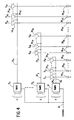
- the controlled LED groups K, L, M and N are placed in a single row in an end to end orientation as shown in FIG. 3a.
- the average exposure by group L is matched, or at least not greatly different from, the average exposure by the adjacent groups K and M, etc.
- the groups may be interleaved as shown in FIG. 3b or FIG. 3c.
- Each group extends a greater length along the printhead, but the average exposure by each group need not be as closely matched to adjacent groups to avoid exposure difference to which the human eye is sensitive.
- each group of LEDs it is not always preferable to make the average light output of each group of LEDs equivalent. For example, it may be desirable to introduce noise to the LED output at a spatial frequency to which the eye is less sensitive or to mask noise for which the eye is more sensitive. It is apparent that the above described invention will allow the light output of each group of eight LEDs to be individually manipulated to produce this result.
- circuits described can be modified to use either p- or n-channel FETs, MOSFETs, or bipolar transistors to accomplish the same purposes. Further, the circuits may be implemented discretely or on integrated chips. It is therefore intended that the above description shall be read as illustrative and not as limited to the preferred embodiments as described herein.
Landscapes
- Physics & Mathematics (AREA)
- Engineering & Computer Science (AREA)
- Optics & Photonics (AREA)
- General Engineering & Computer Science (AREA)
- General Physics & Mathematics (AREA)
- Theoretical Computer Science (AREA)
- Printers Or Recording Devices Using Electromagnetic And Radiation Means (AREA)
- Dot-Matrix Printers And Others (AREA)
Applications Claiming Priority (2)
| Application Number | Priority Date | Filing Date | Title |
|---|---|---|---|
| US41015089A | 1989-09-20 | 1989-09-20 | |
| US410150 | 1989-09-20 |
Publications (2)
| Publication Number | Publication Date |
|---|---|
| EP0419255A2 true EP0419255A2 (fr) | 1991-03-27 |
| EP0419255A3 EP0419255A3 (en) | 1993-02-17 |
Family
ID=23623442
Family Applications (1)
| Application Number | Title | Priority Date | Filing Date |
|---|---|---|---|
| EP19900310293 Withdrawn EP0419255A3 (en) | 1989-09-20 | 1990-09-20 | Method and apparatus for controlling apparent uniformity of led printheads |
Country Status (2)
| Country | Link |
|---|---|
| EP (1) | EP0419255A3 (fr) |
| JP (1) | JPH03118168A (fr) |
Cited By (6)
| Publication number | Priority date | Publication date | Assignee | Title |
|---|---|---|---|---|
| EP0544360A3 (en) * | 1991-11-25 | 1993-12-22 | Philips Nv | Reference current loop |
| EP1123808A4 (fr) * | 1999-08-24 | 2002-04-03 | Nippon Sheet Glass Co Ltd | Dispositif electroluminescent a auto-balayage |
| US6496973B1 (en) | 1999-09-06 | 2002-12-17 | Nippon Sheet Glass Co., Ltd. | Method for designing mask pattern of a self scanning light emitting device |
| US7489310B2 (en) | 2001-08-02 | 2009-02-10 | Seiko Epson Corporation | Supply of a programming current to a pixel |
| US7561147B2 (en) | 2003-05-07 | 2009-07-14 | Toshiba Matsushita Display Technology Co., Ltd. | Current output type of semiconductor circuit, source driver for display drive, display device, and current output method |
| US7817149B2 (en) | 2002-04-26 | 2010-10-19 | Toshiba Matsushita Display Technology Co., Ltd. | Semiconductor circuits for driving current-driven display and display |
Families Citing this family (15)
| Publication number | Priority date | Publication date | Assignee | Title |
|---|---|---|---|---|
| US6859193B1 (en) * | 1999-07-14 | 2005-02-22 | Sony Corporation | Current drive circuit and display device using the same, pixel circuit, and drive method |
| JP2003233347A (ja) * | 2001-08-02 | 2003-08-22 | Seiko Epson Corp | 画素へのプログラミング電流の供給 |
| CN1559064A (zh) * | 2001-09-25 | 2004-12-29 | ���µ�����ҵ��ʽ���� | El显示面板和使用它的el显示装置 |
| JP4630884B2 (ja) * | 2002-04-26 | 2011-02-09 | 東芝モバイルディスプレイ株式会社 | El表示装置の駆動方法、およびel表示装置 |
| JP2007226258A (ja) * | 2002-04-26 | 2007-09-06 | Toshiba Matsushita Display Technology Co Ltd | El表示パネルのドライバ回路 |
| JP4653775B2 (ja) * | 2002-04-26 | 2011-03-16 | 東芝モバイルディスプレイ株式会社 | El表示装置の検査方法 |
| US20050180083A1 (en) * | 2002-04-26 | 2005-08-18 | Toshiba Matsushita Display Technology Co., Ltd. | Drive circuit for el display panel |
| JP4266149B2 (ja) * | 2002-10-07 | 2009-05-20 | ローム株式会社 | 有機el駆動回路およびこれを用いる有機el表示装置 |
| JP3881645B2 (ja) * | 2002-10-08 | 2007-02-14 | ローム株式会社 | 有機el駆動回路およびこれを用いる有機el表示装置 |
| JP4241144B2 (ja) * | 2002-10-31 | 2009-03-18 | カシオ計算機株式会社 | 駆動制御装置及びその制御方法並びに駆動制御装置を備えた表示装置 |
| JP2004334124A (ja) * | 2003-05-12 | 2004-11-25 | Matsushita Electric Ind Co Ltd | 電流駆動装置及び表示装置 |
| JP4232193B2 (ja) * | 2003-05-26 | 2009-03-04 | カシオ計算機株式会社 | 電流生成供給回路及び電流生成供給回路を備えた表示装置 |
| JP4304585B2 (ja) * | 2003-06-30 | 2009-07-29 | カシオ計算機株式会社 | 電流生成供給回路及びその制御方法並びに該電流生成供給回路を備えた表示装置 |
| JP4501839B2 (ja) * | 2005-01-17 | 2010-07-14 | セイコーエプソン株式会社 | 電気光学装置、駆動回路及び電子機器 |
| JP4941426B2 (ja) * | 2008-07-24 | 2012-05-30 | カシオ計算機株式会社 | 表示装置 |
Family Cites Families (4)
| Publication number | Priority date | Publication date | Assignee | Title |
|---|---|---|---|---|
| JPH0785937B2 (ja) * | 1986-09-12 | 1995-09-20 | 三菱電機株式会社 | ドライバic及び記録ヘッド |
| JP2816147B2 (ja) * | 1987-03-27 | 1998-10-27 | 株式会社日立製作所 | 発光ダイオードアレイ用駆動回路 |
| GB8722944D0 (en) * | 1987-09-30 | 1987-11-04 | Plessey Co Plc | Calibration system for led array |
| US4864216A (en) * | 1989-01-19 | 1989-09-05 | Hewlett-Packard Company | Light emitting diode array current power supply |
-
1990
- 1990-09-20 JP JP2254013A patent/JPH03118168A/ja active Pending
- 1990-09-20 EP EP19900310293 patent/EP0419255A3/en not_active Withdrawn
Cited By (7)
| Publication number | Priority date | Publication date | Assignee | Title |
|---|---|---|---|---|
| EP0544360A3 (en) * | 1991-11-25 | 1993-12-22 | Philips Nv | Reference current loop |
| EP1123808A4 (fr) * | 1999-08-24 | 2002-04-03 | Nippon Sheet Glass Co Ltd | Dispositif electroluminescent a auto-balayage |
| US6531826B1 (en) | 1999-08-24 | 2003-03-11 | Nippon Sheet Glass Co., Ltd. | Self-scanning light-emitting device |
| US6496973B1 (en) | 1999-09-06 | 2002-12-17 | Nippon Sheet Glass Co., Ltd. | Method for designing mask pattern of a self scanning light emitting device |
| US7489310B2 (en) | 2001-08-02 | 2009-02-10 | Seiko Epson Corporation | Supply of a programming current to a pixel |
| US7817149B2 (en) | 2002-04-26 | 2010-10-19 | Toshiba Matsushita Display Technology Co., Ltd. | Semiconductor circuits for driving current-driven display and display |
| US7561147B2 (en) | 2003-05-07 | 2009-07-14 | Toshiba Matsushita Display Technology Co., Ltd. | Current output type of semiconductor circuit, source driver for display drive, display device, and current output method |
Also Published As
| Publication number | Publication date |
|---|---|
| EP0419255A3 (en) | 1993-02-17 |
| JPH03118168A (ja) | 1991-05-20 |
Similar Documents
| Publication | Publication Date | Title |
|---|---|---|
| EP0419255A2 (fr) | Procédé et dispositif pour contrôler l'uniformité apparante de têtes d'impression | |
| US4864216A (en) | Light emitting diode array current power supply | |
| US4952949A (en) | LED printhead temperature compensation | |
| US5126759A (en) | Non-impact printer with token bit control of data and current regulation signals | |
| EP0401359B1 (fr) | Imprimante sans impact a circuit d'attaque de courant a miroir | |
| EP0480650B1 (fr) | Alimentation en courant pour rangée de diodes à électroluminescence | |
| EP0936509B1 (fr) | Circuit de commande et tête à LED avec temps constant de mise en circuit | |
| US4982203A (en) | Method and apparatus for improving the uniformity of an LED printhead | |
| US5815025A (en) | Intensity controlling circuit device for LED-array head having a plurality of LED-array chips | |
| US5859658A (en) | LED printbar aging compensation using I-V slope characteristics | |
| WO1992000196A1 (fr) | Imprimante a reseau de del | |
| WO1992000196A9 (fr) | Imprimante a reseau de del | |
| US5264868A (en) | Non-impact printer apparatus with improved current mirror driver | |
| US5166702A (en) | LED printhead with improved current mirror driver and driver chip therefor | |
| EP0487720B1 (fr) | Imprimante sans impact pour l'enregistrement d'images en couleurs | |
| US4998119A (en) | Multiplexed light emitting diode printhead | |
| US6717604B2 (en) | Array driving circuit with control voltage adjusted at both ends, and array head using same | |
| EP0663760A1 (fr) | Imprimante digitale LED avec flux de données et contrôle amélioré | |
| EP0308492B1 (fr) | Appareil d'impression | |
| US6169566B1 (en) | Non-impact printer | |
| US20110001520A1 (en) | Driver circuit and image forming apparatus | |
| JP2001315379A (ja) | 画像形成装置 | |
| US6351278B1 (en) | Circuit for controlling current for driving printing dot array | |
| JP3318124B2 (ja) | 電流駆動型素子の駆動回路及びそれを用いた装置 | |
| JPH06297769A (ja) | Ledプリントヘッド |
Legal Events
| Date | Code | Title | Description |
|---|---|---|---|
| PUAI | Public reference made under article 153(3) epc to a published international application that has entered the european phase |
Free format text: ORIGINAL CODE: 0009012 |
|
| AK | Designated contracting states |
Kind code of ref document: A2 Designated state(s): DE FR GB |
|
| PUAL | Search report despatched |
Free format text: ORIGINAL CODE: 0009013 |
|
| AK | Designated contracting states |
Kind code of ref document: A3 Designated state(s): DE FR GB |
|
| 17P | Request for examination filed |
Effective date: 19930726 |
|
| STAA | Information on the status of an ep patent application or granted ep patent |
Free format text: STATUS: THE APPLICATION HAS BEEN WITHDRAWN |
|
| 18W | Application withdrawn |
Withdrawal date: 19930819 |