EP0419634B1 - Monitoring meat quality - Google Patents
Monitoring meat quality Download PDFInfo
- Publication number
- EP0419634B1 EP0419634B1 EP90906270A EP90906270A EP0419634B1 EP 0419634 B1 EP0419634 B1 EP 0419634B1 EP 90906270 A EP90906270 A EP 90906270A EP 90906270 A EP90906270 A EP 90906270A EP 0419634 B1 EP0419634 B1 EP 0419634B1
- Authority
- EP
- European Patent Office
- Prior art keywords
- carcass
- rigor
- degree
- carrier
- rail
- Prior art date
- Legal status (The legal status is an assumption and is not a legal conclusion. Google has not performed a legal analysis and makes no representation as to the accuracy of the status listed.)
- Expired - Lifetime
Links
- 238000012544 monitoring process Methods 0.000 title claims description 5
- 235000013372 meat Nutrition 0.000 title description 4
- 230000010355 oscillation Effects 0.000 claims abstract description 35
- 238000012545 processing Methods 0.000 claims abstract description 28
- 230000035939 shock Effects 0.000 claims abstract description 8
- 230000003111 delayed effect Effects 0.000 claims abstract 2
- 238000000034 method Methods 0.000 claims description 30
- 230000000638 stimulation Effects 0.000 claims description 6
- 230000001419 dependent effect Effects 0.000 claims description 5
- 239000010868 animal carcass Substances 0.000 abstract 1
- 206010008531 Chills Diseases 0.000 description 48
- 210000003205 muscle Anatomy 0.000 description 11
- 238000011161 development Methods 0.000 description 7
- 238000013016 damping Methods 0.000 description 6
- 241000282887 Suidae Species 0.000 description 5
- 230000000694 effects Effects 0.000 description 5
- 244000144977 poultry Species 0.000 description 5
- 238000003307 slaughter Methods 0.000 description 5
- 241001465754 Metazoa Species 0.000 description 4
- 230000000740 bleeding effect Effects 0.000 description 4
- 239000000969 carrier Substances 0.000 description 4
- 238000004904 shortening Methods 0.000 description 4
- 241000287828 Gallus gallus Species 0.000 description 3
- 238000001816 cooling Methods 0.000 description 3
- 238000005259 measurement Methods 0.000 description 3
- 238000010586 diagram Methods 0.000 description 2
- 238000003780 insertion Methods 0.000 description 2
- 230000037431 insertion Effects 0.000 description 2
- 238000002360 preparation method Methods 0.000 description 2
- 241000191985 Anas superciliosa Species 0.000 description 1
- 241000283690 Bos taurus Species 0.000 description 1
- 241000286209 Phasianidae Species 0.000 description 1
- 210000001361 achilles tendon Anatomy 0.000 description 1
- 238000004458 analytical method Methods 0.000 description 1
- 230000015556 catabolic process Effects 0.000 description 1
- 238000006731 degradation reaction Methods 0.000 description 1
- 238000001914 filtration Methods 0.000 description 1
- 230000002068 genetic effect Effects 0.000 description 1
- 244000144980 herd Species 0.000 description 1
- 238000001139 pH measurement Methods 0.000 description 1
- 238000012856 packing Methods 0.000 description 1
- 238000003825 pressing Methods 0.000 description 1
- 238000010583 slow cooling Methods 0.000 description 1
- 241000894007 species Species 0.000 description 1
- 238000013020 steam cleaning Methods 0.000 description 1
- 238000003860 storage Methods 0.000 description 1
- 210000001364 upper extremity Anatomy 0.000 description 1
- 230000004580 weight loss Effects 0.000 description 1
Images
Classifications
-
- A—HUMAN NECESSITIES
- A22—BUTCHERING; MEAT TREATMENT; PROCESSING POULTRY OR FISH
- A22B—SLAUGHTERING
- A22B5/00—Accessories for use during or after slaughtering
- A22B5/0064—Accessories for use during or after slaughtering for classifying or grading carcasses; for measuring back fat
-
- G—PHYSICS
- G01—MEASURING; TESTING
- G01N—INVESTIGATING OR ANALYSING MATERIALS BY DETERMINING THEIR CHEMICAL OR PHYSICAL PROPERTIES
- G01N33/00—Investigating or analysing materials by specific methods not covered by groups G01N1/00 - G01N31/00
- G01N33/02—Food
- G01N33/12—Meat; Fish
Definitions
- the present invention relates to the monitoring of the quality of meat, and more specifically of animal and bird carcasses during processing shortly after slaughter.
- each chicken carcass undergoes an appreciable amount of processing.
- the bird is first stunned, then killed, and the carcass then undergoes a bleeding period. It is then scalded and passed from the scalding process to a plucking device. From that, it is passed on to further processing, such as chilling, removal of head and feet, removal of giblets, etc.
- further processing such as chilling, removal of head and feet, removal of giblets, etc.
- Cold shortening can be alleviated by slow cooling or by electrical stimulation of the carcass soon after stunning. Hot shortening can be alleviated by advancing the time of cooling.
- these measures can only be employed satisfactorily if a suitable technique for measuring rigor is available. In the absence of such a technique, a compromise processing procedure has to be employed, the timing of which is matched to average or typical carcasses. As a result, the quality of carcasses which go into rigor either faster or more slowly than the average will be poor.
- One technique involves excising a muscle and measuring its extensibility; this is clearly suitable only for laboratory purposes. If a balloon is inserted into a suitable muscle of the carcass, its resistance to inflation is dependent on the degree of rigor of the muscle. The resilience of the carcass can be measured by placing a spring-loaded penetrometer on a suitable location on the carcass. These procedures however obviously require skilled operators and are hence costly and time-consuming. With some carcasses, e.g. pigs, the configuration of the carcass (in particular, the angle of the front legs) changes with the onset of rigor. Measurement of this is however difficult, and this technique is not suitable for poultry.
- the degree to which the configuration changes if the carcass is rehung also depends on the degree of rigor, but this involves major manipulation of the carcasses, the measurement of the change is difficult, and the technique is not applicable to poultry.
- the primary object of the present invention is therefore to provide a cheap and rapid technique of measuring the development of rigor in animal and bird carcasses.
- the present invention provides a method of measuring the degree of rigor in a carcass, characterized by subjecting the carcass to a mechanical shock and measuring the response of the carcass.
- the shock preferably consists of allowing the carcass to fall through a short distance, and the response is preferably measured by monitoring the variation with time of the force exerted by the carcass on the support means which arrest its fall.
- the particular feature of the response which is monitored may for example be the time of fall, the amplitude of oscillation after the carcass has been arrested by the support means, the frequency of that oscillation, the rate at which that oscillation is damped, or some combination of those features.
- the function by which the degree of rigor is determined may include the mass of the carcass.
- the invention also provides a method of preparing a carcass in which its degree of rigor is so measured and its subsequent treatment is dependent on its degree of rigor.
- the degree of rigor may for example adjust the delay in processing, or electrical stimulation of the carcass.
- the invention provides apparatus for determining the condition of a carcass, comprising a carrier for carrying the carcass, a rail along which the carrier is movable and means for providing a step in the path of movement of the carrier along the rail, characterised by means for measuring the force exerted by the carrier on the rail resulting from the carrier's drop over the step.
- the step may be formed by two fixed portions of rail at different heights, or by a tiltable element in the rail which is held against rotation under the weight of the carriage as the carriage passes along it from one end, and is then released as the carrier nears the other end to allow the carriage to drop.
- the tiltable element may be controlled by a pneumatic actuator which is in turn controlled by sensors which sense the passage of the carrier past the one end and nearing the other end.
- the apparatus preferably includes computing means for analysing the measured force on the rail, to determine the time of fall, the amplitude of oscillation after the carcass has been arrested by the support means, the frequency of that oscillation, the rate at which that oscillation is damped, or some combination of those features.
- the computing means may adjust the criteria used to estimate the degree of rigor according to the weight of the carcass.
- the computing means may be special-purpose processing circuitry, a suitably programmed general-purpose computer, or a combination of both.
- the invention also provides apparatus for processing a carcass, comprising apparatus as previously described for determining the degree of rigor of the carcass, and means for controlling the subsequent processing of the carcass in dependence on its degree of rigor.
- the subsequent processing may involve controllably delaying the passage of the carcass to subsequent processing, or controllably applying electrical stimulation to the carcass.
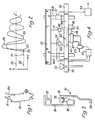
- Fig. 1 shows a pig carcass in its normal suspended position after slaughter.
- the carcass is hung by the Achilles tendons, and the hind legs 11 are therefore pulled from their natural position of roughly at right angles to the body 10 into the position shown, roughly in line with the body.
- the primary frequency of the oscillation will be due mainly to the weight of the bulk of the body and the spring effect of the muscles in the hind legs and, to a lesser extent, the hind quarters of the body; and the decay of the oscillation will be due primarily to the damping effect of the stretching and return of the muscles in the hind legs and hind quarters.
- the carcass will behave more as a single rigid body. When it is released, its rigor (and in particular the rigor of the muscles of the hind legs) will hold the hind legs substantially in the position 11 even though the tension on them is released. When the support carrying the carcase reaches the end of the fall distance, the body 10 will immediately be decelerated. The carcass will then oscillate up and down. The primary frequency of the oscillation will be higher than for a carcass without rigor, because the muscles will have a higher resistance to stretching; and the decay of the oscillation will be slower, because the muscles respond more elastically.
- Fig. 2 shows two idealized graphs of the response, with the force N on the support plotted against time t.
- the initial part 20 of the graphs shows the situation before release of the carcass; this represents the weight of the carcasses.
- the carcasses are released and allowed to fall freely through a fixed distance (a suitable distance is of the order of 50 mm).
- the graphs therefore drop sharply to the level 22, which represents zero force (i.e. free fall).
- the free fall ends at an earlier point 23, which is followed by an oscillation 24. Oscillations have been recorded for up to 5 s but typically last for less than 1 s.
- the oscillation 24 for the carcass without rigor is of a lower frequency (typically around 7 Hz for a pig carcass) than that (typically around 15 Hz) for oscillation 26 for the carcass with rigor.
- the damping of the oscillation 24 is higher than for the oscillation 26. (The damping is normally measured per cycle; the higher frequency of the oscillation 26, with lower damping, means that the envelopes of the two oscillations 24 and 26 are not markedly different.)
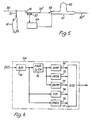
- Fig. 5 is a general view of typical slaughterhouse transport apparatus.
- Carcasses 10 are carried on carriers 31 which run along a rail 30 to carry them through various stages of processing.
- a step or drop 15 is provided in the rail, and a sensor 37 senses the force on the rail which is transmitted thereto via the carrier 31 from the carcass 10 as it goes over the drop 15.
- the sensor feeds signal processing circuitry 54 which determines the degree of rigor in the carcass by monitoring the variation with time of the force exerted by the carcass on the rail 30 as it drops down the step or drop 15.
- a diverting section may be provided in the rail 30 between the sections 30' and 30", comprising a switch 60 and two parallel sections 61 and 62 of different lengths.
- the time of travel of the carcass 10 along the track depends on the setting of the switch 60, which is controlled by the circuitry 54.
- Fig. 3 is an endwise sectional view of typical slaughterhouse transport apparatus.
- the rail 30 is a tubular rail which supports a series of carcass carriers 31 which can be moved along it. (The carriers are usually moved along the rail by means of a continuously driven chain arrangement (not shown) above the rail, with which the carriers engage.)
- Each carrier has a housing 32 containing a wheel 33 at its upper end, and a hook 34 at its lower end from which the carcass is hung.
- the rail 30 is supported from a beam 35 by means of C-shaped brackets 36 located at suitable intervals along the rail; the brackets may be welded to the rail 30 and bolted to the beam 35.
- Fig. 4 is a simplified and diagrammatic side view of a section of the rail 30 incorporating means for subjecting a carcass on a carrier 31 to a mechanical shock and measuring the response.
- the rail 30 includes a separate section 30A which is isolated from the rest of the rail, and is supported by two brackets 36A and 36B; the right-hand bracket 36B incorporates a strain gauge 37 which senses the weight supported by that bracket.
- the rail section 30A has a longitudinal slot cut along its top, and a tiltable plate 41 is pivoted at 42 inside the slot as shown.
- the plate 41 has a hump 43 on its top surface to the left of the pivot 42 and a cusp 44 at its right-hand end, and a toe 45 projecting downwards through a hole in the bottom of the rail 30A as shown.
- a stop 46 is attached underneath the rail 30A adjacent to the hole through which the toe 45 projects, and a pneumatic actuator 47 is attached underneath the rail 30A so that its armature 48 will be interposed between the toe 45 and the stop 46 in the extended position.
- Two sensors 50 and 51 connected to a control unit 52, are mounted below the beam 35 at positions where they sense the passage of a carrier 31 on the hump 43 and at the cusp 44 respectively of the plate 41.
- the operation is as follows.
- a carrier 31 As a carrier 31 is moved along the rail 30, from left to right, it passes onto the rail section 30A, and then runs onto the left-hand end of the plate 41. It then runs onto the hump 43, so pressing the left-hand end of the plate 41 downwards and raising its right-hand end.
- the carrier is sensed by sensor 50 at this point, and control unit 52 causes a pneumatic control unit 53 to operate the actuator 47 to extend its armature 48 to lie between the toe 45 and the bracket 46, so locking the plate 41 in the raised position.
- the carrier 31 As the carrier 31 is moved onwards, it runs up the plate 41 to reach the cusp 44, which briefly halts its progression.
- the carrier is sensed by sensor 51 at this point, and control unit 52 causes a pneumatic control unit 53 to operate the actuator 47 to withdraw its armature 48 from between the toe 45 and the bracket 46.
- the plate 41 is thereby released, and drops back to its original position, the carrier 31 dropping with it.
- a carcass hung from the carrier 31 will thereby drop and exert a varying force on the rail 30A, as discussed above, when its drop from the raised end of plate 41 ends as the carrier reaches the main body of the rail 30A. This force is sensed by the strain gauge 37.
- the strain gauge 37 feeds the signal analyser unit 54, which analyses the resulting oscillation to determine the time of fall, the amplitude of the ensuing oscillation, the frequency of oscillation, the rate at which the oscillation is damped, or some combination of those features. From these factors, a measure of the extent to which rigor has developed in the carcass is calculated. The weight of the carcass can also be determined, and used to adjust the calculation.
- the signal from the strain gauge 37 is likely to contain noise from various sources, such as high frequencies from higher mode oscillations of the carcass and low frequencies from pendulum oscillations of the carcass.
- the analyser unit therefore preferably includes means for frequency filtering, e.g. by taking Fourier transforms.
- the analyser unit 54 may be special-purpose processing circuitry, a suitably programmed general-purpose computer, or a combination of both.
- Fig. 6 is a block diagram of the main functional components of a generalized form of the circuit 54.
- the signal from the sensor 37 is converted to digital form by an analog-to-digital converter 70, and fed to five discriminator units 71 to 75 - an amplitude discriminator 71, a frequency discriminator 72, a damping discriminator 73, a timing discriminator 74, and a mass discriminator 75.
- These five units fed a combining circuit 77 which determines the rigor of the carcass in dependence on the amplitude, frequency, damping, and timing of the signal from the sensor 37 and the mass of the carcass (the mass being determined by the DC level of the signal after the drop).
- the units 71 to 73 are preferably fed from the converter 70 via a Fourier transform circuit 76.
- the rigor may be determined as either a set of discrete values (of only 2 possible values in the extreme) or a continuously variable value.
- a time delay could be used instead of the sensor 51 to determine the moment of release and drop of the plate 41 after the carrier 31 has passed the sensor 50.
- the sensors 50 and 51, the actuator 47, and any ancillary components must be chosen to withstand the conditions encountered in abattoirs, in particular the use of steam cleaning, and to comply with the usual hygiene requirements.
- the actuator 47 is preferably a double-acting one, in which the extension and retraction of the armature 48 are both positively driven.
- a spring-operated extension could be used, since there is no substantial load on the actuator when the toe 45 of the plate 41 is raised.
- the usual sequence of processing stages consists of stunning, killing, bleeding, scalding, plucking, followed by various stages of butchering, chilling, and packing.
- the present apparatus can be located at a variety of points in this processing, e.g. during bleeding, between bleeding and scalding, between scalding and plucking (a position which we believe to be particularly suitable), or after plucking. It will be noted that the development of rigor can be determined before plucking.
- the present apparatus provides an indication of the degree of development of rigor of each carcass, and this indication can usefully be used to control the subsequent processing of the carcass. For example, carcasses in which rigor is developing relatively slowly can be shunted onto longer tracks so that all carcasses have reached substantially the same degree of rigor by the time they reach the chilling stage, or electrical stimulation can be applied to the carcasses with the degree of stimulation being inversely proportional to the rate of development of rigor.
Landscapes
- Life Sciences & Earth Sciences (AREA)
- Engineering & Computer Science (AREA)
- Food Science & Technology (AREA)
- Health & Medical Sciences (AREA)
- Chemical & Material Sciences (AREA)
- Biochemistry (AREA)
- Physics & Mathematics (AREA)
- Analytical Chemistry (AREA)
- Medicinal Chemistry (AREA)
- General Health & Medical Sciences (AREA)
- General Physics & Mathematics (AREA)
- Immunology (AREA)
- Pathology (AREA)
- Biophysics (AREA)
- Processing Of Meat And Fish (AREA)
- Geophysics And Detection Of Objects (AREA)
- Investigating Or Analyzing Materials By The Use Of Ultrasonic Waves (AREA)
- Machines For Laying And Maintaining Railways (AREA)
Applications Claiming Priority (2)
| Application Number | Priority Date | Filing Date | Title |
|---|---|---|---|
| GB8908720 | 1989-04-18 | ||
| GB898908720A GB8908720D0 (en) | 1989-04-18 | 1989-04-18 | Monitoring meat quality |
Publications (2)
| Publication Number | Publication Date |
|---|---|
| EP0419634A1 EP0419634A1 (en) | 1991-04-03 |
| EP0419634B1 true EP0419634B1 (en) | 1994-01-05 |
Family
ID=10655214
Family Applications (1)
| Application Number | Title | Priority Date | Filing Date |
|---|---|---|---|
| EP90906270A Expired - Lifetime EP0419634B1 (en) | 1989-04-18 | 1990-04-18 | Monitoring meat quality |
Country Status (8)
| Country | Link |
|---|---|
| US (1) | US5104352A (da) |
| EP (1) | EP0419634B1 (da) |
| CA (1) | CA2014636A1 (da) |
| DE (1) | DE69005762T2 (da) |
| DK (1) | DK0419634T3 (da) |
| ES (1) | ES2049473T3 (da) |
| GB (2) | GB8908720D0 (da) |
| WO (1) | WO1990012507A1 (da) |
Cited By (1)
| Publication number | Priority date | Publication date | Assignee | Title |
|---|---|---|---|---|
| CN104041564A (zh) * | 2014-05-23 | 2014-09-17 | 安徽荷金来农业发展股份有限公司 | 一种肉牛屠宰加工工艺 |
Families Citing this family (7)
| Publication number | Priority date | Publication date | Assignee | Title |
|---|---|---|---|---|
| US5478990A (en) * | 1993-10-14 | 1995-12-26 | Coleman Environmental Systems, Inc. | Method for tracking the production history of food products |
| US5439694A (en) * | 1994-07-11 | 1995-08-08 | Morris & Associates, Inc. | Poultry preparation process and apparatus |
| DE10110360B4 (de) * | 2001-02-27 | 2004-11-18 | Horst Eger | Verfahren zur Steuerung des Verarbeitungsablaufs in einer Schlacht- und Verarbeitungslinie |
| AUPR511101A0 (en) | 2001-05-21 | 2001-06-14 | Meat & Livestock Australia Limited | Electrical treatment of carcases |
| US7226349B2 (en) * | 2003-09-09 | 2007-06-05 | Allan Todd Berry | Process to electronically automate the sorting of chicken feet in the category of edible or inedible |
| US7771255B2 (en) * | 2004-06-25 | 2010-08-10 | Cattaruzzi International S.R.L. | Plant and method for the stunning and killing of animals for slaughter through asphyxiation |
| US7662030B2 (en) * | 2007-11-05 | 2010-02-16 | Hollis Cheek | Method for humanely stunning and slaughtering poultry using controlled low atmospheric pressure |
Family Cites Families (7)
| Publication number | Priority date | Publication date | Assignee | Title |
|---|---|---|---|---|
| US3593572A (en) * | 1968-02-15 | 1971-07-20 | Armour & Co | Measuring the tenderness of meat |
| US3956924A (en) * | 1968-11-25 | 1976-05-18 | Armour And Company | System and method for measuring meat tenderness |
| US3872716A (en) * | 1970-05-15 | 1975-03-25 | Armour & Co | Measuring the tenderness of meat |
| US3736622A (en) * | 1970-06-18 | 1973-06-05 | Itt | Method and apparatus for slaughtering animals |
| US3732727A (en) * | 1971-12-07 | 1973-05-15 | Us Army | Method and apparatus for testing the tenderness of meat |
| GB1579330A (en) * | 1976-04-23 | 1980-11-19 | Auto Systems Ltd | Sensing device |
| SU745808A1 (ru) * | 1978-01-18 | 1980-07-07 | Центральный научно-исследовательский институт оловянной промышленности | Вибрационное транспортирующее устройство |
-
1989
- 1989-04-18 GB GB898908720A patent/GB8908720D0/en active Pending
-
1990
- 1990-04-17 CA CA002014636A patent/CA2014636A1/en not_active Abandoned
- 1990-04-18 DE DE90906270T patent/DE69005762T2/de not_active Expired - Fee Related
- 1990-04-18 WO PCT/GB1990/000586 patent/WO1990012507A1/en not_active Ceased
- 1990-04-18 EP EP90906270A patent/EP0419634B1/en not_active Expired - Lifetime
- 1990-04-18 US US07/623,445 patent/US5104352A/en not_active Expired - Fee Related
- 1990-04-18 ES ES90906270T patent/ES2049473T3/es not_active Expired - Lifetime
- 1990-04-18 DK DK90906270.5T patent/DK0419634T3/da active
- 1990-12-03 GB GB9026226A patent/GB2238877B/en not_active Expired - Fee Related
Non-Patent Citations (1)
| Title |
|---|
| Soviet Inventions Illustrated, week D36, 14.10.81. Derwent Publications Ltd., London GB, No. 65562 D/36 D12 S03 * |
Cited By (1)
| Publication number | Priority date | Publication date | Assignee | Title |
|---|---|---|---|---|
| CN104041564A (zh) * | 2014-05-23 | 2014-09-17 | 安徽荷金来农业发展股份有限公司 | 一种肉牛屠宰加工工艺 |
Also Published As
| Publication number | Publication date |
|---|---|
| GB2238877B (en) | 1993-07-21 |
| GB9026226D0 (en) | 1991-01-23 |
| CA2014636A1 (en) | 1990-10-18 |
| WO1990012507A1 (en) | 1990-11-01 |
| GB2238877A (en) | 1991-06-12 |
| US5104352A (en) | 1992-04-14 |
| ES2049473T3 (es) | 1994-04-16 |
| DE69005762D1 (de) | 1994-02-17 |
| GB8908720D0 (en) | 1989-06-07 |
| EP0419634A1 (en) | 1991-04-03 |
| DE69005762T2 (de) | 1994-04-28 |
| DK0419634T3 (da) | 1994-01-31 |
Similar Documents
| Publication | Publication Date | Title |
|---|---|---|
| NL1018566C2 (nl) | Werkwijze voor het verwerken van gevogelte. | |
| US5888132A (en) | Post kill tenderization of poultry meat through constant electrical stimulation | |
| Bouton et al. | Effect of low voltage stimulation of beef carcasses on muscle tenderness and pH | |
| EP0419634B1 (en) | Monitoring meat quality | |
| Bouton et al. | Electrical stimulation of beef sides | |
| Alvarado et al. | Rigor mortis development in turkey breast muscle and the effect of electrical stunning | |
| US6338673B2 (en) | Electrical animal stun/kill apparatus | |
| US5512014A (en) | Tenderizing poultry meat through electrical stimulation | |
| Papinaho et al. | Effect of electrical stunning amperage and peri-mortem struggle on broiler breast rigor development and meat quality | |
| US4221021A (en) | Method and apparatus for electrical stimulation of an animal carcass | |
| Contreras et al. | Electrical stunning, hot boning, and quality of chicken breast meat | |
| Giger et al. | Equipment for low-stress, small animal slaughter | |
| NL8004689A (nl) | Werkwijze voor het door middel van een elektrische stroom beinvloeden van de kwaliteit, in het bijzonder de malsheid, van vlees van slachtdieren. | |
| US4340993A (en) | Electrical stimulation bar for an animal carcass | |
| Wilkins et al. | Constant current stunning effects on bird welfare and carcass quality | |
| Chrystall et al. | Low voltage electrical stimulation of lamb: its effect on muscle pH and tenderness | |
| Cavitt et al. | Evaluation of physical dimension changes as nondestructive measurements for monitoring rigor mortis development in broiler muscles | |
| US3736622A (en) | Method and apparatus for slaughtering animals | |
| Lyon et al. | Effects of electric treatments and wing restraints on the rate of post-mortem biochemical changes and objective texture of broiler pectoralis major muscles deboned after chilling | |
| KR20170116583A (ko) | 도축된 가금류의 처리 방법 및 처리 장치 | |
| Papinaho et al. | Effects of electrical stunning duration on postmortem rigor development and broiler breast meat tenderness | |
| US3499184A (en) | Neck dehydrating apparatus for poultry | |
| Gregory et al. | Sheep slaughtering procedures. I. Survey of abattoir practice | |
| Zocchi et al. | Tenderness of broiler breast fillets from carcasses treated with electrical stimulation and extended chilling times | |
| Chrystall et al. | Electrical stimulation of deer carcasses |
Legal Events
| Date | Code | Title | Description |
|---|---|---|---|
| PUAI | Public reference made under article 153(3) epc to a published international application that has entered the european phase |
Free format text: ORIGINAL CODE: 0009012 |
|
| 17P | Request for examination filed |
Effective date: 19901207 |
|
| AK | Designated contracting states |
Kind code of ref document: A1 Designated state(s): DE DK ES FR GB NL |
|
| RAP1 | Party data changed (applicant data changed or rights of an application transferred) |
Owner name: BRITISH TECHNOLOGY GROUP LTD |
|
| 17Q | First examination report despatched |
Effective date: 19930125 |
|
| GRAA | (expected) grant |
Free format text: ORIGINAL CODE: 0009210 |
|
| AK | Designated contracting states |
Kind code of ref document: B1 Designated state(s): DE DK ES FR NL |
|
| ET | Fr: translation filed | ||
| REG | Reference to a national code |
Ref country code: DK Ref legal event code: T3 |
|
| REF | Corresponds to: |
Ref document number: 69005762 Country of ref document: DE Date of ref document: 19940217 |
|
| REG | Reference to a national code |
Ref country code: ES Ref legal event code: FG2A Ref document number: 2049473 Country of ref document: ES Kind code of ref document: T3 |
|
| PLBE | No opposition filed within time limit |
Free format text: ORIGINAL CODE: 0009261 |
|
| STAA | Information on the status of an ep patent application or granted ep patent |
Free format text: STATUS: NO OPPOSITION FILED WITHIN TIME LIMIT |
|
| 26N | No opposition filed | ||
| PGFP | Annual fee paid to national office [announced via postgrant information from national office to epo] |
Ref country code: ES Payment date: 19970409 Year of fee payment: 8 |
|
| PGFP | Annual fee paid to national office [announced via postgrant information from national office to epo] |
Ref country code: FR Payment date: 19970417 Year of fee payment: 8 |
|
| PGFP | Annual fee paid to national office [announced via postgrant information from national office to epo] |
Ref country code: DK Payment date: 19970418 Year of fee payment: 8 Ref country code: DE Payment date: 19970418 Year of fee payment: 8 |
|
| PGFP | Annual fee paid to national office [announced via postgrant information from national office to epo] |
Ref country code: NL Payment date: 19970423 Year of fee payment: 8 |
|
| PG25 | Lapsed in a contracting state [announced via postgrant information from national office to epo] |
Ref country code: ES Free format text: LAPSE BECAUSE OF EXPIRATION OF PROTECTION Effective date: 19980420 |
|
| PG25 | Lapsed in a contracting state [announced via postgrant information from national office to epo] |
Ref country code: FR Free format text: THE PATENT HAS BEEN ANNULLED BY A DECISION OF A NATIONAL AUTHORITY Effective date: 19980430 Ref country code: DK Free format text: LAPSE BECAUSE OF NON-PAYMENT OF DUE FEES Effective date: 19980430 |
|
| PG25 | Lapsed in a contracting state [announced via postgrant information from national office to epo] |
Ref country code: NL Free format text: LAPSE BECAUSE OF NON-PAYMENT OF DUE FEES Effective date: 19981101 |
|
| NLV4 | Nl: lapsed or anulled due to non-payment of the annual fee |
Effective date: 19981101 |
|
| PG25 | Lapsed in a contracting state [announced via postgrant information from national office to epo] |
Ref country code: DE Free format text: LAPSE BECAUSE OF NON-PAYMENT OF DUE FEES Effective date: 19990202 |
|
| REG | Reference to a national code |
Ref country code: FR Ref legal event code: ST |
|
| REG | Reference to a national code |
Ref country code: DK Ref legal event code: EBP |
|
| REG | Reference to a national code |
Ref country code: ES Ref legal event code: FD2A Effective date: 20000601 |