EP0419736B1 - Appareil pour emballer sous vide des denrées périssables - Google Patents
Appareil pour emballer sous vide des denrées périssables Download PDFInfo
- Publication number
- EP0419736B1 EP0419736B1 EP89309727A EP89309727A EP0419736B1 EP 0419736 B1 EP0419736 B1 EP 0419736B1 EP 89309727 A EP89309727 A EP 89309727A EP 89309727 A EP89309727 A EP 89309727A EP 0419736 B1 EP0419736 B1 EP 0419736B1
- Authority
- EP
- European Patent Office
- Prior art keywords
- cup
- opening
- container
- vacuum
- lid
- Prior art date
- Legal status (The legal status is an assumption and is not a legal conclusion. Google has not performed a legal analysis and makes no representation as to the accuracy of the status listed.)
- Expired - Lifetime
Links
- 235000013305 food Nutrition 0.000 title description 18
- 238000009461 vacuum packaging Methods 0.000 title description 5
- 239000004033 plastic Substances 0.000 claims abstract description 9
- 229920003023 plastic Polymers 0.000 claims abstract description 9
- 238000007789 sealing Methods 0.000 claims description 10
- 239000000463 material Substances 0.000 claims description 4
- 239000004417 polycarbonate Substances 0.000 claims description 2
- 229920000515 polycarbonate Polymers 0.000 claims description 2
- 230000014759 maintenance of location Effects 0.000 claims 3
- 238000000605 extraction Methods 0.000 claims 2
- 230000007774 longterm Effects 0.000 abstract description 2
- 238000005057 refrigeration Methods 0.000 abstract description 2
- 238000004321 preservation Methods 0.000 abstract 1
- 238000000034 method Methods 0.000 description 7
- 239000007787 solid Substances 0.000 description 4
- 240000008415 Lactuca sativa Species 0.000 description 2
- 210000005224 forefinger Anatomy 0.000 description 2
- 239000012858 resilient material Substances 0.000 description 2
- 235000012045 salad Nutrition 0.000 description 2
- 210000003813 thumb Anatomy 0.000 description 2
- 241000251468 Actinopterygii Species 0.000 description 1
- 241000238366 Cephalopoda Species 0.000 description 1
- 206010009696 Clumsiness Diseases 0.000 description 1
- 241000238557 Decapoda Species 0.000 description 1
- 238000013459 approach Methods 0.000 description 1
- 238000010276 construction Methods 0.000 description 1
- 238000013461 design Methods 0.000 description 1
- 239000011521 glass Substances 0.000 description 1
- QSHDDOUJBYECFT-UHFFFAOYSA-N mercury Chemical compound [Hg] QSHDDOUJBYECFT-UHFFFAOYSA-N 0.000 description 1
- 229910052753 mercury Inorganic materials 0.000 description 1
- 239000002184 metal Substances 0.000 description 1
- 229910052751 metal Inorganic materials 0.000 description 1
- 230000000717 retained effect Effects 0.000 description 1
- 235000014102 seafood Nutrition 0.000 description 1
- 238000012360 testing method Methods 0.000 description 1
- 230000001131 transforming effect Effects 0.000 description 1
Images


Classifications
-
- B—PERFORMING OPERATIONS; TRANSPORTING
- B65—CONVEYING; PACKING; STORING; HANDLING THIN OR FILAMENTARY MATERIAL
- B65B—MACHINES, APPARATUS OR DEVICES FOR, OR METHODS OF, PACKAGING ARTICLES OR MATERIALS; UNPACKING
- B65B31/00—Packaging articles or materials under special atmospheric or gaseous conditions; Adding propellants to aerosol containers
- B65B31/04—Evacuating, pressurising or gasifying filled containers or wrappers by means of nozzles through which air or other gas, e.g. an inert gas, is withdrawn or supplied
- B65B31/046—Evacuating, pressurising or gasifying filled containers or wrappers by means of nozzles through which air or other gas, e.g. an inert gas, is withdrawn or supplied the nozzles co-operating, or being combined, with a device for opening or closing the container or wrapper
- B65B31/047—Evacuating, pressurising or gasifying filled containers or wrappers by means of nozzles through which air or other gas, e.g. an inert gas, is withdrawn or supplied the nozzles co-operating, or being combined, with a device for opening or closing the container or wrapper the nozzles co-operating with a check valve in the opening of the container or wrapper
Definitions
- the present invention relates to an apparatus for vacuum packing perishable foods.
- an apparatus for vacuum packing perishable foods In particular, to such an apparatus for use by restaurants, food service industries, and home.
- Vacuum packing is a recognised technique for storing and preserving perishable foods.
- Seafood is very commonly vacuum packed in plastic bags by fish wholesalers, but this method is not practical for restaurants, food service industries, or homes, because the necessary equipment is very expensive and cumbersome. Even in cases when restaurants can afford such machinery, it is commonly considered too time-consuming and costly for them to pack all their perishable foods in such manner.
- plastic storage containers as a means of keeping their perishable foods.
- plastic storage containers have air inside them after the lid is placed on.
- food such as shrimp, squid, crab, and the like, to mention only a few, when stored in such containers, will often spoil within 24 hours, even under refrigeration.
- Zaccard in U.S. Patent 2,654,521 provides an apparatus for evacuating and capping jars.
- the Zaccard device must use jars especially designed to accept covers, which are in turn held in a specially adapted rack, which is manipulated from outside the vacuum chamber.
- the complexity and clumsiness of this design makes it unsuitable for daily or frequent use, and is in fact useful only when substantial quantities of food are to be put in relatively long-term storage.
- vacuum containers wherein the pressure compensation opening is closable by an elastic sealing plate.
- a problem with these constructions is that the plate lifts up and is often displaced with each suction stroke, which is undesirable for such sealing plate valves.
- the problem is alleviated in Swiss Patent CH-A-274829, where the plate is held in place during vacuuming, and a flap valve is provided in the sealing plate, positioned above the pressure compensation opening.
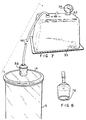
- a flat check valve 48 (Fig. 3) tends to curl up at edge 50 when under constant vacuum, and it is therefore unreliable.
- a plug or solid valve 52 (Fig. 4) requires an extremely smooth surface hole in which to seat. Otherwise, it leaks under high vacuum.
- One object of the present invention is to provide an apparatus for vacuum sealing containers which is both easy and convenient, making it suitable for use in the food service industry, restaurants and home.
- Another object of the invention is to provide an apparatus of vacuum sealing containers of various sizes and shapes, which can also be used for frequent resealing after the initial opening.
- Another object is to provide an 85% vacuum.
- a further object is to provide a fail-safe valve that will not leak under high volume.
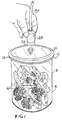
- the present invention provides a method of vacuum sealing a lightweight plastic container 8, Fig. 1, which has an opening 10 defined by a rim 12 and which uses a lid 14 for covering the container opening.
- Container 8 includes an O-ring seal 16 (Fig. 2) corresponding in size and shape to rim 12 and edge 18 of lid 14.
- Lid 14 has a centrally mounted rubber check or cup-valve 28 loosely located in position over hole 20 by a bolt 22, which passes through hole 20 and is retained by locknut 24 which is spaced apart from lower face 26 of lid 14.
- Loose fitting bolt 22 and spaced apart locknut 24 allow cup-valve 28 limited freedom to move sideways and vertically to at least the position shown by phantom lines 30.
- a hand positioned rubber cup 38 (Fig. 1) is attached to vacuum tube 46 and is of sufficient internal diameter to be placed freely over rubber cup-valve 28, or removed therefrom as desired.
- Fig. 2 shows a sectional view of cup 38 in position over cup-valve 28 and in contact with top surface of lid 14.
- vacuum line 46 (Fig. 2) will be partially exhausted. Since line 46 is connected to rubber cup 38, cup 38 will be exhausted also. The vacuum in cup 38 will be maintained by a contact seal between cup opening 29 and top of lid 14. This vacuum will lift cup-valve 28 off its seat 32, whereby cup-valve 28 will rise up slightly to the position shown by phantom lines 30. This raised position of cup-valve 28 permits air from inside container 8 to flow out through hole 20 in lid 14, under valve 28, into space 39 inside cup 38, and thence to outlet pipe 44 and vacuum hose 46. This evacuation of air from inside container 8 causes a reduction of air pressure in container 8 and this, combined with atmospheric air pressure above lid 14, forces lid 14 down against O-ring seal 16, forming an airtight seal with top surface 12 of container 8.
- cup 38 can be removed from its position over cup-valve 28 by squeezing cup 38 sideways with the thumb and forefinger. This will allow air to enter space 39 (Fig. 2) inside cup 38, thereby breaking the vacuum. Cup-valve 28 will immediately seal against top surface of lid 14, due to the difference in air pressure exerted against outer surface of cup-valve and the vacuum inside container 8.
- cup-valve 28 can be squeezed sideways between thumb and forefinger, permitting air to enter container 8, thus allowing lid 14 to be easily removed.
- Resealing can be effected immediately by first replacing lid 14 over container 8, then cup 38 over cup-valve 28, as shown in Fig. 1 and 7, and then switching on vacuum pump 33. As soon as the desired vacuum is reached, cup 38 is removed and sealed and container 8 is returned to the refrigerator.
- cup 38 The speed at which this process can be achieved is a surprising result of the present invention. It is not necessary to physically hold cup 38 in position over cup-valve 28 during the vacuuming process. All that is required is to place the cup in position, and it will immediately be held in place by suction until physically removed. After use, cup 38 can then be used to exhaust another cup-valved container. Thus, it will be seen that many food containers can be exhausted in the space of a very few minutes.
- Cup-valve 28 has proved, under extensive test, to overcome the problems associated with both the flat and solid plug valves of Figs. 3 and 4. It seals consistently under the identical conditions which cause the others to fail.
- cup-valve 28 is made of resilient material, has a hollow interior 56 about 12 mm (1/2 in) in diameter, and is generally dome-shaped inside for rigidity. Cup-valve 28 preferably has an outside diameter of about 18 mm (3/4 in). Stepped portion 60 provides a second but smaller hollow 62, which has a ridge 74.
- Cup 38 (Fig. 6) preferably is made of resilient material and has a hollow interior 78 about 25 mm (1 in) in diameter. This hollow interior is about 18 to 25 mm (3/4 to 1 in) deep, so as to provide room for cup-valve 28 to lift freely from its seat during exhaustion.
- the container of the present invention will maintain a vacuum of 85%, thus increasing the food storage life well above what is possible with the 40% vacuum now prevalent in the vacuum packaging industry.
- the cup-valve of the present invention can be adapted to use in conjunction with a hole which can be drilled in lids of such plastic food pan lids as are currently in use by most restaurants, thus transforming such pans into vacuum food containers.
- the container itself may be formed of glass, metal, plastic or any other suitable material.
- the preferred material is a lightweight plastic such as polycarbonate.
- the rim of the lid has a groove to occupy the rubber O-ring.
- a salad bar as found in some restaurants, could have food containers placed in wells and a vacuum system attached to the lids, which could be brought down over the food containers at the close of each day, thus allowing simultaneous vacuuming of all containers, and thus preserving the salad materials for another day.
Landscapes
- Chemical & Material Sciences (AREA)
- Dispersion Chemistry (AREA)
- Engineering & Computer Science (AREA)
- Mechanical Engineering (AREA)
- Vacuum Packaging (AREA)
- Food Preservation Except Freezing, Refrigeration, And Drying (AREA)
- Packages (AREA)
- Closures For Containers (AREA)
Claims (9)
- Appareil pour étancher sous vide des bacs, des bacs ayant en cela un débouchage, et l'appareil comprenant une soupape de retenue à concourir avec le dit débouchage et un moyen d'extraction d'air (38) s'adapter sur la soupape de retenue, le dit moyen d'extraction étant creux et accoupable à la source du vide par lequel de l'air peut être extrait de là, caractérisé en ce que la soupape de retenue comprenant:
un godet (28) ayant un rebord (76) qui est plus grand que le dit débouchage (20) tel que lorsque le dit godet (28) est placé sur le dit débouchage (20) avec le dit rebord (76) contre le dit bac (18), le dit rebord (76) va entourer et sceller hermétiquement le dit débouchage (20), et
un moyen de retenu (22,24,64,72) associé avec le dit bac (28), permettant le dit rebord (76) du dit bac (28) d'être enlevé du dit débouchage (20) pour desceller le dit débouchage (20), et empêchant le dit bac (28) d'être deplacé de la proximité du dit débouchage (20). - L'appareil pour étancher des bacs sous vide de la revendication 1, caractérisé en ce que le dit moyen de retenu comprenant un organe allonger (22) qui s'étend entre le dit débouchage (20) et a une extrémité (64,72) qui est engagée dans le dit godet (28) et a une extrémité opposée avec un moyen d'arrêt (24) qui est plus grand que le dit débouchage (20) pour retenir le dit organe allonger (22) dans le dit débouchage (20).
- Appareil selon la revendication 1 ou 2, caractérisé en ce que le godet (28) est défléchable élastiquement afin de casse le vide entre l'interior du bac (18) et l'atmosphère.
- Appareil selon la revendication 1,2 ou 3, caractérisé en ce que le godet (28) est tenu sans serrer par le dit moyen de retenu comprenant le dit organe allonger (22) ayant une tête engagée sans serrer, et tenu au bac par moyen d'un écrou (24) représentant le dit moyen d'arrêt.
- Appareil selon la revendication 4, caractérisé en ce que le godet (28) comprenant une base et une paroi, et à l'interior de la paroi est une saille (74) par laquelle le godet est tenu à la tête de l'écrou (22).
- Appareil selon la revendication 5, caractérisé en ce que la paroi externe a une configuration échellonée telle que à l'extremité opposée de la base, le godet (28) a un diamètre plus grand.
- Appareil selon l'une quelconque des revendications précédent, caractérisé en ce que l'appareil comporte un bac en deux parties duquel les parties sont adaptées d'être reunis scellablement, afin de definir un bac dans lequel un vide peut être maintenu.
- Appareil selon la revendication 7, caractérisé en ce que une des dites parties est la caisse du bac ayant une base et une paroi, et l'autre est un couvercle (14) portant un organe d'étanchéité (16) qui engage la saille (12) en haut de la paroi de la caisse lorsque les parties sont assemblées, et la dite soupape de retenue est portée par le couvercle (14).
- Appareil selon la revendication 7 ou 8, caractérisé en ce que les dites parties du bac sont fabriquées d'un clair matière plastique tel que polycarbonate.
Priority Applications (3)
| Application Number | Priority Date | Filing Date | Title |
|---|---|---|---|
| DE89309727T DE68912328D1 (de) | 1989-09-25 | 1989-09-25 | Vorrichtung zum Vakuumverpacken verderblicher Nahrungsmittel. |
| EP89309727A EP0419736B1 (fr) | 1989-09-25 | 1989-09-25 | Appareil pour emballer sous vide des denrées périssables |
| AT89309727T ATE100039T1 (de) | 1989-09-25 | 1989-09-25 | Vorrichtung zum vakuumverpacken verderblicher nahrungsmittel. |
Applications Claiming Priority (1)
| Application Number | Priority Date | Filing Date | Title |
|---|---|---|---|
| EP89309727A EP0419736B1 (fr) | 1989-09-25 | 1989-09-25 | Appareil pour emballer sous vide des denrées périssables |
Publications (2)
| Publication Number | Publication Date |
|---|---|
| EP0419736A1 EP0419736A1 (fr) | 1991-04-03 |
| EP0419736B1 true EP0419736B1 (fr) | 1994-01-12 |
Family
ID=8202795
Family Applications (1)
| Application Number | Title | Priority Date | Filing Date |
|---|---|---|---|
| EP89309727A Expired - Lifetime EP0419736B1 (fr) | 1989-09-25 | 1989-09-25 | Appareil pour emballer sous vide des denrées périssables |
Country Status (3)
| Country | Link |
|---|---|
| EP (1) | EP0419736B1 (fr) |
| AT (1) | ATE100039T1 (fr) |
| DE (1) | DE68912328D1 (fr) |
Cited By (1)
| Publication number | Priority date | Publication date | Assignee | Title |
|---|---|---|---|---|
| WO2015123375A1 (fr) * | 2014-02-12 | 2015-08-20 | Sunbeam Products, Inc. | Récipient de stockage avec moyen extensible |
Families Citing this family (3)
| Publication number | Priority date | Publication date | Assignee | Title |
|---|---|---|---|---|
| DE4410290A1 (de) * | 1994-03-25 | 1995-10-26 | Hartwig Wollert | Vorrichtung zum Schutz der Vakuumpumpe vor Evakuierflüssigkeiten |
| AU5283396A (en) * | 1995-04-07 | 1996-10-23 | Shane Day | Vacuum storage system |
| US6789690B2 (en) * | 2002-04-19 | 2004-09-14 | Tilia International, Inc. | Hose direct canister lid |
Family Cites Families (2)
| Publication number | Priority date | Publication date | Assignee | Title |
|---|---|---|---|---|
| US1621132A (en) * | 1925-01-02 | 1927-03-15 | Reinbold Frank | Method and apparatus for sealing fruit jars |
| CH274829A (de) * | 1948-09-16 | 1951-04-30 | Dalmatica Export Import | Einrichtung zum Verschliessen und Öffnen von Konservengefässen, Einsiedegläsern und dergl., die zum Verschliessen unter innern Unterdruck gesetzt werden. |
-
1989
- 1989-09-25 AT AT89309727T patent/ATE100039T1/de not_active IP Right Cessation
- 1989-09-25 DE DE89309727T patent/DE68912328D1/de not_active Expired - Lifetime
- 1989-09-25 EP EP89309727A patent/EP0419736B1/fr not_active Expired - Lifetime
Cited By (1)
| Publication number | Priority date | Publication date | Assignee | Title |
|---|---|---|---|---|
| WO2015123375A1 (fr) * | 2014-02-12 | 2015-08-20 | Sunbeam Products, Inc. | Récipient de stockage avec moyen extensible |
Also Published As
| Publication number | Publication date |
|---|---|
| ATE100039T1 (de) | 1994-01-15 |
| EP0419736A1 (fr) | 1991-04-03 |
| DE68912328D1 (de) | 1994-02-24 |
Similar Documents
| Publication | Publication Date | Title |
|---|---|---|
| US3943987A (en) | Reclosable air-tight containers with evacuation means | |
| US5121590A (en) | Vacuum packing apparatus | |
| US5364241A (en) | Evacuation system with universal lid for rigid containers | |
| US5628404A (en) | Portable self-contained vacuum packing device | |
| US5406992A (en) | Self contained evacuation lid | |
| US4909014A (en) | Vacuum storage device | |
| CN101500901B (zh) | 真空容器的多功能封盖 | |
| US4018253A (en) | Home vacuum apparatus for freezer bags | |
| US5398811A (en) | Vacuum sealed canister | |
| US4218967A (en) | Vacuum pump closure for canisters and vacuum pack containers | |
| EP1506120B1 (fr) | Couvercle de boite | |
| US4660355A (en) | Vacuum adapter for metal-lid canning jars | |
| US5941391A (en) | Vacuum storage system | |
| US11117791B2 (en) | Jar sealing and unsealing device | |
| US5396751A (en) | Vacuum ejector for home use | |
| US6012265A (en) | Apparatus for quick evacuating and closing lidded jars and vessels containing foodstuff and other products | |
| US1521203A (en) | Sealing device | |
| US4712249A (en) | Valves | |
| EP0419736A1 (fr) | Appareil pour emballer sous vide des denrées périssables | |
| EP0115527A1 (fr) | Ameliorations des conteneurs a vide | |
| US5228274A (en) | Sealing apparatus for metal lid canning jars | |
| US1594512A (en) | Apparatus for preserving foods | |
| CN2169607Y (zh) | 真空保鲜杯 | |
| US3452510A (en) | Vacuum sealing device | |
| CN2296865Y (zh) | 一种容器的真空密封装置 |
Legal Events
| Date | Code | Title | Description |
|---|---|---|---|
| PUAI | Public reference made under article 153(3) epc to a published international application that has entered the european phase |
Free format text: ORIGINAL CODE: 0009012 |
|
| AK | Designated contracting states |
Kind code of ref document: A1 Designated state(s): AT BE CH DE ES FR GB GR IT LI LU NL SE |
|
| 17P | Request for examination filed |
Effective date: 19910930 |
|
| 17Q | First examination report despatched |
Effective date: 19920819 |
|
| GRAA | (expected) grant |
Free format text: ORIGINAL CODE: 0009210 |
|
| AK | Designated contracting states |
Kind code of ref document: B1 Designated state(s): AT BE CH DE ES FR GB GR IT LI LU NL SE |
|
| PG25 | Lapsed in a contracting state [announced via postgrant information from national office to epo] |
Ref country code: IT Free format text: LAPSE BECAUSE OF FAILURE TO SUBMIT A TRANSLATION OF THE DESCRIPTION OR TO PAY THE FEE WITHIN THE PRE;WARNING: LAPSES OF ITALIAN PATENTS WITH EFFECTIVE DATE BEFORE 2007 MAY HAVE OCCURRED AT ANY TIME BEFORE 2007. THE CORRECT EFFECTIVE DATE MAY BE DIFFERENT FROM THE ONE RECORDED.SCRIBED TIME-LIMIT Effective date: 19940112 Ref country code: NL Effective date: 19940112 Ref country code: BE Effective date: 19940112 Ref country code: FR Effective date: 19940112 Ref country code: ES Free format text: THE PATENT HAS BEEN ANNULLED BY A DECISION OF A NATIONAL AUTHORITY Effective date: 19940112 Ref country code: AT Effective date: 19940112 Ref country code: SE Effective date: 19940112 Ref country code: GR Free format text: LAPSE BECAUSE OF FAILURE TO SUBMIT A TRANSLATION OF THE DESCRIPTION OR TO PAY THE FEE WITHIN THE PRESCRIBED TIME-LIMIT Effective date: 19940112 Ref country code: DE Effective date: 19940112 |
|
| REF | Corresponds to: |
Ref document number: 100039 Country of ref document: AT Date of ref document: 19940115 Kind code of ref document: T |
|
| REF | Corresponds to: |
Ref document number: 68912328 Country of ref document: DE Date of ref document: 19940224 |
|
| EN | Fr: translation not filed | ||
| NLV1 | Nl: lapsed or annulled due to failure to fulfill the requirements of art. 29p and 29m of the patents act | ||
| PG25 | Lapsed in a contracting state [announced via postgrant information from national office to epo] |
Ref country code: GB Effective date: 19940925 |
|
| PG25 | Lapsed in a contracting state [announced via postgrant information from national office to epo] |
Ref country code: CH Effective date: 19940930 Ref country code: LU Free format text: LAPSE BECAUSE OF NON-PAYMENT OF DUE FEES Effective date: 19940930 Ref country code: LI Effective date: 19940930 |
|
| PLBE | No opposition filed within time limit |
Free format text: ORIGINAL CODE: 0009261 |
|
| STAA | Information on the status of an ep patent application or granted ep patent |
Free format text: STATUS: NO OPPOSITION FILED WITHIN TIME LIMIT |
|
| 26N | No opposition filed | ||
| GBPC | Gb: european patent ceased through non-payment of renewal fee |
Effective date: 19940925 |
|
| REG | Reference to a national code |
Ref country code: CH Ref legal event code: PL |