EP0419785A2 - Béton renfermant du polystyrène pour pièces préfabriquÀ©es en béton - Google Patents
Béton renfermant du polystyrène pour pièces préfabriquÀ©es en béton Download PDFInfo
- Publication number
- EP0419785A2 EP0419785A2 EP90113756A EP90113756A EP0419785A2 EP 0419785 A2 EP0419785 A2 EP 0419785A2 EP 90113756 A EP90113756 A EP 90113756A EP 90113756 A EP90113756 A EP 90113756A EP 0419785 A2 EP0419785 A2 EP 0419785A2
- Authority
- EP
- European Patent Office
- Prior art keywords
- concrete
- polystyrene
- approx
- ceiling
- frame
- Prior art date
- Legal status (The legal status is an assumption and is not a legal conclusion. Google has not performed a legal analysis and makes no representation as to the accuracy of the status listed.)
- Withdrawn
Links
Images



Classifications
-
- E—FIXED CONSTRUCTIONS
- E04—BUILDING
- E04C—STRUCTURAL ELEMENTS; BUILDING MATERIALS
- E04C1/00—Building elements of block or other shape for the construction of parts of buildings
- E04C1/40—Building elements of block or other shape for the construction of parts of buildings built-up from parts of different materials, e.g. composed of layers of different materials or stones with filling material or with insulating inserts
-
- C—CHEMISTRY; METALLURGY
- C04—CEMENTS; CONCRETE; ARTIFICIAL STONE; CERAMICS; REFRACTORIES
- C04B—LIME, MAGNESIA; SLAG; CEMENTS; COMPOSITIONS THEREOF, e.g. MORTARS, CONCRETE OR LIKE BUILDING MATERIALS; ARTIFICIAL STONE; CERAMICS; REFRACTORIES; TREATMENT OF NATURAL STONE
- C04B28/00—Compositions of mortars, concrete or artificial stone, containing inorganic binders or the reaction product of an inorganic and an organic binder, e.g. polycarboxylate cements
- C04B28/02—Compositions of mortars, concrete or artificial stone, containing inorganic binders or the reaction product of an inorganic and an organic binder, e.g. polycarboxylate cements containing hydraulic cements other than calcium sulfates
-
- E—FIXED CONSTRUCTIONS
- E04—BUILDING
- E04C—STRUCTURAL ELEMENTS; BUILDING MATERIALS
- E04C2/00—Building elements of relatively thin form for the construction of parts of buildings, e.g. sheet materials, slabs, or panels
- E04C2/02—Building elements of relatively thin form for the construction of parts of buildings, e.g. sheet materials, slabs, or panels characterised by specified materials
- E04C2/04—Building elements of relatively thin form for the construction of parts of buildings, e.g. sheet materials, slabs, or panels characterised by specified materials of concrete or other stone-like material; of asbestos cement; of cement and other mineral fibres
- E04C2/049—Building elements of relatively thin form for the construction of parts of buildings, e.g. sheet materials, slabs, or panels characterised by specified materials of concrete or other stone-like material; of asbestos cement; of cement and other mineral fibres completely or partially of insulating material, e.g. cellular concrete or foamed plaster
Definitions
- the invention relates to polystyrene concrete for precast concrete parts according to the preamble of claim 1.
- the invention relates to the production of elements, preferably of building construction, which are produced in precast plants and installed or installed at a construction site.
- these finished parts must be able to to remove significant forces that arise from the structure and possibly also during transport and when installing or installing the prefabricated part.
- prefabricated parts made of concrete should be light due to the ease of transport, but must have the required physical properties.
- a polystyrene concrete has therefore already been proposed as a lightweight concrete (DE-A-23 51 469) which, in addition to cement and a weight-saving addition, contains granules of foamed polystyrene, the concrete being produced using the W process, containing artificially light additives and also Stabilized air pores are created in the cement mortar, which have the shape of polystyrene beads comparatively small grain size and grain span.
- polystyrene concrete has considerable strength, despite its low weight, which has greatly reduced bulk densities and accordingly has favorable thermal insulation properties. He does not require a supporting scaffold made of normal concrete or steel. In contrast to polystyrene concrete with lower strength, it is therefore called lightweight structural concrete.
- the invention relates to such a structural polystyrene concrete.
- the previously known structural polystyrene concrete has the disadvantage, however, that it forms cracks. Its use is therefore limited to constructions that either do not have steel reinforcement or require steel reinforcement that is particularly protected against the water penetrating through the cracks and the corrosion that it generates, but is generally not an option for reasons of cost.
- the invention has for its object to provide a structural polystyrene concrete, which enables precast concrete parts that are lighter than the prefabricated parts made of concrete without additives from polystyrene granules and have improved physical properties, but on the other hand are not subject to any restrictions with regard to reinforcement required in individual cases.
- the inventive admixture of alkaline textile fibers to the starting mixture of the concrete allows significant amounts of granules of foamed polystyrene to be accommodated as a light aggregate to the concrete without any noticeable increase in weight, without cracks in the later finished part arise even if such a prefabricated part forms a larger hollow body, for example a room cell, which is also exposed to dynamic stresses, particularly during transport and its installation on the construction site.
- Tricosal S 55 is, for example, a protein foaming agent concentrate for the mechanical production of air foams based on a protein hydrolyzate) and which have hitherto been in the liquid state must be added to the mixture.
- Tricosal S 55 is, for example, a protein foaming agent concentrate for the mechanical production of air foams based on a protein hydrolyzate
- the liquid produced from the starting raw material which is normally supplied in the form of granules, is foamed by means known per se, which can be done by adding considerable amounts of compressed air to the devices, surprisingly smooth concrete surfaces and reduced viscosities result, which make the filling of the Make formwork in the precast plant possible even if this contain reinforced reinforcements or only small gaps.
- lightweight aggregates are used in structural lightweight concrete, for example in the form of expanded clay sand (up to 2 mm grain size) or expanded clay particles of larger dimensions.
- These additions can also be used in the polystyrene concrete according to the invention, with light additions of other material composition also being considered, for example in the form of fly ash from hard coal power plants.
- ordinary surcharges such as Rhine sand, whereby the type and not the origin of the sand is decisive.
- a suitable mixture of this type results from claim 3.
- the polystyrene concrete then has a bulk density of approx. 600 kg / m3 and thus achieves an internal strength of 12 to 18 M / mm2. If the flow behavior of the concrete is improved, the new polystyrene concrete requires a foam additive according to claim 4.
- the textile, alkaline fibers which according to the invention make the new polystyrene concrete usable only for the technology of the precast concrete elements, have the features of claim 5. Their proportion by weight does not play a decisive role in the concrete, but their use in the hardened precast element avoids any residual formation.
- the structural properties of the new polystyrene concrete are so exceptional that they can be produced with the room cells that are suitable for the room cell construction, with the room cells according to the Floor plan of the building can be installed, but can also be set up individually.
- the invention relates in particular to residential containers according to the preamble of claim 6.
- These new room cells can be constructed in individual lists as commercial or residential buildings.
- the infills of the steel device form the walls and floor of the building, which is insulated from the building ground.
- Such room cells are used in particular as living containers, which are already finished in the factory and, if necessary, are transported to the installation site with parts of their interior fittings.
- the invention is based on a previously known room cell (DE-PS 29 07 630).
- the frame fields are filled with metal panels and stiffened with diagonal struts on one end wall. It is only on this end wall that it is possible to provide an infill made of non-load-bearing panels.
- the steel skeleton which is made self-supporting only through the metal panels and the diagonal braces, can use corner supports and frame members made from cold-formed profiles, which, due to the composite effect with the infills and diagonal braces described, are sufficient Rigidity of the overall construction.
- this self-supporting steel skeleton construction results in a very high overall weight, which is unfavorable for the mobility of the room cell.
- a room cell of the type described above which can maintain the properties of a mobile building required for long-term living and has a high value retention.
- This is achieved according to the invention with the features of claim 6.
- the exclusive use of cold-formed profiles results in a self-supporting steel skeleton with a low weight, due to its self-supporting properties offers the possibility of making the infills exclusively with the new polystyrene concrete.
- the notching of the flanged sheet metal profiles with the polystyrene concrete according to the invention is avoided, which removes the buckling force and, due to its high strength, is also able to do so, but after hardening it forms smooth surfaces that do not require any or any further treatment.
- the infills are therefore also light in weight, but have high thermal insulation. This results in favorable properties, namely an overall light weight, high thermal insulation, low moisture absorption, high fire resistance, the possibility of wood-like processing, a pleasant room climate and other options, e.g. to make living containers immediately habitable and, if necessary, to provide them with underfloor heating .
- Such residential containers can be used as living quarters, sanitary and washrooms, lounge and changing rooms, sales rooms, office and exhibition rooms, temporary dormitories, student dormitories and similar purposes without being objected to by the users.
- the self-supporting properties of the steel skeleton in connection with non-load-bearing infills enable individual frame fields to be left free and larger rooms to be produced from several room cells arranged next to one another in accordance with the invention. This creates the possibility of floor plans that correspond to a larger building.
- the steel skeletons remain in their self-supporting condition and in their mobility. Therefore, from the elements contained in the steel skeletons, quickly built housing estates when they are no longer needed, a larger and more complex building is built, such as a residential bungalow or a row of houses.
- the profiles are arranged so that they disappear behind the infills, they do not affect the external appearance and thus the value of such buildings. This arrangement also results in the building's high fire resistance.
- the claim 7 describes an appropriate design when using the new polystyrene concrete for such a room cell.
- the stems are reliably protected against buckling due to their one-sided embedding in the polystyrene concrete, while the frame members simultaneously form the connections of the panels formed by the frame to the floor pane or to the ceiling.
- the ceiling is usefully not realized from a frame construction, but with the features of claim 8. This results in a high thermal insulation capacity combined with improved static properties through the use of a composite of steel panels with the polyurethane foam.
- Such ceilings can be stored in the usual way by maintaining a roof skin and, if necessary, by weighting them down.
- the polystyrene concrete according to the invention is also suitable for smaller formats of room cells, for example for prefabricated reinforced concrete garages. These spatial cells are preferably realized with the features of claim 9, whereby between the Trä gladly result in considerable spans without the need for reinforcement in these spaces. Vaulted ceilings of this type are light and preferably apply profiles, which are given in claim 9. For reasons of strength, a reinforced floor may be required in such room cells, which is the subject of claim 10. In contrast, room cells with the features of claim 11 are suitable for residential purposes.
- the polystyrene concrete according to the invention is used for a further precast concrete element that could previously only be produced from heavy concrete.
- This is a large-format brick used to rationalize the walls in the construction of commercial and private buildings, i.e. in houses, halls or the like can be used to erect the surrounding walls. Its height is usually chosen in a range that is sufficient, e.g. four layers to cope with the usual room heights of residential buildings. With a joint height of approx. 10 mm, brick heights of approx. 64 cm can therefore be selected. The length of these bricks, using a joint width of also approx. 10 mm, should generally be 99 cm in order to cope with the different room lengths and widths.
- the known bricks of this type generally have recesses which are filled with air, so that they are hollow blocks.
- the main disadvantage is the high weight of these large-format hollow blocks with the required dimensions. That is why masonry sets hoists or wall devices developed from them which raise the large-format brick in question, place it on the previously grouted horizontal joint and finally release it after it has assumed its correct position.
- the use of such aids requires work processes that reduce the time of the actual walling.
- the devices burden the ceilings of the building and are often difficult to move from one room to another if the openings in the partition walls have normal dimensions.
- the fiber reinforcement of the polystyrene concrete according to the invention is sufficient to achieve the required strengths of the order of 4 kn / mm2.
- the large-format bricks according to the invention are then more than half lighter than the known bricks made of heavy concrete. They can therefore be bricked up without lifting equipment and similar devices. This results in significantly higher thermal insulation values than before. Since there are no voids in the new bricks, their thickness depends only on their strength. Generally enough simple plastering or painting during the formation of the facade.
- Fig. 1 the steel skeleton (1) of the floor of a room cell (2) is shown, which together with other room cells (3, 4 and 5) forms a two-storey building, which is shown in vertical section and broken off in Fig. 2.
- the room cells are arranged in two wings (5 and 6), which are connected by aisles (7 and 8) one above the other. Steles, not shown, in the wall panels of the room cells make the necessary connections in the building and also serve as a window and door opening.
- FIG. 3 shows a plan view of one of the room cells (2-4) according to FIG. 2. It shows that the four vertical wall disks (10-13) are built on the floor (9) of the room cell.
- the floor plan of the room is rectangular, the longitudinal walls (10, 12) of the up to 10 m long room cell, which can be transported as a whole on a flatbed truck, are parallel and perpendicular to the transverse walls (11, 13).
- the structure of the walls and floor (9) is essentially the same in all panes of the room cell. From the detail shown in Fig. 4, which is denoted by IV in Fig. 3, it follows that in any case the longitudinal wall panels (10, 12) are provided with tension conductors (14) which are arranged in pairs in the panels which the wall panels form.
- tie rods each contain a tie rod (15) with anchors (16) which are housed in the polystyrene concrete.
- the pull rods have hooks (not shown) at their ends, with which they can be attached to the dishes of a hoist, e.g. of a crane can be connected.
- the frame longitudinal members (17, 18) consist of U-profiles (19) (Fig. 4).
- the ends of cross members (19) of the base frame (1) fit into these.
- the external cross members (20, 21) are connected to the longitudinal frame members (17, 18) to form a rigid frame. Welded joints in the form of fillet welds are suitable for this.
- the cross members (19-21), which form supports in the vertical wall panels (10), are profiled like the cross members (19-21) of the floor frame (1).
- the sheet metal profiles are set against one another with their profile webs (25) and welded to one another, if necessary.
- the polystyrene concrete (30) of the elements fills out the fields between adjacent cross members (19), as shown at (31) in Fig.
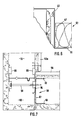
- FIG. 5 shows a broken-away representation of a vertical section through one of the room cells (2-5) according to FIG. 2.
- the wall pane (10 which is cut between two adjacent supports (23, 24), carries the polystyrene concrete layers (32, 33) and reveals the exact shape of the U-profiles that form the longitudinal frame members.
- the U-profile In the base plate (9) the U-profile has a vertical web (37) and inwardly directed flanges (38, 39), of which the lower flange (38) is kept shorter than the upper flange (39), which also has an upstand at (40).
- the lower longitudinal frame profile (41) rests with its web (42) on the upper flange (39).
- the shorter U-profile flange (43) is on the outside, while the longer Pro Fil flange (44) of the upstand (40) and is permanently connected to it by a screw connection (45).
- the upper longitudinal frame profile (46) has a web (47) parallel to the web (42) and an outer flange (48) parallel to the outer flange (43).
- the inner flange (49) is longer than the outer flange (48) and has an upstand (50) that runs perpendicular to the frame plane and horizontally.
- the bevels (50) of the two longer side walls (10, 12) of the side windows serve as ceiling connections.
- the ceiling consists of individual panels (51), which are provided with rigid polyurethane foam at (52) for ceiling insulation. These panels (51) are fastened to the folds (50) with the aid of screws (53).
- the ceiling pane is suspended in the finished room cell, which is used for living purposes.
- plasterboard (53) is used, which are connected to longitudinal or transverse members (54), which in turn are connected to the ceiling formed by the panels (51).
- the inside (55) of each wall panel is covered with a building board (56), which results in smooth and paperable inside in the room cell.
- Fig. 6 shows that the fold (50) of the two upper longitudinal frame members (46) of the side walls (10, 12) result in a uniform slope by extending the inner U-profile flange (49).
- the narrow sides (57) of the panels (51) lie on a uniform incline, as a result of which a downward slope of the rainwater is generated on the upper floor.
- blanket is not shown in the figures and can be carried out conventionally.
- FIG. 7 shows a horizontal section through one of the corners of the room cells.
- these frame members have a symmetrical U-profile with a relatively long web (61) and parallel, as well as inwardly directed flanges (62, 63), which, like all other profiles in the sheet metal strip, were created by cold working and bending.
- the outer sides (64) of the webs (61) are exposed.
- Auxiliary profiles (65, 66) are fastened with them via connecting screws (59). This results in corner parts (60) which are formed by the transverse walls (12, 13).
- These transverse walls also have building panels (56a) on their inner sides as wall cladding.
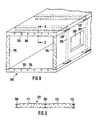
- the reinforced concrete room cell generally designated (100) in the modified embodiment according to FIG. 8, which gives a perspective illustration, has a continuous ceiling pane (102), the outline of which corresponds to a continuous floor pane (103).
- this room cell (100) has longitudinal walls (105) and transverse walls, which are not shown in FIG. 1.
- individual or all walls can have openings that can be used as window or door openings.
- the described ceiling, floor and wall panels consist of the polystyrene concrete according to the invention. This concrete allows separating cuts, which can be carried out with a saw, for example. Therefore, the openings can also be provided later, if they should not be switched off in the precast plant.
- the disks described are reinforced with the help of beams.
- the straps differ from each other in terms of material and profile.
- the longitudinal walls contain the beams (107 and 108), as can be seen from FIG. 9, which represents a section along the line II-II of FIG. 8.
- These supports form supports which, according to the exemplary embodiment shown, consist of galvanized pipes. These are housed in the cross section of the large panel that forms the relevant wall panels (4, 5). They run parallel to the vertical sides of the table and extend over the full height of the large board.
- the carriers (108-110) of the ceiling disc (102) according to FIG. 2 are I-profiles. They rest with both ends on head plates (109 'and 110') according to Fig. 9, which are attached to the supports or supports (106, 107) of the walls (104, 105). They run across the longer side of the floor plan of the reinforced concrete room cell (100).
- the distances between the beams (108-110) are filled with lightweight concrete vaults (111, 112).
- the beams (108-110) are also located in the cross-section of the ceiling pane.
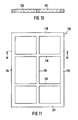
- the bottom plate (103) is shown in FIG. 10, which represents a section along the line IV-IV of FIG. 11, and in FIG. 11, which shows the bottom plate in plan view. It consists of a quadrilateral frame, which accordingly has parallel and longer frame members (114 115), see above such as the frame members (116, 117) which run perpendicular thereto and which are rigidly connected to the supports (114, 115) in the corners of the frame.
- the frame is stiffened with further frame members, namely a longitudinal frame member (118) and cross frame members (119, 120).
- the frame described is filled with the polystyrene lightweight concrete according to the invention, which results in infills, which are designated in FIG. 10 for example by (121 and 122).
- the frame members (114-120) are reinforced concrete beams, whereby the entire frame is made monolithically.
- the base plate has parallel and cylindrical recesses (124) which are used for introducing and discharging a heating medium.
- the ceiling pane can also be provided with such recesses for a room above, as shown at (123), so that the heating medium also acts on this room.
- the ceiling, floor and wall panels form large panels that are manufactured in a formwork.
- the formwork can be made of steel. but is preferably realized with reinforced concrete slabs. Styrofoam waste can be used for the lightweight concrete described. However, the mixture is preferably based on the foamed polystyrene as such, which is in spherical form.
- the balls lie according to a certain grain size spectrum with a maximum diameter of preferably 4 mm in a dry, loose bed.
- the polystyrene concrete described is used according to FIG. 12 in a large-format brick (201), which is shown in a perspective view.
- the inner surface (202) and the outer surface (203) as well as the vertical joint boundary surfaces (204, 205) are smooth. These joint surfaces are provided with a U-shaped recess (106). This widens the vertical joint. It is generally only mortared, but can also be reinforced.
- the surfaces (207 and 208) which delimit the horizontal joint are flat and therefore have no cutouts.
- variable ceiling is selected according to the required strength, which results from the polystyrene concrete from which the large-format brick (201) is made.
- the bulk density class corresponds to 0.5.
- the strength class corresponds to 0.5.
- the cast plates described in connection with the exemplary embodiment can also be used for large buildings in large plate construction.
Landscapes
- Engineering & Computer Science (AREA)
- Architecture (AREA)
- Chemical & Material Sciences (AREA)
- Structural Engineering (AREA)
- Civil Engineering (AREA)
- Ceramic Engineering (AREA)
- Chemical Kinetics & Catalysis (AREA)
- Inorganic Chemistry (AREA)
- Materials Engineering (AREA)
- Organic Chemistry (AREA)
- Building Environments (AREA)
Priority Applications (2)
| Application Number | Priority Date | Filing Date | Title |
|---|---|---|---|
| IT06761890A IT1242721B (it) | 1989-08-08 | 1990-08-06 | Calcestruzzo al polistirolo per prefabbricati e relativi prefabbricati |
| ES9002140A ES2025476A6 (es) | 1989-08-08 | 1990-08-07 | Hormigon de polestireno para partes acabadas de hormigon y su empleo en una celda espacial y en un bloque de gran formato de homigon constructivo. |
Applications Claiming Priority (6)
| Application Number | Priority Date | Filing Date | Title |
|---|---|---|---|
| DE3926123 | 1989-08-08 | ||
| DE19893926123 DE3926123A1 (de) | 1989-08-08 | 1989-08-08 | Grossformatiger mauerstein aus konstruktivem beton mit waermedaemmender gewichtsverminderung |
| DE3933615 | 1989-10-07 | ||
| DE19893933615 DE3933615A1 (de) | 1989-10-07 | 1989-10-07 | Stahlbetonraumzelle |
| DE4003961 | 1990-02-09 | ||
| DE4003961A DE4003961A1 (de) | 1990-02-09 | 1990-02-09 | Raumzelle, insbesondere wohncontainer |
Publications (2)
| Publication Number | Publication Date |
|---|---|
| EP0419785A2 true EP0419785A2 (fr) | 1991-04-03 |
| EP0419785A3 EP0419785A3 (en) | 1991-12-27 |
Family
ID=27199988
Family Applications (1)
| Application Number | Title | Priority Date | Filing Date |
|---|---|---|---|
| EP19900113756 Withdrawn EP0419785A3 (en) | 1989-08-08 | 1990-07-18 | Polystyrene concrete for precast concrete units |
Country Status (2)
| Country | Link |
|---|---|
| EP (1) | EP0419785A3 (fr) |
| FR (1) | FR2650823B1 (fr) |
Cited By (5)
| Publication number | Priority date | Publication date | Assignee | Title |
|---|---|---|---|---|
| EP1157978A1 (fr) * | 2000-05-24 | 2001-11-28 | Günther Dr. c/o Forum of Switzerland AG. Hund | Matériau de construction |
| WO2003018503A1 (fr) * | 2001-08-23 | 2003-03-06 | Eps Cement Svenska Ab | Melange de beton et de plastiques expanses et procede de fabrication correspondant |
| WO2003062168A1 (fr) * | 2002-01-25 | 2003-07-31 | Bela Bill Szoke | Beton isolant |
| CN114517526A (zh) * | 2022-03-21 | 2022-05-20 | 江西中一梦园住宅工业有限公司 | 一种蒸压轻质混凝土房屋建筑结构 |
| CN114656279A (zh) * | 2022-03-23 | 2022-06-24 | 贾彦 | 一种利用废弃聚氨酯泡沫配制空心砖的配方 |
Families Citing this family (1)
| Publication number | Priority date | Publication date | Assignee | Title |
|---|---|---|---|---|
| GB2347413A (en) * | 1999-03-03 | 2000-09-06 | Polybeton Ltd | Lightweight concrete |
Family Cites Families (6)
| Publication number | Priority date | Publication date | Assignee | Title |
|---|---|---|---|---|
| AT254025B (de) * | 1964-04-23 | 1967-05-10 | Building Res Holding Ltd | Verfahren zur Herstellung von hochfesten Bauelementen, insbesondere Bauplatten |
| FR1544214A (fr) * | 1967-09-22 | 1968-10-31 | Fr Lanco Soc | Procédé de fabrication d'un béton, béton et matériau de construction obtenu à partir de ce procédé |
| DE2351469A1 (de) * | 1973-10-13 | 1975-04-17 | Dyckerhoff & Widmann Ag | Verfahren zum herstellen von leichtbeton |
| BE823361A (fr) * | 1974-12-13 | 1975-04-01 | Beton leger | |
| IE47835B1 (en) * | 1978-02-28 | 1984-06-27 | Sanders & Forster Ltd | Improvements in or relating to buildings comprising accomodation units |
| JPS6437478A (en) * | 1987-08-04 | 1989-02-08 | Nichias Corp | Production of cement lightweight molded article |
-
1990
- 1990-07-18 EP EP19900113756 patent/EP0419785A3/de not_active Withdrawn
- 1990-08-07 FR FR9010060A patent/FR2650823B1/fr not_active Expired - Fee Related
Cited By (5)
| Publication number | Priority date | Publication date | Assignee | Title |
|---|---|---|---|---|
| EP1157978A1 (fr) * | 2000-05-24 | 2001-11-28 | Günther Dr. c/o Forum of Switzerland AG. Hund | Matériau de construction |
| WO2003018503A1 (fr) * | 2001-08-23 | 2003-03-06 | Eps Cement Svenska Ab | Melange de beton et de plastiques expanses et procede de fabrication correspondant |
| WO2003062168A1 (fr) * | 2002-01-25 | 2003-07-31 | Bela Bill Szoke | Beton isolant |
| CN114517526A (zh) * | 2022-03-21 | 2022-05-20 | 江西中一梦园住宅工业有限公司 | 一种蒸压轻质混凝土房屋建筑结构 |
| CN114656279A (zh) * | 2022-03-23 | 2022-06-24 | 贾彦 | 一种利用废弃聚氨酯泡沫配制空心砖的配方 |
Also Published As
| Publication number | Publication date |
|---|---|
| FR2650823A1 (fr) | 1991-02-15 |
| FR2650823B1 (fr) | 1993-11-26 |
| EP0419785A3 (en) | 1991-12-27 |
Similar Documents
| Publication | Publication Date | Title |
|---|---|---|
| EP0639677B1 (fr) | Bâtiment composé par des modules de cellules préfabriquées | |
| DE102018001689A1 (de) | Modul und Verfahren zum Herstellen eines Moduls, einer Gebäudewand und eines Gebäudes | |
| DE69224288T2 (de) | Bauelement | |
| DD297386A5 (de) | Polystyrolbeton fuer betonfertigteile | |
| DE2700022A1 (de) | Fertigbau-grosswandelement aus mauerwerk | |
| EP0015444B1 (fr) | Construction avec poutres en té | |
| WO1997004195A1 (fr) | Systeme de construction rapide pour l'erection de murs porteurs | |
| DE1484067A1 (de) | Bewehrtes Mauerwerk | |
| EP0520084A1 (fr) | Méthode et module préfabriquée pour la production des constructions et des bâtiments | |
| DE19708689B4 (de) | Bausatz aus Wandbauelementen für Gebäude | |
| DE4135243A1 (de) | Dach aus grossflaechigen betonfertigteilen | |
| DE202019002033U1 (de) | Vorrichtung zur massenhaften Herstellung von Betonfertigteilen und Anwendung auf herkömmliche Häuser, Leistungshäuser und demontierbare Überbauung genutzter Grundstücke | |
| DE801475C (de) | Betonbauweise | |
| DE19820138A1 (de) | Bauelement und Hausmodul aus mehreren Bauelementen | |
| DE861464C (de) | Stahlbetonskelettbau | |
| DE19804008A1 (de) | Zweischalenhaus | |
| AT394232B (de) | Geschosshohes, massives bauelement fuer waende, insbesondere kellerwaende, sowie wandverband aus solchen bauelementen | |
| DE856214C (de) | Verfahren und Bauweise zur fabrikmaessigen Herstellung von insbesondere skelettlosenBauwerken, beispielsweise Wohnhaeusern | |
| AT331474B (de) | Plattenformiger, insbesondere unter verwendung von expandierten werkstoffen hergestellter fertigbauteil | |
| DE2204111A1 (de) | Armierte Betonbauteile | |
| DE10116976A1 (de) | Selbsttragendes Deckenelement und Verfahren zu dessen Herstellung | |
| EP1593792A2 (fr) | Panneau de paroi à grandes dimensions | |
| DE7420037U (de) | Stütze für Fertigteilbauten | |
| DE2526746A1 (de) | Gebaeudeaussenwand und verfahren zu ihrer herstellung | |
| DE2132091A1 (de) | Verfahren zur errichtung von bauwerken aus betonfertigteilen und mittel zu dessen durchfuehrung |
Legal Events
| Date | Code | Title | Description |
|---|---|---|---|
| PUAI | Public reference made under article 153(3) epc to a published international application that has entered the european phase |
Free format text: ORIGINAL CODE: 0009012 |
|
| AK | Designated contracting states |
Kind code of ref document: A2 Designated state(s): AT BE CH DE DK ES FR GB GR IT LI LU NL SE |
|
| RBV | Designated contracting states (corrected) |
Designated state(s): DE NL |
|
| PUAL | Search report despatched |
Free format text: ORIGINAL CODE: 0009013 |
|
| 17P | Request for examination filed |
Effective date: 19910917 |
|
| AK | Designated contracting states |
Kind code of ref document: A3 Designated state(s): AT BE CH DE DK ES FR GB GR IT LI LU NL SE |
|
| 17Q | First examination report despatched |
Effective date: 19920616 |
|
| RIN1 | Information on inventor provided before grant (corrected) |
Inventor name: KESTING, LORENZ |
|
| RAP1 | Party data changed (applicant data changed or rights of an application transferred) |
Owner name: KESTING, KLAUS LORENZ, DR.-ING. |
|
| GRAH | Despatch of communication of intention to grant a patent |
Free format text: ORIGINAL CODE: EPIDOS IGRA |
|
| GRAH | Despatch of communication of intention to grant a patent |
Free format text: ORIGINAL CODE: EPIDOS IGRA |
|
| STAA | Information on the status of an ep patent application or granted ep patent |
Free format text: STATUS: THE APPLICATION IS DEEMED TO BE WITHDRAWN |
|
| 18D | Application deemed to be withdrawn |
Effective date: 19980203 |