EP0420130A2 - Procédé de reliure de livre - Google Patents
Procédé de reliure de livre Download PDFInfo
- Publication number
- EP0420130A2 EP0420130A2 EP90118352A EP90118352A EP0420130A2 EP 0420130 A2 EP0420130 A2 EP 0420130A2 EP 90118352 A EP90118352 A EP 90118352A EP 90118352 A EP90118352 A EP 90118352A EP 0420130 A2 EP0420130 A2 EP 0420130A2
- Authority
- EP
- European Patent Office
- Prior art keywords
- backbone
- adhesive
- glue
- signature
- cover
- Prior art date
- Legal status (The legal status is an assumption and is not a legal conclusion. Google has not performed a legal analysis and makes no representation as to the accuracy of the status listed.)
- Withdrawn
Links
- 238000000034 method Methods 0.000 title claims abstract description 42
- 239000003292 glue Substances 0.000 claims abstract description 98
- 239000000853 adhesive Substances 0.000 claims abstract description 79
- 230000001070 adhesive effect Effects 0.000 claims abstract description 79
- 239000000839 emulsion Substances 0.000 claims abstract description 31
- 238000007790 scraping Methods 0.000 claims abstract description 7
- 239000011324 bead Substances 0.000 claims description 3
- 238000007788 roughening Methods 0.000 claims description 3
- 229920002689 polyvinyl acetate Polymers 0.000 claims description 2
- 239000011118 polyvinyl acetate Substances 0.000 claims description 2
- 239000011248 coating agent Substances 0.000 abstract description 6
- 238000000576 coating method Methods 0.000 abstract description 6
- 239000012943 hotmelt Substances 0.000 description 7
- 229910001220 stainless steel Inorganic materials 0.000 description 4
- 239000010935 stainless steel Substances 0.000 description 4
- 238000004026 adhesive bonding Methods 0.000 description 3
- 239000000428 dust Substances 0.000 description 3
- 239000004831 Hot glue Substances 0.000 description 2
- 238000005520 cutting process Methods 0.000 description 2
- 230000005923 long-lasting effect Effects 0.000 description 2
- 238000012986 modification Methods 0.000 description 2
- 230000004048 modification Effects 0.000 description 2
- 238000004806 packaging method and process Methods 0.000 description 2
- 238000007605 air drying Methods 0.000 description 1
- 230000001680 brushing effect Effects 0.000 description 1
- 238000004140 cleaning Methods 0.000 description 1
- 238000010586 diagram Methods 0.000 description 1
- 238000001035 drying Methods 0.000 description 1
- 231100001261 hazardous Toxicity 0.000 description 1
- 238000004519 manufacturing process Methods 0.000 description 1
- 230000007246 mechanism Effects 0.000 description 1
- 239000002184 metal Substances 0.000 description 1
- 238000005096 rolling process Methods 0.000 description 1
- 238000005507 spraying Methods 0.000 description 1
Images


Classifications
-
- B—PERFORMING OPERATIONS; TRANSPORTING
- B42—BOOKBINDING; ALBUMS; FILES; SPECIAL PRINTED MATTER
- B42C—BOOKBINDING
- B42C19/00—Multi-step processes for making books
- B42C19/02—Multi-step processes for making books starting with single sheets
Definitions
- This invention relates generally to book binding, and more particularly to a process which bonds both coated and uncoated signatures using low temperature glues.
- Modern book binding processes which mass produce bound books or catalogues are essentially fully automated, with the exception of minor human handling requirements.
- Large printing machines print information onto large paper webs which are cut and folded to form signatures. Since a finished book may require several signatures, the signatures are stacked or compiled to form a book block.
- fork lifts or automatically guided vehicles transport the signatures from the printing machine to a signature compilation machine where operators load the signatures into appropriate stacking stations.
- the signature compilation machine sequentially stacks the proper signatures on top of one another to form a plurality of identical signature blocks.
- each block must be bound together by a suitable process.
- One popular process binds the signatures with a layer of primer adhesive. Prior to the application of primer adhesive, however, one edge of each signature block is cut to form a spine or backbone surface acceptable for the receiving the primer adhesive. This cutting operation is performed by passing each consecutive signature block through a saw which is aligned to cut off a portion of the block. Typically, the surface of the cut backbone surface is also roughened by passing each signature block by a rotating "rougher" blade. Roughening yields an absorptive surface which maximizes the adhesion properties of the primer adhesive.
- the primer adhesive is usually applied to each suitably prepared backbone by brushing, spraying or rolling until the primer adhesive coats and penetrates the roughened backbone.
- the primer adhesive is then set, i.e., at least the top layer of adhesive is dried, by air drying or by subjecting the backbone to a heat source.
- a cover adhesive is applied in a similar fashion to the backbone of each signature block. Book covers are brought into register with the cover adhesive on the backbones, and the adhesive binds the book covers to the respective signature blocks. The covered signature blocks are then automatically trimmed, and the finished books are ready for packaging and shipment.
- animal glues adhere quite well to uncoated paper stock, so animal glues are used for both the primer and cover adhesives in the process described above.
- Books bound with animal glues have excellent repulping value, and, thus, paper mills pay a premium price for paper shavings which contain only animal glue adhesives.
- Animal glues are usually applied at low temperatures (under 150°F), so there animal glue is generally safe to handle and apply.
- animal glues can be undesirably affected by humidity and temperature, and books bound with animal glue tend to display a limited life.
- animal glues do not adhere well to coated paper stock, and, therefore, are usually not used in any process where coated stock must be bound. If animal glue is used to bind coated paper, the life of the book is severely limited to no more than a few months assuming occasional use of the book.
- One gluing process which generally follows the steps of the above-described process uses an emulsion primer glue to bond the signatures together and a hot melt cover glue to bond the cover to the signature block.
- emulsion primer glue to bond the signatures together
- hot melt cover glue to bond the cover to the signature block.
- These glues adhere very well to both coated and uncoated paper stock, and produce high quality, long-lasting books.
- paper shavings which contain hot melt glue have very low repulping value, and emulsion and hot melt glues are more expensive than animal glues.
- Hot melt glues are also applied at temperatures of about 350°F, and, therefore, are more hazardous to handle and apply than animal glues.
- the drying of the emulsion primer layer limits the production rate because the hot melt cover glue cannot be effectively applied until the layer of emulsion primer glue is dry.
- gas dryers are used to dry the emulsion layer. Unfortunately, the use of gas dryers create fire concerns.
- Another type of gluing process which is similar to the process previously described, uses only a single application of glue to bind the signatures together and to bind the covers to the signature blocks.
- This process is referred to as a "one shot hot melt” process.
- a layer of hot melt glue is applied to the backbone of the signature blocks using a glue pot, for instance. Then, before the hot melt adhesive is allowed to dry, the book cover is adhered to the backbone. While this process creates a durable book using any type of paper stock, it also suffers from many of the disadvantages discussed in the previous paragraph.
- animal glue does not adhere well to coated paper stock.
- Cold emulsion adhesive does adhere to coated stock to provide a sufficient bond, and paper shavings having cold emulsion adhesive thereon have a good repulping value.
- animal glue does not adhere to cold emulsion adhesive, so attempts to use a cold emulsion primer adhesive with an animal glue cover adhesive have proven futile.
- the present invention is directed to overcoming one or more of the problems as set forth above.
- a method of applying adhesives to the backbone of a book block which allows a cold emulsion primer adhesive to be used with an animal glue cover adhesive.
- the backbone of a book block is roughened to form a backbone surface suitable for the application of adhesives.
- the backbone surface is transversely slashed, and a coating of primer adhesive, preferably cold emulsion adhesive, is applied to the backbone surface for binding pages in the book block together.
- substantially all of the primer adhesive is removed from the backbone surface, preferably by passing the surface by at least one scraper.
- a cover adhesive preferably animal glue
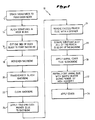
- Fig. 1 illustrates a book binding process using a flowchart 10
- Fig. 2 diagrammatically illustrates a book binding apparatus 100.
- a signature compilation portion 102 of the apparatus 100 sequentially stacks the proper signatures, one top of another, to form a plurality of identical signature blocks.
- the stacking operation is performed by loading the appropriate signatures into their respective receptacles 104a-d, and feeding the signatures one at a time onto a conveyor 106.
- a signature in receptacle 104a is feed onto the conveyor 106.
- a signature from receptacle 104b is fed onto the top of the signature deposited by receptacle 104a, and another signature from receptacle 104a is fed onto the conveyor 106.
- a signature from receptacle 104c is fed onto the top of the first two signatures
- a signature from receptacle 104b is fed onto the second signature deposited by receptacle 104a
- receptacle 104a feeds another signature onto the conveyor 106.
- This sequential stacking operation continues until the requisite number of signature have been stacked to form a signature block. While only four receptacles are illustrated, clearly a fewer or greater number may be used depending on the number of signatures required to form each signature block.
- the signatures in each block are aligned for further processing. Since further processing requires that the alignment of the signatures within each block be maintained, the aligned signature blocks are transferred to a clamping conveyor 108 (Fig. 2.). Spring actuated clamps 110 on the conveyor 108 grip each signature at about point A for transport through various processing apparatus which will form the signature block into a finished book.
- each signature block 40 is cut to form a spine or backbone surface 42.
- This cutting operation is performed by passing each consecutive signature block 40 through at least one saw 112 which is aligned to cut off a portion of the block 40.
- a saw 112 which is aligned to cut off a portion of the block 40.
- three Comstock and Wescott ten-toothed dustless saws are consecutively aligned for making a proper cut in each signature block. The first two saws are right handed and the last saw is left handed to insure an even cut.
- the surface of the cut backbone surface is roughened by passing each signature block by a rotating "rougher" blade 114.
- Roughening yields an absorptive surface acceptable for the receiving a coating of primer adhesive and which maximizes the adhesion properties of the primer adhesive.
- two Comstock and Wescott rougher spindles are located directly after the third saw.
- the rougher spindles have 72 teeth with a 1° to 5° tooth angle, and the spindles rotate at about 3000 r.p.m.
- step 20 is performed by a slasher 114, which is preferably mounted on the second rougher spindle. If the coated stock is in the middle portion of the signature block, two slasher teeth are mounted near the center of the radius of each rougher. However, if the coated stock is on one of the ends of the signature block, two additional slasher teeth are mounted at the outer radius of the rougher.
- one or more brushes 116 are located after the rougher/slasher 114.
- the backbone cleaning step 22 removes paper dust so that the dust will not contaminate the primer adhesive.
- the conveyor 110 moves the signature blocks into contact with a straight brush and a rotary brush. The dust removed by the brushes is withdrawn from the apparatus by a vacuum.
- a primer adhesive is applied to each suitably prepared backbone by passing each backbone through a glue pot 118, as shown in Fig. 4.
- the primer adhesive is a polyvinyl acetate co-polymer emulsion adhesive, such as WB-1791 which may be purchased from the H.B. Fuller Company, 2400 Energy Park Drive, St. Paul, Minnesota 55108.
- the primer adhesive is applied at ambient temperature, and preferably has a low viscosity of about 500 centipoise.
- the glue pot 118 is a straight wheel pot which preferably includes three glue-applying stainless steel wheels 120,122,124, as shown in detail in Figs. 4 and 5.
- the three glue-applying stainless steel wheels 120,122,124 rotate clockwise as shown by the arrows on the wheels in Fig. 4.
- the direction of book travel is shown by the arrow 125, so the upper surface of each of the wheels 120,122,124 is rotating in the same direction as book travel.
- the lower surface of each wheel 120,122,124 is immersed in a bath of the cold emulsion primer adhesive which is held within a vat 126.
- glue becomes attached to the wheels.
- Doctor blades 128,130,132 remove glue from their respective wheels 120,122,124 so that a predetermined thickness of glue remains on the wheels.
- Signature blocks which pass over the glue-covered wheels 120,122,124 contact a portion of the glue on each wheel, thus transferring a portion of the glue to the backbone of the signature blocks.
- Three glue-applying wheels are used to accurately control the amount of glue being applied to the backbones of the passing signature blocks.
- a spinner wheel 134 removes a portion of the cold emulsion adhesive as the backbone of each signature block passes over the spinner wheel 134.
- the spinner wheel 134 is located in the glue pot 118 downstream from the three glue-applying wheels 120,122,124. Unlike the glue-applying wheels, the spinner wheel 134 is not immersed in the glue bath. Instead the spinner wheel 134 rotates in the opposite direction from the wheels 120,122,124, and removes a portion of the cold emulsion adhesive from the backbone of each signature block.
- a doctor blade 136 removes the cold emulsion adhesive from the spinner wheel 134, and directs the removed adhesive down into the glue bath.
- At least one scraper 119 is positioned downstream from said spinner wheel 134.
- a straight-bladed scraper 138 removes the majority of cold emulsion adhesive from the backbone of each passing signature block.
- the straight-bladed scraper 138 is adjusted so that the blade of the scraper just contacts the backbone of each passing signature block. The contact should be sufficient for removing the glue but should not damage the backbone.
- straight-bladed scraper 138 is positioned above a container (not shown) so that the removed adhesive drips off of the scraper and into to the container.
- At least one "tucker” scraper 140 removes cold emulsion adhesive from the sides of the signature block near the backbone.
- the tucker scraper 140 includes two metal fins 140a,140b which are angled in the direction of book travel, one on each side of the passing signature blocks. Since there is very little adhesive on the sides of the signature block, adhesive removed from the sides also falls into the container.
- a V-shaped scraper 142 is positioned downstream from the tucker scraper 140.
- the V-shaped scraper 142 contacts the backbone of each passing signature block, and removes most of any remaining glue from each backbone.
- a pair of side rails or "wings" 144a,144b are positioned on each side of the passing signature blocks.
- the side wings 144a,144b slightly compress the signatures within each block together as the signature blocks pass between them.
- the side wings are positioned above at least the spinner wheel 134 and the straight-bladed scraper 138, because these mechanisms tend to promote flaring of the backbone.
- the wings are not as useful above the tucker scraper 140 and the V-shaped scraper 142, because these scrapers tend to compress the signatures in each block together.
- the conveyor 108 moves the consecutive signature blocks to a cover glue pot 146, as set forth in step 30.
- the cover glue is an animal glue, such as WB-1481 which may be purchased from the H.B. Fuller Company, 2400 Energy Park Drive, St. Paul, Minnesota 55108.
- the cover glue is applied at about 130°F to about 160°F, and preferably has a viscosity of about 20,000 centipoise to about 40,000 centipoise.
- the desired viscosity of the animal glue depends on the thickness of the signature block.
- the glue pot 146 is a straight wheel pot which preferably includes two glue-applying stainless steel wheels 148,150, as shown in detail in Fig. 5.
- the two glue-applying stainless steel wheels 148,150 rotate clockwise as shown by the arrows on the wheels.
- the direction of book travel is shown by the arrow 152, so the upper surface of each of the wheels 148,150 is rotating in the same direction as book travel.
- the lower surface of each wheel 148,150 is immersed in a bath of animal glue which is held within a vat 154.
- glue becomes attached to the wheels.
- Doctor blades 156,158 remove glue from their respective wheels 148,150 so that a predetermined thickness of glue remains on the wheels.
- Signature blocks which pass over the glue-covered wheels 148,150 contact a portion of the glue on each wheel, thus transferring a portion of the glue to the backbone of the signature blocks.
- a pair of wings 160,162 cooperates with the first wheel 148 in order to apply a glue bead to the edges of each passing backbone, and also guide each successive signature block into the cover glue pot 146.
- a groove 164,166 in each respective wing 160,162 causes glue on the rotating wheel 148 to form a raised ridge.
- the ridges of glue are spaced apart from one another by about the thickness of the signature blocks which are being processed. As each signature block passes over the wheel 148, the ridge of glue is applied to the edges of the backbone. The ridge of glue forms a glue bead which effectively bonds the edges of each backbone to an applied cover.
- the second glue-applying wheel 150 carries a greater thickness of animal glue than does the first wheel 148. A portion of the glue is applied to the entire backbone surface of each signature block as it passes over the wheel 150 and contacts the glue.
- a spinner wheel 163 removes a portion of the animal glue from the backbone of each signature block as the backbone of each signature block passes over the spinner wheel 163.
- the spinner wheel 163 is located in the glue pot 146 downstream from the two glue-applying wheels 148,150. Unlike the glue-applying wheels, the spinner wheel 163 is not immersed in the glue bath. Instead the spinner wheel 163 rotates in the opposite direction from the wheels 148,150, and removes a portion of the animal glue from the backbone of each signature block to ensure that there is a predetermined thickness of glue on the backbone of each signature block.
- a doctor blade 165 removes the excess animal glue from the spinner wheel 163, and directs the removed glue down into the glue bath or into a container.
- the signature blocks are passed over a heater 168 which partially dries the applied cover glue.
- the heater is only used when the cover glue has been applied in an environment having a high humidity.
- the final step 34 of the gluing process brings the covers into register with the cover adhesive on the backbones, and the adhesive binds the book covers to the respective signature blocks.
- This step is carried out by a cover applicator 170 which is downline from the heater 168.
- the covered signature blocks are then automatically trimmed, and the finished books are ready for packaging and shipment.
Landscapes
- Adhesives Or Adhesive Processes (AREA)
Applications Claiming Priority (2)
| Application Number | Priority Date | Filing Date | Title |
|---|---|---|---|
| US41266089A | 1989-09-26 | 1989-09-26 | |
| US412660 | 1989-09-26 |
Publications (2)
| Publication Number | Publication Date |
|---|---|
| EP0420130A2 true EP0420130A2 (fr) | 1991-04-03 |
| EP0420130A3 EP0420130A3 (en) | 1991-07-24 |
Family
ID=23633888
Family Applications (1)
| Application Number | Title | Priority Date | Filing Date |
|---|---|---|---|
| EP19900118352 Withdrawn EP0420130A3 (en) | 1989-09-26 | 1990-09-24 | Book binding process |
Country Status (2)
| Country | Link |
|---|---|
| EP (1) | EP0420130A3 (fr) |
| CA (1) | CA2025985A1 (fr) |
Cited By (2)
| Publication number | Priority date | Publication date | Assignee | Title |
|---|---|---|---|---|
| CN106004150A (zh) * | 2016-07-01 | 2016-10-12 | 温州市唐风工艺品有限公司 | 一种上胶机 |
| CN110254066A (zh) * | 2019-07-29 | 2019-09-20 | 温州任和文化创意有限责任公司 | 一种胶装机用夹紧装置以及使用方法 |
Family Cites Families (7)
| Publication number | Priority date | Publication date | Assignee | Title |
|---|---|---|---|---|
| US1879757A (en) * | 1931-03-30 | 1932-09-27 | Hall Printing Co W F | Bookbinding machine |
| US2572243A (en) * | 1949-10-18 | 1951-10-23 | Deflorez Company Inc | Pressure applicator for plastic bindings of hard cased books |
| GB733480A (en) * | 1952-03-31 | 1955-07-13 | Lionel John Bryant Rushent Fre | Improvements in or relating to book binding |
| US3093396A (en) * | 1960-12-22 | 1963-06-11 | Betsy Ross Feld | Bookbinding method and apparatus |
| GB1262081A (en) * | 1968-04-17 | 1972-02-02 | Blakeney Engineering Ltd | Improvements relating to methods and machines for binding books |
| US4702496A (en) * | 1984-04-16 | 1987-10-27 | H. B. Fuller Company | Book binding process involving primer adhesive containing starch |
| US4741236A (en) * | 1986-08-18 | 1988-05-03 | Harris Graphics Corporation | Apparatus for notching the back of a book |
-
1990
- 1990-09-21 CA CA 2025985 patent/CA2025985A1/fr not_active Abandoned
- 1990-09-24 EP EP19900118352 patent/EP0420130A3/en not_active Withdrawn
Cited By (3)
| Publication number | Priority date | Publication date | Assignee | Title |
|---|---|---|---|---|
| CN106004150A (zh) * | 2016-07-01 | 2016-10-12 | 温州市唐风工艺品有限公司 | 一种上胶机 |
| CN106004150B (zh) * | 2016-07-01 | 2018-06-12 | 温州市唐风工艺品有限公司 | 一种上胶机 |
| CN110254066A (zh) * | 2019-07-29 | 2019-09-20 | 温州任和文化创意有限责任公司 | 一种胶装机用夹紧装置以及使用方法 |
Also Published As
| Publication number | Publication date |
|---|---|
| CA2025985A1 (fr) | 1991-03-27 |
| EP0420130A3 (en) | 1991-07-24 |
Similar Documents
| Publication | Publication Date | Title |
|---|---|---|
| US4556353A (en) | Process and apparatus for binding books | |
| JP5578806B2 (ja) | 中本を加工するための無線綴じ機ならびに無線綴じ方法 | |
| CA1173073A (fr) | Livres relies et methode de realisation | |
| EP0104612B1 (fr) | Machine à relier | |
| US4565477A (en) | Method of casing-in books | |
| GB2298163A (en) | Automatic book binding machine for cut-sheets | |
| JP2534292B2 (ja) | 無線とじ機の見返し接着装置 | |
| US20170129269A1 (en) | Automated book assembly system and method | |
| EP0420130A2 (fr) | Procédé de reliure de livre | |
| US5542800A (en) | Method and system for binding a pack of signatures | |
| GB2186546A (en) | Improvements relating to package banding apparatus | |
| JPH08510200A (ja) | 小冊子の製造方法および製造装置 | |
| US4731150A (en) | Apparatus for glueing together material layers | |
| JPH09156248A (ja) | 接着製本用の綴じ込み物または本の丁調べ方法 | |
| CA1239045A (fr) | Dispositif de fabrication de chemises-enveloppes | |
| US4427487A (en) | Novel gluing machine | |
| EP0093099A1 (fr) | Appareil pour plier une feuille en forme d'une chemise | |
| US5635017A (en) | Apparatus for applying closure tabs | |
| CA1185756A (fr) | Methode de reliure de livres | |
| CN119502589B (zh) | 一种自动过胶机 | |
| JP2739032B2 (ja) | 製本装置 | |
| DK160608B (da) | Apparat til sammenlimning af ark | |
| JPH0920448A (ja) | バインドテープ加熱装置及び製本装置及び画像形成装置 | |
| JP3108265B2 (ja) | 製本装置 | |
| US20020040759A1 (en) | Method for effecting a cross-the-grain bonding on veneer sheets in plywood manufacture |
Legal Events
| Date | Code | Title | Description |
|---|---|---|---|
| PUAI | Public reference made under article 153(3) epc to a published international application that has entered the european phase |
Free format text: ORIGINAL CODE: 0009012 |
|
| AK | Designated contracting states |
Kind code of ref document: A2 Designated state(s): AT BE CH DE DK ES FR GB GR IT LI LU NL SE |
|
| PUAL | Search report despatched |
Free format text: ORIGINAL CODE: 0009013 |
|
| AK | Designated contracting states |
Kind code of ref document: A3 Designated state(s): AT BE CH DE DK ES FR GB GR IT LI LU NL SE |
|
| 17P | Request for examination filed |
Effective date: 19920124 |
|
| STAA | Information on the status of an ep patent application or granted ep patent |
Free format text: STATUS: THE APPLICATION IS DEEMED TO BE WITHDRAWN |
|
| 18D | Application deemed to be withdrawn |
Effective date: 19930401 |