EP0420807A1 - Anlagerungsprodukte von Alkylenoxid und Styroloxid an Arylalkanole - Google Patents
Anlagerungsprodukte von Alkylenoxid und Styroloxid an Arylalkanole Download PDFInfo
- Publication number
- EP0420807A1 EP0420807A1 EP90810713A EP90810713A EP0420807A1 EP 0420807 A1 EP0420807 A1 EP 0420807A1 EP 90810713 A EP90810713 A EP 90810713A EP 90810713 A EP90810713 A EP 90810713A EP 0420807 A1 EP0420807 A1 EP 0420807A1
- Authority
- EP
- European Patent Office
- Prior art keywords
- alkylene
- phenyl
- radical
- formula
- hydrogen
- Prior art date
- Legal status (The legal status is an assumption and is not a legal conclusion. Google has not performed a legal analysis and makes no representation as to the accuracy of the status listed.)
- Withdrawn
Links
- 125000002947 alkylene group Chemical group 0.000 title claims abstract description 28
- AWMVMTVKBNGEAK-UHFFFAOYSA-N Styrene oxide Chemical compound C1OC1C1=CC=CC=C1 AWMVMTVKBNGEAK-UHFFFAOYSA-N 0.000 title claims abstract description 16
- 150000002148 esters Chemical class 0.000 claims abstract description 29
- 125000004432 carbon atom Chemical group C* 0.000 claims abstract description 26
- 239000001257 hydrogen Substances 0.000 claims abstract description 26
- 229910052739 hydrogen Inorganic materials 0.000 claims abstract description 26
- 125000001997 phenyl group Chemical group [H]C1=C([H])C([H])=C(*)C([H])=C1[H] 0.000 claims abstract description 23
- 125000002496 methyl group Chemical group [H]C([H])([H])* 0.000 claims abstract description 22
- 230000002378 acidificating effect Effects 0.000 claims abstract description 20
- 125000004435 hydrogen atom Chemical class [H]* 0.000 claims abstract description 19
- 150000003839 salts Chemical class 0.000 claims abstract description 16
- CIUQDSCDWFSTQR-UHFFFAOYSA-N [C]1=CC=CC=C1 Chemical class [C]1=CC=CC=C1 CIUQDSCDWFSTQR-UHFFFAOYSA-N 0.000 claims abstract description 11
- 229910052736 halogen Inorganic materials 0.000 claims abstract description 11
- 150000002367 halogens Chemical group 0.000 claims abstract description 11
- 239000002736 nonionic surfactant Substances 0.000 claims abstract description 3
- 125000001424 substituent group Chemical group 0.000 claims abstract description 3
- 125000006274 (C1-C3)alkoxy group Chemical group 0.000 claims abstract 2
- -1 alkylene radical Chemical class 0.000 claims description 32
- 239000000975 dye Substances 0.000 claims description 26
- 238000002360 preparation method Methods 0.000 claims description 23
- 239000002253 acid Substances 0.000 claims description 15
- QAOWNCQODCNURD-UHFFFAOYSA-N Sulfuric acid Chemical compound OS(O)(=O)=O QAOWNCQODCNURD-UHFFFAOYSA-N 0.000 claims description 14
- 239000000463 material Substances 0.000 claims description 11
- OFOBLEOULBTSOW-UHFFFAOYSA-N Malonic acid Chemical compound OC(=O)CC(O)=O OFOBLEOULBTSOW-UHFFFAOYSA-N 0.000 claims description 10
- NBIIXXVUZAFLBC-UHFFFAOYSA-N Phosphoric acid Chemical group OP(O)(O)=O NBIIXXVUZAFLBC-UHFFFAOYSA-N 0.000 claims description 10
- 150000001875 compounds Chemical class 0.000 claims description 9
- VZCYOOQTPOCHFL-UPHRSURJSA-N maleic acid Chemical compound OC(=O)\C=C/C(O)=O VZCYOOQTPOCHFL-UPHRSURJSA-N 0.000 claims description 9
- 125000000217 alkyl group Chemical group 0.000 claims description 8
- 235000014113 dietary fatty acids Nutrition 0.000 claims description 7
- 239000000194 fatty acid Substances 0.000 claims description 7
- 229930195729 fatty acid Natural products 0.000 claims description 7
- 229920002545 silicone oil Polymers 0.000 claims description 7
- 239000000835 fiber Substances 0.000 claims description 6
- 239000002480 mineral oil Substances 0.000 claims description 6
- VGGSQFUCUMXWEO-UHFFFAOYSA-N Ethene Chemical compound C=C VGGSQFUCUMXWEO-UHFFFAOYSA-N 0.000 claims description 5
- ULUAUXLGCMPNKK-UHFFFAOYSA-N Sulfobutanedioic acid Chemical compound OC(=O)CC(C(O)=O)S(O)(=O)=O ULUAUXLGCMPNKK-UHFFFAOYSA-N 0.000 claims description 5
- 125000000956 methoxy group Chemical group [H]C([H])([H])O* 0.000 claims description 5
- 229920000728 polyester Polymers 0.000 claims description 5
- 125000001931 aliphatic group Chemical group 0.000 claims description 4
- 150000004665 fatty acids Chemical class 0.000 claims description 4
- 235000010446 mineral oil Nutrition 0.000 claims description 4
- 229920001521 polyalkylene glycol ether Polymers 0.000 claims description 4
- 239000005977 Ethylene Substances 0.000 claims description 3
- 239000004952 Polyamide Substances 0.000 claims description 3
- 150000001450 anions Chemical class 0.000 claims description 3
- 238000009792 diffusion process Methods 0.000 claims description 3
- 229910052751 metal Inorganic materials 0.000 claims description 3
- 239000002184 metal Substances 0.000 claims description 3
- 125000001570 methylene group Chemical group [H]C([H])([*:1])[*:2] 0.000 claims description 3
- 150000007522 mineralic acids Chemical class 0.000 claims description 3
- 150000007524 organic acids Chemical class 0.000 claims description 3
- 229920002647 polyamide Polymers 0.000 claims description 3
- QQONPFPTGQHPMA-UHFFFAOYSA-N propylene Natural products CC=C QQONPFPTGQHPMA-UHFFFAOYSA-N 0.000 claims description 3
- 239000012209 synthetic fiber Substances 0.000 claims description 3
- 229920002994 synthetic fiber Polymers 0.000 claims description 3
- SLRMQYXOBQWXCR-UHFFFAOYSA-N 2154-56-5 Chemical compound [CH2]C1=CC=CC=C1 SLRMQYXOBQWXCR-UHFFFAOYSA-N 0.000 claims description 2
- 150000007933 aliphatic carboxylic acids Chemical class 0.000 claims description 2
- 150000004996 alkyl benzenes Chemical class 0.000 claims description 2
- WPYMKLBDIGXBTP-UHFFFAOYSA-N benzoic acid Chemical compound OC(=O)C1=CC=CC=C1 WPYMKLBDIGXBTP-UHFFFAOYSA-N 0.000 claims description 2
- 150000002430 hydrocarbons Chemical group 0.000 claims description 2
- QJGQUHMNIGDVPM-UHFFFAOYSA-N nitrogen group Chemical group [N] QJGQUHMNIGDVPM-UHFFFAOYSA-N 0.000 claims description 2
- 150000003856 quaternary ammonium compounds Chemical class 0.000 claims description 2
- 229920003043 Cellulose fiber Polymers 0.000 claims 1
- 239000003795 chemical substances by application Substances 0.000 abstract description 2
- 239000003945 anionic surfactant Substances 0.000 abstract 1
- 125000000325 methylidene group Chemical group [H]C([H])=* 0.000 abstract 1
- 238000009988 textile finishing Methods 0.000 abstract 1
- 239000000203 mixture Substances 0.000 description 28
- 238000004043 dyeing Methods 0.000 description 19
- IAYPIBMASNFSPL-UHFFFAOYSA-N Ethylene oxide Chemical compound C1CO1 IAYPIBMASNFSPL-UHFFFAOYSA-N 0.000 description 13
- XLYOFNOQVPJJNP-UHFFFAOYSA-N water Substances O XLYOFNOQVPJJNP-UHFFFAOYSA-N 0.000 description 13
- QTBSBXVTEAMEQO-UHFFFAOYSA-N Acetic acid Chemical compound CC(O)=O QTBSBXVTEAMEQO-UHFFFAOYSA-N 0.000 description 9
- WVDDGKGOMKODPV-UHFFFAOYSA-N Benzyl alcohol Chemical compound OCC1=CC=CC=C1 WVDDGKGOMKODPV-UHFFFAOYSA-N 0.000 description 9
- 125000000129 anionic group Chemical group 0.000 description 9
- 150000003863 ammonium salts Chemical class 0.000 description 8
- 238000009472 formulation Methods 0.000 description 8
- UFHFLCQGNIYNRP-UHFFFAOYSA-N Hydrogen Chemical compound [H][H] UFHFLCQGNIYNRP-UHFFFAOYSA-N 0.000 description 7
- WRMNZCZEMHIOCP-UHFFFAOYSA-N 2-phenylethanol Chemical compound OCCC1=CC=CC=C1 WRMNZCZEMHIOCP-UHFFFAOYSA-N 0.000 description 6
- GOOHAUXETOMSMM-UHFFFAOYSA-N Propylene oxide Chemical compound CC1CO1 GOOHAUXETOMSMM-UHFFFAOYSA-N 0.000 description 6
- SESFRYSPDFLNCH-UHFFFAOYSA-N benzyl benzoate Chemical compound C=1C=CC=CC=1C(=O)OCC1=CC=CC=C1 SESFRYSPDFLNCH-UHFFFAOYSA-N 0.000 description 6
- VZCYOOQTPOCHFL-UHFFFAOYSA-N trans-butenedioic acid Natural products OC(=O)C=CC(O)=O VZCYOOQTPOCHFL-UHFFFAOYSA-N 0.000 description 6
- 210000002268 wool Anatomy 0.000 description 6
- LFQSCWFLJHTTHZ-UHFFFAOYSA-N Ethanol Chemical compound CCO LFQSCWFLJHTTHZ-UHFFFAOYSA-N 0.000 description 5
- 229910052783 alkali metal Inorganic materials 0.000 description 5
- 150000005690 diesters Chemical class 0.000 description 5
- 150000002431 hydrogen Chemical class 0.000 description 5
- 239000011976 maleic acid Substances 0.000 description 5
- 150000003014 phosphoric acid esters Chemical class 0.000 description 5
- HEMHJVSKTPXQMS-UHFFFAOYSA-M sodium hydroxide Inorganic materials [OH-].[Na+] HEMHJVSKTPXQMS-UHFFFAOYSA-M 0.000 description 5
- 0 *c1ccccc1 Chemical compound *c1ccccc1 0.000 description 4
- YIWUKEYIRIRTPP-UHFFFAOYSA-N 2-ethylhexan-1-ol Chemical compound CCCCC(CC)CO YIWUKEYIRIRTPP-UHFFFAOYSA-N 0.000 description 4
- 238000009835 boiling Methods 0.000 description 4
- 238000004040 coloring Methods 0.000 description 4
- 238000010438 heat treatment Methods 0.000 description 4
- BDAGIHXWWSANSR-UHFFFAOYSA-N methanoic acid Natural products OC=O BDAGIHXWWSANSR-UHFFFAOYSA-N 0.000 description 4
- DLYUQMMRRRQYAE-UHFFFAOYSA-N tetraphosphorus decaoxide Chemical compound O1P(O2)(=O)OP3(=O)OP1(=O)OP2(=O)O3 DLYUQMMRRRQYAE-UHFFFAOYSA-N 0.000 description 4
- HZAXFHJVJLSVMW-UHFFFAOYSA-N 2-Aminoethan-1-ol Chemical compound NCCO HZAXFHJVJLSVMW-UHFFFAOYSA-N 0.000 description 3
- BDCFWIDZNLCTMF-UHFFFAOYSA-N 2-phenylpropan-2-ol Chemical compound CC(C)(O)C1=CC=CC=C1 BDCFWIDZNLCTMF-UHFFFAOYSA-N 0.000 description 3
- 229920000742 Cotton Polymers 0.000 description 3
- YNQLUTRBYVCPMQ-UHFFFAOYSA-N Ethylbenzene Chemical compound CCC1=CC=CC=C1 YNQLUTRBYVCPMQ-UHFFFAOYSA-N 0.000 description 3
- LYCAIKOWRPUZTN-UHFFFAOYSA-N Ethylene glycol Chemical compound OCCO LYCAIKOWRPUZTN-UHFFFAOYSA-N 0.000 description 3
- 239000005662 Paraffin oil Substances 0.000 description 3
- 229920003171 Poly (ethylene oxide) Chemical class 0.000 description 3
- KWYUFKZDYYNOTN-UHFFFAOYSA-M Potassium hydroxide Chemical compound [OH-].[K+] KWYUFKZDYYNOTN-UHFFFAOYSA-M 0.000 description 3
- 150000007513 acids Chemical class 0.000 description 3
- 150000001340 alkali metals Chemical class 0.000 description 3
- 235000019445 benzyl alcohol Nutrition 0.000 description 3
- 229960002903 benzyl benzoate Drugs 0.000 description 3
- 150000002191 fatty alcohols Chemical class 0.000 description 3
- 238000005187 foaming Methods 0.000 description 3
- HQKMJHAJHXVSDF-UHFFFAOYSA-L magnesium stearate Chemical compound [Mg+2].CCCCCCCCCCCCCCCCCC([O-])=O.CCCCCCCCCCCCCCCCCC([O-])=O HQKMJHAJHXVSDF-UHFFFAOYSA-L 0.000 description 3
- 238000000034 method Methods 0.000 description 3
- LNOPIUAQISRISI-UHFFFAOYSA-N n'-hydroxy-2-propan-2-ylsulfonylethanimidamide Chemical compound CC(C)S(=O)(=O)CC(N)=NO LNOPIUAQISRISI-UHFFFAOYSA-N 0.000 description 3
- 239000003921 oil Substances 0.000 description 3
- 125000006353 oxyethylene group Chemical group 0.000 description 3
- 235000011007 phosphoric acid Nutrition 0.000 description 3
- 229920000435 poly(dimethylsiloxane) Polymers 0.000 description 3
- 238000003756 stirring Methods 0.000 description 3
- 239000000758 substrate Substances 0.000 description 3
- 238000009736 wetting Methods 0.000 description 3
- FYGHSUNMUKGBRK-UHFFFAOYSA-N 1,2,3-trimethylbenzene Chemical compound CC1=CC=CC(C)=C1C FYGHSUNMUKGBRK-UHFFFAOYSA-N 0.000 description 2
- 239000004808 2-ethylhexylester Substances 0.000 description 2
- OSWFIVFLDKOXQC-UHFFFAOYSA-N 4-(3-methoxyphenyl)aniline Chemical compound COC1=CC=CC(C=2C=CC(N)=CC=2)=C1 OSWFIVFLDKOXQC-UHFFFAOYSA-N 0.000 description 2
- QGZKDVFQNNGYKY-UHFFFAOYSA-N Ammonia Chemical compound N QGZKDVFQNNGYKY-UHFFFAOYSA-N 0.000 description 2
- RTZKZFJDLAIYFH-UHFFFAOYSA-N Diethyl ether Chemical compound CCOCC RTZKZFJDLAIYFH-UHFFFAOYSA-N 0.000 description 2
- ROSDSFDQCJNGOL-UHFFFAOYSA-N Dimethylamine Chemical compound CNC ROSDSFDQCJNGOL-UHFFFAOYSA-N 0.000 description 2
- DGAQECJNVWCQMB-PUAWFVPOSA-M Ilexoside XXIX Chemical compound C[C@@H]1CC[C@@]2(CC[C@@]3(C(=CC[C@H]4[C@]3(CC[C@@H]5[C@@]4(CC[C@@H](C5(C)C)OS(=O)(=O)[O-])C)C)[C@@H]2[C@]1(C)O)C)C(=O)O[C@H]6[C@@H]([C@H]([C@@H]([C@H](O6)CO)O)O)O.[Na+] DGAQECJNVWCQMB-PUAWFVPOSA-M 0.000 description 2
- CDBYLPFSWZWCQE-UHFFFAOYSA-L Sodium Carbonate Chemical compound [Na+].[Na+].[O-]C([O-])=O CDBYLPFSWZWCQE-UHFFFAOYSA-L 0.000 description 2
- PMZURENOXWZQFD-UHFFFAOYSA-L Sodium Sulfate Chemical compound [Na+].[Na+].[O-]S([O-])(=O)=O PMZURENOXWZQFD-UHFFFAOYSA-L 0.000 description 2
- FAPWRFPIFSIZLT-UHFFFAOYSA-M Sodium chloride Chemical compound [Na+].[Cl-] FAPWRFPIFSIZLT-UHFFFAOYSA-M 0.000 description 2
- WQDUMFSSJAZKTM-UHFFFAOYSA-N Sodium methoxide Chemical compound [Na+].[O-]C WQDUMFSSJAZKTM-UHFFFAOYSA-N 0.000 description 2
- XSQUKJJJFZCRTK-UHFFFAOYSA-N Urea Chemical compound NC(N)=O XSQUKJJJFZCRTK-UHFFFAOYSA-N 0.000 description 2
- IJCWFDPJFXGQBN-RYNSOKOISA-N [(2R)-2-[(2R,3R,4S)-4-hydroxy-3-octadecanoyloxyoxolan-2-yl]-2-octadecanoyloxyethyl] octadecanoate Chemical class CCCCCCCCCCCCCCCCCC(=O)OC[C@@H](OC(=O)CCCCCCCCCCCCCCCCC)[C@H]1OC[C@H](O)[C@H]1OC(=O)CCCCCCCCCCCCCCCCC IJCWFDPJFXGQBN-RYNSOKOISA-N 0.000 description 2
- 239000000654 additive Substances 0.000 description 2
- 229910052784 alkaline earth metal Inorganic materials 0.000 description 2
- 229910000147 aluminium phosphate Inorganic materials 0.000 description 2
- 150000001412 amines Chemical class 0.000 description 2
- BFNBIHQBYMNNAN-UHFFFAOYSA-N ammonium sulfate Chemical compound N.N.OS(O)(=O)=O BFNBIHQBYMNNAN-UHFFFAOYSA-N 0.000 description 2
- 229910052921 ammonium sulfate Inorganic materials 0.000 description 2
- 235000011130 ammonium sulphate Nutrition 0.000 description 2
- 125000001797 benzyl group Chemical group [H]C1=C([H])C([H])=C(C([H])=C1[H])C([H])([H])* 0.000 description 2
- 239000004202 carbamide Substances 0.000 description 2
- 238000010411 cooking Methods 0.000 description 2
- 229920001577 copolymer Polymers 0.000 description 2
- 239000004205 dimethyl polysiloxane Substances 0.000 description 2
- 235000013870 dimethyl polysiloxane Nutrition 0.000 description 2
- 238000006266 etherification reaction Methods 0.000 description 2
- 125000001495 ethyl group Chemical group [H]C([H])([H])C([H])([H])* 0.000 description 2
- 239000004744 fabric Substances 0.000 description 2
- 239000002657 fibrous material Substances 0.000 description 2
- 239000006260 foam Substances 0.000 description 2
- 235000019253 formic acid Nutrition 0.000 description 2
- FPYJFEHAWHCUMM-UHFFFAOYSA-N maleic anhydride Chemical compound O=C1OC(=O)C=C1 FPYJFEHAWHCUMM-UHFFFAOYSA-N 0.000 description 2
- 238000004519 manufacturing process Methods 0.000 description 2
- RKISUIUJZGSLEV-UHFFFAOYSA-N n-[2-(octadecanoylamino)ethyl]octadecanamide Chemical compound CCCCCCCCCCCCCCCCCC(=O)NCCNC(=O)CCCCCCCCCCCCCCCCC RKISUIUJZGSLEV-UHFFFAOYSA-N 0.000 description 2
- 150000002926 oxygen Chemical class 0.000 description 2
- WVDDGKGOMKODPV-ZQBYOMGUSA-N phenyl(114C)methanol Chemical compound O[14CH2]C1=CC=CC=C1 WVDDGKGOMKODPV-ZQBYOMGUSA-N 0.000 description 2
- 229920000136 polysorbate Polymers 0.000 description 2
- 238000007670 refining Methods 0.000 description 2
- 229910052938 sodium sulfate Inorganic materials 0.000 description 2
- 235000011152 sodium sulphate Nutrition 0.000 description 2
- 239000000126 substance Substances 0.000 description 2
- KDYFGRWQOYBRFD-UHFFFAOYSA-N succinic acid Chemical compound OC(=O)CCC(O)=O KDYFGRWQOYBRFD-UHFFFAOYSA-N 0.000 description 2
- 239000004753 textile Substances 0.000 description 2
- 239000000080 wetting agent Substances 0.000 description 2
- AUHZEENZYGFFBQ-UHFFFAOYSA-N 1,3,5-trimethylbenzene Chemical compound CC1=CC(C)=CC(C)=C1 AUHZEENZYGFFBQ-UHFFFAOYSA-N 0.000 description 1
- KEQGZUUPPQEDPF-UHFFFAOYSA-N 1,3-dichloro-5,5-dimethylimidazolidine-2,4-dione Chemical compound CC1(C)N(Cl)C(=O)N(Cl)C1=O KEQGZUUPPQEDPF-UHFFFAOYSA-N 0.000 description 1
- PJGLCPCTOMLEFG-UHFFFAOYSA-N 1-chloro-1-phenylethanol Chemical compound CC(O)(Cl)C1=CC=CC=C1 PJGLCPCTOMLEFG-UHFFFAOYSA-N 0.000 description 1
- FTUIYSAMJWNVGO-UHFFFAOYSA-N 1-phenyl-1-phenylmethoxyethanol Chemical compound C=1C=CC=CC=1C(O)(C)OCC1=CC=CC=C1 FTUIYSAMJWNVGO-UHFFFAOYSA-N 0.000 description 1
- WAPNOHKVXSQRPX-UHFFFAOYSA-N 1-phenylethanol Chemical compound CC(O)C1=CC=CC=C1 WAPNOHKVXSQRPX-UHFFFAOYSA-N 0.000 description 1
- COBPKKZHLDDMTB-UHFFFAOYSA-N 2-[2-(2-butoxyethoxy)ethoxy]ethanol Chemical compound CCCCOCCOCCOCCO COBPKKZHLDDMTB-UHFFFAOYSA-N 0.000 description 1
- QGZKDVFQNNGYKY-UHFFFAOYSA-O Ammonium Chemical compound [NH4+] QGZKDVFQNNGYKY-UHFFFAOYSA-O 0.000 description 1
- 229910015900 BF3 Inorganic materials 0.000 description 1
- ZOXJGFHDIHLPTG-UHFFFAOYSA-N Boron Chemical compound [B] ZOXJGFHDIHLPTG-UHFFFAOYSA-N 0.000 description 1
- 239000004215 Carbon black (E152) Substances 0.000 description 1
- FYYHWMGAXLPEAU-UHFFFAOYSA-N Magnesium Chemical compound [Mg] FYYHWMGAXLPEAU-UHFFFAOYSA-N 0.000 description 1
- 229920002302 Nylon 6,6 Polymers 0.000 description 1
- ZLMJMSJWJFRBEC-UHFFFAOYSA-N Potassium Chemical compound [K] ZLMJMSJWJFRBEC-UHFFFAOYSA-N 0.000 description 1
- VMHLLURERBWHNL-UHFFFAOYSA-M Sodium acetate Chemical compound [Na+].CC([O-])=O VMHLLURERBWHNL-UHFFFAOYSA-M 0.000 description 1
- WYURNTSHIVDZCO-UHFFFAOYSA-N Tetrahydrofuran Chemical compound C1CCOC1 WYURNTSHIVDZCO-UHFFFAOYSA-N 0.000 description 1
- GSEJCLTVZPLZKY-UHFFFAOYSA-N Triethanolamine Chemical compound OCCN(CCO)CCO GSEJCLTVZPLZKY-UHFFFAOYSA-N 0.000 description 1
- 238000010521 absorption reaction Methods 0.000 description 1
- 150000008065 acid anhydrides Chemical class 0.000 description 1
- 239000002671 adjuvant Substances 0.000 description 1
- 150000001298 alcohols Chemical class 0.000 description 1
- 150000008044 alkali metal hydroxides Chemical class 0.000 description 1
- XPNGNIFUDRPBFJ-UHFFFAOYSA-N alpha-methylbenzylalcohol Natural products CC1=CC=CC=C1CO XPNGNIFUDRPBFJ-UHFFFAOYSA-N 0.000 description 1
- CEGOLXSVJUTHNZ-UHFFFAOYSA-K aluminium tristearate Chemical compound [Al+3].CCCCCCCCCCCCCCCCCC([O-])=O.CCCCCCCCCCCCCCCCCC([O-])=O.CCCCCCCCCCCCCCCCCC([O-])=O CEGOLXSVJUTHNZ-UHFFFAOYSA-K 0.000 description 1
- 150000001408 amides Chemical class 0.000 description 1
- 229910021529 ammonia Inorganic materials 0.000 description 1
- 150000001449 anionic compounds Chemical class 0.000 description 1
- 125000003118 aryl group Chemical group 0.000 description 1
- JPNZKPRONVOMLL-UHFFFAOYSA-N azane;octadecanoic acid Chemical class [NH4+].CCCCCCCCCCCCCCCCCC([O-])=O JPNZKPRONVOMLL-UHFFFAOYSA-N 0.000 description 1
- 239000002585 base Substances 0.000 description 1
- 230000015572 biosynthetic process Effects 0.000 description 1
- 229910052796 boron Inorganic materials 0.000 description 1
- WTEOIRVLGSZEPR-UHFFFAOYSA-N boron trifluoride Substances FB(F)F WTEOIRVLGSZEPR-UHFFFAOYSA-N 0.000 description 1
- 159000000007 calcium salts Chemical class 0.000 description 1
- SMBKCSPGKDEPFO-UHFFFAOYSA-L calcium;docosanoate Chemical compound [Ca+2].CCCCCCCCCCCCCCCCCCCCCC([O-])=O.CCCCCCCCCCCCCCCCCCCCCC([O-])=O SMBKCSPGKDEPFO-UHFFFAOYSA-L 0.000 description 1
- 239000001913 cellulose Substances 0.000 description 1
- 229920002678 cellulose Polymers 0.000 description 1
- 235000013351 cheese Nutrition 0.000 description 1
- 238000006243 chemical reaction Methods 0.000 description 1
- VXIVSQZSERGHQP-UHFFFAOYSA-N chloroacetamide Chemical compound NC(=O)CCl VXIVSQZSERGHQP-UHFFFAOYSA-N 0.000 description 1
- XTHPWXDJESJLNJ-UHFFFAOYSA-N chlorosulfonic acid Substances OS(Cl)(=O)=O XTHPWXDJESJLNJ-UHFFFAOYSA-N 0.000 description 1
- 229940018560 citraconate Drugs 0.000 description 1
- HNEGQIOMVPPMNR-IHWYPQMZSA-N citraconic acid Chemical compound OC(=O)C(/C)=C\C(O)=O HNEGQIOMVPPMNR-IHWYPQMZSA-N 0.000 description 1
- 238000004140 cleaning Methods 0.000 description 1
- 238000001816 cooling Methods 0.000 description 1
- 239000002270 dispersing agent Substances 0.000 description 1
- DLAHAXOYRFRPFQ-UHFFFAOYSA-N dodecyl benzoate Chemical compound CCCCCCCCCCCCOC(=O)C1=CC=CC=C1 DLAHAXOYRFRPFQ-UHFFFAOYSA-N 0.000 description 1
- 230000000694 effects Effects 0.000 description 1
- 239000003792 electrolyte Substances 0.000 description 1
- 239000003995 emulsifying agent Substances 0.000 description 1
- 230000032050 esterification Effects 0.000 description 1
- 238000005886 esterification reaction Methods 0.000 description 1
- PZBXEEXMBBGCML-UHFFFAOYSA-N ethane-1,2-diol;prop-1-ene Chemical compound CC=C.OCCO PZBXEEXMBBGCML-UHFFFAOYSA-N 0.000 description 1
- RESSOZOGQXKCKT-UHFFFAOYSA-N ethene;propane-1,2-diol Chemical compound C=C.CC(O)CO RESSOZOGQXKCKT-UHFFFAOYSA-N 0.000 description 1
- 150000004820 halides Chemical class 0.000 description 1
- FEEPBTVZSYQUDP-UHFFFAOYSA-N heptatriacontanediamide Chemical compound NC(=O)CCCCCCCCCCCCCCCCCCCCCCCCCCCCCCCCCCCC(N)=O FEEPBTVZSYQUDP-UHFFFAOYSA-N 0.000 description 1
- BHIXMQGGBKDGTH-UHFFFAOYSA-N hexatetracontanediamide Chemical compound NC(=O)CCCCCCCCCCCCCCCCCCCCCCCCCCCCCCCCCCCCCCCCCCCCC(N)=O BHIXMQGGBKDGTH-UHFFFAOYSA-N 0.000 description 1
- 229930195733 hydrocarbon Natural products 0.000 description 1
- 125000003253 isopropoxy group Chemical group [H]C([H])([H])C([H])(O*)C([H])([H])[H] 0.000 description 1
- 229910003002 lithium salt Inorganic materials 0.000 description 1
- 159000000002 lithium salts Chemical class 0.000 description 1
- 239000011777 magnesium Substances 0.000 description 1
- 229910052749 magnesium Inorganic materials 0.000 description 1
- 238000002156 mixing Methods 0.000 description 1
- WGOROJDSDNILMB-UHFFFAOYSA-N octatriacontanediamide Chemical compound NC(=O)CCCCCCCCCCCCCCCCCCCCCCCCCCCCCCCCCCCCC(N)=O WGOROJDSDNILMB-UHFFFAOYSA-N 0.000 description 1
- 230000035515 penetration Effects 0.000 description 1
- FCJSHPDYVMKCHI-UHFFFAOYSA-N phenyl benzoate Chemical compound C=1C=CC=CC=1C(=O)OC1=CC=CC=C1 FCJSHPDYVMKCHI-UHFFFAOYSA-N 0.000 description 1
- 229910052700 potassium Inorganic materials 0.000 description 1
- 239000011591 potassium Substances 0.000 description 1
- 238000002203 pretreatment Methods 0.000 description 1
- 125000004805 propylene group Chemical group [H]C([H])([H])C([H])([*:1])C([H])([H])[*:2] 0.000 description 1
- 239000000376 reactant Substances 0.000 description 1
- 239000011541 reaction mixture Substances 0.000 description 1
- 230000002829 reductive effect Effects 0.000 description 1
- 230000000630 rising effect Effects 0.000 description 1
- 229920006395 saturated elastomer Polymers 0.000 description 1
- 229910052708 sodium Inorganic materials 0.000 description 1
- 239000011734 sodium Substances 0.000 description 1
- 239000001632 sodium acetate Substances 0.000 description 1
- 235000017281 sodium acetate Nutrition 0.000 description 1
- 229910000029 sodium carbonate Inorganic materials 0.000 description 1
- 239000011780 sodium chloride Substances 0.000 description 1
- 230000002269 spontaneous effect Effects 0.000 description 1
- 239000007858 starting material Substances 0.000 description 1
- 239000001384 succinic acid Substances 0.000 description 1
- 239000004094 surface-active agent Substances 0.000 description 1
- 239000002562 thickening agent Substances 0.000 description 1
- GSEJCLTVZPLZKY-UHFFFAOYSA-O triethanolammonium Chemical class OCC[NH+](CCO)CCO GSEJCLTVZPLZKY-UHFFFAOYSA-O 0.000 description 1
- GETQZCLCWQTVFV-UHFFFAOYSA-N trimethylamine Chemical compound CN(C)C GETQZCLCWQTVFV-UHFFFAOYSA-N 0.000 description 1
- 238000013022 venting Methods 0.000 description 1
Classifications
-
- D—TEXTILES; PAPER
- D06—TREATMENT OF TEXTILES OR THE LIKE; LAUNDERING; FLEXIBLE MATERIALS NOT OTHERWISE PROVIDED FOR
- D06P—DYEING OR PRINTING TEXTILES; DYEING LEATHER, FURS OR SOLID MACROMOLECULAR SUBSTANCES IN ANY FORM
- D06P3/00—Special processes of dyeing or printing textiles, or dyeing leather, furs, or solid macromolecular substances in any form, classified according to the material treated
- D06P3/58—Material containing hydroxyl groups
- D06P3/60—Natural or regenerated cellulose
- D06P3/66—Natural or regenerated cellulose using reactive dyes
- D06P3/663—Natural or regenerated cellulose using reactive dyes reactive group directly attached to heterocyclic group
-
- C—CHEMISTRY; METALLURGY
- C07—ORGANIC CHEMISTRY
- C07C—ACYCLIC OR CARBOCYCLIC COMPOUNDS
- C07C305/00—Esters of sulfuric acids
- C07C305/02—Esters of sulfuric acids having oxygen atoms of sulfate groups bound to acyclic carbon atoms of a carbon skeleton
- C07C305/04—Esters of sulfuric acids having oxygen atoms of sulfate groups bound to acyclic carbon atoms of a carbon skeleton being acyclic and saturated
- C07C305/06—Hydrogenosulfates
-
- C—CHEMISTRY; METALLURGY
- C07—ORGANIC CHEMISTRY
- C07C—ACYCLIC OR CARBOCYCLIC COMPOUNDS
- C07C43/00—Ethers; Compounds having groups, groups or groups
- C07C43/02—Ethers
- C07C43/03—Ethers having all ether-oxygen atoms bound to acyclic carbon atoms
- C07C43/14—Unsaturated ethers
- C07C43/178—Unsaturated ethers containing hydroxy or O-metal groups
- C07C43/1782—Unsaturated ethers containing hydroxy or O-metal groups containing six-membered aromatic rings
-
- C—CHEMISTRY; METALLURGY
- C07—ORGANIC CHEMISTRY
- C07C—ACYCLIC OR CARBOCYCLIC COMPOUNDS
- C07C43/00—Ethers; Compounds having groups, groups or groups
- C07C43/02—Ethers
- C07C43/03—Ethers having all ether-oxygen atoms bound to acyclic carbon atoms
- C07C43/14—Unsaturated ethers
- C07C43/178—Unsaturated ethers containing hydroxy or O-metal groups
- C07C43/1785—Unsaturated ethers containing hydroxy or O-metal groups having more than one ether bound
-
- C—CHEMISTRY; METALLURGY
- C07—ORGANIC CHEMISTRY
- C07C—ACYCLIC OR CARBOCYCLIC COMPOUNDS
- C07C59/00—Compounds having carboxyl groups bound to acyclic carbon atoms and containing any of the groups OH, O—metal, —CHO, keto, ether, groups, groups, or groups
- C07C59/40—Unsaturated compounds
- C07C59/76—Unsaturated compounds containing keto groups
- C07C59/90—Unsaturated compounds containing keto groups containing singly bound oxygen-containing groups
-
- C—CHEMISTRY; METALLURGY
- C07—ORGANIC CHEMISTRY
- C07F—ACYCLIC, CARBOCYCLIC OR HETEROCYCLIC COMPOUNDS CONTAINING ELEMENTS OTHER THAN CARBON, HYDROGEN, HALOGEN, OXYGEN, NITROGEN, SULFUR, SELENIUM OR TELLURIUM
- C07F9/00—Compounds containing elements of Groups 5 or 15 of the Periodic Table
- C07F9/02—Phosphorus compounds
- C07F9/06—Phosphorus compounds without P—C bonds
- C07F9/08—Esters of oxyacids of phosphorus
- C07F9/09—Esters of phosphoric acids
- C07F9/091—Esters of phosphoric acids with hydroxyalkyl compounds with further substituents on alkyl
-
- C—CHEMISTRY; METALLURGY
- C08—ORGANIC MACROMOLECULAR COMPOUNDS; THEIR PREPARATION OR CHEMICAL WORKING-UP; COMPOSITIONS BASED THEREON
- C08G—MACROMOLECULAR COMPOUNDS OBTAINED OTHERWISE THAN BY REACTIONS ONLY INVOLVING UNSATURATED CARBON-TO-CARBON BONDS
- C08G65/00—Macromolecular compounds obtained by reactions forming an ether link in the main chain of the macromolecule
- C08G65/02—Macromolecular compounds obtained by reactions forming an ether link in the main chain of the macromolecule from cyclic ethers by opening of the heterocyclic ring
- C08G65/26—Macromolecular compounds obtained by reactions forming an ether link in the main chain of the macromolecule from cyclic ethers by opening of the heterocyclic ring from cyclic ethers and other compounds
- C08G65/2603—Macromolecular compounds obtained by reactions forming an ether link in the main chain of the macromolecule from cyclic ethers by opening of the heterocyclic ring from cyclic ethers and other compounds the other compounds containing oxygen
- C08G65/2606—Macromolecular compounds obtained by reactions forming an ether link in the main chain of the macromolecule from cyclic ethers by opening of the heterocyclic ring from cyclic ethers and other compounds the other compounds containing oxygen containing hydroxyl groups
- C08G65/2612—Macromolecular compounds obtained by reactions forming an ether link in the main chain of the macromolecule from cyclic ethers by opening of the heterocyclic ring from cyclic ethers and other compounds the other compounds containing oxygen containing hydroxyl groups containing aromatic or arylaliphatic hydroxyl groups
-
- C—CHEMISTRY; METALLURGY
- C08—ORGANIC MACROMOLECULAR COMPOUNDS; THEIR PREPARATION OR CHEMICAL WORKING-UP; COMPOSITIONS BASED THEREON
- C08G—MACROMOLECULAR COMPOUNDS OBTAINED OTHERWISE THAN BY REACTIONS ONLY INVOLVING UNSATURATED CARBON-TO-CARBON BONDS
- C08G65/00—Macromolecular compounds obtained by reactions forming an ether link in the main chain of the macromolecule
- C08G65/02—Macromolecular compounds obtained by reactions forming an ether link in the main chain of the macromolecule from cyclic ethers by opening of the heterocyclic ring
- C08G65/32—Polymers modified by chemical after-treatment
-
- D—TEXTILES; PAPER
- D06—TREATMENT OF TEXTILES OR THE LIKE; LAUNDERING; FLEXIBLE MATERIALS NOT OTHERWISE PROVIDED FOR
- D06M—TREATMENT, NOT PROVIDED FOR ELSEWHERE IN CLASS D06, OF FIBRES, THREADS, YARNS, FABRICS, FEATHERS OR FIBROUS GOODS MADE FROM SUCH MATERIALS
- D06M13/00—Treating fibres, threads, yarns, fabrics or fibrous goods made from such materials, with non-macromolecular organic compounds; Such treatment combined with mechanical treatment
- D06M13/10—Treating fibres, threads, yarns, fabrics or fibrous goods made from such materials, with non-macromolecular organic compounds; Such treatment combined with mechanical treatment with compounds containing oxygen
- D06M13/165—Ethers
- D06M13/17—Polyoxyalkyleneglycol ethers
-
- D—TEXTILES; PAPER
- D06—TREATMENT OF TEXTILES OR THE LIKE; LAUNDERING; FLEXIBLE MATERIALS NOT OTHERWISE PROVIDED FOR
- D06M—TREATMENT, NOT PROVIDED FOR ELSEWHERE IN CLASS D06, OF FIBRES, THREADS, YARNS, FABRICS, FEATHERS OR FIBROUS GOODS MADE FROM SUCH MATERIALS
- D06M15/00—Treating fibres, threads, yarns, fabrics, or fibrous goods made from such materials, with macromolecular compounds; Such treatment combined with mechanical treatment
- D06M15/19—Treating fibres, threads, yarns, fabrics, or fibrous goods made from such materials, with macromolecular compounds; Such treatment combined with mechanical treatment with synthetic macromolecular compounds
- D06M15/37—Macromolecular compounds obtained otherwise than by reactions only involving carbon-to-carbon unsaturated bonds
- D06M15/53—Polyethers
-
- D—TEXTILES; PAPER
- D06—TREATMENT OF TEXTILES OR THE LIKE; LAUNDERING; FLEXIBLE MATERIALS NOT OTHERWISE PROVIDED FOR
- D06P—DYEING OR PRINTING TEXTILES; DYEING LEATHER, FURS OR SOLID MACROMOLECULAR SUBSTANCES IN ANY FORM
- D06P1/00—General processes of dyeing or printing textiles, or general processes of dyeing leather, furs, or solid macromolecular substances in any form, classified according to the dyes, pigments, or auxiliary substances employed
- D06P1/44—General processes of dyeing or printing textiles, or general processes of dyeing leather, furs, or solid macromolecular substances in any form, classified according to the dyes, pigments, or auxiliary substances employed using insoluble pigments or auxiliary substances, e.g. binders
- D06P1/60—General processes of dyeing or printing textiles, or general processes of dyeing leather, furs, or solid macromolecular substances in any form, classified according to the dyes, pigments, or auxiliary substances employed using insoluble pigments or auxiliary substances, e.g. binders using compositions containing polyethers
- D06P1/607—Nitrogen-containing polyethers or their quaternary derivatives
-
- D—TEXTILES; PAPER
- D06—TREATMENT OF TEXTILES OR THE LIKE; LAUNDERING; FLEXIBLE MATERIALS NOT OTHERWISE PROVIDED FOR
- D06P—DYEING OR PRINTING TEXTILES; DYEING LEATHER, FURS OR SOLID MACROMOLECULAR SUBSTANCES IN ANY FORM
- D06P1/00—General processes of dyeing or printing textiles, or general processes of dyeing leather, furs, or solid macromolecular substances in any form, classified according to the dyes, pigments, or auxiliary substances employed
- D06P1/44—General processes of dyeing or printing textiles, or general processes of dyeing leather, furs, or solid macromolecular substances in any form, classified according to the dyes, pigments, or auxiliary substances employed using insoluble pigments or auxiliary substances, e.g. binders
- D06P1/60—General processes of dyeing or printing textiles, or general processes of dyeing leather, furs, or solid macromolecular substances in any form, classified according to the dyes, pigments, or auxiliary substances employed using insoluble pigments or auxiliary substances, e.g. binders using compositions containing polyethers
- D06P1/607—Nitrogen-containing polyethers or their quaternary derivatives
- D06P1/6076—Nitrogen-containing polyethers or their quaternary derivatives addition products of amines and alkylene oxides or oxiranes
-
- D—TEXTILES; PAPER
- D06—TREATMENT OF TEXTILES OR THE LIKE; LAUNDERING; FLEXIBLE MATERIALS NOT OTHERWISE PROVIDED FOR
- D06P—DYEING OR PRINTING TEXTILES; DYEING LEATHER, FURS OR SOLID MACROMOLECULAR SUBSTANCES IN ANY FORM
- D06P1/00—General processes of dyeing or printing textiles, or general processes of dyeing leather, furs, or solid macromolecular substances in any form, classified according to the dyes, pigments, or auxiliary substances employed
- D06P1/44—General processes of dyeing or printing textiles, or general processes of dyeing leather, furs, or solid macromolecular substances in any form, classified according to the dyes, pigments, or auxiliary substances employed using insoluble pigments or auxiliary substances, e.g. binders
- D06P1/60—General processes of dyeing or printing textiles, or general processes of dyeing leather, furs, or solid macromolecular substances in any form, classified according to the dyes, pigments, or auxiliary substances employed using insoluble pigments or auxiliary substances, e.g. binders using compositions containing polyethers
- D06P1/613—Polyethers without nitrogen
- D06P1/6131—Addition products of hydroxyl groups-containing compounds with oxiranes
- D06P1/6133—Addition products of hydroxyl groups-containing compounds with oxiranes from araliphatic or aliphatic alcohols
-
- D—TEXTILES; PAPER
- D06—TREATMENT OF TEXTILES OR THE LIKE; LAUNDERING; FLEXIBLE MATERIALS NOT OTHERWISE PROVIDED FOR
- D06P—DYEING OR PRINTING TEXTILES; DYEING LEATHER, FURS OR SOLID MACROMOLECULAR SUBSTANCES IN ANY FORM
- D06P3/00—Special processes of dyeing or printing textiles, or dyeing leather, furs, or solid macromolecular substances in any form, classified according to the material treated
- D06P3/02—Material containing basic nitrogen
- D06P3/04—Material containing basic nitrogen containing amide groups
- D06P3/14—Wool
- D06P3/148—Wool using reactive dyes
-
- D—TEXTILES; PAPER
- D06—TREATMENT OF TEXTILES OR THE LIKE; LAUNDERING; FLEXIBLE MATERIALS NOT OTHERWISE PROVIDED FOR
- D06P—DYEING OR PRINTING TEXTILES; DYEING LEATHER, FURS OR SOLID MACROMOLECULAR SUBSTANCES IN ANY FORM
- D06P3/00—Special processes of dyeing or printing textiles, or dyeing leather, furs, or solid macromolecular substances in any form, classified according to the material treated
- D06P3/02—Material containing basic nitrogen
- D06P3/04—Material containing basic nitrogen containing amide groups
- D06P3/14—Wool
- D06P3/16—Wool using acid dyes
-
- D—TEXTILES; PAPER
- D06—TREATMENT OF TEXTILES OR THE LIKE; LAUNDERING; FLEXIBLE MATERIALS NOT OTHERWISE PROVIDED FOR
- D06P—DYEING OR PRINTING TEXTILES; DYEING LEATHER, FURS OR SOLID MACROMOLECULAR SUBSTANCES IN ANY FORM
- D06P3/00—Special processes of dyeing or printing textiles, or dyeing leather, furs, or solid macromolecular substances in any form, classified according to the material treated
- D06P3/02—Material containing basic nitrogen
- D06P3/04—Material containing basic nitrogen containing amide groups
- D06P3/24—Polyamides; Polyurethanes
-
- D—TEXTILES; PAPER
- D06—TREATMENT OF TEXTILES OR THE LIKE; LAUNDERING; FLEXIBLE MATERIALS NOT OTHERWISE PROVIDED FOR
- D06P—DYEING OR PRINTING TEXTILES; DYEING LEATHER, FURS OR SOLID MACROMOLECULAR SUBSTANCES IN ANY FORM
- D06P3/00—Special processes of dyeing or printing textiles, or dyeing leather, furs, or solid macromolecular substances in any form, classified according to the material treated
- D06P3/34—Material containing ester groups
- D06P3/52—Polyesters
-
- D—TEXTILES; PAPER
- D06—TREATMENT OF TEXTILES OR THE LIKE; LAUNDERING; FLEXIBLE MATERIALS NOT OTHERWISE PROVIDED FOR
- D06P—DYEING OR PRINTING TEXTILES; DYEING LEATHER, FURS OR SOLID MACROMOLECULAR SUBSTANCES IN ANY FORM
- D06P3/00—Special processes of dyeing or printing textiles, or dyeing leather, furs, or solid macromolecular substances in any form, classified according to the material treated
- D06P3/34—Material containing ester groups
- D06P3/52—Polyesters
- D06P3/528—Polyesters using reactive dyes
Definitions
- the present invention relates to addition products of alkylene oxide and styrene oxide onto aryl alkanols and their use, in particular as emulsifiers, dyeing aids and in particular as wetting agents or padding aids.
- the products according to the invention are characterized in that they are obtained by addition of an alkylene oxide and styrene oxide onto an arylalkanol and are also prepared in the form of their acidic esters and their salts.
- the addition can be carried out in any order, it being possible to use 1 to 100 alkylene oxide and 1 or 2 mol of styrene oxide.
- benzyl alcohol ⁇ -methylbenzyl alcohol, 2-phenylethanol or phenylisopropanol can be used as the arylalkanol.
- Benzyl alcohol is preferred.
- alkylene oxide ethylene oxide, propylene oxide or butylene oxide can be considered.
- the ring A is an unsubstituted or a phenyl radical substituted by halogen, methyl or C1-C3alkoxy, such as isopropoxy and especially methoxy.
- Q1 means alkylene with 1 to 4 carbon atoms, preferably ethylene or especially methylene. advantageously represents the hydrocarbon radical of an araliphatic alcohol having 7 to 9 carbon atoms the benzyl radical.
- araliphatic alcohols e.g. Benzyl alcohol, phenylethanol, methylphenylethanol, chlorophenylethanol or phenylisopropanol can be considered.
- Alkylene stands for an alkylene radical of 2 or 3 carbon atoms, such as ethylene or propylene or a combination thereof.
- m denotes a number from 1 to 80, preferably 2 to 40 and in particular 2 to 10.
- Alkylene-O ⁇ chains are preferably of the ethylene glycol, propylene ethylene glycol or ethylene propylene glycol type; the former is particularly preferred.
- one Y is phenyl and the other Y is hydrogen.
- Y1 and Y3 are phenyl and Y2 and Y4 are hydrogen.
- the addition products of formula (1) are prepared by first the Araliphatic alcohol etherified with 1 mol of styrene oxide and then reacted with 1 to 80 mol of alkylene oxide (ethylene oxide and / or propylene oxide).
- the etherification of the araliphatic alcohol with styrene oxide is conveniently carried out in a practically anhydrous or low-water medium at a temperature of 40 to 90 ° C. with or without pressure and in the presence of boron trifluoridethyl ether.
- the addition of the alkylene oxide to the substituted phenylethanol is carried out according to methods known per se, ethylene oxide or propylene oxide or alternately ethylene oxide and propylene oxide or mixtures of ethylene oxide and propylene oxide being used.
- the addition products of the formula (2) are prepared by terminally etherifying the products of the formula (1) with a further mole of styrene oxide.
- the addition products of the formula (3) are prepared by first etherifying the araliphatic alcohol with 1 to 80 mol of alkylene oxide (ethylene oxide and / or propylene oxide) and then adding 1 mol of styrene oxide to the polyalkylene glycol ether obtained.
- the acidic esters can be in the form of monoesters, diesters or half esters and as free acids or preferably as salts e.g. Alkali metal or alkaline earth metal salts or ammonium salts are present.
- the alkali metal salts include, in particular, the sodium, potassium or lithium salts, the alkaline earth metal salts the magnesium and calcium salts and the ammonium salts the ammonium, dimethylammonium, trimethylammonium, monoethanolammonium, diethanolammonium and triethanolammonium salts.
- the acidic esters are preferably prepared as ammonium salts.
- Mono- or diethanolammonium salts can be further etherified with 1 to 4 oxyethylene units.
- the acidic esters are prepared by reacting the nonionic addition product according to the invention, for example of the formula (1), (2) or (3), with an at least dibasic oxygenic acid and, if desired, converting the acidic ester obtained into the abovementioned salts.
- polybasic oxygen acids for the formation of the acidic esters sulfonated, organic, preferably aliphatic dicarboxylic acids of 3 to 6 carbon atoms, such as e.g. Maleic acid, malonic acid, succinic acid or sulfosuccinic acid, or polybasic inorganic oxygen acids, e.g. Serve sulfuric acid or orthophosphoric acid.
- their functional derivatives such as acid anhydrides, acid halides or acid amides can be used. Examples of these functional derivatives include maleic anhydride, phosphorus pentoxide, chlorosulfonic acid and sulfamic acid.
- the phosphoric acid esters are expediently formed as mixtures of a mono- and diester.
- the esterification is generally carried out by simply mixing the reactants with heating, advantageously to a temperature between 50 ° C. and 100 ° C.
- the free acids initially formed can then be converted into the corresponding alkali metal or ammonium salts.
- the conversion into the salts takes place in the usual way by adding bases, e.g. Ammonia, monoethanolamine, triethanolamine or alkali metal hydroxides, e.g. Sodium or potassium hydroxide.
- bases e.g. Ammonia, monoethanolamine, triethanolamine or alkali metal hydroxides, e.g. Sodium or potassium hydroxide.
- acidic sulfuric acid esters are prepared directly in the form of their ammonium salts by heating the nonionic addition products, expediently in the presence of urea, with sulfamic acid.
- Preferred acid esters prepared with an inorganic or organic acid correspond to the formula or the formula or the formula wherein A, Q1, Y1, Y2 and m1 have the meaning given, of Z1 and Z2 one methyl and the other hydrogen, X the maleic, sulfosuccinic, sulfuric or phosphoric acid residue and the sum of n1 + n2 2 to 30, preferably 4 to 18 mean.
- Preferred acidic esters of formulas (5), (6) and (7) contain either a maleic acid ester group or a sulfuric acid ester group, which are preferably in the form of their alkali metal salts or ammonium salts.
- Addition products according to the invention are suitable for a wide variety of purposes in textile application, such as pretreatment, dyeing or finishing.
- Nonionic unesterified products are used in particular as auxiliaries for dyeing polyamide-containing fiber materials with anionic dyes or dye mixtures.
- the corresponding acidic esters especially the dicarboxylic acid half-esters, sulfuric acid esters and primarily the phosphoric acid esters, on the other hand, are mainly used as wetting agents, deaerating agents and foam suppressants for aqueous systems, especially in Dyeing natural or synthetic fiber material and used primarily in the dyeing of cellulose textile materials, polyester fibers or natural or synthetic polyamide fiber materials.
- addition products according to the invention in the formulations described improve the absorption capacity of the dyes and thereby accelerate the diffusion of the dyes in the fibers.
- the present invention accordingly also relates to a process for refining natural or synthetic fiber material with or without corresponding dyes, the refining being carried out in the presence of the nonionic and / or anionic addition products according to the invention.
- the amounts in which the addition products according to the invention are added to the finishing liquors e.g. Dyeing liquors or pre-treatment or post-treatment liquors are added, depending on the substrate, advantageously between 0.5 to 20 g, preferably 1 to 10 g, per liter of liquor.
- Advantageous forms of application of the addition products according to the invention consist in the fact that they are used as nonionic and / or anionic compounds with or without water in combination with nonionic or anionic dispersants, fatty alcohols, fatty acid amides, alkylene bis fatty acid amides, alkenyl dicarboxylic acid alkyl esters, metal stearates, silicone oils, e.g. Dialkylpolysiloxanes, or also mineral oils or alkanolamines can be used in stable, wetting and / or foam-reducing formulations.
- Such preparations are also characterized by the fact that they are capable of practically completely deaerating aqueous systems. Air pockets can thus be avoided both in the application baths and in the substrates. Such venting can prevent stains from dyeing and finishing.
- the percentages are by weight unless otherwise indicated; Parts are parts by weight.
- the amounts of the dyes relate to commercial, i.e. coupé goods and with the aids on pure substance.
- Example 2 51 g of the adduct of the formula (11) are heated to 70 ° C. together with 16.2 g of maleic anhydride. The mixture is then stirred at 70 ° C. for 1 hour, the temperature is raised to 90 ° C. and the mixture is stirred at 90 ° C. for 3 more hours. A viscous, clear product of the formula is obtained corresponds. The acid number is 144.
- Example 3 51 g of the adduct of the formula (11) are stirred at room temperature mixed with 7.8 g of phosphorus pentoxide. The temperature rises to 72 ° C. The mixture is then stirred for 4 hours at room temperature and a viscous mixture of phosphoric acid esters of the formulas is obtained
- Example 4 100 g of wool serge are wetted in a circulation apparatus at 40 ° C. for 15 minutes with a float of 1.1 liters of water which contains the following additives: 3.2 g acetic acid 80% 5.0 g sodium sulfate calc. 1 g of the adduct of formula (11).
- Example 5 100 kg of cross-wound bobbins made of wool with a material carrier are inserted in a circulation dyeing machine. 1200 l of water are heated to 60 ° C. in the batch container and 1200 g of an aqueous preparation are dissolved therein, which, based on the preparation, 12% silicone oil e.g. dimethylpolysiloxane 15% 2-ethyl-n-hexanol 15% paraffin oil 2% of a water-soluble, surface-active siloxaneoxyalkylene copolymer 8% of the anionic adduct of formula (13) and 2% of the nonionic addition product of the formula (11) contains and is adjusted to pH 8 with monoethanolamine. The liquor is then pumped from the batch tank through the material into the dyeing machine and then alternately circulated. The addition of the preparation results in a spontaneous deaeration of the dyeing system and thus a good penetration of the dye.
- 12% silicone oil e.g. dimethylpolysiloxane 15% 2-
- the fleet is given 2 kg of the dye of the formula 1 kg of a 1: 1 mixture of the addition product quaternized with chloroacetamide of 7 moles of ethylene oxide and 1 mole of a C16-C18 fatty amine mixture and the ammonium salt of the acid sulfuric acid ester of the addition product of 7 moles of ethylene oxide and 1 mole of a C16-C18 fatty amine mixture (50% aqueous preparation), heats the dye liquor to boiling within 30 minutes and dyes the wool at boiling temperature for 60 minutes. There is practically no foaming during the coloring. You get a strong and uniform coloring of the cheese.
- the preparation used in this example is made as follows.
- Example 6 In a reel runner, 100 kg of knitted cotton fabric in 3000 l of water are added with the addition of 3 kg of an aqueous preparation, based on the preparation, 7% of a silicone oil 11% 2-ethyl-n-hexanol and 11% of the anionic adduct of formula (12) wetted. The cotton is completely wetted and vented within 30 seconds. Then the liquor 2 kg of a dye of the formula and the usual chemicals such as electrolytes and alkalis are added, after which the goods are dyed for two hours at the boiling point of the liquor. There is no disruptive foaming. The dyed goods are dyed through evenly and without stains.
- the preparation used in the example is produced as follows.
- Example 7 100 kg of cotton tricot are wetted in 600 liters of water at 40 ° C. on a short fleet jet. 36 kg of sodium chloride, 5 kg of the dye of the formula (102) and 0.5 kg of a preparation are added to the liquor 186.75 g mineral oil, (e.g. Shell Oil L 6189), 185 g bis-2-ethylhexyl maleic acid, 10 g magnesium distearate 8.25 g of N, N-ethylene bisstearamide 55 g of a polyoxyethylene derivative of sorbitan tristearate with 20 oxyethylene units, for example Tween 65 55 g of the anionic adduct of the formula (12)
- mineral oil e.g. Shell Oil L 6189
- 185 g bis-2-ethylhexyl maleic acid 10 g magnesium distearate 8.25 g of N, N-ethylene bisstearamide 55 g of a polyoxyethylene derivative of sorbitan tristearate with 20 oxyethylene units, for example T
- the goods are dyed at 40 ° C. for 45 minutes. Then add 0.6 kg of calcined sodium carbonate and after a further 5 minutes of 1.2 kg of an aqueous 36% sodium hydroxide solution. The tricot is then dyed for a further 40 minutes, then rinsed and washed. You get a real, level red color of the jersey. During the dyeing process, there is no foaming and no disruption to the flow of goods.
- the preparation used in this example is made as follows.
- Example 8 100 parts of a polyester fabric are placed in a dyeing liquor at 60 ° C., the 1300 parts of water, 2 g / l of ammonium sulfate, 2.5 parts of a dye of the formula and 2 parts of an aid formulation consisting of 16 parts of the anionic adduct of the formula (13) 24 parts of the adduct of 18 moles of ethylene oxide with 1 mole of a C12-C18 fatty alcohol mixture and 60 parts of benzyl benzoate contains and is adjusted to pH 5 with formic acid. The temperature of the liquor is increased to 130 ° C. in the course of 30 minutes and dyeing is carried out at this temperature for 60 minutes.
- the liquor is then cooled to 70 ° C., drained off and the goods are rinsed. Without the usual reductive post-cleaning, a level and rub-fast red dyeing with a high dye yield is obtained.
- the adjuvant formulation used in this example is made as follows:
- benzyl benzoate In a heatable stirred vessel, 60 parts of benzyl benzoate are heated to 60 ° C. with constant stirring and then 24 parts of the adduct of 18 moles of ethylene oxide and 1 mole of a C12-C18 fatty alcohol mixture and 16 parts of the adduct of formula (13) are stirred in. After cooling to room temperature, a storage-stable formulation is obtained which is particularly suitable for dyeing polyester fibers.
- EXAMPLE 9 100 parts of a bobbin made of textured polyester yarns are placed in an HT dyeing machine which contains 800 parts of 40 ° C. warm water, 2 parts of ammonium sulfate and 4 parts of a dye of the formula and contains 2 parts of the auxiliary formulation according to Example 8 and whose liquor is adjusted to pH 5.5 with formic acid. The temperature of the liquor is then raised to 128 ° C. in the course of 40 minutes and the goods are dyed at this temperature for 60 minutes. During the heating phase, no increase in the differential pressure between inside and outside is found in the material block. The liquor is then cooled to 70 ° C. and the substrate is reductively cleaned, rinsed and dried as usual. A strong and level orange coloration is obtained, which is characterized by good coloring and good fastness properties.
- Example 10 A polyamide (6,6) carpet (loop pile) is placed on a foulard at 25 ° C. with a preparation which is in liters 1.2 g of a dye of the formula 0.8 g of a dye of the formula 0.8 g of a dye of the formula 5 g of the addition product of the formula (12) prepared according to Example 1 (c) 2 g of thickener and 1 g sodium acetate contains and is adjusted to pH 5-5.5 with acetic acid, impregnated. The fleet intake is 320%. The impregnated carpet is steamed with saturated steam in a "dog-house steamer" at 100 ° C for 5 minutes. The carpet is then rinsed with cold water and dried. A vivid brown color is obtained, without a gray haze and with the expected authenticity standard.
- Example 11 100 g of wool serge are wetted in a circulation apparatus, for example Ahiba-Turbomat at 40 ° C. for 15 minutes with a float of 1.1 liters of water which contains the following additives: 3.2 g acetic acid 80% 5 g sodium sulfate calc. Containing 2 g of an aqueous preparation, based on this preparation, 30% by weight the styrene oxide addition product of the formula (11) prepared according to Example 1, 10% by weight of the auxiliary mixture A 1 according to EP-A-0089004 and 20% by weight of triethylene glycol monobutyl ether
- the dye bath is 95% exhausted, even though dyeing is carried out at 90 ° C.
- the fastness properties correspond to conventional dyeing at cooking temperature (98 ° C).
Landscapes
- Chemical & Material Sciences (AREA)
- Organic Chemistry (AREA)
- Engineering & Computer Science (AREA)
- Textile Engineering (AREA)
- Chemical Kinetics & Catalysis (AREA)
- Health & Medical Sciences (AREA)
- Medicinal Chemistry (AREA)
- Polymers & Plastics (AREA)
- General Chemical & Material Sciences (AREA)
- Life Sciences & Earth Sciences (AREA)
- Biochemistry (AREA)
- General Health & Medical Sciences (AREA)
- Molecular Biology (AREA)
- Coloring (AREA)
- Treatments For Attaching Organic Compounds To Fibrous Goods (AREA)
- Emulsifying, Dispersing, Foam-Producing Or Wetting Agents (AREA)
- Organic Low-Molecular-Weight Compounds And Preparation Thereof (AREA)
- Compositions Of Macromolecular Compounds (AREA)
- Polyethers (AREA)
Abstract
Anlagerungsprodukte eines Alkylenoxids und Styroloxid an ein Arylalkanol, insbesondere Anlagerungsprodukte der Formeln <IMAGE> und ihre sauren Ester und deren Salze, in denen der Ring A einen unsubstituierten oder einen durch Halogen, Methyl oder C1-C3-Alkoxy substituierten Phenylrest, Q1 Alkylen mit 1 bis 4 Kohlenstoffatomen, besonders Methylen, in den Substituentenpaaren (Y1 und Y2) und (Y3 und Y4) ein Y Phenyl und das andere Y Wasserstoff, "Alkylen" einen Alkylenrest von 2 oder 3 Kohlenstoffatomen und m eine Zahl von 1 bis 80 bedeuten. Diese Produkte stellen eine neue Klasse von nichtionogenen oder anionischen Tensiden, welche als Textilveredlungsmittel verwendet werden.
Description
- Die vorliegende Erfindung betrifft Anlagerungsprodukte von Alkylenoxid und Styroloxid an Arylalkanole sowie ihre Verwendung, insbesondere als Emulgiermittel, Färbereihilfsmittel und besonders als Netzmittel oder Foulardierhilfsmittel.
- Die erfindungsgemässen Produkte sind dadurch gekennzeichnet, dass sie durch Anlagerung eines Alkylenoxides und Styroloxid an ein Arylalkanol erhalten werden und auch in Form ihrer sauren Ester und deren Salze hergestellt werden.
- Die Anlagerung kann in beliebiger Reihenfolge durchgeführt werden, wobei 1 bis 100 Alkylenoxid und 1 oder 2 Mol Styroloxid eingesetzt werden können.
- Als Arylalkanol kann beispielsweise Benzylalkohol, α-Methylbenzylalkohol, 2-Phenylethanol oder Phenylisopropanol verwendet werden. Bevorzugt ist Benzylalkohol.
- Als Alkylenoxid können Ethylenoxid, Propylenoxid oder Butylenoxid in Betracht kommen.
- Bevorzugt sind Anlagerungsprodukte der Formel

- Weitere Anlagerungsprodukte entsprechen den Formeln


- Auch diese Produkte der Formeln (2) und (3) können in Form ihrer sauren Ester und deren Salze vorliegen.
- In den Formeln (1), (2) und (3) bedeutet der Ring A einen unsubstituierten oder einen durch Halogen, Methyl oder C₁-C₃-Alkoxy, wie Isopropoxy und besonders Methoxy substituierten Phenylrest.
- Q₁ bedeutet Alkylen mit 1 bis 4 Kohlenstoffatomen, vorzugsweise Ethylen oder besonders Methylen.


- Als araliphatische Alkohole können z.B. Benzylalkohol, Phenylethanol, Methylphenylethanol, Chlorphenylethanol oder Phenylisopropanol in Betracht kommen.
- "Alkylen" steht für einen Alkylenrest von 2 oder 3 Kohlenstoffatomen, wie Ethylen oder Propylen oder deren Kombinationen. m bedeutet eine Zahl von 1 bis 80, vorzugsweise 2 bis 40 und insbesondere 2 bis 10.
- (Alkylen-O)̵Ketten sind bevorzugt vom Ethylenglykol-, Propylenethylenglykol- oder Ethylenpropylenglykol-Typus; besonders bevorzugt ist erstere.
- In den Substituentenpaaren (Y₁ und Y₂) und (Y₃ und Y₄) bedeutet ein Y Phenyl und das andere Y Wasserstoff. Vorzugsweise sind Y₁ und Y₃ Phenyl und Y₂ und Y₄ Wasserstoff.
- Die Anlagerungsprodukte der Formel (1) werden hergestellt, indem man zuerst den araliphatischen Alkohol mit 1 Mol Styroloxid verethert und dann mit 1 bis 80 Mol Alkylenoxid (Ethylenoxid und/oder Propylenoxid) umsetzt.
- Die Veretherung des araliphatischen Alkohols mit Styroloxid erfolgt zweckmässigerweise in einem praktisch wasserfreien oder wasserarmen Medium bei einer Temperatur von 40 bis 90°C mit oder ohne Druck und in Gegenwart von Bortrifluoridethyletheral.
- Die Anlagerung des Alkylenoxids an das substituierte Phenylethanol wird nach an sich bekannten Methoden durchgeführt, wobei Ethylenoxid oder Propylenoxid oder abwechslungsweise Ethylenoxid und Propylenoxid oder Mischungen von Ethylenoxid und Propylenoxid verwendet werden. Die Anlagerungsprodukte der Formel (2) werden hergestellt, indem man die Produkte der Formel (1) endständig mit einem weiteren Mol Styroloxid verethert.
- Die Anlagerungsprodukte der Formel (3) werden hergestellt, indem man zuerst den araliphatischen Alkohol mit 1 bis 80 Mol Alkylenoxid (Ethylenoxid und/oder Propylenoxid) verethert und dann 1 Mol Styroloxid an den erhaltenen Polyalkylenglykolether anlagert.
- Sowohl die Veretherung des araliphatischen Alkohols als auch die endständige Styroloxidanlagerung können nach den obengenannten Bedingungen durchgeführt werden.
- Die sauren Ester können je nach dem Säurerest in Form von Monoester, Diester oder Halbester und als freie Säuren oder vorzugsweise als Salze z.B. Alkalimetall- oder Erdalkalimetallsalze oder Ammoniumsalze vorliegen. Als Alkalimetallsalze seien insbesondere die Natrium-, Kalium- oder Lithiumsalze, als Erdalkalimetallsalze die Magnesium- und Calciumsalze und als Ammoniumsalze die Ammonium-, Dimethylammonium-, Trimethylammonium-, Monoethanolammonium-, Diethanolammonium- und Triethanolammoniumsalze genannt. Vorzugsweise werden die sauren Ester als Ammoniumsalze hergestellt. Mono- oder Diethanolammoniumsalze können noch weiter mit 1 bis 4 Oxyethylen-Einheiten verethert sein.
- Die sauren Ester werden hergestellt, indem man das erfindungsgemässe nichtionogene Anlagerungsprodukt z.B. der Formel (1), (2) oder (3) mit einer mindestens zweibasischen Sauerstoffsäure umsetzt und gewünschtenfalls den erhaltenen sauren Ester in die obengenannten Salze überführt.
- Als mehrbasische Sauerstoffsäuren für die Bildung der sauren Ester können gegebenenfalls sulfonierte, organische, vorzugsweise aliphatische Dicarbonsäuren von 3 bis 6 Kohlenstoffatomen, wie z.B. Maleinsäure, Malonsäure, Bernsteinsäure oder Sulfobernsteinsäure, oder mehrbasische anorganische Sauerstoffsäuren, wie z.B. Schwefelsäure oder Orthophosphorsäure dienen. Anstelle der Säuren können deren funktionelle Derivate wie Säureanhydride, Säurehalogenide oder Säureamide verwendet werden. Als Beispiele dieser funktionellen Derivate seien Maleinsäureanhydrid, Phosphorpentoxid, Chlorsulfonsäure und Sulfaminsäure genannt. Die Phosphorsäureester entstehen zweckmässigerweise als Gemische eines Mono-und Diesters.
- Die Veresterung wird in der Regel durch einfaches Vermischen der Reaktionspartner unter Erwärmen, zweckmässig auf eine Temperatur zwischen 50°C und 100°C, durchgeführt. Die zunächst entstehenden, freien Säuren können anschliessend in die entsprechenden Alkalimetall- oder Ammoniumsalze übergeführt werden. Die Ueberführung in die Salze erfolgt auf übliche Weise durch Zugabe von Basen, wie z.B. Ammoniak, Monoethanolamin, Triethanolamin oder Alkalimetallhydroxyde, z.B. Natrium- oder Kaliumhydroxyd. Gemäss einer besonders bevorzugten Ausführungsart werden saure Schwefelsäureester in Form ihrer Ammoniumsalze direkt hergestellt, indem man die nichtionogenen Anlagerungsprodukte, zweckmässig in Gegenwart von Harnstoff, mit Sulfaminsäure erwärmt.
- Praktisch wichtige Anlagerungsprodukte entsprechen der Formel

- Bevorzugte mit einer anorganischen oder organischen Säure hergestellte saure Ester entsprechen der Formel


- Bevorzugte saure Ester der Formeln (5), (6) und (7) enthalten entweder eine Maleinsäureestergruppe oder eine Schwefelsäureestergruppe, die vorzugsweise in Form ihrer Alkalimetallsalze oder Ammoniumsalze vorliegen.
- Von besonderem Interesse sind die sauren Phosphorsäureester der Anlagerungsprodukte der Formel (4), wobei die Phosphorsäureester zweckmässigerweise als Gemische der entsprechenden Salze eines Mono- und Diesters vorliegen.
- Erfindungsgemässe Anlagerungsprodukte eignen sich für die verschiedensten Zwecke in der Textilapplikation, wie z.B. Vorbehandlung, Färben oder Ausrüstung. Nichtionogene unveresterte Produkte finden insbesondere Verwendung als Hilfsmittel beim Färben von polyamidhaltigen Fasermaterialien mit anionischen Farbstoffen oder Farbstoffgemischen. Die entsprechenden sauren Ester, besonders die Dicarbonsäure-Halbester, Schwefelsäureester und in erster Linie die Phosphorsäureester hingegen werden vorallem als Netzmittel, Entlüftungsmittel und Schaumdämpfungsmittel für wässrige Systeme, insbesondere beim Färben von natürlichem oder synthetischem Fasermaterial und in erster Linie beim Färben von Cellulose-Textilmaterialien, Polyesterfasern oder natürlichen oder synthetischen Polyamidfasermaterialien verwendet. Sowohl als nichtionogene Produkte als auch als saure Ester verbessern erfindungsgemässe Anlagerungsprodukte in den beschriebenen Formulierungen das Aufziehvermögen der Farbstoffe und beschleunigen dadurch die Diffusion der Farbstoffe in den Fasern.
- Gegenstand der vorliegenden Erfindung ist demnach auch ein Verfahren zum Veredeln von natürlichem oder synthetischem Fasermaterial mit oder ohne entsprechende Farbstoffe, wobei die Veredelung in Gegenwart der erfindungsgemässen nichtionogenen und/oder anionischen Anlagerungsprodukte durchgeführt wird.
- Die Einsatzmengen, in denen die erfindungsgemässen Anlagerungsprodukte den Veredelungsflotten, wie z.B. Färbeflotten oder Vor- oder Nachbehandlungsflotten zugesetzt werden, bewegen sich, je nach Substrat, zweckmässigerweise zwischen 0,5 bis 20 g, vorzugsweise 1 bis 10 g, pro Liter Flotte.
- Vorteilhafte Anwendungsformen der erfindungsgemässen Anlagerungsprodukte bestehen darin, dass diese als nichtionogene und/oder anionische Verbindungen mit oder ohne Wasser in Kombination mit nichtionogenen oder anionischen Dispergatoren, Fettalkoholen, Fettsäureamiden, Alkylenbisfettsäureamiden, Alkenyldicarbonsäurealkylester, Metallstearaten, Siliconölen, z.B. Dialkylpolysiloxanen, oder auch Mineralölen oder Alkanolaminen in stabilen, netzwirkenden und/oder schaumdämpfenden Formulierungen eingesetzt werden. Derartige Zubereitungen zeichnen sich zudem dadurch aus, dass sie fährig sind, wässrige Systeme praktisch vollkommen zu entlüften. Es können somit sowohl in den Applikationsbädern als auch in den Substraten Lufteinschlüsse vermieden werden. Durch eine solche Entlüftung können Fleckenbildung bei Färbungen und Ausrüstungen ausgeschlossen werden.
- Bevorzugt sind wässerige oder wasserfreie Zubereitungen, welche, bezogen auf die gesamte Zubereitung,
- (A) 2 bis 50 Gew.-% eines sauren Esters des Anlagerungsproduktes der Formel (1) oder (4),
- (B) 5 bis 50 Gew.-% eines nichtionogenen Tensides, vorzugsweise eines aliphatischen Monoalkohols mit 6 bis 22 Kohlenstoffatomen oder eines Anlagerungsproduktes von 2 bis 80 Mol Ethylenoxid an 1 Mol eines aliphatischen Monoalkohols mit 6 bis 22 Kohlenstoffatomen oder eines Polyoxyethylenderivates eines Sorbitanfettsäureesters oder eines Anlagerungsproduktes der Formel (1) oder (4) oder Gemische davon und mindestens eine der folgenden Komponenten:
- (C) 1 bis 30 Gew.-% eines Silikonöls z.B. eines Dialkylpolysiloxans wie Dimethylpolysiloxan,
- (D) 10 bis 60 Gew.-% eines Mineralöls z.B. Paraffinöl wie Shell Oil L 6189 oder Mineralöle Esso 301-312,
- (E) 20 bis 45 Gew.-% eines Dialkylesters einer ethylenisch ungesättigten aliphatischen Dicarbonsäure, z.B. Maleinsäure-bis-2-ethylhexylester, Citraconsäure-bis-2-ethylhexylester
- (F) 10 bis 70 Gew.-% eines Diffusionsbeschleunigers, insbesondere eines aliphatischen oder aromatischen Carbonsäureesters wie Milchsäurealkylester, Benzoesäurealkylester, Benzoesäurephenylester oder Benzoesäurebenzylester, oder auch eines Alkylbenzols, wie Trimethylbenzol, Ethylbenzol,
- (G) 0,5 bis 5 Gew.-% eines Salzes einer C₁₀-C₂₄-Fettsäure und eines mehrwertigen Metalles, wie z.B. Magnesiumdistearat, Calciumdibehenat oder Aluminiumtristearat und
- (H) 0,5 bis 3 Gew.-% eines C₁-C₄-Alkylendiamids einer Fettsäure mit 10 bis 24 Kohlenstoffatomen, wie z.B. Methylen-bis-stearinsäureamid, Ethylen-bis-stearinsäureamid und Ethylen-bis-behensäureamid enthalten.
- Weitere bevorzugte wässrige Zubereitungen bestehen darin, dass sie bezogen auf die gesamte Zubereitung,
- (a) 15 bis 50 Gew.% eines nichtionischen Anlagerungsproduktes von Styroloxid an einen Polyalkylenglykolether der Formel (1), besonders eines Styroloxid-Anlagerungsproduktes der Formel (4),
- (b) 1 bis 5 Gew.% eines sauren Esters oder dessen Salzes, z.B. Alkalimetall- oder Ammoniumsalz, einer Verbindung der Formel
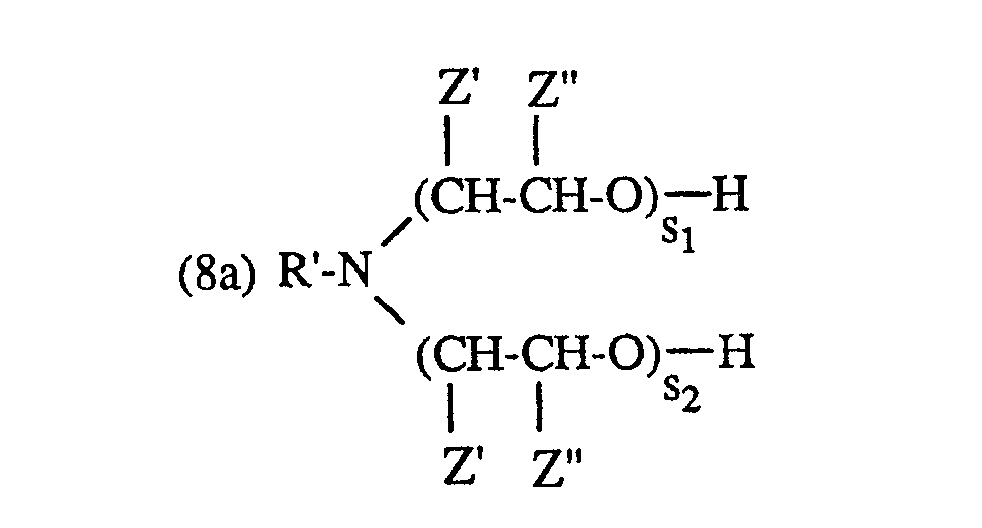
- (c) 2 bis 10 Gew.% einer quaternären Ammoniumverbindung der Formel

- (d) 0,5 bis 25 Gew.% eines Polyalkylenglykolethers der Formel
R‴-O(̵Alkylen-O)̵qH worin R‴ einen Alkyl- oder Alkenylrest mit 4 bis 22 Kohlenwasserstoffatomen bedeutet, "Alkylen" für den Ethylenrest oder Propylenrest steht und q 2 bis 85 ist, und - (e) 0,5 bis 5 Gew.% einer stickstoffhaltigen nichtionogenen Verbindung der Formel

- Nähere Angaben und bevorzugte Kombinationen und Anwendungsformen für Komponenten (b), (c), (d) und (e) können aus den Patentschriften DE-A-1 568 258, DE-A-1 619 385, EP-A-89004 und EP-A-312493 entnommen werden.
- In den folgenden Herstellungs- und Anwendungsbeispielen beziehen sich die Prozentsätze, wenn nicht anders angegeben ist, auf das Gewicht; Teile sind Gewichtsteile. Die Mengen beziehen sich bei den Farbstoffen auf handelsübliche d.h. coupierte Ware und bei den Hilfsmitteln auf Reinsubstanz.
-
- a) 421,2 g Benzylalkohol werden zusammen mit 2,1 g Bortrifluorid-ethyletherat auf 50°C erwarmt. In 60 Minuten lässt man 300 g Styroloxid zutropfen, wobei die Temperatur auf 85°C ansteigt. Das Reaktionsgemisch wird noch 15 Minuten bei 85°C nachgerührt, worauf der Ueberschuss an Benzylalkohol abdestilliert wird. Anschliessend wird im Hochvakuum fraktioniert destilliert. Man erhält 202 g einer farblosen Verbindung der Formel

- b) 243,5 g Benzyloxy-phenylethanol der Formel (i) werden in Gegenwart von 1 % Natriummethylat mit 88 g Ethylenoxid bei 140°C und 2 bar Druck umgesetzt.
Man erhält eine Verbindung der Formel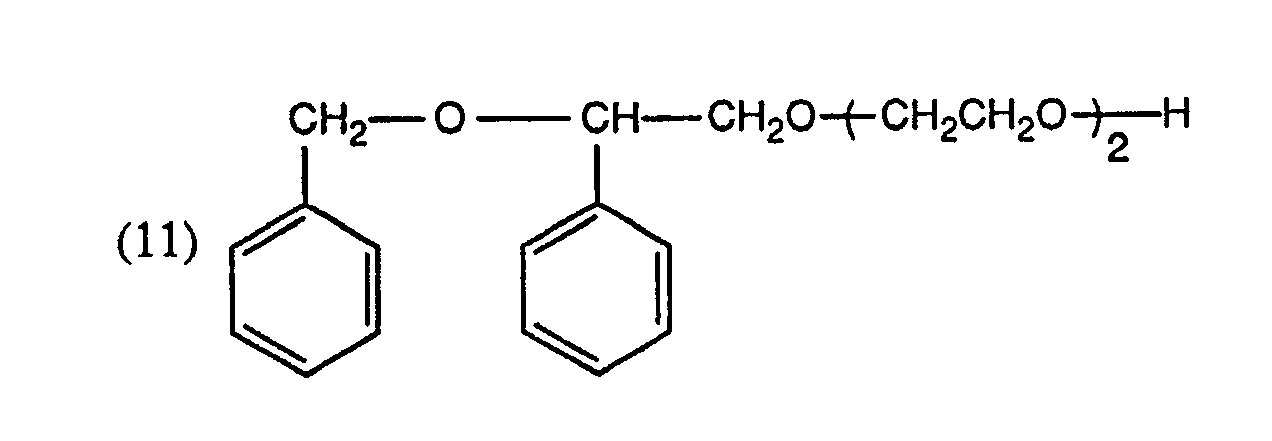
- c) 51 g des Produktes der Formel (11) werden auf 60°C erwärmt und mit 17,2 g Harnstoff 15 Minuten gerührt. Dann gibt man 17,2 g Sulfaminsäure zu, erwärmt auf 70°C, rührt 1 Stunde bei 70°C, erwärmt auf 95°C und rührt weitere 2 Stunden bei 95°C. Nach Zugabe von 85,4 g Wasser erhält man eine 50%-ige klare Lösung der Verbindung der Formel

- Beispiel 2: 51 g des Adduktes der Formel (11) werden zusammen mit 16,2 g Maleinsäureanhydrid auf 70°C erwärmt. Alsdann rührt man 1 Stunde bei 70°C, erhöht die Temperatur auf 90°C und rührt 3 weitere Stunden bei 90°C. Man erhält ein zähflüssiges klares Produkt, welches der Formel

- Beispiel 3: 51 g des Adduktes der Formel (11) werden unter Rühren bei Raumtemperatur mit 7,8 g Phosphorpentoxid gemischt. Dabei steigt die Temperatur auf 72°C. Man rührt anschliessend 4 Stunden bei Raumtemperatur und erhält ein zähflüssiges Gemisch von Phosphorsäureestern der Formeln

- Auf ähnliche Art und Weise wie in den Beispielen 1 bis 3 beschrieben, werden unter Verwendung der entsprechenden Ausgangsprodukte die folgenden nichtionogenen und anionischen Anlagerungsprodukte hergestellt.

- Gemisch eines Phosphorsäure-monoesters und -diesters der Formeln (18a) und (18b)

- Gemisch eines Phosphorsäure-monoesters und -diesters der Formeln (22a) und (22b)

- Beispiel 4: 100 g Wollserge werden in einem Zirkulationsapparat bei 40°C während 15 Minuten mit einer Flotte aus 1,1 Liter Wasser eingenetzt, welche folgende Zusätze enthält:
3,2 g Essigsäure 80 %
5,0 g Natriumsulfat kalz.
1 g des Anlagerungsproduktes der Formel (11). - Alsdann werden 5 g des Farbstoffes Acid Black 172 C.I. 15711 zugegeben. Nach 10 Minuten wird die Färbeflotte im Verlaufe von 45 Minuten auf 85°C erwärmt und das Färbegut unter ständiger Zirkulation 60 Minuten bei dieser Temperatur gehalten. Das Färbebad ist jetzt vollkommen erschöpft (Farbstoff auf der Faser). Anschliessend wird das Färbegut gespült und getrocknet. Man erhält ohne die konventionelle Erwärmung auf Kochtemperatur eine tiefe, egale schwarze Färbung der Wolle. Die Echtheiten entsprechen einer Färbung bei Kochtemperatur.
- Beispiel 5: In einem Zirkulationsfärbeapparat werden 100 kg Kreuzspulen aus Wolle mit einem Materialträger eingefahren. Im Ansatzbehälter werden 1200 l Wasser auf 60°C erwärmt und darin 1200 g eines wässrigen Präparates gelöst, welches bezogen auf das Präparat,
12 % Silikonöl z.B. Dimethylpolysiloxan
15 % 2-Ethyl-n-hexanol
15 % Paraffinöl
2 % eines wasserlöslichen, oberflächenaktiven Siloxanoxyalkylencopolymerisates
8 % des anionischen Anlagerungsproduktes der Formel (13) und
2 % des nichtionogenen Anlagerungsproduktes der Formel (11)
enthält und mit Monoethanolamin auf pH 8 eingestellt ist. Dann wird die Flotte vom Ansatzbehälter durch das Material in den Färbeapparat gepumpt und anschliessend wechselseitig zirkuliert. Durch den Zusatz des Präparates tritt eine spontane Entlüftung des Färbesystems und damit eine gute Durchdringung des Färbegutes ein. - Hierauf gibt man der Flotte 2 kg des Farbstoffes der Formel

- Das in diesem Beispiel verwendete Präparat wird wie folgt hergestellt.
- 12 Teile Silikonöl werden in 15 Teilen 2-Ethyl-n-hexanol gelöst. Hierauf werden unter ständigem Rühren 15 Teile Paraffinöl, 2 Teile eines wasserlöslichen, oberflächenaktiven Siloxanoxyalkylencopolymerisates, 8 Teile des Maleinsäurehalbesters der Formel (13), 2 Teile des Anlagerungsproduktes der Formel (11), 47,6 Teile Wasser und 0,4 Teile Monoethanolamin zugesetzt und 30 Minuten weitergerührt. Man erhält eine lagerstabile Formulierung mit netzender, entlüftender und besonders schaumdämpfender Wirkung.
- Beispiel 6: In einer Haspelkufe werden 100 kg Baumwollwirkware in 3000 l Wasser unter Zusatz von 3 kg eines wässrigen Präparates enthaltend, bezogen auf das Präparat,
7 % eines Silikonöls
11 % 2-Ethyl-n-hexanol und
11 % des anionischen Anlagerungsproduktes der Formel (12) genetzt.
Innerhalb von 30 Sekunden ist die Baumwolle vollständig genetzt und entlüftet. Hierauf werden der Flotte 2 kg eines Farbstoffes der Formel
- Das im Beispiel verwendete Präparat wird wie folgt hergestellt.
- 70 Teile Silikonöl werden zunächst in 110 Teilen 2-Ethyl-n-hexanol bei Raumtemperatur gelöst. Alsdann werden 110 Teile des Anlagerungsproduktes der Formel (12) und nach 30 Minuten 710 Teile Wasser zugegeben, worauf es noch 30 Minuten gerührt wird. Man erhält ein lagerstabiles Produkt mit ausgezeichneten netz- und entlüftenden Eigenschaften.
- Beispiel 7: Auf einem Kurzflotten-Jet werden 100 kg Baumwolltricot in 600 Liter Wasser bei 40°C eingenetzt. In die Flotte gibt man 36 kg Natriumchlorid, 5 kg des Farbstoffes der Formel (102) sowie 0,5 kg einer Zubereitung, enthaltend
186,75 g Mineralöl, (z.B. Shell Oil L 6189),
185 g Maleinsäure-bis-2-ethylhexylester,
10 g Magnesium-distearat
8,25 g N,N-Ethylenbisstearamid
55 g eines Polyoxyethylenderivates von Sorbitantristearat mit 20 Oxyethyleneinheiten z.B. Tween 65
55 g des anionischen Anlagerungsproduktes der Formel (12) - Man färbt die Ware während 45 Minuten bei 40°C. Dann erfolgt der Zusatz von 0,6kg kalziniertem Natriumcarbonat und nach weiteren 5 Minuten von 1,2 kg einer wässrigen 36%igen Natriumhydroxydlösung. Hierauf wird das Tricot während weiteren 40 Minuten gefärbt, anschliessend gespült und nachgewaschen. Man erhält eine echte, egale Rotfärbung des Tricots. Während des Färbeprozesses tritt kein Schäumen und keine Störung des Warenlaufes auf.
- Die in diesem Beispiel verwendete Zubereitung wird wie folgt hergestellt.
- 186,75 g Mineralöl, 185 g Maleinsäure-bis-2-ethylhexylester, 10 g Magnesiumdistearat und 8,25 g N,N-Ethylen-bis-stearamid werden unter ständigem Rühren auf 110°C erwärmt bis eine klare Lösung eintritt. Man kühlt während 5 Minuten auf 45°C ab und verteilt in der Lösung 55 g eines Polyoxyethylenderivates von Sorbitantristearat mit 20 Oxyethyleneinheiten z.B. Tween 65 und 55 g des anionischen Anlagerungsproduktes der Formel (12). Man erhält eine stabile Formulierung, die insbesondere als Schaumdämpfungsmittel in alkalischen Flotten und bei hohen Scherkräften sehr wirksam ist.
- Beispiel 8: 100 Teile eines Polyestergewebes werden in eine 60°C warme Färbeflotte gegeben, die 1300 Teile Wasser, 2 g/l Ammoniumsulfat, 2,5 Teile eines Farbstoffes der Formel

16 Teilen des anionischen Anlagerungsproduktes der Formel (13)
24 Teilen des Anlagerungsproduktes von 18 Mol Ethylenoxid an 1 Mol eines C₁₂-C₁₈-Fettalkoholgemisches und
60 Teilen Benzoesäurebenzylester
enthält und mit Ameisensäure auf pH 5 gestellt ist. Man steigert die Temperatur der Flotte in Verlauf von 30 Minuten auf 130°C und färbt 60 Minuten bei dieser Temperatur. - Danach wird die Flotte auf 70°C abgekühlt, abgelassen und die Ware gespült. Man erhält ohne die übliche reduktive Nachreinigung eine egale und reibechte rote Färbung mit einer hohen Farbstoffausbeute.
- Die in diesem Beispiel verwendete Hilfsmittelformulierung wird wie folgt hergestellt:
- In einem heizbaren Rührgefäss werden 60 Teile Benzoesäurebenzylester auf 60°C unter ständigem Rühren erwärmt und anschliessend 24 Teile des Anlagerungsproduktes von 18 Mol Ethylenoxid an 1 Mol eines C₁₂-C₁₈-Fettalkoholgemisches und 16 Teile des Anlagerungsproduktes der Formel (13) eingerührt. Man erhält nach Abkühlen auf Raumtemperatur eine lagerstabile Formulierung, die insbesondere beim Färben von Polyesterfasern geeignet ist.
- Beispiel 9: 100 Teile eines Wickelkörpers aus texturierten Polyestergarnen werden in einen HT-Färbeapparat, welcher 800 Teile 40°C warmes Wasser, 2 Teile Ammoniumsulfat, 4 Teile eines Farbstoffes der Formel

- Beispiel 10: Ein Polyamid-(6,6)-Teppich (Schlingenflor) wird auf einem Foulard bei 25°C mit einer Zubereitung, welche im Liter
1,2 g eines Farbstoffes der Formel


2 g Verdickungsmittel und
1 g Natriumacetat
enthält und mit Essigsäure auf pH 5-5,5 eingestellt ist, imprägniert. Die Flottenaufnahme beträgt 320 %. Der imprägnierte Teppich wird mit Sattdampf im "Dog-house-steamer" bei 100°C während 5 Minuten gedämpft. Anschliessend wird der Teppich mit kaltem Wasser gespült und getrocknet. Man erhält eine farbkräftige braune Färbung, ohne Grauschleier und mit dem erwarteten Echtheitsstandard. - Beispiel 11: 100 g Wollserge werden in einem Zirkulationsapparat z.B. Ahiba-Turbomat bei 40°C während 15 Minuten mit einer Flotte aus 1,1 Liter Wasser eingenetzt, welche folgende Zusätze enthält:
3,2 g Essigsäure 80 %
5 g Natriumsulfat kalz.
2 g einer wässrigen Zubereitung enthaltend, bezogen auf diese Zubereitung, 30 Gew.% des gemäss Beispiel 1 hergestellten Styroloxidanlagerungsproduktes der Formel (11),
10 Gew.% des Hilfsmittelgemisches A₁ gemäss EP-A-0089004 und
20 Gew.% Triethylenglykolmonobutylether - Alsdann werden 4 g des Farbstoffes Acid Black 172 CI. 15711 zugegeben. Nach 10 Minuten wird die Färbeflotte im Verlauf von 50 Minuten auf 90°C erwärmt und das Färbegut unter ständiger Zirkulation 60 Minuten bei dieser Temperatur gehalten. Anschliessend wird das Färbegut gespült und getrocknet.
- Man erhält eine tiefe, egale und echte schwarze Färbung der Wolle. Das Färbebad ist zu 95 % erschöpft, obwohl bei 90°C gefärbt wird. Die Echtheiten entsprechen einer konventionellen Färbung bei Kochtemperatur (98°C).
Claims (14)
1. Anlagerungsprodukte eines Alkylenoxids und Styroloxid an ein Arylalkanol, ihre saure Ester und deren Salze.
2. Anlagerungsprodukte gemäss Anspruch 1, dadurch gekennzeichnet, dass sie der Formel

entsprechen, worin der Ring A einen unsubstituierten oder einen durch Halogen, Methyl oder C₁-C₃-Alkoxy substituierten Phenylrest,
Q₁ Alkylen mit 1 bis 4 Kohlenstoffatomen,
von Y₁ und Y₂ eines Phenyl und das andere Wasserstoff,
"Alkylen" einen Alkylenrest von 2 oder 3 Kohlenstoffatomen und
m eine Zahl von 1 bis 80 bedeuten.
Q₁ Alkylen mit 1 bis 4 Kohlenstoffatomen,
von Y₁ und Y₂ eines Phenyl und das andere Wasserstoff,
"Alkylen" einen Alkylenrest von 2 oder 3 Kohlenstoffatomen und
m eine Zahl von 1 bis 80 bedeuten.
3. Anlagerungsprodukte gemäss Anspruch 1, dadurch gekennzeichnet, dass sie der Formel

entsprechen, worin
der Ring A einen unsubstituierten oder einen durch Halogen, Methyl oder C₁-C₃-Alkoxy substituierten Phenylrest,
Q₁ Alkylen mit 1 bis 4 Kohlenstoffatomen in den Substituentenpaaren (Y₁ und Y₂) und (Y₃ und Y₄) ein Y Phenyl und das andere Y Wasserstoff,
"Alkylen" einen Alkylenrest von 2 oder 3 Kohlenstoffatomen und
m eine Zahl von 1 bis 80 bedeuten.
der Ring A einen unsubstituierten oder einen durch Halogen, Methyl oder C₁-C₃-Alkoxy substituierten Phenylrest,
Q₁ Alkylen mit 1 bis 4 Kohlenstoffatomen in den Substituentenpaaren (Y₁ und Y₂) und (Y₃ und Y₄) ein Y Phenyl und das andere Y Wasserstoff,
"Alkylen" einen Alkylenrest von 2 oder 3 Kohlenstoffatomen und
m eine Zahl von 1 bis 80 bedeuten.
4. Anlagerungsprodukte gemäss Anspruch 1, dadurch gekennzeichnet, dass sie der Formel

entsprechen, worin
der Ring A einen unsubstituierten oder einen durch Halogen, Methyl oder C₁-C₃-Alkoxy substituierten Phenylrest,
Q₁ Alkylen mit 1 bis 4 Kohlenstoffatomen,
von Y₁ und Y₂ eines Phenyl und das andere Wasserstoff,
"Alkylen" einen Alkylenrest von 2 oder 3 Kohlenstoffatomen und
m eine Zahl von 1 bis 80 bedeuten.
der Ring A einen unsubstituierten oder einen durch Halogen, Methyl oder C₁-C₃-Alkoxy substituierten Phenylrest,
Q₁ Alkylen mit 1 bis 4 Kohlenstoffatomen,
von Y₁ und Y₂ eines Phenyl und das andere Wasserstoff,
"Alkylen" einen Alkylenrest von 2 oder 3 Kohlenstoffatomen und
m eine Zahl von 1 bis 80 bedeuten.
5. Anlagerungsprodukte gemäss einem der Ansprüche 2 bis 4, dadurch gekennzeichnet, dass "Alkylen" Ethylen bedeutet.
6. Anlagerungsprodukte gemäss einem der Ansprüche 2 bis 5, dadurch gekennzeichnet, dass

den Benzylrest bedeutet.
7. Anlagerungsprodukte gemäss einem der Ansprüche 2 bis 6, dadurch gekennzeichnet, dass m 2 bis 40, vorzugsweise 2 bis 10 bedeutet.
8. Anlagerungsprodukte gemäss Anspruch 2, dadurch gekennzeichnet, dass sie der Formel

entsprechen, worin der Ring A einen unsubstituierten oder einen durch Halogen, Methyl oder Methoxy substituierten Phenylrest, von Y₁ und Y₂ eines Phenyl und das andere Wasserstoff und m₁ 2 bis 40, vorzugsweise 2 bis 10 bedeuten.
9. Saure Ester gemäss Anspruch 1, dadurch gekennzeichnet, dass sie der Formel

entsprechen, worin der Ring A einen unsubstituierten oder einen durch Halogen, Methyl oder Methoxy substituierten Phenylrest,
von Y₁ und Y₂ eines Phenyl und das andere Wasserstoff, X den Maleinsäure-, Sulfobernsteinsäure-, Schwefelsäure- oder Phosphorsäurerest und m₁ 2 bis 40, vorzugsweise 2 bis 10 bedeuten.
von Y₁ und Y₂ eines Phenyl und das andere Wasserstoff, X den Maleinsäure-, Sulfobernsteinsäure-, Schwefelsäure- oder Phosphorsäurerest und m₁ 2 bis 40, vorzugsweise 2 bis 10 bedeuten.
10. Saure Ester gemäss Anspruch 1 dadurch gekennzeichnet, dass sie der Formel

entsprechen, worin der Ring A einen unsubstituierten oder einen durch Halogen, Methyl oder Methoxy substituierten Phenylrest,
von Y₁ und Y₂ eines Phenyl und das andere Wasserstoff,
von Z₁ und Z₂ eines Methyl und das andere Wasserstoff,
X den Maleinsäure-, Sulfobernsteinsäure-, Schwefelsäure- oder Phosphorsäurerest und die Summe von n₁ + n₂ 2 bis 30, vorzugsweise 4 bis 18 bedeuten.
von Y₁ und Y₂ eines Phenyl und das andere Wasserstoff,
von Z₁ und Z₂ eines Methyl und das andere Wasserstoff,
X den Maleinsäure-, Sulfobernsteinsäure-, Schwefelsäure- oder Phosphorsäurerest und die Summe von n₁ + n₂ 2 bis 30, vorzugsweise 4 bis 18 bedeuten.
11. Saure Ester gemäss Anspruch 1 dadurch gekennzeichnet, dass sie der Formel

entsprechen, worin der Ring A einen unsubstituierten oder einen durch Halogen, Methyl oder Methoxy substituierten Phenylrest,
von Y₁ und Y₂ eines Phenyl und das andere Wasserstoff,
von Z₁ und Z₂ eines Methyl und das andere Wasserstoff,
X den Maleinsäure-, Sulfobernsteinsäure-, Schwefelsäure- oder Phosphorsäurerest und die Summe von n₁ + n₂ 2 bis 30, vorzugsweise 4 bis 18 bedeuten.
von Y₁ und Y₂ eines Phenyl und das andere Wasserstoff,
von Z₁ und Z₂ eines Methyl und das andere Wasserstoff,
X den Maleinsäure-, Sulfobernsteinsäure-, Schwefelsäure- oder Phosphorsäurerest und die Summe von n₁ + n₂ 2 bis 30, vorzugsweise 4 bis 18 bedeuten.
12. Wässerige oder wasserfreie Zubereitung, welche, bezogen auf die gesamte Zubereitung,
(A) 2 bis 50 Gew.-% eines sauren Esters einer Verbindung der Formel 
worin der Ring A einen unsubstituierten oder einen durch Halogen, Methyl oder
C₁-C₃-Alkoxy substituierten Phenylrest,
Q₁ Alkylen mit 1 bis 4 Kohlenstoffatomen, besonders Methylen,
von Y₁ und Y₂ eines Phenyl und das andere Wasserstoff,
"Alkylen" einen Alkylenrest von 2 oder 3 Kohlenstoffatomen,
m eine Zahl von 1 bis 80 und m₁ eine Zahl von 2 bis 40 bedeuten,
(B) 5 bis 50 Gew.-% eines nichtionogenen Tensides und mindestens eine der folgenden Komponenten
(C) 1 bis 30 Gew.-% eines Silikonöls,
(D) 10 bis 60 Gew.-% eines Mineralöls,
(E) 20 bis 45 Gew.-% eines Dialkylesters einer ethylenisch ungesättigten aliphatischen Dicarbonsäure,
(F) 10 bis 70 Gew.-% eines Diffusionsbeschleunigers, insbesondere eines aliphatischen oder aromatischen Carbonsäureesters oder eines Alkylbenzols,
(G) 0,5 bis 5 Gew.-% eines Salzes einer C₁₀-C₂₄-Fettsäure und eines mehrwertigen Metalls und
(H) 0,5 bis 3 Gew.-% eines C₁-C₄-Alkylendiamids einer Fettsäure mit 10 bis 24 Kohlenstoffatomen
enthält.
(A) 2 bis 50 Gew.-% eines sauren Esters einer Verbindung der Formel
C₁-C₃-Alkoxy substituierten Phenylrest,
Q₁ Alkylen mit 1 bis 4 Kohlenstoffatomen, besonders Methylen,
von Y₁ und Y₂ eines Phenyl und das andere Wasserstoff,
"Alkylen" einen Alkylenrest von 2 oder 3 Kohlenstoffatomen,
m eine Zahl von 1 bis 80 und m₁ eine Zahl von 2 bis 40 bedeuten,
(B) 5 bis 50 Gew.-% eines nichtionogenen Tensides und mindestens eine der folgenden Komponenten
(C) 1 bis 30 Gew.-% eines Silikonöls,
(D) 10 bis 60 Gew.-% eines Mineralöls,
(E) 20 bis 45 Gew.-% eines Dialkylesters einer ethylenisch ungesättigten aliphatischen Dicarbonsäure,
(F) 10 bis 70 Gew.-% eines Diffusionsbeschleunigers, insbesondere eines aliphatischen oder aromatischen Carbonsäureesters oder eines Alkylbenzols,
(G) 0,5 bis 5 Gew.-% eines Salzes einer C₁₀-C₂₄-Fettsäure und eines mehrwertigen Metalls und
(H) 0,5 bis 3 Gew.-% eines C₁-C₄-Alkylendiamids einer Fettsäure mit 10 bis 24 Kohlenstoffatomen
enthält.
13. Wässerige Zubereitung, welche bezogen auf die gesamte Zubereitung
(a) 15 bis 50 Gew.% eines nichtionogenen Styroloxidproduktes der Formel 
worin
der Ring A einen unsubstituierten oder einen durch Halogen, Methyl oder C₁-C₃-Alkoxy substituierten Phenylrest,
Q₁ Alkylen mit 1 bis 4 Kohlenstoffatomen, besonders Methylen,
von Y₁ und Y₂ eines Phenyl und das andere Wasserstoff,
"Alkylen", einen Alkylenrest von 2 oder 3 Kohlenstoffatomen,
m eine Zahl von 1 bis 80 und m₁ eine Zahl von 2 bis 40 bedeuten,
(b) 1 bis 5 Gew.% eines sauren Esters oder dessen Salzes, einer Verbindung der Formel 
oder eines N-quaternierten Produktes des sauren Esters oder dessen Salzes, worin R′ einen Alkyl- oder Alkenylrest mit 12 bis 22 Kohlenstoffatomen, von Z′ und Z˝ eines Wasserstoff, Methyl oder Phenyl und das andere Wasserstoff und s₁ und s₂ ganze Zahlen bedeuen, wobei die Summe s₁ + s₂ 2 bis 100 ist,
(c) 2 bis 10 Gew.% einer quaternären Ammoniumverbindung der Formel 
in der R˝ einen Alkyl- oder Alkenylrest mit 12 bis 22 Kohlenstoffatomen, V′ einen gegebenenfalls substituierten Alkylrest, von Z′ und Z˝ eines Wasserstoff, Methyl oder Phenyl und das andere Wasserstoff, An⊖ ein Anion einer anorganischen oder organischen Säure und p₁ und p₂ je ganze Zahlen bedeuten, wobei die Summe von p₁ und p₂ 2 bis 100 ist, und gegebenenfalls zusätzlich mindestens eine der folgenden Komponenten:
(d) 0,5 bis 25 Gew.% eines Polyalkylenglykolethers der Formel

worin R˝' einen Alkyl- oder Alkenylrest mit 4 bis 22 Kohlenwasserstoffatomen bedeutet,
"Alkylen" für den Ethylenrest oder Propylenrest steht und q 2 bis 85 ist, und
(e) 0,5 bis 5 Gew.% einer stickstoffhaltigen, nichtionogenen Verbindung der Formel 
worin R˝ einen Alkyl- oder Alkenylrest mit 12 bis 22 Kohlenstoffatomen, von Y′ und Y˝ eines Phenyl und das andere Wasserstoff, und x und y ganze Zahlen bedeuten, wobei die Summe von x und y 80 bis 140 ist, enthält.
(a) 15 bis 50 Gew.% eines nichtionogenen Styroloxidproduktes der Formel
der Ring A einen unsubstituierten oder einen durch Halogen, Methyl oder C₁-C₃-Alkoxy substituierten Phenylrest,
Q₁ Alkylen mit 1 bis 4 Kohlenstoffatomen, besonders Methylen,
von Y₁ und Y₂ eines Phenyl und das andere Wasserstoff,
"Alkylen", einen Alkylenrest von 2 oder 3 Kohlenstoffatomen,
m eine Zahl von 1 bis 80 und m₁ eine Zahl von 2 bis 40 bedeuten,
(b) 1 bis 5 Gew.% eines sauren Esters oder dessen Salzes, einer Verbindung der Formel
(c) 2 bis 10 Gew.% einer quaternären Ammoniumverbindung der Formel
(d) 0,5 bis 25 Gew.% eines Polyalkylenglykolethers der Formel
worin R˝' einen Alkyl- oder Alkenylrest mit 4 bis 22 Kohlenwasserstoffatomen bedeutet,
"Alkylen" für den Ethylenrest oder Propylenrest steht und q 2 bis 85 ist, und
(e) 0,5 bis 5 Gew.% einer stickstoffhaltigen, nichtionogenen Verbindung der Formel
14. Verwendung der Verbindungen gemäss einem der Ansprüche 1 bis 11 oder der Zubereitung gemäss Anspruch 12 oder 13 beim Veredeln von natürlichem oder synthetischem Fasermaterial, insbesondere von natürlichen oder synthetischen Polyamidfasern, Polyesterfasern oder Cellulosefasern mit oder ohne entsprechenden Farbstoffen.
Applications Claiming Priority (2)
| Application Number | Priority Date | Filing Date | Title |
|---|---|---|---|
| CH349689 | 1989-09-27 | ||
| CH3496/89 | 1989-09-27 |
Publications (1)
| Publication Number | Publication Date |
|---|---|
| EP0420807A1 true EP0420807A1 (de) | 1991-04-03 |
Family
ID=4257249
Family Applications (1)
| Application Number | Title | Priority Date | Filing Date |
|---|---|---|---|
| EP90810713A Withdrawn EP0420807A1 (de) | 1989-09-27 | 1990-09-18 | Anlagerungsprodukte von Alkylenoxid und Styroloxid an Arylalkanole |
Country Status (4)
| Country | Link |
|---|---|
| US (1) | US5126474A (de) |
| EP (1) | EP0420807A1 (de) |
| JP (1) | JPH03122118A (de) |
| CA (1) | CA2026134A1 (de) |
Families Citing this family (5)
| Publication number | Priority date | Publication date | Assignee | Title |
|---|---|---|---|---|
| DE59510179D1 (de) * | 1994-11-08 | 2002-05-29 | Ciba Sc Holding Ag | Verfahren zum Färben von wollhaltigen Fasermaterialien |
| US5667727A (en) | 1995-06-26 | 1997-09-16 | Baker Hughes Incorporated | Polymer compositions for demulsifying crude oil |
| DE59903364D1 (de) * | 1998-02-19 | 2002-12-19 | Goldschmidt Ag Th | Phosphorsäureester und ihre Verwendung als Dispergiermittel |
| DE19940797A1 (de) * | 1999-08-27 | 2001-03-01 | Goldschmidt Ag Th | Durch Akoxylierung erhaltene blockcopolymere, styrenoxidhaltige Polyalkylenoxide und deren Verwendung |
| WO2025144778A1 (en) | 2023-12-28 | 2025-07-03 | Dexcom, Inc. | Systems and methods for providing therapy management guidance related to liver disease decompensation to users with liver disease |
Citations (5)
| Publication number | Priority date | Publication date | Assignee | Title |
|---|---|---|---|---|
| EP0173879A1 (de) * | 1984-08-09 | 1986-03-12 | Dai-Ichi Kogyo Seiyaku Co., Ltd. | Polyether mit tertiär-alkoholischen Endgruppen |
| EP0197001A1 (de) * | 1985-03-07 | 1986-10-08 | Ciba-Geigy Ag | Hilfsmittelgemisch und seine Verwendung als Färberei- oder Textilhilfsmittel |
| EP0197005A1 (de) * | 1985-03-26 | 1986-10-08 | Ciba-Geigy Ag | Maleinsäure- oder Phthalsäurehalbester von alkoxylierten Fettaminen |
| EP0378048A1 (de) * | 1988-12-23 | 1990-07-18 | Ciba-Geigy Ag | Styroloxid-Anlagerungsprodukte |
| EP0382138A1 (de) * | 1989-02-08 | 1990-08-16 | Ciba-Geigy Ag | Hilfsmittelgemisch und seine Verwendung beim Färben von synthetischen Fasermaterialien |
Family Cites Families (1)
| Publication number | Priority date | Publication date | Assignee | Title |
|---|---|---|---|---|
| US2888489A (en) * | 1957-01-24 | 1959-05-26 | Dow Chemical Co | Polyglycol ether surface-active agents |
-
1990
- 1990-09-18 EP EP90810713A patent/EP0420807A1/de not_active Withdrawn
- 1990-09-20 US US07/585,746 patent/US5126474A/en not_active Expired - Fee Related
- 1990-09-25 CA CA002026134A patent/CA2026134A1/en not_active Abandoned
- 1990-09-27 JP JP2255441A patent/JPH03122118A/ja active Pending
Patent Citations (5)
| Publication number | Priority date | Publication date | Assignee | Title |
|---|---|---|---|---|
| EP0173879A1 (de) * | 1984-08-09 | 1986-03-12 | Dai-Ichi Kogyo Seiyaku Co., Ltd. | Polyether mit tertiär-alkoholischen Endgruppen |
| EP0197001A1 (de) * | 1985-03-07 | 1986-10-08 | Ciba-Geigy Ag | Hilfsmittelgemisch und seine Verwendung als Färberei- oder Textilhilfsmittel |
| EP0197005A1 (de) * | 1985-03-26 | 1986-10-08 | Ciba-Geigy Ag | Maleinsäure- oder Phthalsäurehalbester von alkoxylierten Fettaminen |
| EP0378048A1 (de) * | 1988-12-23 | 1990-07-18 | Ciba-Geigy Ag | Styroloxid-Anlagerungsprodukte |
| EP0382138A1 (de) * | 1989-02-08 | 1990-08-16 | Ciba-Geigy Ag | Hilfsmittelgemisch und seine Verwendung beim Färben von synthetischen Fasermaterialien |
Also Published As
| Publication number | Publication date |
|---|---|
| US5126474A (en) | 1992-06-30 |
| JPH03122118A (ja) | 1991-05-24 |
| CA2026134A1 (en) | 1991-03-28 |
Similar Documents
| Publication | Publication Date | Title |
|---|---|---|
| EP0102926B1 (de) | Färbereihilfsmittel und seine Verwendung beim Färben oder Bedrucken von synthetischen Polyamidfasermaterialien | |
| DE2625707C3 (de) | Netz- und Schaumdämpfungsmittel für wäßrige Systeme auf der Basis von anionischen Tensiden und Propylenoxidumsetzungsprodukten | |
| EP0263069B1 (de) | Entschäumungsmittel für wässerige Systeme und ihre Verwendung | |
| EP0074923B1 (de) | Färbereihilfsmittel und seine Verwendung beim Färben oder Bedrucken von synthetischen Polyamidfasermaterialien | |
| CH637304A5 (de) | Schaumdaempfungsmittel fuer waessrige systeme. | |
| EP0207002B1 (de) | Entschäumungsmittel für wässrige Systeme und ihre Verwendung | |
| EP0403718A2 (de) | Styroloxid-Produkte | |
| EP0360736A1 (de) | Wässriges, hartwasserbeständiges Netz- und Waschmittel, seine Herstellung und Verwendung in der Textilvorbehandlung | |
| DE2802305A1 (de) | Carboxylgruppenhaltige propylenoxyd-polyaddukte, verfahren zu ihrer herstellung und ihre verwendung als faerbereihilfsmittel | |
| EP0378048A1 (de) | Styroloxid-Anlagerungsprodukte | |
| EP0406168B1 (de) | Phenylalkylglycidether-Anlagerungsprodukte | |
| EP0312493B1 (de) | Verfahren zum Färben von natürlichen Polyamidfasern mit Reaktivfarbstoffen | |
| EP0047882B1 (de) | Formaldehydkondensate enthaltende Dispergiermittel | |
| US5126474A (en) | Polyadducts of alkylene oxide and styrene oxide with aryl alkanols | |
| DE1469603A1 (de) | Verfahren zur Trocknung und Fixierung auf Acrylnitrilpolymerisate enthaltendes oder daraus bestehendes Fasergut aufgeklotzter basischer Farbstoffe mit Trockenhitze | |
| US5250202A (en) | Phenyalkyl glycidyl ether addition products | |
| EP0442844A1 (de) | Verfahren zum Färben von Wolle mit Reaktivfarbstoffen | |
| EP0378049B1 (de) | Alkalibeständiges silikonölfreies Entschäumungsmittel | |
| DE2802304A1 (de) | Verfahren zum faerben von wollhaltigem fasermaterial | |
| EP0064029B1 (de) | Hilfsmittelgemisch und seine Verwendung als Faltenfreimittel beim Färben oder optischen Aufhellen von Polyesterfasern enthaltenden Textilmaterialien | |
| US5232628A (en) | Polyadducts of alkylene oxide and styrene oxide with aryl alkanols | |
| US4276046A (en) | Process for dyeing polyester fibres of fibre mixtures containing them | |
| DE19848894A1 (de) | Phosphorsäureester | |
| DE3900699A1 (de) | Verwendung von monocarbonsaeurepolyoxyalkylester-sulfonaten als schaumarme netzmittel in waessrigen alkalischen behandlungsmitteln fuer textile flaechengebilde | |
| DE2116560A1 (de) | Sulfomerte Phenolether |
Legal Events
| Date | Code | Title | Description |
|---|---|---|---|
| PUAI | Public reference made under article 153(3) epc to a published international application that has entered the european phase |
Free format text: ORIGINAL CODE: 0009012 |
|
| 17P | Request for examination filed |
Effective date: 19900921 |
|
| AK | Designated contracting states |
Kind code of ref document: A1 Designated state(s): CH DE FR GB IT LI |
|
| 17Q | First examination report despatched |
Effective date: 19931130 |
|
| STAA | Information on the status of an ep patent application or granted ep patent |
Free format text: STATUS: THE APPLICATION IS DEEMED TO BE WITHDRAWN |
|
| 18D | Application deemed to be withdrawn |
Effective date: 19940412 |