EP0420811A2 - Phosphorhaltige copolymere und deren Verwendung - Google Patents
Phosphorhaltige copolymere und deren Verwendung Download PDFInfo
- Publication number
- EP0420811A2 EP0420811A2 EP90810719A EP90810719A EP0420811A2 EP 0420811 A2 EP0420811 A2 EP 0420811A2 EP 90810719 A EP90810719 A EP 90810719A EP 90810719 A EP90810719 A EP 90810719A EP 0420811 A2 EP0420811 A2 EP 0420811A2
- Authority
- EP
- European Patent Office
- Prior art keywords
- epoxy
- phosphorus
- diphosphite
- epoxy resin
- glycidyl ether
- Prior art date
- Legal status (The legal status is an assumption and is not a legal conclusion. Google has not performed a legal analysis and makes no representation as to the accuracy of the status listed.)
- Withdrawn
Links
- OAICVXFJPJFONN-UHFFFAOYSA-N Phosphorus Chemical compound [P] OAICVXFJPJFONN-UHFFFAOYSA-N 0.000 title claims abstract description 33
- 229920001577 copolymer Polymers 0.000 title claims abstract description 29
- 229920000647 polyepoxide Polymers 0.000 claims abstract description 52
- 239000003822 epoxy resin Substances 0.000 claims abstract description 49
- ZJIPHXXDPROMEF-UHFFFAOYSA-N dihydroxyphosphanyl dihydrogen phosphite Chemical compound OP(O)OP(O)O ZJIPHXXDPROMEF-UHFFFAOYSA-N 0.000 claims abstract description 39
- 239000004593 Epoxy Substances 0.000 claims abstract description 38
- 229910052698 phosphorus Inorganic materials 0.000 claims abstract description 36
- 239000011574 phosphorus Substances 0.000 claims abstract description 32
- LNEPOXFFQSENCJ-UHFFFAOYSA-N haloperidol Chemical compound C1CC(O)(C=2C=CC(Cl)=CC=2)CCN1CCCC(=O)C1=CC=C(F)C=C1 LNEPOXFFQSENCJ-UHFFFAOYSA-N 0.000 claims abstract description 27
- 150000001875 compounds Chemical class 0.000 claims abstract description 26
- 238000006243 chemical reaction Methods 0.000 claims abstract description 20
- 125000004178 (C1-C4) alkyl group Chemical group 0.000 claims abstract description 3
- YXFVVABEGXRONW-UHFFFAOYSA-N Toluene Chemical compound CC1=CC=CC=C1 YXFVVABEGXRONW-UHFFFAOYSA-N 0.000 claims description 30
- -1 alkyl glycidyl ether Chemical compound 0.000 claims description 30
- 239000000203 mixture Substances 0.000 claims description 26
- 238000000034 method Methods 0.000 claims description 21
- 229920005989 resin Polymers 0.000 claims description 17
- 239000011347 resin Substances 0.000 claims description 17
- 239000003795 chemical substances by application Substances 0.000 claims description 16
- 238000002360 preparation method Methods 0.000 claims description 13
- 239000000126 substance Substances 0.000 claims description 12
- 239000003054 catalyst Substances 0.000 claims description 11
- WXZMFSXDPGVJKK-UHFFFAOYSA-N pentaerythritol Chemical compound OCC(CO)(CO)CO WXZMFSXDPGVJKK-UHFFFAOYSA-N 0.000 claims description 11
- LCFVJGUPQDGYKZ-UHFFFAOYSA-N Bisphenol A diglycidyl ether Chemical compound C=1C=C(OCC2OC2)C=CC=1C(C)(C)C(C=C1)=CC=C1OCC1CO1 LCFVJGUPQDGYKZ-UHFFFAOYSA-N 0.000 claims description 8
- CTQNGGLPUBDAKN-UHFFFAOYSA-N O-Xylene Chemical compound CC1=CC=CC=C1C CTQNGGLPUBDAKN-UHFFFAOYSA-N 0.000 claims description 8
- 239000008096 xylene Substances 0.000 claims description 8
- 229920003986 novolac Polymers 0.000 claims description 7
- ZJCCRDAZUWHFQH-UHFFFAOYSA-N Trimethylolpropane Chemical compound CCC(CO)(CO)CO ZJCCRDAZUWHFQH-UHFFFAOYSA-N 0.000 claims description 6
- FQYUMYWMJTYZTK-UHFFFAOYSA-N Phenyl glycidyl ether Chemical compound C1OC1COC1=CC=CC=C1 FQYUMYWMJTYZTK-UHFFFAOYSA-N 0.000 claims description 5
- 125000000217 alkyl group Chemical group 0.000 claims description 5
- GYZLOYUZLJXAJU-UHFFFAOYSA-N diglycidyl ether Chemical compound C1OC1COCC1CO1 GYZLOYUZLJXAJU-UHFFFAOYSA-N 0.000 claims description 5
- AWMVMTVKBNGEAK-UHFFFAOYSA-N Styrene oxide Chemical compound C1OC1C1=CC=CC=C1 AWMVMTVKBNGEAK-UHFFFAOYSA-N 0.000 claims description 4
- 238000005809 transesterification reaction Methods 0.000 claims description 4
- YSUQLAYJZDEMOT-UHFFFAOYSA-N 2-(butoxymethyl)oxirane Chemical group CCCCOCC1CO1 YSUQLAYJZDEMOT-UHFFFAOYSA-N 0.000 claims description 3
- 125000004432 carbon atom Chemical group C* 0.000 claims description 3
- ZWAJLVLEBYIOTI-UHFFFAOYSA-N cyclohexene oxide Chemical compound C1CCCC2OC21 ZWAJLVLEBYIOTI-UHFFFAOYSA-N 0.000 claims description 3
- FWFSEYBSWVRWGL-UHFFFAOYSA-N cyclohexene oxide Natural products O=C1CCCC=C1 FWFSEYBSWVRWGL-UHFFFAOYSA-N 0.000 claims description 3
- 125000002496 methyl group Chemical group [H]C([H])([H])* 0.000 claims description 3
- 125000004108 n-butyl group Chemical group [H]C([H])([H])C([H])([H])C([H])([H])C([H])([H])* 0.000 claims description 3
- 150000007824 aliphatic compounds Chemical class 0.000 claims description 2
- 150000001336 alkenes Chemical class 0.000 claims description 2
- 125000000623 heterocyclic group Chemical group 0.000 claims description 2
- 238000010992 reflux Methods 0.000 claims description 2
- JRZJOMJEPLMPRA-UHFFFAOYSA-N olefin Natural products CCCCCCCC=C JRZJOMJEPLMPRA-UHFFFAOYSA-N 0.000 claims 1
- OJMIONKXNSYLSR-UHFFFAOYSA-N phosphorous acid Chemical compound OP(O)O OJMIONKXNSYLSR-UHFFFAOYSA-N 0.000 claims 1
- 239000003063 flame retardant Substances 0.000 abstract description 8
- 239000004033 plastic Substances 0.000 abstract description 7
- 229920003023 plastic Polymers 0.000 abstract description 7
- RNFJDJUURJAICM-UHFFFAOYSA-N 2,2,4,4,6,6-hexaphenoxy-1,3,5-triaza-2$l^{5},4$l^{5},6$l^{5}-triphosphacyclohexa-1,3,5-triene Chemical compound N=1P(OC=2C=CC=CC=2)(OC=2C=CC=CC=2)=NP(OC=2C=CC=CC=2)(OC=2C=CC=CC=2)=NP=1(OC=1C=CC=CC=1)OC1=CC=CC=C1 RNFJDJUURJAICM-UHFFFAOYSA-N 0.000 abstract description 6
- 239000000654 additive Substances 0.000 abstract description 6
- 238000005227 gel permeation chromatography Methods 0.000 description 12
- 239000000047 product Substances 0.000 description 12
- IISBACLAFKSPIT-UHFFFAOYSA-N bisphenol A Chemical compound C=1C=C(O)C=CC=1C(C)(C)C1=CC=C(O)C=C1 IISBACLAFKSPIT-UHFFFAOYSA-N 0.000 description 11
- AQSJGOWTSHOLKH-UHFFFAOYSA-N phosphite(3-) Chemical group [O-]P([O-])[O-] AQSJGOWTSHOLKH-UHFFFAOYSA-N 0.000 description 9
- YBRVSVVVWCFQMG-UHFFFAOYSA-N 4,4'-diaminodiphenylmethane Chemical compound C1=CC(N)=CC=C1CC1=CC=C(N)C=C1 YBRVSVVVWCFQMG-UHFFFAOYSA-N 0.000 description 8
- ABLZXFCXXLZCGV-UHFFFAOYSA-N Phosphorous acid Chemical class OP(O)=O ABLZXFCXXLZCGV-UHFFFAOYSA-N 0.000 description 8
- 239000002253 acid Substances 0.000 description 8
- 150000007513 acids Chemical class 0.000 description 8
- 229920000642 polymer Polymers 0.000 description 7
- PXKLMJQFEQBVLD-UHFFFAOYSA-N bisphenol F Chemical compound C1=CC(O)=CC=C1CC1=CC=C(O)C=C1 PXKLMJQFEQBVLD-UHFFFAOYSA-N 0.000 description 6
- 229910052757 nitrogen Inorganic materials 0.000 description 6
- ISWSIDIOOBJBQZ-UHFFFAOYSA-N phenol group Chemical group C1(=CC=CC=C1)O ISWSIDIOOBJBQZ-UHFFFAOYSA-N 0.000 description 6
- 150000002989 phenols Chemical class 0.000 description 5
- 239000011734 sodium Substances 0.000 description 5
- 239000002904 solvent Substances 0.000 description 5
- RTZKZFJDLAIYFH-UHFFFAOYSA-N Diethyl ether Chemical compound CCOCC RTZKZFJDLAIYFH-UHFFFAOYSA-N 0.000 description 4
- QIGBRXMKCJKVMJ-UHFFFAOYSA-N Hydroquinone Chemical compound OC1=CC=C(O)C=C1 QIGBRXMKCJKVMJ-UHFFFAOYSA-N 0.000 description 4
- DGAQECJNVWCQMB-PUAWFVPOSA-M Ilexoside XXIX Chemical compound C[C@@H]1CC[C@@]2(CC[C@@]3(C(=CC[C@H]4[C@]3(CC[C@@H]5[C@@]4(CC[C@@H](C5(C)C)OS(=O)(=O)[O-])C)C)[C@@H]2[C@]1(C)O)C)C(=O)O[C@H]6[C@@H]([C@H]([C@@H]([C@H](O6)CO)O)O)O.[Na+] DGAQECJNVWCQMB-PUAWFVPOSA-M 0.000 description 4
- KKEYFWRCBNTPAC-UHFFFAOYSA-N Terephthalic acid Chemical compound OC(=O)C1=CC=C(C(O)=O)C=C1 KKEYFWRCBNTPAC-UHFFFAOYSA-N 0.000 description 4
- 150000001412 amines Chemical class 0.000 description 4
- 150000008064 anhydrides Chemical class 0.000 description 4
- WTEOIRVLGSZEPR-UHFFFAOYSA-N boron trifluoride Chemical compound FB(F)F WTEOIRVLGSZEPR-UHFFFAOYSA-N 0.000 description 4
- 239000000835 fiber Substances 0.000 description 4
- 238000009472 formulation Methods 0.000 description 4
- 229910052739 hydrogen Inorganic materials 0.000 description 4
- QQVIHTHCMHWDBS-UHFFFAOYSA-N isophthalic acid Chemical compound OC(=O)C1=CC=CC(C(O)=O)=C1 QQVIHTHCMHWDBS-UHFFFAOYSA-N 0.000 description 4
- 238000000465 moulding Methods 0.000 description 4
- 239000004848 polyfunctional curative Substances 0.000 description 4
- 235000013824 polyphenols Nutrition 0.000 description 4
- GHMLBKRAJCXXBS-UHFFFAOYSA-N resorcinol Chemical compound OC1=CC=CC(O)=C1 GHMLBKRAJCXXBS-UHFFFAOYSA-N 0.000 description 4
- 229910052708 sodium Inorganic materials 0.000 description 4
- XLYOFNOQVPJJNP-UHFFFAOYSA-N water Substances O XLYOFNOQVPJJNP-UHFFFAOYSA-N 0.000 description 4
- GXURZKWLMYOCDX-UHFFFAOYSA-N 2,2-bis(hydroxymethyl)propane-1,3-diol;dihydroxyphosphanyl dihydrogen phosphite Chemical class OP(O)OP(O)O.OCC(CO)(CO)CO GXURZKWLMYOCDX-UHFFFAOYSA-N 0.000 description 3
- VPWNQTHUCYMVMZ-UHFFFAOYSA-N 4,4'-sulfonyldiphenol Chemical compound C1=CC(O)=CC=C1S(=O)(=O)C1=CC=C(O)C=C1 VPWNQTHUCYMVMZ-UHFFFAOYSA-N 0.000 description 3
- 229920000049 Carbon (fiber) Polymers 0.000 description 3
- BRLQWZUYTZBJKN-UHFFFAOYSA-N Epichlorohydrin Chemical compound ClCC1CO1 BRLQWZUYTZBJKN-UHFFFAOYSA-N 0.000 description 3
- LYCAIKOWRPUZTN-UHFFFAOYSA-N Ethylene glycol Chemical compound OCCO LYCAIKOWRPUZTN-UHFFFAOYSA-N 0.000 description 3
- WSFSSNUMVMOOMR-UHFFFAOYSA-N Formaldehyde Chemical compound O=C WSFSSNUMVMOOMR-UHFFFAOYSA-N 0.000 description 3
- OKKJLVBELUTLKV-UHFFFAOYSA-N Methanol Chemical compound OC OKKJLVBELUTLKV-UHFFFAOYSA-N 0.000 description 3
- ZMXDDKWLCZADIW-UHFFFAOYSA-N N,N-Dimethylformamide Chemical compound CN(C)C=O ZMXDDKWLCZADIW-UHFFFAOYSA-N 0.000 description 3
- ZMANZCXQSJIPKH-UHFFFAOYSA-N Triethylamine Chemical compound CCN(CC)CC ZMANZCXQSJIPKH-UHFFFAOYSA-N 0.000 description 3
- 238000010521 absorption reaction Methods 0.000 description 3
- 150000001298 alcohols Chemical class 0.000 description 3
- 125000001931 aliphatic group Chemical group 0.000 description 3
- 125000003118 aryl group Chemical group 0.000 description 3
- 229910052799 carbon Inorganic materials 0.000 description 3
- 239000004917 carbon fiber Substances 0.000 description 3
- 125000003178 carboxy group Chemical group [H]OC(*)=O 0.000 description 3
- QGBSISYHAICWAH-UHFFFAOYSA-N dicyandiamide Chemical class NC(N)=NC#N QGBSISYHAICWAH-UHFFFAOYSA-N 0.000 description 3
- MTHSVFCYNBDYFN-UHFFFAOYSA-N diethylene glycol Chemical compound OCCOCCO MTHSVFCYNBDYFN-UHFFFAOYSA-N 0.000 description 3
- 238000000921 elemental analysis Methods 0.000 description 3
- 150000002118 epoxides Chemical class 0.000 description 3
- 125000003700 epoxy group Chemical group 0.000 description 3
- 150000002334 glycols Chemical class 0.000 description 3
- 238000010438 heat treatment Methods 0.000 description 3
- 125000002887 hydroxy group Chemical group [H]O* 0.000 description 3
- 238000004519 manufacturing process Methods 0.000 description 3
- VLKZOEOYAKHREP-UHFFFAOYSA-N n-Hexane Chemical compound CCCCCC VLKZOEOYAKHREP-UHFFFAOYSA-N 0.000 description 3
- 239000003973 paint Substances 0.000 description 3
- 239000000843 powder Substances 0.000 description 3
- VYPSYNLAJGMNEJ-UHFFFAOYSA-N silicon dioxide Inorganic materials O=[Si]=O VYPSYNLAJGMNEJ-UHFFFAOYSA-N 0.000 description 3
- 238000003756 stirring Methods 0.000 description 3
- HOXJPOHBQHBZGL-UHFFFAOYSA-N 3,9-dimethoxy-2,4,8,10-tetraoxa-3,9-diphosphaspiro[5.5]undecane Chemical compound C1OP(OC)OCC21COP(OC)OC2 HOXJPOHBQHBZGL-UHFFFAOYSA-N 0.000 description 2
- RNLHGQLZWXBQNY-UHFFFAOYSA-N 3-(aminomethyl)-3,5,5-trimethylcyclohexan-1-amine Chemical compound CC1(C)CC(N)CC(C)(CN)C1 RNLHGQLZWXBQNY-UHFFFAOYSA-N 0.000 description 2
- PAYRUJLWNCNPSJ-UHFFFAOYSA-N Aniline Chemical compound NC1=CC=CC=C1 PAYRUJLWNCNPSJ-UHFFFAOYSA-N 0.000 description 2
- 229910015900 BF3 Inorganic materials 0.000 description 2
- 229930185605 Bisphenol Natural products 0.000 description 2
- ZOXJGFHDIHLPTG-UHFFFAOYSA-N Boron Chemical compound [B] ZOXJGFHDIHLPTG-UHFFFAOYSA-N 0.000 description 2
- ZAMOUSCENKQFHK-UHFFFAOYSA-N Chlorine atom Chemical compound [Cl] ZAMOUSCENKQFHK-UHFFFAOYSA-N 0.000 description 2
- MQJKPEGWNLWLTK-UHFFFAOYSA-N Dapsone Chemical compound C1=CC(N)=CC=C1S(=O)(=O)C1=CC=C(N)C=C1 MQJKPEGWNLWLTK-UHFFFAOYSA-N 0.000 description 2
- PEDCQBHIVMGVHV-UHFFFAOYSA-N Glycerine Chemical compound OCC(O)CO PEDCQBHIVMGVHV-UHFFFAOYSA-N 0.000 description 2
- LRHPLDYGYMQRHN-UHFFFAOYSA-N N-Butanol Chemical compound CCCCO LRHPLDYGYMQRHN-UHFFFAOYSA-N 0.000 description 2
- DNIAPMSPPWPWGF-UHFFFAOYSA-N Propylene glycol Chemical compound CC(O)CO DNIAPMSPPWPWGF-UHFFFAOYSA-N 0.000 description 2
- WYURNTSHIVDZCO-UHFFFAOYSA-N Tetrahydrofuran Chemical compound C1CCOC1 WYURNTSHIVDZCO-UHFFFAOYSA-N 0.000 description 2
- GWEVSGVZZGPLCZ-UHFFFAOYSA-N Titan oxide Chemical compound O=[Ti]=O GWEVSGVZZGPLCZ-UHFFFAOYSA-N 0.000 description 2
- FDLQZKYLHJJBHD-UHFFFAOYSA-N [3-(aminomethyl)phenyl]methanamine Chemical compound NCC1=CC=CC(CN)=C1 FDLQZKYLHJJBHD-UHFFFAOYSA-N 0.000 description 2
- 239000000853 adhesive Substances 0.000 description 2
- 230000001070 adhesive effect Effects 0.000 description 2
- WNLRTRBMVRJNCN-UHFFFAOYSA-N adipic acid Chemical compound OC(=O)CCCCC(O)=O WNLRTRBMVRJNCN-UHFFFAOYSA-N 0.000 description 2
- 229910052783 alkali metal Inorganic materials 0.000 description 2
- 150000001340 alkali metals Chemical class 0.000 description 2
- 150000004982 aromatic amines Chemical class 0.000 description 2
- 230000008033 biological extinction Effects 0.000 description 2
- 238000009835 boiling Methods 0.000 description 2
- 229910052796 boron Inorganic materials 0.000 description 2
- WERYXYBDKMZEQL-UHFFFAOYSA-N butane-1,4-diol Chemical compound OCCCCO WERYXYBDKMZEQL-UHFFFAOYSA-N 0.000 description 2
- 235000013877 carbamide Nutrition 0.000 description 2
- 238000005266 casting Methods 0.000 description 2
- 230000003197 catalytic effect Effects 0.000 description 2
- 229920002678 cellulose Polymers 0.000 description 2
- 239000007795 chemical reaction product Substances 0.000 description 2
- 239000000460 chlorine Substances 0.000 description 2
- 229910052801 chlorine Inorganic materials 0.000 description 2
- 238000009833 condensation Methods 0.000 description 2
- 230000005494 condensation Effects 0.000 description 2
- 239000013078 crystal Substances 0.000 description 2
- DOIRQSBPFJWKBE-UHFFFAOYSA-N dibutyl phthalate Chemical compound CCCCOC(=O)C1=CC=CC=C1C(=O)OCCCC DOIRQSBPFJWKBE-UHFFFAOYSA-N 0.000 description 2
- 150000002148 esters Chemical class 0.000 description 2
- 150000002170 ethers Chemical class 0.000 description 2
- 230000009477 glass transition Effects 0.000 description 2
- 229910052736 halogen Inorganic materials 0.000 description 2
- 150000002367 halogens Chemical class 0.000 description 2
- NAQMVNRVTILPCV-UHFFFAOYSA-N hexane-1,6-diamine Chemical compound NCCCCCCN NAQMVNRVTILPCV-UHFFFAOYSA-N 0.000 description 2
- 239000004922 lacquer Substances 0.000 description 2
- 239000007788 liquid Substances 0.000 description 2
- 239000011159 matrix material Substances 0.000 description 2
- 229910052751 metal Inorganic materials 0.000 description 2
- 239000002184 metal Substances 0.000 description 2
- VNWKTOKETHGBQD-UHFFFAOYSA-N methane Chemical compound C VNWKTOKETHGBQD-UHFFFAOYSA-N 0.000 description 2
- BDJRBEYXGGNYIS-UHFFFAOYSA-N nonanedioic acid Chemical compound OC(=O)CCCCCCCC(O)=O BDJRBEYXGGNYIS-UHFFFAOYSA-N 0.000 description 2
- QWVGKYWNOKOFNN-UHFFFAOYSA-N o-cresol Chemical compound CC1=CC=CC=C1O QWVGKYWNOKOFNN-UHFFFAOYSA-N 0.000 description 2
- XNGIFLGASWRNHJ-UHFFFAOYSA-N phthalic acid Chemical compound OC(=O)C1=CC=CC=C1C(O)=O XNGIFLGASWRNHJ-UHFFFAOYSA-N 0.000 description 2
- WLJVNTCWHIRURA-UHFFFAOYSA-N pimelic acid Chemical compound OC(=O)CCCCCC(O)=O WLJVNTCWHIRURA-UHFFFAOYSA-N 0.000 description 2
- 150000008442 polyphenolic compounds Chemical class 0.000 description 2
- 229920006295 polythiol Polymers 0.000 description 2
- YPFDHNVEDLHUCE-UHFFFAOYSA-N propane-1,3-diol Chemical compound OCCCO YPFDHNVEDLHUCE-UHFFFAOYSA-N 0.000 description 2
- 239000011541 reaction mixture Substances 0.000 description 2
- 230000035484 reaction time Effects 0.000 description 2
- YGSDEFSMJLZEOE-UHFFFAOYSA-N salicylic acid Chemical compound OC(=O)C1=CC=CC=C1O YGSDEFSMJLZEOE-UHFFFAOYSA-N 0.000 description 2
- 239000007787 solid Substances 0.000 description 2
- 239000003381 stabilizer Substances 0.000 description 2
- TYFQFVWCELRYAO-UHFFFAOYSA-N suberic acid Chemical compound OC(=O)CCCCCCC(O)=O TYFQFVWCELRYAO-UHFFFAOYSA-N 0.000 description 2
- 150000003512 tertiary amines Chemical class 0.000 description 2
- 229920001169 thermoplastic Polymers 0.000 description 2
- 239000004416 thermosoftening plastic Substances 0.000 description 2
- XFNJVJPLKCPIBV-UHFFFAOYSA-N trimethylenediamine Chemical compound NCCCN XFNJVJPLKCPIBV-UHFFFAOYSA-N 0.000 description 2
- 230000004580 weight loss Effects 0.000 description 2
- MUTGBJKUEZFXGO-OLQVQODUSA-N (3as,7ar)-3a,4,5,6,7,7a-hexahydro-2-benzofuran-1,3-dione Chemical compound C1CCC[C@@H]2C(=O)OC(=O)[C@@H]21 MUTGBJKUEZFXGO-OLQVQODUSA-N 0.000 description 1
- KMOUUZVZFBCRAM-OLQVQODUSA-N (3as,7ar)-3a,4,7,7a-tetrahydro-2-benzofuran-1,3-dione Chemical compound C1C=CC[C@@H]2C(=O)OC(=O)[C@@H]21 KMOUUZVZFBCRAM-OLQVQODUSA-N 0.000 description 1
- 0 *OP(OC1)OCC11COP(O*)OC1 Chemical compound *OP(OC1)OCC11COP(O*)OC1 0.000 description 1
- VYMPLPIFKRHAAC-UHFFFAOYSA-N 1,2-ethanedithiol Chemical compound SCCS VYMPLPIFKRHAAC-UHFFFAOYSA-N 0.000 description 1
- OUPZKGBUJRBPGC-UHFFFAOYSA-N 1,3,5-tris(oxiran-2-ylmethyl)-1,3,5-triazinane-2,4,6-trione Chemical compound O=C1N(CC2OC2)C(=O)N(CC2OC2)C(=O)N1CC1CO1 OUPZKGBUJRBPGC-UHFFFAOYSA-N 0.000 description 1
- VLDPXPPHXDGHEW-UHFFFAOYSA-N 1-chloro-2-dichlorophosphoryloxybenzene Chemical compound ClC1=CC=CC=C1OP(Cl)(Cl)=O VLDPXPPHXDGHEW-UHFFFAOYSA-N 0.000 description 1
- MCTWTZJPVLRJOU-UHFFFAOYSA-N 1-methyl-1H-imidazole Chemical compound CN1C=CN=C1 MCTWTZJPVLRJOU-UHFFFAOYSA-N 0.000 description 1
- RTBFRGCFXZNCOE-UHFFFAOYSA-N 1-methylsulfonylpiperidin-4-one Chemical compound CS(=O)(=O)N1CCC(=O)CC1 RTBFRGCFXZNCOE-UHFFFAOYSA-N 0.000 description 1
- VILCJCGEZXAXTO-UHFFFAOYSA-N 2,2,2-tetramine Chemical compound NCCNCCNCCN VILCJCGEZXAXTO-UHFFFAOYSA-N 0.000 description 1
- JCUZDQXWVYNXHD-UHFFFAOYSA-N 2,2,4-trimethylhexane-1,6-diamine Chemical compound NCCC(C)CC(C)(C)CN JCUZDQXWVYNXHD-UHFFFAOYSA-N 0.000 description 1
- AHDSRXYHVZECER-UHFFFAOYSA-N 2,4,6-tris[(dimethylamino)methyl]phenol Chemical compound CN(C)CC1=CC(CN(C)C)=C(O)C(CN(C)C)=C1 AHDSRXYHVZECER-UHFFFAOYSA-N 0.000 description 1
- HPDIKXQCDFEARJ-UHFFFAOYSA-N 2-(1-ethoxyheptyl)oxirane Chemical compound CCCCCCC(OCC)C1CO1 HPDIKXQCDFEARJ-UHFFFAOYSA-N 0.000 description 1
- RIAIKPXVFURCBS-UHFFFAOYSA-N 2-(2,2,4-trimethylpentoxymethyl)oxirane Chemical compound CC(C)CC(C)(C)COCC1CO1 RIAIKPXVFURCBS-UHFFFAOYSA-N 0.000 description 1
- DAXRGSDCXVUHEW-UHFFFAOYSA-N 2-(benzhydrylamino)ethanol Chemical compound C=1C=CC=CC=1C(NCCO)C1=CC=CC=C1 DAXRGSDCXVUHEW-UHFFFAOYSA-N 0.000 description 1
- VVHFXJOCUKBZFS-UHFFFAOYSA-N 2-(chloromethyl)-2-methyloxirane Chemical compound ClCC1(C)CO1 VVHFXJOCUKBZFS-UHFFFAOYSA-N 0.000 description 1
- SZCFDTYKNQJQKT-UHFFFAOYSA-N 2-(oxiran-2-ylmethoxy)-6-oxabicyclo[3.1.0]hexane Chemical compound C1CC2OC2C1OCC1CO1 SZCFDTYKNQJQKT-UHFFFAOYSA-N 0.000 description 1
- CUFXMPWHOWYNSO-UHFFFAOYSA-N 2-[(4-methylphenoxy)methyl]oxirane Chemical compound C1=CC(C)=CC=C1OCC1OC1 CUFXMPWHOWYNSO-UHFFFAOYSA-N 0.000 description 1
- XORJNZNCVGHBDZ-UHFFFAOYSA-N 2-[2-(6-oxabicyclo[3.1.0]hexan-2-yloxy)ethoxy]-6-oxabicyclo[3.1.0]hexane Chemical compound C1CC2OC2C1OCCOC1C2OC2CC1 XORJNZNCVGHBDZ-UHFFFAOYSA-N 0.000 description 1
- OJPDDQSCZGTACX-UHFFFAOYSA-N 2-[n-(2-hydroxyethyl)anilino]ethanol Chemical compound OCCN(CCO)C1=CC=CC=C1 OJPDDQSCZGTACX-UHFFFAOYSA-N 0.000 description 1
- VEORPZCZECFIRK-UHFFFAOYSA-N 3,3',5,5'-tetrabromobisphenol A Chemical compound C=1C(Br)=C(O)C(Br)=CC=1C(C)(C)C1=CC(Br)=C(O)C(Br)=C1 VEORPZCZECFIRK-UHFFFAOYSA-N 0.000 description 1
- WPTUDAOQIXOMIQ-UHFFFAOYSA-N 3-(hydroxymethyl)pentane-2,4-diol Chemical compound CC(O)C(CO)C(C)O WPTUDAOQIXOMIQ-UHFFFAOYSA-N 0.000 description 1
- RXBBSTXUVVVWRC-UHFFFAOYSA-N 3-[3-[4,4-dimethyl-3-(oxiran-2-ylmethyl)-2,5-dioxoimidazolidin-1-yl]-2-(oxiran-2-ylmethoxy)propyl]-5,5-dimethyl-1-(oxiran-2-ylmethyl)imidazolidine-2,4-dione Chemical compound O=C1N(CC(CN2C(C(C)(C)N(CC3OC3)C2=O)=O)OCC2OC2)C(=O)C(C)(C)N1CC1CO1 RXBBSTXUVVVWRC-UHFFFAOYSA-N 0.000 description 1
- YTTGZYXNQVFRNC-UHFFFAOYSA-N 3a,4,5,7a-tetrahydro-2-benzofuran-1,3-dione ethene Chemical compound C1(C2C(C(=O)O1)CCC=C2)=O.C=C YTTGZYXNQVFRNC-UHFFFAOYSA-N 0.000 description 1
- DZIHTWJGPDVSGE-UHFFFAOYSA-N 4-[(4-aminocyclohexyl)methyl]cyclohexan-1-amine Chemical compound C1CC(N)CCC1CC1CCC(N)CC1 DZIHTWJGPDVSGE-UHFFFAOYSA-N 0.000 description 1
- WXQZLPFNTPKVJM-UHFFFAOYSA-N 4-[(4-hydroxycyclohexyl)methyl]cyclohexan-1-ol Chemical compound C1CC(O)CCC1CC1CCC(O)CC1 WXQZLPFNTPKVJM-UHFFFAOYSA-N 0.000 description 1
- HDPBBNNDDQOWPJ-UHFFFAOYSA-N 4-[1,2,2-tris(4-hydroxyphenyl)ethyl]phenol Chemical compound C1=CC(O)=CC=C1C(C=1C=CC(O)=CC=1)C(C=1C=CC(O)=CC=1)C1=CC=C(O)C=C1 HDPBBNNDDQOWPJ-UHFFFAOYSA-N 0.000 description 1
- BDBZTOMUANOKRT-UHFFFAOYSA-N 4-[2-(4-aminocyclohexyl)propan-2-yl]cyclohexan-1-amine Chemical compound C1CC(N)CCC1C(C)(C)C1CCC(N)CC1 BDBZTOMUANOKRT-UHFFFAOYSA-N 0.000 description 1
- CDBAMNGURPMUTG-UHFFFAOYSA-N 4-[2-(4-hydroxycyclohexyl)propan-2-yl]cyclohexan-1-ol Chemical compound C1CC(O)CCC1C(C)(C)C1CCC(O)CC1 CDBAMNGURPMUTG-UHFFFAOYSA-N 0.000 description 1
- PLIKAWJENQZMHA-UHFFFAOYSA-N 4-aminophenol Chemical class NC1=CC=C(O)C=C1 PLIKAWJENQZMHA-UHFFFAOYSA-N 0.000 description 1
- NUKYPUAOHBNCPY-UHFFFAOYSA-N 4-aminopyridine Chemical compound NC1=CC=NC=C1 NUKYPUAOHBNCPY-UHFFFAOYSA-N 0.000 description 1
- WXNZTHHGJRFXKQ-UHFFFAOYSA-N 4-chlorophenol Chemical compound OC1=CC=C(Cl)C=C1 WXNZTHHGJRFXKQ-UHFFFAOYSA-N 0.000 description 1
- YWVFNWVZBAWOOY-UHFFFAOYSA-N 4-methylcyclohexane-1,2-dicarboxylic acid Chemical compound CC1CCC(C(O)=O)C(C(O)=O)C1 YWVFNWVZBAWOOY-UHFFFAOYSA-N 0.000 description 1
- QHPQWRBYOIRBIT-UHFFFAOYSA-N 4-tert-butylphenol Chemical compound CC(C)(C)C1=CC=C(O)C=C1 QHPQWRBYOIRBIT-UHFFFAOYSA-N 0.000 description 1
- YIROYDNZEPTFOL-UHFFFAOYSA-N 5,5-Dimethylhydantoin Chemical compound CC1(C)NC(=O)NC1=O YIROYDNZEPTFOL-UHFFFAOYSA-N 0.000 description 1
- OQAPYXJOOYQXDV-UHFFFAOYSA-N 5,5-dimethyl-3-[2-(oxiran-2-ylmethoxy)propyl]-1-(oxiran-2-ylmethyl)imidazolidine-2,4-dione Chemical compound C1OC1COC(C)CN(C(C1(C)C)=O)C(=O)N1CC1CO1 OQAPYXJOOYQXDV-UHFFFAOYSA-N 0.000 description 1
- SVLTVRFYVWMEQN-UHFFFAOYSA-N 5-methylcyclohex-3-ene-1,2-dicarboxylic acid Chemical compound CC1CC(C(O)=O)C(C(O)=O)C=C1 SVLTVRFYVWMEQN-UHFFFAOYSA-N 0.000 description 1
- ULKLGIFJWFIQFF-UHFFFAOYSA-N 5K8XI641G3 Chemical compound CCC1=NC=C(C)N1 ULKLGIFJWFIQFF-UHFFFAOYSA-N 0.000 description 1
- YXALYBMHAYZKAP-UHFFFAOYSA-N 7-oxabicyclo[4.1.0]heptan-4-ylmethyl 7-oxabicyclo[4.1.0]heptane-4-carboxylate Chemical compound C1CC2OC2CC1C(=O)OCC1CC2OC2CC1 YXALYBMHAYZKAP-UHFFFAOYSA-N 0.000 description 1
- 239000005995 Aluminium silicate Substances 0.000 description 1
- 229910000497 Amalgam Inorganic materials 0.000 description 1
- ADAHGVUHKDNLEB-UHFFFAOYSA-N Bis(2,3-epoxycyclopentyl)ether Chemical compound C1CC2OC2C1OC1CCC2OC21 ADAHGVUHKDNLEB-UHFFFAOYSA-N 0.000 description 1
- FBPFZTCFMRRESA-FSIIMWSLSA-N D-Glucitol Natural products OC[C@H](O)[C@H](O)[C@@H](O)[C@H](O)CO FBPFZTCFMRRESA-FSIIMWSLSA-N 0.000 description 1
- FBPFZTCFMRRESA-JGWLITMVSA-N D-glucitol Chemical compound OC[C@H](O)[C@@H](O)[C@H](O)[C@H](O)CO FBPFZTCFMRRESA-JGWLITMVSA-N 0.000 description 1
- MQIUGAXCHLFZKX-UHFFFAOYSA-N Di-n-octyl phthalate Natural products CCCCCCCCOC(=O)C1=CC=CC=C1C(=O)OCCCCCCCC MQIUGAXCHLFZKX-UHFFFAOYSA-N 0.000 description 1
- RPNUMPOLZDHAAY-UHFFFAOYSA-N Diethylenetriamine Chemical compound NCCNCCN RPNUMPOLZDHAAY-UHFFFAOYSA-N 0.000 description 1
- 239000004606 Fillers/Extenders Substances 0.000 description 1
- 238000005727 Friedel-Crafts reaction Methods 0.000 description 1
- XEEYBQQBJWHFJM-UHFFFAOYSA-N Iron Chemical compound [Fe] XEEYBQQBJWHFJM-UHFFFAOYSA-N 0.000 description 1
- OYHQOLUKZRVURQ-HZJYTTRNSA-N Linoleic acid Chemical compound CCCCC\C=C/C\C=C/CCCCCCCC(O)=O OYHQOLUKZRVURQ-HZJYTTRNSA-N 0.000 description 1
- WDKUDVBFDMWOFM-UHFFFAOYSA-N P(O)(O)=O.OCC(CO)(CO)CO.C1(=CC=CC=C1)O Chemical class P(O)(O)=O.OCC(CO)(CO)CO.C1(=CC=CC=C1)O WDKUDVBFDMWOFM-UHFFFAOYSA-N 0.000 description 1
- ALQSHHUCVQOPAS-UHFFFAOYSA-N Pentane-1,5-diol Chemical compound OCCCCCO ALQSHHUCVQOPAS-UHFFFAOYSA-N 0.000 description 1
- LGRFSURHDFAFJT-UHFFFAOYSA-N Phthalic anhydride Natural products C1=CC=C2C(=O)OC(=O)C2=C1 LGRFSURHDFAFJT-UHFFFAOYSA-N 0.000 description 1
- 239000004146 Propane-1,2-diol Substances 0.000 description 1
- KDYFGRWQOYBRFD-UHFFFAOYSA-N Succinic acid Natural products OC(=O)CCC(O)=O KDYFGRWQOYBRFD-UHFFFAOYSA-N 0.000 description 1
- ATJFFYVFTNAWJD-UHFFFAOYSA-N Tin Chemical class [Sn] ATJFFYVFTNAWJD-UHFFFAOYSA-N 0.000 description 1
- YIMQCDZDWXUDCA-UHFFFAOYSA-N [4-(hydroxymethyl)cyclohexyl]methanol Chemical compound OCC1CCC(CO)CC1 YIMQCDZDWXUDCA-UHFFFAOYSA-N 0.000 description 1
- MSILJOYZYPRFDK-UHFFFAOYSA-N [4-[4-(sulfanylmethyl)phenoxy]phenyl]methanethiol Chemical compound C1=CC(CS)=CC=C1OC1=CC=C(CS)C=C1 MSILJOYZYPRFDK-UHFFFAOYSA-N 0.000 description 1
- RSWGJHLUYNHPMX-ONCXSQPRSA-N abietic acid Chemical compound C([C@@H]12)CC(C(C)C)=CC1=CC[C@@H]1[C@]2(C)CCC[C@@]1(C)C(O)=O RSWGJHLUYNHPMX-ONCXSQPRSA-N 0.000 description 1
- GTDPSWPPOUPBNX-UHFFFAOYSA-N ac1mqpva Chemical compound CC12C(=O)OC(=O)C1(C)C1(C)C2(C)C(=O)OC1=O GTDPSWPPOUPBNX-UHFFFAOYSA-N 0.000 description 1
- IKHGUXGNUITLKF-XPULMUKRSA-N acetaldehyde Chemical compound [14CH]([14CH3])=O IKHGUXGNUITLKF-XPULMUKRSA-N 0.000 description 1
- 230000002378 acidificating effect Effects 0.000 description 1
- 239000002318 adhesion promoter Substances 0.000 description 1
- 239000002313 adhesive film Substances 0.000 description 1
- 239000001361 adipic acid Substances 0.000 description 1
- 235000011037 adipic acid Nutrition 0.000 description 1
- 230000001476 alcoholic effect Effects 0.000 description 1
- 150000001299 aldehydes Chemical class 0.000 description 1
- 239000003513 alkali Substances 0.000 description 1
- 229910052784 alkaline earth metal Inorganic materials 0.000 description 1
- 150000001342 alkaline earth metals Chemical class 0.000 description 1
- XAGFODPZIPBFFR-UHFFFAOYSA-N aluminium Chemical compound [Al] XAGFODPZIPBFFR-UHFFFAOYSA-N 0.000 description 1
- 235000012211 aluminium silicate Nutrition 0.000 description 1
- 239000003708 ampul Substances 0.000 description 1
- JFCQEDHGNNZCLN-UHFFFAOYSA-N anhydrous glutaric acid Natural products OC(=O)CCCC(O)=O JFCQEDHGNNZCLN-UHFFFAOYSA-N 0.000 description 1
- 239000003963 antioxidant agent Substances 0.000 description 1
- 239000010425 asbestos Substances 0.000 description 1
- 239000010426 asphalt Substances 0.000 description 1
- 239000002585 base Substances 0.000 description 1
- 238000005452 bending Methods 0.000 description 1
- 235000012216 bentonite Nutrition 0.000 description 1
- VCCBEIPGXKNHFW-UHFFFAOYSA-N biphenyl-4,4'-diol Chemical group C1=CC(O)=CC=C1C1=CC=C(O)C=C1 VCCBEIPGXKNHFW-UHFFFAOYSA-N 0.000 description 1
- BJQHLKABXJIVAM-UHFFFAOYSA-N bis(2-ethylhexyl) phthalate Chemical compound CCCCC(CC)COC(=O)C1=CC=CC=C1C(=O)OCC(CC)CCCC BJQHLKABXJIVAM-UHFFFAOYSA-N 0.000 description 1
- DJUWPHRCMMMSCV-UHFFFAOYSA-N bis(7-oxabicyclo[4.1.0]heptan-4-ylmethyl) hexanedioate Chemical compound C1CC2OC2CC1COC(=O)CCCCC(=O)OCC1CC2OC2CC1 DJUWPHRCMMMSCV-UHFFFAOYSA-N 0.000 description 1
- HQABUPZFAYXKJW-UHFFFAOYSA-N butan-1-amine Chemical compound CCCCN HQABUPZFAYXKJW-UHFFFAOYSA-N 0.000 description 1
- KDYFGRWQOYBRFD-NUQCWPJISA-N butanedioic acid Chemical compound O[14C](=O)CC[14C](O)=O KDYFGRWQOYBRFD-NUQCWPJISA-N 0.000 description 1
- JHIWVOJDXOSYLW-UHFFFAOYSA-N butyl 2,2-difluorocyclopropane-1-carboxylate Chemical compound CCCCOC(=O)C1CC1(F)F JHIWVOJDXOSYLW-UHFFFAOYSA-N 0.000 description 1
- 125000000484 butyl group Chemical group [H]C([*])([H])C([H])([H])C([H])([H])C([H])([H])[H] 0.000 description 1
- 239000004202 carbamide Substances 0.000 description 1
- 239000006229 carbon black Substances 0.000 description 1
- 239000001913 cellulose Substances 0.000 description 1
- 125000001309 chloro group Chemical group Cl* 0.000 description 1
- 239000011280 coal tar Substances 0.000 description 1
- 239000008199 coating composition Substances 0.000 description 1
- 238000000576 coating method Methods 0.000 description 1
- 239000012230 colorless oil Substances 0.000 description 1
- 239000002131 composite material Substances 0.000 description 1
- 238000001816 cooling Methods 0.000 description 1
- 238000007334 copolymerization reaction Methods 0.000 description 1
- 230000007797 corrosion Effects 0.000 description 1
- 238000005260 corrosion Methods 0.000 description 1
- 125000000853 cresyl group Chemical group C1(=CC=C(C=C1)C)* 0.000 description 1
- 239000011353 cycloaliphatic epoxy resin Substances 0.000 description 1
- IFDVQVHZEKPUSC-UHFFFAOYSA-N cyclohex-3-ene-1,2-dicarboxylic acid Chemical compound OC(=O)C1CCC=CC1C(O)=O IFDVQVHZEKPUSC-UHFFFAOYSA-N 0.000 description 1
- QSAWQNUELGIYBC-UHFFFAOYSA-N cyclohexane-1,2-dicarboxylic acid Chemical compound OC(=O)C1CCCCC1C(O)=O QSAWQNUELGIYBC-UHFFFAOYSA-N 0.000 description 1
- 238000007033 dehydrochlorination reaction Methods 0.000 description 1
- WMWXXXSCZVGQAR-UHFFFAOYSA-N dialuminum;oxygen(2-);hydrate Chemical compound O.[O-2].[O-2].[O-2].[Al+3].[Al+3] WMWXXXSCZVGQAR-UHFFFAOYSA-N 0.000 description 1
- OSPSWZSRKYCQPF-UHFFFAOYSA-N dibutoxy(oxo)phosphanium Chemical compound CCCCO[P+](=O)OCCCC OSPSWZSRKYCQPF-UHFFFAOYSA-N 0.000 description 1
- 235000014113 dietary fatty acids Nutrition 0.000 description 1
- CZHYKKAKFWLGJO-UHFFFAOYSA-N dimethyl phosphite Chemical compound COP([O-])OC CZHYKKAKFWLGJO-UHFFFAOYSA-N 0.000 description 1
- XXBDWLFCJWSEKW-UHFFFAOYSA-N dimethylbenzylamine Chemical compound CN(C)CC1=CC=CC=C1 XXBDWLFCJWSEKW-UHFFFAOYSA-N 0.000 description 1
- 238000004821 distillation Methods 0.000 description 1
- 150000004662 dithiols Chemical class 0.000 description 1
- 239000000975 dye Substances 0.000 description 1
- 229920001971 elastomer Polymers 0.000 description 1
- 239000000806 elastomer Substances 0.000 description 1
- 238000004870 electrical engineering Methods 0.000 description 1
- 125000001495 ethyl group Chemical group [H]C([H])([H])C([H])([H])* 0.000 description 1
- 229960004979 fampridine Drugs 0.000 description 1
- 239000000194 fatty acid Substances 0.000 description 1
- 229930195729 fatty acid Natural products 0.000 description 1
- 150000004665 fatty acids Chemical class 0.000 description 1
- 239000000945 filler Substances 0.000 description 1
- DYDNPESBYVVLBO-UHFFFAOYSA-N formanilide Chemical compound O=CNC1=CC=CC=C1 DYDNPESBYVVLBO-UHFFFAOYSA-N 0.000 description 1
- 125000000524 functional group Chemical group 0.000 description 1
- HYBBIBNJHNGZAN-UHFFFAOYSA-N furfural Chemical compound O=CC1=CC=CO1 HYBBIBNJHNGZAN-UHFFFAOYSA-N 0.000 description 1
- 239000003365 glass fiber Substances 0.000 description 1
- 235000011187 glycerol Nutrition 0.000 description 1
- 125000003055 glycidyl group Chemical group C(C1CO1)* 0.000 description 1
- 125000005843 halogen group Chemical group 0.000 description 1
- 125000005842 heteroatom Chemical group 0.000 description 1
- WJSATVJYSKVUGV-UHFFFAOYSA-N hexane-1,3,5-triol Chemical compound CC(O)CC(O)CCO WJSATVJYSKVUGV-UHFFFAOYSA-N 0.000 description 1
- XXMIOPMDWAUFGU-UHFFFAOYSA-N hexane-1,6-diol Chemical compound OCCCCCCO XXMIOPMDWAUFGU-UHFFFAOYSA-N 0.000 description 1
- 150000001469 hydantoins Chemical class 0.000 description 1
- BHEPBYXIRTUNPN-UHFFFAOYSA-N hydridophosphorus(.) (triplet) Chemical compound [PH] BHEPBYXIRTUNPN-UHFFFAOYSA-N 0.000 description 1
- 239000001257 hydrogen Substances 0.000 description 1
- GBHRVZIGDIUCJB-UHFFFAOYSA-N hydrogenphosphite Chemical compound OP([O-])[O-] GBHRVZIGDIUCJB-UHFFFAOYSA-N 0.000 description 1
- YAMHXTCMCPHKLN-UHFFFAOYSA-N imidazolidin-2-one Chemical compound O=C1NCCN1 YAMHXTCMCPHKLN-UHFFFAOYSA-N 0.000 description 1
- 238000007654 immersion Methods 0.000 description 1
- 238000005470 impregnation Methods 0.000 description 1
- 229910052500 inorganic mineral Inorganic materials 0.000 description 1
- 125000001449 isopropyl group Chemical group [H]C([H])([H])C([H])(*)C([H])([H])[H] 0.000 description 1
- NLYAJNPCOHFWQQ-UHFFFAOYSA-N kaolin Chemical compound O.O.O=[Al]O[Si](=O)O[Si](=O)O[Al]=O NLYAJNPCOHFWQQ-UHFFFAOYSA-N 0.000 description 1
- 238000010030 laminating Methods 0.000 description 1
- 239000004611 light stabiliser Substances 0.000 description 1
- 235000020778 linoleic acid Nutrition 0.000 description 1
- OYHQOLUKZRVURQ-IXWMQOLASA-N linoleic acid Natural products CCCCC\C=C/C\C=C\CCCCCCCC(O)=O OYHQOLUKZRVURQ-IXWMQOLASA-N 0.000 description 1
- 239000000463 material Substances 0.000 description 1
- 238000002844 melting Methods 0.000 description 1
- 230000008018 melting Effects 0.000 description 1
- 150000002739 metals Chemical class 0.000 description 1
- WSFSSNUMVMOOMR-NJFSPNSNSA-N methanone Chemical compound O=[14CH2] WSFSSNUMVMOOMR-NJFSPNSNSA-N 0.000 description 1
- 239000010445 mica Substances 0.000 description 1
- 229910052618 mica group Inorganic materials 0.000 description 1
- 239000011707 mineral Substances 0.000 description 1
- 239000006082 mold release agent Substances 0.000 description 1
- 239000000178 monomer Substances 0.000 description 1
- ZQJDKPPZEMPWFK-UHFFFAOYSA-N n,n-dipentylpentan-1-amine;phenol Chemical compound OC1=CC=CC=C1.CCCCCN(CCCCC)CCCCC ZQJDKPPZEMPWFK-UHFFFAOYSA-N 0.000 description 1
- ZMVMYBGDGJLCHV-UHFFFAOYSA-N n-methyl-4-[[4-(methylamino)phenyl]methyl]aniline Chemical compound C1=CC(NC)=CC=C1CC1=CC=C(NC)C=C1 ZMVMYBGDGJLCHV-UHFFFAOYSA-N 0.000 description 1
- 125000004123 n-propyl group Chemical group [H]C([H])([H])C([H])([H])C([H])([H])* 0.000 description 1
- 239000012299 nitrogen atmosphere Substances 0.000 description 1
- XZZXKVYTWCYOQX-UHFFFAOYSA-J octanoate;tin(4+) Chemical compound [Sn+4].CCCCCCCC([O-])=O.CCCCCCCC([O-])=O.CCCCCCCC([O-])=O.CCCCCCCC([O-])=O XZZXKVYTWCYOQX-UHFFFAOYSA-J 0.000 description 1
- 239000003921 oil Substances 0.000 description 1
- 150000002902 organometallic compounds Chemical class 0.000 description 1
- FJKROLUGYXJWQN-UHFFFAOYSA-N papa-hydroxy-benzoic acid Natural products OC(=O)C1=CC=C(O)C=C1 FJKROLUGYXJWQN-UHFFFAOYSA-N 0.000 description 1
- 239000002530 phenolic antioxidant Substances 0.000 description 1
- 125000001997 phenyl group Chemical group [H]C1=C([H])C([H])=C(*)C([H])=C1[H] 0.000 description 1
- 125000005499 phosphonyl group Chemical group 0.000 description 1
- XNGIFLGASWRNHJ-UHFFFAOYSA-L phthalate(2-) Chemical compound [O-]C(=O)C1=CC=CC=C1C([O-])=O XNGIFLGASWRNHJ-UHFFFAOYSA-L 0.000 description 1
- 239000000049 pigment Substances 0.000 description 1
- 239000004014 plasticizer Substances 0.000 description 1
- 229920002755 poly(epichlorohydrin) Polymers 0.000 description 1
- 229920000768 polyamine Polymers 0.000 description 1
- 229920000098 polyolefin Polymers 0.000 description 1
- 229920001296 polysiloxane Polymers 0.000 description 1
- 229920002635 polyurethane Polymers 0.000 description 1
- 239000004814 polyurethane Substances 0.000 description 1
- 229960004063 propylene glycol Drugs 0.000 description 1
- 235000013772 propylene glycol Nutrition 0.000 description 1
- 239000010453 quartz Substances 0.000 description 1
- 150000003856 quaternary ammonium compounds Chemical class 0.000 description 1
- 150000003254 radicals Chemical class 0.000 description 1
- 239000012429 reaction media Substances 0.000 description 1
- 239000012744 reinforcing agent Substances 0.000 description 1
- 239000012262 resinous product Substances 0.000 description 1
- 229910052895 riebeckite Inorganic materials 0.000 description 1
- 229960004889 salicylic acid Drugs 0.000 description 1
- 150000003839 salts Chemical class 0.000 description 1
- 238000007789 sealing Methods 0.000 description 1
- 125000002914 sec-butyl group Chemical group [H]C([H])([H])C([H])([H])C([H])(*)C([H])([H])[H] 0.000 description 1
- 238000007493 shaping process Methods 0.000 description 1
- 150000004760 silicates Chemical class 0.000 description 1
- 239000000377 silicon dioxide Substances 0.000 description 1
- 239000000243 solution Substances 0.000 description 1
- 239000000600 sorbitol Substances 0.000 description 1
- 239000007858 starting material Substances 0.000 description 1
- 125000000999 tert-butyl group Chemical group [H]C([H])([H])C(*)(C([H])([H])[H])C([H])([H])[H] 0.000 description 1
- YLQBMQCUIZJEEH-UHFFFAOYSA-N tetrahydrofuran Natural products C=1C=COC=1 YLQBMQCUIZJEEH-UHFFFAOYSA-N 0.000 description 1
- UFDHBDMSHIXOKF-UHFFFAOYSA-N tetrahydrophthalic acid Natural products OC(=O)C1=C(C(O)=O)CCCC1 UFDHBDMSHIXOKF-UHFFFAOYSA-N 0.000 description 1
- 239000004753 textile Substances 0.000 description 1
- 239000013008 thixotropic agent Substances 0.000 description 1
- 239000004408 titanium dioxide Substances 0.000 description 1
- XTTGYFREQJCEML-UHFFFAOYSA-N tributyl phosphite Chemical compound CCCCOP(OCCCC)OCCCC XTTGYFREQJCEML-UHFFFAOYSA-N 0.000 description 1
- HFFLGKNGCAIQMO-UHFFFAOYSA-N trichloroacetaldehyde Chemical compound ClC(Cl)(Cl)C=O HFFLGKNGCAIQMO-UHFFFAOYSA-N 0.000 description 1
- FAQYAMRNWDIXMY-UHFFFAOYSA-N trichloroborane Chemical compound ClB(Cl)Cl FAQYAMRNWDIXMY-UHFFFAOYSA-N 0.000 description 1
- 229960001124 trientine Drugs 0.000 description 1
- CYTQBVOFDCPGCX-UHFFFAOYSA-N trimethyl phosphite Chemical compound COP(OC)OC CYTQBVOFDCPGCX-UHFFFAOYSA-N 0.000 description 1
- RSJKGSCJYJTIGS-UHFFFAOYSA-N undecane Chemical class CCCCCCCCCCC RSJKGSCJYJTIGS-UHFFFAOYSA-N 0.000 description 1
- 239000001993 wax Substances 0.000 description 1
- 239000010456 wollastonite Substances 0.000 description 1
- 229910052882 wollastonite Inorganic materials 0.000 description 1
- XOOUIPVCVHRTMJ-UHFFFAOYSA-L zinc stearate Chemical class [Zn+2].CCCCCCCCCCCCCCCCCC([O-])=O.CCCCCCCCCCCCCCCCCC([O-])=O XOOUIPVCVHRTMJ-UHFFFAOYSA-L 0.000 description 1
Classifications
-
- C—CHEMISTRY; METALLURGY
- C08—ORGANIC MACROMOLECULAR COMPOUNDS; THEIR PREPARATION OR CHEMICAL WORKING-UP; COMPOSITIONS BASED THEREON
- C08G—MACROMOLECULAR COMPOUNDS OBTAINED OTHERWISE THAN BY REACTIONS ONLY INVOLVING UNSATURATED CARBON-TO-CARBON BONDS
- C08G59/00—Polycondensates containing more than one epoxy group per molecule; Macromolecules obtained by polymerising compounds containing more than one epoxy group per molecule using curing agents or catalysts which react with the epoxy groups
- C08G59/18—Macromolecules obtained by polymerising compounds containing more than one epoxy group per molecule using curing agents or catalysts which react with the epoxy groups ; e.g. general methods of curing
- C08G59/20—Macromolecules obtained by polymerising compounds containing more than one epoxy group per molecule using curing agents or catalysts which react with the epoxy groups ; e.g. general methods of curing characterised by the epoxy compounds used
- C08G59/22—Di-epoxy compounds
- C08G59/30—Di-epoxy compounds containing atoms other than carbon, hydrogen, oxygen and nitrogen
-
- C—CHEMISTRY; METALLURGY
- C08—ORGANIC MACROMOLECULAR COMPOUNDS; THEIR PREPARATION OR CHEMICAL WORKING-UP; COMPOSITIONS BASED THEREON
- C08G—MACROMOLECULAR COMPOUNDS OBTAINED OTHERWISE THAN BY REACTIONS ONLY INVOLVING UNSATURATED CARBON-TO-CARBON BONDS
- C08G59/00—Polycondensates containing more than one epoxy group per molecule; Macromolecules obtained by polymerising compounds containing more than one epoxy group per molecule using curing agents or catalysts which react with the epoxy groups
- C08G59/18—Macromolecules obtained by polymerising compounds containing more than one epoxy group per molecule using curing agents or catalysts which react with the epoxy groups ; e.g. general methods of curing
- C08G59/40—Macromolecules obtained by polymerising compounds containing more than one epoxy group per molecule using curing agents or catalysts which react with the epoxy groups ; e.g. general methods of curing characterised by the curing agents used
- C08G59/4007—Curing agents not provided for by the groups C08G59/42 - C08G59/66
- C08G59/4071—Curing agents not provided for by the groups C08G59/42 - C08G59/66 phosphorus containing compounds
-
- C—CHEMISTRY; METALLURGY
- C08—ORGANIC MACROMOLECULAR COMPOUNDS; THEIR PREPARATION OR CHEMICAL WORKING-UP; COMPOSITIONS BASED THEREON
- C08G—MACROMOLECULAR COMPOUNDS OBTAINED OTHERWISE THAN BY REACTIONS ONLY INVOLVING UNSATURATED CARBON-TO-CARBON BONDS
- C08G59/00—Polycondensates containing more than one epoxy group per molecule; Macromolecules obtained by polymerising compounds containing more than one epoxy group per molecule using curing agents or catalysts which react with the epoxy groups
- C08G59/02—Polycondensates containing more than one epoxy group per molecule
-
- C—CHEMISTRY; METALLURGY
- C08—ORGANIC MACROMOLECULAR COMPOUNDS; THEIR PREPARATION OR CHEMICAL WORKING-UP; COMPOSITIONS BASED THEREON
- C08G—MACROMOLECULAR COMPOUNDS OBTAINED OTHERWISE THAN BY REACTIONS ONLY INVOLVING UNSATURATED CARBON-TO-CARBON BONDS
- C08G59/00—Polycondensates containing more than one epoxy group per molecule; Macromolecules obtained by polymerising compounds containing more than one epoxy group per molecule using curing agents or catalysts which react with the epoxy groups
- C08G59/18—Macromolecules obtained by polymerising compounds containing more than one epoxy group per molecule using curing agents or catalysts which react with the epoxy groups ; e.g. general methods of curing
- C08G59/20—Macromolecules obtained by polymerising compounds containing more than one epoxy group per molecule using curing agents or catalysts which react with the epoxy groups ; e.g. general methods of curing characterised by the epoxy compounds used
- C08G59/22—Di-epoxy compounds
- C08G59/30—Di-epoxy compounds containing atoms other than carbon, hydrogen, oxygen and nitrogen
- C08G59/304—Di-epoxy compounds containing atoms other than carbon, hydrogen, oxygen and nitrogen containing phosphorus
-
- C—CHEMISTRY; METALLURGY
- C08—ORGANIC MACROMOLECULAR COMPOUNDS; THEIR PREPARATION OR CHEMICAL WORKING-UP; COMPOSITIONS BASED THEREON
- C08L—COMPOSITIONS OF MACROMOLECULAR COMPOUNDS
- C08L63/00—Compositions of epoxy resins; Compositions of derivatives of epoxy resins
Definitions
- the invention relates to phosphorus-containing copolymers obtainable by reacting epoxy compounds with certain dialkylpentaerythritol diphosphites, a process for their preparation and their use, in particular as flame-retardant additives for epoxy resins or as phosphorus-containing epoxy resins which, after curing, provide flame-retardant crosslinked products with good properties.
- Dialkyl and diarylpentaerythritol diphosphites i.e. 3,9-dialkoxy- or 3,9-diaryloxy-2,4,8,10-tetraoxa-3,9-diphosphaspiro [5,5] undecanes are known.
- U.S. 2,847,443 describes e.g. Reaction products of triarylphosphites with pentaerythritol, including diarylpentaerythritol diphosphites, which are used as stabilizers for halogen-containing polymers or elastomers, or as oil additives.
- US 3,047,608 describes a process for the preparation of tertiary phosphites of high-boiling alcohols.
- the phosphites or diphosphites thus produced are allegedly suitable as stabilizers for polyolefins or polyurethanes, as flame retardants for cellulose and cellulose esters or as curing agents for epoxy resins, none of these applications being disclosed.
- GB 1,439,092 describes sterically hindered phenol pentaerythritol phosphonates, produced, for example, by reacting pentaerythritol diphosphites with derivatives of sterically hindered phenols. These phosphonates are suitable as phenolic antioxidants for a wide range of different plastics, including epoxy resins.
- JP-OS Sho 53-71, 153/78 describes mixtures of substances containing chlorine-containing plastics, such as PVC, a phosphite, such as, for example, a dialkylpentaerythritol diphosphite, a mono- or dialkyl hydrogen phosphite and a low molecular weight epoxy resin.
- a phosphite such as, for example, a dialkylpentaerythritol diphosphite, a mono- or dialkyl hydrogen phosphite and a low molecular weight epoxy resin.
- JP-OS Sho 46-20,825 / 71 describes the reaction of epoxy compounds with at least 2 epoxy groups with compounds which contain at least 2 hydrophosphoryl or phosphonyl groups in the presence of a catalyst selected from the group consisting of alkali metals, alkaline earth metals and amalgams and organometallic compounds of these metals.
- a catalyst selected from the group consisting of alkali metals, alkaline earth metals and amalgams and organometallic compounds of these metals.
- bisphenol A diglycidyl ether is reacted with an equimolar amount of pentaerythritol diphosphite in the presence of sodium as a catalyst to form a phosphorus-containing, non-flammable polymer.
- Polymers obtained by reacting dialkyl phosphites, including pentaerythritol diphosphite are unable to meet the requirements for plastics, particularly with regard to water resistance.
- the present invention relates to phosphorus-containing copolymers which can be obtained by reacting an epoxy compound with a dialkylpentaerythritol diphosphite of the formula I. wherein R1 and R2 independently represent a C1-C4 alkyl group.
- Dialkylpentaerythritol diphosphites of formula I are e.g. known from the mentioned US 3,047,608. They are generally obtained by reacting a suitable trialkyl phosphite with pentaerythritol in the presence of a catalyst, e.g. Dialkyl phosphites, sodium alcoholates or tertiary amines.
- a catalyst e.g. Dialkyl phosphites, sodium alcoholates or tertiary amines.
- the invention thus also relates to a process for the preparation of the dialkylpentaerythritol diphosphites of the formula I by transesterification of a trialkyl phosphite, where the alkyl groups have 1-4 C atoms, with pentaerythritol in the presence of a catalyst, characterized in that the transesterification in toluene or xylene at the reflux temperature is carried out and the alkanol formed during the reaction is distilled off as an azeotrope with toluene or xylene.
- the reaction can be carried out with a single or with a mixture of trialkyl phosphites.
- Suitable trialkyl phosphites are compounds in which the alkyl groups are methyl, ethyl, n- and iso-propyl and n-, sec- and tert-butyl.
- the alkanol / toluene or xylene azeotropic mixture formed during the reaction can suitably be distilled off at the top of a column.
- the monomeric dialkylpentaerythritol diphosphite thus obtained may e.g. after it has crystallized out of the reaction mixture, can be isolated, or can be reacted further in solution to form a suitable copolymer. Since these monomers are only stable and polymerize to a limited extent even at room temperature, the latter process is particularly expedient.
- Catalysts which are particularly suitable for the preparation of the diphosphites are C1-C4 dialkyl phosphites, sodium alcoholates with 1-4 C atoms or triethylamine.
- dialkyl phosphites or the sodium alcoholates preference is given to using compounds having the same alkyl group as the alkyl group of the trialkyl phosphite starting material which is transesterified with pentaerythritol.
- the catalyst is preferably used in an amount of 0.5-5% by weight, in particular 1-3% by weight, based on the total amount of the trialkyl phosphite and the pentaerythritol.
- diphosphites of the formula I pentaerythritol is preferably reacted with a single trialkyl phosphite, so that diphosphites of the formula I are formed in which the radicals R 1 and R 2 are identical. Diphosphites in which R 1 and R 2 are n-butyl and in particular methyl are particularly suitable.
- any epoxy compound can be used in the preparation of the phosphorus-containing copolymers according to the invention. Both mono- and di- or polyepoxides can be used. Preferably 0.05 to 5 mol, in particular 0.1 to 2.5 mol, of diphosphite are used per mol of the epoxy compound. Depending on the quantitative ratio of the epoxy compound and the diphosphite, copolymers with very different properties, e.g. different molecular weight or phosphorus content can be obtained.
- thermoplastic oligomers or polymers are formed which have a relatively high phosphorus content and are suitable as flame-retardant additives for plastics, in particular for epoxy resins.
- the use of such copolymers instead of not vice versa The use of diphosphites as flame retardants offers the advantage of much easier and safer handling, since the spirodiphosphites polymerize on their own or with epoxides in a highly exothermic reaction and are difficult to control.
- halogen-containing flame-retardant resins entail, e.g. Corrosion damage, particularly undesirable in electrical engineering and electronics.
- the copolymers according to the invention are suitably prepared by heating the reaction mixture at a temperature of 80 to 220 ° C., preferably at 100 to 200 ° C. If appropriate, the reaction can be carried out in a suitable solvent. Examples of suitable solvents are toluene and xylene. After the reaction is complete, the solvent is distilled off. However, the copolymers according to the invention are preferably prepared by heating the epoxide and the diphosphite without a solvent.
- the reaction time can vary greatly depending on the desired product, for example from a few minutes in the pre-extension of reactive epoxy resins to several hours, e.g. 15 hours or more in the production of thermoplastic copolymers with a high phosphorus content.
- the invention thus also relates to a process for the preparation of the copolymers according to the invention.
- copolymers according to the invention are preferably produced in a reaction medium which does not contain any chlorine-containing plastics, such as PVC.
- the inventive copolymerization of epoxy compounds with the spirodiphosphites of the formula I proceeds according to 31 P-NMR with a change in the valence from P III to P v and with the opening of a dioxaphosphacyclohexane ring of the diphosphite, so that phosphorus in phosphonate form is chemically incorporated into the copolymers.
- Such a reaction of diphosphites with epoxy compounds was not foreseeable.
- the copolymers according to the invention are produced by reacting monoepoxides with the diphosphites.
- monoepoxides are alkyl glycidyl ethers, such as butyl or ethyl hexylglycidyl ether, aryl glycidyl ether such as phenyl, cresyl or pt-butylphenyl glycidyl ether or epoxidized olefins such as styrene oxide or cyclohexene oxide.
- Particularly preferred monoepoxides are n-butyl glycidyl ether, cyclohexene oxide, styrene oxide or, in particular, phenyl glycidyl ether.
- Phosphorus-containing copolymers according to the invention which are produced by reacting one mole of the diphosphite per mole of the monoepoxide are particularly preferred.
- the copolymers according to the invention are produced by reacting epoxy resins with the diphosphites.
- epoxy resins any compound customary in the art of epoxy resins can be used as the epoxy resin in the reaction.
- Epoxy resins with an average of at least two epoxy groups per molecule are preferred.
- epoxy resins examples are:
- Polyglycidyl and poly ( ⁇ -methylglycidyl) esters obtainable by reacting a compound with at least two carboxyl groups in the molecule and epichlorohydrin or ⁇ -methyl-epichlorohydrin. The reaction is conveniently carried out in the presence of bases.
- Aliphatic polycarboxylic acids can be used as a compound having at least two carboxyl groups in the molecule.
- examples of these polycarboxylic acids are succinic acid, glutaric acid, adipic acid, pimelic acid, suberic acid, azelaic acid or dimerized or trimerized linoleic acid.
- cycloaliphatic polycarboxylic acids can also be used, such as, for example, tetrahydrophthalic acid, 4-methyltetrahydrophthalic acid, hexahydrophthalic acid or 4-methylhexahydrophthalic acid.
- Aromatic polycarboxylic acids such as phthalic acid, isophthalic acid or terephthalic acid can also be used.
- Polyglycidyl or poly ( ⁇ -methylglycidyl) ether obtainable by reacting a ver binding with at least two free alcoholic hydroxyl groups and / or phenolic hydroxyl groups and a suitably substituted epichlorohydrin under alkaline conditions, or in the presence of an acidic catalyst and subsequent alkali treatment.
- Ethers of this type are derived, for example, from acyclic alcohols, such as ethylene glycol, diethylene glycol and higher poly (oxyethylene) glycols, propane-1,2-diol or poly (oxypropylene) glycols, propane-1,3-diol, butane-1,4 -diol, poly (oxytetramethylene) glycols, pentane-1,5-diol, hexane-1,6-diol, hexane-2,4,6-triol, glycerin, 1,1,1-trimethylolpropane, pentaerythritol, sorbitol, and of polyepichlorohydrins.
- acyclic alcohols such as ethylene glycol, diethylene glycol and higher poly (oxyethylene) glycols, propane-1,2-diol or poly (oxypropylene) glycols, propane-1,3-diol, butane-1,4 -d
- cycloaliphatic alcohols such as 1,4-cyclohexanedimethanol, bis (4-hydroxycyclohexyl) methane or 2,2-bis (4-hydroxycyclohexyl) propane, or they have aromatic nuclei, such as N, N-bis ( 2-hydroxyethyl) aniline or p, p'-bis (2-hydroxyethylamino) diphenylmethane.
- the epoxy compounds can also be derived from mononuclear phenols, such as, for example, resorcinol or hydroquinone; or they are based on polynuclear phenols, such as, for example, bis (4-hydroxyphenyl) methane, 4,4'-dihydroxybiphenyl, bis (4-hydroxyphenyl) sulfone, 1,1,2,2-tetrakis (4-hydroxyphenyl) ethane, 2 , 2-bis (4-hydroxyphenyl) propane, 2,2-bis (3,5-dibromo-4-hydroxyphenyl) propane and of novolaks obtainable by condensation of aldehydes such as formaldehyde, acetaldehyde, chloral or furfuraldehyde with phenols such as phenol, or with phenols which are substituted in the nucleus with chlorine atoms or C1-C9alkyl groups, such as 4-chlorophenol, 2-methylphenol or 4-tert-butylphenol or by
- Poly (N-glycidyl) compounds obtainable by dehydrochlorination of the reaction products of epichlorohydrin with amines which contain at least two amine hydrogen atoms.
- amines are, for example, aniline, n-butylamine, bis (4-aminophenyl) methane, m-xylylenediamine or bis (4-methylaminophenyl) methane.
- the poly (N-glycidyl) compounds also include triglycidyl isocyanurate, N, N'-diglycidyl derivatives of cycloalkylene ureas, such as ethylene urea or 1,3-propylene urea, and diglycidyl derivatives of hydantoins, such as of 5,5-dimethylhydantoin.
- Poly (S-glycidyl) compounds for example di-S-glycidyl derivatives, which are derived from dithiols, such as, for example, ethane-1,2-dithiol or bis (4-mercaptomethylphenyl) ether.
- Cycloaliphatic epoxy resins for example bis (2,3-epoxycyclopentyl) ether, 2,3-epoxycyclopentylglycidyl ether, 1,2-bis (2,3-epoxycyclopentyloxy) ethane, 3,4-epoxycyclohexylmethyl-3 ', 4'-epoxycyclohexane carboxylate or Bis (3,4-epoxycyclohexylmethyl) esters of aliphatic dicarboxylic acids, such as bis (3,4-epoxycyclohexylmethyl) adipate.
- epoxy resins can also be used in which the 1,2-epoxy groups are bonded to different heteroatoms or functional groups; these compounds include, for example, the N, N, O-triglycidyl derivative of 4-aminophenol, the glycidyl ether glycidyl esters of salicylic acid, N-glycidyl-N ′ - (2-glycidyloxypropyl) -5,5-dimethylhydantoin or 2-glycidyloxy-1, 3-bis (5,5-dimethyl-1-glycidylhydantoin-3-yl) propane.
- these compounds include, for example, the N, N, O-triglycidyl derivative of 4-aminophenol, the glycidyl ether glycidyl esters of salicylic acid, N-glycidyl-N ′ - (2-glycidyloxypropyl) -5,5-dimethylhydantoin or 2-glycidyloxy
- Epoxy resins with an epoxy content of 2 to 10 equivalents / kg which are glycidyl ethers, glycidyl esters or N-glycidyl derivatives of aromatic, heterocyclic, cycloaliphatic or aliphatic compounds are preferably used.
- epoxy resins are polyglycidyl ethers of acyclic alcohols, such as 1,1,1-trimethylolpropane, of bisphenols, such as, for example, of 2,2-bis (4-hydroxyphenyl) propane (bisphenol A) or bis (4-hydroxyphenyl) methane ( Bisphenol F), or of novolaks, which are formed by reacting formaldehyde with a phenol, and N-glycidylated aromatic amines, in particular tetraglycidylated bis (4-aminophenyl) methane.
- Very particularly suitable epoxy resins are bisphenol A diglycidyl ether, epoxy novolaks or glycidyl ether of 1,1,1-trimethylolpropane.
- Copolymers are particularly preferably prepared by reacting bisphenol A diglycidyl ethers, epoxy novolaks or glycidyl ethers of 1,1,1-trimethylolpropane with dimethylpentaerythritol diphosphite.
- diphosphite 0.1 to 1 mol of diphosphite are preferably used per epoxy equivalent of the epoxy resin.
- the amounts of the diphosphite and the epoxy resin are particularly preferably selected so that a phosphorus-containing epoxy resin with 2 to 10% by weight of phosphorus is formed.
- the copolymers according to the invention are suitable as flame-retardant additives for plastics, in particular for epoxy resins.
- the invention thus also relates to substance mixtures comprising (a) a phosphorus-containing copolymer according to the invention and (b) an epoxy resin.
- Particularly suitable as component (a) are copolymers with a high phosphorus content, e.g. with at least 10% by weight P.
- component (b) of the substance mixtures according to the invention e.g. all epoxy resins described above are suitable.
- the mixtures of substances according to the invention can be converted into crosslinked products using the customary hardeners for epoxy resins.
- the relative amounts of components (a) and (b) of the substance mixtures are preferably chosen so that the crosslinked product obtained after curing is non-combustible or self-extinguishing.
- the invention thus also relates to curable mixtures of substances comprising (a) a phosphorus-containing epoxy resin according to the invention and (c) a curing agent for epoxy resins.
- curing agents are the customary curing agents for epoxy resins, including the aliphatic, cycloaliphatic, aromatic and heterocyclic amines, such as bis (4-aminophenyl) methane, aniline-formaldehyde resins, bis (4-aminophenyl) sulfone, propane-1, 3-diamine, hexamethylene diamine, diethylene triamine, triethylene tetramine, 2,2,4-trimethylhexane-1,6-diamine, m-xylylenediamine, bis (4-aminocyclohexyl) methane, 2,2-bis (4-aminocyclohexyl) propane and 3- Aminomethyl-3,5,5-trimethylcyclohexylamine (isophoronediamine), polyaminoamides, such as, for example, those made from aliphatic polyamines and dimerized or trimerized fatty acids, polyphenols, such as resorcinol, hydroquinone
- catalytic curing agents such as, for example, tin salts of alkanoic acids (for example tin octanoate), Friedel-Crafts catalysts, such as boron trifluoride and boron trichloride and their complexes and chelates, which are obtained by reaction with boron trifluoride with, for example, amines or 1,3-diketones can be obtained.
- Suitable curing agents are also the cyanoguanidines according to EP-A 306,451 and EP-A 310,545.
- Preferred curing agents are aromatic amines, especially bis (4-aminophenyl) methane or bis (4-aminophenyl) sulfone, boron trifluoride-amine complexes, especially the BF3-ethylamine complex, dicyandiamide, the oligomeric cyanoguanidines according to EP-A 306,451 and polyaminoamides.
- the amount of curing agent used depends on the chemical nature of the curing agent and on the desired properties of the curable mixture and the cured product. The maximum amount can be easily determined.
- the curing agent is an amine
- 0.75 to 1.25 equivalents of hydrogen amine are typically used per 1 epoxy equivalent.
- polycarboxylic acids or their anhydrides usually 0.4 to 1.1 equivalents of carboxyl group or anhydride group are used per 1 equivalent of epoxy group.
- polyphenols it is advantageous to use 0.75 to 1.25 phenolic hydroxyl groups per 1 epoxy equivalent.
- Catalytic curing agents are generally used in amounts of 1 to 40 parts by weight per 100 parts by weight of epoxy resin.
- active curable thinners such as e.g. Styrene oxide, butyl glycidyl ether, 2,2,4-trimethylpentyl glycidyl ether, phenyl glycidyl ether, cresyl glycidyl ether or glycidyl ester of synthetic, highly branched, mainly tertiary aliphatic monocarboxylic acids.
- hardening accelerators for hardening; such accelerators are e.g. tertiary amines, their salts or quaternary ammonium compounds, e.g. Benzyldimethylamine, 2,4,6-tris (dimethylaminomethyl) phenol, 1-methylimidazole, 2-ethyl-4-methylimidazole, 4-aminopyridine, tripentylammonium phenolate; or alkali metal alcoholates, e.g. Na alcoholates of 2,4-dihydroxy-3-hydroxymethylpentane.
- the curing of the mixtures according to the invention is expediently carried out in the temperature interval from 50 ° C. to 300 ° C., preferably from 80-250 ° C., in particular from 120-200 ° C.
- curing can also take place in two stages such that the curing reaction is prematurely terminated or the first stage is carried out at a slightly elevated temperature, a meltable and / or soluble, curable precondensate (so-called “B stage”) being obtained from the epoxy component and the hardener.
- a meltable and / or soluble, curable precondensate (so-called “B stage”) being obtained from the epoxy component and the hardener.
- B stage meltable and / or soluble, curable precondensate
- Such a pre-condensate can be used, for example, to produce "prepregs", molding compounds or sinter powders.
- hardening means the conversion of the soluble, either liquid or meltable, polyepoxides into solid, insoluble and infusible, three-dimensionally crosslinked products or materials, usually with simultaneous shaping into shaped bodies, such as cast bodies , Compacts and laminates, for impregnation, coatings, paint films or bonds.
- the curable mixtures according to the invention can furthermore contain suitable plasticizers, such as dibutyl phthalate, dioctyl phthalate or tricresyl phthalate.
- the mixtures according to the invention may also include extenders, fillers and reinforcing agents, such as coal tar, bitumen, textile fibers, glass fibers, asbestos fibers, boron fibers, carbon fibers, mineral silicates, mica, quartz powder, aluminum oxide hydrate, bentonites, wollastonite, kaolin, Silica airgel or metal powder, e.g. Aluminum powder or iron powder, also pigments and dyes, such as carbon black, oxide paints and titanium dioxide, thixotropic agents, flow control agents, such as silicones, waxes and stearates, some of which are also used as mold release agents, contain adhesion promoters, antioxidants and light stabilizers.
- extenders, fillers and reinforcing agents such as coal tar, bitumen, textile fibers, glass fibers, asbestos fibers, boron fibers, carbon fibers, mineral silicates, mica, quartz powder, aluminum oxide hydrate, bentonites, wollastonite, kaolin, Silica airgel or metal
- the mixtures according to the invention can be used, for example, as adhesives, adhesive films, patches, matrix resins, lacquers or sealing compounds or quite generally for the production of hardened products. They can be used in a formulation adapted to the specific area of application, in the unfilled or filled state, e.g. can be used as paints, coating compositions, lacquers, molding compounds, immersion resins, casting resins, impregnating resins, laminating resins, matrix resins and adhesives.
- the substance mixtures according to the invention are particularly suitable as casting resins and impregnating resins for the production of moldings or prepregs, laminates and composites with self-extinguishing properties.
- the invention also relates to crosslinked products which can be obtained by curing the substance mixtures according to the invention with a curing agent for epoxy resins and crosslinked products obtainable by curing the curable substance mixtures according to the invention.
- Example 1 Preparation of monomeric, crystallized 3,9-dimethoxyphospha-2,4,8,10-tetraoxaspiro [5,5] undecane (dimethylpentaerythritol diphosphite)
- refractive indices n 20th D has between 1.435 and 1.484 and contains a total of 92.1 g of n-butanol. Since the product does not crystallize even at low temperatures, the solvent is distilled off on a rotary evaporator at 80 ° C / 15-0.1 mmHg (2kPa - 13Pa). This leaves 108 g of a colorless oil with a viscosity of 58.4 mPas at 25 ° C and a refractive index of 1.4680 at 25 ° C. Elemental analysis: Calculated for C13H26O6P2: Found: % C: 46.89 47.18 %H: 7.70 7.95 % P: 18.21 17.00
- Example 3 Copolymer of spirodiphosphite according to Example 1 and phenylglycidyl ether
- Example 4 Copolymer of bisphenol A diglycidyl ether and spirodiphosphite according to Example 1 (molar ratio 1: 1)
- Example 5 Copolymer of bisphenol A diglycidyl ether and spirodiphosphite according to Example 1 (molar ratio 2: 1)
- Fiberdux® 914 (Ciba-Geigy) are modified with 7.2 parts by weight of the above copolymer. Carbon fiber laminates are pressed from 3 layers of the modified and the unmodified prepreg for 2 hours at 175 ° C. and 7 bar and post-cured at 190 ° C. for 4 hours.
Landscapes
- Chemical & Material Sciences (AREA)
- Health & Medical Sciences (AREA)
- Chemical Kinetics & Catalysis (AREA)
- Medicinal Chemistry (AREA)
- Polymers & Plastics (AREA)
- Organic Chemistry (AREA)
- Epoxy Resins (AREA)
- Compositions Of Macromolecular Compounds (AREA)
- Polymers With Sulfur, Phosphorus Or Metals In The Main Chain (AREA)
Abstract
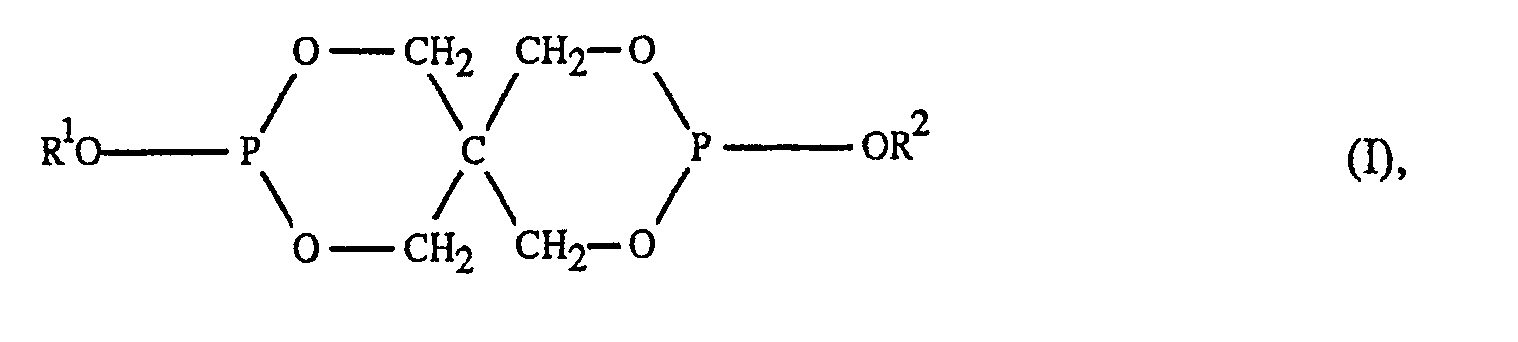
worin R¹ und R² unabhängig voneinander eine C₁-C₄-Alkylgruppe bedeuten, eignen sich als flammhemmende Zusätze für Kunststoffe, insbesondere für Epoxidharze. Bei der Umsetzung des Diphosphits mit einem Überschuss eines Diepoxids werden Epoxidharze mit chemisch gebundenem Phosphor erhalten, welche nach der Härtung flammfeste, vernetzte Produkte mit guten Eigenschaften liefern.
Description
- Die Erfindung betrifft phosphorhaltige Copolymere erhältlich durch Umsetzung von Epoxidverbindungen mit bestimmten Dialkylpentaerythritdiphosphiten, ein Verfahren zu deren Herstellung und deren Verwendung, insbesondere als flammhemmende Zusätze für Epoxidharze oder als phosphorhaltige Epoxidharze, welche nach der Härtung flammfeste vernetzte Produkte mit guten Eigenschaften liefern.
- Dialkyl- und Diarylpentaerythritdiphosphite, d.h. 3,9-Dialkoxy- bzw. 3,9-Diaryloxy-2,4,8,10-tetraoxa-3,9-diphosphaspiro[5,5]undekane, sind bekannt. Die US 2,847,443 beschreibt z.B. Umsetzungsprodukte von Triarylphosphiten mit Pentaerythrit, darunter auch Diarylpentaerythritdiphosphite, welche als Stabilisatoren für halogenhaltige Polymere oder Elastomere, oder als Öladditive verwendet werden. Die US 3,047,608 beschreibt ein Verfahren für die Herstellung von tertiären Phosphiten hochsiedender Alkohole. Dabei wird neben einer Vielzahl von Phosphiten auch die Herstellung von Dialkylpentaerythritdiphosphiten erwähnt, sowie die weitere Verarbeitung dieser Verbindungen in Gegenwart eines Katalysators zu Polymeren, z.B. durch Umsetzung mit geeigneten zweiwertigen Alkoholen. Die so hergestellten Phosphite bzw. Diphosphite eignen sich angeblich als Stabilisatoren für Polyolefine oder Polyurethane, als Flammschutzmittel für Cellulose und Celluloseester oder auch als Härtungsmittel für Epoxidharze, wobei keine dieser Anwendungen offenbart ist.
- Die GB 1,439,092 beschreibt sterisch gehinderte Phenol-Pentaerythrit-Phosphonate, hergestellt beispielsweise durch Umsetzung von Pentaerythritdiphosphiten mit Derivaten sterisch gehinderter Phenole. Diese Phosphonate eignen sich als phenolische Antioxidantien für eine Vielzahl von verschiedenartigen Kunststoffen, darunter auch für Epoxidharze.
- Die JP-OS Sho 53-71,153/78 beschreibt Stoffgemische enthaltend chlorhaltige Kunststoffe, wie PVC, ein Phosphit, wie z.B. ein Dialkylpentaerythritdiphosphit, ein Mono- oder Dialkylhydrogenphosphit und ein niedermolekulares Epoxidharz.
- Die JP-OS Sho 46-20,825/71 beschreibt die Umsetzung von Epoxidverbindungen mit mindestens 2 Epoxidgruppen mit Verbindungen, welche mindestens 2 Hydrophosphoryl- oder Phosphonylgruppen enthalten, in Gegenwart eines Katalysators ausgewählt aus der Gruppe Alkalimetalle, Erdalkalimetalle und Amalgame sowie Organometallverbindungen dieser Metalle. In einem Beispiel wird Bisphenol A-diglycidylether mit einer äquimolaren Menge von Pentaerythritdiphosphit in Gegenwart von Natrium als Katalysator zu einem phosphorhaltigen, nicht brennbaren Polymer umgesetzt. Polymere erhalten durch Umsetzung von Dialkylphosphiten, inklusive Pentaerythritdiphosphit, vermögen aber den Anforderungen an Kunststoffe, insbesondere bezüglich der Wasserbeständigkeit, nicht zu genügen.
- Gegenstand vorliegender Erfindung sind phosphorhaltige Copolymere erhältlich durch Umsetzung einer Epoxidverbindung mit einem Dialkylpentaerythritdiphosphit der Formel I

- Dialkylpentaerythritdiphosphite der Formel I sind z.B. aus der erwähnten US 3,047,608 bekannt. Sie werden im allgemeinen durch Umsetzung eines geeigneten Trialkylphosphits mit Pentaerythrit in Gegenwart eines Katalysators, wie z.B. Dialkylphosphite, Natriumalkoholate oder tertiäre Amine, hergestellt.
- Es wurde nun gefunden, dass besonders gute, monomere Produkte erhalten werden, wenn die Umsetzung in Toluol oder Xylol durchgeführt wird. Gegenstand der Erfindung ist somit auch ein Verfahren zur Herstellung der Dialkylpentaerythritdiphosphite der Formel I durch Umesterung eines Trialkylphosphits, wobei die Alkylgruppen 1-4 C-Atome aufweisen, mit Pentaerythrit in Gegenwart eines Katalysators, dadurch gekennzeichnet, dass die Umesterung in Toluol oder Xylol bei Rückflusstemperatur ausgeführt wird und das während der Reaktion gebildete Alkanol als Azeotrop mit Toluol oder Xylol abdestilliert wird.
- Die Umsetzung kann mit einem einzigen oder mit einem Gemisch von Trialkylphosphiten durchgeführt werden. Geeignete Trialkylphosphite sind Verbindungen, worin die Alkylgruppen Methyl, Ethyl, n- und iso-Propyl und n-, sec- und tert-Butyl bedeuten. Geeigneterweise kann das während der Umsetzung gebildete Alkanol/Toluol- bzw. -Xylolazeotrope Gemisch über den Kopf einer Kolonne abdestilliert werden. Das so erhaltene monomere Dialkylpentaerythritdiphosphit kann, z.B. nachdem es aus dem Reaktionsgemisch auskristallisiert hat, isoliert werden, oder in Lösung gleich weiter zu einem geeigneten Copolymeren umgesetzt werden. Da diese Monomeren selbst bei Raumtemperatur nur beschränkt beständig sind und polymerisieren, ist das letztgenannte Verfahren besonders zweckmässig.
- Für die Herstellung der Diphosphite besonders geeignete Katalysatoren sind C₁-C₄-Dialkylphosphite, Natriumalkoholate mit 1-4 C-Atomen oder Triethylamin. Bei Verwendung der Dialkylphosphite oder der Natriumalkoholate als Katalysatoren werden vorzugsweise Verbindungen mit der gleichen Alkylgruppe eingesetzt wie die Alkylgruppe des Trialkylphosphit-Edukts, das mit Pentaerythrit umgeestert wird. Der Katalysator wird vorzugsweise in einer Menge von 0,5-5 Gew. %, insbesondere 1-3 Gew. %, bezogen auf die Gesamtmenge des Trialkylphosphits und des Pentaerythrits, eingesetzt.
- Vorzugsweise wird bei der Herstellung der Diphosphite der Formel I Pentaerythrit mit einem einzigen Trialkylphosphit umgesetzt, so dass Diphosphite der Formel I entstehen, worin die Reste R¹ und R² gleich sind. Besonders geeignet sind Diphosphite, worin R¹ und R² n-Butyl und insbesondere Methyl bedeuten.
- Bei der Herstellung der erfindungsgemässen phosphorhaltigen Copolymere kann im Prinzip jede beliebige Epoxidverbindung eingesetzt werden. Es können sowohl Mono- als auch Di- oder Polyepoxide verwendet werden. Vorzugsweise werden dabei 0,05 bis 5 Mol, insbesondere 0,1 bis 2,5 Mol, Diphosphit pro Mol der Epoxidverbindung eingesetzt. Je nach Mengenverhältnis der Epoxidverbindung und des Diphosphits können somit Copolymere mit sehr unterschiedlichen Eigenschaften, wie z.B. verschiedenem Molekulargewicht oder Phosphorgehalt, erhalten werden.
- Bei Verwendung eines Überschusses bis zu einer äquimolaren Menge des Diphosphits entstehen thermoplastische Oligomere oder Polymere, welche einen relativ hohen Phosphorgehalt aufweisen und sich als flammhemmende Zusätze für Kunststoffe, insbesondere für Epoxidharze, eignen. Die Verwendung solcher Copolymerer statt des nicht umge setzten Diphosphits als Flammschutzmittel bringt den Vorteil einer wesentlich einfacheren und sichereren Handhabung, da die Spiro-Diphosphite für sich alleine oder mit Epoxiden in stark exothermer Reaktion und schlecht kontrollierbar polymerisieren.
- Wenn bei der Umsetzung ein Überschuss einer Di- oder Polyepoxidverbindung relativ zum Diphosphit, z.B. 2-10 Mol Epoxy-Comonomer pro Mol Diphosphit, eingesetzt wird, werden vorverlängerte Epoxidharze mit chemisch gebundenem Phosphor erhalten. Diese Epoxidharze ergeben nach der Härtung vernetzte Produkte, die unbrennbar oder selbstverlöschend sind und keine Halogenatome enthalten. Bekannterweise sind die Nachteile, welche halogenhaltige flammfest ausgerüstete Harze mit sich bringen, z.B. Korrosionsschäden, insbesondere in der Elektrotechnik und Elektronik unerwünscht.
- Die erfindungsgemässen Copolymere werden geeigneterweise durch Erhitzen des Reaktionsgemisches bei einer Temperatur von 80 bis 220°C, vorzugsweise bei 100 bis 200°C, hergestellt. Die Umsetzung kann, falls zweckmässig, in einem geeigneten Lösungsmittel durchgeführt werden. Beispiele geeigneter Lösungsmittel sind Toluol und Xylol. Nach Abschluss der Reaktion wird das Lösungsmittel abdestilliert. Vorzugsweise werden die erfindungsgemässen Copolymere aber durch Erhitzen des Epoxids und des Diphosphits ohne Lösungsmittel hergestellt. Die Reaktionszeit kann dabei je nach gewünschtem Produkt stark variieren, beispielsweise von einigen Minuten bei der Vorverlängerung reaktiver Epoxidharze bis zu mehreren Stunden, z.B. 15 Stunden oder mehr, bei der Herstellung thermoplastischer Copolymere mit hohem Phosphorgehalt. Gegenstand der Erfindung ist somit auch ein Verfahren zur Herstellung der erfindungsgemässen Copolymere.
- Die Herstellung der erfindungsgemässen Copolymere erfolgt vorzugsweise in einem Reaktionsmedium, in dem keine chlorhaltigen Kunststoffe, wie PVC, enthalten sind.
- Die erfindungsgemässe Copolymerisation von Epoxidverbindungen mit den Spirodiphosphiten der Formel I verläuft gemäss ³¹P-NMR unter Wertigkeitsänderung von PIII zu Pv und unter Öffnung eines Dioxaphosphacyclohexanringes des Diphosphits, so dass dabei Phosphor in Phosphonatform chemisch in die Copolymere eingebaut wird. So eine Umsetzung von Diphosphiten mit Epoxidverbindungen war nicht vorauszusehen.
- In einer bevorzugten Ausführungsform der vorliegenden Erfindung werden die erfindungsgemässen Copolymere durch Umsetzung von Monoepoxiden mit den Diphosphiten hergestellt. Bevorzugte Monoepoxide sind Alkylglycidylether, wie z.B. Butyl- oder Ethyl hexylglycidylether, Arylglycidylether, wie z.B. Phenyl-, Kresyl- oder p-t-Butylphenylglycidylether oder epoxidierte Olefine, wie z.B. Styroloxid oder Cyclohexenoxid.
- Besonders bevorzugte Monoepoxide sind n-Butylglycidylether, Cyclohexenoxid, Styroloxid oder insbesondere Phenylglycidylether. Besonders bevorzugt werden erfindungsgemässe phosphorhaltige Copolymere, welche durch Umsetzung von einem Mol des Diphosphits pro Mol des Monoepoxids hergestellt werden.
- In einer anderen bevorzugten Ausführungsform der vorliegenden Erfindung werden die erfindungsgemässen Copolymere durch Umsetzung von Epoxidharzen mit den Diphosphiten hergestellt.
- Bei der Umsetzung kann als Epoxidharz im Prinzip jede in der Technik der Epoxidharze übliche Verbindung eingesetzt werden. Bevorzugt werden Epoxidharze mit im Durchschnitt mindestens zwei Epoxidgruppen pro Molekül.
- I) Polyglycidyl- und Poly-(β-methylglycidyl)-ester erhältlich durch Umsetzung einer Verbindung mit mindestens zwei Carboxylgruppen im Molekül und Epichlorhydrin bzw. β-Methyl-epichlorhydrin. Die Umsetzung erfolgt zweckmässig in der Gegenwart von Basen.
- Als Verbindung mit mindestens zwei Carboxylgruppen im Molekül können aliphatische Polycarbonsäuren verwendet werden. Beispiele für diese Polycarbonsäuren sind Bernsteinsäure, Glutarsäure, Adipinsäure, Pimelinsäure, Korksäure, Azelainsäure oder dimerisierte bzw. trimerisierte Linolsäure.
- Es können aber auch cycloaliphatische Polycarbonsäuren eingesetzt werden, wie beispielsweise Tetrahydrophthalsäure, 4-Methyltetrahydrophthalsäure, Hexahydrophthalsäure oder 4-Methylhexahydrophthalsäure.
- Weiterhin können aromatische Polycarbonsäuren Verwendung finden, wie beispielsweise Phthalsäure, Isophthalsäure oder Terephthalsäure.
- II) Polyglycidyl- oder Poly(β-methylglycidyl)ether erhältlich durch Umsetzung einer Ver bindung mit mindestens zwei freien alkoholischen Hydroxygruppen und/oder phenolischen Hydroxygruppen und einem geeignet substituierten Epichlorhydrin unter alkalischen Bedingungen, oder in Anwesenheit eines sauren Katalysators und anschliessende Alkalibehandlung.
- Ether dieses Typs leiten sich beispielsweise ab von acyclischen Alkoholen, wie Ethylenglykol, Diethylenglykol und höheren Poly(oxyethylen)glykolen, Propan-1,2-diol oder Poly(oxypropylen)glykolen, Propan-1,3-diol, Butan-1,4-diol, Poly(oxytetramethylen)glykolen, Pentan-1,5-diol, Hexan-1,6-diol, Hexan-2,4,6-triol, Glycerin, 1,1,1-Trimethylolpropan, Pentaerythrit, Sorbit, sowie von Polyepichlorhydrinen.
- Sie leiten sich aber auch beispielsweise ab von cycloaliphatischen Alkoholen, wie 1,4-Cyclohexandimethanol, Bis(4-hydroxycyclohexyl)methan oder 2,2-Bis(4-hydroxycyclohexyl)propan oder sie besitzen aromatische Kerne, wie N,N-Bis(2-hydroxyethyl)anilin oder p,p′-Bis(2-hydroxyethylamino)diphenylmethan.
- Die Epoxidverbindungen können sich auch von einkernigen Phenolen ableiten, wie beispielsweise von Resorcin oder Hydrochinon; oder sie basieren auf mehrkernigen Phenolen, wie beispielsweise Bis(4-hydroxyphenyl)methan, 4,4′-Dihydroxybiphenyl, Bis(4-hydroxyphenyl)sulfon, 1,1,2,2-Tetrakis-(4-hydroxyphenyl)ethan, 2,2-Bis(4-hydroxyphenyl)propan, 2,2-Bis(3,5-dibrom-4-hydroxyphenyl)propan sowie von Novolaken erhältlich durch Kondensation von Aldehyden wie Formaldehyd, Acetaldehyd, Chloral oder Furfuraldehyd mit Phenolen wie Phenol, oder mit Phenolen, die im Kern mit Chloratomen oder C₁-C₉Alkylgruppen substituiert sind, wie beispielsweise 4-Chlorphenol, 2-Methylphenol oder 4-tert-Butylphenol oder durch Kondensation mit Bisphenolen, so wie oben beschrieben.
- III) Poly(N-glycidyl) Verbindungen erhältlich durch Dehydrochlorierung der Reaktionsprodukte von Epichlorhydrin mit Aminen, die mindestens zwei Aminwasserstoffatome enthalten. Bei diesen Aminen handelt es sich zum Beispiel um Anilin, n-Butylamin, Bis(4-aminophenyl)methan, m-Xylylendiamin oder Bis(4-methylaminophenyl)methan.
- Zu den Poly(N-glycidyl) Verbindungen zählen aber auch Triglycidylisocyanurat, N,N′-Diglycidylderivate von Cycloalkylenharnstoffen, wie Ethylenharnstoff oder 1,3-Propylenharnstoff, und Diglycidylderivate von Hydantoinen, wie von 5,5-Dimethylhydantoin.
- IV) Poly(S-glycidyl) Verbindungen, beispielsweise Di-S-glycidylderivate, die sich von Dithiolen, wie beispielsweise Ethan-1,2-dithiol oder Bis(4-mercaptomethylphenyl)ether ableiten.
- V) Cycloaliphatische Epoxidharze, beispielsweise Bis(2,3-epoxycyclopentyl)ether, 2,3-Epoxycyclopentylglycidylether, 1,2-Bis(2,3-epoxycyclopentyloxy)ethan, 3,4-Epoxycyclohexylmethyl-3′,4′-epoxycyclohexancarboxylat oder Bis(3,4-epoxycyclohexylmethyl)ester von aliphatischen Dicarbonsäuren, wie Bis(3,4-epoxycyclohexylmethyl)adipat.
- Es lassen sich aber auch Epoxidharze verwenden, bei denen die 1,2-Epoxidgruppen an unterschiedliche Heteroatome bzw. funktionelle Gruppen gebunden sind; zu diesen Verbindungen zählen beispielsweise das N,N,O-Triglycidylderivat des 4-Aminophenols, der Glycidylether-glycidylester der Salicylsäure, N-Glycidyl-N′-(2-glycidyloxypropyl)-5,5-dimethylhydantoin oder 2-Glycidyloxy- 1,3-bis (5,5-dimethyl-1-glycidylhydantoin-3-yl)propan.
- Bevorzugt verwendet werden Epoxidharze mit einem Epoxidgehalt von 2 bis 10 Aequivalenten/kg, welche Glycidylether, Glycidylester oder N-Glycidylderivate von aromatischen, heterocyclischen, cycloaliphatischen oder aliphatischen Verbindungen sind.
- Besonders bevorzugt als Epoxidharze werden Polyglycidylether von acyclischen Alkoholen, wie von 1,1,1-Trimethylolpropan, von Bisphenolen, wie beispielsweise von 2,2-Bis(4-hydroxyphenyl)propan (Bisphenol A) oder Bis(4-hydroxyphenyl)methan (Bisphenol F), oder von Novolaken, die durch Umsetzung von Formaldehyd mit einem Phenol gebildet werden, sowie N-glycidylierte aromatische Amine, insbesondere tetraglycidyliertes Bis(4-aminophenyl)methan. Ganz besonders geeignete Epoxidharze sind Bisphenol A-diglycidylether, Epoxy-Novolake oder Glycidylether von 1,1,1-Trimethylolpropan. Besonders bevorzugt werden Copolymere hergestellt durch Umsetzung von Bisphenol A-diglycidylethern, Epoxy-Novolaken oder Glycidylethern von 1,1,1-Trimethylolpropan mit Dimethylpentaerythritdiphosphit.
- Bei der Umsetzung von Epoxidharzen mit den Diphosphiten werden vorzugsweise 0,1 bis 1 Mol Diphosphit pro Epoxidäquivalent des Epoxidharzes eingesetzt. Besonders bevorzugt werden die Mengen des Diphosphits und des Epoxidharzes so gewählt, dass ein phosphorhaltiges Epoxidharz mit 2 bis 10 Gew. % Phosphor entsteht.
- Wie weiter oben ausgeführt, eignen sich die erfindungsgemässen Copolymere als flammhemmende Zusätze für Kunststoffe, insbesondere für Epoxidharze. Gegenstand der Erfindung sind somit auch Stoffgemische enthaltend (a) ein erfindungsgemässes phosphorhaltiges Copolymer und (b) ein Epoxidharz. Als Komponente (a) besonders geeignet sind Copolymere mit einem hohen Phosphorgehalt, z.B. mit mindestens 10 Gew. % P. Als Komponente (b) der erfindungsgemässen Stoffgemische sind z.B. alle weiter oben beschriebenen Epoxidharze geeignet. Die erfindungsgemässen Stoffgemische können mit den üblichen Härtern für Epoxidharze in vernetzte Produkte übergeführt werden. Die relativen Mengen der Komponenten (a) und (b) der Stoffgemische werden vorzugsweise so gewählt, dass das nach der Härtung erhaltene vernetzte Produkt nicht brennbar oder selbstverlöschend ist.
- Wie gesagt werden bei der Verwendung eines Überschusses von Epoxidharz relativ zum Diphosphit bei der Herstellung der erfindungsgemässen Copolymere phosphorhaltige Epoxidharze erhalten. Ein weiterer Gegenstand der Erfindung sind somit auch härtbare Stoffgemische enthaltend (a) ein erfindungsgemässes phosphorhaltiges Epoxidharz und (c) ein Härtungsmittel für Epoxidharze.
- Als Beispiele für Härtungsmittel seien die gebräuchlichen Härtungsmittel für Epoxidharze genannt, einschliesslich der aliphatischen, cycloaliphatischen, aromatischen und heterocyclischen Amine, wie Bis(4-aminophenyl)methan, Anilin-Formaldehyd-Harze, Bis(4-aminophenyl)sulfon, Propan-1,3-diamin, Hexamethylendiamin, Diethylentriamin, Triethylentetramin, 2,2,4-Trimethylhexan-1,6-diamin, m-Xylylendiamin, Bis(4-aminocyclohexyl)methan, 2,2-Bis(4-aminocyclohexyl)propan und 3-Aminomethyl-3,5,5-trimethylcyclohexylamin (Isophorondiamin), Polyaminoamide, wie beispielsweise solche aus aliphatischen Polyaminen und dimerisierten oder trimerisierten Fettsäuren, Polyphenole, wie Resorcin, Hydrochinon, 2,2-Bis(4-hydroxyphenyl)propan und Phenol-Aldehyd-Harze, Polythiole, wie die im Handel unter der Bezeichnung "Thiokole" erhältlichen Polythiole, Polycarbonsäuren und ihre Anhydride, wie zum Beispiel Phthalsäureanhydrid, Tetrahydrophthalsäureanhydrid, Hexahydrophthalsäureanhydrid, Hexachlorendomethylentetrahydrophthalsäureanhydrid, Pyromellitsäuredianhydrid, Benzophenon-3,3,4′,4′-tetracarbonsäuredianhydrid, die Säuren der zuvorgenannten Anhydride sowie auch Isophthalsäure und Terephthalsäure. Es können auch katalytisch wirkende Härtungsmittel verwendet werden, wie beispielsweise Zinnsalze von Alkansäuren (zum Beispiel Zinnoctanoat), Friedel-Crafts-Katalysatoren, wie Bortrifluorid und Bortrichlorid und ihre Komplexe und Chelate, die durch Umsetzung mit Bortrifluorid mit zum Beispiel Aminen oder 1,3-Diketonen erhalten werden. Geeignete Härtungsmittel sind auch die Cyanoguanidine gemäss den EP-A 306,451 und EP-A 310,545.
- Bevorzugte Härtungsmittel sind aromatische Amine, insbesondere Bis(4-aminophenyl)methan oder Bis(4-aminophenyl)sulfon, Bortrifluorid-Amin-Komplexe, insbesondere der BF₃-Ethylaminkomplex, Dicyandiamid, die oligomeren Cyanoguanidine gemäss der EP-A 306,451 und Polyaminoamide.
- Die Menge des eingesetzten Härtungsmittels richtet sich nach der chemischen Natur des Härtungsmittels und nach den gewünschten Eigenschaften der härtbaren Mischung und des gehärteten Produktes. Die maximale Menge kann leicht ermittelt werden. Wenn das Härtungsmittel ein Amin ist, werden normalerweise 0,75 bis 1,25 Aequivalente Aminwasserstoff pro 1 Epoxidäquivalent eingesetzt. Wenn Polycarbonsäuren oder ihre Anhydride eingesetzt werden, verwendet man gewöhnlich 0,4 bis 1,1 Aequivalente Carboxylgruppe bzw. Anhydridgruppe pro 1 Aequivalent Epoxidgruppe. Bei der Verwendung von Polyphenolen als Härtungsmittel setzt man zweckmässig 0,75 bis 1,25 phenolische Hydroxylgruppen pro 1 Epoxidäquivalent ein.
- Katalytisch wirkende Härtungsmittel werden allgemein in Mengen von 1 bis 40 Gewichtsteilen pro 100 Gewichtsteile Epoxidharz eingesetzt.
- Gewünschtenfalls kann man den härtbaren Gemischen zur Herabsetzung der Viskosität aktive Verdünner, wie z.B. Styroloxid, Butylglycidylether, 2,2,4-Trimethylpentylglycidylether, Phenylglycidylether, Kresylglycidylether oder Glycidylester von synthetischen, hochverzweigten, in der Hauptsache tertiären aliphatischen Monocarbonsäuren, zusetzen.
- Man kann bei der Härtung ausserdem Härtungsbeschleuniger einsetzen; solche Beschleuniger sind z.B. tertiäre Amine, deren Salze oder quaternäre Ammoniumverbindungen, z.B. Benzyldimethylamin, 2,4,6-Tris(dimethylaminomethyl)phenol, 1-Methylimidazol, 2-Ethyl-4-methylimidazol, 4-Aminopyridin, Tripentylammoniumphenolat; oder Alkalimetallalkoholate, wie z.B. Na-Alkoholate von 2,4-Dihydroxy-3-hydroxymethylpentan. Die Härtung der erfindungsgemässen Mischungen wird zweckmässig im Temperaturintervall von 50°C bis 300°C, bevorzugt von 80-250°C, insbesondere von 120-200°C, durchgeführt.
- Die Härtung kann gewünschtenfalls auch derart in 2 Stufen erfolgen, dass die Härtungs reaktion zunächst vorzeitig abgebrochen bzw. die erste Stufe bei wenig erhöhter Temperatur durchgeführt wird, wobei ein noch schmelzbares und/oder lösliches, härtbares Vorkondensat (sogenannte "B-Stufe") aus der Epoxidkomponente und dem Härter erhalten wird. Ein derartiges Vorkondensat kann z.B. zur Herstellung von "Prepregs", Pressmassen oder Sinterpulvern dienen.
- Der Ausdruck "Härten", wie er hier gebraucht wird, bedeutet die Umwandlung der löslichen, entweder flüssigen oder schmelzbaren Polyepoxide in feste, unlösliche und unschmelzbare, dreidimensional vernetzte Produkte bzw. Werkstoffe, und zwar in der Regel unter gleichzeitiger Formgebung zu Formkörpern, wie Giesskörpern, Presskörpern und Schichtstoffen, zu Imprägnierungen, Beschichtungen, Lackfilmen oder Verklebungen.
- Die erfindungsgemässen härtbaren Gemische können ferner geeignete Weichmacher, wie Dibutylphthalat, Dioctylphthalat oder Trikresylphthalat, enthalten.
- Als weitere übliche Zusätze können die erfindungsgemässen Gemische ferner Streck-, Füll- und Verstärkungsmittel, wie beispielsweise Steinkohlenteer, Bitumen, Textilfasern, Glasfasern, Asbestfasern, Borfasern, Kohlenstoff-Fasern, mineralische Silikate, Glimmer, Quarzmehl, Aluminiumoxidhydrat, Bentonite, Wollastonit, Kaolin, Kieselsäureaerogel oder Metallpulver, z.B. Aluminiumpulver oder Eisenpulver, ferner Pigmente und Farbstoffe, wie Russ, Oxidfarben und Titandioxid, Thixotropiemittel, Verlaufmittel ("flow control agents"), wie Silicone, Wachse und Stearate, die zum Teil auch als Formtrennmittel Anwendung finden, Haftvermittler, Antioxidantien und Lichtschutzmittel enthalten.
- Die erfindungsgemässen Gemische lassen sich beispielsweise als Klebstoffe, Klebefilme, Patches, Matrixharze, Lacke oder Dichtungsmassen oder ganz allgemein zur Herstellung von gehärteten Produkten verwenden. Sie können in jeweils dem speziellen Anwendungsgebiet angepasster Formulierung, in ungefülltem oder gefülltem Zustand, z.B. als Anstrichmittel, Beschichtungsmassen, Lacke, Pressmassen, Tauchharze, Giessharze, Imprägnierharze, Laminierharze, Matrixharze und Klebemittel verwendet werden.
- Besonders geeignet sind die erfindungsgemässen Stoffgemische als Giessharze und Imprägnierharze für die Herstellung von Formkörpern bzw. von Prepregs, Laminaten und Composites mit selbstverlöschenden Eigenschaften. Gegenstand der Erfindung sind auch vernetzte Produkte erhältlich durch Härtung der erfindungsgemässen Stoffgemische mit einem Härtungsmittel für Epoxidharze sowie vernetzte Produkte erhältlich durch Härtung der erfindungsgemässen härtbaren Stoffgemische.
- Die folgenden Beispiele erläutern die Erfindung.
- In einem 2,5 l Rührkolben, versehen mit einem Thermometer und einer Kolonne (L = 55 cm, d = 3 cm), die mit Zylinderchen aus Drahtnetz (h = 3 mm, d = 3mm) gefüllt ist, erhitzt man unter Rühren zum Sieden:
372,8 g (3 Mol) Trimethylphosphit,
5,44 g (0,0495 Mol) Dimethylphosphit,
204,2 g (1,5 Mol) Pentaerythrit und
1200,0 ml Toluol. - Während 5 h werden bei einer Innentemperatur von 93-100°C am Kolonnenkopf zwischen 60 und 62°C 260 g eines Destillats abgenommen, das aus 72,23 % Methanol und 27,77 % Toluol besteht. Nach 3 Stunden Reaktionszeit ist das Pentaerythrit total in Lösung gegangen. Nach dem Abkühlen bildet sich über Nacht eine grosse Menge weisser Kristalle, die abgesaugt und mit kaltem Toluol und danach mit Hexan gewaschen und in einem trockenen Luftstrom bei 35°C getrocknet werden. Ausbeute: 222,7 g entsprechend 58 % der Theorie. Fp = 121,1°C.
Elementaranalyse: Berechnet für C₇H₁₄O₆P₂: Gefunden: %C: 32,83 32,89 %H: 5,51 5,54 %P: 24,19 24,15 Molgewicht: 256 255 (GPC) Reinheit (Mettler TA 3000) 98,34% Gemäss ³¹P-NMR liegt der Phosphor vollständig in 3-wertiger Form vor. - Beim Erhitzen über den Schmelzpunkt bildet sich in stark exothermer Reaktion (ΔH = 389,6 J/g) ein glasiges Polymer. Auch bei der Lagerung bei Zimmertemperatur werden die Kristalle klebrig und gehen in ölige bis harzartige Produkte über.
- Unter einer Destillierkolonne erhitzt man unter Rühren zum Sieden:
158,2 g Tri-n-butylphosphit (95 %ig),
5,0 g Di-n-butylphosphit,
40,8 g Pentaerythrit und
500 ml Xylol. - Im Laufe von 10 Stunden nimmt man über Kopf 337,5 g Destillat ab, das bei 75-80°C übergeht, Brechungszahlen n

Elementaranalyse: Berechnet für C₁₃H₂₆O₆P₂: Gefunden: %C: 46,89 47,18 %H: 7,70 7,95 %P: 18,21 17,00 - 4,491 g (0,03 Mol) Phenylglycidylether und
7,68 g (0,03 Mol) Spiro-diphosphit gemäss Beispiel 1 werden zusammengeschmolzen und in einer verschlossenen Ampulle während 12 Stunden auf 160°C erhitzt. Das viskose Harz enthält noch 0,16 Epoxyäquivalente pro kg. Mittels Gelpermeationschromatographie werdenM n = 1640 undM w = 9170 bestimmt. - Weiteres Erhitzen während 10 Stunden auf 200°C ergibt ein braunes, festes Polymer mit einer Glasumwandlungstemperatur von 58°C, das in Tetrahydrofuran und in Dimethylformamid löslich ist.
Elementaranalyse: Berechnet für (C₁₆H₂₆O₈P₂)n: Gefunden: %C: 47,29 47,60 %H: 6,42 6,30 %P: 15,27 15,05 M n (GPC)= 3420
M w (GPC) = 403800 - 7,68 g (0,03 Mol) Spiro-diphosphit gemäss Beispiel 1 und
10,48 g (0,03 Mol) Bisphenol A-diglycidylether (Epoxidäquivalentgewicht = 174,8) werden 3 Stunden bei 120°C, 2 Stunden bei 150°C, 2 Stunden bei 170°C und 8 Stunden bei 200°C copolymerisiert. Hierbei wird eine Wärmemenge von 463 J/g entwickelt, die Spitzentemperatur beträgt 228°C (Mettler TA 3000). Es wird ein glasiges Copolymer mit einer Glasumwandlungstemperatur von 35,8°C und einem Erweichungspunkt, gemessen auf der Koflerbank, von 84°C erhalten.
M n (GPC) = 1,37 x 10⁴,M w (GPC) = 1,43 x 10⁶. - 10,24 g (0,04 Mol) Spiro-diphosphit gemäss Beispiel 1 und
6,96 g (0,02 Mol) Bisphenol A-diglycidylether (Epoxidäquivalentgewicht = 174,8) werden nach einem Temperaturprogramm wie im Beispiel 4 copolymerisiert.
ΔH = 400 J/g, Tmax. = 207°C,M n (GPC) = 1,76x 10⁴,M w(GPC) = 9,64 x 10⁵, TG = 28,1°C, Erweichungspunkt = 77°C. - 1000 g eines bei Raumtemperatur flüssigen Epoxyharzes auf Basis von Bisphenol A mit einem Epoxidäquivalentgewicht von 190 werden unter Stickstoffatmosphäre auf 170°C erhitzt. Man trägt unter Rühren 143,67 g Spiro-diphosphit (gemäss Beispiel 1) portionenweise während 45 Minuten ein, erhitzt weitere 15 Minuten auf 170°C und kühlt auf Zimmertemperatur ab. Man erhält ein dunkelbraunes Harz mit einem Gehalt von 3,0 Gew. % P, einem Epoxidäquivalentgewicht von 245,
M n (GPC) = 506,M w (GPC) = 579.Härtungsversuche Formulierung Nr. 6a 6b 6c Phosphorhaltiges Harz A (g) 17,5 21,4 22,5 Bisphenol A-diglycidylether (Epoxidäquivalentgewicht: 190) 4,0 - - 4,4′-Diamino-diphenylmethan (g) 4,55 - - 4,4′-Diamino-diphenylsulfon (g) - 6,2 - BF₃-Ethylaminkomplex (g) - - 2,5 - Härtung während 2 Stunden 125°C, 2 Stunden 160°C und 2 Stunden 180°C ergibt einwandfreie, braune, zähe Platten.
Formulierung Nr. 6a 6b 6c TG (Mettler TA 3000) (°C) 149 160 140 Wasseraufnahme (%) nach 4 Tagen bei 25°C: 0,41 0,61 0,47 nach 1 Stunde bei 100°C: 0,47 0,67 0,84 Gewichtsverlust (TGA) 5% bei °C 270 290 280 10% bei °C 305 315 310 Brennbarkeit nach UL 94 VO VO VO - 1000 g eines bei Raumtemperatur zähflüssigen Epoxynovolaks mit einem Epoxidäquivalentgewicht von 179,2 werden mit 144,9 g Spiro-diphosphit gemäss Beispiel 1 während 1 Stunde bei 175°C umgesetzt. Man erhält ein dunkelbraunes Harz mit einem Gehalt von 3,04 Gew.% P, einer Viskosität von 256,4 mPas bei 80°C, einem Epoxidäquivalentgewicht von 241,
M n (GPC) = 486 undM w (GPC) = 634. - Die Härtung erfolgt wie im Beispiel 6.
Formulierung Nr. 7a 7b 7c Phosphorhaltiges Harz A (g) 23,04 23,04 23,04 Epoxynovolak (Epoxidäquivalentgewicht 179,2) 5,0 5,0 10,00 4,4′-Diaminodiphenylmethan (g) 6,33 - - 4,4′-Diaminodiphenylsulfon (g) - 7,9 - BF₃-Ethylaminkomplex (g) - - 0,8 Gew. % P (bezogen auf Harz + Härter) 2,0 1,92 2,0 TG(Mettler TA 3000) (°C) 147,5 144,1 127,8 Wasseraufnahme (%) nach 4 Tagen bei 25°C: 0,35 0,36 0,39 nach 1 Stunde bei 100°C: 0,39 0,59 0,62 Gewichtsverlust (TGA) 5 % bei °C 270 295 315 10 % bei °C 310 320 340 Brennbarkeit nach UL 94 VO VO VO - Man setzt 70,0 g N,N′-Tetraglycidyl-diaminodiphenylmethan mit 30,0 g Spiro-diphosphit gemäss Beispiel 1 während 15 Minuten bei 170°C um. Man erhält ein braunes Copolymer mit einem Epoxidäquivalentgewicht von 256 und einem Phosphorgehalt von 7,25 Gew. %.
- 100 Gewichtsteile Kohlefaser-Prepreg, Fiberdux® 914 (Ciba-Geigy) werden mit 7,2 Gewichtsteilen des obigen Copolymers modifiziert. Aus je 3 Lagen des modifizierten und des unmodifizierten Prepregs werden Kohlefaserlaminate während 2 Stunden bei 175°C und 7 bar gepresst und 4 Stunden bei 190°C nachgehärtet.
Eigenschaften: Laminat aus Fiberdux®914 nicht-modifiziert modifiziert Dicke (mm) 0,85 0,55 Faservolumen (%) 57,0 57,0 TG (TMA) (°C) 197 210 Interlaminare Scherfestigkeit MPa bei 25°C 71 64 MPa bei 120°C 51 51 Biegefestigkeit (DIN 29971) MPa 765 650 Biegemodul (DIN 29971) GPa 63,0 59,1 Wasserabsorption nach 14 Tagen bei 71°C(%) 2,0 2,3 Brennbarkeit nach FAR 25,853 a: Brandlänge (mm) nach 12 Sekunden Beflammung 140 61 Auslöschung nach Sekunden 19 8 Brandlänge (mm) nach 60 Sekunden Beflammung 230 160 Auslöschung nach Sekunden 45 42 Flammentemperatur (°C) 910 920 - 473,7 g eines technischen Triglycidylethers von Trimethylolpropan mit einem Epoxidäquivalentgewicht von 121 und einer Viskosität von 183 mPa·s werden unter Rühren auf 160°C erwärmt. Man trägt portionenweise 126,3 g Spiro-diphosphit gemäss Beispiel 1 ein und lässt 2 Stunden bei 170-175°C nachreagieren. Man erhält 583,90 g eines hellgelben Harzes mit einem Phosphorgehalt von 5,0 %, einem Epoxidäquivalentgewicht von 204 und einer Viskosität von 2,38 Pa·s.
M n= 522,M w = 970. - Werden 100g obigen phosphonylierten Harzes, 100 g Al(OH)₃ und 78 g eines Polyaminoamid-Härters (HV 953 U von Ciba-Geigy) vermischt und 16 Stunden bei 40°C und 3 Stunden bei 100°C gehärtet, so erhält man Formkörper, die nach UL-94 unbrennbar sind (V-0, Nachbrennzeit: 0 sec.)

Claims (16)

Applications Claiming Priority (2)
| Application Number | Priority Date | Filing Date | Title |
|---|---|---|---|
| CH3510/89 | 1989-09-28 | ||
| CH351089 | 1989-09-28 |
Publications (2)
| Publication Number | Publication Date |
|---|---|
| EP0420811A2 true EP0420811A2 (de) | 1991-04-03 |
| EP0420811A3 EP0420811A3 (en) | 1992-04-01 |
Family
ID=4257546
Family Applications (1)
| Application Number | Title | Priority Date | Filing Date |
|---|---|---|---|
| EP19900810719 Withdrawn EP0420811A3 (en) | 1989-09-28 | 1990-09-19 | Phosphor containing copolymers and their use |
Country Status (4)
| Country | Link |
|---|---|
| EP (1) | EP0420811A3 (de) |
| JP (1) | JPH03124728A (de) |
| KR (1) | KR910006367A (de) |
| CA (1) | CA2026255A1 (de) |
Cited By (2)
| Publication number | Priority date | Publication date | Assignee | Title |
|---|---|---|---|---|
| EP0646587A1 (de) * | 1993-09-09 | 1995-04-05 | Ciba-Geigy Ag | Neue phosphorhaltige Flammschutzmittel für Epoxidharzmassen |
| EP4342925A1 (de) * | 2022-09-26 | 2024-03-27 | EMPA Eidgenössische Materialprüfungs- und Forschungsanstalt | Phosphonat-epoxidduroplaste |
-
1990
- 1990-09-19 EP EP19900810719 patent/EP0420811A3/de not_active Withdrawn
- 1990-09-26 CA CA002026255A patent/CA2026255A1/en not_active Abandoned
- 1990-09-28 JP JP2260315A patent/JPH03124728A/ja active Pending
- 1990-09-28 KR KR1019900015477A patent/KR910006367A/ko not_active Withdrawn
Cited By (4)
| Publication number | Priority date | Publication date | Assignee | Title |
|---|---|---|---|---|
| EP0646587A1 (de) * | 1993-09-09 | 1995-04-05 | Ciba-Geigy Ag | Neue phosphorhaltige Flammschutzmittel für Epoxidharzmassen |
| US5506313A (en) * | 1993-09-09 | 1996-04-09 | Ciba-Geigy Corporation | Phosphorus-containing flameproofing agents for epoxy resin materials |
| EP4342925A1 (de) * | 2022-09-26 | 2024-03-27 | EMPA Eidgenössische Materialprüfungs- und Forschungsanstalt | Phosphonat-epoxidduroplaste |
| WO2024068565A1 (en) | 2022-09-26 | 2024-04-04 | Empa Eidgenössische Materialprüfungs- Und Forschungsanstalt | Phosphonate epoxy thermosets |
Also Published As
| Publication number | Publication date |
|---|---|
| CA2026255A1 (en) | 1991-03-29 |
| JPH03124728A (ja) | 1991-05-28 |
| EP0420811A3 (en) | 1992-04-01 |
| KR910006367A (ko) | 1991-04-29 |
Similar Documents
| Publication | Publication Date | Title |
|---|---|---|
| DE60108271T2 (de) | Mittel zur flammschutzausrüstung | |
| EP0252358B1 (de) | Flüssig-kristalline Diglycidylverbindungen, ihre Herstellung und Verwendung in härtbaren Epoxid-Gemischen | |
| EP2158250B1 (de) | Katalysator für die härtung von epoxiden | |
| EP1125960B1 (de) | Latente Kombinationsverbindungen und latente Ammoniumsalze aus Epoxidharzhärter und Flammschutzmittel sowie daraus hergestellte Epoxidharz-Systeme und -Produkte | |
| EP0146498A2 (de) | Härtbare Gemische, enthaltend ein Epoxidharz, ein Imid und einen Härtungskatalysator | |
| DE2838842C2 (de) | ||
| US4111909A (en) | Controlled reactivity epoxy resin compositions | |
| EP1046661B1 (de) | Flammwidrige phosphormodifizierte Epoxidharze | |
| DE2154624A1 (de) | Neue diglycidylderivate von zwei nheterocyclische ringe enthaltenen verbindungen, verfahren zu ihrer herstellung und anwendung | |
| EP0799847A1 (de) | Phosphormodifizierte Epoxid-harzmischungen aus Epoxid-harzen, phosphorhaltigen Verbindungen und einem Härter | |
| DE2003016A1 (de) | Neue Diglydicylderivate von zwei N-heterocyclische Ringe enthaltenden Verbindungen,Verfahren zu ihrer Herstellung und Anwendung | |
| EP0646587A1 (de) | Neue phosphorhaltige Flammschutzmittel für Epoxidharzmassen | |
| EP0018949A1 (de) | Härtbare Epoxidharzgemische und Härtungsbeschleuniger dafür | |
| DE2147899A1 (de) | Neue Polyglycidylverbindungen, Verfahren zu ihrer Herstellung und Anwendung | |
| EP2718399A1 (de) | Herstellung von gehärteten epoxidharzen mit flammhemmenden phosphonaten | |
| EP0377909A1 (de) | Diglycidylverbindungen, ihre Herstellung und ihre Verwendung in härtbaren Epoxid-Gemischen | |
| EP0278900A2 (de) | Vorverlängerte Epoxidharze auf Basis von Cyclohex-1-ylmethylen-diphenolderivaten oder Bicyclo[2.2.1]hept-1-ylmethylen-diphenolderivaten | |
| EP0799848B1 (de) | Phosphormodifizierte Epoxidharze aus Epoxidharzen und phosphorhaltigen Verbindungen | |
| EP0295209A2 (de) | Orthokohlensäureester | |
| EP0191926B1 (de) | Wärmehärtbare Epoxidharzmischungen | |
| DE19613063A1 (de) | Phosphormodifizierte Epoxidharze und ein Verfahren zu ihrer Herstellung | |
| DE2205104A1 (de) | Neue N-heterocyclische Polyglycidylverbindungen, Verfahren zu ihrer Herstellung und ihrer Anwendung | |
| DE1954503C3 (de) | Diglycidylaether von N-heterocyclischen Verbindungen,Verfahren zu ihrer Herstellung und ihre Verwendung | |
| EP0108720A1 (de) | Neue cycloaliphatische Diallyläther | |
| DE2949401A1 (de) | Produkte aus einem polyepoxid und zweikernigen hydantoinverbindungen |
Legal Events
| Date | Code | Title | Description |
|---|---|---|---|
| PUAI | Public reference made under article 153(3) epc to a published international application that has entered the european phase |
Free format text: ORIGINAL CODE: 0009012 |
|
| 17P | Request for examination filed |
Effective date: 19900921 |
|
| AK | Designated contracting states |
Kind code of ref document: A2 Designated state(s): CH DE ES FR GB IT LI NL SE |
|
| PUAL | Search report despatched |
Free format text: ORIGINAL CODE: 0009013 |
|
| AK | Designated contracting states |
Kind code of ref document: A3 Designated state(s): CH DE ES FR GB IT LI NL SE |
|
| 17Q | First examination report despatched |
Effective date: 19940714 |
|
| STAA | Information on the status of an ep patent application or granted ep patent |
Free format text: STATUS: THE APPLICATION IS DEEMED TO BE WITHDRAWN |
|
| 18D | Application deemed to be withdrawn |
Effective date: 19941125 |