EP0421546B1 - Solid, polymeric electrolyte on polyepoxy basis - Google Patents
Solid, polymeric electrolyte on polyepoxy basis Download PDFInfo
- Publication number
- EP0421546B1 EP0421546B1 EP90202637A EP90202637A EP0421546B1 EP 0421546 B1 EP0421546 B1 EP 0421546B1 EP 90202637 A EP90202637 A EP 90202637A EP 90202637 A EP90202637 A EP 90202637A EP 0421546 B1 EP0421546 B1 EP 0421546B1
- Authority
- EP
- European Patent Office
- Prior art keywords
- solid
- range
- comprised
- polymeric electrolyte
- monoepoxide
- Prior art date
- Legal status (The legal status is an assumption and is not a legal conclusion. Google has not performed a legal analysis and makes no representation as to the accuracy of the status listed.)
- Expired - Lifetime
Links
- 239000007787 solid Substances 0.000 title claims abstract description 23
- 239000003792 electrolyte Substances 0.000 title claims abstract description 21
- 239000012528 membrane Substances 0.000 claims abstract description 18
- 229920000647 polyepoxide Polymers 0.000 claims abstract description 18
- 150000008040 ionic compounds Chemical class 0.000 claims abstract description 8
- 230000009477 glass transition Effects 0.000 claims abstract description 7
- 238000007334 copolymerization reaction Methods 0.000 claims abstract description 6
- 239000006104 solid solution Substances 0.000 claims abstract description 5
- QUPDWYMUPZLYJZ-UHFFFAOYSA-N ethyl Chemical compound C[CH2] QUPDWYMUPZLYJZ-UHFFFAOYSA-N 0.000 claims abstract description 3
- 125000002496 methyl group Chemical group [H]C([H])([H])* 0.000 claims abstract description 3
- 230000003287 optical effect Effects 0.000 claims abstract description 3
- -1 fluoborate Chemical compound 0.000 claims description 10
- WHXSMMKQMYFTQS-UHFFFAOYSA-N Lithium Chemical compound [Li] WHXSMMKQMYFTQS-UHFFFAOYSA-N 0.000 claims description 8
- 229910052744 lithium Inorganic materials 0.000 claims description 8
- QVGXLLKOCUKJST-UHFFFAOYSA-N atomic oxygen Chemical compound [O] QVGXLLKOCUKJST-UHFFFAOYSA-N 0.000 claims description 6
- 229910052751 metal Inorganic materials 0.000 claims description 6
- 239000002184 metal Substances 0.000 claims description 6
- 239000001301 oxygen Substances 0.000 claims description 6
- 229910052760 oxygen Inorganic materials 0.000 claims description 6
- MHCFAGZWMAWTNR-UHFFFAOYSA-M lithium perchlorate Chemical compound [Li+].[O-]Cl(=O)(=O)=O MHCFAGZWMAWTNR-UHFFFAOYSA-M 0.000 claims description 4
- 229910001486 lithium perchlorate Inorganic materials 0.000 claims description 3
- BTBUEUYNUDRHOZ-UHFFFAOYSA-N Borate Chemical compound [O-]B([O-])[O-] BTBUEUYNUDRHOZ-UHFFFAOYSA-N 0.000 claims description 2
- OYPRJOBELJOOCE-UHFFFAOYSA-N Calcium Chemical compound [Ca] OYPRJOBELJOOCE-UHFFFAOYSA-N 0.000 claims description 2
- RYGMFSIKBFXOCR-UHFFFAOYSA-N Copper Chemical compound [Cu] RYGMFSIKBFXOCR-UHFFFAOYSA-N 0.000 claims description 2
- DGAQECJNVWCQMB-PUAWFVPOSA-M Ilexoside XXIX Chemical compound C[C@@H]1CC[C@@]2(CC[C@@]3(C(=CC[C@H]4[C@]3(CC[C@@H]5[C@@]4(CC[C@@H](C5(C)C)OS(=O)(=O)[O-])C)C)[C@@H]2[C@]1(C)O)C)C(=O)O[C@H]6[C@@H]([C@H]([C@@H]([C@H](O6)CO)O)O)O.[Na+] DGAQECJNVWCQMB-PUAWFVPOSA-M 0.000 claims description 2
- FYYHWMGAXLPEAU-UHFFFAOYSA-N Magnesium Chemical compound [Mg] FYYHWMGAXLPEAU-UHFFFAOYSA-N 0.000 claims description 2
- ZLMJMSJWJFRBEC-UHFFFAOYSA-N Potassium Chemical compound [K] ZLMJMSJWJFRBEC-UHFFFAOYSA-N 0.000 claims description 2
- ZMZDMBWJUHKJPS-UHFFFAOYSA-M Thiocyanate anion Chemical compound [S-]C#N ZMZDMBWJUHKJPS-UHFFFAOYSA-M 0.000 claims description 2
- ATJFFYVFTNAWJD-UHFFFAOYSA-N Tin Chemical compound [Sn] ATJFFYVFTNAWJD-UHFFFAOYSA-N 0.000 claims description 2
- DTQVDTLACAAQTR-UHFFFAOYSA-M Trifluoroacetate Chemical compound [O-]C(=O)C(F)(F)F DTQVDTLACAAQTR-UHFFFAOYSA-M 0.000 claims description 2
- HCHKCACWOHOZIP-UHFFFAOYSA-N Zinc Chemical compound [Zn] HCHKCACWOHOZIP-UHFFFAOYSA-N 0.000 claims description 2
- 229910052782 aluminium Inorganic materials 0.000 claims description 2
- XAGFODPZIPBFFR-UHFFFAOYSA-N aluminium Chemical compound [Al] XAGFODPZIPBFFR-UHFFFAOYSA-N 0.000 claims description 2
- 239000011575 calcium Substances 0.000 claims description 2
- 229910052791 calcium Inorganic materials 0.000 claims description 2
- 229910052802 copper Inorganic materials 0.000 claims description 2
- 239000010949 copper Substances 0.000 claims description 2
- ZMZDMBWJUHKJPS-UHFFFAOYSA-N hydrogen thiocyanate Natural products SC#N ZMZDMBWJUHKJPS-UHFFFAOYSA-N 0.000 claims description 2
- 239000011133 lead Substances 0.000 claims description 2
- 229910003002 lithium salt Inorganic materials 0.000 claims description 2
- 159000000002 lithium salts Chemical class 0.000 claims description 2
- 239000011777 magnesium Substances 0.000 claims description 2
- 229910052749 magnesium Inorganic materials 0.000 claims description 2
- 150000002739 metals Chemical class 0.000 claims description 2
- VLTRZXGMWDSKGL-UHFFFAOYSA-M perchlorate Inorganic materials [O-]Cl(=O)(=O)=O VLTRZXGMWDSKGL-UHFFFAOYSA-M 0.000 claims description 2
- VLTRZXGMWDSKGL-UHFFFAOYSA-N perchloric acid Chemical compound OCl(=O)(=O)=O VLTRZXGMWDSKGL-UHFFFAOYSA-N 0.000 claims description 2
- 229910052700 potassium Inorganic materials 0.000 claims description 2
- 239000011591 potassium Substances 0.000 claims description 2
- 229910052708 sodium Inorganic materials 0.000 claims description 2
- 239000011734 sodium Substances 0.000 claims description 2
- 239000011135 tin Substances 0.000 claims description 2
- ITMCEJHCFYSIIV-UHFFFAOYSA-N triflic acid Chemical class OS(=O)(=O)C(F)(F)F ITMCEJHCFYSIIV-UHFFFAOYSA-N 0.000 claims description 2
- 229910052725 zinc Inorganic materials 0.000 claims description 2
- 239000011701 zinc Substances 0.000 claims description 2
- 238000004519 manufacturing process Methods 0.000 abstract description 3
- MTHSVFCYNBDYFN-UHFFFAOYSA-N diethylene glycol Chemical compound OCCOCCO MTHSVFCYNBDYFN-UHFFFAOYSA-N 0.000 description 18
- 238000006116 polymerization reaction Methods 0.000 description 15
- 239000002904 solvent Substances 0.000 description 13
- YXFVVABEGXRONW-UHFFFAOYSA-N Toluene Chemical compound CC1=CC=CC=C1 YXFVVABEGXRONW-UHFFFAOYSA-N 0.000 description 12
- 239000011541 reaction mixture Substances 0.000 description 11
- 229920001577 copolymer Polymers 0.000 description 10
- HEMHJVSKTPXQMS-UHFFFAOYSA-M Sodium hydroxide Chemical compound [OH-].[Na+] HEMHJVSKTPXQMS-UHFFFAOYSA-M 0.000 description 9
- HEDRZPFGACZZDS-UHFFFAOYSA-N Chloroform Chemical compound ClC(Cl)Cl HEDRZPFGACZZDS-UHFFFAOYSA-N 0.000 description 8
- RTZKZFJDLAIYFH-UHFFFAOYSA-N Diethyl ether Chemical compound CCOCC RTZKZFJDLAIYFH-UHFFFAOYSA-N 0.000 description 8
- IAZDPXIOMUYVGZ-UHFFFAOYSA-N Dimethylsulphoxide Chemical compound CS(C)=O IAZDPXIOMUYVGZ-UHFFFAOYSA-N 0.000 description 8
- 239000003054 catalyst Substances 0.000 description 8
- 239000000243 solution Substances 0.000 description 7
- WEVYAHXRMPXWCK-UHFFFAOYSA-N Acetonitrile Chemical compound CC#N WEVYAHXRMPXWCK-UHFFFAOYSA-N 0.000 description 6
- IJGRMHOSHXDMSA-UHFFFAOYSA-N Atomic nitrogen Chemical compound N#N IJGRMHOSHXDMSA-UHFFFAOYSA-N 0.000 description 6
- XENVCRGQTABGKY-ZHACJKMWSA-N chlorohydrin Chemical compound CC#CC#CC#CC#C\C=C\C(Cl)CO XENVCRGQTABGKY-ZHACJKMWSA-N 0.000 description 6
- BRLQWZUYTZBJKN-UHFFFAOYSA-N Epichlorohydrin Chemical compound ClCC1CO1 BRLQWZUYTZBJKN-UHFFFAOYSA-N 0.000 description 5
- 238000004566 IR spectroscopy Methods 0.000 description 5
- 238000001704 evaporation Methods 0.000 description 5
- 238000002360 preparation method Methods 0.000 description 5
- 239000000047 product Substances 0.000 description 5
- XLYOFNOQVPJJNP-UHFFFAOYSA-N water Substances O XLYOFNOQVPJJNP-UHFFFAOYSA-N 0.000 description 5
- 239000004593 Epoxy Substances 0.000 description 4
- PMZURENOXWZQFD-UHFFFAOYSA-L Sodium Sulfate Chemical compound [Na+].[Na+].[O-]S([O-])(=O)=O PMZURENOXWZQFD-UHFFFAOYSA-L 0.000 description 4
- 238000006243 chemical reaction Methods 0.000 description 4
- 238000004949 mass spectrometry Methods 0.000 description 4
- 150000002924 oxiranes Chemical class 0.000 description 4
- 229920001223 polyethylene glycol Polymers 0.000 description 4
- UHOVQNZJYSORNB-UHFFFAOYSA-N Benzene Chemical compound C1=CC=CC=C1 UHOVQNZJYSORNB-UHFFFAOYSA-N 0.000 description 3
- YMWUJEATGCHHMB-UHFFFAOYSA-N Dichloromethane Chemical compound ClCCl YMWUJEATGCHHMB-UHFFFAOYSA-N 0.000 description 3
- KWYUFKZDYYNOTN-UHFFFAOYSA-M Potassium hydroxide Chemical compound [OH-].[K+] KWYUFKZDYYNOTN-UHFFFAOYSA-M 0.000 description 3
- 150000001346 alkyl aryl ethers Chemical class 0.000 description 3
- 125000000129 anionic group Chemical group 0.000 description 3
- 239000003426 co-catalyst Substances 0.000 description 3
- 239000000463 material Substances 0.000 description 3
- 239000000203 mixture Substances 0.000 description 3
- 239000000178 monomer Substances 0.000 description 3
- 229910052757 nitrogen Inorganic materials 0.000 description 3
- 150000003839 salts Chemical class 0.000 description 3
- DEWLEGDTCGBNGU-UHFFFAOYSA-N 1,3-dichloropropan-2-ol Chemical compound ClCC(O)CCl DEWLEGDTCGBNGU-UHFFFAOYSA-N 0.000 description 2
- SLNYBUIEAMRFSZ-UHFFFAOYSA-N 2-(2-{2-[2-(2-methoxy-ethoxy)-ethoxy]-ethoxy}-ethoxy)-ethanol Chemical compound COCCOCCOCCOCCOCCO SLNYBUIEAMRFSZ-UHFFFAOYSA-N 0.000 description 2
- 239000002202 Polyethylene glycol Substances 0.000 description 2
- FAPWRFPIFSIZLT-UHFFFAOYSA-M Sodium chloride Chemical compound [Na+].[Cl-] FAPWRFPIFSIZLT-UHFFFAOYSA-M 0.000 description 2
- 229910001854 alkali hydroxide Inorganic materials 0.000 description 2
- 150000008044 alkali metal hydroxides Chemical class 0.000 description 2
- 150000004703 alkoxides Chemical class 0.000 description 2
- 239000011952 anionic catalyst Substances 0.000 description 2
- 239000007864 aqueous solution Substances 0.000 description 2
- 239000012300 argon atmosphere Substances 0.000 description 2
- WTEOIRVLGSZEPR-UHFFFAOYSA-N boron trifluoride Chemical compound FB(F)F WTEOIRVLGSZEPR-UHFFFAOYSA-N 0.000 description 2
- HQWPLXHWEZZGKY-UHFFFAOYSA-N diethylzinc Chemical compound CC[Zn]CC HQWPLXHWEZZGKY-UHFFFAOYSA-N 0.000 description 2
- 238000004821 distillation Methods 0.000 description 2
- 230000008020 evaporation Effects 0.000 description 2
- 239000000284 extract Substances 0.000 description 2
- 239000011521 glass Substances 0.000 description 2
- 239000011261 inert gas Substances 0.000 description 2
- 150000007529 inorganic bases Chemical class 0.000 description 2
- 239000007788 liquid Substances 0.000 description 2
- 239000003960 organic solvent Substances 0.000 description 2
- BASFCYQUMIYNBI-UHFFFAOYSA-N platinum Chemical compound [Pt] BASFCYQUMIYNBI-UHFFFAOYSA-N 0.000 description 2
- LPNYRYFBWFDTMA-UHFFFAOYSA-N potassium tert-butoxide Chemical compound [K+].CC(C)(C)[O-] LPNYRYFBWFDTMA-UHFFFAOYSA-N 0.000 description 2
- 239000000376 reactant Substances 0.000 description 2
- 238000010992 reflux Methods 0.000 description 2
- 239000007858 starting material Substances 0.000 description 2
- RYHBNJHYFVUHQT-UHFFFAOYSA-N 1,4-Dioxane Chemical compound C1COCCO1 RYHBNJHYFVUHQT-UHFFFAOYSA-N 0.000 description 1
- XTIGGAHUZJWQMD-UHFFFAOYSA-N 1-chloro-2-methoxyethane Chemical compound COCCCl XTIGGAHUZJWQMD-UHFFFAOYSA-N 0.000 description 1
- 229910015900 BF3 Inorganic materials 0.000 description 1
- KZMGYPLQYOPHEL-UHFFFAOYSA-N Boron trifluoride etherate Chemical compound FB(F)F.CCOCC KZMGYPLQYOPHEL-UHFFFAOYSA-N 0.000 description 1
- LFQSCWFLJHTTHZ-UHFFFAOYSA-N Ethanol Chemical compound CCO LFQSCWFLJHTTHZ-UHFFFAOYSA-N 0.000 description 1
- 229920003171 Poly (ethylene oxide) Polymers 0.000 description 1
- 239000004721 Polyphenylene oxide Substances 0.000 description 1
- 239000004809 Teflon Substances 0.000 description 1
- 229920006362 Teflon® Polymers 0.000 description 1
- 229910021627 Tin(IV) chloride Inorganic materials 0.000 description 1
- 229910052783 alkali metal Inorganic materials 0.000 description 1
- 150000001351 alkyl iodides Chemical class 0.000 description 1
- 238000004458 analytical method Methods 0.000 description 1
- 239000012298 atmosphere Substances 0.000 description 1
- 239000008139 complexing agent Substances 0.000 description 1
- 150000001875 compounds Chemical class 0.000 description 1
- 238000006735 epoxidation reaction Methods 0.000 description 1
- 239000004210 ether based solvent Substances 0.000 description 1
- 238000000605 extraction Methods 0.000 description 1
- 239000000706 filtrate Substances 0.000 description 1
- 125000005842 heteroatom Chemical group 0.000 description 1
- 239000008240 homogeneous mixture Substances 0.000 description 1
- 239000012456 homogeneous solution Substances 0.000 description 1
- INQOMBQAUSQDDS-UHFFFAOYSA-N iodomethane Chemical compound IC INQOMBQAUSQDDS-UHFFFAOYSA-N 0.000 description 1
- 239000010416 ion conductor Substances 0.000 description 1
- 229910001496 lithium tetrafluoroborate Inorganic materials 0.000 description 1
- 238000003760 magnetic stirring Methods 0.000 description 1
- 238000005259 measurement Methods 0.000 description 1
- 238000000034 method Methods 0.000 description 1
- 230000007935 neutral effect Effects 0.000 description 1
- 238000002103 osmometry Methods 0.000 description 1
- 239000004033 plastic Substances 0.000 description 1
- 229920003023 plastic Polymers 0.000 description 1
- 229910052697 platinum Inorganic materials 0.000 description 1
- 229920000570 polyether Polymers 0.000 description 1
- 229920000642 polymer Polymers 0.000 description 1
- 229920001343 polytetrafluoroethylene Polymers 0.000 description 1
- 239000004810 polytetrafluoroethylene Substances 0.000 description 1
- 239000000843 powder Substances 0.000 description 1
- 239000012047 saturated solution Substances 0.000 description 1
- 238000000926 separation method Methods 0.000 description 1
- 239000011780 sodium chloride Substances 0.000 description 1
- 229910052938 sodium sulfate Inorganic materials 0.000 description 1
- 235000011152 sodium sulphate Nutrition 0.000 description 1
- 238000003756 stirring Methods 0.000 description 1
- UWHCKJMYHZGTIT-UHFFFAOYSA-N tetraethylene glycol Chemical compound OCCOCCOCCOCCO UWHCKJMYHZGTIT-UHFFFAOYSA-N 0.000 description 1
- HPGGPRDJHPYFRM-UHFFFAOYSA-J tin(iv) chloride Chemical compound Cl[Sn](Cl)(Cl)Cl HPGGPRDJHPYFRM-UHFFFAOYSA-J 0.000 description 1
- VOITXYVAKOUIBA-UHFFFAOYSA-N triethylaluminium Chemical compound CC[Al](CC)CC VOITXYVAKOUIBA-UHFFFAOYSA-N 0.000 description 1
Images

Classifications
-
- G—PHYSICS
- G02—OPTICS
- G02F—OPTICAL DEVICES OR ARRANGEMENTS FOR THE CONTROL OF LIGHT BY MODIFICATION OF THE OPTICAL PROPERTIES OF THE MEDIA OF THE ELEMENTS INVOLVED THEREIN; NON-LINEAR OPTICS; FREQUENCY-CHANGING OF LIGHT; OPTICAL LOGIC ELEMENTS; OPTICAL ANALOGUE/DIGITAL CONVERTERS
- G02F1/00—Devices or arrangements for the control of the intensity, colour, phase, polarisation or direction of light arriving from an independent light source, e.g. switching, gating or modulating; Non-linear optics
- G02F1/01—Devices or arrangements for the control of the intensity, colour, phase, polarisation or direction of light arriving from an independent light source, e.g. switching, gating or modulating; Non-linear optics for the control of the intensity, phase, polarisation or colour
- G02F1/15—Devices or arrangements for the control of the intensity, colour, phase, polarisation or direction of light arriving from an independent light source, e.g. switching, gating or modulating; Non-linear optics for the control of the intensity, phase, polarisation or colour based on an electrochromic effect
- G02F1/1514—Devices or arrangements for the control of the intensity, colour, phase, polarisation or direction of light arriving from an independent light source, e.g. switching, gating or modulating; Non-linear optics for the control of the intensity, phase, polarisation or colour based on an electrochromic effect characterised by the electrochromic material, e.g. by the electrodeposited material
- G02F1/1523—Devices or arrangements for the control of the intensity, colour, phase, polarisation or direction of light arriving from an independent light source, e.g. switching, gating or modulating; Non-linear optics for the control of the intensity, phase, polarisation or colour based on an electrochromic effect characterised by the electrochromic material, e.g. by the electrodeposited material comprising inorganic material
- G02F1/1525—Devices or arrangements for the control of the intensity, colour, phase, polarisation or direction of light arriving from an independent light source, e.g. switching, gating or modulating; Non-linear optics for the control of the intensity, phase, polarisation or colour based on an electrochromic effect characterised by the electrochromic material, e.g. by the electrodeposited material comprising inorganic material characterised by a particular ion transporting layer, e.g. electrolyte
-
- H—ELECTRICITY
- H01—ELECTRIC ELEMENTS
- H01B—CABLES; CONDUCTORS; INSULATORS; SELECTION OF MATERIALS FOR THEIR CONDUCTIVE, INSULATING OR DIELECTRIC PROPERTIES
- H01B1/00—Conductors or conductive bodies characterised by the conductive materials; Selection of materials as conductors
- H01B1/06—Conductors or conductive bodies characterised by the conductive materials; Selection of materials as conductors mainly consisting of other non-metallic substances
- H01B1/12—Conductors or conductive bodies characterised by the conductive materials; Selection of materials as conductors mainly consisting of other non-metallic substances organic substances
- H01B1/122—Ionic conductors
-
- H—ELECTRICITY
- H01—ELECTRIC ELEMENTS
- H01M—PROCESSES OR MEANS, e.g. BATTERIES, FOR THE DIRECT CONVERSION OF CHEMICAL ENERGY INTO ELECTRICAL ENERGY
- H01M6/00—Primary cells; Manufacture thereof
- H01M6/14—Cells with non-aqueous electrolyte
- H01M6/18—Cells with non-aqueous electrolyte with solid electrolyte
- H01M6/181—Cells with non-aqueous electrolyte with solid electrolyte with polymeric electrolytes
Definitions
- the present invention relates to a solid, polymeric electrolyte on polyepoxy basis, to the process for preparing it and to the use thereof.
- polymeric electrolytes also said "ionic conductor polymers”
- ionic conductor polymers which are constituted by a solid solution of an ionic compound dissolved in a solid, plastic, macromolecular material, with the latter being the product of polymerization of monomers containing at least one heteroatom, in particular oxygen.
- said macromolecular material is polyethyleneoxide, or another polyether, such as, e.g, disclosed in U.S. patent 4,471,037; French patents 2,523,769 and 2,568,574; and in European patent 13,037.
- the purpose of the present invention is of overcoming the drawbacks which affect the prior art, as briefly mentioned above. More particularly, the present Applicant found, according to the instant finding, that the product of copolymerization of a monoepoxide and a diepoxide, selected from within particular classes of epoxy compounds, can be easily converted into solid, polymeric electrolytes and that these latter are endowed with good mechanical characteristics and good ionic conductivity also at relatively low temperature.
- the present invention relates to a solid, polymeric electrolyte constituted by a solid solution of an ionic compound in a polyepoxide, wherein said polyepoxide is the product of copolymerization of a monoepoxide of formula: wherein:
- n and m are integers comprised within the range of from 2 to 6.
- the copolymerization is carried out with a molar ratio of the monoepoxide to the diepoxide comprised within the range of from 98/2 to 90/10.
- the monoepoxide useful as one of the comonomers for the production of the polyepoxide can be obtained by reacting a suitable mono- or poly-ethyleneglycol monoalkylether with epichlorohydrin, in order to form the corresponding chlorohydrin and then treating said chlorohydrin with an inorganic base, in particular an alkali hydroxide, in order to form the monoepoxide.
- the diepoxide can be obtained in a similar way by reacting diethyleneglycol, or the suitable polyethylene glycol with epichlorohydrin in order to obtain the corresponding dichlorohydrin, and then converting the latter into the diepoxide by means of the treatment with an inorganic base, in particular an alkali hydroxide.
- the polyepoxide is advantageously prepared by copolymerizing the monoepoxide and the diepoxide in an organic solvent, in the presence of an anionic or ionic-coordinate catalyst.
- solvents suitable for the intended purpose are dimethylsulfoxide, in the event the polymerization is carried out by the anionic route, and benzene, toluene or ether solvents, such as dioxane and ethyl ether, in the event of a polymerization carried out by the ionic-coordinate route.
- anionic catalysts suitable for the intended purpose are the metal alkoxides, in particular the alkali-metal alkoxides, such as, e.g., potassium tert.-butoxide.
- ionic-coordinate catalysts suitable for the intended use are trialkyl-aluminum compounds, such as, e.g., triethyl-aluminum and dialkyl-zinc compounds, such as, e.g., diethyl-zinc, which can also be used in combination with a co-catalyst, such as, e.g., water.
- the polymerization is usually carried out at a temperature comprised within the range of from 0 to 50°C, for times of the order of from 24 hours up to 1 week, and with an amount of metal alkoxide generally comprised within the range of from 0.5 to 2 mol per each 100 mol of epoxy monomers.
- the polymerization temperatures are comprised within the range of from -78 to 25°C, with a catalyst amount generally comprised within the range of from 1 to 5 mol per each 100 mol of epoxy monomers.
- the co-catalyst used is generally contained in the reaction mixture in amounts comprised within the range of from 0.5 to 2 mol per each mol of ionic catalyst.
- the catalyst is deactivated, e.g., by means of the addition of small amounts of an alkyl iodide or of an alcohol, and the so obtained polyepoxide can be separated from the reaction mixture by means of the usual separation techniques, e.g., by extraction with an organic solvent, such as chloroform, followed by the removal of the solvent by evaporation.
- the physical form of the so obtained polyepoxide ranges from an oil to a material of rubber-like consistency, as a function of the molecular weight thereof.
- the solid, polymeric electrolyte according to the present invention is constituted by a solid solution of an ionic compound in the polyepoxide having the above reported characteristics.
- Ionic compounds useful for the intended purpose are the salts, and, in particular, perchlorate, borate, fluoborate, thiocyanate, trifluoroacetate and trifluoromethanesulfonate salts of mono- or polyvalent metals selected from the group consisting of lithium, sodium, potassium, calcium, copper, zinc, magnesium, lead, tin and aluminum used in such an amount as to have an atomic ratio of the oxygen contained in the polyepoxide to the metal, comprised within the range of from about 2/1 to about 24/1.
- Lithium salts, and preferably lithium perchlorate and lithium fluoborate, with an atomic ratio of oxygen to lithium comprised within the range of from 6/1 to 18/1, are preferred.
- the solid, polymeric electrolyte In the preparation of the solid, polymeric electrolyte, one can proceed by independently dissolving the polyepoxide and the ionic compound in a suitable solvent, such as, e.g., acetonitrile. Said two solutions are then mixed with each other in order to obtain an end homogeneous solution, which is deposited on a suitable support (e.g., a polytetrafluoroethylene disk) as a liquid film, from which the solvent is evaporated off.
- a suitable support e.g., a polytetrafluoroethylene disk
- the solid, polymeric electrolyte At the end of the evaporation, advantageously carried out under an inert atmosphere, e.g., under an argon atmosphere, the solid, polymeric electrolyte is obtained as a membrane having a thickness which can generally be comprised within the range of from 50 to 200 ⁇ m. This membrane is completely amorphous, and generally shows a glass transition temperature (Tg
- the solid, polymeric electrolyte is endowed with mechanical strength, is dimensionally stable and is highly conductive, even at relatively low temperatures, with the conductivity thereof being of ionic type, in the absence, or substantial absence, of a conductivity of electronic type.
- the solid, polymeric electrolyte according to the present invention in particular in membrane form, can be used as an electrolytic separator in such devices as the electrochemical generators.
- Other application sectors are optical displays, electrochromic systems and sensors.
- Diethyleneglycol monoalkylether (1 mol) and etherated boron trifluoride (BF3.Et2O;2.5 mol) are charged to a three-necked flask of 250 ml of capacity, equipped with a condenser and kept under a nitrogen flow.
- Epichlorohydrin (0.25 mol) is added dropwise to the reaction flask during a dripping time of about 1.5 hours, by operating at the temperature of 80°C; after addition is completed, the reaction mixture is kept at such a temperature for a further 15 hours.
- the reaction mixture is then cooled down to room temperature, is diluted with water and is repeatedly extracted with dichloromethane.
- Diethyleneglycol monoalkylether chlorohydrin and the excess of diethyleneglycol monoalkylether are recovered by distilling the residue under reduced pressure. In particular, 0.2 mol of said chlorohydrin is recovered, with a yield of 80% relatively to epichlorohydrin initially charged to the reaction flask.
- Diethyleneglycol monoalkylether chlorohydrin is identified by N.M.R. and I.R. spectroscopy and mass spectrometry.
- the recovered chlorohydrin (0.2 mol) is diluted in ethyl ether (50 ml), the solution is cooled down to 5°C and an aqueous solution at 50% by weight of sodium hydroxide (0.27 mol) is added to it during a 1-hour time.
- the epoxidation reaction is nearly complete 2.5 hours later than the end of the addition of sodium hydroxide.
- a heterogeneous reaction mixture is obtained, the temperature of which is allowed to increase up to room temperature, then the reaction mixture is filtered and the filtrate is dried over anhydrous sodium sulfate and is distilled.
- a colourless liquid is obtained, which is confirmed to be the desired monoepoxide (I) by the analyses carried out by N.M.R. and I.R. spectroscopy, and mass spectrometry.
- the purity of monoepoxide (I) is higher than 98% and the yield thereof, as referred to the reacted diethyleneglycol monoalkylether used as the starting compound, is of
- Tetraethyleneglycol (1 mol), dimethylsulfoxide (290 ml) as the solvent, and solid potassium hydroxide in powder form (0.33 mol) are charged, in the order shown, to a three-necked flask of 1,000 ml of capacity and equipped with a reflux condenser and kept under a nitrogen flow. After a time of about 1 hour, the reaction mixture is heated up to 80°C and methoxyethyl chloride (0.40 mol) is then added dropwise to it, during a time of about 2 hours. The reaction is maintained at the temperature of 80°C for a further 15 hours, then is cooled down to room temperature, is diluted with water and is extracted with chloroform.
- the epoxide (II) is synthetized from the so obtained pentaethyleneglycol monomethyl ether, by following the same process as reported in Example 1.
- diepoxide (III) is obtained (equivalent to 0.13 mol; yield 40% as referred to the total amount of diethleneglycol used as the starting compound), the structure of which is confirmed by N.M.R. and I.R. spectroscopy and mass spectrometry.
- Toluene as the solvent (10 ml), water as the co-catalyst (1.25 mmol), monoepoxide (I) (34 mmol), diepoxide (II) (1.4 mmol) and finally a solution of diethylzinc catalyst (1.25 mmol) in toluene are charged in the order shown to a glass reactor of 50 ml of capacity, equipped with magnetic stirring means and inlet ways for the reactants and for the inert gas flow.
- the polymerization is carried out at room temperature (20-25°C) for a 30-hour time. During the course of the polymerization, a change in reaction mixture colour (turning from light yellow to dark yellow) is observed, with a simultaneous, gradual increase in the viscosity thereof taking place.
- the copolymer is extracted from the reaction mixture with chloroform and is recovered by evaporating off the solvent under reduced pressure.
- the polymerization yield is of about 80% and the recovered copolymer is a jelly-like mass of light colour.
- the copolymer is characterized by N.M.R. and I.R. spectroscopy and its glass transition temperature, as determined by D.S.C., is of -69°C.
- Monoepoxide (II) (58 mmol) and diepoxide (III) (3.5 mmol) diluted in the polymerization solvent, consisting of anhydrous dimethylsulfoxide (10 ml) are charged to a glass reactor of 50 ml of capacity, equipped with a spiral stirrer and inlet ways for the reactants and the inert gas flow.
- Potassium tert.-butoxide catalyst (0.92 mmol) dissolved in 1 ml of dimethylsulfoxide is added to the reaction mixture, with the latter being kept with strong stirring.
- the polymerization is carried out at room temperature (20-25°C) for a 48-hour time and is eventually discontinued by means of the addition of methyl iodide (16 mmol).
- the copolymer is extracted from the reaction mixture with chloroform, and is recovered by evaporating the solvent.
- the copolymer obtained with an approximately quantitative yield, is a viscous and transparent oil, having a glass transition temperature of -73°C (as determined by D.S.C.) and a weight average molecular weight of 20,000 (as determined by osmometry, by using polyethylene glycols having a known molecular weight, and toluene as the reference solvent).
- the electrolytic membrane is prepared by independently dissolving the copolymer and a salt in acetonitrile, such as to form two homogeneous mixtures. Said two mixtures are then mixed with each other and the resulting mixture is homogenized by operating at 25°C. The resulting solution is deposited on Teflon disks as a film of 4 mm of thickness. The solvent is then slowly evaporated off within a time of 4-5 hours, by operating in an oven and under reduced pressure, with the film being dried under an argon atmosphere (containing less than 10 ppm of moisture) and an electrolytic membrane being recovered, which has a thickness of approximately 100 ⁇ m.
- the measurement of the conductivity of the membrane is carried out in a cell equipped with two symmetrical platinum electrodes between which said membrane is housed.
- a first electrolytic membrane is prepared by using the copolymer of Example 5 and lithium fluoborate (LiBF4), in such amounts as to have an atomic ratio of oxygen (in the copolymer) to lithium (in the salt) of 8/1.
- LiBF4 lithium fluoborate
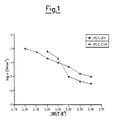
- a second electrolytic membrane is prepared from the copolymer of Example 5 and lithium perchlorate (LiClO4), with the atomic ratio of O/Li being still equal to 8/1.
- the conductivity of this membrane at various temperatures is reported in the chart of Figure 1 (--- --- line).
- Both said first and second electrolytic membranes are amorphous and both of them show a glass transition temperature of about -20°C (as determined by D.S.C.).
- the conductivity of such membranes is reported in the chart of Figure 2.
Landscapes
- Physics & Mathematics (AREA)
- Chemical & Material Sciences (AREA)
- Nonlinear Science (AREA)
- Chemical Kinetics & Catalysis (AREA)
- Electrochemistry (AREA)
- Spectroscopy & Molecular Physics (AREA)
- General Physics & Mathematics (AREA)
- Optics & Photonics (AREA)
- Inorganic Chemistry (AREA)
- Engineering & Computer Science (AREA)
- Manufacturing & Machinery (AREA)
- General Chemical & Material Sciences (AREA)
- Secondary Cells (AREA)
- Conductive Materials (AREA)
- Primary Cells (AREA)
- Epoxy Resins (AREA)
- Electrochromic Elements, Electrophoresis, Or Variable Reflection Or Absorption Elements (AREA)
Priority Applications (1)
| Application Number | Priority Date | Filing Date | Title |
|---|---|---|---|
| AT90202637T ATE102744T1 (de) | 1989-10-06 | 1990-10-04 | Fester polymerelektrolyt auf basis von polyepoxyden. |
Applications Claiming Priority (2)
| Application Number | Priority Date | Filing Date | Title |
|---|---|---|---|
| IT02193789A IT1236512B (it) | 1989-10-06 | 1989-10-06 | Elettrolita polimerico solido a base poliepossidica. |
| IT2193789 | 1989-10-06 |
Publications (3)
| Publication Number | Publication Date |
|---|---|
| EP0421546A2 EP0421546A2 (en) | 1991-04-10 |
| EP0421546A3 EP0421546A3 (en) | 1992-06-03 |
| EP0421546B1 true EP0421546B1 (en) | 1994-03-09 |
Family
ID=11189098
Family Applications (1)
| Application Number | Title | Priority Date | Filing Date |
|---|---|---|---|
| EP90202637A Expired - Lifetime EP0421546B1 (en) | 1989-10-06 | 1990-10-04 | Solid, polymeric electrolyte on polyepoxy basis |
Country Status (7)
| Country | Link |
|---|---|
| US (1) | US5162174A (da) |
| EP (1) | EP0421546B1 (da) |
| AT (1) | ATE102744T1 (da) |
| DE (1) | DE69007227T2 (da) |
| DK (1) | DK0421546T3 (da) |
| ES (1) | ES2062309T3 (da) |
| IT (1) | IT1236512B (da) |
Families Citing this family (19)
| Publication number | Priority date | Publication date | Assignee | Title |
|---|---|---|---|---|
| US5538811A (en) * | 1992-07-23 | 1996-07-23 | Matsushita Electric Industrial Co., Ltd. | Ionic conductive polymer electrolyte |
| FR2695131B1 (fr) * | 1992-09-01 | 1994-09-30 | Alsthom Cge Alcatel | Electrolyte solide polymère conducteur protonique. |
| US5378405A (en) * | 1993-07-28 | 1995-01-03 | Minnesota Mining And Manufacturing Company | Conductive microparticles and pressure-sensitive adhesive tapes made therefrom |
| US5508107A (en) * | 1993-07-28 | 1996-04-16 | Minnesota Mining And Manufacturing Company | Pressure-sensitive adhesive tapes for electronics applications |
| DK0795182T3 (da) * | 1994-12-01 | 1999-10-04 | Danacell Aps | Ionledende polymerer |
| CA2175950C (en) * | 1995-05-08 | 2008-12-02 | Shinzo Kohjiya | Polymer solid electrolyte |
| US5748439A (en) * | 1995-06-06 | 1998-05-05 | Telectronics Pacing Systems, Inc. | Capacitors having high strength electrolytic capacitor separators |
| JP3215436B2 (ja) | 1996-05-08 | 2001-10-09 | ダイソー株式会社 | 架橋高分子固体電解質及びその用途 |
| JP3215440B2 (ja) * | 1996-08-20 | 2001-10-09 | ダイソー株式会社 | 高分子固体電解質 |
| CA2244904C (en) | 1996-12-09 | 2006-11-28 | Daiso Co., Ltd. | Copolyether and solid polymer electrolyte |
| US6201071B1 (en) * | 1997-06-25 | 2001-03-13 | Daiso Co., Ltd. | Polyether copolymer, solid polymer electrolyte and battery |
| JP3301378B2 (ja) * | 1998-03-24 | 2002-07-15 | ダイソー株式会社 | ポリエーテル共重合体および架橋高分子固体電解質 |
| DE69930030T2 (de) * | 1998-06-25 | 2006-11-09 | Hydro-Québec, Montréal | Material mit ionischer Leitfähigkeit |
| JP3491539B2 (ja) * | 1998-10-13 | 2004-01-26 | ダイソー株式会社 | 高分子固体電解質及びその用途 |
| KR100288103B1 (ko) | 1998-12-26 | 2001-05-02 | 윤덕용 | 폴리에테르가 그라프트된 생분해성 지방족 폴리에스테르 및 그의 제조방법 |
| JP3724252B2 (ja) * | 1999-04-19 | 2005-12-07 | ダイソー株式会社 | 架橋高分子固体電解質及びその用途 |
| US20050287441A1 (en) * | 2004-06-23 | 2005-12-29 | Stefano Passerini | Lithium polymer electrolyte batteries and methods of making |
| ITMI20041279A1 (it) * | 2004-06-24 | 2004-09-24 | Pharmaproducts Uk Ltd | Uso di calcio trifluoroacetato per la preparazione di medicamenti ad effetto anti-angiogenetico |
| EP2698392A1 (en) * | 2012-08-17 | 2014-02-19 | Helmholtz-Zentrum Geesthacht Zentrum für Material- und Küstenforschung GmbH | Polymer network material comprising a poly(glycidyl ether) structure, method of its production and use |
Family Cites Families (4)
| Publication number | Priority date | Publication date | Assignee | Title |
|---|---|---|---|---|
| JPS5545774A (en) * | 1978-09-29 | 1980-03-31 | Daikin Ind Ltd | Epoxy resin composition |
| GB8716559D0 (en) * | 1987-07-14 | 1987-08-19 | Secr Defence | Ion conductors |
| JPH0794594B2 (ja) * | 1988-12-16 | 1995-10-11 | 日本石油株式会社 | 高分子固体電解質及びその製造方法 |
| IT1231031B (it) * | 1989-08-01 | 1991-11-08 | Eniricerche Spa | Elettrolita polimerico solido e dispositivi che lo incorporano. |
-
1989
- 1989-10-06 IT IT02193789A patent/IT1236512B/it active IP Right Grant
-
1990
- 1990-10-04 DK DK90202637.6T patent/DK0421546T3/da active
- 1990-10-04 ES ES90202637T patent/ES2062309T3/es not_active Expired - Lifetime
- 1990-10-04 DE DE69007227T patent/DE69007227T2/de not_active Expired - Fee Related
- 1990-10-04 AT AT90202637T patent/ATE102744T1/de not_active IP Right Cessation
- 1990-10-04 EP EP90202637A patent/EP0421546B1/en not_active Expired - Lifetime
- 1990-10-04 US US07/592,811 patent/US5162174A/en not_active Expired - Fee Related
Non-Patent Citations (1)
| Title |
|---|
| PATENT ABSTRACTS OF JAPAN vol. 14, no. 197 (C-712)(4140) 23 April 1990 and JP-A-02 038 451 (Yotsukaichi Gosei K.K.) February 1990 * |
Also Published As
| Publication number | Publication date |
|---|---|
| ATE102744T1 (de) | 1994-03-15 |
| ES2062309T3 (es) | 1994-12-16 |
| IT1236512B (it) | 1993-03-11 |
| DE69007227T2 (de) | 1994-08-04 |
| US5162174A (en) | 1992-11-10 |
| DK0421546T3 (da) | 1994-06-06 |
| IT8921937A1 (it) | 1991-04-06 |
| DE69007227D1 (de) | 1994-04-14 |
| EP0421546A2 (en) | 1991-04-10 |
| EP0421546A3 (en) | 1992-06-03 |
| IT8921937A0 (it) | 1989-10-06 |
Similar Documents
| Publication | Publication Date | Title |
|---|---|---|
| US5162174A (en) | Solid, polymeric electrolyte on polyepoxy basis | |
| EP0312160B1 (en) | Solid polymeric electrolyte and electrochemical generators containing it | |
| US8754138B2 (en) | Polymers obtained from monomers allowing a sequential polymerization, and their use for preparing ionic conductors | |
| CA1336847C (en) | Electrically conducting polymers | |
| JP5610468B2 (ja) | 固体高分子電解質、固体高分子電解質フィルム及び固体高分子電解質フィルムの製造方法 | |
| EP0492710B1 (en) | Solid polymer electrolyte based on cross-linked polyvinylether | |
| EP0260847A1 (en) | Solid electrolytes | |
| KR100394077B1 (ko) | 폴리알킬렌 옥시드계 고체 고분자 전해질 조성물 | |
| EP0411693B1 (en) | Solid polymeric electrolyte and devices which incorporate it | |
| US10756348B2 (en) | Use of certain polymers as a charge store | |
| WO1989000771A1 (en) | Ion conductors | |
| JPH0881553A (ja) | 高分子材料およびそれを利用した電気化学的装置 | |
| US5264307A (en) | Solid, polymeric, polyether based electrolyte | |
| US6913851B2 (en) | Polyether polymer compounds as well as ion conductible polymer compositions and electrochemical devices using the same | |
| CA2320953A1 (en) | Polymeric compounds, polymers for polymer electrolytes, and ion-conductive polymer electrolyte compositions | |
| EP0633578B1 (en) | Solid polymeric electrolyte including a cross-linked polyether encompassing an ionic compound and a liquid plasticizer | |
| US5552510A (en) | Oxirane and dioxolane copolymers, process for their preparation and ionic conduction materials containing same | |
| US5417870A (en) | Solid, polyether-bases polymeric electrolyte | |
| EP0638949B1 (en) | Solid, polymeric, polyether based electrolyte |
Legal Events
| Date | Code | Title | Description |
|---|---|---|---|
| PUAI | Public reference made under article 153(3) epc to a published international application that has entered the european phase |
Free format text: ORIGINAL CODE: 0009012 |
|
| AK | Designated contracting states |
Kind code of ref document: A2 Designated state(s): AT BE CH DE DK ES FR GB GR LI LU NL SE |
|
| PUAL | Search report despatched |
Free format text: ORIGINAL CODE: 0009013 |
|
| AK | Designated contracting states |
Kind code of ref document: A3 Designated state(s): AT BE CH DE DK ES FR GB GR LI LU NL SE |
|
| 17P | Request for examination filed |
Effective date: 19921110 |
|
| 17Q | First examination report despatched |
Effective date: 19930705 |
|
| GRAA | (expected) grant |
Free format text: ORIGINAL CODE: 0009210 |
|
| AK | Designated contracting states |
Kind code of ref document: B1 Designated state(s): AT BE CH DE DK ES FR GB GR LI LU NL SE |
|
| REF | Corresponds to: |
Ref document number: 102744 Country of ref document: AT Date of ref document: 19940315 Kind code of ref document: T |
|
| ET | Fr: translation filed | ||
| REF | Corresponds to: |
Ref document number: 69007227 Country of ref document: DE Date of ref document: 19940414 |
|
| REG | Reference to a national code |
Ref country code: DK Ref legal event code: T3 |
|
| REG | Reference to a national code |
Ref country code: GR Ref legal event code: FG4A Free format text: 3011436 |
|
| REG | Reference to a national code |
Ref country code: ES Ref legal event code: FG2A Ref document number: 2062309 Country of ref document: ES Kind code of ref document: T3 |
|
| PLBE | No opposition filed within time limit |
Free format text: ORIGINAL CODE: 0009261 |
|
| STAA | Information on the status of an ep patent application or granted ep patent |
Free format text: STATUS: NO OPPOSITION FILED WITHIN TIME LIMIT |
|
| EAL | Se: european patent in force in sweden |
Ref document number: 90202637.6 |
|
| 26N | No opposition filed | ||
| PGFP | Annual fee paid to national office [announced via postgrant information from national office to epo] |
Ref country code: DE Payment date: 20000925 Year of fee payment: 11 |
|
| PGFP | Annual fee paid to national office [announced via postgrant information from national office to epo] |
Ref country code: GB Payment date: 20001004 Year of fee payment: 11 |
|
| PGFP | Annual fee paid to national office [announced via postgrant information from national office to epo] |
Ref country code: LU Payment date: 20001006 Year of fee payment: 11 |
|
| PGFP | Annual fee paid to national office [announced via postgrant information from national office to epo] |
Ref country code: SE Payment date: 20001009 Year of fee payment: 11 |
|
| PGFP | Annual fee paid to national office [announced via postgrant information from national office to epo] |
Ref country code: FR Payment date: 20001010 Year of fee payment: 11 |
|
| PGFP | Annual fee paid to national office [announced via postgrant information from national office to epo] |
Ref country code: CH Payment date: 20001011 Year of fee payment: 11 Ref country code: AT Payment date: 20001011 Year of fee payment: 11 |
|
| PGFP | Annual fee paid to national office [announced via postgrant information from national office to epo] |
Ref country code: DK Payment date: 20001012 Year of fee payment: 11 |
|
| PGFP | Annual fee paid to national office [announced via postgrant information from national office to epo] |
Ref country code: ES Payment date: 20001025 Year of fee payment: 11 |
|
| PGFP | Annual fee paid to national office [announced via postgrant information from national office to epo] |
Ref country code: NL Payment date: 20001026 Year of fee payment: 11 |
|
| PGFP | Annual fee paid to national office [announced via postgrant information from national office to epo] |
Ref country code: GR Payment date: 20001027 Year of fee payment: 11 |
|
| PGFP | Annual fee paid to national office [announced via postgrant information from national office to epo] |
Ref country code: BE Payment date: 20001214 Year of fee payment: 11 |
|
| PG25 | Lapsed in a contracting state [announced via postgrant information from national office to epo] |
Ref country code: LU Free format text: LAPSE BECAUSE OF NON-PAYMENT OF DUE FEES Effective date: 20011004 Ref country code: GB Free format text: LAPSE BECAUSE OF NON-PAYMENT OF DUE FEES Effective date: 20011004 Ref country code: DK Free format text: LAPSE BECAUSE OF NON-PAYMENT OF DUE FEES Effective date: 20011004 Ref country code: AT Free format text: LAPSE BECAUSE OF NON-PAYMENT OF DUE FEES Effective date: 20011004 |
|
| PG25 | Lapsed in a contracting state [announced via postgrant information from national office to epo] |
Ref country code: SE Free format text: LAPSE BECAUSE OF NON-PAYMENT OF DUE FEES Effective date: 20011005 Ref country code: ES Free format text: LAPSE BECAUSE OF NON-PAYMENT OF DUE FEES Effective date: 20011005 |
|
| PG25 | Lapsed in a contracting state [announced via postgrant information from national office to epo] |
Ref country code: LI Free format text: LAPSE BECAUSE OF NON-PAYMENT OF DUE FEES Effective date: 20011031 Ref country code: GR Free format text: LAPSE BECAUSE OF NON-PAYMENT OF DUE FEES Effective date: 20011031 Ref country code: CH Free format text: LAPSE BECAUSE OF NON-PAYMENT OF DUE FEES Effective date: 20011031 Ref country code: BE Free format text: LAPSE BECAUSE OF NON-PAYMENT OF DUE FEES Effective date: 20011031 |
|
| REG | Reference to a national code |
Ref country code: GB Ref legal event code: IF02 |
|
| BERE | Be: lapsed |
Owner name: ENIRICERCHE S.P.A. Effective date: 20011031 |
|
| PG25 | Lapsed in a contracting state [announced via postgrant information from national office to epo] |
Ref country code: NL Free format text: LAPSE BECAUSE OF NON-PAYMENT OF DUE FEES Effective date: 20020501 |
|
| GBPC | Gb: european patent ceased through non-payment of renewal fee |
Effective date: 20011004 |
|
| EUG | Se: european patent has lapsed |
Ref document number: 90202637.6 |
|
| REG | Reference to a national code |
Ref country code: CH Ref legal event code: PL |
|
| REG | Reference to a national code |
Ref country code: DK Ref legal event code: EBP |
|
| PG25 | Lapsed in a contracting state [announced via postgrant information from national office to epo] |
Ref country code: FR Free format text: LAPSE BECAUSE OF NON-PAYMENT OF DUE FEES Effective date: 20020628 |
|
| NLV4 | Nl: lapsed or anulled due to non-payment of the annual fee |
Effective date: 20020501 |
|
| PG25 | Lapsed in a contracting state [announced via postgrant information from national office to epo] |
Ref country code: DE Free format text: LAPSE BECAUSE OF NON-PAYMENT OF DUE FEES Effective date: 20020702 |
|
| REG | Reference to a national code |
Ref country code: FR Ref legal event code: ST |
|
| REG | Reference to a national code |
Ref country code: ES Ref legal event code: FD2A Effective date: 20021113 |