EP0422239B1 - Styren-kopolymer und verfahren zur herstellung - Google Patents
Styren-kopolymer und verfahren zur herstellung Download PDFInfo
- Publication number
- EP0422239B1 EP0422239B1 EP90904696A EP90904696A EP0422239B1 EP 0422239 B1 EP0422239 B1 EP 0422239B1 EP 90904696 A EP90904696 A EP 90904696A EP 90904696 A EP90904696 A EP 90904696A EP 0422239 B1 EP0422239 B1 EP 0422239B1
- Authority
- EP
- European Patent Office
- Prior art keywords
- general formula
- group
- styrene
- represented
- repeating unit
- Prior art date
- Legal status (The legal status is an assumption and is not a legal conclusion. Google has not performed a legal analysis and makes no representation as to the accuracy of the status listed.)
- Expired - Lifetime
Links
Classifications
-
- C—CHEMISTRY; METALLURGY
- C08—ORGANIC MACROMOLECULAR COMPOUNDS; THEIR PREPARATION OR CHEMICAL WORKING-UP; COMPOSITIONS BASED THEREON
- C08F—MACROMOLECULAR COMPOUNDS OBTAINED BY REACTIONS ONLY INVOLVING CARBON-TO-CARBON UNSATURATED BONDS
- C08F212/00—Copolymers of compounds having one or more unsaturated aliphatic radicals, each having only one carbon-to-carbon double bond, and at least one being terminated by an aromatic carbocyclic ring
- C08F212/02—Monomers containing only one unsaturated aliphatic radical
- C08F212/04—Monomers containing only one unsaturated aliphatic radical containing one ring
- C08F212/06—Hydrocarbons
- C08F212/08—Styrene
-
- C—CHEMISTRY; METALLURGY
- C08—ORGANIC MACROMOLECULAR COMPOUNDS; THEIR PREPARATION OR CHEMICAL WORKING-UP; COMPOSITIONS BASED THEREON
- C08F—MACROMOLECULAR COMPOUNDS OBTAINED BY REACTIONS ONLY INVOLVING CARBON-TO-CARBON UNSATURATED BONDS
- C08F212/00—Copolymers of compounds having one or more unsaturated aliphatic radicals, each having only one carbon-to-carbon double bond, and at least one being terminated by an aromatic carbocyclic ring
- C08F212/02—Monomers containing only one unsaturated aliphatic radical
- C08F212/04—Monomers containing only one unsaturated aliphatic radical containing one ring
- C08F212/06—Hydrocarbons
- C08F212/08—Styrene
- C08F212/10—Styrene with nitriles
-
- C—CHEMISTRY; METALLURGY
- C08—ORGANIC MACROMOLECULAR COMPOUNDS; THEIR PREPARATION OR CHEMICAL WORKING-UP; COMPOSITIONS BASED THEREON
- C08F—MACROMOLECULAR COMPOUNDS OBTAINED BY REACTIONS ONLY INVOLVING CARBON-TO-CARBON UNSATURATED BONDS
- C08F212/00—Copolymers of compounds having one or more unsaturated aliphatic radicals, each having only one carbon-to-carbon double bond, and at least one being terminated by an aromatic carbocyclic ring
- C08F212/02—Monomers containing only one unsaturated aliphatic radical
- C08F212/04—Monomers containing only one unsaturated aliphatic radical containing one ring
-
- C—CHEMISTRY; METALLURGY
- C08—ORGANIC MACROMOLECULAR COMPOUNDS; THEIR PREPARATION OR CHEMICAL WORKING-UP; COMPOSITIONS BASED THEREON
- C08F—MACROMOLECULAR COMPOUNDS OBTAINED BY REACTIONS ONLY INVOLVING CARBON-TO-CARBON UNSATURATED BONDS
- C08F220/00—Copolymers of compounds having one or more unsaturated aliphatic radicals, each having only one carbon-to-carbon double bond, and only one being terminated by only one carboxyl radical or a salt, anhydride ester, amide, imide or nitrile thereof
- C08F220/02—Monocarboxylic acids having less than ten carbon atoms; Derivatives thereof
-
- C—CHEMISTRY; METALLURGY
- C08—ORGANIC MACROMOLECULAR COMPOUNDS; THEIR PREPARATION OR CHEMICAL WORKING-UP; COMPOSITIONS BASED THEREON
- C08F—MACROMOLECULAR COMPOUNDS OBTAINED BY REACTIONS ONLY INVOLVING CARBON-TO-CARBON UNSATURATED BONDS
- C08F4/00—Polymerisation catalysts
- C08F4/42—Metals; Metal hydrides; Metallo-organic compounds; Use thereof as catalyst precursors
- C08F4/44—Metals; Metal hydrides; Metallo-organic compounds; Use thereof as catalyst precursors selected from light metals, zinc, cadmium, mercury, copper, silver, gold, boron, gallium, indium, thallium, rare earths or actinides
- C08F4/52—Metals; Metal hydrides; Metallo-organic compounds; Use thereof as catalyst precursors selected from light metals, zinc, cadmium, mercury, copper, silver, gold, boron, gallium, indium, thallium, rare earths or actinides selected from boron, aluminium, gallium, indium, thallium or rare earths
-
- C—CHEMISTRY; METALLURGY
- C08—ORGANIC MACROMOLECULAR COMPOUNDS; THEIR PREPARATION OR CHEMICAL WORKING-UP; COMPOSITIONS BASED THEREON
- C08F—MACROMOLECULAR COMPOUNDS OBTAINED BY REACTIONS ONLY INVOLVING CARBON-TO-CARBON UNSATURATED BONDS
- C08F4/00—Polymerisation catalysts
- C08F4/42—Metals; Metal hydrides; Metallo-organic compounds; Use thereof as catalyst precursors
- C08F4/44—Metals; Metal hydrides; Metallo-organic compounds; Use thereof as catalyst precursors selected from light metals, zinc, cadmium, mercury, copper, silver, gold, boron, gallium, indium, thallium, rare earths or actinides
- C08F4/54—Metals; Metal hydrides; Metallo-organic compounds; Use thereof as catalyst precursors selected from light metals, zinc, cadmium, mercury, copper, silver, gold, boron, gallium, indium, thallium, rare earths or actinides together with other compounds thereof
-
- C—CHEMISTRY; METALLURGY
- C08—ORGANIC MACROMOLECULAR COMPOUNDS; THEIR PREPARATION OR CHEMICAL WORKING-UP; COMPOSITIONS BASED THEREON
- C08F—MACROMOLECULAR COMPOUNDS OBTAINED BY REACTIONS ONLY INVOLVING CARBON-TO-CARBON UNSATURATED BONDS
- C08F4/00—Polymerisation catalysts
- C08F4/42—Metals; Metal hydrides; Metallo-organic compounds; Use thereof as catalyst precursors
- C08F4/44—Metals; Metal hydrides; Metallo-organic compounds; Use thereof as catalyst precursors selected from light metals, zinc, cadmium, mercury, copper, silver, gold, boron, gallium, indium, thallium, rare earths or actinides
- C08F4/60—Metals; Metal hydrides; Metallo-organic compounds; Use thereof as catalyst precursors selected from light metals, zinc, cadmium, mercury, copper, silver, gold, boron, gallium, indium, thallium, rare earths or actinides together with refractory metals, iron group metals, platinum group metals, manganese, rhenium technetium or compounds thereof
-
- C—CHEMISTRY; METALLURGY
- C08—ORGANIC MACROMOLECULAR COMPOUNDS; THEIR PREPARATION OR CHEMICAL WORKING-UP; COMPOSITIONS BASED THEREON
- C08F—MACROMOLECULAR COMPOUNDS OBTAINED BY REACTIONS ONLY INVOLVING CARBON-TO-CARBON UNSATURATED BONDS
- C08F4/00—Polymerisation catalysts
- C08F4/42—Metals; Metal hydrides; Metallo-organic compounds; Use thereof as catalyst precursors
- C08F4/44—Metals; Metal hydrides; Metallo-organic compounds; Use thereof as catalyst precursors selected from light metals, zinc, cadmium, mercury, copper, silver, gold, boron, gallium, indium, thallium, rare earths or actinides
- C08F4/60—Metals; Metal hydrides; Metallo-organic compounds; Use thereof as catalyst precursors selected from light metals, zinc, cadmium, mercury, copper, silver, gold, boron, gallium, indium, thallium, rare earths or actinides together with refractory metals, iron group metals, platinum group metals, manganese, rhenium technetium or compounds thereof
- C08F4/62—Refractory metals or compounds thereof
- C08F4/64—Titanium, zirconium, hafnium or compounds thereof
-
- Y—GENERAL TAGGING OF NEW TECHNOLOGICAL DEVELOPMENTS; GENERAL TAGGING OF CROSS-SECTIONAL TECHNOLOGIES SPANNING OVER SEVERAL SECTIONS OF THE IPC; TECHNICAL SUBJECTS COVERED BY FORMER USPC CROSS-REFERENCE ART COLLECTIONS [XRACs] AND DIGESTS
- Y10—TECHNICAL SUBJECTS COVERED BY FORMER USPC
- Y10S—TECHNICAL SUBJECTS COVERED BY FORMER USPC CROSS-REFERENCE ART COLLECTIONS [XRACs] AND DIGESTS
- Y10S526/00—Synthetic resins or natural rubbers -- part of the class 520 series
- Y10S526/943—Polymerization with metallocene catalysts
Definitions
- the present invention relates to a styrene copolymer and a process for production thereof, more specifically it relates to a copolymer which comprises a styrene monomer and (1) an acrylonitrile monomer, (2) an unsaturated carboxylic acid or its ester monomer, or (3) a maleimide or N-substituted maleimide monomer, having a specific stereostructure, and to an efficient process for production thereof.
- a styrene polymer produced by the radical polymerization method, etc. has an atactic configuration in stereostructure. It is molded into various shapes by various molding methods such as injection molding, extrusion molding, blow molding, vacuum molding and cast molding, for example, and has been widely used for electric domestic appliances, office equipments, domestic appliances, packaging containers, toys, furniture, synthetic papers and other industrial materials.
- the styrene polymer having an atactic configuration has drawbacks that it is inferior in heat resistance and chemical resistance.
- the group of the present inventors have succeeded to develop a styrene polymer having a high degree of syndiotacticity, and also developed a styrene copolymer in which other components are blended with the styrene monomer (Japanese Patent Application Laid-Open Nos. 104818/1987 and 241009/1988).
- Such polymer or copolymer having a syndiotactic configuration has excellent heat resistance, chemical resistance and electric characteristic, and expected to be applied in various fields.
- syndiotactic polystyrene is a polymer wherein glass transition temperature is 90 to 100°C and melting point is 250 to 275°C.
- Heat deformation temperature under light load is high level, i.e. around melting point, while heat deformation temperature under heavy load is around glass transition temperature, that is, it is almost the same as that of general-purpose polystyrene (GPPS).
- GPPS general-purpose polystyrene
- the present inventors have studied intensively to develop a copolymer whose impact resistance is improved while maintaining heat resistance and chemical resistance of a polystyrene having a syndiotactic configuration, or a copolymer whose heat resistance is further improved by raising glass transition temperature (heat deformation temperature under heavy load) or heat decomposition temperature, which has good compatibility and adhesion to other resin or inorganic filler and improved wettability, and further to develop an efficient process for production of said copolymer.
- glass transition temperature heat deformation temperature under heavy load
- heat decomposition temperature which has good compatibility and adhesion to other resin or inorganic filler and improved wettability
- the present invention provides a styrene copolymer which comprises a styrene repeating unit (a) represented by the general formula (I): (wherein R1 is a hydrogen atom, a halogen atom or a hydrocarbon group having not more than 20 carbon atoms, m is an integer of 1 to 3, and when m is plural, R1s may be the same or different) and an acrylonitrile repeating unit (b) represented by the general formula (II-(b)): (wherein R2 is a hydrogen atom or a methyl group), an unsaturated carboxylic acid or its ester repeating unit (c) represented by the general formula (II-(c)): (wherein R3 is a hydrogen atom or a saturated hydrocarbon group having not more than 5 carbon atoms, R4 is a hydrogen atom, a saturated hydrocarbon group having not more than 20 carbon atoms, a saturated hydrocarbon group having not more than 20 carbon atoms and at least one hydroxyl
- the present invention provides a process for producing the above styrene copolymer which comprises copolymerization of a styrene monomer represented by the general formula (I'): (wherein R1 and m are the same as defined above) and an acrylonitrile monomer represented by the general formula (II'-(b)): (wherein R2 is the same as defined above), an unsaturated carboxylic acid or its ester monomer represented by the general formula (II'-(c)): (wherein R3 and R4 are the same as defined above) or a maleimide or N-substituted maleimide monomer represented by the general formula (II'-(d)): (wherein R5 is the same as defined above) in the presence of a catalyst comprising a titanium compound and alkylaluminoxane.
- a catalyst comprising a titanium compound and alkylaluminoxane.
- the styrene copolymer of the present invention may be roughly divided into three groups, that is, a styrene copolymer A which comprises a styrene repeating unit (a) represented by the general formula (I) and an acrylonitrile repeating unit (b) represented by the general formula (II-(b)); a styrene copolymer B which comprises the styrene repeating unit (a) and an unsaturated carboxylic acid or its ester repeating unit (c) represented by the general formula (II-(c)); and a styrene copolymer C which comprises the styrene repeating unit (a) and a maleimide or N-substituted maleimide repeating unit (d) represented by the general formula (II-(d)).
- a styrene copolymer A which comprises a styrene repeating unit (a) represented by the general formula (I) and
- R1 is a hydrogen atom, a halogen atom (for example, chlorine, bromine, fluorine, iodine) or a hydrocarbon group having not more than 20 carbon atoms, preferably, 10 to 1 carbon atoms (for example, a saturated hydrocarbon group (particularly an alkyl group) such as methyl, ethyl, propyl, butyl, pentyl, hexyl or an unsaturated hydrocarbon group such as vinyl).
- a halogen atom for example, chlorine, bromine, fluorine, iodine
- a hydrocarbon group having not more than 20 carbon atoms preferably, 10 to 1 carbon atoms
- a saturated hydrocarbon group particularly an alkyl group
- alkyl group such as methyl, ethyl, propyl, butyl, pentyl, hexyl or an unsaturated hydrocarbon group such as vinyl
- the example of the repeating unit represented by the general formula (I) includes a styrene unit, an alkylstyrene unit such as p-methylstyrene unit, m-methylstyrene unit, o-methylstyrene unit, 2,4-dimethylstyrene unit, 2,5-dimethylstyrene unit, 3,4-dimethylstyrene unit, 3,5-dimethylstyrene unit, p-ethylstyrene unit, m-ethylstyrene unit, p-tert-butylstyrene unit; p-divinylbenzene unit, m-divinylbenzene unit, trivinylbenzene unit, a halogenated styrene unit such as p-chlorostyrene unit, m-chlorostyrene unit, o-chlorostyrene unit, p-bromostyren
- the repeating unit (b) represented by the general formula (II-(b)) is derived from the acrylonitrile monomer represented by the above general formula (II'-(b)).
- the example of this acrylonitrile monomer includes, for example, acrylonitrile or methacrylonitrile.
- the repeating unit (c) represented by the general formula (II-(c)) is derived from the unsaturated carboxylic acid or its ester monomer represented by the above general formula (II'-(c)).
- the example of this unsaturated carboxylic acid or its ester monomer includes, for example, acrylic acid, acrylic acid alkyl esters such as methyl acrylate, ethyl acrylate, n-butyl acrylate, isobutyl acrylate, sec-butyl acrylate, tert-butyl acrylate, 2-ethylhexyl acrylate, octyl acrylate, acrylic acid alkyl ester containing hydroxyl group such as 2-hydroxyethyl acrylate, phenyl acrylate, benzyl acrylate and methacrylic acid or methacrylate corresponding to the above acrylate.
- the repeating unit (d) represented by the general formula (II-(d)) is derived from a maleimide or N-substituted maleimide monomer represented by the general formula (II'-(d)).
- the example of such maleimide or N-substituted maleimide includes, for example, maleimide, N-methyl maleimide, N-ethyl maleimide, N-tert-butyl maleimide, N-phenyl maleimide.
- the styrene repeating unit (a) may be composed of two or more components, which applies to the repeating units (b), (c) and (d).
- the repeating units (b), (c) and (d) may be synthesized.
- the content of the above repeating unit (b), (c) or (d) is generally 0.1 to 50 wt%, preferably 1.0 to 20 wt% of the whole copolymer.
- the content of the repeating unit (b) in the copolymer A is less than 0.1 wt%, the improvements such as impartment of flexibility can not be sufficiently attained.
- the improvements such as impartment of flexibility can not be sufficiently attained.
- crystallization is inhibited and chemical resistance, which is a characteristic of the styrene polymer having a syndiotactic configuration, may be degraded. Further, it may often cause coloring (yellowing) during molding, providing defects in physical properties like the conventional acrylonitrile polymer.
- the content of the repeating unit (c) in the copolymer B is less than 0.1 wt%, the improvements such as raising of glass transition temperature or heat deformation temperature can not be sufficiently attained.
- the improvements such as raising of glass transition temperature or heat deformation temperature can not be sufficiently attained.
- crystallization is inhibited and chemical resistance, which is a characteristic of the styrene polymer having a syndiotactic configuration, may be degraded. Further, it may often cause coloring (yellowing) during molding, providing defects in physical properties like the conventional unsaturated carboxylic acid or its ester polymer.
- the content of the repeating unit (d) in the copolymer C is less than 0.1 wt%, the improvements such as raising of glass transition temperature or heat deformation temperature can not be sufficiently attained.
- the improvements such as raising of glass transition temperature or heat deformation temperature can not be sufficiently attained.
- crystallization is inhibited and chemical resistance, which is a characteristic of the styrene polymer having a syndiotactic configuration, may be degraded and the product may become brittle, providing defects in physical properties like the conventional maleimide or N-substituted maleimide polymer.
- intrinsic viscosity measured in 1,2,4-trichlorobenzene solution (135°C) is generally 0.07 to 20 dl/g, preferably, 0.3 to 10 dl/g.
- intrinsic viscosity is less than 0.07 dl/g, the product can not be practically used because o its poor dynamic properties.
- intrinsic viscosity is over 20 dl/g, it is difficult to carry out the conventional melt molding.
- the third component can be added as long as the properties of the resulting copolymer or the syndiotactic configuration of the styrene repeating unit (a) chain are not markedly degraded.
- Such compounds include, for example, dienes, vinylsiloxanes, unsaturated carboxylic acid esters, olefins for the copolymer A; dienes, vinylsiloxanes, olefins, acrylonitriles for the copolymer B; and dienes, vinylsiloxanes, olefins, unsaturated carboxylic acid esters, acrylonitriles for the copolymer C.
- the styrene copolymers of the present invention have a styrene repeating unit (a) chain having a high degree of syndiotactic configuration.
- a high degree of syndiotactic configuration in the styrene polymer means that stereochemical structure is a high degree of syndiotactic configuration, that is, the stereostructure in which phenyl groups or substituted phenyl groups as side chains are located alternately in opposite directions relative to the main chain consisting of carbon-carbon bonds.
- Tacticity is quantitatively determined by the nuclear magnetic resonance method (13C-NMR method) using carbon isotope.
- the tacticity measured by the 13C-NMR method can be indicated in terms of proportions of structural units continuously connected to each other, i.e., a diad in which two structural units are connected to each other, a triad in which three structural units are connected to each other and a pentad in which five structural units are connected to each other.
- the proportion of racemic diad is at least 75%, preferably at least 85%, or proportions of racemic pentad is at least 30% and preferably at least 50%.
- copolymers of the present invention described above with the desired stereoregularity and reactive substituents can be produced by copolymerization of the repeating unit (a) and the monomer corresponding to the repeating units (b), (c) or (d), and fractionation, blend or application of techniques of organic synthesis using the resulting copolymer as a starting material.
- the above-described process of the present invention more efficiently provides the styrene copolymer of high quality.
- the starting monomer used in the process for production of the present invention is a styrene monomer represented by the general formula (I') and a monomer represented by the general formula (II'-(b)), (II'-(c)) or (II'-(d)).
- the styrene monomer and the acrylonitrile monomer represented by the general formula (II'-(b)) are copolymerized to constitute the corresponding repeating units (a) and (b) in the copolymer A.
- the styrene monomer and the unsaturated carboxylic acid or its ester monomer represented by the general formula (II'-(c)) are copolymerized to constitute the corresponding repeating units (a) and (c) in the copolymer B. Further, the styrene monomer and maleimide or N-substituted maleimide monomer represented by the general formula (II'-(d)) are copolymerized to constitute the corresponding repeating units (a) and (d) in the copolymer C.
- examples of such styrene monomer, acrylonitrile monomer, unsaturated carboxylic acid or its ester monomer, or maleimide or N-substituted maleimide monomer include those corresponding to the examples described for the above repeating units (a), (b), (c) and (d).
- these monomers are used as starting materials and copolymerized in the presence of a catalyst containing a titanium compound (A) and alkylaluminoxane (B) as main components.
- the catalyst herein used is the same as that specifically described in Japanese Patent Application Laid-Open No. 241009/1988.
- component (A), i.e., a titanium compound includes various compounds, preferably at least one compound selected from a group consisting of titanium compounds or titanium chelate compounds represented by the general formula: ( ⁇ ) TiR6 a R7 b R8 c R9 4-(a+b+c) ( ⁇ ) or TiR6 d R7 e R8 3-(d+e) (wherein R6, R7, R8 and R9 represent independently a hydrogen, an alkyl group having 1 to 20 carbon atoms, an alkoxy group having 1 to 20 carbon atoms, an aryl group, an alkylaryl group and an arylalkyl group each having 6 to 20 carbon atoms, an acyloxy group having 1 to 20 carbon atoms, a cyclopentadienyl group, a substituted cyclopentadienyl group or an indenyl group or halogen, and a, b and c are independently an integer of 0 to 4, and d and e are independently
- R6, R7, R8 and R9 in the above formula ( ⁇ ) or ( ⁇ ) represent a hydrogen atom, an alkyl group having 1 to 20 carbon atoms (e.g., methyl, ethyl, propyl, butyl, amyl, isoamyl, isobutyl, octyl, 2-ethylhexyl), an alkoxy group having 1 to 20 carbon atoms (e.g., methoxy, ethoxy, propoxy, butoxy, amyloxy, hexyloxy, 2-ethylhexyloxy), an aryloxy group having 6 to 20 carbon atoms (e.g., phenoxy), an aryl group, an alkylaryl group and an arylalkyl group having 6 to 20 carbon atoms (e.g., phenyl, tolyl, xylyl, benzyl), an acyloxy group having 1 to 20 carbon atoms (e.g.,
- More preferable examples include a titanium compound represented by the general formula: TiRXYZ (wherein R is a cyclopentadienyl group, a substituted cyclopentadienyl group or an indenyl group, and X, Y and Z are independently a hydrogen atom, an alkyl group having 1 to 12 carbon atoms, an alkoxy group having 1 to 12 carbon atoms, an aryl group having 6 to 20 carbon atoms, an aryloxy group having 6 to 20 carbon atoms, an arylalkyl group having 6 to 20 carbon atoms or a halogen atom).
- R is a cyclopentadienyl group, a substituted cyclopentadienyl group or an indenyl group
- X, Y and Z are independently a hydrogen atom, an alkyl group having 1 to 12 carbon atoms, an alkoxy group having 1 to 12 carbon atoms, an aryl group having 6 to 20 carbon atoms
- the substituted cyclopentadienyl group represented by R in the above formula is a cyclopentadienyl group substituted by at least one alkyl group having 1 to 6 carbon atoms, specifically methylcyclopentadienyl group, 1,2-dimethylcyclopentadienyl group, pentamethylcyclopentadienyl group or the like.
- X, Y and Z are independently a hydrogen atom, an alkyl group having 1 to 12 carbon atoms (specifically, methyl, ethyl, propyl, n-butyl, isobutyl, amyl, isoamyl, octyl, 2-ethylhexyl group, etc.), an alkoxy group having 1 to 12 carbon atoms (specifically, methoxy, ethoxy, propoxy, butoxy, amyloxy, hexyloxy, octyloxy, 2-ethylhexyloxy, etc.), an aryl group having 6 to 20 carbon atoms (specifically, phenyl, naphthyl, etc.), an aryloxy group having 6 to 20 carbon atoms (specifically, phenoxy, etc.), an arylalkyl group having 6 to 20 carbon atoms (specifically, benzyl, etc.), or a halogen atom (specifically, chlorine
- titanium compound represented by the general formula ( ⁇ ) are cyclopentadienyltrimethyltitanium, cyclopentadienyltriethyltitanium, cyclopentadienyltripropyltitanium, cyclopentadienyltributyltitanium, methylcyclopentadienyltrimethyltitanium, 1,2-dimethylcyclopentadienyltrimethyltitanium, pentamethylcyclopentadienyltrimethyltitanium, pentamethylcyclopentadienyltriethyltitanium, pentamethylcyclopentadienyltripropyltitanium, pentamethylcyclopentadienyltributyltitanium, cyclopentadienylmethyltitanium dichloride, cyclopentadienylethyltitanium dichloride, pentamethylcyclopentadieny
- titanium compounds a compound containing no halogen atom is preferred, and a titanium compound having one ⁇ -electron ligand as described above is particularly preferred.
- Aluminoxane which is used as the component (B) in combination with the above titanium compound is a reaction product of an alkylaluminum compound and water, and more specifically, it includes chain-like alkyl-aluminoxanes represented by the general formula: (wherein n represents a degree of polymerization and is a number of 2 to 50, R10 represents an alkyl group having 1 to 8 carbon atoms), or cyclic alkylaluminoxanes having a repeating unit represented by the general formula:
- the contact product of the alkylaluminoxane and water such as trialkylaluminum is a mixture of the above-described chain-like alkylaluminoxane and cyclic alkyl aluminoxane and unreacted trialkylaluminum, various condensed products, or further molecules in which the above components have a complex association, and it becomes various products with the contact conditions of trialkylaluminum and water.
- the reaction between alkylaluminum and water is not particularly limited and carried out according to the known methods.
- there are methods such as (1) the method in which alkylaluminum is dissolved in an organic solvent and the resulting solution is contacted with water, (2) the method in which alkylaluminum is first added at the time of polymerization, and then water is added thereto, and (3) the method in which water of crystallization contained in a metal salt and the like or water absorbed in an inorganic material or an organic material is reacted with alkylaluminum.
- ammonia, amine such as ethylamine, a sulfur compound such as hydrogen sulfide and a phosphorus compound such as phosphite may be contained in an amount up to 20%.
- the preferred alkylaluminoxane to be used as the above component (B) is preferred by the method in which, when a hydrated compound is used, the resultant solid residue is removed by filtration after the above contact reaction and the filtrate is heated under atmospheric pressure or reduced pressure at a temperature of 30 to 200°C, preferably, at 40 to 150°C for 20 minutes to 8 hours, preferably 30 minutes to 5 hours while solvent is distilled off.
- the temperature for the heat treatment may be determined optimally depending on various conditions, but usually the above range can be used. If the temperature is less than 30°C, effects cannot be obtained, and if it exceeds 200°C, aluminoxane itself is pyrolyzed, which is undesirable.
- the reaction product can be obtained as a colorless solid or solution.
- the product thus obtained can be used as a catalyst solution, if necessary, by dissolving or diluting with hydrocarbon solvent.
- alkylaluminoxane in which the high magnetic field component in the methyl proton signal region due to the aluminum-methyl group (Al-CH3) bond as observed by the proton nuclear magnetic resonance method is not more than 50%. That is, in a proton nuclear magnetic resonance (1H-NMR) spectral analysis of the above contact product in toluene at room temperature, the methyl proton signal due to Al-CH3 is observed in the region of 1.0 to -0.5 ppm (tetramethylsilane (TMS) standard).
- TMS tetramethylsilane
- this methyl proton signal due to Al-CH3 is measured based on the methyl proton signal of toluene (2.35 ppm) based on TMS standard, and when divided into the high magnetic field component (i.e. -0.1 to -0.5 ppm) and the other magnetic field component (i.e. 1.0 to -0.1 ppm), alkylaluminoxane in which said high magnetic field component is not more than 50%, preferably 45 to 5% of the total signal area is preferably used as the component (B) of the catalyst in the process of the present invention.
- the high magnetic field component i.e. -0.1 to -0.5 ppm
- the other magnetic field component i.e. 1.0 to -0.1 ppm
- the catalysts to be used in the process of the present invention contain the above components (A) and (B) as the main components.
- Other catalyst components for example, trialkylaluminum represented by the general formula: AlR113 (wherein R11 is an alkyl group having 1 to 8 carbon atoms), or other organometallic compounds can be added, if desired.
- the ratio of the component (A) to the component (B) in the catalyst varies with the type of component, the type of styrene monomer represented by the general formula (I') and each monomer represented by the general formula (II'-(b)), (II'-(c)) or (II'-(d)) as the starting materials, and other conditions, and thus cannot be determined unconditionally.
- the ratio of aluminum contained in component (B) to titanium contained in component (A), i.e. aluminum/titanium (molar ratio) is 1 to 106, preferably 10 to 104.
- the styrene monomer represented by the above general formula (I') and monomer represented by the general formula (II'-(b)), (II'-(c)) or (II'-(d)) are copolymerized in the presence of a catalyst containing components (A) and (B) as the main components.
- This copolymerization may be carried out in various methods such as bulk copolymerization, solution copolymerization or suspension copolymerization.
- Solvents which may be used for copolymerization include aliphatic hydrocarbons such as pentane, hexane, heptane and the like; alicyclic hydrocarbons such as cyclohexane and the like; or aromatic hydrocarbons such as benzene, toluene, xylene and the like.
- the polymerization temperature is not particularly limited, but generally, 0 to 100°C, preferably, 10 to 70°C.
- the polymerization time is 5 minutes to 24 hours, preferably at least one hour.
- the styrene copolymer obtained by the process of the present invention has a high degree of syndiotacticity of the styrene repeating unit chain.
- the copolymer may be deashed with a washing solution containing hydrochloric acid or the like, if necessary, and after washing, drying under reduced pressure, the solubles may be removed by washing with a solvent such as methyl ethyl ketone or the like to obtain styrene copolymer of high purity having an extremely high degree of syndiotacticity.
- this methyl proton signal due to (Al-CH3) bond was determined based on the methyl proton signal of toluene (2.35 ppm) (tetramethylsilane standard) and divided into high magnetic field component (i.e., -0.1 to -0.5 ppm) and the other magnetic field component (i.e., 1.0 to -0.1 ppm).
- the high magnetic field component was 43%.
- Example 2 After the styrene copolymer obtained in Example 1 was sufficiently dried, then 10 mg portion was charged in a vessel for DSC. The temperature was raised from 50°C to 300°C at a rate of 20°C/min, then kept at 300°C for 5 minutes, and reduced from 300°C to 50°C at a rate of 20°C/min. This sample was heated again from 50°C to 300°C at a rate of 20°C/min, and the endo- and exo-thermic pattern was observed. The apparatus used was DSC-II manufactured by Perkin-Elmer.
- the glass transition temperature and the melt temperature (melting point) of this copolymer were 102°C and 268°C, respectively.
- the styrene copolymer obtained in Example 1 was press molded by mini-press manufactured by Toyo Seiki Co., Ltd. at a heater temperature of 300°C to obtain a specimen (10 x 20 mm, 1.5 mm thick).
- the specimen was determined using an infrared spectrophotometer type A-202 manufactured by Nippon Bunko Co., Ltd.
- absorption characteristic of cyano group peaks due to aromatic ring and crystalline polyolefin were observed at 2,250 cm ⁇ 1, 1,603 cm ⁇ 1 and 1,225 cm ⁇ 1, respectively.
- the above styrene copolymer was analyzed in 1,2,4-trichlorobenzene solution at 135°C. As the result, the aromatic signals were observed at 145.1 ppm and 145.9 ppm. Accordingly, the styrene chain was confirmed to have a syndiotactic configuration.
- the content of the acrylonitrile chain in the copolymer was 7.0 wt%.
- the apparatus used was FX-200 manufactured by Nippon Denshi Co., Ltd.
- the above styrene copolymer was pelletized using a biaxial kneader at a cylinder temperature of 300°C. Injection molding was conducted at a cylinder temperature of 300°C using the resulting pellet to obtain a specimen. The specimen was determined according to JIS-K7113. As the result, elongation was 4.1%.
- the above styrene copolymer was melted at 300°C to prepare a press sheet.
- Critical surface tension of this sheet was determined by droplet shape method using ethyl benzoate/ethylene glycol/formalin/water. The result was 37 dyne/cm, which is higher than that of syndiotactic polystyrene (33 dyne/cm). Generally, critical surface tension is considered as an index of adhesion of the resin. Accordingly, the copolymer was found to be improved in adhesion and compatibility.
- the copolymer is a crystalline styrene-acrylonitrile copolymer which contains styrene chain having syndiotactic configuration.
- Example 1 The procedure of Example 1 was repeated using starting materials, catalysts and polymerization conditions shown in Table 1, to obtain styrene-acrylonitrile copolymers. the characteristics of the resulting copolymers as well as the result of Example 1 are shown in Table 1.
- Example 3 (a) The p-methylstyrene-acrylonitrile copolymer obtained in the above Example 3 (a) was analyzed under the same conditions as those in Example 1 (2). As the result, glass transition temperature of the copolymer was 109°C. The melt peak was not observed under the present conditions.
- Example 1 (2) The above p-methylstyrene-acrylonitrile copolymer was analyzed under the same conditions as those in Example 1 (2). As the result, absorption characteristic of cyano group and a peak due to aromatic ring were observed at 2,250 cm ⁇ 1 and 1,603 cm ⁇ 1, respectively.
- Example 1 (2) The above p-methylstyrene-acrylonitrile copolymer was analyzed under the same conditions as those in Example 1 (2). As the result, a pointed peak was observed in the range from 145.3 ppm to 145.5 ppm. Accordingly, the p-methylstyrene chain was confirmed to have a syndiotactic configuration. The content of the acrylonitrile chain in the copolymer was 3.5 wt%.
- copolymerization was carried out under the conditions shown in the following Table 2.
- the resulting copolymer was extracted by Soxhlet extraction using methylethylketone and dimethylformamide in this order. When dimethylformamide was used, extraction was carried out under reduced pressure to keep boiling point at 100°C. The extractability was 42.5%.
- Example 6 After the styrene copolymer obtained in Example 6 was completely dried, 10 mg portion was charged in a vessel for DSC. The temperature was raised from 50°C to 300°C at a rate of 20°C/min, then kept at 300°C for 5 minutes, and reduced from 300°C to 50°C at a rate of 20°C/min. This sample was heated again from 50°C to 300°C at a rate of 20°C/min, and the endo- and exo-thermic pattern was observed. The apparatus used was DSC-II manufactured by Perkin-Elmer Co.
- the glass transition temperature and the melt temperature of this copolymer were 110°C and 267°C, respectively.
- the above styrene copolymer was analyzed in 1,2,4-trichlorobenzene solution at 135°C. As the result, the aromatic signals were observed at 145.1 ppm and 145.9 ppm. Accordingly, the styrene chain was confirmed to have a syndiotactic configuration. Further, peaks due to methyl methacrylate were found at 22.4 ppm ( ⁇ -methyl), 45.9 ppm (quaternary carbon) and 50.7 ppm (methoxy group). The content of methyl methacrylate chain in the copolymer was 5.0 wt%. The apparatus used was FX-200 manufactured by Nippon Denshi Co., Ltd.
- the above styrene copolymer was pelletized using a biaxial kneader at a cylinder temperature of 300°C.
- the resulting pellet was injection molded at a cylinder temperature of 300°C to obtain a specimen.
- the specimen was heat treated at 230°C for 10 minutes, then analyzed according to JIS-K7207.
- HDT was 115°C at 18.5 kg/cm2 and 215°C at 4.6 kg/cm2.
- HDT of syndiotactic polystyrene has been confirmed to be about 100°C. It is obvious that HDT was improved by copolymerization.
- the copolymer is a crystalline styrene-methyl methacrylate copolymer which contains styrene chain having a syndiotactic configuration, whose heat deformation temperature under heavy load as well as adhesion are improved by raising glass transition temperature.
- Example 6 The procedure of Example 6 was repeated using starting materials, catalyst and polymerization conditions shown in the following Table 3, and styrene-methyl methacrylate copolymers were obtained. The characteristics of the resulting copolymers as well as the result of Example 6 are shown in Table 3.
- the resulting copolymer was subjected to Soxhlet extraction for 8 hours using methanol as a solvent, and completely dried.
- the extractability was 1.5%.
- Example 12 After the styrene copolymer obtained in Example 12 was sufficiently dried, 10 mg portion was charged in a vessel for DSC. The temperature was raised from 50°C to 300°C at a rate of 20°C/min, then kept at 300°C for 5 minutes, and reduced from 300°C to 50°C at a rate of 20°C/min. This sample was heated again from 50°C to 300°C at a rate of 20°C/min, and the endo- and exo-thermic pattern was observed. The apparatus used was DSC-II manufactured by Perkin-Elmer Co.
- the glass transition temperature (Tg) and the melt temperature (Tm) of this copolymer were 115°C and 270°C, respectively.
- the above styrene copolymer was analyzed in 1,2,4-trichlorobenzene solution at 135°C. As the result, the aromatic signals were observed at 145.1 ppm and 145.9 ppm. Accordingly, the styrene chain was confirmed to have a syndiotactic configuration. Further, peaks due to N-phenylmaleimide chain were found at 175.0 ppm and 176.5 ppm. The content of N-phenylmaleimide chain in the copolymer was 8.0 wt%.
- the apparatus used was FX-200 manufactured by Nippon Denshi Co., Ltd.
- the above styrene copolymer was pelletized using a biaxial kneader at a cylinder temperature of 300°C.
- the resulting pellet was injection molded at a cylinder temperature of 300°C to obtain a specimen.
- the specimen was heat treated at 230°C for 10 minutes, then analyzed according to JIS-K7207. As the result, HDT was 119°C at 18.5 kg/cm2 and 235°C at 4.6 kg/cm2.
- HDT of syndiotactic polystyrene was confirmed to be about 100°C. It is obvious that HDT was improved by copolymerization.
- thermogravimetric analysis was carried out. Then milligram of sample was charged in a measuring sample tube, and heated at a rate of 20°C/min, under nitrogen atomosphere.
- the apparatus used was SSC/560GH manufactured by Daini Seiko Co., Ltd. As the result, decomposition starting temperature (Td) of the resulting copolymer was 360°C.
- the copolymer is a crystalline Styrene-N-phenylmaleimide copolymer containing styrene chain having a syndiotactic configuration, which has improved HDT under heavy load by raising Tg and higher (Td-Tm) value than the conventional syndiotactic polystyrene by improvement of Td, which means that the range of set temperature during molding is widened, that is, moldability is improved.
- Example 12 The procedure of Example 12 was repeated using the starting materials, catalysts and polymerization conditions shown in the following Table 5, and styrene-N-phenylmaleimide copolymer was obtained. The characteristics of the resulting copolymer as well as the results of Example 12 are shown in Table 5.
- Example 14 The procedure of Example 14 was repeated except that p-methylstyrene and N-phenylmaleimide were used instead of styrene and N-(2-methylphenyl)-maleimide, respectively. The results are shown in Table 6.
- the styrene copolymer of the present invention particularly, the styrene copolymer A possesses excellent impact resistance and flexibility, while maintaining heat resistance and chemical resistance of syndiotactic polystyrene.
- the styrene copolymers B and C possess elevated glass transition temperature, heat deformation temperature and heat decomposition temperature and markedly improved compatibility, adhesion and wettability.
- the styrene copolymer of the present invention is useful as various structural materials and a compatibilizing agent. Such copolymer can be efficiently produced according to the process of the present invention.
Landscapes
- Chemical & Material Sciences (AREA)
- Health & Medical Sciences (AREA)
- Chemical Kinetics & Catalysis (AREA)
- Medicinal Chemistry (AREA)
- Polymers & Plastics (AREA)
- Organic Chemistry (AREA)
- Engineering & Computer Science (AREA)
- Materials Engineering (AREA)
- Addition Polymer Or Copolymer, Post-Treatments, Or Chemical Modifications (AREA)
- Graft Or Block Polymers (AREA)
- Reinforced Plastic Materials (AREA)
Claims (10)
- Ein Styrol-Copolymer, das umfaßt: Eine Styrol-Wiederholungseinheit (a), dargestellt durch die allgemeine Formel (I):
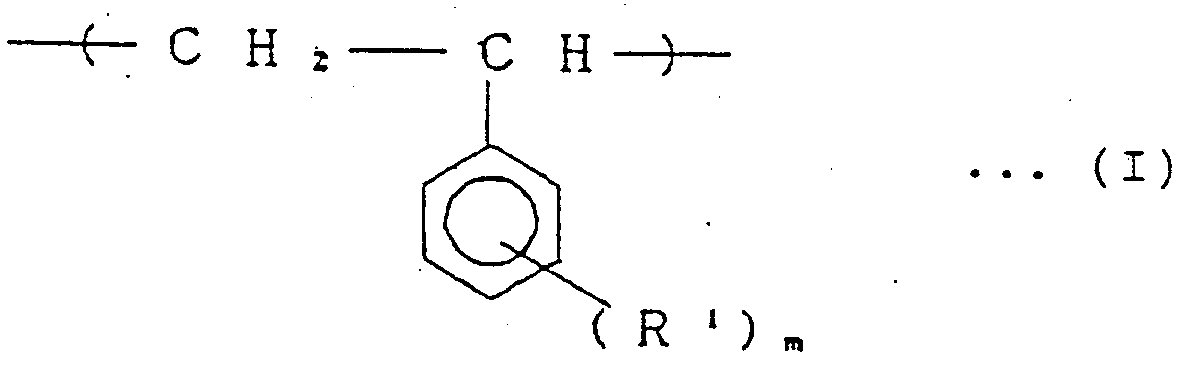


- Das Styrol-Copolymer nach Anspruch 1, das die Styrol-Wiederholungseinheit (a), dargestellt durch die allgemeine Formel (I), und die Acrylnitril-Wiederholungseinheit (b), dargestellt durch die allgemeine Formel (II-(b)), umfaßt, und das 0,1 bis 50 Gew.-% dieser Wiederholungseinheit (b) enthält.
- Das Styrol-Copolymer nach Anspruch 1, das die Styrol-Wiederholungseinheit (a), dargestellt durch die allgemeine Formel (I), und die ungesättigte Carbonsäure- oder deren Ester-Wiederholungseinheit (c), dargestellt durch die allgemeine Formel (II-(c)), umfaßt, und das 0,1 bis 50 Gew.-% dieser Wiederholungseinheit (c) enthält.
- Das Styrol-Copolymer nach Anspruch 1, das die Styrol-Wiederholungseinheit (a), dargestellt durch die allgemeine Formel (I), und die Maleinimid- oder N-substituierte Maleinimid-Wiederholungseinheit (d), dargestellt durch die allgemeine Formel (II-(d)), umfaßt, und das 0,1 bis 50 Gew.-% dieser Wiederholungseinheit (d) enthält.
- Verfahren zur Herstellung des Styrol-Copolymers nach Anspruch 1, das umfaßt: Copolymerisieren eines Styrol-Monomers, dargestellt durch die allgemeine Formel (I'):

und eines Acrylnitril-Monomers, dargestellt durch die allgemeine Formel (II'-(b)):

oder eines Maleinimid- oder N-substituierten Maleinimid-Monomers, dargestellt durch die allgemeine Formel (II'-(d)):
in Gegenwart eines Katalysators, der eine Titanverbindung und Alkylaluminoxan umfaßt. - Verfahren zur Herstellung des Styrol-Copolymers nach Anspruch 2, das umfaßt: Copolymerisieren des Styrol-Monomers, dargestellt durch die allgemeine Formel (I'), und des Acrylnitril-Monomers, dargestellt durch die allgemeine Formel (II'-(b)), in Gegenwart eines Katalysators, der eine Titanverbindung und Alkylaluminoxan umfaßt.
- Verfahren zur Herstellung eines Styrol-Copolymers nach Anspruch 3, das umfaßt: Copolymerisieren des Styrol-Monomers, dargestellt durch die allgemeine Formel (I'), und eines ungesättigten Carbonsäure- oder dessen Ester-Monomers, dargestellt durch die allgemeine Formel (II'-(c)), in Gegenwart eines Katalysators, der eine Titanverbindung und Alkylaluminoxan umfaßt.
- Verfahren zur Herstellung eines Styrol-Copolymers nach Anspruch 4, das umfaßt: Copolymerisieren eines Styrol-Monomers, dargestellt durch die allgemeine Formel (I'), und eines Maleinimid oder N-substituierten Maleinimid, dargestellt durch die allgemeine Formel (II'-(d)), in Gegenwart eines Katalysators, der eine Titanverbindung und Alkylaluminoxan umfaßt.
- Verfahren zur Herstellung eines Styrol-Copolymers, das nach irgendeinem der Ansprüche 5 bis 8 definiert ist worin die Titanverbindung durch die allgemeine Formel dargestellt wird:
TiRXYZ
worin R eine Cyclopentadienylgruppe, eine substituierte Cyclopentadienylgruppe oder Indenylgruppe ist; X, Y und Z unabhängig voneinander ein Wasserstoffatom, eine Alkylgruupe mit 1 bis 12 Kohlenstoffatomen, eine Alkoxygruppe mit 1 bis 12 Kohlenstoffatomen; eine Arylgruppe mit 6 bis 20 Kohlenstoffatomen, eine Aryloxygruppe mit 6 bis 20 Kohlenstoffatomen, eine Arylalkylgruppe mit 6 bis 20 Kohlenstoffatomen oder ein Halogenatom darstellen. - Verfahren zur Herstellung des Styrol-Copolymers, das nach irgendeinem der Ansprüche 5 bis 8 definiert ist, worin das Alkylaluminoxan nicht mehr als 50 % der magnetischen Hochkomponente (-0,1 bis -0,5 ppm unter Toluollösungsmittel-Meßbedingungen, bezogen auf das Methylproton des Toluols (2,35 ppm)) im Bereich des Methylprotonensignals infolge der Aluminium-Methylgruppe(Al-CH₃)-Bindungen enthält, beobachtet durch das kernmagnetische Resonanzverfahren.
Applications Claiming Priority (7)
| Application Number | Priority Date | Filing Date | Title |
|---|---|---|---|
| JP78167/89 | 1989-03-31 | ||
| JP78169/89 | 1989-03-31 | ||
| JP1078169A JP2744282B2 (ja) | 1989-03-31 | 1989-03-31 | スチレン系共重合体及びその製造方法 |
| JP78168/89 | 1989-03-31 | ||
| JP1078168A JP2746410B2 (ja) | 1989-03-31 | 1989-03-31 | スチレン系共重合体及びその製造方法 |
| JP1078167A JP2746409B2 (ja) | 1989-03-31 | 1989-03-31 | スチレン系共重合体及びその製造方法 |
| PCT/JP1990/000371 WO1990012039A1 (en) | 1989-03-31 | 1990-03-20 | Styrenic copolymer and production thereof |
Publications (3)
| Publication Number | Publication Date |
|---|---|
| EP0422239A1 EP0422239A1 (de) | 1991-04-17 |
| EP0422239A4 EP0422239A4 (en) | 1991-09-11 |
| EP0422239B1 true EP0422239B1 (de) | 1995-12-06 |
Family
ID=27302631
Family Applications (1)
| Application Number | Title | Priority Date | Filing Date |
|---|---|---|---|
| EP90904696A Expired - Lifetime EP0422239B1 (de) | 1989-03-31 | 1990-03-20 | Styren-kopolymer und verfahren zur herstellung |
Country Status (10)
| Country | Link |
|---|---|
| US (2) | US5262504A (de) |
| EP (1) | EP0422239B1 (de) |
| KR (3) | KR0137880B1 (de) |
| AT (1) | ATE131179T1 (de) |
| AU (1) | AU621727B2 (de) |
| CA (1) | CA2027587A1 (de) |
| DE (1) | DE69024019T2 (de) |
| ES (1) | ES2083449T3 (de) |
| FI (1) | FI905891A0 (de) |
| WO (1) | WO1990012039A1 (de) |
Families Citing this family (10)
| Publication number | Priority date | Publication date | Assignee | Title |
|---|---|---|---|---|
| WO1992009641A1 (en) * | 1990-11-21 | 1992-06-11 | Idemitsu Kosan Co., Ltd. | Styrenic copolymer and production thereof |
| CA2067525C (en) * | 1991-05-09 | 1998-09-15 | Helmut G. Alt | Organometallic fluorenyl compounds, preparation and use |
| BE1006640A3 (nl) * | 1993-01-29 | 1994-11-03 | Dsm Nv | Werkwijze voor de bereiding van een polymeer. |
| US5610455A (en) * | 1995-06-29 | 1997-03-11 | Minnesota Mining And Manufacturing Company | Electret containing syndiotactic vinyl aromatic polymer |
| DE19542356A1 (de) * | 1995-11-14 | 1997-05-15 | Basf Ag | Verfahren zur Herstellung von Copolymerisaten aus vinylaromatischen und olefinischen Verbindungen durch Dispersionspolymerisation in Gegenwart von Metallocenkatalysatorsystemen |
| IT1293729B1 (it) * | 1997-07-18 | 1999-03-10 | Enichem Spa | Procedimento per la preparazione di copolimeri dell'acrilonitrile con almeno una (di)olefina |
| JP3694692B2 (ja) * | 2003-12-11 | 2005-09-14 | 丸善石油化学株式会社 | レジスト用ポリマー溶液およびその製造方法 |
| EP1854842B1 (de) | 2005-02-28 | 2012-01-11 | Toray Industries, Inc. | Styrolharzzusammensetzung und herstellungsverfahren dafür |
| KR100662184B1 (ko) * | 2005-07-22 | 2006-12-27 | 제일모직주식회사 | 비할로겐계 난연성 열가소성 수지 조성물 |
| TWI522347B (zh) | 2011-03-24 | 2016-02-21 | Nippon Catalytic Chem Ind | A N-phenylmaleimide compound and a copolymer composition obtained using the same |
Family Cites Families (7)
| Publication number | Priority date | Publication date | Assignee | Title |
|---|---|---|---|---|
| JPS6026011A (ja) * | 1983-07-21 | 1985-02-08 | Idemitsu Kosan Co Ltd | プロピレン・スチレン共重合体の製造方法 |
| IL84797A (en) * | 1986-12-15 | 1993-01-14 | Montedison Spa | Production of crystalline vinyl aromatic polymers having mainly a syndiotactic structure |
| US4978730A (en) * | 1987-12-24 | 1990-12-18 | Idemitsu Kosan Company Limited | Process for producing styrene-based polymers and catalyst for use therein |
| JPH0637534B2 (ja) * | 1988-09-28 | 1994-05-18 | 出光石油化学株式会社 | スチレン系重合体の製造方法 |
| AU628194B2 (en) * | 1989-07-28 | 1992-09-10 | Idemitsu Kosan Co. Ltd | Process for producing styrene polymers |
| JP2911501B2 (ja) * | 1989-09-29 | 1999-06-23 | 出光興産株式会社 | スチレン系重合体の製造方法 |
| US5317069A (en) * | 1993-06-07 | 1994-05-31 | National Science Council | Maleimide-alt-silylstyrene copolymer |
-
1990
- 1990-03-20 DE DE69024019T patent/DE69024019T2/de not_active Expired - Fee Related
- 1990-03-20 EP EP90904696A patent/EP0422239B1/de not_active Expired - Lifetime
- 1990-03-20 US US07/598,637 patent/US5262504A/en not_active Expired - Fee Related
- 1990-03-20 ES ES90904696T patent/ES2083449T3/es not_active Expired - Lifetime
- 1990-03-20 CA CA002027587A patent/CA2027587A1/en not_active Abandoned
- 1990-03-20 WO PCT/JP1990/000371 patent/WO1990012039A1/ja not_active Ceased
- 1990-03-20 FI FI905891A patent/FI905891A0/fi not_active Application Discontinuation
- 1990-03-20 KR KR1019900702550A patent/KR0137880B1/ko not_active Expired - Fee Related
- 1990-03-20 AU AU52640/90A patent/AU621727B2/en not_active Ceased
- 1990-03-20 AT AT90904696T patent/ATE131179T1/de not_active IP Right Cessation
-
1993
- 1993-07-09 US US08/088,523 patent/US5391671A/en not_active Expired - Fee Related
-
1997
- 1997-11-07 KR KR97707948A patent/KR0139971B1/ko not_active Expired - Fee Related
- 1997-11-07 KR KR97707947A patent/KR0139972B1/ko not_active Expired - Fee Related
Also Published As
| Publication number | Publication date |
|---|---|
| DE69024019D1 (de) | 1996-01-18 |
| AU621727B2 (en) | 1992-03-19 |
| ATE131179T1 (de) | 1995-12-15 |
| CA2027587A1 (en) | 1990-10-01 |
| EP0422239A1 (de) | 1991-04-17 |
| WO1990012039A1 (en) | 1990-10-18 |
| AU5264090A (en) | 1990-11-05 |
| US5391671A (en) | 1995-02-21 |
| ES2083449T3 (es) | 1996-04-16 |
| EP0422239A4 (en) | 1991-09-11 |
| KR920700238A (ko) | 1992-02-19 |
| KR0139971B1 (en) | 1998-07-01 |
| FI905891A7 (fi) | 1990-11-29 |
| KR0139972B1 (en) | 1998-07-01 |
| FI905891A0 (fi) | 1990-11-29 |
| US5262504A (en) | 1993-11-16 |
| DE69024019T2 (de) | 1996-05-02 |
| KR0137880B1 (ko) | 1998-05-01 |
Similar Documents
| Publication | Publication Date | Title |
|---|---|---|
| US5260394A (en) | Styrene copolymer and process for production thereof | |
| US5554695A (en) | Styrenic copolymer and process for producing same | |
| EP0440014B1 (de) | Verfahren zur Herstellung einer Stryrolpolymerzusammensetzung | |
| US5262504A (en) | Styrene copolymer and process for production thereof | |
| US5023304A (en) | Process for producing styrene-based polymer | |
| EP0505973A2 (de) | Verfahren zur Herstellung eines Styrolpolymerisates | |
| EP0299391A1 (de) | Verfahren zur Herstellung von auf Styren basierten Polymeren | |
| JP2911501B2 (ja) | スチレン系重合体の製造方法 | |
| US5426176A (en) | Process for purification of styrenic polymer | |
| JP2840605B2 (ja) | スチレン系共重合体及びその製造方法 | |
| EP0505972B1 (de) | Verfahren zur Herstellung eines Styrolpolymerisats | |
| JP2746409B2 (ja) | スチレン系共重合体及びその製造方法 | |
| JP3210325B2 (ja) | スチレン系ブロック共重合体及びその製造方法 | |
| JP2746410B2 (ja) | スチレン系共重合体及びその製造方法 | |
| JP2744282B2 (ja) | スチレン系共重合体及びその製造方法 | |
| JP2810098B2 (ja) | スチレン系共重合体とその製造法 | |
| JP3121113B2 (ja) | スチレン系樹脂組成物の製造方法 | |
| JP2980367B2 (ja) | スチレン系共重合体およびその製造方法 | |
| JP2742093B2 (ja) | スチレン系共重合体の製造方法 | |
| JP2758035B2 (ja) | スチレン系重合体の精製法 | |
| JP2904898B2 (ja) | スチレン系共重合体およびその製造方法 | |
| JP2931642B2 (ja) | スチレン系重合体の製造方法とその触媒 |
Legal Events
| Date | Code | Title | Description |
|---|---|---|---|
| PUAI | Public reference made under article 153(3) epc to a published international application that has entered the european phase |
Free format text: ORIGINAL CODE: 0009012 |
|
| 17P | Request for examination filed |
Effective date: 19901215 |
|
| AK | Designated contracting states |
Kind code of ref document: A1 Designated state(s): AT BE CH DE ES FR GB IT LI NL SE |
|
| A4 | Supplementary search report drawn up and despatched |
Effective date: 19910722 |
|
| AK | Designated contracting states |
Kind code of ref document: A4 Designated state(s): AT BE CH DE ES FR GB IT LI NL SE |
|
| 17Q | First examination report despatched |
Effective date: 19911227 |
|
| GRAA | (expected) grant |
Free format text: ORIGINAL CODE: 0009210 |
|
| AK | Designated contracting states |
Kind code of ref document: B1 Designated state(s): AT BE CH DE ES FR GB IT LI NL SE |
|
| PG25 | Lapsed in a contracting state [announced via postgrant information from national office to epo] |
Ref country code: LI Effective date: 19951206 Ref country code: CH Effective date: 19951206 Ref country code: AT Effective date: 19951206 |
|
| REF | Corresponds to: |
Ref document number: 131179 Country of ref document: AT Date of ref document: 19951215 Kind code of ref document: T |
|
| REF | Corresponds to: |
Ref document number: 69024019 Country of ref document: DE Date of ref document: 19960118 |
|
| ITF | It: translation for a ep patent filed | ||
| ET | Fr: translation filed | ||
| PG25 | Lapsed in a contracting state [announced via postgrant information from national office to epo] |
Ref country code: SE Effective date: 19960306 |
|
| REG | Reference to a national code |
Ref country code: ES Ref legal event code: FG2A Ref document number: 2083449 Country of ref document: ES Kind code of ref document: T3 |
|
| REG | Reference to a national code |
Ref country code: CH Ref legal event code: PL |
|
| PLBE | No opposition filed within time limit |
Free format text: ORIGINAL CODE: 0009261 |
|
| STAA | Information on the status of an ep patent application or granted ep patent |
Free format text: STATUS: NO OPPOSITION FILED WITHIN TIME LIMIT |
|
| 26N | No opposition filed | ||
| NLS | Nl: assignments of ep-patents |
Owner name: IDEMITSU KOSAN COMPANY LIMITED;DOW CHEMICAL COMPAN |
|
| REG | Reference to a national code |
Ref country code: GB Ref legal event code: 732E |
|
| REG | Reference to a national code |
Ref country code: FR Ref legal event code: TQ |
|
| REG | Reference to a national code |
Ref country code: ES Ref legal event code: PC2A |
|
| PGFP | Annual fee paid to national office [announced via postgrant information from national office to epo] |
Ref country code: FR Payment date: 20010313 Year of fee payment: 12 |
|
| PGFP | Annual fee paid to national office [announced via postgrant information from national office to epo] |
Ref country code: GB Payment date: 20010314 Year of fee payment: 12 |
|
| PGFP | Annual fee paid to national office [announced via postgrant information from national office to epo] |
Ref country code: ES Payment date: 20010316 Year of fee payment: 12 |
|
| PGFP | Annual fee paid to national office [announced via postgrant information from national office to epo] |
Ref country code: NL Payment date: 20010330 Year of fee payment: 12 |
|
| PGFP | Annual fee paid to national office [announced via postgrant information from national office to epo] |
Ref country code: BE Payment date: 20010516 Year of fee payment: 12 |
|
| REG | Reference to a national code |
Ref country code: GB Ref legal event code: IF02 |
|
| PG25 | Lapsed in a contracting state [announced via postgrant information from national office to epo] |
Ref country code: GB Free format text: LAPSE BECAUSE OF NON-PAYMENT OF DUE FEES Effective date: 20020320 |
|
| PG25 | Lapsed in a contracting state [announced via postgrant information from national office to epo] |
Ref country code: ES Free format text: LAPSE BECAUSE OF NON-PAYMENT OF DUE FEES Effective date: 20020321 |
|
| PGFP | Annual fee paid to national office [announced via postgrant information from national office to epo] |
Ref country code: DE Payment date: 20020327 Year of fee payment: 13 |
|
| PG25 | Lapsed in a contracting state [announced via postgrant information from national office to epo] |
Ref country code: BE Free format text: LAPSE BECAUSE OF NON-PAYMENT OF DUE FEES Effective date: 20020331 |
|
| BERE | Be: lapsed |
Owner name: THE *DOW CHEMICAL CY Effective date: 20020331 Owner name: *IDEMITSU KOSAN CY LTD Effective date: 20020331 |
|
| PG25 | Lapsed in a contracting state [announced via postgrant information from national office to epo] |
Ref country code: NL Free format text: LAPSE BECAUSE OF NON-PAYMENT OF DUE FEES Effective date: 20021001 |
|
| GBPC | Gb: european patent ceased through non-payment of renewal fee |
Effective date: 20020320 |
|
| PG25 | Lapsed in a contracting state [announced via postgrant information from national office to epo] |
Ref country code: FR Free format text: LAPSE BECAUSE OF NON-PAYMENT OF DUE FEES Effective date: 20021129 |
|
| NLV4 | Nl: lapsed or anulled due to non-payment of the annual fee |
Effective date: 20021001 |
|
| REG | Reference to a national code |
Ref country code: FR Ref legal event code: ST |
|
| PG25 | Lapsed in a contracting state [announced via postgrant information from national office to epo] |
Ref country code: DE Free format text: LAPSE BECAUSE OF NON-PAYMENT OF DUE FEES Effective date: 20031001 |
|
| REG | Reference to a national code |
Ref country code: ES Ref legal event code: FD2A Effective date: 20030410 |
|
| PG25 | Lapsed in a contracting state [announced via postgrant information from national office to epo] |
Ref country code: IT Free format text: LAPSE BECAUSE OF NON-PAYMENT OF DUE FEES;WARNING: LAPSES OF ITALIAN PATENTS WITH EFFECTIVE DATE BEFORE 2007 MAY HAVE OCCURRED AT ANY TIME BEFORE 2007. THE CORRECT EFFECTIVE DATE MAY BE DIFFERENT FROM THE ONE RECORDED. Effective date: 20050320 |