EP0422366A2 - Process for the preparation of N-substituted pyrolidin-2-ones - Google Patents
Process for the preparation of N-substituted pyrolidin-2-ones Download PDFInfo
- Publication number
- EP0422366A2 EP0422366A2 EP90116212A EP90116212A EP0422366A2 EP 0422366 A2 EP0422366 A2 EP 0422366A2 EP 90116212 A EP90116212 A EP 90116212A EP 90116212 A EP90116212 A EP 90116212A EP 0422366 A2 EP0422366 A2 EP 0422366A2
- Authority
- EP
- European Patent Office
- Prior art keywords
- ones
- pyrrolidin
- general formula
- alkyl
- aryl
- Prior art date
- Legal status (The legal status is an assumption and is not a legal conclusion. Google has not performed a legal analysis and makes no representation as to the accuracy of the status listed.)
- Granted
Links
- 0 C*N(C(CC1)=N*)C1=O Chemical compound C*N(C(CC1)=N*)C1=O 0.000 description 2
Classifications
-
- C—CHEMISTRY; METALLURGY
- C07—ORGANIC CHEMISTRY
- C07D—HETEROCYCLIC COMPOUNDS
- C07D207/00—Heterocyclic compounds containing five-membered rings not condensed with other rings, with one nitrogen atom as the only ring hetero atom
- C07D207/02—Heterocyclic compounds containing five-membered rings not condensed with other rings, with one nitrogen atom as the only ring hetero atom with only hydrogen or carbon atoms directly attached to the ring nitrogen atom
- C07D207/18—Heterocyclic compounds containing five-membered rings not condensed with other rings, with one nitrogen atom as the only ring hetero atom with only hydrogen or carbon atoms directly attached to the ring nitrogen atom having one double bond between ring members or between a ring member and a non-ring member
- C07D207/22—Heterocyclic compounds containing five-membered rings not condensed with other rings, with one nitrogen atom as the only ring hetero atom with only hydrogen or carbon atoms directly attached to the ring nitrogen atom having one double bond between ring members or between a ring member and a non-ring member with hetero atoms or with carbon atoms having three bonds to hetero atoms with at the most one bond to halogen, e.g. ester or nitrile radicals, directly attached to ring carbon atoms
- C07D207/24—Oxygen or sulfur atoms
- C07D207/26—2-Pyrrolidones
- C07D207/263—2-Pyrrolidones with only hydrogen atoms or radicals containing only hydrogen and carbon atoms directly attached to other ring carbon atoms
- C07D207/267—2-Pyrrolidones with only hydrogen atoms or radicals containing only hydrogen and carbon atoms directly attached to other ring carbon atoms with only hydrogen atoms or radicals containing only hydrogen and carbon atoms directly attached to the ring nitrogen atom
-
- C—CHEMISTRY; METALLURGY
- C07—ORGANIC CHEMISTRY
- C07D—HETEROCYCLIC COMPOUNDS
- C07D207/00—Heterocyclic compounds containing five-membered rings not condensed with other rings, with one nitrogen atom as the only ring hetero atom
- C07D207/02—Heterocyclic compounds containing five-membered rings not condensed with other rings, with one nitrogen atom as the only ring hetero atom with only hydrogen or carbon atoms directly attached to the ring nitrogen atom
- C07D207/30—Heterocyclic compounds containing five-membered rings not condensed with other rings, with one nitrogen atom as the only ring hetero atom with only hydrogen or carbon atoms directly attached to the ring nitrogen atom having two double bonds between ring members or between ring members and non-ring members
- C07D207/34—Heterocyclic compounds containing five-membered rings not condensed with other rings, with one nitrogen atom as the only ring hetero atom with only hydrogen or carbon atoms directly attached to the ring nitrogen atom having two double bonds between ring members or between ring members and non-ring members with hetero atoms or with carbon atoms having three bonds to hetero atoms with at the most one bond to halogen, e.g. ester or nitrile radicals, directly attached to ring carbon atoms
- C07D207/36—Oxygen or sulfur atoms
- C07D207/38—2-Pyrrolones
Definitions
- the present invention relates to a process for the preparation of N-substituted pyrrolidin-2-ones from N, N'-disubstituted 5-imino-pyrrolidin-2-ones on hydrogenation catalysts at elevated pressures and temperatures.
- N-substituted pyrrolidin-2-ones especially N-methylpyrrolidone (NMP) of the formula III can be obtained on an industrial scale by reacting butyrolactone with the respective primary amines, in particular methylamine. This process has proven particularly useful for the production of NMP.
- Butyrolactone is produced by catalytic dehydrogenation from 1,4-butanediol, the production of which is based, for example, on the raw material acetylene (see: Weissermel, Arpe: Industrial Organic Chemistry, pages 105 to 109, VCH-Verlaggesellschaft, Weinheim 1988).
- a new and improved process for the preparation of N-substituted pyrrolidin-2-ones of the general formula I in which R1 represents a C1 to C20 alkyl, a C6 to C10 aryl or a C7 to C12 aralkyl group which is characterized in that is that 5-imino-pyrrolidin-2-ones of the general formula II in which R1 can be the same or different and are a C1 to C20 alkyl, a C6 to C10 aryl or a C7 to C12 aralkyl group, at elevated pressure and at elevated temperature in the presence of a hydrogenation catalyst to the hydrogenolytic Pyrrolidin-2-ones I cleaves.
- the 5-imino-pyrrolidones of the formula II can be reacted with ⁇ -cyanopropionesters of the general formula III NC-CH2-CH2- -OR2 III in which R2 is a C1 to C20 alkyl, a C7 to C12 aralkyl or a C6 to C10 aryl group, with an amine of the general formula IV R1-NH2 IV in which R1 has the meaning given above.
- the ⁇ -cyanopropionic acid ester III used as starting compounds can be obtained in virtually quantitative yield by adding hydrocyanic acid to the corresponding acrylic acid ester. As a result, the number of reaction steps for the preparation of compound III is reduced to 2 stages, as can be seen from the following scheme.
- ester component R2 of the ⁇ -cyanopropionic acid ester III plays only a minor role in the success of the process according to the invention, which is why, for example, both C1 to C20 alkyl, C7 to C12 aralkyl and C6 to C10 aryl groups as the ester component R2 can be used. It goes without saying that the R2 radicals should not be so space-filling that they sterically hinder the Cause reaction. Because of their ready availability and value for money, however, ⁇ -cyanopropionester III is preferably used, in which R2 represents a C1- to C4-alkyl group.
- the radicals R 2 can of course also be substituted with substituents which are inert under the reaction conditions.
- radicals R1 in the compounds II is of course dependent on the nature of the amines IV - R1-NH2- used for the cyclization of the ⁇ -cyanopropionic acid ester III.
- amines IV in which the radical R1 for a C1 to C2 bis alkyl, C0 to C10 aryl or a C oder to C12 aralkyl group can be used.
- amines IV can be used which contain heteroatoms such as oxygen, nitrogen or sulfur in their aliphatic, cycloaliphatic, aromatic or araliphatic radical.
- Amines IV are preferably used in which R1 is a C1 to C4 alkyl group and particularly preferably the methyl group. It goes without saying that the use of amines IV, in which R 1 is substituted with substituents which are inert under the reaction conditions, does not adversely affect the success of the process. Examples of such substituents are ether groups or acetal groups.
- the amines IV can be used in the process according to the invention with respect to the ⁇ -cyanopropionic acid ester III both in a stoichiometric amount, i.e. in an amount of 2 mol of amine IV / mol of ester III, and also in excess with respect to III.
- An excess of amines IV is expediently used, generally 2.2 to 10, preferably 2.5 to 4, mol of amine IV / mol of ester III being used.
- the reaction of the amines IV with the ⁇ -cyanopropionic acid ester III can be carried out in a solvent which is inert under the reaction conditions, such as tetrahydrofuran or dioxane.
- a solvent which is inert under the reaction conditions, such as tetrahydrofuran or dioxane.
- the reaction is preferably in the absence of an additional solvent taken, however, the amine III added in excess or else added process product I can optionally serve as a solvent.
- Solvents are added to the reaction mixture in particular when starting materials and / or process product I are solids.
- the reaction can be carried out both at atmospheric pressure and under elevated pressure. It is expedient to work under increased pressure, in particular autogenously generated pressure, when one of the reactants, generally the amine IV, boils under the reaction conditions. It is also possible to introduce a reactant which is gaseous under the reaction conditions, for example methylamine, into the liquid reaction mixture in gaseous form at atmospheric pressure.
- a reactant which is gaseous under the reaction conditions, for example methylamine
- the two reactants ⁇ -cyanopropionic acid ester III and the amine IV can react with one another at room temperature. To accelerate and complete the reaction, however, work is generally carried out at higher temperatures.
- the reaction is expediently carried out at temperatures between 20 and 250 ° C., preferably at temperatures from 30 to 150 ° C., in particular at 90 to 130 ° C.
- the reaction is expediently carried out under the inherent pressure generated by the reactants at these temperatures. A further exogenous increase in the reaction pressure is possible, but generally proves to be unnecessary.
- the 5-imino-pyrrolidin-2-one II can be isolated from the reaction discharge in a conventional manner, for example by distillation or crystallization.
- the compounds II are obtained in high purity.
- the alcohol R2OH released in the course of the reaction can be recovered by distillation and reused.
- the process according to the invention can be carried out batchwise or continuously as required.
- the reactors usually used for these modes of operation can be used here - for example stirred or bubble reactors in batch mode, tubular reactors in continuous mode.
- N-substituted pyrrolidin-2-ones of the formula I can be prepared in an advantageous manner in which R1 is a C1 to C20 alkyl, C6 to C10 aryl or C7 to C12 aralkyl group.
- R1 is a C1- to C4-alkyl group and in particular the methyl group is particularly advantageous according to the process of the invention.
- the starting materials for the preparation of the N-substituted pyrrolidin-2-one I are the 5-imino-pyrrolidin-2-one II, in which the imido nitrogen atom carries the corresponding radical R 1 and in which the imino nitrogen atom also can be unsubstituted or can carry a C1 to C20 alkyl, a C6 to C10 aryl or a C7 to C12 aralkyl group.
- R1 in II can be the same or different.
- Compounds II are preferably used in which the radicals R1 are identical and are a C1- to C4-alkyl group, in particular the methyl group.
- the hydrogenation is advantageously carried out under elevated pressure and at elevated temperature.
- the reaction according to the invention is carried out at temperatures from 150 to 250, preferably from 170 to 220 and in particular at temperatures from 180 to 200 ° C. and at pressures of advantageously 100 to 400, advantageously 200 to 350 and particularly preferably 250 to 320 bar .
- the hydrogenation can be carried out in the presence or absence of solvents which are inert under the reaction conditions, such as tetrahydrofuran, dioxane, dimethoxyethane, hydrocarbons or aliphatic alcohols.
- solvents which are inert under the reaction conditions, such as tetrahydrofuran, dioxane, dimethoxyethane, hydrocarbons or aliphatic alcohols.
- solvents which are inert under the reaction conditions such as tetrahydrofuran, dioxane, dimethoxyethane, hydrocarbons or aliphatic alcohols.
- the addition of a solvent to the reaction mixture can be particularly advantageous if the starting material to be converted and / or the product to be produced are substances which are solid at room temperature.
- the reaction according to the invention can be carried out batchwise in stirred autoclaves with suspended catalysts or continuously in fixed bed reactors, optionally in the bottom or trickle mode.
- the procedure is generally such that the reaction product is cooled and let down, if necessary separated from the catalyst and the product is purified by distillation or crystallization.
- N-substituted pyrrolidin-2-ones I can be obtained economically competitively and in high purity from an alternative raw material source.
- N-substituted pyrrolidin-2-ones I obtainable by the process according to the invention are widely used, for example, as solvents and extractants.
- Example 2 was repeated with the following starting materials: 80 g of 5-N-methylimino-N-methyl-2-pyrrolidone 80 g tetrahydrofuran 5 g of Raney copper
- Example 2 was repeated with the following starting materials: 80 g of 5-N-methylimino-N-methyl-2-pyrrolidone 80 g tetrahydrofuran 5 g of catalyst according to DE-PS 1 235 879 (Composition: 20% by weight cobalt, 55% by weight copper, 25% by weight manganese)
- Example 2 was repeated with the following starting materials: 80 g of 5-N-methylimino-N-methyl-2-pyrrolidone 80 g tetrahydrofuran 5 g of Raney nickel
Landscapes
- Chemical & Material Sciences (AREA)
- Organic Chemistry (AREA)
- Pyrrole Compounds (AREA)
- Low-Molecular Organic Synthesis Reactions Using Catalysts (AREA)
- Hydrogenated Pyridines (AREA)
- Nitrogen Condensed Heterocyclic Rings (AREA)
Abstract
Verfahren zur Herstellung N-substituierter Pyrrolidin-2-one der allgemeinen Formel I

in der R¹ für einen C₁- bis C₂₀-Alkyl- , eine C₆- bis C₁₀-Arylgruppe oder eine C₇- bis C₁₂-Aralkylgruppe steht, indem man 5-Imino-pyrrolidin-2-one der allgemeinen Formel II
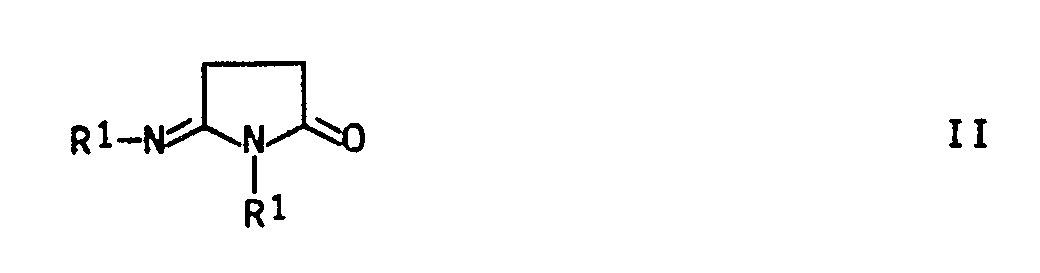
in der R¹ gleich oder verschieden sein kann und eine C₁- bis C₂₀-Alkyl-, eine C₆- bis C₁₀-Aryl- oder eine C₇- bis C₁₂-Aralkylgruppe bedeuten, bei erhöhtem Druck und bei erhöhter Temperatur in Gegenwart eines Hydrierkatalysators hydrogenolytisch zu den Pyrrolidin-2-onen I spaltet; im speziellen lassen sich die 5-Imino-pyrrolidin-2one der Formel II durch Umsetzung von β-Cyanopropionester der allgemeinen Formel III
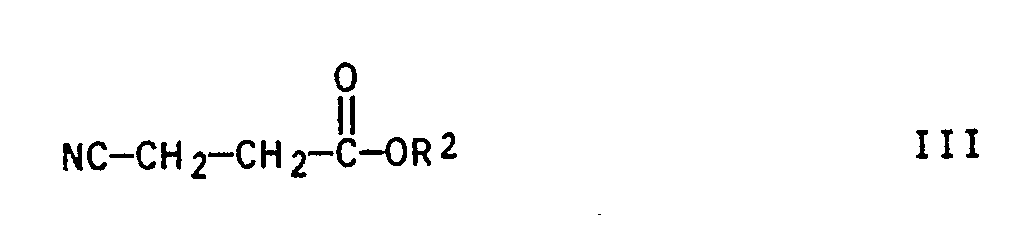
in der R² eine C₁- bis C₂₀-Alkyl-, eine C₇- bis C₁₂-Aralkyl- oder eine C₆- bis C₁₀-Arylgruppe bedeutet, mit einem Amin der allgemeinen Formel IV
R¹-NH₂ IV
in der R¹ die oben genannte Bedeutung besitzt, erhalten.Process for the preparation of N-substituted pyrrolidin-2-ones of the general formula I
in which R¹ is a C₁ to C₂₀ alkyl, a C₆ to C₁₀ aryl group or a C₇ to C₁₂ aralkyl group by 5-imino-pyrrolidin-2-ones of the general formula II
in which R¹ can be the same or different and are a C₁ to C₂₀ alkyl, a C₆ to C₁₀ aryl or a C₇ to C₁₂ aralkyl group, at elevated pressure and at elevated temperature in the presence of a hydrogenation catalyst to the hydrogenolytic Pyrrolidin-2-ones I cleaves; in particular, the 5-imino-pyrrolidin-2ones of the formula II can be reacted with β-cyanopropionester of the general formula III
in which R² is a C₁ to C₂₀ alkyl, a C₇ to C₁₂ aralkyl or a C₆ to C₁₀ aryl group, with an amine of the general formula IV
R¹-NH₂ IV
in which R 1 has the meaning given above.
Description
Die vorliegende Erfindung betrifft ein Verfahren zur Herstellung N-substituierter Pyrrolidin-2-one aus N,N′-disubstituierten 5-Imino-pyrrolidin-2-onen an Hydrierkatalysatoren bei erhöhten Drücken und Temperaturen.The present invention relates to a process for the preparation of N-substituted pyrrolidin-2-ones from N, N'-disubstituted 5-imino-pyrrolidin-2-ones on hydrogenation catalysts at elevated pressures and temperatures.
N-substituierte Pyrrolidin-2-one, insbesondere N-Methylpyrrolidon (NMP) der Formel III

Da die Wettbewerbsfähigkeit von Verfahren zur Herstellung chemischer Großprodukte sehr stark von den Preisen für die erforderlichen Rohstoffe abhängig ist, diese aber wiederum aufgrund der Angebotslage auf dem Weltmarkt und infolge der Verfügbarkeit von Rohstoffquellen und chemischen Anlagen zu deren kostengünstigen Herstellung zeitlich als auch örtlich stark variieren können, bestand die Aufgabe, ein wirtschaftliches Verfahren zur Herstellung von N-substituierten Pyrrolidin-2-onen zu finden, das auf einer zu Acetylen alternativen Rohstoffbasis beruht.Since the competitiveness of processes for the production of large chemical products depends very much on the prices of the required raw materials, these, in turn, can vary greatly in terms of time and location due to the supply situation on the world market and the availability of raw material sources and chemical plants for their cost-effective production , the task was to find an economical process for the preparation of N-substituted pyrrolidin-2-ones, which is based on an alternative raw material to acetylene.
Demgemäß wurde ein neues und verbessertes Verfahren zur Herstellung N-substituierter Pyrrolidin-2-one der allgemeinen Formel I


NC-CH₂-CH₂-
in der R² eine C₁- bis C₂₀-Alkyl-, eine C₇- bis C₁₂-Aralkyl- oder eine C₆- bis C₁₀-Arylgruppe bedeutet, mit einem Amin der allgemeinen Formel IV
R¹-NH₂ IV
in der R¹ die oben genannte Bedeutung besitzt, erhalten.Accordingly, a new and improved process for the preparation of N-substituted pyrrolidin-2-ones of the general formula I
NC-CH₂-CH₂-
in which R² is a C₁ to C₂₀ alkyl, a C₇ to C₁₂ aralkyl or a C₆ to C₁₀ aryl group, with an amine of the general formula IV
R¹-NH₂ IV
in which R¹ has the meaning given above.
Der als Ausgangsverbindungen verwendeten β-Cyanopropionsäureester III sind in praktisch quantitativer Ausbeute durch Addition von Blausäure an die entsprechenden Acrylsäureester erhältlich. Dadurch erniedrigt sich die Zahl der Reaktionsschritte zur Herstellung der Verbindung III, wie aus dem folgenden Schema ersichtlich, auf 2 Stufen.

Die Art der Esterkomponente R² der β-Cyanopropionsäureester III spielt für das Gelingen des erfindungsgemäßen Verfahrens nur eine untergeordnete Rolle, weshalb beispielsweise sowohl C₁- bis C₂₀-Alkyl-, C₇- bis C₁₂-Aralkyl- als auch C₆- bis C₁₀-Arylgruppen als Esterkomponente R² Verwendung finden können. Es versteht sich von selbst, daß die Reste R² nicht so raumerfüllend sein sollten, daß sie eine sterische Hinderung der Reaktion verursachen. Aufgrund ihrer leichten Verfügbarkeit und Preiswürdigkeit werden jedoch vorzugsweise β-Cyanopropionester III verwendet, in denen R² für ein C₁- bis C₄-Alkylgruppe steht. Selbstverständlich können die Reste R² auch mit unter den Reaktionsbedingungen inerten Substituenten substituiert sein.The type of ester component R² of the β-cyanopropionic acid ester III plays only a minor role in the success of the process according to the invention, which is why, for example, both C₁ to C₂₀ alkyl, C₇ to C₁₂ aralkyl and C₆ to C₁₀ aryl groups as the ester component R² can be used. It goes without saying that the R² radicals should not be so space-filling that they sterically hinder the Cause reaction. Because of their ready availability and value for money, however, β-cyanopropionester III is preferably used, in which R² represents a C₁- to C₄-alkyl group. The radicals R 2 can of course also be substituted with substituents which are inert under the reaction conditions.
Die Art der Reste R¹ in den Verbindungen II ist natürlich von der Natur der zur Cyclisierung der β-Cyanopropionsäureester III verwendeten Amine IV - R¹-NH₂- abhängig. Zur Cyclisierung der Ester III eignen sich praktisch alle primären Amine R¹-NH₂, d.h. Amine, in denen R¹ für einen aliphatischen Rest mit 1 bis 20, einen aromatischen Rest mit 6 bis 10 oder einen araliphatischen Rest mit 7 bis 12 Kohlenstoffatomen steht, vorausgesetzt die Reste R¹ sind sterisch nicht so anspruchsvoll, daß die Reaktion sterisch gehindert wird. Dementsprechend können Amine IV, in denen der Rest R¹ für eine C₁- bis C₂₀-Alkyl-, C₆- bis C₁₀-Aryl- oder eine C₇- bis C₁₂-Aralkylgruppe, verwendet werden. Des weiteren können Amine IV verwendet werden, welche in ihrem aliphatischen, cycloaliphatischen, aromatischen oder araliphatischen Rest Heteroatome wie Sauerstoff, Stickstoff oder Schwefel enthalten. Bevorzugt werden Amine IV eingesetzt, in denen R¹ eine C₁- bis C₄-Alkylgruppe und besonders bevorzugt die Methylgruppe ist. Es versteht sich von selbst, daß sich die Anwendung von Aminen IV, in denen R¹ mit unter den Reaktionsbedingungen inerten Substituenten substituiert ist, auf den Erfolg des Verfahrens nicht nachteilig auswirkt. Als Beispiele für solche Substituenten seien Ethergruppen oder Acetalgruppierungen genannt.The type of radicals R¹ in the compounds II is of course dependent on the nature of the amines IV - R¹-NH₂- used for the cyclization of the β-cyanopropionic acid ester III. Virtually all primary amines R¹-NH₂, i.e. Amines in which R¹ is an aliphatic radical having 1 to 20, an aromatic radical having 6 to 10 or an araliphatic radical having 7 to 12 carbon atoms, provided that the radicals R¹ are not sterically demanding so that the reaction is sterically hindered. Accordingly, amines IV in which the radical R¹ for a C₁ to C₂ bis alkyl, C₀ to C₁₀ aryl or a C oder to C₁₂ aralkyl group can be used. Furthermore, amines IV can be used which contain heteroatoms such as oxygen, nitrogen or sulfur in their aliphatic, cycloaliphatic, aromatic or araliphatic radical. Amines IV are preferably used in which R¹ is a C₁ to C₄ alkyl group and particularly preferably the methyl group. It goes without saying that the use of amines IV, in which R 1 is substituted with substituents which are inert under the reaction conditions, does not adversely affect the success of the process. Examples of such substituents are ether groups or acetal groups.
Üblicherweise wird der β-Cyanpropionsäureester III nur mit einer Aminspezies R¹-NH₂ umgesetzt. Es ist natürlich auch möglich, diesen Ester mit einer Mischung von Aminen R¹-NH₂, mit unterschiedlichen Resten R¹, umzusetzen. Dabei entstehen Produktgemische, welche Verbindungen II enthalten, in denen die Reste R¹ verschieden sind.Usually the β-cyanopropionic acid ester III is only reacted with an amine species R¹-NH₂. It is of course also possible to implement this ester with a mixture of amines R¹-NH₂, with different radicals R¹. This gives rise to product mixtures which contain compounds II in which the radicals R 1 are different.
Die Amine IV können im erfindungsgemäßen Verfahren bezüglich des β-Cyanopropionsäureester III sowohl in stöchiometrischer Menge, d.h. in einer Menge von 2 mol Amin IV/mol Ester III, als auch im Überschuß bezüglich III eingesetzt werden. Zweckmäßigerweise wird ein Überschuß an Aminen IV gearbeitet, wobei im allgemeinen 2,2 bis 10, vorzugsweise 2,5 bis 4 mol Amin IV/mol Ester III eingesetzt werden.The amines IV can be used in the process according to the invention with respect to the β-cyanopropionic acid ester III both in a stoichiometric amount, i.e. in an amount of 2 mol of amine IV / mol of ester III, and also in excess with respect to III. An excess of amines IV is expediently used, generally 2.2 to 10, preferably 2.5 to 4, mol of amine IV / mol of ester III being used.
Die Umsetzung der Amine IV mit dem β-Cyanopropionsäureester III kann in einem unter den Reaktionsbedingungen inerten Lösungsmittel, wie Tetrahydrofuran oder Dioxan, ausgeführt werden. Vorzugsweise wird die Umsetzung jedoch in Abwesenheit eines zusätzlichen Lösungsmittels genommen, wobei jedoch gegebenenfalls das im Überschuß zugegebene Amin III oder aber auch zugesetztes Verfahrensprodukt I als Lösungsmittel dienen kann. Lösungsmittel werden insbesondere dann dem Reaktionsansatz zugesetzt, wenn Ausgangsmaterialien und/oder Verfahrensprodukt I Feststoffe sind.The reaction of the amines IV with the β-cyanopropionic acid ester III can be carried out in a solvent which is inert under the reaction conditions, such as tetrahydrofuran or dioxane. However, the reaction is preferably in the absence of an additional solvent taken, however, the amine III added in excess or else added process product I can optionally serve as a solvent. Solvents are added to the reaction mixture in particular when starting materials and / or process product I are solids.
Die Umsetzung kann sowohl bei Atmosphärendruck als auch unter erhöhtem Druck durchgeführt werden. Unter erhöhtem Druck, insbesondere autogen erzeugtem Druck, wird zweckmäßigerweise dann gearbeitet, wenn einer der Reaktanten, im allgemeinen das Amin IV, unter den Reaktionsbedingungen siedet. Ebenso ist es möglich einen unter den Reaktionsbedingungen gasförmigen Reaktanten, beispielsweise Methylamin, gasförmig bei Atmosphärendruck in das flüssige Reaktionsgemisch einzuleiten.The reaction can be carried out both at atmospheric pressure and under elevated pressure. It is expedient to work under increased pressure, in particular autogenously generated pressure, when one of the reactants, generally the amine IV, boils under the reaction conditions. It is also possible to introduce a reactant which is gaseous under the reaction conditions, for example methylamine, into the liquid reaction mixture in gaseous form at atmospheric pressure.
Die beiden Reaktanten β-Cyanpropionsäureester III und das Amin IV können bereits bei Raumtemperatur miteinander reagieren. Zur Beschleunigung und Vervollständigung der Umsetzung wird jedoch im allgemeinen bei höheren Temperaturen gearbeitet. Zweckmäßigerweise wird die Umsetzung bei Temperaturen zwischen 20 und 250°C, vorzugsweise bei Temperaturen von 30 bis 150°C insbesondere bei 90 bis 130°C durchgeführt. Wie bereits erwähnt, wird die Umsetzung zweckmäßigerweise unter dem von den Reaktanten bei diesen Temperaturen erzeugten Eigendruck ausgeführt. Eine weitere exogene Erhöhung des Reaktionsdruckes ist möglich, erweist sich aber im allgemeinen als nicht erforderlich.The two reactants β-cyanopropionic acid ester III and the amine IV can react with one another at room temperature. To accelerate and complete the reaction, however, work is generally carried out at higher temperatures. The reaction is expediently carried out at temperatures between 20 and 250 ° C., preferably at temperatures from 30 to 150 ° C., in particular at 90 to 130 ° C. As already mentioned, the reaction is expediently carried out under the inherent pressure generated by the reactants at these temperatures. A further exogenous increase in the reaction pressure is possible, but generally proves to be unnecessary.
Die 5-Imino-pyrrolidin-2-one II können aus dem Reaktionsaustrag auf herkömmliche Weise isoliert werden, beispielsweise durch Destillation oder Kristallisation. Dabei werden die Verbindungen II in hoher Reinheit erhalten. Der im Zuge der Umsetzung freigesetzte Alkohol R²OH kann durch Destillation zurückgewonnen und wiederverwendet werden.The 5-imino-pyrrolidin-2-one II can be isolated from the reaction discharge in a conventional manner, for example by distillation or crystallization. The compounds II are obtained in high purity. The alcohol R²OH released in the course of the reaction can be recovered by distillation and reused.
Das erfindungsgemäße Verfahren kann je nach Bedarf diskontinuierlich oder kontinuierlich ausgeführt werden. Dabei können die für diese Betriebsweisen üblicherweise verwendeten Reaktoren eingesetzt werden - beispielsweise Rühr- oder Blasenreaktoren im diskontinuierlichen, Rohrreaktoren im kontinuierlichen Betrieb.The process according to the invention can be carried out batchwise or continuously as required. The reactors usually used for these modes of operation can be used here - for example stirred or bubble reactors in batch mode, tubular reactors in continuous mode.
Die hydrogenolytische Spaltung der 5-Imino-pyrrolidin-2-one der allgemeinen Formel II verläuft formal nach der folgenden Reaktionsgleichung:

Als Ausgangsmaterialien zur Herstellung der N-substituierten Pyrrolidin-2-one I dienen die 5-Imino-pyrrolidin-2-one II, in denen das Imido-Stickstoff-Atom den entsprechenden Rest R¹ trägt und in denen das Imino-Stickstoff-Atom auch unsubstituiert sein kann oder eine C₁- bis C₂₀-Alkyl-, eine C₆- bis C₁₀-Aryl- oder eine C₇- bis C₁₂-Aralkylgruppe tragen kann. R¹ in II kann gleich oder verschieden sein. Vorzugsweise werden Verbindungen II eingesetzt, in denen die Reste R¹ gleich sind und eine C₁- bis C₄-Alkylgruppe, insbesondere die Methylgruppe bedeuten.The starting materials for the preparation of the N-substituted pyrrolidin-2-one I are the 5-imino-pyrrolidin-2-one II, in which the imido nitrogen atom carries the corresponding radical R 1 and in which the imino nitrogen atom also can be unsubstituted or can carry a C₁ to C₂₀ alkyl, a C₆ to C₁₀ aryl or a C₇ to C₁₂ aralkyl group. R¹ in II can be the same or different. Compounds II are preferably used in which the radicals R¹ are identical and are a C₁- to C₄-alkyl group, in particular the methyl group.
Zur hydrogenolytischen Abspaltung der Iminogruppierung der 5-Imino-pyrrolidin-2-one II eignen sich im Prinzip alle Hydrierkatalysatoren, d.h. unter der Vielzahl der getesteten Hydrierkatalysatoren konnte bislang keiner gefunden werden, mit dem sich die erfindungsgemäße Umsetzung nicht durchführen ließ. Als geeignete Katalysatoren seien beispielhaft die folgenden Hydrierkatalysatoren genannt: Platinmetalle wie Platin, Palladium, Rhodium und Ruthenium sowie deren Oxide und Oxidhydrate, Raney-Nickel, Raney-Kobalt, Raney-Kupfer, Eisen oder Eisen(III)oxid. Diese Hydrierkatalysatoren können als solche in reiner Form, vorzugsweise in fein verteilter Form mit großer Oberfläche, eingesetzt werden. Es kann aber auch vorteilhaft sein, diese Katalysatoren auf einem inerten Trägermaterial abgeschieden, also als Trägerkatalysatoren, einzusetzen. Dazu können alle für Hydrierkatalysatoren bewährten Trägermaterialien wie Aluminiumoxide, Zirkondioxid, Bariumsulfat oder Aktivkohle benutzt werden.In principle, all hydrogenation catalysts are suitable for the hydrogenolytic cleavage of the imino grouping of the 5-imino-pyrrolidin-2-one II. So far, none of the large number of hydrogenation catalysts tested could be found with which the reaction according to the invention could not be carried out. Examples of suitable catalysts are the following hydrogenation catalysts: platinum metals such as platinum, palladium, rhodium and ruthenium and their oxides and oxide hydrates, Raney nickel, Raney cobalt, Raney copper, iron or iron (III) oxide. These hydrogenation catalysts can be used as such in pure form, preferably in finely divided form with a large surface area. However, it can also be advantageous to use these catalysts on an inert support material, that is to say to use them as supported catalysts. For this purpose, all carrier materials such as aluminum oxides, zirconium dioxide, barium sulfate or activated carbon that have been tried and tested for hydrogenation catalysts can be used.
Selbstverständlich ist es auch möglich Mischkatalysatoren als Hydrierkatalysatoren im erfindungsgemäßen Verfahren zu verwenden. Beispielhaft für derartige Katalysatoren seien die Hydrierkatalysatoren der DE-PS 1 235 879 oder die Klasse der Hydrier-/Dehydrier-Katalysatoren auf der Basis von Chromiten genannt (siehe z.B. US-A 2 492 614; US-A 1 977 750; J. Am. Chem. Soc. 62, 2874 bis 2876, (1940)).It is of course also possible to use mixed catalysts as hydrogenation catalysts in the process according to the invention. Examples of such catalysts are the hydrogenation catalysts of DE-PS 1 235 879 or the class of hydrogenation / dehydrogenation catalysts based on chromites (see, for example, US Pat. No. 2,492,614; US Pat. No. 1 977 750; J. Am Chem. Soc. 62, 2874 to 2876, (1940)).
Die Hydrierung wird vorteilhaft unter erhöhtem Druck und bei erhöhter Temperatur vorgenommen. Im allgemeinen wird die erfindungsgemäße Umsetzung bei Temperaturen von 150 bis 250, vorzugsweise von 170 bis 220 und insbesondere bei Temperaturen von 180 bis 200°C sowie bei Drucken von zweckmäßigerweise 100 bis 400, vorteilhaft 200 bis 350 und besonders bevorzugt bei 250 bis 320 bar durchgeführt.The hydrogenation is advantageously carried out under elevated pressure and at elevated temperature. In general, the reaction according to the invention is carried out at temperatures from 150 to 250, preferably from 170 to 220 and in particular at temperatures from 180 to 200 ° C. and at pressures of advantageously 100 to 400, advantageously 200 to 350 and particularly preferably 250 to 320 bar .
Die Hydrierung kann in An- oder Abwesenheit von unter den Reaktionsbedingungen inerten Lösungsmitteln wie Tetrahydrofuran, Dioxan, Dimethoxyethan, Kohlenwasserstoffen oder aliphatischen Alkoholen erfolgen. Der Zusatz eines Lösungsmittels zum Reaktionsansatz kann sich insbesondere dann vorteilhaft auswirken, wenn es sich bei dem umzusetzenden Ausgangsmaterial und/oder dem herzustellenden Produkt um bei Raumtemperatur feste Stoffe handelt.The hydrogenation can be carried out in the presence or absence of solvents which are inert under the reaction conditions, such as tetrahydrofuran, dioxane, dimethoxyethane, hydrocarbons or aliphatic alcohols. The addition of a solvent to the reaction mixture can be particularly advantageous if the starting material to be converted and / or the product to be produced are substances which are solid at room temperature.
Die erfindungsgemäße Umsetzung kann je nach Bedarf chargenweise in Rührautoklaven mit suspendierten Katalysatoren oder kontinuierlich in Festbettreaktoren, wahlweise in der Sumpf- oder Rieselfahrweise, durchgeführt werden. Zur Isolierung der Pyrrolidin-2-one I wird im allgemeinen so vorgegangen, daß man den Reaktionsaustrag abkühlt und entspannt, erforderlichenfalls vom Katalysator abtrennt und das Produkt durch Destillation oder Kristallisation reinigt.The reaction according to the invention can be carried out batchwise in stirred autoclaves with suspended catalysts or continuously in fixed bed reactors, optionally in the bottom or trickle mode. To isolate the pyrrolidin-2-one I, the procedure is generally such that the reaction product is cooled and let down, if necessary separated from the catalyst and the product is purified by distillation or crystallization.
Nach dem erfindungsgemäßen Verfahren lassen sich N-substituierte Pyrrolidin-2-one I wirtschaftlich konkurrenzfähig und in hoher Reinheit aus einer alternativen Rohstoffquelle gewinnen.According to the process of the invention, N-substituted pyrrolidin-2-ones I can be obtained economically competitively and in high purity from an alternative raw material source.
Die nach dem erfindungsgemäßen Verfahren erhältlichen N-substituierten Pyrrolidin-2-one I finden beispielsweise als Lösungs- und Extraktionsmittel breite Verwendung.The N-substituted pyrrolidin-2-ones I obtainable by the process according to the invention are widely used, for example, as solvents and extractants.
In einem Autoklaven wurden bei Raumtemperatur 350 g β-Cyanopropionsäuremethylester vorgelegt und 350 g gasförmiges Methylamin in den Autoklaven eingepreßt. Nach dem Abklingen der ersten Reaktion wurde noch 3 Stunden auf 130°C erhitzt, wobei sich im Autoklaven ein Druck von 20 bar einstellte. Der Reaktionsaustrag wurde unter vermindertem Druck fraktionierend destilliert. 1-Methyl-5-methylimino-2-pyrrolidinon wurde in einer Ausbeute von 98 %, bezogen auf den Ester II, und in einer Reinheit von 99,2 % erhalten.350 g of methyl β-cyanopropionate were placed in an autoclave at room temperature and 350 g of gaseous methylamine were injected into the autoclave. After the first reaction had subsided, the mixture was heated at 130 ° C. for a further 3 hours, a pressure of 20 bar being established in the autoclave. The reaction product was fractionally distilled under reduced pressure. 1-Methyl-5-methylimino-2-pyrrolidinone was obtained in a yield of 98%, based on the ester II, and in a purity of 99.2%.
In einem Autoklaven von 300 ml Inhalt wurden folgende Stoffe vorgelegt:
30 g 5-N-Methylimino-N-methyl-2-pyrrolidon
130 g Tetrahydrofuran
2 g Katalysator (Palladium auf Aluminiumoxidträger; Palladiumgehalt: 5 Gew.-%)The following substances were placed in an autoclave with a volume of 300 ml:
30 g of 5-N-methylimino-N-methyl-2-pyrrolidone
130 g tetrahydrofuran
2 g catalyst (palladium on alumina support; palladium content: 5% by weight)
Auf diesen Reaktionsansatz wurden bei Raumtemperatur 100 bar Wasserstoff aufgepreßt und der Autoklav unter Rühren auf 180°C hochgeheizt. Nach dem Erreichen dieser Reaktionstemperatur wurde der Druck auf 300 bar durch Aufpressen von Wasserstoff erhöht. Nach 5 Stunden Reaktionsdauer ließ man abkühlen, entspannte und arbeitete nach dem Abfiltrieren des Katalysators durch Destillation auf. Es wurden 19 g N-Methylpyrrolidon erhalten (Ausbeute: 81 %).100 bar of hydrogen were injected onto this reaction mixture at room temperature and the autoclave was heated to 180 ° C. with stirring. After reaching this reaction temperature, the pressure was increased to 300 bar by injecting hydrogen. After a reaction time of 5 hours, the mixture was allowed to cool, the pressure was released and, after the catalyst had been filtered off, worked up by distillation. 19 g of N-methylpyrrolidone were obtained (yield: 81%).
Beispiel 2 wurde mit folgenden Einsatzstoffen wiederholt:
80 g 5-N-Methylimino-N-methyl-2-pyrrolidon
80 g Tetrahydrofuran
5 g Raney-KupferExample 2 was repeated with the following starting materials:
80 g of 5-N-methylimino-N-methyl-2-pyrrolidone
80 g tetrahydrofuran
5 g of Raney copper
Es wurden 38 g NMP erhalten (Ausbeute: 61,5 %).38 g of NMP were obtained (yield: 61.5%).
Beispiel 2 wurde mit folgenden Einsatzstoffen wiederholt:
80 g 5-N-Methylimino-N-methyl-2-pyrrolidon
80 g Tetrahydrofuran
5 g Katalysator gemäß DE-PS 1 235 879
(Zusammensetzung: 20 Gew.-% Kobalt, 55 Gew.-% Kupfer, 25 Gew.-% Mangan)Example 2 was repeated with the following starting materials:
80 g of 5-N-methylimino-N-methyl-2-pyrrolidone
80 g tetrahydrofuran
5 g of catalyst according to DE-PS 1 235 879
(Composition: 20% by weight cobalt, 55% by weight copper, 25% by weight manganese)
Es wurden 41 g NMP erhalten (Ausbeute: 65 %).41 g of NMP were obtained (yield: 65%).
Beispiel 2 wurde mit folgenden Einsatzstoffen wiederholt:
80 g 5-N-Methylimino-N-methyl-2-pyrrolidon
80 g Tetrahydrofuran
5 g Raney-NickelExample 2 was repeated with the following starting materials:
80 g of 5-N-methylimino-N-methyl-2-pyrrolidone
80 g tetrahydrofuran
5 g of Raney nickel
Es wurden 38 g NMP erhalten (Ausbeute: 61,5 %).38 g of NMP were obtained (yield: 61.5%).
Claims (2)


NC-CH₂-CH₂-

in der R² eine C₁- bis C₂₀-Alkyl-, eine C₇- bis C₁₂-Aralkyl- oder eine C₆- bis C₁₀-Arylgruppe bedeutet, mit einem Amin der allgemeinen Formel IV
R¹-NH₂ IV
in der R¹ die oben genannte Bedeutung besitzt, umsetzt und die gebildeten 5-Imino-pyrrolidin-2-one der allgemeinen Formel II

NC-CH₂-CH₂-
in which R² is a C₁ to C₂₀ alkyl, a C₇ to C₁₂ aralkyl or a C₆ to C₁₀ aryl group, with an amine of the general formula IV
R¹-NH₂ IV
in which R¹ has the meaning given above, and implements formed 5-imino-pyrrolidin-2-ones of the general formula II
Applications Claiming Priority (4)
| Application Number | Priority Date | Filing Date | Title |
|---|---|---|---|
| DE19893928982 DE3928982A1 (en) | 1989-09-01 | 1989-09-01 | N,N'-di:substd. 5-imino-pyrrolidinone(s) prodn. - by reacting beta-cyano-propionic acid ester with prim. amine |
| DE19893928981 DE3928981A1 (en) | 1989-09-01 | 1989-09-01 | N-substd. pyrrolidinone(s) prodn. - by catalytic hydrogenolytic cleavage N,N'-di:substd. 5-imino-pyrrolidinone(s) |
| DE3928982 | 1989-09-01 | ||
| DE3928981 | 1989-09-01 |
Publications (3)
| Publication Number | Publication Date |
|---|---|
| EP0422366A2 true EP0422366A2 (en) | 1991-04-17 |
| EP0422366A3 EP0422366A3 (en) | 1992-04-15 |
| EP0422366B1 EP0422366B1 (en) | 1997-01-22 |
Family
ID=25884644
Family Applications (1)
| Application Number | Title | Priority Date | Filing Date |
|---|---|---|---|
| EP90116212A Expired - Lifetime EP0422366B1 (en) | 1989-09-01 | 1990-08-24 | Process for the preparation of N-substituted pyrolidin-2-ones |
Country Status (5)
| Country | Link |
|---|---|
| US (1) | US5101044A (en) |
| EP (1) | EP0422366B1 (en) |
| JP (1) | JP2877919B2 (en) |
| DE (1) | DE59010636D1 (en) |
| ES (1) | ES2096569T3 (en) |
Families Citing this family (4)
| Publication number | Priority date | Publication date | Assignee | Title |
|---|---|---|---|---|
| US5068800A (en) * | 1989-03-14 | 1991-11-26 | Rem Technologies, Inc. | Crack detection method for shaft at rest |
| DE10026233A1 (en) * | 2000-05-26 | 2001-11-29 | Basf Ag | Process for the production of pure N-vinylpyrrolidone |
| US6603021B2 (en) | 2001-06-18 | 2003-08-05 | Battelle Memorial Institute | Methods of making pyrrolidones |
| US7199250B2 (en) * | 2002-12-20 | 2007-04-03 | Battelle Memorial Institute | Process for producing cyclic compounds |
Family Cites Families (6)
| Publication number | Priority date | Publication date | Assignee | Title |
|---|---|---|---|---|
| CA604321A (en) * | 1960-08-30 | H. Mckeever Charles | Preparation of pyrrolidinone | |
| DE1014113B (en) * | 1954-07-20 | 1957-08-22 | Rohm & Haas | Process for the preparation of pyrrolidone |
| FR1171323A (en) * | 1955-08-04 | 1959-01-23 | Union Carbide & Carbon Corp | Manufacturing process of 2-pyrrolidone |
| US4420620A (en) * | 1981-11-27 | 1983-12-13 | National Distillers And Chemical Corporation | Preparation of 2-pyrrolidones |
| DE3631414A1 (en) * | 1986-09-16 | 1988-03-24 | Basf Ag | METHOD FOR PRODUCING (ALPHA) -PYRROLIDONES, THE USE THEREOF AND NEW (ALPHA) -PYRROLIDONES |
| PL1624076T3 (en) | 2004-08-06 | 2007-08-31 | Hopitaux Paris Assist Publique | Quantitative detection of HDV by real-time RT-PCR |
-
1990
- 1990-08-24 EP EP90116212A patent/EP0422366B1/en not_active Expired - Lifetime
- 1990-08-24 ES ES90116212T patent/ES2096569T3/en not_active Expired - Lifetime
- 1990-08-24 DE DE59010636T patent/DE59010636D1/en not_active Expired - Fee Related
- 1990-08-30 JP JP2226805A patent/JP2877919B2/en not_active Expired - Fee Related
- 1990-09-04 US US07/577,589 patent/US5101044A/en not_active Expired - Lifetime
Also Published As
| Publication number | Publication date |
|---|---|
| DE59010636D1 (en) | 1997-03-06 |
| JPH03236372A (en) | 1991-10-22 |
| ES2096569T3 (en) | 1997-03-16 |
| JP2877919B2 (en) | 1999-04-05 |
| EP0422366B1 (en) | 1997-01-22 |
| US5101044A (en) | 1992-03-31 |
| EP0422366A3 (en) | 1992-04-15 |
Similar Documents
| Publication | Publication Date | Title |
|---|---|---|
| EP2132162B1 (en) | Method for producing ethyleneamines | |
| DE2907869C2 (en) | ||
| EP0696575B1 (en) | Process for the preparation of optically active aminoalcohols | |
| EP0238961B1 (en) | Process for the preparation of hydroxyamines | |
| DE2413178A1 (en) | PROCESS FOR THE PREPARATION OF OMEGAAMINODODECANIC ACID ESTERS | |
| EP0717023A2 (en) | Process for the preparation of optically active alcohols through catalytic reduction of optically active carboxylic acids | |
| EP0422366B1 (en) | Process for the preparation of N-substituted pyrolidin-2-ones | |
| EP0446783B1 (en) | Procedure for the preparation of N-aryl substituted 2-aminoalkyl-2-hydroxyalkylamines and N-aryl substituted piperazines | |
| EP0007520B1 (en) | Process for the preparation of cis-2.6-dimethylmorpholine | |
| EP0545150B1 (en) | Process for the preparation of N-substituted lactams by reductive amination of dicarboxylic acid derivatives with mixtures of primary, secondary and tertiary amines | |
| DE3886501T2 (en) | Process for the synthesis of N, N-dialkylhydroxylamines. | |
| EP0105146B1 (en) | Process for preparation of diamines or mixtures of diamines | |
| DE2620445B2 (en) | Process for the production of glycine nitriles | |
| DE2938698A1 (en) | METHOD FOR PRODUCING CIS-2,6-DIMETHYLMORPHOLINE | |
| EP0104396A1 (en) | Process for preparation of diamines or mixtures of diamines | |
| DE3544510A1 (en) | METHOD FOR PRODUCING ALIPHATIC TERTIA AMINES | |
| EP0171046B1 (en) | Process for the preparation of pantolactone | |
| EP0036131B1 (en) | Process for making butyrolactones | |
| DE2630562A1 (en) | Hydrogenating per:fluoro-alkyl-aniline cpds. to cyclohexyl-amine cpds. - useful as herbicide intermediates | |
| DE3928982A1 (en) | N,N'-di:substd. 5-imino-pyrrolidinone(s) prodn. - by reacting beta-cyano-propionic acid ester with prim. amine | |
| EP1339672B1 (en) | Method for reducing the content of an unsaturated amine in a mixture containing an amine and a nitrile | |
| DE3883276T2 (en) | Process for the preparation of fluorine-substituted alicyclic diols. | |
| DE3803162A1 (en) | SYNTHESIS OF HETEROCYCLIC AMINES BY REACTION OF DIALKYLENE GLYCOL AND AMMONIA | |
| DE2655794A1 (en) | Prepn. of ethylene cyanohydrin from acrylonitrile and water - in presence of quat. ammonium hydroxide catalyst and formaldehyde, for use in prepn. of pharmaceuticals, plant protection agents, dyes, etc. | |
| DE3928981A1 (en) | N-substd. pyrrolidinone(s) prodn. - by catalytic hydrogenolytic cleavage N,N'-di:substd. 5-imino-pyrrolidinone(s) |
Legal Events
| Date | Code | Title | Description |
|---|---|---|---|
| PUAI | Public reference made under article 153(3) epc to a published international application that has entered the european phase |
Free format text: ORIGINAL CODE: 0009012 |
|
| 17P | Request for examination filed |
Effective date: 19901227 |
|
| AK | Designated contracting states |
Kind code of ref document: A2 Designated state(s): BE CH DE ES FR GB IT LI NL |
|
| PUAL | Search report despatched |
Free format text: ORIGINAL CODE: 0009013 |
|
| AK | Designated contracting states |
Kind code of ref document: A3 Designated state(s): BE CH DE ES FR GB IT LI NL |
|
| 17Q | First examination report despatched |
Effective date: 19940317 |
|
| GRAG | Despatch of communication of intention to grant |
Free format text: ORIGINAL CODE: EPIDOS AGRA |
|
| GRAH | Despatch of communication of intention to grant a patent |
Free format text: ORIGINAL CODE: EPIDOS IGRA |
|
| GRAH | Despatch of communication of intention to grant a patent |
Free format text: ORIGINAL CODE: EPIDOS IGRA |
|
| GRAA | (expected) grant |
Free format text: ORIGINAL CODE: 0009210 |
|
| AK | Designated contracting states |
Kind code of ref document: B1 Designated state(s): BE CH DE ES FR GB IT LI NL |
|
| REG | Reference to a national code |
Ref country code: CH Ref legal event code: EP |
|
| GBT | Gb: translation of ep patent filed (gb section 77(6)(a)/1977) |
Effective date: 19970203 |
|
| REF | Corresponds to: |
Ref document number: 59010636 Country of ref document: DE Date of ref document: 19970306 |
|
| REG | Reference to a national code |
Ref country code: ES Ref legal event code: FG2A Ref document number: 2096569 Country of ref document: ES Kind code of ref document: T3 |
|
| ITF | It: translation for a ep patent filed | ||
| ET | Fr: translation filed | ||
| PLBE | No opposition filed within time limit |
Free format text: ORIGINAL CODE: 0009261 |
|
| STAA | Information on the status of an ep patent application or granted ep patent |
Free format text: STATUS: NO OPPOSITION FILED WITHIN TIME LIMIT |
|
| 26N | No opposition filed | ||
| REG | Reference to a national code |
Ref country code: GB Ref legal event code: IF02 |
|
| PGFP | Annual fee paid to national office [announced via postgrant information from national office to epo] |
Ref country code: CH Payment date: 20080918 Year of fee payment: 19 Ref country code: DE Payment date: 20080905 Year of fee payment: 19 Ref country code: ES Payment date: 20080922 Year of fee payment: 19 Ref country code: NL Payment date: 20080803 Year of fee payment: 19 |
|
| PGFP | Annual fee paid to national office [announced via postgrant information from national office to epo] |
Ref country code: IT Payment date: 20080827 Year of fee payment: 19 Ref country code: FR Payment date: 20080818 Year of fee payment: 19 |
|
| PGFP | Annual fee paid to national office [announced via postgrant information from national office to epo] |
Ref country code: GB Payment date: 20080903 Year of fee payment: 19 |
|
| PGFP | Annual fee paid to national office [announced via postgrant information from national office to epo] |
Ref country code: BE Payment date: 20090119 Year of fee payment: 19 |
|
| BERE | Be: lapsed |
Owner name: *BASF A.G. Effective date: 20090831 |
|
| REG | Reference to a national code |
Ref country code: CH Ref legal event code: PL Ref country code: NL Ref legal event code: V1 Effective date: 20100301 |
|
| GBPC | Gb: european patent ceased through non-payment of renewal fee |
Effective date: 20090824 |
|
| PG25 | Lapsed in a contracting state [announced via postgrant information from national office to epo] |
Ref country code: LI Free format text: LAPSE BECAUSE OF NON-PAYMENT OF DUE FEES Effective date: 20090831 Ref country code: CH Free format text: LAPSE BECAUSE OF NON-PAYMENT OF DUE FEES Effective date: 20090831 |
|
| REG | Reference to a national code |
Ref country code: FR Ref legal event code: ST Effective date: 20100430 |
|
| PG25 | Lapsed in a contracting state [announced via postgrant information from national office to epo] |
Ref country code: BE Free format text: LAPSE BECAUSE OF NON-PAYMENT OF DUE FEES Effective date: 20090831 |
|
| PG25 | Lapsed in a contracting state [announced via postgrant information from national office to epo] |
Ref country code: NL Free format text: LAPSE BECAUSE OF NON-PAYMENT OF DUE FEES Effective date: 20100301 Ref country code: FR Free format text: LAPSE BECAUSE OF NON-PAYMENT OF DUE FEES Effective date: 20090831 Ref country code: DE Free format text: LAPSE BECAUSE OF NON-PAYMENT OF DUE FEES Effective date: 20100302 |
|
| REG | Reference to a national code |
Ref country code: ES Ref legal event code: FD2A Effective date: 20090825 |
|
| PG25 | Lapsed in a contracting state [announced via postgrant information from national office to epo] |
Ref country code: GB Free format text: LAPSE BECAUSE OF NON-PAYMENT OF DUE FEES Effective date: 20090824 |
|
| PG25 | Lapsed in a contracting state [announced via postgrant information from national office to epo] |
Ref country code: IT Free format text: LAPSE BECAUSE OF NON-PAYMENT OF DUE FEES Effective date: 20090824 |
|
| PG25 | Lapsed in a contracting state [announced via postgrant information from national office to epo] |
Ref country code: ES Free format text: LAPSE BECAUSE OF NON-PAYMENT OF DUE FEES Effective date: 20090825 |