EP0422565A2 - Beschickungstür für Haushaltsgeräte - Google Patents
Beschickungstür für Haushaltsgeräte Download PDFInfo
- Publication number
- EP0422565A2 EP0422565A2 EP19900119270 EP90119270A EP0422565A2 EP 0422565 A2 EP0422565 A2 EP 0422565A2 EP 19900119270 EP19900119270 EP 19900119270 EP 90119270 A EP90119270 A EP 90119270A EP 0422565 A2 EP0422565 A2 EP 0422565A2
- Authority
- EP
- European Patent Office
- Prior art keywords
- loading door
- damper
- dampers
- household appliance
- loading
- Prior art date
- Legal status (The legal status is an assumption and is not a legal conclusion. Google has not performed a legal analysis and makes no representation as to the accuracy of the status listed.)
- Granted
Links
Images
Classifications
-
- E—FIXED CONSTRUCTIONS
- E05—LOCKS; KEYS; WINDOW OR DOOR FITTINGS; SAFES
- E05F—DEVICES FOR MOVING WINGS INTO OPEN OR CLOSED POSITION; CHECKS FOR WINGS; WING FITTINGS NOT OTHERWISE PROVIDED FOR, CONCERNED WITH THE FUNCTIONING OF THE WING
- E05F5/00—Braking devices, e.g. checks; Stops; Buffers
- E05F5/06—Buffers or stops limiting opening of swinging wings, e.g. floor or wall stops
- E05F5/10—Buffers or stops limiting opening of swinging wings, e.g. floor or wall stops with piston brakes
-
- E—FIXED CONSTRUCTIONS
- E05—LOCKS; KEYS; WINDOW OR DOOR FITTINGS; SAFES
- E05F—DEVICES FOR MOVING WINGS INTO OPEN OR CLOSED POSITION; CHECKS FOR WINGS; WING FITTINGS NOT OTHERWISE PROVIDED FOR, CONCERNED WITH THE FUNCTIONING OF THE WING
- E05F1/00—Closers or openers for wings, not otherwise provided for in this subclass
- E05F1/08—Closers or openers for wings, not otherwise provided for in this subclass spring-actuated, e.g. for horizontally sliding wings
- E05F1/10—Closers or openers for wings, not otherwise provided for in this subclass spring-actuated, e.g. for horizontally sliding wings for swinging wings, e.g. counterbalance
- E05F1/1041—Closers or openers for wings, not otherwise provided for in this subclass spring-actuated, e.g. for horizontally sliding wings for swinging wings, e.g. counterbalance with a coil spring perpendicular to the pivot axis
- E05F1/105—Closers or openers for wings, not otherwise provided for in this subclass spring-actuated, e.g. for horizontally sliding wings for swinging wings, e.g. counterbalance with a coil spring perpendicular to the pivot axis with a compression spring
- E05F1/1058—Closers or openers for wings, not otherwise provided for in this subclass spring-actuated, e.g. for horizontally sliding wings for swinging wings, e.g. counterbalance with a coil spring perpendicular to the pivot axis with a compression spring for counterbalancing
-
- F—MECHANICAL ENGINEERING; LIGHTING; HEATING; WEAPONS; BLASTING
- F24—HEATING; RANGES; VENTILATING
- F24C—DOMESTIC STOVES OR RANGES ; DETAILS OF DOMESTIC STOVES OR RANGES, OF GENERAL APPLICATION
- F24C15/00—Details
- F24C15/02—Doors specially adapted for stoves or ranges
- F24C15/023—Mounting of doors, e.g. hinges, counterbalancing
-
- E—FIXED CONSTRUCTIONS
- E05—LOCKS; KEYS; WINDOW OR DOOR FITTINGS; SAFES
- E05F—DEVICES FOR MOVING WINGS INTO OPEN OR CLOSED POSITION; CHECKS FOR WINGS; WING FITTINGS NOT OTHERWISE PROVIDED FOR, CONCERNED WITH THE FUNCTIONING OF THE WING
- E05F1/00—Closers or openers for wings, not otherwise provided for in this subclass
- E05F1/08—Closers or openers for wings, not otherwise provided for in this subclass spring-actuated, e.g. for horizontally sliding wings
- E05F1/10—Closers or openers for wings, not otherwise provided for in this subclass spring-actuated, e.g. for horizontally sliding wings for swinging wings, e.g. counterbalance
- E05F1/12—Mechanisms in the shape of hinges or pivots, operated by springs
- E05F1/1246—Mechanisms in the shape of hinges or pivots, operated by springs with a coil spring perpendicular to the pivot axis
- E05F1/1253—Mechanisms in the shape of hinges or pivots, operated by springs with a coil spring perpendicular to the pivot axis with a compression spring
- E05F1/1261—Mechanisms in the shape of hinges or pivots, operated by springs with a coil spring perpendicular to the pivot axis with a compression spring for counterbalancing
-
- E—FIXED CONSTRUCTIONS
- E05—LOCKS; KEYS; WINDOW OR DOOR FITTINGS; SAFES
- E05Y—INDEXING SCHEME ASSOCIATED WITH SUBCLASSES E05D AND E05F, RELATING TO CONSTRUCTION ELEMENTS, ELECTRIC CONTROL, POWER SUPPLY, POWER SIGNAL OR TRANSMISSION, USER INTERFACES, MOUNTING OR COUPLING, DETAILS, ACCESSORIES, AUXILIARY OPERATIONS NOT OTHERWISE PROVIDED FOR, APPLICATION THEREOF
- E05Y2201/00—Constructional elements; Accessories therefor
- E05Y2201/20—Brakes; Disengaging means; Holders; Stops; Valves; Accessories therefor
- E05Y2201/21—Brakes
-
- E—FIXED CONSTRUCTIONS
- E05—LOCKS; KEYS; WINDOW OR DOOR FITTINGS; SAFES
- E05Y—INDEXING SCHEME ASSOCIATED WITH SUBCLASSES E05D AND E05F, RELATING TO CONSTRUCTION ELEMENTS, ELECTRIC CONTROL, POWER SUPPLY, POWER SIGNAL OR TRANSMISSION, USER INTERFACES, MOUNTING OR COUPLING, DETAILS, ACCESSORIES, AUXILIARY OPERATIONS NOT OTHERWISE PROVIDED FOR, APPLICATION THEREOF
- E05Y2201/00—Constructional elements; Accessories therefor
- E05Y2201/20—Brakes; Disengaging means; Holders; Stops; Valves; Accessories therefor
- E05Y2201/252—Type of friction
- E05Y2201/254—Fluid or viscous friction
- E05Y2201/256—Fluid or viscous friction with pistons or vanes
-
- E—FIXED CONSTRUCTIONS
- E05—LOCKS; KEYS; WINDOW OR DOOR FITTINGS; SAFES
- E05Y—INDEXING SCHEME ASSOCIATED WITH SUBCLASSES E05D AND E05F, RELATING TO CONSTRUCTION ELEMENTS, ELECTRIC CONTROL, POWER SUPPLY, POWER SIGNAL OR TRANSMISSION, USER INTERFACES, MOUNTING OR COUPLING, DETAILS, ACCESSORIES, AUXILIARY OPERATIONS NOT OTHERWISE PROVIDED FOR, APPLICATION THEREOF
- E05Y2201/00—Constructional elements; Accessories therefor
- E05Y2201/20—Brakes; Disengaging means; Holders; Stops; Valves; Accessories therefor
- E05Y2201/262—Type of motion, e.g. braking
- E05Y2201/264—Type of motion, e.g. braking linear
-
- E—FIXED CONSTRUCTIONS
- E05—LOCKS; KEYS; WINDOW OR DOOR FITTINGS; SAFES
- E05Y—INDEXING SCHEME ASSOCIATED WITH SUBCLASSES E05D AND E05F, RELATING TO CONSTRUCTION ELEMENTS, ELECTRIC CONTROL, POWER SUPPLY, POWER SIGNAL OR TRANSMISSION, USER INTERFACES, MOUNTING OR COUPLING, DETAILS, ACCESSORIES, AUXILIARY OPERATIONS NOT OTHERWISE PROVIDED FOR, APPLICATION THEREOF
- E05Y2900/00—Application of doors, windows, wings or fittings thereof
- E05Y2900/30—Application of doors, windows, wings or fittings thereof for domestic appliances
- E05Y2900/308—Application of doors, windows, wings or fittings thereof for domestic appliances for ovens
Definitions
- the invention relates to a loading door for household appliances, in particular for electric cookers, e.g. to cover the baking tray; the loading door should be plane-parallel to the front view of the kitchen unit in the closed state and also plane-parallel to the floor space of the kitchen unit in the open state.
- the invention has for its object to avoid that when opening the loading door this falls into the open position with a comparatively large force. On the other hand, however, it should also be ensured that the loading door opens automatically and that part of the weight is removed from the loading door when it is closed.
- this object is achieved in that the weight of the loading door is at least partially balanced by pneumatic dampers in connection with spring elements.
- the spring elements are integrated in the pneumatic dampers. It is avoided that the full weight of the loading door becomes effective when the door is opened and the latter falls into the open position with full weight.
- At least one damper is arranged in the household appliance, the damper being connected to the latter via a lever mechanism when the loading door is opened and closed.
- two dampers are advantageously arranged in a household appliance, the dampers being arranged in side niches in the household appliance.
- the dampers are each connected to an angle lever, the damper being attached to one end of the angle lever and the loading door being attached to the other end of the angle lever.
- the pivot point (s) of the loading door are each located in the apex of the angle lever or, if there is only one angle lever, in the apex of the angle lever.
- the loading door is to be cleaned, it is advantageous to lift it off the angle brackets and place it on a surface and then clean it.
- This is accomplished according to the invention in that the loading door can be detached and removed from the angle levers by means of handling and can be placed and fastened again on the angle levers.
- the dampers are lifted from their rest position when the loading door is opened - by elastic means pre-tensioned when the latter is closed - almost perpendicular to the longitudinal axis of the damper. It is accomplished that when the unlocking button is actuated the loading door opens and then gently lowers in its open position.
- the dampers are only effective when the loading door is moved from approximately 45 to 550 (360) until fully opened; they therefore only partially compensate for the weight of the loading door.
- a household appliance here an electric cooker 2 is arranged in a kitchenette 1; it has a switch panel 3 and a hob 4.
- the loading door 6 of the hob can be opened by means of an unlocking button 5.
- the loading door will open. initiated by pressing this release button.
- the loading door can now be supported by an elastic one. Swing up force and be opened by pulling gently, whereby the loading door automatically inclines to the end position, as shown in dashed lines.
- a pull by hand is necessary up to an opening angle of 20 °, then the weight of the loading door acts so that it opens automatically, however, at an opening angle of 50 ° from lowering the loading door is damped. This prevents the loading door from falling into its end position at high speed and possibly damaging the device.
- At least one pneumatic damper 7 with an internal compression spring is installed in the loading door; it is articulated on an angle lever 8.
- the angle lever rotates about a pivot axis 9 - which is also the pivot axis of the loading door - on which another damper, which is located on the other side of the electric cooker, can also act.
- the loading door 5 is pushed onto the other leg 8 'of the angle lever 8 and fastened by means of a closure 10 actuated by a handle. If the handle is actuated in the direction of arrow 10, the bolt 11 of the closure comes into the position shown in dashed lines, so that the loading door 6 can be removed from the leg 8 'of the angle lever 8.
- an elastic element 12 is arranged under the damper 7.
- the damper 7 is raised slightly by the elastic element, in such a way that the angle lever swings somewhat or the loading door 6 opens.
- a spring damper or an air damper or a spring air damper can serve as the damper 7. If the loading door 6, as in Fig. 3 shown, drawn up to about 20 ° - as shown by the dashed line 13 - it falls gently into position 14 - the open position - then the damper come into action and intercept the falling movement. During the closing process, it is necessary to manually close the loading door 6 from the position 14 shown. When the loading door is lifted, the dampers first work, the rest of the closing is done by hand.
- the stroke distance (in the direction of arrow 6 ( X 2nd ) is plotted, while on the ordinate Y the torque caused by the loading door 6 is plotted.
- the door must be opened by hand up to an opening angle of 200, the torque exerted by the weight of the loading door then taking effect, so that the loading door falls into the end position E.
- the pneumatic dampers 7, supported by their internal springs become particularly effective, as shown at 15, so that the loading door falls gently into the end position E.
- the torque exerted by the weight of the loading door is somewhat greater at E than the restoring force 15, so that the loading door remains in the end position.
- the curve 16 shows the load of the loading door when closing. It is advantageous to arrange the dampers 7 in side niches 17 of the household appliance; assembly and adjustment is thereby facilitated.
- a compression spring advantageously serves as the elastic element 12 for initiating the door opening movement, which springs when the damper 7 is closed and thus lowered, but can relax when the unlocking button 5 is unlocked and the loading door opens slightly.
- the compression spring 12 can be connected directly to the damper and when opening the loading door from the floor 18 of the household appliance or, as shown, directly connected to the floor 18 of the household appliance, the damper 7 on a head plate 12 'of the elastic Element supports.
- Shockers shown schematically can also have a different characteristic than shown in Fig. 4, without thereby leaving the invention.
- the closure 11 for pulling off the loading door from the angle levers 8 can also be formed in a different way, only the expediency being decisive here.
- the dampers can also be arranged at a different location in the household appliance than shown in the example.
Landscapes
- Engineering & Computer Science (AREA)
- Chemical & Material Sciences (AREA)
- Combustion & Propulsion (AREA)
- Mechanical Engineering (AREA)
- General Engineering & Computer Science (AREA)
- Closing And Opening Devices For Wings, And Checks For Wings (AREA)
- Electric Ovens (AREA)
- Specific Sealing Or Ventilating Devices For Doors And Windows (AREA)
- Securing Of Glass Panes Or The Like (AREA)
- Vending Machines For Individual Products (AREA)
- Charge And Discharge Circuits For Batteries Or The Like (AREA)
- Power-Operated Mechanisms For Wings (AREA)
Abstract
Description
- Gegenstand der Erfindung ist eine Beschickungstür für Haushaltsgeräte, insbesondere für Elektroherde, z.B. zum Abdecken der Backmulde; die Beschickungstür soll im geschlossenen Zustand planparallel zur Frontansicht der Küchenzeile und im offenen Zustand ebenfalls planparallel zur Stellfläche der Küchenzeile gelegen sein.
- Beim Öffnen der Beschickungstür kann es vorkommen, daß diese durch ihr Eigengewicht schnell in die Offenstellung fällt. Dabei kann es zu Beschädigungen kommen. Es ist daher erforderlich, daß die Beschickungstür manuell geführt und gehalten wird, bis sie in ihrer Offen-Ruhestellung angelangt ist. Beim Schließen der Beschikkungstür muß diese angehoben werden und in die Schließstellung gebracht werden. Derartige Handhabungen sind umständlich und zeitraubend.
- Der Erfindung liegt die Aufgabe zugrunde, zu vermeiden, daß beim öffnen der Beschickungstür diese mit vergleichsweise großer Kraft in die Offenstellung fällt. Andererseits soll aber auch gewährleistet werden, daß sich die Beschickungstür selbsttätig sanft öffnet und beim Schließen ein Teil des Gewichtes von der Beschickungstür genommen wird.
- Gemäß der Erfindung wird diese Aufgabe dadurch gelöst, daß das Gewicht der Beschickungstür zumindest teilweise durch pneumatische Dämpfer in Verbindung mit Federelementen ausgeglichen ist. Insbesondere sind die Federelemente in die pneumatischen Dämpfer integriert. Es wird vermieden, daß beim Öffnen das volle Gewicht der Beschickungstür wirksam wird und letztere mit vollem Gewicht in die Offenstellung fällt. Im Haushaltsgerät ist zumindestens ein Dämpfer angeordnet, wobei der Dämpfer über einen Hebelmechanismus beim Öffnen und Schließen der Beschikkungstür mit letzteren verbunden ist. Vorteilhaft sind indessen in einem Haushaltgerät zwei Dämpfer angeordnet, wobei die Dämpfer in seitlichen Nischen im Haushaltgerät angeordnet sind. Die Dämpfer stehen jeweils mit einem Winkelhebel in Verbindung, wobei an einem Ende des Winkelhebels der Dämpfer angebracht und am anderen Ende des Winkelhebels die Beschickungstür befestigt ist. Die oder der Drehpunkt(e) der Beschickungstür sind jeweils im Scheitelbogen der Winkelhebel bzw. bei nur einem Winkelhebel, im Scheitelbogen des Winkelhebels gelegen.
- Soll die Beschickungstür gereinigt werden, so ist es vorteilhaft, diese von den Winkelhbeln abzuheben und auf eine Unterlage zu legen und dann zu reinigen. Das wird gemäß der Erfindung dadurch bewerkstelligt, daß die Beschickungstür von den Winkelhebeln mittels Handhaben lösbar und abziehbar sowie auf die Winkelhebel wieder aufsetzbar und zu befestigen ist. Die Dämpfer werden aus ihrer Ruhelage beim Öffnen der Beschickungstür - durch beim Schließen der letzteren vorgespannte elastische Mittel - nahezu senkrecht zur Längsachse des Dämpfers angehoben. Dabei wird bewerkstelligt, daß bei Betätigung der Entriegelungstaste die Beschickungstür aufspringt und sich sodann sanft in ihrer Öffnungslage senkt. Die Dämpfer sind nur bei Bewegung der Beschickungstür von etwa 45 bis 550 (360) bis zum vollkommenen Öffnen wirksam; sie kompensieren das Gewicht der Beschickungstür daher nur teilweise.
- In den Zeichnungen ist die Erfindung beispielsweise und zum Teil schematisch dargestellt. Es zeigen:
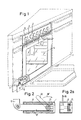
- Fig. 1 eine Ansicht auf eine Küchenzeile mit einem darin angeordneten Elektroherd,
- Fig. 2 den Verschlußmechanismus zum Abziehen der Beschickungstür vom Elektroherd,
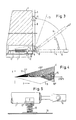
- Fig. 3 eine schematische Seitenansicht auf die Beschickungstür,
- Fig. 4 ein Kraftdiagramm der Beschickungstür und
- Fig. 5 eine Sektion des Dämpfers der Beschickungstür.
- In einer Küchenzeile 1 ist ein Haushaltgerät, hier ein Elektroherd 2, eingeordnet; er besitzt eine Schalterblende 3 und eine Kochmulde 4. Mittels einer Entriegelungstaste 5 ist die Beschickungstür 6 der Kochmulde zu öffnen. Das Öffnen der Beschickungstür wird. durch Druck auf diese Entriegelungstaste eingeleitet. Die Beschickungstür kann nunmehr unterstützt durch eine elastische. Kraft aufschwingen und durch leichten Zug von Hand geöffnet werden, wobei die Beschickungstür sich selbsttätig bis in die Endlage, wie gestrichelt dargestellt, neigt. Ein Zug von Hand ist bis etwa einem Öffnungswinkel von 20° erforderlich, sodann wirkt das Gewicht der Beschikkungstür, so daß sie sich selbsttätig öffnet, wobei jedoch bei einem Öffnungswinkel von 50° ab das Senken der Beschickungstür gedämpft wird. Dadurch wird vermieden, daß die Beschickungstür nicht mit großer Geschwindigkeit in ihre Endlage fällt und möglicherweise zur Beschädigung des Gerätes führt. Zu diesem Zweck ist in der Beschickungstür mindestens ein pneumatischer Dämpfer 7 mit innenliegender Druckfeder eingebaut; er ist an einem Winkelhebel 8 angelenkt. Der Winkelhebel dreht um eine Schwenkachse 9 - welche auch die Schwenkachse der Beschickungstür ist - auf der auch ein weiterer Dämpfer, der auf der anderen Seite des Elektroherdes gelegen ist, einwirken kann.
- Wie aus Fig. 2 ersichtlich, ist auf dem anderen Schenkel 8′ des Winkelhebels 8 die Beschickungstür 5 aufgeschoben und mittels eines von einer Handhabe 10 betätigten Verschlusses befestigt. Wird die Handhabe in Richtung des Pfeiles 10 betätigt, so kommt der Riegel 11 des Verschlusses in die gestrichelt gezeichnete Lage, so daß die Beschickungstür 6 vom Schenkel 8′ des Winkelhebels 8 abgezogen werden kann.
- Wie Fig. 3 zeigt, ist unter dem Dämpfer 7 eine elastisches Element 12 angeordnet. Bei Betätigung der Entriegelungstaste 5 wird der Dämpfer 7 durch das elastische Element geringfügig angehoben, derart, daß der Winkelhebel etwas schwenkt bzw. die Beschickungstür 6 aufspringt. Als Dämpfer 7 kann ein Federdämpfer oder ein Luftdämpfer bzw. ein Federluftdämpfer dienen. Wird die Beschickungstür 6, wie in Fig. 3 dargestellt, etwa bis auf 20° aufgezogen - wie durch die gestrichelt gezeichnete Linie 13 dargestellt - so fällt sie sanft bis in die Stellung 14 - die Offenstellung - wobei sodann die Dämpfer in Tätigkeit treten und die Fallbewegung abfangen. Beim Schließvorgang ist es erforderlich, von der gezeichneten Stellung 14 ab von Hand die Beschickungstür 6 zu schließen. Beim Anheben der Beschickungstür wirken zunächst die Dämpfer mit, das restliche Schließen geschieht von Hand.
- Im Diagramm Fig. 4 ist in Richtung des Pfeiles 6 die Hubstrecke (

- Wie Fig. 6 zeigt, dient als elastisches Element 12 zum Einleiten der Türöffnungsbewegung vorteilhaft eine Druckfeder, die sich beim Schließen und somit Senken des Dämpfers 7 spannt, jedoch beim Entriegeln der Entriegelungstaste 5 entspannen kann und die Beschickungstür dabei geringfügig öffnet. Die Druckfeder 12 kann unmittelbar mit dem Dämpfer verbunden sein und bei weiterer Öffnung der Beschickungstür vom Boden 18 des Haushaltsgerätes abheben oder aber, wie dargestellt, unmittelbar mit dem Boden 18 des Haushaltsgerätes verbunden sein, wobei sich der Dämpfer 7 auf eine Kopfplatte 12′ des elastischen Elementes abstützt.
- Die in der Beschreibung z.T. schematisch dargestellten Dämpfer können auch eine andere Charakteristik als in Fig. 4 dargestellt aufweisen, ohne daß dadurch die Erfindung verlassen wird. Auch der Verschluß 11 zum Abziehen der Beschickungstür von den Winkelhebeln 8 kann in anderer Weise gebildet sein, wobei hier nur die Zweckmäßigkeit ausschlaggebend ist. Auch können die Dämpfer an einem andern Ort im Haushaltsgerät angeordnet sein, als im Beispiel dargestellt.
Claims (8)
Applications Claiming Priority (2)
| Application Number | Priority Date | Filing Date | Title |
|---|---|---|---|
| DE3933719 | 1989-10-09 | ||
| DE3933719A DE3933719C2 (de) | 1989-10-09 | 1989-10-09 | Beschickungstür für Haushaltsgeräte |
Publications (3)
| Publication Number | Publication Date |
|---|---|
| EP0422565A2 true EP0422565A2 (de) | 1991-04-17 |
| EP0422565A3 EP0422565A3 (en) | 1992-03-18 |
| EP0422565B1 EP0422565B1 (de) | 1994-07-20 |
Family
ID=6391135
Family Applications (1)
| Application Number | Title | Priority Date | Filing Date |
|---|---|---|---|
| EP90119270A Expired - Lifetime EP0422565B1 (de) | 1989-10-09 | 1990-10-08 | Beschickungstür für Haushaltsgeräte |
Country Status (4)
| Country | Link |
|---|---|
| EP (1) | EP0422565B1 (de) |
| AT (1) | ATE108885T1 (de) |
| DE (2) | DE3933719C2 (de) |
| ES (1) | ES2057311T3 (de) |
Cited By (7)
| Publication number | Priority date | Publication date | Assignee | Title |
|---|---|---|---|---|
| EP1055881A3 (de) * | 1999-05-26 | 2003-10-01 | BSH Bosch und Siemens Hausgeräte GmbH | Hausgerät-Scharniervorrichtung |
| US6789293B2 (en) * | 2001-09-27 | 2004-09-14 | Mansfield Assemblies Co. | Dampened hinge system for appliance door |
| DE102007032758A1 (de) * | 2007-07-13 | 2009-01-15 | BSH Bosch und Siemens Hausgeräte GmbH | Haushaltsgerät mit Aufsatzdämpfung |
| WO2009124856A1 (de) * | 2008-04-08 | 2009-10-15 | BSH Bosch und Siemens Hausgeräte GmbH | Schliessvorrichtung |
| EP1548366A3 (de) * | 2003-12-22 | 2012-02-29 | Electrolux Home Products Corporation N.V. | Türscharnier für eine Tür eines Haushaltsgeräts |
| EP2574712A1 (de) * | 2011-09-27 | 2013-04-03 | BSH Bosch und Siemens Hausgeräte GmbH | Haushaltsgerät mit einem Aufnahmeraum und einer Tür zum Verschließen des Aufnahmeraums, sowie Verfahren zum Betätigen einer Tür eines Haushaltsgeräts |
| EP1764558A3 (de) * | 2005-09-16 | 2018-03-28 | BSH Hausgeräte GmbH | Schließvorrichtung für eine Tür eines Haushaltsgeräts |
Families Citing this family (3)
| Publication number | Priority date | Publication date | Assignee | Title |
|---|---|---|---|---|
| DE10138878A1 (de) * | 2001-08-08 | 2003-03-06 | Bsh Bosch Siemens Hausgeraete | Haushaltsgeräte-Tür und Haushaltsgerät |
| DE10360384A1 (de) | 2003-12-22 | 2005-07-28 | Electrolux Home Products Corporation N.V. | Vorrichtung zum Verschließen der Zugangsöffnung eines Innenraums eines Haushaltsgeräts |
| DE102008026383A1 (de) * | 2008-06-02 | 2009-12-03 | BSH Bosch und Siemens Hausgeräte GmbH | Haushaltsgerät mit einer eine Bremsvorrichtung aufweisenden Tür |
Family Cites Families (6)
| Publication number | Priority date | Publication date | Assignee | Title |
|---|---|---|---|---|
| DE1879157U (de) * | 1962-11-30 | 1963-09-12 | Siemens Elektrogeraete Gmbh | Geschirrspuelautomat. |
| DE1779221B1 (de) * | 1968-07-19 | 1972-05-31 | Licentia Gmbh | Aushaengbare bratofentuer fuer herde |
| DE2939727A1 (de) * | 1979-10-01 | 1981-04-09 | Bosch-Siemens Hausgeräte GmbH, 7000 Stuttgart | Backofen |
| DE7927859U1 (de) * | 1979-10-01 | 1983-03-17 | Bosch-Siemens Hausgeräte GmbH, 7000 Stuttgart | Backofen |
| DE3140039A1 (de) * | 1981-10-08 | 1983-04-21 | Bosch-Siemens Hausgeräte GmbH, 7000 Stuttgart | Vorrichtung zum gewichtsausgleich einer klappbaren tuer von haushaltgeraeten |
| FR2557273B1 (fr) * | 1983-12-22 | 1986-04-11 | Europ Equip Menager | Dispositif d'articulation et d'equilibrage d'une porte d'un appareil de cuisson |
-
1989
- 1989-10-09 DE DE3933719A patent/DE3933719C2/de not_active Expired - Fee Related
-
1990
- 1990-10-08 DE DE59006493T patent/DE59006493D1/de not_active Expired - Fee Related
- 1990-10-08 EP EP90119270A patent/EP0422565B1/de not_active Expired - Lifetime
- 1990-10-08 AT AT90119270T patent/ATE108885T1/de active
- 1990-10-08 ES ES90119270T patent/ES2057311T3/es not_active Expired - Lifetime
Cited By (7)
| Publication number | Priority date | Publication date | Assignee | Title |
|---|---|---|---|---|
| EP1055881A3 (de) * | 1999-05-26 | 2003-10-01 | BSH Bosch und Siemens Hausgeräte GmbH | Hausgerät-Scharniervorrichtung |
| US6789293B2 (en) * | 2001-09-27 | 2004-09-14 | Mansfield Assemblies Co. | Dampened hinge system for appliance door |
| EP1548366A3 (de) * | 2003-12-22 | 2012-02-29 | Electrolux Home Products Corporation N.V. | Türscharnier für eine Tür eines Haushaltsgeräts |
| EP1764558A3 (de) * | 2005-09-16 | 2018-03-28 | BSH Hausgeräte GmbH | Schließvorrichtung für eine Tür eines Haushaltsgeräts |
| DE102007032758A1 (de) * | 2007-07-13 | 2009-01-15 | BSH Bosch und Siemens Hausgeräte GmbH | Haushaltsgerät mit Aufsatzdämpfung |
| WO2009124856A1 (de) * | 2008-04-08 | 2009-10-15 | BSH Bosch und Siemens Hausgeräte GmbH | Schliessvorrichtung |
| EP2574712A1 (de) * | 2011-09-27 | 2013-04-03 | BSH Bosch und Siemens Hausgeräte GmbH | Haushaltsgerät mit einem Aufnahmeraum und einer Tür zum Verschließen des Aufnahmeraums, sowie Verfahren zum Betätigen einer Tür eines Haushaltsgeräts |
Also Published As
| Publication number | Publication date |
|---|---|
| EP0422565B1 (de) | 1994-07-20 |
| ES2057311T3 (es) | 1994-10-16 |
| ATE108885T1 (de) | 1994-08-15 |
| DE3933719C2 (de) | 1994-02-03 |
| DE3933719A1 (de) | 1991-04-18 |
| EP0422565A3 (en) | 1992-03-18 |
| DE59006493D1 (de) | 1994-08-25 |
Similar Documents
| Publication | Publication Date | Title |
|---|---|---|
| EP2870895B1 (de) | Schwenktablar für ein Möbel | |
| EP0422565A2 (de) | Beschickungstür für Haushaltsgeräte | |
| DE2006621C2 (de) | Back- und Bratrohr | |
| DE3935597C2 (de) | Back- u. Bratofen mit einer beheizbaren Ofenmuffel | |
| DE19744190A1 (de) | Unterdruckhandhabungsgerät | |
| DE4142475C2 (de) | Dunstabzugshaube, insbesondere für eine Flachschirmhaube | |
| DE2205488C3 (de) | Aushängbare Bratofentür | |
| DE2218225C3 (de) | Mikrowellenherd | |
| DE949602C (de) | Einrichtung an Back- und Bratroehrentueren von Herden | |
| EP4085796B1 (de) | Möbelfach mit einem schubkasten und einer schubkasten-riegeleinrichtung | |
| DE636374C (de) | Selbsttaetige Anhaengerkupplung fuer Kraftfahrzeuge | |
| DE1779221B1 (de) | Aushaengbare bratofentuer fuer herde | |
| DE354482C (de) | Verschiebbare Kochhaube fuer Herde | |
| DE2624578B1 (de) | Elektrischer brotroester | |
| DE3230707C1 (de) | Verschiebbare Tragvorrichtung für Einsatzbleche und Grilleinsätze eines Herdes | |
| DE9211953U1 (de) | Vorrichtung für eine Backofenmuffel | |
| DE202025103449U1 (de) | Elektrisches Grillgerät sowie elektrische Steuer- und Heizeinheit für ein Grillgerät | |
| DE322759C (de) | Back- und Bratvorrichtung | |
| DE603651C (de) | Haubenhalter fuer Kraftfahrzeuge | |
| DE3119761C2 (de) | ||
| DE2252021C3 (de) | Haushaltsbackgerät mit Grilleinrichtung ' | |
| DE202025100908U1 (de) | Haushaltsgerät mit wenigstens einem durch ein Pedal höhenverstellbaren Standbein | |
| AT200296B (de) | Kocher, insbesondere für Campingzwecke | |
| DE741654C (de) | Ausziehtisch | |
| DE965533C (de) | Gelenkig gelagerte, aufklappbare Herdofenplatten- oder Ofenplatten-Abdeckplatte |
Legal Events
| Date | Code | Title | Description |
|---|---|---|---|
| PUAI | Public reference made under article 153(3) epc to a published international application that has entered the european phase |
Free format text: ORIGINAL CODE: 0009012 |
|
| AK | Designated contracting states |
Kind code of ref document: A2 Designated state(s): AT CH DE ES FR GB IT LI |
|
| PUAL | Search report despatched |
Free format text: ORIGINAL CODE: 0009013 |
|
| AK | Designated contracting states |
Kind code of ref document: A3 Designated state(s): AT CH DE ES FR GB IT LI |
|
| 17P | Request for examination filed |
Effective date: 19920918 |
|
| 17Q | First examination report despatched |
Effective date: 19921113 |
|
| RAP3 | Party data changed (applicant data changed or rights of an application transferred) |
Owner name: BOSCH-SIEMENS HAUSGERAETE GMBH |
|
| GRAA | (expected) grant |
Free format text: ORIGINAL CODE: 0009210 |
|
| AK | Designated contracting states |
Kind code of ref document: B1 Designated state(s): AT CH DE ES FR GB IT LI |
|
| REF | Corresponds to: |
Ref document number: 108885 Country of ref document: AT Date of ref document: 19940815 Kind code of ref document: T |
|
| REF | Corresponds to: |
Ref document number: 59006493 Country of ref document: DE Date of ref document: 19940825 |
|
| ET | Fr: translation filed | ||
| GBT | Gb: translation of ep patent filed (gb section 77(6)(a)/1977) |
Effective date: 19940815 |
|
| ITF | It: translation for a ep patent filed | ||
| REG | Reference to a national code |
Ref country code: ES Ref legal event code: FG2A Ref document number: 2057311 Country of ref document: ES Kind code of ref document: T3 |
|
| PLBE | No opposition filed within time limit |
Free format text: ORIGINAL CODE: 0009261 |
|
| STAA | Information on the status of an ep patent application or granted ep patent |
Free format text: STATUS: NO OPPOSITION FILED WITHIN TIME LIMIT |
|
| 26N | No opposition filed | ||
| PGFP | Annual fee paid to national office [announced via postgrant information from national office to epo] |
Ref country code: CH Payment date: 19951221 Year of fee payment: 6 |
|
| PGFP | Annual fee paid to national office [announced via postgrant information from national office to epo] |
Ref country code: AT Payment date: 19960913 Year of fee payment: 7 |
|
| PG25 | Lapsed in a contracting state [announced via postgrant information from national office to epo] |
Ref country code: LI Effective date: 19961031 Ref country code: CH Effective date: 19961031 |
|
| REG | Reference to a national code |
Ref country code: CH Ref legal event code: PL |
|
| PG25 | Lapsed in a contracting state [announced via postgrant information from national office to epo] |
Ref country code: AT Free format text: LAPSE BECAUSE OF NON-PAYMENT OF DUE FEES Effective date: 19971008 |
|
| PGFP | Annual fee paid to national office [announced via postgrant information from national office to epo] |
Ref country code: GB Payment date: 20010926 Year of fee payment: 12 |
|
| REG | Reference to a national code |
Ref country code: GB Ref legal event code: IF02 |
|
| PG25 | Lapsed in a contracting state [announced via postgrant information from national office to epo] |
Ref country code: GB Free format text: LAPSE BECAUSE OF NON-PAYMENT OF DUE FEES Effective date: 20021008 |
|
| PGFP | Annual fee paid to national office [announced via postgrant information from national office to epo] |
Ref country code: ES Payment date: 20021021 Year of fee payment: 13 |
|
| GBPC | Gb: european patent ceased through non-payment of renewal fee |
Effective date: 20021008 |
|
| PG25 | Lapsed in a contracting state [announced via postgrant information from national office to epo] |
Ref country code: ES Free format text: LAPSE BECAUSE OF NON-PAYMENT OF DUE FEES Effective date: 20031009 |
|
| PGFP | Annual fee paid to national office [announced via postgrant information from national office to epo] |
Ref country code: FR Payment date: 20031024 Year of fee payment: 14 |
|
| REG | Reference to a national code |
Ref country code: ES Ref legal event code: FD2A Effective date: 20031009 |
|
| PG25 | Lapsed in a contracting state [announced via postgrant information from national office to epo] |
Ref country code: FR Free format text: LAPSE BECAUSE OF NON-PAYMENT OF DUE FEES Effective date: 20050630 |
|
| REG | Reference to a national code |
Ref country code: FR Ref legal event code: ST |
|
| PG25 | Lapsed in a contracting state [announced via postgrant information from national office to epo] |
Ref country code: IT Free format text: LAPSE BECAUSE OF NON-PAYMENT OF DUE FEES;WARNING: LAPSES OF ITALIAN PATENTS WITH EFFECTIVE DATE BEFORE 2007 MAY HAVE OCCURRED AT ANY TIME BEFORE 2007. THE CORRECT EFFECTIVE DATE MAY BE DIFFERENT FROM THE ONE RECORDED. Effective date: 20051008 |
|
| PGFP | Annual fee paid to national office [announced via postgrant information from national office to epo] |
Ref country code: DE Payment date: 20081031 Year of fee payment: 19 |
|
| PG25 | Lapsed in a contracting state [announced via postgrant information from national office to epo] |
Ref country code: DE Free format text: LAPSE BECAUSE OF NON-PAYMENT OF DUE FEES Effective date: 20100501 |