EP0422880A2 - Vorrichtung zum Verriegeln eines Verschlusses und Originalitätsverschluss - Google Patents
Vorrichtung zum Verriegeln eines Verschlusses und Originalitätsverschluss Download PDFInfo
- Publication number
- EP0422880A2 EP0422880A2 EP90311024A EP90311024A EP0422880A2 EP 0422880 A2 EP0422880 A2 EP 0422880A2 EP 90311024 A EP90311024 A EP 90311024A EP 90311024 A EP90311024 A EP 90311024A EP 0422880 A2 EP0422880 A2 EP 0422880A2
- Authority
- EP
- European Patent Office
- Prior art keywords
- closure
- container
- thread
- locking
- seal
- Prior art date
- Legal status (The legal status is an assumption and is not a legal conclusion. Google has not performed a legal analysis and makes no representation as to the accuracy of the status listed.)
- Withdrawn
Links
- 230000002093 peripheral effect Effects 0.000 claims abstract description 12
- 230000000670 limiting effect Effects 0.000 claims abstract description 5
- 210000002105 tongue Anatomy 0.000 claims description 43
- 239000004033 plastic Substances 0.000 claims description 13
- 229920003023 plastic Polymers 0.000 claims description 13
- 239000000463 material Substances 0.000 claims description 10
- 230000000295 complement effect Effects 0.000 claims description 9
- 230000001419 dependent effect Effects 0.000 claims description 3
- 230000000694 effects Effects 0.000 claims 1
- 238000007789 sealing Methods 0.000 description 22
- 239000011324 bead Substances 0.000 description 19
- 239000002184 metal Substances 0.000 description 7
- 238000009434 installation Methods 0.000 description 5
- 230000009471 action Effects 0.000 description 4
- 230000006835 compression Effects 0.000 description 4
- 238000007906 compression Methods 0.000 description 4
- 230000008901 benefit Effects 0.000 description 3
- 230000002401 inhibitory effect Effects 0.000 description 3
- 230000010354 integration Effects 0.000 description 3
- 238000011068 loading method Methods 0.000 description 3
- 238000003860 storage Methods 0.000 description 3
- 239000011521 glass Substances 0.000 description 2
- 238000004519 manufacturing process Methods 0.000 description 2
- 238000005096 rolling process Methods 0.000 description 2
- 239000004677 Nylon Substances 0.000 description 1
- 238000013459 approach Methods 0.000 description 1
- 235000008452 baby food Nutrition 0.000 description 1
- 239000011230 binding agent Substances 0.000 description 1
- 230000015572 biosynthetic process Effects 0.000 description 1
- 239000000356 contaminant Substances 0.000 description 1
- 238000001816 cooling Methods 0.000 description 1
- 230000000994 depressogenic effect Effects 0.000 description 1
- 238000006073 displacement reaction Methods 0.000 description 1
- 239000013013 elastic material Substances 0.000 description 1
- 239000012530 fluid Substances 0.000 description 1
- 230000036541 health Effects 0.000 description 1
- 238000007654 immersion Methods 0.000 description 1
- 238000011065 in-situ storage Methods 0.000 description 1
- 238000007373 indentation Methods 0.000 description 1
- 230000005764 inhibitory process Effects 0.000 description 1
- 238000007689 inspection Methods 0.000 description 1
- 230000002452 interceptive effect Effects 0.000 description 1
- 239000007788 liquid Substances 0.000 description 1
- 230000013011 mating Effects 0.000 description 1
- 230000007246 mechanism Effects 0.000 description 1
- 238000000465 moulding Methods 0.000 description 1
- 229920001778 nylon Polymers 0.000 description 1
- 230000035515 penetration Effects 0.000 description 1
- 230000000750 progressive effect Effects 0.000 description 1
- 230000009467 reduction Effects 0.000 description 1
- 230000002441 reversible effect Effects 0.000 description 1
- 238000006467 substitution reaction Methods 0.000 description 1
- XLYOFNOQVPJJNP-UHFFFAOYSA-N water Substances O XLYOFNOQVPJJNP-UHFFFAOYSA-N 0.000 description 1
- 230000003313 weakening effect Effects 0.000 description 1
Images
Classifications
-
- B—PERFORMING OPERATIONS; TRANSPORTING
- B65—CONVEYING; PACKING; STORING; HANDLING THIN OR FILAMENTARY MATERIAL
- B65D—CONTAINERS FOR STORAGE OR TRANSPORT OF ARTICLES OR MATERIALS, e.g. BAGS, BARRELS, BOTTLES, BOXES, CANS, CARTONS, CRATES, DRUMS, JARS, TANKS, HOPPERS, FORWARDING CONTAINERS; ACCESSORIES, CLOSURES, OR FITTINGS THEREFOR; PACKAGING ELEMENTS; PACKAGES
- B65D41/00—Caps, e.g. crown caps or crown seals, i.e. members having parts arranged for engagement with the external periphery of a neck or wall defining a pouring opening or discharge aperture; Protective cap-like covers for closure members, e.g. decorative covers of metal foil or paper
- B65D41/32—Caps or cap-like covers with lines of weakness, tearing-strips, tags, or like opening or removal devices, e.g. to facilitate formation of pouring openings
- B65D41/34—Threaded or like caps or cap-like covers provided with tamper elements formed in, or attached to, the closure skirt
- B65D41/3404—Threaded or like caps or cap-like covers provided with tamper elements formed in, or attached to, the closure skirt with ratchet-and-pawl mechanism between the container and the closure skirt or the tamper element
- B65D41/3419—Threaded or like caps or cap-like covers provided with tamper elements formed in, or attached to, the closure skirt with ratchet-and-pawl mechanism between the container and the closure skirt or the tamper element the tamper element being formed separately but connected to the closure
-
- B—PERFORMING OPERATIONS; TRANSPORTING
- B65—CONVEYING; PACKING; STORING; HANDLING THIN OR FILAMENTARY MATERIAL
- B65D—CONTAINERS FOR STORAGE OR TRANSPORT OF ARTICLES OR MATERIALS, e.g. BAGS, BARRELS, BOTTLES, BOXES, CANS, CARTONS, CRATES, DRUMS, JARS, TANKS, HOPPERS, FORWARDING CONTAINERS; ACCESSORIES, CLOSURES, OR FITTINGS THEREFOR; PACKAGING ELEMENTS; PACKAGES
- B65D2401/00—Tamper-indicating means
- B65D2401/15—Tearable part of the closure
- B65D2401/25—Non-metallic tear-off strips
Definitions
- This invention relates to lockable closure fastenings for apertures, especially the access mouths of containers or other enclosures.
- the term 'closure' employed herein embraces any form of cover, cap or lid, spanning the spatial extent of an aperture and at least partially filling that aperture with a blanking portion.
- Some means is usually provided for locating and securing or fastening the closure in place upon the aperture.
- closures commonly employ a threaded fastening for fitting to a container, with complementary threads on the closure and a peripheral rim profile, typically upon an upstanding neck, of the container mouth or aperture.
- one aspect of the invention is particularly concerned with a closure fastener thread-locking device.
- unlocking generally either requires excess physical force to 'over-ride' the mechanical lock, typically breaking or rupturing the locking material, or severing and prising or tearing away the locking material from the thread body.
- 'seal' employed herein embraces any form of mechanically close, tight or interference fit, relative disposition of elements, whether a fluid (ie gas or liquid)-tight, or hermetic seal, or otherwise.
- the seal may be operative only in a 'security' sense - ie as an element that must be deliberately and visibly broken to gain admission to the contents of an article sealed thereby.
- the facilities for, and associated implementation of, closing, fastening, locking and sealing may be integrated 'seamlessly'.
- Container closures commonly provide some form of seal, in order to secure the container contents, and inhibit the egress (ie leakage or spillage) of contents from the container - or indeed the ingress of contaminants into the container.
- This very compression at the last stage of fastening may act as a fastening lock, particularly when vacuum or relatively low internal container pressures are imposed.
- Sealing may thus represent a critical factor in the container closure - to the extent that some positive indication should be furnished, if the seal has not been positioned, is not yet completely effective, or has been subsequently displaced or otherwise interfered with.
- unlocking (ie for subsequent unfastening and opening) of the closure requires breaking of the seal - desirably as a deliberate and, most importantly, self-evident, preliminary step.
- peripheral sealing band typically of synthetic plastics material, temperature shrunk into place after fitment of the closure.
- a closure for an aperture with a co-operative peripheral or boundary (rim) profile such as a mouth of a container
- the closure incorporating a self-locking fastener (element) which co-operates with the peripheral (rim) profile and securely locks the closure on to the aperture upon limiting engagement thereof.
- the fastener locking element is integrated with a peripheral security seal, disposed to inhibit unlocking, unfastening and opening of the closure once installed.
- seal breakage Whilst such a seal may be over-ridden or broken, in order to overcome the inhibition upon closure unfastened and opening, the very act of seal breakage provides permanent and vital evidence - even on casual inspection - that the closure has been tampered with.
- Randomly, generated, matched pairs of easily visible security markings on the seal and closure respectively could be provided in production, after initial closure fastening and seal installation, in order to prevent substitution of another (fresh) seal after the initial container opening.
- a multiple 'combination' rotating drum indentation mechanism applied in rolling contact with the periphery of the container closure, could provide such security marking as a post-production step upon closure fastening.
- a lockable threaded container closure fastening utilising complementary threads upon the container mouth and closure, with a (thread) locking element disposed to selectively either run aligned there-between, allowing relative rotation thereof, for fastening and unfastening of the closure, or to become misaligned therewith (for example, axially offset there-from), to obstruct such rotation.
- closure is re-usable - ie it may be (securely) fastened and unfastened repeatedly - once the initial (integrated) lock and seal has been (visibly) broken by the first act of opening, the automatic or self-locking and sealing facility is operative only once.
- a container must also be able to withstand vertical stacking loads, such as are encountered in transit and point-of-sale display, without damage to, or reduction in the efficacy of, the individual (internal) closure seal.
- a container lid deforms or buckles at its centre, the load on a peripheral rim seal could be eased.
- the seal itself bears the load it may be crushed - to the detriment of the intimacy of its sealing contact with the closure and container.
- Some aspects of the present invention provide just this facility, by accommodating and distributing such loads through the threaded fastener locking element - optionally in conjunction with a travel limit and locking abutments on the rim of the container neck.
- This thread lock may inhibit thread slackening under vibration or may maintain a predetermined locking torque initially applied.
- the invention provides a closure for tamper-proofing container, such as jars, bottles, cans or other enclosures, which have apertures bounded by externally threaded neck-rings, onto which closures with complementary threads can be securely (rotatably) fastened, or 'screwed' to close and seal the apertures.
- Such embodiments provide a means of ensuring that, once a container has been closed and sealed by such a closure, it cannot be unsealed and opened - and consequently that the contents cannot be tampered with - without there being visible evidence that the seal has been disturbed, and the closure opened or vulnerable to tampering.
- a conventional threaded closure for fastening onto an externally threaded container neck-ring commonly has a top panel and a dependent skirt.
- the skirt In the case of a metal closure, it is known for the skirt to be rolled inwardly or outwardly at its lower edge, to form a circumferential bead, and either the bead or the skirt is deformed, to enable the closure to engage the threads on a neck-ring, for fastening into sealing engagement with the sealing surface of a neck-ring.
- the skirt In the case of a plastic closure, the skirt normally terminates in a moulded thread, which likewise engages the threads on a neck-ring, so that the closure can be fastened into sealing engagement therewith.
- Embodiments of the present invention provide a closure incorporating one or more internal tongues which, as the closure reaches sealing engagement, take up a position where they lock the closure onto the neck-ring, so that it cannot be unfastened without the tongues being removed, and in turn the tongues themselves cannot be removed without an outer ring of the closure being broken - thereby providing visible evidence that the seal may have been disturbed.
- the tongues may be moulded integrally with an outer ring, which fits around the outside of a depending closure skirt.
- tongues are marginally spaced inwardly from the outer ring, in order to accommodate the bead depth, and can thereby pass under and inside the skirt - but still outside the container neck ring.
- the tongues have thickened (alternatively thread running or thread jamming) portions, which can pass between the threads on a neck-ring when the closure is being applied, but which, when the closure has reached sealing engagement with the container rim, can form a wedge between the closure and the lower ends of the threads, thereby effectively jamming or obstructing those threads and inhibiting the unfastening and opening of the closure.
- the wedge action cannot be released, (ie the tongues released or displaced from the threads), without the outer-ring being broken.
- the outer-ring is configured so that, once broken, it can be used to pull the tongues from their wedging positions.
- the tongues are secured to the closure in a way which inhibits relative angular rotation, but which allows a limited amount of relative axial movement.
- the amount of such axial movement required is normally only one-half of a thread pitch, so that the thickened portion can move from a position where it is aligned with a thread groove during installation, to a position where it is directly in line with the body of a thread when installation is completed.
- the tongue If the tongue is then restrained from moving back into alignment with a groove, it can be caused to lock against the end of a thread, thereby preventing the closure from being unfastened.
- relative angular rotation can be inhibited by locally recessing the rim bead, to form channels (generally aligned with the thread axis) in which the tongues can lie, as they pass in between the closure skirt and the threads of the neck-ring.
- Limited relative axial movement can be provided by affording the outer (locking) ring of the closure freedom to move axially relative to the body of the closure.
- the tongues are conveniently moulded integrally with the outer ring and are afforded sufficient flexibility to permit limited axial movement, within axial retaining slots moulded through the threads on the closure.
- a tongue can be tensioned by restraint from the upper ends of the threads on a neck-ring and offering resistance to any further downward movement of the outer member as it is fastened onto the neck-ring; or it can be brought into compression by the lower end of the tongues coming into contact with a transfer ring or a similar abutment on the neck-ring.
- the tail end of the tongue thickened portion can be profiled to lock on to the thread, or can be angled or orientated so that the thread tends to force it upwards between the neck-ring and the closure skirt, when any attempt is made to unfasten the closure.
- the lower end of a neck ring thread can be angled to act in concert with the profile on the tail end of the thickened portion, to encourage the thickened portion upwards into a locking position.
- the locking action can be assisted by positioning an abutment on the neck-ring, which presses the nose of the tongue thickened portion up under the skirt of the closure as the tail end of the thickened portion is passing under the bottom end of the thread.
- a transfer ring for example, a continuous ring adjacent and below the threads
- it can be positioned to act in this way.
- the pressure exerted on the nose of the thickened portion can be increased to any desired extent.
- closure incorporating internal tongues over a conventional closure is that the tongues can help accommodate any closure top loading. This commonly occurs when sealed containers are stacked on top of each other in storage.
- the tongues passing beneath the bottom edge of the skirt can be brought into contact with a transfer ring, or similar abutment on the neck-ring, and can thereby help inhibit any downward movement of the closure relative to the neck-ring - thereby preventing excess penetration of the neck-ring into the sealing surface of the closure.
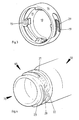
- a closure 30 for a container 50 such as a glass jar, with a neck 60 bounding an access aperture 70, comprises a cap with a disc shaped top panel 10 and an outer peripheral dependent skirt 11.
- the lower edge of the skirt 11 is turned (for example by rolling) inwardly to form an internal bead, ridge or flange 12, into which are pressed a series of angled (thread-running) grooves 13.
- the grooves 13 are of complementary profile to the threads, or more particularly multiple circumferentially-spaced arcuate thread portions, 23 of a neck, or more particularly neck-ring, 60 of a container 50.
- closure thread portions 23 can be aligned with, and thereafter co-operatively engage and pass through, the grooves 13, when the closure 30 is mounted upon the neck-ring 60 - to enable progressive (threaded) fastening of the closure 30 upon the container 50.
- the cap 30 may be fabricated from a variety of materials, for example pressed metal sheet, painted or plastic-coated, or directly of synthetic plastics material.
- annular sealing gasket (not shown) may be fitted within the cap 30 for subsequent (compression) sealing engagement with the upper rim or lip of the container neck 60.
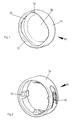
- a closure (threaded fastener) locking element 40 as shown individually in Fig 2, in the form of a plastic outer ring member 14, fits around the skirt 11 of the closure and supports a plurality of integrally-moulded, circumferentially-spaced internal locating and thread-running tongues 15.
- Each such peripheral tongue 15 corresponds to a successive thread portion 23 on the neck-ring 60 and is radially offset inwardly from the ring 14, enabling it to accommodate the bead 12 depth and pass under the skirt 11 of the closure 30 into corresponding recesses 16 in the threaded bead 12, representing the start of each closure thread portion 23.
- a four 'start' thread 23, that is with four successive thread portions, is illustrated, but other multiples may be employed - for example in applications requiring a spread of higher closure tightening loads.
- the thread angle may be varied to achieve 'fast' or 'slow' thread configurations, which in turn determine the torque loadings and degree of turning required to complete and lock the closure fastening.
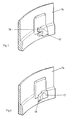
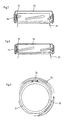
- Each tongue 15 carries a thickened wedge-shaped portion, as shown in Figures 6 and 7, with a ('leading') nose section 17 of a curved profile to engage readily with the thread 23 on the neck-ring 60 and a ('trailing') tail section 18 configured so that, immediately it passes the end of a thread 23, it can move into locking engagement therewith.
- the tongues 15 will lie in the recesses or grooves 16 in the threaded bead 12 - thereby securing the locking member 40 to the closure 30 and inhibiting relative angular movement there-between, whilst allowing limited axial movement (specifically, over a distance equal to one half of the neck-ring thread pitch).
- the assembly is so arranged that, when the locking member 40 is in its lowest position relative to the closure 30, the thickened portions 17, 18 of the tongues 15 and the ribs between the grooves 13 in the bead 12 of the closure 30 are in the correct relative position to pass freely between the threads 23 on the neck-ring 60.
- the locking member 40 has also moved to its upper position relative thereto - whereupon the thickened portions 17, 18 of the tongues 15 will abut the ends of the threads 23.
- closure 30 and locking member 40 assembly is applied to the neck-ring 60 in the general manner of a conventional closure.
- the locking member 40 is carried by the closure 30, and because it is angularly constrained therewith, rotates as the closure 30 itself rotates.
- the thickened portions 17,18 of the tongues 15 are initially positioned below the bead 12 and hence they engage the threads 23 of the neck-ring 60, before the closure 30 itself, and in particular the grooves 13, reaches the threads 23.
- the locking member 40 is fabricated from a material, such as synthetic plastics, with a degree of flexibility and resilience.
- the locking member 40 will flex sufficiently to allow the closure 30 to engage the threads 23 on the neck-ring 60 - whereupon the locking member 40 will float downwards relative to the closure 30, into a position where it is in correct alignment.
- the annular ring 14 of the locking member 40 incorporates an integral tab 19, which can readily be lifted clear of the ring 14, by fracturing locating strands 29.
- the tab 19 when pulled, the tab 19 will cause the ring 14 to fracture, (across a pre-formed weakening line), from a continuous loop into a single strip, whereupon the locking member 40 as a whole can be pulled clear away from the closure 30 - taking with it each of the internal tongues 15 (which can be withdrawn from under the bead 12).
- lug cap One advantage of a lug cap is that the lugs can be used to inhibit relative angular rotation and hence there is no need for recessed grooves in the bead.
- lug cap One disadvantage of using a lug cap is that the radial gap between the bead and glass neck-ring is greater than that with a grooved bead closure, and hence it is more difficult for the wedge portion of the tongue, to achieve a locking condition between the closure and the neck-ring.
- the invention will work with closures where the threads are formed directly in the skirt, or where the bead is rolled outwardly.
- Another advantage of the invention is the provision of an effective means of preventing the ingress of foreign matter into the space between the neck-ring and the skirt of the closure.
- a warning message can be printed on the skirt of the closure, within the area covered by the outer member, so that the message is visible only when the outer member has been removed.
- the invention will function satisfactorily with a conventionally threaded neck-ring, but its performance can be enhanced by adding more elaborate features to the neck-ring as shown in Figure 4.
- the degree of overlap of the thread portions 23 may be varied to suit particular applications, but it is convenient with a multi-start thread to space the ends of successive thread portions, leaving a longitudinal channel through which the tongues 15 and the ribs between grooves 13 in the bead 12 may pass.
- Incorporating a transfer ring 21 on the neck-ring 60 helps to secure the wedges 18 on the tongues 15 in a locking position, and profiling the upper surface of the transfer ring 21 to provide a localised abutment 22, which will encourage, by a co-operative displacement 'cam' action, the wedges 18 of the tongues 15 into a thread jamming or locking position, once they have passed the bottom ends of the lower thread portions 23.
- a closure 30 according to the invention can securely seal a container 70 - in that, once applied, it cannot be removed, without the locking member 40 being detached - thereby providing visible evidence that the closure 30 has been tampered with, or is vulnerable to such tampering.
Landscapes
- Engineering & Computer Science (AREA)
- Mechanical Engineering (AREA)
- Closures For Containers (AREA)
- Package Frames And Binding Bands (AREA)
Applications Claiming Priority (4)
| Application Number | Priority Date | Filing Date | Title |
|---|---|---|---|
| GB8923118 | 1989-10-13 | ||
| GB898923118A GB8923118D0 (en) | 1989-10-13 | 1989-10-13 | Tamper-evident closure |
| GB9014752 | 1990-07-03 | ||
| GB909014752A GB9014752D0 (en) | 1989-10-13 | 1990-07-03 | Tamper-evident closure |
Publications (2)
| Publication Number | Publication Date |
|---|---|
| EP0422880A2 true EP0422880A2 (de) | 1991-04-17 |
| EP0422880A3 EP0422880A3 (en) | 1992-03-25 |
Family
ID=26296045
Family Applications (1)
| Application Number | Title | Priority Date | Filing Date |
|---|---|---|---|
| EP19900311024 Withdrawn EP0422880A3 (en) | 1989-10-13 | 1990-10-09 | Closure locking device and tamper-evident closure |
Country Status (7)
| Country | Link |
|---|---|
| US (1) | US5197617A (de) |
| EP (1) | EP0422880A3 (de) |
| JP (1) | JPH04128145A (de) |
| AU (1) | AU639720B2 (de) |
| BR (1) | BR9005141A (de) |
| CA (1) | CA2027470A1 (de) |
| GB (1) | GB2238779B (de) |
Cited By (2)
| Publication number | Priority date | Publication date | Assignee | Title |
|---|---|---|---|---|
| WO2015157236A1 (en) | 2014-04-11 | 2015-10-15 | Silgan White Cap LLC | Metal closure with low pressure engagement lugs |
| CN110834809A (zh) * | 2019-11-22 | 2020-02-25 | 徐州龙安电子科技有限公司 | 一种防伪酒瓶扣 |
Families Citing this family (14)
| Publication number | Priority date | Publication date | Assignee | Title |
|---|---|---|---|---|
| FR2686066B1 (fr) * | 1992-01-14 | 1994-03-25 | Petzl Sa | Boitier a bague de fixation flexible. |
| US5711442A (en) * | 1996-02-29 | 1998-01-27 | Owens-Illinois Prescription Products Inc. | Child resistant package |
| US5899348A (en) * | 1997-12-02 | 1999-05-04 | Owens-Illinois Prescription Products Inc. | Child resistant package |
| CA2387500C (en) * | 1999-10-20 | 2007-07-31 | Gentra Systems, Inc. | Mixing and pouring apparatus with rotatable arm and related vessel |
| US8920590B1 (en) | 2003-04-14 | 2014-12-30 | Winfield Laboratories, Inc. | Tamper evident seal for a medical container |
| KR101216627B1 (ko) * | 2004-06-23 | 2012-12-31 | 듀보이스 리미티드 | 음료 용기 |
| GB0602382D0 (en) * | 2006-02-07 | 2006-03-15 | Dubois Ltd | Packaging article |
| FR2921910B1 (fr) * | 2007-10-05 | 2009-12-18 | Saint Gobain Emballage | Produit creux a cran pour bouchage sous vide |
| GB2482000A (en) * | 2010-07-14 | 2012-01-18 | Threadless Closures Ltd | Closure having Seal and Inner and Outer Components |
| US9592656B1 (en) | 2010-09-23 | 2017-03-14 | Winfield Laboratories, Inc. | Tamper evident seal with visible adhesive dot pattern |
| US9321564B2 (en) * | 2011-03-02 | 2016-04-26 | Rubbermaid Incorporated | Mechanically secured lid and container |
| USD722689S1 (en) * | 2012-05-01 | 2015-02-17 | Tri State Distribution, Inc. | Segmented threads for a pharmaceutical cap |
| CN109250294B (zh) * | 2018-11-01 | 2024-03-29 | 广州曼盛包装有限公司 | 一种带点状螺纹的可以快速拆卸的盖子 |
| JP7344682B2 (ja) | 2019-06-18 | 2023-09-14 | 株式会社ディスコ | 加工装置 |
Family Cites Families (29)
| Publication number | Priority date | Publication date | Assignee | Title |
|---|---|---|---|---|
| US2226390A (en) * | 1938-05-27 | 1940-12-24 | Benjamin H Anibal | Locking bottle cap |
| US2326480A (en) * | 1941-03-18 | 1943-08-10 | Empire Metal Cap Company | Closure |
| FR1491263A (fr) * | 1966-04-18 | 1967-08-11 | Bouchon de sécurité pour flacons et récipients pharmaceutiques | |
| US3445022A (en) * | 1967-12-21 | 1969-05-20 | Frank A Cilluffo | Childproof safety container and closure |
| US3482723A (en) * | 1968-10-09 | 1969-12-09 | Vincent J Esposito Jr | Child-proofing collar for containers having screw-on or snap-on caps |
| US3741421A (en) * | 1971-05-10 | 1973-06-26 | J Wittwer | Safety locking cap |
| US3746199A (en) * | 1971-06-14 | 1973-07-17 | Anchor Hocking Corp | Closure cap and sealed package |
| US3695476A (en) * | 1971-06-15 | 1972-10-03 | Continental Can Co | Tamper-indicating and child-proof closure |
| GB1439460A (en) * | 1972-07-19 | 1976-06-16 | Parsons Bros Ltd | Tamperproof closures for containers |
| NL7311409A (de) * | 1972-08-18 | 1974-02-20 | ||
| US3820678A (en) * | 1972-09-05 | 1974-06-28 | Continental Can Co | Tamper-proof closure |
| US3828958A (en) * | 1972-11-20 | 1974-08-13 | J Shannon | Safety bottle cap |
| US3895731A (en) * | 1973-07-09 | 1975-07-22 | Bouchage Mecanique | Closure for receptacles |
| US3858743A (en) * | 1973-10-15 | 1975-01-07 | Owens Illinois Inc | Tamperproof package |
| US3901400A (en) * | 1974-02-04 | 1975-08-26 | Continental Can Co | Childproof closure |
| US3913769A (en) * | 1974-12-20 | 1975-10-21 | Suwa Seikosha Kk | Safety locking cap |
| US4071156A (en) * | 1976-08-13 | 1978-01-31 | The West Company | Child resistant container-closure assembly |
| FR2524425B1 (fr) * | 1982-03-31 | 1985-07-12 | Boussois Souchon Neuvesel Sa | Bouchon en matiere synthetique equipe d'une bague d'inviolabilite |
| US4560016A (en) * | 1983-12-14 | 1985-12-24 | Anco Engineers, Incorporated | Method and apparatus for measuring the weight of a vehicle while the vehicle is in motion |
| US4560076A (en) * | 1984-04-17 | 1985-12-24 | Continental White Cap, Inc. | Tamper indicating band for use in low rise cam-off application |
| FR2563500B1 (fr) * | 1984-04-26 | 1986-11-28 | Astra Plastique | Recipient a jeter apres utilisation et destine plus particulierement a l'alimentation des nourrissons |
| US4576298A (en) * | 1984-05-08 | 1986-03-18 | Continental White Cap, Inc. | Tamper indicating fitment |
| AT391827B (de) * | 1984-12-07 | 1990-12-10 | Sticht Walter | Handhabungseinrichtung fuer montageteile |
| US4645087A (en) * | 1984-12-17 | 1987-02-24 | Owens-Illinois, Inc. | Tamper indicating device |
| NZ218603A (en) * | 1985-12-13 | 1988-02-12 | Pdl Packaging Ltd | Tamper indicating sealing ring for container closure |
| DE3613782A1 (de) * | 1986-04-23 | 1987-10-29 | Vaw Folien Verarb Gmbh | Sicherungsring fuer flaschen-, weithals- o.ae. behaelterverschluesse |
| US4801032A (en) * | 1987-08-24 | 1989-01-31 | Northern Engineering & Plastics Corp. | Closure for containers with convenient tear off skirt |
| US4919286A (en) * | 1988-05-27 | 1990-04-24 | Robert Linkletter Assoc. | Hinged closure and container |
| US4886175A (en) * | 1989-04-10 | 1989-12-12 | Merck & Co., Inc. | Bottle and cap closure system |
-
1990
- 1990-10-09 GB GB9021914A patent/GB2238779B/en not_active Expired - Fee Related
- 1990-10-09 EP EP19900311024 patent/EP0422880A3/en not_active Withdrawn
- 1990-10-12 AU AU64609/90A patent/AU639720B2/en not_active Ceased
- 1990-10-12 JP JP2275109A patent/JPH04128145A/ja active Pending
- 1990-10-12 CA CA002027470A patent/CA2027470A1/en not_active Abandoned
- 1990-10-12 BR BR909005141A patent/BR9005141A/pt unknown
- 1990-10-12 US US07/595,866 patent/US5197617A/en not_active Expired - Fee Related
Cited By (4)
| Publication number | Priority date | Publication date | Assignee | Title |
|---|---|---|---|---|
| WO2015157236A1 (en) | 2014-04-11 | 2015-10-15 | Silgan White Cap LLC | Metal closure with low pressure engagement lugs |
| EP3066017A4 (de) * | 2014-04-11 | 2017-05-31 | Silgan White Cap LLC | Metalleinschluss mit niedrigdruck-einrastlaschen |
| US10364070B2 (en) | 2014-04-11 | 2019-07-30 | Silgan White Cap LLC | Metal closure with low pressure engagement lugs |
| CN110834809A (zh) * | 2019-11-22 | 2020-02-25 | 徐州龙安电子科技有限公司 | 一种防伪酒瓶扣 |
Also Published As
| Publication number | Publication date |
|---|---|
| JPH04128145A (ja) | 1992-04-28 |
| GB2238779A (en) | 1991-06-12 |
| GB2238779B (en) | 1994-05-18 |
| CA2027470A1 (en) | 1991-04-14 |
| EP0422880A3 (en) | 1992-03-25 |
| GB9021914D0 (en) | 1990-11-21 |
| BR9005141A (pt) | 1991-09-17 |
| AU6460990A (en) | 1991-04-18 |
| AU639720B2 (en) | 1993-08-05 |
| US5197617A (en) | 1993-03-30 |
Similar Documents
| Publication | Publication Date | Title |
|---|---|---|
| US5197617A (en) | Lockable closure fastening and tamper evident closure | |
| US4934554A (en) | Tamper-evident lid with tear-away ring | |
| US4787530A (en) | Tamper-evident lid | |
| US5450973A (en) | Tamper-evident closure apparatus | |
| US4919286A (en) | Hinged closure and container | |
| US3913771A (en) | Closure cap with tamper indicator | |
| US6257435B1 (en) | Tamper evident closure member | |
| US5788100A (en) | Closure with two position lock ring | |
| US4875594A (en) | Closure cap | |
| US4394918A (en) | Screw cap with tamper-proof hold ring | |
| US6688483B2 (en) | Molded plastic pail with double lock | |
| CA1129813A (en) | Tamperproof package | |
| EP0176279B1 (de) | Garantieverschluss für einen Behälter | |
| AU2003302391B2 (en) | Tamper evident closure with locking band | |
| MXPA05011004A (es) | Envase que muestra evidencia de violacion. | |
| US5042680A (en) | Reclosable container assembly | |
| AU2005256821A1 (en) | Beverage container | |
| US5622273A (en) | Resealable snap-fit plastic closure | |
| CA1309379C (en) | Tamper-evident cap construction | |
| US7549547B2 (en) | Composite two-piece tamper-evident closure with a seal-delay-release feature and a method therefor | |
| US4276988A (en) | Tamper-proof closure | |
| US12454396B2 (en) | Mold-material flip-top tamper evident closure | |
| JP3422526B2 (ja) | 不正表示ふた | |
| GB2280895A (en) | Closure devices with compressible core seal | |
| US6923333B2 (en) | Tamper resistant plastic industrial container with pail, cover and pour spout closure |
Legal Events
| Date | Code | Title | Description |
|---|---|---|---|
| PUAI | Public reference made under article 153(3) epc to a published international application that has entered the european phase |
Free format text: ORIGINAL CODE: 0009012 |
|
| AK | Designated contracting states |
Kind code of ref document: A2 Designated state(s): DE ES FR GB IT |
|
| PUAL | Search report despatched |
Free format text: ORIGINAL CODE: 0009013 |
|
| AK | Designated contracting states |
Kind code of ref document: A3 Designated state(s): DE ES FR GB IT |
|
| 17P | Request for examination filed |
Effective date: 19920924 |
|
| 17Q | First examination report despatched |
Effective date: 19931001 |
|
| STAA | Information on the status of an ep patent application or granted ep patent |
Free format text: STATUS: THE APPLICATION IS DEEMED TO BE WITHDRAWN |
|
| 18D | Application deemed to be withdrawn |
Effective date: 19950209 |