EP0423148B1 - Als antioxidations-schmiermittelzusatz verwendbare dihydroxyaryl-hydroxyaliphatische borate und diese enthaltende schmiermittel - Google Patents
Als antioxidations-schmiermittelzusatz verwendbare dihydroxyaryl-hydroxyaliphatische borate und diese enthaltende schmiermittel Download PDFInfo
- Publication number
- EP0423148B1 EP0423148B1 EP89906289A EP89906289A EP0423148B1 EP 0423148 B1 EP0423148 B1 EP 0423148B1 EP 89906289 A EP89906289 A EP 89906289A EP 89906289 A EP89906289 A EP 89906289A EP 0423148 B1 EP0423148 B1 EP 0423148B1
- Authority
- EP
- European Patent Office
- Prior art keywords
- hydroxyester
- aliphatic
- product according
- hydrocarbyl group
- grease
- Prior art date
- Legal status (The legal status is an assumption and is not a legal conclusion. Google has not performed a legal analysis and makes no representation as to the accuracy of the status listed.)
- Expired - Lifetime
Links
Classifications
-
- C—CHEMISTRY; METALLURGY
- C10—PETROLEUM, GAS OR COKE INDUSTRIES; TECHNICAL GASES CONTAINING CARBON MONOXIDE; FUELS; LUBRICANTS; PEAT
- C10M—LUBRICATING COMPOSITIONS; USE OF CHEMICAL SUBSTANCES EITHER ALONE OR AS LUBRICATING INGREDIENTS IN A LUBRICATING COMPOSITION
- C10M169/00—Lubricating compositions characterised by containing as components a mixture of at least two types of ingredient selected from base-materials, thickeners or additives, covered by the preceding groups, each of these compounds being essential
- C10M169/06—Mixtures of thickeners and additives
-
- C—CHEMISTRY; METALLURGY
- C07—ORGANIC CHEMISTRY
- C07F—ACYCLIC, CARBOCYCLIC OR HETEROCYCLIC COMPOUNDS CONTAINING ELEMENTS OTHER THAN CARBON, HYDROGEN, HALOGEN, OXYGEN, NITROGEN, SULFUR, SELENIUM OR TELLURIUM
- C07F5/00—Compounds containing elements of Groups 3 or 13 of the Periodic Table
- C07F5/02—Boron compounds
- C07F5/04—Esters of boric acids
-
- C—CHEMISTRY; METALLURGY
- C10—PETROLEUM, GAS OR COKE INDUSTRIES; TECHNICAL GASES CONTAINING CARBON MONOXIDE; FUELS; LUBRICANTS; PEAT
- C10M—LUBRICATING COMPOSITIONS; USE OF CHEMICAL SUBSTANCES EITHER ALONE OR AS LUBRICATING INGREDIENTS IN A LUBRICATING COMPOSITION
- C10M139/00—Lubricating compositions characterised by the additive being an organic non-macromolecular compound containing atoms of elements not provided for in groups C10M127/00 - C10M137/00
-
- C—CHEMISTRY; METALLURGY
- C10—PETROLEUM, GAS OR COKE INDUSTRIES; TECHNICAL GASES CONTAINING CARBON MONOXIDE; FUELS; LUBRICANTS; PEAT
- C10M—LUBRICATING COMPOSITIONS; USE OF CHEMICAL SUBSTANCES EITHER ALONE OR AS LUBRICATING INGREDIENTS IN A LUBRICATING COMPOSITION
- C10M2203/00—Organic non-macromolecular hydrocarbon compounds and hydrocarbon fractions as ingredients in lubricant compositions
- C10M2203/10—Petroleum or coal fractions, e.g. tars, solvents, bitumen
- C10M2203/102—Aliphatic fractions
- C10M2203/1025—Aliphatic fractions used as base material
-
- C—CHEMISTRY; METALLURGY
- C10—PETROLEUM, GAS OR COKE INDUSTRIES; TECHNICAL GASES CONTAINING CARBON MONOXIDE; FUELS; LUBRICANTS; PEAT
- C10M—LUBRICATING COMPOSITIONS; USE OF CHEMICAL SUBSTANCES EITHER ALONE OR AS LUBRICATING INGREDIENTS IN A LUBRICATING COMPOSITION
- C10M2207/00—Organic non-macromolecular hydrocarbon compounds containing hydrogen, carbon and oxygen as ingredients in lubricant compositions
- C10M2207/10—Carboxylix acids; Neutral salts thereof
- C10M2207/12—Carboxylix acids; Neutral salts thereof having carboxyl groups bound to acyclic or cycloaliphatic carbon atoms
- C10M2207/121—Carboxylix acids; Neutral salts thereof having carboxyl groups bound to acyclic or cycloaliphatic carbon atoms having hydrocarbon chains of seven or less carbon atoms
- C10M2207/124—Carboxylix acids; Neutral salts thereof having carboxyl groups bound to acyclic or cycloaliphatic carbon atoms having hydrocarbon chains of seven or less carbon atoms containing hydroxy groups; Ethers thereof
-
- C—CHEMISTRY; METALLURGY
- C10—PETROLEUM, GAS OR COKE INDUSTRIES; TECHNICAL GASES CONTAINING CARBON MONOXIDE; FUELS; LUBRICANTS; PEAT
- C10M—LUBRICATING COMPOSITIONS; USE OF CHEMICAL SUBSTANCES EITHER ALONE OR AS LUBRICATING INGREDIENTS IN A LUBRICATING COMPOSITION
- C10M2207/00—Organic non-macromolecular hydrocarbon compounds containing hydrogen, carbon and oxygen as ingredients in lubricant compositions
- C10M2207/28—Esters
-
- C—CHEMISTRY; METALLURGY
- C10—PETROLEUM, GAS OR COKE INDUSTRIES; TECHNICAL GASES CONTAINING CARBON MONOXIDE; FUELS; LUBRICANTS; PEAT
- C10M—LUBRICATING COMPOSITIONS; USE OF CHEMICAL SUBSTANCES EITHER ALONE OR AS LUBRICATING INGREDIENTS IN A LUBRICATING COMPOSITION
- C10M2227/00—Organic non-macromolecular compounds containing atoms of elements not provided for in groups C10M2203/00, C10M2207/00, C10M2211/00, C10M2215/00, C10M2219/00 or C10M2223/00 as ingredients in lubricant compositions
- C10M2227/06—Organic compounds derived from inorganic acids or metal salts
- C10M2227/061—Esters derived from boron
-
- C—CHEMISTRY; METALLURGY
- C10—PETROLEUM, GAS OR COKE INDUSTRIES; TECHNICAL GASES CONTAINING CARBON MONOXIDE; FUELS; LUBRICANTS; PEAT
- C10N—INDEXING SCHEME ASSOCIATED WITH SUBCLASS C10M RELATING TO LUBRICATING COMPOSITIONS
- C10N2030/00—Specified physical or chemical properties which is improved by the additive characterising the lubricating composition, e.g. multifunctional additives
- C10N2030/10—Inhibition of oxidation, e.g. anti-oxidants
-
- C—CHEMISTRY; METALLURGY
- C10—PETROLEUM, GAS OR COKE INDUSTRIES; TECHNICAL GASES CONTAINING CARBON MONOXIDE; FUELS; LUBRICANTS; PEAT
- C10N—INDEXING SCHEME ASSOCIATED WITH SUBCLASS C10M RELATING TO LUBRICATING COMPOSITIONS
- C10N2040/00—Specified use or application for which the lubricating composition is intended
- C10N2040/04—Oil-bath; Gear-boxes; Automatic transmissions; Traction drives
- C10N2040/042—Oil-bath; Gear-boxes; Automatic transmissions; Traction drives for automatic transmissions
-
- C—CHEMISTRY; METALLURGY
- C10—PETROLEUM, GAS OR COKE INDUSTRIES; TECHNICAL GASES CONTAINING CARBON MONOXIDE; FUELS; LUBRICANTS; PEAT
- C10N—INDEXING SCHEME ASSOCIATED WITH SUBCLASS C10M RELATING TO LUBRICATING COMPOSITIONS
- C10N2040/00—Specified use or application for which the lubricating composition is intended
- C10N2040/04—Oil-bath; Gear-boxes; Automatic transmissions; Traction drives
- C10N2040/044—Oil-bath; Gear-boxes; Automatic transmissions; Traction drives for manual transmissions
-
- C—CHEMISTRY; METALLURGY
- C10—PETROLEUM, GAS OR COKE INDUSTRIES; TECHNICAL GASES CONTAINING CARBON MONOXIDE; FUELS; LUBRICANTS; PEAT
- C10N—INDEXING SCHEME ASSOCIATED WITH SUBCLASS C10M RELATING TO LUBRICATING COMPOSITIONS
- C10N2040/00—Specified use or application for which the lubricating composition is intended
- C10N2040/04—Oil-bath; Gear-boxes; Automatic transmissions; Traction drives
- C10N2040/046—Oil-bath; Gear-boxes; Automatic transmissions; Traction drives for traction drives
-
- C—CHEMISTRY; METALLURGY
- C10—PETROLEUM, GAS OR COKE INDUSTRIES; TECHNICAL GASES CONTAINING CARBON MONOXIDE; FUELS; LUBRICANTS; PEAT
- C10N—INDEXING SCHEME ASSOCIATED WITH SUBCLASS C10M RELATING TO LUBRICATING COMPOSITIONS
- C10N2040/00—Specified use or application for which the lubricating composition is intended
- C10N2040/08—Hydraulic fluids, e.g. brake-fluids
-
- C—CHEMISTRY; METALLURGY
- C10—PETROLEUM, GAS OR COKE INDUSTRIES; TECHNICAL GASES CONTAINING CARBON MONOXIDE; FUELS; LUBRICANTS; PEAT
- C10N—INDEXING SCHEME ASSOCIATED WITH SUBCLASS C10M RELATING TO LUBRICATING COMPOSITIONS
- C10N2050/00—Form in which the lubricant is applied to the material being lubricated
- C10N2050/10—Form in which the lubricant is applied to the material being lubricated semi-solid; greasy
Definitions
- This application is directed to dihydroxyaryl-hydroxyaliphatic borates useful as multifunctional/antioxidant additives in lubricant compositions containing small concentrations of said dihydroxyaryl-hydroxyaliphatic borates.
- Hydroxyaryls are known for their antioxidant properties in a variety of petroleum and non-petroleum products.
- the use of borates has found extensive application in such diverse areas as grease additives, brake and hydraulic fluids, and field and combustion additives.
- the use of hydroxyaliphatics such as hydroxyesters has been widely reported as having beneficial multifunctional characteristics in a variety of fuel and lubricant applications.
- novel mixed dihydroxyaryl-hydroxyaliphatic borates provide exceptional antioxidant and corrosion inhibiting activity with the potential for antifatigue, friction reducing, antirust and high temperature stabilizing properties.
- These novel borates are highly useful no only in oils of lubrication viscosity but also in solid lubricants such as greases.
- U.S. Patent No. 3,445,498 relates to a borated reaction product of resorcinol or hydroquinone and an N,N-di-substituted hydroxyamine, such as an N,N-di-substituted alkanolamine as an antioxidant in lubricants.
- U.S. Patent No. 2,975,134 relates to a boron partial ester or triester product.
- dihydroxyaryl-hydroxyaliphatic borates possess excellent antioxidant activity when incorporated into lubricant compositions.
- Typical dihydroxyaryl compounds include hydroquinone, alkyl-substituted hydroquinones, resorcinol (1,3-dihydroxybenzene) and alkyl-substituted resorcinols.
- both the dihydroxyaryl moiety and the borate ester derived by reaction of the hydroxyaliphatic with borating agent are believed to provide the basis for synergistic antioxidant activity.
- a plurality of moieties can be introduced to contribute additional antirust and/or friction reducing properties to the additives. These beneficial properties are believed to be enhanced as a result of this novel internal synergism.
- This internal synergism concept is believed to be especially applicable to structures containing dihydroxyaryl, borate ester and hydroxyester (preferably diol containing) moieties within the same molecule.
- the products disclosed herein also show good compatibility when used in the presence of other additives in the lubricant compositions.
- the reaction product of the present invention is preparable by reacting (1) an unsubstituted or hydrocarbyl substituted hydroquinone or resorcinol of the formula: wherein R1, R2 and R3 represent a hydrogen atom or a C1 to C30 hydrocarbyl group; and one of Z1 and Z2 represents a hydroxyl group while the other represents a hydrogen atom or a C1 to C30 hydrocarbyl group; with (2) an aliphatic hydroxyester containing at least one free hydroxyl group; and (3) a borating agent.
- the reaction is carried out with molar ratios of (I) to aliphatic hydroxyester from 10:1 to 1:10, preferably 3:1 to 1:3; and the borating agent is present in amounts sufficient to react with 5 to 100%, preferably 80 to 100% of the hydroxyl groups of (I) and aliphatic hydroxyester available for boration. In some cases an excess of borating agent providing up to 3 times the stoichoimetric ratio is useful to impart additional desirable properties to the reaction product.
- Suitable temperatures for the above reaction are from 60 to 250°C, preferably 80 to 135°C.
- the reaction can take place under ambient or autogenous pressures.
- the aliphatic hydroxyester can be selected from one or more of any hydroxyester having the formula: where y is 1 or 2 and where R5 and R6 are each independently C3-C30 hydrocarbyl.
- a preferred hydroxyester is where R6 is as given above and R7 is H or CH2OH.
- the hydroxyesters suitable for use herein contain at least one free hydroxyl group but may contain two or more.
- the hydroxyesters also contain one ester group (as in glycerol monooleate) or more (as in glycerol dioleate).
- the esters can be used in pure form, or preferably in mixtures such as mixtures of glycerol mono- and dioleate.
- the hydrocarbyl R groups may be alkyl, straight or branched, cyclic or substituted; and may contain one or more double bonds, halogen or one or more sulfur atoms or aromatic rings.
- Suitable hydroxyesters may be made by the reaction of polyhydroxy alcohols with organic acids, e.g., glycerol and oleic acid reacted to form glycerol monooleate. Thioglycerol hydroxyesters can also be used. Sorbitan hydroxyesters and hydroxyesters prepared from trimethylolpropane and pentaerythritol are also useful, e.g., sorbitan monooleate, trimethylolpropane monooleate, trimethylolpropane dioleate and pentaerythritol dioleate monolaurate.
- the borating agent can be an appropriate boron compound, including, but not limited to, boric acid, boric oxide, metaborates or a compound of the formula (R10O) m B(OH) n wherein R10 is a C1 to C6 alkyl group, m is 0 to 3 and n is 0 to 3, their sum being 3.
- R10O a compound of the formula (R10O) m B(OH) n wherein R10 is a C1 to C6 alkyl group, m is 0 to 3 and n is 0 to 3, their sum being 3.
- boric acid and the alkylborates such as the mono-, di- and trialkyl borates.
- Dihydroxyaromatic compounds used in the present invention include 1,3-dihydroxybenzene (resorcinol), 1,4-dihydroxybenzene (hydroquinone), as well as their hydrocarbyl substituted analogs.
- Representative high molecular weight alkyl-substituted dihydroxyaromatic compounds include those wherein the alkyl group will have from 1 to 30 carbon atoms.
- the alkyl group may be derived from a simple alkene or from a polymer or copolymer of such alkenes.
- the alkene may be selected from 1-octene, 1-decene or 1-dodecene.
- the polymers or copolymers may be made from these or from other olefins such as ethene, propene, butene or isobutene.
- hydroquinones which may be employed include 2,5-ditertiary butyl hydroquinone; hydroquinone monomethyl ether; monotertiary butyl hydroquinone; hydroquinone; and hydroquinone monobenzyl ether. Resorcinol and its analogs similar to the above hydroquinone analogs may also be used.
- the borated derivatives are conveniently produced by the reaction of the selected mixture of compounds with, for example, boric acid, in the presence of a suitable solvent or solvents. Specific reactor conditions and molar equivalents can be readily determined by one of ordinary skill in the art. Besides direct treatment with boric acid, other boration procedures known in the art can be used, for example, transesterification with a trialkylborate such as tributylborate. In any event, the boration procedure generally adopted is conveniently a one-pot, one-step process. The resulting borated materials provided as noted previously and containing from 12 to 48 or more carbon atoms are much more effective as antioxidant/friction reducing lubricant additives than their non-borated counterparts or physical mixtures of the individual borated materials.
- 1,4-dihydroxybenzene (hydroquinone) is co-borated with glycerol oleate (60% glycerol monooleate, 40% glycerol dioleate) to form mixed borate esters having the structure, as generally described below: where R is C8-C20 hydrocarbyl and Y is the boronating agent.
- the borated mixed materials of the invention possess antioxidant and corrosion inhibiting properties not generally found in the non-borated material and are superior to equivalent physical mixtures of the individual borated materials.
- the higher molecular weight borated mixtures also appear to be relatively resistant to hydrolysis and retain their multifunctional characteristics even after being in the presence of water at elevated temperatures.
- the additive product of the invention improves the resistance to oxidation of oleaginous materials such as lubricating oils, either a mineral oil or a synthetic oil, or mixtures thereof, or a grease in which any of the aforementioned oils are employed as a vehicle.
- lubricating oils either a mineral oil or a synthetic oil, or mixtures thereof, or a grease in which any of the aforementioned oils are employed as a vehicle.
- mineral oils, both paraffinic, naphthenic and mixtures thereof, employed as a lubricating oil or as the grease vehicle may be of any suitable lubricating viscosity range, as for example, from 5.9 to 1300 cs at 38°C (45 to 6,000 SUS at 100°F), preferably from 7.4 to 54 cs at 100°C (50 to 250 SUS at 210°F).
- These oils may have viscosity ranging to 100 or higher.
- Viscosity indexes from 70 to 95 are preferred.
- the average molecular weights of these oils may range from 250 to 800.
- the lubricating oil is generally employed in an amount sufficient to balance the total grease composition, after accounting for the desired quantity of the thickening agent, and other additive components to be included in the grease formulation.
- a wide variety of materials may be employed as thickening or gelling agents. These may include any of the conventional metal salts or soaps, which are dispersed in the lubricating vehicle in grease-forming quantities in an amount to impart to the resulting grease composition the desired consistency.
- a narrow class of thickening agents is preferred to make the grease of this invention.
- the preferred thickening agents are those containing at least a portion of alkali metal, alkaline earth metal or amine soaps of hydroxyl-containing fatty acids, (hydroxycarboxylate soap) fatty glycerides and fatty esters having from 12 to 30 carbon atoms per molecule.
- Th metals are typified by sodium, lithium, calcium and barium. Preferred is lithium.
- Preferred members among these acids and fatty materials are 12-hydroxystearic acid and glycerides containing 12-hydroxystearates, 14-hydroxystearic acid, 16-hydroxystearic acid and 6-hydroxystearic acid.
- thickener need not be derived from the aforementioned preferred members. Significant benefit can be attained using as little thereof as 15% by weight of the total thickener.
- a complementary amount, i.e., up to 85% by weight of a wide variety of thickening agents can be used in the grease of this invention. Included among the other useful thickening agents are alkali and alkaline earth metal soaps of methyl-12-hydroxystearate, diesters of a C4 to C12 dicarboxylic acid and tall oil fatty acids. Other alkali or alkaline earth metal acids containing from 12 to 30 carbon atoms and no free hydroxyl may be used. These include soaps of stearic and oleic acids.
- thickening agents that may be employed in the grease formulation may comprise the non-soap thickeners, such as surface-modified clays and silicas, aryl ureas, calcium complexes and similar materials.
- grease thickeners may be employed which do not melt and dissolve when used at the required temperature within a particular environment; however, in all other respects, any material which is normally employed for thickening or gelling hydrocarbon fluids for forming grease can be used in preparing the aforementioned improved grease in accordance with the present invention.
- the thickener will have at least 15% by weight of a metal or non-metal hydroxy-containing soap therein, the total thickener being from 3% to 20% by weight of the grease composition.
- Typical synthetic vehicles include polyisobutylenes, polybutenes, hydrogenated polydecenes, polypropylene glycol, polyethylene glycol, trimethylol propane esters, neopentyl and pentaerythritol esters, di(2-ethylhexyl)sebacate, di(2-ethylhexyl)adipate, dubutyl phthalate, fluorocarbons, silicate esters, silanes, esters of phosphorus-containing acids, liquid ureas, ferrocene derivatives, hydrogenated synthetic oils, chain-type polyphenyls, siloxanes and silicones (polysiloxanes) and alkl-substituted bis(p-phenoxy phenyl)ether and phenoxy phenyl
- compositions contemplated herein can also contain other materials.
- other corrosion inhibitors extreme pressure agents, viscosity index improvers, coantioxidants or antiwear agents can be used. These include, but are-not limited to, phenates, sulfonates, succinimides or zinc dialkyldithiophosphates. These materials do not detract from the value of the compositions of this invention; rather the materials serve to impart their customary properties to the particular compositions in which they are incorporated.
- Mineral oil heat exchange fluids particularly contemplated in accordance with the present invention have the following characteristics: high thermal stability, high initial boiling point, low viscosity, high heat-carrying-ability and low corrosion tendency.
- the transmission fluids of consequence to the present invention are blends of highly refined petroleum base oils combined with VI improvers, detergents, defoamants and special additives to provide controlled-friction or lubricity characteristics.
- Varied transmission design concepts have led to the need for fluids with markedly different frictional characteristics, so that a single fluid cannot satisfy all requirements.
- the fluids intended for use in passenger car and light-duty truck automatic transmissions are defined in the ASTM Research Report D-2, RR 1005 on "Automatic Transmission Fluid/Power Transmisson Fluid Property and Performance Definitions. Specifications for low-temperature and aircraft fluids are defined in U.S. Government Specification MIL-H-5606A.
- reaction products of the present invention may be employed in any amount which is effective for imparting the desired degree of antioxidant activity.
- the product is effectively employed in amounts from 0.1% to 10% by weight, and preferably from 1% to 5% of the total weight of the composition.
- the borates of the invention exhibit significant antioxidant properties by improving the thermal/oxidative stability of the test lubricant, by more than 30°C.
- the products of this invention show very good antioxidant activity as evidenced by control of increase in acidity and viscosity, especially under the very severe conditions shown in Table 3.
- the products of this invention when used in premium quality automotive and industrial lubricants will significantly enhance the stability and extend the service life.
- These additives do not contain any potentially undesirable metals or chlorine and are ashless.
Landscapes
- Chemical & Material Sciences (AREA)
- Organic Chemistry (AREA)
- Chemical Kinetics & Catalysis (AREA)
- General Chemical & Material Sciences (AREA)
- Oil, Petroleum & Natural Gas (AREA)
- Lubricants (AREA)
Claims (10)
- Reaktionsprodukt, herstellbar durch Umsetzung von:(1) einem unsubstituierten oder hydrocarbylsubstituierten Hydrochinon oder Resorcin der Formel
 (2) einem aliphatischen Hydroxyester mit mindestens einer freien Hydroxylgruppe; und(3) einem Borierungsmittel.
- Produkt nach Anspruch 1, wobei der aliphatische Hydroxyester zumindest einen der folgenden Bestandteile umfaßt:

y 1 oder 2 bedeutet;
R⁵ und R⁶ jeweils unabhängig voneinander einen C₃-C₃₀-Hydrocarbylrest bedeuten; und
R⁷ H oder CH₂OH bedeutet; und
wobei das Borierungsmittel unter Borsäure, Boroxid, Metaboraten und (R¹⁰O)mB(OH)n ausgewählt ist, worin:
R¹⁰ einen C₁-C₆-Alkylrest bedeutet;
m 0 bis 3 bedeutet;
n 0 bis 3 bedeutet; und
m + n = 3. - Produkt nach Anspruch 1 oder 2, wobei es sich bei


worin:
R⁶ einen C₃-C₃₀-Hydrocarbylrest bedeutet; und
R⁷ H oder CH₂OH bedeutet. - Produkt nach Anspruch 1 oder 2, wobei es sich bei

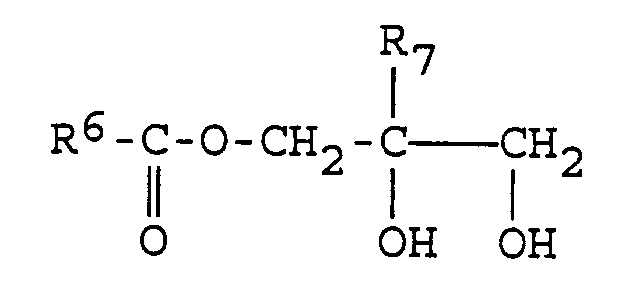
wobei:
R⁶ einen C₃-C₃₀-Hydrocarbylrest bedeutet; und
R⁷ H oder CH₂OH bedeutet. - Produkt nach einem der vorstehenden Ansprüche, wobei der aliphatische Hydroxyester Glycerinmonooleat umfaßt.
- Schmiermittelzusammensetzung, deren Hauptanteil ein Schmieröl oder Schmierfett daraus und eine oxidationshemmende Menge des Produkts nach einem dar vorstehenden Ansprüche ist.
- Zusammensetzung nach Anspruch 6, wobei das Schmieröl unter Mineralöl und synthetischem Öl ausgewählt ist.
- Zusammensetzung nach Anspruch 6 oder 7, deren Hauptanteil ein Scnmierfett mit einem Gehalt an einem Hydroxycarboxylatseifen-Verdickungsmittel ist.
- Verwendung eines Produkts nach einem der Ansprüche 1 bis 5 zur Hemmung der Oxidation bei Zusatz zu einer Schmiermittelzusammensetzung.
- Verwendung eines Produkts nach einem der Ansprüche 1 bis 5 zur Verstärkung der Reibungsverringerung bei Zusatz zu einer Schmiermittelzusammensetzung.
Priority Applications (1)
| Application Number | Priority Date | Filing Date | Title |
|---|---|---|---|
| AT89906289T ATE126804T1 (de) | 1989-05-01 | 1989-05-01 | Als antioxidations-schmiermittelzusatz verwendbare dihydroxyaryl-hydroxyaliphatische borate und diese enthaltende schmiermittel. |
Applications Claiming Priority (1)
| Application Number | Priority Date | Filing Date | Title |
|---|---|---|---|
| PCT/US1989/001849 WO1990013551A1 (en) | 1989-05-01 | 1989-05-01 | Dihydroxyaryl-hydroxyaliphatic borates useful as lubricant antioxidants and lubricants containing same |
Publications (2)
| Publication Number | Publication Date |
|---|---|
| EP0423148A1 EP0423148A1 (de) | 1991-04-24 |
| EP0423148B1 true EP0423148B1 (de) | 1995-08-23 |
Family
ID=22214974
Family Applications (1)
| Application Number | Title | Priority Date | Filing Date |
|---|---|---|---|
| EP89906289A Expired - Lifetime EP0423148B1 (de) | 1989-05-01 | 1989-05-01 | Als antioxidations-schmiermittelzusatz verwendbare dihydroxyaryl-hydroxyaliphatische borate und diese enthaltende schmiermittel |
Country Status (3)
| Country | Link |
|---|---|
| EP (1) | EP0423148B1 (de) |
| DE (1) | DE68923968T2 (de) |
| WO (1) | WO1990013551A1 (de) |
Families Citing this family (2)
| Publication number | Priority date | Publication date | Assignee | Title |
|---|---|---|---|---|
| US4985157A (en) * | 1989-05-01 | 1991-01-15 | Mobil Oil Corporation | Mixed alkoxylated alcohol-hydroquinone/resorcinol borates-antioxidants |
| US5252237A (en) * | 1992-08-03 | 1993-10-12 | Mobil Oil Corporation | Complex alkoxy borates of alkylated phenols as lubricant stabilizers |
Family Cites Families (4)
| Publication number | Priority date | Publication date | Assignee | Title |
|---|---|---|---|---|
| US2975134A (en) * | 1956-02-24 | 1961-03-14 | Union Oil Co | Antiwear lubricants containing boron esters |
| US3267177A (en) * | 1963-11-26 | 1966-08-16 | American Cyanamid Co | Boric acid esters of phenols as inhibitors for unsaturated polyester resins |
| US3445498A (en) * | 1965-05-25 | 1969-05-20 | Universal Oil Prod Co | Boric acid esters |
| US3523014A (en) * | 1967-11-13 | 1970-08-04 | Standard Oil Co | Borated monoalkyl dihydroxybenzenes |
-
1989
- 1989-05-01 DE DE68923968T patent/DE68923968T2/de not_active Expired - Fee Related
- 1989-05-01 EP EP89906289A patent/EP0423148B1/de not_active Expired - Lifetime
- 1989-05-01 WO PCT/US1989/001849 patent/WO1990013551A1/en not_active Ceased
Also Published As
| Publication number | Publication date |
|---|---|
| WO1990013551A1 (en) | 1990-11-15 |
| DE68923968T2 (de) | 1996-01-11 |
| EP0423148A1 (de) | 1991-04-24 |
| DE68923968D1 (de) | 1995-09-28 |
Similar Documents
| Publication | Publication Date | Title |
|---|---|---|
| US4410438A (en) | Borated epoxides and lubricants containing same | |
| US4522734A (en) | Borated friction reducing additives and compositions thereof | |
| US4787996A (en) | Mannich base oil additives | |
| US4834893A (en) | Substituted phosphorodithioates and their metal salts as multifunctional additives | |
| JPS6187793A (ja) | グリ−ス組成物 | |
| US4519928A (en) | Lubricant compositions containing N-tertiary alkyl benzotriazoles | |
| CA1220212A (en) | Multifunctional additives | |
| US4162224A (en) | Solubilized borates of bis-oxazoline and lubricant compositions containing the same | |
| EP0287273A2 (de) | Sulfurierte Verschleissschutzzusätze und diese enthaltende Zusammensetzungen | |
| EP0191967A2 (de) | Reaktionsprodukte von Alkenylsuccinverbindungen mit aromatischen Aminen und diese enthaltende Schmiermittelzusammensetzungen | |
| US4985157A (en) | Mixed alkoxylated alcohol-hydroquinone/resorcinol borates-antioxidants | |
| US5037567A (en) | Phosphorus-sulfur olefinic derivatives as multifunctional lubricants and multifunctional additives for lubricants | |
| EP0308264B1 (de) | Schmieröl-Zusätze enthaltend Borat-Abkömmlinge gemischter Nichtaryldiolphosphorodithioate | |
| EP0420453B1 (de) | Schwefelgekoppelte alkylabgeleitete Merkaptobenzothiazol-Addukte als multifunktionelle verschleissschützende Zusätze und diese enthaltende Zusammensetzungen | |
| US5370806A (en) | Borated dihydrocarbyl dithiocarbamate lubricant additives and composition thereof | |
| US4828740A (en) | Mixed hydroquinone-hydroxyester borates as antioxidants | |
| US4599183A (en) | Multifunctional additives | |
| EP0471120B1 (de) | Schmiermittelzusammensetzungen, die Phenol/Phosphorodithioatborate als Mehrzweckzusätze enthalten | |
| US5019284A (en) | Multifunctional lubricant additives and compositions thereof | |
| US5006270A (en) | Mixed resorcinol-hydroxyester borates as antioxidants | |
| WO1990013551A1 (en) | Dihydroxyaryl-hydroxyaliphatic borates useful as lubricant antioxidants and lubricants containing same | |
| US5254276A (en) | Diol phosphite adducts of olefins as multifunctional lubricants and additives for lubricants | |
| US4162225A (en) | Lubricant compositions of enhanced antioxidant properties | |
| US5399276A (en) | Lubricant composition containing the reaction product of an olefinic compound and an alkoxylated-amine-phosphite | |
| US4400283A (en) | Multifunctional lubricant additives and compositions thereof |
Legal Events
| Date | Code | Title | Description |
|---|---|---|---|
| PUAI | Public reference made under article 153(3) epc to a published international application that has entered the european phase |
Free format text: ORIGINAL CODE: 0009012 |
|
| 17P | Request for examination filed |
Effective date: 19901210 |
|
| AK | Designated contracting states |
Kind code of ref document: A1 Designated state(s): AT BE CH DE FR GB IT LI LU NL SE |
|
| 17Q | First examination report despatched |
Effective date: 19920827 |
|
| GRAA | (expected) grant |
Free format text: ORIGINAL CODE: 0009210 |
|
| AK | Designated contracting states |
Kind code of ref document: B1 Designated state(s): AT BE CH DE FR GB IT LI LU NL SE |
|
| REF | Corresponds to: |
Ref document number: 126804 Country of ref document: AT Date of ref document: 19950915 Kind code of ref document: T |
|
| REF | Corresponds to: |
Ref document number: 68923968 Country of ref document: DE Date of ref document: 19950928 |
|
| ET | Fr: translation filed | ||
| ITF | It: translation for a ep patent filed | ||
| PG25 | Lapsed in a contracting state [announced via postgrant information from national office to epo] |
Ref country code: GB Effective date: 19960501 Ref country code: AT Effective date: 19960501 |
|
| PG25 | Lapsed in a contracting state [announced via postgrant information from national office to epo] |
Ref country code: SE Effective date: 19960502 |
|
| PG25 | Lapsed in a contracting state [announced via postgrant information from national office to epo] |
Ref country code: LU Free format text: LAPSE BECAUSE OF NON-PAYMENT OF DUE FEES Effective date: 19960531 Ref country code: LI Effective date: 19960531 Ref country code: CH Effective date: 19960531 Ref country code: BE Effective date: 19960531 |
|
| PLBE | No opposition filed within time limit |
Free format text: ORIGINAL CODE: 0009261 |
|
| STAA | Information on the status of an ep patent application or granted ep patent |
Free format text: STATUS: NO OPPOSITION FILED WITHIN TIME LIMIT |
|
| 26N | No opposition filed | ||
| BERE | Be: lapsed |
Owner name: MOBIL OIL CORP. Effective date: 19960531 |
|
| PG25 | Lapsed in a contracting state [announced via postgrant information from national office to epo] |
Ref country code: NL Effective date: 19961201 |
|
| GBPC | Gb: european patent ceased through non-payment of renewal fee |
Effective date: 19960501 |
|
| REG | Reference to a national code |
Ref country code: CH Ref legal event code: PL |
|
| PG25 | Lapsed in a contracting state [announced via postgrant information from national office to epo] |
Ref country code: FR Effective date: 19970131 |
|
| PG25 | Lapsed in a contracting state [announced via postgrant information from national office to epo] |
Ref country code: DE Effective date: 19970201 |
|
| EUG | Se: european patent has lapsed |
Ref document number: 89906289.7 |
|
| NLV4 | Nl: lapsed or anulled due to non-payment of the annual fee |
Effective date: 19961201 |
|
| REG | Reference to a national code |
Ref country code: FR Ref legal event code: ST |
|
| PG25 | Lapsed in a contracting state [announced via postgrant information from national office to epo] |
Ref country code: IT Free format text: LAPSE BECAUSE OF NON-PAYMENT OF DUE FEES Effective date: 20050501 |