EP0423672A2 - Verarbeitungsgerät für optische Karten - Google Patents
Verarbeitungsgerät für optische Karten Download PDFInfo
- Publication number
- EP0423672A2 EP0423672A2 EP90119697A EP90119697A EP0423672A2 EP 0423672 A2 EP0423672 A2 EP 0423672A2 EP 90119697 A EP90119697 A EP 90119697A EP 90119697 A EP90119697 A EP 90119697A EP 0423672 A2 EP0423672 A2 EP 0423672A2
- Authority
- EP
- European Patent Office
- Prior art keywords
- optical card
- optical
- card
- error signal
- objective
- Prior art date
- Legal status (The legal status is an assumption and is not a legal conclusion. Google has not performed a legal analysis and makes no representation as to the accuracy of the status listed.)
- Granted
Links
Images



Classifications
-
- G—PHYSICS
- G11—INFORMATION STORAGE
- G11B—INFORMATION STORAGE BASED ON RELATIVE MOVEMENT BETWEEN RECORD CARRIER AND TRANSDUCER
- G11B7/00—Recording or reproducing by optical means, e.g. recording using a thermal beam of optical radiation by modifying optical properties or the physical structure, reproducing using an optical beam at lower power by sensing optical properties; Record carriers therefor
- G11B7/002—Recording, reproducing or erasing systems characterised by the shape or form of the carrier
- G11B7/0033—Recording, reproducing or erasing systems characterised by the shape or form of the carrier with cards or other card-like flat carriers, e.g. flat sheets of optical film
-
- G—PHYSICS
- G06—COMPUTING OR CALCULATING; COUNTING
- G06K—GRAPHICAL DATA READING; PRESENTATION OF DATA; RECORD CARRIERS; HANDLING RECORD CARRIERS
- G06K7/00—Methods or arrangements for sensing record carriers, e.g. for reading patterns
- G06K7/10—Methods or arrangements for sensing record carriers, e.g. for reading patterns by electromagnetic radiation, e.g. optical sensing; by corpuscular radiation
- G06K7/10544—Methods or arrangements for sensing record carriers, e.g. for reading patterns by electromagnetic radiation, e.g. optical sensing; by corpuscular radiation by scanning of the records by radiation in the optical part of the electromagnetic spectrum
- G06K7/10792—Special measures in relation to the object to be scanned
- G06K7/10801—Multidistance reading
- G06K7/10811—Focalisation
Definitions
- the present invention relates to an optical card processing apparatus for handling a card-shaped information recording medium on which information can be optically recorded (to be referred to as an optical card herebelow) so as to record information thereon and/or to reproduce (read) information written thereon, and in particular, to an optical card processing apparatus having a function to judge a setting state or a disposition state of an optical card therein for a determination of a normal state or an abnormal state.
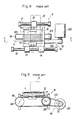
- the conventional optical card processing apparatus of this kind comprises, as shown in Figs. 4 and 5, a shuttle 2 for supporting an optical card 1 inserted thereonto from a card insertion slit (not shown), an optical head 3 for irradiating a converged light onto the optical card 1 to record information thereon and/or to reproduce information recorded thereon (the intensity of the irradiated light varies between the recording and reproducing operations), and a carrier or transporting mechanism 4 to reciprocating the shuttle 2.
- the optical card 1 includes, as showin in a partially magnified diagram of Fig. 6a, an information recording section 6 (a hatched portion) having a surface on which a lot of information recording tracks 5 are disposed.
- the optical head 3 irradiates the converged lights onto these information recording tracks 5 for the information recording and reproducing operations.
- a reference numeral 7 indicates a track guide to be used by the optical head 3 for tracing the information recording tracks 5 and a numeral 8 denotes pits constituting a unit of information written on the tracks 5.
- the track guide 7 and the pits 8 are associated with a light reflection factor relatively lower than one developed in other portions than the track guide 7 and pits.
- Fig. 6b shows a rear surface of the optical card 1.
- blank regions 9 may be adopted by the user to present a logotype or logo mark in conformity with the user's specification.
- the shuttle 2 includes a depression 10 disposed on an upper surface thereof and clamp mechanisms 11 and 12.
- the optical card 1 is arranged in the shuttle 2 along a direction in which the card is fed so as to be fixed by means of the clamp mechanisms 11 and 12.
- the transporting mechanism 4 includes guide shafts 16 and 17 for guiding and for supporting the shuttle 2 via bearings 13 to 15 disposed on the shuttle 2 to allow a reciprocating movement of the shuttle 2 and a driver unit 19 for reciprocating the shuttle 2 by means of a transporting belt 18.
- the driver unit 19 transfers power from a motor 20 via a pulley 21 on a driving side and a power transfer belt 22 to a driving pulley 23.
- the transporting belt 18 is reeved between the driving pulley 23 and a pulley 24 subordinate thereto so as to be linked with the shuttle 2.
- the shuttle 2 When the belt 18 starts running, the shuttle 2 is set to a reciprocating movement.
- the motor 20 drives the transporting belt 18 in a running state to move the shuttle 2.
- the optical head 3 is activated to emit a converged light onto the information recording section 6 of the optical card 1 for an information recording or reproducing operation.
- the information recording and reproducing operations on the optical card 1 is accomplished on assumption that the card 1 is appropriately set onto the shuttle 2. Particularly, it is necessary that the optical card 1 is arranged correctly with respect to the front or rear side and to a forward or reverse direction of the card 1.
- the difference between the light reflection factors respectively of the recording section 6 and the blank region 9 becomes to be quite small. In this situation, there rarely appears the difference between the magnitudes of the reproduced signals associated with the section 6 and the region 9.
- the blank region 9 having white as its base color develops a reflection factor of at least 30%.
- a reflection factor of about 40% ⁇ 5% on the information recording section 6 having a recording layer which is produced by diffusing particles of silber in a surface of the information recording section 6 through an exposure and thermal treatment by use of a halogenated silber emulsion containing fine particles of silber.
- an optical card processing apparatus in which a light converged by use of an objective is irradiated onto an optical card installed in a predetermined position for recording information onto the card or for reproducing information recorded thereon inciudes lens transport means for forcibly moving the objective, in a state where a focusing servo is operating, in a direction orthogonal to a direction of information recording tracks of the optical card and judge means for detecting, in the forcible movement of the objective, presence or absence of a tracking error signal to judge the setting state of the optical card.
- the converged light is irradiated onto the information recording section. Consequently, when the objective is forcibly moved in a direction orthogonal to the information recording tracks, the converged light traverses the information recording tracks, thereby detecting a tracking error signal.
- the optical card when the optical card is set to the apparatus in an inappropriate manner with respect to the front/rear side thereof or to the forward/reverse direction thereof, namely, when the card is set with a wrong side facing upward, for example, the converged light is not irradiated onto the information recording section.
- the objective is forcibly moved in a direction orthogonal to the direction of the information recording tracks, the converged light thus emitted does not intersect the information recording tracks and hence the system cannot detect any tracking error signals.
- the setting state of the optical card can be easily determined with a high reliability.
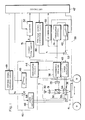
- FIG. 1 shows an overall structure of an optical card processing apparatus in an embodiment according to the present invention.
- This constitution includes an optical card 1, a shuttle 2 for keeping the optical card 1, an optical head 3 disposed at a position over the shuttle 2, and a transporting mechanism 4 arranged at a position below the shuttle 2.
- the mechanism shown in Figs. 4 and 5 can be directly applied also to this card processing apparatus.
- the optical head 3 comprises a light source 30 including a laser diode, which emits a light beam to be collimated through a collimation lens 31 such that the resuitant light is passed through a polarization beam splitter 32 so as to attain a p-polarized light.
- the light is fed through a quarter-wave plate 33 to be focused via an objective 34 onto the optical card 1.
- the light reflected from the optical card 1 returns through the light path in a reverse direction to pass the objective 34 and the quarter-wave plate 33.
- the p-polarized light is thus converted into an s-polarized light, which is hence reflected on the polarization beam splitter 32 so as to be received by a light receiver 35.
- the objective 34 is arranged in such a manner that when a focusing coil 36 and a tracking coil 37 are powered, the objective 34 is respectively displaced to be orthogonal and parallel to a surface of the optical card 1. That is, the focusing coil 36 sets the objective 34 to a focusing direction orthogonal to the card surface, whereas the tracking coil 37 moves the objective 34 to a posture parallel to the card surface, namely, orthogonal to the information recording tracks 5 of the information recording section 6.
- the light receiver 35 includes a pair of photodiodes (not shown), which are arranged at positions forming a symmetric pattern to be adjacent to each other.
- the reflection light from the optical card 1 is focused onto a location in the proximity of a boundary between the photodiodes.
- the photodiodes feed respective outputs to associated inputs of a differential amplifier 38, which obtains a difference between the two outputs so as to deliver a focusing error signal i and a tracking error signal j to a focusing servo loop 39 and a tacking servo loop 40, respectively.
- the focusing servo loop 39 is a control loop for achieving a focusing servo operation in which the signal path is established through the differential amplifier 38, a compensation circuit 41, a switching circuit 42, an adder 53, a power ampiifier 43, and the focusing coil 36.
- the compensation circuit 41 determines, based on the focusing error signal i , a correction voltage (or current) associated with the upward/downward movement of the objective 34. Thereafter, the power ampiifier 43 amplifies the power to be supplied to the focusing coil 36.
- the tracking servo loop 40 is a control loop for accomplishing a tracking servo operation and includes a signal route constituted with the differential amplifier 38, a compensation circuit 44, a switching circuit 45, an adder 54, a power amplifier 46, and the tracking coil 37.
- the compensation circuit 44 decides, depending on the tracking error signal j , a correction voltage (or current) related to the parallel movement of the objective 34 such that the power amplifier 46 then amplifies the power to be supplied to the tracking coil 37.
- the power amplifiers 43 and 46 are respectively connected via the adders 53 and 54 to forcible signal generator circuits 48 and 49, which operate under supervision of the controller 47.
- the forcible signal generator 48 delivers a forced movement signal k1 to the focusing coil 36 to forcibly move the objective 34 toward the focusing direction.
- the forcible signal generator 49 supplies a forced movement signal k2 to the tracking coil 37 to forcibly move the objective 34 in a direction orthogonal to the information recording tracks 5.
- Fig. 2 shows operation timings of the forced movement signal k1 to be fed to the focusing coil 36 and the focusing error signal i to be delivered thereto during the forced movemtent.
- a circuit including an analog-to-digital (A/D) converter 50 is disposed to sense the focusing error signal i during the forced movement.
- the A/D converter 50 converts the focusing error signal i into a digital signal.
- the controller 47 judges to determine an occurrence of the focusing error signal i and a condition where the signal level of the digital signal exceeds a discrimination level A (shown in Fig. 2).
- Fig. 2 further shows the forced movement signal k2 to be fed to the tracking coil 37 and the tracking error signal j to be developed in the forced movement.
- a circuit including the signal sense circuit 51 and a counter 52 is disposed to determine whether or not the tracking error signal j has been produced in the forced movement.
- the signal sense circuit 51 discriminates the value of the tracking error signal j with use of a threshold value TH for a binarization of the signal, thereby producing a pulse signal p .
- the number of pulse signals p is counted during a period of time from a point of time t1 when the forced movement signal k2 is generated to a point of time t2 when the signal k2 is stopped.
- the controller 47 compares the obtained count value with a reference value to determine the presence or absence of the tracking error signal j .
- Fig. 3 shows a control procedure employed by the controller 47 to judge the setting or installation state of the optical card 1 on the shuttle 2.
- a step 1 moves the optical head 3 by means of the head transporting mechanism to an initial position thereof.
- the information recording section 6 is disposed in a portion of the front surface of the optical card 1, the portion being shifted from the center portion toward a side thereof as shown in Fig. 6a.
- an end position of the side associated with the information recording section 6 is selected as the initial position a as shown in Fig. 4.
- the controller 47 initiates the forcible signal generator 48 to produce a forced movement signal k1 so as to energize the focusing coil 30, thereby forcibly moving the objective 34 to the focusing direction.
- a focusing error signal i created in the forced movement is converted through the A/D converter 50 into a digital signal to be fed to the controller 47. In this operation, the switching circuit 42 is kept retained in the off state.
- a step 3 determines whether or not the magnitude of the forced movement signal k1 reaches a predetermined limit level S.
- a step 4 then judges to decide whether or not a focusing error signal i has been sensed.
- step 6 In a case where the focusing error signal i is not sensed even when the objective 34 is moved in the overall movable range thereof with the forced movement signal k1 increased to the limit level S, the system assumes that the optical card 1 is missing in the shuttle 2. Control is then passed from the step 3 to a step 5, which then turns the forced movement signal k1 off and outputs a message "Card not inserted" (step 6).
- step 7 the controller 47 determines whether or not the signai level of the focusing error signal i has reached the judge level A.
- the apparatus If the signal level does not exceed the judge level A, the check of the step 7 results in "No". Consequently, the apparatus assumes that the converged light is irradiated onto the blank region 9 having a reflection factor less than a reflection factor of the information recording section 6, namely, the optical card 1 is installed on the shuttle 2 upside down or with a wrong orientation with resepct to the insertion direction thereof. As a result, the system turns the forced movement signal k1 off and then outputs a message "Card installation abnormality" (steps 8 and 9).
- Step 7 judges that the signal level has exceeded the judge level A, the controller 47 issues a focusing servo instruction to hold the current signal level of the forced movement signal k1 and then turns the switching circuit 42 associated with the focusing servo loop 39 on.
- Steps 10 and 11 are the operation procedure in which the focusing servo is started.
- the controller 47 causes the forcible signal generating circuit 49 to produce the forced movement signal k2 for a predetermined period of time.
- the tracking coil 37 is hence powered to forcibly move the objective 34 in a direction orthogonal to the information recording tracks 5 of the optical card 1 (setp 12).
- a tracking error signal j generated in the forced movement is compared with a threshold value TH in the signal sense circuit 51 for a binarization thereof.
- the resultant pulse signal p is counted by the counter 52 during a period of time from the point of time t1 when the forced movement signal k2 is generated to the point of time t2 when the signal k2 is stopped (step 13).
- the switch 45 is kept remained in the off state.
- the counted value is received by the controller 47, which in turn compares the count value with a reference value. If the count value is equal to or more than the reference value, an occurrence of the tracking error signal j is assumed and hence a message "Normal” is produced (step 15). If the count value is less than the reference value, it is assumed that the optical card 1 has been installed on the shuttle 2 upside down or with an inappropriate orientation in the insertion direction thereof. Consequently, the forced movement signai k2 is stopped and a message "Card installation abnormality" is outputted (step 9).
- the controller 47 turns the switching circuit 45 of the tracking servo loop 40 on to activate the tracking servo into the operating state. Thereafter, control is passed to an operation to record information on the opticai card 1 or to reproduce information recorded on the opticai card 1 in advance.
Landscapes
- Physics & Mathematics (AREA)
- Engineering & Computer Science (AREA)
- Electromagnetism (AREA)
- General Physics & Mathematics (AREA)
- Toxicology (AREA)
- General Health & Medical Sciences (AREA)
- Artificial Intelligence (AREA)
- Computer Vision & Pattern Recognition (AREA)
- Health & Medical Sciences (AREA)
- Theoretical Computer Science (AREA)
- Holo Graphy (AREA)
- Optical Recording Or Reproduction (AREA)
- Prostheses (AREA)
- Multi-Process Working Machines And Systems (AREA)
- Control Of Vending Devices And Auxiliary Devices For Vending Devices (AREA)
- Moving Of The Head For Recording And Reproducing By Optical Means (AREA)
Applications Claiming Priority (2)
| Application Number | Priority Date | Filing Date | Title |
|---|---|---|---|
| JP267042/89 | 1989-10-14 | ||
| JP1267042A JPH03130932A (ja) | 1989-10-14 | 1989-10-14 | 光カード処理装置 |
Publications (3)
| Publication Number | Publication Date |
|---|---|
| EP0423672A2 true EP0423672A2 (de) | 1991-04-24 |
| EP0423672A3 EP0423672A3 (en) | 1991-06-05 |
| EP0423672B1 EP0423672B1 (de) | 1996-02-28 |
Family
ID=17439236
Family Applications (1)
| Application Number | Title | Priority Date | Filing Date |
|---|---|---|---|
| EP90119697A Expired - Lifetime EP0423672B1 (de) | 1989-10-14 | 1990-10-15 | Verarbeitungsgerät für optische Karten |
Country Status (4)
| Country | Link |
|---|---|
| EP (1) | EP0423672B1 (de) |
| JP (1) | JPH03130932A (de) |
| AT (1) | ATE134787T1 (de) |
| DE (1) | DE69025534T2 (de) |
Families Citing this family (1)
| Publication number | Priority date | Publication date | Assignee | Title |
|---|---|---|---|---|
| WO2008053513A1 (fr) * | 2006-10-30 | 2008-05-08 | Renesas Technology Corp. | Dispositif de commande de disque et dispositif à semi-conducteur |
Family Cites Families (5)
| Publication number | Priority date | Publication date | Assignee | Title |
|---|---|---|---|---|
| WO1983004329A1 (fr) * | 1982-06-04 | 1983-12-08 | Sony Corporation | Reproducteur de disque optique |
| JPH0664632B2 (ja) * | 1985-09-06 | 1994-08-22 | キヤノン株式会社 | 情報記録再生装置 |
| US4700056A (en) * | 1985-11-13 | 1987-10-13 | Optotech, Inc. | Objective lens focus initialization system |
| DE3852350T2 (de) * | 1987-07-22 | 1995-07-27 | Omron Tateisi Electronics Co | Gerät zur Feststellung der Neigung einer optischen Karte. |
| JPH02281432A (ja) * | 1989-04-21 | 1990-11-19 | Matsushita Electric Ind Co Ltd | 光学的情報再生装置の光ディスク検出装置 |
-
1989
- 1989-10-14 JP JP1267042A patent/JPH03130932A/ja active Pending
-
1990
- 1990-10-15 AT AT90119697T patent/ATE134787T1/de active
- 1990-10-15 EP EP90119697A patent/EP0423672B1/de not_active Expired - Lifetime
- 1990-10-15 DE DE69025534T patent/DE69025534T2/de not_active Expired - Fee Related
Also Published As
| Publication number | Publication date |
|---|---|
| ATE134787T1 (de) | 1996-03-15 |
| EP0423672A3 (en) | 1991-06-05 |
| DE69025534D1 (de) | 1996-04-04 |
| DE69025534T2 (de) | 1996-10-31 |
| JPH03130932A (ja) | 1991-06-04 |
| EP0423672B1 (de) | 1996-02-28 |
Similar Documents
| Publication | Publication Date | Title |
|---|---|---|
| EP0713217B1 (de) | Wiedergabe von optischen Platten | |
| JPH0468691B2 (de) | ||
| US4683560A (en) | Microprocessor controlled focussing servo acquisition | |
| US4872154A (en) | Method for recording indicia for indicating presence or absence of error in medium after error checking and apparatus therefor | |
| US7515524B2 (en) | High density disk recording medium and apparatus using the same | |
| EP0910073A3 (de) | Gerät zum abspielen von optischen Platten mit Mitteln gegen Kollision versehen , sowie Steurungsverfahren für dieses Gerät | |
| JPH0664632B2 (ja) | 情報記録再生装置 | |
| US5189290A (en) | Optical card processing apparatus using tracking error signals to determine proper card orientation | |
| EP0423672B1 (de) | Verarbeitungsgerät für optische Karten | |
| US7145854B2 (en) | Recording layer determination apparatus for determining whether recording layer of recording medium is single-layer or multi-layer | |
| EP0318897A2 (de) | Gerät zum Fokussieren eines Lichtstrahls auf einem Informationsspeichermedium | |
| US5119356A (en) | Information recording and reproducing apparatus including detection of whether an information recording medium has been normally loaded into the apparatus | |
| US4888753A (en) | Information recording medium capable of accurately detecting the recording and reproduction starting positions and an information recording-reproducing method and apparatus therefor | |
| JPH01251327A (ja) | 光ディスク自動焦点サーボ系起動方法ならびにこれを用いた光ディスク装置 | |
| US5287339A (en) | Optical information processing apparatus for holding a lens at a predetermined position along a tracking path at pulling-in of focusing control | |
| US6215741B1 (en) | Optical recording device having a defect detection system | |
| EP0456014B1 (de) | Optisches Aufnahme-/Wiedergabegerät | |
| EP0326343A2 (de) | Optisches Informationsaufzeichnungsgerät | |
| JP2503971B2 (ja) | 光カ―ドの記録再生装置 | |
| JP2995096B2 (ja) | 光カード装置 | |
| JPH0432030A (ja) | 光カード記録再生装置 | |
| JPH08329510A (ja) | 光学的情報記録再生装置 | |
| JPH05258092A (ja) | 光カード処理装置および光カード装着状態判別方法 | |
| JP2001319352A (ja) | 情報記録再生装置と情報記録再生方法 | |
| JPH04105222A (ja) | 対物レンズ駆動装置 |
Legal Events
| Date | Code | Title | Description |
|---|---|---|---|
| PUAI | Public reference made under article 153(3) epc to a published international application that has entered the european phase |
Free format text: ORIGINAL CODE: 0009012 |
|
| PUAL | Search report despatched |
Free format text: ORIGINAL CODE: 0009013 |
|
| 17P | Request for examination filed |
Effective date: 19901112 |
|
| AK | Designated contracting states |
Kind code of ref document: A2 Designated state(s): AT BE CH DE DK ES FR GB GR IT LI NL SE |
|
| AK | Designated contracting states |
Kind code of ref document: A3 Designated state(s): AT BE CH DE DK ES FR GB GR IT LI NL SE |
|
| 17Q | First examination report despatched |
Effective date: 19940725 |
|
| GRAH | Despatch of communication of intention to grant a patent |
Free format text: ORIGINAL CODE: EPIDOS IGRA |
|
| GRAA | (expected) grant |
Free format text: ORIGINAL CODE: 0009210 |
|
| AK | Designated contracting states |
Kind code of ref document: B1 Designated state(s): AT BE CH DE DK ES FR GB GR IT LI NL SE |
|
| PG25 | Lapsed in a contracting state [announced via postgrant information from national office to epo] |
Ref country code: NL Free format text: LAPSE BECAUSE OF FAILURE TO SUBMIT A TRANSLATION OF THE DESCRIPTION OR TO PAY THE FEE WITHIN THE PRESCRIBED TIME-LIMIT Effective date: 19960228 Ref country code: LI Effective date: 19960228 Ref country code: GR Free format text: LAPSE BECAUSE OF FAILURE TO SUBMIT A TRANSLATION OF THE DESCRIPTION OR TO PAY THE FEE WITHIN THE PRESCRIBED TIME-LIMIT Effective date: 19960228 Ref country code: ES Free format text: THE PATENT HAS BEEN ANNULLED BY A DECISION OF A NATIONAL AUTHORITY Effective date: 19960228 Ref country code: DK Effective date: 19960228 Ref country code: CH Effective date: 19960228 Ref country code: BE Effective date: 19960228 Ref country code: AT Effective date: 19960228 |
|
| REF | Corresponds to: |
Ref document number: 134787 Country of ref document: AT Date of ref document: 19960315 Kind code of ref document: T |
|
| ITF | It: translation for a ep patent filed | ||
| REF | Corresponds to: |
Ref document number: 69025534 Country of ref document: DE Date of ref document: 19960404 |
|
| ET | Fr: translation filed | ||
| PG25 | Lapsed in a contracting state [announced via postgrant information from national office to epo] |
Ref country code: SE Effective date: 19960531 |
|
| NLV1 | Nl: lapsed or annulled due to failure to fulfill the requirements of art. 29p and 29m of the patents act | ||
| REG | Reference to a national code |
Ref country code: CH Ref legal event code: PL |
|
| PGFP | Annual fee paid to national office [announced via postgrant information from national office to epo] |
Ref country code: GB Payment date: 19960919 Year of fee payment: 7 |
|
| PGFP | Annual fee paid to national office [announced via postgrant information from national office to epo] |
Ref country code: FR Payment date: 19961024 Year of fee payment: 7 |
|
| PLBE | No opposition filed within time limit |
Free format text: ORIGINAL CODE: 0009261 |
|
| STAA | Information on the status of an ep patent application or granted ep patent |
Free format text: STATUS: NO OPPOSITION FILED WITHIN TIME LIMIT |
|
| 26N | No opposition filed | ||
| PG25 | Lapsed in a contracting state [announced via postgrant information from national office to epo] |
Ref country code: GB Free format text: LAPSE BECAUSE OF NON-PAYMENT OF DUE FEES Effective date: 19971015 |
|
| PG25 | Lapsed in a contracting state [announced via postgrant information from national office to epo] |
Ref country code: FR Free format text: THE PATENT HAS BEEN ANNULLED BY A DECISION OF A NATIONAL AUTHORITY Effective date: 19971031 |
|
| GBPC | Gb: european patent ceased through non-payment of renewal fee |
Effective date: 19971015 |
|
| REG | Reference to a national code |
Ref country code: FR Ref legal event code: ST |
|
| PG25 | Lapsed in a contracting state [announced via postgrant information from national office to epo] |
Ref country code: IT Free format text: LAPSE BECAUSE OF NON-PAYMENT OF DUE FEES;WARNING: LAPSES OF ITALIAN PATENTS WITH EFFECTIVE DATE BEFORE 2007 MAY HAVE OCCURRED AT ANY TIME BEFORE 2007. THE CORRECT EFFECTIVE DATE MAY BE DIFFERENT FROM THE ONE RECORDED. Effective date: 20051015 |
|
| PGFP | Annual fee paid to national office [announced via postgrant information from national office to epo] |
Ref country code: DE Payment date: 20061031 Year of fee payment: 17 |
|
| PG25 | Lapsed in a contracting state [announced via postgrant information from national office to epo] |
Ref country code: DE Free format text: LAPSE BECAUSE OF NON-PAYMENT OF DUE FEES Effective date: 20080501 |