EP0424121B1 - Einrichtung zur Sprachkodierung - Google Patents
Einrichtung zur Sprachkodierung Download PDFInfo
- Publication number
- EP0424121B1 EP0424121B1 EP90311396A EP90311396A EP0424121B1 EP 0424121 B1 EP0424121 B1 EP 0424121B1 EP 90311396 A EP90311396 A EP 90311396A EP 90311396 A EP90311396 A EP 90311396A EP 0424121 B1 EP0424121 B1 EP 0424121B1
- Authority
- EP
- European Patent Office
- Prior art keywords
- vector
- speech
- excitation signal
- code
- coding system
- Prior art date
- Legal status (The legal status is an assumption and is not a legal conclusion. Google has not performed a legal analysis and makes no representation as to the accuracy of the status listed.)
- Expired - Lifetime
Links
- 239000013598 vector Substances 0.000 claims description 239
- 230000015572 biosynthetic process Effects 0.000 claims description 50
- 238000000034 method Methods 0.000 claims description 46
- 238000003786 synthesis reaction Methods 0.000 claims description 44
- 239000011159 matrix material Substances 0.000 claims description 37
- 238000004364 calculation method Methods 0.000 claims description 5
- 238000001914 filtration Methods 0.000 claims description 5
- 238000013139 quantization Methods 0.000 claims description 5
- 239000000284 extract Substances 0.000 claims description 3
- 230000007774 longterm Effects 0.000 claims description 2
- 230000005284 excitation Effects 0.000 claims 23
- 230000008878 coupling Effects 0.000 claims 5
- 238000010168 coupling process Methods 0.000 claims 5
- 238000005859 coupling reaction Methods 0.000 claims 5
- 230000001934 delay Effects 0.000 claims 1
- 238000001514 detection method Methods 0.000 description 11
- 230000015654 memory Effects 0.000 description 10
- 238000010586 diagram Methods 0.000 description 9
- 230000002194 synthesizing effect Effects 0.000 description 9
- 230000006870 function Effects 0.000 description 8
- 230000004044 response Effects 0.000 description 6
- 238000005070 sampling Methods 0.000 description 4
- 238000012546 transfer Methods 0.000 description 4
- 230000000052 comparative effect Effects 0.000 description 2
- 238000007796 conventional method Methods 0.000 description 2
- 230000003247 decreasing effect Effects 0.000 description 2
- 210000005069 ears Anatomy 0.000 description 2
- 238000004519 manufacturing process Methods 0.000 description 2
- 238000012986 modification Methods 0.000 description 2
- 230000004048 modification Effects 0.000 description 2
- 238000012545 processing Methods 0.000 description 2
- 238000001228 spectrum Methods 0.000 description 2
- 230000002411 adverse Effects 0.000 description 1
- 230000005540 biological transmission Effects 0.000 description 1
- 230000006835 compression Effects 0.000 description 1
- 238000007906 compression Methods 0.000 description 1
- 230000001419 dependent effect Effects 0.000 description 1
- 230000003467 diminishing effect Effects 0.000 description 1
- 238000005516 engineering process Methods 0.000 description 1
- 230000003287 optical effect Effects 0.000 description 1
- 230000009290 primary effect Effects 0.000 description 1
- 230000009291 secondary effect Effects 0.000 description 1
- 230000017105 transposition Effects 0.000 description 1
Images






Classifications
-
- G—PHYSICS
- G10—MUSICAL INSTRUMENTS; ACOUSTICS
- G10L—SPEECH ANALYSIS TECHNIQUES OR SPEECH SYNTHESIS; SPEECH RECOGNITION; SPEECH OR VOICE PROCESSING TECHNIQUES; SPEECH OR AUDIO CODING OR DECODING
- G10L19/00—Speech or audio signals analysis-synthesis techniques for redundancy reduction, e.g. in vocoders; Coding or decoding of speech or audio signals, using source filter models or psychoacoustic analysis
- G10L19/04—Speech or audio signals analysis-synthesis techniques for redundancy reduction, e.g. in vocoders; Coding or decoding of speech or audio signals, using source filter models or psychoacoustic analysis using predictive techniques
- G10L19/08—Determination or coding of the excitation function; Determination or coding of the long-term prediction parameters
- G10L19/083—Determination or coding of the excitation function; Determination or coding of the long-term prediction parameters the excitation function being an excitation gain
-
- G—PHYSICS
- G10—MUSICAL INSTRUMENTS; ACOUSTICS
- G10L—SPEECH ANALYSIS TECHNIQUES OR SPEECH SYNTHESIS; SPEECH RECOGNITION; SPEECH OR VOICE PROCESSING TECHNIQUES; SPEECH OR AUDIO CODING OR DECODING
- G10L19/00—Speech or audio signals analysis-synthesis techniques for redundancy reduction, e.g. in vocoders; Coding or decoding of speech or audio signals, using source filter models or psychoacoustic analysis
-
- G—PHYSICS
- G10—MUSICAL INSTRUMENTS; ACOUSTICS
- G10L—SPEECH ANALYSIS TECHNIQUES OR SPEECH SYNTHESIS; SPEECH RECOGNITION; SPEECH OR VOICE PROCESSING TECHNIQUES; SPEECH OR AUDIO CODING OR DECODING
- G10L19/00—Speech or audio signals analysis-synthesis techniques for redundancy reduction, e.g. in vocoders; Coding or decoding of speech or audio signals, using source filter models or psychoacoustic analysis
- G10L19/04—Speech or audio signals analysis-synthesis techniques for redundancy reduction, e.g. in vocoders; Coding or decoding of speech or audio signals, using source filter models or psychoacoustic analysis using predictive techniques
- G10L19/08—Determination or coding of the excitation function; Determination or coding of the long-term prediction parameters
- G10L19/12—Determination or coding of the excitation function; Determination or coding of the long-term prediction parameters the excitation function being a code excitation, e.g. in code excited linear prediction [CELP] vocoders
-
- G—PHYSICS
- G10—MUSICAL INSTRUMENTS; ACOUSTICS
- G10L—SPEECH ANALYSIS TECHNIQUES OR SPEECH SYNTHESIS; SPEECH RECOGNITION; SPEECH OR VOICE PROCESSING TECHNIQUES; SPEECH OR AUDIO CODING OR DECODING
- G10L19/00—Speech or audio signals analysis-synthesis techniques for redundancy reduction, e.g. in vocoders; Coding or decoding of speech or audio signals, using source filter models or psychoacoustic analysis
- G10L19/04—Speech or audio signals analysis-synthesis techniques for redundancy reduction, e.g. in vocoders; Coding or decoding of speech or audio signals, using source filter models or psychoacoustic analysis using predictive techniques
- G10L19/16—Vocoder architecture
-
- G—PHYSICS
- G10—MUSICAL INSTRUMENTS; ACOUSTICS
- G10L—SPEECH ANALYSIS TECHNIQUES OR SPEECH SYNTHESIS; SPEECH RECOGNITION; SPEECH OR VOICE PROCESSING TECHNIQUES; SPEECH OR AUDIO CODING OR DECODING
- G10L19/00—Speech or audio signals analysis-synthesis techniques for redundancy reduction, e.g. in vocoders; Coding or decoding of speech or audio signals, using source filter models or psychoacoustic analysis
- G10L2019/0001—Codebooks
- G10L2019/0011—Long term prediction filters, i.e. pitch estimation
-
- G—PHYSICS
- G10—MUSICAL INSTRUMENTS; ACOUSTICS
- G10L—SPEECH ANALYSIS TECHNIQUES OR SPEECH SYNTHESIS; SPEECH RECOGNITION; SPEECH OR VOICE PROCESSING TECHNIQUES; SPEECH OR AUDIO CODING OR DECODING
- G10L19/00—Speech or audio signals analysis-synthesis techniques for redundancy reduction, e.g. in vocoders; Coding or decoding of speech or audio signals, using source filter models or psychoacoustic analysis
- G10L2019/0001—Codebooks
- G10L2019/0013—Codebook search algorithms
- G10L2019/0014—Selection criteria for distances
Definitions
- the present invention relates to a vector quantamization system made available for compression and transmission of data of digital signals like speech signal for example. More particularly, the invention relates to a speech coding system using vector quantamization process for quantamizing vector by splitting into data related to gain and index.
- the vector quantamization system is one of the most important technologies attracting keen attention of the concerned, which is substantially a means for effectively encoding either speech signal or image signal by effectively compressing it.
- CELP code excited linear production
- VXC vector excited coding
- the conventional method of vector quantamization is described below.
- Fig. 15 presents a schematic block diagram of a conventional vector quantamization unit based on the the CELP system.
- Code book 50 is substantially a memory storing a plurality of code vectors.
- vector u(i) is generated.
- the vector quatamization unit 54 selects an optimal index I and gain code G so that error can be minimized.
- Gl designates an optical gain for minimizing the value of E i in the above equation (B3) against each index i.
- the value of Gl can be determined by assuming that the both sides of the above equation (B3) is zero by partially differentiating the both sides with G i .
- the optimal index capable of minimizing the error Ei is substantially the index which minimizes [A i ] 2 /B i .
- This conventional system dispenses with the need of directly computing error E i , and yet, makes it possible to select the index I and the gain Q according to the number of computation which is dependent on the number of the prospective indexes dispensing with computation of all the combinations of i and q.
- Fig. 16 presents a flowchart designating the procedure of the computation mentioned above.
- Step 31 shown in Fig. 16 computes power B i of vector u i generated from the prospective index i by applying the above equation (B7), and also computes an inner product A i of the vector u i and the target vector u by applying the above equation (B6).
- Step 32 determines the index 1 maximizing the assessed value [A i ] 2 /B i by applying the power B i and the inner product A i , and then holds the selected index value.
- Step 33 quantamizes gain using the power B i and the inner product A i based on the quantamization output index determined by the process shown in the preceding step 32.
- the ultimate index is selected, which is called the "quantamization output index".
- the conventional system related to the vector quantamization described above can select indexes and gains by executing relatively less number of computations. Nevertheless, any of these conventional systems has problem in the performance of quantamization. More particularly, since the conventional system assumes that no error is present in the quantamized gain when selecting an index, in the event that substantial error in the quantamized gain later on, the error E(i,q) of the above equation B2 expands beyond negligible range. The detail is described below.
- the error E I between the target vector and the quantamized vector yielded by applying the index I and the quantamized gain GI can be expressed by the following equation (B12) by substituting the preceding equations (B6) through (B8) and (B11) into the preceding equation (B3).
- the conventional system selects the index I in order to maximize only the value of A I 2 /B I in the second term of the right side of the above equation (B12) without considering the influence of the error ⁇ of the quantamized gain on the overall error of quantamized vector.
- the value of ⁇ 2 B I can grow beyond the negligible range in the actual quantamization process.
- any conventional vector quantamization system selects indexes without considering adverse influence of the error of the quantamized gain on the overall error of the quantamized vector.
- overall error of the quantamized vector significantly grows.
- any conventional system cannot provide quantamization of stable vector.
- Fig. 7 presents the principle structure of a conventional CELP system.
- speech signal is received from an input terminal 1, and then block-segmenting section 2 prepares L units of sample values per frame basis, and then these sample values are output from an output port 3 as speech signal vectors having length L.
- these speech signal vectors are delivered to an LPC analyzer 4.
- the LPC forecast residual vector is output from an output port 18 for delivery to the ensuing pitch analyzer 21.
- the pitch analyzer 21 uses the LPC forecast residual vector to analyze pitch which is substantially the long-term forecast of speech, and then extracts "pitch period" TP and "gain parameter" b. These LPC forecast parameter, pitch period" and gain parameter extracted by the pitch analyzer are respectively utilized when generating synthesis speech by applying an LPC synthesis filter 14 and a pitch synthesizing filter 23.
- the code book 17 shown in Fig. 7 contains n units of white noise vector of K units of the dimensional number (the number of vector elements), where K is selected so that L/K can generally become integer.
- the j-th white noise vector of the code book 17 is multiplied by the gain parameter 22, and then the product is filtered through the pitch synthesizing filter 23 and the LPC synthesis filter 14. As a result, the synthesis speech vector is output from an Output port 24.
- the transfer function P(Z) of the pitch synthesizing filter 23 and the transfer function A(Z) of the LPC synthesis filter 14 are respectively formulated into the following equations (1) and (2).
- P(Z) 1/(1 + bZ -TP )
- the generated synthesis speech vector is delivered to the square error calculator 19 to gather with the target vector composed of the input speech vector.
- the square error calculator 19 calculates the Euclidean distance E j between the synthesis speech vector and the input speech vector.
- the minimum error detector 20 detects the minimum value of E j . Idential processes are executed against n units of white noise vectors, and as a result, number "j" of the white noise vector providing the minimum value i8 selected.
- the CELP system is characterized by quantamizing vectors by applying the code book to the signal driving the synthesis filter in the course of synthesizing speech. Since the input speech vector has length 1, the speech synthesizing process is repeated by L/K rounds.
- Fig. 8 illustrates the functional block diagram of a conventional CELP system apparatus performing those functional operations identical to those of the apparatins shown in Fig. 7.
- the weighting filter 5 shown in Fig. 8 is installed to an outer position.
- P(Z) of the pitch synthesizing filter 23 and A(Z) of the LPC synthesis filter 14 can respectively be expressed to be P(Z/ ⁇ ) and A(Z/ ⁇ ). It is thus clear that the weighting filter 5 can diminish the amount of calculation while preserving identical function.
- the initial memory available for the filtering operation of the pitch synthesizing filter 23 and the LPC synthesis filter 14 does not affect detection of the code book relative to the generation of synthesis speech.
- another pitch synthesizing filter 25 and another LPC synthesis filter 7 each containing an initial value of memory are provided, which respectively subtract "zero-input vector" delivered to an output port 8 from weighted input speech vector preliminarily output from an output port 6 so that the resultant value from the subtraction can be made available for the target vector.
- the initial values of memories of the pitch synthesizing filter 23 and the LPC synthesis filter 14 can be reduced to zero.
- the square error calculator 19 calculates error Ej from the following equation (6), and then the minimal distortion detector 20 calculates the minimal value (distortion value).
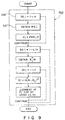
- Fig. 9 presents a flowchart designating the procedure in which the value E j is initially calculated and the vector number "j" giving the minimum value of E j is calculated.
- the value of HC j must be calculated against each "j" by applying multiplication by K(K+1)/2 ⁇ n rounds.
- L/K 4 in the total flow of computation, then as many as 1,048,736 rounds per frame of multiplication must be executed.
- at least three units of DSP each having 20MIPS of multiplication capacity are needed.
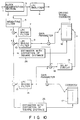
- Fig. 10 is a schematic block diagram designating principle of the structure. Only the method of analyzing pitch makes up the difference between the CELP system based on either the above "formation of closed loop for pitch forecast" or the "compatible code book” and the CELP system shown in Fig. 7. When analyzing pitch according to the CELP system shown in Fig. 7, pitch is analyzed based on the LPC forecast residual signal vector output from the output port 18 of the LPC analyzer. On the other hand, the CELP system shown in Fig. 10 features the formation of closed loop for analyzing pitch like the case of detecting the code book. When operating the CELP system shown in Fig.
- the LPC synthesis filter drive signal output from the output 18 of the LPC analyzer goes through a delay unit 13 which is variable throughout the pitch detecting range and generates drive signal vectors corresponding to the pitch period "j".
- the drive signal vector is assumedly stored in a compatible code book 12.
- Target vector is composed of the weighted input vector free from the influence of the preceding frames.
- the pitch period is detected in order that the error between the target vector and the synthesis signal vector can be minimized.
- an estimating unit 26 applying square-distance distortion computes error Ej as per the equation (7) shown below.
- E j X - ⁇ j HB j (a ⁇ j ⁇ b)
- X designates the target vector
- Bj the drive signal vector when the pitch period "j" is present
- ⁇ j the optimal gain parameter against the pitch period "j”
- H is given by the preceding equation (5)
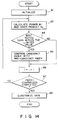
- "t” shown in Fig. 11 designates the number of sub-frame composed by input process. When executing this process, the value of HBj must be computed against each "t" and "j".
- the object of the invention is to provide a speech coding system which is capable of fully solving those problems mentioned above by minimizing the amount of computation to a certain level at which real-time data processing operation can securely be executed with a digital signal processor.
- the second object of the invention is to provide a vector quantization system which is capable of securely quantizing stable and quality vector notwithstanding the procedure of quantizing gain after selecting an optimal index.
- the invention provides a speech coding system as defined in Claims 1 and 5.
- the invention of Claim 1 provides a novel speech coding system which recursively executes filter-applied "Toeplitz characteristic" by causing the drive signal utilized to be converted into the "Toeplitz matrix” when detecting such a pitch period in which tte distortion of the input vector and the vector subsequent to the application of filter-applied computation to the drive signal vector in the pitch forecast called either "closed loop” or "compatible code book” is minimized.
- the vector quantization system substantially makina up the speech coding system of the invention preferably uses a vector quantization system comprising the following; a means for generating power of vector from the prospective indexes; a means for computing the inner product values of the above vector and the target vector; a means for limiting the prospective indexes based on the inner product value of the power of vector and the critical value of the preliminarily set code vector; a means for selecting the quantized output index by applying the vector power and the liner product value based on the limited prospective indices and a means for quantizing the gain by applying the vector power and the inner product value based on the selected index.
- the system When executing the pitch-forecasting process called “closed loop” or “compatible code book", the system converts the drive signal matrix into “toeplitz matrix” to utilize the “Toeplitz characteristic” so that the filter-applied computation can recursively be accelerated, thus making it possible to sharply decrease the rounds of multiplication.
- the second function of the preferred system is to cause the speech coding system to identify whether the optimal gain exceeds the critical value or not by applying the vector power generated from the prospective index, the inner product value of the target vector, and the critical value of the gain of the preliminarily set vector. Based on the result of this judgement, the speech coding system specifies the prospective indexes, and then selects an optimal index by eliminating such prospective indexes containing substantial error of the quantized gain. As a result, even when quantizing the gain after selecting an optimal index, stable and quality vector quantamization can be provided.
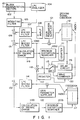
- a line of speech signals are delivered from an input terminal 101 to a block segmenting section 102, which then generates L units of sample values and puts them together as a frame and then outputs these sample values as input signal speech vectors having length 1 for delivery to an LPC analyzer 104 and a weighting filter 105.
- the character P designates the prediction order.
- the extracted LPC forecast parameter is made available for those LPC synthesis filters 107, 109, and 114.
- the weighting filter 105 is set to a position outer from the original code-book detecting and pitch-period detecting loop so that the weighting can be executed by the LPC forecast parameter extracted from the LPC analyzer 104.
- the initial value of memory cannot affect the detection of the pitch period or the code book during the generation of synthesis speech while the computation is performed by the LPC synthesis filters 109 and 114.
- another LPC synthesis filter 107 having memory 108 containing the initial value zero is provided for the system, and then, zero-input response vector is generated from the LPC synthesis filter 107. Then, the zero-input response vector is substracted from the weighted input speech vector preliminarily output from an adder 106 in order to reset the initial value of the LPC synthesis filter 107 to zero.
- the speech coding system of the invention can express the filtering by the product of the drive signal vector or the code vector and the trigonometric matrix below the following K ⁇ K.
- a signal "e" for driving the LPC synthesis filters output from the adder 118 is delivered to a switch 115. If the pitch period "j" as the target of the detection had a value more than the dimensional number K of the code vector, the drive signal “e” is then delivered to a delay circuit 116. Conversely, if the target pitch period "j" were less than the dimensional number K, the drive signal “e” is delivered to a waveform coupler 130, and as a result, a drive signal vector against the pitch period "j" is prepared covering the pitch-detecting range "a” through “b".
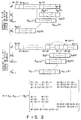
- a counter 111 increments the pitch period "j" all over the pitch detecting range "a” through “b", and then outputs the incremented values to a drive signal code-book 112, switch 115 and the delay circuit 116, respectively. If the pitch period "j" were in excess of the dimensional number "K”, as shown in Fig. 2-1, drive signal vector B j is generated from the past drive signal vector "e” yielded by the delay circuit 116.
- B j designates the drive signal vector when the pitch period "j" is present.
- the character "t” designates transposition.
- the system combines the past drive signal (e(-p), e(-p+l), ..., e(-l)) used for the pitch period "P" of the last sub-frame stored in register 110 with the past drive signal vector "e” to rename the combined unit as e', and then, a new drive signal vector is generated from the combined unit e'.
- This is formulated by the equation (13) shown below.
- the pitch period capable of minimizing error is sought by applying the target vector composed of weighted input vector free from influence of the last frame output from the adder 106.
- Distortion E i arose from the square distance of error is calculated by applying the equation (15) shown below.
- E j X t - ⁇ j HB j (a ⁇ j ⁇ b)
- the symbol X t designates the target vector
- B j the drive signal vector when the pitch period "j" is present
- ⁇ j the optimal gain parameter against the pitch period "j”
- H is given by the preceding equation (10).
- the filtering operation can recursively be executed by utilizing those characteristics that the drive signal matrix is based on the Toeplitz matrix, and yet, the impulse response matrix of the weighted filter and the LPC synthesis filter is based on downward trigonometric matrix and the Toeplitz matrix as well.
- This filtering operation can recursively be executed by applying the following equations (16) and (17).
- V j (l) h(l)e(-j)
- V j (m) V j-l (m-l) + h(m)e(-j) (2 ⁇ m ⁇ K)(a+l ⁇ j ⁇ b)
- (V i (1), V i (2), ..., V, (K)) t designates the element of HB i .
- HB a can be calculated by applying conventional matrix-vector product computation, whereas HB j (a+l ⁇ j ⁇ b) can recursively be calculated from HB j-i , and in consequence, the round of needed multiplication can be reduced to ⁇ K(K+1)/2 + (b-a) ⁇ L/K.
- the need of multiplication is at 3.3 ⁇ 10 6 aounds per second.
- Gain parameter ⁇ j and the pitch period "j" are respectively computed so that E j shown in the above equation (15) can be minimized. Concrete method of computation described later on.
- the synthesis speech vector based on the optimal pitch period "j" output from the LPC synthetic filter 109 is subtracted from the weighted input speech vector (free from the influence of the last frame output from from the adder 106, and then the weighted input speech vector free from the influence of the last frame and the pitch is output.
- synthesis speech is generated by means of code vector of the code book 117 in reference to the target vector composed of the weighted input speech vector (free from the influence of the last frame and the pitch) output from the adder 131.
- a code vector number "j" is selected, which minimizes distortion E j generated by square distance of error. The process of this selection is expressed by the following equation (18).
- E j X t - ⁇ j Hc j (1 ⁇ j ⁇ n ) (1 ⁇ t ⁇ L/K)
- X designates the weighted input speech vector free from the influence of the last frame and the pitch
- C j the j-th code vector
- ⁇ j the optimal gain parameter against the j-th code vector
- n designates the number of the code vector.
- C j ... C j-1 (m-1) (2 ⁇ j ⁇ n, 2 ⁇ m ⁇ k)
- the code-book matrix composed of code vector C j aligned in respective vector matrixes is characteristically the Toeplitz matrix itself.
- W j (l) h(l)U(n+l-j) (2 ⁇ m ⁇ K)
- W j (m) W j-l (m-l) + h(m)U(n+l-j) (2 ⁇ j ⁇ n)
- the speech coding system of the invention can shift the code vector by one sample lot from the forefront of the white noise matrix having n+K-l of length.
- the CELP system called "formation of closed loop” or “comptatible code-hook" available for the pitch forecast shown in Fig.
- Fig. 6 is a block diagram designating the principle of the structure of the speech coding system related to the above embodiment.
- the speech coding system according to this embodiment can produce the drive signal vector bY combining zero vector with the past drive signal vector "e" for facilitating the operation of the waveform coupler 130 when the pitch period "j" is less than "K". By execution of this method, the total rounds of computation can be reduced furthermore.
- the speech coding system of the invention when executing pitch forecast called either the "closed loop” or the "compatible code-book", can recursively compute filter operation by effectively applying characteristic of the Toeplitz-matrix formation of the drive signals. Furthermore, when detecting the content of the code book, the speech coding system of the invention can recursively execute filter operation by arranging the code-book matrix into the Toeplitz matrix, thus advantageously decreasing the total rounds of computing operations.
- the speech coding system of the invention can detect the pitch and the content of the code book by applying the identical method, and thus, assume that the following two cases are present.
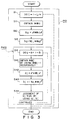
- Step 21a shown in Fig. 12 computes power B i of the vector u i generated from the prospective index i by applying the equation (B7) shown below. If the power B i could be produced from "off-line", it can be stored in a memory (not shown) for reading as required.
- Step 62 shown in Fig. 14 computes the inner product value A i of the vector ui and the target vector X t by applying the equation (B6) shown below.
- Step 22 checks to see if the optimal gain G i is out of the critical value of the gain, or not.
- the critical value of the gain consists of either the upper or the lower limit value of the predetermined code vector of the gain table, and yet, the optimal gain G i is interrelated with the power B i , the inner product value A i , and the equation (B8) shown below. Only the index corresponding to the gain within the critical value is delivered to the following step 23.
- G i A i B i
- step 23 When step 23 is entered, by applying the power B i and the inner product value A i , the speech coding system executes detection of the index containing the assessed maximum value A i /B i against the index i specified in the last step 22 before finally selecting the quantamized output index.
- step 24 by applying the power and the inner product value based on the quantamized output index selected in the last step 23, the speech coding system of the invention quantamizes the gain pertaining to the above equation (B8).
- the speech coding system of the invention also quantamizes the gain in step 24 by sequentially executing steps of directly computing error between the target value and the quantamized vector by applying the quantamized value of the gain table for example, followed by detection of the gain quantamized value capable of minimizing error, and finally selects this value.
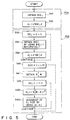
- step 13 the speech coding system detects the index and the quatamized gain output value capable of minimizing error of quantamized vector against the specific index i determined in process of step 22 before eventually selecting them.
- the speech coding system of this embodiment detects an ideal combination of a specific index and a gain capable of minimizing error in the quantamized vector against the combination of the index i and q by applying all the indexes i' and all the quantamized gain values Gq in the critical value of the gain in the gain table, and then converts the combination of the detected index value i and q into the quantamized index output value and the quantamized gain output value.
- the embodiment just described above relates to a speech coding system which introduces quantamization of the gain of vector.
- This system collectively executes common processes to deal with indexes entered in each process, and then only after completing all the processes needed for quantamizing vector, the system starts to execute the ensuing processes.
- modification of process into a loop cycle is also practicable. In this case, step 62 shown in Fig.
- the speech coding system detects and selects the quantamized output index in step 65 for comparing the parameter based on the presently prospective index i to the parameter based on the previously prospective index i-l, and thus, the initial-state-realizing step 61 must be provided to enter the parameter available for the initial comparison.
- the speech coding system initially identifies whether the value of the optimal gain exceeds the critical value of the gain, or not and then, based on the identified result, prospective indexes are specified. As a result, the speech coding system can select the optimal index by eliminating such indexes which cause the error of the quantamized gain to expand. Accordingly, even if the gain is quantamized after selection of the optimal index, the speech coding system embodied by the invention can securely provide stable and quality vector quantamization.
Landscapes
- Engineering & Computer Science (AREA)
- Computational Linguistics (AREA)
- Signal Processing (AREA)
- Health & Medical Sciences (AREA)
- Audiology, Speech & Language Pathology (AREA)
- Human Computer Interaction (AREA)
- Physics & Mathematics (AREA)
- Acoustics & Sound (AREA)
- Multimedia (AREA)
- Compression, Expansion, Code Conversion, And Decoders (AREA)
Claims (12)
- Sprachkodiereinheit, die eine Einrichtung (102) umfaßt, um ein Eingangssprachsignai zu empfangen und um das Eingangssprachsignal in Form eines Eingangssprachvektors mit einem Länge-Rahmen bzw. Länge-Frame auszugeben, und eine Analysiereinrichtung (104) für die Analyse des Eingangssprachvektors mittels eines linearen, prädiktiven Kodierungsverfahrens und für die Extrahierung eines Prädiktionsparameters aus dem Eingangssprachvektor, gekennzeichnet durch:eine Gewichtungseinrichtung (105) zur Gewichtung des Eingangssprachvektors mit dem Prädiktionsparameter von der Analysiereinrichtung und zum Ausgeben eines ersten gewichteten Sprachvektors;ein erstes Aufbereitungsfilter (107) zum Filtern eines Nulleingangssprachvektors;eine erste Subtrahiereinrichtung (106) zum Bilden einer Differenz zwischen dem ersten gewichteten Sprachvektor und dem Nulleingangssprachvektor;eine Erregersignalvektor-Erzeugungseinrichtung (115, 116, 118, 130) zum Erzeugen eines ersten Erregersignalvektors, wenn eine Zielteilungsperiode einen vorbestimmten Wert überschreitet, und zum Erzeugen eines zweiten Erregersignals, wenn die Zielteilungsperiode unter dem vorbestimmten Wert ist;eine Berechnungseinrichtung (111, 112, 119, 120a) für die rekursive Ausführung einer oder mehrerer Operationen unter Verwendung einer Steuersignalmatrix, wobei einer der ersten und zweiten Erregersignalvektoren in Form einer ersten Toeplitz-Matrix verwendet wird, während die eine oder mehreren Operationen ausgeführt werden, um eine optimale Teilungsperiode zu bestimmen, bei der eine Abweichung zwischen dem ersten gewichteten Eingangssprachvektor und einem aufbereiteten Vektor, der unter Verwendung des einen von den ersten und zweiten Erregersignalvektoren erhalten wird, minimal ist; ein zweites Aufbereitungsfilter (109a) zum Erzeugen eines zu der optimalen Teilungsperiode gehörigen Aufbereitungssprachvektors;ein drittes Aufbereitungsfilter (114);eine Codetabelle (117) zum Erzeugen eines Codevektors für die Eingabe in das dritte Aufbereitungsfilter (114), wobei der Codevektor in Form einer zweiten Toeplitz-Matrix ausdrückbar ist;eine zweite Subtrahiereinrichtung (131) für das Bilden einer Differenz zwischen dem Ausgang der ersten Subtrahiereinrichtung (106) und dem zu der optimalen Teilungsperiode gehörigen Aufbereitungssprachvektor, womit der Einfluß eines letzten Rahmens und der Einfluß einer Teilung von dem ersten gewichteten Eingangssprachvektor verlegt bzw. verschoben wird;eine dritte Subtrahiereinrichtung (132) zum Bilden einer Differenz zwischen dem Ausgang der zweiten Subtrahiereinrichtung (131) und des dritten Aufbereitungsfilters (114); undeine Auswahleinrichtung (119b, 120b) zum Auswählen eines optimalen Codevektors aus der Codetabelle (117), der benutzt wird, um eine stabile Qualitätsvektorquantisierung bereitzustellen, so daß die Differenz zwischen dem Ausgang von dem dritten Aufbereitungsfilter (114) und einem zweiten gewichteten Eingangssprachvektor minimiert wird.
- Sprachkodiereinheit nach Anspruch 1, bei der die Erregersignalvektor-Erzeugungseinrichtung umfaßt:eine Verzögerungsschaltung (116) und eine Wellenformkopplungseinrichtung (130), die eine vorbestimmte Sprachwellenform und zuvor in einer Speichereinrichtung (110) zur Speicherung vorheriger Sprachwellenformen gespeicherte Sprachwellenformen aufbereiten; undbei der die Erregersignalvektor-Erzeugungseinrichtung (116, 130) mit einer Umschalteinrichtung (115) verbunden ist, die bei Vorliegen einer vorbestimmten Bedingung das Ziel bzw. die Zieladresse des von der Erregersignalvektor-Erzeugungseinrichtung (118) gelieferten Erregersignalvektors entweder auf die Verzögerungsschaltung (116) oder auf die Wellenformkopplungseinrichtung (130) schaltet.
- Sprachkodiereinheit nach Anspruch 2, bei der dann, wenn die optimale Teilungsperiode eine Dimension des Codevektors überschreitet, die Umschalteinrichtung (115) einen Erregersignalvektor von der Erregersignalvektor-Erzeugungseinrichtung (116) an der Verzögerungsschaltung (116) bereitstellt, wohingegen dann, wenn die Teilungsperiode kleiner ist als die Dimension des Codevektors, die Umschalteinrichtung (115) einen Erregersignalvektor von der Erregersignalvektor-Erzeugungseirichtung (118) an der Wellenformkopplungseinrichtung (130) bereitstellt;
wobei die Verzögerungsschaltung (116) die Teilungsperiode um einen vorbestimmten Betrag verzögert, und die Wellenformkopplungseinrichtung (130) einen Nullvektor mit einem vorherigen Erregersignal koppelt, um einen neuen Erregersignalvektor zu erzeugen. - Sprachkodiereinheit nach Anspruch 2, des weiteren umfassend eine Teilungsanalysiereinrichtung (103), die mit der Analysiereinrichtung (104) verbunden ist, um eine Teilungsanalyse für die Realisierung einer langfristigen Sprachprädiktion durch Anwenden eines Prädiktionsparameters, der von der Analysiereinrichtung (104) extrahiert wird, durchzuführen, und am außerdem einen Prädiktionsrestsignalvektor anzuwenden, der einen Prädiktionsfehler kennzeichnet, und bei der die Teilungsanalysiereinrichtung (103) eine Teilungsperiode, die aus der Teilungsanalyse resultiert, und einen für die Teilungsperiode geeigneten optimalen Verstärkungsparameter extrahiert, und den Wert des optimalen Verstärkungsparameters an die Wellenformkopplungseinrichtung (130) ausgibt.
- Sprachkodiereinheit, die eine Spracheingabeeinrichtung (102) umfaßt, die bei Erhalt eines Sprachsignals einen Eingangssprachvektor erzeugt, gekennzeichnet durch:eine Gewichtungseinrichtung (105), die den Eingangssprachvektor anhand eines vorbestimmten Parameters gewichtet und einen gewichteten Eingangssprachvektor erzeugt;eine Erregersignalvektor-Erzeugungseinrichtung (118, 115, 116, 130), die einen Erregersignalvektor aus einem Filtererregersignal extrahiert und erzeugt, um ein lineares Prädiktionskodierungsprüffilter anzusteuern, das einen aufbereiteten Vektor ausgibt;eine Berechnungseinrichtung (111, 112, 119, 120) zur rekursiven Ausführung von Operationen anhand einer Steuersignalmatrix, die den durch eine Toeplitz-Matrix repräsentierten Erregersignalvektor enthält, wobei die Ausführung der Operationen zur Bestimmung eines optimalen Codevektors so erfolgt, daß eine Abweichung zwischen dem gewichteten Eingangssprachvektor und dem aufbereiteten Vektor minimal ist; undeine Ausgabeerzeugungseinrichtung (109) zur Ausgabe eines Sprachvektors, der zu dem optimalen Codevektor gehörig ist.
- Sprachkodiereinheit nach Anspruch 5, bei der die Erregersignalvektor-Erzeugungseinrichtung (118) eine Einrichtung zum Erzeugen des Erregersignalvektors enthält, und zwar mit einem ersten Erregersignalvektor, der erzeugt wird, wenn eine Teilungsperiode einen vorbestimmten Wert überschreitet, und einem zweiten Erregersignalvektor, der erzeugt wird, wenn die Teilungsperiode unter dem vorbestimmten Wert liegt.
- Sprachkodiereinheit nach Anspruch 1 oder 5, dadurch gekennzeichnet, daß die Berechnungseinrichtung umfaßt: eine Filterkoeffiziententabelle (121, 122), die Koeffizienten in der Form einer Toeplitz-Matrix H enthält; eine Codetabelle (112, 117) mit Vektoren Bi oder Ci, die eine vorbestimmte Anzahl N von L-dimensionalen Vektoren bezeichnen, von denen jeder L Abtastelemente hat, und die Abtastelemente der L-dimensionalen Vektoren (B=Ba, Ba+1, - - -, Bb oder C=C1, C2, - - -, CN) eine ÜberLappungsbeziehung Bj(m) = Bi(m-k) oder Cj(m) = Ci(m-k) haben, wobei 1 ≤ i, j ≤ N, 1 ≤ m ≤ L, 1 ≤ k < L, Bj(m) oder Cj(m) = m-tes Element des Vektors Bj oder Cj ist; ein LPC-Aufbereitungsfilter (109, 114), um, einen Zielvektor zu erhalten, wobei Daten der Filterkoeffiziententabelle und der Codetabelle mittels einer rekursiven Berechnung verwendet werden, so daß die Multiplikaktion von H · Bj oder H · Cj auf Basis des Berechnungsergebnisses von H · Bi oder H · Ci durchgeführt wird.
- Sprachkodiereinheit nach Anspruch 1 oder 5, dadurch gekennzeichnet, daß die Berechnungseinrichtung umfaßt:eine Filterkoeffiziententabelle (121, 122), die Koeffizienten in der Form einer Toepliz-Matrix H enthält;eine Codetabelle (112, 117) mit Vektoren Bi oder Ci, wobei der Ausdruck Bi oder Ci eine vorbestimmte Anzahl N von L-dimensionalen Vektoren bezeichnet, von denen jeder L Abtastelemente hat, und die Abtastelemente der L-dimensionalen Vektoren eine Überlappungsbeziehung Bi(m) = Bi-1(m-k) oder Ci(m) = Ci-1(m-k) haben, wobei 2 ≤ i ≤ N, 1 ≤ m ≤ L, 1 ≤ k < L, Bi(m) oder Ci(m) = m-tes Element des Vektors Bi oder Ci ist; undein LPC-Aufbereitungsfilter (109, 114), um einen Zielvektor zu erhalten, wobei Daten der Filterkoeffiziententabelle und der Codetabelle mittels einer rekursiven Berechnung verwendet werden, so daß die Multiplikaktion von H · Bi oder H · Ci auf Basis des Berechnungsergebnisses von H · Bi-1 oder H · Ci-1 durchgeführt wird.
- Sprachkodiereinheit nach Anspruch 1 oder 5, dadurch gekennzeichnet, daß die Berechnungseinrichtung umfaßt:eine Filterkoeffiziententabelle (121, 122), die Koeffizienten in der Form einer Toeplitz-Matrix H enthält;eine Codetabelle (112, 117) mit Vektoren Bi oder Ci, wobei der Ausdruck Bi oder Ci eine vorbestimmte Anzahk N von L-dimensionalen Vektoren bezeichnet, die L Abtastelemente haben, wobei die Abtastelemente der L-dimensionalen Vektoren eine Überlappungsbeziehung Bj(m) = Bi(m-k) oder Cj(m) = Ci(m-k) haben, wobei 1 ≤ i, j ≤ N, 1 ≤ m ≤ L, 1 ≤ k < L, Bj(k) oder Bj(m) = m-tes Element des Vektors Bi oder Ci ist; undein LPC-Aufbereitungsfilter (109, 117) mit einer Einrichtung zum Speichern eines Ergebnisses der Multiplikation von H · Bi oder H · Ci, einer Einrichtung zur Multiplikation von Bj oder Cj mit der Matrix H nach dem Setzen von N-k Elementen von Bj oder Cj auf Null, so daß Bj(m) oder Cj(m) = 0, k+1 ≤ m ≤ L ist, und einer Einrichtung zum Addieren des Multiplikationsergebnisses von der Multipliziereinrichtung und des in der Speichereinrichtung gespeicherten Multiplikationsergebnisses, nachdem es um k Abtastwerte verschoben wurde, um ein Additionsergebnis zu erhalten.
- Sprachkodiereinheit nach Anspruch 1 oder 5, dadurch gekennzeichnet, daß die Berechnungseinrichtung umfaßt:eine Filterkoeffiziententabelle (121, 122), die Koeffizienten in der Form einer Toeplitz-Matrix H enthält;eine Codetabelle (112, 117) mit Vektoren Bi oder Ci, wobei der Ausdruck Bi oder Ci eine vorbestimmte Anzahl N von L-dimensionalen Vektoren bezeichnet, von denen jeder L Abtastelemente hat, und die Abtastelemente der L-dimensionalen Vektoren eine Überlappungsbeziehung Bj(m) = Bi(m-k) oder Cj(m) = Ci(m-k) haben, wobei 1 ≤ i, j ≤ N, 1 ≤ m ≤ L, 1 ≤ k < L, Bj(m) oder Ci(m) = m-tes Element des Vektors Bj oder Cj ist; undein LPC-Aufbereitungsfilter (109, 114) mit einer Einrichtung zum Speichern eines Ergebnisses der Multiplikation von H · Bj oder Cj, einer Einrichtung zur Multiplikation von Bj oder Cj mit der Matrix H nach dem Setzen von Elementen von L-k Spalten von H auf Null, so daß H (i, j) = 0, 1 ≤ i ≤ L, k+1 ≤ j ≤ L ist, und einer Einrichtung zum Addieren des Multiplikationsergebnisses von der Multipliziereinrichtung und des in der Speichereinrichtung gespeicherten Multiplikationsergebnisses, nachdem es um k Abtastwerte verschoben wurde, um ein Additionsergebnis zu erhalten und zu speichern.
- Sprachkodiereinheit nach Anspruch 1 oder 5, dadurch gekennzeichnet, daß die Berechnungseinrichtung umfaßt:eine Filterkoeffiziententabelle (121, 122), die Koeffizienten in der Form einer Toeplitz-Matrix H enthält;eine Codetabelle (112, 117) mit Vektoren Bi oder Ci, wobei der Ausdruck Bi oder Ci eine vorbestimmte Anzahl N von L-dimensionalen Vektoren bezeichnet, die L Abtastelemente haben, wobei die Abtastelemente der L-dimensionalen Vektoren eine Überlappungsbeziehung Bi(m) = Bi-1(m-k) oder Ci(k) = Ci-1(m-k) haben, wobei 2 ≤ i ≤ N, 1 ≤ m ≤ L, 1 ≤ k < L, Bi(m) oder Ci(m) = m-tes Element des Vektors Bi oder Ci ist;ein LPC-Aufbereitungsfilter (109, 114) mit einer Einrichtung zum Speichern eines Ergebnisses der Multiplikation von H · Bi-1 oder H · Ci-1, einer Einrichtung zur Multiplikation von Bj oder Cj (2 ≤ j ≤ N) mit der Matrix H nach dem Setzen von N-k Elementen von Bj oder Cj auf Null, so daß Bj(m) oder Cj(m,) = 0, k+1 ≤ m ≤ L ist, und einer Einrichtung zum Addieren eines Multiplikationsergebnisses von der Multipliziereinrichtung und des in der Speichereinrichtung gespeicherten Multiplikationsergebnisses, nachdem es um k Abtastwerte verschoben wurde, um ein Additionsergebnis zu erhalten und zu speichern.
- Sprachkodiereinheit nach Anspruch 1 oder 5, dadurch gekennzeichnet, daß die Berechnungseinrichtung umfaßt:eine Filterkoeffiziententabelle (121, 122), die Koeffizienten in der Form einer Toeplitz-Matrix H enthält;eine Codetabelle (112, 117) mit Vektoren Bi, oder Ci, wobei der Ausdruck Bi oder Ci eine vorbestimmte Anzahl N von L-dimensionalen Vektoren bezeichnet, die L Abtastelemente haben, wobei die Abtastelemente der L-dimensionalen Vektoren eine Überlappungsbeziehung Bi(m) = Bi-1(m-k) oder Ci(k) = Ci-1(m-k) haben, wobei 2 ≤ i ≤ N, 1 ≤ m ≤ L, 1 ≤ k < L, Bi(m) oder Ci(m) = m-tes Element des Vektors Bi oder Ci ist;ein LPC-Aufbereitungsfilter (109, 114) mit einer Einrichtung zum Speichern eines Ergebnisses der Multiplikation von H · Bi-1 oder H · Ci-1, einer Einrichtung zur Multiplikation von Bj oder Cj (2 ≤ j ≤ N) mit der matrix H nach dem Setzen von Elementen von L-k Spalten von H auf Null, so daß H(i, j) = 0, 1 ≤ i ≤ L, k+1 ≤ j ≤ L ist, und einer Einrichtung zum Addieren des in der Speichereinrichtung gespeicherten Multiplikationsergebnisses, nachdem es um k Abtastwerte verschoben wurde, um ein Additionsergebnis zu erhalten und zu speichern.
Applications Claiming Priority (4)
| Application Number | Priority Date | Filing Date | Title |
|---|---|---|---|
| JP268050/89 | 1989-10-17 | ||
| JP01268050A JP3112462B2 (ja) | 1989-10-17 | 1989-10-17 | 音声符号化装置 |
| JP44405/90 | 1990-02-27 | ||
| JP2044405A JP2829083B2 (ja) | 1990-02-27 | 1990-02-27 | ベクトル量子化方式 |
Publications (3)
| Publication Number | Publication Date |
|---|---|
| EP0424121A2 EP0424121A2 (de) | 1991-04-24 |
| EP0424121A3 EP0424121A3 (en) | 1993-05-12 |
| EP0424121B1 true EP0424121B1 (de) | 1998-08-12 |
Family
ID=26384307
Family Applications (1)
| Application Number | Title | Priority Date | Filing Date |
|---|---|---|---|
| EP90311396A Expired - Lifetime EP0424121B1 (de) | 1989-10-17 | 1990-10-17 | Einrichtung zur Sprachkodierung |
Country Status (4)
| Country | Link |
|---|---|
| US (2) | US5230036A (de) |
| EP (1) | EP0424121B1 (de) |
| CA (1) | CA2027705C (de) |
| DE (1) | DE69032551T2 (de) |
Families Citing this family (174)
| Publication number | Priority date | Publication date | Assignee | Title |
|---|---|---|---|---|
| GB2266822B (en) * | 1990-12-21 | 1995-05-10 | British Telecomm | Speech coding |
| US5671327A (en) * | 1991-10-21 | 1997-09-23 | Kabushiki Kaisha Toshiba | Speech encoding apparatus utilizing stored code data |
| WO1994025959A1 (en) * | 1993-04-29 | 1994-11-10 | Unisearch Limited | Use of an auditory model to improve quality or lower the bit rate of speech synthesis systems |
| GB9408037D0 (en) * | 1994-04-22 | 1994-06-15 | Philips Electronics Uk Ltd | Analogue signal coder |
| US5528516A (en) * | 1994-05-25 | 1996-06-18 | System Management Arts, Inc. | Apparatus and method for event correlation and problem reporting |
| JP2970407B2 (ja) * | 1994-06-21 | 1999-11-02 | 日本電気株式会社 | 音声の励振信号符号化装置 |
| US5797118A (en) * | 1994-08-09 | 1998-08-18 | Yamaha Corporation | Learning vector quantization and a temporary memory such that the codebook contents are renewed when a first speaker returns |
| CA2159571C (en) * | 1994-09-30 | 2000-03-14 | Kimio Miseki | Vector quantization apparatus |
| FR2729245B1 (fr) * | 1995-01-06 | 1997-04-11 | Lamblin Claude | Procede de codage de parole a prediction lineaire et excitation par codes algebriques |
| US5664053A (en) * | 1995-04-03 | 1997-09-02 | Universite De Sherbrooke | Predictive split-matrix quantization of spectral parameters for efficient coding of speech |
| JP3308764B2 (ja) * | 1995-05-31 | 2002-07-29 | 日本電気株式会社 | 音声符号化装置 |
| FR2739964A1 (fr) * | 1995-10-11 | 1997-04-18 | Philips Electronique Lab | Dispositif de prediction de periode de voisement pour codeur de parole |
| JP3680380B2 (ja) * | 1995-10-26 | 2005-08-10 | ソニー株式会社 | 音声符号化方法及び装置 |
| US6175817B1 (en) * | 1995-11-20 | 2001-01-16 | Robert Bosch Gmbh | Method for vector quantizing speech signals |
| US6038528A (en) * | 1996-07-17 | 2000-03-14 | T-Netix, Inc. | Robust speech processing with affine transform replicated data |
| JP3357795B2 (ja) * | 1996-08-16 | 2002-12-16 | 株式会社東芝 | 音声符号化方法および装置 |
| US5794182A (en) * | 1996-09-30 | 1998-08-11 | Apple Computer, Inc. | Linear predictive speech encoding systems with efficient combination pitch coefficients computation |
| US6192336B1 (en) | 1996-09-30 | 2001-02-20 | Apple Computer, Inc. | Method and system for searching for an optimal codevector |
| US5924062A (en) * | 1997-07-01 | 1999-07-13 | Nokia Mobile Phones | ACLEP codec with modified autocorrelation matrix storage and search |
| DE19729494C2 (de) * | 1997-07-10 | 1999-11-04 | Grundig Ag | Verfahren und Anordnung zur Codierung und/oder Decodierung von Sprachsignalen, insbesondere für digitale Diktiergeräte |
| JP3261691B2 (ja) * | 1997-11-28 | 2002-03-04 | 沖電気工業株式会社 | 符号帳予備選択装置 |
| JP3268750B2 (ja) * | 1998-01-30 | 2002-03-25 | 株式会社東芝 | 音声合成方法及びシステム |
| JP3553356B2 (ja) * | 1998-02-23 | 2004-08-11 | パイオニア株式会社 | 線形予測パラメータのコードブック設計方法及び線形予測パラメータ符号化装置並びにコードブック設計プログラムが記録された記録媒体 |
| US8645137B2 (en) | 2000-03-16 | 2014-02-04 | Apple Inc. | Fast, language-independent method for user authentication by voice |
| JP4231987B2 (ja) * | 2001-06-15 | 2009-03-04 | 日本電気株式会社 | 音声符号化復号方式間の符号変換方法、その装置、そのプログラム及び記憶媒体 |
| US7123655B2 (en) * | 2001-08-09 | 2006-10-17 | Sharp Laboratories Of America, Inc. | Method for reduced bit-depth quantization |
| ITFI20010199A1 (it) | 2001-10-22 | 2003-04-22 | Riccardo Vieri | Sistema e metodo per trasformare in voce comunicazioni testuali ed inviarle con una connessione internet a qualsiasi apparato telefonico |
| US8677377B2 (en) | 2005-09-08 | 2014-03-18 | Apple Inc. | Method and apparatus for building an intelligent automated assistant |
| US7633076B2 (en) | 2005-09-30 | 2009-12-15 | Apple Inc. | Automated response to and sensing of user activity in portable devices |
| US9318108B2 (en) | 2010-01-18 | 2016-04-19 | Apple Inc. | Intelligent automated assistant |
| US8977255B2 (en) | 2007-04-03 | 2015-03-10 | Apple Inc. | Method and system for operating a multi-function portable electronic device using voice-activation |
| US9053089B2 (en) | 2007-10-02 | 2015-06-09 | Apple Inc. | Part-of-speech tagging using latent analogy |
| US8620662B2 (en) | 2007-11-20 | 2013-12-31 | Apple Inc. | Context-aware unit selection |
| US10002189B2 (en) | 2007-12-20 | 2018-06-19 | Apple Inc. | Method and apparatus for searching using an active ontology |
| US9330720B2 (en) | 2008-01-03 | 2016-05-03 | Apple Inc. | Methods and apparatus for altering audio output signals |
| US8065143B2 (en) | 2008-02-22 | 2011-11-22 | Apple Inc. | Providing text input using speech data and non-speech data |
| US8996376B2 (en) | 2008-04-05 | 2015-03-31 | Apple Inc. | Intelligent text-to-speech conversion |
| US10496753B2 (en) | 2010-01-18 | 2019-12-03 | Apple Inc. | Automatically adapting user interfaces for hands-free interaction |
| US8464150B2 (en) | 2008-06-07 | 2013-06-11 | Apple Inc. | Automatic language identification for dynamic text processing |
| US20100030549A1 (en) | 2008-07-31 | 2010-02-04 | Lee Michael M | Mobile device having human language translation capability with positional feedback |
| US8768702B2 (en) | 2008-09-05 | 2014-07-01 | Apple Inc. | Multi-tiered voice feedback in an electronic device |
| US8898568B2 (en) | 2008-09-09 | 2014-11-25 | Apple Inc. | Audio user interface |
| US8712776B2 (en) | 2008-09-29 | 2014-04-29 | Apple Inc. | Systems and methods for selective text to speech synthesis |
| US8583418B2 (en) | 2008-09-29 | 2013-11-12 | Apple Inc. | Systems and methods of detecting language and natural language strings for text to speech synthesis |
| US8676904B2 (en) | 2008-10-02 | 2014-03-18 | Apple Inc. | Electronic devices with voice command and contextual data processing capabilities |
| WO2010067118A1 (en) | 2008-12-11 | 2010-06-17 | Novauris Technologies Limited | Speech recognition involving a mobile device |
| US8862252B2 (en) | 2009-01-30 | 2014-10-14 | Apple Inc. | Audio user interface for displayless electronic device |
| US8380507B2 (en) | 2009-03-09 | 2013-02-19 | Apple Inc. | Systems and methods for determining the language to use for speech generated by a text to speech engine |
| US10540976B2 (en) | 2009-06-05 | 2020-01-21 | Apple Inc. | Contextual voice commands |
| US10241644B2 (en) | 2011-06-03 | 2019-03-26 | Apple Inc. | Actionable reminder entries |
| US9858925B2 (en) | 2009-06-05 | 2018-01-02 | Apple Inc. | Using context information to facilitate processing of commands in a virtual assistant |
| US10706373B2 (en) | 2011-06-03 | 2020-07-07 | Apple Inc. | Performing actions associated with task items that represent tasks to perform |
| US10241752B2 (en) | 2011-09-30 | 2019-03-26 | Apple Inc. | Interface for a virtual digital assistant |
| US9431006B2 (en) | 2009-07-02 | 2016-08-30 | Apple Inc. | Methods and apparatuses for automatic speech recognition |
| US8682649B2 (en) | 2009-11-12 | 2014-03-25 | Apple Inc. | Sentiment prediction from textual data |
| US8600743B2 (en) | 2010-01-06 | 2013-12-03 | Apple Inc. | Noise profile determination for voice-related feature |
| US8311838B2 (en) | 2010-01-13 | 2012-11-13 | Apple Inc. | Devices and methods for identifying a prompt corresponding to a voice input in a sequence of prompts |
| US8381107B2 (en) | 2010-01-13 | 2013-02-19 | Apple Inc. | Adaptive audio feedback system and method |
| US10679605B2 (en) | 2010-01-18 | 2020-06-09 | Apple Inc. | Hands-free list-reading by intelligent automated assistant |
| US10553209B2 (en) | 2010-01-18 | 2020-02-04 | Apple Inc. | Systems and methods for hands-free notification summaries |
| US10276170B2 (en) | 2010-01-18 | 2019-04-30 | Apple Inc. | Intelligent automated assistant |
| US10705794B2 (en) | 2010-01-18 | 2020-07-07 | Apple Inc. | Automatically adapting user interfaces for hands-free interaction |
| DE202011111062U1 (de) | 2010-01-25 | 2019-02-19 | Newvaluexchange Ltd. | Vorrichtung und System für eine Digitalkonversationsmanagementplattform |
| US8682667B2 (en) | 2010-02-25 | 2014-03-25 | Apple Inc. | User profiling for selecting user specific voice input processing information |
| US8713021B2 (en) | 2010-07-07 | 2014-04-29 | Apple Inc. | Unsupervised document clustering using latent semantic density analysis |
| US8719006B2 (en) | 2010-08-27 | 2014-05-06 | Apple Inc. | Combined statistical and rule-based part-of-speech tagging for text-to-speech synthesis |
| US8719014B2 (en) | 2010-09-27 | 2014-05-06 | Apple Inc. | Electronic device with text error correction based on voice recognition data |
| US10762293B2 (en) | 2010-12-22 | 2020-09-01 | Apple Inc. | Using parts-of-speech tagging and named entity recognition for spelling correction |
| US10515147B2 (en) | 2010-12-22 | 2019-12-24 | Apple Inc. | Using statistical language models for contextual lookup |
| US8781836B2 (en) | 2011-02-22 | 2014-07-15 | Apple Inc. | Hearing assistance system for providing consistent human speech |
| US9262612B2 (en) | 2011-03-21 | 2016-02-16 | Apple Inc. | Device access using voice authentication |
| US20120310642A1 (en) | 2011-06-03 | 2012-12-06 | Apple Inc. | Automatically creating a mapping between text data and audio data |
| US10057736B2 (en) | 2011-06-03 | 2018-08-21 | Apple Inc. | Active transport based notifications |
| US8812294B2 (en) | 2011-06-21 | 2014-08-19 | Apple Inc. | Translating phrases from one language into another using an order-based set of declarative rules |
| US8706472B2 (en) | 2011-08-11 | 2014-04-22 | Apple Inc. | Method for disambiguating multiple readings in language conversion |
| US8994660B2 (en) | 2011-08-29 | 2015-03-31 | Apple Inc. | Text correction processing |
| US8762156B2 (en) | 2011-09-28 | 2014-06-24 | Apple Inc. | Speech recognition repair using contextual information |
| US10134385B2 (en) | 2012-03-02 | 2018-11-20 | Apple Inc. | Systems and methods for name pronunciation |
| US9483461B2 (en) | 2012-03-06 | 2016-11-01 | Apple Inc. | Handling speech synthesis of content for multiple languages |
| US9280610B2 (en) | 2012-05-14 | 2016-03-08 | Apple Inc. | Crowd sourcing information to fulfill user requests |
| US8775442B2 (en) | 2012-05-15 | 2014-07-08 | Apple Inc. | Semantic search using a single-source semantic model |
| US10417037B2 (en) | 2012-05-15 | 2019-09-17 | Apple Inc. | Systems and methods for integrating third party services with a digital assistant |
| WO2013185109A2 (en) | 2012-06-08 | 2013-12-12 | Apple Inc. | Systems and methods for recognizing textual identifiers within a plurality of words |
| US9721563B2 (en) | 2012-06-08 | 2017-08-01 | Apple Inc. | Name recognition system |
| US9495129B2 (en) | 2012-06-29 | 2016-11-15 | Apple Inc. | Device, method, and user interface for voice-activated navigation and browsing of a document |
| US9576574B2 (en) | 2012-09-10 | 2017-02-21 | Apple Inc. | Context-sensitive handling of interruptions by intelligent digital assistant |
| US9547647B2 (en) | 2012-09-19 | 2017-01-17 | Apple Inc. | Voice-based media searching |
| US8935167B2 (en) | 2012-09-25 | 2015-01-13 | Apple Inc. | Exemplar-based latent perceptual modeling for automatic speech recognition |
| EP4560630A3 (de) | 2013-02-07 | 2025-08-06 | Apple Inc. | Sprachauslöser für einen digitalen assistenten |
| US10652394B2 (en) | 2013-03-14 | 2020-05-12 | Apple Inc. | System and method for processing voicemail |
| US10572476B2 (en) | 2013-03-14 | 2020-02-25 | Apple Inc. | Refining a search based on schedule items |
| US9368114B2 (en) | 2013-03-14 | 2016-06-14 | Apple Inc. | Context-sensitive handling of interruptions |
| US9733821B2 (en) | 2013-03-14 | 2017-08-15 | Apple Inc. | Voice control to diagnose inadvertent activation of accessibility features |
| US10642574B2 (en) | 2013-03-14 | 2020-05-05 | Apple Inc. | Device, method, and graphical user interface for outputting captions |
| US9977779B2 (en) | 2013-03-14 | 2018-05-22 | Apple Inc. | Automatic supplementation of word correction dictionaries |
| US10078487B2 (en) | 2013-03-15 | 2018-09-18 | Apple Inc. | Context-sensitive handling of interruptions |
| WO2014144579A1 (en) | 2013-03-15 | 2014-09-18 | Apple Inc. | System and method for updating an adaptive speech recognition model |
| KR101857648B1 (ko) | 2013-03-15 | 2018-05-15 | 애플 인크. | 지능형 디지털 어시스턴트에 의한 사용자 트레이닝 |
| US10748529B1 (en) | 2013-03-15 | 2020-08-18 | Apple Inc. | Voice activated device for use with a voice-based digital assistant |
| CN105027197B (zh) | 2013-03-15 | 2018-12-14 | 苹果公司 | 训练至少部分语音命令系统 |
| WO2014197336A1 (en) | 2013-06-07 | 2014-12-11 | Apple Inc. | System and method for detecting errors in interactions with a voice-based digital assistant |
| WO2014197334A2 (en) | 2013-06-07 | 2014-12-11 | Apple Inc. | System and method for user-specified pronunciation of words for speech synthesis and recognition |
| US9582608B2 (en) | 2013-06-07 | 2017-02-28 | Apple Inc. | Unified ranking with entropy-weighted information for phrase-based semantic auto-completion |
| WO2014197335A1 (en) | 2013-06-08 | 2014-12-11 | Apple Inc. | Interpreting and acting upon commands that involve sharing information with remote devices |
| US10176167B2 (en) | 2013-06-09 | 2019-01-08 | Apple Inc. | System and method for inferring user intent from speech inputs |
| EP3008641A1 (de) | 2013-06-09 | 2016-04-20 | Apple Inc. | Vorrichtung, verfahren und grafische benutzeroberfläche für gesprächspersistenz über zwei oder mehrere instanzen eines digitaler assistenten |
| HK1220313A1 (zh) | 2013-06-13 | 2017-04-28 | 苹果公司 | 用於由语音命令发起的紧急呼叫的系统和方法 |
| US10791216B2 (en) | 2013-08-06 | 2020-09-29 | Apple Inc. | Auto-activating smart responses based on activities from remote devices |
| US10296160B2 (en) | 2013-12-06 | 2019-05-21 | Apple Inc. | Method for extracting salient dialog usage from live data |
| US9620105B2 (en) | 2014-05-15 | 2017-04-11 | Apple Inc. | Analyzing audio input for efficient speech and music recognition |
| US10592095B2 (en) | 2014-05-23 | 2020-03-17 | Apple Inc. | Instantaneous speaking of content on touch devices |
| US9502031B2 (en) | 2014-05-27 | 2016-11-22 | Apple Inc. | Method for supporting dynamic grammars in WFST-based ASR |
| US9715875B2 (en) | 2014-05-30 | 2017-07-25 | Apple Inc. | Reducing the need for manual start/end-pointing and trigger phrases |
| US10078631B2 (en) | 2014-05-30 | 2018-09-18 | Apple Inc. | Entropy-guided text prediction using combined word and character n-gram language models |
| US9633004B2 (en) | 2014-05-30 | 2017-04-25 | Apple Inc. | Better resolution when referencing to concepts |
| US9785630B2 (en) | 2014-05-30 | 2017-10-10 | Apple Inc. | Text prediction using combined word N-gram and unigram language models |
| US10170123B2 (en) | 2014-05-30 | 2019-01-01 | Apple Inc. | Intelligent assistant for home automation |
| US10289433B2 (en) | 2014-05-30 | 2019-05-14 | Apple Inc. | Domain specific language for encoding assistant dialog |
| US9842101B2 (en) | 2014-05-30 | 2017-12-12 | Apple Inc. | Predictive conversion of language input |
| US9734193B2 (en) | 2014-05-30 | 2017-08-15 | Apple Inc. | Determining domain salience ranking from ambiguous words in natural speech |
| US9760559B2 (en) | 2014-05-30 | 2017-09-12 | Apple Inc. | Predictive text input |
| US9430463B2 (en) | 2014-05-30 | 2016-08-30 | Apple Inc. | Exemplar-based natural language processing |
| US9966065B2 (en) | 2014-05-30 | 2018-05-08 | Apple Inc. | Multi-command single utterance input method |
| US10659851B2 (en) | 2014-06-30 | 2020-05-19 | Apple Inc. | Real-time digital assistant knowledge updates |
| US9338493B2 (en) | 2014-06-30 | 2016-05-10 | Apple Inc. | Intelligent automated assistant for TV user interactions |
| US10446141B2 (en) | 2014-08-28 | 2019-10-15 | Apple Inc. | Automatic speech recognition based on user feedback |
| US9818400B2 (en) | 2014-09-11 | 2017-11-14 | Apple Inc. | Method and apparatus for discovering trending terms in speech requests |
| US10789041B2 (en) | 2014-09-12 | 2020-09-29 | Apple Inc. | Dynamic thresholds for always listening speech trigger |
| US9886432B2 (en) | 2014-09-30 | 2018-02-06 | Apple Inc. | Parsimonious handling of word inflection via categorical stem + suffix N-gram language models |
| US9646609B2 (en) | 2014-09-30 | 2017-05-09 | Apple Inc. | Caching apparatus for serving phonetic pronunciations |
| US9668121B2 (en) | 2014-09-30 | 2017-05-30 | Apple Inc. | Social reminders |
| US10074360B2 (en) | 2014-09-30 | 2018-09-11 | Apple Inc. | Providing an indication of the suitability of speech recognition |
| US10127911B2 (en) | 2014-09-30 | 2018-11-13 | Apple Inc. | Speaker identification and unsupervised speaker adaptation techniques |
| US10552013B2 (en) | 2014-12-02 | 2020-02-04 | Apple Inc. | Data detection |
| US9711141B2 (en) | 2014-12-09 | 2017-07-18 | Apple Inc. | Disambiguating heteronyms in speech synthesis |
| US9865280B2 (en) | 2015-03-06 | 2018-01-09 | Apple Inc. | Structured dictation using intelligent automated assistants |
| US9721566B2 (en) | 2015-03-08 | 2017-08-01 | Apple Inc. | Competing devices responding to voice triggers |
| US10567477B2 (en) | 2015-03-08 | 2020-02-18 | Apple Inc. | Virtual assistant continuity |
| US9886953B2 (en) | 2015-03-08 | 2018-02-06 | Apple Inc. | Virtual assistant activation |
| US9899019B2 (en) | 2015-03-18 | 2018-02-20 | Apple Inc. | Systems and methods for structured stem and suffix language models |
| US9842105B2 (en) | 2015-04-16 | 2017-12-12 | Apple Inc. | Parsimonious continuous-space phrase representations for natural language processing |
| US10083688B2 (en) | 2015-05-27 | 2018-09-25 | Apple Inc. | Device voice control for selecting a displayed affordance |
| US10127220B2 (en) | 2015-06-04 | 2018-11-13 | Apple Inc. | Language identification from short strings |
| US10101822B2 (en) | 2015-06-05 | 2018-10-16 | Apple Inc. | Language input correction |
| US11025565B2 (en) | 2015-06-07 | 2021-06-01 | Apple Inc. | Personalized prediction of responses for instant messaging |
| US10255907B2 (en) | 2015-06-07 | 2019-04-09 | Apple Inc. | Automatic accent detection using acoustic models |
| US10186254B2 (en) | 2015-06-07 | 2019-01-22 | Apple Inc. | Context-based endpoint detection |
| US10671428B2 (en) | 2015-09-08 | 2020-06-02 | Apple Inc. | Distributed personal assistant |
| US10747498B2 (en) | 2015-09-08 | 2020-08-18 | Apple Inc. | Zero latency digital assistant |
| US9697820B2 (en) | 2015-09-24 | 2017-07-04 | Apple Inc. | Unit-selection text-to-speech synthesis using concatenation-sensitive neural networks |
| US11010550B2 (en) | 2015-09-29 | 2021-05-18 | Apple Inc. | Unified language modeling framework for word prediction, auto-completion and auto-correction |
| US10366158B2 (en) | 2015-09-29 | 2019-07-30 | Apple Inc. | Efficient word encoding for recurrent neural network language models |
| US11587559B2 (en) | 2015-09-30 | 2023-02-21 | Apple Inc. | Intelligent device identification |
| US10691473B2 (en) | 2015-11-06 | 2020-06-23 | Apple Inc. | Intelligent automated assistant in a messaging environment |
| US10049668B2 (en) | 2015-12-02 | 2018-08-14 | Apple Inc. | Applying neural network language models to weighted finite state transducers for automatic speech recognition |
| US10223066B2 (en) | 2015-12-23 | 2019-03-05 | Apple Inc. | Proactive assistance based on dialog communication between devices |
| US10446143B2 (en) | 2016-03-14 | 2019-10-15 | Apple Inc. | Identification of voice inputs providing credentials |
| US9934775B2 (en) | 2016-05-26 | 2018-04-03 | Apple Inc. | Unit-selection text-to-speech synthesis based on predicted concatenation parameters |
| US9972304B2 (en) | 2016-06-03 | 2018-05-15 | Apple Inc. | Privacy preserving distributed evaluation framework for embedded personalized systems |
| US10249300B2 (en) | 2016-06-06 | 2019-04-02 | Apple Inc. | Intelligent list reading |
| US10049663B2 (en) | 2016-06-08 | 2018-08-14 | Apple, Inc. | Intelligent automated assistant for media exploration |
| DK179588B1 (en) | 2016-06-09 | 2019-02-22 | Apple Inc. | INTELLIGENT AUTOMATED ASSISTANT IN A HOME ENVIRONMENT |
| US10490187B2 (en) | 2016-06-10 | 2019-11-26 | Apple Inc. | Digital assistant providing automated status report |
| US10192552B2 (en) | 2016-06-10 | 2019-01-29 | Apple Inc. | Digital assistant providing whispered speech |
| US10509862B2 (en) | 2016-06-10 | 2019-12-17 | Apple Inc. | Dynamic phrase expansion of language input |
| US10067938B2 (en) | 2016-06-10 | 2018-09-04 | Apple Inc. | Multilingual word prediction |
| US10586535B2 (en) | 2016-06-10 | 2020-03-10 | Apple Inc. | Intelligent digital assistant in a multi-tasking environment |
| DK179343B1 (en) | 2016-06-11 | 2018-05-14 | Apple Inc | Intelligent task discovery |
| DK179049B1 (en) | 2016-06-11 | 2017-09-18 | Apple Inc | Data driven natural language event detection and classification |
| DK201670540A1 (en) | 2016-06-11 | 2018-01-08 | Apple Inc | Application integration with a digital assistant |
| DK179415B1 (en) | 2016-06-11 | 2018-06-14 | Apple Inc | Intelligent device arbitration and control |
| US10593346B2 (en) | 2016-12-22 | 2020-03-17 | Apple Inc. | Rank-reduced token representation for automatic speech recognition |
| DK179745B1 (en) | 2017-05-12 | 2019-05-01 | Apple Inc. | SYNCHRONIZATION AND TASK DELEGATION OF A DIGITAL ASSISTANT |
| DK201770431A1 (en) | 2017-05-15 | 2018-12-20 | Apple Inc. | Optimizing dialogue policy decisions for digital assistants using implicit feedback |
Family Cites Families (4)
| Publication number | Priority date | Publication date | Assignee | Title |
|---|---|---|---|---|
| NL8500843A (nl) * | 1985-03-22 | 1986-10-16 | Koninkl Philips Electronics Nv | Multipuls-excitatie lineair-predictieve spraakcoder. |
| US4944013A (en) * | 1985-04-03 | 1990-07-24 | British Telecommunications Public Limited Company | Multi-pulse speech coder |
| US4878230A (en) * | 1986-10-16 | 1989-10-31 | Mitsubishi Denki Kabushiki Kaisha | Amplitude-adaptive vector quantization system |
| US4899385A (en) * | 1987-06-26 | 1990-02-06 | American Telephone And Telegraph Company | Code excited linear predictive vocoder |
-
1990
- 1990-10-16 CA CA002027705A patent/CA2027705C/en not_active Expired - Lifetime
- 1990-10-17 DE DE69032551T patent/DE69032551T2/de not_active Expired - Lifetime
- 1990-10-17 US US07/598,989 patent/US5230036A/en not_active Ceased
- 1990-10-17 EP EP90311396A patent/EP0424121B1/de not_active Expired - Lifetime
-
1995
- 1995-07-19 US US08/504,227 patent/USRE36646E/en not_active Expired - Lifetime
Also Published As
| Publication number | Publication date |
|---|---|
| CA2027705A1 (en) | 1991-04-18 |
| CA2027705C (en) | 1994-02-15 |
| EP0424121A2 (de) | 1991-04-24 |
| DE69032551D1 (de) | 1998-09-17 |
| USRE36646E (en) | 2000-04-04 |
| EP0424121A3 (en) | 1993-05-12 |
| DE69032551T2 (de) | 1999-03-11 |
| US5230036A (en) | 1993-07-20 |
Similar Documents
| Publication | Publication Date | Title |
|---|---|---|
| USRE36646E (en) | Speech coding system utilizing a recursive computation technique for improvement in processing speed | |
| US5208862A (en) | Speech coder | |
| US6023672A (en) | Speech coder | |
| US20020072904A1 (en) | Noise feedback coding method and system for efficiently searching vector quantization codevectors used for coding a speech signal | |
| EP0501421B1 (de) | Sprachkodiersystem | |
| US4669120A (en) | Low bit-rate speech coding with decision of a location of each exciting pulse of a train concurrently with optimum amplitudes of pulses | |
| EP0413391A2 (de) | System und Methode zur Sprachkodierung | |
| WO1992016930A1 (en) | Speech coder and method having spectral interpolation and fast codebook search | |
| EP1162604B1 (de) | Sprachkodierer hoher Qualität mit niedriger Bitrate | |
| US5754733A (en) | Method and apparatus for generating and encoding line spectral square roots | |
| EP0477960A2 (de) | Sprachcodierung durch lineare Prädiktion mit Anhebung der Hochfrequenzen | |
| JPH0990995A (ja) | 音声符号化装置 | |
| EP0778561B1 (de) | Vorrichtung zur Sprachkodierung | |
| US6009388A (en) | High quality speech code and coding method | |
| JPH08179795A (ja) | 音声のピッチラグ符号化方法および装置 | |
| US5873060A (en) | Signal coder for wide-band signals | |
| EP0578436A1 (de) | Selektive Anwendung von Sprachkodierungstechniken | |
| US5797119A (en) | Comb filter speech coding with preselected excitation code vectors | |
| EP0557940B1 (de) | Sprachkodierungsystem | |
| US4908863A (en) | Multi-pulse coding system | |
| EP0903729A2 (de) | Vorrichtung zur Sprachcodierung und Langzeitprädiktion eines eingegebenen Sprachsignals | |
| JP3249144B2 (ja) | 音声符号化装置 | |
| JP3002299B2 (ja) | 音声符号化装置 | |
| JP3112462B2 (ja) | 音声符号化装置 | |
| AU702506C (en) | Method and apparatus for generating and encoding line spectral square roots |
Legal Events
| Date | Code | Title | Description |
|---|---|---|---|
| PUAI | Public reference made under article 153(3) epc to a published international application that has entered the european phase |
Free format text: ORIGINAL CODE: 0009012 |
|
| 17P | Request for examination filed |
Effective date: 19901102 |
|
| AK | Designated contracting states |
Kind code of ref document: A2 Designated state(s): DE FR GB IT |
|
| PUAL | Search report despatched |
Free format text: ORIGINAL CODE: 0009013 |
|
| AK | Designated contracting states |
Kind code of ref document: A3 Designated state(s): DE FR GB IT |
|
| 17Q | First examination report despatched |
Effective date: 19950601 |
|
| GRAG | Despatch of communication of intention to grant |
Free format text: ORIGINAL CODE: EPIDOS AGRA |
|
| GRAG | Despatch of communication of intention to grant |
Free format text: ORIGINAL CODE: EPIDOS AGRA |
|
| GRAH | Despatch of communication of intention to grant a patent |
Free format text: ORIGINAL CODE: EPIDOS IGRA |
|
| GRAH | Despatch of communication of intention to grant a patent |
Free format text: ORIGINAL CODE: EPIDOS IGRA |
|
| GRAA | (expected) grant |
Free format text: ORIGINAL CODE: 0009210 |
|
| AK | Designated contracting states |
Kind code of ref document: B1 Designated state(s): DE GB |
|
| REF | Corresponds to: |
Ref document number: 69032551 Country of ref document: DE Date of ref document: 19980917 |
|
| PLBE | No opposition filed within time limit |
Free format text: ORIGINAL CODE: 0009261 |
|
| STAA | Information on the status of an ep patent application or granted ep patent |
Free format text: STATUS: NO OPPOSITION FILED WITHIN TIME LIMIT |
|
| 26N | No opposition filed | ||
| REG | Reference to a national code |
Ref country code: GB Ref legal event code: IF02 |
|
| PGFP | Annual fee paid to national office [announced via postgrant information from national office to epo] |
Ref country code: DE Payment date: 20091015 Year of fee payment: 20 |
|
| PGFP | Annual fee paid to national office [announced via postgrant information from national office to epo] |
Ref country code: GB Payment date: 20091014 Year of fee payment: 20 |
|
| REG | Reference to a national code |
Ref country code: GB Ref legal event code: PE20 Expiry date: 20101016 |
|
| PG25 | Lapsed in a contracting state [announced via postgrant information from national office to epo] |
Ref country code: GB Free format text: LAPSE BECAUSE OF EXPIRATION OF PROTECTION Effective date: 20101016 |
|
| PG25 | Lapsed in a contracting state [announced via postgrant information from national office to epo] |
Ref country code: DE Free format text: LAPSE BECAUSE OF EXPIRATION OF PROTECTION Effective date: 20101017 |